




Abstract
The literature on anti-immigrant sentiment analyzes generalized threat—rooted in a mix of cultural and economic anxieties—but relies on a theoretical foundation based on the study of race. This is puzzling since research on immigration attitudes has developed theoretical and empirical blind spots regarding the relevance of race-ethnicity. This study engages with race theories to show that racialization and symbolic racism constitute a primary axis along which a substantial subset of the European public views immigrants. Using five waves of the European Social Survey (2002–2016) and matched country-level data, the study finds that excluding immigrants based on race-ethnicity distinguishes a sizeable minority in most countries, and is also not isolated to any one region. Further, results provide evidence for the racialization of certain immigrant groups through greater associations between these groups’ presence and anti-immigrant sentiment. Strong and consistent reactions to the Muslim foreign-born population stand out. Finally, ethnoracist exclusionists are the primary agents of such racialization as they exhibit the strongest reactions to racialized groups, having the highest anti-immigrant sentiment. Findings are discussed within the context of assumptions underlying classical threat theories, the cultural, religious, and racialized aspects of anti-Muslim sentiment, and the global and local manifestations of race.
Keywords
Introduction
Immigration to Europe is becoming more racially and ethnically diverse. The term race in the social sciences can refer to classification systems that distinguish groups based on visible phenotype and the historically constituted forms of power used to sustain them (more below). Migration from the Middle East, particularly from conflict areas such as Syria, Iraq, and Afghanistan, produces a large proportion of new asylum applications in the EU (OECD, 2018). Sub-Saharan migration, historically a small proportion of overall migration to Europe, has substantially increased in past years. From 2010 to 2017, it is estimated that over a million sub-Saharan Africans have entered Europe, where there are approximately 4.15 million residing (Connor, 2018).
The bulk of the literature on anti-immigrant sentiment in Europe analyzes a generalized threat rooted in both cultural and economic anxieties, while failing to adequately consider the race-ethnicity of immigrants (Quillian, 1995; Scheepers et al., 2002; Schneider, 2008; Semyonov et al., 2006). This is curious considering the theoretical foundations for this literature—group threat and competition theories—are based on studies of interracial group relations (see, e.g., Blalock, 1967; Blumer, 1958). Because of this, research on immigration to Europe has developed rather askew, with theoretical assumptions about the relevance of race-ethnicity yet a notable analytical blind spot regarding its increasing importance.
The current study forwards the literature on anti-immigrant sentiment both theoretically and empirically. Theoretically, it begins to seriously engage with theories of racism and racialization, which have often been sidelined in this area (Gorodzeisky and Semyonov, 2016) and in the social sciences more widely (Connell, 1997; Morris, 2015). This is important because a lack of intellectual engagement with perspectives can cause certain observable facts to “disappear from view” (Go, 2017: 198). As such, it builds on a more recent collection of studies on anti-immigrant sentiment by putting race-ethnicity at the forefront of analyses (Ben-Nun Bloom et al., 2015; Gorodzeisky and Semyonov, 2009; Gorodzeisky and Semyonov, 2016; Ramos et al., 2020). Further, a framework is developed positing that symbolic racism constitutes a discrete force shaping the public’s view of immigrants. Empirically, the study identifies the segments of the population that exclude potential immigrants based on race-ethnicity and examines how their levels of anti-immigrant sentiment increase with the presence of different foreign-born groups, some of them racialized.
Findings from the study qualify conventional group threat theories and open the possibility for incorporating a focus on racial animus, which the foundational literature emphasizes. Quantitative analyses show that the strongest and most consistent anti-immigrant sentiment is found among natives who exhibit ethnoracist exclusion and, in terms of diversity contexts, with the Muslim foreign-born population. Muslim immigrants have been cast as culturally and religiously distant and incompatible with Western norms (Helbling and Traunmüller, 2020; Sniderman and Hagendoorn, 2007), yet also as targets of racialization and cultural racism (Garner and Selod, 2015; Meer and Modood, 2019; Modood, 2015). This study moves toward a framework that better explains anti-immigrant sentiment in terms of its racialized elements, with strong and enduring boundaries forming toward specific groups and not solely a product of generalized cultural threats.
Theoretical background
Research has generally recognized two main types of negative influence on anti-immigrant attitudes: economic and cultural threat, often conflated in the literature under the concept of “group threat” or “competitive threat.” Group threat theories suggest that the presence of an outgroup inspires a sense of fear among the ingroup that the former poses a threat to members’ social and economic positions (Bobo and Hutchings, 1996; Quillian, 1995), which leads to negative attitudes.
Underlying much of the research on anti-immigrant sentiment is a classical approach to racial prejudice. The original theories motivating both realistic group conflict and group identity are based on paradigms of interracial relations and conflict, often in the U.S. (see, e.g., Blalock, 1967; Blumer, 1958). In practice, empirical research in this area has focused on the role of cultural incompatibility and competition between European and foreign-born groups, particularly immigrants from the Global South (Helbling and Traunmüller, 2020; Hjerm and Nagayoshi, 2011; Sniderman and Hagendoorn, 2007; Tolsma et al., 2007). Some studies even directly test the association between the presence of specific foreign-born groups, such as Muslims or Africans, and a range of immigration-related outcomes within a cultural difference framework (Hjerm and Nagayoshi, 2011; Tolsma et al., 2007; Wickes et al., 2013). Nevertheless, the role of racialized difference in shaping the public’s views of immigrants is often missing from studies’ theoretical foundations. Racial animus is thus largely ignored, or at most mentioned in passing.
Most studies imply race, but rely on a more familiar concept, namely “cultural difference” or “cultural threat.” By race, I refer to both the classification systems and social processes that distinguish groups based on visible markers that carry collective racial meaning as well as the historically circumscribed forms of global inequality and power that sustain such classifications. 1 A product of racial systems is racism and racialization, which are described below. Quantitative research often uses the relative size of the non-EU or non-Western population as a proxy for racially-ethnically different immigration and many even refer to visibility without explicitly using race frameworks (Quillian, 1995; Scheepers et al., 2002; Schneider, 2008; Semyonov et al., 2006). Key works note that non-EU migrants are “more noticeable” (Semyonov et al., 2006: 434); that non-EEC immigrants represent “both racial minorities and immigrants” (Quillian, 1995: 594); that non-Western immigrants “induce more cultural threat to Europeans… because they are culturally less familiar, and are perceived to hold differing values. They are probably also more visible in daily life.” (Schneider, 2008: 58); and that non-EU immigrants “are more noticeable as a group” (Gorodzeisky and Semyonov, 2009, citing Lahav, 2004).
The references to visibility, noticeability, and threat beg a more complete analysis in terms of race-ethnicity.
Theories of cultural racism, racialization, and symbolic racism
Theories of racism and racialization can deepen the analysis of anti-immigrant sentiment by generating different explanations of social reality. Specifically, theories of cultural racism elucidate the relationship between culture and race-ethnicity, theories of racialization suggest which immigrant groups are targeted and how, and theories of symbolic racism help clarify the motivating factors that structure individuals’ and groups’ negativity toward immigrants.
Some recent studies differentiate between the exclusion of same-race migrants and of different-race migrants using concepts like cultural racism. Gorodzeisky and Semyonov (2009), for instance, distinguish between ‘total exclusionists,’ or those who exclude migrants irrespective of their race, and ‘racial exclusionists,’ who exclude racial-ethnic minorities only. They refer to the former as cultural racism and the latter as classical racism, in conformity with how racist right-wing parties’ tactics have developed. They find that larger non-EU outgroups are associated with significantly greater racial exclusion, but not total exclusion. Other studies have employed similar logics and designs to uncover racial prejudice (Ben-Nun Bloom et al., 2015; Gorodzeisky and Semyonov, 2016; Ramos et al., 2020). This research goes beyond these studies by formulating a conceptual framework that more deeply engages multiple race theories and, empirically, by identifying groups of foreign-born and native populations that are the principal agents of racialization and symbolic racism.
More broadly, cultural racism is used to describe forms of racism that do not rely solely on biological- or phenotypical-based concepts of race. Theories of cultural racism underscore the transition from older forms of racism to racism that emphasizes culture. As classical forms of racism fell out of favor in the post-war period, discourse shifted to frame racial thinking in terms of intractable and naturalized cultural differences (Balibar, 1991; Gilroy, 1987). Theorists argue that cultural forms of racism loosen themselves from explicit reference to biology, and partially from the body, but are rarely fully detached from an embodied heuristic that acts as a measure against Europeanness (Meer and Modood, 2019; Modood, 2015). Cultural racism characterizes the other using traits that appear intuitive and well-known to many: a penchant for violence, unpredictability, and untrustworthiness; secretive allegiances; irrational adherence to traditionalist or religious worldviews; the perception of group self-isolation; cultural gender and sexual norms that conflict with notions of egalitarianism; loyalty to patriarchal norms amongst males and passivity-subservience amongst females; an unbreakable reluctance to integrate into mainstream cultures and a propensity toward parasitism, among other tropes. Cultural racism works to package these detailed and persistent stereotypical cultural traits and apply them to all members of a group despite the group’s internal diversity, of which most of the majority remains unaware.
In the European context, much research has focused on Muslim immigrant groups. A growing body of evidence suggests that Muslims experience racialization processes that group and distinguish them from non-Muslim Europeans. This stems in part from their religious difference, which has often formed the basis for identifying potential racialized characteristics (Meer, 2013; Rana, 2011). Racialization theories suggest that Muslims’ distinctiveness derives partly from a number of markers—visibly embodied phenotypical features, dress such as the hijab or thawb, beardedness, or having a Muslim name—that reduce their human complexity into a discrete racialized category (Garner and Selod, 2015). Racialization circumscribes the members of a group, imputes ‘group-ness’ to them, and treats the collective as a homogenous and often vilified entity (Garner and Selod, 2015). Muslims thus likely face greater hurdles in realizing inclusion due to such racialization compared to other European and non-Muslim immigrants.
Black immigrants from sub-Saharan Africa also have raced experiences in Europe. Black immigrants in a number of European countries are highly aware that their skin color takes on new social meaning in their destinations and marks their position in society (Bass, 2014; Cretton, 2018; Hellgren, 2018). Small (2018) argues that throughout Europe Black people are concentrated and highly visible in the lowest sectors of the social, political, and economic hierarchies. They are also overwhelmingly located in urban centers and have increasingly mobilized around racial identity movements to protest inequalities (Small, 2018). Research shows that Black immigrants in Europe face some of the same racial barriers as those in the U.S., and may even have fewer advantages in terms of collective identity formation (Foner, 2018).
Racial prejudice toward certain immigrants could stem not from a sense of competitive threat, but rather from learned patterns of antipathy and animosity through deep socialization. Theories of symbolic racism suggest that racism emerges as a structured belief system among the dominant group about the innate inferiority of racial-ethnic outgroups (Kinder and Sears, 1981; Sears and Henry, 2003). Importantly, symbolic racism is passed down from generation to generation through socializing early-learned racial fears and stereotypes (Kinder and Sears, 1981). Symbolic racism thus has roots in abstract moral values that are distinct from “self-interest or personal experience” (Sears and Henry, 2003: 260), and can be activated politically (Kinder and Sears, 1981). Certain majority groups might then adopt negative attitudes toward racial-ethnic immigrants due to socialization rather than direct competition, or even in the absence of racially othered groups.
Features inherent to symbolic racism can also be found in observed antipathy toward immigrants in Europe. According to Henry and Sears (2002: 254), symbolic racism constitutes a psychological “blend” of negative affect directed toward the outgroup with a belief that they violate cherished national values. Much of the discourse surrounding immigration and integration in European societies centers on immigrants’ incompatibility and sometimes willful ignorance of national ways of belonging. Indeed, the very concept of integration in practice has in some contexts been defined by a requisite problematization of immigrant groups and strong assimilation philosophies that place the blame for integration failures on immigrants themselves (Entzinger, 2014; Schinkel, 2013). This construction of immigrants as occupying a space outside of the national society (Schinkel, 2013) coupled with the consistent negativity by which they are viewed suggest a form of symbolic racism. I argue that symbolic racism in Europe is rooted in historical foundations of national distinction and superiority yet is sustained by contemporary processes of immigrant groups’ racialization (see Figure 1 below). Conceptual figure illustrating the relationship between cultural differentiation and racialization and their influence on anti-immigrant sentiment.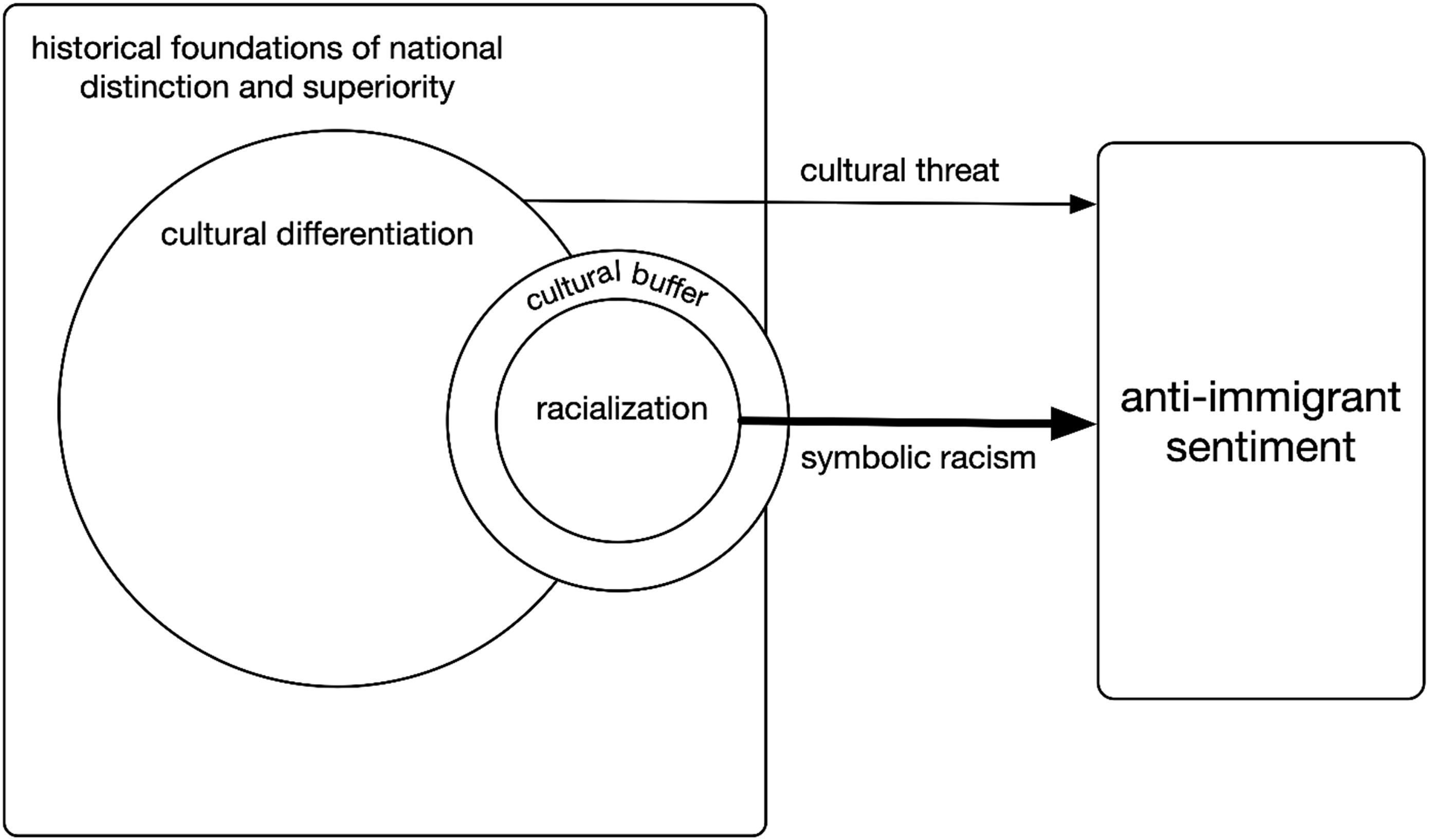
Classical cultural threat theories suggest that natives as a whole will react negatively to culturally different immigrants. However, to some extent, all foreign-born groups are culturally distinct from majority populations, so this does not tell us which types of immigrant cultures are most threatening. Neither do such theories indicate which segments of the native population are likely to react most negatively to such threat.
Summary of expectations
Figure 1 presents a conceptual model comparing racialization processes to processes of cultural differentiation. Forms on the model’s left-hand side represent intergroup processes with arrows illustrating the result of such processes and their separate effects on anti-immigrant sentiment. In the European context, both forms of cultural differentiation and racialization are rooted in historical processes of national distinction and superiority, as illustrated by the encompassing left square. Cultural differentiation refers to processes where outgroups are seen as culturally different from majority populations, which often lead to feelings of cultural threat as suggested by classic cultural threat theories. In contrast, racialization processes result from viewing specific outgroups as racially different and are tied to symbolic racism. The cultural buffer surrounding racialization represents the tendency of racialized difference to be subsumed under the sphere of culture. As cultural racism theories suggest, underlying racialization processes can be concealed both in discourse and practice by the language of “cultural difference,” thus rendering racialization less transparent and more taken-for-granted.
Analyses proceed from this conceptual model and the theories outlined above. First, symbolic racism theories tell us how resulting racialized tropes are internalized through processes of socialization. Such socialization leads to persistent and inflexible negative attitudes toward certain immigrant groups with a sense that such groups stand irreconcilably outside of national norms. What symbolic racism theories do not tell us is what segments of the population hold such racist attitudes. It is possible that ethnoracist exclusion is relatively widespread among the public. However, it is just as likely that only portions of the majority hold such attitudes. Further, when identifying outgroups, which immigrant groups are subject to racialization processes? Theories of racialization suggest that Muslim and Black immigrants may be subject to racialization in rich Western contexts. Thus, we may expect to see greater levels of anti-immigrant sentiment with the presence of these foreign-born groups.
These propositions are assessed in multiple ways. First, groups are identified that constitute the primary agents of symbolic racism by identifying individuals who exhibit ethnoracist exclusion in their immigration preferences. I then determine whether this group exhibits different patterns of anti-immigrant sentiment compared to those not exhibiting such exclusion with the presence of racialized immigrant groups: Muslims and Black immigrants.
Because symbolic racism theories do not provide guidance on the extent of ethnoracist exclusion, no formal hypotheses are provided. I contend that ethnoracist exclusion could be widespread when people who exhibit such exclusion outnumber those who do not. Alternatively, ethnoracist exclusion could be bounded when those who do not exhibit such exclusion outnumber those who do.
The effects of racialization are more clearly theorized:
(racialization): People respond more negatively to the presence of outgroups that are racialized (Muslim and Black foreign-born populations) than outgroups that are not by exhibiting higher levels of anti-immigrant sentiment with the presence of racialized groups. Further, symbolic racism could work in concert with racialization, with the presence of certain racial-ethnic groups triggering greater anti-immigrant sentiment among subsets of the majority population. Depending on the extent of ethnoracist exclusion, its relevance in distinguishing the attitudinal profiles of majority subgroups, and its interplay with the racialization of minority groups, two alternative hypotheses are formulated:
(racialization as widespread): Those who exhibit ethnoracist exclusion and those who do not respond similarly to racialized populations by both displaying significantly high levels of anti-immigrant sentiment.
(racialization as bounded): Those who exhibit ethnoracist exclusion respond more strongly to racialized populations by showing significantly higher levels of anti-immigrant sentiment compared to those who do not exhibit ethnoracist exclusion.
Data, measures, and methods
Analyses rely on data from the European Social Survey (ESS), merged with macro-level variables measuring country’s economic and demographic contexts. ESS waves were selected to coincide with available macro-level variables (waves one, three, five, seven, and eight). The breadth of countries and time points in the ESS is well-suited to analyzing the influence that levels and differences in the foreign-born population have on anti-immigrant sentiment. Only EU/EFTA countries are retained for analyses. Foreign-born respondents whose parents are also foreign-born (immigrants) are excluded. The ESS design weight accounts for individuals’ varying probability of selection and is applied in all analyses. The final sample includes 162,918 individuals from 29 countries. 2 Complete descriptive statistics are available in the Online Supplement.
Outcome variable
Anti-immigrant sentiment
A scale averages three repeated ESS items measuring respondents’ general negativity toward immigrants in both economic and cultural terms. Respondents are asked whether they think immigrants: (1) are bad/good for the economy; (2) undermine/enrich cultural life; and (3) make the country a better/worse place to live. Responses are reverse coded when necessary and the resulting scale ranges from 0 (most positive) to 10 (most negative). The scale’s Cronbach’s alpha is 0.85 for the pooled sample with individual country alphas above 0.73. This suggests high levels of internal consistency, meaning the scale taps the same concept across countries. The same three-item scale has been used in similar cross-national studies (Gorodzeisky and Semyonov, 2016, 2018). In more rigorous confirmatory factor analyses, fit statistics suggest an approximate equivalence, which should suffice for comparing anti-immigrant attitudes across countries (Davidov et al., 2015).
Respondent groups by ethnoracist exclusion
Descriptions of ethnoracist exclusion groups.
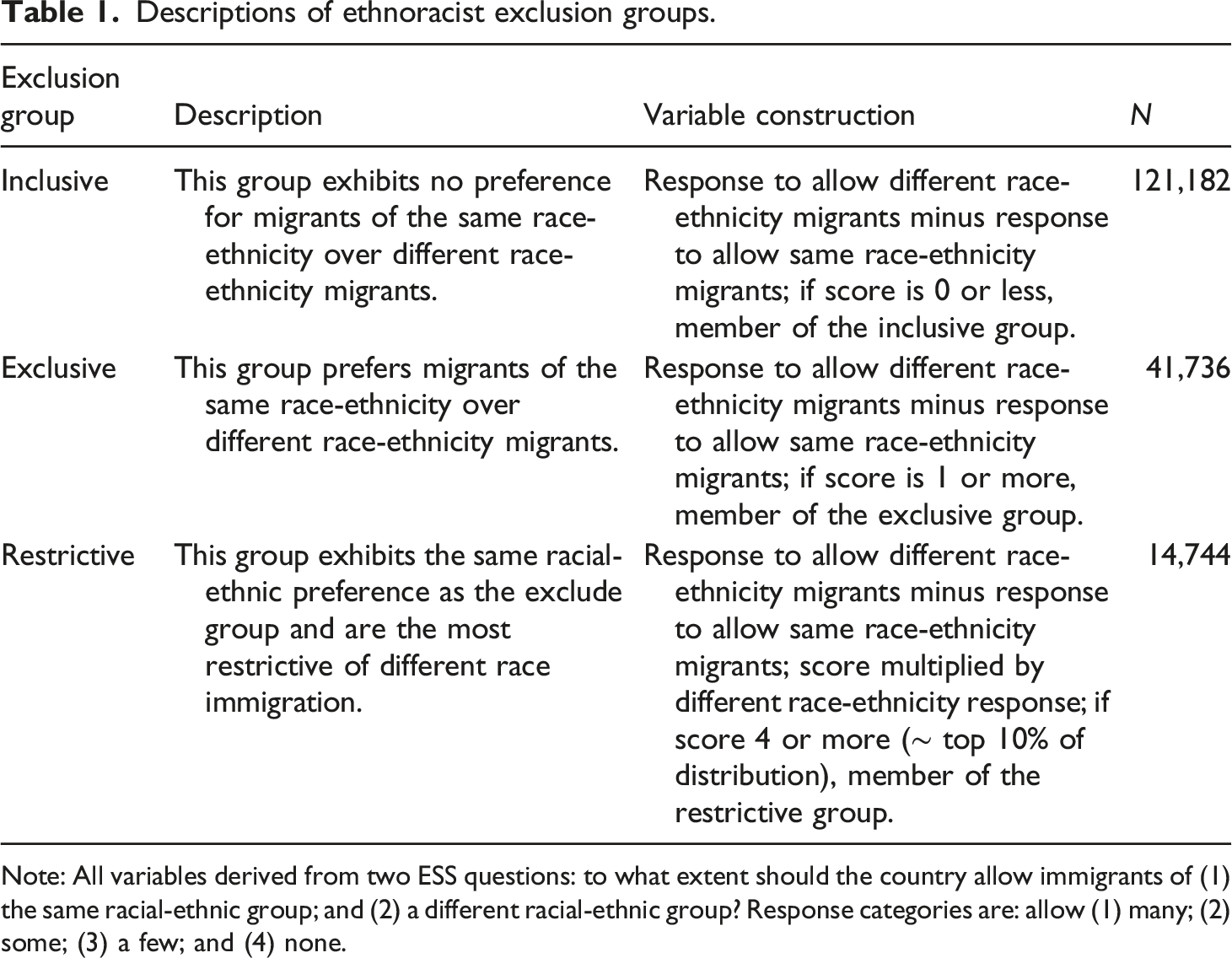
Note: All variables derived from two ESS questions: to what extent should the country allow immigrants of (1) the same racial-ethnic group; and (2) a different racial-ethnic group? Response categories are: allow (1) many; (2) some; (3) a few; and (4) none.
Table 1 also includes a ‘restrictive’ group, which identifies those respondents who are both exclusive and restrictive of different race migration. This group includes members of the exclusive group who answer toward the high end of the allow many-allow none continuum. Again, restrictiveness is related but not equivalent to anti-immigrant sentiment since respondents could in principle dislike immigrants yet still believe some should be allowed into the country (e.g., to fill labor needs or for humanitarian purposes), or vice-versa. Indeed, the restrictive group is represented along all values of the anti-immigrant scale.
While respondents in different contexts may think of different racial-ethnic groups when answering these questions, these variables measures the symbolic process that delineates those considered racial-ethnic insiders from outsiders, in line with a focus on boundary making versus the “stuff” that these boundaries contain (Barth, 1969). Such boundaries can entail a number of markers—including religion, cultural repertoires, language, and physical attributes—that distinguish one group from another. The vast literature on symbolic boundaries shows that boundary-making processes can similarly delineate and exclude different minority groups while the markers in diverse country contexts may vary (Alba, 2005; Alba and Foner, 2015; Lamont, 2000).
Contextual variables
Key predictor variables measure countries’ demographic contexts as levels and changes in foreign-born populations. Foreign-born populations are selected for their cultural and racial-ethnic differences following extant literature and represent a continuum from most general and least differentiated to most specific and visible with respect to race-ethnicity.
Total foreign-born
Measured as the number of residents coming from outside the country as a percentage of total population. This predictor provides a baseline measure for the presence of all foreign-born in a country.
Global north foreign-born
Measured as those coming from the original EU/EFTA and European microstates, the U.S., Canada, Australia, and New Zealand as percentage of the total population. This predictor represents the presence of culturally similar populations and does not necessarily capture racial-ethnic distinctiveness or visibility.
Muslim foreign-born
Measured as residents coming from predominately Muslim societies as percentage of the total population. 3 This measure represents migrant populations in Europe perceived as culturally, religiously, and potentially racially different, thus substantiating the bright symbolic boundary of Muslim otherness in Europe (Alba, 2005). This measure may over-represent foreign-born Muslims, particularly for origins where there are large non-Muslim populations. However, it is preferable to other means of estimating the Muslim population, for example, by relying on counts from aggregated survey data in destination countries, since surveys regularly underrepresent smaller minorities. Further, the overall Muslim population in each country is likely undercounted since foreign-born statistics do not capture Muslims from the second-plus generations in destination countries. The propensities for the measure to over-count and under-count are assumed to approximately cancel out.
African foreign-born
Measured as those residents coming from any country in Africa as a percent of total population. Africa is chosen as migrants from this region are potentially racially othered and are coming from a migration corridor that has long historical and geographic ties to Europe. This predictor provides a first step in assessing the demographic contextual effects of migration from a region often connected to “invasion” and “plague” in Europe.
Sub-saharan African foreign-born
Measured as those residents in a country coming from sub-Saharan nations as percentage of the total population. 4 Sub-Saharan African immigrants are the most visibly distinct in the European context and, thus, potentially the most racially othered.
Economic development
Measured as GDP per capita (World Bank). Macro-structural analyses of anti-immigrant sentiment most often use GDP per capita or unemployment levels to examine how economic conditions shape attitudes (see, e.g., Scheepers et al., 2002; Schneider, 2008; Semyonov et al., 2006).
Controls
Control variables are included to account for individual characteristics consistent with similar studies (see Online Supplement Table S2 for full descriptions). Sociodemographic controls include female gender; age and its quadratic term; education (none or primary only, lower secondary, upper secondary, post-secondary); income (middle to high income, low income, missing income); occupation and labor market position (high white-collar, low white-collar, agricultural, blue-collar, unemployed, student, and other work status); and urban/suburban residence (reference group: rural). Controls also include two human values dimensions shown to strongly influence anti-immigrant sentiment (Datler et al., 2013; Davidov and Meuleman, 2012; Davidov et al., 2008): the higher dimension values of self-transcendence and conservation (see Online Supplement Table S3 for individual items and wording). For self-transcendence, five ESS items are averaged representing respondents’ support for understanding, appreciating, tolerating, and protecting all people and nature. For conservation, six ESS items are averaged representing respondents’ humility and adherence to tradition, conformity to norms, and support for preserving stability. Self-transcendence is expected to be negatively related to anti-immigrant attitudes, and conservation positively related.
Analytical strategy
Ignoring the hierarchical nature of data can violate the assumption of independent errors and lead to underestimation of standard errors (Snijders and Bosker, 2012). Hierarchical modeling has advantages over other techniques, such as ordinary least squares since it allows the simultaneous estimation of individual- and country-level effects and variance components at each level. The ESS data include 1,62,918 individuals (ijk) nested in 108 country-years (jk) nested in 29 countries (k). Analyses of empty models suggest the use of multilevel models is appropriate since the intraclass correlation attributed to country differences is 0.13 with an additional 0.02 attributed to country-year differences.
Analyses exploit the data’s repeated cross-sectional nature to analyze both between-country levels and within-country changes in diversity. Hybrid models are estimated to decompose levels and change effects simultaneously, harnessing the strengths of both fixed and random effects models (Bell et al., 2019; Fairbrother, 2014). This is especially important as predictor variables are measured at the country-year level. This is important theoretically because it is possible that respondents react more to abrupt changes in levels of foreign-born populations as previous research has suggested (see, e.g., Brady and Finnigan, 2014; Schmidt-Catran and Spies, 2016). Between-country estimates tell us whether comparative mean levels of foreign-born populations are tied to heighted anti-immigrant sentiment. Differences in mean levels are taken to result from longer-term processes like colonialism and related migration histories. Within-country estimates tell us whether fluctuations in foreign-born populations are related to anti-immigrant sentiment. Such fluctuations could be amplified by political discourse and media surrounding immigration changes.
The outcome for each individual ijk is modeled as:
Results
Who exhibits ethnoracist exclusion?
Figure 2 shows the distribution of inclusive, exclusive, and restrictive groups by country. The proportion of exclusionists varies widely, from only 8.46 percent in Sweden to over 53.67 percent in Hungary. At the high end, Eastern and Mediterranean Europe are represented, along with key Northern European societies like Germany (33.51 percent) and Denmark (37.27 percent). Similarly, at the low end, both Southern European countries like Spain and Portugal, Eastern European countries like Croatia and Romania, as well as northern societies like Sweden and Netherlands are represented. Belgium and Bulgaria show average levels of exclusion at around 26 percent. No clear regional pattern emerges. Distribution of ethnoracist exclusion, by country. Source: European social survey, rounds 1, 3, 5, 7, 8 (2002–2016); countries: Austria (AT), Belgium (BE), Bulgaria (BG), Switzerland (CH), Cyprus (CY), Czechia (CZ), Germany (DE), Denmark (DK), Estonia (EE), Spain (ES), Finland (FI), France (FR), Greece (GR), Croatia (HR), Hungary (HU), Ireland (IE), Iceland (IS), Italy (IT), Lithuania (LT), Latvia (LV), Netherlands (NL), Norway (NO), Poland (PL), Portugal (PT), Romania (RO), Sweden (SE), Slovenia (SI), Slovakia (SK), United Kingdom (UK). Sorted by % exclusive.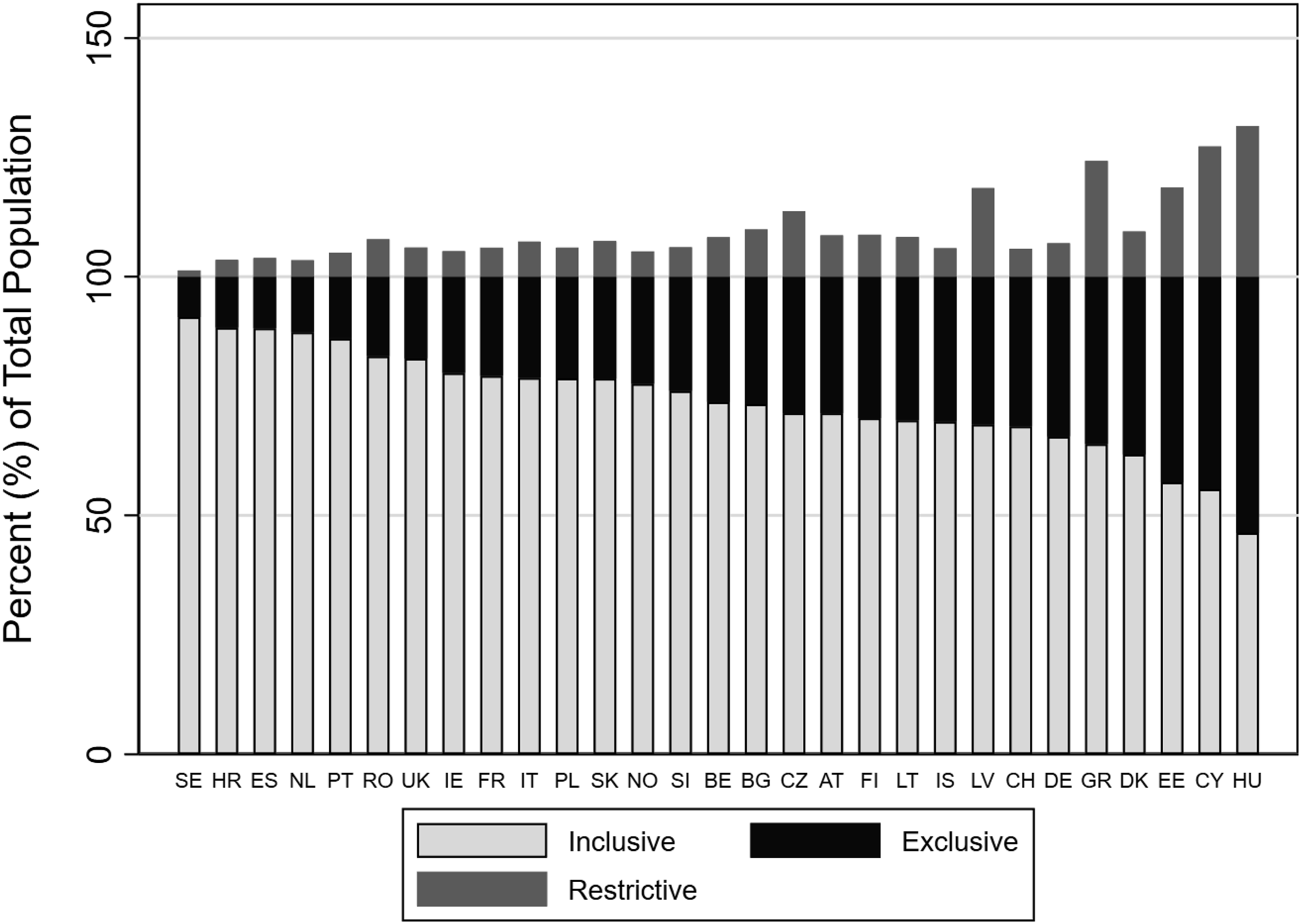
Those who are restrictive constitute the majority of the exclusionist groups in several Southern and Eastern European countries: Greece, Cyprus, Latvia, and Hungary. In these countries, exhibiting ethnoracist exclusion is associated with restrictiveness toward immigration.
Figure 3 compares countries’ rankings on anti-immigrant attitudes with more specific ethnoracist exclusion. It shows that while many countries have a higher ranking on anti-immigrant attitudes, certain Germanic and Nordic societies exhibit a notable positivity (or low negativity) toward immigrants but marked preference for same race immigrants, which could suggest a predilection for whiteness. Paired plots of countries’ rankings on anti-immigrant sentiment and ethnoracist exclusion. Sources: European social survey, rounds 1, 3, 5, 7, 8 (2002–2016); Countries: Austria (AT), Belgium (BE), Bulgaria (BG), Switzerland (CH), Cyprus (CY), Czechia (CZ), Germany (DE), Denmark (DK), Estonia (EE), Spain (ES), Finland (FI), France (FR), Greece (GR), Croatia (HR), Hungary (HU), Ireland (IE), Iceland (IS), Italy (IT), Lithuania (LT), Latvia (LV), Netherlands (NL), Norway (NO), Poland (PL), Portugal (PT), Romania (RO), Sweden (SE), Slovenia (SI), Slovakia (SK), United Kingdom (UK). Note: Dark lines indicates country’s rank is higher on ethnoracist exclusion than its rank on anti-immigrant sentiment.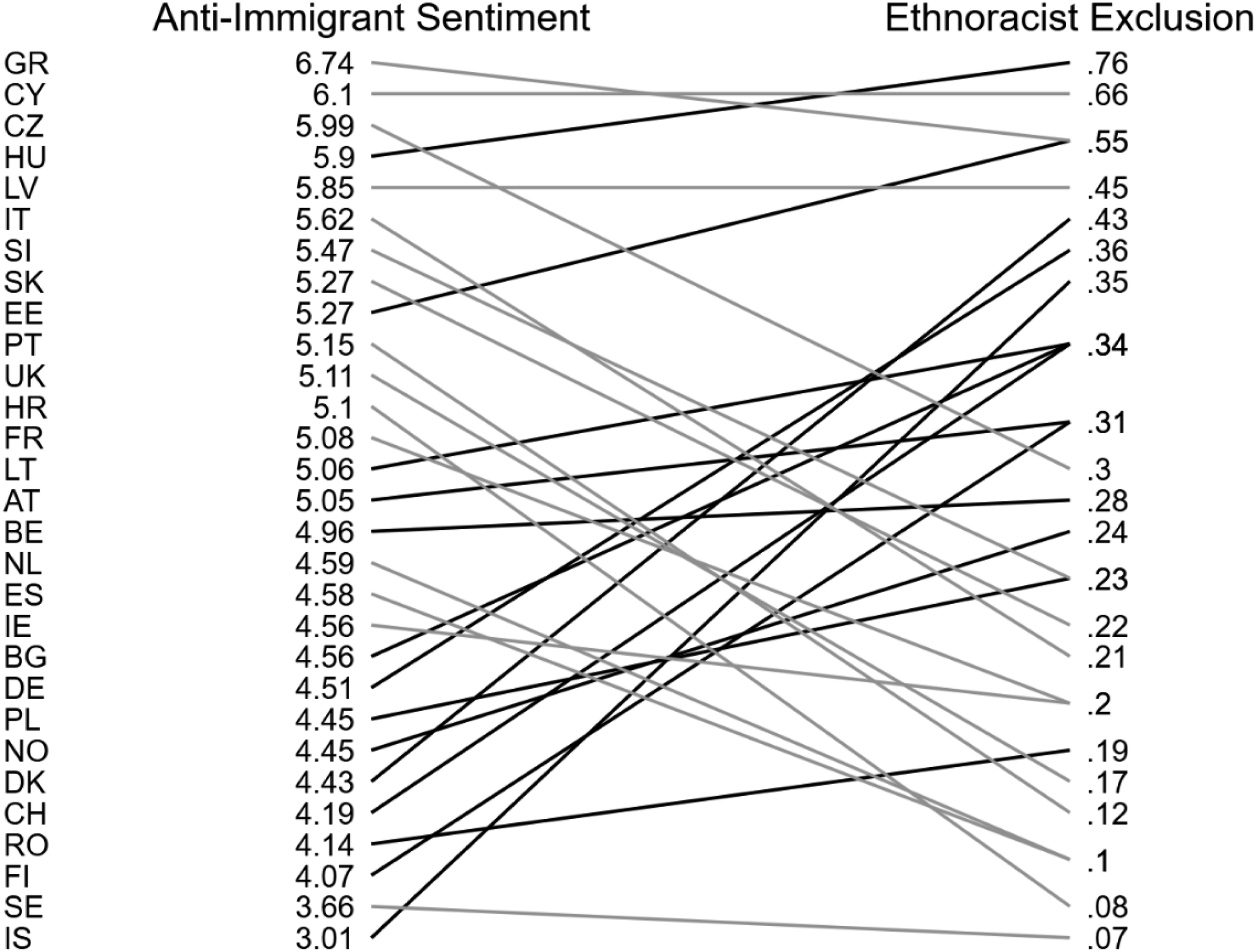
Overall, around a quarter of the European population can be categorized as ethnoracist exclusionists. Formal t-tests for group differences show that exclusionists exhibit significantly higher levels of anti-immigrant sentiment than those in the inclusive group. Most Europeans, however, do not exhibit ethnoracist exclusion; the proportion of the inclusive group ranges from 46.33 percent in Hungary to 91.54 percent in Sweden. This provides evidence for bounded and not widespread ethnoracist exclusion.
Multivariate results
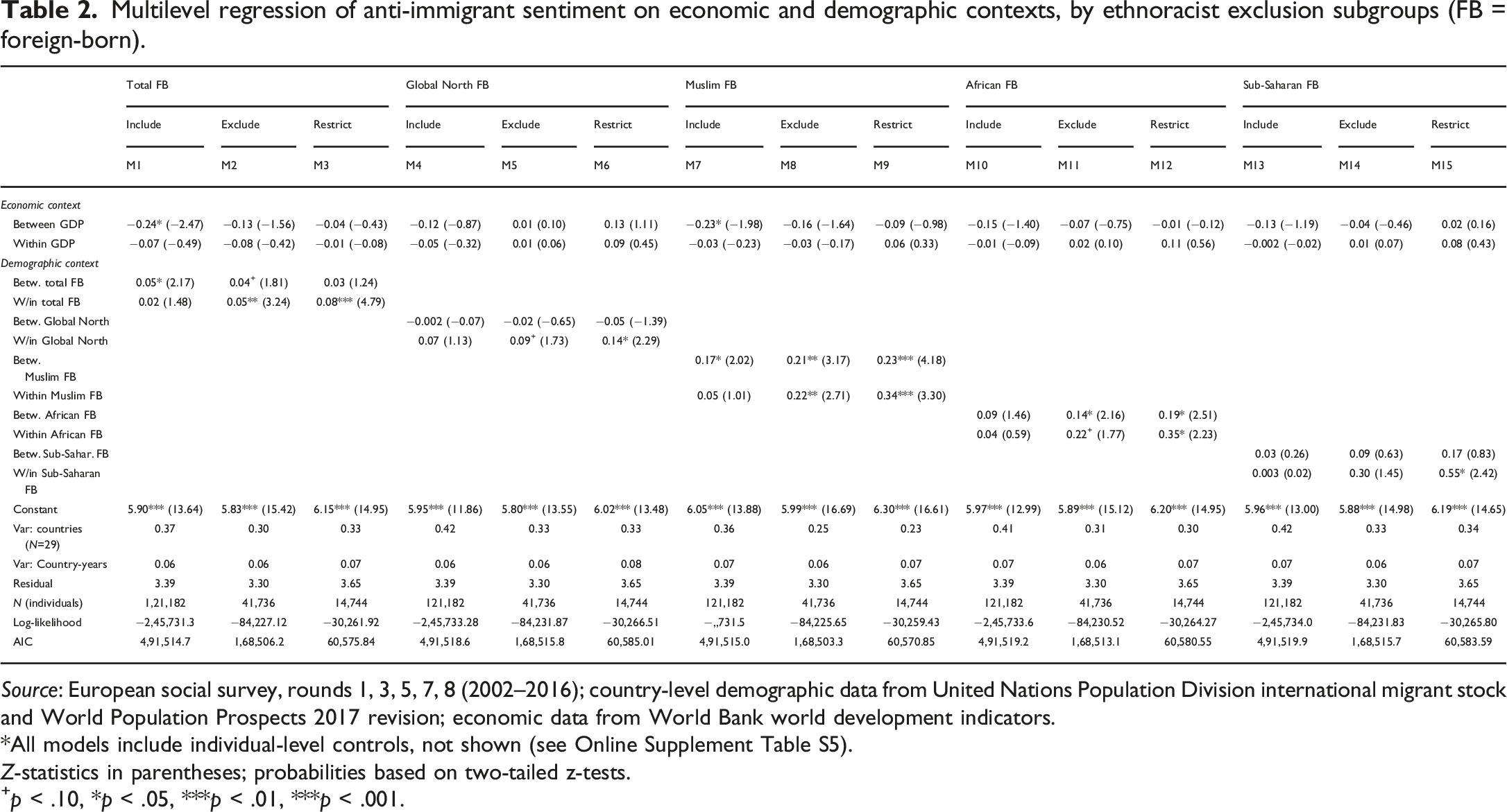
Multilevel regression of anti-immigrant sentiment on economic and demographic contexts, by ethnoracist exclusion subgroups (FB = foreign-born).
Source: European social survey, rounds 1, 3, 5, 7, 8 (2002–2016); country-level demographic data from United Nations Population Division international migrant stock and World Population Prospects 2017 revision; economic data from World Bank world development indicators.
*All models include individual-level controls, not shown (see Online Supplement Table S5).
Z-statistics in parentheses; probabilities based on two-tailed z-tests.
+p < .10, *p < .05, ***p < .01, ***p < .001.
What is the relationship between the percent total foreign-born population and anti-immigrant sentiment for people with different ethnoracist exclusion profiles? M1 shows that among members of the inclusive group, larger average foreign-born populations are associated with significantly higher levels of anti-immigrant sentiment. This between-country effect is not found with the exclusive or restrictive groups. However, within-country changes are associated with significantly higher levels of anti-immigrant sentiment among the exclusive and restrictive subgroups. It appears, then, that for these latter groups, fluctuations in the total foreign-born population matter for levels of anti-immigrant sentiment, while mean levels do not.
Turning to the next series, M4–M6 estimate the mean levels and changes in the Global North population, which is largely racially-ethnically unmarked in the European context. Estimating between-country levels of the Global North foreign-born population reveals non-significant negative coefficients across all groups. Nearly the same is true when estimating within-country changes. For the restrictive group only, a within-country increase of one percentage point in the Global North population is associated with an increase of 0.14 points on the anti-immigrant sentiment scale. This suggests this group may be sensitive to within-country increases in any foreign-born group. Results point to this group’s general xenophobic characteristics.
Are more distinct foreign-born populations associated with greater anti-immigrant sentiment, as H1 predicts? M7–M9 estimate levels and changes in the Muslim foreign-born population. Estimating between-country levels shows that all groups are affected. A level of one percentage point higher in the Muslim foreign-born population is associated with a level of anti-immigrant sentiment of 0.17 points higher among the inclusive group, 0.21 points among the exclusive group, and 0.23 points among the restrictive group. The p-values also decrease, from 0.05 to 0.001, as the subgroups become more exclusionist and restrictive, which suggests greater significance. It appears, then, that living in a country with higher mean levels of Muslim foreign-born is associated with greater anti-immigrant sentiment for most. 5 The picture is somewhat different when considering within-country changes. The inclusive group shows no significant increase in anti-immigrant sentiment with within-country changes. In contrast, both the exclusive and restrictive groups show greater anti-immigrant sentiment with increases in Muslim foreign-born. For the exclusive group, a one percentage point increase in the Muslim foreign-born population is associated with a 0.22-point increase in the anti-immigrant sentiment scale. A corresponding increase is associated with even greater increases for the restrictive group: 0.34 points. It appears that both mean levels and changes in the Muslim foreign-born population affect the exclusive and restrictive groups, while only mean levels show a relationship for the inclusive group in models estimating GDP.
Results from M7–M9 give us evidence for H1, particularly when considering country mean levels. Muslims are potentially racialized as they are seen as inherently different and separate from the majority in many western societies and their exclusion is often predicated on a mix of physical visibility and cultural and religious difference (Garner and Selod, 2015; Meer and Modood, 2019; Modood, 2015). For example, research shows that racialized Muslims suffer a penalty in a tiered labor hierarchy; immigrant-background Muslims identifying as “white” or who share the same sociocultural attitudes as the majority are offered no protection against this penalty (Sweida-Metwally, 2022). Our models show that potentially racialized Muslim populations are associated with overall higher levels of anti-immigrant sentiment compared to Global North foreign-born populations. This holds when comparing the number of statistically significant coefficients, and when comparing effect sizes. For within-country changes, Muslim foreign-born effects sizes are at least double those of Global North effect sizes for exclusive and restrictive groups. 6
Are the same results found when estimating the African foreign-born population? Patterns from M10–M12 mirror those from Muslim foreign-born models yet with fewer and less significant coefficients. For the inclusive group, neither between-country levels nor within-country changes are associated with greater anti-immigrant sentiment. For the exclusive group, only country mean levels of African foreign-born are associated with greater anti-immigrant sentiment. In contrast, for the restrictive group, both mean levels and within-country changes are associated with greater anti-immigrant sentiment. Effects are more significant and larger than corresponding Global North effects. Further, it appears that the combination of mean levels and within-country changes only affects the most restrictive group. Results provide further evidence suggesting greater exclusion and restrictiveness against a racialized group.
M13–M15 narrow the foreign-born population to those who are potentially the most racially othered. Estimating the sub-Saharan African population produces few statistically significant contextual effects. Contrary to expectations, the restrictive group shows the only significant effect with within-country changes. The broader exclusive group does not show significantly greater anti-immigrant sentiment with either higher mean levels or greater within-country changes. This is puzzling considering sub-Saharan African immigrants should be a particularly visible segment of the broader African population, for which there are significant between-country effects. I speculate this could be due to two reasons. First, much African migration to Europe has historically come from the Maghreb region (Morocco, Algeria, Tunisia), which is not included in the sub-Saharan measure. This could also explain why the African foreign-born measure performs similarly to the Muslim foreign-born measure. Second, however, the relative lack of effects for the sub-Saharan African population could point to an influential outlier. Sensitivity analyses suggest that some non-results are due to significant outlier Portugal, which exhibits high mean levels of migration from its former African colonies. Unlike other southern European countries, Portugal had extensive colonial experience in sub-Saharan Africa (Angola and Mozambique). Portugal is uniquely positioned in that its colonial experience shaped subsequent colonial migration while simultaneously being in the category of late advanced European economies, unlike other African colonizers who were early advanced economies (U.K., France, and even Germany). This unique position likely masks between-country differences and may provide a less xenophobic ‘Southern European’ model for immigrant incorporation. Removing Portugal indeed leads to significance for between-country measures for the exclusive (β = 0.52; z = 2.77) and restrictive (β = 0.76; z = 3.44) groups (see Table S7 in Online Supplement). 7
Overall, the degree of racial-ethnic distinctiveness of foreign-born populations appears to play a role, in line with H1. More racially-ethnically distinct and visible foreign-born populations are associated with larger and more significant increases in anti-immigrant sentiment, particularly among the exclusive and restrictive groups. This is especially clear when comparing results for the Global North foreign-born with those for the Muslim foreign-born population.
Comparing the ethnoracist exclusion groups, those who are exclusive and restrictive respond more strongly to demographic levels and shifts than those who are inclusive. For the inclusive group, only two effects emerge in Table 2 for between-country total and Muslim foreign-born measures. This provides evidence for bounded and not widespread racialization, in line with H2b. Consistently stronger and more significant demographic context effects are shown for the exclusive and restrictive groups across models compared to the inclusive group. 8
Results from additional demographic control analyses confirm that racially-ethnically different populations are associated with greater anti-immigrant sentiment and are distinguishable particularly from the Global North foreign-born population but also largely from the broader non-Western foreign-born population (see Online Supplement ‘Sensitivity analyses.’) This provides evidence for the racial-ethnic distinctiveness of Muslim and African foreign-born populations. Additional sensitivity analyses include results with the estimation of unemployment levels, analyses accounting for individual contact with outgroups, and immigration coming from countries with shared languages (i.e., former colonies).
Discussion and conclusion
Immigration to Europe has become more racially and ethnically diverse in recent decades. Yet, mainstream theories of anti-immigrant sentiment continue to rely on notions of economic and cultural threat, which may not fully describe animosity toward immigrants in contexts with racially-ethnically different others. Even when research recognizes cultural difference and incompatibility, the extent to which these differences are racialized, for which immigrant groups, and the exact majority groups that react to such racialization remain unclear. This lack of attention to race-ethnicity is curious considering the theoretical foundations of such competition theories originate in studies of interracial animosity and conflict (Blalock, 1967; Blumer, 1958). This study’s overall goal is to address this oversight by more fully engaging with theories of racialization and racism and, empirically, by mapping the contours of targeted ethnoracist exclusion across Europe.
A conceptual framework is developed drawing on theories of racialization, cultural racism, and symbolic racism to show that the racialization of certain immigrant groups is a process distinct from general patterns of cultural threat. Newer forms of racialization are supported by learned symbolic racism and wrapped in the language of “culture.” Such symbolic racism instills racial fears and negative stereotypes in individuals and is embedded in discourses of separateness and a belief that some outgroups violate cherished national ways of being. Notably, symbolic racism does not have to be predicated on direct competition or even local conditions. As such, symbolic racism frameworks allow us to better understand how anti-immigrant sentiment can stem from racial animus directed toward specific immigrant groups on varied and crosscutting scales from local to national to global. This conceptual framework is useful for explaining ethnoracist exclusion in Europe and may be useful for analyzing other virulent forms of ethnoracist exclusion globally. Anti-immigrant populism in contexts as distinct as Italy, Sweden, the U.S., and Brazil have drawn on similar tropes of racialized exclusion.
Analyzing ethnoracist exclusion through the lens of symbolic racism also allows us to explain how people learn to view racial-ethnic immigrants in negative ways even when few racialized minorities are present, as in countries like Hungary or Estonia. This is something that group threat theories fail to fully explain. Symbolic racism theories can potentially connect empirical patterns, such as the ones uncovered herein for Europe, with the global study of race-ethnicity. New-World societies like the U.S. and Brazil confront racial disparities and tensions on a more foundational level due their histories and demographies. However, several scholars have suggested that the origins of modern race as a category can be traced to Europe and European colonialism (Goldberg, 1993; Heng, 2018; Mills, 1997). Such global scholars argue that the concept of race emerged during the period of European-led colonial expansion (or even earlier). During the institution of slavery, indigenous and black populations came to be perceived as inferior to their Europeans overseers, and some argue that race has since become “the fundamental criterion for the distribution of the world population into ranks, places, and roles” (Quijano, 2000: 535). That we see ethnoracist exclusion in the European context is not surprising from the perspective of such global race theories.
On the other hand, the shape of such ethnoracist exclusion and anti-immigrant sentiment is likely context dependent. The logics behind such exclusion may differ by which groups are racialized, national self-understandings, and institutional configurations. In countries like France, republican secularism may be presented as a neutral cohesive force, yet may harden into racialized local practices (Ragazzi, 2022), while in Italy the protection of traditional Christian identities may frame boundary-making processes (Gattinara, 2016). In other regions, like Northern Europe, Islamophobia may be embedded in universalist notions of civic nationalism where excluding religion from the public sphere has become “a cultural value constitutive of the nation itself” (Simonsen and Bonikowski, 2020: 130). These examples show that ethnoracist exclusion is flexible enough to adapt to various institutional and cultural arrangements.
Current findings illuminate a number of these theoretical propositions. Rather than being widespread, findings provide evidence for a bounded ethnoracist exclusion in Europe, as most Europeans do not exhibit such exclusion. However, in some notable contexts, a sizeable minority—up to a third—provide the foundation for symbolic racism in their countries. This also does not appear to be isolated to any one region and is found in very advanced economies like Germany and Denmark. Such patterns should be cause for concern, especially as right-wing political parties exploit explicitly anti-immigrant platforms.
Further, findings provide evidence for theories of racialization. The degree of foreign-born populations’ racial-ethnic distinctiveness emerges through larger increases in anti-immigrant sentiment, particularly among ethnoracist exclusionists. Higher levels and growth in the Global North foreign-born population are generally not associated with greater anti-immigrant sentiment, while these same changes in potentially racialized populations are. While clearer patterns were expected with immigrants from Africa, these populations are likely not distinguishable from general changes in the non-European population. It should be noted that within-country effects better represent more acute and visible changes in group composition amplified by political discourse and media while between-country effects partially represent slow-moving institutional legacies like colonialism. Findings related to the African and sub-Saharan African populations are likely connected more to colonial heritage than observable changes, as between-country levels prove more consistent and some results are masked by outlier Portugal. Further, such relations may provide continuity for more negative attitudes toward former colonial immigrants, and are not xenophobia reducing. It is worth noting that effects associated with Sub-Saharan African populations are greater than corresponding effects for other foreign-born groups. This suggests higher levels of anti-immigrant sentiment for this group when effects do arise.
Findings also provide evidence that those who exhibit ethnoracist exclusion and those who do not show different patterns of anti-immigrant sentiment. The exclusive group responds more consistently and more negatively to racially-ethnically different populations than the inclusive group. This suggests that patterns of racialization and symbolic racism are not widespread but rather bounded. In some countries, such as Sweden, such patterns are unlikely. However, in other contexts where ethnoracist exclusionists make up larger proportions of the population, symbolic racism could constitute the main frame by which immigrant groups are viewed. Generally speaking, findings run contrary to the commonly accepted belief that racial meaning plays no significant role in shaping social relations in Europe (Lentin, 2008). This, together with results that show few economic effects, suggest that standard competition theories should at least be supplemented by theories of symbolic racism, cultural racism, and racialization to generate a more profound and extensive understanding of how anti-immigrant sentiment emerges.
The strong and consistent effects associated with increases in the foreign-born from Muslim majority nations are notable. While some literature focuses on Muslims’ cultural and religious differences (Helbling and Traunmüller, 2020; Sniderman and Hagendoorn, 2007), other literature suggests that such cultural differences are often racialized (Garner and Selod, 2015; Meer and Modood, 2019; Modood, 2015). While it may be analytically foolhardy to distinguish clear-cut boundaries between religion, culture, and racial stratification, it is notable that ethnoracist exclusionists respond most strongly and consistently to Muslim presence. This provides further evidence that the exclusion of groups that are culturally and religiously different can manifest through racialized practices. It is likely that cultural and religious differences are racialized when they become the essentialized and taken-for-granted basis for understanding members of a group while producing strong and enduring inter-generational boundaries. Future research on European contexts should examine how immigrant groups’ cultural and religious differences solidify boundaries and impede inclusion in the same way racial categories have done historically and in other contexts.
Despite current findings, this study leaves open questions for future research and debate. Among its limitations is that it favors breadth over depth and, thus, does not investigate the exact mechanisms that trigger episodes of racial backlash at a particular time or country context. More research is needed to understand how already existing negative attitudes toward racial-ethnic outsiders are exploited by political entrepreneurs in time and place. Relatedly, the study’s cross-sectional time-series design does not allow for an analysis of within-individual longitudinal change. Due to a lack of data, examining how individuals change their views of outgroups with evolving economic and demographic conditions is not possible, but would be of great research value. Further, while individual contact is modeled in the sensitivity analyses, its exclusion from the main models due to data limitations qualifies current findings. Future research and data collection efforts would do well to facilitate more robust analyses of intergroup contact over time. Finally, the study focuses on discrete levels of analysis: namely, between and within nations. Future research should continue to develop analyses of historical, regional, and transnational contexts to provide additional pieces to the puzzle of how ethnoracist exclusion and anti-immigrant sentiment are generated and sustained across Europe.
Supplemental Material
Supplemental Material - Ethnoracist exclusion and anti-immigrant sentiment in Europe: A hybrid model analysis using the European Social Survey, 2002–2016
Supplemental Material for Ethnoracist exclusion and anti-immigrant sentiment in Europe: A hybrid model analysis using the European social survey, 2002–2016 by Aaron Ponce in Ethnicities.
Footnotes
Acknowledgments
The author thanks Kody Steffy, Patricia McManus, members of the Department of International Studies at Indiana University, Uzair Ahmed, Mette Andersson, Simon Roland Birkvad, Karoline Blix Hjelle, Grete Brochmann, Katrine Fangen, Inger Furseth, Laura Führer, Arnfinn Midtbøen, Inga Sæther, Sabine Tica and other members of the Race, Ethnicity, and Migration workshop at the University of Oslo for their very thoughtful comments and valuable suggestions on previous drafts of this paper. The author also thanks the editors and anonymous reviewers for their comments and suggestions. All mistakes are the author’s own.
Declaration of conflicting interests
The author(s) declared no potential conflicts of interest with respect to the research, authorship, and/or publication of this article.
Funding
The author(s) received no financial support for the research, authorship, and/or publication of this article.
Data availability statement
This project uses publicly available data. All data available for replication are available through the European Social Survey at europeansocialsurvey.org (European Social Survey, 2002), the United Nations Population Division International Migrant Stock and World Population Prospects  revision (country-level demographic data), and the World Bank World Development Indicators (economic data).
Supplemental Material
Supplemental material for this article is available online.
Notes
References
Supplementary Material
Please find the following supplemental material available below.
For Open Access articles published under a Creative Commons License, all supplemental material carries the same license as the article it is associated with.
For non-Open Access articles published, all supplemental material carries a non-exclusive license, and permission requests for re-use of supplemental material or any part of supplemental material shall be sent directly to the copyright owner as specified in the copyright notice associated with the article.
