




Abstract
Public opinion climates on immigrants are subject to certain dynamics. This study examines two mechanisms for such dynamics in Western EU member states for the 2002–2018 period. First, the impact of cohort replacement and, second, the impact of periodic threat perceptions, namely, changing macroeconomic conditions and shifts in immigration rates. To date, empirical research on anti-immigrant sentiments rarely combines these two concepts simultaneously to disentangle the interplay of period and cohort effects and determine the factors for long- and short-term attitude changes in societies. Motivated by this gap in the literature, I conduct multiple linear regression analyses of pooled data from all waves of the European Social Survey to show that the process of cohort replacement has led to a substantially more positive opinion climate toward immigrants since the 2000s. However, results indicate that in the future, this positive development is likely to come to a halt since younger cohorts no longer hold significantly more immigrant-friendly attitudes than their immediate predecessors. Furthermore, we observe different period effects to impact cohorts’ attitudes. Fixed-effects panel analyses show that the effect of changing macroeconomic conditions on cohorts’ attitudes is low. Changes in immigration rates, however, lead to significantly more dismissive attitudes when immigrants originate from the Global South as opposed to when they enter from EU countries. These insights suggest that it is less economic or cultural threat perceptions, but ethnic prejudice that plays a key role for natives to oppose immigration. Overall, findings suggest that it is not either cohort or period effects driving large-scale attitude changes, but rather we observe an interplay of both.
Keywords
Introduction
Globally, an increasing number of people are on the move, and Western European countries are among the prime destination countries for immigrants. The topic of immigration is one of the most pressing and contested issues in public discourse, often leading to substantial divide within host societies (Bansak et al., 2016). With ongoing immigration to Western Europe, it is crucial to gain a better understanding of how public opinion toward immigrants is evolving and developing.
Previous studies emphasize the impact of two mechanisms of large-scale attitude change: first, cohort replacement and, second, period effects. While cohort replacement can bring about long-term attitude changes (Calahorrano, 2013; Ebner et al., 2020; Eger et al., 2021; Firebaugh, 1992; Inglehart, 1977; Kiley and Vaisey, 2020; Mannheim, 1928; Schotte and Winkler, 2018; Schuman and Corning, 2012), certain period effects are responsible for more immediate changes in societies’ current opinion climates (Czymara, 2021; Heizmann and Huth, 2021; Meuleman et al., 2009; Newman and Velez, 2014; Quillian, 1995; Schneider, 2008). To date, empirical research on anti-immigrant sentiments rarely combines these two concepts simultaneously to disentangle the interplay of period and cohort effects and determine the factors for long- and short-term attitude changes in societies (Ross and Rouse, 2015; Wilkes and Corrigall-Brown, 2011). This study fills this research gap by investigating both inter-cohort differences and intra-cohort changes. First, I explore how Western European birth cohorts differ in their sentiments toward immigrants and what this implies for future opinion climates, when younger birth cohorts replace their predecessors. Second, I address the periodic forces that affect all birth cohorts: How stable are birth cohorts’ attitudes toward immigrants, given changing threat perceptions on the country level, due to changing economic conditions and differing immigrant population?
In specifically analyzing periodic changes in the host societies’ immigrant populations, this study furthermore contributes to the growing literature investigating whether different types of immigrants are perceived as more or less threatening (Bloom et al., 2015a, 2015b; Gorodzeisky and Semyonov, 2016, 2019; Kustov, 2019; Stephan et al., 2005). To date, it remains unclear how far increasing intra-European migration (mostly from East to West) affects Western European attitudes toward immigrants compared with immigration from the Global South. Since these migrant groups differ in their economic, cultural, and ethnic composition, according to ethnic competition theory, they potentially trigger different threat perceptions in host populations (Bloom et al., 2015b; Czymara and Schmidt-Catran, 2017; Kustov, 2019; Stephan et al., 2005). While empirical research indicates that the level of opposition to immigrants varies depending on the immigrant groups in question, these findings predominantly rely on cross-sectional research designs and do not account for the importance of changes over time. Most findings are also based on hypothetical immigration only, where respondents evaluate different immigrant groups based on their socioeconomic, ethnic, and cultural backgrounds. Evidence for how actual demographic changes in ethnic composition affect the opinion climates in different countries remains scarce (Czymara, 2021). The present study contributes to the current literature in the field of ethnic competition theory in determining the roles of symbolic, realistic, and ethnic threat perceptions and their synergies based on actual migration rates from different regions of the world, while including the cohort perspective.
I use data from nine waves of the European Social Survey (ESS) (2002–2018) and country-level information provided by the Organisation for Economic Co-operation and Development (OECD) and World Bank. I employ a set of multiple linear regression analyses to estimate between-cohort variation. In a second step, I apply a fixed-effects panel analysis at cohort level to identify within-cohort changes over time. The results show that both the process of cohort replacement and specific demographic shifts within the migrant population, particularly when originating from the Global South, affect the overall opinion climate toward immigrants in Western EU member states between 2002 and 2018. This granular analysis reveals the power of ethnic prejudice over cultural and economic threat perceptions.
Theoretical background and previous research
Long-term attitude changes toward immigrants through cohort replacement
Socialization theory states that early life experiences leave an imprint on individuals, shaping their “natural worldviews” throughout life (Firebaugh, 1992; Inglehart, 1977; Mannheim, 1928). With few exceptions (Schröder, 2018; Wilkes and Corrigall-Brown, 2011), empirical research in several fields supports this line of argumentation (Ebner et al., 2020; Kiley and Vaisey, 2020; Krosnick and Alwin, 1989; Piotrowski et al., 2019; Ross and Rouse, 2015; Vaisey and Kiley, 2021). With regard to attitudes toward immigrants, cohort effects play a dominant role. Rather than an individual’s biological age, it is their year of birth and experiences during adolescence that predict their sentiments toward immigrants in the present (Calahorrano, 2013; Eger et al., 2021; Jeannet and Dražanová, 2019; Ross and Rouse, 2015; Schotte and Winkler, 2018; Schuman and Corning, 2012). Consequently, changes in societal conditions that occur during people’s formative years bring about large-scale value changes over time, as younger birth cohorts that differ in their values and priorities replace preceding cohorts (Firebaugh, 1992; Inglehart, 1977; Mannheim, 1928; Schuman and Corning, 2012).
According to previous research, two macro-level conditions during the impressionable years of adolescence can have a key impact on sentiments toward immigrants later in life: first, existential security (Inglehart, 1977; Inglehart and Norris, 2017) and, second, a context of high immigrant-origin diversity (Eger et al., 2021; McLaren et al., 2020; Norris and Inglehart, 2019). In other words, cohorts growing up in a secure environment as well as cohorts that are familiar with ethnic diversity should feel less threatened by immigration and thus hold more immigrant-friendly attitudes. Thus, when aiming at drawing conclusions on the effects of cohort replacement on future immigration attitudes, it is of particular interest to examine the different tempo-spatial contextual environments that affected different birth cohorts in Western Europe over time.
After World War II, birth cohorts in Western Europe experienced a continuously more secure upbringing. These years of existential security brought an intergenerational shift toward more postmaterialist values, causing a “Silent Revolution” (Inglehart, 1977; Inglehart and Norris, 2017). Several attitude changes accompanied this intergenerational value shift, including increasingly tolerant views on foreigners and immigration (Inglehart, 1997). Some argue that with rising levels of higher education, more recent cohorts hold more positive attitudes toward immigrants (e.g. Hello et al., 2006). In addition, younger birth cohorts grow up in a society where an existing immigrant population is the norm (Norris and Inglehart, 2019). Larger immigrant populations within Western European countries enable rising opportunities for intergroup contacts, reducing outgroup prejudice (Pettigrew et al., 2011; Pettigrew and Tropp, 2006). Owing to the process of globalization and the growing integration of the European Union, opportunities for prejudice-reducing intergroup contact during cohorts’ formative years were heightened and familiarization with people of different cultural and ethnic backgrounds grew. For instance, while the experience of living a year abroad was considered rather exotic for students born in the 1950s, it almost became the norm for students born in the 1990s (European Commission, 2020). Accordingly, research shows that growing up in an ethnically more diverse society is associated with more positive attitudes toward immigrants (Eger et al., 2021; McLaren et al., 2020). High inequality levels (McLaren et al., 2020) and high unemployment rates at the time of a cohort entering the job market (Coenders and Scheepers, 2008; Gorodzeisky and Semyonov, 2018), however, diminish this effect.
Together, these socialization processes are expected to bring about more open and tolerant sentiments toward people of different cultural or ethnical backgrounds. Thus, as previous research indicates (Bazán-Monasterio et al., 2021; Calahorrano, 2013; Ross and Rouse, 2015; Schotte and Winkler, 2018), for the specific case of Western European countries, younger birth cohorts should hold more immigrant-friendly attitudes than older cohorts, who, during their formative years, did not experience intergroup contact to the same degree. Consequently, we can expect that the process of cohort replacement will, in the long term, bring about large-scale attitude changes toward more immigrant-friendly attitudes. This positive development, however, is unlikely to be perfectly linear over the cohorts, due to fluctuating levels of inequality and differing conditions for cohorts when entering the labor markets (Gorodzeisky and Semyonov, 2018; Jeannet and Dražanová, 2019; McLaren et al., 2020). Overall, however, for Western European societies, we can expect the following:
H1. Successive cohorts will have more immigrant-friendly attitudes.
Short-term attitude changes toward immigrants through periodic threat perceptions
Although socialization theory emphasizes the formative phase as particularly important for value and attitude formation, scholars do not exclude the possibility of attitude change in the further course of life, impacting an entire population due to period effects (Inglehart, 1977; Mannheim, 1928). Current perceived threats, such as economic and financial crises, concerns about international terrorism, or the so-called refugee crisis, give rise to changing attitudes toward immigrants in society as a whole (Brouard et al., 2018; Kiley and Vaisey, 2020; Norris and Inglehart, 2019; Wilkes and Corrigall-Brown, 2011; Yang, 2008). Thus, the second research question of this study investigates how stable previously formed attitudes toward immigrants are in the face of changing threat perceptions at the country level. Besides changing economic conditions, this study’s focus hereby lies on the differentiation between immigrant groups, potentially causing more or less perceived threats within Western European birth cohorts.
Ethnic competition theory provides one of the most widely accepted explanations for exclusionary attitudes toward immigrants. Accordingly, social groups are competing over scarce resources, believing that the societal position of members of the own social group are threatened by members of the outgroup (Blumer, 1958). Thus, natives’ fears of losing power and privileges due to immigrants’ influence drive the potential for exclusionary attitudes, whether the threat is real or perceived (Blalock, 1967). Newcomers are thereby perceived to challenge the status quo in not only posing a potential threat to a country’s economic well-being (Heizmann and Huth, 2021), but even more so to the host societies’ cultural goods, such as religion, traditions, and norms (Bloom et al., 2015a; Czymara and Schmidt-Catran, 2017; Hainmueller and Hopkins, 2014; Schneider, 2008). A third dimension of perceived threats prevail over a nation’s ethnic homogeneity (Bloom et al., 2015b), resulting in racial prejudice toward the non-white minority population (Bloom et al., 2015a, 2015b; Gorodzeisky and Semyonov, 2016). It is necessary to distinguish between these dimensions of ethnic threat, as they differ in their development and in their consequences.
Comparative research considers economic conditions in a country (Blalock, 1967; Quillian, 1995; Schneider, 2008; Semyonov et al., 2006) and the size and composition of the outgroup (Gorodzeisky and Semyonov, 2018, 2019; Kunovich, 2004; Newman and Velez, 2014; Quillian, 1995; Scheepers et al., 2002) as important drivers of natives’ collective threat perceptions, although these effects could not always be replicated in this rather general proposition and static approach (Ceobanu and Escandell, 2010; Kaufmann and Goodwin, 2018; Laurence et al., 2019; Sides and Citrin, 2007).
In fact, immigration scholars highlight the importance of the dynamic developments of both indicators under examination—economic situation as well as immigrant population (Coenders and Scheepers, 2008; Czymara, 2021; Heizmann and Huth, 2021; Hopkins, 2010; Newman and Velez, 2014; Olzak, 1992). Period effects, or as Blumer (1958) argues “big events,” such as an economic crisis or a large and sudden influx of immigrants are found to be crucial drivers of perceived threat, since such events also generally receive wide media coverage (McLaren et al., 2018; Schlueter and Davidov, 2011).
Findings on how changing macro-conditions particularly impact cohorts’ attitudes toward immigrants, however, are not only scarce but also somewhat discordant in their conclusions. For Canada, Wilkes and Corrigall-Brown (2011) find that changes in cohorts’ attitudes toward immigrants are a response to changing macro-conditions, such as unemployment rates. Ross and Rouse (2015), however, emphasize the resilience of the “millennial” generation’s attitudes toward immigrants in the face of the 2008 financial crisis in the United States, implying a certain stability of a cohort’s attitude pattern over time. Although empirical findings are somewhat mixed, the effect will be tested with the hypothesis that:
H2. Deteriorating economic conditions on the country level lead to a rise in birth cohorts’ dismissive attitudes toward immigrants.
The role of immigrant origin
Concerning the impact of rising levels of immigrants, a more granular analysis is in order. Perhaps there is a linear association between ethnic change and elevated threat (Kaufmann and Goodwin, 2018). Studies provide evidence that changes in the immigrant group size drive changes in the level of threat perceptions within European host societies (Gorodzeisky and Semyonov, 2018, 2019; Meuleman et al., 2009; Newman and Velez, 2014). However, opposition to immigration is not unidimensional. Rather, the level of opposition to immigration varies according to who the immigrants are (Bloom et al., 2015a, 2015b; Czymara, 2021; Czymara and Schmidt-Catran, 2017; Gorodzeisky and Semyonov, 2016, 2019). As outlined above, according to the logic of group conflict theory, three sources of particular outgroup rejection are identified.
First, economic competition poses a source of threat, whereby competition over jobs is one factor and the endangering of the welfare state is another. The latter is increasingly prevalent within Western European countries. There, citizens see new immigrants as jeopardizing the welfare state by taking advantage of the benefits it provides (Reeskens and Van Oorschot, 2012). Thus, depending on how members of a host society evaluate the actual or stereotypical socioeconomic status of a particular immigrant group, they are perceived as more or less threatening to the material well-being of the host society. Second, competition over cultural dominance and national identity are sources of threat, leading to exclusionary attitudes toward immigrants (Czymara and Schmidt-Catran, 2017; Fetzer, 2000; Raijman and Semyonov, 2004; Schneider, 2008; Sniderman et al., 2004). From this perspective, natives fear the national culture will be undermined by immigrants who differ in their cultural background (e.g. religion), potentially triggering changes in the norms and values system of a country (Bloom et al., 2015a; Castles et al., 2013; Fetzer, 2000; Hainmueller and Hopkins, 2014). Third, ethnic and racial prejudice poses a source for anti-immigrant attitudes within host societies. Here, threat perceptions prevail over the ethnic homogeneity of a nation due to immigration (e.g. Bloom et al., 2015b; Gorodzeisky and Semyonov, 2016; Pettigrew, 1998). As a result, immigrant groups that differ in their ethnic background from the majority population in European countries will face increased opposition. Together, from the perspective of group threat theory, a power struggle prevails over economic resources, cultural dominance, and ethnic homogeneity, differing in intensity depending on the immigrants’ background.
Empirical findings lend support for the proposition that the level of opposition to immigrants varies across immigrant groups (Bloom et al., 2015a, 2015b; Czymara and Schmidt-Catran, 2017; Gorodzeisky and Semyonov, 2016, 2019). These findings, however, rely on cross-sectional research designs, not accounting for the importance of changes. Furthermore, they are based on hypothetical immigration only, meaning that respondents were asked how they would feel about the immigration of particular groups who are dissimilar to in-group members in socioeconomic status, religion, or ethnicity. Though valuable, this leaves open the question of how real-life periodic events, such as large and sudden increases in immigration from particular regions in the world, impact public opinion toward immigrants in Western European host societies. As predicted by the dynamic approach of group conflict theory, there is an initial empirical indication that during times of strong change in a country’s ethnic composition, public opinion toward immigrants is more hostile (Czymara, 2021). This study sets out to empirically test this theoretical argument more granularly.
One goal of this study is to examine whether changes in the immigration of different immigrant groups caused increased or reduced perceptions of threat within Western European host societies. In accordance with the presented theoretical framework and contemporary immigration patterns for countries under analyses, I use the following classification of major immigrant groups: (1) old EU member states (before 2004); (2) new EU member states (since 2004); (3) countries in the Global South (excluding EU member states); and (4) asylum seekers (in general). I follow this with a discussion of why this particular classification is relevant.
First, within-EU immigration makes up a large part of overall immigration numbers. In 2020, 13.5 million EU citizens are settled in another EU country (Eurostat, 2021a), whereby citizens from new EU member states emigrate at a higher rate and predominantly to old EU member states (Eurostat, 2021a). With the eastern enlargement, beginning in 2004, the EU underwent its largest and fastest expansion to date when 13 countries, mostly in Eastern Europe, joined the European Union. Within roughly a decade of the EU’s eastern enlargement, about 74 million people from poorer, formerly communist, countries became EU citizens and were progressively granted freedom of movement and the possibility of living and working in all EU countries. Eastern enlargement triggered heated public debates in Western EU countries concerning both economic threat perceptions and cultural threat perceptions. 1 With immigration from new EU member states in the East, citizens in the old EU member states fear competition on labor markets and the exploitation of their social welfare systems, since immigrants from Eastern Europe are stereotyped as economically more vulnerable. Furthermore, even though they are predominantly Christian, Eastern Europeans are likely to be perceived as culturally different, having been socialized under communist rule. Immigration from old EU member states, however, is likely to trigger less pronounced economic and cultural threat perceptions among Western European populations since, for decades, these countries underwent a process of economic and cultural integration. Through travels, study exchange programs, and business cooperation, threat-reducing familiarity could be established.
Second, with regard to immigration from outside Europe, a further distinction of immigrant origin needs to be drawn. Independent of their actual economic and cultural characteristics, immigrants from less developed countries face greater rejection (Kustov, 2019). By definition, this implies immigrants from the Global South, who on average hold a lower socioeconomic status than European citizens. In addition, they are stigmatized as culturally distant (Brücker et al., 2002; Czymara and Schmidt-Catran, 2017; Dustmann and Preston, 2007; Hagendoorn, 1995; Schneider, 2008) and predominantly differ in their ethnic background from the majority population in EU member states. Thus, according to the theoretical assumption of ethnic threat theory, immigration from the Global South is likely to trigger a combination of economic, cultural, and ethnic threat perceptions among European citizens. Therefore, an increase in immigration from citizens of the Global South can be expected to lead to more hostile public opinion toward immigrants.
Finally, asylum seekers represent an important immigrant group and are presumably most affected with respect to negative stereotyping on multiple levels. Most asylum seekers originate from countries in the Middle East and Africa (Eurostat, 2021b). Owing to their origins, they are exposed to particularly high rates of prejudice in European societies (especially since the refugee “crisis” of 2015/2016). Not only are they culturally and ethnically different from the predominantly Christian and White population in Europe, but asylum seekers are also stigmatized as being poor and as having immigrated illegally or under false asylum claims (Esses et al., 2017; Holmes and Castañeda, 2016). Thus, an increasing number of asylum seekers is likely to trigger threat perceptions regarding the economic well-being of a host society, its cultural dominance, and its ethnic homogeneity.
Since opposition to immigration is hierarchical (Gorodzeisky and Semyonov, 2019), varying dependent on who the immigrant is, the reasoning above leads to the following hypothesis with respect to opposition to different immigrant groups to Western EU member states:
H3. Increasing immigration from the Global South and from asylum seekers leads to a greater increase in anti-immigrant attitudes than increasing immigration from new EU member states (since 2004), whereas an enlarged share of immigrants from old EU member states (before 2004) will bring the smallest increase in anti-immigrant attitudes.
Data
Data for this analysis are drawn from nine waves of the ESS from 2002 through 2018. The ESS is a repeated cross-sectional representative survey of mainly European countries. In face-to-face interviews, respondents are surveyed on attitudes, opinions, and behavior as well as on socio-demographic information. In all rounds, the survey includes items measuring respondents’ attitudes toward immigrants.
While many studies that focus on immigration attitudes exploit data for all countries available in the ESS (38 countries as of 2018), in this analysis, the country sample is restricted to 10 Western EU countries that were part of the Union before the eastern enlargement in 2004. This restriction of course limits the overall generalizability of this study’s results; however, it is necessary to answer the research questions posed in this article. Since this study sets out to examine cohort effects, the analyses require a country sample in which birth cohorts generally experienced a similar formative phase (for further examples, see Inglehart, 1977; McLaren et al., 2020; Norris and Inglehart, 2019). During the Cold War, but also in its subsequent years, however, young adults’ living realities in the “East” significantly differ from those in the “West” in many aspects so that we cannot assume a context of similar experiences. Furthermore, it is this study’s goal to examine the impact of particular immigration patterns on natives’ attitudes among the most popular immigration countries. Heated debates resulted from large-scale immigration from Eastern to Western Europe, following the EU eastern enlargement, focusing on potential economic disadvantages in the receiving societies. Determining whether immigration from Eastern Europe triggers different reactions in natives compared with immigration from other regions of the world is a central objective of this study and further justifies the sample restriction to Western EU member states.
Another important reason for the sample restriction lies in this study’s focus on longitudinal change and the data requirements that must be met to enable reliable estimates. Owing to missing data for some Western EU member states, I exclude countries from the sample that did not take part in at least seven out of nine ESS waves (Austria, Greece, Italy, and Luxembourg). Moreover, I drop Ireland because it is missing substantial information on immigrant shares for the period of analysis. Ignoring this missing data in an analysis focusing on longitudinal change would provide a sample that severely changes in composition over the period of analysis, hampering reliable estimates. Hence, restricting the sample is the superior option with regard to reliability and validity of results. Thus, the focus of this analysis is on the following 10 countries: Belgium (BE), Germany (DE), Denmark (DK), Spain (ES), Finland (FI), France (FR), Great Britain (GB), Netherlands (NL), Portugal (PT), and Sweden (SE). 2
On the respondent level, I exclude those from the analysis who were not born in the respective countries and who do not hold the country’s nationality. This restriction is necessary since I aim at evaluating attitudes toward immigrants among citizens (as potential voters) who likely experienced their formative years in the countries under analysis to account for the effects of cohort affiliation. The final dataset contains a total of 135,446 observations ranging from 616 to 2568 per country, per year.
Dependent variable
The dependent variable “attitudes toward immigrants” measures a person’s overall assessment of the impact of immigrants on his or her country. I use the following three questions to compose a summary index for “attitudes toward immigrants”: (1) “Would you say it is generally bad or good for the country’s economy that people come to live here from other countries?”; (2) “Would you say that the country’s cultural life is generally undermined or enriched by people coming to live here from other countries?”; and (3) “Is the country made a worse or a better place to live by people coming to live here from other countries?” 3 The respondents’ answers vary on an 11-point scale, which is recoded, so that 0 represents support for immigration and 10 represents opposition to immigration. Capturing attitudes toward immigrants, this index serves as a dependent variable in several studies (see Gorodzeisky and Semyonov, 2018; McLaren and Paterson, 2020; Sides and Citrin, 2007 (reversely coded)).
Independent variables
I derive the independent variables on the country level (see Appendix 1, Table 4) from World Bank (2021a) and OECD (2021) data, which are internationally comparable across countries for all years. In this analysis, gross domestic product (GDP) per capita functions as indicator for the objective economic conditions in a country. Immigrants function as indicators measuring the size of the “outgroup” as a percentage of the overall population. In this study, I define immigrants as the foreign-born population: people who were born in a different country from their country of residence. Therefore, I do not consider second-generation immigrants, but do account for different naturalization procedures in different countries.
With OECD data, I can further differentiate immigrants by country of origin and calculate their share of the single country’s overall population per survey year. Based on the assumptions in the theory section, I create four categories. Share of immigrants from (1) old EU member states (before 2004); (2) new EU member states (since 2004); (3) countries in the Global South (excluding EU member states); and (4) asylum seekers (in general). One important distinction requires further explanation: Whereas the categories 1–3 represent the shares, category 4 (asylum seekers) is operationalized with the inflow (in % of overall population). This is because the International Migration Database (OECD) does not provide the overall share of asylum seekers. Furthermore, since the OECD does not provide yearly country-specific information on asylum seekers’ nationalities, a person applying for asylum is represented in two categories depending on the migrant’s country of origin. Potential correlations deriving from this are reviewed in the subsequent analysis. All other categories are mutually exclusive.
The distinction for Global South derives from the World Bank (2021b) categorization of income. High-income economies are those with a gross national income (GNI) per capita varying from US$9205 or more in 2001 to US$12,375 or more in 2018 (World Bank, 2021c). I categorize all countries with a lower GNI than “high-income economies” as Global South. Hence, it is not the country’s geography but its income level that defines its status. While this categorization is somewhat flawed because it cannot sufficiently capture the aspect of cultural distance or ethnic diversity, for analytical reasons, it is the most realizable categorization for this study. Appendix 1, Table 4 in the appendix provides further information on the country categorization. Moreover, for some years some countries do not provide data, so I impute any missing values with the closest value available, as proposed by Frank and Hou (2015). 4
Since previous research strongly suggests that the socioeconomic status of a person affects their attitudes toward immigrants, I include ESS information on household income as well as level of education as control variables in the analyses. Unfortunately, the ESS does not offer objective information on household income that is easily comparable across all rounds. Therefore, I use a subjective proxy to measure a respondent’s satisfaction with his or her own household income. I recode answers so that they range from finding it “very difficult to cope on present income” (1) to “comfortably living on present income” (4). Hence, higher values indicate higher income satisfaction. The variable “Education” is based on the years of education: lower level of education (1) = up to 9 years; medium level of education (2) = 10–12 years; and higher level of education (3) = more than 12 years. Furthermore, in the first set of analyses, I control sociotropic economic concerns, namely the variable “satisfaction with the country’s economic situation,” to account for economic conditions at the country level. Answers vary on an 11-point scale from “extremely dissatisfied” (0) to “extremely satisfied” (10). In addition, in all analyses, I control religiosity (“not at all religious” (0) to “very religious” (10)) as well as political orientation, where respondents place themselves on a political left-right scale (“left” (0)–“right” (10)). Finally, to disentangle the effects of birth cohorts (socialization) from the effects of life-cycles (age) and periods (influential events, e.g. refugee immigration to Europe in 2015), it is necessary to circumvent the classic age-period-cohort (APC) identification problem (Glenn, 1976; Luo, 2013; Oppenheim Mason et al., 1973; Ryder, 1965; Winship and Harding, 2008). The problem emerges because, statistically, the effects of age, period, and cohort are difficult to separate due to perfect collinearity, as the variables explain one another: period—age = cohort. As a result, models cannot identify separate effects of the three factors.
To circumvent the APC identification problem, Winship and Harding (2008) propose theoretically specifying the models by replacing either age, period, or cohort with an indicator representing the respective social process (e.g. marriage, parenthood, retirement for age effects; and war, party in power, economic boom for period effects). In this study, I follow the common approach to measure age effects indirectly by using underlying indicators of social aging (Norris and Inglehart, 2019; Tilley, 2005; Winship and Harding, 2008). Analogous to Norris and Inglehart (2019), I add the variable whether a respondent is currently, or has ever been, married or lived in a civil partnership (coded as “yes” (0), “no” (1)), as a proxy for the effect of aging. It lies in the nature of a proxy that this indicator has certain flaws, since not all individuals get married or live in a civil partnership, despite the fact that they age. For such individuals, the analyses naturally miss the effect of aging. In this sample, however, with growing age, respondents increasingly report “yes” for marital status. Overall, the value of almost 90 percent for respondents over the age of 40 ever having been married represents a solid proxy.
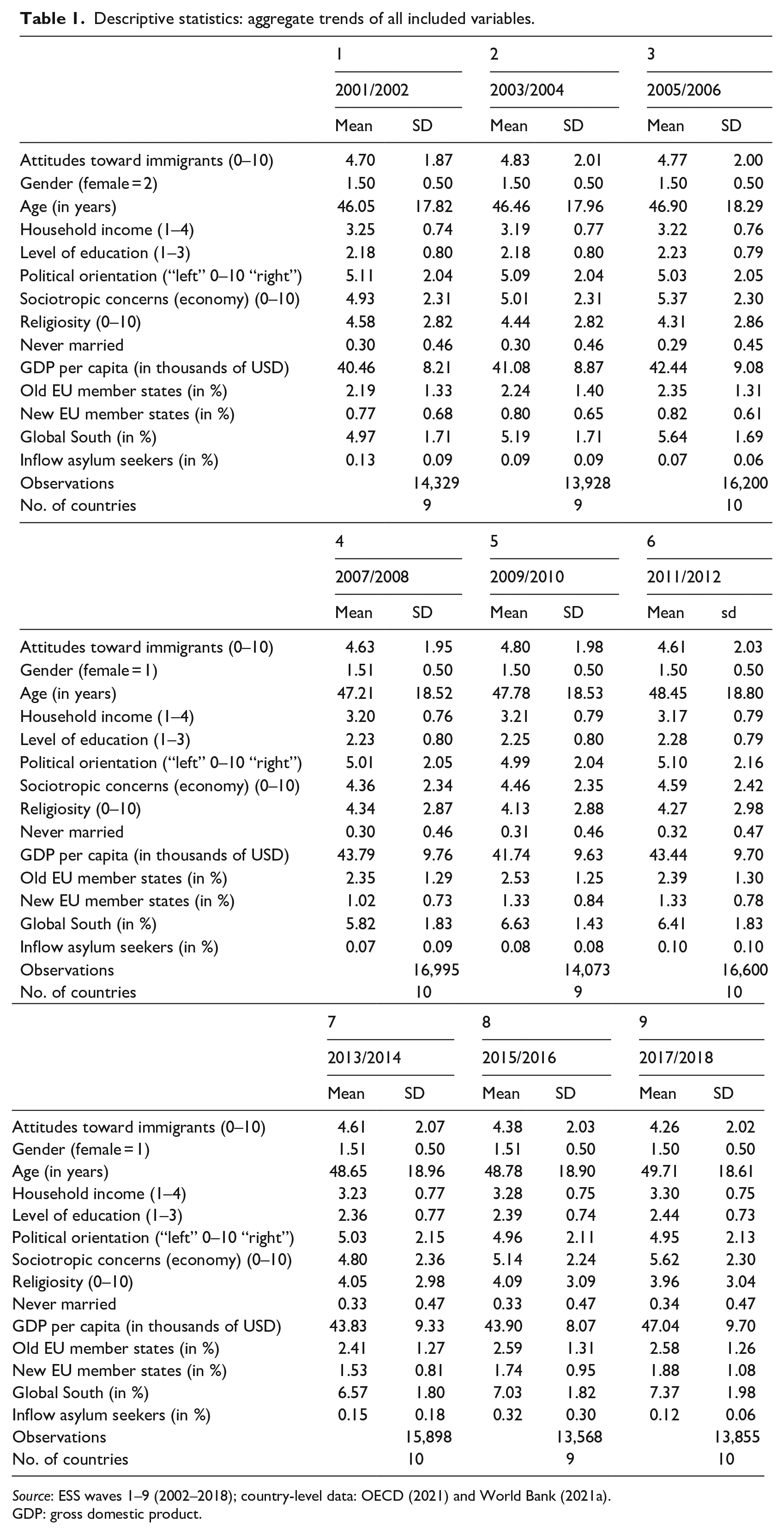
Table 1 illustrates the aggregate trends of all included variables. For the 10 countries under analysis, the financial crisis of 2008 made its impact evident in a subsequent stagnation of GDP, which, on average, only rose again substantially in 2017/2018. Immigrant shares generally increased from 2002 to 2018. In particular, the share of so-called mobile EU citizens rose. The share of citizens from new EU member states increased substantially from 0.8 percent to almost 1.9 percent, as a result of the EU eastern enlargement. Immigration from the Global South also increased steadily and represents the largest share of immigrants within the countries under analysis at 7.4 percent in 2017/2018. In addition, the inflow of asylum seekers varied over the years, reaching its peak with the refugee immigration of 2015/2016. Interestingly, since then, overall attitudes toward immigrants have been most positive in the country sample. The initially assumed variation in country-level indicators in Western EU countries during the turbulent period from 2002 to 2018 is clearly reflected in the data.
Descriptive statistics: aggregate trends of all included variables.
Source: ESS waves 1–9 (2002–2018); country-level data: OECD (2021) and World Bank (2021a).
GDP: gross domestic product.
Analytic strategy
Multiple linear regression analyses (between-cohort effects)
To answer the two posed research questions, I divide the analysis into two parts. First, I approach the first question of how Western European birth cohorts differ in their sentiments toward immigrants and examine the potential impact of cohort replacement. For this purpose, multiple linear regression analyses are performed based on pooled ESS data from 2002 to 2018. By gradually including additional control variables in the models, this procedure reveals isolated differences in attitudes toward immigrants between birth cohorts.
Panel analyses at cohort level (within-cohort effects)
In a second step, I examine to what extent periodic changes over time affect attitudes toward immigrants within birth cohorts. To identify the within-cohort change over time, I apply a fixed-effects panel analysis at cohort level. 5 This technique facilitates the investigation of the dynamic approach of group threat theory and answers the second research question of this study, concerning the stability of cohorts’ attitudes.
Individual time-constant effects potentially correlate with the explanatory variables, leading to biased estimates. It is well known that such bias can be avoided by using panel data and the fixed-effects model. In this study, panel data on the individual level are not available. Therefore, I construct a pseudo panel, as proposed in Deaton (1985), in which birth cohorts constitute the units of analysis (see below). Thus, in contrast to the linear regression analysis described above, the analysis is not performed at the individual level but at the aggregate level. The approach of pseudo-panel analysis has been applied in a variety of empirical studies. Depending on the research question, they use differing units of analysis (Antman and McKenzie, 2007; Cuesta et al., 2011; Jæger, 2013; Olivera, 2015; Russell and Fraas, 2005).
With the construction of a panel dataset based on cohorts, this study proposes an alternative model to multilevel approaches, such as hierarchical APC models (e.g. Wilkes and Corrigall-Brown, 2011) and three-level multilevel models (e.g. Czymara, 2021) analyzing time trends in public opinion. In principle, multilevel modeling is an equally valid approach to answer the research question. For example, a linear mixed model with random cohort effects should yield results similar to those of a pseudo panel. The main difference is that the within-estimator of the pseudo panel does not rely on distributional assumptions for the cohort effects. 6 There is no obvious way of testing one approach against the other. For this reason, I attach results for a linear mixed model to Appendix 1 (Table 5), showing that the two approaches are similar.
Application
I use the repeated cross-sectional ESS data to construct a pseudo-panel dataset. Individuals are grouped into synthetic observations based on time-constant characteristics. Besides birth cohorts, I also include the characteristics of gender and country of residence. Ideally, individuals are relatively homogeneous in their characteristics within groups and relatively heterogeneous between groups (Verbeek, 2008). Larger numbers of groups based on more defining characteristics better reflect societal variation, but groups with small numbers of individuals do not provide a basis for reliable estimates. Thus, finding a decent balance between the number and size of the groups is important (Olivera, 2015). I attempt to strike this balance by limiting the size of each group to a minimum of 30 respondents and the number of groups to 200. This number results from forming groups based on 10-year birth cohorts (10), gender (2), and country of residence (10). By adding the time dimension (9 × ESS rounds), a maximum possible number of 1800 (10 × 2 × 10 × 9) synthetic observations is reached based on 135,446 observations. An exemplary synthetic observation representing a unit of analysis is the women belonging to the same birth cohort in Portugal in the survey year 2002. Hence, the approach allows for identification of mechanisms of attitude changes toward immigrants on the level of birth cohorts, gender, and country of residence. The actual number of synthetic observations in this study is 1217 based on 164 synthetic groups, as opposed to the theoretical maximum. The number of observations is reduced for several reasons. First, not all 10 countries participated in all nine ESS rounds; second, the youngest and oldest birth cohorts are not surveyed at each time point (because they are either too young to be interviewed or are deceased); and third, the synthetic observations entering the regression analysis have to contain at least 30 respondents to represent reliable group estimates. I exclude observations with fewer than 30 individuals.
Finally, I conduct three robustness checks. First, I test the robustness of the results by varying the minimum size of respondents in a synthetic observation as well as by varying the cohort classification for the synthetic groups. Second, with a country sensitivity analysis, I exclude single countries from the analysis to test whether particular countries drive certain effects. Third, I conduct a period sensitivity analysis assessing whether particular periods impact the results.
Results and interpretation
Descriptive overview
Figure 1 illustrates the process of cohort replacement within Western EU societies under examination over time. Whereas the share of the two youngest birth cohorts consistently increases from 8.6 percent in 2002 to almost 30 percent in 2018, the share of the three oldest birth cohorts decreases from almost 25 percent to less than 10 percent. Overall, over the 2002–2018 period, the share of birth cohorts born before 1961 shrinks, while the share born thereafter steadily increases.
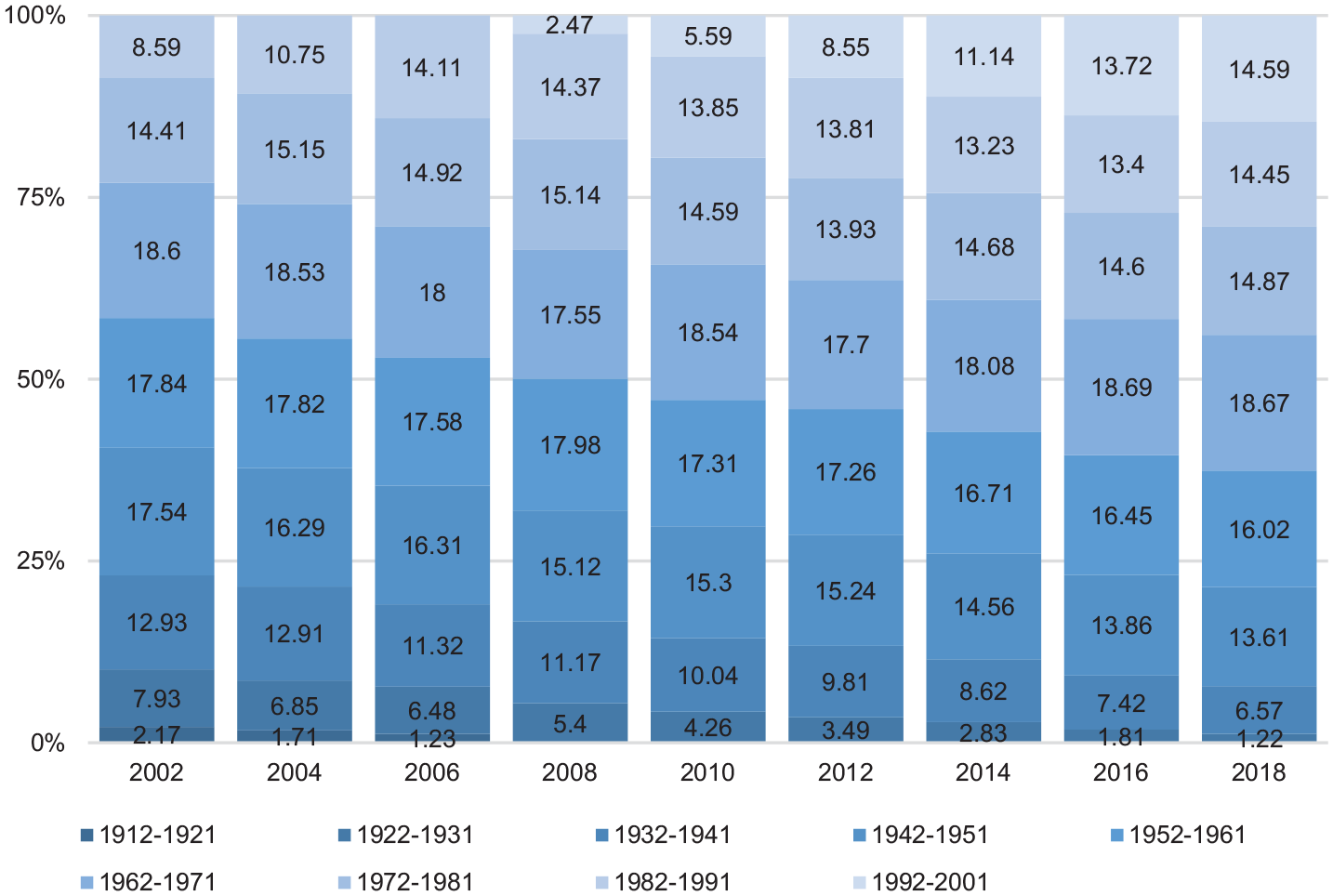
The process of cohort replacement within Western EU member states between 2002 and 2018.
Examining time trends in attitudes to immigrants by birth cohort offers additional insights. Figure 2 illustrates the attitudes toward immigrants averaged over the country sample across the 2002–2018 period. Over this 16-year time period, attitudes shifted with natives becoming more immigrant-friendly in 2018 than in 2002. This positive trend holds for all birth cohorts (with the exception of the oldest cohort, which suffers from a small n in the years 2014–2018 due to the old age of respondents and, thus, is excluded). This similar pattern in attitude changes over the years reveals the impact of period effects. Between 2008 and 2010 there is an increase in dismissive attitudes toward immigrants for all birth cohorts, which is likely to be the result of the financial crisis. Furthermore, between 2014 and 2018, Western Europeans’ opposition to immigrants decreases to a value below 5 on the 11-point scale for all cohorts. In further analysis, I examine whether this drop in opposition is associated with the gradual recovery of the European economy after the financial crisis or to the so-called long summer of migration. Whereas patterns in attitude shifts are similar for all birth cohorts over time, these shifts occur on different levels. The three oldest birth cohorts (born between 1912 and 1941) display the highest levels of anti-immigrant sentiments (average values predominantly above 5), while attitudes steadily become more positive among the younger cohorts (average values below 5).
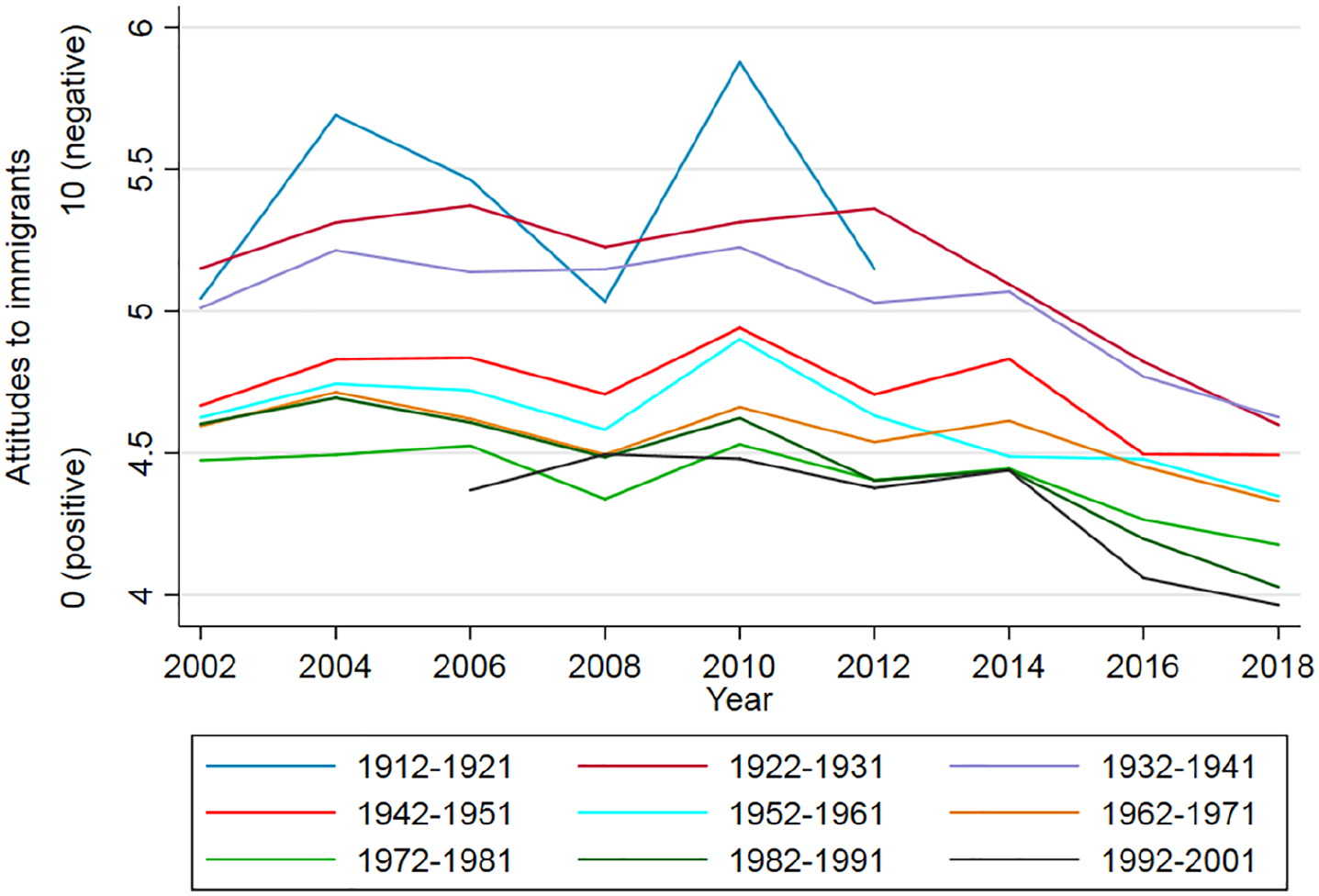
Attitudes toward immigrants among Western EU birth cohorts between 2002 and 2018.
Results multivariate regression analyses (between-cohort effects)
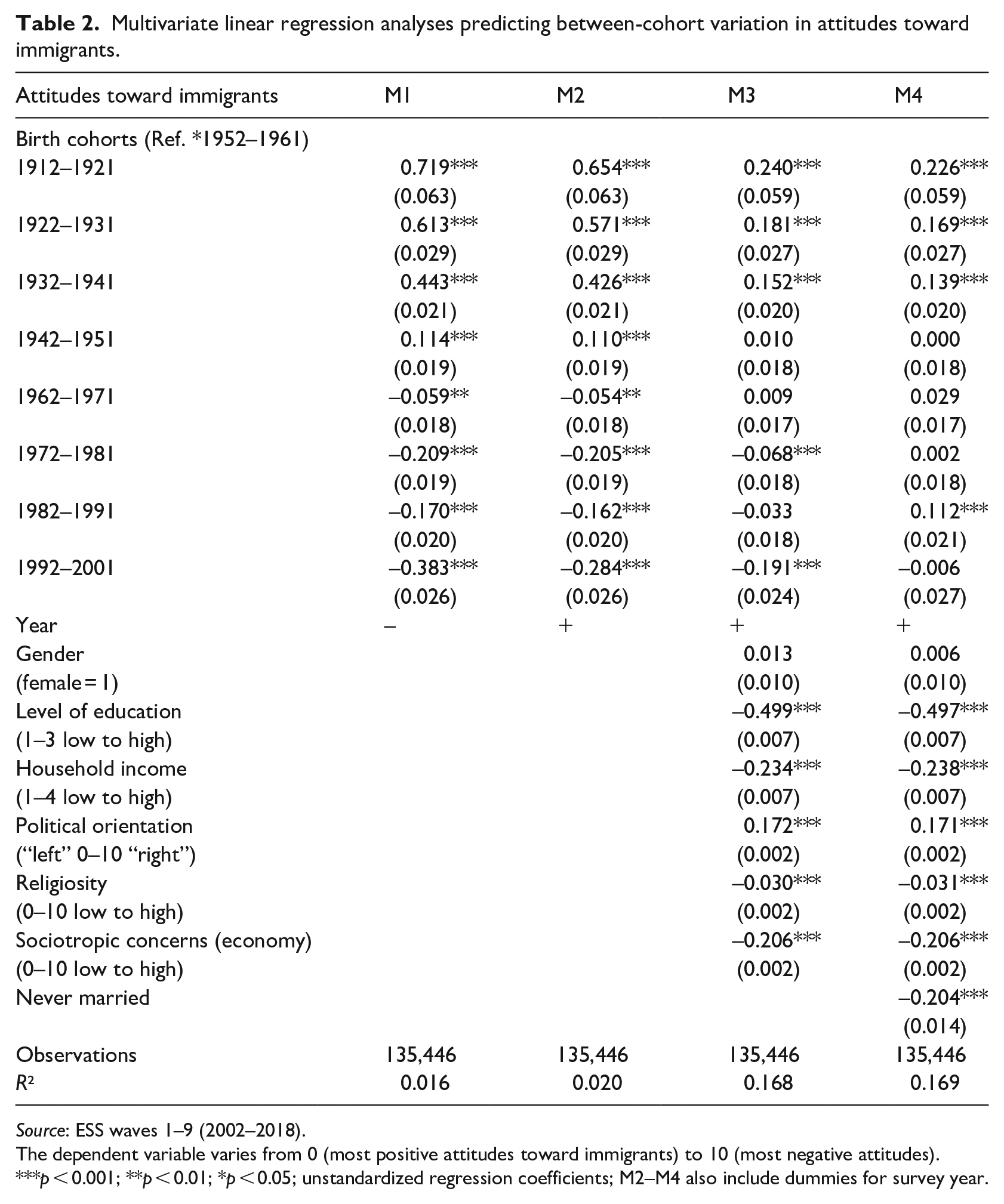
Table 2 indicates the results of the multivariate linear regression analyses, specifying cohort effects irrespective of age and period effects. The cohort born between 1952 and 1961 serves as the reference category, as it is positioned in the middle and permits plausible comparability with the oldest and youngest birth cohorts.
Multivariate linear regression analyses predicting between-cohort variation in attitudes toward immigrants.
Source: ESS waves 1–9 (2002–2018).
The dependent variable varies from 0 (most positive attitudes toward immigrants) to 10 (most negative attitudes).
p < 0.001; **p < 0.01; *p < 0.05; unstandardized regression coefficients; M2–M4 also include dummies for survey year.
The results in the successive models confirm that birth cohort affiliation is an important predictor of attitudes toward immigrants. In model 1, when not controlling any additional factors, all birth cohorts younger than the reference cohort (1952–1961) are significantly less disapproving of immigration whereas the opposite is reported for older cohorts. The effect of increasing anti-immigrant sentiment becomes ever stronger in the older cohorts.
Model 2 additionally includes the year of the ESS survey in the analysis, controlling period effects. This does not affect the results in any significant way. In model 3, further control variables are included, accounting for respondents’ social background characteristics. After controlling for their political orientation, religiosity, education, household income, and satisfaction with the country’s economy, most significant differences between birth cohorts remain stable, although effect sizes shrunk. Including the proxy for age and life-cycle effects in model 4 (“never married”), however, leads to a different pattern. Never having been married (or lived in a civil partnership) is strongly associated with less anti-immigrant sentiments. The underlying mechanism, however, driving this effect, is age, since it is older individuals who are more likely to have experienced a marriage(-like) relationship. In adding this proxy for age, results show that with growing age, respondents become more opposed to immigrants. This finding is consistent with most previous studies, where age shows a significant negative effect on sentiments toward immigrants (for an overview, see McLaren and Paterson, 2020).
Controlling age effects, model 4 reveals that the oldest cohorts, born between 1912 and 1941, continue to hold consistently more negative attitudes toward immigrants than the reference birth cohort (*1952–1961). However, the subsequent cohorts (born after 1961) no longer significantly differ in their attitudinal patterns. Strikingly, in their cohort average, individuals born between 1982 and 1991 show even more opposing attitudes, at a statistically significant level. Here, a strong cohort effect prevails.
Generally, as hypothesized earlier, successive cohorts will have more immigrant-friendly attitudes (H1). With this, the process of cohort replacement impacts aggregated population level attitudes toward immigrants for Western European societies. With the three oldest (born between 1912 and 1941) cohorts’ shrinking share of the overall population between 2002 and 2018 from almost 25 percent to less than 8 percent (see Figure 1), a substantial amount of variation in the overall opinion climate toward immigrants can be accounted for through the process of cohort replacement. Hence, with the complete replacement of these older cohorts, we can expect a more positive evaluation of immigrants within Western EU member states. For the future, however, this trend of decreasing anti-immigrant attitudes over birth cohorts is coming to a halt. Western European birth cohorts that were socialized after World War II, predominantly do not significantly differ in their average attitudes toward immigrants. Moreover, a reverse trend might be underway. Independent of additional explanatory factors, such as age, period, and socioeconomic characteristics, the cohort born between 1982 and 1991, on average, holds increased dismissive attitudes toward immigrants when compared with the cohort born between 1952 and 1961. Perceived insecurities, potentially triggered by high unemployment rates (due to the global financial crisis in 2008) when first entering the job market, by the consolidation of neoliberalism, and, by international terrorism, when growing up, might have led to a preference for nationalism and global isolation, explaining why the “millennial” cohort born between 1982 and 1991 is more skeptical about immigration.
Results longitudinal fixed effect models at cohort level (within-cohort effects)
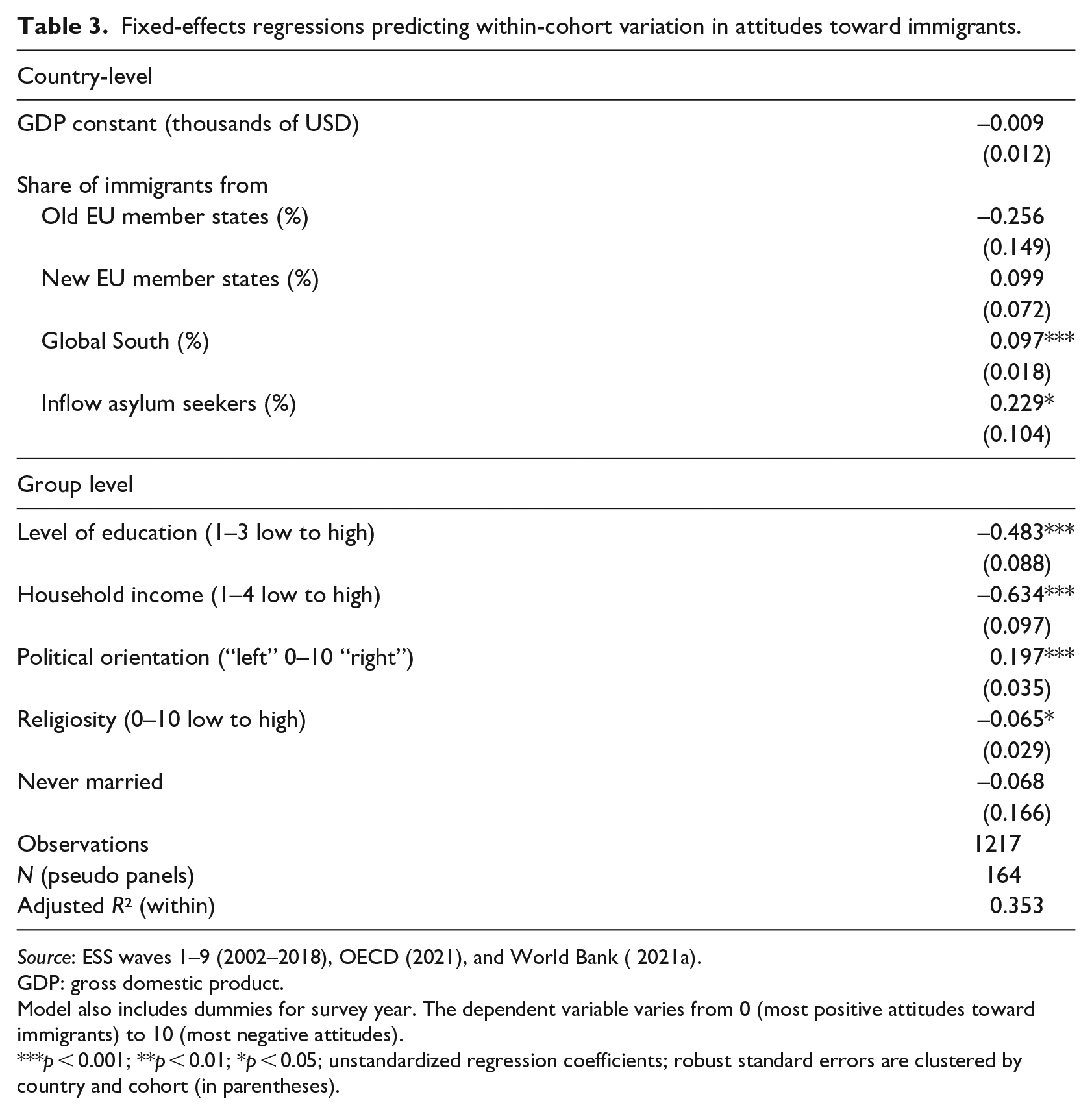
Table 3 displays the results of the pseudo-panel analysis with fixed effects. The regression model predicts the impact of macroeconomic changes and varying immigration rates from different country categories on cohorts’ attitudes toward immigrants. A variance inflation factor (VIF) analysis does not indicate multicollinearity between the explanatory variables. Values remain below 2. Therefore, I calculate one model including all explanatory macro-variables.
Fixed-effects regressions predicting within-cohort variation in attitudes toward immigrants.
Source: ESS waves 1–9 (2002–2018), OECD (2021), and World Bank ( 2021a).
GDP: gross domestic product.
Model also includes dummies for survey year. The dependent variable varies from 0 (most positive attitudes toward immigrants) to 10 (most negative attitudes).
p < 0.001; **p < 0.01; *p < 0.05; unstandardized regression coefficients; robust standard errors are clustered by country and cohort (in parentheses).
Results show that changing economic conditions at the country-level (measured with GDP per capita) do not lead to significant intra-cohort shifts in the evaluation of immigrants. Immigration from different country categories, however, exerts different effects on public opinion. Whereas an increase in immigration from old EU member states points toward a decrease in cohorts’ anti-immigrant attitudes, a rise in the immigrant share from new EU member states tends to increase anti-immigrant attitudes, but not at any level of statistical significance. Rising immigration rates from the Global South, however, lead to significant opposition to immigrants within native cohorts, as does an increase in the inflow of asylum seekers.
Although variables on the group level mainly function as control variables in this analysis, it is worth mentioning that the results lend support to the majority of previous findings: An increase in a cohort’s level of education significantly decreases anti-immigrant attitudes. The same holds for “satisfaction with household income.” Rising income satisfaction significantly decreases negative attitudes toward immigrants. The proxy for life-cycle events proves to be insignificant for cohorts’ attitudes to change, whereas a cohort’s tendency to become more religious leads to a small decrease in opposition to immigrants. A cohort’s shift toward the political right, however, significantly increases dismissive attitudes toward immigrants.
Robustness checks
As outlined above, to answer the research question of how periodic changes over time affect attitudes toward immigrants within birth cohorts, multilevel modeling provides an equally valid approach. Appendix 1, Table 5 in the appendix shows that a linear mixed model with random cohort effects yield results similar to those of the pseudo panel. Only the effect of GDP gains some significance in the multilevel model. The very small effect size of the coefficient, however, does not imply a strong effect that is potentially missed in the pseudo-panel approach.
The results remain robust, even when limiting the size of respondents in the synthetic observations (Appendix 1, Table 6) to n ⩾ 0 and n ⩾ 50 instead of n ⩾ 30, as administered in the original analysis. Moreover, when varying the cohort categorization to 7-year birth cohorts or 12-year birth cohorts instead of 10-year birth cohorts (Appendix 1, Table 7), no significant differences in results are detected.
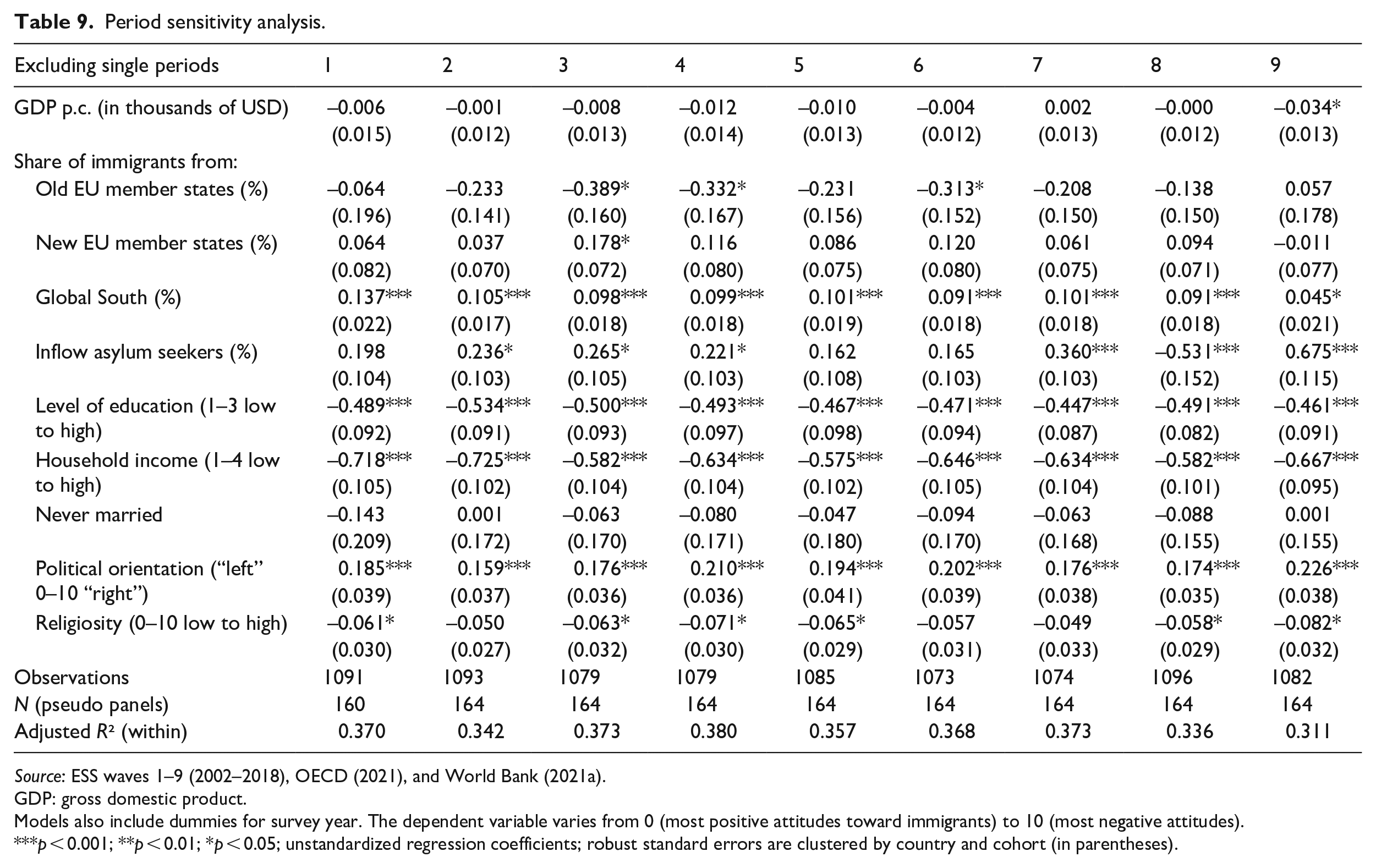
Furthermore, by excluding single countries (Appendix 1, Table 8) and single survey years (Appendix 1, Table 9) from the analysis, I test whether effects are largely robust or whether they are driven by particular countries or periods. When excluding single countries from the analysis, the null effect of GDP on anti-immigrant attitudes remains predominantly stable, though changes in estimates directions occur. When excluding Denmark or Portugal from the analysis, an increase in GDP leads to a small and weak but significant decrease in anti-immigrant sentiments (Appendix 1, Table 8). When excluding single periods from the analysis, I observe a similar pattern (Appendix 1, Table 9). Coefficient sizes for GDP remain small and insignificant. Only when excluding 2018 from the analysis does a rise in GDP exert a small statistically significant decrease in anti-immigrant attitudes. In sum, a tendency of rising GDP leading to less pronounced anti-immigrant attitudes can be observed. However, overall, changes in economic macro-conditions during the observation period do not play a significant role in explaining changes in cohorts’ opposition to immigrants. Hence, the hypothesis that deteriorating economic conditions on the country level lead to a rise in birth cohorts’ dismissive attitudes toward immigrants (H2) does not find strong support.
Furthermore, sensitivity analyses (Appendix 1, Tables 8 and 9) confirm the findings of the main analysis with regard to changing immigration rates from old and new EU member states. Whereas the directions of the estimates remain predominantly robust, coefficient sizes vary somewhat and change their levels of significance. The effect of immigration from new EU member states changes direction when Portugal is excluded and when excluding ESS round 9. In addition, when excluding ESS round 9, the effect of immigration from old EU member states changes direction, although the effect remains statistically insignificant. Thus, reactions to demographic changes due to rising immigration from old and new EU member states do not prove to be strong at the cohort level.
In contrast, rising immigration shares from the Global South prove to be stable predictors of cohorts’ attitude changes toward immigrants. The coefficients for the immigration share from the Global South remain stable in size, direction, and level of significance when excluding single countries and periods. Only when excluding ESS round 9 from the analysis does the coefficient size decrease somewhat, losing some of its statistical significance. Finally, the findings of the sensitivity analysis concerning the inflow of asylum seekers are rather striking. Results are predominantly robust in direction when excluding single countries, although levels of significance vary somewhat. When excluding Germany, Finland, Great Britain, or Portugal from the analyses, the inflow of asylum seekers no longer affects cohorts’ attitudes at a significant level. Furthermore, when considering the period sensitivity analysis, it becomes apparent that the effects are mainly driven by the year of the so-called refugee crisis in Europe. Once data from 2015/2016 are excluded from the analysis, the estimators change direction.
Hypothesis 3 finds partial support: Increasing immigration from the Global South and from asylum seekers leads to a greater increase in anti-immigrant attitudes than increasing immigration from new EU member states (since 2004). At the same time, an enlarged share of immigrants from old EU member states (before 2004) will bring the smallest increase in anti-immigrant attitudes. Overall, the results show that increases in different immigrant groups evoke different reactions in host societies regarding cohorts’ attitudes toward immigrants in general. Increasing immigration from the Global South leads to increasing anti-immigrant attitudes among Western EU cohorts. However, only a stark increase in asylum applications such as that in 2015/2016 leads to a negative effect: This is not observed during other periods of observation. Furthermore, an increase in immigrant shares from new EU member states does not provoke substantially differing attitude changes among Western European cohorts than an increasing number of immigrants from old EU countries. Here, both the country sample and the period of observation play critical roles.
Conclusion
Summary and discussion
Whereas much is known about the impact of age (Coenders and Scheepers, 2008; Semyonov et al., 2006), early-years socialization conditions (Jeannet and Dražanová, 2019; McLaren et al., 2020), as well as changing macro-conditions (Heizmann and Huth, 2021) on contemporary attitudes toward immigrants, the interplay of these factors—age, period, and cohort effects—in large-scale attitude changes remains understudied. This is surprising since most recent studies emphasize the importance of the dynamic approach of ethnic competition theory (e.g. Czymara, 2021). Motivated by this gap in the literature, in a first step, I use pooled ESS data from 2002 to 2018 to examine how Western European birth cohorts differ in their sentiments toward immigrants irrespective of age and period, by performing multiple linear regression analyses. In a second step, I combine ESS data with country-level information on economic conditions and immigration rates from different regions in the world to examine to what extent periodic changes over time affect attitudes toward immigrants within birth cohorts. To achieve this, I apply a fixed-effects panel analysis at cohort level. Country and period sensitivity analyses function as robustness checks.
This study is limited to analyses that include 10 Western EU member states, narrowing the implications of the findings to a particular sample. Keeping this limitation in mind, the study has several key findings: First, demographic changes due to the process of cohort replacement led to a substantially more positive opinion climate toward immigrants within Western EU host societies over the 2002–2018 period. With the successive replacement of the oldest cohorts, born between 1912 and 1941, overall anti-immigrant attitudes within societies decreased. In the future, however, this positive development is likely to come to a halt, since younger cohorts no longer significantly differ in their attitudes from those born between 1952 and 1961. Even though the effects are indiscernible in the younger cohorts, these findings ascribe certain explanatory power to cohort affiliation in determining attitudes toward immigrants. This, to some degree, contradicts the findings of Wilkes and Corrigall-Brown (2011), who ascribe no explanatory power to cohort affiliation but rather to period effects. Whether this disparity in findings is rooted in differing time scales or country samples is open to scrutiny.
Second, the expected positive effect for cohorts growing up in a context of higher-immigrant-origin diversity, as proposed by several researchers (Eger et al., 2021; McLaren et al., 2020; Norris and Inglehart, 2019), apparently does not outweigh the negative effects of perceived existential insecurities during the younger cohorts’ formative years (Inglehart and Norris, 2017). As previous research stresses, a context of high income inequality, high unemployment rates, and perceived insecurities during a cohort’s formative years stimulates the rejection of outsiders, leaving a permanent imprint on individuals throughout life (Gorodzeisky and Semyonov, 2018; Inglehart and Norris, 2017; McLaren et al., 2020). If the goal is to ensure social cohesion within European states, these insecurities need to be addressed so that migrants do not become targets of frustration. Future studies should specifically investigate the conditions for perceived threats triggering anti-immigrant sentiments among young adults. Single country studies offer a way of extending previous research (Eger et al., 2021; Jeannet and Dražanová, 2019; McLaren and Paterson, 2020) to gain a better understanding of cohort trends in differing contexts (Coenders and Scheepers, 2008; McLaren et al., 2020; Wilkes and Corrigall-Brown, 2011).
Third, cohorts change their attitudes toward immigrants due to certain period effects, such as changing macro level conditions. In this study, there is indication for rising GDP levels to slightly decrease anti-immigrant attitudes, supporting previous findings for Canada (Wilkes and Corrigall-Brown, 2011), but GDP development only plays a subordinate role in general. More importantly, this study illustrates that certain shifts in the immigrant population function as periodic events boosting threat perceptions within birth cohorts. A key finding of the study is that increases in immigration from different origin backgrounds evoke dissimilar reactions within Western EU host societies. While increases in immigration rates of EU citizens do not play a significant role in changing natives’ sentiments, rising immigration from countries in the Global South proves to be a stable predictor of within-cohort attitude changes toward immigrants. Furthermore, increases in asylum seekers only lead to increasing negative sentiments within cohorts when the year of the so-called refugee crisis is included in the analysis. Increased issue salience provides further explanatory power for natives’ increased opposition during this particular period (Czymara and Dochow, 2018; Hopkins, 2010).
No previous study has analyzed changing immigration rates in such detail. Thus, this study provides the first empirical evidence based on actual demographic shifts as opposed to previous studies that rely on survey respondents’ evaluation of hypothetical immigration of particular immigrant groups only (Bloom et al., 2015b; Czymara and Schmidt-Catran, 2017; Gorodzeisky and Semyonov, 2016, 2019). Furthermore, it supports the findings of Czymara (2021), who examines the impact of asylum seeker inflows on attitudes toward refugees, and further expands them, by providing a more granular analysis of several immigrant groups’ background-origins and a longer period of observation.
In the light of these findings, the theoretical assumption that it is mainly economic and cultural group threat perceptions that drive periodic changes in anti-immigrant attitudes needs further adaptation (e.g. Hainmueller and Hopkins, 2014). As increased immigration levels from mostly Eastern European countries do not significantly impact Western European attitudes toward immigrants in general, cultural and economic dimensions of threat perceptions alone prove insufficient for explaining anti-immigrant attitudes. By definition, the Global South comprises lower-income countries, but it also primarily entails countries with ethnic populations that are non-white. Thus, this study’s findings rather illustrate that ethnic prejudice plays a key role in Western EU populations to oppose immigration. With this, the study lends initial empirical support to previous research based on actual demographic shifts, suggesting that opposition to immigration is hierarchical (Bloom et al., 2015b; Czymara and Schmidt-Catran, 2017; Gorodzeisky and Semyonov, 2019). Moreover, we learn that immigrant groups that stereotypically represent all three dimensions of perceived threats—economic, cultural, and ethnic—face highest disapproval. Thus, future research should not only distinguish between economic and cultural threat perceptions but also include the specific dimension of ethnic prejudice.
Concluding remarks
What are the implications of this study for our understanding of shifts in attitudes toward immigrants? Overall findings suggest that it is neither cohort (Ross and Rouse, 2015) nor period effects (Wilkes and Corrigall-Brown, 2011) alone that are driving large-scale attitude changes, but rather an interplay of cohort and period effects. Cohort affiliation is clearly associated with attitudes toward immigrants, especially when comparing the oldest with younger birth cohorts. This does not imply, however, that cohorts’ attitudes remain stable over time. Instead, certain period effects can significantly change cohorts’ attitudes, whereby increasing immigration rates from the Global South play a decisive role.
While we know from previous research that natives’ perceptions of the size and composition of the immigrant population affect public opinion, this study goes beyond sheer perceptions and establishes that it is actual demographic change that acts as an important predictor for attitude changes. More specifically, the acceptance of rising immigration in European societies depends on the immigrants’ country of origin. While Europeans largely accept inner-European migration, prejudice prevails as a result of immigration from the Global South. This reveals the power of ethnic prejudice over cultural and economic threat perceptions.
Footnotes
Appendix 1
Period sensitivity analysis.
| Excluding single periods | 1 | 2 | 3 | 4 | 5 | 6 | 7 | 8 | 9 |
|---|---|---|---|---|---|---|---|---|---|
| GDP p.c. (in thousands of USD) | –0.006 | –0.001 | –0.008 | –0.012 | –0.010 | –0.004 | 0.002 | –0.000 | –0.034* |
| (0.015) | (0.012) | (0.013) | (0.014) | (0.013) | (0.012) | (0.013) | (0.012) | (0.013) | |
| Share of immigrants from: | |||||||||
| Old EU member states (%) | –0.064 | –0.233 | –0.389* | –0.332* | –0.231 | –0.313* | –0.208 | –0.138 | 0.057 |
| (0.196) | (0.141) | (0.160) | (0.167) | (0.156) | (0.152) | (0.150) | (0.150) | (0.178) | |
| New EU member states (%) | 0.064 | 0.037 | 0.178* | 0.116 | 0.086 | 0.120 | 0.061 | 0.094 | –0.011 |
| (0.082) | (0.070) | (0.072) | (0.080) | (0.075) | (0.080) | (0.075) | (0.071) | (0.077) | |
| Global South (%) | 0.137*** | 0.105*** | 0.098*** | 0.099*** | 0.101*** | 0.091*** | 0.101*** | 0.091*** | 0.045* |
| (0.022) | (0.017) | (0.018) | (0.018) | (0.019) | (0.018) | (0.018) | (0.018) | (0.021) | |
| Inflow asylum seekers (%) | 0.198 | 0.236* | 0.265* | 0.221* | 0.162 | 0.165 | 0.360*** | –0.531*** | 0.675*** |
| (0.104) | (0.103) | (0.105) | (0.103) | (0.108) | (0.103) | (0.103) | (0.152) | (0.115) | |
| Level of education (1–3 low to high) | –0.489*** | –0.534*** | –0.500*** | –0.493*** | –0.467*** | –0.471*** | –0.447*** | –0.491*** | –0.461*** |
| (0.092) | (0.091) | (0.093) | (0.097) | (0.098) | (0.094) | (0.087) | (0.082) | (0.091) | |
| Household income (1–4 low to high) | –0.718*** | –0.725*** | –0.582*** | –0.634*** | –0.575*** | –0.646*** | –0.634*** | –0.582*** | –0.667*** |
| (0.105) | (0.102) | (0.104) | (0.104) | (0.102) | (0.105) | (0.104) | (0.101) | (0.095) | |
| Never married | –0.143 | 0.001 | –0.063 | –0.080 | –0.047 | –0.094 | –0.063 | –0.088 | 0.001 |
| (0.209) | (0.172) | (0.170) | (0.171) | (0.180) | (0.170) | (0.168) | (0.155) | (0.155) | |
| Political orientation (“left” 0–10 “right”) | 0.185*** | 0.159*** | 0.176*** | 0.210*** | 0.194*** | 0.202*** | 0.176*** | 0.174*** | 0.226*** |
| (0.039) | (0.037) | (0.036) | (0.036) | (0.041) | (0.039) | (0.038) | (0.035) | (0.038) | |
| Religiosity (0–10 low to high) | –0.061* | –0.050 | –0.063* | –0.071* | –0.065* | –0.057 | –0.049 | –0.058* | –0.082* |
| (0.030) | (0.027) | (0.032) | (0.030) | (0.029) | (0.031) | (0.033) | (0.029) | (0.032) | |
| Observations | 1091 | 1093 | 1079 | 1079 | 1085 | 1073 | 1074 | 1096 | 1082 |
| N (pseudo panels) | 160 | 164 | 164 | 164 | 164 | 164 | 164 | 164 | 164 |
| Adjusted R² (within) | 0.370 | 0.342 | 0.373 | 0.380 | 0.357 | 0.368 | 0.373 | 0.336 | 0.311 |
Source: ESS waves 1–9 (2002–2018), OECD (2021), and World Bank (2021a).
GDP: gross domestic product.
Models also include dummies for survey year. The dependent variable varies from 0 (most positive attitudes toward immigrants) to 10 (most negative attitudes).
p < 0.001; **p < 0.01; *p < 0.05; unstandardized regression coefficients; robust standard errors are clustered by country and cohort (in parentheses).
Funding
The author(s) disclosed receipt of the following financial support for the research, authorship, and/or publication of this article: The project on which this report is based was funded by the Federal Ministry of Education and Research (BMBF) under the funding code 01UM1812CY. The responsibility for the content of this publication lies with the author.
