




Abstract
Do green behaviors earn social status among liberals and conservatives? Although evidence shows that high-status consumers incorporate ecological concerns into their consumption choices, politically polarized views on environmentalism in the United States complicate the relationship between green behaviors and status. A vignette experiment shows that across political ideology, people grant status to green consumption. Results from semistructured interviews suggest that green consumers are seen as wealthy, knowledgeable, and ethical, although these status beliefs vary with political ideology. The findings reveal unlikely common ground between liberal and conservative judgments of green behaviors and indicate that green consumption is an emerging domain for evaluating social status.
Why would anyone adopt time-intensive, costly behaviors that promise a lower environmental impact? Commonly adopted green behaviors include green consumption (e.g., purchasing hybrid cars, ecofriendly soaps, organic foods) and reduced consumption (e.g., restricting water use, saving energy, avoiding the use of personal automobiles). In addition to individual-level attributes such as environmental concern (e.g., Dunlap et al. 2000), a possible cultural mechanism explaining engagement in these green behaviors is social approval. Households might be more likely to try to lower their environmental impact if they believe they will be awarded social status on the basis of these efforts (Bourdieu 1984; Sexton and Sexton 2014). But do others judge green behaviors as high status? And do people evaluate green consumption and reduced consumption differently? Such questions require an examination of the status beliefs and distinctions associated with green behaviors. Complicating our knowledge of how people judge proenvironmental strategies is the politically polarized context, particularly in the United States (Dunlap, McCright and Yarosh 2016). Conservatives are more likely than liberals to doubt the scientific consensus regarding anthropogenic climate change, whereas liberals are strong supporters of climate change policies (McCright, Xiao, and Dunlap 2014). However, it is unclear how political ideology might shape judgments of individual-level strategies to reduce environmental impact.
We use mixed methods—a vignette experiment and semistructured interviews—to examine whether green behaviors earn social status and the extent to which that holds for liberals and conservatives in the United States. Results suggest some unlikely common ground: both liberals and conservatives grant status to green consumption, because both associate green consumption with wealth. But conservatives are more likely to associate green consumption with knowledgeability; liberals tend to associate green consumption with morality. Both liberals and conservatives perceive green consumption as a higher status choice than reducing consumption.
Status Distinctions and Green Practices in a Politically Polarized Context
Status distinctions are central to social inequality, as they constitute the axes along which hierarchies are constructed and boundaries are maintained (Bourdieu 1984; Ridgeway 2013; Ridgeway and Correll 2006). High-status actors receive more deference and are viewed as more influential than low-status actors, benefits that can maintain and increase their status. Sociological research on status focuses on ascribed traits such as race, gender, and attractiveness (Foschi 2000; Webster and Driskell 1983); on achieved characteristics such as motherhood (Correll, Benard, and Paik 2007) and wealth (Alderson and Katz-Gerro 2016); and on actions, particularly those that contribute to the well-being of the group (Willer 2009). We build on this latter work to explore another set of actions that may contribute to social status: green behaviors.
How might consumer choices relate to social status? Veblen’s ([1899] 1994) theory of conspicuous consumption posits that people consume in a conscious effort to seek status. In contrast, Bourdieu (1984) suggested that definitions of status are context-specific and that the tastes of those with more cultural and economic resources are ultimately deemed “good” taste. Although they rely on different mechanisms, both approaches see an association between consumption and status.
Environmental research finds an association between green consumption and status. Consistent with Veblen ([1899] 1994), Griskevicius, Tybur, and Van den Bergh (2010) showed that status motives drive engagement in green consumption, even when the products consumed are not “conspicuous” in the traditional sense (e.g., green household soaps rather than luxurious, nongreen soaps). In other words, people expect to receive status for “going green.” Consistent with Bourdieu (1984), more recent research shows that green behaviors are associated with high-status tastes. Carfagna et al. (2014) showed that well-educated Americans with occupational prestige infuse an ecological consciousness into their consumption decisions. Likewise, Elliott (2013) reported a strong positive association between educational achievement and a desire to engage in green consumption. On the basis of this evidence, Elliott argued that green consumption may be an emerging domain for status differentiation. Overall, existing evidence suggests green consumption (more than reduced consumption) is associated with social status.
The currently politically polarized context of environmentalism in the United States casts doubt on the generalizability of this association, however. Research suggests that liberals are more likely than conservatives to practice green and reduced consumption (Gifford and Nilsson 2014; but see Elliott 2013). And experimental work finds that conservatives can be repelled by products with “green” labeling (Gromet, Kunreuther, and Larrick 2013), even when alternative options are more expensive and of lower quality. Such research suggests we might expect liberals and conservatives to react differently to reduced and green consumption. Because past research has demonstrated the importance of visible displays of wealth in conveying social status and an emerging high-status taste for “green,” we expect that both liberals and conservatives will view green consumption as higher status than reduced consumption.
Hypothesis 1: Both liberals and conservatives will attach higher status to green consumption than to reduced consumption.
Researchers argue that status structures rest not only on people’s own beliefs about status but also on their expectations about the status beliefs that others hold (see Correll et al. 2017 on third-order expectations). In fact, these expectations may have more influence on behavior than an individual’s own opinions (e.g., Bourdieu 1984; Willer, Kuwabara, and Macy 2009). It is therefore important not only to assess individuals’ judgments but also their expectations regarding the opinions held by others.
Experimental research conducted with a nonrepresentative sample of Americans indicates that people expect others to attach status to households that try to help the environment (Horne and Kennedy 2017) and expect to be granted status for engaging in green consumption (Griskevicius et al. 2010). Sexton and Sexton (2014) reported similar patterns but noted that people expect more positive reactions to green consumption from liberals than from conservatives. The implications for reactions to green consumption relative to reduced consumption in the U.S. political context are unclear. On one hand, because of the wealth associations with green consumption, it may be that people will expect both Democrats and Republicans to grant more status to a household that engages in green consumption than one that engages in green behavior. However, given vocal antienvironmental statements in conservative networks (McCright and Dunlap 2010), it may be that people expect Republicans to grant low status to any proenvironmental action, including both green consumption and reduced consumption. Accordingly, we test two competing hypotheses:
Hypothesis 2a: People will expect both Democrats and Republicans to attach higher status to green consumption than reduced consumption.
Hypothesis 2b: People will expect Democrats, but not Republicans, to attach higher status to green consumption than reduced consumption.
Study 1: Vignette Experiment
The vignette focuses on a particular domain of green behavior, energy consumption. We chose this context because of the importance of renewable energy adoption for global climate change.
Design
The experiment had a 2 × 2 between-subjects design crossing participant ideology (liberal or conservative) with the manipulated conditions: green consumption (installing rooftop solar panels) and reduced consumption (making behavior changes that reduce electricity use). 1 In each experimental condition, half the participants were liberal and half were conservative. Each participant saw only one condition. There were approximately 100 participants per cell, for a total of 400 participants.
Participants and Procedures
We designed the study and hired the Internet research company YouGov to administer it. YouGov conducts studies with online samples that are weighted to be representative of the population in question (for the United States, samples are consistent with distributions found in the 2010 American Community Survey). YouGov solicits study participants and awards points to participants that they redeem to obtain rewards such as gift cards.
Because our theory makes predictions about liberals and conservatives, we conducted our study with liberal and conservative participants on the basis of a prescreening ideology measure from the National Election Study. YouGov also provided information on other sociodemographic characteristics. Forty-seven percent of participants were men and 53 percent were women. All participants were older than 18 years. Mean age was 49.9 years (SD = 17.5 years). Mean education was 13.7 years (SD = 2.31 years), and mean income was $67,400 (SD = $64,500). For our statistical analyses, we used weights to achieve nationally representative samples.
Participants read a vignette that described a woman (Angie Johnson) and her household’s energy consumption behaviors. Following the vignette, participants answered questions about their evaluations of Angie and their expectations regarding how Democrats and Republicans would evaluate Angie.
Experimental Manipulations
The experimental conditions (green consumption and reduced consumption) were manipulated using a vignette: Angie Johnson and her family live in your neighborhood. They have lived there for a decade. Their residence is similar to others in your neighborhood in age, size, and style. Over the past year Angie has reduced her family’s carbon emissions so that their carbon emissions are
Dependent Measures
We measured participants’ perceptions of Angie’s social status by having them identify a rung on a 10-rung ladder (1 = lowest status, 10 = highest status) that corresponded to their perceptions of Angie’s standing in the community (Adler and Stewart 2007). We also asked participants about their expectations regarding the social status that Republicans and Democrats would grant to Angie (i.e., where most Democrats and Republicans would place Angie on the ladder).
Experimental Findings
Consistent with hypothesis 1, we find that both liberal and conservative participants grant higher status to green consumption than to reduced consumption. Liberals’ mean status ranking was 7.82 (SD = 1.52) in the green consumption condition (n = 94) and 7.07 (SD = 1.69) in the reduced consumption condition (n = 95) (p < .05). Conservatives’ mean status ranking in the green consumption condition (n = 94) was 6.88 (SD = 1.80) and in the reduced consumption condition (n = 97) was 6.20 (SD = 1.85) (p < .01). Consistent with hypothesis 2b, participants expected Democrats (not Republicans) to grant more status to green than reduced consumption. Participants expected Democrats to rank green consumption at 7.93 (SD = 1.78; n = 1.98) and reduced consumption at 7.37 (SD = 1.78; n = 199) (p < .01). They expected Republicans to rank green consumption at 6.07 (SD = 2.12; n = 199) and reduced consumption at 5.55 (SD = 2.16; n = 200) (ns).
Consistent with our hypotheses, both liberals and conservatives grant higher status to green consumption (rooftop solar panels) than to reduced consumption (reducing emissions through behavior change). But they (inaccurately) expect that only Democrats grant status on the basis of green consumption.
Study 2: Semistructured Interviews
To better identify the processes underlying the status distinctions identified in the experiments above, we conducted semistructured interviews with conservatives and liberals in Washington State. The interviews provide insight into conservative and liberal perceptions and the considerations underlying status attributions. We asked participants about rooftop solar panels specifically and green consumption generally, as well as questions about reduced consumption. Our data set comprises 63 interviews conducted between May 2016 and June 2017; our analytic sample is 58, because 6 participants refused to answer the question about political ideology.
Participants and Procedures
We randomly selected three Washington communities from rural, urban cluster, and urban sites (targeting one place from each category). We then targeted two neighborhoods within each site, using a quota sampling technique to ensure roughly equal representation of higher and lower socioeconomic status. In each neighborhood, the lead author and two graduate research assistants knocked on every nth (frequency varied with the size of the neighborhood) door to recruit participants using random-route sampling design (Hoffmeyer-Zlotnik 2003). We later used key informants and snowball sampling in a fourth (rural) community to reach more conservatives.
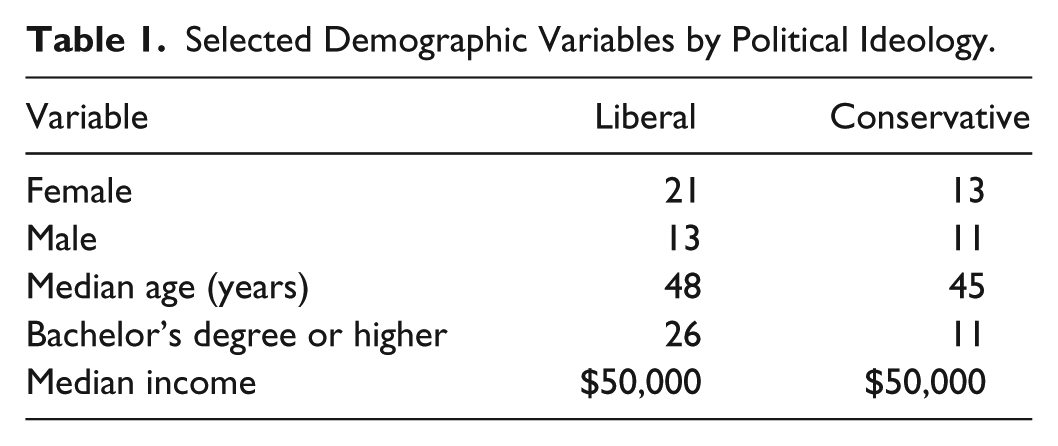
In our sample, 24 participants identify as conservative and 34 as liberal. We interviewed more women (n = 34) than men (n = 24), and the majority (n = 60) are white. Thirty-seven participants have university degrees. Age ranges from 21 to 85 years. Pretax household income ranges from $2,500 to more than $120,000. Selected demographic characteristics are presented in Table 1.
Selected Demographic Variables by Political Ideology.
Interviews ranged in length from 45 minutes to 3 hours. We conducted all interviews at locations chosen by the participant, either their homes, a café or restaurant, or their workplaces. Interviews were audio-recorded and professionally transcribed. The questions most relevant to this study asked how participants perceive those who buy green products generally and rooftop solar panels specifically.
Analysis
To analyze the interview data, we read and coded transcripts using NVivo 10.0 qualitative data management software. Codes were developed in NVivo to examine patterns and variation in people’s judgments of green consumption and green behavior. All interviews were coded several times. We began with the lead author using analytic coding to identify themes (e.g., wealth, self-sufficiency knowledge, awareness/morality) and to systematically code all interviews with these themes in mind. After completing these rounds of coding, the lead author conducted matrix queries to identify patterns of similarity and difference in the frequency of coding at each theme by the political ideology of the participants. To protect participants’ identities, we do not name the places where data were collected, and we use pseudonyms throughout.
Qualitative Findings
Our qualitative data provide further evidence that people associate green consumption with social status and reveal some of the beliefs underlying these status attributions. First, our participants perceive people who engaged in green consumption as wealthy in terms of both money and time. Second, particularly for conservatives, green consumers are granted higher status because they are viewed as having knowledge that makes them more self-sufficient and frugal, especially people with solar panels. In contrast, for liberals, green consumers are seen as highly ethical because of perceived commitment to environmental protection.
Green Consumption Signals Wealth
Participants (both liberal and conservative) generally viewed green consumers as high status. First, they saw them as wealthier in both finances and leisure time. Scott, a relatively wealthy and well-educated conservative, says, “I applaud them for [having solar panels]. And I think I make the assumption that they have more disposable income. Again, that’s a very high upfront cost.” Greg, a middle-income conservative, says he thinks very highly of people with solar panels, “First thing that comes to my mind: those people have a lot of money. They have a lot of wealth, because these products are not cheap.” Participants expressed similar sentiments regarding green consumption more broadly. For example, Brian, a 48-year old liberal college instructor, when picturing a customer with a grocery cart full of green products, said, “I would think ‘good for them’ and I would wonder what they do for a living [laughs]. Because I would think about how expensive that cart would be.” Jenny, a wealthy and well-educated libertarian, says, It’s that keeping up with the Joneses, but with this eco-friendly stuff. I try really hard not to get caught up in it. Even though I’d like to, I’m not gonna impact my family in a negative way financially just to try to keep up.
Although Jenny does say she feels like ecofriendly consumption is, “pretty cool,” and her comments suggest she sees green consumption as a status signal, she does not see it as an accessible lifestyle, because she feels she cannot afford these green products. 2
People also associate leisure time with green consumption. When asked what she thinks about someone who buys green products, Hannah, an upper-income conservative, responds, I’m picturing a stay-at-home mom, someone who doesn’t even have to work, that has the time to do the shopping once a week, even once every three days, and has the time to do the research on all those products too.
Kyle, a high-income conservative, says, They probably have more time to consider their choices, and certainly more money to consider their choices. They might have more of a bigger view on things, more educational [knowledgeable]. But I think it comes down to time and money.
Kyle says he feels “very positively” about people who shop like this, and his comments suggest that he assumes they are high status, in part because of their surplus time and money. He also sees them as knowledgeable. Overall, 22 of 24 conservatives and 31 of 34 liberals expressed status beliefs that associate green consumption and wealth.
Status Beliefs about Knowledgeability and Morality
Following Kyle’s comments above and Hannah’s allusion to the research that green consumers have the time to do, we note that conservatives perceive green consumers to be more knowledgeable. In the case of solar panels, this knowledge is perceived to enhance self-sufficiency and frugality. Ted, a lower income conservative, says that he knew a family that had solar panels and lived completely off the grid. Ted saw this as impressive, perceiving the family as having the know-how to avoid the expense of electricity and be more self-sufficient. Christine, a lower income conservative, voices this sentiment too: “Lots of money into it, but after you get it going, you can save so much. It’s such a smart way to go.” Among conservative participants, 19 of 24 connect green consumption and knowledge fostering self-sufficiency. Among liberals, only 4 of 34 made the same association.
Liberal and conservative participants also drew different inferences about green consumers’ morality. Conservatives were hesitant to judge someone’s moral worth on the basis of their consumption. Amber, a middle-income conservative woman, says, when we ask if a green consumer is more ethical than a regular consumer, “There is so much more that goes into ethical behavior. There’s so much more to me than just making environmental choices. Those two don’t equal each other in my mind.” Comments from Tina, a middle-income conservative farmer, echo this sentiment: I think you need to look at the whole picture. Not just the one thing. Does that make sense? So, without knowing that person I would probably be like, “Oh, look at those solar panels.” But that would probably be the only thought that popped in my head. Not, “Oh I think they’re good people, just because they do that one thing.”
Ted, quoted above, likens green consumption to religious practice as he argues against the idea that being green is equal to being ethical: “Some people choose to go to church. Some people choose to do this [buy solar panels]. I don’t think there’s any way to tell if someone’s actually a good person because they have solar.” Only one conservative suggested that her esteem of green consumers was based on a perception that they are more ethical than others.
In contrast, our liberal participants associate green consumption with morality, specifically with a commitment to using green consumption choices to protect the planet. Lexi, a low-income college student, says that she is impressed when she sees a house with solar panels: “Obviously it’s a huge commitment, like you have to really care about the environment to want to do that and, oh my gosh, if you care that much to drop that much money, wow! I am just so impressed.” With regard to purchasing everyday, ecofriendly products, Caitlyn, a low-income liberal, says that when people are buying green products, “you can . . . tell they care more about their bodies, or their environment too, you know? What’s going in them, and how it’s affecting the world.” Travis, a middle-income liberal, says that when he sees people buying green products, “I think they’re making better choices than me.” When asked to explain what he means by “better choices”, Travis says, “They’re not just thinking about the bottom line, you know? They’re thinking about how it impacts other people or the environment.” After describing how much she admires green consumers, Angela, a high-income liberal, says, “I’d like to be a part of that group but I don’t know. . . . We make a lot of selfish choices.” In all, 32 of 34 liberals associate green consumption with morality.
Discussion
Green consumption appears to be an emerging domain for evaluating people’s social status. The granting of status is contingent on the approach that households use (green vs. reduced consumption) and on political ideology. For both liberals and conservatives, our quantitative and qualitative data suggest that green consumption is a status symbol, while reducing consumption is not. The qualitative data further suggest these status distinctions rest not only on beliefs about wealth but also on perceptions of knowledgeability (for conservatives) and morality (for liberals). For conservatives, green consumption is associated with status because it is costly, not because it is green. For liberals, both the cost and environmental dimensions of green consumption indicate moral commitment. It is possible that purchasing expensive green products acts as a proxy for wealth, a traditional status category. But our study shows that attributions of status also rest on associations with knowledgeability and morality.
Our findings call for a more in-depth examination of the role of political ideology in status attributions. Our results show that households that practice green consumption are judged by liberals as being more ethical and by conservatives as being more knowledgeable. This suggests that for conservatives, the status earned by green consumption is less tied to the environment than it is to wealth and perceived competence (e.g., self-sufficiency, frugality). Our finding that conservatives are less likely to make moral judgments on the basis of green consumption is consistent with recent work showing conservatives have a wider range of moral intuitions than liberals (e.g., Haidt and Graham 2007), and conservatives are less likely than liberals to value other-oriented motivations and more likely to value agency (Eriksson 2018). For liberals, the relationship between green consumption and status is much better understood: green consumers earn status distinction by engaging in actions that contribute to the well-being of the group (e.g., Willer 2009) and demonstrate their morality by visibly making a financial sacrifice to protect the environment (Horton 2003).
Finally, people expect Democrats, but not Republicans, to award status for engaging in green consumption. This is a widespread assumption in academic outlets as well as the popular press (e.g., McCright and Dunlap 2010). Although conservatives do not respond to the environment as liberals do (Feinberg and Willer 2013), a growing body of evidence indicates that conservatives support investment in renewable energy (e.g., Hess, Mai, and Brown 2016; Horne and Kennedy 2018). Consistent with this evidence, our findings show there is more common ground between liberals and conservatives on green initiatives than is usually recognized.
Our findings have theoretical and substantive implications. Theoretically, they demonstrate that green consumption earns status. Furthermore, whereas liberals seem to value green consumers because of a perceived commitment to protecting the environment, conservatives award status because green consumption practices showcase knowledge and self-sufficiency. Status researchers might consider exploring how political ideology conditions how status is awarded in other domains.
Substantively, our study indicates shared status judgments create some common ground within a political polarized landscape (McCright et al. 2014). This creates possibilities for bipartisan engagement of households. But the more liberals emphasize the moral elements of environmental practices, the less likely they are to be persuasive to conservatives and the more judgmental they will appear (for a similar argument see Gromet et al. 2013). Finally, people appear to award status in ways that may not be optimum for mitigating climate change. Although reducing consumption may be more beneficial than continuing to consume at current rates while substituting “less bad” options for conventional products, more social rewards are given for consuming green products than for reducing consumption. In addition, some green practices are invisible to others. The visibility of consumption, and therefore the extent to which it can be used as a basis for status, may not be correlated with effectiveness in reducing environmental harm.
Conclusions
We have several suggestions for building on this research. Our research is limited by the samples and data collection methods we used. Our vignette experiment measured judgments and expectations (not behavior), focused on one domain of consumption (rooftop solar panels), and was conducted with an Internet panel (Hays, Liu, and Kapteyn 2015). Green consumption can occur across a range of domains. The consistency between the experiment findings (focusing on energy) and the interview findings (looking at energy as well as green consumption generally) increase our confidence in our results, but future research could test hypotheses across a range of green products and behaviors. Replication of our findings with other samples will increase confidence in the theory.
Our research also suggests additional questions. We show that both liberals and conservatives grant status for green consumption. But there is reason to think that in the U.S. context, such status attributions are not necessarily a good thing. For example, people may view the elite as snobs (e.g., “the latté-drinking liberal”). Status researchers typically assume that more status is better, but in some domains or communities, this might not be the case. Finally, future research could examine green consumption using frameworks from the status characteristics literature (e.g., Ridgeway 1991). For example, examining whether status based on green consumption affects patterns of deference and influence, and how these dynamics might work differently among liberals and conservatives, could contribute to general theoretical understanding of status as well as enhance understanding of status in the environmental domain.
Using quantitative and qualitative methods, we find that people award social status for green consumption, but not reduced consumption. Despite polarized views on climate change, both liberals and conservatives reward green consumption. These status judgments rest on assumptions about wealth but also about competence (for conservatives) and moral commitments (for liberals). Theoretically, our findings show that green practices earn social status and highlight variation in the beliefs underlying status distinctions across political ideology. Substantively, our findings provide insights into differences between liberal and conservative approaches to environmental issues, and have implications for motivating households to reduce their environmental footprint.
Footnotes
Appendix
Although we did not have hypotheses about reactions to reduced consumption compared with doing nothing, we included a control condition (with no information about green behavior) to further explore sentiment toward reduced consumption. Mean responses across conditions are reported in Table A1. We analyze the data using ordinary least squares regressions in which reduced consumption is the omitted category (Tables A2 and A3).
For liberals, reduced consumption was granted the same status as no change at all, suggesting that for liberals, there is no status distinction associated with reduced consumption (see the no change coefficient in model 1, Table A2). And conservatives actually granted more status to a household that did nothing than to one that reduced emissions by reducing consumption, suggesting that not only does reduced consumption fail to earn status distinctions but it is actually seen negatively (see the no change coefficient in model 2).
We then look at participants’ expectations of how Democrats and Republicans will react (models 3 and 4, Table A2). In this analysis, we aggregate the weighted data for liberal and conservative participants. The results show that participants (correctly) expected Democrats to grant more status to Angie when she installed solar panels on her roof than when she made behavioral changes to reduce her consumption (model 3, Table A2). In addition, participants (incorrectly) expected Democrats to grant lower status to Angie when she did nothing than when she reduced her consumption (see the no change coefficient in model 3). In other words, people expected Democrats to grant status for both types of green behavior. And participants (incorrectly) expected that Republicans would grant the same (low) status to green consumption and reduced consumption, and the same status to reduced consumption and doing nothing at all (model 4, Table A2).
The results show that expectations regarding the status judgments of Democrats and Republicans (models 3 and 4, Table A2) are inconsistent with the status judgments that liberals and conservatives actually make (models 1 and 2, Table A2). Although both liberals and conservatives grant higher status to green consumption than reduced consumption, people expect Democrats to grant status to both types of green behavior and expect Republicans to grant status to neither. These results suggest that there is actually more agreement about status judgments of green behaviors across political ideology than people believe there is.
We conducted follow-up analyses that look separately at the expectations of liberals and conservatives. These results show that liberals expected Democrats to evaluate solar panels more positively than behavior change, and conservatives did not (models 1 and 2, Table A3). And neither conservatives nor liberals expected Republicans to grant more status for green consumption than green behavior (models 3 and 4, Table A3).
Acknowledgements
We wish to thank Julie Kmec for thoughtful comments on an earlier draft of this manuscript.
Funding
The author(s) disclosed receipt of the following financial support for the research, authorship, and/or publication of this article: This study was funded by Emily Huddart Kennedy’s New Faculty Seed Grant from Washington State University and from Christine Horne’s grant from the National Science Foundation (1441357).
1
2
We note that many people who felt that green consumption was too expensive for their lifestyles earned quite high incomes. This is consistent with past research showing that education, more than income, motivates green consumption. See  for an eloquent argument about how this suggests that cultural capital is associated with a taste for green consumption.