



Abstract
How does political ideology influence the ways individuals reason about immigrants? Analyzing data from a 2013 national survey, this study offers new perspective on the relevance of political ideology for understanding individuals’ willingness to accept immigrants. Liberals and conservatives show very different responses to the prospect of specific individuals or groups immigrating to the United States. These differences are large when experimental treatments cue Arabic and Hispanic names or symbolic threats. The authors discuss the benefits of incorporating ideology and extending the scope of established theory and research on immigrant acceptance.
How does political ideology influence reasoning about immigrants? Theory and research have established threats and other mechanisms associated with group competition and contact as key to attitudes toward immigrants. Although less is known about whether these factors operate differently for liberals and conservatives, we believe questions about the moderating role of ideology are important ones. Policy conflicts over immigrants and immigration appear to play an increasingly central and divisive role in U.S. politics, as evidenced by struggles over President Obama’s 2014 executive order blocking the deportation of undocumented immigrants and by the prominence of anti-immigrant rhetoric in the 2016 presidential campaign of Donald Trump. Do liberals and conservatives respond differently to conflicts of this sort? More generally, does ideology moderate how individuals reason about immigrants?
Until recently, questions about political factors were underdeveloped in established scholarship on the dynamics of immigrant acceptance. But a series of recent review essays have urged greater consideration of how political factors may shed light on public willingness to accept immigrants (Ceobanu and Escandell 2010; Fussell 2014; Hainmueller and Hopkins 2014b). This study takes one step forward by focusing on political ideology. We ask whether liberal versus conservative identification influences how individuals react to threat cues and competition-inducing characteristics of immigrants.
Using motivated reasoning theory (Ditto and Lopez 1992; Druckman, Fein, and Leeper 2012; Lodge and Taber 2013) as a starting point, we explain why we expect that liberals and conservatives will respond differently to the same cues. We present results from two experiments fielded in the 2013 Survey of American Policy Attitudes (SAPA), a new national survey. We discuss implications in the concluding section.
Theoretical Perspectives on Immigrant Acceptance
Group Competition and Contact
Sociological research on attitudes toward immigrants has traditionally been organized by reference to group competition and group contact approaches. Group competition theory argues that threats to the in-group raise the likelihood that out-group members are viewed unfavorably (Blumer 1958; Bobo and Hutchings 1996). Drawing from this theory, increases in immigrant group size, alongside the presence of similarly skilled immigrants and symbolic threats to group dominance, pose challenges to majority groups’ identity and welfare, leading to negative attitudes toward immigrants (e.g., Burns and Gimpel 2000; Quillian 1995; Schlueter and Davidov 2013). Taking up where competition theorizing leaves off, group contact theory (Allport 1954; Oliver and Wong 2003; Pettigrew 1998) posits that intergroup contact can promote more favorable attitudes toward out-groups. Pressures toward tolerance are strongest when groups share equivalent goals or when contact is overseen by supportive authorities and backed by the force of law (Brown and Hewstone 2005; Krysan 2000; see also Okamoto and Ebert 2015).
These approaches have generated enduring insights into the formation of attitudes toward immigrants. In this context an intriguing question is which segment of the population is most susceptible to the communication of threats and stereotypes. Our focus in this study is on political ideology as a moderator. We want to know whether liberals or conservatives might be disproportionately receptive to triggers and cues known to shape attitudes toward immigrants.
For instance, we know from past scholarship that immigrants from majority-Muslim nations tend to elicit high levels of threat and stereotyping within many European nations (e.g., Ford 2011; Savelkoul et al. 2011; Hainmueller and Hangartner 2013). And in the United States, there is historical and survey evidence that Hispanic immigrants have faced persistently negative sentiments and patterns of social exclusion (Fox 2012; Timberlake and Williams 2012). If anti-Hispanic sentiments or negative attitudes toward Muslims operate as a resource for populist, right-wing politicians (Brown 2013; Hellwig and Kweon 2016), it is useful to probe whether it be liberals or conservatives who are most susceptible to threats and other cues. This scenario is also important because anti-immigrant rhetoric may in some contexts have the capacity to weaken traditional center-left coalitions or otherwise elevate far-right candidates (Marquand 2015).
Motivated Reasoning
In seeking to understand how political ideology (liberal vs. conservative identification) shapes attitudes toward immigrants, we turn to motivated reasoning theory. Two assumptions are central (Druckman et al. 2012; Jost and Amodio 2012; Kunda 1990). First, cognition tends to be shaped by prior beliefs and expectations. Rather than starting from scratch, individuals reason about new situations and interact with others in ways that reflect preexisting dispositions. Second, when confronted with potentially disconfirming evidence, individuals often reject the latter and seek to maintain their beliefs. It is in this sense that reasoning and choice are seen as “motivated” within this tradition (Taber and Lodge 2006; Jost, Federico, and Napier 2009; see also Vaisey 2009).
Together, these assumptions depart from neoclassical perspectives on agency and any scholarship assuming the frictionless processing of information. Rather than simply accepting new information, motivated reasoning scholarship views individuals as often reluctant to accept unwelcome news. In one seminal line of research (Ditto and Lopez 1992), individuals receiving negative medical test results reported higher levels of self-assessed health than subjects in the control group. This result departs from classical assumptions about rationality. Similarly, laboratory subjects have been found to scrutinize and reject policy arguments that contradict their beliefs in comparison with those that confirm their preferences (Taber, Cann, and Kucsova 2009). Individuals may thus maintain their prior attitudes in the face of dissonance-inducing situations.
Ideology and Immigrant Acceptance
Motivated reasoning scholarship identifies political ideology as a recurrent influence on attitude formation. Whereas self-identified conservatives tend to show greater hostility or distrust toward out-groups, self-identified liberals are typically more tolerant of ambiguity or differences in lifestyle or identity (Inbar, Pizarro, and Bloom 2009; Jost et al. 2009; Skitka et al. 2002). Once established, seeing oneself as liberal or conservative is a consequential form of identification in a variety of settings (Lodge and Taber 2013; Martin and Desmond 2010). Rising political polarization appears to have further increased the salience of these processes in the United States, and recent scholarship has unearthed evidence for the influence of ideology in such seemingly unlikely arenas as online dating (Anderson et al. 2014).
Viewed from this perspective, we should expect that liberals and conservatives will tend to differ as regards attitudes toward immigrants. Recalling the thrust of recent scholarly reviews (e.g., Hainmueller and Hopkins 2014b), past work has seldom placed political ideology or partisanship at the center of investigation. Yet when these factors are included as control variables, reported results are suggestive. Reviewing research on immigrant acceptance, we have identified 30 studies in which ideology was included in the analyses. Of these 30 studies, 25 report significant patterns of association with measured attitudes, though the relevant coefficient is discussed in only 8 of the 25 studies. In these 8 studies, authors tend to characterize ideology as exerting a strong influence, though in no case was ideology a central research focus.
What remains to be seen is whether ideology influences the ways that individuals perceive and evaluate different immigrant groups, thereby operating as a moderating variable. We have found three studies analyzing ideology-by-treatment interactions, and they reach strikingly different conclusions. Lahav and Courtemanche (2012) reported that liberals’ (but not conservatives’) support for immigration decreases when the issue is framed in national security terms. Bloemraad, Silva, and Voss (2016) find that an experimental frame emphasizing family considerations increases support for immigration (only) among conservative identifiers, while priming immigrant rights has no effect on liberals and conservatives (but lowers support among moderate identifiers). In contrast, Hainmueller and Hopkins’s (2014a) analysis returned no evidence that liberals and conservatives differ in their views of immigration policy when various combinations of cues for group characteristics are manipulated. We add to these past studies by examining how political ideology interacts with treatments in a pair of new survey experiments that seek to directly incorporate several confounding, competition and threat-inducing attributes among immigrant groups and individuals.
Data and Measures
SAPA
We analyze data from the 2013 SAPA, a survey with three key features: (1) a nationally representative sample of adult Americans, (2) the use of experiments, and (3) incorporation of a variety of cues for economic and symbolic threats and other factors established in past theory and research on attitudes toward immigrants. These data were collected from a nationwide sample using randomly generated telephone numbers.
We present the results of two experiments that draw from past research on attitudes toward immigrants (Harell et al. 2012; Sniderman, Hagendoorn, and Prior 2004), albeit with modifications of relevance to the present study. Estimation samples range from 958 to 982. Sampling, computer-assisted telephone-interviewing protocols, and response rates are discussed in Appendix A.
Experiments and Dependent Variables
Experimental survey methods allow us to test whether mechanisms underlying the formation of immigration attitudes work the same way for individuals across the ideological spectrum. We analyze a pair survey experiments based on earlier experiments fielded by Sniderman et al. (2004) and by Harell et al. (2012). The first experiment, Fitting-In, allows us to test whether previously established factors relating to economic and symbolic threats shape attitudes toward immigrants (e.g., Chandler and Tsai 2001; Hainmueller and Hopkins 2014b). As summarized in Table 1, Fitting-In uses a 2 × 2 factorial design. This yields four target groups defined by high versus low economic skill and by high versus low symbolic threat. Economic skill is measured by cues for a group’s education level and past employment in “HIGH-SKILL/LOW-SKILL jobs.” 1 Symbolic threat is measured by cues for English language skills and by whether a group is characterized as likely or unlikely to “fit in quickly to American society.” 2
Experiments with Attitudes toward Immigrants.
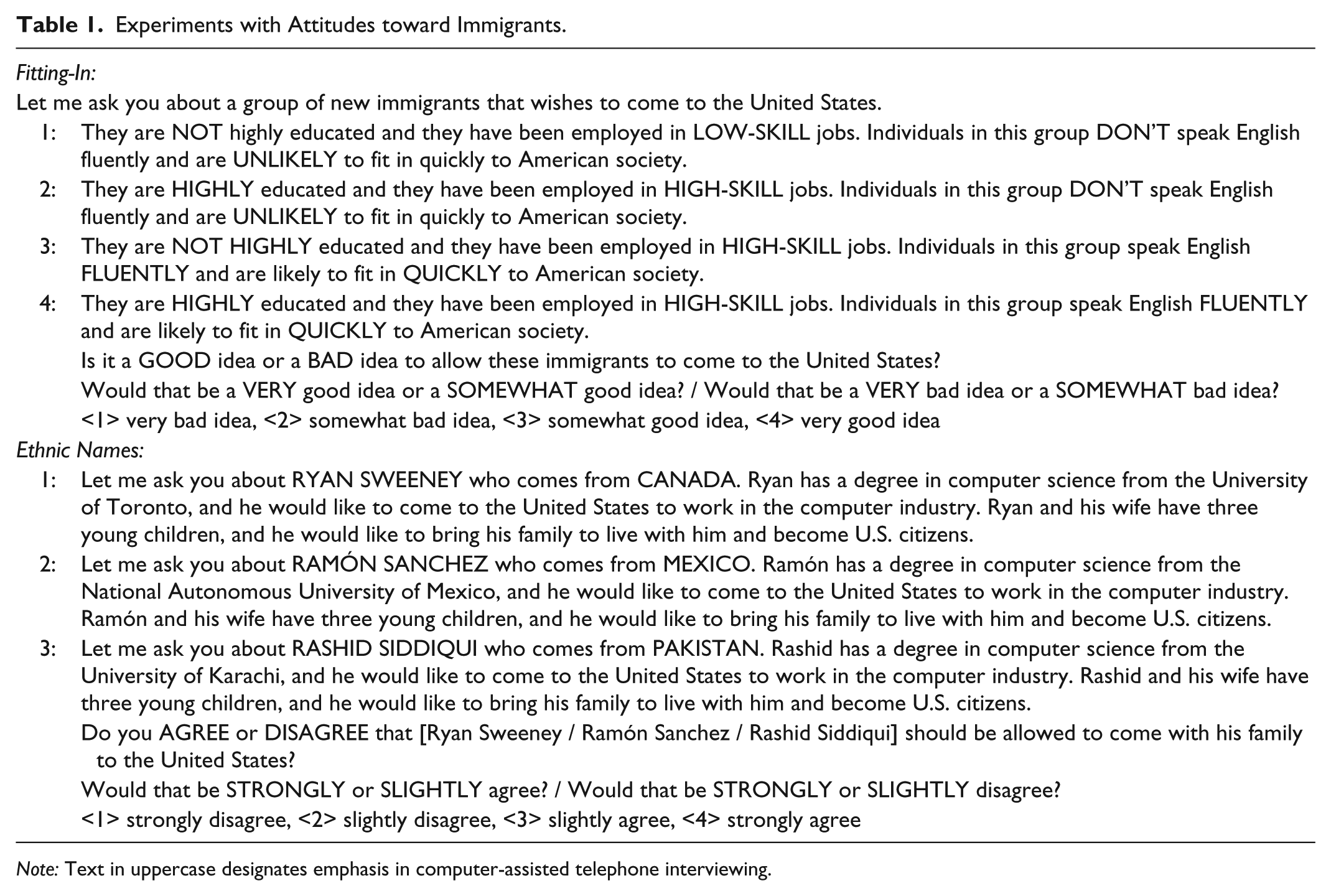
Note: Text in uppercase designates emphasis in computer-assisted telephone interviewing.
After random assignment to one of the four conditions, respondents are asked whether it is “a GOOD idea or a BAD idea to allow these immigrants to come to the United States.” Using a branching format (Krosnick and Berent 1993), respondents are subsequently probed as regards opinion strength. We combine item responses to yield a four-category item, whose categories range from “very good idea” to “very bad idea.” This is the first dependent variable in our regression analysis. 3 After analyzing the experimental treatments, we test for their possible interaction with the more novel factor of ideology.
Our second experiment, Ethnic Names, addresses the phenomenon of “person-positivity” (Iyengar et al. 2013), with respect to which laboratory participants and survey respondents display more positive attitudes toward individuals than toward groups of which the same individuals are members. For Ethnic Names, respondents are randomly assigned to one of three conditions: RYAN SWEENEY, RAMÓN SANCHEZ, or RASHID SIDDIQUI. 4 In all three cases, respondents are asked (again using the branching format) whether the individual and his family should be allowed to come to the United States. As before, this yields a four-category response item.
By design, Ethnic Names directly incorporates established competition factors by describing all three individuals as having “a degree in computer science” and wishing to “work in the computer industry.” Given these cues for high skill and low economic threat, evidence of Ethnic Name treatment effects is suggestive of symbolic threats and the influence of racial/ethnic hierarchies. Also key to Ethnic Names is incorporation of the phenomenon of person-positivity. As before, our hypothesis testing seeks to evaluate whether experimental treatments interact with respondents’ ideology.
Ideology
Ideology is our main independent variable of interest. In measuring ideology as a respondent-level attribute that is not experimentally manipulated, we follow the research design of prior studies investigating ideology-by-treatment interactions (e.g., Bloemraad et al. 2016; Hainmueller and Hopkins 2014a). It is possible that exposure to the experimental treatments itself influenced the measurement of ideology (leading to bias in key estimates), but as detailed in Appendix B, there is no evidence of this sort across the two experiments.
As summarized in Table 2, we measure ideology with a seven-point scale with responses ranging range from 1 (“strong liberal”) to 7 (“strong conservative”). Respondents are asked about identification as a liberal, conservative, or moderate; identification strength is probed with a second question. 5 Ideology enters the multivariate analysis first as a main effect in regression models predicting attitudes toward immigrants and then in tests for ideology-by-treatment interactions.
Coding and Descriptive Statistics for Independent Variables.
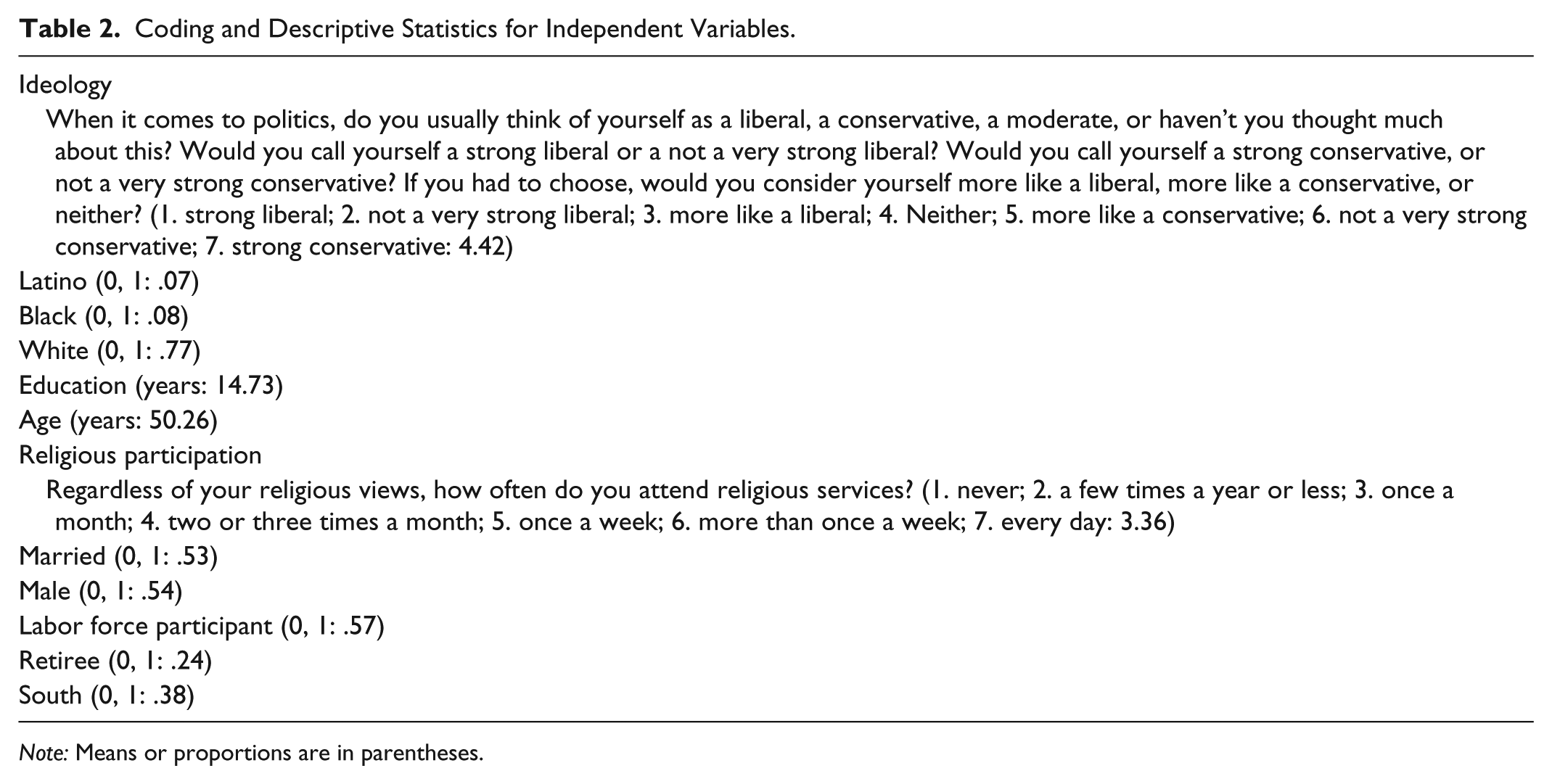
Note: Means or proportions are in parentheses.
Other Independent Variables
Table 2 lists other independent variables in the analysis. We use indicator variables for Latino, non-Latino black, and white (with others as the reference). Given a possible connection between experimental treatments and racial/ethnic identities, we report tests for interactions.
Eight other covariates round out the roster. Education and age are coded in years; religious participation is coded 1 to 7 for “never attend services” to “attend every day.” The five remaining covariates are dichotomies for married, male, labor force participant, retiree, and southern residence. Our ordered logistic regression analyses include all independent variables as covariates, but as discussed below, our primary focus is on main and interaction estimates for the experimental treatments and respondents’ ideology.
Results
Fitting-In
Table 3 presents our first set of results for the Fitting-In experiment. The table’s top half shows respondents’ levels of willingness to welcome immigrants across the four experimental conditions. Starting with the first column, nearly one in four respondents exposed to the most threat-inducing treatments (cues for low skill and high symbolic threat) react quite negatively to the prospect of allowing immigration. At .06, this figure is substantially lower among respondents exposed to the least threating treatments (cues for high skill and low symbolic threat). The remaining two conditions in the factorial design yields proportions (.14 and .19) that are closer to those observed in the highest threat condition (.24) than the lowest threat condition (.06).
Fitting-In Experiment (n = 958).

Note: Proportions choosing a response category are presented in rows.
The tests summarized at the bottom of Table 3 provide further perspective. These tests are for the significance of ordered logistic regression coefficients (not shown) predicting the effect of experimental condition. 6 The effects of both economic skill and symbolic threat reach significance using a conventional p < .05 threshold, as does the Skill × Threat interaction. Skill and threat cues both matter, and there is evidence that together they exert disproportionate influence on the formation of attitudes toward immigrants.
So far, the Fitting-In results are consistent with the insights of established scholarship. What happens when we focus on the operation of ideology? We do this by analyzing whether experimental treatments interact with individuals’ underlying identification as liberals or conservatives.
Table 4’s tests are for interactions between the experimental treatments and ideology (the first column) and between these same treatments and race/ethnicity (the second column). We again use an ordered logistic regression model, but now the model considers a series of interactions as well. There is no evidence of interaction between treatments and the race/ethnicity variables or between ideology and the symbolic threat treatment. 7 The skill treatment-by-ideology interaction is significant at the .04 level, and this p value shrinks to .02 when the interaction references the (joint) treatment of low skill and high threat. We retain this interaction in the model, noting that it accords well with patterns in the observed data that we discussed with respect to Table 3’s results.
Tests for Interactions.

We use Figure 1 to see how ideology moderates the experimental treatments in Fitting-In. Predicted probabilities for choosing “very good idea” and “somewhat good idea” are displayed in each of Figure 1’s four charts, corresponding to the experiment’s four conditions. 8 Predicted probabilities in these and all other figures are calculated by holding continuous covariates at their means and binary covariates at their modal values. In Figure 1, higher scores on the y-axis indicate a greater probability of agreement; higher scores on the x-axis indicate greater identification as a conservative.

Ideology and “somewhat good/very good idea” in the Fitting-In experiment.
In the first chart for the low-skill and high-threat condition, liberals and conservatives differ in their attitudes toward immigrants, particularly with respect to the “very good idea” response option. Keeping in mind the nonlinearity of the probabilities, we can see the largest differences in “very good idea” as we move from strongly identified liberals toward approximately the midpoint of the ideology item. Overall, the predicted difference between strong liberals and strong conservatives choosing “very good idea” is a sizable .24.
We observe a comparable pattern of ideologically based difference in attitudes for the next two conditions in Figure 1. Indeed, we already know that the relevant regression coefficient is the same for the first three conditions of the Fitting-In experiment. It is in the fourth condition that we find a different pattern. Here, the predicted differences with respect to both “very good idea” and “somewhat good idea” are smaller across the ideological spectrum. Moreover, as indicated in Figure 1’s note, these differences in predicted probabilities are not statistically significant. In the high-skill and low-threat condition, then, liberals and conservatives are equally likely to agree (see also Appendix C) with respect to the prospect of an immigrant group coming to the United States.
We can summarize these results as follows. Ideology matters substantially in the Fitting-In experiment, with conservative identifiers tending to be less positive than liberal identifiers toward the prospect of immigrant groups coming to the United States. But when experimental cues are manipulated to convey low levels of symbolic threat and high levels of immigrant skill, liberals and conservatives exhibit similar attitudes. It is now conservatives who join liberals in adopting more favorable attitudes toward the prospect of immigration.
Ethnic Names
Initial results for the Ethnic Names experiment are summarized in Table 5. Looking at the table’s first two columns, the prospect of Ryan Sweeney and his family immigrating to the United States elicits lower levels of disagreement among survey respondents than Ramón Sanchez or Rashid Siddiqui and their respective families. The “slightly agree” and “strongly agree” categories also suggests differences, with respondents showing greater favorability toward Sweeney in comparison with Sanchez and Siddiqui.
Ethnic Names Experiment (n = 982).

Note: Proportions choosing a response category are presented in rows.
These results are in keeping with findings of person-positivity scholarship, whereby attitudes are warmer when it is specific individuals rather than groups who are under consideration. But tests in the lower half of Table 5 also confirm that differences across experimental conditions are significant. Ethnic Names provides evidence of a hierarchy in which respondents still distinguish individuals on the basis of countries of origin (and identities attributed to distinct nations).
How does ideology enter the picture? Here we must return to Table 4’s interaction tests. Holding other covariates constant and using p < .05 as a threshold, there is evidence for an interaction between ideology and the Rashid Siddiqui and Ramón Sanchez conditions when these are considered as a single, homogenous treatment. When this interaction and the interaction between ideology and the Rashid Siddiqui treatment are estimated in the same model, the Wald test casts doubt on a unique Rashid Siddiqui interaction: χ2(1) = .15, p > χ2 = .70. 9 We conclude that there is evidence for the single Ideology × Rashid Siddiqui/Ramón Sanchez interaction. 10
We summarize the Ethnic Names results in Figure 2. The top three charts show predicted probabilities of “slightly agree” and “strongly agree” by ideology for the three conditions in the experiment. The bottom charts show parallel probabilities of “slightly disagree” and “strongly disagree” for the three conditions.

Ideology in the Ethnic Names Experiment.
Starting with the Ryan Sweeney condition, very high levels of agreement for Sweeney and his family to immigrate to the United States dominate the results. Indeed, just a fraction of the sample endorses either of the two disagree options. Perhaps most important, all four response categories show no variation across the ideological spectrum, indicating an underlying similarity in how liberals and conservatives reason about the prospect of an immigrant family from Canada.
The results change with respect to Ramón Sanchez and Rashid Siddiqui. Now conservatives respond less favorably than liberals. 11 We know from Table 4’s tests that the same coefficient captures the treatment-by-ideology interaction for Ramón Sanchez and Rashid Siddiqui conditions. Figure 2 provides perspective on the size of this interaction. The predicted difference in the probability of “strongly agree” between strongly identified liberals versus conservatives is .28 for Ramón Sanchez and .31 for Rashid Siddiqui. 12 Differences in attitude between liberals versus conservatives are substantial.
Extending our results to address the phenomenon of person-positivity, Ethnic Names thus provides further evidence that liberals and conservatives may respond differently in their reasoning about the same immigrant individuals. Liberals are consistently positive in their attitudes toward immigrants from three different nations. Conservatives, in contrast, appear more sensitive to cues indicating an immigrant’s country of origin.
Discussion
Immigration has transformed the populations of most developed countries, giving rise to intense conflicts over citizenship and social inclusion. These processes have been on display in the recent European refugee crisis and the ongoing evolution of populist, right-wing parties in many European nations (Lahav 2015; Semyonov, Raijman, and Gorodzeisky 2006; see also Mudde 2013), and they likely played a key role in the 2016 Brexit vote in the United Kingdom (Taub 2016). In the United States, anti-immigrant rhetoric and mobilization in the 2016 presidential campaign of Donald Trump underscores the significance of conflicts surrounding immigrant acceptance on the part of the American public.
In this study we have probed the relevance of political ideology for understanding attitudes toward immigrants. Ideology appears to be a central influence across the two SAPA experiments we have analyzed. In the Fitting-In experiment, for instance, strongly identified liberals have, on average, a .25 higher probability of choosing the “very good idea” response in comparison with their conservative counterparts. The parallel estimate in the Ethnic Names experiment is .20.
We have introduced motivated reasoning theory to get perspective on how prior beliefs shape the ways that individuals respond to information about, or interaction with, immigrant groups and individuals. Taking up an emerging focus within motivated reasoning scholarship (Jost et al. 2009; Lodge and Taber 2013), we have investigated the possibility that liberal and conservative identifiers respond differently to the same immigrants. We find evidence that ideology plays a moderating role in the two SAPA experiments we have analyzed. Liberal identifiers are consistently positive toward a variety of immigrant groups and individuals. Conservatives’ attitudes are more varied but move in positive directions when experimental cues make reference to an individual or group more closely resembling the dominant group (Ethnic Names) or when there are low levels of symbolic and economic threats (Fitting-In).
Of the three past studies investigating the moderating role of ideology in the formation of attitudes toward immigrants and immigration, our results most closely match the findings of Bloemraad et al. (2016), who unearthed interactions involving ideology in two of three survey experiments using a California sample. The sharp contrast between such results and those of Hainmueller and Hopkins (2014a) suggest the benefits of additional investigation. Likewise, although motivated reasoning theory inspired our analysis of ideology-by-treatment interactions, there is room to further unpack the specific type of reasoning individuals are engaging in. For example, scholars could see whether the patterns reported in Ethnic Names are the result of conservatives’ bias against Mexican and Pakistani origin immigrants, liberals’ social desirability bias, or some combination of both. Similarly, research could assess how individuals’ survey responses map onto their behavior in other contexts as well as their preferences regarding specific immigration policies.
Our results have additional relevance to scholarship on the development of blurry versus bright lines defining groups historically and in the collective memory of nations (e.g., Bail 2008; Fox 2012; Lamont and Molnar 2002). Boundary-making scholarship has investigated classifications schemes embedded in policies and political discourse. Here it may also be fruitful to ask what segment of the population is most receptive to these stimuli. Is it, for instance, conservatives who tend to see the social world as organized around firmer and less negotiable boundaries? Ideology may provide a complementary perspective with respect to which segment of the population sees (or can be mobilized to see) ethnic boundaries as of consequence for evaluating and reasoning about specific groups.
We believe that a sustained focus on political ideology has much to offer theory and research on the politics of immigration, extending the scope of scholarship in the United States and perhaps other national contexts as well. The SAPA data suggest that ideology may operate as a moderator when immigrant groups and individuals are (or can be) cast as having a high degree of symbolic or ethnic dissimilarity. This may provide a powerful if asymmetrical resource to politicians, and how these resources are activated in concrete settings may be useful to probe in future work.
Footnotes
Appendix A: SAPA
SAPA was developed in cooperation with the Center for Survey Research at Indiana University. Data were collected using computer-assisted telephone-interviewing methods, and numbers were randomly generated using the Genesys list-assisted method, allowing unpublished numbers and new listings to be sampled. After selecting a random sample of telephone numbers, numbers were matched to a database of business and nonworking numbers, and all matches were subsequently purged from the sample. The sample was nationwide, and at each residential number a respondent from all household members age 18 or older was selected.
The data collection staff included 9 supervisors and 41 interviewers. All interviewers received at least 12 hours of training in interviewing techniques before production interviewing. This training included the protocol for cues appearing in capitalized text and also standardized pronunciation for all proper names referenced in the survey instrument. Interviewers were instructed to read questions and response categories at a pace slower than conversation, and to use neutral probes and feedback phrases. Audio and visual monitoring was regularly conducted by the telephone survey supervisors using desktop monitoring software (VNC Viewer) and telephone units with monitoring capabilities.
All cases with confirmed valid telephone numbers were called up to 15 times, unless the respondent refused or there was insufficient time before the end of the study. Cases with unknown validity (persistent no answers or answering devices) were called a minimum of 8 times, with calls made during the morning, afternoon, evening, and weekend. Interviewers attempted to convert each “refusal” at least twice. Survey questions were pretested from April 7 to 17; production began on May 9, finishing on July 7, 2013. The average interview length was 22.2 minutes.
Acknowledgements
We thank Lauren Apgar, David Brady, Paul Burstein, Cara Davies, Kyle Dodson, Tim Hellwig, Tom Janowski, John Levi Martin, Dina Okamoto, Mark Peffley, Amanda Weiss, and Socius editors and a reviewer for comments on earlier versions of this article.
Funding
This research was supported by a grant from the Russell Sage Foundation (RSF-92-11-13).
1
Uppercase instructs telephone interviewers to pause for emphasis with respect to key terms.
2
3
The results we present are based on an ordered logistic regression model, and linear regression yields similar results. We note that the all tests fail to reject the parallel regression (e.g., using the Wolfe-Gould test, p > χ2 = .28 for Fitting-In and p > χ2 = .23 Ethnic Names).
4
Among changes to the SAPA version of Ethnic Names is the introduction of a control condition for a majority group member or symbolically nonthreating individual (“Ryan Sweeney”). See Harell et al. (2012:507–508) for the earlier version of this experiment fielded in surveys in Canada and the United States and  for results for its fielding in seven countries (Australia, Canada, Japan, South Korea, Norway, the United Kingdom, and the United States).
5
Although our focus in this study is on political ideology, we note that the inclusion of partisanship in the analysis yields very similar main and interaction effect estimates for ideology.
6
7
9
The test for the combined Rashid Siddiqui and Ramón Sanchez interaction is χ2(1) = 5.55, p > χ2 = .02.
11
In both these conditions “strongly disagree” and “slightly disagree” responses also show an interaction with ideology, but overall levels of disagreement are much lower in comparison with overall levels of agreement (suggesting again the relevance of the person-positivity phenomenon).
12
We note that the .28 and .31 estimates differ because of the nonlinearity of the probability function in the ordered logistic regression model.