




Abstract
Environment has become a major social problem for a greater number of people than ever before in recent years. As a consequence, in-depth research on green marketing and green purchasing has increased significantly. Although academic researchers have examined antecedents of green purchasing behavior, there still is room for further progress. One such area that needs further investigation is the role of generativity on green purchasing behavior because sustainability requires a long-term perspective that is embedded in the concept of generativity. This study examines the impact of generativity on consumer green purchasing behavior. Generativity refers to individuals’ beliefs that their current behaviors have consequences that extend into future generations. Moreover, the moderating roles of man-nature orientation and perceived behavioral control on generativity-green purchasing behavior link are also examined. Based on moral norm-activation theory, value-belief-norm theory, and theory of planned behavior, hypotheses were developed. Data were collected from a homogenous sample of 416 university students of four faculties through the non-probability sampling technique. Hierarchical regression analysis was used to test the hypotheses. Results show that generative consumers are more likely to show green purchasing behavior. Man-nature orientation and perceived behavioral control positively moderate the relationship between generativity and green purchasing behavior. Findings revealed that consumers who possess a greater concern for future generations, and high on man-nature orientation and perceived behavioral control constitute a segment that will be more likely to engage in green purchasing behavior, enabling effective targeting of marketing communications.
Keywords
Introduction
Over the last decade, demand for goods and services has increased dramatically, resulting in the depletion of natural resources and severe environmental degradation. Climate change has emerged as a critical issue for people, industries, and communities. The main challenges that the majority of stakeholders face on earth are environmental destruction, abuse of natural resources, and industrialization (Yew et al., 2019). A growing body of research has attempted to explore consumers’ views toward environmentally friendly goods and services in order to address these issues (e.g., Afridi et al., 2021; do Paço et al., 2013a; Groening et al., 2018; Shiel et al., 2020). While, human activity is causing a slew of serious environmental problems (Change, 2014), and households are a significant source of greenhouse gas emissions (Pothitou et al., 2016), consumer eco-friendly behavior in such cases is very critical (Steg & Vlek, 2009) and should be prioritized in developed as well as developing countries (Hsu, 2016; Keho, 2016). Although people are more aware of climate change and its environmental implications than ever before (IPCC, 2014), the proportion of consumers who take personal environmental responsibility is relatively low (Cleveland et al., 2012).
Green purchasing behavior (GPB) refers to environmentally-conscious usage, where the environmental impact of purchase, usage, and disposal of particular products or the use of different environmentally sustainable resources is understood by the consumer (Moisander, 2007). Moreover, GPB is the purchase of products that could benefit the environment or decrease the harm caused to the environment (Mainieri et al., 1997), and it has a direct effect on the environment (Mostafa, 2007). GPB is critical as unplanned product purchases may have a significant environmental effect (Joshi & Rahman, 2015). Grunert (1995) claimed that 40% of environmental harm was done by consumer households. It shows that consumers can prevent or reduce the harm to the environment by purchasing environmentally friendly products or services. Earlier studies have shown a positive attitude of consumers toward the protection of the environment (Arvola et al., 2008) and they have articulated demand for the green product (Bockman et al., 2009), but still, there is scarce research that suggests that purchase of an environmentally friendly product or services has increased.
Despite consumer positive attitudes toward the environment, the share of the environmentally friendly product is still very low (Bray et al., 2011). That is because consumers do not generally receive an uplifting disposition to the acquisition of green products. Amid thorough analysis, studies often yield conflicting findings on the intention and actions of consumers toward green purchasing. This is not yet apparent why environmentally friendly consumers behave differently when buying the product and the service (Biswas, 2017). Alwitt and Pitts (1996) called this an attitude-behavior gap. In recent years, this behavioral gap has been explained in several ways. The relationship between attitudes and behavioral constructs is greater when measured at the level of abstraction (Ajzen & Fishbein, 1977, 1980). However, when attitudes are more prevalent, their statistical association is weak (Fransson & Gärling, 1999). Another reason is that not all relevant variables may be included in the model of environmental behavior. Due to the complexity of the interaction between behavioral aspect and behavior itself, all related factors in a common model is hard to use. In most cases, self-interest is the main driver of consumer behavior, however, this is not the case for environmental behaviors where altruistic propensity influences environmental awareness, intentions, and actions (Wesley Schultz, 2001). Furthermore, various social structure variables such as race, gender, and ethnicity have also been studied in relation to environmental friendliness (Carrus et al., 2005; Dietz et al., 1998; Johnson et al., 2004; Olli et al., 2001; Zelezny et al., 2000). Moreover, the positive impact of perceived consumer’s effectiveness on their green behavior is confirmed by previous scholars (e.g., Heo & Muralidharan, 2019; Jaiswal & Kant, 2018). There has also been a growing body of research linking value orientation and environmental concerns. These findings support the idea that value orientation is associated with a variety of behavioral and environmental concerns (Helm et al., 2018; Verma et al., 2019). While a variety of individual and organizational factors and their impact on environmental behavior have been investigated, the effect of how an individual’s belief system is related to green purchasing is still unexplored. Thus, the primary goal of this paper is to comprehend the role of generativity (GEN) in pro-environmental behavior such as GPB.
GEN is described as one’s future orientation (Erikson, 1950). It could play a major role in eco-friendly behaviors because one of the most important aspects of warranting a greener future is reducing the use and manufacturing of goods that are harmful to the environment (Kropfeld et al., 2018). Consumers high on GEN are involved in the restoration and development of ecological systems and the well-being of future generations (Afridi et al., 2021; Aubin & McAdams, 1995). Most studies imply that creating a green environment is essential, but the extent to which it affects consumer decisions is rarely considered. Given that GEN raises the importance of work on the possible consequences of existing decisions in the future, it will be interesting to know how it shapes consumers’ GPB. However, a list of important and potential individualistic variables that might play an important boundary condition in individual GPB is yet to be examined (Joshi & Rahman, 2015). Further research is suggested in the evaluation of individual factors that might lead to GBP. For this purpose, two important attributes (man-nature orientation (MNO) and perceived behavior control (PBC)) related to individualistic values are taken as potential moderators in the GEN-GBP link. MNO is expressed as “people should behave according to the way of nature” (Chan, 2001, p. 392). Since MNO determines the association of human beings and the environment, therefore, it could interact with an individual’s belief system to affect GPB (Chan & Lau, 2000). Individuals with low MNO feel that they control nature (Jandt, 2004), whereas individuals with high MNO live according to nature. MNO has a direct and positive influence on the attitude toward green products (Chan, 2001; Chan & Lau, 2000; Wijaya, 2009). Therefore, individuals with high MNO tend to possess a positive attitude toward GPB. MNO is one of the prevailing characteristics of consumer interest orientation based upon the interaction between humans and nature (Diyah & Wijaya, 2017). It encourages people to live by the nature (Chan & Lau, 2000). Consequently, a consumer with a perception of man-nature orientation may have a role that encourages green product consumption. Furthermore, value-belief-norm (VBN) theory also states that environmental values are the main driver for behavioral responses (Stern, 2000). It implies that individuals who are high on generativity and MNO are potentially more worried about eco-sustainable transactions.
PBC refers to the degree to which individuals have control over their behavior and they can easily manage their behavior (Ajzen, 1991). Numerous studies have shown that despite a positive attitude toward a sustainable environment, individuals hardly convert it into green purchase intentions and behaviors (Chen, 2007). There are certain obstacles such as high price and product unavailability (Carrigan & Attalla, 2001; Vermeir & Verbeke, 2006) that might prevent an individual to convert a positive attitude into green purchase intentions and behaviors. Despite the generative concern, individuals may not be able to engage in actual green purchasing behavior due to such obstacles. In such situation, we argue that PBC might play a crucial role. Since, over-consumption is leading to depletion of natural resources (Chen & Chai, 2010) and consumer households are significantly harming the environment (Grunert, 1995), control over one’s own behavior to decide what to purchase might serve as a boundary condition. When individuals have greater control over themselves, they are more likely to follow certain behavior. Moreover, the theory of planned behavior (TPB) suggests that PBC is the most dominant factor in swaying behavior change (Armitage & Talibudeen, 2010) and it was found to account for a significant amount of variance in individual intentions toward environmental friendly behavior (Greaves et al., 2013). Recent studies have indicated that PBC is a clear indicator of intentions and behavior because the feeling of control improves an individual’s willingness to exert extra effort to effectively execute a specific behavior (Armitage & Conner, 2001; Ma et al., 2012; Wang et al., 2014). Besides, Webb et al. (2013) argued that individuals’ intention to accomplish a particular behavior would be stronger if they possess more control over themselves. In other words, individuals with high PBC and concern toward the sustainability of the environment for the future generation will be more likely to form the intention to buy environmentally friendly products and services (Donald et al., 2014).
Previously, the theory of reasoned action (TRA) and TPB were used to analyze the model of green consumer behavior to understand the attitude and behavior of consumers. The TRA focuses on behavior intention, while the TPB model incorporates PBC to predict green purchasing behavior (Paul et al., 2016). Despite such theoretical models, creating a comprehensive model that forecasts consumer GPB remains a challenge. Overall, previous studies propose a gap between consumer attitude toward the environment and actual environmentally friendly behavior and suggest that various other factors that affect consumer GPB may be envisaged (Biswas, 2017; He et al., 2016). The present study with the help of a multi-theoretical approach aims to contribute by proposing a comprehensive framework that might better explain the predictors of GPB. To date, this is the first study that will examine the moderating effects of man-nature orientation and perceived behavioral control on the relationship between generativity and green purchasing behavior. Moreover, this study is conducted on university students. There were two main reasons for selecting university students as the sample for this study. First, a review of literature observed that young adults are more sensitive to pro-environmental behavior (Devenport et al., 2021; Evanschitzky & Wunderlich, 2006; Han et al., 2011; Straughan & Roberts, 1999; Tiplady & Menter, 2021; Zimmer et al., 1994). Young people have higher levels of environmental values, which account for their stronger citizenship behavior than older people (Kanchanapibul et al., 2014; Ru et al., 2019). Second, for this study, it was required that a homogenous sample be selected, and the requirements of the homogenous sample were satisfied by the university students. The remaining part of the present study is organized as follows. Literature review along with the theoretical support for hypotheses development are presented in the next section. Then, methodology, analysis, and results are discussed. Finally, discussion, theoretical and practical implications, limitation, and future research recommendations, and conclusion are presented. Figure 1 presents the conceptual framework of this study.

Conceptual framework.
Literature Review and Hypotheses Development
Generativity and Green Purchasing Behavior
GEN concept was originally proposed by Erikson (1950) that includes concern for establishing and guiding future generations. GEN is expressed as “a desire to invest one’s substance in form of life and work that will outlive the self” (Kotre, 1984, p. 10). Later on, Urien and Kilbourne (2011) defined GEN as “a resource encouraging people toward the public good, maintaining continuity from one generation to the next” (p. 73). Besides, McAdams and de St Aubin (1992) express GEN with the help of seven interrelated attributes which are: “cultural demand,” “inner desire,” “generative concern,” “belief in the species,” “commitment,” “generative action,” and “personal narration.” These attributes are interlinked, for instance, inner desire or cultural demand encourages generative actions. However, the focus of the present study is the “generative concern” which is referred to the extent to which an individual articulates a conscious concern or obsession with having a positive and lasting impact on the next generation (McAdams & de St Aubin, 1992). Consumers high on GEN are highly involved in the restoration and development of ecological systems. They are also involved in the well-being of future generations (Aubin & McAdams, 1995) and exhibit GPB (Afridi et al., 2021).
Green consumers are those who consider the impact of their consumption on the environment and are willing to make changes in their behavior (Moisander, 2007). GPB is important because unplanned consumption may significantly affect the environment (Wang et al., 2020). One of the most important components of ensuring an “ecological future” is reducing the use and manufacturing of goods that are known to harm the environment (Liobikienė & Bernatonienė, 2017). Though, the psychological factors linked with individual behavior toward the environment are widely studied (Kilbourne & Beckmann, 1998; Talbi et al., 2020; Varela-Candamio et al., 2018). However, the spectrum of alternatives is wide enough to explain how individuals view the world. Some of these states are temporary, while others will last a long time. The effects of these states on individuals and the environment are of primary interest because their involvement in the decline or restoration of the ecosystem has a long-lasting impact on the coming generations. This raises the issue of “intergenerational justice,” which is often overlooked in marketing and other business-related fields.
Since a significant portion of consumer transactions cause environmental harm (Grunert, 1995), with a detrimental impact on the next generations, consumers’ GPB in such cases may perform a major role in avoiding or reducing environmental damage. Despite consumers’ optimistic attitudes toward a greener environment (Arvola et al., 2008) and desire for green goods (Bockman et al., 2009), research that suggests an increase in the purchase of environmentally friendly products is scarce. The concept of GEN in the model of GPB is imperative to study because it is the condition of the environment that the current GEN will pass on to future GEN. Gen was previously examined with a variety of variables. For instance, Ding and Schuett (2020) examined the role of GEN in volunteer’s commitment toward environmental stewardship and that GEN significantly enhances volunteer’s commitment toward environmental stewardship. Similarly Hart et al. (2001) verified the positive role of GEN in social involvement. Likewise, the positive role of GEN and “volunteering” (Agostinho & Paço, 2012), “social motives” (Timilsina et al., 2019), and “personality” (Navarro-Prados et al., 2018) have been verified. Further, the importance of GEN in “environmental commitment” (Chan, 2009), “environmental engagement and attitude” (Matsuba et al., 2012), and “environmental activism” (Alisat et al., 2014).
While a variety of individual and organizational factors and their impact on environmental behavior have been investigated, scholars have recently given importance to the concept of GEN in the GPB models. For instance, Afridi et al. (2021) investigated the impact of GEN in GPB and revealed that high GEN individuals have shown greater concern toward GPB. Similarly, Shiel et al. (2020) examined the role of GEN in consumer green purchase intentions and found that GEN positively influences consumers’ green purchase intentions. Thinking about the planet and future generations is likely to be reflected in one’s behaviors. If an individual believes that his/her actions would have far-reaching consequences on future generations, the propensity to behave in greener ways would increase. For example, planting trees so that future generations could breathe well is one of the actions that GEN could encourage. Extending this argument, the most important behavior that seems to have greater environmental concerns is the purchase of goods and services with a greener inclination. Moreover, Urien and Kilbourne (2011) reported that individuals with high scores on GEN are more likely to be eco-friendly when their self-enhancement levels are high. This is because individuals who think their contribution to the future is valuable are more likely to buy green. Besides empirical evidence, the moral norm-activation theory of altruism also supports the argument. It states that pro-environmental behavior occurs when individuals become aware of the adverse effects of their conditions and take actions that could avert them (Schwartz, 1973). Since, the GEN concern is referred to the extent to which an individual articulates a conscious concern or obsession with having a positive and lasting impact on the next generation (McAdams & de St Aubin, 1992). We believe that a person high on GEN concern would exhibit GPB. Thus, with the help of the above empirical and theoretical support, the following hypothesis of the study is formulated.
H1: There is a meaningful impact of generativity on consumer green purchasing behavior.
Moderating Role of Man-Nature Orientation
The role of GEN has previously been linked positively with green purchasing behavior by various scholars (Afridi et al., 2021; Giménez García-Conde et al., 2016; Shiel et al., 2020; Urien & Kilbourne, 2011). However, it is still not clear that when and how GEB leads to GPB. Because, despite the positive attitude toward the safety of the environment, the share of environmentally friendly products and services is still low (Bray et al., 2011). It shows that GEN concern alone may not be enough to encourage individuals toward environmentally friendly purchasing. Thus we argue, that MNO along with generative concern might have a stronger impact on individual GPB. Concern for protecting the environment and taking care of the planet might drive individuals who have generative beliefs to engage in purchasing green products and services. If an individual believes that nature should coexist with him/her and that his actions would define how this harmony can be achieved, the effect of such beliefs on generativity is likely to be stronger when it comes to green purchasing. That is generative beliefs together with a strong inclination to keep nature as it is, would mean that the individual acts in ways that could protect the environment. Purchasing is a decision that is to be taken on a daily basis as an individual has to buy. This decision to purchase is dependent on a number of factors but what one believes in terms of the environment is definite to create an impact. Because, MNO is referred to an individual’s ability to live with nature in harmony (Kluckhohn & Strodtbeck, 1961), consumers who have greater MNO are likely to increase the effect of generativity on green purchasing behavior. Societies with low MNO think that they dominate nature (Jandt, 2004) while societies with high MNO live in harmony with the environment. Societies with a high level of human nature can therefore tend to have a positive attitude toward green products. Moreover, the theory of VBN (Stern, 2000) also states that environmental values are the principle attributes that foster pro-environmental behavior. Since one aspect of GEN is to protect the environment for the well-being of the future generation and MNO specifies the relationship of the individual with the environment may likely have a stronger impact on individuals GPB.
Moreover, empirical studies have also identified a strong correlation between the value orientation and attitude of people. For instance, Sreen et al. (2018) have recently confirmed the direct positive impact of MNO on green purchase attitudes that further leads to green purchase intentions. Likewise, Liang and Chaipoopirutana (2014), acknowledge the positive role of MNO in attitude toward the purchase of green electronic products. Similarly, Chan and Lau (2000) with the help of ecological effect and ecological knowledge verified the impact of MNO on green purchase intentions that lead to green purchasing behavior. Furthermore, the positive impact of value orientation on environmental concern and eco-friendly behavior has also been acknowledged by numerous scholars in the past (e.g., Poortinga et al., 2004; Schultz & Zelezny, 1998; Stern & Dietz, 1994).
A consumer who considers environmentally sustainable products are supposed to have orientation values toward human relation with nature and knows the environmental effects of consumption. MNO is one of the dominant consumer value orientation’s attributes that focuses on the human relationship with nature (Diyah & Wijaya, 2017) and directs humans to live in harmony with nature (Chan & Lau, 2000). A consumer with a MNO value can therefore have an attitude that encourages the consumption of green products. Moreover, Chan and Lau (2000) added that MNO determines the association of human being and their environment. The authors further suggested that MNO could positively affect individual green purchasing behavior. MNO can be described as human-friendly behavior toward nature out of nature love and nature protection. Individuals who possess high MNO are likely to be more concerned about eco-friendly purchasing. Individual who lives in the harmony with nature will act in a way to protect the nature and may likely be indulge in more eco-friendly consumption. Thus, under the lights of VBN theory and empirical supports, we argue that GEN when combines with MNO would have a stronger impact on the individual GPB. Thus the following hypothesis of the study is developed.
H2: Man-nature orientation positively moderates the relationship between generativity and green purchasing behavior to strengthen generativity on consumer green purchasing behavior.
Moderating Role of Perceived Behavioral Control
While several studies have acknowledged that individuals with a positive attitude toward green purchasing behavior might not have the intention to purchase the green products when perceiving difficulties (Chen, 2007). There are certain obstacles such as high price and product unavailability (Carrigan & Attalla, 2001; Vermeir & Verbeke, 2006) that might prevent an individual to convert the positive attitude into green purchase intentions and behavior. Despite the GEN concern, individuals may not be able to engage in actual green purchasing behavior due to such obstacles. In such a situation, we argue that Perceived behavioral control (PBC) when combined with generative concern would have a stronger impact on individual GPB. Because, PBC is considered a dominant attribute in influencing behavior change through which individuals can regulate their actions and handle their conduct effectively (Ajzen, 1991), and when such a dominant attribute of behavior change is combined with individual altruistic values such as environmental concern for future generation may have a greater impact on individual GPB. This argument is also supported by the theory of moral norm-activation (Schwartz, 1973) which states that individuals would be engaged in pro-environmental behavior if they have the knowledge and concern for the environment and the well-being of others. When individuals feel easy and have the knowledge and concern toward the sustainability of the environment for future generations, they will be more likely to form the intention to consume less and buy environmentally friendly products and services (Donald et al., 2014). Individuals with greater control over themselves are more likely to follow certain behavior such as; green purchasing behavior.
Besides the theoretical support, we found some empirical studies that endorse our argument. For instance, PBC was found to indicate substantial variance in employees’ intentions to shut their computers off in the workplace and use video conferencing instead of meeting (Greaves et al., 2013). If a person has sufficient control over the behavior, it is more possible that the person will conduct the action when there is a chance to do so (Ajzen, 1991). Individual intention to accomplish a particular behavior would be stronger if he/she possesses more control over themselves (Webb et al., 2013). Previous research has found that PBC is a direct predictor of attitudes and behaviors because feelings of control increase the degree to which individuals are able to exert extra effort to effectively perform a specific behavior (Armitage & Conner, 2001). Moreover, Maichum et al. (2016) with the help of the extended theory of planned behavior examined the purchase intentions of green products in the Thai context. They proposed the positive association of PBC with purchase intention. Their findings revealed that PBC has a significant positive influence on consumer green purchase intentions.
Furthermore, Kalafatis et al. (1999) examined the determinants of consumer green purchasing behavior with the help of the theory of planned behavior. They tested their proposed model in UK and Greece. They hypothesized that PBC is positively affecting consumer green purchase intentions. Their result revealed that a positive and significant impact of PBC on consumer green purchase intentions. Similarly, Shaw and Shiu (2002) reported that attitudes and perceived control behavior were major determinants of purchase intentions. More recently, Wang et al. (2016) through TPB examine the factor influencing resident e-waste recycling behavior. They examined the direct and indirect impact of PBC on consumer purchase behavior. Their findings confirmed the PBC has a significant impact on consumer purchase behavior. However, these studies have taken PBC either as an independent variable or mediating variable. Though the moderating role of PBC between attitude toward organic products and intention to buy organic products has been verified previously by Kim and Chung (2011). However, we found no single study that examined the moderating role of PBC on the relationship of GEN and GPB. Thus, based on the above theoretical and empirical discussion, we propose that individuals who are more concerned about the future generation and high PBC may likely be involved in green purchasing behavior. Henceforth, the third hypothesis of the study is formulated;
H3: Perceived behavioral control positively moderates the relationship between generativity and green purchasing behavior to strengthen generativity on consumer green purchasing behavior.
Method
Sampling
This study was conducted on the students of a university in the North of Pakistan having four faculties (arts, humanities, computational, and biological). This university prioritizes sustainability and environmental issues and has resulted in the development of new buildings taking into consideration the environmental and energy-saving concerns. Furthermore, the university also has environmental protection and sustainability policy to install these values in their students. A sample of university students has been selected for this study as they are more informed and concerned about the issues of environmentalism and sustainability and makes up for a major portion of customer indulging in green purchases (Furlow & Knott, 2009). Further review of literature also noticed that young adults are more sensitive to the study constructs that is green purchasing behavior (do Paço et al., 2013c), generativity (Shiel et al., 2020), and man-nature orientation (do Paço et al., 2013b). Lastly, this target group is most crucial for the development of environmentally conscious populations and provides a snapshot of the future regarding green behaviors. This study evaluates the effects of generativity on GPBs and further analyzes the moderating effects of MNC and PBC on this relationship. In both these cases, the level of these variables will not be the concern within the target group of university students making it homogeneous and thus fulfilling the requirements of the study as convenience sampling would be employed for data collection. In total, 800 surveys were distributed. The final usable sample for this study was 416 students from four faculties of the university. The sample consisted of 67% (281) male and 33% (134) females. All the respondents were from the undergraduate programs of the university. The mean age of the sample was 23 years with a standard deviation of 2.2 years.
Measurement
Generativity: 16-items GEN scale was adapted from Aubin and McAdams (1995). Sample items include “I feel as though my contribution will exist after I die” and “I think that I will be remembered for a long time after I die.”
Green purchasing behavior: GPB was measured with a 10-items scale developed by Straughan and Roberts (1999). The sample items include; “I try to buy energy-efficient products and appliances” and “I have switched product/brands for an ecological reason.”
The respondents rated these scales on a seven-point Likert scale, with 1 indicating “strongly disagree” and 7 indicating “strongly agree.”
Man-nature orientation: A 5-items scale adopted from Chan (2001) to measure MNO. The sample items include; “Human beings need to understand the ways of nature and act accordingly” and “we should maintain harmony with the nature.”
Perceived behavioral control: PBC was measured with 5-items adapted from Ajzen and Fishbein (1980). The respondents rated these scales on a seven-point Likert scale. Items include “How much control do you have over whether you do or do not purchase organically grown products?” “(1 = very little control to 7 = complete control).” Items were averaged to compute a scale score, with higher scores indicating greater perceptions of control toward organic consumerism. Questionnaire with all items can be found in appendix.
Results
To assess the validity of the model, exploratory factor analysis (EFA) and confirmatory factor analysis (CFA) were used. The EFA results showed that all items significantly loaded on their respective factors with all factor loadings above .5 and cross-loading difference below .4 displaying sufficient factor structure. CFA was used to evaluate the to assess the discriminate and convergent validity of the model the four-factor model provided the best fit for the data (χ2/df = 1.97, GFI = .903, CFI = .911, NFI = .9104, RMSE = .046).
Table 1 shows that there exists a positive relationship between age and level of the undergraduate semester (R = .114, p < .05), however, the correlation of the control variables age semester and gender isn’t significant with the dependent, independent, and moderating variables. The independent variable GEN is positively and significantly correlated with the dependent variable GPB (R = .320, p < .01). The moderator PBC has a positive relationship with independent variable GEN (R = .175, p < .01) and GPB (R = .290, p < .01). Similarly, the second moderator MNO also has a positive and significant association with GEN (R = .157, p < .01) and GPB (R = .218, p < .01). These results provide partial evidence for the acceptance of H1.
Correlation Among Study Variables.

Note. *p < .05; **p < .01.
To test the hypotheses the following regression analyses in Table 2 have been conducted.
Hierarchical Regression Analyses.

.05, **.01 significance level.
Table 2 shows the results of hierarchical regression analyses to test the direct and moderating based hypotheses. In model 1, the control variables were regressed against the dependent variable GPB which resulted in an insignificant R2 value of .003. In model 2, the independent variable along with the control variables were regressed against the dependent variable GPB to test the study hypothesis 1 that “GEN is positively and significantly associated with consumers’ GPB.” The results provide ample proof for the acceptance of this hypothesis with β = .219 (p < 0.01). To assess the moderating effects of PBC and MNO on the relationship between GEN and GPB models 5 and 6 would be used. In model 5 the moderating variable PBC and the interaction term of PBC and GEN are regressed against GPB. The results show that GEN (β = .272, p < .01), PBC (β = .228, p < .01), and their interaction term (β = .077, p < .05) has a significant effect on GPB.
Figure 2 plot shows that PBC strengthens the positive relationship between GEN and GPB. This provides significant proof for the acceptance of the second hypothesis of the study which stated that PBC positively moderates the relationship of GEN and GPB so that it will strengthen the positive impact of GEN on consumer GPB. In model 6, the moderating variable MNO and the interaction term of MNO and GEN are regressed against GPB. The results show that GEN (β = .294, p < .01), MNO (β = .189, p < .01), and their interaction term (β = .064, p < .05) has a significant effect on GPB. The results are plotted in Figure 3.
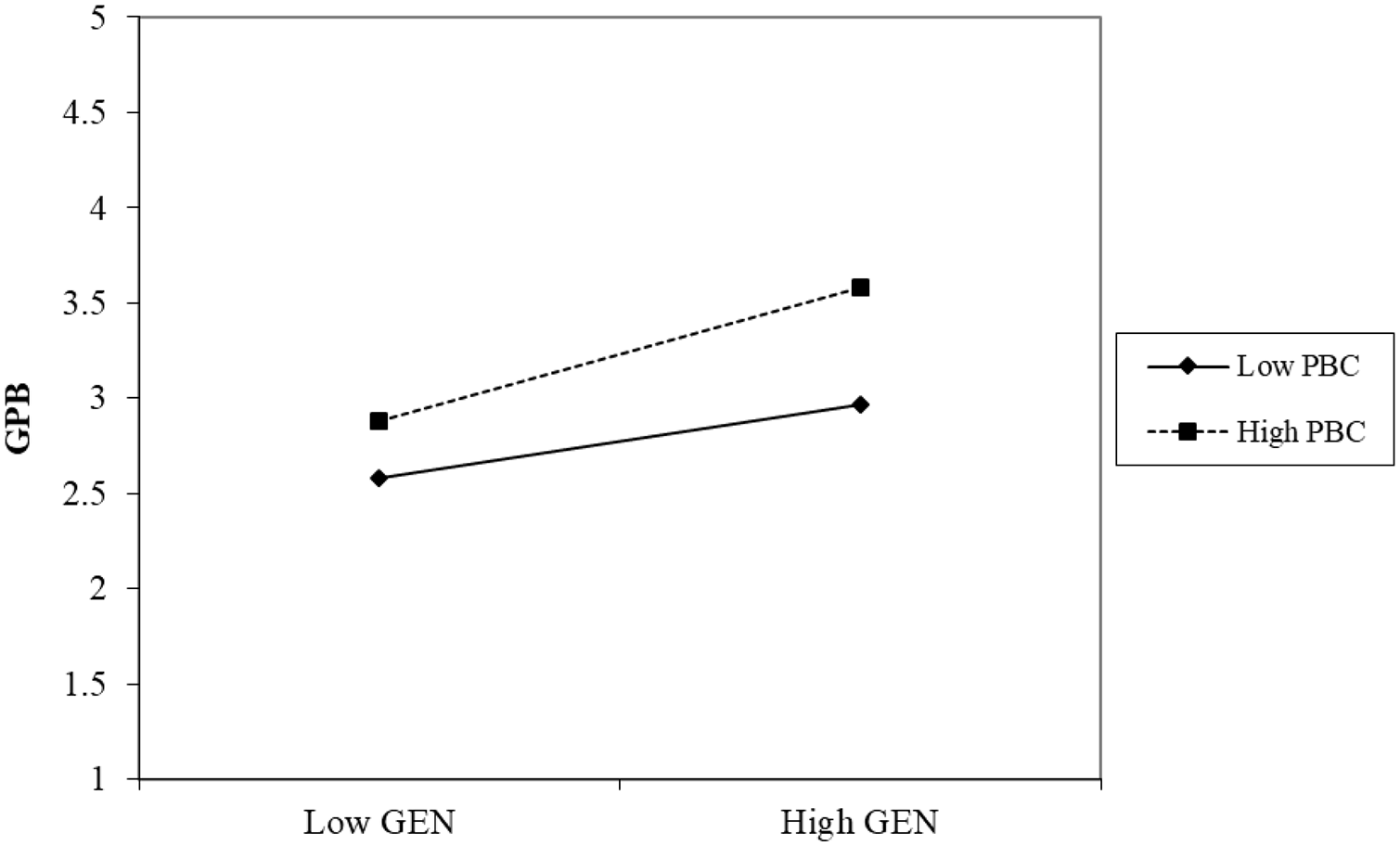
Moderating effects of PBC.
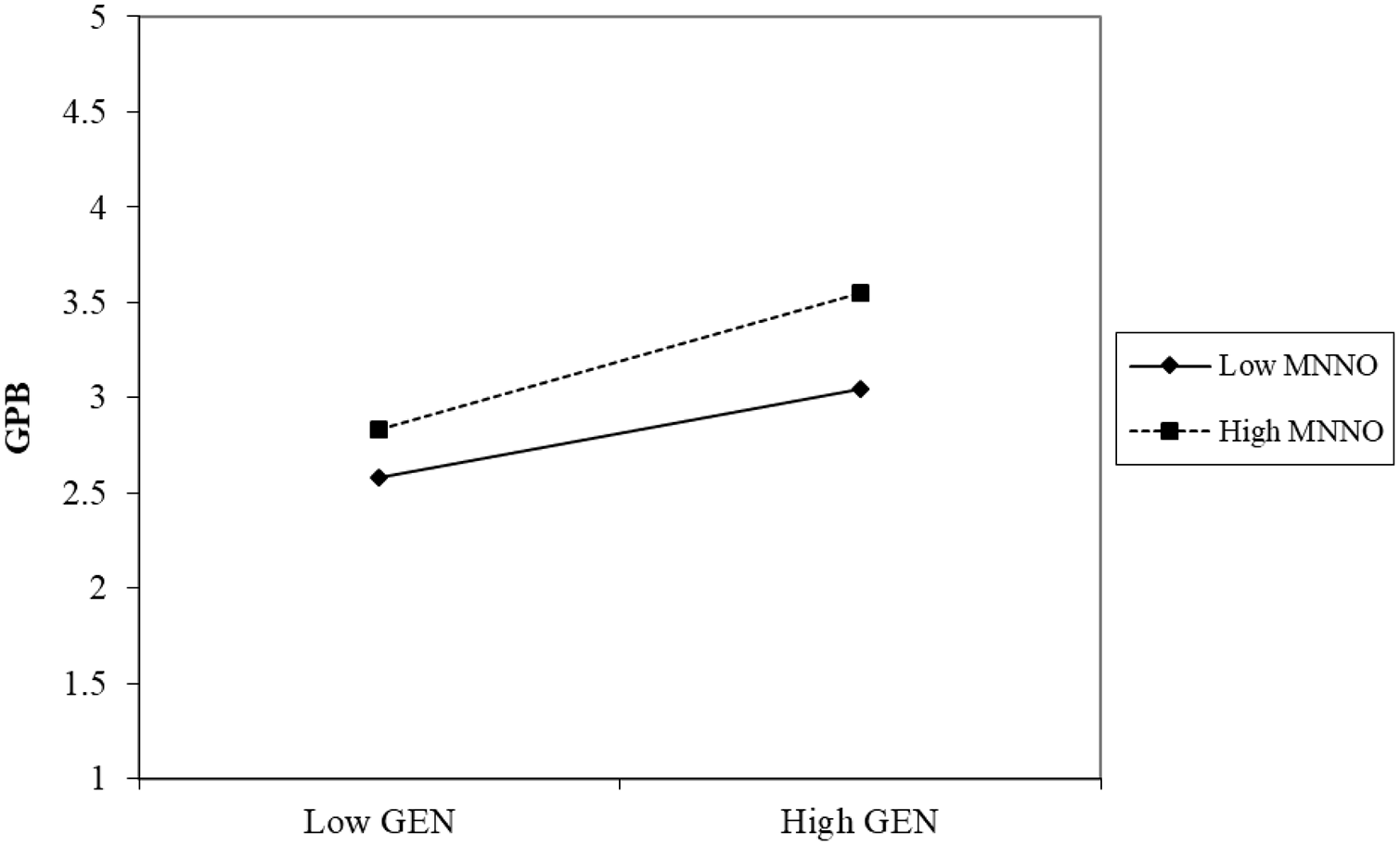
Moderating effects of MNO.
Figure 3 shows that MNO strengthens the positive relationship between GEN and GPB. This provides significant proof for the acceptance of the third hypothesis of the study which stated that MNO positively moderates the relationship of GEN and GPB so that it will strengthen the positive impact of GEN on consumer GPB.
Discussion
The need for sustainable growth has been exacerbated through environmental destruction, temperature anomalies, and natural resource depletion, with a stronger understanding of the value of protecting the environment for future generations. Besides, eco-friendly consumption has not only increased but become the priority for both; researcher and the producer of eco-friendly goods and services. Despite several studies that proposed various models to examine the association of different concepts that affect GPB, the gap between consumer intention and actual purchase behavior is still not clear. The present study, therefore, constituted a comprehensive framework by adding individual and psychological variables with the help of multiple theoretical perspectives to the model of GPB. The model was tested by collecting data from the students of four faculties of the university situated in the Northwest of Pakistan.
The present research aimed both to enhance our awareness of the factors affecting GPB and to foster discussion in the literature concerning GPB. The present study adds GEN into the green purchasing behavior model in a view that concern for future generations graces greater consideration because it forms part of the fundamental concept of sustainable growth. Moreover, examining the role of GEN in this paper is with the implication that although many researchers have explored a multitude of variables that encourage ecological use, care for the future, and the well-being of others, has got limited consideration. Besides, this study extended the model of Shiel et al. (2020) by adding MNO and PBC as moderators which have never been tested before in the context of GEN and GBP.
Consequently, hypotheses were developed in the light of empirical and theoretical literature. Results show that GEN is positively associated with GPB. The finding of this hypothesis is consistent with Afridi et al. (2021), do Paco et al. (2019), Shiel et al. (2020), and Urien and Kilbourne (2008, 2011). Findings confirm that those consumers who have greater concern for future generations possess stronger behavior toward the purchase of green products and services. The finding of this hypothesis is also in line with the theory of moral norm-activation (Schwartz, 1973) which states that consumers who have a greater concern toward the environment for the sake of the future generation and the well-being of others are found more concerned toward GPB.
Similarly, the moderating role of MNO was examined and it was found that MNO significantly moderates the association of GEN and GPB. Findings suggest consumers who are high MNO will strengthen the impact of generativity on green purchasing behavior. In other words, individuals with high MNO are potentially more worried about eco-sustainable transactions. Anyone who resides by nature will behave to conserve it and will consume more environmentally friendly. Though the interactive role of MNO is novel and has not been examined previously, there are some studies available that examined the role of MNO in explaining green attitude and green consumption (Chan & Lau, 2000; Sreen et al., 2018). Moreover, the finding of this hypothesis is also consistent with VBN theory (Stern, 2000) which states that environmental values are the principle attributes that foster pro-environmental behavior.
Besides, the moderating role of PBC has also been examined, and verified that PBC significantly moderates the relationship of GEN and GPB. This means, individual they are high on PBC possess more control on their behavior and will strengthen the impact of generativity on green purchasing behavior. In other words, individuals with high on PBC possess greater control over their behavior and concern toward the sustainability of the environment for future generations, will buy environmentally friendly products and services. The finding of this hypothesis is in line with the findings of Kim and Chung (2011) and La Barbera and Ajzen (2021) who verified the moderating role of PBC on attitude and intentions to purchase green products. Moreover, our finding is also consistent with the theory of moral norm-activation, and the theory of planned behavior which states that environmental values and behavioral control have a significant role in behavioral change (Ajzen, 1991; Schwartz, 1973).
Theoretical Implications
This paper is groundbreaking and seeks to establish a concept which, interestingly, has received little literature coverage. Concerning green purchasing behavior, the concept of generativity has been explored in a new manner. This study proposed a new model that defines the underlying mechanism that links GEN with green purchasing behavior. Moreover, this study adds literature to the concept of GEN and GPB by introducing new promising but surprisingly overlooked concepts to the model of GEN and GPB. The present study also added to the literature of MNO and PBC by verifying their roles as a moderator for the first time. The model of green consumer behavior was previously studied using the “Theory of Reasoned Action” and “Theory of Planned Behavior.” The two theories were used to formulate the model and predict the behavior. The current study adds to the green consumer behavior literature by expending a multi-theoretical approach to the model of GPB. By doing so, the present study distinguishes itself from previous studies that mainly focused on TRA and TPB in exploring GPB.
Practical Implications
This research has also some valuable practical implications. The research focuses on the importance of understanding consumers when seeking to promote green products and services. The results also reveal that consumers with greater concern for the future are more likely to purchase green products and services, while those with less concern are less likely to do so and may need more persuasive strategies to be appropriately focused. Campaigners may wish to consider the influence of emotion and attitudes toward future concerns when trying to influence behavior change. For instance, in certain segments, the presence of children may be influential. Moreover, to secure the environment for the future generation, it is also important to understand how to get those who care less, to act more environmentally friendly to the next generation. Companies can promote pro-environmental concerns by designing products that attract consumers to behave more pro-environmentally. Moreover, advertisements can be designed in such a way that could portray the planet and concern for its protection as the main pillar. Another way that can prove effective is through corporate social responsibility. Companies should reflect in their values and practices that they care for the good of the environment and the earth.
Limitations and Future Research
The current study is not without limitations. First, data was collected based on convenience sampling from a group of university students. This may lead to the issue of generalizability and validity of results. As the sample was drawn from only university students, ignoring other segments of the consumers, its effects cannot be generalized to larger segments of the consumers. Sample size may be extended to various universities to get a diversified sample for better results. Second, data were cross-sectional and future studies could use experimental designs to observe the purchasing behaviors of individuals. Third, consumers might behave differently when deciding to purchase a product or use a service. This study did not compare the types of products or services and future studies could look into this interesting phenomenon. For example, how generativity affects green purchasing in industries such as automobiles, cement, cigarettes, chemicals, electronics, and medicines. Fourth, only two moderators were considered in this study. Green purchasing behaviors are often complex and there could be a lot of boundary conditions such as situational influences, norms, habits, and intentions. Future research should look into these conditions to better understand green purchasing behavior. Finally, generativity could affect green purchasing behavior through pro-environmental awareness and organizational green culture but this study did not consider any mediating mechanisms. Therefore, it is proposed that future researchers might examine the mediating effect of pro-environmental awareness and green culture to better understand the mechanism through which generativity influences green purchasing behavior.
Conclusion
This is the first study of its kind to empirically examine the effect of generativity on green purchasing behavior. Moreover, the moderating roles of man-nature orientation and perceived behavioral control on generativity-green purchasing behavior link are also examined. Using moral norm-activation theory, value-belief-norm theory, and theory of planned behavior, we argue that generative consumers are more likely to show green purchasing behavior; man-nature orientation and perceived behavioral control positively moderate the relationship between generativity and green purchasing behavior. The findings of this study revealed that consumers who possess a greater concern for future generations, and high on man-nature orientation and perceived behavioral control are more likely to engage in green purchasing behavior, enabling effective targeting of marketing communications.
Footnotes
Appendix
Declaration of Conflicting Interests
The author(s) declared no potential conflicts of interest with respect to the research, authorship, and/or publication of this article.
Funding
The author(s) received no financial support for the research, authorship, and/or publication of this article.
