




Abstract
According to a number of psychological and sociological theories, individuals are susceptible to social influence from their immediate social environment, especially during adolescence. An important social context is the network of one’s peers. However, data limitations, specifically a lack of longitudinal data with information about respondents’ social networks, have limited previous analyses of the relationship between peers and prejudice over time. In this article, we rely on a five-wave panel of adolescents, aged either 13 or 16 in wave 1 (N = 1,009). We examine the effects of this social context on prejudice by focusing on nominated friends’ attitudes, attitudes of prestigious peers, and respondents’ own positions in their networks. Results indicate that the level of prejudice among peers affects individual prejudice over time. Results also show that both prestigious and nonprestigious peers affect prejudice. Finally, adolescents’ own positions in their networks matter: Network centrality is inversely related to prejudice.
Research has demonstrated that adolescence is a critical period for the formation of attitudes and political values (Krosnick and Alwin 1989; Alwin and Krosnick 1991) and for the development of prejudicial attitudes in particular (Kinder and Sears 1981). Based on their meta-analysis of prejudice during childhood and adolescence, Raabe and Beelmann (2011) conclude that prejudice in childhood is related to age and development, but as children enter adolescence the effects of age diminish and are increasingly replaced by social influences. However, partly due to a lack of longitudinal data, research focusing on this process is rare (Raabe and Beelmann 2011).
While previous research has not emphasized individual-level change in prejudice, there are theoretical reasons to expect that social context matters for the development of negative attitudes toward out-groups. A number of social psychological theories point to the importance of the social environment, including the role of significant others such as parents and peers, in the formation and development of attitudes (e.g., Hogg and Smith 2007). Additionally, research in sociology identifies social networks as central to social influence (Friedkin and Cook 1990).
Still, there is little research that investigates social influence within a longitudinal framework or the development of prejudice over time. Therefore, we consider the dynamic relationship between the social context and attitudinal change within individuals. More specifically, we examine the effect of individuals’ own peer groups—their contents and structures—on the development of prejudice during adolescence.
In the sections that follow, we review relevant research from social psychology and sociology on socialization. There is no dominant social psychological or sociological account of the development of prejudice in adolescence, and this article does not seek to adjudicate between specific theories. However, in all previous explanations, the social environment is central to attitude formation. Thus, we use this insight as our point of departure in our investigation of the role of social relationships in the development of prejudice over time.
We then introduce our data set, a five-wave panel of adolescents with egocentric social network data. As a first step, we present descriptive statistics to provide an overview of the data. Next, using mixed, multilevel repeated measurement models, we test three hypotheses about the effect of peers on prejudice during adolescence. First, we assess the overall effect of peer attitudes on prejudice over time. Second, we examine the relationship between prestigious peers and prejudice. Third, we consider the relationship between adolescents’ own positions in their respective social networks on their attitudes over time. We conclude with a discussion of our results and directions for future research.
Social Context and Prejudice
A large body of research from social psychology demonstrates the importance of the social environment for adolescents’ attitudes and behavior (Festinger, Schachter, and Back 1950; Katz and Lazarsfeld 1955). For example, according to social learning theory, influential role models, like parents, teachers, and peers, influence children’s attitudes and behaviors (Bandura, Ross, and Ross 1961; Bandura 1977). Scholars have incorporated such general accounts of social influence into explanations of prejudice. Theories of modern or symbolic racism (Sidanius and Pratto 1993; Kinder and Sanders 1996) hold that prejudicial attitudes are learned from influential role models and society more generally. Further, they find these attitudes are “more likely traceable to pre-adult socialization than to current racial threat” (Kinder and Sears 1981:416). Put simply, this account views prejudice as primarily the result of socialization early in life (Sears and Henry 2003).
Both symbolic racism and social learning theory emphasize the social environment in the formation of adolescent attitudes and behaviors but do not privilege one socializing agent over another. Group norm theory is more specific in claiming that attitudes toward objects, or out-groups in this case, are formed by adopting the attitudes of an in-group they value (Sherif and Sherif 1953). These in-group norms may represent widely held societal beliefs or those specific to smaller groups (e.g., Crandall, Eshleman, and O’brien 2002).
Further, social identity development theory (Nesdale 1999, 2004) draws explicitly on social identity theory (e.g., Tajfel 1982) and implicitly on group norm theory to explain the development of prejudice among children. According to this account, knowledge of others’ attitudes plays a role in the development of attitudes. Processes of social comparison specific to the social environment prompt children to identify with an in-group and develop biases in favor of in-group members. As they grow older, in-group biases facilitate the adoption of views held by the in-group, which include attitudes about out-groups. Importantly, this implies that attitudinal change also depends on group norms or beliefs about social norms within in-groups.
Social psychological accounts point to the importance of the social context, specifically social relationships, in the development of prejudice. Previous empirical research is supportive, demonstrating associations between social relationships and prejudice. Typically these social relationships are demonstrated empirically in dyadic relationships. For example, Blanchard et al. (1994) find that hearing a peer either condone or condemn racist views influences students’ attitudes. Lun et al. (2007) demonstrate that even a peer’s T-shirt may affect one’s implicit bias toward an out-group. Stangor, Sechrist, and Jost (2001) show that providing cues about others’ stereotypes affects the reporting of one’s own stereotypes. In other words, learning that people’s views differ from their own either increases or decreases prejudice, depending on the content of the information.
Research on the influence of genetics on prejudice also emphasizes the role of the social environment (e.g., Lewis and Bates 2014). Twin studies find that while genetic factors are important, nongenetic factors explain a larger proportion of the variance (Orey and Park 2012). According to Hatemi et al. (2009), the pattern of genetic transmission, where genetic factors play a role in political attitudes only after adolescence, is consistent with a formative years model of attitude development. During adolescence, the social environment plays a critical role in attitudes.
While these studies indicate that individuals are susceptible to the attitudes of in-group members and role models, especially during adolescence, it is not clear whether particular relationships matter for prejudice or whether attitudes are susceptible to the social context more generally. One’s social environment is not merely the aggregation of dyadic relationships where social relationships are independent of each other. Instead, interpersonal relationships are embedded in the larger social context, including social networks. Previous research has shown that adolescents’ attitudes are susceptible to social influence via social networks. For example, research on peer pressure connects social networks to a variety of behavioral outcomes such as school performance (Zimmerman et al. 2003), charitable giving (Meer 2011), drug use (Allen et al. 2003), and delinquency (Haynie 2001).
Previous research also connects social networks to prejudice, but these studies rarely investigate how the content of peers’ attitudes affect prejudice. Instead, the majority of these studies have focused on the diversity of one’s network, typically whether ethnic or racial out-group members are among one’s peers. This body of work relies on contact theory (Allport 1985) and mainly tests hypotheses about interethnic group contact on prejudice. They find that contact with out-group members undermines the use of stereotypes and/or decreases prejudice (e.g., Kawakami et al. 2000; Dhont et al. 2012; Hooghe, Meeusen, and Quintelier 2013). However, these studies do not tell us about how peers’ attitudes—regardless of their race or ethnicity—affect individuals’ prejudice.
Indeed, few studies have investigated how the content of social networks affects prejudice. Côté and Erickson (2009) theorize that attitudes embedded in networks affect individuals’ prejudice, but they do not measure attitudes directly. They find that the socioeconomic status of one’s ties matters for attitudes about immigrants and ethnic minorities and attribute these network effects to the notion that members of the working, middle, and upper classes hold different attitudes about ethnic out-groups due to differences in education and labor market competition. Poteat (2007), however, models the effect of others’ attitudes directly and finds that peers’ views about homosexuality and social dominance influence individuals’ own attitudes eight months later.
Previous research underscores the importance of the social context for the formation of attitudes, lending support to a variety of social psychological theories (i.e., social learning theory, symbolic racism, and identity theories, not to mention intergroup contact theory). However, there are few empirical tests of hypotheses derived from or consistent with group norm theory and social development identity theory research that make explicit the role of in-group attitudes and group norms in the development of individual-level attitudes. Further, previous research does not analyze how the relationship between peers and prejudice develops over time, which means we still know little about how peer attitudes affect attitudinal change. 1 Based on seminal research in social psychology and sociology on the effect of social relationships on social influence, we posit the following:
Hypothesis 1: The average level of prejudice among peers affects individual-level prejudice over time.
Our second and third hypotheses investigate how the structure of these social relationships contributes to social influence. With the exception of one recent study (Paluck 2011), previous research has not investigated possible sources of variation in the effect of peers on attitudes. Seminal scholarship on social influence argues that individuals weigh the opinions of their peers somewhat evenly (French 1956). However, others contend that some peers are more influential than others. Katz and Lazarsfeld (1955:3) identified opinion leaders as “the individuals who were likely to influence other persons in their immediate environment.” Merton (1968) called these individuals “influentials.” Centrality is the overarching term that network scholars use to refer such focal points in a network (e.g., Freeman 1978), although there are a number of measures used to capture these structures.
Recent research on prejudice suggests that the effect of prestige on attitudes is limited to close friends only. In an intervention study that trained some student leaders to tackle intolerance, Paluck (2011) finds that treatment leaders were more likely than control leaders to be recognized by peers as confronting prejudice. However, treatment leaders’ attitudes influenced close friends’ opinions but not their acquaintances’ views. These findings are consistent with other research that shows the average settled opinion of a peer group is a good predictor of social influence (Friedkin and Cook 1990). It is unclear, however, whether this would still apply to a peer group of adolescents, whose attitudes are in the process of formation. Considering research shows that opinion leaders influence close friends’ levels of prejudice, we hypothesize the following:
Hypothesis 2: Attitudes of prestigious peers have an independent effect on adolescent prejudice.
An adolescent’s own social position among his or her peers should also matter for prejudice. For instance, it is likely that more popular individuals are less susceptible to social influence. Empirical research has not investigated this specifically, but studies have shown that peer rejection is associated with a number of negative outcomes among children and adolescents, including victimization (Hodges and Perry 1999), lower rates of classroom participation (Buhs, Ladd, and Herald 2006), dropping out of school (French and Conrad 2001), and delinquency (Coie et al. 1992). Research on peer rejection and prejudice is limited, but Nesdale (2008) shows that peer rejection among young children is associated with out-group prejudice. Based on recent research that finds a positive relationship between marginalization and prejudice, we posit the following:
Hypothesis 3: Prestige is inversely related to prejudice.
The current study builds on previous research on social context, social networks, and social influence and, in the process, fills significant gaps in the literature on prejudice. All major theoretical frameworks acknowledge that social relationships affect individuals’ attitudes. However, most previous research in the field of prejudice has not considered the role of social networks, specifically. The few that have analyze the demographic makeup as opposed to the attitudinal makeup of the network. Fewer study these processes over time, and if they do they use only two time points. Therefore, we focus on a dynamic social environment, specifically one’s social network throughout adolescence. Using egocentric social network data wherein individuals identify their friends, we test hypotheses about the content and structure of social networks on prejudice over time.
Data and Methods
Data come from the Youth and Society study (Amnå et al. 2010), a longitudinal study consisting of five cohorts. The ages of the respondents vary between 13 and 30, but given our interest in adolescence, our subsample includes only the two youngest cohorts that were aged 13 and 16 at t0 in 2010. The response rate at t0 was 94 percent in cohort 1 and 85 percent in cohort 2.
Respondents were first interviewed in junior high schools and high schools in a midsized city in Sweden. Adolescents in cohort 1 were surveyed on a yearly basis for five years. Adolescents in cohort 2 were surveyed four times over the five-year period and did not participate at t4 in 2014. Parents of all respondents consented to their children’s participation in the survey. A parent of each child also participated, and parents’ responses are linked to their children’s responses.
As indicated in Table 1, panel mortality between t0 and t4 for cohort 1 was 23 percent, and between t0 and t2 it was 16 percent for cohort 2. The somewhat high panel mortality between t2 and t3 for cohort 2 is due to graduation from high school. Nevertheless, panel mortality is not related to our measure of prejudice: There is no significant difference in mean scores in prejudice between those in cohort 1 who did and did not participate at t5 (M = 2.18, SE = .031/M = 2.23, SE = .045).
Number of Respondents in Analysis over Time (Percentage Girls).

Source: Youth and Society study, 2010–2015.
Dependent Variable
Researchers who study prejudice use a variety of not always validated scales to measure negative attitudes toward out-groups. Nevertheless, empirical analyses consistently demonstrate that our understanding of antipathy toward out-groups does not hinge on a specifically worded question or particular outcome variable. To operationalize prejudice, we use anti-immigrant sentiment, as immigrants are the most commonly referenced out-group in empirical studies of prejudice in Europe. Our dependent variable is a multidimensional index of anti-immigrant sentiment, consisting of three measures that are very similar to the items found in the European Social Survey, which is often used to measure anti-immigrant sentiment (Schneider 2008; Hjerm 2009). These statements are, “It happens only too often that immigrants have customs and traditions that do not fit into Swedish society.” “Immigrants often come here just to take advantage of welfare in Sweden.” and “Immigrants often take jobs from people who are born in Sweden.” For each question, there are four possible responses. Translated directly from Swedish to English, these answers range from doesn’t apply at all to applies very well on a four-point scale and indicate how well the respondent thinks the statement captures his or her belief. We combine these items into an index that varies from 1 to 4, where 4 indicates the highest level of anti-immigrant sentiment. Over the five waves, the Cronbach’s alpha varies between .76 and .81, indicating that the variables capture the same underlying concept. Results from a multigroup structural equation model also indicate metric invariance, meaning that the variables capture the same underlying concept across waves. Table 2 reports descriptive statistics for this dependent variable and all other variables included in our analyses.
Descriptive Statistics, Average over Time Points.

Source: Youth and Society study (Amnå et al. 2010).
We present two figures that illustrate the average level of prejudice in the sample and the extent to which, on average, individual attitudinal change occurs. Figure 1 shows the mean level of prejudice among all respondents at each time point. The average level of prejudice in the sample increases initially and then decreases over time, indicating that on average, the adolescents become less prejudiced over time. Figure 2 shows the average change in individual-level prejudice over time. During the final period, individuals tend to experience the largest change in attitudes, becoming increasingly positive toward immigrants.
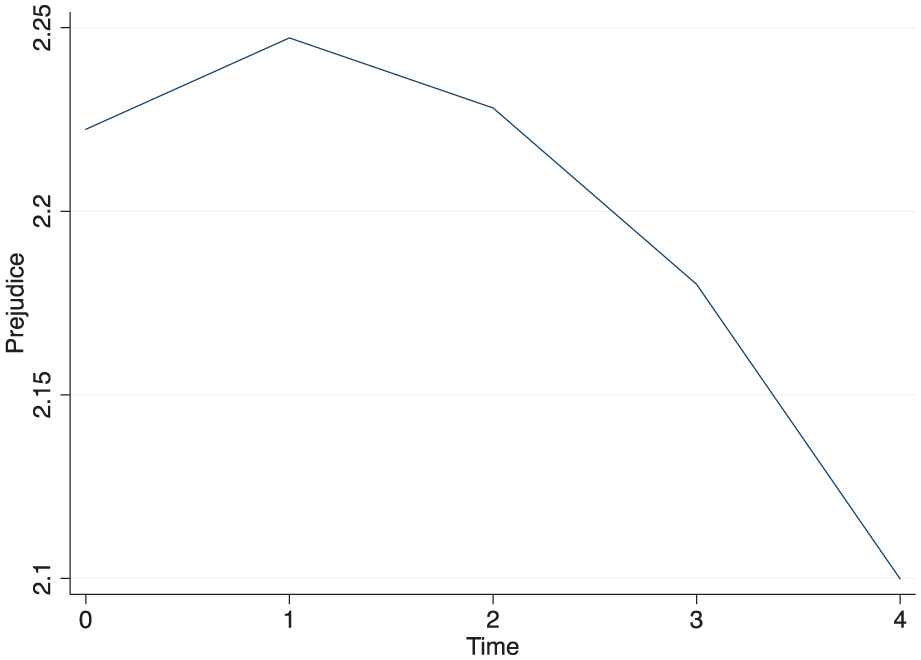
Average level of prejudice in sample, over time.

Average level of change in prejudice, over time.
Independent Variables
Recent research shows that self-reported friends and networks are robust in explaining the relationship between intergroup contact and attitudes toward out-groups (Wölfer et al. 2017). To capture the level of prejudice in one’s network, we rely on respondents’ identification of their peers. Respondents were asked to name up to 10 friends. On average, the majority of these friends were already part of the sample. However, those identified by a respondent who were not original participants in the study were snowballed into the sample, making these data more reflective of adolescents’ actual social relationships and potential sources of social influence than if this were a closed network limited only to a class or school. To test hypothesis 1, we use the same measure of prejudice to calculate the average level of prejudice among respondents’ nominated peers. This means that we do not consider reciprocal friendships separately or weight them more heavily. Theoretically, peers nominated by a respondent are those most likely to influence him or her, whether or not the friendship is reciprocal.
To test hypothesis 2 and hypothesis 3, we rely on network data to capture social influence from direct and extended contact (e.g., Wölfer et al. 2017). We calculate proximity prestige, which is a measure of an individual’s potential to influence others. This measurement is then used to construct two variables: first, the average level of prejudice among the more influential adolescents among the respondent’s peers and, second, the respondent’s own proximity prestige, which essentially captures the adolescent’s own position in his or her extended peer network. The measurement of proximity prestige summarizes an individual’s ability to exercise both direct influence over one’s friends and indirect influence over friends’ friends. To illustrate the theoretical rationale behind the measure, we can imagine a small network of three individuals: A, B, and C. Individual A is a friend of individual B, and individual B is friends with individual C. Individual C directly influences individual B and indirectly individual A. Adding relationships to this small network, it is obvious that an individual can have both direct and indirect influence over the same individual. Moreover, indirect influence between two individuals can be mediated through several other friends.
We calculate proximity prestige using the following steps. First, we define the influence domain for each individual in the total network and measure its size. The influence domain of an individual in a directed network is all other members of the network who are connected by a path to the individual. Thus, if A choses B and B choses C, paths exist between A and C, A and B, and B and C. If there are no other arches in the network, the size of the influence domain for A is 0, B is 1, and C is 2. It is prudent to limit the size of the influence domain by restricting the length of the longest path. Thus, we have limited the length of the path to a maximum of three steps. Second, we normalize the influence domain by dividing it by n – 1, where n is the number of individuals in the sample. Third, for each individual in the network, we calculate the average distance, measured as path length, from individuals in the influence domain. Fourth, we calculate the proximity prestige for an individual by dividing the normalized size of the influence domain by the average distance from the individual to the members of the influence domain. In the above example the proximity prestige for individual C is (2 / [3 – 1]) / (3 / 2) = 1 / 1.5 = 0.7. B’s proximity is (1 / [3 – 1]) / (1 / 1) = 0.5. For an individual without an influence domain, the average distance is set to 999999999. A’s proximity prestige is therefore 0 / 999999999 = 0. The proximity prestige for all individuals in the sample is used to test hypothesis 3. In order to test hypothesis 2 we calculate the level of prejudice for the most prestigious friend in the respondent’s network.
Covariates
First, we control for a number of time-variant covariates (within-individual effects). We include a measure of political discussion with peers, as research shows that discussing politics inoculates adolescents against voting for extreme Right parties (Kuhn 2004) and that political discussions between parents and adolescents are related to intergenerational similarity in prejudice (Meeusen and Dhont 2015). We use a summary index of three items: discussions about news, environment, and politics/societal issues with peers. The question asks about discussion with peers in general; thus, we cannot know with absolute certainty that those peers overlap exactly with nominated friends, but it is more likely than not that the adolescents have the same peers in mind. Finally, we also control for the ethnic homogeneity of the network by measuring the proportion of Swedish-born peers in the network. We also control for the size of the network by including the number of nominated peers.
We also include a number of time-invariant covariates (between-individual effects). Parents are often considered to be an important socializing agent, but the effect of parents’ attitudes may not have an immediately measurable effect on children’s own attitudes (Aboud and Doyle 1996) as parents’ influence may depend on other factors such as level of attachment (Sinclair, Dunn, and Lowery 2005; Miklikowska 2016) or the saliency of the issue at home (Levy and Hughes 2009). Parents’ attitudes are available only at t0, but theoretically this is unproblematic due to both the stability of these attitudes in adulthood and the likelihood that adolescents are affected by their parents’ attitudes throughout the examined period. We include a measure of parental prejudice based on the same variables used in the dependent variable. By doing this, we can see the relative importance of parents’ and peers’ attitudes on adolescent prejudice. To measure the impact of parental prejudice on attitudes net of other time-invariant factors, we control for sex, nativity, cohort, and parental income level. We use parental income level as an indicator of socioeconomic status. We can measure this effect only between individuals because we lack an objective measure that varies over time. 2 We do not control for adolescents’ age or education level because this is already captured by cohort.
To test our hypotheses about social influence on attitudes, we analyze these data with mixed, multilevel repeated measurement models (using SPSS 23.0 and Stata 14). These models are hierarchical, with time nested in individuals, and allow for both random intercept and slope. This approach considers different baseline values as well as different trajectories over time, thereby controlling for previous time points and, more important, baselines. Thus, we avoid the problem of regression to the mean. Moreover, time-invariant covariates cannot affect the estimation of time-variant covariates, which means that omitting a time-invariant covariate does not affect the main results. The models are specified using diagonal covariance structure for the random slope and an autoregressive covariance structure for the repeated measurement part. Fit statistics (Akaike information criterion) show that this approach yields the best-fitting models.
Results
To test hypotheses about the effect of social influence on prejudice, we rely on mixed, multilevel repeated measurement models with random intercept and slope. Because time is measured at the same interval in our panel data, we choose an autoregressive error covariance matrix for the repeated measurement (i.e., within-individuals) part of the equation. The autoregressive covariance matrix assumes constant variance between time points and assumes two adjacent time points are more highly correlated that two distant time points. The between-individuals part is specified as diagonal, allowing for different variances at each time point. This combination of covariance structures yields the best model fit. The N reported here deviates from the descriptives in Table 1 due to missing values on parental attitudes. 3 Running the analyses without parental attitudes, and thus with a larger N, does not change the size or interpretation of the coefficients or significance of key independent variables.
We report our results in Table 3. In model 0, we examine the change over time within the sample. Figure 1 indicates a slight curvilinear change over time, so we fit a model that includes a measure of linear time as well as time-squared (the latter only as a fixed effect). Further, we transform time into orthogonal time to avoid collinearity between the two time variables. Thus, time is coded as –2, 1, 0, 1, and 2, whereas cubic is time coded as 2, –1, –2, 0, and 2. There are significant fixed effects of both time variables. These results are consistent with the descriptive statistics that show that on average, adolescents initially become slightly more prejudiced but then less so over time (i.e., the average level of prejudice at t4 is lower than at t0).
Prejudice, Linear Mixed Model with Repeated Measurement.

Source: Youth and Society study, 2010–2015.
p < .05. **p < .01. ***p < .001.
Model 0 indicates that during adolescence prejudice tends to decrease slightly over time but that adolescents vary both in their level of prejudice and in how much their attitudes change over time. There is individual variation in growth trajectories (i.e., the diagonal covariance = 0.29) and between individual differences in intercept and slope. We have not included a random slope for quadratic time because it does not vary significantly between individuals. The correlation between any two consecutive time points is 0.28 (Rho). The repeated measurement model with no random intercept or slope gives a Rho of 0.61, which corresponds to the average bivariate correlations between two consecutive time points.
Between-individual Effects
In models 1 through 3, we first assess time-invariant independent variables. Results indicate that relationships among the demographic variables and the dependent variable are consistent with previous research: Girls, foreign-born people, and adolescents whose parents have higher income levels have, on average, lower levels of prejudice. There is also a relationship between parents’ and adolescents’ attitudes in that adolescents with more prejudiced parents are on average more prejudiced themselves. Although we can examine parents’ attitudes only at t0, those attitudes are likely to be relatively constant over time as prejudice is fairly stable in adulthood, and the majority of the adolescents are exposed to their parents during the whole period. Nevertheless, as demonstrated by interacting parental prejudice with time, adolescents who have parents with higher levels of prejudice at t0 do become more prejudiced over time. These results are consistent across models. There is no significant difference between cohorts.
Within-individual Effects
In model 1, we find support for hypothesis 1 that the average level of peer prejudice affects individuals’ prejudice. A one-unit increase in peer prejudice increases adolescents’ prejudice by 0.29 net of controls. 4 Thus, it appears adolescents’ attitudes are quite susceptible to social influence. While individuals tend to self-select into peer groups where members hold similar attitudes (Kandel 1978) and prejudice helps guide one’s choice of friends (Binder et al. 2009; van Zalk et al. 2013), it is also the case that adolescents are affected by their peers’ attitudes. As previously discussed, repeated measurement models control for previous time points and baselines. Results indicate that peer prejudice affects adolescents’ prejudice, net of other factors including previous levels of individual-level prejudice. We note that individual-level prejudice also may influence choice of friends, but we do not test this empirically because peer selection is a distinct research question that would imply a rather different set of analyses.
Model 1 demonstrates that our predictors explain a large portion of the between-individual change. The random slope of time decreases 23 percent but is still significant at p < .05. In an unreported model, we find a significant random slope for peer prejudice, which shows that peer effects vary somewhat between individuals. However, we report the more parsimonious model as substantive results do not differ and we did not originally set out to explain between-individual variation in peer effects.
To illustrate further the relationship between peer attitudes and individual prejudice over time, we also run a growth model. We identify the average level of prejudice respondents are exposed to during adolescence (i.e., the average level of prejudice of all time points) by calculating the mean of peer prejudice across waves. We interact time with this new level 2 variable, which captures between-individual variation in the growth of prejudice dependent on the average level of prejudice among one’s peers. Figure 3 reports results from this model, clearly demonstrating that adolescents exposed to lower levels of peer prejudice become less prejudiced over time and adolescents exposed to higher levels of peer prejudice become more prejudiced over time. This suggests that even in the unlikely event that prejudice completely drives peer selection, adolescents’ own level of prejudice is still influenced by having those peers.

Predicted values from linear mixed repeated measurement model with 95 percent confidence intervals.
In the next two models (2a and 2b), we test hypothesis 2: that attitudes of prestigious peers have an independent effect on adolescent prejudice. Because prestigious peers are a part of one’s network, results from model 1 already include the effect of this individual. By examining the effect of the peer who is theoretically most influential, we can assess whether the attitudes of the most prestigious individual account for the effect of peer prejudice in model 1 or whether nonprestigious and prestigious peers have independent effects. In model 2a, we examine the impact of prestigious peers and find that the level of prejudice of the most prestigious individual in one’s network affects adolescents’ own level of prejudice. In model 2b, we remove the attitudes of the most prestigious peer from the calculation of peer prejudice and measure these effects separately. Results show that both prestigious peers and nonprestigious peers have an effect on prejudice. Moreover, isolating prestigious peers from the rest of the network only marginally affects the impact of peer prejudice. This indicates that the broader social context and not only specific people influence adolescents’ attitudes. All other results are consistent with those reported in model 1 except that in models 2a and 2b, the time random slope is not significant. The slightly smaller Ns in models 2a and 2b are due to the measurement of prestigious peers.
In model 3, we find support for hypothesis 3 that one’s own prestige is associated with prejudice. Proximity prestige is negatively correlated with prejudice, demonstrating that the less popular the adolescents are, the more prejudiced they tend to become. Although the coefficient is large, the effect is somewhat smaller than expected. The difference between the maximum and minimum in proximity prestige is 0.0189. On a four-point scale of prejudice, this means the difference between the most central and the least central adolescent is about 5 percent. Thus, one’s own position in the network matters, but its impact does not translate to any substantive effect. We find this rather interesting given that research on delinquent behavior typically finds a more consequential effect of social isolation.
We also find interesting relationships between other time-variant covariates and the dependent variable. All models show that engaging in political discussions with your friends does decrease prejudice. This result is arguably important because the content of political discussions should theoretically differ among networks with higher or lower levels of prejudice. Thus, discussion should have an amplifying effect on individuals’ prejudice. To test this, we interacted peer discussion and peer prejudice, but there is no significant effect. Therefore, results reveal that engaging in political discussions with your peers decreases prejudice regardless of the average level of prejudice in your network. Finally, the ethnic makeup of the network has a small positive effect on prejudice. Adolescents in more homogeneous networks tend to become more prejudiced over time, a finding consistent with the literature on intergroup contact (e.g., Pettigrew 1998).
Conclusion
According to seminal scholarship on socialization, individuals’ attitudes are influenced by social relationships, especially during adolescence, when attitudes are most susceptible to change. Both social learning theory (Bandura et al. 1961; Bandura 1977) and symbolic racism (Sidanius and Pratto 1993; Kinder and Sanders 1996) posit that prejudicial attitudes are learned from influential others, such as peers and parents. While rarely contested, this notion has seldom been tested explicitly, let alone in longitudinal research. Further, while previous research has focused on dyadic friendships, this study investigates the impact of the broader social context. We also move beyond studies that assess the relationship between intergroup contact and prejudice by focusing instead on the content of peers’ attitudes instead of the race and ethnicity of one’s friends.
In this article, we draw on insights from these theoretical traditions and build on existing empirical studies of social influence in order to advance the study of prejudice by testing the literature’s central claim. Our research investigates how peer attitudes embedded in social networks affect the development of prejudice during teenagers’ formative years. We examined the relationship between peer prejudice and adolescent prejudice by testing three hypotheses. First we modeled the effect of the average level of prejudice among respondents’ nominated peers. Results show that peer prejudice affects individual-level prejudice over time, demonstrating adolescents’ susceptibility to social influence. While previous research finds that resistance to peer pressure increases between 14 and 18 years of age (Steinberg and Monahan 2007), our results indicate that susceptibility to social influence does not disappear. This coefficient is 0.30 and, on a four-point scale, translates into a fairly large effect.
Second, we posited that the attitudes of more prestigious friends would have an independent effect on adolescent prejudice. Thus, we distinguished empirically between the attitudes of the peer who is theoretically most influential and those who are less influential to assess whether the attitudes of the most prestigious individual explains prejudice or if the broader social context also plays an important role. We found that the peer most central in the network influences adolescents but that the attitudes of less prestigious peers still have a substantial effect on prejudice.
Third, we tested the hypothesis that adolescents’ own position in their network affects prejudice. Results reveal that the less central an adolescent is in the network, the more prejudiced he or she is. Although this effect is relatively small, the finding raises a question about the mechanism involved. When we consider the other end of the spectrum (i.e., adolescents with a high level of proximity prestige), it becomes less clear how to explain this relationship. Does prestige insulate adolescents from antisocial behavior or from social influence?
An important question is whether we can claim causality. Can we conclude that the level of prejudice among adolescents’ peers increases individual-level prejudice over time? To the extent that determining causality is possible without conducting experimental research, we believe that we can. There are three common criteria associated with determining causality and causal order: temporal precedence (x happens before y), covariation (x and y covary), and the absence of other alternatives (omitted time-varying covariates). First, we do have temporal precedence as the temporal order is built into the model. Second, our results indicate that peer prejudice covaries with adolescent prejudice. Thus, we meet the first two criteria. Although our analysis includes a number of theoretical controls, we cannot be sure that we have controlled for all possible time-varying covariates, even though it is not obvious what those other controls should be. Arguably, this third criterion cannot be met in a nonexperimental study. We contend that our results reveal a process of social influence, where the level of peer prejudice affects adolescent prejudice over time.
As in all research, there are limitations to the current study. First, it is possible that adolescent prejudice also affects choice of friends prior to the first wave of the study and then subsequently between waves. In this article, we argue that peers affect prejudice, but it is possible, even likely, that two-way causality exists. However, peer selection is beyond the scope of this research. Nevertheless, the vast majority of peer selection in these data is within the classroom or school context, which is not a function of self-selection. Second, our sample comes from a midsized Swedish city, which raises the question of generalizability. Yet we have no theoretical reason to believe that an analysis of adolescents from another country would yield different substantive results. Of course, this remains an empirical question.
Beyond replicating this study in other settings, there are a number of other promising avenues for future research. First, future research should examine prejudice toward other salient out-groups, such as antiblack attitudes in the United States. Second, research should investigate further the mechanisms responsible for social influence. For example, the mechanism that accounts for the relationship between one’s own proximity prestige and prejudice is unclear. Also, it is not obvious why having political discussions with peers reduces prejudice regardless of the level of prejudice in one’s network. Does discussion itself make adolescents think more critically and rely less on stereotypes? Finally, future research should analyze the relationship between peers and prejudice in adulthood. New data sources and online social networking should make it easier for researchers to investigate how features of social networks influence attitudes about immigrants and other out-groups throughout the life course.
Limitations aside, our analyses reveal something significant. We find that adolescents in low-prejudice networks become less prejudiced over time while adolescents in high-prejudice networks become more prejudiced over time. This suggests that exposure to qualitatively different attitudes has the potential to change minds, at least during adolescence.
Footnotes
Acknowledgements
The authors thank Ida Öun and Jonas Edlund for their useful comments and suggestions.
Funding
The author(s) disclosed receipt of the following financial support for the research, authorship, and/or publication of this article: This research was supported by the Marianne and Marcus Wallenberg Foundation (MMW) Grant No. 2014.0019, the Swedish Foundation for Humanities and Social Sciences (Riksbankens Jubileumsfond [RJ]) Grant No. P14-0775:1, and the Swedish Research Council for Health, Working Life and Welfare (FORTE) Grant No. 2016-07177.

1
2
We have adolescents’ subjective socioeconomic status at our disposal, but adolescents’ perceptions of their families’ statuses are suboptimal. Still, we included this measure in unreported models to test for perceived relative deprivation. This variable has no significant effect on prejudice, nor does it change the relationship between peer prejudice the dependent variable in any of the models.
3
Parental response rate was approximately 60 percent. We limit our subsample to adolescents whose parents participated in the survey at t0. Sample means indicate that the views of adolescents whose parents responded to the survey are not substantively different from the adolescents whose parents did not respond. Main regression results do not substantively differ if we exclude parental information from the analysis and rely on the full sample.
4
The effect of peer prejudice does not depend on levels of attitudinal heterogeneity in the network.