




Abstract
According to scapegoat theory, individuals tend to attribute personal or social problems to an out-group (real or imagined). This self-serving bias protects the ego or social identity from responsibility while increasing prejudice towards the out-group blamed for feelings of frustration. In this research note, we test this theory using five waves of the Czech Household Panel Study (CHPS 2016, 2017, 2018, 2019, 2020), which captures the tail end of the 2015–2016 refugee crisis in Europe through the lockdown in response to COVID-19 pandemic in 2020. We focus attention on both personal and professional domains, asking if factors like subjective health, work stress, relationship dissatisfaction, life dissatisfaction, and unhappiness contribute to attitudes towards immigrants over time. We also ask whether socio-political attitudes such as distrust in the government, social distrust, and political disinterest are associated with changes in anti-immigrant sentiment. Results show that personal and professional domains help explain between-individual differences in attitudes towards immigrants, while trust in the government and society are related to both within-individual change and between-individual differences in anti-immigrant sentiment.
Introduction
In this research note, we aim to contribute to scholarship on prejudice by examining the role of scapegoating in the development of anti-immigrant attitudes. Scapegoat theory is one of the oldest explanations of prejudice in the social sciences (Dollard et al. 1939; Allport 1954) and is often invoked in popular understandings of prejudice past and present. Despite this, empirical scholarship testing the role of scapegoating in the development of these attitudes is rare. We contend that one reason for this is a lack of longitudinal data appropriate for testing hypotheses derived from the theory, but a panel survey from the Czech Republic provides an opportunity to change that.
Scapegoating is the act of blaming someone else for your own misfortunes. Zawadzki (1948) identified this process as involving three steps. First, an individual experiences personal or collective frustration that leads to aggression or hostility. Second, the individual displaces this frustration onto a conveniently defenseless out-group, whose members differ from the individual in some socially salient way. Third, the individual rationalizes the displaced hostility. To illustrate with a hypothetical example, an individual becomes frustrated due to losing her job, but does not blame herself. Instead, she attributes her personal loss to an external factor, an immigrant group (who are frequently blamed in the media or by politicians for “stealing” jobs), while forgetting the initial source of her frustration. She then rationalizes her frustration with immigrants, justifying it using, for example, out-group stereotypes, or negative generalizations about the target group (e.g., Zawadzki 1948; Allport 1954). This self-serving bias protects one's ego and/or in-group's social identity from responsibility, while simultaneously increasing prejudice towards the out-group.
The goal of this research note is to test hypotheses derived from scapegoat theory, a theory that fell out fashion—though not necessarily because it has poor explanatory power. In truth, we do not know exactly why its popularity declined, but since very few empirical studies have tested scapegoat theory, the reason cannot be due to a plethora of evidence contradicting it. Thus, we suspect that data and methodological limitations contributed. Meanwhile another seminal account of prejudice, group threat theory (Blumer 1958), is consistently tested in empirical studies and continues to be the dominant explanation of anti-immigrant sentiment, despite limited empirical evidence to support it (Kaufmann and Goodwin 2018; Pottie-Sherman and Wilkes 2017). Group threat and scapegoat theory differ in that, according to the former, prejudice stems from a threat to an in-group's dominant position in society (Blumer 1958), while the latter theory focuses on an individual's experiences of misfortune (Allport 1954). To be clear, this research note does not adjudicate between these two theories. Rather, by testing hypotheses related to scapegoat theory, we aim to assess whether there is a scientific reason for its poor standing in the field, or if its lack of popularity is the result of serendipity. Should our analyses yield supportive evidence, future research may benefit from reconsidering it as a plausible explanation of anti-immigrant sentiment.
To test several hypotheses about scapegoat theory, we use five waves of the Czech Household Panel Study (2016–2020) to assess how changes in three domains of life (the personal, the professional, and the socio-political) affect individuals’ anti-immigrant sentiment over time. Specifically, we ask if factors like health, work stress, family life, and happiness contribute to individuals’ attitudes toward immigrants. We also ask whether socio-political attitudes, such as trust in the government, contribute to changes in anti-immigrant sentiment.
The period in question captures the tail end of the 2015–2016 migration crisis in Europe through the initial lockdown in response to COVID-19 in 2020. Though it manifested in different ways, both crises increased the salience of immigration as a policy issue in Europe. Between 2015 and 2016, over one million people fled ongoing wars and violence conflicts in Syria, Iraq, Afghanistan and elsewhere for Europe (IOM 2016), bringing immigration to the forefront of national politics throughout Europe irrespective of cross-national differences in rates of asylum seeking (Eger, Larsen and Mewes 2020; Hutter and Kriesi 2022). The COVID lockdown stigmatized immigrants and their families as carriers of disease (O’Brien and Eger 2021; Rowe et al. 2021; Wu, Qian and Wilkes 2021).
In the sections that follow, we discuss scapegoat theory and the related empirical research that inspired our research. We then introduce our data and present our analyses. We conclude with a discussion of our results and their implications for both the theoretical literature on scapegoating and the empirical literature on anti-immigrant sentiment.
Theoretical Framework and Analytical Strategy
Scapegoating has not been the primary focus of modern-day research on prejudice, although scholarship on the phenomenon dates to at least the 1930s (Dollard et al. 1939; Allport and Kramer 1946). However, contemporary experimental research consistently shows that emotions—in particular, anger—correlate with prejudice (e.g., Dasgupta et al. 2009; DeSteno et al. 2004). Studies also show that frustration due to an incident unrelated to any intergroup relation—so called incidental emotions (e.g., Bodenhausen, Geoffrey and Süsser 1994)—may nevertheless be transferred to an out-group. This strand of research, while not focused directly on scapegoating, lends empirical support for the theory.
Glick (2005, 244) defines scapegoating as “an extreme form of prejudice in which an out-group is unfairly blamed for having intentionally caused an in-group's misfortunes.” Tajfel (1982) posited that in cases of personal problems, individuals should, in theory, blame other individuals and that only group-level frustrations should yield the scapegoating of an out-group. For example, in the earlier hypothetical scenario, the woman who loses her job might blame her supervisor if other in-group members remain employed; yet if she loses her job during an economic crisis, during which many others also become unemployed, she may blame an out-group (Glick 2005, 249). Allport (1954) argued that even personal problems could heighten prejudice towards an out-group. We contend that this remains an empirical question and therefore it is the focus of our analysis.
According to Allport (1954), individuals may experience frustration in several areas of life and subsequent prejudice towards an out-group. Building on his seminal work, we examine three specific domains of life: the personal, the professional, and the socio-political. The personal refers to one's personal and family life. We test if levels of subjective unhealthiness, unhappiness, life dissatisfaction, and dissatisfaction with one's romantic relationship—as well as changes over time in these levels—are associated with prejudice. Previous research has rarely examined prejudice in relation to individual health as most research has focused on the health consequences for the victims of prejudice or discrimination (for an overview, see Williams and Mohammed 2013). However, studies have shown that fear of death is associated with conservatism (Jost et al. 2003), and that perceived vulnerability to disease correlates with prejudice (Navarette and Fessler 2006) and avoidance of unfamiliar immigrant out-groups (Faulkner et al. 2004). Further, recent studies find that sleep deprivation is associated with prejudice (Ghumman et al. 2013), and that trauma, poor life satisfaction (Kayitesi and Mwaba 2014) and unhappiness (Haney 2016) are correlates of prejudice as well.
Despite Allport implicating dysfunctional family life in the development of prejudice, little research has focused on the effects of relationship satisfaction among adults. Instead, most previous research on families analyzes the transmission of prejudice within parental-child dyads (Rodrıguez-Garcıa and Wagner 2009; Meeusen and Dhont 2015; Miklikowska 2016), revealing lower levels of prejudice among children in more empathic and functional families (White and Gleitzman 2006). However, research links anxiety about one's relationship to sexism (Fisher and Hammond 2019), and it is possible that relationship dissatisfaction could also matter for other types of prejudice.
Our second domain, the professional, includes experiences related to one's occupation and working life. We examine if levels of and over time changes in work-related stress and job dissatisfaction increase prejudice. Empirical tests of the sociological theories of group threat and ethnic competition (Blumer 1958; Olzak 1992) have established an association between lower socio-economic status and prejudice (e.g., Hjerm 2009), which theoretically results from higher levels of actual or perceived economic competition from out-groups among those in lower socio-economic positions. Yet, little is known about the relationship between one's actual work experiences and attitudes towards out-groups. Bird and Monachesi (1954) explored the relationship between job satisfaction and prejudice almost seventy years ago; their results were inconclusive. Since then, research has not focused specifically on the implications of job dissatisfaction for prejudice, but studies have shown that job dissatisfaction can trigger negative emotions (e.g., Fitzgerald et al. 2003) while other research connects negative emotions like anger and anxiety to prejudice (Tapias et al. 2007). DeSteno et al. (2004) show that such emotions easily translate into prejudice, which is consistent with scapegoating. Additionally, research finds that pursuing extrinsic goals is associated with more prejudice (Duriez et al. 2007); thus, to the extent that job stress and dissatisfaction with working life may hinder such goals, negative experiences in this domain may affect prejudice.
Our third domain, the socio-political, combines a few areas Allport cited as important and refers to individuals’ experiences with or perceptions of society, political institutions, organizations, and leaders. While our first two domains directly concern an individual's daily experiences, this third domain captures an individual's orientation towards society. As previously mentioned, scholars have disagreed about whether individual-level misfortunes or mundane frustrations should, theoretically, lead to the scapegoating of an out-group rather than another individual, but there is clear consensus that (perceptions of) collective misfortunes should (see Glick 2005 for a discussion). Thus, from a theoretical standpoint, we expect individuals’ perceptions of the social and political features of society to be most closely related to out-group prejudice. In our analyses, we examine how levels of and over time changes in generalized social distrust, distrust in government, and disinterest in politics affect prejudice. Previous research connects prejudice to social distrust (Herreros and Criado 2009; Ekici and Yucel 2015; Mitchell 2021), distrust in government (Dhanani and Franz 2020), and disinterest in politics (Pettigrew et al. 2008; Bohman, Hjerm and Eger 2019).
While the personal, professional, and socio-political spheres of individuals are the focus of our empirical analysis, we examine a period that includes two collective crises: the 2015–2016 European migration crisis and the 2020 COVID-19 pandemic. While these events are exogeneous to our models, theoretically their existence makes scapegoating more likely. Blumer (1958, 6) argued that out-group prejudice is more likely following a “big event,” something “that touches deep sentiments, that seems to raise fundamental questions about relations, and that awakens strong feelings of identification with one's racial group.” According to Glick's (2002, 2005) model of scapegoating, collective misfortunes provide the impetus for prejudice, which implies that scapegoating is more likely in the wake of specific events, such as an economic crisis. Allport (1954) also noted that poor societal conditions should enhance the likelihood that one's own poor health, for example, would lead to scapegoating and prejudice.
A limitation of scapegoat theory is that it is not entirely clear why certain groups end up the target of scapegoating (Allport 1954, 351). Yet because we examine a period that includes the aforementioned crises, we can identify immigrants as the most likely targets of scapegoating due to the increase in the political salience of immigration throughout Europe (Buštíková 2018) and, in particular, in the wake of the 2015–2016 migration crisis (Eger, Larsen and Mewes 2020). While it is easy to see how a dramatic increase in asylum-seeking would increase the salience of in-group/out-group boundaries based on national origin, race, and ethnicity, the pandemic also makes the foreign-born a convenient target for scapegoating (O’Brien and Eger 2021) because immigrants have long been stigmatized as carriers of disease (von Unger, Scott and Odukoya 2019; White 2020). Indeed, harassment, violence, and discriminatory practices against ethnic minorities and immigrants occurred in several countries during the pandemic (Dionne and Turkmen 2020; Lu et al. 2021).
For our analyses, we rely on panel data from the Czech Republic, where prejudice towards immigrants is, on average, higher than in most other European countries. Figure 1 shows Europeans’ attitudes toward immigrants with cross-sectional data from the European Social Survey (ESS). These data show that people in the Czech Republic (represented by the bold line), on average, have higher levels of anti-immigrant sentiment than the average person in most other countries. Further, attitudes are becoming slightly more anti-immigrant over time. At the same time, however, the Czech Republic has a comparatively small immigrant population (as a percentage of the total population), and this share has not increased dramatically in recent years as it has in other European countries. In 2009, the average size of the immigrant population in the 26 OECD countries in Europe was 11.2%. In 2019, the OECD European average was 14.3%. In the Czech Republic, 6.4% of the population was born abroad in 2009 and this share increased to 8.5% by the end of the decade (OECD 2020).
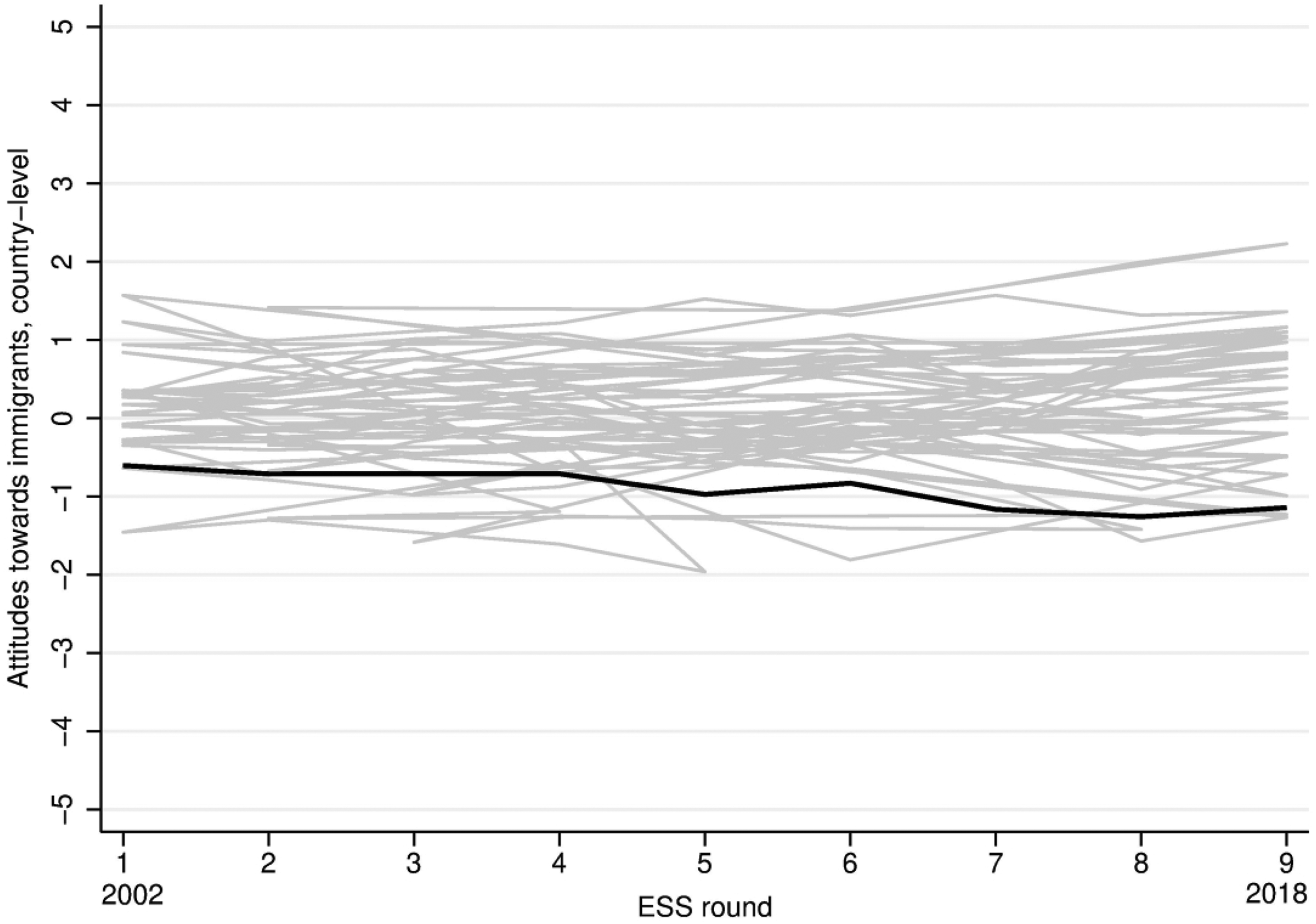
Attitudes Towards Immigrants in Europe, 2002–2018. Source: European Social Survey (ESS1-9e01). Note: With the Czech Republic in bold, lines represent country-level averages of attitudes towards immigrants based on row means of three variables (imbgeco, imueclt, imwbcnt). The y-axis runs from −5 to 5 (original values are 0 to 10) to differentiate between pro-immigrant and anti-immigrant sentiment.
We contend that the Czech Republic is a good country in which to analyze the scapegoating effect on anti-immigrant attitudes, because this combination of high anti-immigrant sentiment and the absence of a very large immigrant population or rapid demographic change suggests that individual-level factors are more important than contextual-level ones. In tests of group threat theory, the size of the foreign-born population and increases in its size are contextual-level factors typically used to operationalize “threat.” In the absence of this external threat, individual-level variables should hold more explanatory power. However, the results of our analysis should not be understood as indicative of a phenomenon specific to the Czech Republic or countries with relatively low levels of immigration. We merely use available Czech panel data to test the theory that variation in individuals’ personal misfortunes over time help explain patterns of prejudice.
Data and Methods
Data for this research note come from the Czech Household Panel Study (CHPS), collected annually between 2015 (Wave 1) and 2018 (Wave 4) with two follow-up surveys in 2019 (Wave 5) and 2020 (Wave 6). (Hereafter, waves of the survey will be referred to as W1–W6.) Households were randomly selected to ensure national representativeness. One representative of the household provided information about the household, and then all household members older than 10 years were invited to participate in an individual survey. However, we limit our analysis to respondents over 18 years old. Data were collected with computer assisted personal interviewing (CAPI) and paper-pencil questionnaires. Additional information regarding sampling and interviewing methods are available in the technical report in the Czech Sociological Data Archive (Kudrnáčová 2019).
We use W2–W6, or all available waves that include a measure of anti-immigrant sentiment. In 2015, 8131 adults participated in the first wave of the survey. In 2016, in the second wave of the survey but the first one that we analyze, the number of participants was 6561. This number was 5839 in 2017 (W3) and 5132 in 2018 (W4). The design of the panel changed in waves 5 and 6. In 2019, only 2046 individuals were selected to participate and 1533 people also participated in 2020. 1479 respondents took part in all five waves that we analyze here (i.e., W2–W6). However, a benefit of using mixed models (see below) is that they do not require a balanced panel; thus, our models’ sample sizes range from 7714 to 19,051 observations across 3361 to 6790 individuals residing in 2482 to 3754 households.
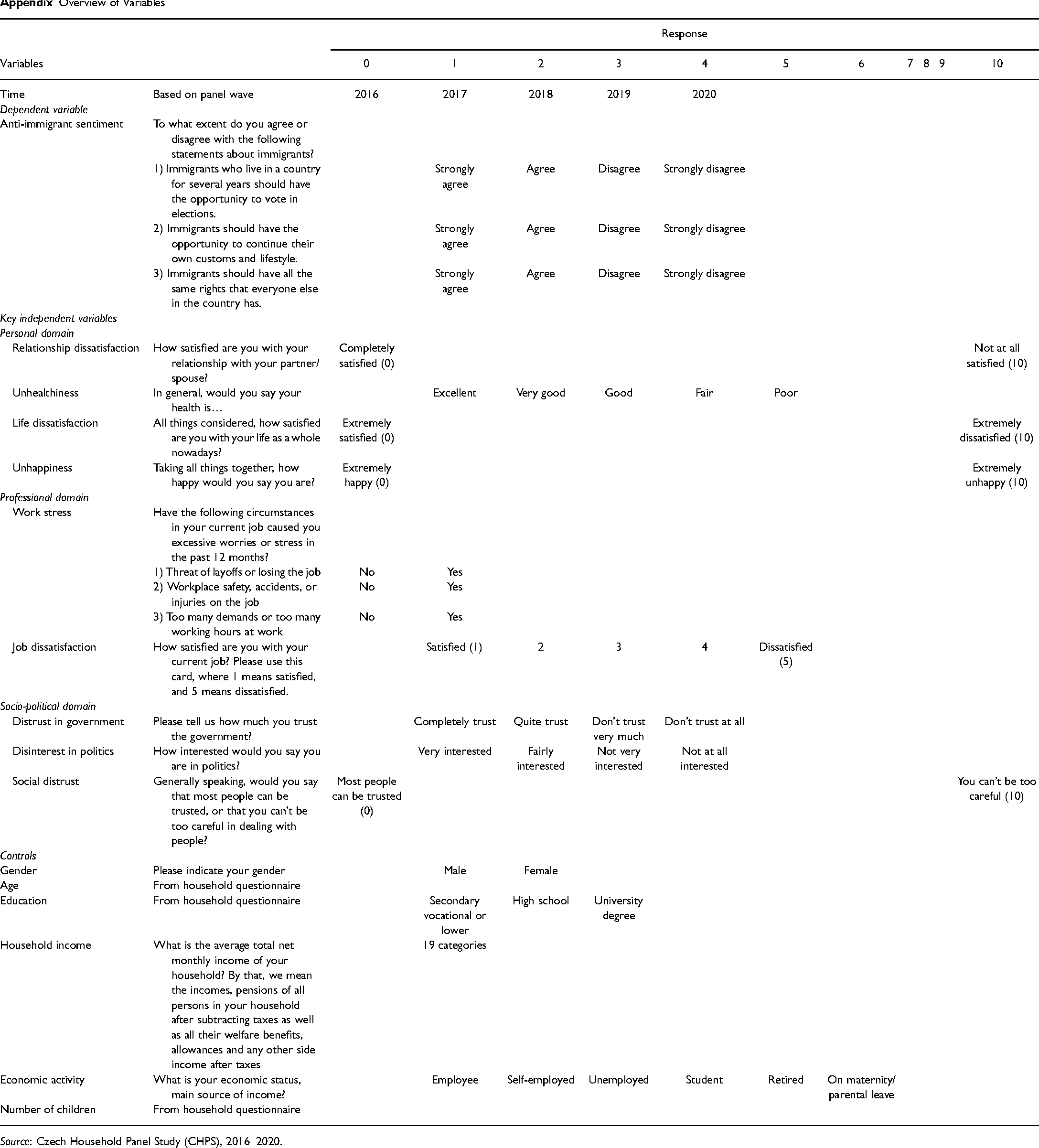
Our dependent variable, anti-immigrant sentiment, is the average of three questions that ask respondents for their views concerning immigrants’ rights. This variable is first asked in the second wave, which we designate as time 1 (T1). The Cronbach's alpha for each wave indicates that this scale is reliable, though it varies slightly over time (αt1 = .894; αt2 = .936, αt3 = .793; αt4 = .901; αt5 = .761). Key independent variables fall under three domains: personal, professional, and socio-political. The personal domain includes four indicators: relationship dissatisfaction, subjective unhealthiness, life dissatisfaction, and unhappiness. The professional domain is captured by job dissatisfaction and work-related stress. The socio-political domain involves distrust in government, political disinterest, and social distrust. Not all these variables were included at every time point. Additionally, we control for gender, age, education, household income, number of children in the household, and economic activity. We report descriptive statistics for all variables in Table 1 and wording of the questions and responses in the Appendix.
Descriptive Statistics.
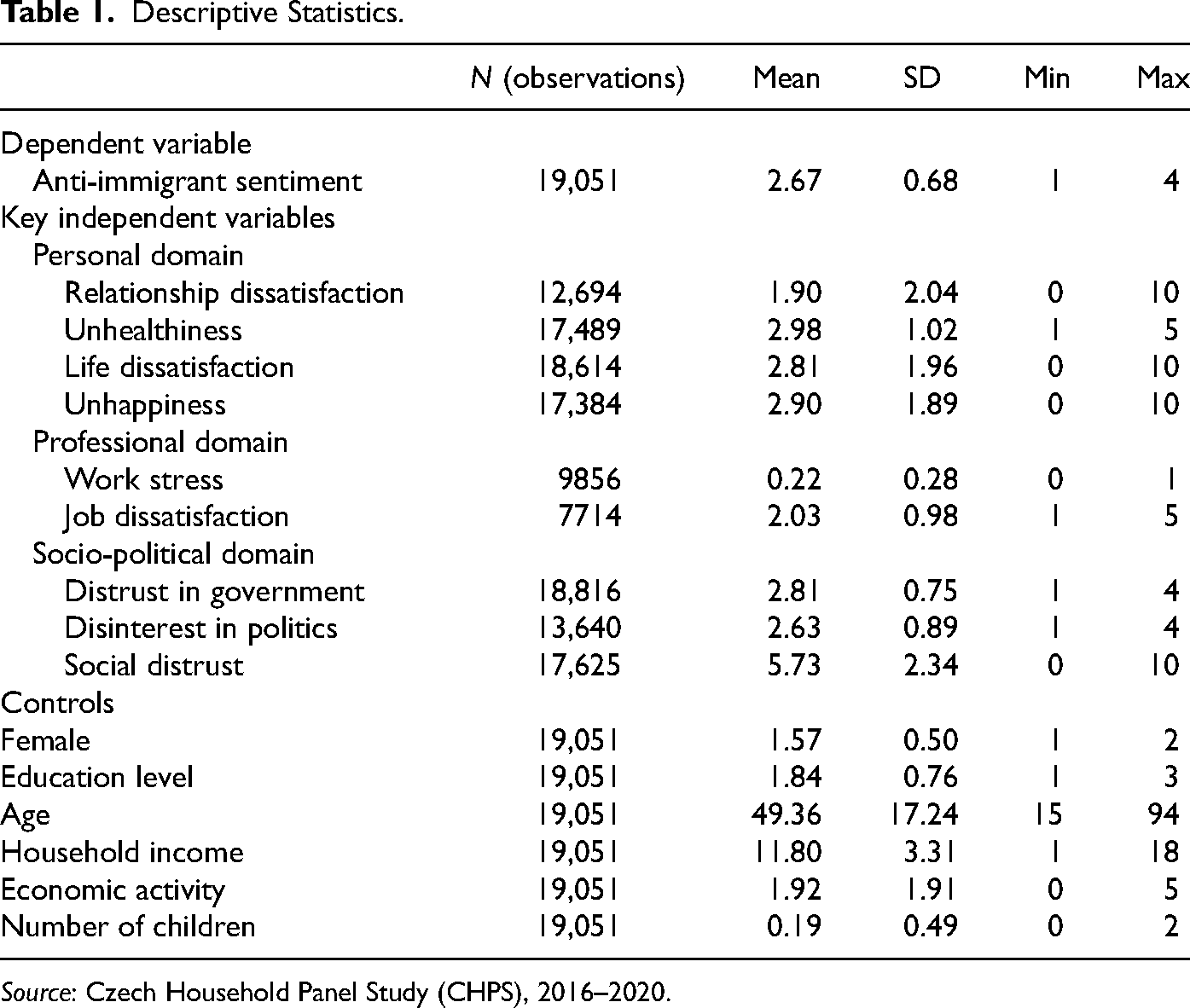
Source: Czech Household Panel Study (CHPS), 2016–2020.
Because we have panel data on individuals collected within households, we use mixed, three-level repeated measurement models, where observations are nested within individuals, which are nested within households. Mixed models combine fixed and random components and are optimal to analyze repeated measurement data because we can simultaneously measure individual trajectories and group differences while controlling for both baseline values and correlations between time-points. These models assign random intercepts for individuals and households, and we also add a random slope for time. As mentioned, mixed models can also handle missing within-subject data (Seltman 2018, 357).
We also separate the key independent variables into their within- and between-individual parts. This allows us to examine the extent to which both within-individual changes in these domains and between-individual differences across these domains are related to anti-immigrant sentiment. To accomplish this, we use mean-centering to create two new orthogonal variables based on each key independent variable. For each key independent variable, we first calculate the average of each individual's responses across time points. This mean score represents the between-individual difference. Second, we subtract that mean score from the level of the key independent variable at each time point. This variable represents the within-individual difference from the respondent's average response over the entire period. Including both variables in a regression model makes it possible to measure both the statistical relationship between individual change and change in the dependent variable and differences between individuals and the dependent variable.
The hierarchical repeated measurement formula is as follows:
Results
Table 2 reports results from our longitudinal analysis. Variance components from the null model reveal that 47% of the variance in the dependent variable exists within-individuals. Twenty-three percent of the variance is between individuals and 30% of the variance exists between households. Model 1 includes only the fixed effect of time; in Model 2, we add all control variables. The fixed effect for time shows that, on average, anti-immigrant attitudes have decreased slightly between 2016 and 2020. The estimate for the variance of the random slopes of time across individuals is close to zero, indicating that the relationship between time and the dependent variable does not vary between individuals. Among the control variables, level of educational attainment and currently being a student are consistently associated with lower anti-immigrant sentiment. In some of the models, being female is related to lower anti-immigrant sentiment.
Anti-Immigrant Sentiment Over Time, 2016–2020.
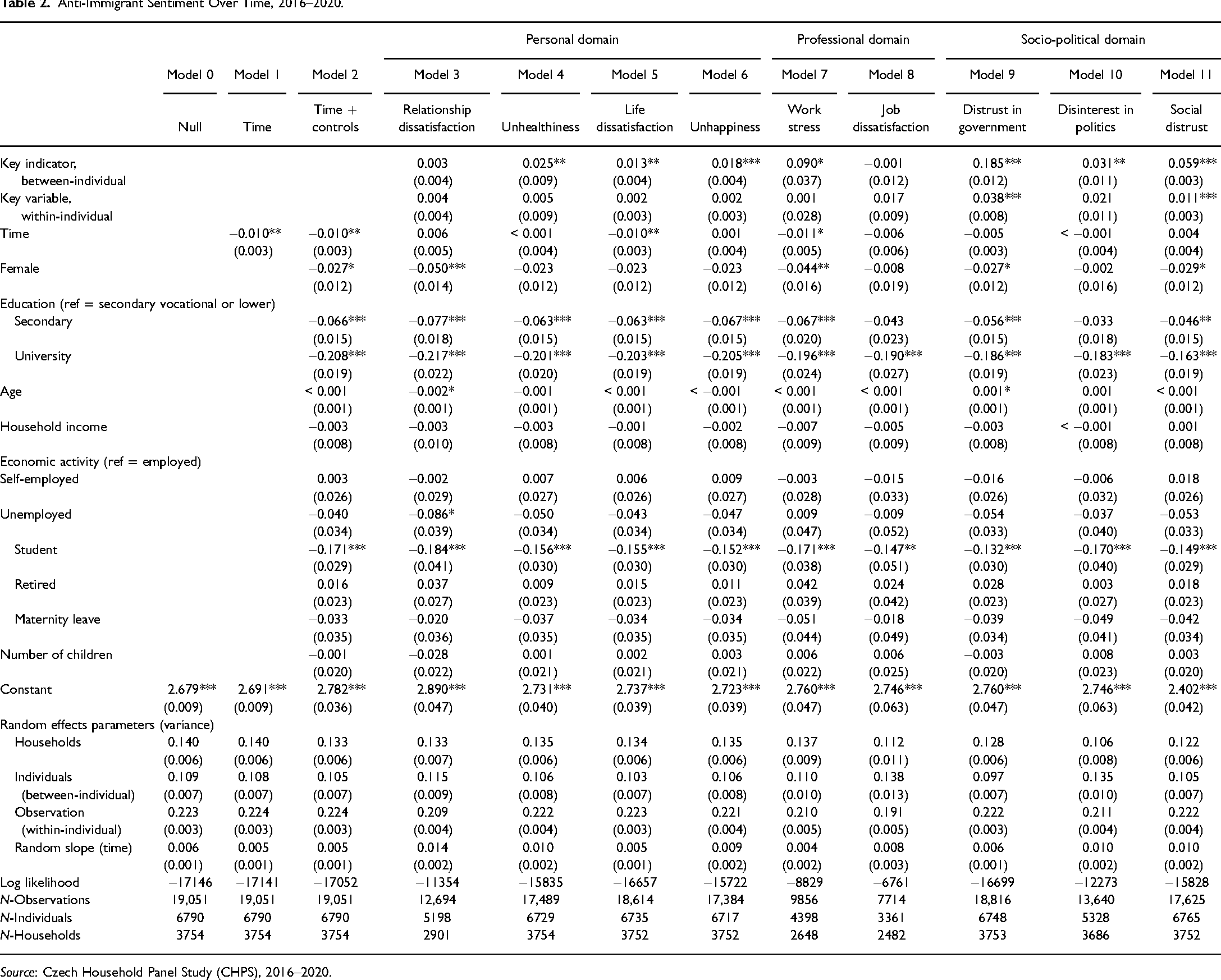
Source: Czech Household Panel Study (CHPS), 2016–2020.
The remaining models are divided among the three domains. First, we find evidence of between-individual effects in both the personal and professional domains, which suggests that personal problems are related to scapegoating. Individuals with poor health report higher levels of anti-immigrant sentiment compared to those with better subjective health. Further, both those who report greater dissatisfaction with life and those who report unhappiness also report higher levels of anti-immigrant sentiment compared to those who are satisfied with life and who are happy. Dissatisfaction in partner relationship is not correlated with attitudes toward immigrants. Turning to the professional domain, individuals who experience more work-related stress also report higher anti-immigrant sentiment, but job dissatisfaction is not correlated with anti-immigrant attitudes.
Second, we find evidence of both between-individual and within-individual effects in the socio-political domain. People with lower levels of social and institutional trust also are more anti-immigrant. Individuals who are less politically interested also report higher levels of anti-immigrant sentiment. Moreover, results reveal that within-person increases in distrust in society and political institutions correspond with increasing anti-immigrant attitudes.
Conclusion
In this research note, we revisited scapegoat theory, an older explanation of prejudice that understands it as the result of unfairly blaming an out-group for frustrations due to personal or collective troubles. Once a dominant explanation for prejudice, scapegoat theory has been ignored for many years. This is not due to an abundance of empirical research disproving its theoretical claims. Instead, few attempts to empirically test the theory exist, although in recent years some scholars have begun to think about native-born responses to perceived threat as indicative of scapegoating (Savun and Gineste 2019; Polo and Wucherpfennig 2022), even if they lack the data to test it this way. Indeed, we suspect that scapegoat theory's relative unpopularity is due to a lack of appropriate data for testing it rather than a logical fallacy. Thus, in this research note, we returned to Allport's (1954) seminal work and designed research to examine three domains of life with the potential for scapegoating, the personal, professional, and socio-political.
As there is consensus in the scholarly literature that perceptions of collective problems should engender scapegoating, the socio-political domain is the area in which we expected to find the most empirical support for scapegoat theory. Our analyses reveal that between-individual differences and within-individual increases in both generalized social distrust and institutional distrust are associated with heightened levels of anti-immigrant attitudes. Examining the personal and the political domains allowed us to speak to the theoretical debate over whether personal problems could also lead to scapegoating. Our results indicate that people who report being unhealthy, unhappy, dissatisfied with life, and stressed at work also tend to be more anti-immigrant. However, changes in those domains were not associated with changes in anti-immigrant attitudes between 2016 and 2020.
What does this research note tell us about scapegoat theory? Our results support the notion that perceptions of collective misfortunes are related to scapegoating. Thus, we contend it may have been too early to abandon scapegoating as an account of how prejudices are formed. Indeed, the between- and within-individual effects in the socio-political domain certainly provide strong enough evidence to reconsider scapegoating as a possible mechanism contributing to anti-immigrant prejudice. Moreover, the between-individual differences also hint that frustration in both the personal and the professional domains are relevant for these attitudes—and worth revisiting in future analyses with panel data that cover a longer time period. Most variables that we used to measure the personal and professional domains are not susceptible to rapid changes because they capture long-term work and family arrangements, and it is possible that the relatively short time span of this research contributed to the lack of within-individual effects. It is also possible that significant changes in the lives of some of the most unhappy, unhealthy, and dissatisfied respondents occurred prior to participation in the panel. 1 While we interpret these between-individual effects in the personal and professional domains as support for the strain of the theory that also sees personal problems as relevant for scapegoating (Allport 1954), the fact that we find both within- and between-individual effects in the socio-political domain suggests to us that perceptions of collective misfortunes provide a stronger impetus for prejudice.
While not the primary focus of our study, our period includes the tail end of one crisis and the beginning of another. Our results indicate a decline in anti-immigrant sentiment in the Czech Republic between 2016 and 2020. As our analysis begins at the tail end of the 2015–2016 migration crisis in Europe, we cannot know for sure its impact on scapegoating and anti-immigrant sentiment. However, the pattern we observe does not preclude the possibility that this decrease follows a spike in anti-immigrant sentiment, as found in longer panel studies from Norway (Nordø and Ivarsflaten 2022; Velásquez and Eger, 2022). Further, we did not find evidence that the initial COVID-19-related lockdown was related to a surge in anti-immigrant attitudes in May and June of 2020, which is consistent with results from a German panel study that compared attitudes in the months just prior to the pandemic to those in March and April of 2020 (Drouhot et al. 2021). While it is difficult to predict what COVID-19 will mean for anti-immigrant sentiment in the long run, O’Brien and Eger (2021) theorize that once COVID-19 border restrictions that prevent the movement of immigration are lifted, rates of immigration should experience a rebound akin to a baby boom. They posit that such a migration spike may lead to increasing levels of anti-immigrant sentiment. Our own research suggests that, to the extent that people perceive personal and collective loses in the wake of the pandemic, scapegoating could be responsible.
Measuring the relationship between a set of variables and anti-immigrant attitudes, even in a longitudinal study like this, is notoriously difficult, as we cannot corroborate the theoretical mechanism. Our data do not permit us to examine scapegoating directly, but we focused our attention on the key domains in which scapegoating is theoretically expected to take place. By doing so, we have provided empirical support for the notion of its existence. We do not, however, claim to have provided concrete evidence of scapegoating, which should be the goal of future research. Theoretically, scapegoating is a three-staged process (Zawadzki 1948) and, if possible, should be modeled accordingly. To do this, we need panel data that includes questions not only about life satisfaction and work stress but also questions that that tap into respondents’ emotions and attribution of blame for misfortunes.
In summary, we have provided evidence that misfortunes in all three domains are associated with anti-immigrant attitudes. We conclude that this is strong enough evidence of its existence that future researchers should revisit scapegoating as a mechanism contributing to prejudice.
Footnotes
Declaration of Conflicting Interests
The authors declared no potential conflicts of interest with respect to the research, authorship, and/or publication of this article.
Funding
The authors disclosed receipt of the following financial support for the research, authorship, and/or publication of this article: This research was supported in part by the Swedish Research Council for Health, Working Life and Welfare (Forskningsrådet för hälsa, arbetsliv och välfärd [FORTE]) Grant No. 2016-07177 and the Swedish Research Council (Vetenskapsrådet [VR]) Grant No. 2016-04165.

Notes
Overview of Variables
| Response | ||||||||||||
|---|---|---|---|---|---|---|---|---|---|---|---|---|
| Variables | 0 | 1 | 2 | 3 | 4 | 5 | 6 | 7 | 8 | 9 | 10 | |
| Time | Based on panel wave | 2016 | 2017 | 2018 | 2019 | 2020 | ||||||
| Dependent variable | ||||||||||||
| Anti-immigrant sentiment | To what extent do you agree or disagree with the following statements about immigrants? | |||||||||||
| 1) Immigrants who live in a country for several years should have the opportunity to vote in elections. | Strongly agree | Agree | Disagree | Strongly disagree | ||||||||
| 2) Immigrants should have the opportunity to continue their own customs and lifestyle. | Strongly agree | Agree | Disagree | Strongly disagree | ||||||||
| 3) Immigrants should have all the same rights that everyone else in the country has. | Strongly agree | Agree | Disagree | Strongly disagree | ||||||||
| Key independent variables | ||||||||||||
| Personal domain | ||||||||||||
| Relationship dissatisfaction | How satisfied are you with your relationship with your partner/spouse? | Completely satisfied (0) | Not at all satisfied (10) | |||||||||
| Unhealthiness | In general, would you say your health is… | Excellent | Very good | Good | Fair | Poor | ||||||
| Life dissatisfaction | All things considered, how satisfied are you with your life as a whole nowadays? | Extremely satisfied (0) | Extremely dissatisfied (10) | |||||||||
| Unhappiness | Taking all things together, how happy would you say you are? | Extremely happy (0) | Extremely unhappy (10) | |||||||||
| Professional domain | ||||||||||||
| Work stress | Have the following circumstances in your current job caused you excessive worries or stress in the past 12 months? | |||||||||||
| 1) Threat of layoffs or losing the job | No | Yes | ||||||||||
| 2) Workplace safety, accidents, or injuries on the job | No | Yes | ||||||||||
| 3) Too many demands or too many working hours at work | No | Yes | ||||||||||
| Job dissatisfaction | How satisfied are you with your current job? Please use this card, where 1 means satisfied, and 5 means dissatisfied. | Satisfied (1) | 2 | 3 | 4 | Dissatisfied (5) | ||||||
| Socio-political domain | ||||||||||||
| Distrust in government | Please tell us how much you trust the government? | Completely trust | Quite trust | Don’t trust very much | Don’t trust at all | |||||||
| Disinterest in politics | How interested would you say you are in politics? | Very interested | Fairly interested | Not very interested | Not at all interested | |||||||
| Social distrust | Generally speaking, would you say that most people can be trusted, or that you can’t be too careful in dealing with people? | Most people can be trusted (0) | You can’t be too careful (10) | |||||||||
| Controls | ||||||||||||
| Gender | Please indicate your gender | Male | Female | |||||||||
| Age | From household questionnaire | |||||||||||
| Education | From household questionnaire | Secondary vocational or lower | High school | University degree | ||||||||
| Household income | What is the average total net monthly income of your household? By that, we mean the incomes, pensions of all persons in your household after subtracting taxes as well as all their welfare benefits, allowances and any other side income after taxes | 19 categories | ||||||||||
| Economic activity | What is your economic status, main source of income? | Employee | Self-employed | Unemployed | Student | Retired | On maternity/parental leave | |||||
| Number of children | From household questionnaire | |||||||||||
Source: Czech Household Panel Study (CHPS), 2016–2020.