




Abstract
Border closures associated with COVID-19 constitute a response to an exogenous shock unrelated to migration. In this IMR Dispatch, we argue that the impact of policies initially implemented to halt movement and curb the spread of the disease will nonetheless have medium- and longer term consequences for international migration. Specifically, we argue that these initial border restrictions have set in motion demographic and sociological processes that are likely to culminate in greater support for restricting future migration. Based on demographic evidence, we posit that after extended suppression of migration, OECD countries and Russia will see a migration spike, akin to a “baby boom” for fertility rebounds. Drawing on sociological theory and research, we hypothesize that these spikes in migration will increase anti-immigrant sentiment among native-born residents in destination countries and mobilize political support for reintroducing restrictive migration policies — triggering a feedback loop. In an effort to help facilitate future research and empirical tests of our model, we identify key concepts, processes, and data sources for the analysis of the pandemic’s impact on international migration over time.
By April 1, 2020, nine out of 10 people in the world suddenly lived under travel or immigration restrictions intended to curb the spread of COVID-19 (Connor 2020). Not surprisingly, in some countries, political leaders who were already opposed to immigration immediately used this crisis as an opportunity to halt asylum seeking, deport refugees (Austen 2020; Kanno-Youngs and Semple 2020; Novak et al. 2020), threaten the free movement of indigenous populations (Boström 2020), and suspend temporary work visas for both high- and low-skilled migrants (Trump 2020). While these border closures are a response to an external shock unrelated to migration, we argue that the impact of these closures will have medium- and longer term consequences for international migration.
The effects of extraordinary global changes, such as the COVID-19 pandemic, are not easy to anticipate with certainty. Yet these border closures are of consequence not only to international migrants but also to their destination and origin communities, making research on the impact of COVID-19 border closures critically important. With unprecedented global transformations to mobility and migration control, international migration research ostensibly finds itself in uncharted territory. However, we can use previous scholarship to help us make sense of the social and political dynamics already emerging, even if data are not yet available to empirically examine this crisis and its consequences for international migration.
To that end, in this IMR Dispatch, we draw on previous sociological and demographic research to advance a predictive model where COVID-19 border restrictions precipitate cycles of suppression, spikes, and stigma. The pre-virus political climate was already characterized by a tension between skepticism toward international migration and economic demands for immigrant labor in destination countries, as well as demand for emigration opportunities in origin countries. This tension will persist and perhaps grow stronger as societies strive to return to “normal.” Indeed, neither the economic nor the non-economic push and pull factors that drive migration (Ravenstein 1885; Lee 1966) will disappear. Thus, we posit that it is likely that countries will eventually lift restrictions on immigration, which will lead to a migration spike, due to a build-up of supply and unmet demand. Yet fear of immigration can readily be mobilized to support stricter border controls and restrictive immigration policies; thus, we also hypothesize that this migration spike will engender negative consequences for immigrants, due to increasing prejudice and political support for discriminatory and restrictive policies as well as the political parties that advocate for them. These hypotheses, which we advance in the form of a model with a feedback loop, are intended to be tested in future research to understand the consequences of COVID-19 restrictions on international migration.
In the sections that follow, we first discuss the border restrictions imposed by OECD countries plus Russia (henceforth OECD+ countries) and use data on inflows of foreign population in 2017 to estimate the number of migrants affected. Then, based on demographic research, we hypothesize about what restrictions on movement will mean for future trends in migration. Next, we draw on sociological theories and empirical evidence to derive expectations about why cycles of immigration suppression and spikes will lead not only to increased hostilities against migrations but also to more restrictive immigration policy. We present a research agenda in which our predictive model can be tested, suggesting avenues of data collection and analyses, and conclude with a discussion of the stigmatization of migrants in the wake of COVID-19.
The Impact of COVID-19 Border Closures on Migration in the Short Term
Based on recent migration trends, we estimate that 7.5 million foreign nationals would have traveled to the OECD+ countries for work or extended stays in 2020 (OECD 2018). For months, COVID-19 travel restrictions largely halted this flow of migrants. We argue that this temporary suppression of migration creates unmet demand for immigration from employers in receiving countries, as well as unmet demand for migration opportunities out of sending countries for not only employment but also the myriad other reasons why people cross borders (e.g., family reunification, asylum seeking, and education).
In Table 1, we categorize the border restrictions implemented in OECD+ countries in response to COVID-19, as of April 11, 2020, one month after the World Health Organization declared it a global pandemic (WHO 2020). Among these countries, the most common response was also the most extreme. Eighteen countries essentially closed their borders, allowing only citizens and permanent residents to return. Sixteen countries implemented moderate border controls by severely restricting travel but making allowances for specific nationalities or travelers who had no recent travel to badly impacted countries. Thus, of the largest economies in the world, the overwhelming majority reacted swiftly and imposed strong or moderate restrictions. Mexico, Ireland, and the United Kingdom proved exceptions.
Implementation of COVID-19 Travel and Immigration Restrictions.
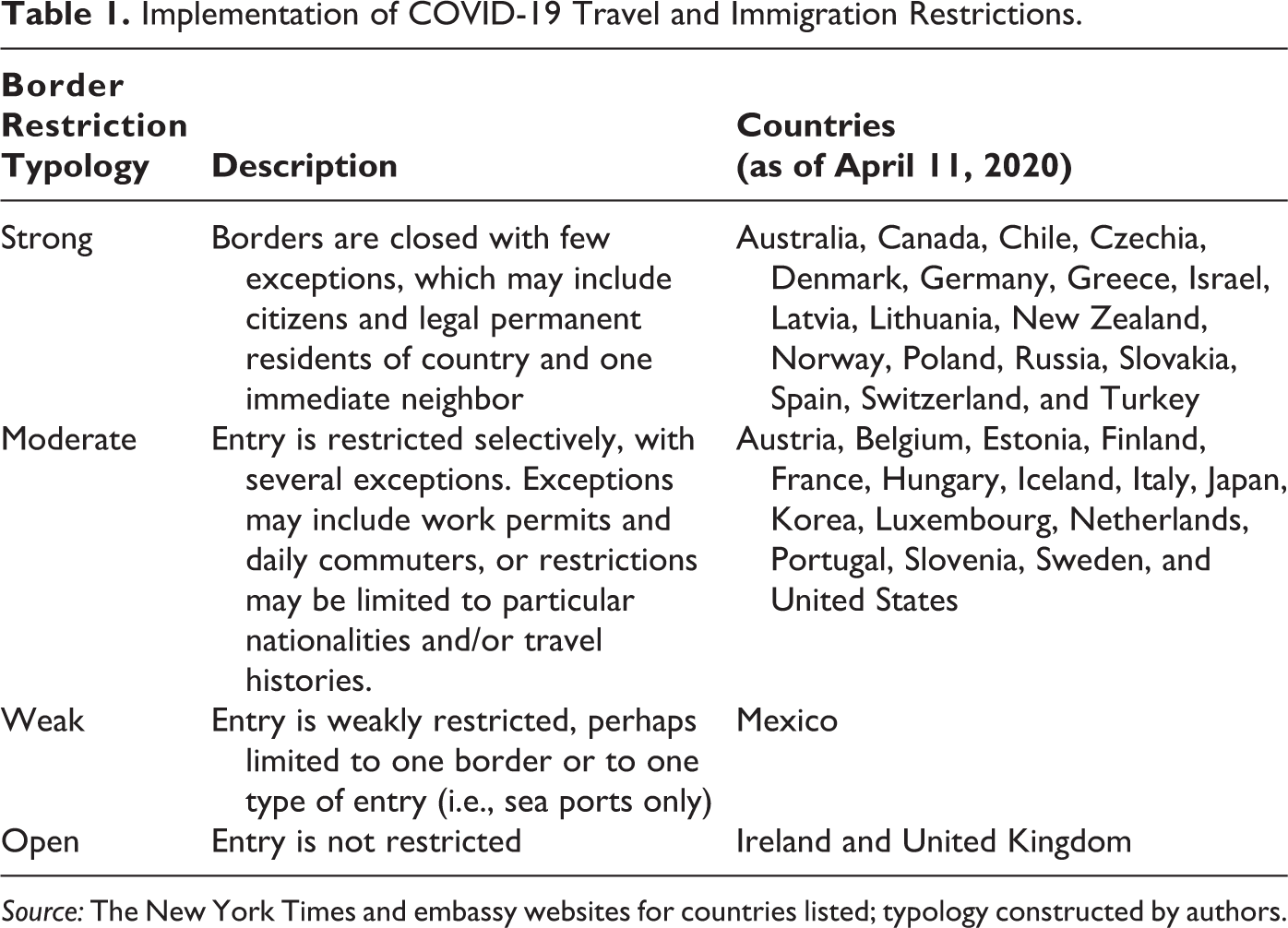
Source: The New York Times and embassy websites for countries listed; typology constructed by authors.
What do these COVID-19 restrictions mean for international migration? In Table 2, we provide estimates of the 2020 expected inflows based on 2017 statistics and extrapolated, using a five-year moving average. Collectively, the OECD+ countries accept approximately 7.5 million foreign nationals for work or long-term residential stays every year. 1 Assuming that these trips are taken relatively consistently month-to-month, a three-month stoppage of migration due to moderate and strong COVID-19 border policies would lead to a suppression of more than 1.7 million migration trips. A six-month stoppage would lead to nearly 3.5 million suppressed trips. The longer these restrictions are in place, the larger the potential back-up of what would otherwise be typical levels of migration.
Estimated Inflow of Foreign Population (in Thousands) for Each Type of Border Policy for OECD Countries and Russia.
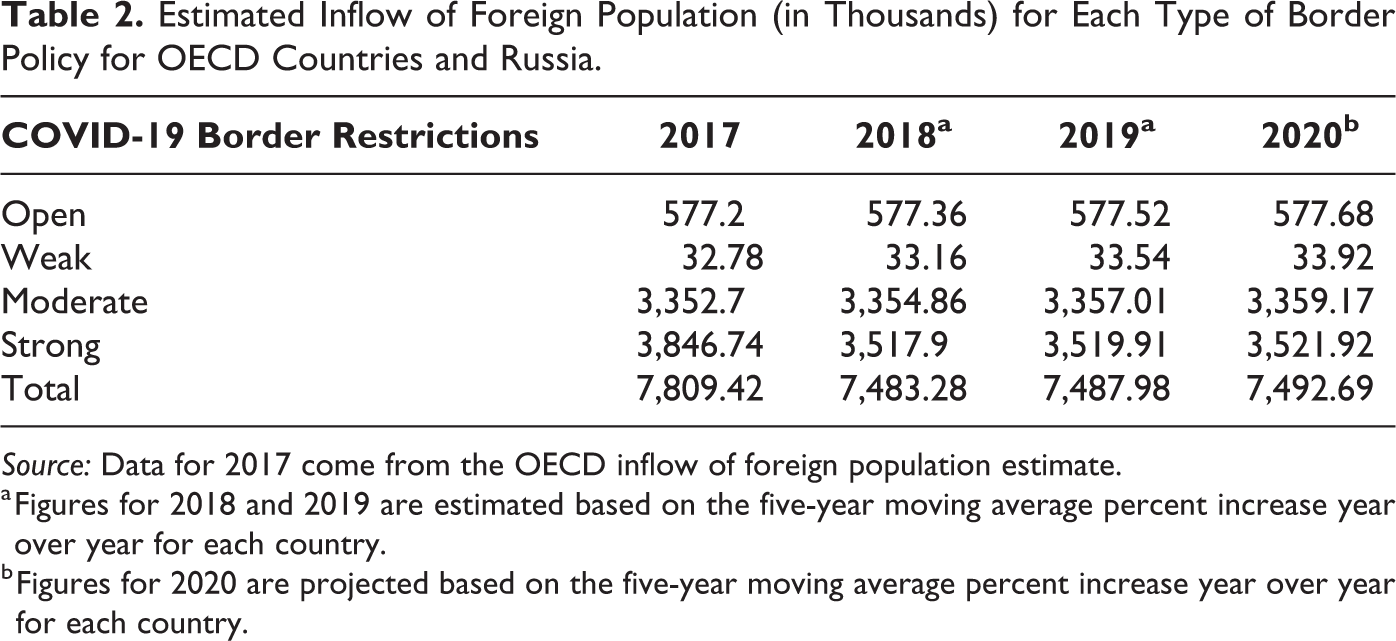
Source: Data for 2017 come from the OECD inflow of foreign population estimate.
a Figures for 2018 and 2019 are estimated based on the five-year moving average percent increase year over year for each country.
b Figures for 2020 are projected based on the five-year moving average percent increase year over year for each country.
The Cycle of Suppression and Spikes: A Predictive Model
COVID-19 was an exogeneous shock to all institutions, and few things around the world will return to “business as usual” when COVID-19 restrictions are lifted. Arguably, this observation is especially true for international migration. In Figure 1, we illustrate a predictive model, which begins with the COVID-19 pandemic and its impact on immigration policy and, in particular, border control. Increased border control suppresses ongoing or planned demographic processes and outcomes (such as decisions on whether and when to immigrate to another country), generating a build-up of unmet demand for opportunities to emigrate from sending countries. We posit that changes to these demographic processes will lead to a migration “rebound” or “spike” in the months and years following countries lifting their COVID-19 restrictions on movement. We also posit that these spikes in migration will then engender sociological processes and outcomes, including increased anti-immigrant sentiment and anti-immigration mobilization. We further hypothesize that these processes will culminate in support for reintroducing restrictive immigration policies, triggering a feedback loop and reinforcing a vicious cycle of suppression, spikes, and stigma. In the following sections, we rely on theory and past empirical evidence to explicate these processes in greater detail. In doing so, we also motivate what are, in practice, testable hypotheses for future research.
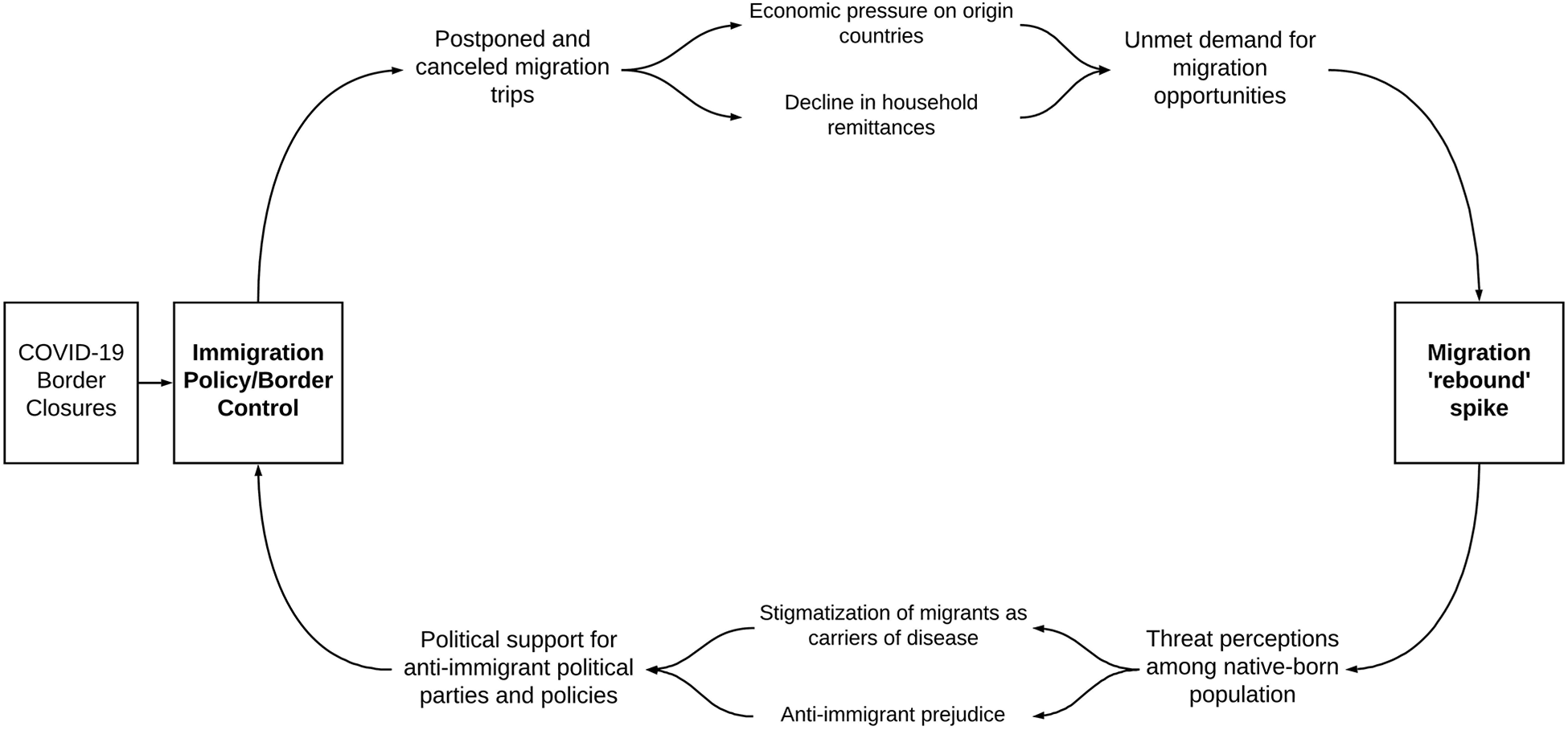
A model of cyclical consequences of COVID-19 border closures on international migration.
Before the Spike: Demographic Processes and Consequences
After an extended period of suppression related to COVID-19, why should we expect a spike in migration? Demographic research provides a plethora of evidence that when disasters and wars historically restrict demographic behaviors like fertility, these temporary suppressions result in rebounds of such behavior. Perhaps most famously in the West was the “baby boom” after WWII (Eggebeen and Sturgeon 2014). Like wars, disasters are not always rapid-onset phenomena but can be slow, lingering processes that impact people differently, depending on their stage in the life course (DeWaard 2016). In some cases, disasters can lead to delays in planned life course trajectories, including demographic behaviors such as marriage (Williams et al. 2012; Shemyakina 2013) and fertility (Nobles, Frankenberg, and Thomas 2015; Islam et al. 2016; Nandi, Mazumdar, and Behrman 2018; Kraehnert et al. 2019).
We argue that delayed, postponed, or altogether canceled migration trips due to COVID-19 border closures will have consequences for future migration decisions. In migrant-sending countries, we expect to see an increase in the unmet demand for opportunities to migrate — that is, more people will want to migrate abroad than will be able to. Partially, this unmet demand comes from the economic gains provided by migration, particularly remittances. Remittances are important income sources that contribute to household resilience and ability to invest in human capital (VanWey 2004; Sana and Massey 2005; Buch and Kuckulenz 2010; Clement 2011; Garip 2012). Only a month into the COVID-19 pandemic, the World Bank predicted one of the steepest historical declines (20%) in global remittances due to disruptions in labor migration (Ong 2020). Six months into the pandemic, remittance-dependent countries like Tajikistan began to report hundreds of millions of dollars in lost revenue, due to the drop in remittances (EurasiaNet 2020).
In addition, a surplus of labor will mean even higher unemployment in sending countries, leading to an increased demand for emigration. Typically, the migration of young, unemployed people from less developed countries to OECD+ countries acts as a “release valve” to reduce pressure on origin-country labor markets. Without this release valve, already high unemployment rates in migrant-sending countries will increase. Previously planned migration trips that were stymied due to COVID-19 restrictions will be delayed until borders re-open. These delayed trips, usually spread out over the course of several months, are likely to occur on an expedited timeline once travel restrictions are relaxed. 2
Uncertainties, delays, and restrictions have already emerged for migrants who intend to move for non-economic reasons. In the case of refugees, return and resettlement have largely been suspended (OECD 2020). For example, citing concerns about the spread of the coronavirus, the United States increased deportation of children and teens seeking asylum at the border (Dickerson 2020). In addition, family reunification has become more difficult. Even in cases where countries have made exceptions for family reunification, such as Canada and the United Kingdom, in practice, visa applications have been delayed due to coronavirus precautions and staffing challenges (e.g., Dickson 2020; Konstantinidis 2020).
Refugees and those seeking family reunification are not the only groups affected by confusing policies and de facto restrictions. For instance, swift policy changes around international student visas in the United States resulted in confusion and uncertainty as restrictive policies were issued and rescinded over a matter of days (Jordan and Hartocollis 2020; Quintana 2020). Even in countries that have not changed migration policy per se, border closures nevertheless impact most people’s ability to plan migration trips. For example, the Migration Board in Sweden reports that applications for work, study, and asylum decreased by nearly 50 percent between April and May 2020 (Migrationsverket 2020), suggesting that migration trips that would have otherwise occurred are delayed or have been canceled altogether. As OECD+ countries clarify their policies at various stages of “re-opening,” one plausible scenario is that migration trips will be undertaken with a sense of urgency, in order to get to one’s destination before the policy shifts again.
Finally, economic and political conditions in many places have worsened due to a combination of COVID-19 restrictions on migration and tourism, which represent important sources of capital, as well as tanking oil prices, and the devastating effects of COVID-19 closures on the service industry. Take, for example, the case of Lebanon. Decades of political corruption and economic woes have been exacerbated by sharply increasing cases of COVID-19 and the subsequent lockdown, leading to despair and famine (Al-Arshani 2020). In the midst of COVID-19 lockdowns and uncertainty, the deadly Beirut port explosion on August 4, 2020, also highlighted the danger of corruption and mismanagement and resulted in an outpouring of public anger (Hubbard et al. 2020). Should remittances, which in 2019 accounted for 14 percent of Lebanon’s GDP, 3 decline as predicted, the already dire circumstances are likely to worsen. Demographic research suggests that this coalescence of political and economic conditions is likely to further drive the demand for survival migration (Betts 2013).
Taken together, then, there is ample reason to anticipate that when COVID restrictions on migration ease, a migration spike will occur. Some portion of this spike will stem from the backlog of migration trips postponed by COVID-19 border closures. Based on historical trends (see Table 2), we estimate this figure to be in the millions. Another portion will come from what prior to the pandemic would have been considered typical levels of migration: approximately 600,000 per month. Additionally, we expect an unknown number of new migration trips in response to the pandemic’s more widespread effects to constitute a third portion of this spike, as individuals and families seek opportunities to escape pandemic-related economic and political pressures.
After the Spike: Sociological Processes and Consequences
Especially following a period characterized by an absence of migration, this demographic spike will not go unnoticed. Since Quillian (1995), most research on negative reactions to immigration derives its hypotheses from group threat theory (see Eger and Bohman 2016 for a review). This theory (Blumer 1958; Blalock 1967) understands prejudice as a response to a perceived threat from an out-group due to intergroup competition for scarce economic resources (Semyonov, Raijman, and Gorodzeisky 2006; Hjerm 2009) and/or a weakening of a homogeneous national culture (McLaren 2003). 4 Scholars have long maintained that negative reactions to minorities should be greatest when there is a rapid increase in the size of the out-group (Olzak 1992; Quillian 1996; Coenders and Scheepers 1998), due to increases in actual competition between groups in the labor market (Olzak 1992) or increased media attention, which heightens out-group salience and, therefore, threat perceptions (Koopmans and Olzak 2004; Hopkins 2010). Importantly, this expectation extends to countries with already large immigrant communities. People may, over time, become familiar with or accustomed to even high levels of diversity, so much so that small increases in the relative share of the outgroup no longer intensifies prejudice (Blalock 1967; Schneider 2008; Savelkoul et al. 2011). However, migration spikes have the potential to upend that trend, as evidenced by reactions to the European “migration crisis” in 2014 and 2015 (Benček and Strasheim 2016; Nordø and Ivarsflaten 2019).
Evidence of how group threat theory fares when tested dynamically is limited (c.f., Lancee and Pardos-Prado 2013), but existing empirical research supports the notion that rapid population change is associated with native-born hostilities toward immigrants in OECD+ countries. For example, inflows to European countries between 2001 and 2005 are associated with less support for immigration between 2002 and 2007 (Meuleman, Davidov, and Billiet 2009). Among German adolescents, monthly inflows of asylum-seekers between 2010 and 2015 are associated with increasingly negative attitudes toward ethnic minorities (Weber 2019), as are within-region increases in the size of the foreign-citizen population (Mitchell 2019). In Norway, increases in immigration have been initially met with increased hostility toward immigrants (Sørensen 2016; Nordø and Ivarsflaten 2019). Further, in the wake of the European “migration crisis,” support for extending social welfare to immigrants was less likely in countries that experienced a shift in public opinion regarding immigration (Eger, Larsen, and Mewes 2020).
This is not necessarily to say that spikes in immigration will invariably transform public opinion (Stockemer et al. 2019), but dramatic increases in migration may make it easier to mobilize existing anti-immigrant sentiment and make other features, such as race and ethnicity, increasingly salient identity markers (Jiménez 2008). For instance, in the Netherlands, when levels of immigration increased, so did popular support for ethnic discrimination in the housing and labor markets (Coenders and Scheepers 1998). Sharp increases in immigration were associated with ethnic conflict in US cities between 1880 and 1914 (Olzak 1989). Moreover, immigration flows correlated with radical-right violence against asylum-seekers and foreigners in 1990s Germany (Koopmans and Olzak 2004), and the dramatic increase in asylum seeking to Germany in 2014 and 2015 also preceded an eruption of hostilities and violence perpetuated against migrants (Benček and Strasheim 2016).
Other effects are political. For example, increases in the relative size of the foreign-born population in Norwegian municipalities were associated with greater support for the anti-immigrant Norwegian Progress Party between 1977 and 2011 (Sørensen 2016), while increases in the size of the minority population in British regions were associated with greater support for the radical right party UKIP between 2009 and 2014 (Kaufmann 2017). In Russia, inflows of ethnic-minority immigrant populations have also led to more anti-immigrant voting (Alexseev 2006).
Previous empirical research shows that the electoral success of anti-immigrant parties and politicians is consequential for immigration policy and, therefore, for immigrants (Menjívar and Abrego 2012). In the US state of Arizona, anti-immigrant political rhetoric on social media increased after the passing of profiling law SB 1070 (Flores 2017). In another US state, Pennsylvania, politicians used stereotypes about immigrant criminal activity to mobilize popular support for more restrictive immigration policies, and gun sales increased by 6 percent where this kind of political rhetoric was deployed (Flores 2015). Moreover, research from Germany shows that violent attacks against refugees increased when nearby terrorist events led to anti-immigrant reactions from political leaders (Jäckle and König 2018).
Migration policy should be most susceptible to restrictions when anti-immigrant political parties are in government or anti-immigrant figures are heads of state. For instance, in the United States, increasingly restrictive immigration policies have accelerated under President Trump (Pierce and Selee 2017). However, electoral gains made by such parties may also have indirect effects on restrictive immigration policies by influencing the positions of other parties. Recent research shows that the electoral success of radical right parties in European countries affected mainstream right and left parties’ own stances on issues related to immigration between 1980 and 2014 (Abou-Chadi and Krause 2020). Anti-immigrant, nationalist politics had already seen a resurgence prior to the pandemic (Eger and Valdez 2019), and reactions to the pandemic will continue to play out in a context where the far right has not only increased its share of the electorate in the majority of OECD+ countries but also enjoyed the normalization and mainstreaming of its stances on immigration (Mudde 2019). For parties like the popular Swiss People’s Party, COVID-19 has indeed presented a political opportunity to champion stricter border controls to restrict future migration (Betz 2020).
Testing the Model: A COVID-19 Research Agenda
In summary, we argue that these initial COVID-19 border restrictions have set in motion demographic and sociological processes that are likely to culminate in support for reintroducing restrictive immigration policies, triggering a feedback loop. In an effort to help facilitate future research, our model implies a number of testable hypotheses about the pandemic and its impact on international migration over time. Each arrow can be tested simply; for instance, does the lifting of border restrictions lead to a migration spike? However, the model’s real explanatory power comes from an examination of the feedback mechanisms. For example, under what conditions do migration spikes lead to increasingly restrictive immigration policies? What are the necessary and sufficient conditions for political mobilization around spikes in migration?
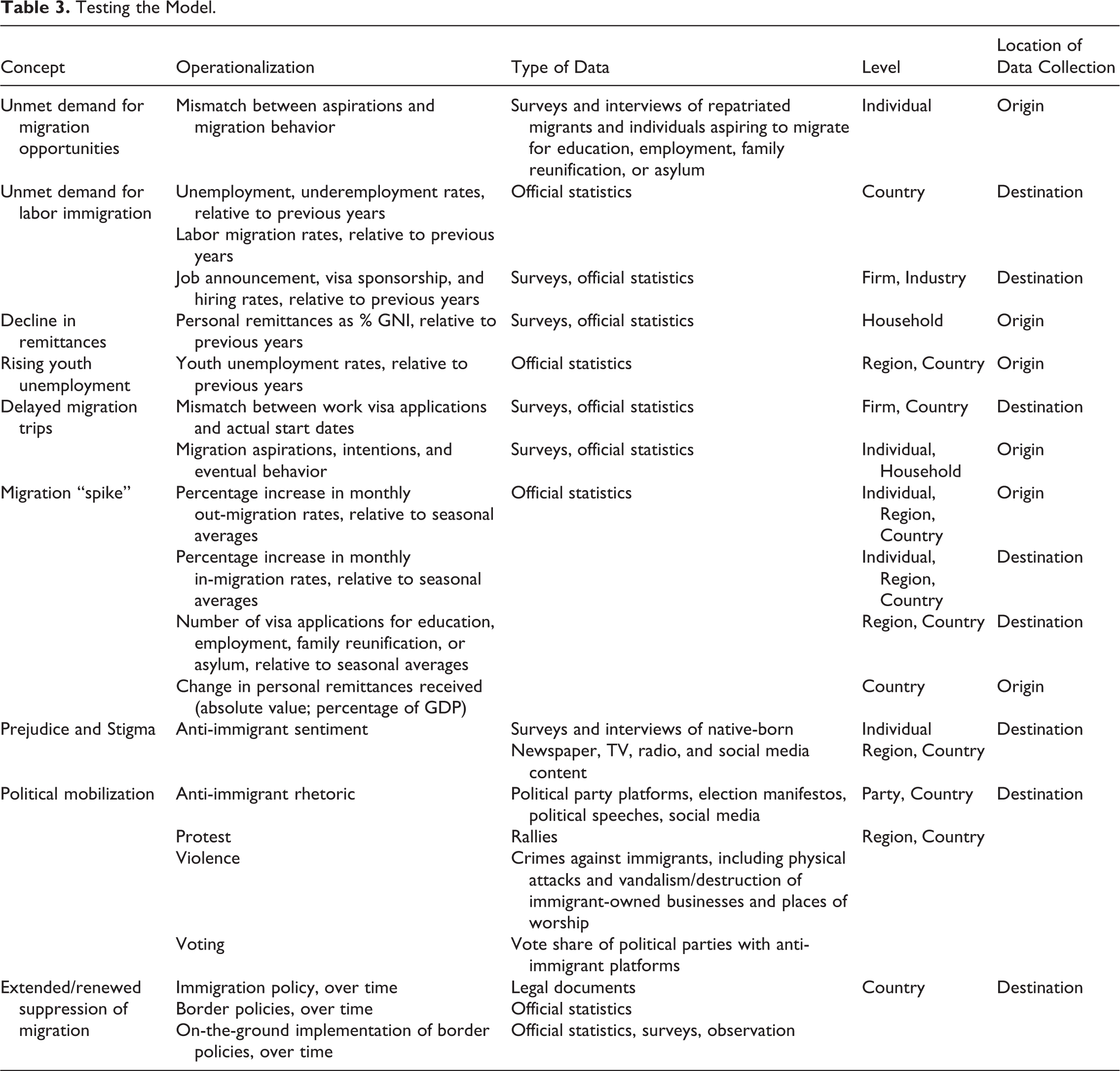
In Table 3, we suggest types of data that can be collected and used to correspond to the concepts we have identified. As our model contains a feedback loop with both sociological and demographic processes, empirical tests can take many different forms. Accordingly, many different types of data have the potential to inform these tests. Some of these data are regularly collected by national statistics offices, such as official migration rates and border policies. Others require original data collection (e.g., Cheng et al. 2020), such as surveys and interviews focused on the mismatch between aspirations and migration behavior. We do not intend this list to be exhaustive, but rather illustrative of the ways in which our model can be applied and empirically examined.
Testing the Model.
A Vicious Cycle
What will the exogenous shock that is COVID-19 mean for international migration? What will anti-immigrant prejudice and politics mean for future cycles of suppression and spikes? Based on theory and previous empirical findings, we predict a feedback loop in which these spikes and their consequences will contribute to political mobilization for stricter immigration policies, further contributing to a vicious cycle of the suppression of migration, episodic spikes in migrant inflows, and subsequent anti-immigrant prejudice and politics. We base our model on demographic and sociological theory and previous empirical research; however, there is another reason to expect these outcomes: stigma. By “stigma,” we explicitly refer to instances “when elements of labeling, stereotyping, separation, status loss, and discrimination co-occur in a power situation that allows the components of stigma to unfold” (Link and Phelan 2001, 367). Migrants have historically been stigmatized as carriers of disease (von Unger, Scott, and Odukoya 2019; White 2020). Thus, our model best predicts the consequences not of border closures, writ large, but of pandemic-induced closures.
Prior to community spread, COVID-19’s initial spread was facilitated by movement, in the form of both tourism and migration (for the example of India, see Thakur [2020]). While political rhetoric on the dangers of tourism has not yet emerged, violent scapegoating against people labeled as non-native has already begun: against Asian Americans in the United States (Asmelash 2020; Zia 2020), against African migrants in parts of China (Marsh, Deng, and Gan 2020; Su 2020), and surely others that have yet to be reported. Indeed, migrants who are stigmatized as carriers of disease (COVID-19 or otherwise) are labeled, stereotyped as more vulnerable to disease due to living conditions and dense population, separated as “others” from the native-citizen population, considered lower status because of this stigma, and discriminated against in everyday interactions, labor and housing markets, and visa processes. The concept of stigma, either its causes or consequences, is not central in the theoretical or empirical literatures on migration (e.g., FitzGerald and Arar 2018), but it should be especially relevant in the wake of COVID-19.
Public health measures to restrict movement during a pandemic are necessary, but these border closures will not last forever. When they are lifted, the extent to which governments will enforce protective legislation for migrants is contingent on political leaders’ will to do so in the face of populist hostilities and increasing neo-nationalist claims (Eger and Valdez 2019). The spread of fear has closely followed the global spread of COVID-19. We predict that the cycle of suppression, spikes, and stigma will engender future political mobilization for restrictive immigration policies. 5
Research shows that such policies almost never result in their intended goal of stopping migration; instead, they tend to change the nature of migration from legal and temporary to undocumented and long term (Massey 1987, 2002). Therefore, political leaders seeking long-term restrictive immigration policies to curb fears over COVID-19 are more likely to increase nativist hostilities and violence toward migrants than actually protect a country’s or localities’ population from disease. Empirical analyses applying our model should examine the dynamics of this selectivity. If selective immigration restrictions are applied to sending countries with high infection rates of COVID-19, this evidence would suggest that public health concerns drive immigration restrictions. If, on the other hand, selective immigration restrictions are applied to sending countries that have been the subject of stigma perpetuated by political leaders, this evidence would suggest that nativist fears drive immigration restrictions, contributing to the vicious cycle we have presented here.
Footnotes
Declaration of Conflicting Interests
The author(s) declared no potential conflicts of interest with respect to the research, authorship, and/or publication of this article.
Funding
The author(s) received financial support for the research, authorship, and/or publication of this article: This research was partially supported by the Marianne and Marcus Wallenberg Foundation (MMW 2014.0019) and the Swedish Research Council for Health, Working Life and Welfare (FORTE 2016-07177).
