




Abstract
Using five waves of the German Panel Analysis of Intimate Relationships and Family Dynamics (pairfam), we examine how economic circumstances are related to fertility intentions in childless young men and women in East and West Germany. We explore multiple dimensions of fertility intentions: short-term intentions for the next two years, long-term expectations about family size, and uncertainty about these short- and long-term intentions. Our findings suggest that economic circumstances constrain fertility intentions and increase uncertainty. Although fertility intentions differ between men and women and by region, the broad mechanisms that predict intentions are very similar across groups for long-term intentions and uncertainty. However, group differences emerge in short-term intentions.
Introduction
Examining the demographic and economic circumstances of fertility intentions among young adults in advanced postindustrial countries is crucial to understanding both current and future fertility patterns. More broadly, it is one specific example of how experiences in early adulthood may affect plans across the life course and can reveal information about the process through which economics influence individual behavior. Research on intentions has lagged behind that of the determinants of fertility behavior, but we have reason to believe that economic circumstances will be particularly influential (Goldstein et al. 2013; Hayford 2009; Liefbroer 2009; Testa and Basten 2014). In this article, we examine the relationship between economic circumstances and fertility intentions of childless young men and women in East and West Germany. Germany is an important case to study in part because it has extremely low fertility (Population Reference Bureau 2010), relatively low levels of unplanned fertility (Feldhaus and Boehnke 2007), strongly held notions about traditional gender roles, and unique regional variation between East and West Germany. These regional differences exist with respect to fertility patterns (Goldstein and Kreyenfeld 2011) as well as economic uncertainty (Bhaumik and Nugent 2005).
We focus on childless young people in early adulthood for several reasons. First, early adulthood intentions are important for both later life intentions and later behaviors (e.g., Hayford 2009; Schoen et al. 1999). Second, early adulthood is a particularly salient time period regarding fertility and economics as it is when individuals typically transition to lead independent lives and is a period when many aspects of their lives, including their fertility intentions, are most likely to be changing or changeable (Rindfuss 1991). Third, life course theory and research demonstrate that the events and experiences at one point in the life course can have lasting influences on individuals (Cherlin, Chase-Landsdale, and McRae 1998; Elder 1999). Fourth, we limit our investigation to childless adults because the experience of childbearing likely influences intentions and may condition the relationship between economics and intentions.
We expand the existing literature in three main ways. First, we focus on several dimensions of fertility intentions, including those for the short and long term as well as uncertainties about them. This allows us to shed a more nuanced light on the process through which individual economic resources may indirectly influence fertility. Second, we explore the role of social context in conditioning the relationship between individual economic resources and fertility intentions by explicitly comparing East and West Germany. Third, we include men in our analyses, a group that is often excluded from research on fertility. Exploring how economic resources and context shape Germans’ fertility intentions improves our understanding of economics in the lives of young people, a particularly important question in these times of economic uncertainty or strain and low fertility.
Background
We begin with a brief note on terminology. There are several elements to the ideas individuals hold about their future fertility behavior. Theoretically, fertility intentions and expectations are distinct components with expectations incorporating both intentions and external factors (Bachrach and Morgan 2013; Iacovou and Tavares 2011; Warshaw and Davis 1985). However, empirically the two are virtually indistinguishable. Furthermore, although some factors may influence intentions and expectations differently, we expect the same direction for theoretical relationships. In the context of economic factors, we are hard pressed to identify a factor that would, say, increase fertility intentions but somehow reduce expectations. As such, scholars often use intentions as a general term that includes both (Hayford 2009). We do the same here when discussing theoretical relationships and also include reported uncertainty about fertility intentions under this umbrella. When reporting empirical results, our own and those in the literature, we use the term that best matches the actual measure or operationalization in question.
Fertility intentions have theoretically and empirically been recognized as an important predictor of fertility behavior. Sociological theories of social change identify changing fertility intentions as a key mechanism through which macro-level context (e.g., social policies or structures) shapes individual-level behaviors (Lesthaeghe and Surkyn 1988; Thornton and Lin 1994). More recent theoretical efforts have further explicated the role of fertility intentions, showing that they are shaped by structural factors like economic context and underlying “schemas of childbearing and parenthood” (Bachrach and Morgan 2013; Johnson-Hanks et al. 2011).
In research motivated by these various frameworks, fertility intentions have been documented as an important component of fertility behavior. Hayford (2009:765) argues that people’s actual number of children born “is largely a product of how many children they want.” This is particularly true in low fertility countries where contraception is widely accessible. As such, intentions are one of the strongest predictors of behavior, even among teens (Miller, Barber, and Gatny 2013), although they do not do so perfectly (see e.g., Balbo, Billari, and Mills 2013; Morgan 2001; Morgan and Rackin 2010; Quesnel-Vallee and Morgan 2003; Schoen et al. 1999). Furthermore, Hayford’s (2009) research also shows that intentions held early in life are indicative of those held later. In particular, women whose expected family size at age 18 was two or fewer children went on to expect even smaller families over the life course whereas women who expected larger families at age 18 increased their family size expectations.
As mentioned, fertility intentions are not a one-dimensional concept, and different aspects are potentially shaped by different structural and/or individual factors. We explore multiple dimensions of this ideational component: short-term intentions (respondent’s intentions on having children within the next 2 years), relative uncertainty about short-term intentions, long-term family size expectations, and the degree of certainty young people have about those long-term expectations.
Examining several aspects of fertility intentions allows us to capture a more nuanced picture of the factors that shape them and by extension, subsequent fertility behavior. Specifically, these dimensions reveal information on the process linking economics to fertility and on the life course nature or sensitivity of this process. Differences in the relationship between short-term and long-term intentions can reveal the extent of the life course dynamics at work. We also specifically model uncertainty about intentions, an issue that has rarely been included in existing work on fertility intentions and family size expectations.
Race, gender, age, the number of siblings, and relationship status have all been identified as important individual characteristics associated with fertility intentions and changes in those intentions (cf. Lutz, Skirbekk, and Testa 2006; Rindfuss and Parnell 1989; Schoen et al. 1999). To date, far less is known about how factors that themselves are more variable, such as one’s economic circumstances, are related to intentions. Previous research has explicitly called for more investigation into the relationship between employment and fertility intentions, in part to understand the degree to which those external and changing circumstances may constrain fertility intentions (Hayford 2009). Our article follows this call.
Economic Circumstances and Fertility Intentions
To guide our investigation into the relationship between economic circumstances and fertility intentions, we extend frameworks typically applied to fertility behaviors to intentions. We also incorporate the uncertainty individuals may have in their stated intentions to further identify alternative mechanisms. In particular, we rely on the economic strain approach (Kreyenfeld 2010), which builds off of the globalization and uncertainty for youth employment literature (Mills and Blossfeld 2005) and Oppenheimer’s (1988) economic models of family formation. These foundational frameworks hold that individuals are more likely to enter marriage and parenthood if they are secure in their economic position and feel confident in their future economic position. An underlying assumption is that these life course stages, for example, being a parent, require a certain amount of financial security and resources. When individuals feel economic strain or are in situations that do not appear to guarantee high future economic resources, they will delay parenthood and/or have fewer children. Said another way, potential parents may perceive children as too costly and so have fewer. Given recent estimates of the high cost of rearing children, this assessment of costs is not unfounded (Lino 2014). Extended to fertility intentions, this approach implies that young people experiencing greater economic strain will be less likely to expect to have children in the near future. Unemployment, low earnings, and currently being enrolled in school all indicate fewer resources (i.e., greater strain), thereby lowering short-term fertility intentions. Higher levels of education indicate, at minimum, greater earnings potential and employability and therefore raise short-term intentions.
The influence of economic strain on fertility intentions is not limited to the short term. Current strain may also influence longer term intentions, particularly about completed family size, because young people may interpret their current economic situation to be indicative of their future, or they may see their current lack of resources as enough to limit fertility. Regarding education, because it is typically considered an investment for higher future earnings, young people with more education may expect larger families despite the fact that current enrollment in school may be associated with lower long-term intentions (Blossfeld and Huinink 1991; Kravdal and Rindfuss 2008). This relationship is analogous to what is observed with behavior where enrollment in school deters childbearing and marriage but attainment increases both (Elder 1995; Upchurch, Lillard, and Panis 2002). There is some additional empirical evidence that suggests that the education-fertility intention relationship is highly dependent on macro-level context (Berrington and Pattaro 2014).
For men, the limited economics-fertility research that has been done employs this economic strain framework: Declining earnings or income reduces the likelihood of becoming a father and presumably (although rarely explicitly addressed in existing research) lowers fertility intentions and expectations (Kreyenfeld 2004). Among employed West German men, higher income, more education, and a greater sense of job security were associated with higher intentions to have a first child (Berninger, Weiss, and Wagner 2011), and job insecurity was associated with delayed fertility (Bernardi, Klärner, and Von der Lippe 2008).
Research on fertility behavior offers some support for this framework for women as well, although it is not the framework most commonly applied to women’s fertility decision-making process. German women with economic concerns had lower fertility than those who felt more financially secure (Hofmann and Hohmeyer 2013), and highly educated women responded to employment uncertainty with postponed parenthood (Kreyenfeld 2010; Kreyenfeld and Andersson 2014). In other settings, research has found associations between economic insecurity/instability and lower fertility at the individual and macro levels (Ahn and Mira 2002; Kohler and Kohler 2002; Philipov, Speder, and Billari 2006).
Economic strain may also be important for its connection to uncertainty more broadly (Mills and Blossfeld 2005). Young adulthood is a period of many transitions across multiple domains in the life course (Rindfuss 1991), and success in navigating one arena may increase confidence in others. Low earnings and unemployment may increase feelings of economic uncertainty, leading young people to be less certain or confident about their future fertility intentions (in both the short and long term). Regarding education, more education should create a sense of security in part because individuals have either higher earnings or earnings potential and lower risk of unemployment. In this way, educational attainment should lower uncertainty about fertility intentions. However, current enrollment may be associated with status uncertainty in ways that operate similarly to unemployment experiences, leading to increased uncertainty.
To the extent that economic strain is a key factor underlying fertility intentions, we expect that:
Hypothesis 1a: Individual economic resources are positively associated with short- and long-term fertility intentions for both men and women.
Hypothesis 2: Individual economic resources are negatively associated with uncertainty about short-term and long-term intentions for both men and women.
Of course, an economic strain framework is far from the only one used to study the economics-fertility relationship. Another theoretical framework that has received much attention in the economics-fertility research is the new home economics ideal (brought forward by Becker 1981), which posits that women leave the labor market to bear and raise children and as a result incur costs. These costs—loss of earnings, human capital depreciation, loss of status and identity—are referred to as opportunity costs, and when opportunity costs are higher, women are less likely to leave the labor market to have children.
The opportunity costs framework implies a negative relationship between economic circumstances and women’s short-term fertility intentions. Because of the immediate exit from the labor market implied by this framework, women with higher opportunity costs (those employed, with greater earnings, and with more education) will be less likely to expect to have children in the immediate future (Iacovou and Tavares 2011). However, this framework is less useful for understanding the certainty with which they hold those short-term intentions and offers even less guidance for understanding women’s long-term intentions or their uncertainty or for men’s intentions at all. On the one hand, as the immediate trade-off between childbearing and foregone earnings is not at play, we would not expect a relationship between opportunity costs and long-term intentions such as those regarding ultimate family size. On the other hand, it’s possible that those with greater earnings and more education are more likely to anticipate having smaller families because they plan on incurring those opportunity costs fewer times by having fewer children. Similarly, for uncertainty in long-term fertility intentions, there is simply no obvious link to opportunity costs. Because of the relative lack of research on uncertainty and the conflicting theoretical predictions, we do not propose specific opportunity cost hypotheses for long-term fertility intentions or for uncertainty regarding short- or long-term fertility intentions.
The opportunity cost framework traditionally is applied only to women as they experience pregnancy, and it is usually women, and not men, who expect to adjust their employment patterns in response to parenthood. Empirically, the opportunity cost framework has generally not been applied to men’s fertility behavior or intentions.
In sum, the opportunity costs framework leads us to expect:
Hypothesis 1b: Individual economic resources are negatively associated with short-term fertility intentions for women but not for men.
Macro-level Context: Two German “Regions”
An increasing body of literature argues that macro-level (e.g., country or regional) social institutions have an important influence on fertility in low-fertility settings (Klüsener, Neels, and Kreyenfeld 2013; Rindfuss and Brauner-Otto 2008; Rindfuss, Choe, and Brauner-Otto 2016). A key argument is that social institutions, such as labor markets and gender norms, work together to create settings with varying degrees of compatibility between work and family and that when work and family are more compatible, observed fertility is higher. Although intentions are generally not explicitly addressed in this research, we argue that macro-level context may be similarly important in influencing fertility intentions. The German case, with considerable differences across regions in key dimensions but substantial similarity existing within one larger macro context, provides us a window into how the macro-level context may influence fertility intentions and how the macro-level context may condition the relationship between individual economic circumstances and intentions.
There are several characteristics that make Germany an ideal setting for examining these questions. First, consider the demographic picture: Fertility is quite low in Germany (only about 1.5 children are expected for an average woman if current fertility behaviors are maintained; Human Fertility Database 2015). Fertility levels this low lead to shrinking and aging populations with a host of social concerns such as a decreasing labor force and strain on welfare systems (Bloom et al. 2010; Feyrer 2007; Lee and Mason 2014; Lindh and Malmberg 2009). Other characteristics of German fertility make it particularly appropriate for studying fertility intentions. Specifically, there are low levels of unplanned births, especially among those under the age of 25 (Feldhaus and Boehnke 2007), and a relatively high and increasing mean age of first birth (currently at 29 years; Human Fertility Database 2015). What this means is that, as with all countries with low levels of unplanned pregnancies, fertility intentions may be closer to actual fertility outcomes. Since the majority of young people have not had children but have finished schooling and entered, or tried to enter, the labor market, we are able to investigate the economic context–fertility intentions relationship without the added methodological and theoretical complications of incorporating actual childbearing. 1
Second, examining the role of household and individual-level economic context on fertility intentions in Germany may yield a conservative estimate of the role of economic context since the German welfare state is fairly generous (Statistisches Bundesamt 2012; Wulfgramm 2014). It is considered a conservative corporate welfare state according to Esping-Anderson’s typology, where male breadwinners are supported and somewhat protected from market forces (e.g., DiPrete and McManus 2000; Esping-Andersen 1990). As a result, economic setbacks may not pose the same existential threat that they do in less generous liberal welfare states like the United States, where much of the research on fertility intentions is set.
Third, conservative welfare states, including Germany, have been shown to exhibit a more traditional domestic division of labor (Cooke 2006; Geist 2005). This value system is reflected by the continued existence of derogatory terms like “Rabenmutter” (Raven mother, e.g., Bennhold 2010; Borck 2014; Goldstein and Kreyenfeld 2011), used to describe women who place their children in daycare so they can return to work when their children are young. While overall women’s labor force participation is high, larger gender differences appear when looking at parents of young children (e.g., only 32 percent of mothers with children under 3 worked for pay; Statistisches Bundesamt 2014). Because of the high value placed on the male breadwinner, economic strain may be particularly linked to lower fertility intentions for men in this setting.
Fourth, there are still fundamental, meaningful differences between East and West Germany in demographic trends and patterns (e.g., average fertility patterns), economic conditions (e.g., unemployment rates), patterns of and attitudes toward women’s labor force participation, child care infrastructure, and even willingness to take risks (Bauernschuster and Rainer 2010; Buhr and Huinink 2015; Heineck and Süssmuth 2013; Kuhn 2013). Following reunification, fertility in East Germany was much lower than in the West. The gap in fertility narrowed rapidly in the late 1990s, and by the early 2000s, fertility was actually higher in the East than in the West (according to the Total Fertility Rate, a commonly used measure of childbearing; Goldstein and Kreyenfeld 2011). However, recent estimates show that this may be largely due to differences in when women have children in the two regions, not how many children they have. West German women have been and continue to be older on average at their first birth and are more likely to wish to be childless (Goldstein and Kreyenfeld 2011; Klein 2006). The mean age at first birth was 29.21 in East Germany and 30.47 in West Germany in 2013 (Human Fertility Database 2015).
Finally, despite identical tax, policy, and regulation environments, the lived economic context of young Germans also varies considerably between East and West Germany. East German states have substantially higher rates of un- and underemployment compared to the West (i.e., 9.0 percent vs. 5.9 percent and 13.1 percent vs. 7.6 percent for 2013, respectively; Bundesagentur für Arbeit 2014). And East German labor markets have been plagued with ongoing structural problems (Schmitt 2012). Support for women’s labor force participation remains substantially larger in the East (Bauernschuster and Rainer 2010), and the strongly gendered division of labor patterns are far more prevalent in West Germany (Cooke 2006). This is likely partly due to the more developed child care system in the East where about 52 percent of children under 3 are in some type of daycare facility. In turn, this pattern is reflected in and reflective of differences in maternal employment, which varies across regions. For example, in the West, roughly 75 percent of mothers work part-time, whereas only 44 percent of mothers do so in the East (Statistisches Bundesamt 2014, 2015).
This yields a country with two regions with substantial variation in individual and contextual economic circumstances and where individuals typically experience planned fertility occurring later in life (i.e., once people have had the opportunity to engage with the labor market). Of course, these patterns on their own are not unique to Germany, but the specific combination of fertility, economics, and historical context make Germany an especially good setting in which to examine our research questions. These differences allow us to further test our main hypotheses and assess whether the relationship between individual economic resources and fertility intentions varies by macro-contextual forces (Rindfuss et al. 2016). It may be that the different levels of economic strain in the form of uncertainty and unemployment across regions correspond with different levels of fertility intentions. Additionally, the different value systems and other institutional structures (e.g., child care) may condition the effect of economic circumstances so that the nature of the relationship between economics and fertility intentions varies across regions.
Empirical evidence regarding East-West differences is mixed. On the one hand, Bernardi et al. (2008) revealed that established job security was an important prerequisite for parenthood among West German men but not among East Germans (Mayer and Schulze 2013). On the other hand, Adler (1997) illustrated that the economic and social uncertainty associated with the end of the German Democratic Republic and German reunification had a profound negative effect on East German women’s fertility, despite the still better child care infrastructure in the area of the former GDR. We examine the regional differences in fertility intentions and the relationship between economic context and fertility intentions.
To the extent that economic strain theory applies and given the greater levels of economic uncertainty in East Germany, we expect that:
Hypothesis 3a: Living in East Germany is negatively associated with both short- and long-term fertility intentions for men and women.
Hypothesis 4: Living in East Germany is positively associated with uncertainty about both short- and long-term fertility intentions for men and women.
Based on recent fertility behavior, we expect that:
Hypothesis 3b: Living in East Germany is positively associated with short-term fertility intentions for both men and women, as East Germans have children earlier.
Hypothesis 3c: Living in East Germany is positively associated with long-term intentions for low fertility but negatively associated with long-term intentions of childlessness, as East Germans are less likely to have large families and less likely to be childless
Data
To examine these hypotheses, we use data from the first five waves of the German Family Panel, pairfam (Nauck et al. 2015). A detailed description of the study can be found in Huininik et al. (2011). Data were collected yearly from 2008–2009 (Wave 1) through 2012–2013 (Wave 5). We further limit our sample to childless respondents aged 18 to 30 to capture early adulthood. 2 Excluding observations with missing data (the largest proportion of which were due to missing information for the household income measure) yields a sample of 7,880 observations from 3,095 individuals, in an unbalanced panel. The imbalance arises both from individuals aging in and out of the sample.
Dependent Variables: Fertility Intentions
We examine multiple dimensions of fertility intentions—short-term intentions for having children, long-term family size expectations, and uncertainty regarding both—yielding five dependent variables. Fertility intentions were ascertained from respondents who are not (known to be) infertile and whose partner, if they have one, is not (known to be) infertile.
Our first measure captures short-term intentions based on the question, “Do you intend to become a mother/father in the next two years?” We distinguish between respondents who indicate that they “definitely” intend to have a child in the next two years and those who do not—the reference group includes those who “perhaps” intend to have a child in the next two years or do not intend to have children in the next two years (“no, probably not” and “definitely not”). During the first year they are observed, 6 percent of respondents said they definitely intended on having a child in the next two years, but about 17 percent of respondents expressed definite intentions for parenthood in the next two years at some point during our observation timeframe. Table 1 shows descriptive statistics for this and all dependent variables for all respondents for the first wave they were observed.
Fertility Intentions of German Men and Women, pairfam Waves 1–5 (Years 2009–2013).

Note: From first observation for each respondent, entry waves vary. All measures are dummy variables with values of 0 or 1.
Uncertainty about short-term intentions is measured by distinguishing between those who perhaps intend to have children in the next two years and those who definitely intend to have a child in the next two years (the reference category). For the analysis of this dimension, we excluded those who do not intend to have a child in the next two years.
We measure long-term fertility intentions with two indicators. First, we created a measure for plans for a “small” family based on the question, “When you think realistically about having children, how many children do you think you will have?” Response options included 0, 1, 2, 3, 4, or more, as well as “I am not sure” and “I haven’t thought about this.” Those who plan on having no or only one child are categorized as expecting low fertility or small families (in contrast with those who plan for two or more children). Stated ideal family size (which reflects societal norms and not individual restraints and circumstances; Hagewen and Morgan 2005) has been stable in Germany around 2.1 children since the early 1980s (Sobotka and Beaujouan 2014) and is not part of our analyses. 3 Twenty-four percent of respondents reported anticipating low fertility the first time they are interviewed, but 32 percent of respondents indicate at some point that they expect a small family.
A second measure of long-term family size expectations specifically captures respondents who are expecting to have no children at all (with any number of children as the comparison category). They represent only 6 percent among the first wave observations; about 10 percent of respondents expect to remain childless at some point during the study. Those who are unsure or have not thought about it are treated as missing for both of these indicators.
Uncertainty about long-term fertility expectations are captured by our final measure, as they are treated as missing for the expected family size outcomes. We combine responses of “I am not sure” and “I haven’t thought about this” to the question on expected family size into a measure of uncertainty about future fertility. Ten percent of respondents express uncertainty in the first observation, and 22 percent reported being uncertain about their future fertility at some point.
The measures we examine are closely linked as they are partially subsets of each other. Expectations of low fertility and expectations to remain childless are two different ways to measure expected family size and by definition are overlapping. Similarly, those we have identified about being uncertain about their expected family size by definition are missing on our measure of planning a small family and expecting to remain child free. However, there is only a moderate correlation between short-term intentions for having children and expected small family size overall (tetrachoric correlation coefficient 4 = −.09).
Individual-level Economic Circumstances
We examine three dimensions of individual-level economic circumstances to move beyond a narrow conceptualization of economic circumstances: labor force status, income, and education. Our measure of labor force status captures the respondents’ current labor market attachment for their primary activity. We distinguish between respondents who work for pay (includes all types of work), those who are currently enrolled in schooling, and those who are currently not working for pay. Over half of respondents were working, and 38 percent were in school in their first observation period (see Table 2 for descriptive statistics for all independent variables).
Independent Variables.
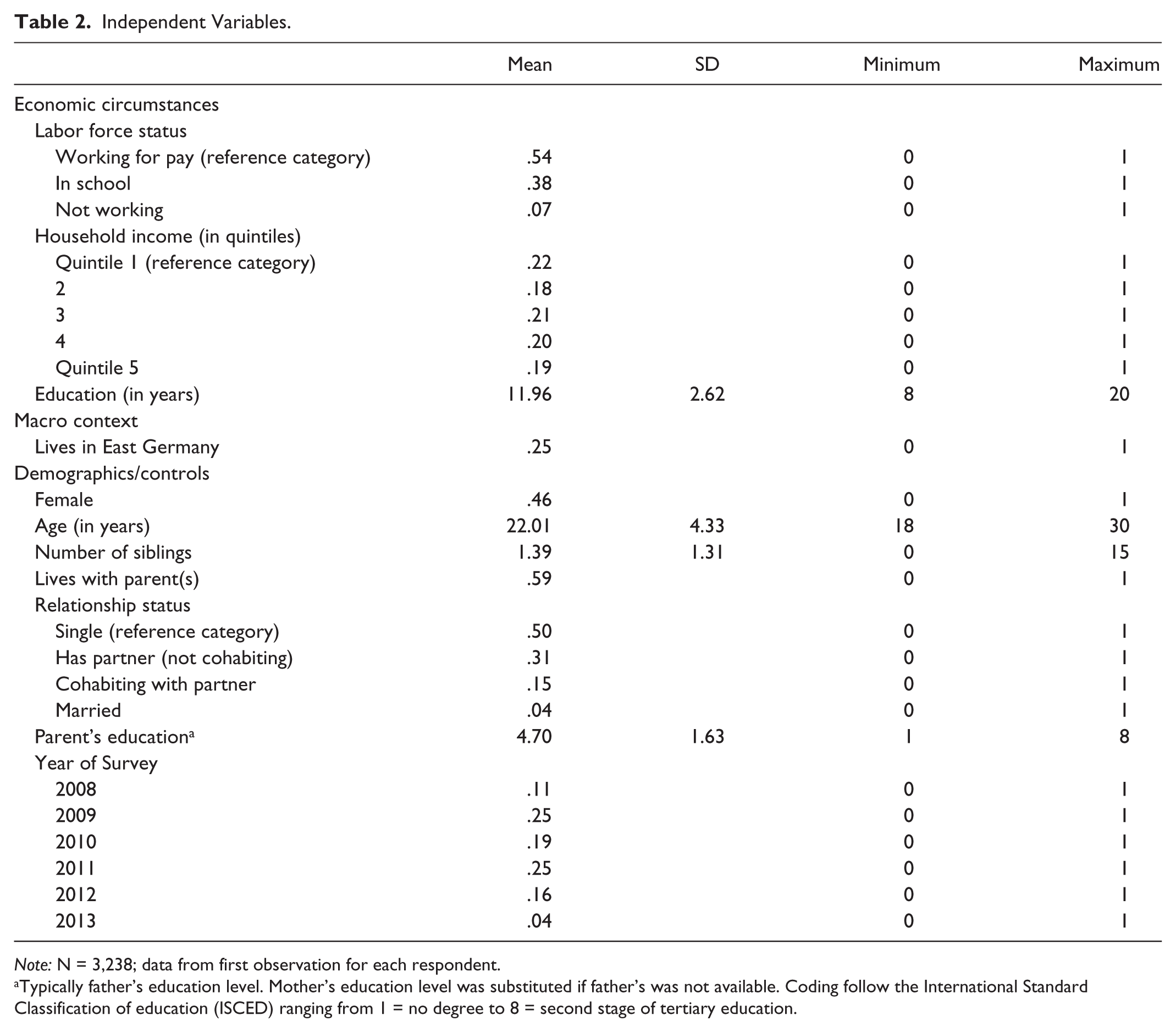
Note: N = 3,238; data from first observation for each respondent.
Typically father’s education level. Mother’s education level was substituted if father’s was not available. Coding follow the International Standard Classification of education (ISCED) ranging from 1 = no degree to 8 = second stage of tertiary education.
We rely on household income as an additional measure of economic resources. This, as opposed to individual earnings, better captures the actual economic circumstances of respondents who have partners with earnings. In supplementary analyses, we also explored the use of individual labor earnings, and the overall findings were similar to those presented here. We prefer household income as it more accurately reflects the realities of those who live with partners. To more accurately measure overall economic well-being, we adjust household income for household size (by dividing by the square root of the household size as suggested by the Pairfam Data Manual; Brüderl 2015). We then divide the sample into quintiles based on adjusted household income. Grouping provides a conservative measurement approach as it reduces the variation within the sample.
Educational attainment is measured in years. This measure includes formal schooling, formal vocational training, as well as training at all forms of institutions of higher learning (see details of coding in Brüderl et al. 2015). The mean number of years of education for our sample was almost 12.
Macro Context
We measure regional context by region of residence within Germany at the time of each interview. We distinguish between East and West Germany based on the area of the former Federal Republic of Germany and the former German Democratic Republic (Kreyenfeld and Trappe 2013). There is minimal regional mobility, with less than 3 percent of respondents moving across regions. Of course, this measure captures all of the differences—economic, cultural, and social—between these two regions, and we will not be able to identify which specific components of regional context may be at play.
Gender
The sample has slightly more men than women, with 46 percent of respondents being women.
Demographic Controls
Although our study focuses on the economic context of intentions among young adults, we include measures of key demographic characteristics as controls. These are all shown in Table 2. See the following literature for theoretical and empirical motivations for their inclusion: Hayford (2009), Lutz et al. (2006), Rindfuss and Parnell (1989), and Schoen et al. (1999).
Methods and Analytic Strategy
We estimate random effect logistic regression models to reflect the binary nature of our five dependent variables. Our data provide us with multiple data points per respondent so our models include a random effect at the individual level, which accounts for the fact that observations for the same person may be highly correlated. This data structure is often interpreted as a call for the use of fixed effects models to model change in outcomes within respondents in response to change in independent variables. However, this approach does not allow us to include (effectively) time-invariant covariates, such as gender and region, which are an essential component of our research questions.
Our research seeks to explore group differences, but comparing the size of effects across separate samples in models with binary dependent variables is highly problematic, as is using interaction terms to “test” for group differences (Long 2009). Instead, we follow Long’s (2009) recommendation to calculate predicted probabilities to illustrate the extent of meaningful group differences. In our case, we assess the average marginal effects of key independent variables (with other variables held at observed values), and if the average marginal effects do not overlap, we consider the effects to differ across groups.
We first estimate pooled models (for Germany as a whole), followed by separate models for East and West German respondents and then men and women. We then estimated fully stratified models by region and gender simultaneously. When effects were meaningfully different, based on confidence intervals surrounding predicted probabilities, we present both pooled and separate models. For clarity, when group differences were not meaningfully different, we present only the pooled models. Sample sizes vary across dependent variables because not all are relevant for all respondents.
Results
Short-term Fertility Intentions
First, we focus on respondents’ short-term fertility intentions and examine whether economic circumstances are related to having definite intentions for childbearing in the next two years. Results for the pooled sample are presented in Table 3, Model 1. Currently being in school, as opposed to being employed, is associated with substantially reduced odds of definitely intending to have a child in the next two years, which is in line with the economic strain hypothesis Hypothesis 1a. This hypothesis is further supported by our finding that those in the highest income bracket are more likely to have definite plans for a child in the next two years compared to those in the lowest income bracket. We see that years of education is associated with reduced odds of planning for a child in the next two years. Respondents with more education were less likely to say they definitely intended to have a child in the next two years. This supports the opportunity cost hypothesis Hypothesis 1b rather than the economic strain hypothesis Hypothesis 1a. East Germans and women have significantly greater odds of planning to have a child in the next two years, everything else equal, in line with demographic trends.
Random Effects Logistic Regression Models: Relationship between Economic Circumstances and Short-term Fertility Intentions, Childless German Men and Women Aged 18–30, pairfam Waves 1–5, 2008–2013.

Note: Random component not shown. Models contain all controls described in text and shown in Table 2 as well as a squared term for age and a constant (see Appendix Table A1 for full models). Robust standard errors in parentheses. Coefficients with the same superscript letters imply significant differences between groups based on predicted probabilities.
p < .10. **p < .05. ***p < .01.
We estimated separate models by region and gender, but marginal effects were not significantly different. However, when we stratified our sample by gender and region, meaningful differences emerged. Models 2 through 5 show results for women (East and West German) and men (East and West German), respectively. These subgroup analyses yield several important findings. First, being in school dramatically reduced the odds of planning on children in the short term for women in the East (Model 2) but not in the West, and the difference is significant, suggesting that economic certainty operates differently for both groups. The effect of being in school also differs significantly between men and women in East Germany. For the latter group, we find a nonsignificant positive effect, in stark contrast to the pronounced negative effect of current enrollment of East German women’s plans. For West German men, however, we also see current enrollment associated with reduced odds of short-term parenthood plans.
Second, the findings regarding the effect of household income demonstrate that higher income is associated with greater odds of definitely planning to have children in the next two years for West German men, but for West German women, higher income is linked to lower short-term fertility intentions.
Years of education for West German men and women is associated with reduced odds to definitely expect to have a child in the next two years. This might be interpreted as evidence in line with the opportunity cost arguments (Hypothesis 1b), where more highly educated individuals are hesitant to enter parenthood in the short term. But, that argument and hypothesis are typically not thought to be relevant for men, leading us to believe this finding is reflecting regional differences, not opportunity costs per se (we return to this issue in the discussion section).
Uncertainty about Short-term Fertility Intentions
Next, we turn to uncertainty about short-term fertility intentions. We limit this analysis to those who indicated they intend to have children in the next two years and examine what differentiates those who are uncertain about those plans from those who definitely intend on having a child in the next two years (Table 3, Model 6). In contrast to the aforementioned findings, we find that those who are unemployed have lower odds of uncertainty about their short-term intentions. That is, of those who intend to have a child in the next two years, those who are unemployed are more certain they will do so than those who are employed. We also find that higher levels of education are associated with more uncertainty about those short-term intentions. Both of those findings run counter to the expectations about uncertainty stated in Hypothesis 2.
Women and those living in East Germany have reduced odds of being uncertain about their short-term intentions to have a child in the next two years, which does not support Hypothesis 4.
We also estimated separate models by region, gender, and region and gender, but the effects did not differ significantly by groups.
Long-term Fertility Expectations
Of course, intentions to have a child in the short term does not tell us about overall fertility expectations. To explore this dimension, we first compare those who expect to have no children or only one child to those who expect a larger family size of two or more. Results in Table 4, Model 1 show no effect of labor market status or household income on the odds of expecting a small family. However, we find that years of education is significant—those with more education are less likely to expect smaller families (i.e., more likely to expect larger families). This is in line with the economic strain approach (Hypothesis 1a) assuming individuals see their educational attainment as a proxy for future earnings and economic well-being.
Random Effects Logistic Regression Models: Relationship between Economic Circumstances and Long-term Fertility Expectations, Childless German Men and Women Aged 18–30, pairfam Waves 1–5, 2008–2013.
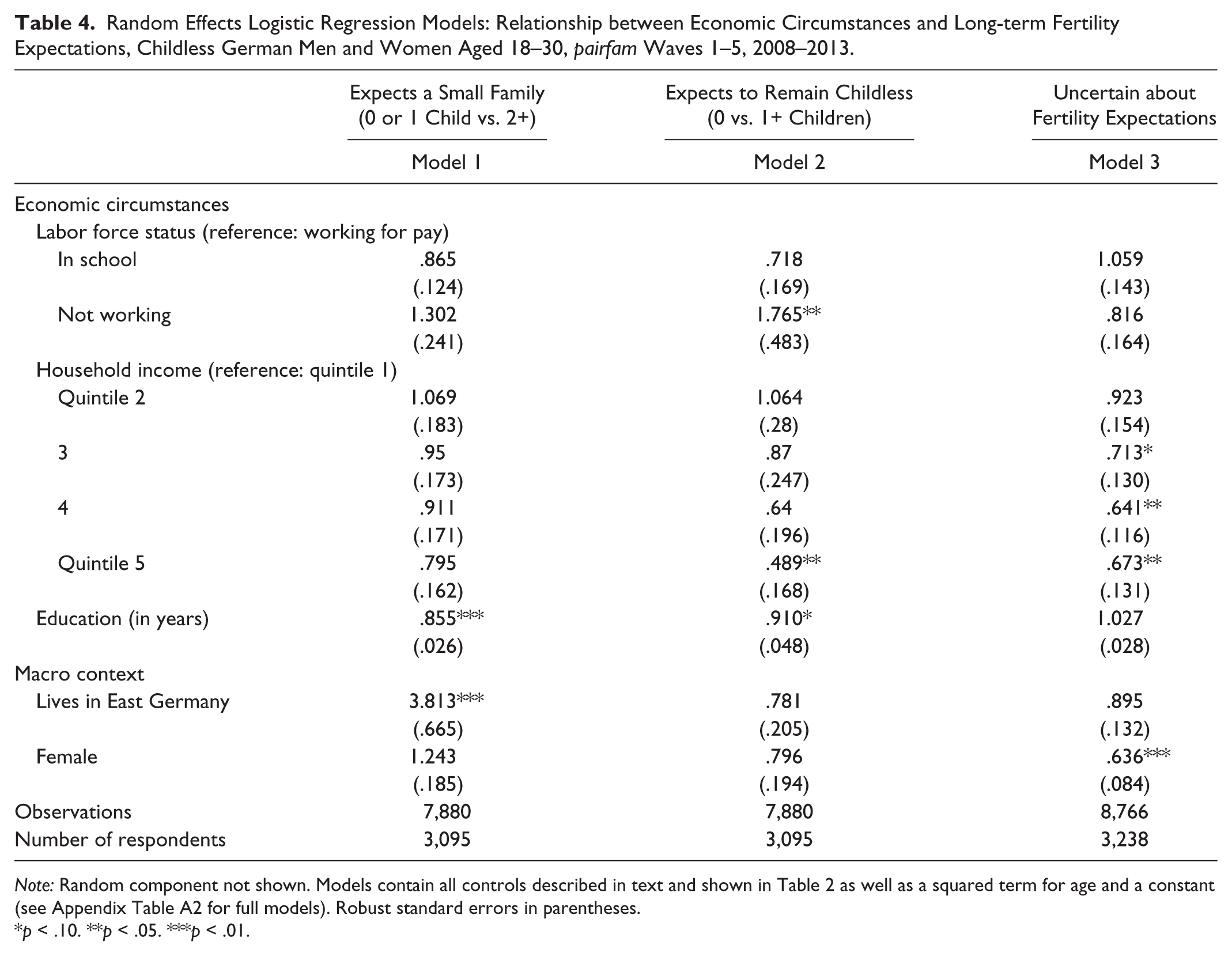
Note: Random component not shown. Models contain all controls described in text and shown in Table 2 as well as a squared term for age and a constant (see Appendix Table A2 for full models). Robust standard errors in parentheses.
p < .10. **p < .05. ***p < .01.
When we turn to the larger context, we find that East Germans have greatly increased odds of intending to have small families compared to West Germans, supporting hypothesis Hypothesis 3c.
Separate models by region, gender, and region and gender combined did not reveal any significant group differences.
Next, we look at young adults’ expectation to remain childless (Table 4, Model 2), our most extreme fertility intention. Labor market status was statistically significantly related to the expectation to remain childless. Those who are not working have significantly greater odds of expecting to have no children compared to those who are currently working. We find no difference between those who are currently working and those who are in school. These findings are line with the expectations of the economic strain perspective in Hypothesis 1a, as are the results for household income: Those in the top household income quintile have lower odds of intending to remain childless. More years of education reduced the odds of expecting to remain childless, also in line with the economic strain hypothesis. Contrary to expectations from Hypothesis 3c, we do not find evidence that there are East-West differences in the odds of expecting to remain childless rather than having children.
Uncertainty about Long-term Fertility Expectations
Finally, in Model 3, we include respondents who are uncertain about their long-term fertility levels—those who indicated that they are not able (or willing) to express how many children they expect to have. We find that income rather than labor market status or education is related to the odds of being uncertain about fertility in the distant future. Living in households with greater income levels is associated with lower odds of being unsure about their future fertility (i.e., more certainty). This is in line with an economic strain approach (as expressed in Hypothesis 2). We find that women are less likely to be uncertain about the expected family size but contrary to Hypothesis 4 find no regional differences in uncertainty about long-term fertility. We also found no differences in the effects of these predictors across separate models by region, gender, or region and gender combined.
Discussion
This study aims to increase our understanding of the process through which economic context shapes fertility intentions. We specifically examine how useful economic strain explanations are for predicting intentions and (un)certainty about intentions in childless Germans. Germany provides an ideal setting to explore this relationship because of its long history of low fertility, low levels of unplanned fertility, entrenched gendered division of paid labor, and macro-level variation between East and West, including differences in attitudes and economic constraints. We investigate both short-term and long-term fertility intentions as well as uncertainty about them, which allows us to begin exploring the nuances in how young people form their fertility intentions.
Overall, we largely find support for the idea that economic circumstances constrain fertility intentions. For both short- and long-term intentions, we find evidence that those with fewer current or potential resources (e.g., lower income or less education) had lower fertility intentions and increased uncertainty about those intentions. The German context provides a conservative setting for assessing these gender differences since the breadwinner/homemaker model is still quite prevalent. In other settings where dual-income households are more common, we would be surprised to find many gender differences in the nature of the relationship between economic context and fertility expectations. These findings suggest that theoretical discussions of economics and fertility, which are dominated by archaic views of household dynamics and tend to assume that women are motivated largely by opportunity costs and men by financial concerns, need to be reexamined.
Our multidimensional approach to both economic circumstances and fertility intentions, combined with our stratified examination, moves us beyond this broad conclusion and reveals some important differences. For example, being currently enrolled in school lowers short-term fertility intentions but not long-term intentions and only for some groups. Had we limited our analysis to long-term family size expectations, we would have seen no evidence of a school enrollment effect on fertility intentions. A focus on ultimate, or final, fertility intentions glosses over meaningful temporal or delaying influences of economic circumstances. Also, higher income was associated with higher fertility intentions but only with decreases in uncertainty in the long run. Furthermore, the observed income effect is driven by West German men, which may be because of strong cultural norms toward male breadwinners and female homemakers. We acknowledge that our measure of regional differences is imprecise and likely captures many differences, including economic and cultural, that warrant additional, more detailed research.
This leads us to our stratified analysis. When we assess the simple differences between men and women and then separately for East and West Germans, we see similarities in the way economic resources are related to fertility intentions. We do find differences in levels (e.g., East Germans and women are more likely to expect to have a child in the next two years and are more certain about it compared to West Germans and men; women are less uncertain about short-term intentions but more uncertain about long-term expectations), but there are no simple gender or regional differences in the ways economic conditions relate to fertility intentions. That is, the mechanisms that predict intentions are very similar across groups. On the other hand, as briefly mentioned previously, when we consider the intersection between gender and region, we do find differences in the process through which economic conditions influence short-term intentions (those to have a child in the next two years).
Based on our stratified analysis and findings regarding education, we conclude that our measure of educational attainment is likely not capturing economic constraints or resources in the same way as income and labor force status do. Specifically, we find that more educated, West German men and women had significantly higher short-term fertility intentions than their East German counterparts. While this could be interpreted as evidence in line with the opportunity cost arguments (more highly educated individuals are hesitant to enter parenthood in the short term), it could also be that educational attainment is more linked to variation in life course sequencing across regions. In this case, more educated West Germans hold values that make them particularly open to enter parenthood later in life. Further evidence in support of interpreting our education findings in a different framework is that years of education was significantly related to all measures of intentions except uncertainty about long-term fertility expectations. This is surprising since one commonly used argument for obtaining higher education is that it is a form of insurance in unstable economic times. Here, we find preliminary evidence that young people do not interpret education in this way. Education may be key to higher earnings and therefore related to expectations about family size and short-term intentions, but in the end, we found support for actual household income increasing feelings of certainty about the future and not education. This nuanced interpretation of the relationship between education and fertility intentions is only possible because of our multidimensional approach.
Our study underlines the importance of examining multiple aspects of fertility intentions. Conclusions from just one aspect yield an incomplete picture of how intentions are formed and how confident individuals are about their intentions. Although there is no perfect correspondence between intentions and behaviors, understanding how economic constraints shape fertility intentions provides insights into this observed behavior, especially in countries with low levels of unintended births. Specifically, we find evidence that the observed low fertility in Germany may be at least partly due to economic circumstances leading to lowered short-term intentions, lowered overall family size expectations, and increased uncertainty regarding family formation. The similarity in predictors of fertility intentions contradict the notion that economic constraints impact men’s and women’s lives in fundamentally different ways and that assumptions of economic frames of family behavior need to be questioned.
Current global trends toward less stable employment opportunities and increasing (perceived) costs of childrearing are examples of the types of macro-level changes that may lead to continued and lowered fertility expectations (and likely subsequent behavior) (Blossfeld et al. 2006). As a result, it will be particularly important to understand in which contexts individuals may be buffered from the effects of these changes or where individual expectations are particularly susceptible to change.
Footnotes
Appendix
Random Effects Logistic Regression Models: Relationship between Economic Circumstances and Long-term Fertility Expectations, Childless German Men and Women Aged 18–30, pairfam Waves 1–5, 2008–2013.

| Variables | Expects a Small Family | Expects to Remain Childless | Uncertain about Fertility Expectations |
|---|---|---|---|
| Labor force status (reference: working for pay) | |||
| In school | .865 | .718 | 1.059 |
| (.124) | (.169) | (.143) | |
| Not working | 1.302 | 1.765** | .816 |
| (.241) | (.483) | (.164) | |
| Household income (reference: quintile 1) | |||
| Quintile 2 | 1.069 | 1.064 | .923 |
| (.183) | (.280) | (.154) | |
| Quintile 3 | .950 | .870 | .713* |
| (.173) | (.247) | (.130) | |
| Quintile 4 | .911 | .640 | .641** |
| (.171) | (.196) | (.116) | |
| Quintile 5 | .795 | .489** | .673** |
| (.162) | (.168) | (.131) | |
| Education (in years) | .855*** | .910* | 1.027 |
| (.026) | (.048) | (.028) | |
| Lives in East Germany | 3.813*** | .781 | .895 |
| (.665) | (.205) | (.132) | |
| Female | 1.243 | .796 | .636*** |
| (.185) | (.194) | (.084) | |
| Interview year (reference: 2008) | |||
| 2009 | .929 | .853 | .974 |
| (.220) | (.319) | (.280) | |
| 2010 | .772 | .567 | 1.292 |
| (.190) | (.216) | (.375) | |
| 2011 | .591** | .538* | 1.498 |
| (.147) | (.202) | (.422) | |
| 2012 | .524** | .435** | 1.571 |
| (.133) | (.171) | (.440) | |
| 2013 | .530** | .511 | 1.526 |
| (.146) | (.218) | (.462) | |
| Relationship status (reference: single) | |||
| Has partner | .623*** | .334*** | .408*** |
| (.083) | (.074) | (.055) | |
| Cohabiting | .506*** | .243*** | .315*** |
| (.094) | (.078) | (.062) | |
| Married | .599* | .179*** | .354*** |
| (.168) | (.095) | (.111) | |
| Number of siblings | .661*** | .841* | .975 |
| (.046) | (.082) | (.051) | |
| Age | .544** | .530 | .886 |
| (.132) | (.215) | (.223) | |
| Age squared | 1.017*** | 1.016* | 1.004 |
| (.005) | (.009) | (.005) | |
| Lives with parent | 1.067 | .735 | 1.186 |
| (.188) | (.205) | (.199) | |
| Parental education | .917* | .967 | .980 |
| (.045) | (.076) | (.041) | |
| Constant | 253.004* | 29.140 | .097 |
| (739.608) | (141.698) | (.293) | |
| Random effect | 9.121*** | 10.588*** | 4.043*** |
| (.825) | (1.431) | (.443) | |
| Observations | 7,880 | 7,880 | 8,766 |
| Number of respondents | 3,095 | 3,095 | 3,238 |
Note: Robust standard errors in parentheses.
p < .10. **p < .05. ***p < .01.
Authors’ Note
This specific research received no grant from any funding agency in the public, commercial, or not-for-profit sectors. However, the paper uses data from the German Family Panel PAIRFAM, coordinated by Josef Brüderl, Karsten Hank, Johannes Huinink, Bernhard Nauck, Franz Neyer, and Sabine Walper and funded as a long-term project by the German Research Foundation (DFG).
1
Individuals who already have children have a different set of information of how children impact their lives, and the cost of adding another child also differs from going from no to one child. Future research should explore the differential mechanisms by parity.
2
About 25 percent of all observations are excluded due to this restriction. Eighteen percent of respondents already had a child the first time they were interviewed for the study. Initially childless respondents are excluded once they enter parenthood.
3
Our data include a measure of “ideal” family size, but the question specifically states “all barriers aside, how many children would you like to have under ideal circumstances?” Since our article is specifically examining possible barriers, we do not include this “ideal” measure in our analyses. An examination of the link between ideal family size and realistic expectation is beyond the scope of this article.
4
A correlation coefficient specifically for the correlation of two binary measures.