




Abstract
Immigrant fertility and the realization of fertility intentions are two topics of considerable interest in contemporary demographic research. Yet very few studies have explored the relationship between intended and actual fertility among immigrants and their children. Using data from the Norwegian and Swedish Generations and Gender Surveys, this article analyzes how both positive and negative short-term fertility intentions stated by men and women at Wave 1 in 2007/08 (Norway) or 2012/13 (Sweden) had been realized at register-based follow-ups three years after the initial interview. Results show that second-generation women of non-Western origin were significantly less likely than native women (defined here as Swedish-born women with two Swedish-born parents) to realize a positive fertility intention, whereas first-generation men of Western origin were significantly more likely than native men to realize a positive fertility intention. Western-origin men were also significantly less likely than native men to have an unintended birth. These findings are robust to controlling for demographic and socioeconomic characteristics at interview. Possible reasons for these intergroup realization differences include group differences in the ability to predict future changes to demographic and socioeconomic status and in the motivation to pursue the realization of a reported fertility intention. This article demonstrates that exploring immigrant-native differences in realization patterns can provide information about immigrants’ ideational and behavioral adaptation to the destination country’s fertility regime that cannot be attained by studying intended or actual fertility alone.
Introduction
An important reason for studying immigrant fertility is to understand fertility differences between immigrants and natives. 1 The degree to which immigrants adjust their childbearing to patterns in the destination country serves as an indicator of social integration (Milewski and Mussino 2018) and shapes immigration’s long-term impact on destination societies’ population growth, ethnic composition, and age structure (Coleman 2008; Parrado 2011). Earlier research on immigrant fertility has shown that differences in fertility behavior between natives and first-generation immigrants tend to diminish with immigrants’ longer duration of stay in the destination country (e.g., Andersson 2004; Milewski 2007; Mussino and Strozza 2012) and that differences in fertility behavior between children of immigrants and natives are often smaller than differences between natives and first-generation immigrants (e.g., Andersson, Persson and Obućina 2017; Kulu et al. 2017; Milewski 2007, 2010b; Pailhé 2017; Wilson 2019).
However, convergence in fertility behavior between immigrants and natives does not necessarily reflect immigrants’ adaptation to the normative aspects of the destination country’s fertility regime. Recognizing that fertility desires and intentions, to a greater extent than actual behavior, represent reproductive norms, a growing number of studies have extended the analysis of immigrant fertility by exploring how immigrants and natives differ in their fertility preferences (Carlsson 2018; Holland and De Valk 2013; Kraus and Castro-Martín 2018; Mussino and Ortensi 2018; Mussino et al. 2021; Puur, Vseviov and Abuladze 2018; De Valk 2013). Nevertheless, and despite a rich body of literature on the realization of fertility intentions in countries with large immigrant populations (e.g., Dommermuth, Klobas and Lappegård 2015; Kapitány and Spéder 2012; Kuhnt and Trappe 2016; Régnier-Loilier and Vignoli 2011; Rinesi et al. 2011; Toulemon and Testa 2005), very few studies have explored differences in realization patterns by immigrant background or ethnicity (c.f., Hartnett 2014).
This article takes as its departure point the notion that studying differences in fertility realization patterns between immigrants and natives can provide information on adaptation processes in immigrant fertility that cannot be attained from studying either intended or actual fertility alone. Milewski (2010a) has pointed out that immigrants’ behavioral convergence to fertility patterns in the destination country may reflect two different types of adaptation process. First, behavioral convergence may result from immigrants’ cultural and normative assimilation to the destination society so that preferences and realization patterns are similar for immigrants and natives. Second, behavioral convergence may primarily be a response to opportunities and constraints related to the destination country’s institutional context, while fertility preferences and realization patterns could remain different from those of natives. While these two possible trajectories toward behavioral convergence have different implications for understanding the adaptation process, they cannot easily be disentangled when analyzing actual fertility alone. Similarly, studying fertility preferences alone cannot reveal to what extent attitudinal (dis)similarities between immigrants and natives translate into behavioral (dis)similarities, since both the exposure and reaction to hindering and enabling factors may differ between social groups.
Realization differences between groups of a population should be attributable to differences either in individual group members’ control over realization or in their motivation to translate a reported fertility intention into actual childbearing. Differences in control over realization would refer to compositional differences between groups in factors that may hinder or enable realization (i.e., socioeconomic circumstances, prospects of finding a suitable partner, etc.), suggesting that members of certain groups are (dis)advantaged compared to members of other groups regarding the prospects of achieving their family formation preferences. Differences in the motivation to realize an intention suggest that groups differ in the meaning attached to a reported fertility intention (Bachrach and Morgan 2013; Ní Bhrolcháin and Beaujouan 2019), possibly reflecting group differences in attitudes to family planning more generally (Mussino and Ortensi 2018). Thus, differences between immigrants and natives in the motivation to realize a fertility intention should point to immigrants’ incomplete normative adaptation to the destination country’s fertility regime.
This article uses data from the Wave 1’s and register-based follow-ups of the Norwegian and Swedish Generations and Gender Surveys (GGSs) to examine how the realization of both positive and negative short-term fertility intentions varies between immigrants and natives in Norway and Sweden. The data setup with register-based follow-ups to the initial interviews is unique to Norway and Sweden within the Generations and Gender Program and minimizes attrition from interview to follow-up, compared to using successive survey waves. Low attrition is especially advantageous for studying intention realization among population subgroups with a limited number of survey respondents, such as immigrants. For all steps of the analysis, the Norwegian and Swedish samples are merged and examined jointly, which is possible, given the far-reaching institutional, cultural, and demographic similarities between the two countries (see the section The Norwegian and Swedish Setting). Analyses are conducted separately for men and women and distinguish among immigrants by regional origin and, when allowed by sample size, between the first and second generation (hereafter referred to as G1 and G2).
This article’s main aim is to address the research gap on the realization of fertility preferences among immigrants by exploring how the propensity to realize positive and negative short-term fertility intentions varies between natives and immigrants of different gender, origin, and generational status in Norway and Sweden. Exploring differences in realization patterns between immigrants and natives is important because it provides information about certain aspects of immigrants’ adaptation to the destination country’s fertility regime that cannot be attained by studying either actual fertility or fertility preferences alone. Whereas Hartnett (2014) studies differences between White and Hispanic Americans in meeting life-time fertility intentions, this article is, to our knowledge, the first to examine realization differences between immigrants and natives outside the United States and the first overall to analyze differences in realizing short-term fertility intentions. Moreover, whereas earlier research on immigrant fertility has focused primarily on patterns among women (e.g., Andersson 2004; Milewski 2007; Mussino and Strozza 2012), this article examines realization patterns among both male and female immigrants. Finally, this article demonstrates the value of analyzing the realization of both positive and negative intentions, in contrast to many earlier studies on the realization of fertility intentions which explored only the realization of positive intentions (e.g., Dommermuth, Klobas and Lappegård 2015; Hanappi and Buber-Ennser 2017; Kapitány and Spéder 2012; Spéder and Kapitány 2014).
This article is structured as follows. The section The Norwegian and Swedish Setting describes the Norwegian and Swedish context, in terms of both the wide-ranging similarities between the two countries that justify a joint analysis and earlier research on immigrant fertility in Norway and Sweden. The section Possible Reasons for Realization Differences Between Immigrants and Natives discusses possible reasons that realization patterns may differ between immigrants and natives in Norway and Sweden, drawing on both theoretical arguments and earlier empirical findings on the realization of fertility intentions. The section Research Design describes the data and analytical approach, while the section Results presents the results. Findings are discussed and conclusions drawn in the section Discussion and Conclusions.
The Norwegian and Swedish Setting
The analyses presented here combine data from the Norwegian and Swedish GGSs to examine patterns of fertility intention realization in the two countries jointly. This approach is facilitated by the far-reaching institutional, cultural, and demographic similarities between Norway and Sweden. Both countries are classified as social democratic welfare states in Esping-Andersen’s typology of welfare regimes (Esping-Andersen 1990). Both Norway and Sweden have a strong secular-rational and self-expression value orientation in the Inglehart-Welzel cultural map of the world (Inglehart and Welzel 2005: 63) and rank among the most gender-egalitarian countries in the world, according to the World Economic Forum’s Global Gender Gap Index (World Economic Forum 2021). Scandinavian countries, in general, have been considered forerunners in demographic change since the 1960s, manifested, for example, in the postponement of parenthood and the decoupling of marriage and childbearing (Ohlsson-Wijk, Turunen and Andersson 2020). During the observation period (2007–2011 in Norway and 2012–2016 in Sweden), the total fertility rate was stable and slightly below replacement level in both Norway (1.88–1.98) and Sweden (1.85–1.90) (Statistics Norway 2021a; Statistics Sweden 2021a).
Both Norway and Sweden have relatively large immigrant populations of heterogeneous origin, generational status, and reasons for migration (Statistics Norway 2021b, 2021c; Statistics Sweden 2021b, 2021c, 2021d; Swedish Migration Agency 2021). There are also notable similarities between the two countries regarding immigrants’ origin: At the time when the GGS Wave 1 interviews were completed (2008 in Norway, 2013 in Sweden), Bosnia and Herzegovina, Denmark, Germany, Iran, Iraq, Poland, and Somalia were among the top ten most common origin countries for the G1 in both Norway and Sweden (Statistics Norway 2021d; Statistics Sweden 2021b). The other top-10 most common origin countries were Pakistan, Sweden, and Vietnam in Norway and Finland, Turkey, and Yugoslavia in Sweden (Statistics Norway 2021d; Statistics Sweden 2021b). Sweden has a longer history of large-scale immigration, meaning that its G2 population is larger than that of Norway (Statistics Norway 2021b; Statistics Sweden 2021c). Since both Norway and Sweden have attracted labor migrants, as well as refugees and family migrants, for many decades, different reason-for-migration backgrounds are well-represented within the G1 and G2 in both countries (Byström and Frohnert 2017; Statistics Norway 2021c; Statistics Sweden 2021d; Swedish Migration Agency 2021). In both Norway and Sweden, immigrants of Western origin are predominately labor or family migrants, whereas immigrants of other origins may be refugee, labor, or family migrants (Statistics Norway 2021c; Statistics Sweden 2021d; Swedish Migration Agency 2021). 2
Immigrant Fertility in Norway and Sweden
Earlier research on immigrant fertility in Norway and Sweden has found that G1 fertility often converges toward native patterns with immigrants’ longer duration of stay in the destination country (Andersson 2004; Statistics Sweden 2014; Tønnessen 2014). However, the extent and tempo of convergence vary between origin groups (Andersson 2004; Statistics Sweden 2014; Tønnessen 2014). Similar findings of a general convergence, coupled with variation between origin groups, have been made in other European countries (e.g., Milewski 2007; Mussino and Strozza 2012). For the G2, fertility tends to be similar or slightly lower than that of natives in both Norway (Lappegård 2006; Tønnessen 2014) and Sweden (Andersson, Persson and Obućina 2017; Scott and Stanfors 2011; Statistics Sweden 2010), as well as in other European countries (e.g., Guarin Rojas, Bernardi and Schmid 2018; Kulu and Hannemann 2016; Kulu et al. 2017; Milewski 2007, 2010b; Van Landschoot, De Valk and Van Bavel 2017; Wilson 2019). However, similar to the G1, fertility patterns among the G2 in Norway, Sweden, and elsewhere in Europe vary considerably by (parental) origin (e.g., Andersson, Persson and Obućina 2017; Kulu et al. 2017; Lappegård 2006; Tønnessen 2014; Wilson 2019).
Convergence between immigrant and native fertility behavior across time within the G1 and across generations from the G1 to the G2 may be interpreted as immigrants’ adaptation to the destination country’s fertility regime. However, as discussed in the introduction, behavioral convergence does not necessarily reflect normative change. A growing literature has sought to better capture adaptation at the ideational or normative level by studying fertility preferences among immigrants and children of immigrants (Carlsson 2018; Holland and De Valk 2013; Kraus and Castro-Martín 2018; Mussino and Ortensi 2018; Mussino et al. 2021; Puur, Vseviov and Abuladze 2018; De Valk 2013). In Sweden, Carlsson (2018) finds considerable differences across origin groups in the propensity to state a positive short-term fertility intention. Interestingly, Carlsson’s (2018) findings do not match earlier findings on differences in actual fertility between immigrant groups in Sweden (e.g., Andersson 2004; Andersson, Persson and Obućina 2017; Scott and Stanfors 2011), suggesting that the propensity to realize a reported fertility intention could differ between natives and certain immigrant groups.
Whereas Carlsson (2018) finds that the G1 of Eastern European origin are more likely than natives to express a positive fertility intention, research on actual childbearing has found that the Eastern European G1 tends to have lower fertility than native Swedes (Andersson 2004). Similarly, the G2 of Eastern European origin has intentions that are similar or slightly elevated, compared to natives (Carlsson 2018), whereas the Eastern European G2’s actual fertility tends to be lower than that among natives (Scott and Stanfors 2011). Furthermore, while actual fertility among the Middle Eastern G2 falls between the G1 and natives (Andersson 2004; Andersson, Persson and Obućina 2017; Scott and Stanfors 2011), Carlsson (2018) finds that both the G1 and G2 of Middle Eastern or North African origin are more likely than natives to state a positive intention, with no clear intergenerational difference. These findings suggest that both the G1 and G2 of Eastern European origin, as well as the G2 of Middle Eastern origin, could be less likely than native Swedes to realize a positive intention. For individuals of Western origin, both intentions and actual fertility have been found to be similar to natives (Andersson 2004; Andersson, Persson and Obućina 2017; Carlsson 2018; Statistics Sweden 2010, 2014; Scott and Stanfors 2011), indicating that realization patterns do not differ between natives and immigrants of Western origin.
Possible Reasons for Realization Differences Between Immigrants and Natives
Before discussing the possible reasons that realization patterns may differ between immigrants and natives, a few words can be said about the definitions of realization/non-realization and intended/unintended births used in this article. The intentions analyzed here are expressed prospectively for the three years that follow the interview. Realization of a positive intention is defined as having a child within the three-year time window after having stated a positive intention at interview. Having an unintended birth is defined as having a child within the three-year time window after having stated a negative intention at interview. A respondent’s intention may, of course, change over time, meaning that the intention stated at interview does not necessarily coincide with the intention held at conception, childbirth, or follow-up. For example, a child who is unintended in relation to the intention stated at interview may be intended at conception or childbirth when compared to the intention held at that time.
The approach outlined above is in line with earlier research on the realization of prospective fertility intentions (e.g., Dommermuth, Klobas and Lappegård 2015; Kapitány and Spéder 2012; Kuhnt and Trappe 2016; Régnier-Loilier and Vignoli 2011; Spéder and Kapitány 2009; 2014) but contrasts in two important ways with the retrospective approach often employed in research on unwanted/unintended pregnancies/childbearing (Rackin and Morgan 2018). First, the retrospective approach is associated with a major disadvantage, since recollections of the intendedness of a pregnancy or birth tend to cause recall and rationalization bias, due to respondents’ unwillingness to report children as unwanted (e.g., Guzzo and Hayford 2014; Rackin and Morgan 2018). Second, whereas retrospective accounts of intendedness primarily capture contraceptive success or failure (Rackin and Morgan 2018), the propensity to realize a prospective fertility intention expressed within a three-year time frame is influenced by a considerably wider set of demographic, socioeconomic, ideational, and other factors (e.g., Dommermuth, Klobas and Lappegård 2015; Kapitány and Spéder 2012; Kuhnt and Trappe 2016; Régnier-Loilier and Vignoli 2011; Spéder and Kapitány 2009; 2014).
Control Over Realization
The Theory of Planned Behavior (TPB), as applied to fertility research (see Ajzen and Klobas 2013), is the most influential theoretical model to guide research on the formation of fertility intentions and their realization over the last decades (e.g., Dommermuth, Klobas and Lappegård 2015; Kuhnt and Trappe 2016; Spéder and Kapitány 2015). According to the TPB, an individual’s prospects of realizing an intention should only depend on his/her actual and perceived control over realization (Ajzen and Klobas 2013). Thus, a possible reason for realization differences between immigrants and natives is compositional differences in characteristics that affect control over realization. Earlier research has identified a large set of demographic, socioeconomic, and other factors that may enable or hinder realization (e.g., Dommermuth, Klobas and Lappegård 2015; Hanappi and Buber-Ennser 2017; Kapitány and Spéder 2012; Kuhnt and Trappe 2016; Régnier-Loilier and Vignoli 2011; Rinesi et al. 2011; Spéder and Kapitány 2009; 2014).
Three demographic variables of central importance to the propensity to realize a positive fertility intention are partnership status, age, and parity (e.g., Kapitány and Spéder 2012; Spéder and Kapitány 2015). Research from various European countries finds that the probability of realizing a positive fertility intention is higher among individuals in stable and co-residential partnerships but lower among older individuals, particularly above age 35, while the effect of parity is important but varies across countries (Dommermuth, Klobas and Lappegård 2015; Hanappi and Buber-Ennser 2017; Kapitány and Spéder 2012; Kuhnt and Trappe 2016; Régnier-Loilier and Vignoli 2011; Rinesi et al. 2011; Spéder and Kapitány 2009; 2014; Toulemon and Testa 2005). The lower propensity to realize a positive fertility intention above age 35, compared to younger ages, is more pronounced among women than among men (Beaujouan et al. 2019). It has also been found that men with a female partner above age 35 are less likely than men with a younger partner to realize a positive fertility intention (Kapitány and Spéder 2012).
The effect of partnership status may vary between natives and some immigrant groups, due to cultural differences in the status ascribed to marriage and cohabitation (Andersson, Obućina and Scott 2015; Hiekel, Liefbroer and Poortman 2014; Kogan and Weiβmann 2020; Lappegård 2006). Childbearing within non-married cohabiting unions is widely accepted in the majority cultures of Norway and Sweden (Holland 2013; Lappegård and Noack 2015), which could lead to smaller differences in realization patterns by type of partnership among natives than among immigrants. While married individuals are more likely than cohabiting individuals to realize a positive fertility intention in France (Régnier-Loilier and Vignoli 2011), Hungary (Spéder and Kapitány 2009), and Italy (Rinesi et al. 2011), the opposite holds in Norway, at least among the childless (Dommermuth, Klobas and Lappegård 2015).
Among socioeconomic factors, both employment status and educational attainment may affect the prospects of realizing a positive fertility intention. Unemployment has been found to be negatively associated with the propensity to realize a positive intention (Kuhnt and Trappe 2016; Toulemon and Testa 2005). However, part-time employed women are more likely than full-time employed women to realize a positive fertility intention in Germany (Kuhnt and Trappe 2016). Similarly, the propensity to realize a positive intention has been found to be elevated among couples where one partner is economically inactive in France (Toulemon and Testa 2005) and Italy (Régnier-Loilier and Vignoli 2011). However, the institutional setting surrounding family formation (e.g., the design of parental leave and formal childcare systems), as well as the individualistic and gender-egalitarian norms in Norway and Sweden, encourage and support fertility within dual-earner households to a greater extent than in many other developed countries (Brinton et al. 2018; Lee, Duvander and Zarit 2016; Oláh 2003). Therefore, positive associations between realization and part-time employment and between realization and economic inactivity found in Southern and Central Europe are unlikely to apply to the majority cultures in Norway and Sweden. Yet since women’s labor market participation often differs between immigrant and native segments of the population (e.g., Blau, Kahn and Papps 2011; Blekesaune 2021), the effect of both the respondent’s and the respondent’s partner’s employment status on realization patterns could vary between natives and different immigrant groups.
Educational attainment’s effect on fertility intention realization seems to vary across contexts (Hanappi and Buber-Ennser 2017; Kapitány and Spéder 2012; Kuhnt and Trappe 2016; Régnier-Loilier and Vignoli 2011; Rinesi et al. 2011; Spéder and Kapitány 2014; Toulemon and Testa 2005). In Norway, the propensity to realize a positive fertility intention does not differ significantly by educational attainment among childless individuals, while tertiary-educated individuals are more likely than secondary-educated individuals to realize a positive intention among parents (Dommermuth, Klobas and Lappegård 2015). However, since gender-role arrangements may differ between immigrants and natives, educational attainment’s effect on realization could also differ between groups.
Beyond demographic and socioeconomic characteristics, an additional factor that affects control over realization is the intention of the respondent’s partner (Duvander et al. 2020; Kuhnt and Trappe 2016; Testa and Bolano 2021). In general, disagreement between partners about what type of fertility intention to pursue is associated with a lower propensity to realize a positive fertility intention (Kuhnt and Trappe 2016; Testa and Bolano 2021). However, the relative influence of the male and female partner over fertility decisions in case of disagreement may vary across cultural contexts. In Sweden, Thomson and Hoem (1998) found that men and women in disagreeing couples were equally likely to influence childbearing decisions, whereas Duvander et al. (2020) find that women are more likely than men to influence the decision to have another child in disagreeing couples who already have at least one child. In many non-Western and non-European settings, on the other hand, men have been found to have a greater influence than women over family formation decisions (Kane et al. 2016; Oppenheim Mason and Smith 2000; UNFPA 2020). In Norway, qualitative findings indicate that Somali immigrant women experience pressure from their husbands to give birth to a high number of children (Gele et al. 2020). If such patterns translate into immigrant men from certain cultural backgrounds having higher realization rates than immigrant women from the same backgrounds, differences in the relative influence of the male and female partners in family formation decisions could contribute to realization differences between immigrants and natives.
Compared to the realization of positive fertility intentions, there is considerably less research examining the realization of negative intentions. Yet the propensity to have an unintended birth (i.e., failing to realize a negative intention) has been shown to be elevated among individuals in a co-residential partnership, parents, younger individuals, and the unemployed (Kuhnt and Trappe 2016; Spéder and Kapitány 2009). The fact that many religious groups prohibit or discourage the use of effective contraception and abortion (Srikanthan and Reid 2008) could lead to a higher likelihood of having an unintended birth among immigrants than among natives, since many immigrants to Norway and Sweden originate from countries that are more religious than the relatively secular destination countries (Statistics Norway 2021d; Statistics Sweden 2021b; World Values Survey 2022).
Due to data restrictions, this article only controls for characteristics known at the time of interview. However, since respondents were surveyed about their fertility intention for the three years that followed the interview, the reported intention should depend not only on control at the time of interview but also on individuals’ expectations of their future control over realization. If some groups experience unexpected changes to relevant characteristics more often than other groups, such intergroup differences in the ability to predict future control could lead to realization differences that are not captured by controlling for characteristics at interview. It is possible, for example, that natives have a general knowledge advantage regarding the opportunity structure related to childbearing in the destination country, which could make them better able to predict whether childbearing could realistically constitute a component of their future life course. In the Norwegian and Swedish context, differences in the ability to predict future control should be more likely between natives and non-Western immigrants than between natives and Western immigrants, since the latter originate from countries that are more culturally and institutionally similar to Norway and Sweden.
Motivational Strength Associated with the Reported Intention
Another possible explanation for intergroup differences in the realization of fertility intentions that remain when controlling for demographic and socioeconomic characteristics at interview is differences in individual group members’ motivation to realize the reported fertility intention. A reported intention may represent a well-calibrated, pre-existing plan to act upon a true, underlying preference for some survey respondents, while respondents who do not have a clear preference and plan for their future childbearing may, instead, construct the reported intention at interview (Bachrach and Morgan 2013; Ní Bhrolcháin and Beaujouan 2019). Presumably, the motivation to follow through on the reported intention is greater in the former case than in the latter, meaning that realization should also be more likely. While this aspect of intention formation and realization is not well captured by the TPB framework, the meaning individual respondents attach to their reported intention is likely to affect the prospects of realization beyond actual and perceived control (Bachrach and Morgan 2013). If immigrants differ from natives in the meaning attached to a reported intention and, thereby, in the motivation to follow through on the intention, such differences could lead to differences in realization patterns.
The fact that non-Western immigrants often originate from societies that are more collectivistic and religious than the relatively individualistic and secular majority cultures of Norway and Sweden may influence differences in the meaning attached to a reported fertility intention in several ways. First, religiosity and a family-oriented socialization experience could lead to higher realization if they cause individuals to prioritize family formation over other life goals. Earlier research on the association between fertility preferences and actual fertility has found that having a larger number of siblings is associated with a smaller gap between desired and achieved family size (Adsera 2006) and that religiously affiliated individuals are more likely than non-affiliated individuals to realize a positive fertility intention (Kuhnt and Trappe 2016; Spéder and Kapitány 2009).
However, there are also reasons to expect influence from religion and pronatalist norms to have a negative impact on the meaning attached to a reported intention and, thereby, on realization rates. It has been shown that non-numeric fertility desires of the type “up to God” and “don’t know” are more common among certain non-Western G1 groups than among G1 groups of other origins in Italy (Mussino and Ortensi 2018), suggesting a fatalistic attitude to family planning among non-Western G1 groups. It is also possible that socialization into a pronatalist normative environment could lead to a social desirability bias toward reporting a positive fertility intention or against reporting a negative intention (Kazenin and Kozlov 2020). If the fertility intentions reported by natives tend to reflect “true” preferences and concrete plans to a greater extent than the intentions reported by non-Western immigrants, natives should be more motivated to follow through on their reported intentions and, therefore, have higher realization rates.
Research Design
Data
This article uses data from the Wave 1’s and register-based follow-ups of the Norwegian and Swedish GGSs. 3 In both countries, Wave 1 was based on nationally representative samples of both men and women, aged 18–79 years. Interviews were conducted between January 2007 and October 2008 in Norway and between April 2012 and April 2013 in Sweden, yielding 14,884 respondents in Norway (61 percent response rate) and 9,688 respondents in Sweden (54 percent response rate). Data for Wave 1 were collected by Statistics Norway and Statistics Sweden, respectively, via telephone interviews, population registers, and a follow-up postal/online questionnaire (Lappegård and Veenstra 2010; Thomson et al. 2015).
The Norwegian and Swedish register-based follow-ups are unique to the Generations and Gender Program (GGP) and replace the second survey wave conducted in many other countries. The follow-ups contain both demographic and socioeconomic information about Wave-1 respondents and cover periods both before and after the time of interview. The follow-ups cover all births to Wave-1 respondents that happened in Norway/Sweden from the time of interview until December 31 of the calendar year coming three years after the calendar year of the final Wave-1 interviews. Thus, birth histories for the three years that follow interview are available for every respondent who did not emigrate or die within those three years. Compared to earlier studies on the realization of fertility intentions that rely on successive survey waves (e.g. Buber-Ennser 2014; Kapitány and Spéder 2012; Kuhnt and Trappe 2016), an important advantage of the register-based follow-ups analyzed here is that attrition from initial interview to follow-up is largely avoided. Using register-based follow-ups also avoids potential errors associated with the self-reporting of birth histories.
The sample analyzed here consists of 9,692 individuals (5,860 from the Norwegian and 3,832 from the Swedish GGS), including 4,603 women 18–44 years old at the Wave-1 interview and 5,089 men who either were single and 18–49 years old at the Wave-1 interview or had a female partner 18–44 years old at the Wave-1 interview. The sample excludes respondents who said that they or their partners were physically unable to have children. Individuals who intended to adopt are not included, since neither the Norwegian nor the Swedish GGS allows the intention to adopt to be separated from the intention to take a foster child, which is not easily compared to having biological or adoptive children. Individuals who had a child less than six months after interview are excluded, since a criterion for being asked the intention question was that the respondent or the respondent’s partner was not currently pregnant. Six months is chosen as the cutoff point, instead of nine months, since it is possible that respondents still do not know about their or their partner’s pregnancy in its early stages and due to the possibility that births were preterm.
Respondents are also excluded if they emigrated or died within 36 months of interview, if they had missing information on their migration histories, and if they had a same-sex partner. 4 Individuals who either refused to answer or provided a “don’t know” response to the intention question are excluded, since they are too few to be analyzed as a separate category, given our primary focus on realization patterns among relatively small population subgroups. For the sample as a whole, the propensity to have a child within 36 months of interview among “don’t know” respondents was between the propensities of respondents with positive and negative intentions, meaning that the “don’t know” respondents are not easily merged with either group. In total, 1,022 of the 10,714 respondents who were asked the intention question were excluded from the sample.
Variables
This article’s dependent variable is a binary indication of whether an individual had a child during the 36 months that followed the interview. To be able to interpret what a birth means in terms of realization, this analysis distinguishes among respondents by intention type, which may be either positive (i.e., a yes intention) or negative (i.e., a no intention). While the Norwegian GGS only provided respondents with a yes or no alternative to the survey question on their short-term fertility intention, the Swedish GGS offered four response alternatives: definitely yes, probably yes, probably no, and definitely no. To allow for joint analyses of the Norwegian and Swedish samples, the Swedish GGS’s two yes and two no categories are collapsed to fit the Norwegian GGS’s binary categorization. This difference between the Norwegian and Swedish surveys means that responses on short-term fertility intentions are not entirely comparable, since it is likely that the probably yes/no categories pick up some of the uncertainty that would go into the don’t know category in the absence of these alternatives. However, the share of refusals and don’t know responses is low in both countries (6.3 percent in Norway, 2.3 percent in Sweden), meaning this effect is of limited importance.
The main explanatory variable is immigrant background, with the following possible categories: native, Eastern European G1, Middle Eastern or North African (MENA) G1, other G1, Western G2, and non-Western G2. Native refers to native-born individuals with two native-born parents. Western origin refers to the EU15, 5 the EFTA countries, 6 the United States, Canada, Australia, and New Zealand. Eastern European origin refers to all European former East Bloc countries, except East Germany, including the former Soviet states in the Caucasus but not those in Central Asia. MENA origin includes Turkey. Other origin refers to all countries not included in the Western, Eastern European, and MENA categories. Due to data restrictions in the Norwegian GGS, it was not possible to distinguish among G2 origins beyond a Western/non-Western dichotomy. Non-Western combines the Eastern European, MENA, and other origin categories. The G1 includes all foreign-born individuals, while the G2 includes native-born individuals with either one or two foreign-born parent(s). Individuals with one parent of Western and one parent of non-Western origin are categorized according to the mother’s origin. Due to sample size considerations, the Western G1 and G2 are combined into one category for some steps of the analysis, as are the three non-Western G1 groups and the non-Western G2 so that the immigrant background variable has the following three categories: natives, Western origin (G1 + G2), and non-Western origin (G1 + G2).
The following control variables are used for the main analyses: partnership status (married, cohabiting, non-cohabiting/single), parity (0, 1, 2 or more children), age (18–25 years, 26–35 years, 36 years or older), employment status (full-time, other), educational attainment (university, no university), partner’s intention (agrees, disagrees), partner’s age (18–25 years, 26–35 years, 36 years or older), partner’s employment status (full-time, other), and country of interview (Norway, Sweden). All variables are measured at the time of the Wave-1 interview. See Online Appendix Tables 1 and 2 for descriptive statistics.
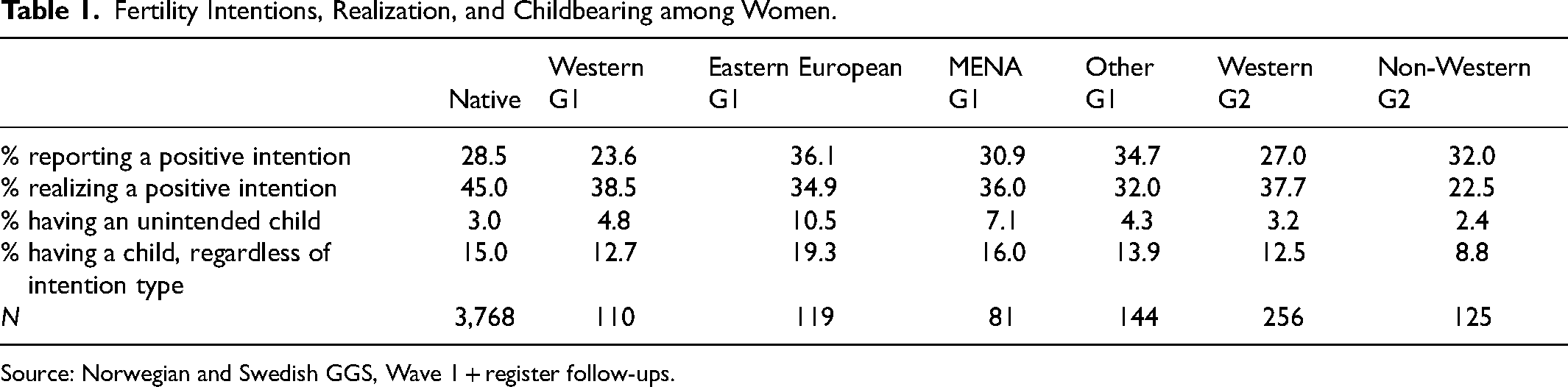
Fertility Intentions, Realization, and Childbearing among Women.
Source: Norwegian and Swedish GGS, Wave 1 + register follow-ups.
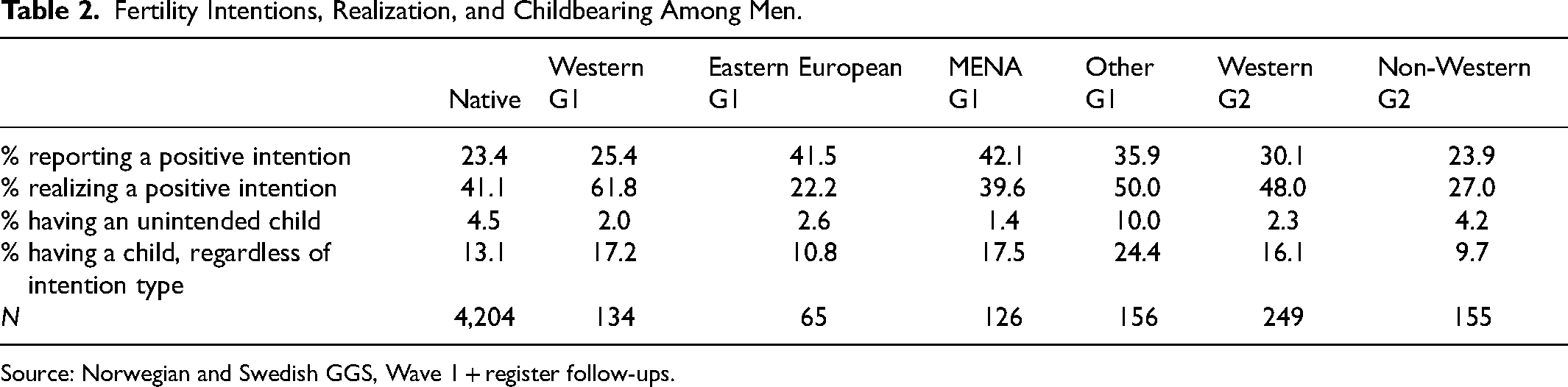
Fertility Intentions, Realization, and Childbearing Among Men.
Source: Norwegian and Swedish GGS, Wave 1 + register follow-ups.
Method and Analytical Approach
In a first step of the analysis, descriptive statistics are shown to illustrate how the relationship between actual childbearing, fertility intentions, and the realization of positive and negative intentions varies between groups. Logistic regression is, then, used for multivariate analyses that control for factors known to influence the probability of realization, with results presented as average marginal effects. 7 All logistic regression analyses are conducted on the combined Norwegian and Swedish GGS samples but separately by gender and intention type. Analyzing respondents with positive and negative intentions separately facilitates interpretation of results, since having a child within 36 months of interview carries the same meaning in terms of realization for all respondents in any single model. 8
As discussed in the section The Norwegian and Swedish Setting, analyzing the Norwegian and Swedish samples jointly is reasonable, given wide-ranging institutional and cultural similarities between the two countries. Yet the fact that interviews and follow-ups to the Norwegian GGS preceded those of the Swedish GGS by five years is potentially problematic for joint analyses if realization patterns vary over time. One reason to expect such differences is that the follow-up period in Norway coincides with the so-called Great Recession, while the follow-up period in Sweden takes place after the recession. However, the recession’s effects on unemployment and public services were relatively mild and short-lived in both Norway and Sweden (Dølvik and Oldervoll 2019; Palme 2019). Within the sample, only among men with a positive fertility intention was there a statistically significant difference in realization rates between Norwegian and Swedish respondents. Contrary to what would be expected, given the Great Recession’s timing, men in Norway were actually more likely to realize a positive fertility intention in 2007–2011, compared to men in Sweden in 2012–2016. Although the difference between the countries is only statistically significant among men with a positive intention, all logistic regression models control for survey country.
For the logistic regression analyses of the realization of both positive and negative fertility intentions, model 1 includes immigrant background as the only explanatory variable (in addition to survey country), with demographic factors added in model 2 and socioeconomic factors added in model 3. Model 4 adds the partner’s intention and, for men, also the partner’s age. For the analysis of positive intentions, the sample size allows for further models (5–9) that examine interaction effects between immigrant background and educational attainment, employment status, partner’s employment status, partnership status, and partner’s intention, respectively. Models 1–3 and 5 include both partnered and unpartnered respondents. Models 4, 6, and 8–9 include only respondents in a partnership, whether married, cohabiting, or non-cohabiting. Model 7 includes only respondents in a co-residential partnership, whether married or cohabiting.
Results
Descriptive Findings on Intentions, Realization, and Actual Childbearing
Descriptive findings show that women of all immigrant backgrounds were less likely than native women to realize a positive intention (see Table 1). The immigrant/native gap in the propensity to realize a positive fertility intention is especially pronounced for G2 women of non-Western origin, which is in line with expectations based on earlier findings on the group’s intended and actual fertility in Norway and Sweden, as discussed in the section The Norwegian and Swedish Setting. Whereas lower realization for the Eastern European G1 is also in line with expectations, the lower realization rates of both G1 and G2 women of Western origin are unexpected. The probability of having an unintended birth was elevated among G1 women of Eastern European and MENA origin, while the other groups were relatively similar to natives in this respect. The figures for unintended births should be interpreted with caution, however, since the number of respondents who had an unintended birth was very low for all immigrant background categories.
In line with expectations and similar to the patterns among women, the probability of realizing a positive intention was depressed among Eastern European G1 men and non-Western G2 men, when compared to native men (see Table 2). However, Western-origin men, especially the G1, were unexpectedly more likely than native men to realize a positive intention. Both G1 and G2 men of Western origin, as well as Eastern European and MENA G1 men, were less likely than natives to have an unintended birth, while the non-Western G2 was similar to natives and G1 men of “other” origin were considerably more likely than natives to have an unintended birth. Again, figures for unintended births should be interpreted with caution, since the number of respondents having an unintended birth was very low for all immigrant background categories.
Tables 1 and 2 illustrate that studying realization patterns among immigrants can contribute new knowledge about immigrant fertility that cannot be attained by analyzing actual or intended fertility alone. First, behavioral similarities between groups do not necessarily reflect similarities in intentions and realization. For example, whereas “other” G1 women and native women were about equally likely to have a child during the observation period, the former were more likely to state a positive intention but considerably less likely to realize it. Second, similarities in intentions between groups do not necessarily translate into behavioral similarities. For example, native men, G1 men of Western origin, and G2 men of non-Western origin were about equally likely to state a positive fertility intention, whereas the groups differed considerably in their propensity to realize the intention, leading to differences in actual childbearing. Thus, compared to analyses of either actual or intended fertility alone, exploring the relationship between intentions and behavior (i.e., realization) can produce a deeper understanding of immigrants’ adaptation to the destination country’s fertility regime.
The Realization of Positive Fertility Intentions
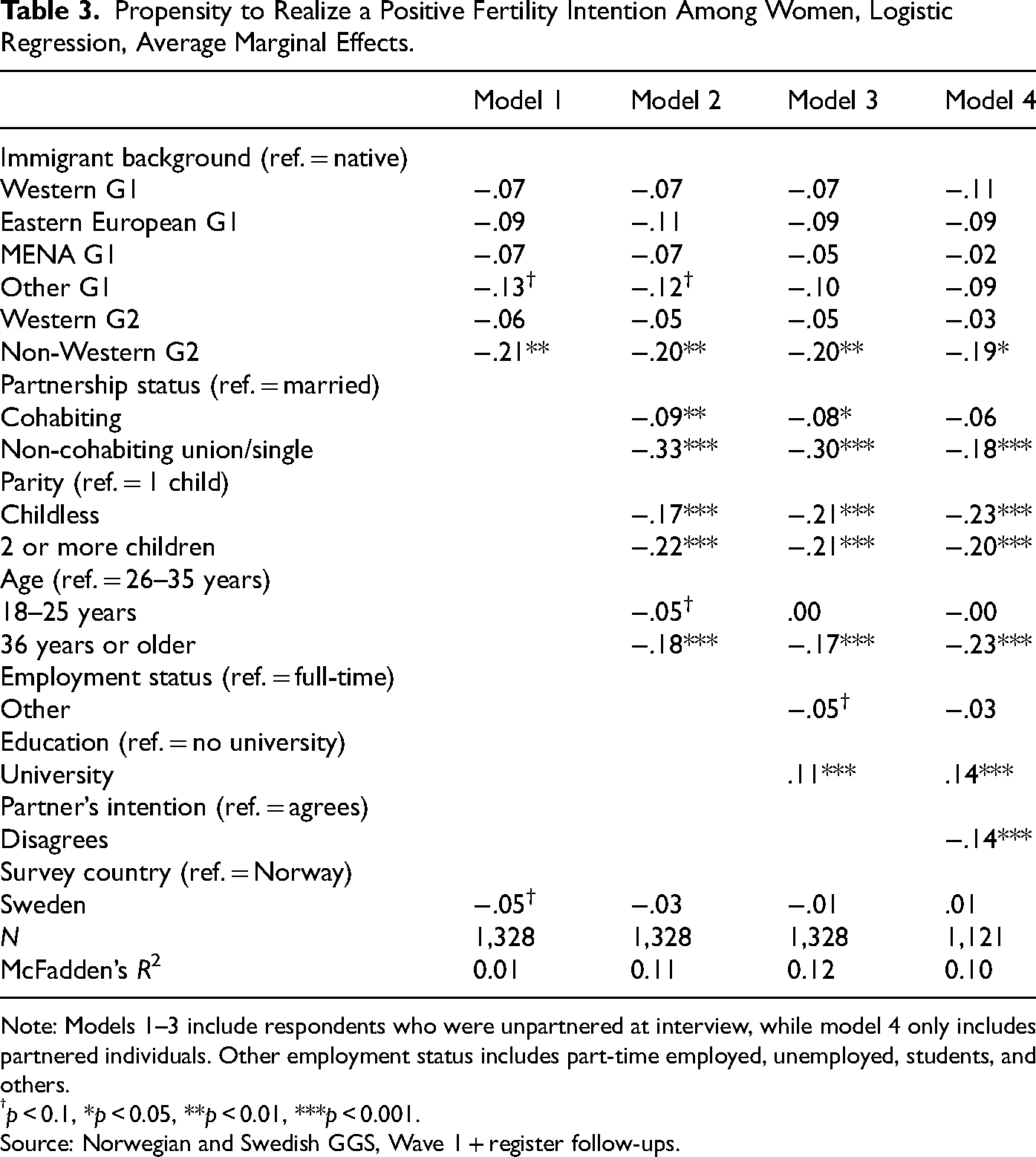
To test whether the patterns described above hold when controlling for factors known to affect the realization of positive fertility intentions, a set of logistic regression models were estimated, as described in the section Method and Analytical Approach. Starting with women, results show that G2 women of non-Western origin were significantly less likely than native women to realize a positive intention in all four models (see Table 3). Whereas all other immigrant groups were also less likely than natives to realize a positive intention, differences are not significant at the 5% level. Stepwise introduction of controls for demographic and socioeconomic characteristics, as well as the partner’s intention, only leads to small changes in the average marginal effects across models 1–4, indicating that realization differences between immigrant and native women cannot be fully explained by compositional differences at interview.
Propensity to Realize a Positive Fertility Intention Among Women, Logistic Regression, Average Marginal Effects.
Note: Models 1–3 include respondents who were unpartnered at interview, while model 4 only includes partnered individuals. Other employment status includes part-time employed, unemployed, students, and others.
p < 0.1, *p < 0.05, **p < 0.01, ***p < 0.001.
Source: Norwegian and Swedish GGS, Wave 1 + register follow-ups.
A series of additional models were estimated to further explore these patterns. First, models where the three non-Western G1 groups were combined to a single category similar to the G2 show that non-Western G1 women were significantly less likely than native women to realize a positive intention, even after controlling for the demographic and socioeconomic variables in model 3. Second, stratifying the sample by parity shows that childless women of both the “other” G1 and the non-Western G2 were significantly less likely than native childless women to realize a positive intention. Among one-child mothers, most immigrant groups were considerably less likely than natives to realize a positive intention, but differences are not significant. Third, stratifying the sample by age group shows that differences between immigrants and natives were especially pronounced among women in the prime childbearing ages of 26–35 years, where both the MENA and “other” G1, as well as the non-Western G2, were significantly less likely than native women to realize a positive intention. 9 Fourth, separate models for Norway and Sweden show that G2 women of non-Western origin were significantly less likely than native women to realize a positive intention in both countries (results available upon request).
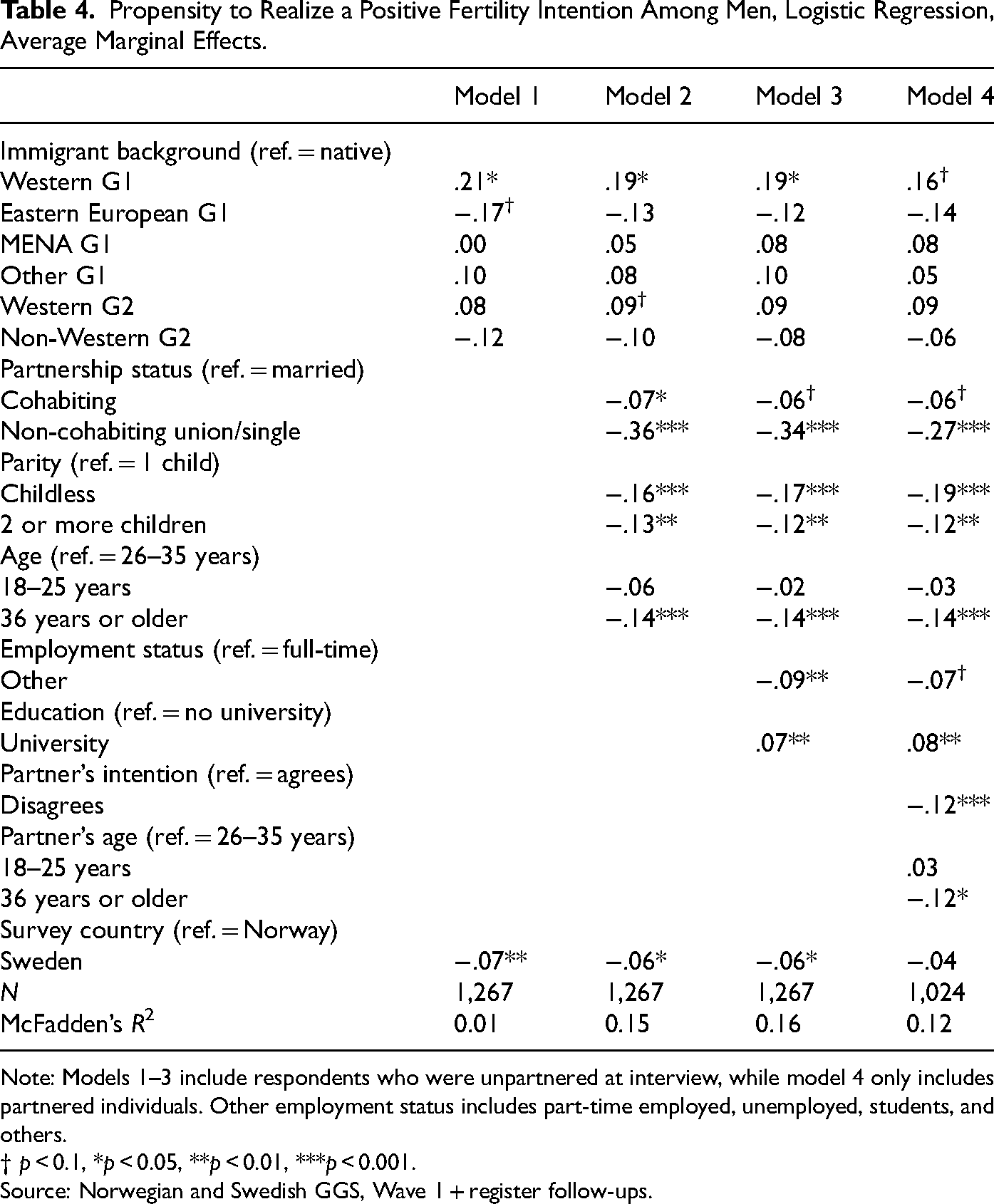
Results for men show that the G1 of Western origin were significantly more likely than native men to realize a positive intention in all models (significant at the 5 percent level in models 1–3 and at the 10 percent level in model 4; see Table 4). Results for the Western G2 and the MENA and “other” G1 go in the same direction but are not significant at the 5 percent level. Similar to women, the Eastern European G1 and non-Western G2 were less likely than native men to realize a positive intention, although results are not significant at the 5 percent level. Similar to the analysis of realization patterns among women, introducing controls for demographic and socioeconomic characteristics, as well as the partner’s intention, only leads to relatively small changes to the average marginal effects across models 1–4, again indicating that realization differences between immigrants and natives cannot be fully explained by compositional differences at interview.
Propensity to Realize a Positive Fertility Intention Among Men, Logistic Regression, Average Marginal Effects.
Note: Models 1–3 include respondents who were unpartnered at interview, while model 4 only includes partnered individuals. Other employment status includes part-time employed, unemployed, students, and others.
† p < 0.1, *p < 0.05, **p < 0.01, ***p < 0.001.
Source: Norwegian and Swedish GGS, Wave 1 + register follow-ups.
Similar to the analyses for women, additional models were also estimated for men to further explore intergroup differences in realization patterns. First, stratifying the sample by parity shows that one-child fathers of the Eastern European G1 were significantly less likely than native one-child fathers to realize a positive intention. Western G1 men were considerably more likely than native men to realize a positive intention at both parity 0 and parity 1, but differences are not significant. Second, stratifying the sample by age group shows that G1 men of “other” origin in the 18–25-year age group were significantly more likely than native men in the same age group to realize a positive intention. Other differences between natives and different immigrant groups are not significant. 10 Third, separate models for the Norwegian and Swedish samples show that G1 men of Western origin were considerably more likely than native men to realize a positive intention in both countries, although results are not significant in Norway and only significant at the 10 percent level in Sweden (results available upon request).
A possible explanation for the high realization rates of Western G1 men could be that individuals within the group who did not realize their fertility intention were more likely than non-realizers within other groups to emigrate from Norway and Sweden. It has been shown that Western-origin immigrants in Sweden are more likely than other immigrants to re-emigrate (Monti 2019). While respondents who emigrated before childbirth or follow-up are excluded from the sample analyzed here, only one individual among the group of Western G1 men with a positive intention was excluded for this reason. Thus, high emigration rates among the Western G1 cannot explain their elevated propensity to realize a positive intention.
To further examine the group differences in realization patterns discussed above, the next step of the analysis specifies five additional models where the immigrant background variable is combined with educational attainment (Model 5), employment status (Model 6), the partner’s employment status (Model 7), partnership status (Model 8), or the partner’s intention (Model 9) to examine potential effect differences across immigrant backgrounds. Due to sample size considerations, the Western G1 and G2 are combined into a single Western category, and the three non-Western G1 groups and the non-Western G2 are combined into a single non-Western category.
Results point to differences between immigrants and natives in the association between socioeconomic status and realization patterns (Figure 1). Higher-educated women of non-Western origin were significantly less likely than higher-educated native women to realize a positive fertility intention, as were full-time employed women of non-Western origin compared to full-time employed native women. While both lower-educated women and women who were not full-time employed were also less likely than their native counterparts to realize a positive intention, differences are somewhat smaller and not significant. Among men, both higher-educated and full-time employed individuals of Western origin were more likely than natives with the same socioeconomic status to realize a positive fertility intention. Mostly, the effect of the partner’s employment status on realization does not differ significantly between groups.
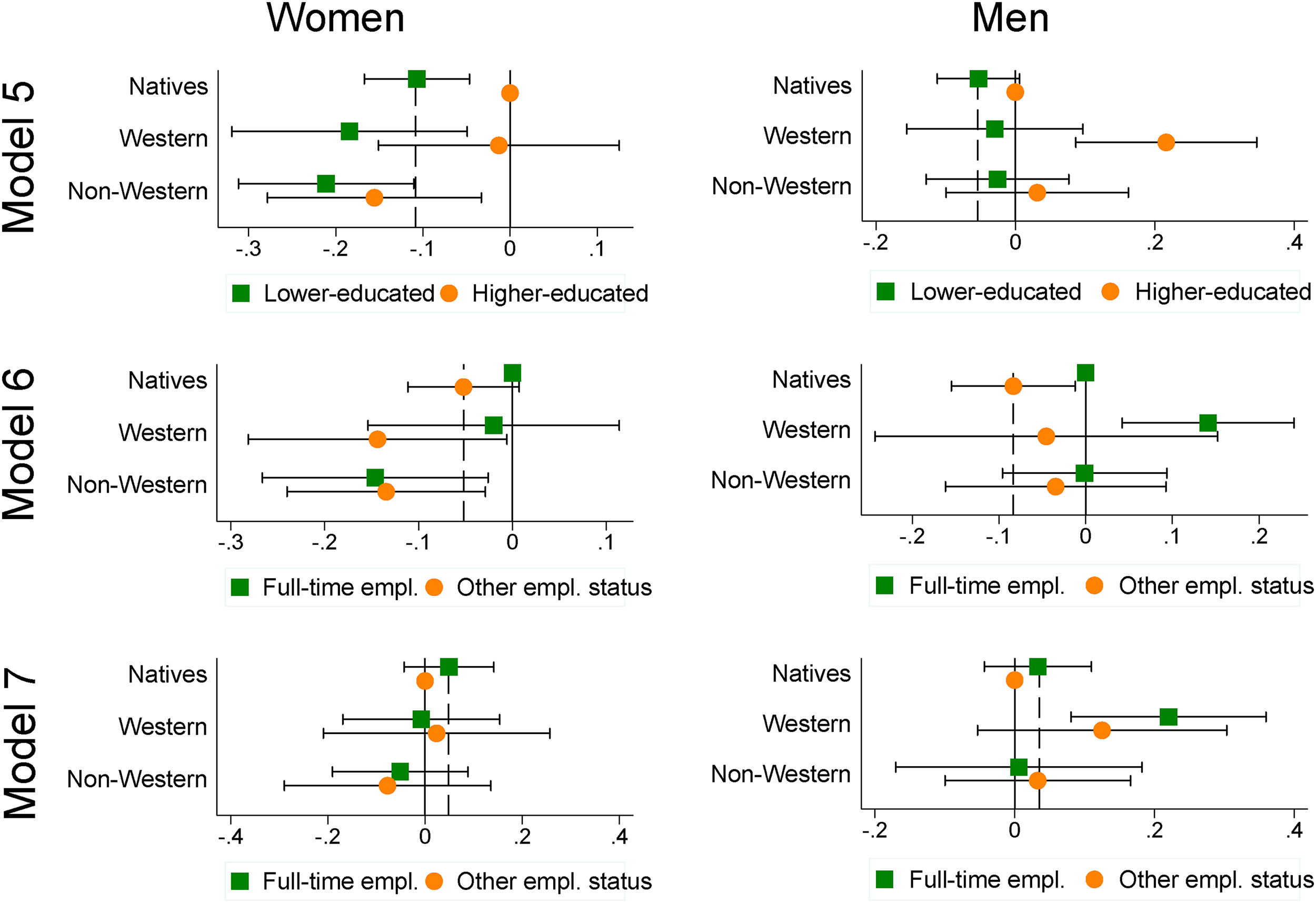
Propensity to realize a positive fertility intention, logistic regression, by respondent’s educational attainment (model 5), employment status (model 6) and the employment status of the respondent’s partner (model 7), average marginal effects. Note: Other employment status includes part-time employed, unemployed, students, and others. Models 5 and 6 include respondents who were either married, cohabiting, or had a non-coresidential partner, while model 7 only includes respondents who were either married or cohabiting. Model 5 controls for partnership status, parity, age at interview, employment status, and survey country. Model 6 controls for partnership status, parity, age at interview, educational attainment, and survey country. Model 7 controls for parity, age at interview, educational attainment, employment status, and survey country. 95% confidence intervals. n: female models 5 and 6: 1,328, female model 7: 946, male models 5 and 6: 1,267, male model 7: 839. McFadden’s R2s: women: Model 5: 0.12, Model 6: 0.13, Model 7: 0.08, men: Model 5: 0.15, Model 6: 0.16, Model 7: 0.07. Source: Norwegian and Swedish GGS, Wave 1 + register follow-ups.
There is only partial support for the hypothesis that the relatively weak status of marriage in Scandinavia should mean that marriage’s positive effect on realization is stronger among immigrants than among natives. The only immigrant group that clearly fits this pattern is Western-origin men, among whom married individuals were considerably more likely than all other categories to realize a positive intention, while Western-origin men in an unmarried union were not significantly different from native men in an unmarried union (see Figure 2). There is no support for the hypothesis that cultural differences in the relative influence of the male and female partner could mean that the effect of having a disagreeing partner varies between natives and certain immigrant groups. Figure 2 shows that realization did not differ significantly by immigrant background among respondents with a partner that disagreed with the respondent’s positive intention.
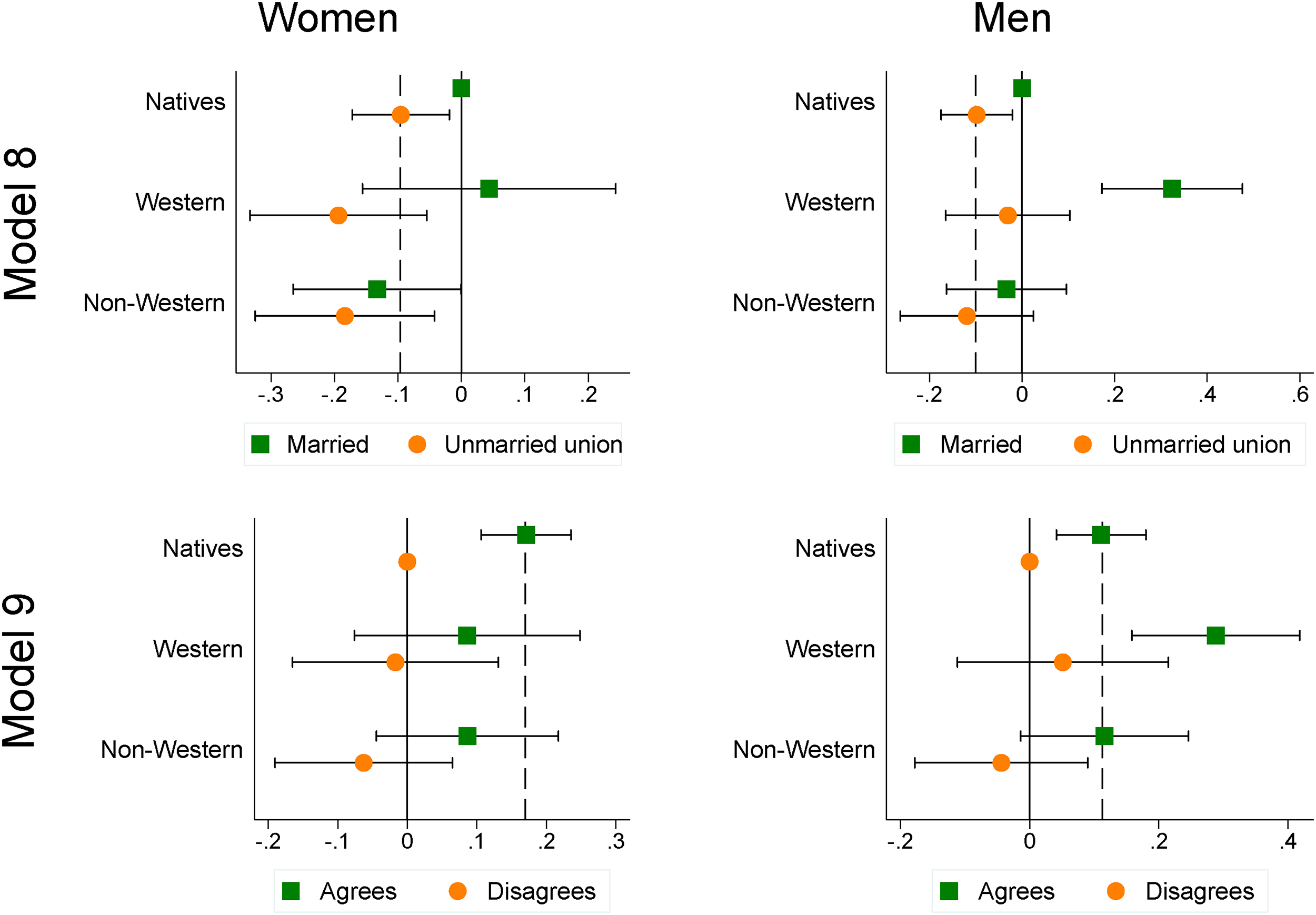
Propensity to realize a positive fertility intention, logistic regression, by partnership status (model 8) and partner’s intention (model 9), average marginal effects. Note: Both models include respondents who were either married, cohabiting, or had a non-coresidential partner but not respondents who did not have a partner. The models control for parity, age at interview, educational attainment, employment status, and survey country. 95% confidence intervals. n: female models: 1,121, male models: 1,024. McFadden’s R2s: women: Model 8: 0.08, Model 9: 0.09, men: Model 8: 0.09, Model 9: 0.09. Source: Norwegian and Swedish GGS, Wave 1 + register follow-ups.
Models 5–9 were also estimated with an alternative categorization of immigrant background, where immigrants were grouped into two generational categories (i.e., G1 and G2), instead of two regional origin categories (i.e., Western and non-Western). Results from these models show that educational attainment’s positive effect on the propensity to realize a positive fertility intention was especially pronounced among G2 men. Being married had a strong positive effect on realization among both the male and female G2, whereas the effect was small among the G1 (results available upon request).
Results point to considerable differences in realization patterns between men and women. Yet when estimating additional models for each immigrant background category separately, gender differences were only significant within the Western G1, among whom women were considerably less likely than men to realize a positive fertility intention (results available upon request). Gender differences in realization within immigrant groups did not seem to be linked to women more often reporting a positive intention. The propensity to state a positive, as opposed to a negative, fertility intention did not differ significantly between men and women in any immigrant category.
The control variable’s effects (see Tables 3 and 4) are largely as expected, given earlier research (e.g. Dommermuth, Klobas and Lappegård 2015; Kapitány and Spéder 2012; Kuhnt and Trappe 2016; Régnier-Loilier and Vignoli 2011; Spéder and Kapitány 2009; 2014). In addition to the variables included in the models presented here, further analyses also controlled for the respondent’s number of siblings, religiosity, income, number of rooms at the current residence, whether the partner was native or foreign born, and the partner’s employment status (all measured at interview). 11 None of these variables contributed to a substantial change in the association between immigrant background and fertility intention realization. These variables are not included in the main models because they either did not have a significant effect on realization or only covered a subset of respondents.
To test whether realization patterns differed between respondents stating a probably yes or a definitely yes intention, additional analyses by type of positive intention were conducted only on the Swedish sample. These analyses do not indicate that group differences in realization patterns varied substantially by type of positive intention (results available upon request).
Having an Unintended Birth
Because the number of births to respondents reporting a negative fertility intention was small among all immigrant groups, analyses of the propensity to have an unintended birth (i.e., failure to realize a negative intention) combines the G1 and G2 within the Western and non-Western origin groups, similar to the interaction models in the section The Realization of Positive Fertility Intentions. However, the number of events in the combined categories was still small, meaning that results in this section should be interpreted with caution. Yet results show that women of non-Western origin were more likely than native women to have an unintended birth. The difference is significant at the 5 percent level in model 1 and at the 10 percent level in models 2 and 3 (Table 5). Men of Western origin were less likely than native men to have an unintended birth. The difference is significant at the 5 percent level in models 1 and 4 and at the 10 percent level in models 2 and 3 (Table 6). Similar to results for the realization of positive intentions, it seems that the observed intergroup differences in the propensity to have an unintended birth are relatively robust to controlling for demographic, socioeconomic, and other characteristics.
Propensity to Have an Unintended Birth among Women, Logistic Regression, Average Marginal Effects.
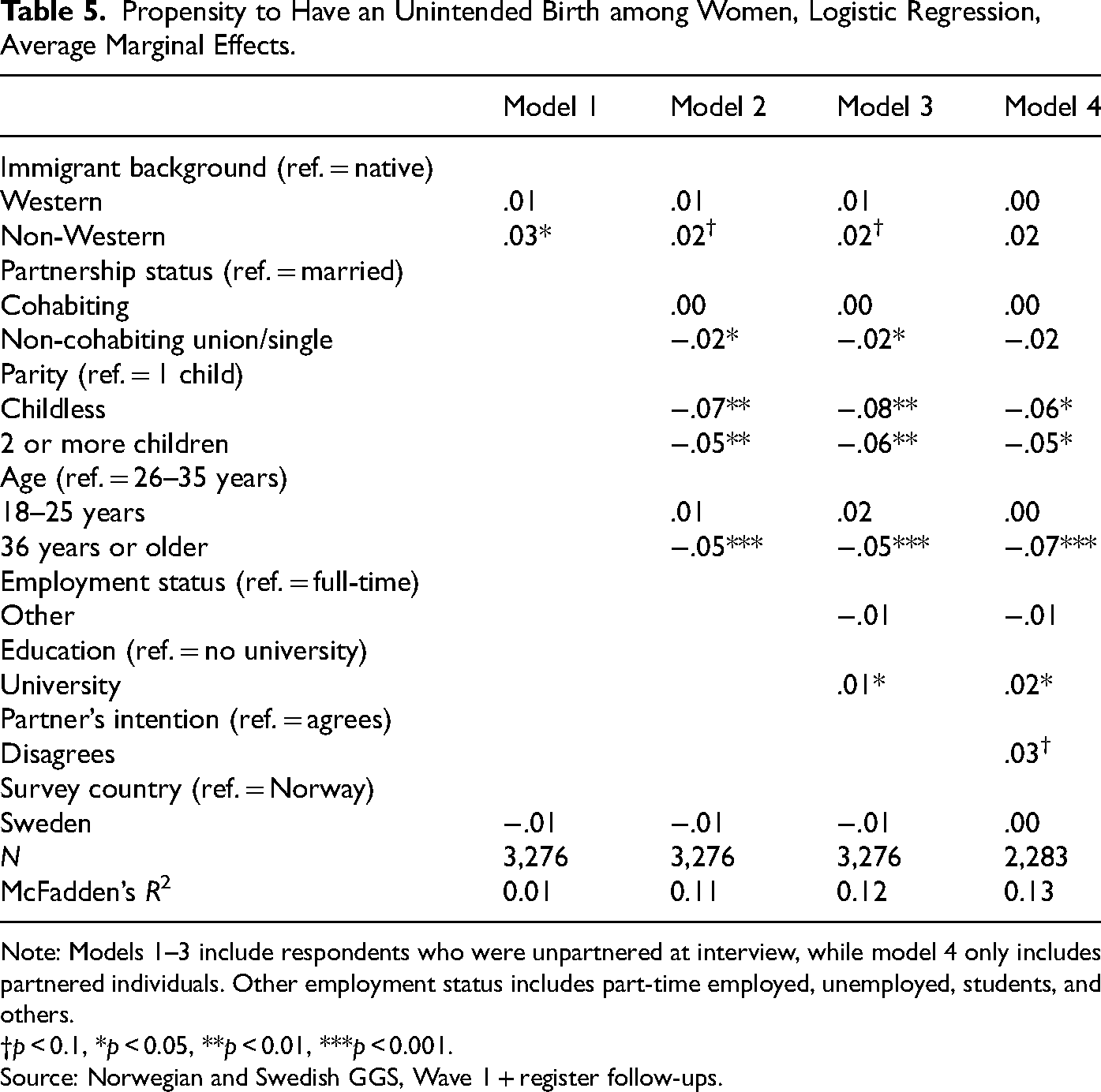
Note: Models 1–3 include respondents who were unpartnered at interview, while model 4 only includes partnered individuals. Other employment status includes part-time employed, unemployed, students, and others.
†p < 0.1, *p < 0.05, **p < 0.01, ***p < 0.001.
Source: Norwegian and Swedish GGS, Wave 1 + register follow-ups.
Propensity to Have an Unintended Birth Among Men, Logistic Regression, Average Marginal Effects.
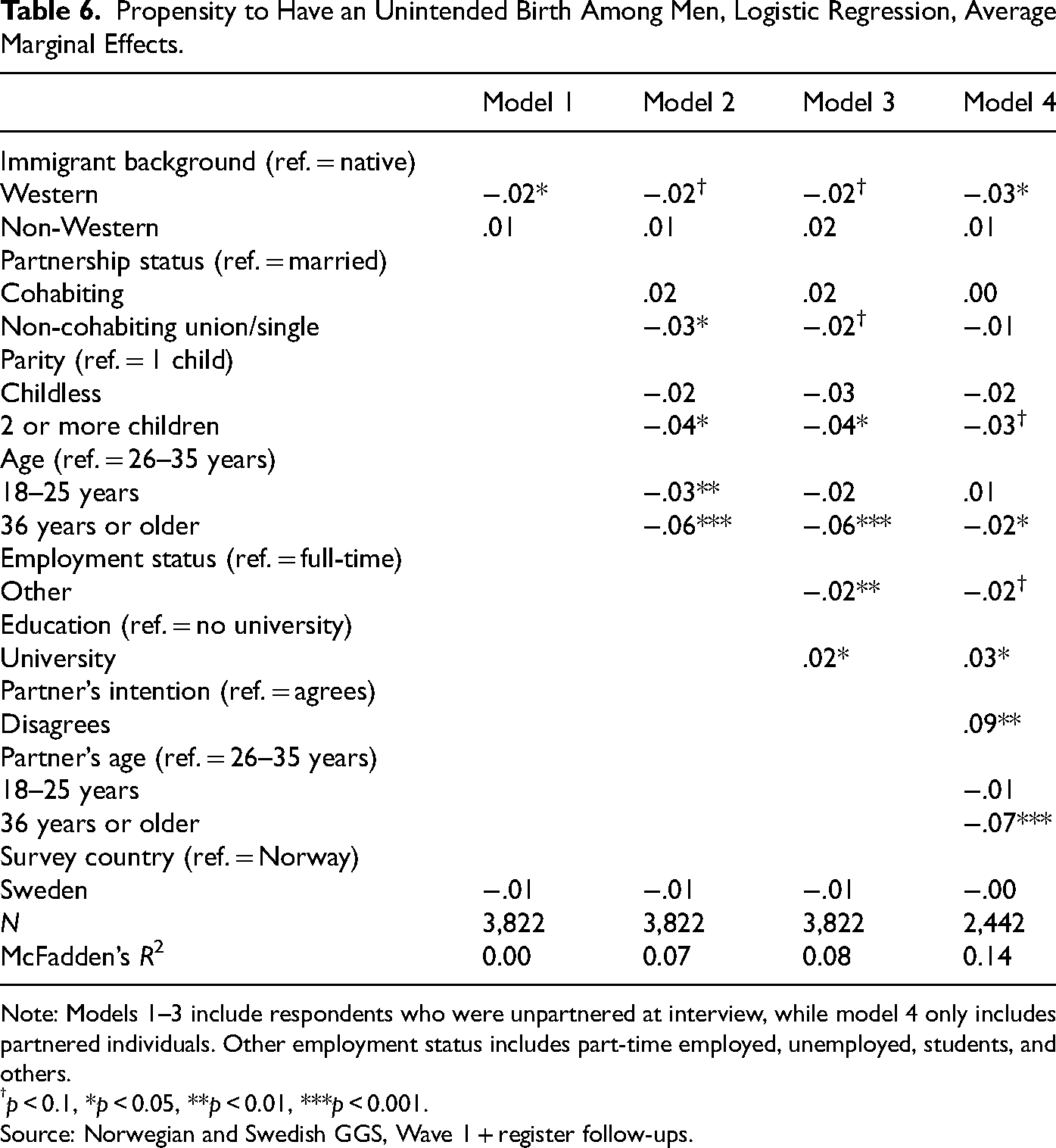
Note: Models 1–3 include respondents who were unpartnered at interview, while model 4 only includes partnered individuals. Other employment status includes part-time employed, unemployed, students, and others.
p < 0.1, *p < 0.05, **p < 0.01, ***p < 0.001.
Source: Norwegian and Swedish GGS, Wave 1 + register follow-ups.
Additional analyses for the Norwegian and Swedish samples separately show that the depressed probability of having an unintended birth among Western-origin men existed primarily in the Norwegian sample. Further models where G1 and G2 women of non-Western origin were kept as separate categories point to an elevated probability of having an unintended birth primarily among the G1 (see also Table 1). The difference between non-Western G1 women and native women is significant at the 10 percent level, when controlling for the variables in models 2–4.
The control variables’ effects are again largely as expected, given earlier research (Kuhnt and Trappe 2016; Spéder and Kapitány 2009). However, it is somewhat surprising that higher-educated men and women were more likely than lower-educated individuals to have an unintended birth. A possible explanation is that higher-educated individuals more often experience unexpected positive changes to their living conditions, allowing them to abandon their original negative intention in favor of a positive intention.
Discussion and Conclusions
This article’s overarching aim was to explore how the propensity to realize positive and negative short-term fertility intentions varies between natives and immigrants of different gender, origin, and generational status. Using data from the Norwegian and Swedish Generations and Gender Surveys together with their respective register-based follow-ups, results show that realization patterns differed between natives and certain immigrant groups. G2 women of non-Western origin were significantly less likely than native women to realize a positive fertility intention, whereas G1 men of Western origin were significantly more likely than native men to realize a positive intention. Western-origin men were also significantly less likely than native men to have an unintended birth. These intergroup differences in realization patterns are robust to controlling for compositional differences in demographic and socioeconomic factors that have previously been found to influence the individual propensity to realize a fertility intention (e.g., Dommermuth, Klobas and Lappegård 2015; Kapitány and Spéder 2012; Kuhnt and Trappe 2016; Régnier-Loilier and Vignoli 2011; Spéder and Kapitány 2009; 2014).
Earlier findings on either intended or actual fertility among immigrants and children of immigrants in Sweden (Andersson 2004; Andersson, Persson and Obućina 2017; Carlsson 2018; Scott and Stanfors 2011) suggested that the Eastern European G1 and G2 and the Middle Eastern G2 could be less likely than natives to realize a positive fertility intention. Results point in the expected direction, as both G1 men and women of Eastern European origin, as well as G2 men and women of non-Western origin, were less likely than natives of the same gender to realize a positive fertility intention. However, only the difference between G2 women of non-Western origin and native women was statistically significant.
Two possible explanations for non-Western G2 women’s depressed fertility realization seem plausible. First, non-Western G2 women may be more likely than native women to report a fertility intention that they are not motivated to pursue. It is possible that non-Western G2 women tend to have a more fatalistic approach to family planning than native women or that they are more affected than native women by a social desirability bias toward reporting a positive intention, due to influence from pronatalist norms associated with the parental origin country’s fertility regime. A reported intention that is not grounded in the individual’s actual lived circumstances is likely to carry less meaning for the individual, meaning he/she should be less motivated to pursue it, thereby making the reported intention less likely to be realized. Second, non-Western G2 women may be less able than natives to predict their future life course trajectories. Native women may have a general knowledge advantage regarding the opportunity structure surrounding childbearing in the destination country, which could make them more likely to form a fertility intention that is realistic, given the institutional and cultural context in Norway and Sweden. Non-Western G2 women, on the other hand, may be more likely than native women to experience unexpected changes to their life course trajectories, which would force them to abandon or postpone their reported fertility intention.
These interpretations have implications for understanding non-Western G2 women’s adaptation to fertility patterns in the destination country, since both interpretations suggest that non-Western G2 women tend to be influenced ideationally by the origin country’s fertility regime. Children of non-Western immigrants might gather inspiration from the fertility trajectories of their parents or by contemporary relatives, friends, or celebrities in the origin country. If the origin country’s fertility regime involves high fertility, early childbearing, limited family planning, and/or low labor market participation among mothers, it may not be easily combined with the institutional and cultural context surrounding family formation in Norway and Sweden. Thus, it is possible that ideational influences from the origin country’s fertility regime lead non-Western G2 women to report fertility intentions that are relatively unrealistic in the destination country, due to differences between origin and destination in the opportunity structure surrounding childbearing.
The mechanisms outlined in the previous two paragraphs may affect all immigrant groups to some extent. However, the intensity of normative conflict between the origin and destination fertility regimes is likely to be higher for origin groups that are culturally more distant from Norway and Sweden, especially non-Western origin groups, and for the G2, which may have experienced socialization into both the origin and destination culture.
The elevated propensity to realize a positive fertility intention among Western G1 men was not expected, given earlier findings on fertility preferences and behavior in Norway and Sweden (Andersson 2004; Carlsson 2018; Tønnessen 2014). The other Western-origin groups did not differ significantly from natives in the propensity to realize a positive intention. A possible explanation for the high realization rates among Western G1 men is that they are caused by a selection effect related to migration patterns among Western-origin immigrants. In Sweden, Western-origin immigrants are more likely than immigrants of other origins to re-emigrate (Monti 2019). Western-origin immigrants move to Norway and Sweden primarily for labor market or family reasons (Statistics Norway 2021c; Swedish Migration Agency 2021) and face relatively low barriers to emigration, given extensive freedom of movement within the EU/EFTA (Marzocchi 2022). It may, therefore, be assumed that Western-origin immigrants are more likely than other groups to emigrate if the conditions that caused immigration change or if new labor market opportunities become available outside Norway or Sweden. If Western G1 men with relatively unstable living conditions tend to emigrate more often than those with stable living conditions, it is possible that male Western G1 stayers constitute a select group with particularly favorable conditions for realizing a fertility intention.
Although the gap between native and Western G1 men in the propensity to realize a positive fertility intention remains when controlling for demographic and socioeconomic factors, it seems likely that the Western G1’s relatively advantageous conditions should contribute to explaining their higher realization rates. Western G1 men were more likely than all other groups, including natives, to be university educated, to be in the top income quartile, and to be in a co-residential partnership (especially marriage). They were also considerably more likely than other male G1 groups to be full-time employed, to have a full-time employed partner, and to have a native-born partner. The models that interact immigrant background with educational attainment and employment status show that Western-origin men with higher education and full-time employment were more likely to realize a positive fertility intention than native men with the same favorable characteristics. One possible interpretation is that Western-origin men tend to belong to particularly privileged segments within the privileged categories of the socioeconomic variables. For example, they might tend to be not only full-time employed but also full-time employed within industries or sectors where realization rates are particularly high. Another possibility is that Western-origin G1 men tend to experience multiple reinforcing advantages simultaneously to a greater extent than other groups and that interaction effects lead to extra high realization rates.
In showing marked gendered differences in realization patterns, this article demonstrates the value of including both men and women in immigrant fertility research. Earlier research on immigrant fertility often only focused on patterns among women (e.g., Andersson 2004; Milewski 2007; Mussino and Strozza 2012). Similarly, this article shows that the propensity to realize a negative fertility intention may differ significantly between groups in society, demonstrating the value of studying the realization of both positive and negative fertility intentions. Earlier research on the realization of fertility intentions often only focused on the realization of positive intentions (e.g., Dommermuth, Klobas and Lappegård 2015; Hanappi and Buber-Ennser 2017; Kapitány and Spéder 2012; Spéder and Kapitány 2014).
This article’s main limitation is the relatively small number of respondents with an immigrant background, which imposed constraints on the analyses, most notably in restricting the possibilities to distinguish among groups of immigrants while maintaining statistical power. For parts of the analysis, it was only possible to distinguish among immigrant origins along a Western/non-Western dichotomy. Especially the non-Western group is very heterogeneous, with realization patterns likely to vary between subgroups. Since the Norwegian data did not allow G2 individuals’ parental origin to be identified beyond Western and non-Western, alternative groupings that could have been more suitable for this analysis, such as European versus non-European, were not possible. It could also have been interesting to distinguish between more generational categories than the G1 and G2. Earlier research on immigrant fertility has shown that there is reason to distinguish among the G1 between those who immigrated as adults and those who immigrated as children, as well as among the G2 between those with two and those with one foreign-born parent (e.g., Carlsson 2018; Scott and Stanfors 2011; Tønnessen 2014).
However, all survey data where immigrants or ethnic minorities are not oversampled suffer from similar problems related to the small sample size of individuals with an immigrant background. In fact, the minimal attrition from interview to follow-up resulting from the use of register-based follow-ups to the Norwegian and Swedish GGSs should mean that this material is better suited to this article’s research objectives than are alternative data sources based on successive survey waves. Yet larger samples of immigrants or ethnic minorities are needed to further develop understandings of realization differences between immigrants and natives or between ethnic groups.
A disadvantage of completely replacing the second survey wave with register-based follow-ups is that doing so rules out the possibility of comparing intentions at two different time points. Previous research has used information from two survey waves to distinguish among non-realizers between postponers and abandoners (e.g., Régnier-Loilier and Vignoli 2011; Spéder and Kapitány 2009). The data used in this article do not allow for the exploration of whether non-realizing immigrants and natives differed in the tendency to either abandon or postpone the intention reported at the Wave 1 interview.
This article is one of the first to examine variation in patterns of fertility intention realization across immigrant backgrounds or ethnic groups. Further research should explore the extent to which the findings reported here can be generalized across space and time. Country-specific factors, such as native realization patterns (earlier studies found realization patterns to differ across European countries: Kapitány and Spéder 2012; Régnier-Loilier and Vignoli 2011), integration policies, and immigrants’ origins and reasons for migration, are likely to affect the magnitude and direction of realization differences between natives and immigrants. It is also possible that patterns in Norway and Sweden have changed over time, since overall fertility levels have dropped considerably, especially in Norway, since the time of the GGS (Statistics Norway 2021a; Statistics Sweden 2021a). Additionally, future research should explore whether realization differences between natives and immigrants are more pronounced when considering other types of fertility preferences, such as ideals and desires. It can be assumed that preference types that are more distant from behavior, such as ideals and desires, should be more influenced by normative differences between origin and destination countries than preference types that are relatively proximate to behavior, such as intentions.
To conclude, this article contributes new information to understandings of both immigrant fertility and the realization of fertility intentions. Examining realization differences between groups explores a dimension of immigrants’ adaptation to the destination country’s fertility regime that cannot easily be examined by analyzing intended or actual fertility alone. It also shows that similarities in fertility behavior between immigrants and natives do not necessarily reflect attitudinal similarities and, vice versa, that attitudinal similarities do not necessarily translate into behavioral similarities. Thus, there is reason to be cautious about drawing conclusions about immigrants’ adaptation to the destination society’s fertility regime based on patterns in fertility preferences or fertility behavior alone. In addition to providing new insights on the fertility adaptation processes of immigrants and children of immigrants, this article contributes to research on fertility intention realization in showing that immigration status and/or ethnicity can be important determinants of realization. Future research on fertility intention realization in immigrant-receiving and ethnically heterogeneous countries could benefit from taking potential differences by immigrant status or ethnicity into consideration.
Supplemental Material
sj-pdf-1-mrx-10.1177_01979183221107930 - Supplemental material for The Realization of Short-Term Fertility Intentions Among Immigrants and Children of Immigrants in Norway and Sweden
Supplemental material, sj-pdf-1-mrx-10.1177_01979183221107930 for The Realization of Short-Term Fertility Intentions Among Immigrants and Children of Immigrants in Norway and Sweden by Erik Carlsson in International Migration Review
Footnotes
Acknowledgments
I am grateful to the editor of the International Migration Review and the anonymous reviewers for valuable comments and suggestions. Eleonora Mussino, Livia Sz. Oláh, Ben Wilson, Gunnar Andersson, and Sunnee Billingsley provided valuable feedback on earlier versions of this article. The LOGG data are distributed by the Norwegian Social Science Data Services. None of the funding institutions are responsible for the current analyses and interpretations of the data.
Declaration of Conflicting Interests
The author(s) declared no potential conflicts of interest with respect to the research, authorship, and/or publication of this article.
Funding
The author(s) disclosed receipt of the following financial support for the research, authorship, and/or publication of this article: The research received financial support from the Swedish Research Council through the Swedish Initiative for Research on Microdata in the Social and Medical Sciences (SIMSAM): Stockholm University SIMSAM Node for Demographic Research, grant no. 340-2013-5164. The LOGG study is financed by the Research Council of Norway (grant no. 168373), Ministry of Health and Care Services; Ministry of Labour; Ministry of Children, Equality and Social Inclusion; Ministry of Local Government and Regional Development; Norwegian Social Research (NOVA); and Statistics Norway. The NorLAG and LOGG datasets are part of the ACCESS Life Course infrastructure project funded by the National Financing Initiative for Research Infrastructure at the Research Council of Norway (grant no. 195403) and by NOVA.

Supplemental Material
Supplemental material for this article is available online.
Notes
References
Supplementary Material
Please find the following supplemental material available below.
For Open Access articles published under a Creative Commons License, all supplemental material carries the same license as the article it is associated with.
For non-Open Access articles published, all supplemental material carries a non-exclusive license, and permission requests for re-use of supplemental material or any part of supplemental material shall be sent directly to the copyright owner as specified in the copyright notice associated with the article.
