




Abstract
Background
Perceived organizational support and nurses’ intention to stay are key elements in retaining nursing staff. Previous research has highlighted the work engagement of nursing staff as a factor that can be improved and is linked to retention. However, prior research has not explored the moderating role of transformational leadership in this relationship. This research aimed to provide insights into the relationships among perceived organizational support, transformational leadership, work engagement, and nurses’ intention to stay within the context of an emerging country.
Methods
A quantitative research design was employed in this study, utilizing a structured questionnaire to collect data. This approach facilitated the collection of responses from a diverse group of healthcare professionals across Vietnam through an online platform. The proposed research model was tested using partial least squares structural equation modeling.
Results
A total of 302 valid responses were included in the final analysis. The result found that perceived organizational support significantly enhanced both nurses’ intention to stay and work engagement. Work engagement had a significant positive impact on nurses’ intention to stay. Additionally, work engagement mediated the relationship between perceived organizational support and nurses’ intention to stay, while transformational leadership moderated this relationship.
Conclusion
The findings suggest that while perceived organizational support and work engagement enhance nurses’ intention to stay, transformational leadership may inadvertently reduce this effect when leadership-driven expectations exceed the level of tangible organizational support. Therefore, healthcare managers should ensure that transformational leadership behaviors are closely aligned with concrete organizational support practices, such as adequate resources, fair policies, and workload support, to prevent expectation–support mismatches and sustain nurse retention.
Introduction
Nursing shortages constitute a persistent and critical challenge for healthcare systems worldwide (Chang et al., 2019; Hu et al., 2022; Wang et al., 2019). The global nursing workforce currently comprises approximately 29 million nurses and 2.2 million midwives, forming the backbone of healthcare delivery. However, projections by the World Health Organization (Boniol et al., 2022) forecast a deficit of 4.5 million nurses and 310,000 midwives by 2030. Nurse attrition remains a significant concern worldwide. In recent evaluations, the hospital attrition rate reached 25.9% in the United States. Specifically, in 2023, this rate experienced an increase of 6.4%, with variations ranging from 5.1% to 40.8%. Over the preceding 5-year period, an average hospital experienced a complete turnover of its workforce, amounting to 106.6% (Colosi, 2025). In South Korea, the annual turnover rate among nurses has been reported at 13.3% (Bae et al., 2021). A large-scale survey of 23,000 nurses across 10 countries found that 33% intended to seek alternative employment within the following year, while 9% expressed a desire to leave the nursing profession entirely. Moreover, the proportion of nurses considering leaving their current positions varied across countries, ranging from 5% to 17% (Heinen et al., 2013). These findings highlight the global scope of nurse turnover intentions and emphasize the pressing need for strategies that promote workforce stability. The COVID-19 pandemic has further underscored the urgent global need for a resilient and adequately staffed nursing workforce, while simultaneously exposing the profound consequences of nursing shortages on healthcare systems worldwide (Bell & Sheridan, 2020). In Vietnam, this issue is further aggravated by a pronounced attrition rate within the nursing profession. Official records from the Vietnamese Ministry of Health indicate that between January 1, 2021 and June 30, 2022, Vietnam experienced the withdrawal or leaving of 9,680 medical staff, a substantial portion of whom were nurses (MinistryofHealth, 2022). According to Vietnam's health sector development strategy, with a population of 100 million people, 260,000 nurses are needed in the healthcare system. However, the actual number of nurses is only 140,000 (Minh, 2023).
Exploring nurses’ intention to stay (NITS) and its associated factors across multiple levels is essential for understanding and addressing workforce retention challenges. Extensive prior research has identified various variables that can significantly influence NITS: Perceived organizational support (POS; Li et al., 2020), Leadership (Karlsson et al., 2019; Ngabonzima et al., 2020), and Work engagement (WEG; Kim & Yoo, 2018). Most studies on POS and NITS have primarily concentrated on developed countries, leading to a notable knowledge gap regarding emerging countries, especially Vietnam. This gap is particularly pronounced in researching the effects of POS on NITS in these rapidly developing economies, highlighting the need for more comprehensive research. Additionally, there is a significant lack of understanding regarding how nurses maintain their professional commitment and the factors contributing to their career longevity.
While prior research has highlighted nurse retention in developed countries, the existing gap extends beyond contextual limitations. Much of the literature assumes that POS and transformational leadership (TLD) operate synergistically to enhance engagement and retention (Pham et al., 2024; Singh et al., 2025). From a theoretical standpoint, TLD may elevate employees’ expectations regarding recognition, performance standards, and developmental opportunities (Breevaart et al., 2014; Stock et al., 2023). When these heightened expectations are not matched by sufficient tangible support, an imbalance may occur, weakening reciprocal exchange relationships and reducing retention intentions. By identifying the negative moderating role of TLD in the POS–NITS relationship, this study challenges the assumption of uniformly positive leadership–support interactions and offers a more nuanced understanding of how leadership and organizational resources jointly shape nurse retention.
Accordingly, this study explores the interrelationships among POS, TLD, WEG, and NITS. Specifically, it investigates the mediating role of WEG in the relationship between POS and NITS and considers the moderating impact of TLD on these dynamics. The findings will contribute to the growing body of literature on POS by clarifying the interconnected mechanisms that drive NITS in an emerging economy. Based on the outlined gap and objectives, this study addresses the following research questions:
RQ1: Does POS positively predict NITS in the Vietnamese healthcare system? RQ2: Does WEG mediate the relationship between POS and NITS in the Vietnamese healthcare system? RQ3: How does TLD moderate the relationships among POS, WEG, and NITS in the Vietnamese healthcare system?
Literature Review
Theoretical Background
This study is grounded in Social Exchange Theory (SET). SET provides a dominant conceptual foundation for understanding reciprocal relationships within the workplace, emphasizing the mutual obligations generated between parties, such as employees and their organization. SET defines “voluntary actions of individuals that are motivated by the returns they are expected to bring and typically do it in fact from others” (Blau, 1964). Unlike purely economic exchanges, SET deals with social exchanges characterized by diffuse future obligations rather than specific ones, where the nature of the return is left to the discretion of the responding party (Blau, 1964; Saks, 2006). Within the framework of SET, relationships between employees and organizations develop over time into trusting, loyal, and mutually beneficial commitments, provided that both parties uphold the norms of reciprocity and fairness (Cropanzano & Mitchell, 2005). A key concept underlying SET is the norm of reciprocity, which posits that when one party provides benefits, the recipient is obligated to return comparable benefits (Gouldner, 1960). In organizational settings, employees’ commitment and discretionary behaviors are shaped by their perceptions of the fairness, value, and sincerity of the organization's actions within this exchange relationship (Saks, 2006).
Within the framework of SET, POS occupies a pivotal position. POS encapsulates employees’ beliefs regarding the extent to which their organization values their contributions and cares about their well-being (Eisenberger et al., 2014). From the perspective of SET, when organizations provide employees with both economic (e.g., benefits) and socioemotional support (e.g., recognition, respect, and care), employees tend to feel a moral obligation to reciprocate. This reciprocity often manifests in positive attitudes and behaviors directed toward the organization (Eisenberger et al., 2001; Khan et al., 2021). POS is inherently embedded within the broader concept of social support within the organizational setting (Singh et al., 2018). The resources received signal to the employee that the organization has fulfilled its side of the implicit social contract (Gelens et al., 2014; Ghosh et al., 2014).
In addition to SET, this study also draws on Job Demands-Resources (JD-R) theory to further explain the interaction between POS and TLD. JD-R theory posits that employee well-being and work outcomes are shaped by the balance between job demands and job resources (Bakker & Demerouti, 2007; Demerouti et al., 2001). Job resources, such as organizational support and TLD, generally foster motivation and engagement (Al-Hamdan & Bani Issa, 2022; Chen & Shaffer, 2017; Jameel et al., 2025; Zhang et al., 2025). However, when demands exceed available resources, strain and withdrawal tendencies may emerge. TLD may also increase performance expectations and psychological demands (Breevaart et al., 2014). When elevated expectations are not accompanied by sufficient tangible organizational resources, employees may experience a resource imbalance. From a JD-R perspective, this mismatch can shift leadership from being purely motivational to becoming an additional demand, thereby weakening positive outcomes such as intention to stay (ITS).
Perceived Organizational Support and Nurses’ Intention to Stay
The relationship between POS and employee attitudes, such as employees’ ITS, is commonly grounded in SET. SET posits that social relationships are governed by reciprocity—individuals feel obliged to return favorable treatment when they perceive that the organization values and supports them (Dechawatanapaisal, 2018). Employees feel obligated to reciprocate when an organization offers benefits or demonstrates care (POS). This reciprocation manifests in positive attitudes and behaviors (Arasanmi & Krishna, 2019), such as greater commitment to organizational goals, increased loyalty, and an enhanced willingness to remain with the organization (Hadi & Ahmed, 2018; Huang et al., 2021; Naz et al., 2020).
ITS refers to “an employee's willingness to remain in their current organization and serves as a critical determinant of actual turnover behavior” (Tett & Meyer, 1993). A growing body of empirical research consistently affirms that higher levels of POS are linked to stronger ITS and lower turnover intentions. POS directly enhances employees’ willingness to remain with their organization, thereby greatly reducing their willingness to leave (Huang et al., 2021; Naz et al., 2020). Conversely, when employees perceive limited organizational concern for their well-being, they are more likely to disengage and eventually exit the organization (Schmiedehaus et al., 2023). This relationship is particularly salient in the healthcare sector, where high job demands and stress underscore the need for strong organizational support systems. Within this context, POS has been recognized as a fundamental element of healthcare professionals’ work experience and a robust predictor of clinicians’ ITS in their positions (Li et al., 2020; Pu et al., 2024). When nurses perceive high levels of organizational support and acceptance, they are more motivated to dedicate themselves to their work and less inclined to pursue alternative employment opportunities (Liu & Liu, 2016). To reinforce POS among nursing staff, healthcare managers should promote organizational justice, provide superior support, and improve working conditions and treatment (Eisenberger et al., 2002).
A study utilizing a large sample of 2,352 clinical nurses from tertiary hospitals in China developed and validated a theoretical model demonstrating that POS had a significant and direct positive effect on NITS (Li et al., 2020). This study highlighted that POS promotes job satisfaction, contributing to a sense of security and belonging, which improves NITS. Another study on nurses in Guangdong Province, China found a strong positive correlation between POS and NITS (Pu et al., 2024). Research in the Taiwan context suggests that the society's strong interpersonal ties, loyalty, and relationships affect how support is perceived. In these settings, the influence of a leader often acts as a surrogate for the organization, reinforcing POS, which subsequently decreases the employee's willingness to quit (Huang et al., 2021). Therefore, a robust theoretical and empirical foundation supports the proposed hypothesis.
H1: POS positively affects NITS in the Vietnamese healthcare context.
WEG as Mediator
WEG is defined as “a positive, fulfilling state characterized by vigor, dedication, and absorption” (Schaufeli & Bakker, 2004). Vigor reflects employees’ high levels of energy and mental resilience, characterized by their willingness to invest effort and persist even when confronted with challenges. Dedication encompasses a strong sense of involvement, enthusiasm, significance, pride, and inspiration derived from one's work. Absorption refers to deep concentration and complete immersion in one's tasks, where individuals become fully engaged and lose awareness of the passage of time (Schaufeli, 2021). WEG is the energetic and emotional repayment offered for supportive intentions from the organization (Xu & Yang, 2021). According to SET, when employees receive resources (like POS), they feel obligated to reciprocate this positive treatment or reciprocate the favorable treatment, which ultimately enhances organizational performance (Cropanzano & Mitchell, 2005; Hameed et al., 2019). Employees choose the degree to which they will engage in their work and organization in response to the resources they receive (Achsan et al., 2025; Kurtessis et al., 2017; Saks, 2006). Furthermore, POS reinforces WEG by raising both intrinsic and extrinsic motivation (Blau, 1964).
A substantial body of empirical evidence identifies POS as a key antecedent of WEG. Using the Utrecht Work Engagement Scale, Saks (2019) indicated that POS was a strong predictor of employee engagement. Similarly, among registered nurses in Jordanian hospitals, POS positively correlated with WEG (Al-Hamdan & Bani Issa, 2022). Evidence from private and nonprofit organizations in the United States further confirmed that POS is significantly and positively associated with WEG (Aldabbas et al., 2023). Consistent findings emerged from research in the Ugandan primary education sector, where POS enhanced WEG among employees (Musenze et al., 2020). Collectively, these studies underscore the pivotal role of POS in fostering employees’ psychological investment and motivation at work.
Additionally, extensive empirical evidence demonstrates that WEG is positively linked to employees’ ITS and inversely related to their intention to leave. A meta-analysis confirmed that turnover intention shows a medium to high negative correlation with WEG, and therefore, increasing WEG is explicitly recommended as a strategy to reduce turnover intention (Mazzetti et al., 2023). Evidence from diverse industries further supports this relationship. In the Indian IT and IT-enabled services sectors, WEG emerged as a significant predictor of employees’ ITS (Bellamkonda et al., 2021). Similarly, a study conducted among organizations in Puerto Rico found that WEG had a positive and significant influence on employees’ ITS (Sánchez-Cardona et al., 2023). Empirical research within the nursing profession consistently underscores the critical link between WEG and ITS. A study conducted among long-term care nurses in Japan revealed a strong, statistically significant positive association between elevated WEG levels and NITS in their roles (Eltaybani et al., 2018). Similarly, a study involving newly licensed registered nurses reported a significant negative association between WEG and turnover intention (Cao et al., 2020). Complementing these findings, a nationwide survey in the United States demonstrated that nurses exhibiting lower intent to leave their positions also reported higher levels of WEG (Wei et al., 2023). Moreover, WEG was identified as a significantly influential factor in the ITS among new graduate nurses in South Korea (Kim & Yoo, 2018).
Empirical evidence indicates that WEG is a critical mediating mechanism connecting diverse job resources to employee retention outcomes. For instance, WEG has been shown to partially mediate the relationship between organizational justice and reduced turnover intention (Cao et al., 2020). Similarly, Bellamkonda et al. (2021) found that WEG fully mediated the effects of goal clarity and trust in management on managers’ ITS. Moreover, job resources, such as task variety and skill significance, were shown to influence ITS through a serial mediation involving meaningful work and WEG, highlighting that WEG operates as an intermediary psychological state through which job resources foster employees’ desire to remain with the organization (Sánchez-Cardona et al., 2023). Accordingly, this research advances the following hypothesis.
H2: WEG mediates the relationship between POS and NITS in the Vietnamese healthcare context.
TLD as Moderator
TLD is defined as “a form of leadership intended to motivate and inspire followers to pursue higher-order goals through the transformation of their attitudes, beliefs, values, and behaviors” (To et al., 2015). TLD is typically defined through four core dimensions: idealized influence, inspirational motivation, intellectual stimulation, and individualized consideration (Bass et al., 2003). In healthcare settings, TLD has been identified as a critical determinant of nurse retention (Wang et al., 2018). The existing literature largely supports a positive relationship between TLD and ITS. Studies conducted among Thai nurses found that TLD positively affected ITS (Lyu et al., 2022; Theucksuban et al., 2022). Similarly, research conducted in Chinese nurses found TLD to be a significant predictor of nurse ITS, both directly and indirectly (Wang et al., 2018). However, the nature of this relationship is sometimes complex. Research conducted in China's performing arts industry indicated that TLD does not significantly affect ITS (Xu et al., 2022). Some studies conducted in the nursing field indicate that TLD does not have a significant direct effect on ITS. Brewer et al. (2016) found that TLD did not significantly predict ITS among U.S. nurses once organizational commitment was controlled, suggesting that TLD influences retention indirectly through affective mechanisms such as commitment and satisfaction. Abualrub and Alghamdi (2012) also found that TLD did not significantly predict ITS among Saudi Arabian nurses.
Drawing on JD-R theory, employee outcomes are shaped by the balance between job resources and job demands. POS functions as an important job resource by signaling recognition, care, and tangible assistance (Eisenberger et al., 1986). Such resources enhance motivation and increase employees’ ITS with the organization (Duong & Ho, 2024; Pu et al., 2024). Although TLD is frequently conceptualized as a job resource, it may also elevate performance expectations and psychological demands. TLD often encourage higher standards, strong commitment to organizational vision, and extra-role behaviors, which may require additional emotional and cognitive effort (Breevaart et al., 2014). When these elevated expectations increase job demands beyond what available organizational support can sufficiently buffer, nurses may experience strain or feel overwhelmed. Therefore, this study proposed a hypothesis.
H3: TLD negatively moderates the relationship between POS and NITS in the Vietnamese healthcare context.
Methods
Research Design and Participants
This study employed a quantitative cross-sectional research design to examine the relationships among POS, TLD, WEG, and NITS in the Vietnamese healthcare context. A data collection framework was employed to achieve the objectives of this research. This framework adopted a hybrid sampling strategy, incorporating both convenience and snowball sampling techniques. Data were gathered from various sources within both public and private healthcare in Vietnam, using a structured survey questionnaire administered via Google Forms between March and April 2024. Participants were recruited through personal and professional networks. Inclusion criteria required participants to be full-time registered nurses aged 18 years or older and willing to provide informed consent. Potential participants were contacted by telephone and invited to participate. After providing informed consent, the survey link was distributed via email and shared on Vietnamese social media platforms (Facebook and Zalo). Participants were encouraged to forward the survey to colleagues across departments. Departmental representatives coordinated responses, verified respondents’ eligibility as registered nurses, and helped avoid duplicate submissions. This approach facilitated diverse representation across the healthcare system. The questionnaire survey comprised two main sections. The first collected demographic information, including age, gender, educational level, marital status, tenure (years), monthly income, and geographic location. Age, monthly income, and tenure were collected as categorical variables using predefined ranges. The second comprised items measuring the key study variables. This approach provided a comprehensive dataset to better understand the drivers of NITS in Vietnam's healthcare system. Figure 1 illustrates the proposed conceptual framework.

Research model. Source. Authors' work.
Measurements
The key constructs of this research are POS, TLD, WEG, and NITS. Each construct was adapted from validated scales used in prior research and refined to align with the contextual characteristics of the Vietnamese healthcare context. POS was evaluated through an eight-item scale from Eisenberger et al. (1986), the original scale demonstrated high internal consistency (Cronbach's alpha = .92). TLD was assessed using a nine-item scale adapted from Gerards et al. (2018), which also showed excellent reliability in the original study (Cronbach's alpha = .95). WEG was measured using a nine-item scale adapted from Schaufeli et al. (2006), with high internal consistency reported in the original validation (Cronbach's alpha = .92). NITS was assessed using five items from the McCain Behavioral Commitment Scale, which demonstrated good reliability in previous research, with Cronbach's alpha values ranging from .88 to .90 (McCloskey, 1990). In the present study, all four scales (POS, TLD, WEG, and NITS) demonstrated satisfactory reliability, with Cronbach's alpha and composite reliability (CR) values exceeding the recommended threshold of 0.70. This research adopted a 5-point Likert scale for all constructs for assessment.
To ensure the nuances of the language were accurately captured, the researchers carefully translated the questionnaire into Vietnamese, making it accessible to all respondents. A back-translation method (Brislin, 1976) was applied to maintain linguistic precision and conceptual consistency. Initially developed in English, a bilingual specialist translated the survey instrument into Vietnamese. A second independent translator then retranslated the Vietnamese version into English to verify accuracy and equivalence in meaning. After completing the translation process, a pilot study was conducted to evaluate the questionnaire's clarity, readability, and contextual relevance for participants in the Vietnamese healthcare setting.
Data Analysis
Descriptive statistics were analyzed using SPSS version 25, and partial least squares structural equation modeling (PLS-SEM) was performed with SmartPLS version 4.1.1.4. The PLS-SEM approach was selected because of its strong predictive power and its appropriateness for both theory development and complex model estimation (Hair et al., 2021). The analysis proceeded in two stages. First, the measurement model was evaluated through confirmatory factor analysis to assess internal consistency reliability, convergent validity, discriminant validity, and collinearity (variance inflation factor [VIF]). Second, the structural model was evaluated by examining path coefficients, coefficient of determination (R2), effect sizes (f2), and predictive relevance (Q2). Statistical significance of the hypothesized relationships was assessed using a bootstrapping procedure with 5,000 resamples. A significance level of P-value <0.05 was used to determine statistical significance. In the structural model, POS was specified as an exogenous variable, WEG as a mediating variable, TLD as a moderating variable, and NITS as the endogenous variable.
Common Method Bias
To reduce potential bias and enhance credibility, common method bias (CMB) was assessed using Harman's single-factor test (Podsakoff et al., 2003, 2012). The first unrotated factor accounted for 38.36% of the total variance, below the 50% threshold. Additionally, inner VIF values ranged from 1.000 to 1.501, below the conservative cutoff of 3.3 (Hair et al., 2021), indicating no multicollinearity among predictor constructs. These findings suggest that CMB was not a significant threat to the study's validity.
Results
Participants’ Characteristics
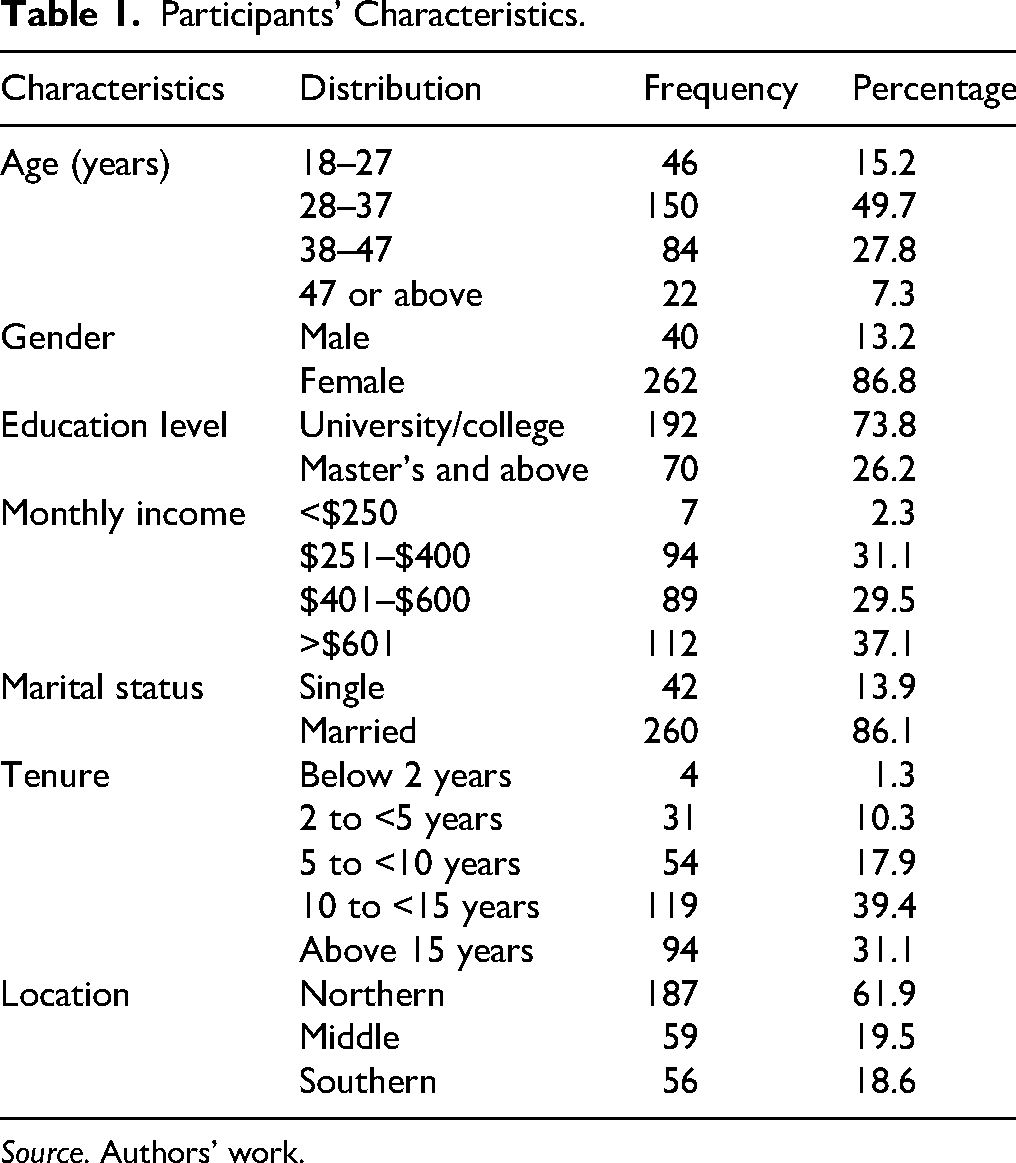
This research engaged 302 respondents. Table 1 reveals a marked gender imbalance, with 86.75% of respondents being female, compared with 13.25% of respondents being male. The age distribution of participants is as follows: 46 individuals (15.23%) aged 18 to 27, 150 participants (49.67%) aged 28 to 37, 84 participants (27.81%) aged 38 to 47, and 22 participants (7.29%) aged 47 and above. The educational background of the majority of participants consists of university or college degrees (73.84%), with 26.16% holding a master's degree or above. Details of respondents’ characteristics are presented in Table 1.
Participants’ Characteristics.
Source. Authors' work.
Assessment of the Measurement Model
The results indicated that the outer loadings for NITS3, TLD1, TLD2, and WEG1 were below the recommended threshold of 0.70 (Hair et al., 2021). In addition, the result shows that WEG8's VIF value of 5.603 exceeds 5.0 (Kock, 2015). Consequently, these scales have been removed from the model. After eliminating the ineligible scales, we analyzed the remaining scales. The results revealed that all outer loading values exceeded 0.7, and all VIF values were below 5.0. Internal consistency reliability was confirmed, with Cronbach's alpha values exceeding .80 for all constructs (DeVellis, 2016). The lowest CR value recorded was 0.906, exceeding the recommended benchmark of 0.70 (Bagozzi & Yi, 1988), and all average variance extracted (AVE) values were above 0.60 (Hair et al., 2021). These findings demonstrate that the measurement model exhibits strong internal consistency, reliability, and convergent validity. A summary of the reliability and validity statistics is presented in Table 2.
Result of Validity and Convergent Validity.

Note. POS = perceived organizational support; TLD = transformational leadership; WEG = work engagement; NITS = nurses’ intention to stay; CR = composite reliability; AVE = average variance extracted; VIF = variance inflation factor.
Source. Authors’ work.
Discriminant validity was evaluated to confirm that each construct represented a unique dimension within the research framework. The square root of each construct's AVE exceeded its correlations with other constructs (Fornell & Larcker, 1981; see Table 3), thus supporting discriminant validity. Additionally, the heterotrait–monotrait ratio (HTMT) was used as a complementary measure. All HTMT values were less than 0.85 (Henseler et al., 2015) as shown in Table 3, further confirming that discriminant validity was adequately established across all constructs.
Fornell–Larcker Criterion and HTMT Ratio.

Note. POS = perceived organizational support; TLD = transformational leadership; WEG = work engagement; NITS = nurses’ intention to stay.
Source. Authors’ work.
Assessment of the Structural Model
The structural model was evaluated using a comprehensive approach that considered both the magnitude and statistical significance of the path coefficients, as well as the model's predictive relevance. The hypothesized relationships were tested by examining the path coefficients and their corresponding P-values to determine significance levels. All R2 values were greater than 0.10 (Hair et al., 2021), indicating adequate explanatory power for the endogenous variables. Predictive relevance was assessed using the PLSPredict procedure. The Q2 values were 0.256 for WEG and 0.278 for NITS, indicating medium predictive relevance based on recommended benchmarks (0.02 = small, 0.15 = medium, 0.35 = large; Hair et al., 2021). The structural model demonstrated satisfactory predictive capability. Effect sizes (f2) were also examined to assess the magnitude of structural relationships, with values of 0.02, 0.15, and 0.35 representing small, medium, and large effects, respectively (Cohen, 1988).
After establishing the reliability and validity of the measurement model, the structural model was evaluated through a bootstrapping procedure with 5,000 resamples to assess the significance and stability of the estimated coefficients. The results of the PLS-SEM analysis are shown in Table 4 and Figure 2. The findings demonstrate that POS positively affected NITS (β = 0.312, P-value <0.001, f2 = 0.087), indicating a direct and strong influence, thus supporting hypothesis 1. Hypothesis 2 was also affirmed; WEG partially mediated the relationship between POS and NITS (β = 0.135, P-value <0.001). Hypothesis 3 is also verified; the interaction between TLD and POS negatively affected NITS (β = −0.117, P-value = 0.016, f2 = 0.042), suggesting that the interaction between POS and TLD reduced the influence of POS on NITS (see Figure 3).

PLS-SEM model result. PLS-SEM = partial least squares structural equation modeling. Source. Authors' work.
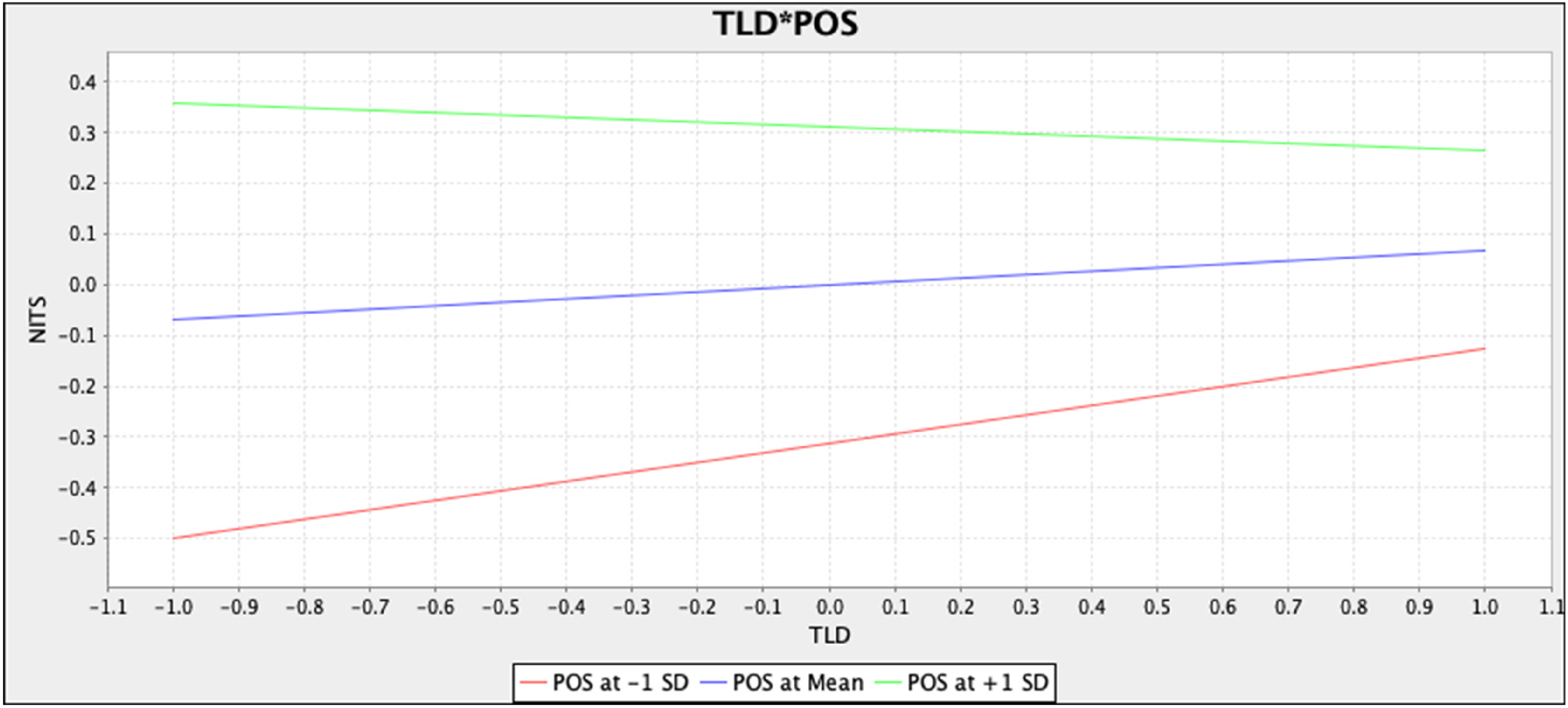
The moderating impact of TLD on the POS–NITS relationship. POS = perceived organizational support; TLD = transformational leadership; NITS = nurses’ intention to stay. Source. Authors' work.
Path Analysis.

Note. POS = perceived organizational support; TLD = transformational leadership; WEG = work engagement; NITS = nurses’ intention to stay; HTMT = heterotrait–monotrait ratio.
Source. Authors’ work.
Discussion
The research sheds light on NITS determinants, explaining 36.1% of its variability. The findings confirm the beneficial impact of POS on NITS, consistent with previous research in diverse sectors such as nursing in China (Li et al., 2020) and telecommunications in India (Nargotra & Sarangal, 2023). This highlights both the robustness of the findings and the broad predictive power of POS. Additionally, the research contribute to the literature by demonstrating how POS influences WEG, aligning with similar observations in nursing contexts in Jordan and India (Al-Hamdan & Bani Issa, 2022; Gupta et al., 2016). Furthermore, this study confirms a positive relationship between WEG and NITS, aligning with prior evidence reported in the Australian and South Korean nursing contexts (Kim & Yoo, 2018; Walker & Campbell, 2013).
The mediation analysis reveals that WEG does not merely transmit the influence of POS; rather, WEG functions as an important psychological mechanism linking POS to NITS. The finding is consistent with prior research conducted in India's IT service sector (Nargotra & Sarangal, 2023), which similarly identified a positive relationship between WEG and employees’ ITS. This understanding of the interplay between these variables offers a detailed framework for explaining how nurses’ WEG levels serve as crucial conduits through which the advantages of organizational support manifest.
Notably, the results reveal that TLD exerts a significant negative moderating effect on the POS–NITS relationship. When POS is high, nurses may already experience a sense of stability, recognition, and adequate resource provision (Eisenberger et al., 2001). In such contexts, high level of TLD that strongly emphasizes vision, change, and extra-role commitment may unintentionally create additional job demands. Although TLD is typically viewed as a motivational resource, it can also heighten expectations, performance pressure, and discretionary effort beyond formal role requirements (Breevaart et al., 2014). From a JD-R perspective, job characteristics may function as either resources or demands depending on contextual conditions.
When leadership behaviors heighten expectations and require sustained emotional and cognitive effort, they may shift from supportive to partially demanding (Nielsen & Daniels, 2016). In a high-POS environment, nurses may POS as sufficient; however, intensified leadership expectations may create a perceived imbalance between available resources and required effort. This imbalance can increase emotional strain and cognitive load, which are known precursors of exhaustion and withdrawal tendencies (Bakker et al., 2005; Schaufeli & Taris, 2014). Consequently, rather than amplifying the positive effect of organizational support, high levels of TLD may attenuate its influence on NITS. Additionally, in this study, a substantial proportion of respondents (88.39%) reported more than 5 years of tenure. This demographic characteristic may further help explain the observed negative moderation effect. Prior research indicates that positive perceptions of organizational practices tend to peak during the early tenure period (1–3 years) and may plateau thereafter (Sangeeta, 2025). In this context, senior nurses may be less influenced by inspirational rhetoric if it is not accompanied by concrete career advancement opportunities. Consequently, TLD that emphasizes vision and high expectations without corresponding structural support may be perceived as an additional demand, thereby weakening the positive effect of POS on ITS.
In the Vietnamese context, where hierarchical relationships, reciprocity, moral duty, and social harmony are deeply valued (Ho et al., 2022), nurses may feel constrained from expressing disagreement or declining additional responsibilities assigned by TLD. Consequently, instead of strengthening the positive impact of organizational support, TLD may exacerbate psychological burden under conditions where expectations exceed manageable workload levels.
Implications
This research provides valuable insights for academic managers and policymakers in developing countries. First, although POS enhances NITS, its effect may weaken when TLD heightens expectations. Hospitals should avoid relying exclusively on visionary or change-oriented leadership, especially in high-pressure situations such as staffing shortages or organizational transitions. During crises, leaders should reduce emphasis on inspirational appeals and elevated performance expectations and instead prioritize tangible support, including reasonable workload allocation, staffing reinforcement, clear scheduling, and prompt problem-solving. When implementing systemic support initiatives, leadership expectations should be carefully calibrated to prevent additional psychological strain on nurses.
Second, leadership development programs should explicitly train managers to recognize the dual nature of TLD. While vision and inspiration are valuable, leaders must learn to “moderate” their visionary expectations when employees are already experiencing resource constraints. Training should emphasize adaptive leadership, adjusting motivational intensity according to staff workload, stress levels, and available organizational support.
Third, hospitals should implement structured career signaling mechanisms. If TLD promotes long-term vision and commitment, it must be accompanied by visible career progression pathways, professional development funding, and transparent promotion criteria. Without tangible career support, inspirational messaging may be perceived as symbolic rather than substantive, particularly among senior nurses.
Finally, healthcare organizations should routinely assess whether leadership behaviors are perceived as motivating or demanding. Anonymous climate surveys, pulse feedback tools, and structured performance dialogues can help identify when leadership enthusiasm is unintentionally creating pressure. Retention strategies should therefore integrate both organizational resource provision and calibrated leadership intensity to ensure that support mechanisms are not undermined by excessive expectations.
Strengths and Limitations
This study has several notable strengths. First, it provides a comprehensive examination of the relationships among POS, WEG, TLD, and NITS within an emerging economy context, which remains underexplored in the literature. Second, the study integrates the SET and JD-R framework to offer a more nuanced theoretical explanation of nurse retention. Finally, data were collected from a relatively diverse sample of nurses across different regions in Vietnam, enhancing the relevance of the findings to the healthcare context. Despite these strengths, this study has several limitations. First, the cross-sectional design effectively captures a momentary snapshot, it limits the ability to examine how relationships evolve over time. Future research adopting a longitudinal approach could provide insight into the evolution of dynamics and more clearly establish causal relationships. Second, this research focused only on the Vietnamese healthcare sector, which may restrict the generalizability of findings. Cultural and economic factors significantly affect occupational attitudes and behaviors, suggesting the need for replication in diverse geographical and cultural settings to ascertain broader applicability. Exploring POS, WEG, TLD, and NITS in varied contexts would clarify whether observed relationships are universal or context-specific.
Conclusions
This research provides important insights into the antecedents and consequences of NITS, particularly within emerging countries. By incorporating WEG and TLD into the theoretical framework, this study reveals further complexities in the relationship between POS and NITS.
The findings of this study indicated that POS enhanced both WEG and NITS. This study not only deepens the understanding of how POS influences NITS but also underscores the need to continuously refine theoretical models to reflect the dynamics of today's rapidly evolving work environment. The findings hold particular significance for the healthcare sector in emerging countries, offering practical guidance on strengthening POS as a means to enhance nurses’ WEG and ITS.
Especially, the study discovered that TLD negatively impacts the relationship between POS and NITS. This finding indicates potential barriers and challenges that may arise under TLD, highlighting the need for strategic interventions. Healthcare administrators should consider implementing measures to support nurses more effectively, ensuring that the leadership style promotes, rather than inhibits, their ITS in the workplace.
Footnotes
Acknowledgments
The authors deeply appreciate the nurses who participated in this study and their distinguished colleagues for their valuable contributions and support, which were crucial to the success of this research. Additionally, all authors acknowledge that this article is part of a series of research based on a single research project. Each article focuses on separate aspects of the research.

Ethical Considerations
Ethical guidelines were strictly followed, and written informed consent was obtained from survey respondents. Participant contact is now unavailable. To ensure anonymity, all personal identifiers were removed, and the data were coded using unique identification numbers. This procedure protected participant confidentiality and privacy in accordance with recognized ethical research standards. The study was conducted in compliance with the principles of the Helsinki Declaration and did not involve any minors. Ethical approval was obtained from the Scientific Committee of the Thai Nguyen University of Economics and Business Administration, Thai Nguyen, Vietnam, with the acceptance signed on January 22, 2024. No ethics approval number was issued by the Committee.
Author Contributions
Cheng-Kun Wang: writing—review and editing, writing—original draft, methodology, investigation, formal analysis, data curation, supervision, project administration, and conceptualization.
Cong Hiep Duong: writing—review and editing, writing—original draft, validation, methodology, investigation, formal analysis, data curation, visualization, and conceptualization.
Yi-Hui Ho: writing—review and editing, validation, methodology, investigation, formal analysis, and data curation.
Dinh Long Do: writing—review and editing, validation, methodology, investigation, formal analysis, and data curation.
Quynh Trinh Dang: writing—review and editing, validation, methodology, and conceptualization.
Kim Thoa Thi Hoang: writing—review and editing, formal analysis, data curation, and methodology.
Funding
The authors received no financial support for the research, authorship, and/or publication of this article.
Declaration of Conflicting Interests
The authors declared no potential conflicts of interest with respect to the research, authorship, and/or publication of this article.
Declaration of Generative AI and AI-Assisted Technologies in the Writing Process
During the preparation of this manuscript, the authors used ChatGPT and Grammarly to enhance the clarity and readability of the text. After utilizing these tools, the authors thoroughly reviewed and revised the content and take full responsibility for the integrity and accuracy of the published material.