




Abstract
Introduction
Mental health is a serious concern among novice school nurses in Japan. Numerous novice school nurses with various health problems experience high stress levels, affecting their mental health. They may be experiencing reality shock, a known risk factor for burnout and turnover, or its factor, the “reality gap.”
Objective
This study aimed to examine the hypothetical model by which the reality gap affects the mental health of novice school nurses.
Methods
This cross-sectional study conducted a self-administered questionnaire survey, and responses were obtained from 102 novice school nurses. A path model was created based on a hypothetical model.
Results
After several revisions on the hypothesis model, a modified path model was generated (CFI = .98, TLI = .93, RMSEA = .06). The path model showed that reality gaps negatively affected work engagement, work engagement positively affected intention to stay, and intention to stay positively affected mental health. Reality gap was also directly negatively associated with mental health. Having various support networks reduced the effects of reality gaps on mental health. Additionally, social support in the workplace boosted work engagement.
Conclusion
Unique from other studies, this study contributed to understanding the effects of reality gaps on mental health. School managers and administrators should establish a support system that enables school nurses to receive various supports from within and outside the school. In addition, novice school nurses should take advantage of networks and support inside and outside school to reduce reality gaps and grow as professionals.
Introduction
School nurses in Japan, “Yogo teachers,” are special licensed educators who support children's growth and development through health education and health services based on the principles of health promotion in all areas of educational activities in school (Japanese Association of Yogo Teachers’ Education, 2012). Most schools in Japan employ full-time school nurses, albeit often only one. Although some school nurses are licensed nurses, a nursing certification is not required to obtain a school nurse license. Most school nurses start their careers as new graduates.
Especially, the first year of practice as a nurse can be stressful. Education gaps, reality shock, burnout, and other negative experiences influence their intention to remain in nursing (Gardiner & Sheen, 2016). Similarly, for school nurses, a study reported that a significant proportion of them had high levels of experienced burnout (Jameson & Bowen, 2020); however, research on the mental health of novice school nurses and its related factors is limited. To support the professional development of novice school nurses, the researchers must pay attention to burnout and mental health conditions.
Recently, the deterioration in the mental health of Japanese teachers has become a serious social issue (Kuwato & Hirano, 2020). According to a survey by the Ministry of Education, Culture, Sports, Science and Technology (MEXT) in Japan, 5,897 teachers (0.64% of the total) took leave because of mental illness, the highest number ever. Specifically, 65% of those on leave because of mental illness in FY 2021 have worked at their current school for less than 3 years. (MEXT, 2022). Another survey found that teachers in their 20 s have high stress responses and poor mental health (MEXT, 2018). Accordingly, teachers have difficulties in the transition from education to actual work (Voss & Kunter, 2020); this indicates a requirement for attention to the mental health of novice teachers and school nurses with fewer years of experience.
Mental illness is also a serious concern for novice school nurses. The high number of students with various health problems has increased stress on school nurses, affecting their mental health. This is true in novice school nurses because they must perform various professional practices such as first aid, check-ups, health counseling, and health education by themselves despite their limited knowledge and skills. A survey of stress among school nurses in Japan found that those with <5 years of experience as school nurses were significantly more likely than those with 20–30 years of experience to answer that they have “too much work” or “too much to do” (Uehara et al., 2011). Some of them have high levels of stress and may experience reality shock.
Review of Literature
Reality shock is described as shock reactions caused by gaps between expectations and reality (Kramer, 1974). This is caused by a gap between expectations and the reality of entering employment (Schein, 1978). The experience of a gap such as “unmet expectations” causes burnout and turnover (Hultell & Gustavsson, 2011; Lait & Wallace, 2002; Lee & Ashforth, 1996). Thus, preventing reality shock and reducing the reality gap among school nurses are important issues for their mental health and school health outcomes.
In recent years, several studies have reported reality shocks or transition shocks among new graduate nurses at hospitals (e.g., Chen et al., 2021; Labrague & De Los Santos, 2020); the concept of transition shock is built on elements such as reality shock (Duchscher, 2009). Although these studies on reality shock or transition shock have been reported among hospital nurses, applying such studies to school nurses has certain limitations. This is because the work nature and administrative hierarchy of the school nurse's work environment differs greatly from other healthcare settings (Jameson & Bowen, 2020). In contrast, little is known regarding the effect of factors such as reality shock on the mental health of novice school nurses. According to a survey concerning reality shock among 64 novice school nurses with ≤3 years of experience in Japan, an association was revealed between “workplace relationships” and “gaps between ideals and reality” and stress reactions (Kokado, 2014). Thus, the “reality gap,” such as “gaps between ideals and reality” is a core concept in reality shock. To support the mental health of novice school nurses, research on the impact of reality gaps as well as reality shock and on mental health should be conducted. In the present study, the researchers focused on the “reality gaps” as a key factor of reality shock on the mental health of novice school nurses.
In addition, this study focused on the impact of work engagement on mental health. Traditionally, the mental health of nurses and teachers has focused on negative factors such as reality shock and burnout, which are work-related stress reactions. More recently, studies have also focused on positive factors such as work engagement (e.g., Kim & Yoo, 2018; Minghui et al., 2018). Work engagement is defined as a positive, fulfilling, work-related state of mind that is characterized by vigor, dedication, and absorption (Schaufeli et al., 2002). As regards the work engagement of school nurses, Kagotani et al. (2021) reported associations with social support, occupational stressors, and plateau phenomenon. Unfortunately, the effects of work engagement on mental health have not been clarified among school nurses.
Hypothetical Model
The JD-R model (Bakker & Demerouti, 2007) indicated that reduced job demands and improved social and personal resources led to increased work engagement and reduced burn out. The researchers created a hypothetical model to examine the effects of reality gap on the mental health of novice school nurses, which the reality gap is related to mental health through work engagement and intention to stay, referring to the JD-R model. In addition, social support in the workplace and number of support networks (e.g., colleagues, school nurses at other schools, and family and relatives) were assumed as job resources. Therefore, social support in the workplace and number of support networks were hypothesized to buffer the impact of the reality gap and boost work engagement. The hypothetical model has been illustrated in Figure 1.

A Hypothetical Model of the Effect of the Reality Gaps on the Mental Health of Novice School Nurses.
H1 states that social support in the workplace and number of support networks are directly related to reality gaps and work engagement. This is because while reducing transition shock (Cao et al., 2021), social support in the workplace also increases work engagement (Hult & Terkamo-Moisio, 2023; Minghui et al., 2018). The number of support networks was assumed to be another factor for social support. Hypothesis 2 states that reality gap is directly and negatively related to work engagement. A previous study reported that unmet expectations related to the reality gap were negatively associated with work engagement (Hultell & Gustavsson, 2011). Hypothesis 3 states that work engagement is directly and positively related to intention to stay. Work engagement is reportedly positively associated with intention to stay or intention to remain among nurses (Eltaybani et al., 2018; Kim & Yoo, 2018). Another study reported that turnover intention is negatively related to work engagement (Laschinger, 2012). Hypothesis 4 states that intention to stay is directly and positively related to mental health. In a previous study, the prevalence of mental health issues was significantly higher among those with turnover intention (Tominaga et al., 2007). Hypothesis 5 states that the reality gap is directly and negatively related to mental health. Unmet expectations related to reality gaps have been associated with job-related stress (Lait & Wallace, 2002). The Model of Job Stress and Health explains that stress causes acute reactions that lead to illness (Hurrell & McLaney, 1988). H6 states that work engagement is directly and positively associated with mental health. Work engagement predicts employees’ perceived health and psychological well-being (Hult & Terkamo-Moisio, 2023; Koyuncu et al., 2006). Thus, the researchers set up six hypotheses and created a hypothetical model.
This study aimed to examine the hypothetical model by which the reality gap affects the mental health of novice school nurses. This study provides foundational evidence on mental health models among novice school nurses and could be useful to support the mental health of novice school nurses.
Methods
Design
A cross-sectional study design was used to examine the effect of the reality gap, work engagement, and intention to stay on the mental health of novice school nurses in Japan.
Sampling and Data Collection
A multistage random sampling method was conducted. Based on the “FY2014 School Basic Survey Bulletin” from MEXT in Japan, the sample size was calculated based on the composition ratio by nine regions and school types in prefecture A. Considering that the response rate of studies targeting school nurses in Japan was approximately 30% (e.g., Kagotani & Asakura, 2015), the researchers targeted approximately 1,500 school nurses. The researchers estimated that among the responses from 500 (estimated response rate: 30%) school nurses there would be approximately 100 novice school nurses. The ratio of elementary schools to junior high schools in prefecture A was 62.4% for elementary schools and 37.6% for junior high schools. Thus, for a total of 1,499 school nurses, 935 elementary schools (62.4%) and 564 junior high schools (37.6%) were included in the study. In December 2014, the anonymous self-administered questionnaires were sent by mail to elementary and junior high schools. The survey period was from December 8 to December 25, 2014. In total, 755 female school nurses returned the questionnaires, which included responses from 102 novice school nurses, denoting an actual response rate of 50.4%. This data was part of the “Survey on Career Development of School Nurses.”
Inclusion/Exclusion Criteria
This study focused on the responses of these 102 novice school nurses. In this study, school nurses were defined as school staff that support children's growth, development, and health promotion through health education and health services. “Yogo teachers” in Japan were considered a related specialty to school nurses.
School nurses were considered “novice” if she or he had ≤3 years of experience because Japanese teachers are often transferred to other schools after three years of experience. Kokado (2014), who investigated the reality shock of Japanese school nurses, also defined novices as those with 3 or fewer years of experience. The items related to the reality gaps pertain only to those school nurses with less than 3 years of experience. Data from those with more than 4 years of experience were excluded from the analysis.
Measures
The survey included items pertaining to demographic characteristics, mental health, and work-related variables, i.e., reality gap, work engagement, intention to stay, social support, and number of networks. The following subsections detail the questionnaire's work-related and mental health variables.
Demographic Characteristics
Data included age, years at current school, education, nursing license, working setting, and number of students.
Reality Gap for School Nurses
Referring to Kramer (1974) and Schein (1978), the reality gap was defined as a recognition of differences between expectations and the reality of starting as a school nurse. No scales have been reported to measure the reality gap in school nurses. Thus, the researchers used the original measure of the reality gap for school nurses.
In the process of creating a scale for the reality gap, the researchers referred to Loevinger's theoretical approach, particularly the three components of construct validity, namely, the substantive, structural, and external component (Loevinger, 1957).
Substantive validity is the conceptualization and development of an initial item pool (Clark & Watson, 2019). The researchers confirmed substantive validity through a literature review and semistructured interviews to create a structure of constructs and an item pool. After reviewing the literature, the researchers referred to the Reality Shock Scale for Teachers by Harada et al. (2009). The conceptual framework consists of “interpersonal relations in the workplace,” “relationship with students or parents,” “lack of experience,” “pressure at work,” and “gaps in ideal and reality.” However, the scale was designed for teachers, and some scale items are unsuitable for school nurses. In addition, the scale has 30 items, which could be burdensome for the respondents. Thus, the researchers created a simplified measure of the reality gap for school nurses according to this scale and data from semistructured interviews.
Semistructured interviews were conducted with nine novice school nurses who had ≤3 years of experience. In the interview, the first author asked, “Did you feel any gaps when you started working compared to before you started working?” Then, the researchers created a scale, which includes seven items and three concepts, namely, “gaps in school nurse's jobs,” “gaps in the skills and image of a school nurse,” and “gaps in relationships.” The researchers evaluated whether the scale reflects the concept being measured without bias; the first author was an experienced school nurse, and the other author was a researcher who was involved in education for school nurses.
The reality gap scale included seven items scored on a 5-point Likert scale, ranging from 1 (“not at all”) to 5 (“very applicable”). A total score was calculated for each subscale and used in the analysis. A higher total score indicated a greater reality gap (score range: 7 to 35 points).
Work Engagement
Work engagement was defined as a positive, fulfilling, work-related state of mind characterized by vigor, dedication, and absorption (Schaufeli et al., 2002). Work engagement was measured using a shortened 9-item version of the Japanese version of the Utrecht Work Engagement Scale (UWES-J). This scale is the Japanese version of the UWES developed by Schaufeli et al. (2002). It consists of 17 items reflecting three dimensions: vigor, dedication, and absorption. Similarly, the 9-item version has been confirmed as reliable and valid (Schaufeli et al., 2006).
The scale was evaluated on a 7-point Likert scale, ranging from 0 (“never”) to 6 (“always”), and the higher the score, the higher the work engagement. Previously, Shimazu et al. (2008) confirmed the reliability (internal consistency and stability), factorial invariance, and construct validity of the UWES-J in three independent samples. The total score was used in the analysis, with higher total scores indicating greater work engagement (score range: 0 to 54 points).
Intention to Stay
Intention to stay was defined as the desire to continue working as a school nurse. The intention to stay was rated on a 5-point scale from 5 (“very much”) to 1 (“not at all”) on the question “Would you like to continue working as a school nurse in the future?” The range was from 1 to 5, with higher scores indicating higher intention to stay.
Mental Health
Mental health was defined as a state of mental well-being. Mental health was measured using five items of the simplified Japanese version of WHO-Five Well-being Index (S-WHO-5-J) (Inagaki et al., 2013). WHO-5 is a short and generic global rating scale measuring subjective well-being (Topp et al., 2015). This scale was a simplified validated version of the WHO-5 Questionnaire that was reduced from a 6-point scale to a 4-point scale. The authors simplified the scale in consideration of ease of response, such as for the elderly and those with mental illness. The researchers used this simplified version in consideration of the burden on the respondents. The scores of the five items range from 1 (at no time) to 4 (all the time), with higher scores indicating greater mental health. The total score was used in the analysis (score range: 5 to 20 points).
Social Support
Social support was defined as informational support, instrumental support, and emotional support by others. Social support was measured using six items of the brief scale of social support in the work place developed by Mori and Miura (2006). The internal consistency and a certain degree of validity of this scale were confirmed. This scale was constructed using three factors, namely, informational support, instrumental support, and emotional support. All items were scored on a 5-point Likert scale ranging from 1 (“not at all”) to 5 (“very applicable”), with higher scores indicating greater social support. The total score of each subscale was used in the analysis. This study used the total scale including three subscales for informational support, instrumental support, and emotional support.
Number of Support Networks
The number of support networks was the total number of support networks; principal or vice principal, senior teachers, colleagues, school nurse at another school, schoolmates, and family and relatives. The range was 0–6, with higher scores indicating more support networks.
Statistical Analysis
Data were analyzed using IBM SPSS Statistics version 26.0 and Amos graphics 24.0 (IBM Corp., Armonk, NY, USA). Missing values were excluded for each analysis. A two-tailed p value of < .05 indicated statistical significance.
Demographic Characteristics
Descriptive statistics were used to determine the sample's sociodemographic characteristics. Categorical variables are shown as the number (n) and percentage (%).
Structural and External Validity of the Reality Gap Scale for School Nurses
Structural validity involves item selection and psychometric evaluation (Clark & Watson, 2019). This study examined structural validity through exploratory factor analysis (EFA) and item-total correlation using Pearson's correlation coefficient analysis. In addition, confirmatory factor analysis (CFA) was performed to evaluate the fitness of the factor structure of the reality gap scale. The fit indices of the scale included comparative fit index (CFI) ≥ .95, Tucker Lewis Index (TLI) ≥ .90, and root mean square error of approximation (RMSEA) ≤ .08 (Boateng et al., 2018). Internal consistency was evaluated using Cronbach's alpha of the scales.
External validity was examined by criterion validity, i.e., the degree of the relationship between a given test score and performance on another measure of particular relevance (Boateng et al., 2018). A previous study reported that unmet expectations were associated with higher levels of stress (Lait & Wallace, 2002). The researchers hypothesized that a negative correlation exists between the reality gap scale and mental health (S-WHO-5-J). Pearson's correlation coefficient analysis was performed to determine the scale's criterion validity.
Effect of Reality Gap on the Mental Health of Novice School Nurses
A path model was tested based on the hypothetical model (Figure 1). The optimal model was explored by the fit indices of the model and the relationship of the variables.
Ethics
Permission to commence the study was received from the Ethics Committee of Tokyo Gakugei University. The participants were informed that their involvement was optional and their anonymity and privacy would be protected. The interviewees filled in a consent form before participating in the study, and the questionnaire survey participants were deemed to have provided consent by returning the questionnaire.
Results
Demographic Characteristics
Table 1 provides an overview of the participant's demographic characteristics. Novice school nurses in their 20 s accounted for 89.2% of the total, and 55.9% had 2–3 years of experience at their current school.
Demographic Characteristics among Novice School Nurses (N = 102).

Note: All participants had school nurse (Yogo teacher) licenses, and an experience of less than 3 years as school nurses.
special course: 1-year training after acquiring a nursing license
The number of support networks indicates the total number of support networks (principal or vice principal, senior teachers, colleagues, school nurse at another school, schoolmates, and family and relatives). The range was 0–6.
The intention to stay was rated on a 5-point Likert scale, from 5 (very much) to 1 (not at all) for the question “Would you like to continue working as a school nurse in the future?”
SD, standard deviation.
Structural and External Validity of the Reality Gap Scale for School Nurses
The structural validity of the reality gap scale was evaluated through EFA and CFA. Table 2 presents the results of the CFA. In the CFA, the measurement model showed a reasonable fit to the data: CFI = .98, TLI = .95, RMSEA = .06. Item-total correlations of the seven items ranged from .67 to .80, p < .001. Cronbach's alpha of the scale was .84. The scale's external validity was examined using correlation analysis. Expectedly, a negative association was found among the subscale and mental health (r = −.48, p < .01).
Validity of the Reality Gap Scale for Novice School Nurses.

Fit Indices: comparative fit index (CFI) = .98, Tucker–Lewis Index (TLI) = .95, root mean square error of approximation (RMSEA) = .06, *p < .05, **p < .01, ***p < .001.
External validity was examined using the correlation between the reality gap scale and the mental health scale (S-WHO-5-J) (Inagaki et al., 2013).
Effect of Reality Gap on the Mental Health of Novice School Nurses
Table 3 provides a summary of instruments, i.e., number of items, mean, standard deviation, range, and Cronbach's alpha. Cronbach's alpha of the scales ranged from .84 to .90.
Items, Mean, Standard Deviation (SD), Range, and Cronbach's Alpha of Mental Health, Work Engagement, Reality Gap, and Social Support.
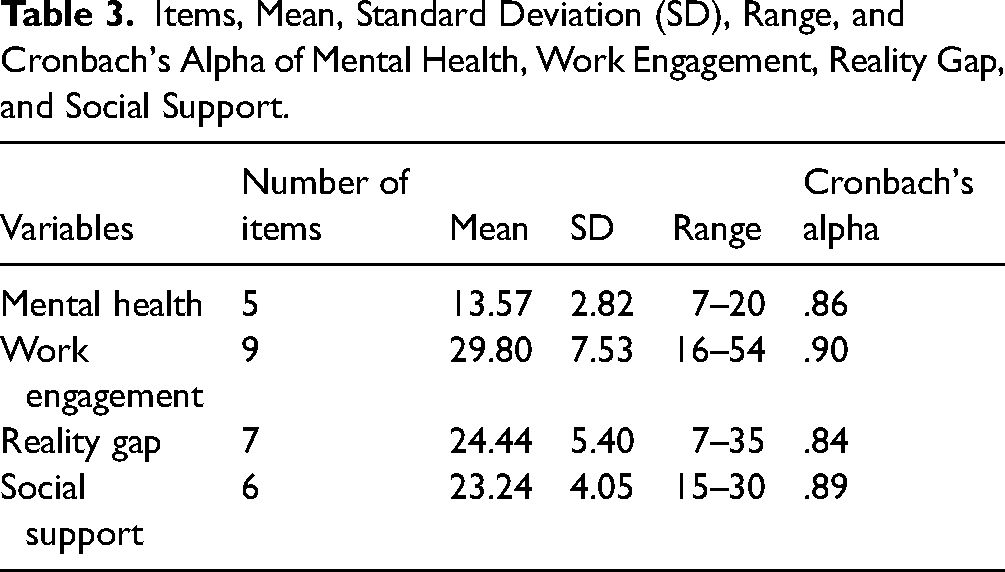
Table 4 provides the correlation coefficients between mental health and work-related variables. Mental health significantly correlated with intention to stay (r = .37), work engagement (r = .34), reality gap (r = −.48), social support (r = .36), and number of support networks (r = .35).
Correlations Between Mental Health, Intention to Stay, Work Engagement, Reality Gap, Social Support, and Number of Support Networks.

*p < .05, **p < .01.
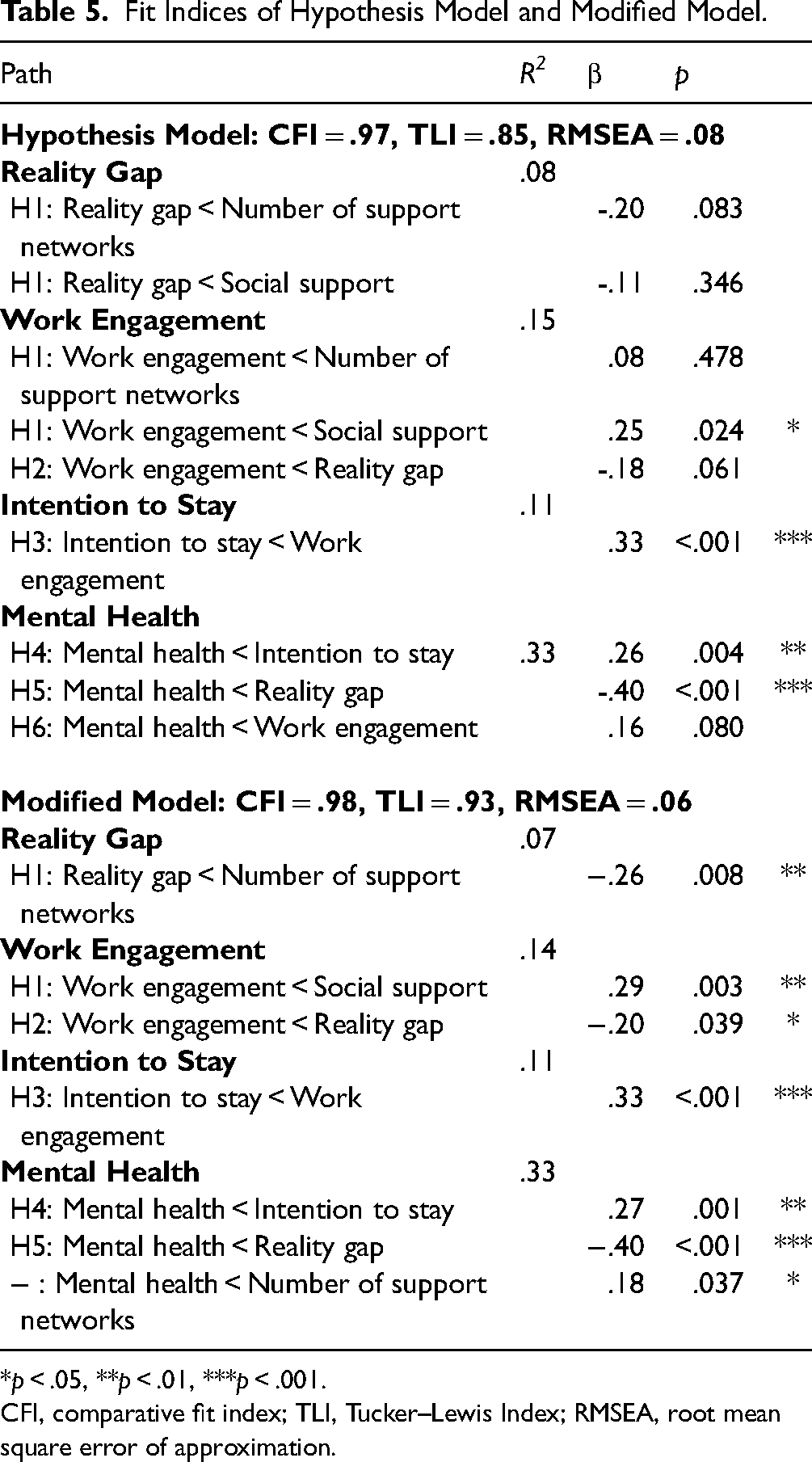
Table 5 provides an estimation of the hypothetical and modified models. Given that the hypothetical model did not fit the data well (CFI = .97, TLI = .85, RMSEA = .08), a modified path model was created after several revisions (CFI = .98, TLI = .93, RMSEA = .06). During model building, the researchers deleted three paths: from social support to reality gaps, from the number of support networks to work engagement, and work engagement to mental health. Then, the researchers included a new path from the number of support networks to mental health. Consequently, the modified model was found to be a good fit to the data (Figure 2).

Modified Model of the Effect of the Reality Gaps on the Mental Health of Novice School Nurses.
Fit Indices of Hypothesis Model and Modified Model.
*p < .05, **p < .01, ***p < .001.
CFI, comparative fit index; TLI, Tucker–Lewis Index; RMSEA, root mean square error of approximation.
H1 states that social support in the workplace and the number of support networks are directly related to reality gaps and work engagement. The researchers found that the number of support networks was significantly related to reality gaps (β = −.26, p = .008). Although the path from social support to reality gaps was statistically insignificant, social support directly affected work engagement (β= .29, p = .003). H2 states that reality gaps are directly and negatively associated with work engagement. The researchers found a significant relationship between reality gaps and work engagement (β = −.20, p = .039). In H3, work engagement is directly and positively associated with intention to stay. As expected, the researchers found that work engagement was significantly associated with intention to stay (β = .33, p < .001). Regarding H4, intention to stay is directly and positively associated with mental health. Intention to stay was found to be significantly associated with mental health (β = .27, p = .001). H5 states that reality gaps are directly and negatively associated with mental health. The researchers also found a significant relationship between reality gaps and mental health (β = −.40, p < .001). In the modified model, a new path from the number of support networks to mental health was added (β = .18, p = .037). Finally, H6 states that work engagement is directly and positively associated with mental health. Contrary to expectations, the direct path from work engagement to mental health was excluded in the final model.
Discussion
The path model (Figure 2) of this study showed that the reality gaps of school nurses in Japan may affect mental health through work engagement and intention to stay. This study also showed that the reality gaps have a direct effect on the mental health of novice school nurses. These findings are useful for understanding mental health and its related factors among novice school nurses and provide fundamental evidence for school administrators and school board staff to support the mental health of novice school nurses.
Validity of the Reality Gap Scale for School Nurses
To assess the substantive validity of the Reality Gap Scale for novice school nurses, the researchers referred to the scale for measuring the factor of first-year teachers’ reality shock (Matsunaga et al., 2017). Similar to the scale by Matsunaga et al. (2017), our scale also includes items regarding on this scale for the following four factors: “interpersonal relations in the workplace,” “lack of experience,” “relationship with students or parents,” and “pressure at work.” Thus, the substantial validity could be confirmed. For the structural validity, the researchers assessed good model fit indices, high item-total correlation values for the seven items, and Cronbach's alpha for the scale. Thus, the structural validity could be confirmed. For external validity, negative relationships were found among the three subscales for reality gap and mental health. Therefore, the researchers used this scale in the analysis.
Effect of Reality Gap on the Mental Health of Novice School Nurses
As shown in Figure 2, this study supported the following hypotheses: reality gaps negatively affect work engagement (H2), work engagement positively affects intention to stay (H3), and intention to stay (H4) and reality gaps (H5) positively affect mental health. Although several studies reported on reality shock and transition shock, which are phenomena unique to newly appointed workers, our study results are original because no studies have clarified reality gaps as a core concept of reality shock. Furthermore, reality gaps may affect the mental health of novice school nurses through work engagement and intention to stay. Therefore, reducing reality gaps is necessary to support novice school nurses’ mental health. An integrate review of the transition to practice nursing program reported that novice nurses need to be prepared for transition shock and need help to find a balance between their academic teachings, internal values, and workplace practice (Hampton et al., 2021). This preparation and support can decrease reality gaps and increase the mental health of novice school nurses. In Japan, training is compulsory for novice school nurses, but the content is not specifically determined by the central government but by local governments. According to a report by MEXT (2023), not all school nurses receive mental health training for themselves, and whether such training considers reality gaps and reality or transition shocks is unclear. Thus, to support the transition of novice school nurses, in addition to acquiring the knowledge and skills necessary for practice, it is necessary to incorporate training on reality gaps and mental health.
Another hypothesis is that H1, the number of support networks, and social support in the workplace reduce the reality gaps and boost work engagement. H1 states that the number of support networks is directly related to reality gaps. Although the relationship between reality gaps or reality shocks and the number of support networks is poorly understood, previous studies demonstrated an association involving transition shock. Transition shock is built on elements such as reality shock (Duchscher, 2009), a conceptual framework aligning Kramer's reality shock theory, Benner's novice to expert theory, and Bridges’ transition theory with the challenges experienced by contemporary registered graduates (Graf et al., 2020). In a previous study of transition shocks, newly graduated nurses with more support from colleagues and supervisors reported less transition shock (Cao et al., 2021). Another study of transition shock among newly graduated nurses reported that support from preceptors negatively affected transition shock, and providing feedback and evaluation, using appropriate teaching strategies, and showing concern from preceptors reduced transition shock (Su et al., 2021). Thus, the number of support networks could be a key factor in reducing the reality gap and affected the mental health of novice school nurses. In addition, the number of support networks was directly related to mental health. A study of 322 school nurses in Japan reported that support from colleagues and superiors reduced stress reactions (Yano, 2013). Thus, a supportive work environment, which could help novice school nurses obtain support from various networks, including supervisors and co-workers, is necessary.
Another point of the path model is that social support in the work place boosts work engagement; a higher work engagement leads to intention to stay. Social support in the work place is a key factor in improving work engagement. This result is supported by the results of a similar previous study reporting a positive relationship between social support and work engagement (Hultell & Gustavsson, 2011). Principals are expected to foster a supportive work culture at school through regular meetings, promote collaboration among multiple professions, and provide opportunities for communication with novice school nurses and other school staff.
Strengths and Limitations
First, the strength of this study is that it identified the reality gaps of novice school nurses based on their experiences and created a scale and tested for its validity. Moreover, using this validated scale, the researchers could clarify the influence of the reality gaps on the mental health of novice school nurses. Second, the present study reported on the mental health of school nurses in Japan, which has rarely been previously reported. This study is unique in that it examined the hypothetical model by which the reality gap affects the mental health. This study could provide fundamental evidence on the mental health of school nurses.
This study has several limitations to the generalizability. First, the results were limited by the timing of data collection and sampling. The study was based on the result of data collected from novice school nurses in 2014; nonetheless, the mental health of new teachers including school nurses was a serious matter. According to a survey by MEXT in Japan, 5,045 teachers (0.55% of the total) took a leave of absence because of mental illness in FY 2014 (MEXT, 2015). However, according to the latest data (MEXT, 2022), the highest number of teachers with mental illness has been recorded to date. Data were also collected from novice school nurses in elementary and junior high schools in a single prefecture in Japan, excluding high schools and special-needs schools. Therefore, caution should be exercised when applying these results to the current situation. Second, the sample size is small. Although various arguments have been reported to justify the sample size, the recommended sample size for a factor analysis is at least ten participants per item (Boateng et al., 2018). Considering that the reality gap scale has seven items, a minimum of 70 participants was needed for the analysis. This study met the criterion because it included 102 participants. Third, the reality gap scale needs to be examined. This scale was created to ensure substantive validity, structural validity, and external validity. However, some school nurses in Japan are not licensed nurses. Thus, further research is needed to examine whether this scale can be applied to school nurses in other countries. Moreover, future studies should use a larger sample from multiple regions and include school nurses from both high schools and special-needs schools. It is necessary to verify the robustness of the model and to examine the mediating or moderation effects of reality gaps on mental health through work engagement and intention to stay using mediation and moderation analyses.
Implications for Practice
The results of this study, which focused on the effects of reality gap on mental health, can be used as fundamental evidence that can be applied to support novice school nurses. For example, the items in the reality gap scale for school nurses were “gaps in school nurse's jobs,” “gaps in the skills and image of a school nurse,” and “gaps in relationships.” Regarding work gaps, it is necessary to survey novice school nurses to determine the specific gaps and use this information to improve future training programs. For the skills and image gaps, a curriculum that allows students to gain practical experience as well as a school nursing practicum are needed. The gaps in relationships need to be closed through support not only from novice school nurses but also from other staff members.
Especially, this study indicated that the number of support networks is an important factor for decreasing the reality gaps. Although the impact of social support on reality gaps and mental health has been reported, the impact of the number of support networks remains largely unknown. School nurses usually practice alone and are often the only people onsite with health-related skills (Jameson & Bowen, 2020). Hence, school managers and administrators should establish a support system that enables school nurses to receive various supports from within and outside the school, such as principal or vice principal, teachers, and school nurses at another school. In some areas in Japan, recently retired school nurses mentor novice school nurses; nevertheless, most are rarely mentored, such as nurse preceptors. In most cases, learning opportunities are centered on off-campus group training, and opportunities for individual mentoring are limited. To reduce the reality gap among novice school nurses, a system is needed to support novice school nurses via staff with expertise in the field of school nursing.
Conclusion
This study contributed to understanding the effects of the reality gap on the mental health among novice school nurses in Japan. First, the path model showed that reality gaps negatively affected work engagement, work engagement positively affected intention to stay, and intention to stay and reality gap positively affected mental health.
Second, the model showed that the number of support networks reduced the reality gaps and boosted mental health. Moreover, social support in the workplace boosted work engagement. A support system should be established that enables school nurses to receive various supports from within and outside the school. In addition, novice school nurses should take advantage of networks and support inside and outside school to reduce reality gaps and grow as professionals.
This study could provide fundamental evidence regarding the mental health of school nurses. Further research is needed to prevent the reality gaps among school nurses and promote mental health measures based on the current situation.
Footnotes
Acknowledgment
We would like to thank all the Japanese school nurses who cooperated in the survey.
Contribution List
MK conceived and designed the study, collected the data, analyzed and interpreted the data, and wrote the paper; TA provided critical comments on the study design, data analysis and interpretation, and revised the paper. All authors approved the final manuscript.
Declaration of Conflicting Interests
The authors declared no potential conflicts of interest with respect to the research, authorship, and/or publication of this article.
Ethical Committee as Applicable
Permission to commence the study was received from the Ethics Committee of Tokyo Gakugei University.
Funding
The authors disclosed receipt of the following financial support for the research, authorship, and/or publication of this article: This work was supported by the Japan Society for the Promotion of Science, (JSPS KAKENHI Grant Number JP26885084).
