



Abstract
Introduction
Progressive muscle relaxation (PMR) is a structured technique that induces relaxation by alternately tensing and relaxing muscle groups, supporting both physical and psychological well-being. Slow stroke back massage (SSBM) is also recognized as a therapeutic method that enhances comfort and reduces stress. Given the susceptibility of older adults to hypertension, psychological stress, and sleep disturbances, evaluating the effects of these non-pharmacological interventions remains highly relevant. This review aimed to examine the effects of PMR and SSBM on blood pressure reduction, stress alleviation, and sleep quality improvement among older adults.
Methods
A scoping review was conducted following the Arksey and O’Malley (2005) framework, refined by Levac et al. (2010), and reported according to PRISMA-ScR guidelines. Literature searches were performed in Scopus, ProQuest, PubMed, and Google Scholar for studies published between January 2019 and March 2024. The Boolean strategy combined search terms related to PMR, SSBM, blood pressure, stress, and sleep quality. Eligible studies included empirical research among with older adults that assessed PMR or SSBM with outcomes on blood pressure, stress, or sleep. Non-empirical articles, studies involving children, non-English publications, and studies with poor methodological quality were excluded. After duplicate removal and screening, 10 studies were included in the synthesis. Data were extracted using a standardized form and were analyzed thematically.
Results
Ten studies met the inclusion criteria and contributed to two major themes. First, PMR significantly reduced systolic and diastolic blood pressure, lowered heart rate, decreased stress and anxiety scores, and improved sleep quality. Second, SSBM helped stabilize blood pressure, reduce stress and depressive symptoms, and enhance sleep comfort in older adults.
Conclusion
PMR and SSBM are effective, evidence-based, non-pharmacological interventions for improving cardiovascular and psychological outcomes in older adults. Both techniques may be recommended as complementary therapies in geriatric nursing practice.
Introduction
The global aging population is increasing significantly, with projections indicating that the number of people aged 60 years and above will double from 1 billion in 2020 to 2.1 billion by 2050 (WHO, 2022). This demographic shift contributes to a higher prevalence of chronic conditions such as hypertension, stress-related disorders, and sleep disturbances, which are major risk factors for morbidity and mortality in older adults. Aging is a natural physiological process that leads to a gradual decline in organ function and immune system capacity, thereby increasing susceptibility to cardiovascular, metabolic, and psychological disorders (Kusumoningtyas & Ratnawati, 2018).
Among the most prevalent health issues in older adults are elevated blood pressure, chronic stress, and poor sleep quality. These conditions not only reduce quality of life but also increase the risk of healthcare utilization, complications, and premature mortality. Pharmacological management remains the standard approach; however, the potential side effects and limited adherence to medications highlight the importance of non-pharmacological interventions. In this context, complementary therapies such as progressive muscle relaxation (PMR) and slow stroke back massage (SSBM) have gained growing attention for their potential to enhance both physical and psychological well-being.
Non-pharmacological approaches are particularly relevant in geriatric populations, as they are generally safe, cost-effective, and culturally adaptable. Previous studies have reported that PMR effectively lowers blood pressure and alleviates stress by activating the parasympathetic nervous system, while SSBM improves circulation, reduces anxiety, and enhances sleep quality. Despite this growing evidence, a comprehensive mapping of existing studies remains limited. Therefore, this scoping review aims to systematically examine the effects of PMR and SSBM on blood pressure reduction, stress alleviation, and sleep quality improvement among older adults.
PMR is a structured relaxation technique that involves the repeated tensing and releasing of muscle groups. This process helps reduce muscle tension, lower blood pressure, regulate heart rate, and improve sleep quality. Several studies have shown that PMR contributes to better physiological and psychological outcomes in both medical and non-medical contexts. For example, Abdelaziz et al. (2024) reported that preoperative relaxation techniques such as deep breathing and PMR significantly reduced blood pressure, heart rate, and pain levels, especially when combined with pharmacological interventions like ketamine. Similarly, Hendra Irawan et al. (2024) demonstrated that PMR was effective in stabilizing vital signs and improving well-being in hypertensive patients. These findings highlight PMR as a simple and effective non-pharmacological therapy for older adults.
SSBM is another non-invasive intervention that promotes relaxation by stimulating the parasympathetic nervous system. The therapy involves gentle stroking, petrissage, and friction techniques applied to the back, which enhance blood circulation, reduce stress, and induce a calming effect. Evidence shows that SSBM can effectively lower anxiety levels and improve sleep quality, particularly among older adults with mild sleep disturbances (Abdelaziz et al., 2024). Patonengan et al. (2023) further emphasized that SSBM reduces blood pressure and helps alleviate depression in older adult patients, making it a valuable complementary intervention.
In addition to their independent benefits, some studies suggest that PMR and SSBM may have greater combined effects. Pathan et al. (2023) reported that incorporating slow breathing exercises with PMR produced more significant reductions in heart rate, respiratory rate, blood pressure, and anxiety compared to either intervention alone. However, despite the increasing number of studies on PMR and SSBM, there is still limited literature specifically addressing their combined impact on cardiovascular and psychological outcomes in older adults. This gap underscores the need for further exploration of these interventions as complementary therapies to support healthy aging.
This review aims to synthesize the existing evidence on the combined effects of PMR and SSBM on lowering blood pressure, reducing stress, and improving sleep quality in older adults. This scoping review is expected to contribute to the development of evidence-based nursing interventions in geriatric care.
Method
This study employed a scoping review framework guided by the methodological framework of Arksey and O’Malley (2005), later refined by Levac et al. (2010). The review process followed five stages: (a) identifying the research question, (b) identifying relevant studies, (c) selecting studies, (d) charting the data, and (e) collating, summarizing, and reporting the results. The primary objective of this scoping review was to examine and summarize the current empirical evidence on the effects of PMR and SSBM on blood pressure, stress, and sleep quality in older adults. A mapping approach was utilized to organize and identify the extent, nature, and gaps of the available literature. Reporting adhered to the PRISMA-ScR guidelines (Page et al., 2021).
Literature Search
A comprehensive search was conducted in four electronic databases: Scopus, ProQuest, PubMed, and Google Scholar, covering publications from January 2019 to March 2024. The Boolean search string was: (“progressive muscle relaxation” OR “PMR”) AND (“slow stroke back massage” OR “SSBM”) AND (“blood pressure” OR “hypertension”) AND (“stress” OR “sleep quality”).
The search was restricted to English-language studies, human subjects, and full-text availability. This process yielded 1,157 articles (Scopus = 249; ProQuest = 438; PubMed = 449; Google Scholar = 21). After removing duplicates, 327 articles remained. Title and abstract screening reduced the records to 129 articles, and 31 articles underwent full-text assessment. Following methodological quality appraisal, 10 studies met the inclusion criteria and were included in the final synthesis. The selection process is illustrated in the PRISMA flow diagram (Figure 1).
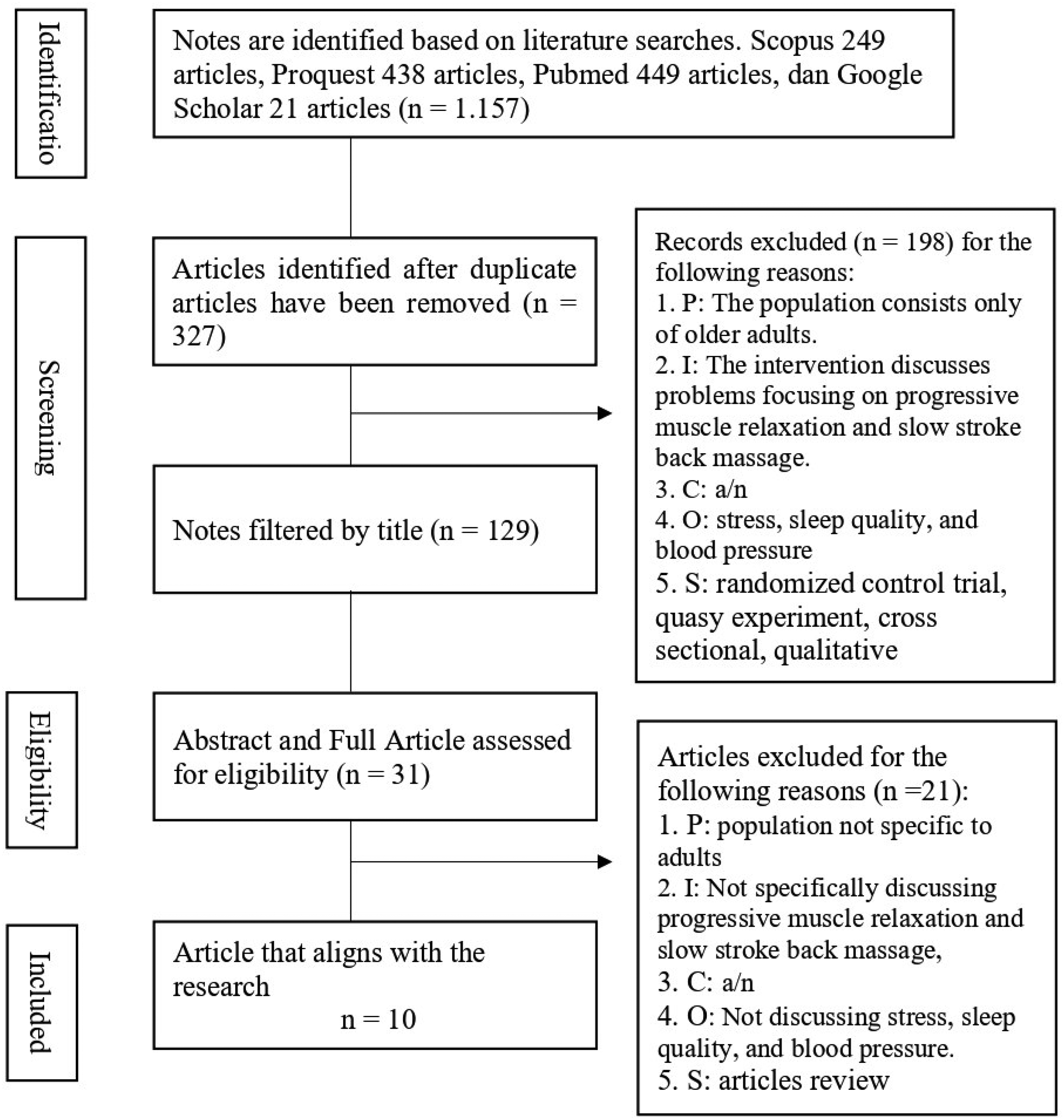
Flow diagram literature search based on PRISMA for the review: the effect of modified slow stroke back massage progressive muscle relaxation on blood pressure, stress, and sleep quality in the older adults.
Inclusion and Exclusion Criteria
The inclusion criteria for selecting studies in this review were: (a) empirical studies using quantitative or qualitative designs (randomized controlled trials, quasi-experiments, cohort, cross-sectional, or qualitative studies); (b) studies examining the effects of PMR or SSBM on blood pressure, stress, or sleep quality; (c) older adult populations (≥60 years), including those with or at risk of hypertension; (d) publications in English between 2019 and 2024; (e) availability of full-text articles.
Exclusion criteria included: (a) non-empirical articles (reviews, editorials, commentaries, letters); (b) studies on children, adolescents, or non-human subjects; (c) studies not directly related to PMR or SSBM interventions; (4) publications with poor methodological quality or incomplete data; (e) non-English publications.
Following full-text screening, 31 articles were assessed for eligibility. After methodological quality appraisal, 10 studies met the inclusion criteria and were included in the final synthesis. The selection process is summarized in the PRISMA flow diagram (Page et al., 2021).
Data Collection
The screening and selection process followed the PICOS framework:
Two reviewers independently screened all titles, abstracts, and full texts. Discrepancies were resolved through discussion, with arbitration by a third reviewer. Reference management and duplicate removal were conducted using Mendeley. From the literature search results, 1157 articles were found in each database, including Scopus with 249 articles, Proquest with 438 articles, PubMed with 449 articles, and Google Scholar with 21 articles. Then, the found articles were checked for duplication using Mendeley, resulting in 327 articles. After the title screening process, 129 articles remained. Then, a feasibility selection with full texts was conducted, resulting in 31 articles for the next selection, of which 10 articles were included and 21 articles were excluded due to not meeting the study quality.
Two reviewers independently reviewed each publication using the assessment template. Not all fields were applicable to every study. At each stage of the review process, two reviewers conducted the screening and made independent judgments. Any discrepancies identified by Covidence were resolved through discussion with a third reviewer. The selection of the included publications is presented in the PRISMA flow diagram (Figure 1).
Data Extraction and Analysis
For the process of standardizing data extraction, the researchers created a data extraction table (Table 1) that included title, author, year, study objective, research design, participants, sample size, variables, outcomes, and key findings. Data were extracted from Covidence and exported into Microsoft Excel for synthesis. Although the majority of the included studies reported quantitative outcomes (e.g., changes in systolic/diastolic blood pressure, stress scores, or sleep quality indices), the researchers applied qualitative content analysis (Mayring, 2014) to organize these findings into broader inductive themes.
Summary of Study Descriptions (n = 10).

Note. PMR = progressive muscle relaxation; SSBM = slow stroke back massage; SBP = systolic blood pressure; DBP = diastolic blood pressure; Significance (P < .05).
Specifically, individual study results were coded into preliminary categories (e.g., “reduction of blood pressure,” “improvement in sleep quality,” “stress reduction”). These categories were iteratively refined and compared across studies to identify patterns, overlaps, and contrasts. Through this process, quantitative outcomes were transformed into meaningful thematic clusters that address the research questions. Finally, main themes were developed to summarize the evidence in a structured and narrative manner.
Results
Study Characteristics
A total of 1,157 studies were identified through the database search, and 10 studies met the inclusion criteria for final synthesis. Table 1 presents the characteristics of the included studies.
A synthesis of 10 empirical studies (see Table 1) revealed the efficacy of PMR and SSBM in improving both physiological and psychological outcomes among hypertensive patients and vulnerable populations such as the older adults and pregnant women. PMR consistently demonstrated significant reductions in systolic and diastolic blood pressure, heart rate, and respiratory rate. For instance, Pathan et al. (2023) reported a mean reduction of 8.6 mmHg in systolic blood pressure (P < .05). PMR also improved sleep quality and reduced psychological stress, with Gökşin and Aşiret (2021) noting a decrease in depression scores among older adults women (P < .01).
SSBM showed positive effects on lowering blood pressure and reducing anxiety. Patonengan et al. (2023) demonstrated a significant reduction in both systolic blood pressure and anxiety scores in older hypertensive patients after SSBM sessions (P < .001). Hsu et al. (2019) found improvements in sleep quality scores among ICU patients receiving SSBM, suggesting broader applications beyond geriatric population (Table 2).
Summary of Studies Reporting the Effects of Progressive Muscle Relaxation and Stroke Back Massage on Physiological and Psychological Parameters (n = 373 Participants).

Discussion
Effects of Progressive Muscle Relaxation
Evidence from several studies (Abed Atiyah & Majeed Hameed, 2024; Azmy et al., 2021; Gultom & Sinaga, 2024; Ismansyah et al., 2019; Pathan et al., 2023) indicates that PMR significantly reduces blood pressure, heart rate, and respiratory rate, while improving oxygen saturation, psychological adaptation, and sleep quality. These findings can be explained by enhanced parasympathetic activity, which reduces sympathetic drive and systemic vascular resistance. For example, Pathan et al. (2023) reported a significant decrease in systolic and diastolic blood pressure among hypertensive patients after PMR sessions, consistent with parasympathetic activation leading to vasodilation and improved hemodynamic stability. Likewise, the improvement in oxygen saturation and respiratory rate noted by Ismansyah et al. (2019) aligns with reduced muscle tension and cortisol levels, which facilitate more efficient pulmonary function. At the neuromuscular level, alternating contraction and relaxation stimulate vascular elasticity, reduce cardiac workload, and improve circulation. Psychologically, PMR is associated with reduced cortisol secretion and increased endorphin release, thereby lowering anxiety and depression (Abdel-Wahab Afifi Araby Ali et al., 2024; Gökşin & Aşiret, 2021).
Effects of Slow Stroke Back Massage
SSBM was also consistently reported as effective in reducing hypertension, depression, and anxiety, while enhancing sleep quality (Azmy et al., 2021; Hsu et al., 2019; Patonengan et al., 2023; Shintia et al., 2023). The reductions in anxiety and depression reported by Hsu et al. (2019) and Patonengan et al. (2023) are consistent with the neurohormonal mechanisms of oxytocin and endorphin release triggered by tactile stimulation, which not only induce vasodilation but also modulate the limbic system to improve emotional regulation. Similar non-pharmacological approaches such as foot massage have also demonstrated comparable effects, with studies in Indonesian populations showing significant reductions in blood pressure and anxiety among older adults with hypertension (Anwar et al., 2022) and lowered intradialytic blood pressure in hemodialysis patients (Sitoresmi et al., 2020).
Mechanistically, gentle tactile stimulation activates mechanoreceptors and induces hypothalamic regulation, triggering oxytocin and endorphin release. These neurohormonal changes promote vasodilation and relaxation (Setiawan et al., 2023; Yuliyanto & Abdurrachman, 2021). Compared to PMR, SSBM requires less active patient participation, making it more feasible for older adult patients with mobility or cognitive limitations. However, intervention duration and frequency were inconsistent across studies, highlighting the need for standardized protocols.
Despite these consistent findings, several limitations of the included studies warrant consideration. First, the methodological rigor across studies varied, with some employing quasi-experimental designs without adequate randomization or blinding, which may introduce bias. Second, the majority of studies involved relatively small sample sizes, limiting the statistical power and generalizability of their results. Third, many interventions were conducted in specific populations such as older adults patients, individuals with hypertension, or those admitted to particular hospital settings which may not fully represent broader patient groups. In addition, intervention protocols, including duration, frequency, and measurement tools, were heterogeneous, making direct comparison and synthesis of outcomes challenging. These limitations suggest that while PMR and SSBM show promise, further large-scale, rigorously designed randomized controlled trials with standardized protocols are needed to strengthen the evidence base.
Comparative and Complementary Mechanisms
Although both interventions reduce blood pressure and stress, their mechanisms differ. PMR primarily modulates autonomic and neuromuscular pathways, whereas SSBM acts through tactile and hormonal regulation. This suggests potential synergistic benefits when combined, particularly for older adults requiring both physiological stability and psychological comfort. Nevertheless, few studies have directly examined combined interventions, and further trials are needed to establish their comparative and complementary effectiveness.
Implications for Practice
The findings of this review suggest that PMR and SSBM can be considered as complementary nursing interventions for older adults, particularly those with hypertension, stress, or sleep disturbances. When applying these interventions, nurses should carefully assess the physiological and psychological conditions of older adults, including mobility limitations, skin integrity, injuries, and comorbidities, to ensure safety and comfort. Although the included studies demonstrated beneficial outcomes, most did not specify contraindications; therefore, clinical judgment and individualized assessment are essential prior to implementation.
To optimize the delivery of PMR and SSBM, training and capacity-building for healthcare providers are recommended to ensure proper technique and reduce the risk of procedural errors. Integrating these interventions into routine nursing care may improve patient relaxation, enhance quality of life, and reduce reliance on pharmacological therapy. Future clinical guidelines should incorporate clear recommendations regarding indications, contraindications, and standardized protocols for using PMR and SSBM in geriatric care settings.
Strengths and Limitations
This review offers several strengths. It synthesized recent empirical evidence (2019–2024) on the effects of PMR and SSBM in older adults, ensuring relevance to current clinical practices. The review followed the Arksey and O’Malley framework and PRISMA-ScR reporting standards, contributing to a structured and transparent review process. Independent double screening and quality assessment were conducted by multiple reviewers, which strengthened the credibility of the findings and minimized selection bias.
However, this review also has some limitations. Most included studies were conducted in international settings. Differences in cultural perceptions of touch, family caregiving roles, comorbidity patterns, and healthcare service availability may limit the generalizability of the findings to Indonesian older adults. Therefore, future research should consider local contextual factors to enhance applicability. In addition, most studies used quantitative methods, providing limited insights into patient experiences and implementation challenges; thus, qualitative research is recommended to complement existing evidence. The final synthesis included only 10 studies, which may restrict the breadth and depth of the mapped literature. Furthermore, restrictions on publication years (2019–2024), English language, and selected databases may have resulted in the inadvertent exclusion of relevant studies published earlier, in other languages, or indexed elsewhere.
Despite these limitations, the findings provide valuable support for incorporating PMR and SSBM as complementary interventions for managing blood pressure, stress, and sleep problems in older adults.
Conclusion
Several studies suggest that PMR can help lower blood pressure, relieve pain, stabilize vital signs such as breathing, pulse, and heart rate, reduce the risk of depression and anxiety, and improve sleep quality. Similarly, the administration of SSBM therapy helps lower blood pressure, reduce the risk of depression and anxiety, and improve sleep quality. From the results of the research, PMR and SSBM therapy have a significant impact on lowering blood pressure, reducing stress, and improving the sleep quality of the older adults.
Footnotes
Acknowledgments
The authors would like to express their thanks to all members who supported conducting the current study. The author is grateful to the tikes Gunung Sari Makassar, South Sulawesi, Indonesia and Universitas Airlangga, Surabaya, Indonesia for supporting this study.

Author Contributions
Conceptualization was accomplished by Asriadi Asriadi and Fadli Fadli. Data curation was done by Fadli Fadli. Methodology was done by Asriadi Asriadi and Nursalam Nursalam. The original draft was written by Fadli Fadli. Writing review and editing the final draft were done by Asriadi Asriadi, Nursalam Nursalam, and Fadli Fadli.
Funding
The authors disclosed receipt of the following financial support for the research, authorship, and/or publication of this article: This research received funding from Indonesian Education Scholarship, Center for Higher Education Funding and Assessment, and Indonesian Endowment Fund for Education.
Declaration of Conflicting Interests
The authors declared no potential conflicts of interest with respect to the research, authorship, and/or publication of this article.