




Abstract
Objective
To explore the relationships between job satisfaction, work environment, and intention to leave among registered nurses in the United Arab Emirates (UAE), and to identify potential predictors of intention to leave.
Methods
A cross-sectional study was conducted to collect data from registered nurses working in governmental hospitals in the UAE between October and November 2022. A convenience sampling method was used to recruit 294 participants.
Results
Approximately 40.8% of nurses reported a high intention to leave their jobs. Significant correlations were found between the intention to leave and several factors, including education level (P = .038), years of experience (P = .033), employment status (P = .002), and nationality (P = .037). Regression analysis revealed that both the work environment and job satisfaction were significant predictors of intention to leave (β = 1.156, P = .015; β = 0.857, P = .015, respectively).
Conclusions
The findings of this study indicate that both the work environment and job satisfaction are significant and independent predictors of nurses’ intention to leave their positions in the UAE. To reduce turnover, nursing managers and healthcare leaders should prioritize strategies that enhance work conditions, support professional development, reduce burnout, and offer competitive compensation, ultimately promoting nurse retention and better patient care.
Introduction
Healthcare systems worldwide are facing a significant shortage of qualified professionals. The World Health Organization (WHO) highlights the need for a sufficiently skilled and adequately sized healthcare workforce to maintain effective health systems (World Health Organization, 2016). Over 40% of nurses, midwives, and medical technicians are at high risk of leaving their professions prematurely (Mulisa et al., 2022), causing major disruptions in the healthcare sector. Reports indicate that approximately 20% of the healthcare workforce, including 30% of nurses, has been lost, with nearly 1.7 million healthcare workers quitting their jobs in 2023 alone, representing nearly 3% of the workforce each month (Bureau of Labor Statistics, 2023).
The European Commission stresses the importance of retaining healthcare professionals to combat workforce shortages. Addressing work-related stressors and enhancing working conditions are crucial for retaining staff (Ruotsalainen et al., 2014). In hospitals where the ratio of patients to nurses is high, nurses often face burnout and job dissatisfaction. This situation is linked to increased patient mortality and higher failure-to-rescue rates, in contrast to hospitals with a lower patient-to-nurse ratio (Haddad et al., 2024). Both international and national organizations have raised concerns about nursing shortages and identified significant issues within the field (Marć et al., 2019).
The United Arab Emirates (UAE), like other Gulf Cooperation Council (GCC) countries, heavily relies on a multicultural nursing workforce, primarily expatriates from countries such as the Philippines, India, and South Africa. Many expatriate nurses use the Gulf region as a steppingstone to migrate to Western nations, leading to high turnover rates (Alsadaan et al., 2021). This pattern aligns with the broader trend of nurse migration, where professionals seek career advancement, better salaries, and enhanced working conditions in destination countries (Laari et al., 2024). However, not all expatriate nurses leave; some choose to remain in the region due to factors such as financial stability, family considerations, employer-sponsored benefits, and favorable working environments (Ung et al., 2024).
Retention challenges among expatriate nurses in the GCC are compounded by cultural adaptation difficulties, limited career progression opportunities, and contractual employment structures that may not provide long-term stability (Ung et al., 2024). Research has shown that workplace policies promoting inclusivity, mentorship programs, and professional development opportunities can improve retention rates among foreign nurses (Haddad et al., 2024). The Gulf region also faces competition from Western healthcare systems that actively recruit skilled nurses, offering citizenship pathways and stronger social welfare systems (Al Yahyaei et al., 2022). Despite the extensive research on job satisfaction (JS), work environment (WE), and nurse turnover in the GCC, there is limited investigation into how the multicultural nature of the workforce influences these dynamics. Understanding the interplay between workforce diversity and retention is critical for developing targeted strategies that enhance nurse retention in the UAE. This study aims to address this gap by examining the factors influencing nurses’ intention to leave (IL) within the UAE's diverse healthcare workforce.
Nurse Retention Dynamics: WE and IL
The issue of nurse turnover has been extensively studied globally, with significant attention paid to factors such as JS, WE, workload, and organizational support. For instance, positive WEs play a critical role in reducing burnout and dissatisfaction, as demonstrated in Thailand, where supportive work conditions were linked to lower turnover rates among nurses (Nantsupawat et al., 2017). Similarly, extended working hours have been shown to increase turnover intentions, as observed in South Korea, where nurses working longer shifts reported higher likelihoods of leaving their positions (Kim et al., 2024). Perceived organizational support has also been highlighted as a vital factor, with findings indicating that greater organizational support can significantly reduce nurses’ IL their jobs (Galanis et al., 2024).
Review of Literature
The nursing shortage in the UAE and neighboring countries such as Saudi Arabia, Qatar, and Oman is a significant issue for healthcare managers. There is an urgent need to attract and train local nurses familiar with the regional culture, as well as increase their commitment to the healthcare system (Saifan et al., 2021). The UAE must employ effective recruitment strategies to assist with attracting and retaining skilled nurses and deliver high-quality care (Al-Yateem et al., 2021). The shortage has led to increased stress and burnout among nurses, negatively impacting job retention and patient safety (Bakhamis et al., 2019; Carthon et al., 2019). Effective nurse staffing is crucial for patient safety, as nurse-to-patient ratios are heavily influenced by the total number of nurses (Scheidt et al., 2021). The WHO predicts a shortage of 7.2 million health workers by 2035 worldwide, including a need for 12.9 million nurses (Tamata et al., 2021). The WHO also anticipates a significant rise in the IL the nursing career, with studies showing 40% to 54% of nurses planning to exit. For example, in Lebanon, 62.5% of nurses planned to leave within 1–3 years. Factors such as work-related stress, burnout, JS, and quality of life are associated with nurses’ IL (El-Jardali et al., 2013; Slater et al., 2021). Elements like salaries, promotions, and professional development opportunities impact JS, while occupational stress can reduce productivity and contribute to higher turnover rates (Albougami et al., 2020).
The WE significantly affects both physical and mental health (Agbozo et al., 2017). Research indicates that enhancing the WE and overall quality of working life can reduce nurses’ intent to leave and help prevent staffing shortages while enhancing healthcare quality (de Oliveira et al., 2017; Sharififard et al., 2019). A supportive atmosphere that assists nurses participating in decision-making and fostering positive teamwork can decrease their IL. Moreover, a supportive supervisor who values safety can lower turnover rates, even if employees have negative views of the company (Zaheer et al., 2019). Healthy WE is indispensable for nurses to effectively promote patient-related care. Literature found six key principles for creating healthy WE: competent communication, honest cooperation, efficacious decision-making, meaningful recognition, suitable and qualified healthcare providers, and authentic leadership (Ulrich et al., 2019). Ensuring fairness and equality in the workplace is crucial for preventing bullying and mitigating its effects. Therefore, organizations should foster a respectful and equitable psychosocial WE (Reknes et al., 2020). Bordignon and Monteiro suggest that enhancing JS, work capacity, and safety can reduce employees’ intent to leave. Nursing managers should address these factors individually to develop effective retention strategies (Bordignon & Monteiro, 2019). Ensuring a healthy work–life balance and fostering a supportive WE are crucial for retaining a large nursing workforce (Matsuo et al., 2021).
JS is widely recognized as a key strategy for employee retention. A study across Pakistan, India, and Sri Lanka found that while salary and employee potential are positively linked to JS, these factors alone are not strong predictors of employees’ intent to stay, particularly in healthcare (Shah et al., 2018). At Dubai Hospital, factors such as increasing demands for continuing education, slow promotions, job description inconsistencies, high workloads, nurse shortages, and lack of recognition contribute to rising dissatisfaction among public sector nurses (El-Salibi, 2012). Nurses’ organizational commitment is closely tied to both extrinsic and overall JS (Cherian et al., 2018). Research indicates that higher JS is associated with lower turnover intentions, reduced burnout, and less absenteeism (Masum et al., 1896). Additionally, having more registered nurses (RNs) with bachelor's degrees improves JS, patient outcomes, and safety, while decreasing turnover and missed care (Sasso et al., 2019). High nurse dissatisfaction often leads to understaffing, increased overtime, greater job stress, longer patient wait times, and higher patient dissatisfaction, as well as increased recruitment and training costs (Masum et al., 2016). Furthermore, factors such as the WE, the leadership style of nursing directors, and nurses’ trust in their leaders are crucial for enhancing JS, reducing emotional exhaustion, and lowering turnover intentions (Sasso et al., 2019).
This study is guided by the job demands-resources (JD-R) model (Bakker & Demerouti, 2007), which suggests that employee well-being and organizational outcomes are influenced by the balance between job demands (e.g., workload, long working hours) and job resources (e.g., supportive WE, JS). The JD-R model provides a structured approach to understanding how these factors interact to influence nurses’ IL. Specifically, JS is conceptualized as a key resource that can buffer the negative effects of job demands, while the WE serves as a critical determinant that can either mitigate or exacerbate these demands.
Purpose
This study aimed to examine the relationships between IL, job, and WE among RNs in the UAE, as well as to identify the key predictors of nurses’ IL.
Additionally, the study sought to determine the prevalence of nurses’ IL and its associated factors. The central research question was: What factors predict nurses’ IL their jobs, and how are these factors related to JS and the WE in the UAE? This research question specifically targets the identified gap in the literature by investigating how JS and WE manifest in the prediction of nurses’ IL within the UAE's unique healthcare and sociocultural landscape.
Methods
Design, Sample, and Data Collection
This study employed a descriptive cross-sectional design to collect data from RNs working in hospitals and clinics under the Emirates Health Services (EHS) Corporation and the Ministry of Health and Prevention in the UAE, between October and November 2022. In conducting this study, researchers adhered to the STROBE (Strengthening the Reporting of Observational Studies in Epidemiology) guidelines for reporting observational studies. The inclusion criteria for this study consisted of RNs with at least 1 year of clinical experience who voluntarily agreed to participate. Exclusion criteria included individuals who were not actively practicing as RNs, those with less than 1 year of clinical experience, those not directly involved in patient care, as their experiences may not accurately reflect the factors influencing IL, and those who declined to participate. The required sample size, calculated using G*Power version 3.1.9.7, was 214 RNs to detect a strong correlation (r = .5) with a power of 0.95 and a significance level of α = .05. Participants were recruited using convenience sampling. This study received approval from three institutional review boards (IRBs) on September 22nd of 2022.
Data were gathered using an online survey that was distributed through two methods. First, the survey link was sent to the Nursing Research Department at the EHS, which then disseminated it to all RNs. Additionally, researchers approached potential participants face-to-face during their working hours and invited them to participate in the study. For those who expressed interest, a QR code linked to the online survey was provided. Participation in this study was voluntary, anonymous, and confidential. Participants were informed that they could withdraw at any time without providing a reason, and that their decision to participate or not would not affect their personal lives or employment in any way. To further ensure participants’ autonomy, it was explicitly communicated that nonparticipation would have no impact on their professional standing or relationships with colleagues or supervisors. Before joining the study, participants were required to review the information provided and sign an informed consent form, which detailed the study's purpose, their role, and their rights as participants. From all distributed surveys, 294 participants completed the questionnaires, comprising the final sample size. No missing data was identified in this study, as all participants completed the survey in its entirety.
Measures
The nursing staff at the Ministry of Health and Prevention is noted for its bilingual skills, with English being the primary language for communication and documentation. To maintain consistency and ensure accurate interpretation of responses, the questionnaires were administered only in English. A 14-item demographic questionnaire was developed to gather sociodemographic and employment information from participants.
Intention to Leave
Nurses’ IL their job was assessed using the 6-item Turnover Intention Scale (TIS-6). This widely used tool evaluates an individual's intention to exit their current role or organization, with responses rated on a Likert scale from 1 (strongly disagree) to 5 (strongly agree). The scale covers thoughts of quitting, exploring other job opportunities, and future career plans. In this study, responses were analyzed using continuous scoring, summing item ratings to determine overall IL, with higher scores reflecting a stronger intention. Additionally, categorical scoring identified low (6–18) and high (19–30) levels of IL. The TIS-6 has shown to be both reliable and valid in assessing turnover intention, with satisfactory internal consistency reliability measures (Bothma & Roodt, 2013). In this study, the TIS-6 showed an acceptable internal consistency (Cronbach's α = .778).
Work Environment
The WE was assessed through the Practice Environment Scale of the Nursing Work Index (PES-NWI) (Lake, 2002). The scale includes 32 positively worded items rated from 1 “Strongly Disagree” to 4 “Strongly Agree.” The scale comprises five subscales: “Participation of Nurse in Hospital Affairs” (eight items), "Fundamentals of Nursing for Ensuring Quality Care” (nine items), “Capability of Nurse Manager, Leadership, and Support” (four items), “Availability of Staffing and Resources” (four items), and “Collaborative Relationships Between Nurses and Physicians” (seven items). Responses were analyzed by calculating the overall composite score and the mean scores for each subscale. The PES-NWI was assessed among Arabic-speaking populations and found reliable and valid in assessing turnover intention (Ambani et al., 2019). In this study, the PES-NWI demonstrated high internal consistency (Cronbach's α = .975).
Job Satisfaction
Nurses’ JS was evaluated using the Minnesota Satisfaction Questionnaire-Short Form (MSQ) (Weiss et al., 1977). The MSQ-short form includes 20 items categorized into two subscales. The Intrinsic Satisfaction comprises 12 items, and Extrinsic Satisfaction consists of 8 items. Responses were rated on a 5-point Likert scale from “Very Dissatisfied” to “Very Satisfied.” Scores are summed across all items, with a total range of 20 to 100, where greater scores indicate better JS. MSQ is a widely recognized tool for evaluating JS in various settings and provides insights into job aspects perceived as fulfilling. The MSQ has been validated by Marijani (2011) in Tanzania, and the findings indicated that the scale demonstrates satisfactory reliability and validity in assessing JS in similar settings (Marijani, 2011). In this study, the MSQ showed high reliability (Cronbach's α = .969).
Data Analysis
Data analysis was conducted using IBM SPSS Statistics, Version 29, 2022. Percentages and frequencies were calculated for categorical variables, while standard deviations and means were computed for continuous variables. The relationships between IL, WE, and JS were assessed using Pearson's correlation coefficient. The chi-square test was performed to examine associations between IL and demographic variables. Multiple linear regression analysis was used to determine the key predictors of RNs’ IL their jobs. Statistical assumptions for each test were verified before analysis, with P-values <.05 considered statistically significant.
Results
Participant Sociodemographic Characteristics
Of all sent invites, 294 RNs from EHS hospitals and clinics participated in the study. The mean age of the participants was 35.9 (±8.22) years. The sample was primarily female (n = 236, 80.3%), married (n = 207, 70.1%), Emirati (n = 103, 35.0%), with bachelor's degree (n = 217, 73.8%), and employed full-time (n = 240, 81.6%). Nearly half of the participants reported working 41–50 h per week (n = 146, 49.7%), 146 (49.7%), and 104 of them (35.4%) reported working 31–40 h per week. In contrast, the majority of the participants had over 10 years of experience (n = 151, 51.4%), working in nonmanagerial positions (n = 217, 73.8%) and primarily in emergency rooms (n = 52, 17.7%) (Table 1).
Participants’ Characteristics (N = 294).
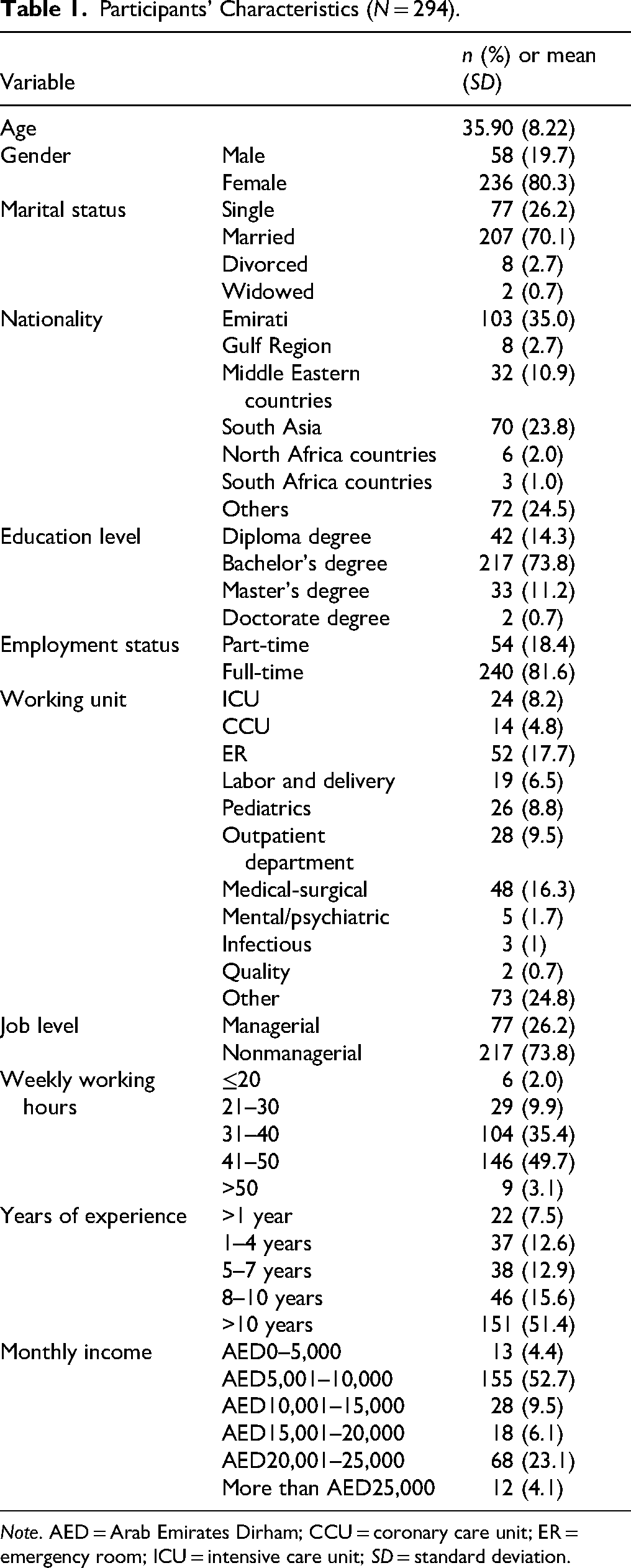
Note. AED = Arab Emirates Dirham; CCU = coronary care unit; ER = emergency room; ICU = intensive care unit; SD = standard deviation.
Descriptive Statistics of IL, WE, and JS
Table 2 displays descriptive statistics for IL, WE, and JS. The participants displayed a mean IL of 17.81 (±4.82). For the WE, the highest average subscale score was for nursing foundation for quality of care (2.94 ± 0.63), followed by collegial nurse–physician relationships (2.88 ± 0.67). The average total score for WE was 2.82 ± 0.61. The average total JS score was 3.21 ± 0.82, with the highest score in the intrinsic domain (3.25 ± 0.83). Regarding IL, 174 (59.2%) nurses reported low IL their job, while 120 (40.8%) reported high IL.
Descriptive Statistics for Intention to Leave, Work Environment, and Job Satisfaction (N = 294).

Note. TIS-6 = 6-item Turnover Intention Scale; PES-NWI = Practice Environment Scale of the Nursing Work Index; MSQ-SF = Minnesota Satisfaction Questionnaire-Short Form.
Correlation Analysis
Multiple Pearson's chi-square tests were computed. The results showed a statistically significant association between IL and education level (P = .038), years of experience (P = .033), employment status (P = .002), and nationality (P = .037). This study found no statistically significant associations between IL the job and gender, income, job level, weekly working hours, city of residency, and city of employment.
Pearson's product–moment correlation coefficient tests are presented in Table 3. The results indicated a statistically significant correlation between JS and WE (r = .253, P ˂ .01). In contrast, the results showed no statistically significant associations between IL job and age, WE, and JS.
Pearson's Correlations Between Intention to Leave, Work Environment, and Job Satisfaction (N = 294).

Note. r = Pearson's correlation; P = significance value.
*P < .05, **P < .01.
Regression Analysis for the Prediction of IL the Job
Table 4 shows the results of multiple linear regression analysis and provides the parameters of the best model comprised of three variables. The regression model was conducted using the main-effects model, employing the maximum-likelihood method for estimating parameters.
Regression Model Predicting Intention to Leave (N = 294).

Dependent variable: intention to leave.
Note. SE-B = standard error of beta coefficient; 95% CI = 95% confidence interval.
*P < .05, **P < .01.
The overall regression model was statistically significant and accounted for 3.5% of the variance in IL scores (R2 = 3.5%). Both WE (β = 1.156, P = .015) and JS (β = −0.857, P = .015) appeared as significant predictors of nurses’ IL the job. The regression analysis indicated that a one-unit increase in WE scores, which reflects a more stressful or less favorable WE as perceived by nurses, was associated with a 1.15-point increase in the IL score. Conversely, a one-unit increase in JS scores, indicating greater satisfaction with the job, corresponded to a 0.857-point decrease in the IL score. These results highlight the significant relationship between these factors, with the interpretation of a “unit” tied directly to the scales used in the validated instruments (PES-NWI and MSQ).
Discussion
The study explored how JS and WE affect intention of nurses to leave their positions. The results showed no significant correlation between IL and WE (r = .11, P = .06). This finding could be attributed to several factors, such as variations in the operationalization of WE constructs or differences in cultural and organizational contexts within the UAE healthcare system. Moreover, the findings of this study differ from Al-Hamdan et al. (2017) in Jordan, where a significant association was found between the WE and intention of nurses to stay. Despite this, the findings of this study align with Al-Hamdan et al. (2017) regarding the WE’s role in predicting IL. Similarly, Chiou-Fen et al. (2019) in Taiwan found that a safe practice environment significantly influenced nurses’ intention to stay, with 89.1% of nurses planning to remain in the field. They also noted a significant correlation between longer tenure in administrative roles and intention to stay, a trend not observed in this study.
The study found that RNs working more hours per week had a greater IL their jobs, consistent with Park et al. (2019), who observed a similar trend among nurses working over 40 h a week. Additionally, JS was recognized as a key factor associated with the IL, aligning with findings from Sillero-Sillero and Zabalegui (2020) in Spain, which showed that job dissatisfaction increased the likelihood of nurses contemplating departure or job change. The study identified a significant association between working hours and the IL, supporting Dall'Ora et al. (2015) research, which showed that longer shifts increased JS and the likelihood of leaving. The study also identified a significant relationship between education level and IL, but did not find a similar association with gender or marital status. This contrasts with Jiang et al. (2019), who found in China that male and unmarried nurses were more likely to intend to leave the profession. The study found a significant link between JS and the WE, consistent with Nantsupawat et al. (2017) in Thailand, which showed that a positive hospital WE reduced job dissatisfaction, burnout, and the IL nursing.
The low variance of 3.5% in the regression model regarding nurses’ IL warrants further exploration. This finding suggests that while a variety of factors influence IL, the model was only able to explain a limited portion of this variability. One possible explanation for the low variance is the complexity and multidimensional nature of JS and the WE. Factors such as work–life balance, supervisor support, workload, and organizational culture are likely to play significant roles in shaping nurses’ IL. However, these factors may not have been fully captured in the study's model, leading to a lower explanatory power. Additionally, while study was able to identify significant associations between various WE factors and IL, it is likely that interventions targeting these factors could influence the overall variance in IL. For instance, improving work conditions, providing career advancement opportunities, offering better compensation packages, and fostering supportive WEs may reduce nurses’ IL, thereby increasing the variance explained by the model. In future studies, it would be beneficial to incorporate a broader range of variables and to consider longitudinal designs that track nurses’ intentions to leave over time. This would help provide a more comprehensive understanding of the factors contributing to IL and offer constructive understandings for developing interventions that could improve workforce retention in healthcare settings.
Strengths and Limitations
This study has notable strengths and some limitations that warrant consideration. Among its strengths, this research is one of the founding efforts in the UAE to investigate nurses’ IL, addressing a critical gap in understanding the nursing workforce in the region. The diversity of the sample, representing nurses from various healthcare settings and units, enhances the breadth of perspectives and supports the generalizability of the findings. Additionally, the use of a validated tool for measuring JS, WE perceptions, and IL adds methodological rigor and reliability to the study outcomes.
However, the study has several limitations. The cross-sectional design captures data at a single point in time, limiting the ability to establish causal relationships between variables. The use of convenience sampling may affect the generalizability of the findings, as participants were selected based on accessibility rather than random selection, potentially introducing selection bias. Moreover, reliance on self-reported measures could lead to biases such as recall bias or social desirability bias, which may impact the accuracy of reported JS, WE perceptions, and IL. These limitations suggest the need for cautious interpretation of the findings and highlight areas for methodological improvement in future longitudinal or intervention-based research.
Implications for Nursing Practice
The findings of this study emphasize the critical need to address JS and working conditions to ensure a sustainable nursing workforce. By understanding and targeting factors such as excessive working hours, educational support, and JS, healthcare organizations can implement strategies to mitigate nurses’ IL. Initiatives such as creating supportive WEs, promoting work–life balance, and offering career development opportunities could enhance retention rates. Strengthening these aspects not only reduces turnover but also improves the quality of care provided to patients. Moreover, the study highlights the importance of continually monitoring workforce dynamics and designing evidence-based interventions tailored to the unique needs of the nursing workforce in the UAE and similar settings.
Conclusion
In conclusion, this study enhances the understanding of factors affecting RNs’ IL in their jobs.
Although no significant association was found between IL and the WE, the research identified key associations between JS, working hours, education level, and IL. These results highlight the need to focus on JS and working conditions to reduce nurse turnover. Practical strategies include implementing flexible scheduling models, such as self-scheduling or shorter shifts, to alleviate the burden of long working hours. Targeted professional development programs should be designed to support nurses with lower education levels, offering clear pathways for career progression and skill enhancement. Furthermore, fostering a culture of recognition and support through culturally relevant reward systems and leadership training can significantly enhance JS. Future research using longitudinal designs, random sampling, and objective measures could offer deeper insights into these dynamics. Additionally, qualitative interviews could provide deeper perceptions into nurses’ lived experiences and the key factors influencing their IL. This study underlines the importance of JS and favorable working conditions in retaining a sustainable nursing workforce. Addressing these factors can reduce turnover and improve patient care, supporting the long-term sustainability of healthcare systems.
Supplemental Material
sj-docx-1-son-10.1177_23779608251362315 - Supplemental material for Associations Between Intention to Leave, Job Satisfaction, and Work Environment Among Registered Nurses: A Cross-Sectional Study in the United Arab Emirates
Supplemental material, sj-docx-1-son-10.1177_23779608251362315 for Associations Between Intention to Leave, Job Satisfaction, and Work Environment Among Registered Nurses: A Cross-Sectional Study in the United Arab Emirates by Yousef Aljawarneh and Ahmad Al-Bashaireh, Nader E. Alotaibi, Mariam Kawafha, Osama Alkouri, Tarfah Almesmari, Bashayer Alnuaimi, Sarah Alabdouli, Maryam Alsereidi in SAGE Open Nursing
Supplemental Material
sj-docx-2-son-10.1177_23779608251362315 - Supplemental material for Associations Between Intention to Leave, Job Satisfaction, and Work Environment Among Registered Nurses: A Cross-Sectional Study in the United Arab Emirates
Supplemental material, sj-docx-2-son-10.1177_23779608251362315 for Associations Between Intention to Leave, Job Satisfaction, and Work Environment Among Registered Nurses: A Cross-Sectional Study in the United Arab Emirates by Yousef Aljawarneh and Ahmad Al-Bashaireh, Nader E. Alotaibi, Mariam Kawafha, Osama Alkouri, Tarfah Almesmari, Bashayer Alnuaimi, Sarah Alabdouli, Maryam Alsereidi in SAGE Open Nursing
Footnotes

Ethical Approval and Informed Consent Statement
The study received dual ethical approval from the Research Ethics and Integrity Committee (REIC) at the Higher College of Technology (REIC/2022/9), and the Research Ethics Committee (REC) at the Ministry of Health and Prevention, UAE (MOHAP/DXB-REC/SOO/No. 94/2022). The study also obtained approval from the Data Statistics/Healthcare/EHS (DSD) department within the Ministry of Health and Prevention on November 7th of 2022 (Approval Number: EHS/DSD/Form/002/29/11-2022).
Author Contributions
Conceptualization: Y.A. and O.A.; methodology: A.A.-B. and M.K.; formal analysis: N.E.A. and B.A.; data curation: S.A. and M.A.; writing—original draft preparation: Y.A., T.A., B.A., M.A., O.A., and N.E.A.; writing—review and editing: A.A.-B. and M.K.; supervision: Y.A. and A.A.-B.. All authors have read and agreed to the published version of the manuscript.
Funding
The authors disclosed receipt of the following financial support for the research, authorship, and/or publication of this article: This research received fund from the Ongoing Research Program Funding (ORF-2025-1444), King Saud University, Riyadh, Saudi Arabia.
Declaration of Conflicting Interests
The authors declared no potential conflicts of interest with respect to the research, authorship, and/or publication of this article.
Data Availability Statement
Data are available upon request.
Supplemental Material
Supplemental material for this article is available online.
References
Supplementary Material
Please find the following supplemental material available below.
For Open Access articles published under a Creative Commons License, all supplemental material carries the same license as the article it is associated with.
For non-Open Access articles published, all supplemental material carries a non-exclusive license, and permission requests for re-use of supplemental material or any part of supplemental material shall be sent directly to the copyright owner as specified in the copyright notice associated with the article.
