




Abstract
Introduction
Suicide is defined as the deliberate taking of one's own life with either implicit or explicit proof; however, it can also refer to the contemplation or actualization of suicide. Suicide is a mental illness with several contributing factors. It is frequently linked to sex, age, health problems, substance misuse, and traumatic life experiences.
Objective
The purpose of this study was to evaluate the prevalence of suicide thought and attempts among glaucoma patients and its contributing factors in Gondar, Ethiopia, 2022.
Methods
An observational cross-sectional study was conducted on 422 glaucoma patients at the Tertiary Eye Care Clinic, University of Gondar Comprehensive and Specialized Hospital. Suicidal ideation and attempts were assessed using the suicidality module of the World Mental Health Survey Initiative version of the World Health Organization's Composite International Diagnostic Interview. Bivariate and multivariate logistic regressions were conducted to identify factors associated with suicidal ideation and attempts. The variables with a p-value less than 0.05 and a 95% CI were considered statistically significant.
Results
The overall prevalence of suicidal ideation and attempt was 6.4% with a 95% CI of 4.3–9.2% and 2.4% with a 95% CI of 1.1–4.3%, respectively. In multivariate analysis, severe psychological distress, moderate psychological distress, mild psychological distress, and current substance use were identified as risk factors for suicidal ideation, whereas living alone, co-morbid chronic medical disease, and ever-present substance use were identified as risk factors for suicidal attempts.
Conclusion
Based on this study finding, the prevalence of suicidal ideation and attempts was high among glaucoma patients. This study may provide further information to pay much attention to the physical health care of patients with glaucoma. More representative samples, or rather, a cross-sectional study design, should be used in future studies aiming for more precise data.
Introduction
Glaucoma is one of the common eye diseases that causes blindness with characteristic features of the optic disc and a specific pattern of visual field defects (Congdon et al., 2004; Kanski & Bowling, 2003). The number of patients with glaucoma worldwide was expected to reach 64.3 million in 2013, and by 2040, it is predicted to reach 111.8 million (Tham et al., 2014). Chronic glaucoma frequently results in psychological problems for the patient, including anxiety and sadness (Clarke & Currie, 2009; Jampel et al., 2007; Janz et al., 2007; Jindal, 2013; Mabuchi et al., 2008). Suicidal ideation, planning, and attempts are all at risk due to psychological suffering (First, 2013; Sadock, 2007; Townsend, 2013).
Suicide is defined as the deliberate taking of one's own life with either implicit or explicit proof; however, it can also refer to the contemplation or actualization of suicide (Sadock, 2007). Suicidal ideation is defined as any self-reported wish to end one's life (O'Carroll et al., 1996; Sadock, 2007), whereas a suicide attempt is defined as a voluntary self-injurious behavior with a nonfatal outcome (Esposito-Smythers & Goldston, 2008; Sadock, 2007).
The American Psychiatry Association states that risk factors for mental illness might be biological, psychological, or environmental and can raise the chance of contracting an illness or disorder (Sadock, 2007). Suicide is a mental illness with several contributing factors. It is frequently linked to sex, age, health problems, substance misuse, and traumatic life experiences (First, 2013; Sadock, 2007; Suicide, 2018; Townsend, 2013). Suicide affects people of all ages, but it is more common in those who are 15–25 years and 59 years and older (Organization, 2014; Sadock, 2007). Numerous studies conducted in many nations have indicated that glaucoma is more common among the elderly (Chen et al., 2022; Chen et al., 2018; Hashemi et al., 2019; Merepa et al., 2018; Oh et al., 2019; Onwubiko et al., 2020; Sukumar et al., 2009; Wang et al., 2019). The global mortality rate of suicide is 16 deaths per 100,000 males and 7 deaths per 100,000 females (Naghavi, 2019), as indicated by other studies. Men commit suicide at a higher rate than women, with men three to four times more likely than women to kill themselves, whereas suicidal thoughts and attempts were three-fold more common in females (Alimohammadi et al., 2013; Naghavi, 2019; Sadock, 2007). According to a study conducted in western Ethiopia, suicide behavior was linked to the female gender (Belete et al., 2021). Despite some studies reporting that glaucoma was more prevalent in women (Chen et al., 2022; Chen et al., 2018; Merepa et al., 2018; Onwubiko et al., 2020; Singh et al., 2020; Wang et al., 2019), it was more prevalent in men (Bedasso et al., 2016; Hamid et al., 2022; Hashemi et al., 2019; Law et al., 2018; Oh et al., 2019; Shadid et al., 2020; Sukumar et al., 2009; Tilahun et al., 2021). Psychological and social studies suggest that single, separated, divorced, widowed, unemployment (Rehkopf & Buka, 2006), and substance use disorders may also contribute to suicidal behavior (Ilgen et al., 2010; Kessler et al., 1999; Poorolajal et al., 2016; Roy, 2009). The studies conducted in our nation, Ethiopia, have revealed that: the prevalence of suicidal behavior was higher among patients who attended health service areas, with cases of HIV/AIDS, diabetes mellitus, hypertension, and other chronic medical conditions, than among the residents in the community (Belete et al., 2021). Other studies revealed that glaucoma patients had greater rates of chronic illnesses such as hypertension and diabetes mellitus (Hashemi et al., 2019; Law et al., 2018; Oh et al., 2019; Tripathi & Srinivasan, 2018). Suicidal ideation and attempts are at an increased risk in those with chronic illnesses. People with chronic diseases are vulnerable to developing psychological distress (depression and anxiety) (First, 2013; Sadock, 2007; Townsend, 2013). The studies done in Southeast Asian countries revealed that the degree of psychological distress among glaucoma patients was varied. The prevalence of depression and anxiety was 30% and 64% in Singapore (Lim et al., 2016), 6.8% and 9.1% in Malaysia (Hamid et al., 2022), respectively. Whereas, in African countries, it was relatively prevalent: 51.33% were depressed, and 56.67% were afraid of going blind in Ghana (Merepa et al., 2018); 41.8% were depressed, and 44% were anxious in Nigeria (Onwubiko et al., 2020). Psychological distress is more common in women, the elderly, those who are not married, are unemployed, have little social support, and are current substance users (First, 2013; Sadock, 2007; Townsend, 2013). In different countries, much literature has revealed that glaucoma is more prevalent in females (Chen et al., 2022; Chen et al., 2018; Merepa et al., 2018; Onwubiko et al., 2020; Singh et al., 2020; Wang et al., 2019), current substance users (Law et al., 2018), and unemployed or retired people (Bedasso et al., 2016; Hamid et al., 2022; Merepa et al., 2018). Suicidal ideation and attempts were associated with various biopsychosocial conditions (Sadock, 2007).
As a result of the dual and/or triple effect of co-occurring biopsychosocial conditions, glaucoma may thereby increase the likelihood of suicide ideation and attempt. Information regarding suicide thoughts and attempts among Ethiopian glaucoma sufferers is scarce. Thus, the purpose of this study was to evaluate the prevalence of suicide thought and attempts among glaucoma patients, as well as the factors that may have contributed to it in the study area. Additionally, it will serve as a reference for future research and help evaluate the suicide thought and attempts rates among glaucoma patients.
Review of Literatures
Prevalence and Associated Factors of Suicidal Ideation and Attempts
Depression varies greatly in prevalence among people with common eye disorders (glaucoma, cataract, age-related macular degeneration, and diabetic retinopathy) and has a significant global impact on morbidity and mortality rates associated with these conditions. Retrospective cohort and cross-sectional studies involving 3259 participants in the USA (United States of America) and 129 individuals in Brazil revealed that the prevalence of depression among glaucoma patients was 33% and 10.08%, respectively (Abe et al., 2021; Berchuck et al., 2021). Another study, based on a cross-sectional study conducted in Nigeria with 197 participants, used the hospital anxiety and depression scale; the prevalence of depression among patients with eye glaucoma was 24.4% (Okudo et al., 2021). People with chronic diseases are vulnerable to developing depression, which is a cause of suicidal ideation and attempts (First, 2013; Sadock, 2007; Townsend, 2013).
A systematic review and meta-analysis study done in Africa showed the pooled prevalence of suicidal ideation was 21.7%. And the pooled prevalence of suicidal ideation in each country, Ethiopia, Nigeria, Uganda, and South Africa—was 22.7%, 25.3%, 9.8%, and 18.05%, respectively. Co-morbid depression, perceived stigma, and poor social support were among the variables linked to suicidal thoughts (Necho et al., 2021).
Suicidal thought was linked to depression, a family history of suicide attempts, and feelings of stigma. Additionally, suicidal attempts were linked to desperation, substance use, and gender (Gebremariam et al., 2017). In order to conduct a comparative study on suicidal behavior in northwest Ethiopia, 1,363 patients at the health center and 2,625 residents were questioned. Suicidal behavior was reported to be 5.6% more prevalent overall. 4.4% for residents and 7.9% for patients, it was discovered. Suicide behavior was found to be associated with female sex, depressive symptoms, and a sense of stigma; however, risk variables that were found to be protective against suicide behavior included having public health insurance and leading a healthy lifestyle, even after controlling for patient status (Belete et al., 2021). A cross-sectional study based in the community was carried out on 1,597 young people who had been diagnosed with diabetes. Among study participants, the lifetime prevalence of suicide attempts was 5.5%. A suicide attempt was substantially correlated with the existence of common mental health issues and a personal history of violence (Geremew et al., 2023). Other studies revealed that glaucoma patients had greater rates of chronic illnesses, like hypertension and diabetes mellitus (Hashemi et al., 2019; Law et al., 2018; Oh et al., 2019; Tripathi & Srinivasan, 2018). The objectives of this study were two: (1) to determine the prevalence of suicidal ideation and attempts among glaucoma patients and (2) to identify factors associated with suicidal ideation and attempts among glaucoma patients.
Methods
This study followed the cross-sectional reporting standards for Strengthening the Reporting of Observational Studies in Epidemiology (STROBE) (Von Elm et al., 2007).
Study Design and Area
An institutional-based observational cross-sectional study (Grujičić & Nikolić, 2021) was conducted from June-08 to August-07, 2022, at the Tertiary Eye Clinic, University of Gondar Comprehensive and Specialized Hospital. It was established by the Federal Ministry of Health (FMOH) in 1954 and is currently one of the specialized teaching university comprehensive hospitals in Ethiopia. The tertiary eye care provides ophthalmic service to the population. Glaucoma was a major subspecialty in tertiary eye care, which provides care to around 990 glaucoma patients per month at an adult follow-up unit.
Study Population
The study population included glaucoma patients attending the University of Gondar Comprehensive and specialized hospitals during the data collection period. Those glaucoma patients who were on follow-up and aged 18 or more tried to be included in the study, but they were severely sick and unable to communicate and were excluded from the study.
Bias
Response biases might have occurred when completing the questionnaire due to the nature of the illness, loss of sight, which could disrupt the interview. The selection process could be a random sampling technique rather than a survey.
Sample Size Determination and Procedure
The sample size of the participant was calculated by using a single population proportion formula with the following considerations: a standard normal distribution (z = 1.96) with a 95% confidence interval (α = 0.05), prevalence (p = 50%) because no similar study has been done in our country among the glaucoma population, and a margin of error (d = 0.05). Then, using a 10% non-response rate, the final sample size was 422. A systematic random sampling method was applied to select study units among the glaucoma patients during the study period. Sampling fraction (K) was determined by dividing the total study population during the two-month data collection period by a total sample size: K = N/n = 1980/422 = 5. Therefore, the starting point was randomly selected by using the lottery method from the first five glaucoma patients, and then the next patient was selected at 5th intervals on each day within the study period.
Data Collection Instruments
The outcome variables were suicidal ideation and attempt, assessed using the suicidality module of the World Mental Health Survey Initiative version of the World Health Organization's Composite International Diagnostic Interview (CIDI), in which its Amharic version is validated in Ethiopia both in clinical and community settings. Suicidal ideation was assessed with the question, “Have you seriously thought about committing suicide within the last month?” The respondents who answered “yes” were considered to have suicidal ideation, and suicidal attempts were assessed with the question, “Have you attempted suicide within the last year?” The respondents who answered “yes” were considered to have had a suicide attempt according to the suicidality module of CIDI (Kessler & Üstün, 2004).
Psychological distress was assessed by the Kessler Psychological Distress Scale (K10). The K10 scale involves 10 questions about emotional states, each with a five-level response scale. The scores of the 10 items are then summed, yielding a minimum score of 10 and a maximum score of 50. The measure can be used as a brief screen to identify levels of distress. Patients who scored less than 20 were classified as having no psychological distress, and those who scored 20 or more were classified as having psychological distress. The cut-off scores were: 10–19 well, 20–24 mild, 25–29 moderate, and 30–50 severe disorder psychological distress (Kessler et al., 2003; Serraglio et al., 2003). Social support was measured by the Oslo-3 Social Support Scale (OSS-3). Patients who scored less than 9 were classified as having low or poor social support, and those who scored 9 or more had high social support (Kocalevent et al., 2018). Stigma, clinical, and substance-related factors were assessed by the yes-or-no answers of the respondents, and socio-demographic background information (age, sex, marital status, occupation, and others) was collected using structured questions.
Data Collection Procedure
Data was collected through face-to-face interviews using the Amharic version of a pre-tested questionnaire. Two days of training were given to five BSc psychiatry nurses and one MSc psychiatry professional on data collection tools, ethical consent, sampling methods, and procedures, supervised by one MSc psychiatry professional. The questionnaires were translated into Amharic, then translated back to English to check for consistency and understandability of the tools. The pre-test was conducted two weeks prior to the actual data collection on 5% of the sample size at the tertiary eye care center at the University of Gondar Comprehensive Specialized Hospital, and the questionnaire was checked for its reliability, clarity, simplicity, and understandability. Pre-test questionnaires were not included in the analysis as part of the main study.
Data Processing and Analysis
The data was edited, cleaned, coded, and entered into Epi-Info version 7 and analyzed using SPSS 25. Summary statistics, frequencies, and cross-tabulations were performed for the descriptive data. Binary logistic regression was conducted to identify factors associated with suicidal ideation and attempt. A bivariate analysis was performed for each independent variable. Variables with a p-value of less than .2 were transferred to multivariate analysis. Bivariate and multivariate logistic regression analyses were done to identify the associated factors. A p-value less than .05 was considered statistically significant. The strength of the association was presented by the odds ratio with a 95% CI, and Hosmer-Lemeshow goodness was used to check model fit. The results were presented in the form of a table.
Ethical Consideration
The study was conducted as per the Declaration of Helsinki and approved by the University of Gondar Ethical Review Board. Ethical clearance was obtained from the institutional review board of the University of Gondar, College of Medicine and Health Science, Department of Psychiatry, ethical review committee. An informed written consent was obtained from each participant after giving a clear explanation about the purpose of the research. Study participants were assured their responses would be kept confidential and no personal identifiers would be used.
Results
Prevalence of Suicidal Ideation and Attempt in Socio-Demographic Characteristics of the Study Participants
A total of 422 participants responded to the questionnaire with a response rate of 100%. The mean age of the participants was 59.77 ± 12.38 years (range from 28 to 96 years). More than half (422 (52.8%)) of the participants were women. Regarding occupation, 38 (9.0%) of the participants were jobless, 69 (16.3%) were retired, and 39 (9.2%) lived alone.
Among the participants, those whose age was 59 or older had around two-fold higher suicidal ideation compared with those whose age was less than 59 years. Suicidal ideation among women (6.7%) was relatively higher than among men (6.0%), whereas suicidal attempts were twice as common among men. Suicidal ideation and attempts among participants who lived alone were 5.1% and 10.3%, respectively (Table 1).
Prevalence of Suicidal Ideation and Attempt in Socio-Demographic Characteristics of the Study Participants (N = 422).

Prevalence of Suicidal Ideation and Attempt in Psychological Distress, Stigma, Level of Social Support, Clinical and Substance Related Factors Among Study Participants
From the study participants, 70 in 422 participants had severe psychological distress, 133 in 422 participants had low social support, and 79 in 422 participants were current substance users.
Among the participants who had severe psychological distress, 22.9% had suicidal ideation and 4.3% had suicidal attempts. Suicidal ideation and attempts among the participants with low social support were 10.5% and 5.3%, respectively. The distribution of suicidal ideation and attempts was higher among participants who had chronic diseases and were current substance users (Table 2).
Prevalence of Suicidal Ideation and Attempt in Psychological Distress, Stigma, Level of Social Support, Clinical and Substance Related Factors Among Study Participants (N = 422).

Co-morbid chronic diseases (self-reported) including one or more of diabetes mellitus, hypertension, HIV/AIDS, and other chronic diseases; History of suicides in the family (including: parent, sibling, grandparent, uncle, and aunt); Substances include one or more of alcohol, cigarettes, khat, and other substances; Ever substance use means use of one or more of the above substances in a lifetime; Current substance use means use of one or more of the above substances in the last 3 months for non-medical purposes.
Prevalence of Suicidal Ideation and Attempt
This study showed that the prevalence of suicidal ideation and attempt was 27 (6.4%) with a 95% CI of 4.3–9.2% and 10 (2.4%) with a 95% CI of 1.1–4.3%, respectively. Among the study participants, 6 (1.4%) had a history of committing suicide in the family (Table 3).
Prevalence of Suicidal Ideation and Attempt Among the Study Participants.

Factors Associated With Suicidal Ideation
Variables (age, living condition, psychological distress, social support, co-morbid chronic medical diseases, and current substance use) having a p-value of less than .2 in bivariate analysis were transferred to multivariate analysis. In the multivariate analysis, psychological distress and current substance use were significantly associated (p-value <.05) with suicidal ideation, whereas age, living condition, social support, and co-morbid chronic medical diseases were not significantly associated with suicidal ideation.
The odds of having suicidal ideation among glaucoma patients who had severe psychological distress were 8.07 times (AOR = 8.07, 95% CI: 2.47–26.38), moderate psychological distress was 6.57 times (AOR = 6.57, 95% CI: 1.14–38.0), and mild psychological distress was 18.11 times (AOR = 18.11, 95% CI: 4.14–79.21) higher as compared to those patients who had no psychological distress.
Among the study participants, those who were current substance users were 4.36 times (AOR = 4.36, 95% CI: 1.57–12.09) more likely to have suicidal ideation compared to those who were not current substance users (Table 4).
Factors Associated With Suicidal Ideation (N = 422).

Factors Associated With Suicidal Attempt
Variables (marital status, residence, living condition, psychological distress, social support, co-morbid chronic medical diseases, ever substance use, and current substance use) having a p-value of less than .2 in bivariate analysis were transferred to multivariate analysis. In the multivariate analysis, living conditions, co-morbid chronic medical diseases, and ever substance use were significantly associated (p-value <.05) with suicidal attempts, whereas marital status, residence, psychological distress, social support, and current substance use were not significantly associated with suicidal attempts.
Among the participants, glaucoma patients in this study who lived alone were 27.47 times (AOR = 27.47, 95% CI: 2.10, 35.69) more likely to have suicidal attempts compared to those participants who lived with family or families.
Glaucoma patients who had co-morbid chronic medical disease or diseases were 8.71 times (AOR = 8.71, 95% CI: 1.73–43.78) more likely to have suicidal attempts compared to those patients who had no co-morbid chronic medical disease or diseases. The odds of having suicidal attempts among participants who had used substances in their lifetime were 11.6 times (AOR = 11.60, 95% CI: 1.66, 81.02) higher than those participants who didn’t use substances in their lifetime (Table 5).
Factors Associated With Suicidal Attempt (N = 422).
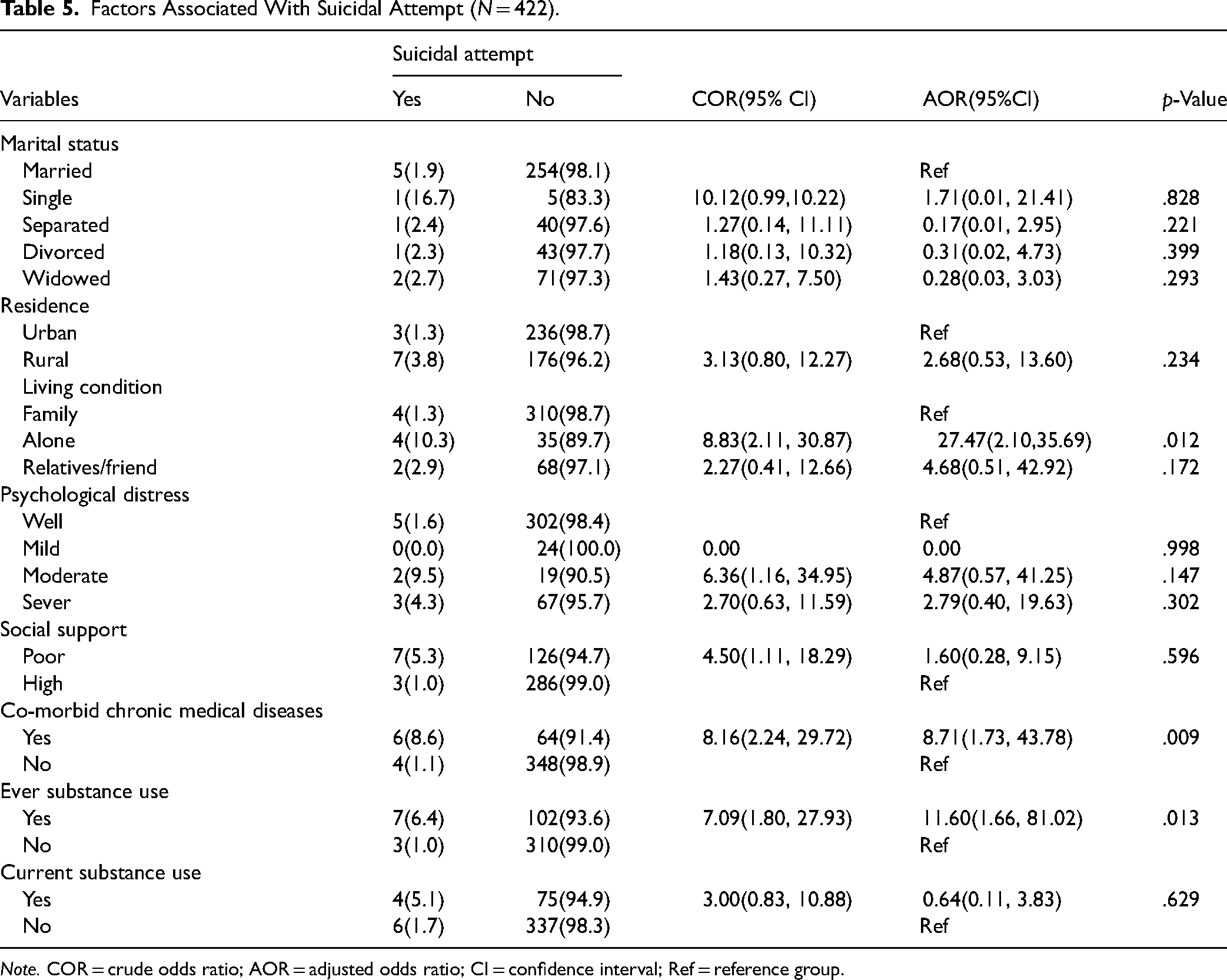
Note. COR = crude odds ratio; AOR = adjusted odds ratio; CI = confidence interval; Ref = reference group.
Discussion
Suicide claims the lives of about 800,000 individuals globally each year (one suicide death every 40 s), ranking it as the 10th most common cause of death. An estimated 10 to 20 million people attempt suicide annually (Alimohammadi et al., 2013; Jenkins et al., 2011). The annual age-standardized suicide rates in developing and wealthy nations are 11.2 and 12.7 per 100,000, respectively. Nonetheless, emerging nations accounted for 75% of all suicide deaths worldwide (Suicide, 2018). Of the one million suicide deaths that occur globally each year, two-thirds take place in low- and middle-income countries, including Ethiopia (Turecki & Brent, 2016). The prevalence of suicidal behavior was found to be 5.6% among the patients attending the health institution and the residents in the community. However, the proportion of suicidal behavior was double in patients compared with residents (Belete et al., 2021).
The overall magnitude of suicidal ideation in this study was 6.4% with a 95% CI of 4.3–9.2%, which is lower than the previous studies done in Ethiopia among HIV/AIDS patients (Gebremariam et al., 2017; Gizachew et al., 2021), cancer patients (Molla et al., 2022b), and diabetes mellitus (Necho et al., 2019). The difference might be related to the study participants and the type of question used to assess suicidal ideation. In this study, we used the question, “Have you seriously thought about committing suicide within the last month?”. Whereas, other studies used the question, “Have you seriously thought about committing suicide within the last 12 months?” (Molla et al., 2022a), and lifetime suicidal thought: “Have you ever seriously thought about committing suicide?” (Gebremariam et al., 2017; Necho et al., 2019). However, it is higher than the study done among diabetes mellitus patients when the suicidal ideation was assessed within the last month: “Have you seriously thought about committing suicide within the last month?” (Necho et al., 2019). Although suicidal ideation was assessed with the question “Have you seriously thought about committing suicide within the last month?” in both studies, the variation might be related to the differences between the study participants of glaucoma patients in this study and diabetes. The prevalence of suicidal attempts was 2.4% with a 95% CI of 1.1–4.3%, which is lower than the previous studies done in Ethiopia, patients with HIV/AIDS (Gebremariam et al., 2017; Gizachew et al., 2021), cancer (Molla et al., 2022b), diabetes mellitus (Necho et al., 2019), and the meta-analysis study in Africa (Ethiopia, Nigeria, Uganda, and South Africa) (Necho et al., 2021), among HIV/AIDS patients. The variation might be the severity of illness (the study participants live with HIV/AIDS, cancer, and diabetes mellitus), type of question used, and number of patricians. In other studies, suicidal attempts were assessed by using the question “Have you ever made suicidal attempts?” (Gebremariam et al., 2017; Necho et al., 2019). In this study, the suicidal attempt was assessed by using the question “Have you suicidal attempted within the last year?” Despite, even if other studies were done among cancer participants using the same question (Molla et al., 2022b), our finding was lower than it. The possible reason might be related to the differences among the participants. Another difference might be the number of participants in the systematic review meta-analysis study; 7128 HIV/AIDS patients in Africa were included, and in this study, 422 glaucoma patients participated.
During the analysis of suicidal ideation in relation to all explanatory variables, severe psychological distress (AOR = 8.07, 95% CI: 2.47–26.38), moderate psychological distress (AOR = 6.57, 95% CI: 1.14–38.0), and mild psychological distress (AOR = 18.11, 95% CI: 4.14–79.21) were significantly associated with suicidal ideation. Psychological distress (anxiety and depression) is a risk factor for suicidal behavior (Sadock, 2007), and it is supported by the studies done in Ethiopia (Belete et al., 2021; Gizachew et al., 2021). And current substance use has a statistically significant association with suicidal ideation. Substances (alcohol, cigarettes, khat, and others) are either precipitating (whether intoxication or withdrawal time) or perpetuating risk factors for mental illness (First, 2013; Sadock, 2007; Townsend, 2013), and suicide is once among psychiatric disorders, but it had no statistically significant association in other studies (Bitew et al., 2016; Gebremariam et al., 2017; Molla et al., 2022b).
In the analysis of suicidal attempts, regarding living conditions, living alone was a risk factor for suicidal attempts, as supported by the earlier study done in Ethiopia (Gizachew et al., 2021). Co-morbid chronic medical disease/diseases were 8.71 times more likely to have suicidal attempts compared to those participants who had no co-morbid chronic medical disease/diseases and were significantly associated with suicidal attempts. Chronic diseases are directly or indirectly a risk factor for psychiatric disorders such as suicide (Sadock, 2007); however, it is not supported by the study done in Ethiopia (Molla et al., 2022b) among cancer patients. There was a statistically significant association between substance use and suicidal attempts, and it is agreed with by another study (Gebremariam et al., 2017) but not supported by other studies (Bitew et al., 2016; Gizachew et al., 2021). However, some variables were significantly associated with suicidal thought but not suicidal attempt, and vice versa, such as psychological distress, which had a statistically significant association with suicidal thought but not a statistically significant association with suicidal attempt, and co-morbid chronic medical disease or disease that had a statistically significant association with suicidal attempt but not a statistically significant association with suicidal thought. The possible difference might be that the time duration of the question to assess the suicidal thought was within one month and the suicidal attempt was within 12 months. Given the occurrence of confounding factors regarding these, researchers recommend future researchers address this issue. Suicidal ideation and suicidal attempts are warning signs for and determine the prognosis of suicide (Parra-Uribe et al., 2017). This study demonstrated the magnitude of suicidal ideation, attempt, and its associated factors among people with glaucoma. This suggests the need to develop and implement suicidal prevention strategies in the ophthalmology treatment unit. Training to identify suicidal risk factors should be given to health professionals working in the ophthalmology treatment unit, and consultation services should be strengthened with psychiatric professionals in the ophthalmology treatment clinic.
Strengths and Limitations of the Study
This study might raise insights into managing suicidal ideation and attempts for individuals with glaucoma. An additional strength of this research that could provide a basis for further research. Reports for some of the questions were past time or encounters, which are prone to recall bias. We employed a cross-sectional study design, which could not draw the exact relationship between suicidal intention and glaucoma and missed the variables that were incorporated, like the severity of glaucoma disease, subtypes of glaucoma, medications, and history of surgeries.
Implications for Practice
Hospital administrators and professionals need to conduct continuous training to screen for suicidal ideation and attempts among glaucoma patients. It is also important for hospital administrators to strengthen the integration of working with psychiatry professionals to provide appropriate health services for patients. Hospitals also needed to offer more resources to manage glaucoma patients with suicidal behaviors. Further study using the other observational method and additional factors associated with suicidal ideation and attempts among glaucoma patients is needed in the future.
Conclusion
Based on this study finding, the prevalence of suicidal ideation and attempts was high. The study also identified factors associated with suicidal ideation and attempt: psychological distress and current substance use were significantly associated with suicidal ideation, whereas living alone, co-morbid chronic disease/diseases, and ever substance use were significantly associated with suicidal attempt. This study may provide further information to pay much attention to the physical health care of patients with glaucoma. More representative samples, or rather, a cross-sectional study design, should be used in future studies aiming for a more precise diagnosis.
Footnotes
Acknowledgments
We would like to thank University of Gondar Comprehensive and specialized hospital's clinical staff for their cooperation during the data collection period. We also appreciate participants for their time.
Author Contributions
FA designed the study, wrote the proposal, data analyses, and manuscript preparation. DA and DD participated in writing the methodology and revised the proposal. DA, TT, GN, GM, DD, TD, LF, and JS revised the manuscript preparation. All authors read and approved the final manuscript.
Availability of Data
All the data is available and included within the manuscript.
Declaration of Conflicting Interests
The authors declared no potential conflicts of interest with respect to the research, authorship, and/or publication of this article.
Ethics Approval and Consent to Participate
The study was conducted as per the Declaration of Helsinki and approved by the University of Gondar Ethical Review Board. Ethical clearance was obtained from the Institutional Review Board of the University of Gondar, College of Medicine and Health Science, Department of Psychiatry Ethical Review Committee. An informed written consent was obtained from each participant after giving a clear explanation about the purpose of the research. Study participants were assured their response will be kept confidential and no personal identifiers were used.
Funding
The authors received no financial support for the research, authorship, and/or publication of this article.
