




Abstract
Background
Problem-based learning (PBL) was introduced over half a century ago and accepted as a cornerstone in many medical education curriculums. Since there was no similar study in Ethiopia, this study assessed the gap of acceptance and associated factors among a school of nursing students at Wachemo University, Central Ethiopia.
Objective
To assess PBL acceptance and associated factors among school of nursing students at Wachemo University, Central Ethiopia.
Method and Material
This study used a quantitative design with a cross-sectional approach among 200 students who were enrolled in PBL at Wachemo University School of Nursing from July 30, 2023 to August 30, 2023. Data were collected using a pre-tested self-administered questionnaire. The data were entered using Epi-Data version 3.1 and analyzed using SPSS version 22.0. A descriptive analysis was done by computing proportion and cross-tabulation. Then the findings were described by using frequency, tables, and figures. Binary logistic regression was employed at p-value <.25 to identify variables that had a statistical association with PBL acceptance. Considering the candidate variables that were statistically significant in bivariate analysis, multivariate analyses were performed to determine the association between the outcome variable and each independent variable. Multivariable logistic regression analyses were done to identify factors having an association with PBL acceptance. Variables whose p < .05 are considered for statistical significance.
Results
In this study, 58.5% [95% CI 52.5–65.5] of the respondents accepted PBL as a teaching-learning strategy. Being female (AOR = 4.8 [95% CI 2.80–10.11]), study year (AOR = 2.92 [95% CI 1.85–5.65]) and computer access in the learning environment (AOR = 2.42 [95% CI 1.01–5.43]) were found to be associated with PBL.
Conclusion
The result of this study revealed that PBL acceptance among nursing students was high. Being female, study year and Computer access in the learning environment were factors associated with PBL.
Background
Problem-based learning (PBL) is a method of small-group collaborative learning that was pioneered in the medical school program at Manchester University in Hamilton, Ontario, Canada in the late 1960s by Howard Barrows and his colleagues (Chan, 2009; Chan et al., 2022; Vargas et al., 2021). In medicine and health sciences, PBL is a highly structured, student-centered, educational methodology, in which students in their small groups do collaborative problem-solving activities and learn actively by themselves using clinical problems to identify what they need to learn to solve those problems (Bate et al., 2014; Chan, 2009; Orfan et al., 2021; Tawanwongsri & Phenwan, 2018). PBL is an instructional approach that has been used successfully for over 30 years and continues to gain acceptance in multiple disciplines. It is an instructional (and curricular) learner-centered approach that empowers learners to conduct research, integrate theory and practice, and apply knowledge and skills to develop a viable solution to a defined problem (Kibret et al., 2021; Savery, 2006).
PBL has been implemented throughout the world as an innovative learning method in nursing education (Othman & Shalaby, 2014). The transformation of the medical curriculum from traditional teacher-centered to integrated Student-centered PBL has been adopted by many medical colleges around the globe (Al-Drees et al., 2015; Szabo et al., 2014). Introduced over half a century ago, PBL has long been accepted as a cornerstone in many medical education curricula worldwide. However, in re-designing curricula, medical educators need to balance producing graduates with contemporary attributes, where the learning environment is resource-challenged, in both the higher education and health sectors (Burgess et al., 2018).
Globally, the rapid acceptance, use of PBL have failed to reach the expected results due to philosophical objections as an educational method and resistance from faculty made PBL implementation could be affected by many factors that emanate from the curriculum, institution, and students and Ignoring these factors was the major reason for failed PBL implementation in many institutions (Atwa & Hassan, 2016; Sattarova et al., 2021). A study conducted at Korean medical schools showed that (87.5%) of respondents accepted PBL implementation in their curricular activities (Yeo & Chang, 2017).
A study conducted in Thailand revealed those (69.9%) students’ positive acceptance of PBL due to no difficulties in their learning process and good feedback mechanisms from session facilitators (Tawanwongsri & Phenwan, 2018). A study conducted in Johannesburg South Africa showed that the majority of nursing students felt that PBL was a stimulating (and useful learning strategy, with most students rating their attitude positively (Bruce et al., 2018). Until today experience from PBL in clinical education and integration between theoretical and clinical parts of the curriculum is limited. PBL as a curriculum concept has a relatively short history in Ethiopia but is becoming increasingly important.
PBL was adopted as an educational strategy in the 2011 innovative medical curriculum, which is being implemented in 13 medical schools around the country (Abraham & Azaje, 2013). A study conducted at Debre Tabor University in the College of Health Sciences showed that heavy workload and insufficient time for self-study from the students’ side and lack of incentives and frequent leadership turnover from the tutors’ side were the major challenges of PBL implementation (Wondie et al., 2020). An additional study conducted at this university revealed that some students reported the challenge of unfair evaluation of assessment due to the workload of the tutor and student's unfamiliarity with PBL which was introduced in a relatively short history in Ethiopia as one of the key educational strategies (Kibret et al., 2021).
The figure below is a conceptual framework that shows an overview of the previously published and presumed relationships among the study variables. This framework was constructed by reviewing different literature of published work in order to address the variables that affect or have a relation with the outcome variable of PBL acceptance. It also assessed the student's problem-based learned acceptance in relation to socio-demographic factors, course organization factors, PBL Facilitator or tutor-based factors, and learning environment factors (see Figure 1).
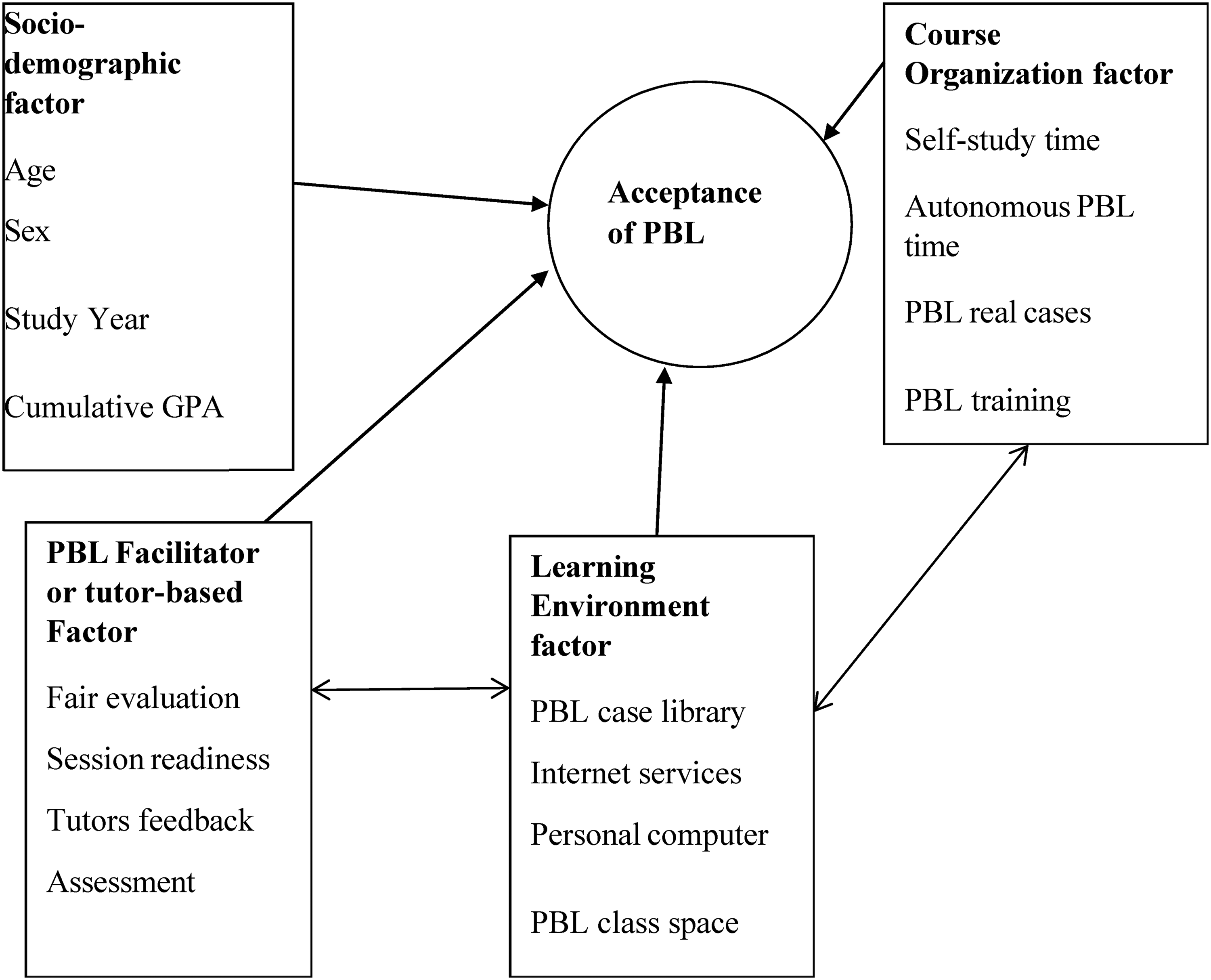
The conceptual framework shows factors related to acceptance among school students.
The purpose of this study is to its scientific value by assessing PBL acceptance and its associated factors among school nursing Students in the study area.
Methods and Materials
Study Settings and Sampling Design
An institution-based quantitative cross-sectional study was conducted among students who were registered and enrolled in PBL at Wachemo, School of Nursing. The School has adopted a hybrid innovative curriculum that incorporates PBL as a learning method.
The study population of this survey was all actively engaged year batch of nursing students and the survey was conducted from July 30, 2023 to August 30, 2023 G.C.
This study is a survey-based study of graduating class students of medical and health science students.
Source Population
All registered nursing Students who enrolled in PBL in the school of nursing.
Study Population
All students, who were willing to complete the survey questionnaire were the study population.
Inclusion and Exclusion Criteria
Students who were available during the study period were included in the study and those who were critically ill during the study period were excluded.
Sampling Size
This study is a survey-based study of school of nursing. All nursing students who began PBL as a teaching-learning strategy were included.
Sampling Technique
The School of Nursing has actively implemented PBL as teaching teaching-learning strategy with a total number of 210. The study included all students to fill out the survey questionnaires. This study used five types of survey questionnaire categories such as socio-demographic, PBL facilitator or tutor-based, course organization factor, learning environment factor, and PBL acceptance-related factor. From these, 200 students filled out the questionnaires.
Data Collection Procedures
Data was collected by using a structured, pretested, validated self-administered questionnaire that encompasses socio-demographic, facilitator-based factors, course organization factors, and learning environment factors adapted from different literature reviews (Al-Naggar & Bobryshev, 2012; Bruce et al., 2018; Ommar, 2011; Othman & Shalaby, 2014; Yulistianti et al., 2018). Ten technical assistants four chiefs one, and six senior Technical Assistant were assigned as data facilitators.
PBL acceptance rate was measured by using 18 items with a points scale ranging from 3 (accept) to 1 (not accept) PBL acceptance measurement rating scale (Al-Naggar & Bobryshev, 2012; Othman & Shalaby, 2014). To test the internal consistency of the tool, a reliability test (Cronbach's alpha) was performed and the result was .71.
Nursing student's PBL acceptance was assessed by using a points Likert scale measurement, which contains 18 items. Study participants who scored the mean and above the mean score of Likert scale questions that were used to assess the PBL acceptance rate were considered as accepted PBL. Those who scored below the mean score of all scales of PBL acceptance rating items were considered as not accepted PBL.
Data Quality Control
The study questionnaires were prepared in English. Data facilitators and supervisors were trained on data collection items which include the study tools, objectives, and rationale of the study as well as the rights of respondents. The required regular supervision and follow-up were made and finally, Investigators crosschecked the completeness and consistency of data throughout the data collection period before the next duty.
Data Analysis
The collected data were checked for completeness, cleaned, coded manually, and entered into Epi-Data version 3.1. Then for further data cleaning and analysis data were exported to Statistical Package for Social Science/SPSS version 22. A descriptive analysis was done by computing proportion and cross-tabulation. Then the findings were described by using frequency, tables. PBL acceptance was measured by an acceptance measurement rating scale relating to accepting, not sure, and not accepting. The average or mean value was used as the cutoff point to determine whether the respondents were accepted or not accepted for PBL.
Binary logistic regression was employed at p-value <.25 to identify variables of statistical association with PBL acceptance. All variables with p-value ≤.25 in bivariate analyses were included in the final model of multivariate analyses; to control all possible confounders all variables statistically significant entered into to last models. Adjusted odds ratio (AOR) along with 95% confidence interval (CI) was estimated to identify factors associated with PBL acceptance among nursing students. Finally, variables whose p-value <.05 in multivariate logistic regression were considered as a statistically significant association, and by looking at odds ratio factors of PBL acceptance were identified.
Ethical Consideration
The research ethical review committee of the comprehensive nursing department approved the proposal of this research (DCN 047/2023).
Written informed consent was obtained from each participant before initiation of the study, as the information obtained from them would not have been disclosed to a third person and it was only for investigation purposes.
Results
Socio-Demographic Characteristics
A total of 200 nursing students participated in the study. The age of respondents ranges from 18 to 33 years with a mean age of 25.5 (SD ± 1.96) years. One hundred ninety-two (96%) were in the age group of less than 26 years. Out of the total respondents, more than half 103 (51.5%) of participants were male. Regarding study year, the majority 129 (60.5%) were third-year students, and above half of the respondents 112 (56.0%) had a cumulative GPA of <3 (Table 1).
Socio-Demographic Characteristics (n = 200).

PBL Acceptance-Related Factors
Regarding the learning environment, the majority of respondents did not get internet access in their PBL session room 167 (83.5%). More than ¾ of respondents 153 (76.5%) replied that they have the opportunity to get the information by computer access in the learning environment. 184 (92%) of study participants did not easily get sufficient PBL books, manuals, and lecture notes in the PBL library. Most of the study participant had sufficient time for their self-study 157 (78.5%). More than half of the respondents138 (69%) received proper PBL training before starting of PBL learning session. Concerning facilitator-related factors, more than half of the study participants 127 (63.5%), 105 (52.5%), and 110 (55%) respondents replied that their PBL session facilitator or tutor ready to help them during the session, including assessment of both lecture and PBL equally and fairly evaluate them respectively (Table 2).
Problem-Based Learning Acceptance-Related Factors of Study Participants (n = 200).

Problem-Based Learning Overall Acceptance Rate Among a School of Nursing Students at Wachemo University (n = 200).
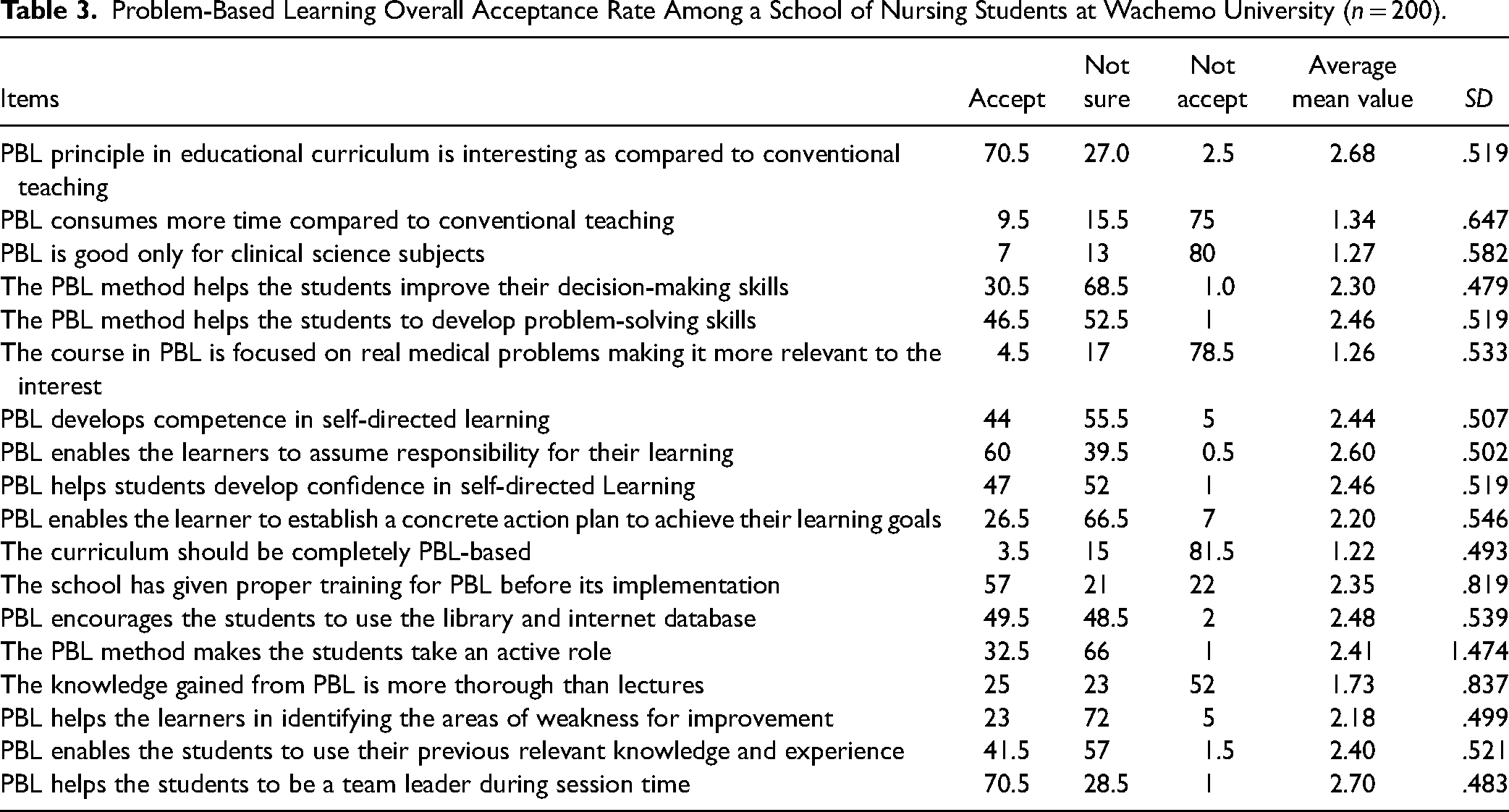
The Magnitude of PBL Acceptance
A standardized PBL acceptance 3-point scale measurement finding indicates that more than half of the study participants accepted the PBL strategy 58.5% [95% CI 52.5–65.5] (Figure 2).

Magnitude of problem-based learning acceptance.
Factors Associated With PBL Acceptance
Among socio-demographic variables, two variables sex and study year from other variables, Self-Study time, training, and computer access in the learning environment, facilitator feedback, and PBL class space were statistically significant in bivariate logistic regression. In the multivariate analysis, sex, study year, and computer access in the learning environment were statistically associated with PBL acceptance (Table 3).
The odds of PBL acceptance were 5 times higher among female nursing students when compared to male nursing students (AOR = 4.8 [95% CI 2.80–10.11]). Senior students were 3 times more likely to accept PBL than junior students (AOR = 2.92 [95% CI 1.85–5.65]). Students who used Computer access in a learning environment were 2 times more likely to accept PBL than those who were not used (AOR = 2.42 [95% CI 1.01–5.43]) (see Table 4).
Factors Associated With Problem-Based Learning Acceptance Among Nursing Students School of Nursing Wachemo University, Central Ethiopia, 2023 (n = 200).
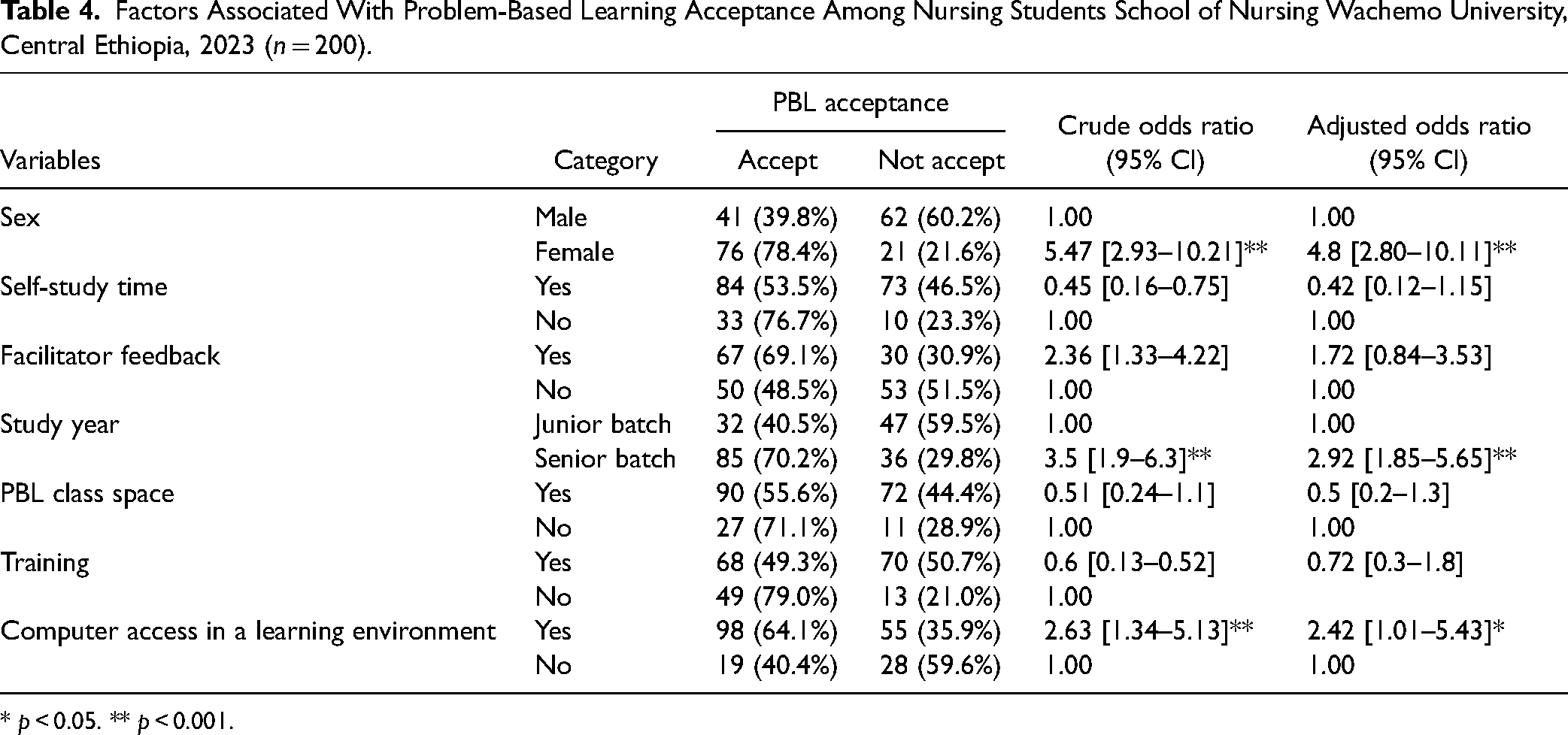
* p < 0.05. ** p < 0.001.
Discussion
More than half 58.5% [95% CI 52.5–65.5] of the respondents accepted PBL as a teaching-learning strategy. This study revealed that the overall prevalence rate of PBL acceptance was 58.5%. The findings of this study are nearly similar to study reports from Egyptian universities, South African Johannesburg University, and Malaysian University studies (Al-Drees et al., 2015; Bruce et al., 2018; Ommar, 2011). The prevalence of this study was higher than the study conducted in East Asia Malaysia (Al-Naggar & Bobryshev, 2012). The possible reason for this higher prevalence of PBL acceptance might be due to time difference, study setting, and differences in the study population. The other reason may also be the current education trend in the modern curriculum.
PBL can promote critical thinking skills, problem-solving skills, creative skills, and analytical skills, which are crucial in the twenty-first century, as they can enhance an individual's life. As these skills are important for students’ lives, it is crucial to encourage students to think deeply and critically. Additionally, Students will learn or be taught effectively and fruitfully if the teachers know their individual feelings, approaches, and methods that are appropriate for use in the classroom.
Being female, Computer access in the learning environment, and study year were factors that positively and significantly associated with PBL acceptance. Regarding study year, senior students were 3 times more likely to accept PBL than junior students. This finding was consistent with the study done in East Asia of Malaysia and Saud Arabia (Al-Naggar & Bobryshev, 2012; Atwa & Hassan, 2016).
The reason for this might be a progression of students from one study year to the next study increasing the development of knowledge level and their routine adherence to PBL sessions. In addition to this, PBL in parallel to conventional learning encourages the students to advance their self-dependent learning which makes them innovative, critical thinkers and enhances decision-making skills (EL-Shaer & Gaber, 2014). In the PBL strategy, the students are involved in a sequence of investigation activities to solve problems by integrating skills and concepts of the content of the teaching materials.
PBL places the students in a position to solve authentic problems to order or arrange the students’ knowledge, develop inquiry and high-order thinking skills, and develop self-confidence. Computer access in the learning environment made students 2 times more likely to accept PBL. This finding was consistent with the study done in Thailand and Malaysia (Al-Naggar & Bobryshev, 2012; Tawanwongsri & Phenwan, 2018). The possible reason for this might be a computer can help complete their work by giving them access to countless sources of information.
Government, education and organization websites offer a wealth of information related to practically any topic that students could be studying in school. Accessing the Internet from a computer allows students to quickly search for information and begin researching. While this information is good to have and can make it easier to clear up a topic or to cite information, they have to be careful of the legitimacy of the information. As many new technologies are interactive, it is now easier to create environments in which students can learn by doing, receive feedback continually refine their understanding, and build new knowledge. These technologies can also provide access to a vast array of information, (including digital libraries), data for analysis, tools for organizing ideas (concept maps), presenting ideas (PowerPoint presentations), and people who provide information, feedback, and inspiration.
Female students were 5 times more likely to accept PBL than male students. There was no similar research done for the factor being female with the AOR, the authors could not compare this research finding with the previous findings in this discussion part. From the investigator's view of viewpoint, Ethiopia which is a male-dominated country had a habit of giving males first than ladies and did not create much opportunity for females to express their ideas freely which come from people's cultures of different environments.
The other reason might be that PBL sessions made all students learn from each other, participate equally, advance their communication skills, become self-reliant, and responsible, and develop further confidence in the educational road map due to this, PBL brought a golden opportunity for female students to accept this strategic learning system (Yulistianti et al., 2018).
Conclusion
In conclusion, the result of this study showed that PBL acceptance among nursing students was high. Regarding associated variables, three variables such as being female, study year, and Computer access in the learning environment were factors associated with PBL.
Recommendations
Based on the study result, the University has to pay attention to female students to explore their potential to build the capacity for self-centered learning. This is a good opportunity for them to be competent students. Regarding computer access, the university must prepare all PBL session classes with functional internet access, avoid power interruption, and fulfill all necessary material for computers as much as possible. Regarding, the study year, all concerned instructors of PBL facilitators coach, mentor, and support students in their self-centered learning. The school must give feedback on PBL depending on the study year, and evaluate and construct an adaptive environment to the changing needs of students, teachers, and society. In addition, respective department heads and instructors should have developed strategies for real continuity of competency-based curriculum implementation in the educational system.
Implications for Research and Practice
The data generated will be valuable for healthcare managers and nurses in exploring student-centered learning interventions.
The findings will serve for further large-scale studies to closely examine the quality of nurse's education which have a great impact on nurse's practice today. This study put forward to improve the learning experiences of university students through the use of innovative collaboration technologies and novel methodologies to make students more motivated and researchable through PBL. Additionally, this study adds an attempt to move towards a more student-centered and participatory approach to learning through problem-based) and a unique opportunity for students to have an academic cross-cultural exchange.
Limitations of Study
Since this study used a cross-sectional design it cannot establish a cause-and-effect relationship or analyze behavior over some time. Therefore, it's better if future investigators use other study designs.
Footnotes
Acknowledgments
We want to thank the study participants for their openness to participate the provision of the necessary information, and scarification of their valuable time.
Authors’ Contribution
Asnakech Zekiwos, Taye Mezgebu, Elias Ezo, Getachaw Osabo, and Senteyehu Admasu participated in the ideas, formulation, or evaluation of overarching research goals and aims. Bethlehem Birhanu, Getachew Ossabo, and Bereket Hegeno are involved in data management activities, scrub data, and maintain research data (including software code for interpreting the data itself). Asnakech Zekiwos, Taye Mezgebu, Awoke Girma, Elias Ezo, Taye Mezgebu, and Getachaw Osabo conducted the data analysis and interpretation. Asnakech Zekiwos, Taye Mezgebu, Senteyehu Admasu, Bethlehem Birhanu, Getachew Ossabo, Elias Ezo, Awoke Girma, and Bereket Hegeno participated in the conducting research and investigation process, specifically performing the experiments. Elias Ezo, Asnakech Zekiwos, Taye Mezgebu, Senteyehu Admasu, and Bereket Hegeno participated in the development or design of the methodology. Asnakech Zekiwos, Elias Ezo, and Getachaw Osabo contributed to the management and coordination responsibility for the research activity planning and execution. Elias Ezo, Asnakech Zekiwos, Taye Mezgebu, Senteyehu Admasu, Bethlehem Birhanu, Getachew Ossabo, and Awoke Girma contributed to the provision of study materials, reagents, materials, patients, instruments, computing sources, and other analysis tools. Asnakech Zekiwos, Taye Mezgebu, and Awoke Girma used Epi data and SPSS software for analysis. Asnakech Zekiwos, Taye Mezgebu, Senteyehu Admasu, Bethlehem Birhanu, Getachew Ossabo, Bereket Hegeno, Awoke, and Elias Ezo supervised the study. Asnakech Zekiwos, Taye Mezgebu, Senteyehu Admasu, Bereket Hegeno, and Elias Ezo contributed to the verification, whether as part of the activity or separate, of the overall replication/reproducibility of results. Asnakech Zekiwos, Elias Ezo, and Senteyehu Admasu participated in the preparation, creation, and/or presentation. Asnakech Zekiwos and Taye Mezgebu made contributions in preparation, creation, and/or presentation, specifically writing the initial draft. Asnakech Zekiwos, Taye Mezgebu, and Getachaw Osabo have made contributions in preparation, creation, and/or presentation, specifically critical review, commentary, or revision.
Data Availability
The data used for analysis are available on secure and reasonable request.
Declaration of Conflicting Interests
The authors declared no potential conflicts of interest with respect to the research, authorship, and/or publication of this article.
Funding
The authors received no financial support for the research, authorship, and/or publication of this article.
