




Abstract
Background
Globally, ostomy creation rates are rising. Stomas, while life-saving, pose significant challenges. Nurses are vital in providing care and support to stoma patients. However, ostomy care practice and knowledge among Ethiopian nurses remain understudied. This study aimed to assess these aspects among nurses in Bahir Dar City, Ethiopia, in 2022.
Methods
An institutional-based cross-sectional study was conducted in three public hospitals in Bahir Dar City from September 19 to September 30, 2022. A simple random sampling technique was used to select 423 nurses. Binary logistic regression analysis was employed to identify associated factors toward dependent variables by considering p-value <0.05 to be statistically significant.
Result
From the total samples, 382(90.3%) responded to the questionnaire. The overall good knowledge and practice level of nurses regarding ostomy care was 55.2% and 52.1%, respectively. Taking ostomy care training {AOR = 2.44; 95% CI (1.29, 4.61)} and high level of a monthly income of study participants {AOR = 2.90; 95% CI (1.72, 4.91)} had a significant association with knowledge of ostomy care. On the other hand, taking courses on ostomy care {AOR = 1.76; 95% CI (1.06, 2.93)}, receiving training on ostomy care {AOR = 4.15; 95% CI (2.12, 8.09)} and good knowledge level on ostomy care {AOR = 2.13; 95% CI (1.32, 3.45)} were significantly associated with expressed practice of ostomy care.
Conclusion
The study found that only half of nurses exhibit good knowledge and practice in ostomy care. Training and monthly income significantly influence nurses’ knowledge, while practice level is associated with training, course attendance, and knowledge. These findings highlight the importance of targeted training programs and education initiatives to enhance nurses’ competence in ostomy care. It is also crucial to address factors like nurses’ income levels to ensure equitable access to educational resources and opportunities for professional development, thus enhancing their knowledge.
Introduction
An ostomy is a surgically created opening in the abdominal wall that diverts feces and urine externally (Hinkle & Cheever, 2018). More specifically, an intestinal ostomy involves the surgical creation of an opening in the intestine on the anterior abdominal wall, facilitating the expulsion of feces and flatus. The two predominant procedures in this category are colostomy and ileostomy (Ahmad et al., 2010). An intestinal ostomy may be permanent or temporary depending on the reason for the surgery, and the surgery is performed for various etiologies (Coca et al., 2015; Francielle Profeta et al., 2019).
The global incidence of ostomy creation is on the rise; nevertheless, not every country maintains precise and well-documented statistics on ostomates, contributing to the complexity of the situation (Subih & Teresa, 2016). In the case of Ethiopia, while the exact number of ostomates remains unknown, a significant number undergo stoma surgery annually (SSE, 2019).
Often, an intestinal ostomy can save lives by reducing the morbidity and mortality associated with the disease. Despite this, stomas are associated with significant complications, social isolation, and reduced quality of life (Ahmad et al., 2013). Approximately 20% to 71% of persons with an ostomy experience stoma-related complications (Medley, 2014). They may experience various physical, social, psychological, and spiritual problems following ostomy creation. Physically, patients experience peristomal skin problems, a prolapsed stoma, diarrhea, fecal leakage, wound infection, bleeding, anastomotic site stenosis, adhesion, wound dehiscence, stricture, and pain. Socially, they struggle with daily activities and feel that they are a burden to their families (Akgül & Karadag, 2016; Ambe et al., 2018; Bekele et al., 2008; Roshini et al., 2017; Veena et al., 2019). Patients may also face psychological problems like major depression and anxiety disorder (Porrett et al., 2010). A study conducted in Ethiopia revealed that of 253 patients who underwent ostomy surgery, 48.4% developed complications, and 9.6% died after surgery (Engida et al., 2016).
To effectively address the challenges faced by ostomates, specialized nursing care is crucial. These patients necessitate tailored management promoting independence and enhancing the quality of life across various care settings, including acute care, long-term care, or home environments (RNspeak, 2018). Nurses play a pivotal role in offering care and ongoing support during the adjustment phase to life with a stoma. Their influence extends to shaping perceptions and significantly impacting how patients and their families adapt to the new reality. The success of this role hinges on nurses possessing the requisite knowledge and skills, emphasizing the importance of continuous professional development (Dalmolin et al., 2016; Lapkin et al., 2018; Subih & Teresa, 2016).
Studies exploring the knowledge, attitude, and practice levels of nurses have been conducted across different nursing specialties and countries. In Ethiopia, recent studies have specifically assessed nurses’ knowledge and attitude toward colostomy care. However, none of these studies have specifically investigated the practice level (Belay et al., 2023; Tiruneh et al., 2022).
Review of Literature
Previous studies highlight a deficiency in the knowledge and skills of nurses caring for patients with intestinal ostomies. In a cross-sectional study in Nellore, India, 53.3%, 40%, and 6.7% of sampled staff nurses exhibited inadequate, moderately adequate, and adequate knowledge of colostomy care, respectively (G Betty Lebona G et al., 2016). Similarly, a descriptive study in India found that 46.7% of staff nurses had inadequate knowledge, 40% had moderately adequate knowledge, and 13.3% had adequate knowledge regarding ostomy care (Rama Harika et al., 2016). A study in California revealed that the majority of staff nurses possessed a fair working knowledge of ostomy care principles (Gemmill et al., 2011). Conversely, a cross-sectional study in Egypt reported that all studied nurses had unsatisfactory knowledge regarding colostomy standards, with a corresponding unsatisfactory score for actual nurses’ practice of those standards (Bhzeh et al., 2013). Additionally, a study at Mansoura University, Egypt, disclosed that 80% of the studied nurses had poor knowledge and practice regarding ostomy care (Hashem & Abusaad, 2016). In the Ethiopian context, recent cross-sectional studies have been conducted to assess nurses’ knowledge levels regarding colostomy care. These studies specifically found that 57.6% (Belay et al., 2023) and 40.4% (Tiruneh et al., 2022) of nurses demonstrated a good knowledge of colostomy care.
Specifically on practice, a cross-sectional study in Turkey assessing staff nurses’ knowledge and perceived responsibilities for care revealed that 43.4% routinely cared for stoma patients (Duruk & Uçar, 2013). In Iran, a cross-sectional study among nurses found that only 27.8% and 5.6% demonstrated good and very good practices in ostomy care (Bagheri et al., 2017). In China, a study indicated that 62.62% of respondents provided direct ostomy care in their daily practice, with an average total practice score of 26.61 ± 7.98 (range, 8–40 points) (Li et al., 2019).
Many factors may affect the care given to patients with an ostomy. Level of education, level of reviewing professional literature on ostomy care, receiving training on ostomy care, and participation in scientific meetings on the subject are factors that affect knowledge of ostomy care (Cross et al., 2014; Duruk & Uçar, 2013). Practice regarding ostomy care is also affected by a variety of factors. Evidence showed that insufficient knowledge of the nurses regarding the subject, insufficient training during graduation, or lack of technical and scientific training, reading professional literature, and work experience affect nurses’ ostomy care practice (Ardigo & Amante, 2013; Bhzeh et al., 2013; Cross et al., 2014; Duruk & Uçar, 2013; Li et al., 2019; Mauricio et al., 2013).
If nurses do not have adequate knowledge and skill, this may lead to a greater incidence of stoma-related complications and ultimately to poor quality of life in patients who have an intestinal ostomy. Despite these facts, only little action is undertaken to solve this problem (Foà et al., 2019). Assessing the level of knowledge and skill of health care providers, especially nurses is crucial to design appropriate interventions for problems encountered by patients who need ostomy care. Despite this fact here in Ethiopia, the knowledge and practice level of nurses and their associated factors regarding intestinal ostomy care are not well studied. So, this study aimed to assess the current knowledge and practice level of nurses regarding intestinal ostomy care along with their associated factors in Bahir Dar City, Ethiopia.
Methods
Study Design, Area, and Period
An institutional-based cross-sectional study was conducted from September 19–30/2022 at public hospitals of Bahir Dar City which is the capital city of Amhara regional state and is situated southern shore of Lake Tana. The city is located approximately 565 km northwest of Addis Ababa, Ethiopia's capital city. It has three public hospitals: Felege Hiwot Comprehensive Specialized Hospital, Tibebe Ghion Specialized Teaching Hospital, and Addis Alem Primary Hospital. These hospitals are serving the population of Bahir Dar City and remote areas of Northwest Ethiopia along with private health facilities in the city.
Research Questions
What is the knowledge level of intestinal ostomy care among nurses in Bahir Dar City, Ethiopia?
What is the practice level of intestinal ostomy care among nurses in Bahir Dar City, Ethiopia?
What are the factors associated with knowledge of intestinal ostomy care among nurses in Bahir Dar City, Ethiopia?
What are the factors associated with the practice of intestinal ostomy care among nurses in Bahir Dar City, Ethiopia?
Study Population and Eligibility Criteria
The study population consisted of staff nurses employed in the three hospitals. Only staff nurses who had been working in these hospitals for more than 6 months and were available during the study period were included. Ophthalmic, psychiatric, and anesthetic nurses were excluded from the study.
Sample
The sample size was calculated using a single population proportion formula considering the assumptions of 95% CI and a 5% margin of error. Since there was no similar published study found in Ethiopia that addresses the proportion of good knowledge and practice of nurses regarding ostomy care, the investigators premeditate to make use of 50%. Based on this assumption, the calculated sample size was 384. After adding a 10% nonresponse rate the final sample size was calculated to be 423
The list of all nurses who were eligible for the study was taken from the human resource management department of each respective hospital. Through the proportional allocation of the three hospitals, the selection of 423 study participants was implemented using a simple random sampling technique.
Study Variables
The dependent variables were the knowledge and practice levels of nurses. The independent variables included various sociodemographic factors, such as sex, age, marital status, work experience, monthly income, school attended, and educational level. Furthermore, factors related to continuous education in ostomy care were also considered, such as receiving training, reviewing related literature, taking ostomy care courses, and participating in relevant scientific conferences.
Operational Definition
Ostomy care knowledge and practice were classified as either good or poor based on their mean value (Nuru et al., 2015). For knowledge, it was considered good if the total score of knowledge questions equaled or exceeded the mean (27.02). Otherwise, it was classified as poor. Similarly, good practice in ostomy care was determined if the total score of practice-related questions met or exceeded the mean score (44.35); otherwise, it was characterized as poor.
Data Collection Tool
Data were collected using a structured, self-administered questionnaire. The data collection instrument was developed in the English version which contained three parts. Part one explains nurses’ sociodemographic and professional characteristics. The second part is about nurses’ knowledge regarding intestinal ostomy care, and the third part is about nurses’ expressed practice regarding this care. The knowledge part of the questionnaire is adopted from a similar study conducted in Turkey (Duruk & Uçar, 2013). This tool had 54 items with a true–false and I do not know options. The correct answer was coded as 1, while the remaining options were coded as 0. In this essence, the possible minimum and maximum scores were 0 and 54 respectively. The practice part of the questionnaire is adapted from different pieces of literature (Bhzeh et al., 2013; Li et al., 2019). It had 17 question items with a 5-point Likert scale (always = 4, often = 3, sometimes = 2, rarely = 1, and never = 0). The possible maximum score was 68. The Cronbach alpha of this tool was 0.88. The validity of the questionnaire was ensured by experienced nurses who have expertise in both clinical practice and research.
Data Collection Procedure
After obtaining ethical approval, permission was sought from the relevant authorities in each hospital. Then, selected nurses were approached and invited to participate in the study at their workplace. Once informed consent was obtained from the nurses, they were given questionnaires to fill out, which were then returned on the same day. Failure to return the questionnaire on the same day was considered as nonresponse. The data collection process was facilitated by three diploma nurses who had no affiliation with the study settings. Additionally, a trained BSc Nurse closely supervised the data collection process.
Data Quality Assurance
The instrument was pretested in 5% of subjects before the actual day of data collection at the Debre Tabor referral hospital. Data collectors and the supervisor received one-day training on the study's purpose, confidentiality, and respondents’ rights. Supervision was also made daily and the records were checked for completeness every day by the supervisor.
Statistical Analysis
Data were coded, entered into Epi-data version 4.6, and then exported to STATA version 14.0 for analysis. Following data cleaning procedures, descriptive statistics including mean, standard deviation, frequencies, and proportions were computed and presented using tables, graphs, and textual summaries. Binary logistic regression analysis was performed to identify factors associated with the knowledge and practice levels of nurses, serving as the dependent variables. Two models were fitted for each dependent variable. All independent variables were entered into multivariable logistic regression analysis. Model fitness was checked by the Hosmer–Lemeshow goodness-of-fit test. The p-values for these test results were .49 and .08 for knowledge and practice, respectively. Statistical significance was declared at p-value <.05.
Result
Sociodemographic Characteristics of Respondents
From the total of 423 samples, a complete response was obtained from 382 (90.3%) of them. The mean age of study participants was 30.5 years (±SD 5.4) with a range of 21–48 years. Slightly more than half (58.1%) were females. Of the participants, the majority (90.1%) were BSc degree holders and 72.3% of them reported being married (Table 1).
Sociodemographic Characteristics of Nurses Working at Public Hospitals in Bahir Dar City, Northwest Ethiopia, 2022 (n = 382).

Profession-Related Characteristics of Nurses
In this study, almost two-thirds (64.9%) of respondents took courses on ostomy care while they studied for their highest nursing qualification. On the other hand, the majority (87.7%) of them did not ever attend scientific conferences on ostomy care (Table 2).
Profession-Related Characteristics of Nurses Working at Public Hospitals in Bahir Dar City, Northwest Ethiopia, 2022 (n = 382).

Knowledge and Practice Level of Nurses Regarding Ostomy Care
Among study participants, 211 (55.2%, 95% CI; 50.2–60.2) had good knowledge of ostomy care, and 199 (52.1%, 95% CI; 47.1–57.1) had good expressed practice about ostomy care (Figure 1). Around one third (34.3%) of nurses reported that they were always performing preoperative stoma site marking on clients undergoing ostomy surgery. Regarding checking stomal or peristomal skin conditions with each appliance change, two-fifths (41.9%) of them did always and 4% of them never did (Supplemental Table 1).

Proportion of the overall knowledge and practice level of nurses working at public hospitals in Bahir Dar City, Northwest Ethiopia, 2022 (n = 382).
Factors Associated With Knowledge of Ostomy Care
All 11 independent variables were entered into the multivariable logistic regression analysis. As a result, training on ostomy care and the monthly income level of participants showed a statistically significant association. The odds of having good knowledge of ostomy care were 2.4 times among nurses who took training regarding ostomy care compared with those who did not take the training {AOR = 2.44; 95% CI (1.29, 4.61)}. The analysis also showed that nurses who had relatively high monthly income levels were almost 3 times more likely to have good knowledge of ostomy care compared to their counterparts {AOR = 2.90; 95% CI (1.72, 4.91)} (Table 3).
Factors Associated with Knowledge of Ostomy Care Among Nurses Working at Public Hospitals in Bahir Dar, Northwest Ethiopia, 2022 (n = 382).

*p < .05, **p < .01, ***p < .001.
Factors Associated With Expressed Practice Toward Ostomy Care
Another model was fitted to identify factors associated with the expressed practice. The result showed taking courses on ostomy care, training on ostomy care, and knowledge level on ostomy care were significantly associated with it. The odds of having good expressed practice on ostomy care were 1.8 times among nurses who took courses concerning ostomy care when they studied for their highest nursing qualification compared with those who did not take the course {AOR = 1.76; 95% CI (1.06, 2.93)}. On the other hand, the odds of having good expressed practice on ostomy care among nurses who took training within the last six months were 4 times compared with their counterparts {AOR = 4.15; 95% CI (2.12, 8.09)}. The odds of having good expressed practice were 2 times {AOR = 2.13; 95% CI (1.32, 3.45)} among nurses who had good knowledge compared with their counterparts (Table 4).
Factors Associated with Expressed Practice Regarding Ostomy Care Among Nurses Working at Public Hospitals in Bahir Dar, Northwest Ethiopia, 2022 (n = 382).
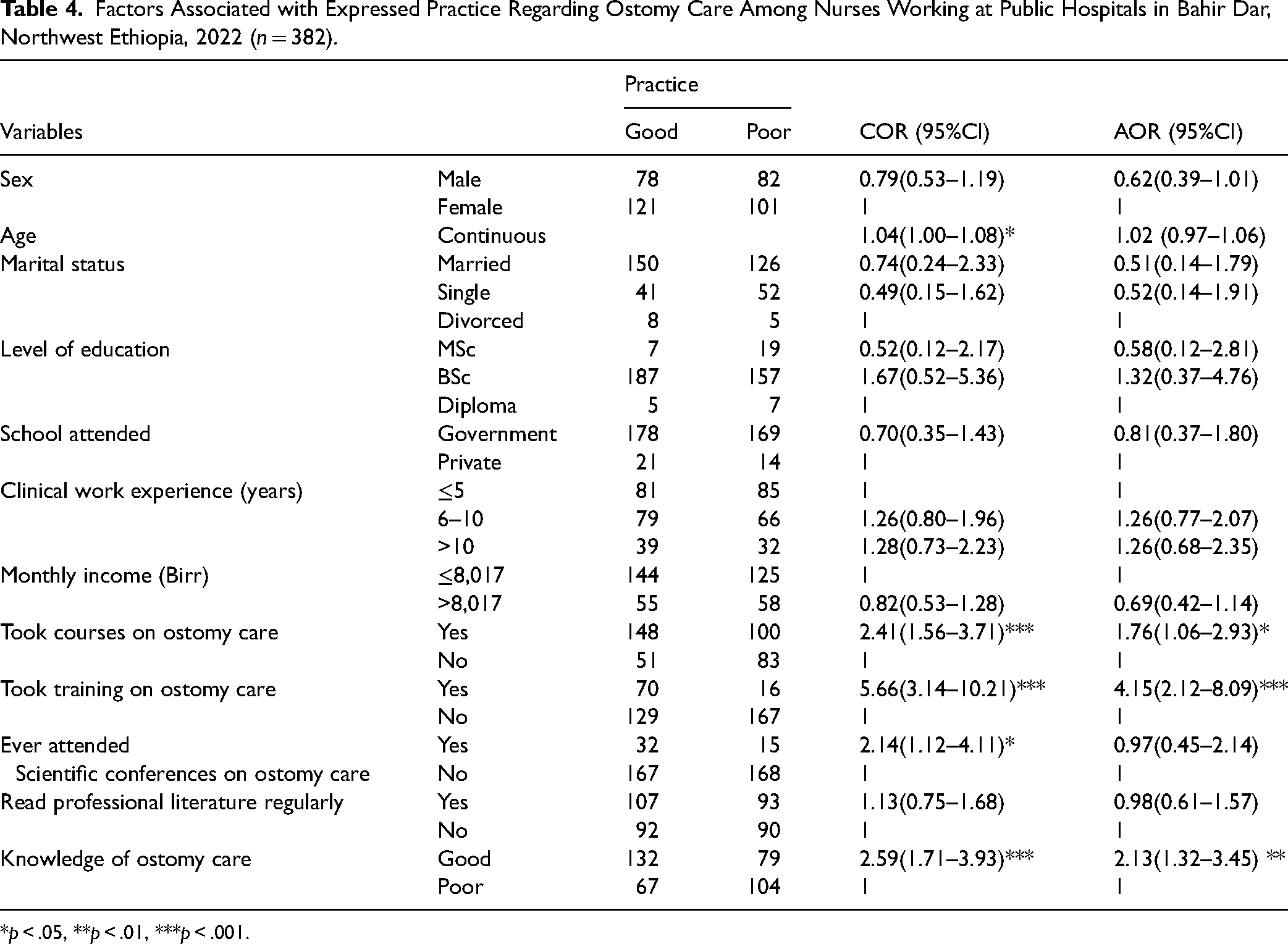
*p < .05, **p < .01, ***p < .001.
Discussion
This facility-based cross-sectional study has assessed the knowledge, expressed practice, and associated factors regarding ostomy care among nurses working at public hospitals in Bahir Dar City, North West Ethiopia. The study found that more than half of nurses (55.2%) were knowledgeable about ostomy care. This finding is consistent with the study findings from India (Rama Harika et al., 2016) and Ethiopia (Belay et al., 2023).
Knowledge of ostomy care documented in this study finding is higher than the findings from Egypt and Ethiopia (Bhzeh et al., 2013; Hashem & Abusaad, 2016; Tiruneh et al., 2022). The disparity in results could be attributed to variations in sociodemographic characteristics of nurses as well as study time discrepancies. The majority of participants (88.5%) in one of the above studies were diploma nurses, which may decrease the proportion of knowledgeable nurses (Bhzeh et al., 2013). According to the literature, the educational level has a substantial impact on nurses’ knowledge and competencies. Nurses with a Bachelor of Science in Nursing degree are better prepared to fulfill the demands of the profession than those with a lesser level of education (Masha et al., 2017). The other reason might be the difference in the data collection tool and cut point.
Regarding ostomy care practice, slightly more than half (52.1%) were in the higher category. This result is much higher than the study conducted in Egypt where the majority of their respondents had poor practice levels (Bhzeh et al., 2013; Hashem & Abusaad, 2016). These inconsistencies might be due to differences in data collection tools and procedures. In the Egyptian studies, data were collected by an observational checklist which is believed to reduce the proportion of nurses that had satisfactory practice. The implication that can be drawn from this observation, especially when taking into account the avoidance of social desirability bias, is that the practice of ostomy care may be substandardized. Therefore, there is a clear need for standardized protocols and comprehensive training in this area to ensure consistent and high-quality care across healthcare settings. This study finding is also higher than the study done in Turkey where only 43.4% of respondents had a good practice (Duruk & Uçar, 2013). This discrepancy may be due to differences in study time and sociodemographic features. On the contrary, the level of practice in this study is lower compared to a Chinese study (Li et al., 2019). This inconsistency might be due to the better healthcare system in China that obliges high standard nursing care for patients.
The current study also identified variables like level of monthly income and receiving training as factors significantly associated with knowledge of ostomy care. Nurses who received ostomy care training had higher odds of having good knowledge. This finding is supported by other studies (Cross et al., 2014; Hashem & Abusaad, 2016). This is because individuals who took training on a certain subject matter have the latest information which eventually raises their level of knowledge. According to the current study, those with a relatively higher monthly income have a better knowledge of ostomy care. This could be justified as nurses with a higher monthly income might have access to more resources, such as purchasing books and having a private internet connection, which may aid in knowledge acquisition.
In this study, three variables showed statistically significant associations with the expressed practice of ostomy care. Accordingly, the odds of having good practice were higher among nurses who had good knowledge. This study finding is consistent with the findings of an earlier study conducted in Egypt (Bhzeh et al., 2013). This result supports the assertion that knowing about something is necessary for putting it into action. This study result also revealed that participating in training regarding ostomy care is significantly associated with the practice of ostomy care. Similarly, the previous finding from New York revealed that higher knowledge and skills in ostomy care were associated with more training (Cross et al., 2014). Moreover, this study analysis showed that nurses who took courses on ostomy care when they studied for their highest nursing qualification had a higher practice level. This could be justified as those who took training and courses recently can update their knowledge thereby providing quality ostomy care. This implies that both preservice and in-service training are crucial for improving the care given to ostomates.
In this study, it is important to acknowledge the possibility that the self-rating of practice level could be influenced by social desirability bias. This bias may lead participants to overestimate their practice level, potentially skewing the results.
Implication for Practice
The findings from this study underscore the need for targeted interventions to enhance nurses’ knowledge and practice in ostomy care. The overall levels of good knowledge and practice indicate room for improvement in this critical aspect of nursing care. Notably, the study highlights the significant associations between formal ostomy care training and a higher monthly income with increased knowledge of ostomy care. This suggests that investing in specialized training programs and addressing economic factors may positively influence nurses’ knowledge levels. Recommendations include prioritizing ostomy care training for staff nurses in hospitals, active facilitation of training programs by the Amhara Regional Health Bureau, and governmental consideration of measures to increase nurses’ monthly income. Furthermore, the study emphasizes the importance of ongoing education, as evidenced by the significant associations between taking courses, receiving training, and possessing a good knowledge level with improved ostomy care practices. These findings advocate for the incorporation of targeted educational initiatives and continuous training programs to enhance both knowledge and practical skills among nursing professionals in the field of ostomy care.
Conclusion
The study found a relatively high good knowledge and expressed practice of ostomy care. Receiving training regarding ostomy care and the high monthly income level of study participants significantly associated with their knowledge of ostomy care. Furthermore, taking courses on ostomy care, receiving training on ostomy care, and high knowledge status on ostomy care positively affect the expressed ostomy care practice of nurses.
Supplemental Material
sj-docx-1-son-10.1177_23779608241274205 - Supplemental material for Knowledge and Practice of Intestinal Ostomy Care Among Nurses in Bahir Dar City, Ethiopia: A Cross-Sectional Study
Supplemental material, sj-docx-1-son-10.1177_23779608241274205 for Knowledge and Practice of Intestinal Ostomy Care Among Nurses in Bahir Dar City, Ethiopia: A Cross-Sectional Study by Destaw Endeshaw, Tadesse Dagget Tesfaye, Sahileslassie Afewerk, Ousman Adal and Asnake Gashaw Belayneh, Eyob Ketema Bogale, Senay Yohannes in SAGE Open Nursing
Supplemental Material
sj-pdf-2-son-10.1177_23779608241274205 - Supplemental material for Knowledge and Practice of Intestinal Ostomy Care Among Nurses in Bahir Dar City, Ethiopia: A Cross-Sectional Study
Supplemental material, sj-pdf-2-son-10.1177_23779608241274205 for Knowledge and Practice of Intestinal Ostomy Care Among Nurses in Bahir Dar City, Ethiopia: A Cross-Sectional Study by Destaw Endeshaw, Tadesse Dagget Tesfaye, Sahileslassie Afewerk, Ousman Adal and Asnake Gashaw Belayneh, Eyob Ketema Bogale, Senay Yohannes in SAGE Open Nursing
Supplemental Material
sj-docx-3-son-10.1177_23779608241274205 - Supplemental material for Knowledge and Practice of Intestinal Ostomy Care Among Nurses in Bahir Dar City, Ethiopia: A Cross-Sectional Study
Supplemental material, sj-docx-3-son-10.1177_23779608241274205 for Knowledge and Practice of Intestinal Ostomy Care Among Nurses in Bahir Dar City, Ethiopia: A Cross-Sectional Study by Destaw Endeshaw, Tadesse Dagget Tesfaye, Sahileslassie Afewerk, Ousman Adal and Asnake Gashaw Belayneh, Eyob Ketema Bogale, Senay Yohannes in SAGE Open Nursing
Footnotes
Acknowledgments
The authors would like to express our gratitude to the study participants, data collectors, and supervisors for their contributions to this study.
Author Contributions
DE, TDT, SY, and SA conceived and designed the study. EKB, OAT, and AGB performed the analysis and write-up of the study. DE prepared the manuscript for publication, and all authors critically reviewed the initial draft of the manuscript. All authors read and approved the final manuscript.
Data Availability
All data generated or analyzed during this study are included in this published article.
Declaration of Conflicting Interests
The authors declared no potential conflicts of interest with respect to the research, authorship, and/or publication of this article.
Ethical Consideration
Ethical clearance was obtained from University of Gondar, College of Medicine and Health Sciences, School of Nursing ethical review committee (Ref Number: S/N/397/2014). A formal letter was written to all concerned authorities. Written informed consent was obtained from study participants. To ensure privacy and confidentiality, personal details such as the names of the participants were not collected, and all research data were securely stored in a password-protected file.
Funding
The authors received no financial support for the research, authorship, and/or publication of this article.

Supplemental Material
Supplemental material for this article is available online.
References
Supplementary Material
Please find the following supplemental material available below.
For Open Access articles published under a Creative Commons License, all supplemental material carries the same license as the article it is associated with.
For non-Open Access articles published, all supplemental material carries a non-exclusive license, and permission requests for re-use of supplemental material or any part of supplemental material shall be sent directly to the copyright owner as specified in the copyright notice associated with the article.
