




Abstract
Introduction
Catheter-associated urinary tract infection
Objective
This study aimed to assess KAP and associated factors toward the prevention of CAUTI among nurses in public hospitals in Addis Ababa, Ethiopia, in 2021.
Methods
An institution-based cross-sectional study was conducted among nurses from March 1 to April 30, 2021, in five public hospitals in Addis Ababa, Ethiopia. A total of 344 nurses were chosen for the study using a systematic random sampling technique. Data were collected using knowledge, attitude, and practice toward the prevention of CAUTI questionnaires. Data were entered into Epi Data 4.2 and exported into SPSS 25 for analysis. Binary and multivariate logistic regression were performed, and the statistical significance of associations between the variables was determined using odds ratios with a 95% confidence interval and p < .05.
Results
The study included 344 nurses, with a 97.7% response rate. Of the total nurses, 42.7% had good knowledge, 48.0% had a positive attitude, and 54.9% had good practice toward the prevention of CAUTI. Being married, having guidelines, and having a positive attitude were associated with good knowledge, whereas being married, having good knowledge, and having good practice were associated with a positive attitude toward the prevention of CAUTI. Having a high monthly income, having guidelines, having good knowledge, and having a positive attitude were associated with good practices toward the prevention of CAUTI.
Conclusion
The findings of this study show that nurses have a low level of knowledge, a negative attitude, and poor practice toward the prevention of CAUTI. Factors such as marital status, monthly income, and having guidelines in the working unit were associated with KAP toward the prevention of CAUTI. Therefore, the Ministry of Health and Hospital Interventions focused on these findings are required to improve KAP toward the prevention of CAUTI among nurses.
Introduction
Catheter-associated urinary tract infection (CAUTI) is one of the major device-associated hospital-acquired infections (HAIs) of the urinary tract in hospitals (Shah et al., 2017). HAI is an infection in which a patient is infected after 48 h of admission, within 3 days of discharge, or 30 days after a surgical procedure. CAUTI is one of the most common HAIs, accounting for 80% of HAIs (Dellinger, 2016; Nicolle, 2014). CAUTIs have been linked to higher morbidity, mortality, healthcare expenses, and length of stay (Rubi et al., 2022).
CAUTI is not only the burden of low- and middle-income countries, but it is also a global burden (World Health Organization, 2011). Global estimates, however, show that the burden of CAUTI is greater in low-income countries than in high-income nations, with cumulative incidence densities of 8.8/1,000 catheter days and 4.1/1,000 catheter days, respectively (Lakoh et al., 2023; World Health Organization, 2011).
Globally, CAUTIs account for 40% of all HAIs and 80% of all nosocomial urinary tract infections (UTIs) (Dellinger, 2016; Nicolle, 2014; Oumer et al., 2021). In the USA, UTI is one of the most prevalent hospital-acquired illnesses; CAUTI accounts for 70%–80% of these infections (Lo et al., 2014). The prevalence of CAUTI is 23.33% in Benin, West Africa (Dougnon et al., 2016), 14.8% in Sierra Leone (Lakoh et al., 2023), 15.3% in south Uganda (Musinguzi et al., 2019), 17.6% in Rwanda (Etyang et al., 2020), 23.3% in Addis Ababa, Ethiopia (Shiferaw et al., 2023), 30.2% in Hawassa, Ethiopia (Kefeni et al., 2024), and 16.8% in Arba Minch, southern Ethiopia (Oumer et al., 2021).
In order to lower the frequency of CAUTI, research on health workers’ knowledge, attitudes, and practices about CAUTI prevention, particularly among nurses, is crucial. Because nurses are accountable for catheter insertion and maintenance, they are seen as the primary healthcare provider (Benny et al., 2020). If nurses have good knowledge and practice effectively by following aseptic methods in the prevention of CAUTI, 69% of catheter-associated infections can be avoided (Mota & Oliveira, 2019).
Literature Review
Studies have demonstrated that health professionals, especially nurses, should have good knowledge, a positive attitude, and good practices toward the prevention of CAUTI (Saint et al., 2016). Nevertheless, poor knowledge, a negative attitude, and poor practice toward the prevention of CAUTI remain an extensive problem among nurses (Shah et al., 2017). The proportion of nurses with good knowledge regarding the prevention of CAUTI in Pakistan is 66.0% (Shah et al., 2017), in Georgia 86.9% (Shaver et al., 2018), in India 16.7% (Cutinho & Sheilini, 2018), in Nellore 20% (Ramya et al., 2016), and in Rwanda 64.5% (Mukakamanzi, 2017). In Ethiopia, the proportion of nurses with good knowledge regarding the prevention of CAUTI in Addis Ababa among nurses working in the intensive care unit (ICU) is 36.9% (Teshager et al., 2022), in Assela 58.7% (Wake et al., 2021), and in Gondar 37.7% (Zegeye et al., 2023).
The proportion of nurses with positive attitudes toward the prevention of CAUTI is 52.2% in Pakistan (Shehzadi et al., 2018), 52.8% in Rwanda (Mukakamanzi, 2017), and 52.9% in Assela, Ethiopia (Wake et al., 2021). The proportion of nurses with good practice toward the prevention of CAUTI is 56.4% in Pakistan (Shah et al., 2017), 79.9% in Rwanda (Mukakamanzi, 2017), 52.2% in Addis Ababa, Ethiopia, among nurses working in the ICU (Teshager et al., 2022), 50% in Assela, Ethiopia (Wake et al., 2021), and 51.8% in Gondar, Ethiopia (Zegeye et al., 2023).
A multitude of factors may affect good knowledge, a positive attitude, and good practice toward the prevention of CAUTI among nurses. These include demographic factors such as age, gender, marital status, religion, monthly incomes or salaries, level of education, and year of experience (Algarni et al., 2019; Benny et al., 2020; Jain et al., 2015; Mong et al., 2022; Mukakamanzi, 2017; Ramya et al., 2016; Rashmi & Dhakal, 2021; Shah et al., 2017; Shaver et al., 2018; Teshager et al., 2022; Wake et al., 2021; Zegeye et al., 2023) and institutional factors such as availability of a training program related to infection prevention, taking training related to infection prevention, numbers of trainings taken related to infection prevention, time of training related to infection prevention, having a catheter insertion and removal protocol or guideline in your working unit, and following protocol or guideline (Benny et al., 2020; Biresaw et al., 2020; Mukakamanzi, 2017; Niederhauser et al., 2019; Rashmi & Dhakal, 2021; Shaver et al., 2018; Zegeye et al., 2023).
Good knowledge, a positive attitude, and good practice toward the prevention of CAUTI among nurses are very important for preventing the patient from developing CAUTI. However, only one study was conducted on knowledge, practice, and associated factors among nurses working in intensive care units in public hospitals in Addis Ababa (Teshager et al., 2022), and per our search, there have been no studies conducted among nurses working in all units in public hospitals in the study area. Therefore, this study aimed to assess knowledge, attitude, practice, and associated factors toward the prevention of CAUTI among nurses in public hospitals in Addis Ababa, Ethiopia, in 2021.
Methods
Study Design, Setting, and Population
This cross-sectional study was conducted from March 1 to April 30, 2021, in five selected public hospitals from 12 public hospitals located in Addis Ababa, Ethiopia, using the lottery method. Those hospitals were Tikur Anbessa Specialized Hospital, ALERT Comprehensive Specialized Hospital, Menilik II Comprehensive Specialized Hospital, Eka Kotebe General Hospital, and Zewditu Memorial Hospital. The source population of the study was all nurses working in public hospitals in Addis Ababa, Ethiopia. The study population consisted of all nurses working in the selected public hospitals in Addis Ababa, Ethiopia.
Inclusion and Exclusion Criteria
All nurses working in public hospitals who were willing to participate were included in the study. Nurses working in public hospitals who were on maternity leave, annual leave, and sick leave at the time of data collection and nurses who were in managerial positions were excluded from the study.
Sample Size and Sampling Procedure
The sample size was calculated using a single population proportion formula based on the assumptions of the 95% confidence level, 5% margin of error, and 50% population proportion, since the actual proportion of knowledge, attitude, and practice toward the prevention of CAUTI in Ethiopia among nurses was unknown. Because the sampling frame was <10,000, a correction formula was used, and the final sample size was determined using the correction formula (nf = n/n + 1/N). The final sample size was 352 by adding 10% of the nonresponse rate. Out of 352, 344 nurses were consented to and recruited from five public hospitals in Addis Ababa. The sample size (n) was proportionally allocated to each hospital depending on the number of nurses in each hospital (N). Tikur Anbessa Specialized Hospital (N = 825, n = 128); ALERT Comprehensive Specialized Hospital (N = 400, n = 62); Menilik II Comprehensive Specialized Hospital (N = 376, n = 59); Eka Kotebe General Hospital (N = 160, n = 25); and Zewditu Memorial Hospital (N = 500, n = 78). Each nurse was finally selected using a systematic random sampling method, obtaining the list of nurses working in the study area from the administrative records of each hospital. Each nurse was selected by using the formula K = N/n (N = population size, n = required sample size). For each hospital, K = 2261/352 = 6, and then the first sample was selected randomly from 1 to 6 by the lottery method, and every six intervals were selected until the proportional sample size was completed for each hospital.
Study Variables
Dependent Variable
The dependent variables were knowledge, attitude, and practice toward the prevention of CAUTI.
Independent Variables
The independent variables included sociodemographic factors (age, gender, marital status, religion, monthly incomes or salaries, level of education, and year of experience) and institutional factors (availability of a training program related to infection prevention, taking training related to infection prevention, numbers of trainings taken related to infection prevention, time of training related to infection prevention, having a catheter insertion and removal protocol or guideline in your working unit, and following protocol or guideline).
Data Collection Instruments and Procedures
The English version of the self-administered structured questionnaire, which was adapted from a similar study conducted in Rwanda, was used for data collection, and the reliability (α) of these tools was .76 (Mukakamanzi, 2017). A pretest was done on 5% of the study population (18 nurses) at Yekatit-12 Hospital Medical College in Addis Ababa, Ethiopia. Based on the findings of the pretest, modifications and developments to the questionnaire were made. The questionnaire consisted of five parts: Part 1: sociodemographic information; Part 2: information on institutional factors; Part 3: knowledge toward the prevention of CAUTI; Part 4: attitude toward the prevention of CAUTI; and Part 5: practice toward the prevention of CAUTI. The data were collected by three BSc nurses under the supervision of two supervisors (MSc nurses) and a principal investigator.
Knowledge toward the prevention of CAUTI is the nurse's theoretical understanding of catheterization, indications of catheterization, the removal of the catheter, the major complications related to catheterization, and determining factors that cause UTI (Mukakamanzi, 2017). The 10-item questionnaire was used to measure the knowledge of nurses about the prevention of CAUTI. For each correct answer, 1 point is given, and 0 is given for incorrect answers. The score range is 0–10. The level of knowledge of nurses toward the prevention of CAUTI was classified as good for those who answered correctly the mean and above the mean value and poor for those who answered below the mean value. The tool had an internal consistency (α) of .75 in this study.
Attitude toward the prevention of CAUTI refers to the perception, beliefs, opinions, and general views of the nurses about the indication of catheterization, the removal of catheterization, and the complications of UTI related to catheter-associated care from their perspective (Mukakamanzi, 2017). The eight-item questionnaire was used to measure the attitude toward the prevention of CAUTI among nurses. Items were scored on a 3-point Likert scale ranging from disagree (1) to agree (3). The score range is 8–24, with scores equal to the mean value and above indicating positive attitude and below the mean value indicating negative attitude. The internal consistency of the measure was .78 (α) in this study.
Practice toward prevention of CAUTI is the actual skill and performance of the nurse regarding the procedure, ways, and methods to prevent CAUTI during catheterization, catheter removal, and maintenance (Mukakamanzi, 2017). The 20 self-reported practice items questionnaire was used to measure practice toward the prevention of CAUTI among nurses. Each nurse scored 1 (yes) if they performed the action to prevent CAUTI or 0 (no) if they did not. The score range is 0–20, with scores equal to the mean value and above considered good practice and scores below the mean value considered poor practice. The internal consistency (α) of the tool was .71 in this study.
Data Analysis and Processing
The collected data were coded, cleaned, and entered into Epi Data version 4.2 and exported to SPSS version 25 for analysis. Descriptive statistics, binary, and multivariate logistic regression were performed. A binary logistic regression analysis model was used to identify factors associated with knowledge, attitude, and practice toward the prevention of CAUTI. In binary logistic regression analysis, different independent variables have associations with each of the dependent variables (knowledge, attitude, and practice toward the prevention of CAUTI). Those variables with P ≤ 0.25 in the bivariate logistic regression analysis with each of the dependent variables were entered into a multivariate logistic regression analysis for each of the dependent variables. A multivariate logistic regression model was used to identify the association of independent variables and knowledge, attitude, and practice toward the prevention of CAUTI. In multivariable logistic regression analysis, the statistical significance of associations between independent variables and knowledge, attitude, and practice toward the prevention of CAUTI was determined using odds ratios with a 95% confidence interval (CI) at p < .05.
Results
Sociodemographic Characteristics of Nurses
Out of a total of 352, 344 nurses participated in the study, with a response rate of 97.7%. More than half of the nurses, 200 (58.1%), were between the ages of 26 and 30, with a mean age of 28.68 ± 4.18 years. Among the nurses, 194 (56.4%) were female, 190 (55.2%) were single, and 239 (69.5%) were followers of the orthodox Christian religion. The majority of the nurses, 217 (63.1%), had a monthly income or salary between 6,193 and 8,125 Ethiopian Birr (ETB), and 282 (82.0%) held a bachelor degree (BSc) in nursing. Of the nurses, 153 (44.5%) had work experience of 4–6 years (Table 1).
Sociodemographic Characteristics of Nurses in Public Hospitals, Addis Ababa, Ethiopia, 2021(n = 344).

Note. ETB = Ethiopian Birr.
Institutional Factors That Affect the Knowledge, Attitude, and Practice of Nurses
Of the nurses, 147 (42.7%) claimed the availability of training programs related to infection prevention in their institution; out of these, 91 (61.9%) had taken training related to infection prevention. Out of the nurses who took training related to infection prevention, 75 (82.4%) of them took the training once, and 62 (68.1%) of them took the training before 2 years. Regarding the availability of catheter insertion and removal protocol or guidelines, 76 (22.1%) of the nurses claimed the availability of protocol or guidelines in their working unit, and out of these, 68 (89.5%) of them follow a protocol or guideline (Table 2).
Institutional Factors That Affect KAP of Nurses in Public Hospitals, Addis Ababa, Ethiopia, 2021(n = 344).

Knowledge, Attitude, and Practice Status of the Nurses
Of the total nurses, 147 (42.7%) had good knowledge, 166 (48.0%) had a positive attitude, and 189 (54.9%) had good practice toward the prevention of CAUTI (Table 3
Knowledge, Attitude, and Practice Statutes of Nurses Toward Prevention of CAUTI in Public Hospitals Addis Ababa, Ethiopia, 2021 (n = 344).

Note. CI = confidence interval; SD = standard deviation.
Factors Associated With the Knowledge of Nurses
In bivariate analysis, the covariates: gender, marital status, monthly income, taking training related to infection prevention, having guidelines in the working unit, and attitude toward the prevention of CAUTI were associated with the knowledge of nurses toward the prevention of CAUTI. In multiple logistic regression analysis, covariates such as marital status, having guidelines in the working unit, and attitude toward the prevention of CAUTI were significantly associated with the knowledge of nurses toward the prevention of CAUTI at a 95% CI, p < .05.
Nurses who were married were 2.51 times more likely to have good knowledge about the prevention of CAUTI compared to those who were single (adjusted odd ratio [AOR] = 2.51, 95% CI: 1.18–5.36). Nurses who had guidelines in the working unit were 2.95 times more likely to have good knowledge about the prevention of CAUTI compared to those who did not have guidelines in the working unit (AOR = 2.95, 95% CI: 1.33–6.56). Those nurses who had a positive attitude toward the prevention of CAUTI were 2.67 times more likely to have good knowledge about the prevention of CAUTI compared to those who had a negative attitude toward the prevention of CAUTI (AOR = 2.67, 95% CI: 1.22–5.85) (Table 4).
Factors Associated With Knowledge of Nurses Toward Prevention of CAUTI in Public Hospitals, Addis Ababa, Ethiopia, 2021 (n = 344).

Note. AOR = adjusted odd ratio; CI = confidence interval; COR = crude odd ratio.
p < .05: statistically significant.
Factors Associated With the Attitude of Nurses
In bivariate analysis, the covariates: age, marital status, level of education, having guidelines in the working unit, knowledge, and practice toward the prevention of CAUTI were associated with the attitude of nurses toward the prevention of CAUTI. In multiple logistic regression analysis, covariates such as marital status, knowledge, and practice toward the prevention of CAUTI were significantly associated with the attitude of nurses toward the prevention of CAUTI at a 95% CI, p < .05.
Nurses who were married were 1.94 times more likely to have positive attitudes toward the prevention of CAUTI compared to those who were single (AOR = 1.94, 95% CI: 1.16–3.24). Nurses who had good knowledge toward the prevention of CAUTI were 2.33 times more likely to have positive attitudes toward the prevention of CAUTI compared to those who had poor knowledge toward the prevention of CAUTI (AOR = 2.33, 95% CI: 1.39–3.88). Nurses who had good practice toward the prevention of CAUTI were 2.58 times more likely to have a positive attitude compared to those who had poor practice toward the prevention of CAUTI (AOR = 2.58, 95% CI: 1.59–4.18) (Table 5).
Factors Associated with an Attitude of Nurses Toward Prevention of CAUTI in Public Hospitals, Addis Ababa, Ethiopia, 2021 (n = 344).

Note. AOR = adjusted odd ratio; CI = confidence interval; COR = crude odd ratio.
p < .05: statistically significant.
Factors Associated With the Practice of Nurses
In bivariate analysis, the covariates: marital status, monthly income, level of education, year of experience, having guidelines in the working unit, knowledge, and attitude toward the prevention of CAUTI were associated with the practice of nurses toward the prevention of CAUTI. In multiple logistic regression analysis, covariates such as monthly income, having guidelines in the working unit, knowledge, and attitude toward the prevention of CAUTI were significantly associated with the practice of nurses toward the prevention of CAUTI at a 95% CI, p < .05.
Nurses who had a monthly income >9,058 ETB were 8.13 times more likely to have good practices toward the prevention of CAUTI compared to those who had a monthly income <6,193 ETB (AOR = 8.13, 95% CI: 1.36–48.56). Nurses who had guidelines in the working unit were 3.25 times more likely to have good practices toward the prevention of CAUTI compared to those who did not have guidelines in the working unit (AOR = 3.25, 95% CI: 1.73–6.10).
Nurses who had good knowledge toward the prevention of CAUTI were 1.83 times more likely to have good practices toward the prevention of CAUTI compared to their counterparts (AOR = 1.83, 95% CI: 1.09–3.06). Nurses who had a positive attitude toward the prevention of CAUTI were 3.00 times more likely to have good practices toward the prevention of CAUTI compared to their counterparts (AOR = 3.00, 95% CI: 1.81–4.97) (Table 6).
Factors Associated With the Practice of Nurses Towards Prevention of CAUTI in Public Hospitals, Addis Ababa, Ethiopia, 2021 (n = 344).
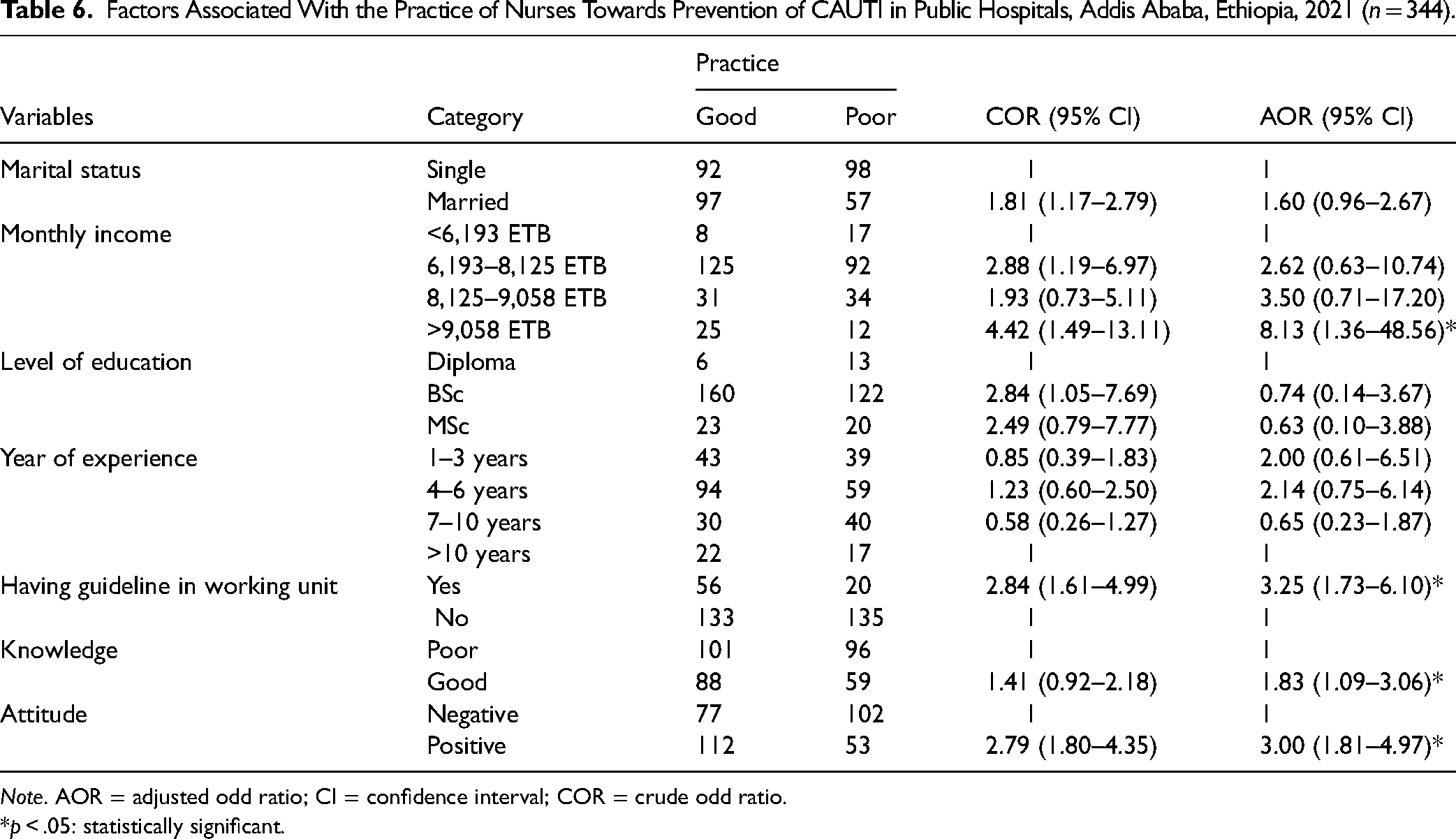
Note. AOR = adjusted odd ratio; CI = confidence interval; COR = crude odd ratio.
p < .05: statistically significant.
Discussion
This study explored the knowledge, attitude, practice, and associated factors toward the prevention of CAUTI among nurses in public hospitals in Addis Ababa, Ethiopia. In this study, 42.7% (95% CI: 37.4%–48.1%) of nurses had good knowledge about the prevention of CAUTI. This result showed that more than half of the nurses (57.3%) had a significant knowledge gap regarding the prevention of CAUTI. This is alarming and shows a large gap in the knowledge of nurses toward the prevention of CAUTI, which requires urgent action. Therefore, educational training programs such as workshops, seminars, and on-the-job training focused on CAUTI prevention are required to improve the knowledge of nurses about the prevention of CAUTI.
The study finding is lower than studies conducted in Pakistan (66.0%) (Shah et al., 2017), Georgia (86.9%) (Shaver et al., 2018), and Ruanda (64.5%) (Mukakamanzi, 2017) and 58.7% in Assela, Ethiopia (Wake et al., 2021). However, the proportion of knowledge level of nurses toward the prevention of CAUTI in this study was higher than the study done in India (16.7%) (Cutinho & Sheilini, 2018) and Nellore (20%) (Ramya et al., 2016). The low level of knowledge found in this study may be due to the presence of continuing training provided, which initiates nurses to update themselves, the availability of training programs that provide training related to infection prevention, the monthly income difference, the study population difference, the sociodemographic difference, and having guidelines in Pakistan, Georgia, and Ruanda. In this study, the majority of nurses had a low monthly income or salary (70.4%), claimed the absence of a training program related to infection prevention in their institution (57.3%), and did not have a protocol or guideline in their working unit (77.9%).
This study revealed that nurses who were married had good knowledge about the prevention of CAUTI compared to those who were single. Although there is no study that shows the association between knowledge toward the prevention of CAUTI and this variable, this finding highlights the potential influence of marital status on nurses’ knowledge. Therefore, nurses who are single require close attention when designing and implementing interventions aimed at improving nurses’ knowledge. This study shows that nurses who had guidelines in the working unit had good knowledge about the prevention of CAUTI compared to those who did not have guidelines. This finding was supported by studies done in Pakistan and Gondar, Ethiopia (Shah et al., 2017; Zegeye et al., 2023). This might be related to the fact that the presence of guidelines will advocate for the prevention of CAUTI, and the availability of guidelines in the working unit is likely to improve nurses’ knowledge and provide continuity of care. Therefore, it is recommended that there be guidelines in the working units of each hospital. This study also revealed that nurses who had a positive attitude toward the prevention of CAUTI had better knowledge compared to those who had a negative attitude. This finding was supported by a study done in Malaysia (Mong et al., 2022). This finding might be justified by nurses who had a positive attitude; they read more about CAUTI and thereby acquired more knowledge about the prevention of CAUTI.
This study showed that 48.0% (95% CI: 46.6%–57.4%) of nurses had a positive attitude toward the prevention of CAUTI. The study finding is similar to studies conducted in Pakistan (52.2%) (Shehzadi et al., 2018), Rwanda (52.8%) (Mukakamanzi, 2017), and Assela, Ethiopia (52.9%) (Wake et al., 2021). This indicates the global nature of the negative attitude of nurses toward the prevention of CAUTI. Thus, regular training sessions, including interactive workshops and simulations on the importance of CAUTI prevention and promoting a culture of safety and infection control in healthcare settings, are needed to enhance the attitudes of nurses toward the prevention of CAUTI.
This study revealed that nurses who were married had positive attitudes toward the prevention of CAUTI compared to those who were single. Although there is no study that shows the association between attitude toward the prevention of CAUTI and this variable, this finding highlights the potential influence of marital status on nurses’ attitudes. In this study, nurses who had good knowledge had positive attitudes toward the prevention of CAUTI compared to those who had poor knowledge. This finding was supported by studies done in Gondar and Assela, Ethiopia (Biresaw et al., 2020; Wake et al., 2021). The possible explanation might be that nurses with good knowledge about the prevention of CAUTI may strive to develop positive attitudes toward the prevention of CAUTI. This study also showed that nurses who had good practice had a positive attitude compared to those who had poor practice toward the prevention of CAUTI. This finding highlights the direct relationship between practice and nurses’ attitudes.
This study showed that 54.9% (95% CI: 49.5%–60.3%) of nurses had good practice toward the prevention of CAUTI. The study finding is lower than the study conducted in Rwanda (79.9%) (Mukakamanzi, 2017). This difference might be due to the availability of training materials, the availability of well-trained nurses, continuous on-site and on-the-job training, and the availability of CAUTI prevention guidelines in Rwanda. However, the proportion of nurses practicing toward the prevention of CAUTI in this study was similar to the studies done in Pakistan (56.4%) (Shah et al., 2017), Addis Ababa (52.2%) (Teshager et al., 2022), Assela (50%) (Teshager et al., 2022), and Gondar, Ethiopia (51.8%) (Zegeye et al., 2023). Therefore, educational training programs (workshops, seminars, and on-the-job training), the implementation and adherence to evidence-based guidelines for catheter insertion, maintenance, and removal practices, and the enforcement of standardized protocols for catheter use, including criteria for insertion and timely removal, are required to improve nurses’ practice in preventing CAUTI.
Our study shows that nurses who had a high monthly income had good practices toward the prevention of CAUTI compared to those who had a low monthly income. Although there is no study that shows the association between practice toward the prevention of CAUTI and this variable, this finding highlights the potential influence of monthly income or salary on nurses’ practice. This might be related to the fact that those nurses who have a high monthly income have job satisfaction, which positively impacts their practice. This study revealed that nurses who had guidelines in the working unit had good practices toward the prevention of CAUTI compared to those who did not have guidelines. This might be related to the fact that the presence of guidelines improves practice toward the prevention of CAUTI. Therefore, it is recommended that there should be guidelines in the working units of each hospital.
This study shows nurses who had good knowledge toward the prevention of CAUTI had good practices toward the prevention of CAUTI compared to their counterparts. This finding was supported by studies done in Iran (Kalantarzadeh et al., 2014), Saudi Arabia (Algarni et al., 2019), India (Zachariah, 2016), and Gondar, Ethiopia (Zegeye et al., 2023). This might be related to the fact that nurses who had more knowledge about CAUTI had more practice preventing it. Our study also shows nurses who had a positive attitude toward the prevention of CAUTI had good practices toward the prevention of CAUTI compared to their counterparts. This finding was similar to the study done in India (Balu et al., 2021), Assela, Ethiopia (Wake et al., 2021), and Gondar, Ethiopia (Zegeye et al., 2023). This might be related to the fact that nurses with a good attitude toward the prevention of CAUTI have good practices toward the prevention of CAUTI.
Limitations of the Study
This study has a number of limitations. First, use a self-administered, self-reported practice questionnaire for practice data collection. Using this method to assess practice among nurses might involve some risk, although an observational study to cross-check with real practice is required. Second, the use of cross-sectional design does not allow inferring causality. Prospective and experimental studies are warranted. Third, the study did not include nurses who were in private hospitals. Fourth, the study was done only among nurses working in public hospitals in Addis Ababa; it cannot be generalizable to nurses working in public hospitals in Ethiopia. Thus, a nationwide study on KAP and associated factors among nurses toward the prevention of CAUTI was recommended.
Implications for Practice
More than half of the nurses in this study had a low level of knowledge (57.3%), a negative attitude toward the prevention of CAUTI (58.0%), and good practice toward the prevention of CAUTI (54.9%). Being married, having guidelines in the working unit, and having a positive attitude toward the prevention of CAUTI were associated with good knowledge toward the prevention of CAUTI. Being married and having good knowledge and good practice toward the prevention of CAUTI were associated with a positive attitude toward the prevention of CAUTI. Having a high monthly income, having guidelines in the working unit, having knowledge toward the prevention of CAUTI, and having a positive attitude toward the prevention of CAUTI were associated with good practices toward the prevention of CAUTI. The Ministry of Health and Hospital Interventions addressing these factors are required to improve knowledge, attitude, and practice toward the prevention of CAUTI among nurses.
Conclusion
This study reveals that nurses exhibit a low level of knowledge, a negative attitude, and poor practice in preventing CAUTI. Marital status, having guidelines, and attitude were found to be associated with good knowledge; marital status, knowledge, and practice were found to be associated with a positive attitude; and monthly income, having guidelines, knowledge, and attitude were found to be associated with good practice toward the prevention of CAUTI. Therefore, the Ministry of Health and Hospital Interventions focused on these findings are required to improve knowledge, attitude, and practice toward the prevention of CAUTI among nurses.
Supplemental Material
sj-docx-1-son-10.1177_23779608241281317 - Supplemental material for Knowledge, Attitude, Practice, and Associated Factors Toward the Prevention of Catheter-Associated Urinary Tract Infection Among Nurses in Ethiopia: Cross-Sectional Study
Supplemental material, sj-docx-1-son-10.1177_23779608241281317 for Knowledge, Attitude, Practice, and Associated Factors Toward the Prevention of Catheter-Associated Urinary Tract Infection Among Nurses in Ethiopia: Cross-Sectional Study by Zemene Dessie, Debela Gela and Nete Tewfik Yusuf in SAGE Open Nursing
Supplemental Material
sj-docx-2-son-10.1177_23779608241281317 - Supplemental material for Knowledge, Attitude, Practice, and Associated Factors Toward the Prevention of Catheter-Associated Urinary Tract Infection Among Nurses in Ethiopia: Cross-Sectional Study
Supplemental material, sj-docx-2-son-10.1177_23779608241281317 for Knowledge, Attitude, Practice, and Associated Factors Toward the Prevention of Catheter-Associated Urinary Tract Infection Among Nurses in Ethiopia: Cross-Sectional Study by Zemene Dessie, Debela Gela and Nete Tewfik Yusuf in SAGE Open Nursing
Footnotes
Abbreviations
AOR: adjusted odds ratio; BSC: Bachelor of Science; CAUTI: catheter-associated urinary tract infection; CI: confidence interval; COR: crude odds ratio; ETB: Ethiopian Birr; HAIs: hospital-acquired infections; KAP: knowledge, attitude, practice; MSC: Master; NHSN: National Health Science Network; SD: standard deviation; SPSS: Statistical Processing for Social Science.
Acknowledgments
We are grateful to Addis Ababa University for the provision of financial support for this research project. We would like to thank Tikur Anbessa Specialized Hospital, ALERT Comprehensive Specialized Hospital, Menilik II Comprehensive Specialized Hospital, Eka Kotebe General Hospital, and Zewditu Memorial Hospital nurses who provided us with their information during data collection.
Author Contributions
ZD, DG, and NTY made substantial contributions to conception and design, acquisition of data, or analysis and interpretation of data. ZD writes the background and methods sections and analyzes and interprets the patients’ data. DG revised the background, method results analysis, and conclusion part, wrote in the manuscript, and gave the final approval of the manuscript. NTY was commenting, editing, and taking part in the manuscript writing.
Availability of Data and Materials
Datasets used and/or analyzed during the current study are available from the corresponding author on reasonable request.
Declaration of Conflicting Interests
The authors declared no potential conflicts of interest with respect to the research, authorship, and/or publication of this article.
Ethical Approval
Ethical clearance was obtained from the Institutional Review Board of the School of Nursing and Midwifery, the College of Health Sciences, Addis Ababa University (Protocol No: SNM69/21), and an official letter was sent to the selected public health hospitals. Permission to conduct the study was obtained from the administration of hospitals participating in the study. Written informed consent was obtained from each selected respondent to confirm their willingness, and the study was conducted following the Declaration of Helsinki.
Funding
The authors disclosed receipt of the following financial support for the research, authorship, and/or publication of this article: This study was funded by Addis Ababa University.

Supplemental Material
Supplemental material for this article is available online.
References
Supplementary Material
Please find the following supplemental material available below.
For Open Access articles published under a Creative Commons License, all supplemental material carries the same license as the article it is associated with.
For non-Open Access articles published, all supplemental material carries a non-exclusive license, and permission requests for re-use of supplemental material or any part of supplemental material shall be sent directly to the copyright owner as specified in the copyright notice associated with the article.
