




Abstract
Introduction
Digital healthcare, especially virtual health, has changed nurses' jobs and skills. In the evolving healthcare landscape, nurses healthcare landscape is increasingly required to have diverse competencies to navigate the world of virtual health effectively.
Objective
This study aims to qualitatively explore the role of nurses in virtual health and the competencies required to work in virtual health in Saudi Arabia, with a specific focus on SEHA virtual hospital.
Methods
An online open survey with nursing experts was employed as the qualitative method approach during the initial phase of an online Delphi study design.
Results
Twelve core competencies were identified: digital technology proficiency, professionalism, clinical expertise, leadership, legal and ethical considerations, care coordination, documentation, effective communication, patient assessment and diagnosis, patient safety, patient-centered care, and remote patient monitoring.
Conclusions
The research emphasizes the crucial role of nurses in virtual hospitals and clinics, contributing to the expansion of the virtual healthcare environment. It presents a thorough competency framework that can guide the development of training programs and policies, enhancing the effectiveness of virtual healthcare delivery.
Impact
The study provides a foundational competencies list that can guide the development of comprehensive training programs for nurses in virtual healthcare. Policymakers and educational leaders are encouraged to use these findings to create standardized practices and policies, enhancing the effectiveness and efficiency of virtual healthcare delivery.
Keywords
Introduction
Background
Virtual health, which includes telehealth and telemedicine, uses digital information and communication technologies to access healthcare services remotely and manage individual health needs (HRSA, 2022). This innovative approach transcends geographic boundaries, enabling people to receive medical care and follow-up without the constraints of physical proximity. By harnessing the power of digital platforms, virtual health optimizes convenience and accessibility, facilitating more efficient and flexible healthcare delivery (Haleem et al., 2021). This can accomplished effortlessly using online platforms, requiring only Internet access on a computer, tablet, or smartphone. The services include telephone or video chat consultations, secure messaging, email communication, secure file exchange, and remote monitoring (HRSA, 2022). The role of nurses in virtual health is multifaceted and crucial. In the virtually integrated care (VIC) team model, the virtual nurse is an expert advanced practice nurse who is a member of a healthcare delivery team with some core roles: virtual care coordination, patient education and counseling, staff mentoring, patient safety surveillance, virtual assessments, coordination with interdisciplinary teams, and medication management (Alqurashi et al., 2023). Virtual nurses who work in a virtual clinic, not the patient bedside care unit, can monitor the patient remotely and access the electronic health record. They interact with the patient through technology, ensuring patient safety (Sanford et al., 2023).
Additionally, nurses with limited telehealth training are expected to adeptly utilize various technological tools (Rutledge & Gustin, 2021). These tools encompass videoconferencing for patient communication, remote patient home monitoring for gathering clinical data such as blood pressure and glucose levels, and peripherals like Bluetooth stethoscopes and high-definition cameras for data collection and transmission to healthcare providers (Haleem et al., 2021). The integration of virtual nursing into healthcare practices presents an opportunity for nurses to cultivate novel skills and revolutionize their profession, ultimately enhancing the quality of patient care. However, it is crucial to acknowledge that the swift adoption of telehealth during the pandemic may have raised concerns regarding patient safety, particularly in telehealth scenarios involving episodic care (Sanford et al., 2023). In such cases, challenges like communication limitations, the inability to conduct physical examinations, and reliance on patients and their families for vital sign measurements could contribute to diagnostic errors.
In 2017, the Saudi MOH elaborated a policy aimed to enhance the quality and effectiveness of health care and services (Fronczek & Rouhana, 2018). This strategy was also aimed at making healthcare services easily available to patients and healthcare professionals (HCPs) regardless of their physical locations. Saudi Arabia's Vision 2030 program targets both the country's economy and healthcare system, and the hospital's opening is a necessary step toward fulfilling this vision (Alghamdi et al., 2022). A virtual hospital establishment is intended to help in the delivery of high-quality healthcare services to many Saudis, which is one of the motivations for that. Since the establishment of the MOH in 2017, applications such as Tawakkalna, Tabaud, SEHA, and Talamanha have been introduced. These applications create a bridge between the healthcare providers and the patients so that the patients do not need to visit the healthcare facilities.
In February 2022, the Ministry of Health (MOH) of Saudi Arabia put the SEHA Virtual Hospital (SVH) into operation. SEHA Virtual Hospital (SVH) is the world's largest virtual health hospital and the first in the Middle East. It plays a major role in the process of the state turning into a digital healthcare space (ICT & health, 2023). SVH aims to offer patients one-stop access to comprehensive healthcare, comprising primary care consults, specialist referrals, mental support, telestroke, tele ICU rounds, and educational assets useful in managing conditions such as diabetes. (MOH, 2023). In SEHA, patients are provided with a range of virtual healthcare solutions, including teleconsultation, remote patient monitoring, and digital health platforms. The coming of SVH is a substantial milestone in the development of healthcare in Saudi Arabia, which leads to better access to the finest medical and health services for residents in the kingdom.
SEHA Virtual Hospital, the world's first and the largest in the Middle East, offers telehealth solutions at the forefront of innovative healthcare services. With innovation and excellence, the hospital provides a wide spectrum of specialized services, including emergency and critical consultations, specialized clinics, multidisciplinary committees, home care services, and supportive medical services. Through the implementation of highly advanced technologies like artificial intelligence, augmented reality, and IoT, SEHA virtual hospital enables high-quality care and positive patient outcomes. Through its strategic collaboration with more than 170 hospitals across Saudi Arabia, SEHA Virtual Hospital facilitates seamless access to high-quality healthcare services, transcending geographical barriers and revolutionizing healthcare delivery in the kingdom. This initiative ensures that patients receive timely and efficient care, regardless of their location, significantly enhancing the overall healthcare landscape in Saudi Arabia.
Review of Literature
Virtual health competency frameworks are guidelines that define and outline the knowledge, skills, and abilities required to use and manage virtual health technology effectively. These frameworks are designed to guide healthcare providers and other stakeholders involved in using and managing virtual health tools to ensure quality care and outcomes. The frameworks typically include patient safety, privacy and security, technology infrastructure, provider competencies, and collaborative care. By outlining the competencies necessary to use virtual health technology, these frameworks help ensure that healthcare providers are adequately prepared to safely and effectively use and manage virtual health tools.
According to Khalifa (2013), patients and providers benefit most when virtual health is utilized to supplement in-person treatment rather than replace it. Also, Wernhart et al. (2019) found that telehealth was most widely used by more seasoned health professionals, highlighting the significance of providers’ familiarity with the technology and their capacity to integrate their clinical expertise with that of the virtual care they give. Some of the current virtual health competency frameworks include the following: (1) the American College of Medical Quality (ACMQ), which outlines the core areas of competence needed to provide virtual care. These competencies include patient-centered care, communication, technology, team-based care, and quality measurement. (2) The Center for Connected Health Policy (CCHP) outlines the core competencies needed to provide virtual care. These competencies include patient-centered care, communication, legal and regulatory issues, technology, and team-based care.
National Council for Behavioural Health (NCBH): NCBH outlines the core competencies needed to provide virtual care. These competencies include patient-centered care, communication, legal and regulatory issues, technology, and team-based care. American Telemedicine Association (ATA) has developed a virtual health competency framework that outlines the core competencies needed to provide virtual care. They include patient-centered care, communication, legal issues, technology, and team-based care. Many clinical competencies required for virtual health are not new but are required in all healthcare encounters. Despite this view, a few essential competencies should be examined while providing virtual care. This qualitative study aims to explore and identify the core competencies a nurse requires to effectively address the virtual healthcare needs of clients in Saudi Arabia and to identify the nursing roles in virtual healthcare settings.
Method
Research Design and Setting
Using the Delphi first-round technique, data were collected through an online survey using a qualitative study design. The research employs the qualitative research design since it successfully establishes meaning concerning these subjects’ human experiences, perceptions, and behaviors (Tenny et al., 2022). As such, the following professionals were purposively selected from SEHA Virtual Hospital in Saudi Arabia to get a focused selection of experts who implement virtual healthcare. Nurses were formally invited by email, delineating specifics of the study objectives and the voluntary character of the participation (Shang, 2023). Participants were instructed to complete a personal online survey, which provided additional information about the background and content of the questionnaire. It is ideal for qualitative research because it captures diverse and context-driven realities to offer an overall understanding and to elaborate on the role, competence, and knowledge of nursing staff performing in virtual care settings at SEHA Virtual Hospital, Saudi Arabia.
Research Question
According to a panel of nurses experts from the SEHA Virtual Hospital in Saudi Arabia, what competencies (including knowledge, skills, and attitudes) are perceived as essential for nurses to effectively engage in virtual health services? And what is the role of nurse in virtual health settings?
Sample
A purposeful sampling technique was used to choose experts based on their quality, knowledge, experience regarding virtual health, and clinical and academic credentials. The study involved 19 participants.
Inclusion/Exclusion Criteria
Participants were all staff nurses of the SEHA Virtual hospital. The inclusion criterion was having experience providing virtual healthcare services not less than 2 years.
Data Collection
Data collection was carried out between May 2023 and December 2023. The research team adopted a qualitative approach to obtain in-depth information on participants’ experiences. Qualitative open-response surveys were used to capture the experiences and perceptions of nurses working at SEHA Virtual Hospital. Participants were exposed to open questions that investigated their roles, challenges, and what they perceived as competencies in virtual healthcare. The surveys were distributed electronically to ensure efficiency and reach within the targeted recruitment of nursing professionals. The survey was conducted virtually to give participants flexibility.
Data Analysis
The systematic analysis of the responses provided by the participants and the definition of thematic areas were achieved using Colaizzi's (1978) methodological seven-stage framework (Olan & Richmond, 2019). The data were mainly collected through open survey discussions, which involved responses from 19 nurses. These responses are processed and evaluated for motifs from both investigators using Colaizzi's theme analysis approach, displayed in Table 1 to identify common threads.
Coliazzi’s (1978) Methodological Seven-Stage Framework.

Institutional Review Board Approval
The study approved by the Central Institutional Review Board at Ministry of Health (IRB log No: 23-26 M) and the King Saud University Institutional Review Board (No:KSU-HE-23-621). To ensure ethical integrity, participants were informed about the purpose of the study. Each participant provided informed consent before answering the survey. Participants were assured of their voluntary nature and the anonymity and confidentiality of their data.
Results
Sample Characteristics
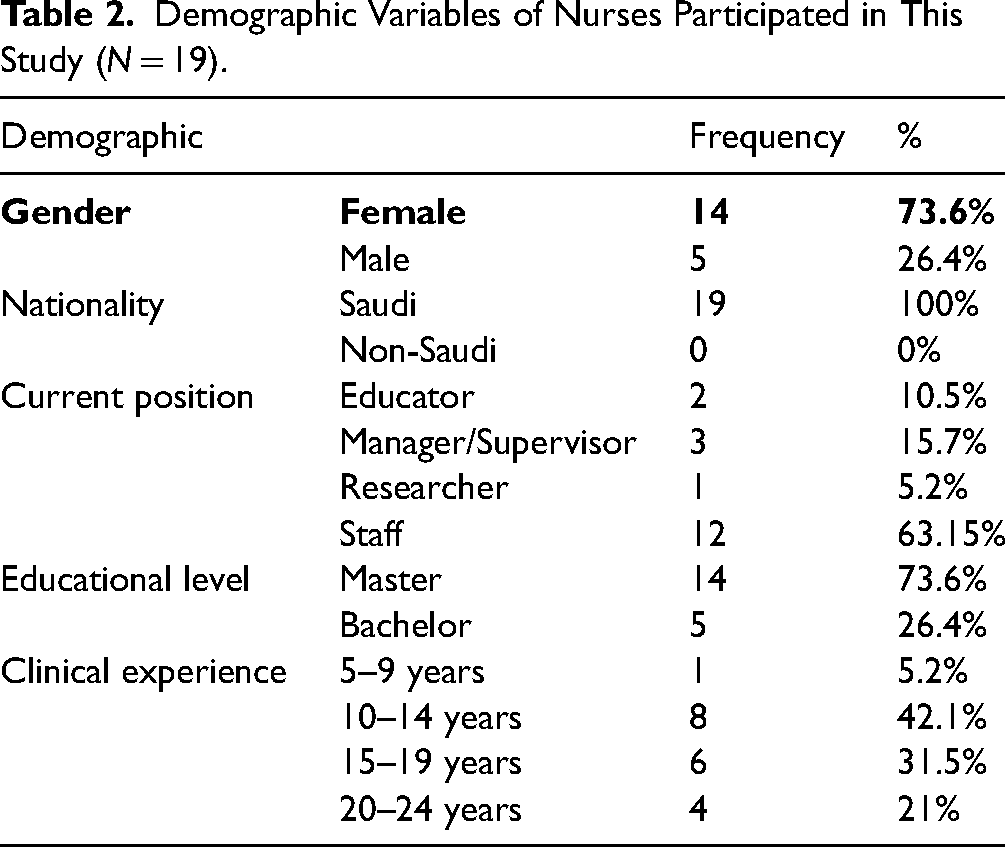
In this study, we engaged 19 nurses from the SEHA Virtual Hospital in Saudi Arabia to gain insights into their experiences and perspectives on virtual healthcare (Table 2). The participants’ demographics highlight a predominantly female representation (14 females, five males), all Saudi nationals. Participants encompass various roles within the nursing profession, with two serving as educators, 3 in managerial or supervisory positions, one as a researcher, and 12 as virtual nurses from different departments (including Tele et al. Clinic and Tele Cardiology). Educational backgrounds range from bachelor's to master's degrees, reflecting diverse qualifications. The clinical experience ranges from 5 to 24 years, while the virtual health ranges from 1 to 5 years. The variety of participants helps to create a universal picture of the roles and competencies of nurses in the dynamic virtual care ecosystem of the SEHA Virtual Hospital.
Demographic Variables of Nurses Participated in This Study (N = 19).
Role of Nurses in Virtual Health
The participants disclosed the many roles nurses play in the virtual hospital's various virtual health setups. The nurses perform several tasks, including patient education and counseling, coaching, safety monitoring, teamwork, virtual assessments, and monitoring the use of the medication in the virtual integrated care (VIC) team model.
Nurses, having mentored the staff within the virtual health, showed a dedication to nurturing professional development and striving for improvement. The nurse highlighted, “Mentoring in virtual healthcare is dynamic as we provide our colleagues with guidance and support using digital platforms. We embrace the use of technology to share knowledge and expertise, and we give constructive feedback.” Nurses highlighted the significant aspect of their role in the context of the virtual health space by providing the knowledge exchange. One nurse stated, “The virtual place offers us the opportunity to guarantee that our colleagues remain resilient, well-educated, and experienced in providing good care.” A nurse from virtual health care expressed, “Besides the traditional care, we are also educators who remotely guide both patients and colleagues.”
The nurses remarked on the importance of cooperation within virtual health, which is provided through the integration of their jobs into a functional team. One of the nurses said, “Teamwork and communication through the virtual environment are the foundation for effective and well-coordinated patient care. Our role in virtual health is all about reflecting high network connectivity, thereby assuring a high quality of care and efficiency for all patients.”
Participants put attention to the role of patient safety within virtual care, where, for instance, one nurse said, “Surveillance is key; we are watching patients remotely acting fast enough on potential risks.” “Patient safety remains at the forefront of our virtual care practices. We as nurses recognize the need for strong protocols and clear communication to mitigate risks and address potential challenges when we deliver virtual care.”
Another one indicated the role in admissions and discharges on virtual nursing care plans by stating, “We ensure seamless transitions of patients so that they receive adequate support virtually during admission and comprehensive upon discharge. We prioritize using technology to enhance the patient experience at every stage, from initial virtual assessments to post-discharge follow-ups and coordination.”
Nearly all respondents highlighted nurses’ integral role in medication management within the scope of virtual health. One participant mentioned: “We actively engage in medication management through virtual platforms, meticulously reviewing and discussing medication regimens with patients. This includes providing detailed instructions, addressing concerns, and fostering a collaborative approach to ensure patients feel empowered and informed about their medications, even in the digital space.”
Domains of Competencies
The participants listed several primary competencies for nurses to serve virtual care services according to the client's needs. The identified competencies are diverse, reflecting the various skills nurses need to function effectively in a virtual environment.

Discussion
This study is one of the first to identify the competencies required by healthcare professionals, especially to provide and deliver appropriate virtual healthcare services. The study, conducted at SEHA Virtual Hospital in Saudi Arabia, offers valuable insight into the roles of nurses in virtual health and identifies the core competencies essential for effective performance in a virtual healthcare delivery environment. These competencies were further categorized into themes to enable an in-depth analysis.
Competency with Digital Technology Virtual health competencies of nursing staff emerged as the main themes of the study related to virtual health adopted during the pandemic (Haleem et al., 2021). The study revealed that the staff should be aware and competent in video conferencing, remote monitoring, and modern peripheral systems. Incorporating such digital technologies proves very useful in supporting smooth virtual interactions. As argued by Booth et al., 2021, this will also allow the nurses to associate with them and their colleagues to improve effectiveness in virtual healthcare provision. So far, the above discussion mentions that digital literacy has a notable impact on the healthcare system through virtual interaction. Professionalism in the Provision of Virtual Care Professionalism became a significant ingredient in virtual care provision. According to nurses, trust and empathy communication were available via the digital interface (Haleem et al., 2021). Virtual communications professionals are required to enhance patient experiences and better communication (Tötterman, 2021). Professionalism in the realm of virtual healthcare is essential for evoking a need for trust-building endeavors and empathic communication Expertise Clinically and Decision-Making Clinical expertise and timely decision-making were two competencies that emerged as the vital essence of virtual healthcare. Nurses highlighted being adaptable and competent to apply clinical knowledge in various situations to make accurate decisions quickly (Hui et al., 2023). Therefore, the combination of speed of decision generation with clinical knowledge has been called a defining feature of virtualization nursing practice (Shahmoradi et al., 2017). This competence is essential if virtual care must be dispensed in real-time, frequently involving fast decision-making. Virtual Health Leadership and Management Effective leadership and management skills are needed to support VC's objectives in health innovation provision (Boamah et al., 2017). Proactive leadership was critical in guiding teams in virtual health care and sustaining operations in succession. The willingness to advance virtual health services into a more excellent healthcare system requires that nursing leadership take a proactive role in driving its implementation. This discussion underscores the significance of leadership and management skills in virtual healthcare (Van Diggle et al., 2020). It emphasizes the critical role of effective leadership in coordinating virtual teams and ensuring smooth operations. Virtual Health Legal and Ethical Issues Understanding virtual healthcare's legal and ethical considerations is very complex because it is a relatively new field (Adetayo & Obasa, 2023). Nurses stressed the need to progress through legal and ethical elements in such a digital environment to maintain standards and care safety that are ethically met. It underscores the necessity to ensure that nurses formally sanction while maintaining and sustaining professional standards to ensure ethical care in a digital environment Care Coordination and Integration in Virtual Healthcare Regarding virtual healthcare, care coordination can be described as integrating different healthcare services across multiple virtual platforms without requiring the patient to physically move any format or medical records (Kouijzer et al., 2023). This would require a deep understanding of the digital landscape and the ability to fit into systems and platforms (Cerner, 2021). It also means being able to communicate well with other healthcare providers, ensuring that all activities of care performed fall within the prospective patient's overall care plan. Record Keeping and Documentation in Virtual Healthcare The quality and appropriateness of recordkeeping is one of the necessary components proposed by (Kouijzer et al., 2023) to make virtual healthcare reliable (Kouijzer et al., 2023). This document provides for the continuity of care and a smooth information flow among healthcare professionals about consultations, treatment plans, and follow-ups (Houser et al., 2022). All virtual interactions, for instance, consultations, treatment plans, and follow-up programs, should be well documented. Effective Communication in Virtual Healthcare For effective delivery of virtual healthcare, clearly and concisely expressing oneself is a fundamental skill. Thus, deliberate modification of the expression could be vital in enhancing clarity and reaction during the online forum. Communication consists of the use of simple language, active listening, and empathy. It is crucial to rapport building, message receipt accuracy, and customer satisfaction. Patient Assessment and Diagnosis in Virtual Healthcare It refers to the ability to remotely access a patient's assessment by employing other tools and techniques to land virtually an accurate diagnosis diagonally. This implies that a healthcare specialist must possess a thorough knowledge of a disease, intuition, and the ability to read data from different sources and make a precise diagnosis based on that information (Fink et al., 2023). Patient Safety in Virtual Healthcare Providing remote protocols for emergencies and risks ensures the safety of patients within virtual healthcare settings. This may include robust and safe technology, explicit emergency procedures, and monitoring health status (O’Malley et al., 2022). Patient-Centered Care in Virtual Healthcare Part of this ability is comprehending patients and their needs while interacting with them virtually. One must be able to relate to people, understand an individual's situation, and make care plans that ideally fit his particular needs. According to the American Hospital Association (2024), virtual care will still be patient-centered, and great attention will be paid to personalized care as well. Remote Patient Monitoring Remote patient monitoring is a particular skill because it involves using advanced tools to monitor patients from far away. This helps maintain patient monitoring and strategic and preventive healthcare. It requires in-depth knowledge of various tracking tools, the ability to understand real-time data, and the ability to use this information to make accurate and quick decisions (Anuja Vaidya, 2022).
The findings provided insight into the specialized expert competencies required for nurses in virtual healthcare settings. These skills are digital literacy, professionalism, expertise in clinical issues, leadership, understanding the law and ethical factors, knowledge of care coordination, documentation, effective communication, patient assessment, diagnosis, care for the security of the patient, patient-centered care, and remote monitoring of patients. Developing and recognizing these competencies will be crucial for professional nurses to thrive in this new emerging landscape of virtual healthcare, ensuring the delivery of quality patient-centered services.
Implications for Research and Practice
The implications of this study can potentially be useful for both the research and practice of virtual healthcare. For research, the study suggests future research on the competencies and roles of nurses in virtual health environments and in other cultural and healthcare settings than the KSA context. Future research should employ samples that are larger and more heterogeneous in order to increase the external validity of the results. Further, research based on longitudinal designs could also be useful to determine how these competencies and roles will change as the use of virtual healthcare technologies and practices gains further enhancements.
For practice, the study offers important implications for practice to healthcare organizations and educational institutions particularly in Saudi Arabia and other similar settings. These competencies can be useful in designing specific training and continuing education interventions for preparing nurses for virtual healthcare. Healthcare providers can use these findings to refine job descriptions, performance evaluations, and career development pathways for nurses in virtual health roles. Moreover, policymakers and healthcare leaders can leverage this information to create supportive infrastructures and policies that facilitate the effective integration of virtual healthcare services, ultimately improving patient outcomes and the efficiency of healthcare delivery.
Conclusion
The context of virtual health, particularly the digitalization of care in Saudi Arabia, has sought to promote a transformative shift in redefining roles and competencies among nurses. The study conducted in SEHA Virtual Hospital, Saudi Arabia, has provided some valuable insight into the different role play that a nurse is required to perform, multitasking in their competencies being on the job in virtual healthcare settings and listing out twelve core competency areas in which to deliver their best capabilities efficiently. The competencies constituted various domains in digital technology proficiency, professionalism, clinical expertise, leadership, legal and ethical considerations, coordination in care, documentation, effective communication, assessment and diagnosis of patients, patient safety, patient-centeredness, and remote patient monitoring skills. These skills would be essential to ensure that future nurses are ready to effectively engage virtual healthcare demands through their integration into nursing curricula. It is a significant step toward realizing affordable, efficient, and effective health care by integrating virtual health technologies with the required contributions from nursing.
Strengths and Limitations
This study addresses the innovative and highly relevant topic of nurse competencies and roles in virtual healthcare, focusing on SEHA virtual hospitals in Saudi Arabia. The use of an online open survey with nursing experts, as part of an initial phase of a Delphi study design, provides rich qualitative insights and ensures a systematic gathering of expert opinions. This approach allows for an in-depth exploration of the practical realities and challenges of virtual healthcare in a specific context. However, the findings may have limited generalizability due to the focused setting and potential constraints related to the sample size and diversity of the participants. Additionally, the reliance on qualitative methods and online surveys may introduce biases and limit the breadth of perspectives captured. As the field of virtual healthcare is rapidly evolving, the identified competencies and roles may change over time, requiring ongoing research to remain current.
Footnotes
Acknowledgments
The authors express their gratitude to the Deanship of Scientific Research, College of Nursing at King Saud University (KSU), Saudi Arabia, as well as all the leaders and nurses who participated in this study of the SEHA virtual hospital—MOH, for their involvement and time. We extend our heartfelt gratitude to the CEO of the SEHA Virtual Hospital Eng. Mona Sahman Al-Subaie for her invaluable help and unwavering support throughout this endeavor.
Author Contributions
The authors explicitly declare the sole role in writing all elements, original draft preparation, review and editing, and visualization to draft this manuscript.
Data Availability Statement
The data sets used and analyzed during the current study are available from the corresponding author upon reasonable request.
Declaration of Conflicting Interests
The authors declared that they have no potential conflicts of interest regarding the research, authorship, and publication of this article.
Ethical Consideration
This study is approved by the Central Institutional Review Board at the Ministry of Health (IRB log No. 23-26 M) and the King Saud University Institutional Review Board (No. KSU-HE-23-621). To ensure ethical integrity, participants were informed about the purpose of the study. Each participant provided informed consent before answering the survey. Participants were assured of their voluntary nature and the anonymity and confidentiality of their data.
Funding
The authors received no financial support for the research, authorship, and/or publication of this article.

Setting
This research was conducted at SEHA Virtual Hospital (SVH) in Saudi Arabia.