




Abstract
Introduction
As Saudi Arabia faces a growing ageing population, the demand for gerontologically competent nurses is increasingly critical. Yet, nursing students often enter clinical practice with limited exposure to older adults, perpetuating ageist views and inadequate preparedness.
Objective
This study aimed to explore how a geriatric nursing course influenced perceptions of ageing among Saudi nursing students and to identify attitudinal and emotional shifts before and after course completion.
Methods
A qualitative longitudinal design was used with 19 undergraduate nursing students who completed pre- and postcourse reflection activities. Data were collected between January and April 2025 and were analyzed thematically using Braun and Clarke's six-step framework.
Results
Five key themes revealed: (1) from pity to empathy, (2) valuing strengths and resilience, (3) busting ageing myths, (4) holistic, person-centred care intentions, and (5) educational compounds. Precourse reflections revealed deficit-based perceptions of ageing, while postcourse reflections demonstrated greater emotional sensitivity, corrected misconceptions, and a commitment to dignified elder care.
Conclusion
The findings highlight the transformative impact of even a single semester of structured gerontological education and support the integration of experiential, myth-challenging content to foster age-inclusive care, informing curriculum development in Saudi nursing programs.
Introduction
As populations age globally, the demand for age-competent healthcare professionals, particularly nurses, is rising sharply. In Saudi Arabia (KSA), this demographic shift is complicated by evolving cultural, institutional, and educational frameworks surrounding elder care. Despite the Kingdom's deep historical roots in nursing—dating back to Rufaida Al-Asalmiya, often regarded as the first nurse in Islamic history—formal gerontological education in Saudi nursing curricula is a relatively recent development (Almalki et al., 2011; Jan, 1996).
Before 2016, nursing curricula in Saudi Arabia offered little or no formal training in geriatrics or dementia care (Al-Aama, 2016). While basic gerontological concepts have been included since then, most programs continue to lack specialized educators in geriatrics, thereby contributing to a considerable knowledge gap among practicing nurses (Alsenany & Alsaif, 2014; Yaghmour et al., 2016). This knowledge and experience gap could negatively influence both attitudes and preparedness to provide care to older adults, particularly those with cognitive difficulties. Conventional perceptions of ageing as a process of deterioration or destiny have also contributed to the neglect of geriatrics in health education and practice.
The Saudi Ministry of Health has begun to address the issues presented by an ageing population through the development of clinical guidelines and strategic programs to improve elderly care (Ministry of Health, 2020). However, numerous studies have reported continued adverse or ambivalent attitudes to ageing among health professionals and nursing students (Algahtani et al., 2020; Halabi & Zafar, 2010). These attitudes are not only the result of inadequate exposure in educational curricula but also due to deeply ingrained societal views that often associate ageing with burden and decline (Elmorshedy et al., 2020; Sharif et al., 2024).
The inclusion of gerontological nursing in the curriculum at the undergraduate level is recognized as an important contribution to the development of empathy, competence, and positive attitudes toward the elderly population (Annear et al., 2015; Bridges et al., 2018). There is, however, a lack of research in the Saudi context investigating nursing students’ attitudes toward ageing before and after the completion of a specialized course. This is especially noteworthy considering the growing rate of admissions of elder patients to hospitals and long-term care facilities, often with complex and varied requirements.
Review of Literature
Educational interventions consistently reduce ageist attitudes and strengthen gerontological competence among healthcare learners. Knowledge-translation and structured training have improved dementia-care capability and empathy in diverse settings (Annear et al., 2015; Collier et al., 2015; Strøm et al., 2019). Systematic reviews indicate persistent gaps in nurses’ knowledge and confidence regarding dementia and ageing, underscoring the need for targeted curricula and experiential components (Ericson-Lidman et al., 2014; Evripidou et al., 2018). Within Saudi Arabia, limited formal geriatric education and a shortage of specialist faculty have contributed to variability in students’ preparedness (Al-Aama, 2016; Alsenany & Alsaif, 2014; Yaghmour et al., 2016). Cultural values play a dual role—deep respect for elders coexists with societal views equating ageing with dependency (Karlin et al., 2016). Recent policy frameworks (Ministry of Health, 2020; Saudi Commission for Health Specialties, 2018) and Vision 2030 emphasize quality of life for older adults, yet few empirical studies have examined how structured geriatric coursework influences attitudinal change longitudinally. The present study extends this literature by qualitatively exploring pre- and postcourse reflections among Saudi nursing students to understand how educational interventions foster person-centred, age-inclusive perspectives.
The current investigation aims to explore Saudi nursing students’ perceptions of ageing and older people, comparing their attitudes before and after undertaking a geriatric nursing course. By analyzing changes in attitudes and values, this study hopes to make recommendations for curriculum development, highlight the importance of educational intervention, and inform the broader discussion of age-inclusive care in the Gulf region.
The current research focuses on analyzing the impact of formal geriatric nursing education on nursing students’ attitudes, perceptions, and beliefs towards the elderly and the process of ageing. Due to the demographic trend of the growing elderly population in Saudi Arabia and the resultant need for specialized care in the context of ageing, nursing educational programs have started incorporating curriculum that deals with the issues of ageing. However, the extent to which this curriculum influences the attitudes of the students is not yet well established. The current study is investigating the subjective perceptions, emotional changes, and value-oriented insights of nursing students related to ageing before and after the completion of a gerontological nursing course. By recording these attitudinal changes, this research is assessing learning outcomes related to curriculum-based courses in geriatrics and make recommendations for evidence-based approaches to promote age-sensitive care in Saudi Arabia.
Despite recent curriculum developments, geriatric nursing education in Saudi Arabia is still in its developmental stages, with behavioral and cognitive issues and other ageing-related topics traditionally receiving inadequate coverage in undergraduate curricula. This has resulted in noticeable knowledge deficits and disparate attitudes among nursing students regarding the older population. Given the nation's changing demographic trends and the increasing pattern of institutionalization of older adults, there is a need to prepare future nurses not merely with fundamental clinical skills but also with compassionate attitudes necessary for person-centred geriatric care. However, there is a striking lack of empirical evidence that clarifies how formal education in geriatric nursing impacts students’ cognitive and affective attitudes toward older adults. Without such information, educators and policymakers could find it challenging to develop practical strategies to foster positive and respectful attitudes toward ageing. Therefore, this study addresses a vital gap by examining changes in nursing students’ perspectives through a longitudinal, reflective approach.
Despite curriculum reforms, geriatric nursing education in Saudi Arabia remains limited, leaving students underprepared to provide person-centred care for older adults. This study explores how a dedicated geriatric course influences nursing students’ perceptions of ageing, aiming to inform curriculum design and promote age-inclusive care.
Methods
Design
This study employed a qualitative, exploratory longitudinal design to explore the shifts in nursing students’ attitudes toward ageing before and after completing a geriatric nursing course. This design was selected to capture attitudinal and emotional changes over time and to provide rich, descriptive insights into students’ reflections. The longitudinal aspect allowed for direct comparison between pre- and postcourse perspectives, emphasizing individual and collective transformations resulting from educational exposure.
Research Questions
- How do Saudi nursing students perceive ageing and older adults before completing a geriatric nursing course?
- How do these perceptions and attitudes change after course completion?
- What educational experiences contribute most to these attitudinal shifts?
Setting and Sample
The study was conducted within an undergraduate nursing program at a public university in Saudi Arabia King Abdulaziz University. All students enrolled in the Older Adults or Geriatric Nursing course were invited to participate. Using purposive sampling, 19 students who completed both the pre- and postcourse reflection activities were included in the final analysis. This sample size was adequate to achieve data saturation and to reflect the views of a single cohort within one semester.
Inclusion and Exclusion Criteria
Inclusion criteria:
- Undergraduate nursing students enrolled in the geriatric nursing course. - Completion of both pre- and postcourse reflection activities. - Provision of informed consent to participate.
Exclusion criteria:
- Students who withdrew from the course. - Incomplete reflection submissions. - Lack of consent to participate in the study.
Ethical Considerations
Ethical approval was obtained from the Institutional Review Board of King Abdulaziz University, Ref. No: KAU-REC-2024-NUR-471, December 2024. Participation was entirely voluntary, and written informed consent was obtained from all students. Confidentiality was ensured by anonymizing responses, and participants were informed of their right to withdraw at any stage without penalty.
Data Collection
Data were collected between January and April 2025 through structured pre- and postcourse reflection activities. The precourse reflection included open-ended questions on students’ beliefs, sentence-completion tasks, and identification of influential older role models. The postcourse reflection replicated these items and added prompts about changes in perception, surprising learnings, and anticipated impact on future nursing practice. Both reflections were submitted in writing and analyzed as paired qualitative data points.
Data Analysis
Data were analyzed thematically following Braun and Clarke's (2006) six-step framework: familiarization, coding, theme identification, theme review, definition, and reporting. Arabic and English responses were inductively coded, then cross-mapped to identify pre- and postcourse changes in perspective. Data saturation was achieved when no new themes emerged from the final two reflections. To enhance credibility, peer debriefing was conducted, and an independent researcher reviewed a subset of coded data to verify consistency and confirm theme validity.
Trustworthiness
Credibility, dependability, and confirmability were ensured through reflexive journaling, audit trails, and peer verification. Direct quotations were used to illustrate participants’ voices and to ensure authenticity of representation.
Results
A total of 19 students participated. The demographic characteristics of the sample are summarized below.
Precourse Activity
A total of 19 nursing students completed the precourse activity exploring their attitudes and values regarding older adults and the ageing process. Thematic analysis of their responses revealed five overarching themes: Ageing as Decline or Loss, Ageing as Wisdom and Value, Social and Cultural Framing of Ageing, Emotional Responses to Ageing, and Individual versus Societal Views of Ageing. Students’ responses often contained elements of both appreciation and apprehension, reflecting a complex and ambivalent view of ageing. Each identified theme collectively illustrates students’ progression from limited understanding to a deeper attitudinal and emotional readiness to apply empathy, respect, and holistic principles in real-world geriatric care.
Theme 1: Ageing as Decline or Loss
Initially, students associated ageing with physical and cognitive deterioration, loss of independence, and social isolation. This theme captured perceptions of ageing as a period marked by physical deterioration, chronic illness, and social irrelevance. Many students anticipated personal losses such as reduced strength, memory, or independence. One participant wrote, “When I get older, I will lose my strength, energy, and possibly some memories” (P05). Others expressed concern about the societal neglect of older adults, with one stating, “Older people stop being a part of the community and deserving of respect” (P17).
Theme 2: Ageing as Wisdom and Value
In contrast, another dominant theme highlighted admiration for the wisdom, resilience, and life experience of older adults. Students frequently mentioned grandparents and elders who had shaped their values. For example, a student shared, “Older people always share wisdom and offer valuable advice” (P03), while another noted, “Seeing an older person makes me feel respect and appreciation for their life stories” (P01). Many associated ageing with increased emotional strength and personal growth.
Theme 3: Social and Cultural Framing of Ageing
Students discussed cultural expectations, ageism, and family roles in shaping perceptions of ageing. Students’ perceptions were also shaped by cultural narratives and societal influences. Some acknowledged ageist stereotypes, as in: “We live in a world that worships youth and beauty” (P02). Others described culturally ingrained respect for elders, referencing traditional family roles and intergenerational care. The definition of “old” was often viewed as fluid and relative, based on functional ability rather than chronological age.
Theme 4: Emotional Responses to Ageing
Responses evolved from fear and discomfort to empathy and emotional sensitivity. Emotional reactions ranged from empathy and admiration to anxiety and sadness. Several students expressed fear about their own ageing, citing concerns about loneliness, dependency, or losing relevance. One stated, “I worry I will lose my independence and feel isolated” (P19), while another wrote, “Seeing older adults makes me feel a mix of respect and concern” (P06).
Theme 5: Educational Components
Students highlighted differences between personal and societal definitions of being “old,” with postcourse reflections showing greater emphasis on functional and psychosocial factors. Students differentiated between personal views of ageing and broader societal perceptions. Many emphasized that “old” is not simply a number, but a matter of mindset, health, and engagement with life. One participant explained, “Some people are 80 but don’t act old; others are younger but frail” (P01). Others noted the tension between personal appreciation of older adults and their observed marginalization in public life.
Postcourse Reflection
To evaluate changes in perception following course completion, a postcourse reflection activity was administered during the final week. This activity included the same open-ended prompts used in the precourse exercise, enabling longitudinal comparison of students’ evolving beliefs and attitudes toward older adults and ageing. Additionally, three new questions were introduced to capture course-specific impacts: (1) “Has your view of older adults changed throughout the course? If so, how?”; (2) “What is one thing you’ve learned that surprised you about ageing?”; and (3) “How has this course shaped your approach to caring for older patients?” These prompts encouraged students to critically reflect on their learning journey, synthesize newly acquired knowledge, and articulate potential changes in future clinical practice. Responses revealed rich, nuanced insights that extended beyond knowledge acquisition, highlighting emotional growth, shifts in values, and an increased commitment to holistic, person-centred care.
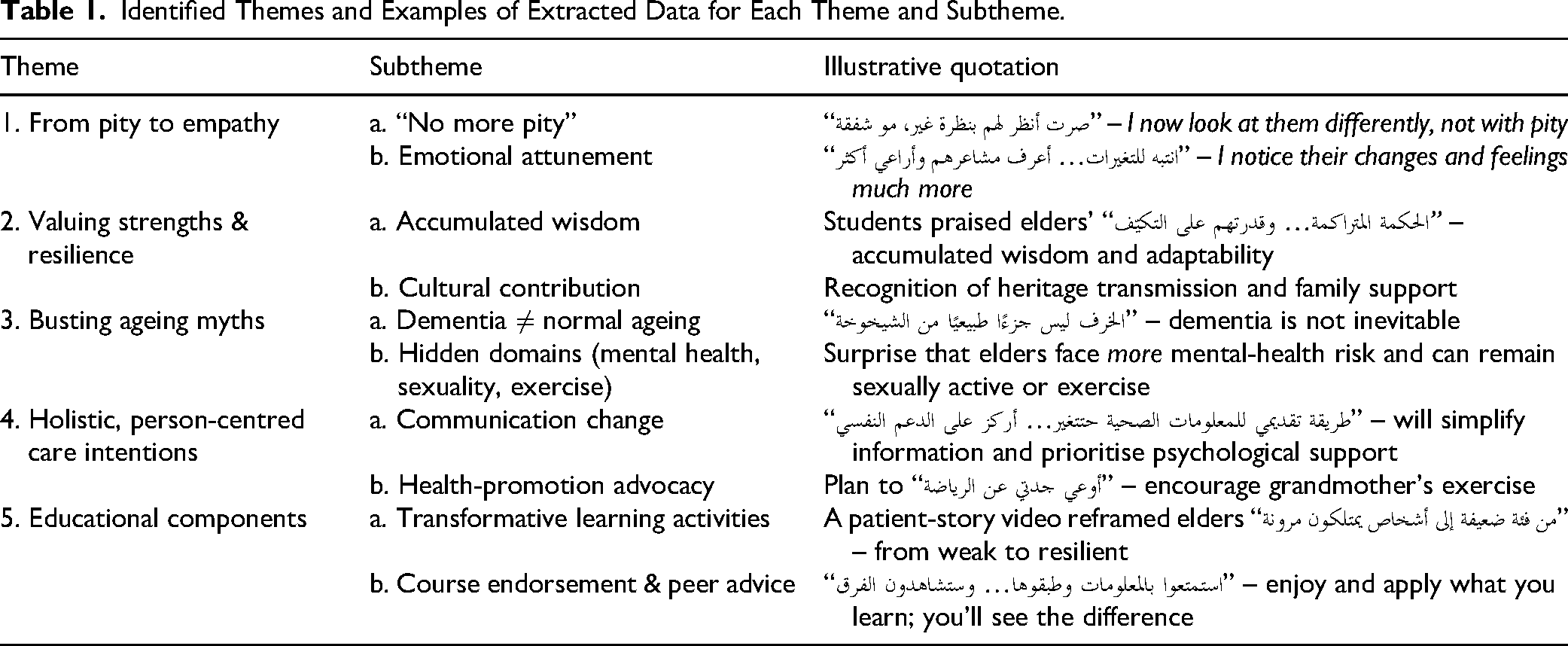
Following Braun & Clarke's six-step process—familiarisation, initial coding, theme searching, review, definition, and writing. Codes from Arabic-and-English responses were inductively clustered, then mapped back to the precourse codebook to highlight shifts. Five overarching themes with nine subthemes emerged (Table 1).
Identified Themes and Examples of Extracted Data for Each Theme and Subtheme.
Theme 1: From Pity to Empathy
Students widely reported moving away from seeing older adults as helpless or burdensome. This shift was often expressed as a conscious rejection of pity. One student stated, “I used to see older people as weak and dependent, but now I see strength in their survival and stories.” Another wrote, “I now look at them differently, not with pity.” These responses highlight the emotional and cognitive growth that occurred through the course.
Beyond rejecting pity, students demonstrated a deeper emotional connection. Several participants described how they became more sensitive to subtle signs of mood, discomfort, or social withdrawal in older people. One reflection read, “I pay more attention now to how they’re feeling, not just what they say,” while another shared, “I’ve learned to listen beyond words—to look at expressions, body language, even silence.” This subtheme reflects an evolving emotional intelligence in nursing care.
Theme 2: Valuing Strengths and Resilience
Students expressed admiration for the life experience of older adults, noting how ageing could bring growth rather than decline. One wrote, “They are full of knowledge and stories—so much wisdom if we just take time to ask.” Another stated, “I used to think ageing was losing things. Now I think it's gaining perspective.” These responses show a redefinition of ageing as a rich, rather than depleted, stage of life.
Many students highlighted the role of elders as cultural anchors and spiritual guides. For instance, one participant stated, “My grandmother taught me how to be strong through prayer and patience,” and another reflected, “They hold our family together—without them, we lose more than just a person.” These insights show an enhanced recognition of elders’ social and intergenerational significance.
Theme 3: Busting Ageing Myths
Many students wrote that one of the most surprising learnings was the clarification that dementia is not a natural part of ageing. As one put it, “I thought forgetfulness meant Alzheimer's, but now I know the difference between normal ageing and disease.” Another shared, “Not every old person becomes forgetful—that was eye-opening.” This theme reflects the success of the course in correcting misconceptions.
Many reflections noted surprise at the fact that older adults still value exercise, intimacy, and mental wellness. One student wrote, “I was shocked to learn about depression in older adults—it's common but often hidden.” Another expressed, “I never thought about sexuality in older age, but now I understand it's part of well-being too.” Students also commented on the importance of encouraging physical activity: “I told my grandma walking 15 minutes a day helps her memory—she listened.”
Students also revealed increasing awareness that misconceptions about ageing extend beyond memory loss or dementia. For instance, several reflections addressed emotional and social wellbeing, noting that “older people can still dream, learn, and adapt” and “mental health matters at every age.” Others highlighted surprise about physical activity and sexuality in late life: “I realized exercise helps even at 80” and “they still seek connection and love, which changed my thinking.” These examples illustrate how the course challenged deeply ingrained stereotypes and expanded understanding of holistic ageing beyond disease-focused views.
Theme 4: Holistic, Person-Centred Care Intentions
After completing the course, students described a desire to communicate in more respectful, age-appropriate, and emotionally aware ways. One student wrote, “I won’t speak to them like children. They deserve respect and calm, not rushed instructions.” Another added, “I’ll give them time to respond, not push for quick answers—they process differently.” These responses reflect improved communication awareness tailored to older adults’ needs.
Students expressed readiness to engage in public health promotion for ageing populations. One reflection read, “I now want to educate older patients on how to stay active safely,” while another said, “Healthy ageing is possible—I want to spread that message in my family and in clinics.” The theme underscores a shift from passive care to proactive engagement.
Theme 5: Educational Compounds
Students frequently cited specific course elements that changed their thinking—especially case studies, interviews with elders, and video materials. One noted, “After seeing the story of the elderly woman who lived alone, I understood how loneliness impacts health more than disease.” Another shared, “Watching real interviews made me cry. They are not numbers; they are people with dreams and fears.” These activities helped bridge theory with emotional insight.
Almost all students spoke positively about the course and recommended it to future nursing students. One advised, “Take this course seriously—it's not just for geriatrics, it's for every nurse.” Another wrote, “Enjoy and apply what you learn, and you’ll see the difference—it changed me.” This theme emphasizes the perceived relevance and long-term value of gerontological education in nursing curricula.
Taken together, these longitudinal shifts indicate movement from deficit-based perceptions to actionable, person-centred intentions.
Discussion
The present study demonstrates that a single semester of structured gerontological content can catalyze profound attitudinal and behavioral shifts in undergraduate nursing students. Consistent with international literature (Bridges et al., 2018; Luckett et al., 2019; Yaghmour, 2022), students moved from a deficit-based stance—characterised by pity, fear of frailty, and narrow biomedical assumptions—toward an asset-based, relationship-centred perspective. This deepened empathy was evidenced by students’ deliberate attention to elders’ emotional cues and their stated intent to tailor tone, pacing, and nonverbal communication accordingly. Such findings resonate with Kitwood's concept of personhood, which emphasizes the relational nature of care for older adults and people with dementia.
Equally important was the newfound recognition of older adults’ psychosocial assets—wisdom, resilience, and cultural stewardship. By foregrounding these strengths, the course helped counteract prevailing Saudi stereotypes that equate ageing with dependence or social irrelevance (Al-Aama, 2016; Yaghmour et al., 2016). Students’ reflections also revealed effective myth-busting: they learned that dementia is neither inevitable nor synonymous with normal ageing and that mental healthcare, sexuality, and physical activity remain salient in later life. These revelations align with global gerontological guidelines calling for holistic assessment across physical, cognitive, and psychosocial domains.
The attitudinal changes observed in this study are consistent with global evidence showing that structured gerontological courses can reduce ageist attitudes and enhance empathy among healthcare students. For example, Annear et al. (2015) demonstrated that knowledge translation interventions improved dementia care competence, while Evripidou et al. (2018) and Strøm et al. (2019) reported significant gains in nurses’ knowledge and empathy following educational workshops. Similarly, Kupeli et al. (2016) and Collier et al. (2015) emphasized that positive shifts in perception often emerge when theoretical content is paired with reflective or experiential components, as was the case in the present study. These parallels reinforce the educational value of embedding reflective gerontological experiences in undergraduate curricula.
Furthermore, cross-cultural comparisons reveal that Saudi students’ precourse ambivalence mirrors findings from other collectivist societies, where ageing is both respected and feared (Karlin et al., 2016). The observed transformation from pity to empathy aligns with Meleis' theory of transitions, wherein reflection and guided experience facilitate adaptation and professional growth. This suggests that similar pedagogical frameworks could be adapted across Middle Eastern nursing programs to promote culturally congruent, person-centred elder care.
A notable pedagogical driver behind these shifts was experiential learning. Video narratives, case studies, and flipped-class discussions were repeatedly cited as “game changers,” providing concrete, humanized contexts that challenged students’ preconceptions. This supports constructivist theories of learning, which propose that knowledge acquired through authentic experience is more likely to provoke critical reflection and value change. However, students still described limited exposure to real clinical encounters with older adults, underscoring the importance of augmenting classroom activities with simulation, intergenerational service-learning, and mentored clinical placements in geriatric settings.
Strengths and Limitations
This study offers valuable insights into the educational and attitudinal transformation of nursing students within a gerontological context; however, several limitations should be acknowledged. The study's small sample size (N = 19), drawn from a single public university in Saudi Arabia, may limit the transferability of findings to other programs or cultural settings. Participation was voluntary, which may have led to self-selection bias, as students with greater interest in geriatrics could have been more inclined to participate. Additionally, the study relied on self-reported reflections collected immediately after course completion, making results susceptible to social-desirability effects and short-term interpretation. Although peer debriefing and an independent review enhanced analytic credibility, formal inter-rater reliability was not calculated.
Despite these limitations, the study demonstrates notable methodological strengths. The longitudinal reflective design enabled the exploration of attitudinal change over time, and the use of Braun and Clarke's analytical framework ensured systematic, transparent theme development. The integration of Arabic and English reflections enhanced cultural depth and authenticity of responses. Future research with larger, multisite cohorts and extended follow up is recommended to assess the sustainability of attitudinal change and its translation into clinical practice.
Implication or Practice
The findings from this study underscore the value of integrating gerontological content early in nursing education to foster empathy and age-sensitive practice. Curriculum designers should incorporate experiential and reflective learning opportunities—such as storytelling, elder interviews, and simulation—to bridge theory and practice. Clinical institutions could adopt similar reflective models to support ongoing professional development and reduce ageist attitudes among practicing nurses. Policymakers and educators may also collaborate to ensure that national nursing standards explicitly emphasize geriatric competence as part of professional accreditation frameworks in Saudi Arabia.
These findings also carry significant policy implications for nursing accreditation bodies and educational institutions in Saudi Arabia. Embedding gerontological content within national standards can ensure that every graduating nurse demonstrates geriatric competence, empathy, and cultural sensitivity toward older adults. Such systemic integration aligns with Saudi Vision 2030's commitment to improving quality of life for the ageing population.
Conclusion
This longitudinal qualitative study illustrates the transformative potential of geriatric-focused coursework in reshaping Saudi nursing students’ perceptions of older adults. Through reflective activities embedded in a culturally responsive curriculum, learners progressed from pity and stereotype to empathy, respect, and advocacy for holistic, person-centred care. To sustain and amplify these gains, nursing programs should integrate experiential components—such as elder interviews, simulation, and community engagement—alongside myth-busting didactics. Future multisite studies with extended follow up are warranted to examine how attitudinal change translates into clinical competence and improved elder outcomes. Embedding gerontological education across nursing curricula is crucial for preparing a workforce capable of delivering dignified, age-inclusive care in Saudi Arabia.
Supplemental Material
sj-docx-1-son-10.1177_23779608251402956 - Supplemental material for Shifting Perceptions: A Qualitative Exploration of Saudi Nursing Students’ Views on Ageing Before and After a Geriatric Nursing Course
Supplemental material, sj-docx-1-son-10.1177_23779608251402956 for Shifting Perceptions: A Qualitative Exploration of Saudi Nursing Students’ Views on Ageing Before and After a Geriatric Nursing Course by Sara Yaghmour in SAGE Open Nursing
Supplemental Material
sj-docx-2-son-10.1177_23779608251402956 - Supplemental material for Shifting Perceptions: A Qualitative Exploration of Saudi Nursing Students’ Views on Ageing Before and After a Geriatric Nursing Course
Supplemental material, sj-docx-2-son-10.1177_23779608251402956 for Shifting Perceptions: A Qualitative Exploration of Saudi Nursing Students’ Views on Ageing Before and After a Geriatric Nursing Course by Sara Yaghmour in SAGE Open Nursing
Footnotes
Acknowledgments
The author thank the participating students and faculty involved in the geriatric nursing course.

Ethical Approval
Ethical approval was obtained from the Institutional Review Board of King Abdulaziz University, Ref. No: KAU-REC-2024-NUR-471, December 2024. All participants provided informed consent. The study adhered to the Declaration of Helsinki and SAGE Ethics guidance.
Consent to Participate
Submitting responses consider consent to participate as all participants aware of the study and its purpose.
Author Contributions
The author contributed to research proposal, literature review, data collection and analysis, findings and discussion, and writing and reviewing the manuscript. For the editing ChatGPT was used.
Funding
The project was funded by KAU Endowment (WAQF) at king Abdulaziz University, Jeddah, Saudi Arabia. The author, therefore, acknowledge with thanks WAQF and the Deanship of Scientific Research (DSR) for technical and financial support.
Declaration of Conflicting Interests
The author declared no potential conflicts of interest with respect to the research, authorship, and/or publication of this article.
Data Availability Statement
Data available from the author upon request.
Supplemental Material
Supplemental material for this article is available upon request.
References
Supplementary Material
Please find the following supplemental material available below.
For Open Access articles published under a Creative Commons License, all supplemental material carries the same license as the article it is associated with.
For non-Open Access articles published, all supplemental material carries a non-exclusive license, and permission requests for re-use of supplemental material or any part of supplemental material shall be sent directly to the copyright owner as specified in the copyright notice associated with the article.
