



Abstract
Introduction
Corporate social responsibility (CSR) practices refer to the deliberate actions and strategies implemented by a company or organization to generate positive outcomes for its stakeholders beyond the sole objective of profit maximization. Internal CSR is a significant management and investment concept within enterprises, such as hospitals, that enhances organizational performance excellence.
Objectives
The article aims to trace how hospitals thrive in nurses’ job performance by leveraging internal CSR practices.
Methods
Cross-sectional design quantitative research through structured questionnaire interviews on 215 nurses in Vietnam. Data collection was conducted from May 2023 to August 2023. Partial least squares structural equation modeling was applied to test the hypotheses.
Results
The study has proven that a hospital's internal CSR practices impact nurses’ job performance. Income and benefits, human resource training and development, and work-related quality of life directly and significantly impact three dimensions of a nurse's job performance (competence to practice patient care, attitude to performance work, and management and professional development capacity). Connection and trust in the workplace and health and safety at work significantly affect two dimensions of a nurse's job performance (namely, competence to practice patient care and attitude to performance work). Diversity in the workplace impacts nurses’ competence in practicing patient care and their management and professional development capacity. Demographic variables did not correlate statistically significantly with dimensions of internal CSR and nurses’ job performance.
Conclusion
The study presents significant findings on the influence of internal CSR on nurses’ job performance within the hospital management theory of an emerging market. The results of the present study contribute to a better understanding of the benefits of hospitals’ socially responsible actions and contribute further to resource management in hospitals, especially nursing. If the nursing staff positively perceives the hospital's internal CSR practices, they will be more able to perform their job, impacting the hospital's overall performance. This study has certain limitations regarding the representative nature of the sample, the use of the self-report survey instrument, and the use of cross-sectional data.
Introduction
Nurses constitute the most considerable proportion of the healthcare industry's medical personnel workforce (Akter et al., 2018) and play an indispensable role in delivering high-quality services to patients in hospitals and healthcare facilities around the globe (Lebni et al., 2021). The performance of nurses is an essential determinant of hospitals’ performance excellence and the quality of healthcare services (Aung Po et al., 2023; Krijgsheld et al., 2022), which can be defined as the efficiency with which the nurse carries out duties and responsibilities related to direct patient care (Ko et al., 2007; Wang et al., 2023).
Practicing corporate social responsibility (CSR) is a concept that refers to a business/organization's activities and policies to benefit stakeholders in addition to maximizing profits (Carroll, 1999; Turker, 2009). Private hospitals are starting to participate in CSR initiatives (Yildirim & Dincer, 2016). Additionally, private hospitals were more significantly impacted by CSR than their public counterparts (Limbu et al., 2020). CSR has been proven to significantly impact the work performance of medical and nursing staff, thereby affecting the overall performance of hospitals (Hsieh et al., 2016; Htun, 2022; Liu et al., 2023; Pourteimour et al., 2021). However, research has yet to evaluate the impact of internal CSR implementation on nurses’ work performance, especially in the context of hospital management in emerging markets.
The present study investigates the impact of internal CSR on nurses’ job performance. In this study, we present our methodology, which employs a quantitative approach that prioritizes the exploration of well-established theoretical frameworks, employs a robust research design, and gathers survey data from a sample of 215 nurses at an international hospital in Vietnam. The collected data is then analyzed using partial least squares structural equation modeling (PLS-SEM) approaches. Subsequently, we comprehensively analyze and articulate our results and discussion, followed by the study's theoretical and managerial implications, address the limitations, and suggest potential avenues for further research. The study presents significant findings on the influence of internal CSR on nurses’ job performance within the health business of an emerging market.
Review of Literature
Theoretical Foundations
Two significant theories elucidate the correlation between CSR and work performance: social exchange theory and social identity theory (Carroll, 1999). The justification for enhancing employee performance through CSR is grounded in social exchange theory, which emphasizes the reciprocal nature of social relationships. As per the statement above, when employees hold a favorable perception of the organization's commitment toward their development through CSR initiatives, it establishes a sense of obligation for them to reciprocate by enhancing their job performance (Blau, 1964). Based on the principles of social identity theory, individuals develop a sense of attachment to a particular social entity when they perceive a connection or affiliation with it (Jnaneswar & Ranjit, 2020; Turner, 1985). Therefore, the positive behavior of the organization toward different stakeholders will influence employees with the same identity, thereby creating a personal connection with the organization. Employees can understand the alignment of their values and ethics with the organization's actions, leading to increased job performance.
The concept of practicing internal CSR has been widely applied since the 1960s through the work of Bowen (1953), emphasizing that activities that benefit society are encouraged and accepted by the public, to some extent by corporations, but beyond the direct interests of companies and shareholders and not regulated by laws and government regulations (Turner, 1985).
CSR is divided into two categories based on the theoretical point of view of stakeholders, and management decisions should not only be designed to satisfy shareholders but also stakeholders (Carroll, 1999), namely (i) external CSR mainly refers to activities focused on the community of shareholders, customers, suppliers, local communities, environment, associations, non-governmental organizations, and local government; (ii) internal CSR refers to a hospital management activities that focus on internal members, including policies supporting employees’ physical and mental well-being, such as salary and bonus policies, creating a healthy and safe working environment, and protecting rights and interests, work–life balance, employee training, and development programs and creates diverse and equal opportunities (Hsieh et al., 2016; Turker, 2009).
Nursing job performance encompasses the delivery of nursing care to patients, considering nurses’ professionalism and all associated activities and processes (Cho & Kim, 2022; Ko et al., 2007; Krijgsheld et al., 2022). Performance assessment refers to the systematic procedure of observing and assessing an employee's performance, recording the evaluation, and delivering constructive feedback to the employee. Nurses can actively establish evaluation criteria, ensure that the evaluation process is equitable, receive ongoing feedback regarding their performance, and express dissent concerning their evaluation (Awases et al., 2013).
Firm Internal CSR Practices and Nurse Job Performance
Observing the importance of internal CSR, several studies (De Roeck et al., 2014; Glavas, 2016; Newman et al., 2015; Sheel & Vohra, 2016) have investigated how internal CSR affects employee attitudes and behaviors (Rupp & Mallory, 2015). Internal CSR refers to an organization's policies and practices concerning employees’ psychological and physiological well-being (Brammer et al., 2007). The concepts for assessing the dimensions of internal CSR for nurses in Vietnam are modified and aligned to a certain extent with the content of labor practice as specified in TCVN 26000:2013 and ISO 26000:2010 (François et al., 2019; Tehemar, 2015), namely: (a) income and benefits, (b) health and safety at work, (c) human resource training and development, (d) connection and trust in the workplace, (e) diversity in the workplace, and (f) work-related quality of life. The concept for evaluating the work performance of nurses has also been adjusted to suit the context in Vietnam, including three dimensions: competence to practice patient care, attitude to performance work, and management and professional development capacity.
Current research has been done on the labor rights of nurses, which might be defined as protecting and respecting human life in the workplace and the right to work (Ugur et al., 2015; Umar, 2014). The rights afford chances to improve patient care under their endorsement in various working contexts (Kadiresan et al., 2015). As part of their professional rights, nurses provide care to patients by utilizing their knowledge and acquired rights through education and work experience (Bahcecik et al., 2016).
Connection and trust in the workplace via ethical labor practices encompass adherence to legal standards, fairness, and providing decent treatment to the workforce (Dirks & de Jong, 2022; Hogler et al., 2013). This entails establishing working conditions that safeguard employees’ physical and emotional well-being. The nursing ethics standard governs the professional conduct of nurses (West, 2020). Ethics, clinical judgment, and care are the three fundamental principles of nursing care (Tønnessen et al., 2020). Nursing ethics significantly impact patients’ health improvement (Witczak et al., 2021).
Human resource training and development is based on human capital development, enhancing an organization's personnel performance, competencies, and resources (Gerhart & Feng, 2021). Firms must invest in programs such as training to promote their performance and competencies (Kadiresan et al., 2015). Training and development programs help organizations maintain their employees’ current status and equip them with the necessary knowledge, skills, experiences, and competencies (Ramendram et al., 2014). Numerous activities are found in hospitals, resulting in a more contented, dedicated staff and enhanced patient care (Parker & Collins, 2010).
Health and safety involve the prudent handling of potential hazards to safeguard employees and the organization (Ulrich & Kear, 2018). Ensuring workplace safety is a crucial and complex concern for organizations, particularly within the healthcare sector. Nurses are crucial in providing essential healthcare services, encompassing physical and mental healthcare responsibilities. They are considered integral components of the treatment process (Ts, 2022). Nurses are entitled to a secure working environment that enables them to deliver safe care by upholding professional standards and ethical principles. This objective is achieved by providing enhanced and contemporary equipment and workplace safety measures, protecting healthcare personnel, and establishing favorable working conditions (Seren Intepeler et al., 2019). Improving nurse outcomes and health and creating positive work environments are the key determining factors for job performance (Cramer et al., 2014; Dutra et al., 2018; Laschinger et al., 2016; Rivaz et al., 2017; Wei et al., 2018).
Nurses’ work-related quality of life is how they can meet their essential and personal requirements through their work and ultimately achieve organizational objectives (Lin et al., 2015). Improving nurses’ work quality is essential for ensuring the healthcare system's sustainability to provide high-quality patient care (Suleiman et al., 2019). Numerous healthcare organizations significantly emphasize the quality of labor performed in hospitals. Numerous researchers have investigated the relationship between the quality of work–life at various healthcare institutions and the quality of service provided to patients worldwide, which might translate into job performance (Davoodi et al., 2020; Lebni et al., 2021).
Diversity in the workplace refers to employing individuals from a wide range of demographic categories, including but not limited to gender, race, ethnicity, age, sexual orientation, language proficiency, educational attainment, and personal background. The concept of diversity in the workplace encompasses more than just the act of recruiting individuals from varied backgrounds. It also involves promoting equitable engagement among these employees. Integrating diversity and inclusion into our workplace culture is essential, as it yields substantial advantages for the overall well-being of employees and the business's success. Workplace diversity is associated with better financial performance and a higher quality of patient care (LaVeist & Pierre, 2014). Diversification improves performance by providing various perspectives and skills (Morrison et al., 2021).
The article aims to trace how hospitals thrive in nurses’ job performance by leveraging internal CSR practices.
Methods
Research Design
Our study applied a quantitative design emphasizing mature theory research (Witczak et al., 2021) based on a multitheoretical approach. The scales were built on previous empirical studies and background theories. Besides, 12 in-depth interviews with two groups (with one manager in the top management team, three middle managers, and eight nurses (who met the standards of the quantitative survey, including internal medicine nurses, surgical nurses, resuscitation nurses, and cardiovascular nurses in the international general hospital X) are conducted to revise the scale in the Vietnamese hospital sector context. Then, a pilot survey of 30 nursing employees is implemented in the international general hospitals X to assess scale reliability. Test results show that: (i) regarding testing the quality of the scale, the scales to evaluate the implementation of internal CSR for nurses in hospitals have good reliability (Cronbach's alpha reaches 0.756). Similarly, for the nursing job performance scale (Cronbach's alpha reaches 0.810; Hair et al., 2019). (ii) Regarding adjusting the scale: The measurement variables for the concepts used in the research are kept the same. However, there are minimal adjustments to the wording to suit the Vietnamese style (e.g., adjust the term “organization” to “our/your hospital”). Finally, the completed questionnaire is used for the final survey. The questionnaire is drafted in English and then translated into Vietnamese by academic and industry professionals in both languages. The questionnaire is then utilized to collect data. The Vietnamese version is subsequently translated into English (see Table A1 in the Supplemental Appendix for the details of the questionnaire used in the quantitative research), enhancing the questionnaire's linguistic, content, and ethical similarity (Valdez et al., 2021).
The present study adopted the self-reported reflective scale for all constructs in the model, given on a five-point Likert scale ranging from 1 = totally disagree to 5 = totally agree.
Scale for evaluating internal CSR practices: using The International Organization for Standardization (ISO) 26000's Guidelines on internal CSR in enterprises in general and the Toolkit of previous studies adapted to apply in the healthcare environment, hospital (Htun, 2022; International Organization for Standardization (ISO), 2010). Internal CSR is assessed through six dimensions, with five questions for each dimension, including (i) income and benefits, (ii) health and safety at work, (iii) human resource training and development, (iv) connection and trust in the workplace, (v) diversity in the workplace, and (vi) work-related quality of life. Each question comprised a five-point Likert scale; the higher the score, the higher the internal CSR practices.
The measurement tool for nursing job performance was developed by Ko et al. (2007) and consisted of 17 questions in three subareas: competence to practice patient care (10-item), attitude to performance work (4-item), and management and professional development capacity (3-item). Each question comprised a five-point Likert scale; the higher the score, the higher the nursing job performance.
This research tool's questions on general and nursing work characteristics were derived through a literature review of previous studies.
Research Question
The extent to which nurses’ job performance is impacted by their perception of the hospital's internal CSR practices?
Sample and data collection
Based on the work of Westland (2010), the authors adopted the Soper (2020) sample size calculation instrument for determining the sample size (Hair et al., 2019). The participants voluntarily agreed to participate in the study; they were among the nurses working at an international hospital in B province, Vietnam, and gave consent by signature. The research carrying out period spans from October 2022 until October 2023. Data collection was conducted from May 2023 to August 2023. As a result, 215 copies were collected and used as the final analysis data. The integrated planning department provided the list of participants who have been approved for their involvement in the project. The employees were invited to participate in the study voluntarily, with the assurance that their input would be treated with anonymity and confidentiality. Furthermore, the author rigorously followed the rules and procedures that regulate safeguarding research participants (Smith, 2003).
Exclusion criteria:
Are on long-term leave (maternity, long-term study, and unpaid leave). Participants were invited but not approached.
Ethical considerations
The study was approved by the institutional review board of Ha Noi University of Public Health in Ha Noi, Vietnam (No. 023-2211DD-YTCC). Before their participation, written informed consent was meticulously obtained from all participants with the help of hospital administrators we approached, ensuring the participants were fully aware of the study's objectives, procedures, and their rights to withdraw at any time without consequences. Their privacy will be fully protected. All methods were performed by following the Declaration of Helsinki and other relevant guidelines and regulations. The results of this study do not affect the participants.
Partial Least Squares Structural Equation Modelling (PLS-SEM)
The PLS-SEM method allows researchers to estimate complex models with numerous constructs, indicator variables, and structural routes without putting distributional assumptions on the data (Hair et al., 2019). Therefore, we used SmartPLS 3.2.6 (Ringle et al., 2015) to test our research model using a variance-based PLS-SEM method. PLS-SEM is our preferred technique due to its predictive character in optimizing the explained variance of dependent variables (Hair et al., 2019). Furthermore, PLS is also suitable for complex models due to the block-wise estimation. Specifically, our research contains five core variables and five hypotheses, which can be classified as complex. Besides, PLS-SEM is a causal-predictive approach to PLS-SEM that stresses prediction in estimating statistical models, the structures of which are aimed to provide causal explanations (Wold, 1982). Thus, as generally stressed in academic research, the technique overcomes the seeming dichotomy between explanation and prediction, which is the basis for establishing managerial implications (Hair et al., 2019).
Results
Sample characteristics
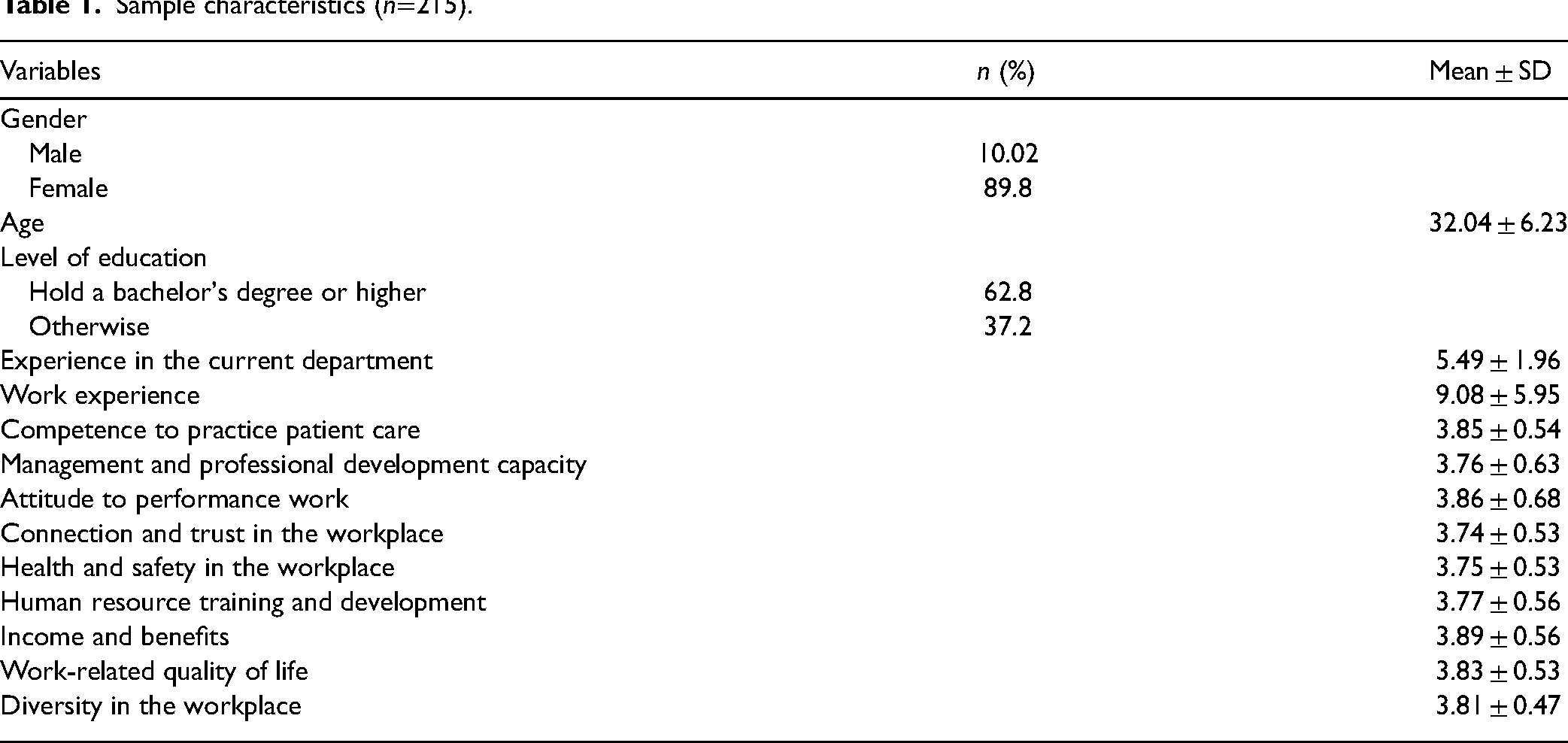
Table 1 summarizes the main characteristics of the sample obtained. The nurses’ perceptions of the hospital's internal social responsibility practices are positive, with scores above 3.5 out of 5.0. Specifically, the scores for income and welfare are 3.89 ± 0.56, human resource training and development are 3.77 ± 0.53, health and safety at work are 3.75 ± 0.53, connection and trust in the workplace are 3.74 ± 0.53, quality of life at work is 3.83 ± 0.53, and diversity in the workplace is 3.81 ± 0.47. Nurses reflect a high level of job performance, as indicated by their self-assessment scores above 3.5/5.0. Specifically, they rate their ability to provide nursing care at 3.85 ± 0.54, their job performance attitude at 3.86 ± 0.68, and their management and career development capacity at 3.76 ± 0.63.
Sample characteristics (n=215).
The effect of internal CSR on nurses’ job performance
Evaluation of the Measurement Model
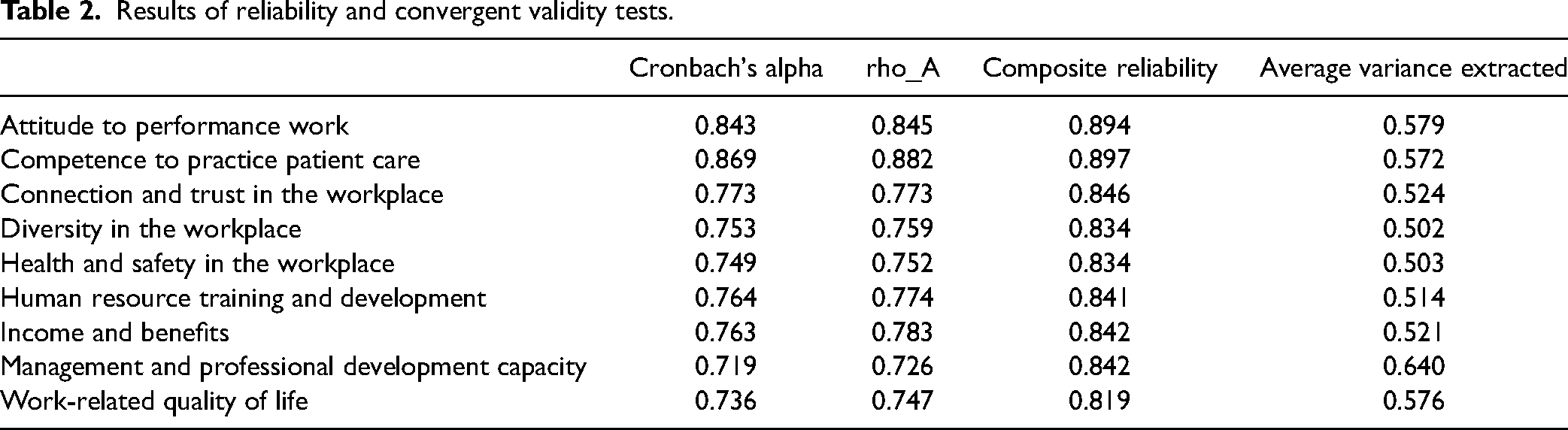
The research model was tested using the variance-based PLS-SEM approach (Hair et al., 2019) with the assistance of SmartPLS 3.2.6. During the initial stage of our analysis, we evaluated the reliability and validity of our measurement models through a component-based method to estimate that relies on variance (Wold et al., 2006). The estimated results showed that the constructs of the model exhibit indicator loadings of 0.50 or higher. This suggests that the constructs account for more than 50% of the variance in the indicators, hence confirming the reliability and credibility of the items (Hair et al., 2019). The study's high internal consistency dependability was fulfilled, as evidenced by the composite factor reliability coefficients (C.R.) in Table 2, which varied from 0.819 to 0.896 (Hair et al., 2019). The average variance extracted for each concept in the model is used as an indicator of convergent validity, with a recommended threshold of 0.502 or higher (Hair et al., 2019).
Results of reliability and convergent validity tests.
The discriminant validity of the constructs in each possible pair was evaluated by comparing the variance extracted estimates and pairwise correlations using PLS-SEM analysis. The common variance for all models was analyzed and presented in Table 3 (Hair et al., 2019).
Fornell–Larcker criterion analysis for testing discriminant validity and correlations matrix among constructs.
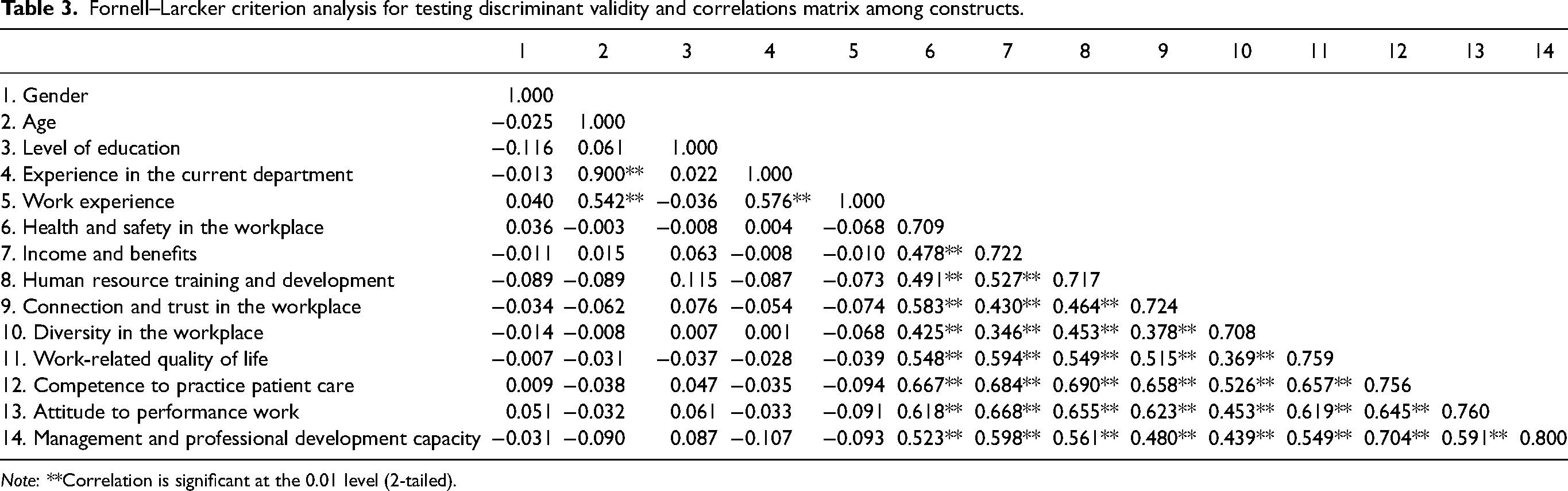
Note: **Correlation is significant at the 0.01 level (2-tailed).
Hypothesis Testing
The PLS technique was executed during the second phase of the data processing. The hypotheses are examined using the bootstrapping technique, founded on the PLS approach (Wold et al., 2006). Figure 1 provides the path coefficients of the model.

Path coefficients.
The R2 value of the dependent variable is a measure of the model's explanatory and predictive ability (Hair et al., 2019). R2 value of the components of the nurse's job performance variables: competence to practice patient care (0.749), attitude to performance work (0.673), and management and professional development capacity (0.502), demonstrating a good level of explanation of the component variables of the hospital's internal CSR practices. Chi-square = 2238.87 (p < .001). Standardized root means square residual equal 0.074, thus fitting the model (Hair et al., 2019). The value of f2 reflects the importance of CSR components to competence to practice patient care (f2 = 0.034–0.154), attitude to performance work (f2 = 0.007–0.146), and management and professional development capacity (f2 = 0.006–0.082). Q2 values are positive and higher than 0, 0.25, which depicts the PLS-path model's small and medium predictive relevance: coefficient Q2 is positive: competence to practice patient care (0.346), attitude to performance work (0.450), and management and professional development capacity (0.311), showing that the path model can predict good model fit.
A bootstrapping procedure using 1000 subsamples will determine the statistical significance of each path coefficient (Chin, 1998). The hypothesized path coefficients, bootstrap values, and C.R values are listed in Table 4. The study has also proven that a hospital's internal CSR practices impact nurses’ job performance, the level of importance of which is ranked in the following order: (i) income and benefits, human resource training and development, and work-related quality of life positively relate to three dimensions of a nurse's job performance (competence to practice patient care, attitude to performance work, and management and professional development capacity); (ii) connection and trust in the workplace and health and safety at work significantly affect two dimensions of a nurse's job performance (namely, competence to practice patient care and attitude to performance work); and (iii) diversity in the workplace impacts nurses’ competence to practice patient care and their management and professional development capacity. Demographic variables did not correlate statistically significantly with dimensions of internal CSR and nurses’ job performance.
The total direct effect with standardized regression weights.

Discussion
Nurse job performance is central to health management research due to its core role in hospital performance and patient well-being (Janssen et al., 2020). Tracing the origins of nursing performance has taken up a substantial share of previous research, but the results need to be more solid and focused to stop the debate (Abdullah et al., 2021; Terzioglu et al., 2016). This study, therefore, contributes critical perspectives to contemporary debates. Under the lens of internal CSR, research results demonstrate the role of components, namely (i) income and benefits, (ii) health and safety at work, (iii) human resource training and development, (iv) connection and trust in the workplace, (v) diversity in the workplace, and (vi) work-related quality of life (Liu et al., 2023).
Strengths and Limitations
This study granted four main contributions to hospital management literature via the evidence from an emerging market. Firstly, in recent studies, CSR awareness has increased significantly, but the issue of individual response mechanisms for an organization's internal CSR implementation still needs to be completed. This contributing study sheds light on the critical overall effects of internal CSR activities on hospital performance at the micro and employee levels. Hospital CSR can meet employee needs based on the organization's ethical well-being policies, which can build a relationship between employee perception of CSR practices and the implementation performance of nursing work. An individual can rely on CSR policies and ethical behavior toward stakeholders as a potential indicator of expected working conditions. Individuals may perceive the organization involved in CSR as more trustworthy, which may impact nurses’ successful job performance. A distinction can be observed between the evaluations of internal CSR practices by nurses in Vietnam and other case studies. Differences in economic development levels, regulations, and pressure from relevant parties can account for this result. For instance, in the context of Taiwan, the scrutiny of stakeholders regarding hospital CSR practices will be more rigorous compared to Vietnam or Myanmar, where such practices are expected to be more lax. Furthermore, hospitals that have constrained resources will give precedence to CSR initiatives that have an immediate effect on their financial or social performance rather than those that are discretionary or global in scope (Chang et al., 2021; Htun, 2022; Liu et al., 2023). Secondly, measuring the effectiveness of nursing care in hospitals is becoming increasingly important in monitoring the impact of nursing staffing levels and supporting quality improvement activities related to hospital nursing. Developing effective performance measurement systems will enable healthcare and hospital stakeholders to understand better and monitor the extent to which nursing care impacts patient safety and quality of service delivery. The research has inherited and developed a measurement scale system that constitutes the hospital's CSR practice for nurses in the context of private hospitals in Vietnam, including six components: (i) income and benefits, (ii) health and safety at work, (iii) human resource training and development, (iv) connection and trust in the workplace, (v) diversity in the workplace, and (vi) work-related quality of life. Thirdly, this study integrates quantitative and qualitative research methods in hospital management. The research adopted the PLS-SEM quantitative model in testing hypotheses/relationships between variables, precisely the dimensions of CSR practice and nurses’ job performance. Integrating research and estimation methods will help provide additional estimation results for orienting practical hospital management policies. Finally, the research results have provided additional roles of hospitals’ internal CSR practices and nurses’ job performance, emphasizing the role of income and benefits, human resource training and development, health and safety, connection and trust, quality of life, and diversity in the workplace.
This study has certain limitations in terms of the representative nature of the sample, the self-report survey instrument used, and the use of cross-sectional data. Participants were selected from one hospital, part of a private health system, and shared a similar organizational culture related to working conditions, such as promotion policies and regulations on wages and salaries—labor welfare. Therefore, the homogeneity of the sample may limit the generalization of this study's findings. This suggests that it is necessary to continue to conduct larger-scale and more diverse studies to explore nurses’ attitudes/expectations/feelings toward practicing CSR in other hospital environments (e.g., public or private, for-profit or not-for-profit, and university or nonuniversity hospitals). However, measuring the research concept of CSR and nurses’ job performance is very complex and has yet to receive consensus from an academic and practical perspective. Therefore, future studies can continue to apply the scale proposed in this study to other research contexts. Besides, although this study is an initial investigation of the impact of internal CSR practices on nurses’ job performance in the context of hospital management in Vietnam, it is an exciting adjustment to internal CSR and nursing work performance elements. However, the impact mechanism of CSR on hospital performance at the organizational level and individual level, in addition to the direct relationship as in this study, may also include the effects of mediator and moderator variables, requiring continued research to provide more theoretical and practical evidence for the field of hospital and nursing management through the lens of CSR practice.
Implications for Practice
The results of the present study contribute to a better understanding of the benefits of hospitals’ socially responsible actions and contribute further to resource management in hospitals, especially nursing. If the nursing staff positively perceives the hospital's internal CSR practices, they will be more able to perform their job, impacting the hospital's overall performance.
Research results give hospital management teams an essential practical foundation for applying hospital quality management systems. ISO 26000:2010 is the first international standard to cover CSR. Although it describes the principles of CSR and provides guidance, unlike other standards, such as ISO14000 on environmental management management, ISO 26000:2010 is not a management standard, and this standard does not warrant certification. Instead, in line with CSR, the objective of the ISO 26000:2010 standard is to contribute to sustainable development by encouraging organizations to embed their activities toward the needs/expectations of stakeholders, especially employees. This study, in a hospital context, shows that whether the formal application is published (e.g., on websites and reports) or unpublished (but with the planned use of the implications of labor practice, ISO 26000:2010 responsibilities) will provide essential resources for nursing staff to practice nursing care and work attitudes and improve management capacity and professional development, which can improve the hospital's overall performance.
From a strategic perspective, hospitals need to have an investment strategy for internal CSR practices as an official investment, enhancing hospital human resources and thereby making an essential contribution to the quality of hospital performance.
The ethical climate has the potential to serve as a predictor of job success among nurses. Nurse leaders and hospital management must develop ethical norms as the prevailing standards for evaluating the logical analysis of tasks and specific concepts related to nursing practice (Abou Hashish, 2017; Akkoç et al., 2022). The safety systems component of safety climate pertains to employees’ attitudes regarding the effectiveness of safety management systems, including safety policies and practices, implemented inside their firm (Manapragada et al., 2019). There is potential for employees to hold varying perspectives regarding the efficacy of safety policies and procedures in mitigating accidents and injuries and their effectiveness in fostering worker performance. The nurses in personnel management utilized various elements of human capital, including specialized education and prior professional experience during the hiring process.
Additionally, strategies for talent retention through promotion were employed. The development of professionals was facilitated through support and training initiatives. Lastly, collaborative efforts were made to construct processes and assess outcomes (Cordeiro et al., 2017). The nursing profession is widely recognized as associated with significant stress levels, which has a detrimental impact on nurses’ overall quality of life. The study of nurses’ quality of life is essential due to its association with job performance. Numerous prominent national organizations have extensively emphasized the importance of diversity in nursing to promote culturally competent and patient-centered care and mitigate health disparities. The diversification of the healthcare workforce has promise to enhance healthcare delivery in terms of both business operations and patient outcomes. Despite a limited amount of comprehensive research establishing a direct correlation between diversity in healthcare and clinical results, an increasing body of evidence highlights the advantages of a diverse workforce from a corporate perspective. For instance, a favorable correlation exists between increased workforce diversity and financial performance indicators such as productivity, precision in risk assessment, and creativity. Existing research indicates that enhancing diversity within the healthcare workforce may serve as a means to enhance interactions between patients and providers, thereby leading to improved patient outcomes and reduced health inequalities (Rovito et al., 2022).
It is recommended that hospitals allocate resources toward internal CSR initiatives as a strategic and enduring investment in enhancing nursing performance, which translates into organizational performance. The maintenance and enhancement of ethical responsibility toward patients and stakeholders is of significant importance for nurses, necessitating the presence of an ethical working environment. A morally principled institution ensures its personnel have the resources to articulate their thoughts and ideas successfully.
Conclusion
Nurses allocate a more significant amount of time to patient interaction compared to other healthcare professionals, and the quality of nursing care has a direct impact on patient outcomes. Therefore, enhancement in patient safety can be attained by enhancing nursing performance. The study presents significant findings on the influence of internal CSR on nurses’ job performance within the health business of an emerging market.
Supplemental Material
sj-docx-1-son-10.1177_23779608241267060 - Supplemental material for Fostering the Job Performance of Nurses: A Responsibility of an Ethical Hospital
Supplemental material, sj-docx-1-son-10.1177_23779608241267060 for Fostering the Job Performance of Nurses: A Responsibility of an Ethical Hospital by Hua Thanh Thuy and Bui Thi Lan in SAGE Open Nursing
Footnotes
Data Availability
The datasets analyzed during the current study are available from the corresponding author upon reasonable request.
Declaration of Conflicting Interests
The authors declared no potential conflicts of interest with respect to the research, authorship, and/or publication of this article.
Funding
The authors received no financial support for the research, authorship, and/or publication of this article.

Supplemental Material
Supplemental material for this article is available online.
References
Supplementary Material
Please find the following supplemental material available below.
For Open Access articles published under a Creative Commons License, all supplemental material carries the same license as the article it is associated with.
For non-Open Access articles published, all supplemental material carries a non-exclusive license, and permission requests for re-use of supplemental material or any part of supplemental material shall be sent directly to the copyright owner as specified in the copyright notice associated with the article.
