



Abstract
Objective
To examine the mediating role of job performance in the relationship between employee entitlement and flourishing among nurses in Saudi Arabia and Jordan.
Methods
A cross-sectional study was conducted in government hospitals located in eastern Saudi Arabia and northern Jordan. Utilizing convenience sampling, data were collected from a sample of 437 nurses. The instruments employed in this study included the Flourishing Index, the Job Performance Scale, and the Employee Entitlement Scale.
Results
In Saudi Arabia, the model accounted for 15.9% of the variance in flourishing and 7.1% in performance. In Jordan, the model explained 15.2% of flourishing but only 4.3% of performance. Mediation analysis revealed that entitlement exerted an indirect influence on flourishing through performance in both countries (Saudi Arabia: indirect effect = 0.107, p < .001; Jordan: indirect effect = 0.062), with a fully mediated effect observed in Jordan.
Conclusion
Job performance serves as a mediating factor between entitlement and flourishing among nurses. These findings provide valuable insights for healthcare administrators and policymakers seeking to improve nurse well-being through targeted performance support interventions.
Introduction
Employee performance is a critical determinant of organizational success, as it has a direct impact on the achievement of organizational objectives (Krishnan et al., 2018; Pujotomo et al., 2022). Several factors have been linked to employee performance (Al-Dossary, 2022; Hamdan et al., 2020). However, little is known about the relationship between nurses’ job performance, entitlement, and flourishing. Hence, it is essential to explore the relationships among these variables in the nursing context.
Nursing job performance denotes the behaviors and outcomes related to nursing labor (Tura et al., 2024). Professional authority reflects nurses’ applied knowledge and skills, crucial to healthcare, especially amid global shortages and early career challenges faced by nurses (Jerpseth & Jensen, 2025). Assessing and enhancing nursing job performance helps advance department efficiency and patient diagnosis, in addition to increasing medical service quality (Guo et al., 2020). Currently, the shortage of the nursing workforce has been a worldwide obstruction (Rahmani et al., 2021; Tamata & Mohammadnezhad, 2023), and it has been reported that clinical nurses face a high mental workload, which can be eased by positive coping strategies supported by strong social support systems (Ren et al., 2025).
Flourishing is widely acknowledged in academic discourse as a multidimensional construct that encompasses emotional, psychological, and social well-being (VanderWeele, 2017). It is commonly conceptualized as existing on a continuum with mental illness (Seligman, 2018). A growing body of research suggests that the presence of flourishing plays a significant role in enhancing nurses’ overall health and well-being (Abdelkreem et al., 2021). Factors such as family satisfaction, resilience, and cognitive efficiency have been identified as crucial in promoting and fostering flourishing in this group (Fastame et al., 2024).
Employee entitlement occurs when an employee believes that he or she is entitled to rewards and preferential treatment, often with little to no work attributes or performance levels (Piotrowski & Besta, 2022). Research suggests that individuals who have high levels of psychological entitlement often display self-centered behaviors, which can negatively impact their job performance and relationships with others. While entitlement may provide some protection against work–family conflict, it can also lead to decreased job satisfaction among employees who are less entitled. This indicates that there is a complex relationship between entitlement and workplace dynamics (Laird et al., 2020). Examining nursing entitlement to enhance nurse flourishing and job performance is crucial for stabilizing the nursing workforce, minimizing talent attrition, and promoting the development of nursing and hospital specialties.
Review of Literature
Job satisfaction is identified as an emotional attitude toward a job and its related features (Guo et al., 2020). Job satisfaction not only affects nurses’ well-being and performance (Kabbash et al., 2020; Katebi et al., 2021) but it also influences patients’ quality of care provision (Kabbash et al., 2020). Many variables have been identified that affect nurses’ job performance. These include the head nurses’ leadership style (Suwarno, 2023), human resource development (Suprapto et al., 2023), work engagement (Al Badi et al., 2023), organizational justice (Ekingen, 2021), and psychological and organizational factors (Sarumaha et al., 2022).
Flourishing has been identified as a state in which aspects of an individual's life are good (Lomas et al., 2024). The human-flourishing conceptual model was created by contemplating compound domains based on philosophical traditions and social sciences (Wȩziak-Białowolska et al., et al., 2019). There are six domains of flourishing: (1) physical and mental health, (2) purpose and meaning in life, (3) close social relationships, (4) happiness and life satisfaction, (5) character and virtue, and (6) financial and physical stability (Hsu et al., 2024). Extensive research suggests that flourishing entails more than just the absence of mental illness. It encompasses positive psychological characteristics, such as resilience, life satisfaction, and social connectedness (Nur’aini & Mulyana, 2024). Constructing positive organizational behavior is now widely acknowledged as crucial to enhancing employees’ work experiences and overall organizational performance. Research shows that positive organizational behavior creates a supportive environment where employees feel motivated and empowered, leading to better performance (Chauhan et al., 2024). Although flourishing is usually viewed as a multidimensional and fundamental construct of well-being (Weziak-Bialowolska et al., 2021), it has been theorized in diverse ways and involves different components. Managers are encouraged to give precedence to job flourishing on a day-to-day basis, both for themselves and those with whom they collaborate (A’yuninnisa et al., 2023).
Workplace flourishing is essential for achieving positive outcomes, including engagement (Erum et al., 2020), proactive behaviors, and effective knowledge sharing (Khari & Sinha, 2018; Tu et al., 2020). Furthermore, it contributes to enhanced performance at the individual, group, and organizational levels (Fragkos et al., 2020; Giolito et al., 2021) and is associated with overall well-being, encompassing improved physical health, greater life satisfaction, and the cultivation of positive behaviors (Hori et al., 2019; Magnano et al., 2019). However, no study has focused on the relationship between nursing entitlement, job performance, and flourishing. Few studies have focused on the flourishing of nursing, whereas others have focused on ethical leadership (El-Gazar & Zoromba, 2021), job demands and resources (Castner, 2019), authentic leadership (Chevalier et al., 2021), and nurses’ motivation through daily communication (Ahlstedt et al., 2020).
Entitlement in organizational contexts refers to an individual's anticipation of receiving more than what is considered appropriate by an impartial observer (Piotrowski & Besta, 2022). This often stems from the belief that certain outcomes are deserved, regardless of their actual contributions (Neville et al., 2024). Extensive research suggests that employee entitlement is becoming increasingly recognized and is linked to various characteristics of employees (Neville et al., 2024; Neville et al., 2019). Individuals with a sense of entitlement often expect special treatment, which can significantly affect their relationships and behavior. Entitlement can have positive and negative effects, depending on context and perception. For example, students’ entitlement toward teachers can impact their school experience, highlighting the complex nature of entitlement in social settings (Tolmacz et al., 2024).
In previous studies, employees working with highly entitled coworkers reported experiencing high levels of job conflict (Zhu & Anagondahalli, 2017) and staff with high expectations of entitlement were more likely to feel work frustration, which may persuade them to engage in political behavior and may lead to coworker abuse (Piotrowski & Besta, 2022). This indicates a complex relationship between entitlement and workplace dynamics (Laird et al., 2020). Research suggests that individuals with high levels of psychological entitlement often display self-centered behaviors that can negatively impact their job performance and relationships with others. Studies on nurses’ entitlement are limited.
Historically, employees often have certain expectations from their employers, particularly in terms of career advancement opportunities, such as promotions. Employees highly value clear promotion pathways, viewing them as key to job satisfaction and retention (Rokjane & Dislere, 2020). Research consistently shows that employees with high personal performance expectations tend to expect more from their organization than what is typically offered based on their actual performance (Syakur et al., 2021). Given the differing beliefs about entitlement between employers and employees, it is important to sustain high job performance despite these differences (Joplin et al., 2021). Research on nursing entitlement is limited, highlighting a gap in insight into this worthy topic within the profession (Peng et al., 2022). Moreover, the perceived value of nursing, shaped by professional development opportunities and job satisfaction, plays a vital role in attracting and retaining nursing talent (Anderson et al., 2024).
Notably, this study is the first to use structural equation modeling to examine the relationship between entitlement, flourishing, and job performance among nurses in Saudi Arabia and Jordan. This study is significant as it's a cross-cultural comparison, focusing on how entitlement influences job performance and flourishing in nurses from two countries. It contributes to the knowledge of flourishing, as a multidimensional construct, in the healthcare worker context, specifically, nurses. The study provides valuable insight into the unique challenges faced by nurses in these countries and makes suggestions for improving workplace climates and support systems. Therefore, the primary objective was to examine the mediating role of job performance in the relationship between employee entitlement and flourishing across different countries. The hypotheses of this study were as follows:
Methods
Design and Setting
This descriptive, cross-sectional study was conducted in the eastern regions of Saudi Arabia and northern Jordan. This study collected data from nurses employed in various departments, including emergency, intensive care, medical-surgical, and outpatient units. The sample consisted of diverse nursing roles, such as direct care nurses, registered nurses (RNs), and nurse managers. Eligible participants consisted of RNs currently employed at the selected government hospitals, possessing a minimum of 6 months of work experience, and demonstrating a willingness to participate in the study. Data collection was conducted at two government hospitals in each country.
Sample
The sample for this study comprised RNs and employed a convenience sampling methodology. Nurses employed in government hospitals across both countries were invited to participate via an online questionnaire disseminated through a secure link provided by QuestionPro. This link was distributed through official hospital communication channels, including emails, internal messaging systems, and direct invitations from nursing supervisors. Prior to obtaining informed consent, participants were informed of the study's objectives, the voluntary nature of their participation, and assurances of confidentiality. The requisite sample size of 242 nurses per country was determined using G*Power software, based on an assumed effect size of 0.3 and an α level of .05. The response rate for the study was 53.1%.
Instruments
The Flourishing Index consists of 12 items in six domains: (1) happiness and life satisfaction, (2) physical and mental well-being, (3) meaning and purpose, (4) character and virtue, (5) close social relationships, (6) financial and material stability. Each point was scored on an 11-point scale ranging from 0.0 (lowest answer) to 10.0 (highest answer). Scores from the first six domains were summed, with higher scores indicating a more positive assessment of human flourishing. This index was used to assess individual perceptions of well-being and flourishing (VanderWeele, 2017; Wȩziak-Białowolska et al., 2019). The Flourish Index (FI) has demonstrated significant reliability and validity, including within Saudi cultural contexts. Research employing the Arabic version, notably the Global Flourishing Study, substantiates its psychometric robustness through Confirmatory Factor Analysis and reliability metrics such as Cronbach's α. In the context of Saudi Arabia, the FI exhibited excellent model fit indices (Comparative Fit Index [CFI] = 0.962, Root Mean Square Error of Approximation [RMSEA] = 0.059) and high internal consistency (Cronbach's α = .86). The validation processes encompassed expert reviews and pilot studies to ensure cultural relevance, with modifications made to address religious and linguistic nuances. These findings affirm the FI's appropriateness for assessing flourishing in Saudi populations (Shdaifat et al., 2024a, 2024b). In the context of Jordan, the Flourishing Scale has exhibited robust psychometric properties among nursing professionals, evidenced by a Cronbach's α of .873 and a composite reliability of .867 (Shdaifat, 2023).
The Job Performance Scale developed by Williams and Anderson (1991) includes five items to assess job performance. Participants rated each item on a five-point scale ranging from 1 (strongly disagree) to 5 (strongly agree). To obtain the scale value, the ratings of all five items were averaged (Williams & Anderson, 1991). This scale is commonly used to measure participants’ self-assessed job performance. In the context of Jordan and among nursing professionals, the Job Performance Scale exhibited a satisfactory level of internal consistency, evidenced by a Cronbach's α coefficient of .760. This suggests that the scale serves as a reasonably reliable instrument for evaluating participants’ job performance (Shdaifat et al., 2023).
The Employee Entitlement Scale consists of eight items developed by (Campbell et al., 2004) to measure employees’ personal entitlement. Participants rated their level of agreement with claim statements on a seven-point scale from 1 (strongly disagree) to 7 (strongly agree). The scale assesses individual perceptions of job entitlement (Campbell et al., 2004). In this study conducted in Jordan, the Entitlement Scale demonstrated robust internal consistency and construct validity, evidenced by a Cronbach's α of .884, rho_A of 0.907, composite reliability (rho_C) of 0.906, and an average variance extracted (AVE) of 0.555.
To ensure the reliability and validity of the measurement model, items with factor loadings below 0.50 were excluded from the analysis. The retained items exhibited acceptable factor loadings exceeding 0.50, and all constructs demonstrated satisfactory internal consistency, as indicated by Cronbach's α values greater than .70, composite reliability coefficients above .70, and adequate convergent validity, with AVE values surpassing 0.50.
Ethical Considerations
Ethical considerations were rigorously addressed throughout all phases of the study, encompassing design, recruitment, data collection, and storage. Written informed consent was obtained after a comprehensive explanation of the study's purpose, procedures, and participants’ rights. Ethical approval was secured from the relevant Institutional Review Boards in Saudi Arabia and Jordan. Data confidentiality was maintained through de-identification and secure storage practices. The study adhered to the principles outlined in the Declaration of Helsinki and complied with institutional ethical guidelines.
Participant Recruitment
Participant recruitment was standardized and monitored by a centralized research team that coordinated the process across the study sites in Saudi Arabia and Jordan. Standardized recruitment protocols were adhered to at each site to guarantee consistency in participant selection, encompassing uniform eligibility criteria and the utilization of identical recruitment materials. This methodology was employed to reduce variability in the recruitment process and to ensure the reliability of the sample across both nations.
Data Analysis
Several steps were involved to ensure the validity and reliability of the results. Microsoft Excel was used to store, clean, and screen data. Additionally, SmartPLS 4 software was used to examine factor loadings, composite reliability, and extracted mean variance, ensuring the convergent validity of the data. Before conducting the structural equation modeling (SEM) analysis, the assumptions of normality and multicollinearity were evaluated. SEM analysis, aimed at testing the hypothetical model and examining the relationships between the latent constructs (flourishing, job performance, and entitlement), was performed using SmartPLS 4.0. Both direct and indirect effects were examined in this study. To ascertain the significance of the relationships within the model, the researchers employed the bootstrapping technique, a resampling method that involves the repeated drawing of random samples (5,000 resamples in this study) to estimate confidence intervals and bolster the robustness of the findings. The significance level was set at p < .05. Finally, the results of the SEM analysis were used to evaluate the hypothetical model and examine the mediating role of performance in the relationship between flourishing and entitlement. These rigorous analytical methods ensured a robust assessment of the research hypotheses and contributed to the credibility of the study results.
The data cleaning and analysis preparation process was carried out as part of the research study and it took several steps to ensure the quality and validity of the data. Firstly, participants with a response variance of zero were excluded from the analysis. Next, data from eight individuals were removed due to a large amount of missing data. An imputation strategy was employed to address the issue of missing data by substituting missing values with estimated values. For continuous variables, the mean was utilized to minimize bias within the dataset, whereas for categorical variables, the median was applied to preserve the integrity of the distribution (Alam et al., 2023; Kang, 2013). This approach aimed to obtain valuable data without skewing the overall analysis. In Saudi Arabia, the variable “Perf5” was removed from the analysis due to low loading, indicating a lack of relevance or significance. In Jordan, several variables, including “Perf5,” “F7,” “F8,” “F11,” and “F12,” were removed because of their low validity. Additionally, three participants in Jordan were excluded from the analysis because their responses exhibited zero variance on the flourishing scale, rendering them unsuitable for further analysis. Mahalanobis distance, a multivariate metric utilized to assess the deviation of a data point from the centroid of a distribution, was computed to identify potential outliers (Li et al., 2019; Yan et al., 2018). Three participants exhibiting extreme values were excluded to mitigate their undue influence on the results.
Measurement Model
Table 1 illustrates robust discriminant validity for the constructs of entitlement, flourishing, and performance within the context of Saudi Arabia. The diagonal values, representing the AVE, exceed the threshold of 0.50, thereby indicating a satisfactory degree of variance explained by each construct. The correlations among the constructs, presented below the diagonal, are predominantly low to moderate in magnitude, with Flourishing and Performance exhibiting the strongest correlation at 0.427. Furthermore, the heterotrait-monotrait ratio (HTMT) values, shown above the diagonal, are significantly below the critical value of 0.90, thereby reinforcing the distinctiveness of the constructs. Collectively, the findings encapsulated in the table substantiate the validity of the measurement model employed in this study. All elements in the model had factor loadings above the minimum acceptable value of 0.50 (Hair et al., 2010). While factor loadings above 0.7 are desirable (Vinzi et al., 2010), weaker external loadings (<0.70) are commonly observed in social science studies. Elements with external charges between 0.40 and 0.70 were considered for removal only if their deletion resulted in an increase in composite reliability or AVE over recommended values (Hair et al., 2017). In the current study, the following items were removed from further analysis in the study from both countries: perf5 and from the Jordanian data set; F7, F8, F11, and F12.
Discriminant Validity: Fornell-Larcker Criterion and Heterotrait-Monotrait Ratio of Correlations in Saudia Arabia.
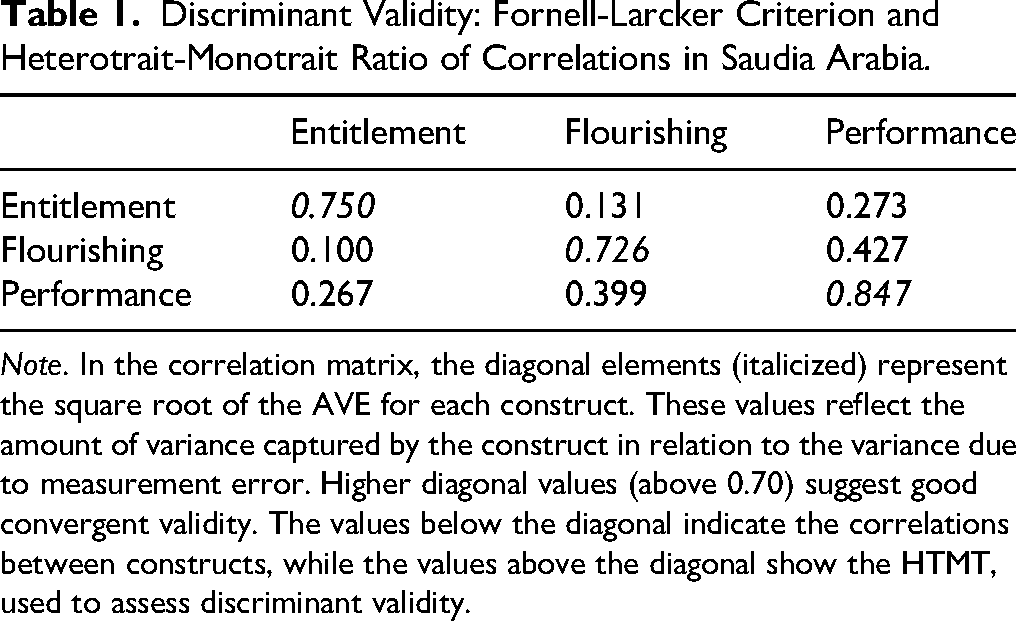
Note. In the correlation matrix, the diagonal elements (italicized) represent the square root of the AVE for each construct. These values reflect the amount of variance captured by the construct in relation to the variance due to measurement error. Higher diagonal values (above 0.70) suggest good convergent validity. The values below the diagonal indicate the correlations between constructs, while the values above the diagonal show the HTMT, used to assess discriminant validity.
The reliability assessment included Cronbach's α, rho_a, and composite reliability statistics. All of these exceeded the recommended threshold of 0.70 (Wasko & Faraj, 2005). In addition, the rho_a value, which lies between Cronbach's α and composite reliability (Hair et al., 2017), was above 0.70, indicating good reliability (Henseler et al., 2016). Convergent validity was confirmed when the AVE was greater than 0.500. To determine discriminant validity, correlations between latent variables were compared using the square root of the AVE (Fornell & Larcker, 1981) and the HTMT of the correlations (Henseler et al., 2015). All values were below the conservative threshold of 0.85, confirming the specificity of the latent constructs in this study (see Tables 1 and 2). These results instill confidence in the reliability and validity of the measurement model and lend support to the soundness of the latent constructs in the study.
Discriminant Validity: Fornell-Larcker Criterion and Heterotrait-Monotrait Ratio of Correlations in Jordan.

Note. In the correlation matrix, the diagonal elements (italicized) represent the square root of the AVE for each construct. These values reflect the amount of variance captured by the construct in relation to the variance due to measurement error. Higher diagonal values (above 0.70) suggest good convergent validity. The values below the diagonal indicate the correlations between constructs, while the values above the diagonal show the HTMT, used to assess discriminant validity.
Results
Overall demographic information for participants from Saudi Arabia and Jordan showed that in Saudi Arabia, the majority of participants (94.6%) were female, 78.4% were married, and 70.3% were graduates. In Jordan, 63.3% were women, 61.9% were married, and 68.8% had a bachelor's degree. The average age of participants from Saudi Arabia was 37.7 years. In Jordan, the average age was 32.3 years. In terms of work experience, the Saudi participants had an average of 14.3 years of work experience, while the Jordanian participants had an average of 9.2 years of work experience.
Structural Model
The structural model was developed to capture the expected relationships between variables in the research framework. To evaluate the structural model, we considered R2 and Q2 and the importance of paths. For this analysis, 5,000 resamples were used to generate 95% confidence intervals, as shown in Table 3. A non-zero confidence interval indicates a significant relationship between the variables. The results of the hypotheses tests are summarized in Table 3 and provide valuable insights into the relationships and their importance in this study.
Results of Hypotheses Testing, R2, Q2, and SRMR.
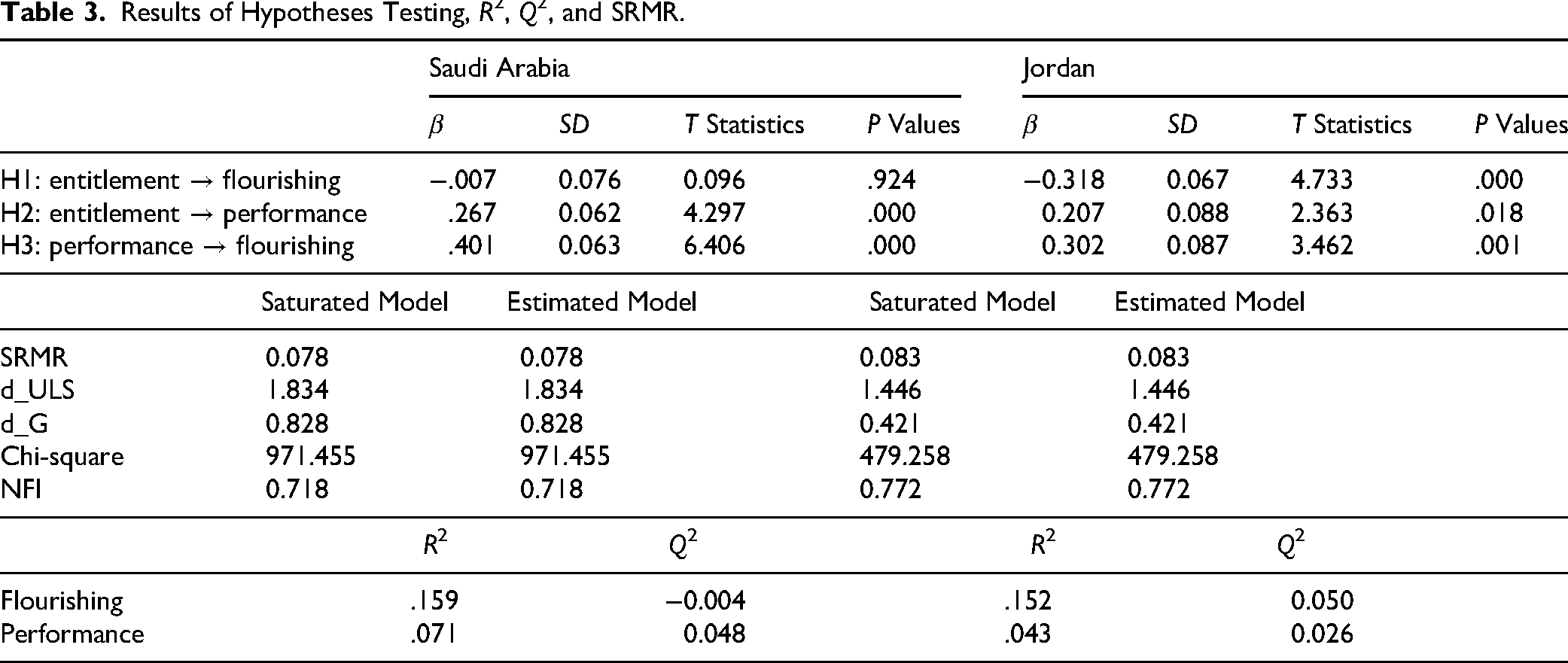
The quality of the structural model is assessed using the R2 value, which indicates the strength of each structural path for the dependent variable (Juan et al., 2017). An R2 value equal to or greater than .1 (Falk & Miller, 1992) is considered adequate to demonstrate a significant impact. In our study, the results presented in Table 3 show that all R2 values exceeded .1. This indicates the strong predictive ability of the model. In addition, the Q2 values showed that the model has predictive relevance, with all constructs showing significance and demonstrates the ability of the model to accurately predict the outcome variables. In addition, an SRMR value of 0.08 indicates an acceptable model fit (Hair et al., 2017). The structural root mean square residual (SRMR) is a measure of the difference between observed and predicted covariance matrices and a value below 0.08 indicates an acceptable fit. This study's structural model adequately represented the data. Taken together, the evaluation of the R2, Q2, and SRMR values provides confidence in the reliability and predictive ability of the structural model and supports its suitability for research frameworks.
The findings from hypotheses testing that explored the relationships between entitlement, flourishing, and job performance in both Saudi Arabia and Jordan, reveal interesting patterns. In Saudi Arabia, entitlement did not show a significant impact on flourishing (β = −.007, SD = 0.076, T statistics = 0.096, p = .924). However, it did have a significant influence on performance (β = .267, SD = 0.062, T statistics = 4.297, p = .000). Additionally, performance had a significant impact on flourishing (β = .401, SD = 0.063, T statistics = 6.406, p = .000). In Jordan, the trends were similar. Entitlement significantly impacted flourishing (β = −.318, SD = 0.067, T statistics = 4.733, p = .000) and performance (β = .207, SD = 0.088, T statistics = 2.363, p = .018). Furthermore, performance significantly influenced flourishing (β = .302, SD = 0.087, T-statistics = 3.462, p = .001).
Various model fit statistics, including SRMR, d_ULS, d_G, chi-square, and NFI, were computed for both the saturated and estimated models. The findings indicated that SRMR and d_ULS suggested a good model fit in both Saudi Arabia and Jordan. The statistic d_ULS evaluates model fit utilizing unweighted least squares, while d_G assesses fit through geodesic distance, with lower values on both metrics signifying a superior fit. The Normed Fit Index (NFI) compares the proposed model against a null model; values approaching 1 (≥0.90) are indicative of an acceptable fit. However, the chi-square values were relatively high, indicating some discrepancies between the estimated and saturated models. Nevertheless, it is important to consider that the chi-square statistic can be influenced by sample size, and it is prudent to take into consideration other fit indices such as SRMR and NFI. The NFI values, which measure incremental fit, demonstrated a moderate fit for both models. Overall, these fit statistics provided valuable insights into the adequacy of the models in both Saudi Arabia and Jordan. Thus, helping to assess the quality and appropriateness of the estimated models.
The R Square values offered valuable insights into the extent to which the models explained the variance in variables. In Saudi Arabia, the R2 for flourishing was .159, indicating that the model accounts for approximately 15.9% of the variability in this variable. The corresponding Q2 value was −0.004, suggesting a slight deviation from perfect predictive accuracy. For performance, the R2 was .071, signifying that around 7.1% of the variance was explained by the model, and the Q2 was 0.048, indicating a moderate predictive relevance.
In Jordan, the R2 for flourishing was .152, indicating that the model explains approximately 15.2% of the variability in this variable. The Q2 value for flourishing was 0.050, showing a reasonable predictive relevance. Conversely, for performance, the R2 was .043, explaining approximately 4.3% of the variance, and the Q2 is 0.026, suggesting a comparatively lower predictive accuracy.
Mediation Analysis
Table 4 demonstrates the findings of a statistical analysis that examined the connections between entitlement, performance, and flourishing in Saudi Arabia. The results showed that “entitlement has a significant indirect impact on flourishing” (0.107, p < .001), mainly through its influence on performance. However, when considering both direct and indirect effects, the total impact of entitlement on flourishing was not statistically significant (0.100, p > .05). On the other hand, entitlement has a significant total impact on performance (0.267, p < .001), and performance has a significant total effect on flourishing (0.401, p < .001). In essence, entitlement indirectly affects flourishing through its impact on performance, while performance directly influences flourishing.
Total and Indirect Effects.
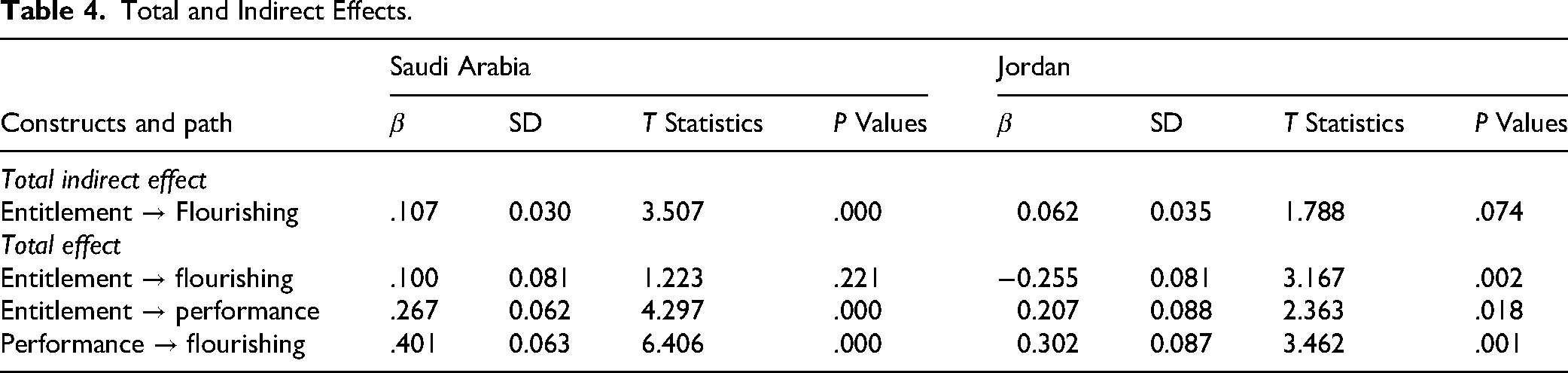
The Table 4 provides the results of a statistical analysis that explored the connections between entitlement, performance, and flourishing in Jordan. It indicates a total indirect effect of 0.062 for entitlement on flourishing, suggesting a potential indirect relationship likely influenced by other variables, especially performance. The total effect of entitlement on flourishing is −0.255, signifying a significant combined direct and indirect impact, resulting in reduced flourishing. Additionally, entitlement significantly influences performance with a total effect of 0.207. Furthermore, performance plays a noteworthy role in promoting well-being, as evidenced by its significant total effect of 0.302 on flourishing. While the findings provide valuable insights, further research is necessary to fully comprehend the underlying mechanisms and implications of these relationships in the Jordanian context.
Discussion
The study examined the relationship between entitlement, job performance, and flourishing across different country contexts. The measurement model showed good reliability and convergent validity for the constructs. The structural model demonstrated strong predictive ability with acceptable fit statistics despite relatively high chi-square values. In Saudi Arabia, entitlement had no direct impact on flourishing. Overall, entitlement had a significant impact on job performance, which in turn significantly impacted flourishing. In Jordan, entitlement had an entirely indirect impact on flourishing, likely influenced by job performance. The overall effect of the entitlement was significant and resulted in reduced flourishing. Additionally, entitlement had a significant impact on job performance, which played an important role in promoting well-being and flourishing.
The current study found that in Saudi Arabia, entitlement had no direct impact on flourishing. However, entitlement had a significant impact on job performance, which, in turn, significantly impacted flourishing. In other words, there was no impact on nurses’ well-being in Saudi Arabia for those who feel they deserve more in their job. However, the feeling of entitlement does affect their job performance. This result is consistent with previous studies that have argued that psychological entitlement must be negatively associated with well-being outcomes (Stronge & Sibley, 2021). It is proposed that entitlement decreases with advancing age, and self-esteem (a component of flourishing and well-being) increases as individuals grow older. Additionally, flourishing and well-being have been shown to be positively associated with job satisfaction and job performance, and several studies among nurses in Saudi Arabia have reported high levels of job satisfaction (Almansour et al., 2020).
Another possible explanation for why entitlement did not affect the flourishing levels of nurses in Saudi Arabia is the growing emphasis on psychological capital (PsyCap)—a key internal resource that supports mental health, especially among nurses facing unique job stressors, making its assessment essential for understanding and improving their (Wang et al., 2024) well-being (Wang et al., 2024). According to the Saudi Vision 2030 plan, which prioritizes implementing transformative reforms in healthcare and improving people's lifestyles, this sector plays a pivotal role in the country's development (Alsharari et al., 2021). Given that nurses constitute the largest healthcare workforce and provide the majority of healthcare services, it is essential for the transformational plan to address the obstacles that nurses currently face and their impact on healthcare delivery (Alsharari et al., 2021).
In the current study, for nurses employed in Jordan, entitlement had an indirect impact on flourishing, likely influencing job performance. In other words, Jordanian nurses exhibited a sense of entitlement regarding additional job benefits, and this affected both their well-being and job performance. This finding contradicts previous studies. One possible explanation for this result is that there is a correlation between psychological entitlement and decreased life satisfaction. This can be attributed to the fact that individuals with high entitlement often have elevated expectations, which frequently result in disappointment when these expectations are not met. These individuals often have a tendency to demand rewards that they have not earned, which further exacerbates their dissatisfaction when their expectations go unfulfilled (Neville et al., 2024).
Entitlement, while often viewed negatively, can benefit young adults in their careers by promoting self-focused and financially driven goals. Research indicates that entitlement in negotiations enhances self-efficacy and aspirations, motivating individuals to seek favorable outcomes, and occasionally disregarding ethical considerations (Neville & Fisk, 2019). Entitlement has also been proposed to enhance assertiveness during significant life transitions and act as a safeguard for one's self-esteem in the face of failures (Hill & Roberts, 2018). The study by Stronge and Sibley (2021) supported the idea that personality changes across the lifespan, impacting success in various roles (Stronge & Sibley, 2021). As a result, future research should explore the age group and personality traits of nurses in relation to entitlement.
Notably, this study is unique in that it is the first of its kind to reveal a significant impact of entitlement on job performance, a factor that plays a pivotal role in enhancing the well-being and flourishing of nurses. This research represents the inaugural attempt to investigate the interplay among these three variables. As such, there is no prior study to corroborate these findings. Nevertheless, several factors associated with nurses’ job performance lend support to these results. For example, in a study involving 126 nurses in Jordan, it was discovered that working in an empowering environment with valuable opportunities and genuine support is conducive to nurses’ job satisfaction (Ta’an et al., 2022). The study also found that nurses experience higher job satisfaction when their voices are heard (Ta’an et al., 2022). Similarly, a study was conducted among 214 nurses at the University of Jordan Hospital, which found that positive and significant correlations existed between self-evaluation, empowerment behavior, and job security (Sulaiman et al., 2021). It was observed that male nurses and those working in medical/surgical units reported higher levels of job security compared to female nurses and those in intensive care units (Sulaiman et al., 2021). Hence, these studies shed light on factors related to nurses’ entitlement, including nurses’ empowerment, genuine support, being heard, self-evaluation, gender, and practice units, which may influence the observed impact on job performance.
In one study conducted by (Hamdan et al., 2020), the authors explored the moderating role of organizational culture in the relationship between strategic planning and job performance in Jordanian public hospitals. Results indicated that recruitment, developmental training, rewards and benefits, performance evaluation, strategic planning, and organizational culture significantly influenced the job performance of nurses. Another study investigated the relationship between the quality of work life, job performance, and organizational loyalty among 209 nurses in Saudi Arabia. It revealed that nurse managers reported a good quality of life, high organizational loyalty, and strong job performance, while staff nurses exhibited lower levels of work–life quality, organizational loyalty, and job performance (Al-Dossary, 2022). Professional training and development were found to have a strong positive relationship with persistence and commitment, while job satisfaction and security were positively associated with performance (Al-Dossary, 2022). Additionally, the style of decision-making and job security were correlated with increased motivation and productivity among nurses (Al-Dossary, 2022). In Saudi Arabia, a study involving 295 nurses across four public hospitals identified that income level and decision-making style were predictors of job security (Alzahrani et al., 2022). Therefore, when examining the relationship between entitlement, well-being, and job performance, it is important to consider other organizational factors that have been shown to positively influence feelings of entitlement, such as management style, organizational commitment, and the quality of work life.
Implications for Nursing and Health Policy
Nurses constitute the largest percentage of healthcare providers. The results of the current study indicate that nurses’ entitlement is related to job performance and flourishing, leading to several recommendations. Firstly, it is essential to ensure that nurses’ job performance is not adversely affected by any factors to meet the standards of patient quality of care and organizational expectations. Secondly, prioritizing nurses’ overall well-being and job flourishing should be of utmost importance, as this contributes to nurse satisfaction and helps prevent the development of entitlement feelings, which could lead to burnout, decreased job satisfaction, and ultimately nurse shortages. Thirdly, the effective implementation of human resources and improved reward and promotion strategies (Chevalier et al., 2021) have been reported to have a significant impact on job perception.
Establishing a culture of wellness and implementing joint governance programs can enhance individual work engagement and empowerment, potentially reducing negative aspects of job perception, such as fatigue and stress (Abd-EL Aliem & Abou Hashish, 2021; Abou Hashish & Farghaly, 2021; Alsayed et al., 2022; Hashish, 2019). Consequently, these initiatives may have a positive impact on nurses’ psychological entitlement.
Study Limitations
The present study exhibits several limitations. Firstly, it employed a cross-sectional design, which assessed nurses’ entitlement, flourishing, and job performance at a singular point in time, thereby complicating the establishment of causal relationships. Additionally, the dependence on self-reported questionnaires may introduce bias, as the current circumstances of the nurses could affect their responses, subsequently influencing the accuracy of the data collected. Furthermore, the investigation did not consider additional variables that may impact nurses’ psychological entitlement, such as sociodemographic factors and the physical and mental health of the participants.
The application of convenience sampling further constrains the generalizability of the findings, as the sample may not adequately represent the broader nursing population in Saudi Arabia and Jordan. Future research employing random sampling and longitudinal designs could enhance the representativeness and robustness of the results. To mitigate these limitations, subsequent studies are encouraged to utilize mixed-methods approaches and explore a broader array of factors that may influence nurses’ perceptions of entitlement.
Conclusion
To the best of this study's authors’ knowledge, this study represents the first attempt to examine the mediating role of job performance in the relationship between nurses’ psychological entitlement and flourishing across different country contexts. The study's findings revealed differences in how entitlement impacts flourishing among nurses in Saudi Arabia and Jordan. It is noteworthy that entitlement had a significant impact on job performance. This finding plays a crucial role in promoting the well-being and flourishing of nurses in both countries. In light of these results, several recommendations for practice and future research have been proposed to enhance nurses’ quality of care by focusing on the improvement of these three significant variables: entitlement, flourishing, and job performance.
Supplemental Material
sj-docx-1-son-10.1177_23779608251347688 - Supplemental material for Entitlement, Job Performance, and Flourishing Among Nurses: An International Mediation Analysis Study
Supplemental material, sj-docx-1-son-10.1177_23779608251347688 for Entitlement, Job Performance, and Flourishing Among Nurses: An International Mediation Analysis Study by Emad Adel Shdaifat and Amira Alshowkan in SAGE Open Nursing
Supplemental Material
sj-docx-2-son-10.1177_23779608251347688 - Supplemental material for Entitlement, Job Performance, and Flourishing Among Nurses: An International Mediation Analysis Study
Supplemental material, sj-docx-2-son-10.1177_23779608251347688 for Entitlement, Job Performance, and Flourishing Among Nurses: An International Mediation Analysis Study by Emad Adel Shdaifat and Amira Alshowkan in SAGE Open Nursing
Footnotes

Funding
The authors received no financial support for the research, authorship, and/or publication of this article.
Declaration of Conflicting Interests
The authors declared no potential conflicts of interest with respect to the research, authorship, and/or publication of this article.
Supplemental Material
Supplemental material for this article is available online.
References
Supplementary Material
Please find the following supplemental material available below.
For Open Access articles published under a Creative Commons License, all supplemental material carries the same license as the article it is associated with.
For non-Open Access articles published, all supplemental material carries a non-exclusive license, and permission requests for re-use of supplemental material or any part of supplemental material shall be sent directly to the copyright owner as specified in the copyright notice associated with the article.
