




Abstract
Background
Codes of ethics provide essential guidance for nursing like those of other professions. This is because nurses are increasingly challenged by complex concerns in their practice. Ethical practice is the foundation for nurses because they deal with ethical issues on daily basis.
Objectives
This study was aimed to determine the nursing codes of ethics practice and associated factors among nurses working in selected public hospitals in Addis Ababa, Ethiopia.
Methods
Institution-based cross-sectional study was conducted in selected public hospitals in Addis Ababa between mid-March and June 2022. Study participants were selected using a simple random sampling technique.
Result
Of the 367 nurses, 334(91%) were aged ≤35 years. The majority 221(60.2%) of nurses were married. The level of a good “nursing code of ethics” practice among nurses was 48.8%. Having training on nursing ethics/code of ethics after school [AOR = 2.41, 95%CI: 1.24, 4.68, p-value = 0.009], good job satisfaction [AOR = 1.58, 95%CI: 1.25, 7.35, p-value = 0.022], good knowledge towards “nursing code of ethics” [AOR = 3.11, 95%CI: 1.59, 6.05, p-value = 0.001], and positive attitude towards “nursing code of ethics” [AOR = 8.56, 3.81, 18.25, p-value = 0.000] were factors significantly associated with “nursing code of ethics” practice.
Conclusion
The level of good “nursing code of ethics” practice among nurses was relatively low. Training in nursing ethics/code of ethics after school, job satisfaction, knowledge about “nursing code of ethics”, and attitude towards “nursing code of ethics” were factors significantly associated with “nursing code of ethics” practice. Health education and training on “nursing codes of ethics” need to be provided to improve nursing codes of ethics practice among nurses.
Background
The Code of Ethics is fundamental for any profession. It provides a social contract with the society served. It provides ethical and legal guidance to all members of a profession (Lachman, 2009). Ethics is concerned with “right and wrong.” Understanding ethics is crucial to provide skilled professional care. Nurses must appreciate the ethical value of their work. Ethics is relevant both to clinical and practical issues. This affects all areas of professional nursing. To effectively apply ethics, nurses should understand concepts and principles that aid in ethical analysis and develop reasoning skills (Chaloner, 2007). Ethics has been an integral part of nursing since the early beginnings of this profession. In 1950, the American Nurses Association adopted its first “nursing code of ethics”. Much has changed in the healthcare environment since then, but the responsibility of nurses to act ethically has not (Bell, 2015).
Review of the Literature
Professional ethics are a familiar concept in nursing. This provides an ethical code for nursing practice (Kangasniemi et al., 2015). The nursing profession requires the growing competence of its practitioners at all levels. This is because competent nursing practices for the pursuit of healthcare are expected throughout the society (Jormsri et al., 2005). However, nurses are increasingly challenged by complex issues in their practice and codes of ethics are essential guidance for nursing, similar to other professions (Zahedi et al., 2013). Nurses typically encounter ethical issues in three realms of biomedical ethics: broad, overarching, health-related problems, dilemmas that arise within organizations, and dilemmas that affect patient populations or individual patients. Nurse researchers, policymakers, educators, ethicists, administrators, advanced practice nurses, consultants, and clinical nurses encounter problems related to biomedical ethics daily (Epstein & Turner, 2015).
Although there are authentic international codes of ethics for nurses, the national code of ethics would be the extra guidance offered to clinical nurses in their complex roles, such as patient care, education, management, and research (Zahedi et al., 2013). The “International Council of Nursing's Code of Ethics for Nurses serves as a critical model for ethical standards in the nursing profession, stressing responsibility and advocacy for the human rights of patients, their families, communities, social issues, and the work of nurses within health care systems and working with other health professionals” (Stievano & Tschudin, 2019).
The mandate to ensure and protect community health is moral. It carries the obligation to care for the well-being of the community and indicates the possession of an element of power to carry out that mandate. The requirements to apply powers to ensure the health of the community and at the same time to prevent abuse of such powers are at the crux of public health ethics (Thomas et al., 2002).
The community has demanded increasing accountability from the scientific community for the implications of life science research, rise in influence, and there are concerns about the integrity, credibility, and motives of science (Jones, 2007). A code of ethics and conduct is the main identifying factor for professions. During intense nursing mobility, if the community is aware that health professionals have committed themselves to drawing up a code of ethics and conduct, they will have more trust in the health professionals they choose (Sasso et al., 2008).
“Nursing codes of ethics” promote fair treatment for all communities. It helps to denounce discrimination for any reason. This includes ensuring that they distribute limited healthcare resources based on needs, and by exercising fair treatment, nurses will create trusting relationships with patients. Despite the obvious importance of the “nursing code of ethics”, it has not been well investigated in nursing science and there is a limitation of studies in the study setting and around the worldwide. Understanding the level of the “nursing code of ethics” practice and associated factors among nurses would support moral decision-making of nurses and respond to the challenges of current changes in health care and the community. Therefore, this study aimed to determine the nursing codes of ethics practice and associated factors among nurses working in selected public hospitals in Addis Ababa, Ethiopia.
Methods
Study Area
This study was carried out in selected public hospitals in Addis Ababa, Ethiopia. Addis Ababa is Ethiopia's capital city. The city has people living in it from as many as 40 different countries who speak 80 different languages. There are many different communities in the city, including Christians, Muslims, and Jewish communities. It has approximately five million people (Wikipedia, 2023).
Study Period
This study was conducted between mid-March and June 2022 in selected public hospitals in Addis Ababa, Tirunesh Beijing Hospital, Yekatit 12 Hospital Medical College and Menelik II comprehensive specialized hospitals.
Study Design
A cross-sectional study was done.
Research Questions
▪ What is the level of nursing codes of ethics practice among nurses working in selected public hospitals in Addis Ababa, Ethiopia?
▪ What are the factors associated with nursing codes of ethics practice among nurses working in selected public hospitals in Addis Ababa, Ethiopia?
Source Population
All nurses who work in the selected public hospitals.
Study Population
All nurses worked in selected public hospitals during the data collection time.
Eligibility Criteria
All nurses worked in the selected public hospitals for a minimum of six months. Nurses who were seriously ill during the data collection period were excluded from the study.
Sample Size Determination
A single population proportion formula was used to determine the sample size. During this period, it was assumed that “nursing code of ethics” practice was (p = 50%), because there were no studies conducted in Ethiopia. Therefore, the sample size was determined using the following assumptions: N = population size (973), p = proportion 50%, d = margin of error 5%, Za/2 = 1.96, with corresponding to 95% CI, n = sample size, and 5% for non-responses. The final sample size was
Sampling Techniques and Procedure
A simple random technique was used to select the study participant and the hospitals. Initially, three hospitals were selected using a lottery method. Namely, Tirunesh Beijing Hospital, Yekatit 12 Hospital Medical College, and Menelik II comprehensive specialized hospitals. Then, proportional allocation was applied to select nurses working in each selected public hospital (Table 1).
Sampling Procedure for Nurses Working at Selected Public Hospitals in Addis Ababa, Ethiopia, 2022.

Variables of the Study
Dependent variable
“Nursing Code of ethics” practice
Independent Variables
Sociodemographic factors: age, sex, marital status, average monthly income, religion, educational status, and work experience.
Job satisfaction
Knowledge about “nursing code of ethics”
Attitude about “nursing code of ethics”
Operational Definition
Data Collection Instrument, Procedures, and Quality Assurance
The data collection tool was adapted from the relevant literature (Aliyu et al., 2014; Haile, 2022; Shrestha & Jose, 2014; Timilsina & Kc, 2018). The questionnaire was written in English language. The questionnaire included questions on the sociodemographic characteristics of nurses, general information, job satisfaction, knowledge about “nursing code of ethics”, attitude about the “nursing code of ethics”, and “nursing code of ethics” practice. The questionnaire is given as
Two-day training was provided to the two bachelor of science qualified nurses data collectors on the data collection procedure and data collection tools. The collected data were checked for completeness, accuracy, clarity, and consistency. In addition, data collection supervision was performed daily. A pre-test was conducted on 5% of the sample size before the actual data collection period and necessary adjustments were made accordingly.
Statistical Analysis
EpiData version 4.2.0.0 was used for data entry and SPSS version 25.0 was used for statistical analysis of this study. The job satisfaction was coded as “0” and “1” representing unsatisfactory job satisfaction and satisfactory job satisfaction, respectively. Knowledge about “nursing code of ethics” was coded as “0” and “1” representing poor knowledge and good knowledge, respectively. Attitude about “nursing code of ethics” was coded as “0” and “1” representing negative attitude and positive attitude, respectively.
“Nursing code of ethics” practice was coded as “0” and “1” representing poor “nursing code of ethics” practice and good “nursing code of ethics” practice, respectively. Descriptive statistics, such as percentage, frequency, and mean, were calculated, and the results were presented using tables, figures, and text. Bivariable and multivariable logistic regression analyses were performed to determine the association between the independent variables and nursing codes of ethics practice.
To determine the variables eligible for multivariable logistic regression analysis, a cut-off point p-value <0.25 in the bivariable logistic regression analysis was considered. The crude odds ratio (COR) and adjusted odds ratio (AOR) with the corresponding 95%CI were calculated to display the results. The Hosmer-Lemeshow's goodness-of-fit test was used to determine model fitness, and the p-value was 0.752. A p-values <0.05 was considered as statistically significant for multivariable logistic regression analysis output.
Results
Sociodemographic Characteristics of Nurses
367 nurses were enrolled in this study, giving a response rate of 90.84%. A total of 334(91%) nurses were ≤35 years old. The majority 221(60.2%) of nurses were married. About 281(76.6%) of nurses were Orthodox Christians followers (Table 2).
Sociodemographic Characteristics of Nurses Working in the Selected Public Hospitals in Addis Ababa, Ethiopia, 2022. [n = 367].

Nurse's Level of Job Satisfaction
The nurse's level of satisfactory job satisfaction was 53.70%

Job Satisfaction among nurses working in the selected public hospitals in Addis Ababa, Ethiopia, 2022. [367].
Nurse's Level of Knowledge
Nurse's level of good knowledge towards “nursing code of ethics” was 69.50% (Figure 2).

Level of Knowledge Towards “Nursing Code of Ethics” among nurses working in the selected public hospitals in Addis Ababa, Ethiopia, 2022. [367].
Nurse's Level of Attitude
Nurses’ level of positive attitude towards the “nursing code of ethics” was 53.7% (Figure 3).

Level of Attitude Towards “Nursing Code of Ethics” among nurses working in the selected public hospitals in Addis Ababa, Ethiopia, 2022. [367].
Nursing Code of Ethics Practice
Nurse's level of good “nursing code of ethics” practice among nurses was 48.8% (Figure 4).
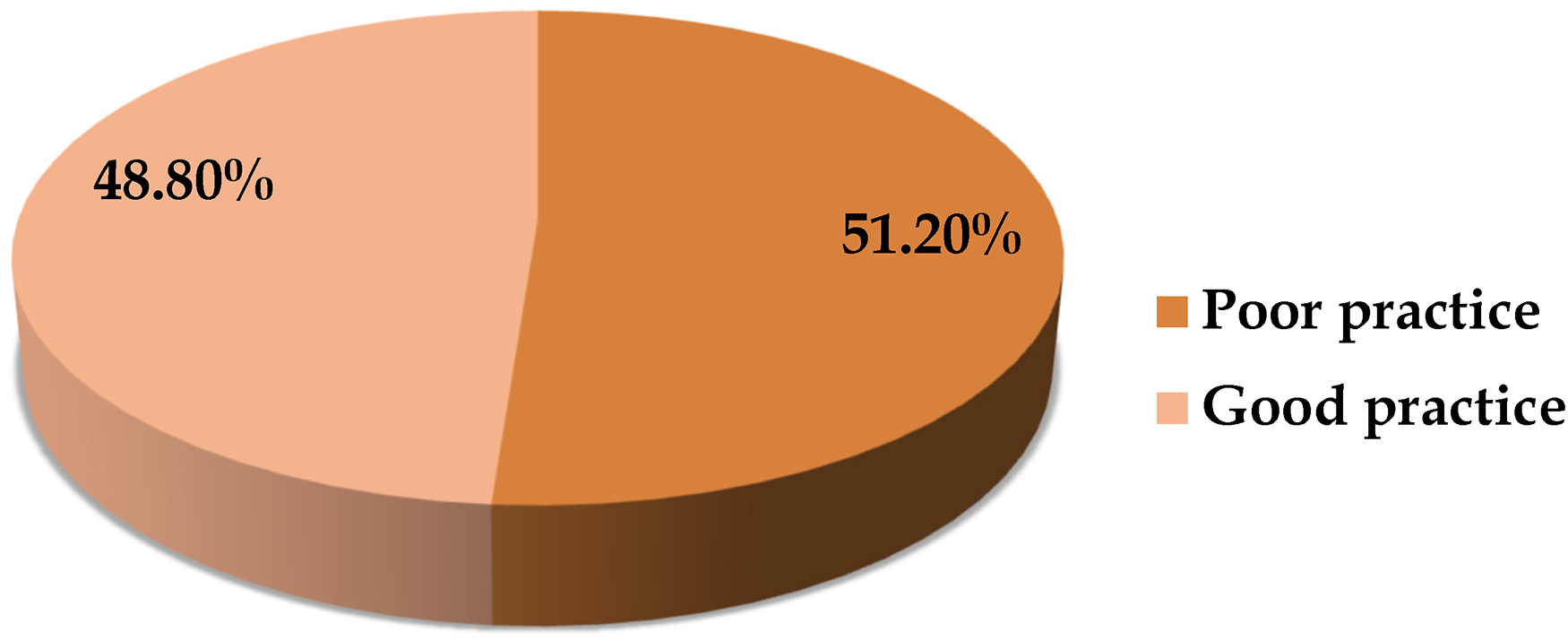
Level of “Nursing Code of Ethics” Practice among nurses working in the selected public hospitals in Addis Ababa, Ethiopia, 2022. [367].
Factors Associated with “Nursing Code of Ethics” Practice
Age, sex, average monthly income, educational status, work experience, marital status, taking an ethics course during nursing education, taking training on nursing ethics/code of ethics after school, knowing that Ethiopia has a health professionals code of ethics, knowing the existence of the federal health professionals ethics committee, job satisfaction, knowledge towards “nursing code of ethics”, and attitude towards “nursing code of ethics” were entered into bivariable logistic regression to determine their association with “nursing code of ethics” practice. However, sex, work experience and educational status were omitted from multivariable logistic regression due to their p-values were greater than 0.25, which was used to screen of variable to include in multivariable logistic regression. Finally, taking training on nursing ethics/code of ethics after school, job satisfaction, knowledge towards “nursing code of ethics”, and attitude towards “nursing code of ethics” were factors significantly associated with “nursing code of ethics” practice.
The odds of having a good “nursing code of ethics” practice among nurses who had received training on nursing ethics/code of ethics after school was 2.41 times [AOR = 2.41, 95%CI: 1.24, 4.68, p-value = 0.009] more likely than among those who had not received training. The likelihood of having good “nursing code of ethics” practice among nurses who had good job satisfaction was 1.58 time [AOR = 1.58, 95%CI: 1.25, 7.35, p-value = 0.022] more likely than their contrary.
The odds of having good “nursing code of ethics” practice among nurses who had good knowledge towards “nursing code of ethics” was 3.11 times [AOR = 3.11, 95%CI: 1.59, 6.05, p-value = 0.001] more likely than their opposite. The likelihood of having good “nursing code of ethics” practice among nurses who had positive attitude towards “nursing code of ethics” was 8.56 time [AOR = 8.56, 3.81, 18.25,p-value = 0.000] than their contrary (Table 3).
Bivariable and Multivariable Logistic Regression Analysis of Factors Associated with “Nursing Code of Ethics” Practice among Nurses Working at Selected Public Hospitals in Addis Ababa, Ethiopia, 2022. [n = 367].
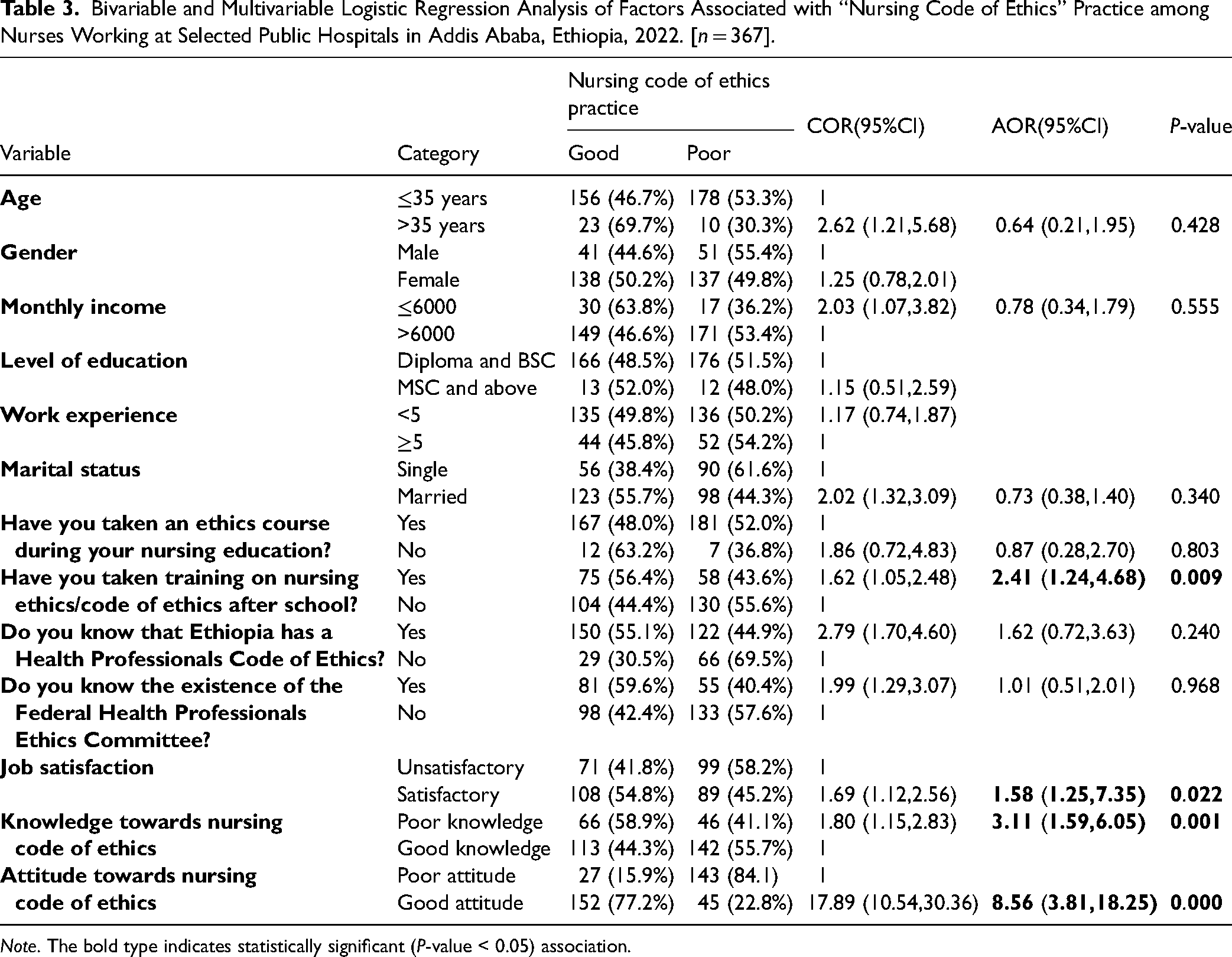
Note. The bold type indicates statistically significant (P-value < 0.05) association.
Discussion
Recognizing nursing care is deeply rooted in traditions and practices of equity and inclusion and in the appreciation of diversity beginning from the mid-1800s. Nurses have consistently recognized four fundamental nursing responsibilities. “They are to promote health, to prevent illness, to restore health, and to alleviate suffering and promote a dignified death. The need for nursing is universal” (International Council of Nurses, 2021).
Ethical practice is a foundation for nurses because they deal with ethical issues daily. “Ethical dilemmas arise as nurses’ care for patients and these dilemmas may conflict with the code of ethics or with the nurse's ethical values. Nurses are advocates for patients and must find a balance while delivering patient care. There are four main principles of ethics: beneficence, autonomy, justice, and non-maleficence” (Haddad & Geiger, 2022).
Nurse's level of good “nursing code of ethics” practice was 48.8%. This study was lower than the study done at Port Said, Egypt, which reported that 78.8% of nurses had adequate practice of professional ethics (Ghareap Hassan et al., 2012). This study was also lower than the study done in Pokhara, which reported that 76.4% of nurses had adequate practice of patient care ethics (Timilsina & Kc, 2018).
This study was also lower than the study done in Zagazig University Hospital, which reported that 97.8% of nurses had a faire practice of professional ethics (Ali et al., 2018). The difference might be that due to the difference in sociodemographic characteristics, cultural, and hospital trends.
This study was consistent with the study done in Southern Nations, Nationalities, and People's Region state, Ethiopia (53%) (Haile, 2022). This study was consistent with the study done in Nepal (50%) (Shrestha & Jose, 2014). This study was consistent with the study done in Gonder, Ethiopia (46.7%) (Yeshineh et al., 2022).
However, the study was done with different study population and concepts of the study. The study done in Gonder, Ethiopia was conducted among health professionals on the practice of code of ethics while this study was done among nurses on “nursing code of ethics”. This study was higher than the study done in Addis Ababa, Ethiopia (30.4%) (Tiruneh & Ayele, 2018). The variation might be that the difference in study population and concepts of the study. The study done in Addis Ababa was conducted among medical doctors on code of ethics while this study was done among nurses on “nursing code of ethics”.
The odds of having good “nursing code of ethics” practice among nurses who had taken training on nursing ethics/code of ethics after school was 2.41 times [AOR = 2.41, 95%CI: 1.24, 4.68, p-value = 0.009] more likely than who had not taken. This study finding was supported by the study done in Southern Nations, Nationalities, and People's Region states. This because nurses who had training on “nursing code of ethics” had more likely to have “nursing code of ethics” practice (Haile, 2022).
The likelihood of having good “nursing code of ethics” practice among nurses who had good job satisfaction was 1.58 time [AOR = 1.58, 95%CI: 1.25, 7.35, p-value = 0.022] more likely than their contrary. This study finding was supported by the study done in Gonder, Ethiopia. This because health care professionals who had job satisfaction had more likely to practice of health care ethics (Yeshineh et al., 2022).
The odds of having good “nursing code of ethics” practice among nurses who had good knowledge towards “nursing code of ethics” was 3.11 times [AOR = 3.11, 95%CI: 1.59, 6.05, p-value = 0.001] more likely than their opposite. This study finding was consistent with the study done in Gonder, Ethiopia. This is because healthcare professionals who had good ethical knowledge had more likely to practice of health care ethics (Yeshineh et al., 2022).
The likelihood of having good “nursing code of ethics” practice among nurses who had positive attitude towards “nursing code of ethics” was 8.56 time [AOR = 8.56, 3.81, 18.25,p-value = 0.000] than their contrary. This study finding was consistent with the study done in Gonder, Ethiopia. This is because of that healthcare practice who had favourable attitude of healthcare ethics had more likely to practice of health care ethics (Yeshineh et al., 2022).
Strengths and Limitations
This is a primary study to the setting and these findings would give the basic information regarding this problem to the responsible bodies. Since this topic is not well investigated, these findings could attract the insight of the stakeholders and researchers for a solution and more investigation in the future. Bias was minimized by using the probability sampling techniques, validated data collection tools, training for data collectors and incorporating multicentre population. Regarding the limitation of this study, the cause-and-effect relation could not be determined since the study design used for this study was cross-sectional.
Implications for Practice
The findings of this study are significant for all stakeholders. These findings would provide essential evidence for the government, nurses associations, hospital administrators, policy makers and implementers, and researchers to focus on these populations to strengthen the quality of care by promoting fair treatment for all communities and denouncing the discrimination for any reason.
It is strongly recommended that the government, nurses associations, and any stakeholders should emphasize on nurses to abate this problem. Health education and training on “nursing code of ethics” need to be provided to improve the “nursing code of ethics” practice among nurses. Added, further research on this topic, which address the additional factors associated with “nursing code of ethics”, are suggested.
Conclusion
The nurse's level of “nursing code of ethics” practice was relatively low. Multivariable logistic regression provides that taking training on nursing ethics/code of ethics after school, job satisfaction, knowledge towards “nursing code of ethics” and attitude towards “nursing code of ethics” were factors significantly associated with “nursing code of ethics” practice.
Standards of Reporting
Strengthening the Reporting of Observational Studies in Epidemiology (STROBE) guidelines and methodologies were followed in this study
Supplemental Material
sj-docx-1-son-10.1177_23779608241264196 - Supplemental material for Nursing Code of Ethics Practice and Associated Factors Among Nurses Working in Ethiopia: A Cross-Sectional Study
Supplemental material, sj-docx-1-son-10.1177_23779608241264196 for Nursing Code of Ethics Practice and Associated Factors Among Nurses Working in Ethiopia: A Cross-Sectional Study by Mulugeta Hailu Tolosa, Daniel Mengistu Bekele and Addisu Dabi Wake in SAGE Open Nursing
Supplemental Material
sj-docx-2-son-10.1177_23779608241264196 - Supplemental material for Nursing Code of Ethics Practice and Associated Factors Among Nurses Working in Ethiopia: A Cross-Sectional Study
Supplemental material, sj-docx-2-son-10.1177_23779608241264196 for Nursing Code of Ethics Practice and Associated Factors Among Nurses Working in Ethiopia: A Cross-Sectional Study by Mulugeta Hailu Tolosa, Daniel Mengistu Bekele and Addisu Dabi Wake in SAGE Open Nursing
Footnotes
Acknowledgments
The authors would like to acknowledge Rift Valley University, selected public hospitals in Addis Ababa, data collectors, and the study participants.
Author Contributions
MHT and DMB have conceptualized the study. MHT, DMB and ADW have contributed for study design execution, acquisition of data, analysis and interpretation. All the authors took part in drafting, and critically reviewing the article. All the authors gave final approval of the version to be published, have agreed on the journal to which the article has been submitted and agree to be accountable for all aspects of the work.
Availability of Data
The datasets analyzed during this study are available from the corresponding author upon reasonable request.
Declaration of Conflicting Interests
The authors declared no potential conflicts of interest with respect to the research, authorship, and/or publication of this article.
Funding
The authors received no financial support for the research, authorship, and/or publication of this article.
Ethics Approval and Consent to Participate
Ethical clearance was gained from Institutional Review Board (IRB) of Rift Valley University, College of Health Sciences, and Department of Public Health with letter Ref No: 278/RVUPH/10/21. After official letter was obtained, the selected public hospitals of Addis Ababa were contacted and permission for this study was gained. Explanation about the goal of this study was provided for the study participants before the commencement of this study. The confidentiality of the collected data was also insured. Written informed consent was obtained from each study participant. All human procedures were performed as per the Declaration of Helsinki. None of the Animals were included in this study.

Supplemental Material
Supplemental material for this article is available online.
References
Supplementary Material
Please find the following supplemental material available below.
For Open Access articles published under a Creative Commons License, all supplemental material carries the same license as the article it is associated with.
For non-Open Access articles published, all supplemental material carries a non-exclusive license, and permission requests for re-use of supplemental material or any part of supplemental material shall be sent directly to the copyright owner as specified in the copyright notice associated with the article.
