




Abstract
Introduction
Nurses are required to fulfill many roles, including expertise, communication, and leadership and are psychologically vulnerable due to lack of manpower, emotional labor, and shift work. Among them, it is necessary to understand the psychological well-being of new nurses and junior nurses who have a high early resignation rate.
Objective
The purpose of this study was to investigate psychological well-being of nurses and compare psychological well-being of nurses from the first to the fifth years of clinical experience.
Methods
Cross-sectional comparative design and purposive sampling method were used. Data were collected from 148 nurses with one to five years of experience working in tertiary care general hospitals. On November 11, 2021, an online link for the structured questionnaire was sent to the group social networking service accounts for nurses. Psychological well-being was assessed using a Korean version of the Scales of Psychological Well-being including autonomy, environmental mastery, personal growth, positive relations with others, purpose in life, and self-acceptance.
Results
The average psychological well-being of nurses was 194.11, with significant differences depending on years of clinical experience (p = .006, F = 3.82) and satisfaction with nursing (p < .001, F = 13.12). It was lowest at 180.08 in the first year, gradually improving, but falling again from the fourth year. Among five subfactors except positive relations with others (p = .389), psychological well-being was related to clinical experiences years using satisfaction with nursing and religion as covariates.
Conclusions
This study that compared psychological well-being from the first to the fifth year according to clinical experience revealed the need for optimized intervention for each year. Nursing managers can improve the psychological well-being of nurses through active and appropriate intervention according to the passage of nursing experience.
Introduction
Psychological well-being is an integration of six aspects that constitute quality of life: autonomy, environmental mastery, personal growth, positive relations with others, purpose in life, and self-acceptance (Ryff, 1989). Individuals with high psychological well-being have purpose and meaning in their lives, positively view their personal values, and can actively interact with the environment (Ryff, 1989). Conversely, if psychological well-being is low, negative emotions can increase. Hence, it is critical to improve psychological well-being, which focuses not only on physical fatigue but also on mental stress.
Nurses, compared to those on other career paths, are more vulnerable psychosocially because their job environments include shift work, job circulation, and building relationships with various people. They can feel valued and part of the team, learning from or feeling supported by other nurses, while they also experience negative emotions such as overwhelm, stress, isolation, and/or inadequacy (Jarden et al., 2021). Nurses are expected to have executive competencies in areas such as communication and relationship management, professionalism, leadership, knowledge of the health care environment, and business skills and principles. (American Organization of Nurse Executives & American Organization for Nursing Leadership, 2015). During this process, nurses experience various emotional issues (La & Yun, 2019), emotional labor (Kim, 2020), and stress (Labrague & McEnroe-Petitte, 2018), all of which threaten their psychological well-being. Even, while experiencing the pandemic, nurses faced various difficulties such as lack of protective equipment and manpower, and negative attitudes of families in the process of actively dedicating themselves (Ding et al., 2022).
Review of Literature
Many studies have addressed the psychological well-being of nurses. Psychological well-being had strong positive associations with workplace resilience (Delgado et al., 2021). And studies that verified the structural model of nurses’ psychological well-being reported that social support and coping strategies have direct and indirect effects (Arrogante et al., 2016; Kim & Han, 2020). Also, there are factors that can damage the psychological well-being of nurses such as recurrent changes in work environment (Verhaeghe et al., 2006) and negative work satisfaction (Arafa et al., 2003). To promote nurses’ well-being and prevent unhappiness, it is necessary to create an environment in which all members are treated fairly (Huang et al., 2021), and nursing manager education for inclusive leadership is necessary. Many efforts are being made, and nurses’ psychological well-being has improved through stress management training (Pahlevani et al., 2015). Mindfulness breathing meditation also made significant differences to psychological well-being before and after the intervention (Kusman et al., 2022).
In particular, junior nurses experience a transition shock from university to hospital (Graf et al., 2020), during the career development process from nursing student to registered nurse. Nurses reported extremely high levels of burnout during their first three years after graduation, and burnout was accompanied by depressive symptoms and turnover intentions (Rudman & Gustavsson, 2011). According to a survey on the current status of hospital nursing personnel assignment, the nursing turnover rate is still high at 13–15%. In particular, the turnover rate of new nurses was in the low 30% range until 2016, but rose sharply from 2017 and exceeded 50% in 2022 (Korean Hospital Nurses Association, 2020). During transition, workload, inadequate staffing, managing multiple role demands, and incivility were reported as stressor in newly qualified nurses (Halpin et al., 2017). According to a study investigating the turnover by year spent in the career of nursing, there is a significant difference in job survival time between competent, proficient, and expert nurses group (Kang and Lee, 2022). Rather than expert nurses (six year or more) who have a longer survival time, it is necessary to investigate the psychological well-being of junior nurses with less than five years career length. In particular, if there is a comparison, it will be easy to understand psychological well-being according to the flow of years.
The purpose of this study was to investigate psychological well-being of nurses and compare psychological well-being of nurses from the first to the fifth years of clinical experience.
Methods
Study Design
This study is descriptive research that describes and explores the psychological well-being of nurses, and a cross-sectional method was used to examine differences between groups by year of clinical experience.
Research Questions
How is psychological well-being by subfactor of nurses with one to five years?
Is there a difference in psychological well-being according to clinical experience when confounding variables are adjusted for covariates?
Is the psychological well-being of each subfactor the worst in the first year, and does it improve as clinical experience lengthens?
Sample
Participants were selected using purposive sampling. All nursing alumni of one university in South Korea with up to five years of clinical experience were used as a sample. Selection criteria for the participant sample were as follows: nurses with one to five years’ experience working at a tertiary general hospital, no issues regarding communication ability, capable of independently responding to a self-report questionnaire, and willing to voluntarily participate in the study. An exclusion criterion was nurses who did not work in hospitals.
Sample-size estimation was performed using G*power 3.1.9.7 with the following settings: ANCOVA test, a significance level of .05, a power of .80, an effect size of .25 (medium), and five groups. The effect size was set at a medium size, referring to previous studies that set it at 0.298 (Morales-Rodríguez et al., 2020). Consequently, the minimum sample size was estimated to be 128. A total of 148 nurses responded to the online survey; 37 nurses participated in the first year, 34 in the second year, 24 in the third year, 24 in the fourth year, and 29 in the fifth year.
Data Collection
This research was conducted online. An explanation of the study and questionnaires were distributed online through representatives of each grade of the nursing school alumni association. The data collection period was two weeks from November 11, 2021. Data were collected only from those who consented to participate in the study.
Measurement
Psychological well-being was assessed using the Scales of Psychological Well-being developed by Ryff (Ryff, 1989). A questionnaire that had been adjusted to a six-point, 42-item version (Abbott et al., 2006) was translated by a bilingual person, and then reverse translated by another bilingual person. The content validity of the Korean version was performed by the experts, that is, five nursing professors. The Korean version showed high content validity of individual items (I-CVI > 0.8) and high overall content validity (S-CVI/UA = 0.83, S-CVI/ave = 0.96).
The six factors are “autonomy,” “environmental mastery,” “personal growth,” “positive relations with others,” “purpose in life,” and “self-acceptance,” and each factor contains seven items. Autonomy refers to the ability to be voluntary, independent, and control one's actions and consists of items such as “I am not afraid to voice my opinions even when they are in opposition to the opinions of most people.” Second, environmental mastery is the ability to handle a complex environment by controlling the environment appropriate for one's psychological state and consists of items such as “I am quite good at managing the many responsibilities of my daily life.” Personal growth is realizing one's potential, challenging new changes, and solving problems on one's own and consists of items such as “I think it is important to have new experiences that challenge how you think about the world.” Positive relations with others refers to the capacity for friendship and love in interpersonal relationships and consists of items such as “Most people see me as loving and affectionate.” Purpose in life is acting with value, meaning, and purpose in life and consists of items such as “I am an active person in carrying out the plans I set for myself.” Self-acceptance means accepting, acknowledging, and positively accepting one's limitations and abilities and consists of items such as “I have made some mistakes in the past, but feel that all in all everything has worked out for the best.”
The total score is obtained by summing the item scores. The higher is the total score, the higher is the level of psychological well-being. The reliability of the scale was Cronbach's α = .877. The reliability of each subfactor is as follows. (Autonomy α=.777, environmental mastery α=.758, personal growth α=.773, positive relations with others α=.779, purpose in life α=.755, and self-acceptance α=.747)
Ethical Consideration
This study was approved by the institutional review board of Catholic University of Korea (approval no. MC20QISI0151). The data were coded to protect privacy. Subjects were informed of the study purposes and procedure, and data were collected only from those who consented to participate. The survey was completed anonymously, but subjects were informed that, if they wished to receive a small gift (a coupon for coffee) in return for their participation, they would need to provide contact information. The contact information was not used for any purpose other than sending the gift and was deleted afterward. The study results will be used for research purposes only and are stored in a PC accessible only to the current researchers.
Statistical Analysis
Statistical analyses were conducted using IBM SPSS Statistics software Version 27.0 (IBM, Armonk, New York, USA). Of the general characteristics, gender, religion, years of clinical experience, and satisfaction with nursing were examined by computing frequencies and percentages. Age and psychological well-being were examined by computing means and standard deviations.
Correlation analysis was conducted to investigate differences in psychological well-being according to age. An independent t-test was conducted to investigate differences in psychological well-being according to gender and religion affiliation or not. An analysis of variance was conducted to investigate differences in psychological well-being according to years of clinical experience and satisfaction with nursing.
An analysis of covariance was performed to investigate changes in psychological well-being in terms of years of clinical experience among nurses by designating satisfaction with nursing and religion as covariates.
Results
Sample Characteristics
The characteristics of the participants are described in Table 1. The average age of the entire sample (N = 148) was 26.62 years (SD = 2.03). 141 participants (95.3%) were female, and 60 of the participants were religious (40.5%). When classified by hospital working period, Participants consisted of 37 new graduates (25.0%), 34 in the second year (23.0%), 24 in the third year (16.2%), 24 in the fourth year (16.2%), and 29 in the fifth year (19.6%). There were 83 participants (56.1%) who responded that they were satisfied with nursing, 49 participants (33.1%) who responded that they were moderate, and 16 participants (10.8%) who were dissatisfied. There was a major difference in psychological well-being according to the length of clinical experiences (p = .006) and satisfaction with nursing (p < .001).
Psychological Well-Being According to the General Characteristics of Participants.
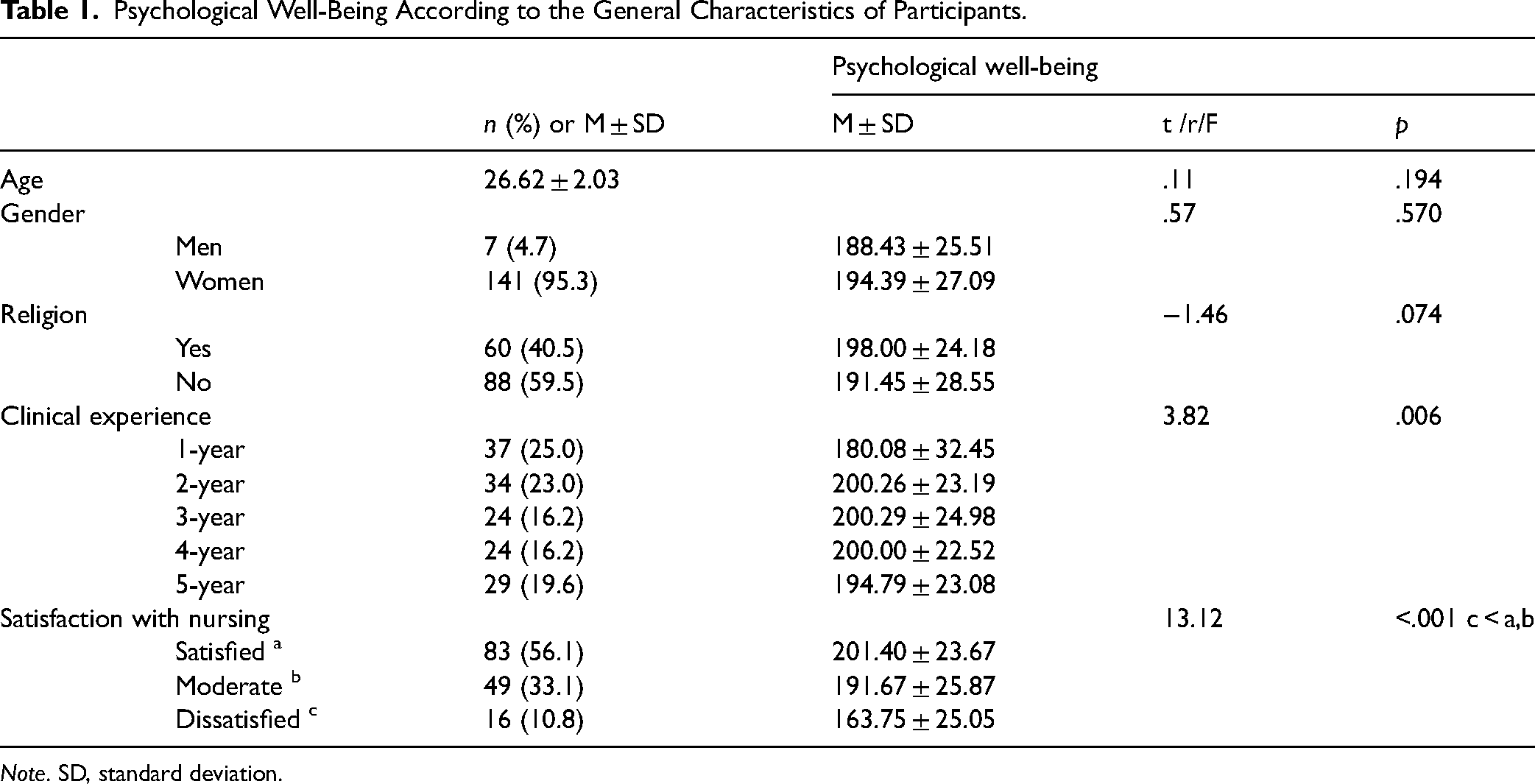
Note. SD, standard deviation.
Research Question Results
Nurses’ psychological well-being
Table 2 shows the results of overall psychological well-being of nurses by dividing factors into Autonomy, Environmental Mastery, Personal Growth, Positive Relations with Others, Purpose in Life, and Self-Acceptance. The psychological well-being score of nurses averaged 194.11(SD = 26.97). By subfactors, “Positive relations with others” reported the highest psychological well-being at 37.07 (SD = 5.46), and “Autonomy” reported the lowest score at 27.59 (SD = 5.82).
Nurses’ Psychological Well-Being.

Note. SD, standard deviation.
Psychological well-being of nurses according to clinical experiences
As shown in Table 3, psychological well-being of nurses according to clinical experiences years were analyzed using satisfaction with nursing (p < .001) and religion (p = .074) as covariates, which p values were less than .1 in the previous descriptive statistics (Table 1).
Psychological Well-Being and Subfactors of Nurses According to Clinical Experiences.

Psychological well-being (p = .003) differed by length of clinical experience when adjusting for satisfaction with nursing and religion. When analyzing each subfactor, there were differences by clinical experience period in all subfactors except “Positive relations with others (p = .389).”
Comparison of psychological well-being of n-year nurses
Figure 1 shows psychological well-being (Y-axis) according to years of clinical experience (X-axis). In the first graph, the psychological well-being of first-year nurses is the lowest at around 180, and the psychological well-being of third-year nurses is the highest at over 200. The research hypothesis assumed that the psychological well-being of new graduated nurses would be the lowest and that it would improve with longer clinical experience, but the psychological well-being of fourth- and fifth-year nurses deteriorated again.

Psychological well-being and subfactors of nurses according to clinical experiences.
The analysis results for each subfactor were also presented in a graph. Autonomy, personal growth, purpose in life, and self-acceptance of nurses tended to decrease after the third year.
Discussion
Nurses in the first year of clinical experience scored especially low for psychological well-being. This is consistent with previous studies that reported that new nurses were psychologically vulnerable. Psychological state can be decreased in the absence of effective socialization because of the need to adapt not only to the nursing role but also to the structural environment of a hospital (Blevins, 2018). With regard to the subfactors of autonomy, environmental mastery, and positive relations, the clinical environment traditionally has a vertical hierarchy with the doctor at the top, which can create a stressful environment for nurses. In particular, newly graduated nurses feel that they lack personal autonomy in a rigid organizational culture and have difficulties because they do not possess appropriate conflict resolution skills (Bogaert & Franck, 2021).
The result of this study indicated that the psychological well-being tended to increase until the third-year and then decrease after the fourth year of clinical experience, which was not found in previous studies. According to Benner (Benner, 1984), proficient fourth- and fifth-year nurses who had adapted to hospital organizational life for several years and performed their duties according to guidelines reported lower psychological well-being than second- and third-year nurses, who were learning clinical skills.
These research results support Maslow's Self-actualization (Maslow, 1943). Among nurses with four to five years of experience, environmental mastery (ability to adapt well to new environments, control, and handle complex environments) scores are high, but personal growth (sense of accomplishment gained from realizing potential and challenging new changes) and purpose in life (awareness of the value, meaning, and purpose in life) scores are rapidly decreasing. This shows the unmet esteem needs of nurses four to five years after they have adapted well to the hospital environment and have met their needs for safety & security and social needs.
Additionally, the results of this study partially support and partially challenge Benner's Expert theory (Benner, 2001). According to Benner, the fourth to fifth year-nurse is the Proficient that requires holistic understanding, perceives the situation as a whole. Proficient improves decision-making ability with holistic understanding, but this result shows that the autonomy (ability to be free from social conventions or other people's standards) of five-year nurses is decreasing.
Based on the results of this study, appropriate intervention is needed in the clinical field according to the clinical experience. Intervention is needed to prevent early resignation by increasing the overall psychological well-being of newly graduated nurses. Discussing successes and difficulties in their roles with colleagues can help energize new nurses; reduce their stress, anxiety, depression, and job dissatisfaction; and enhance their psychological well-being (Sampson et al., 2019). Thus, it is desirable to create forums that allow nurses to converse with each other. Overall, to become effective members of a hospital, new nurses require preceptors’ guidance, organizational support, and opportunity to discuss shared nursing experiences (Matter & Wolgast, 2020). Hospitals can retain competent nurses for an extended time if a professional development program supporting the enthusiasm of new nurses is developed or if a healthy working environment is provided in consideration of subjective health and psychological state of new nurses (Sadler, 2018).
It is important to develop proficient nurses into experts through intervention for their poor “personal growth” and “purpose in life.” The generation Z who were born in the years of 1996–2010 view the workplace as an opportunity for development and a place for positive social change (Leslie et al., 2021). The nurses in generation Z tended to perceive they were growing as a nurses when they were getting promoted in position, achieving career goals, realizing their professional ability, or developing professional identity. (Ni et al., 2022). It is difficult for the fourth- and fifth-year nurses to find the chance for getting promoted in position, achieving career goals, or realizing their professional ability. The supports from organizations, supervisors, and coworkers, as well as organization culture in terms of teamwork, collaborations can be the important influence factors of nurses’ career growth (Ni et al., 2022). For this reason, it is necessary for hospitals to foster nurses so that they can maintain career motivation and development and to support various educational programs for professional development after the third year of clinical experiences. For example, traveling to conferences, taking the lead on projects, and receiving regular training from experts can be a chance to improve personal growth of nurses of three years or more (Leslie et al., 2021).
Clinical nurses have a desire for growth and self-realization along with a great desire for achievement (Mahmoud et al., 2020). In order for the competent nurses to become self-actualized experts, it is necessary to develop programs for leadership, communication, and motivation required for their careers, as well as job competency training.
The following research is needed to retain experts with high psychological well-being. The psychological well-being of expert nurses with more than six years of experience remaining in hospitals needs to be investigated, and qualitative research is needed to identify the characteristics of experts who report high levels of psychological well-being. An educational program that can develop such characteristics must be developed, and intervention research is needed to confirm the effectiveness of the educational program.
Strength and Limitations
The strength of this study is that it confirmed the low psychological well-being of nurses after their fourth year of adjustment to work. Therefore, by identifying the subfactors of psychological well-being that are impaired depending on the length of clinical experience, we provide new insight into the need for intervention tailored to each career development period.
A limitation of this study was that the study was cross-sectional. Because the sample targeted remaining nurses, excluding early retirees, nurses with worse psychological well-being may not have been included in the sample. Therefore, a longitudinal study that takes survival bias into account should be performed. The present study was a simple comparative study, and it was not possible to peruse difficulties experienced by nurses in transition, during which psychological well-being deteriorates. Third, this study used a purposive sampling that sampled nurses from one university alumni, so it is difficult to represent all first to fifth year nurses. Therefore, to resolve sampling bias, repeated research is needed targeting nurses from multiple universities. Finally, in this study, expert validity was confirmed by translating a foreign instrument, and the construct validity of the Korean version was not presented. A repeat study to confirm construct validity is proposed in the future.
Implications for Practice
In order to improve the psychological well-being of the first-year nurses, it is important to establish an educational program to develop conflict management, communication skills, and doctor–nurse teamwork promotion. Additionally, the chance for discussing successes and difficulties in their roles with colleagues can help energize new nurses. To improve the psychological well-being of nurses of three years or more, innovative changes in the clinical field are needed, such as traveling to conferences, taking the lead on projects, and receiving regular training from experts.
Conclusion
This study analyzed the psychological well-being of nurses with one to five years of clinical experience. Psychological well-being of the first-year nurses was significantly low, improved in the second year, and then decreased again from the third year. Especially, personal growth and purpose in life of the fifth-year nurses were lower than those of the second-year nurses. This study compared the psychological well-being of junior nurses by year. Multifaceted efforts are needed to resolve the psychological difficulties of new nurses, and a system is needed to meet the self-actualization needs of proficient nurses. Using the results of this study, nursing managers and clinical sites should prepare motivation and nursing education interventions tailored to each work experience.
Footnotes
Acknowledgements
The authors thank Dr. SH Choo for collecting data.
Declaration of Conflicting Interests
The author(s) declared no potential conflicts of interest with respect to the research, authorship, and/or publication of this article.
Ethical Statement
Our study was approved by The Catholic University of Korea, Institutional Review Boards (approval no. MC20QISI0151).
Funding
The author(s) disclosed receipt of the following financial support for the research, authorship, and/or publication of this article: The authors wish to acknowledge the financial support of the Catholic Medical Center Research Foundation made in the program year of 2022.
