




Abstract
Introduction
Clinical training allows nursing students to acquire and strengthen their psychomotor abilities, which is an important component of nursing education. The clinical components of nursing training programs were much more demanding than the academic ones.
Purposes
The purpose of this study was to examine sources of stress-related and coping behaviors during first clinical training among nursing students in the Arab American University.
Methods
The study was cross-sectional and conducted with a convenience sample of 266 participants of nursing students. Data collection was performed by “Perceived Stress Scale and the Coping Behavior Inventory.” The data were analyzed by using the descriptive, that is, frequency and percentage, mean, and standard deviation.
Results
The results revealed that the perceived stress mean was 41.2 (SD = 19.5). The main stressors were taking care of the patients (M = 11.4 ± 0.85) and teachers and nursing staff (M = 8.32 ± 5.3). Coping behaviors mean was (M = 29.0 ± 15.2). The main coping behavior was problem-solving (M = 9.5 ± 5.6).
Conclusion
The study confirmed that students perceived moderate levels of stress in their first clinical training, and the most common sources of stress were taking care of the patients and teachers and nursing staff. However, the main coping behavior was problem-solving.
Introduction
The theoretical part and clinical training are the two components of nursing education (Doyle et al., 2017). Clinical training is a necessary part as it gives nursing students the opportunity to employ knowledge in improving their psychomotor abilities (Oermann & Shellenbarger, 2020). The clinical training components of nursing training programs were more demanding than the academic components (Bektaş et al., 2018; Kostak et al., 2014).
Literature Review
Working with equipment and machinery, incivility among staff and faculty, a gap between theory and practice, fear of making a mistake, fear of unknown incidents, and communication with staff, peers, and patients were all prominent sources of clinical stress among nursing students (Ab Latif & Nor, 2019; Hamadi et al., 2021; Onieva-Zafra et al., 2020; Sun et al., 2016; Welch, 2023; Yasmin et al., 2018). Also, stress is caused by “lack of professional knowledge and skills, patient care, assignments and workload, the field of practice, a nurse educator and nursing, and staff peers and daily life” (Ahmed & Mohammed, 2019). Stress is a critical issue in education since it hinders the ability to learn and perform (Whiting et al., 2021). Stress factors of nursing students highlighted the significance of adequate coping methods in nursing education and practical practicum (Hwang et al., 2021).
The coping mechanisms that students use in clinical training can modify and impact their stress levels. Coping methods can help students reduce stress while simultaneously increasing academic achievement (Freire et al., 2020). Stress-reduction strategies utilized by students involved problem-solving, transference, optimism, and avoidance (Alanazi et al., 2023). Nursing students who are doing their first clinical training encounter additional hurdles owing to a lack of knowledge during the early clinical practicum. Prior qualitative studies, for example, indicated that nursing students were unsatisfied with their first clinical skills and found them stressful (Alshowkan, 2022; Hwang et al., 2021; Öner & Karabudak, 2021).
In Palestine, students registered in baccalaureate nursing programs are between the ages of 18 and 20 when they first begin clinical training. At the beginning of their nursing education, students usually attend fundamentals of nursing and general university requirements courses before being placed in clinical training. Fundamentals of nursing focus on basic patient care, safety, skin integrity, vital signs, admission and discharge, and body mechanics. High-fidelity simulation was integrated into nursing courses as well as the Fundamentals of Nursing course to improve students’ knowledge and clinical judgments (Ayed et al., 2021; Salameh et al., 2021). Nursing fundamentals and communication skills are the focus of the first round of clinical practice for students. Clinical students, on the other hand, are exposed to a diverse spectrum of patients with varied diseases, which may be extremely challenging. Nursing students commonly feel conflict as a result of the discrepancy between the actual illness and the intended learning outcomes in clinical practice (Hwang et al., 2021). This type of conflict can cause stress, which can decrease students’ performance and discourage them from learning. Despite the fact that nursing students spend more than half of their time in the clinical setting, it may be a cause of great stress and anxiety (Ayed, 2022; Onieva-Zafra et al., 2020).
There is little evidence about the causes and effects of stress on Palestinian baccalaureate nursing students during their first clinical placement, as well as their self-initiated stress-coping mechanisms. Also, nursing students train in different settings in Palestinian hospitals, which exposes them to different cultural backgrounds and, as a result, increases stress. Assessing the effect of clinical training stress and developing adequate coping strategies is critical for both nursing students and educators, as it may encourage the creation of a successful clinical training environment for nursing education. Therefore, the purpose of this study was to examine sources of stress-related and coping behaviors during the first clinical training among nursing students at the Arab American University.
Methods
Design and Setting
A cross-sectional study was conducted at Arab American University. Arab American University is the largest nursing school in Palestine, with a student body of 2,000 undergraduate and graduate nursing students. The undergraduate program is 4 years and obtain a baccalaureate in nursing. In 2015, a simulation laboratory was developed to increase clinical training and compensate for a lack of training placements. The laboratory incorporates high-fidelity simulation, which can imitate a wide range of physiological processes and anatomical features in people. It can also mimic the physiological changes caused by some disorders as well as a patient's vocal responses.
In Palestine, the academic year is divided into two semesters, the fall and spring semesters. Students undertake their clinical placement in the second semester of their first year of study and have two periods of clinical practice each year thereafter. Six of the seven clinical practice sessions are held in hospitals, while one is held in primary health care. The hospitals are public hospitals with 120–160 beds in the North West Bank area. The initial clinical practice will span 16 weeks and take place 1 day per week. Each student is required to enroll in an 8-week medical nursing clinical and an 8-week surgical nursing clinical. Clinical teachers with a nursing bachelor's or master's degree are employed to train students during clinical practice. Each clinical instructor is responsible for supervising and evaluating a group of six students.
Sample
A convenient sample of 266 nursing students in their first year had accomplished their first practical in the Baccalaureate nursing program. The sample size was calculated based on Raosoft software, in which the population size was kept at 500 and the response distribution at 50%, while the confidence interval and margin of error were set at 95% and 5%, respectively. The calculated sample size was 218. To overcome the attrition rate, a total of 266 students enrolled in this study.
Inclusion and Exclusion Criteria
The inclusion criteria were students in the baccalaureate nursing program in their first year in the faculty of nursing who have completed their first clinical practice. Students with stress and anxiety who had been diagnosed by a doctor and were taking medication, according to self-reporting, were excluded.
Instruments
The instrument was divided into three sections, the first of which included characteristics such as gender, age, academic year, and area of training. The second section was the Perceived Stress Scale (PSS), developed by Sheu et al. (1997), consisted of 29 items on a Likert-type 5-point scale, arranged into six aspects, including “stress of teachers and staff (6 items), stress of patient care (8 items), stress of peer and daily life (4 items), stress of assignments and workload (5 items), stress from the environment (3 items), and stress of lack of professional knowledge and skills (3 items).” The overall score ranged from 0 to 116, with a lower number indicating a lower amount of stress. The exploratory factor analysis (EFA) indicated that 50.7% of the total variance was accounted by the six factors. Sheu et al. stated a good internal consistency reliability of .89, whereas the test–retest reliability 1-week stability coefficient was r = .60. The content validity index (CVI) was 0.94, which indicated high levels (Sheu et al., 1997; Sheu et al., 2002).
The third section was the Coping Behavioral Inventory Scale (CBI), developed by Sheu et al. (2002) and used to determine students’ coping behaviors. The CBI consists of 19 items on a 5-point Likert scale classified as follows: “problem-solving action (6 items), optimistic coping action (4 items), avoidance action (6 items), and transference action (3 items).” A higher score for each aspect indicates that a specific type of coping behavior is more regularly performed and fruitful. The factor analysis indicated that 38.2% of the variance was accounted by four factors. The Cronbach's alpha for the CBI was .76, which shows a moderate reliability of the scales Sheu et al. (2002).
These instruments were intended to evaluate the type and degree of stress experienced by nursing students during clinical training, as well as coping techniques, so they were appropriate for the study's context.
The questionnaire was forwarded to five experts to assess its validity. A pilot study with 20 nursing students was undertaken to ensure the survey's readability, completion duration, and simplicity of comprehension. The questionnaire took an average of 10–15 min to complete. The Cronbach’s alpha for PSS was .92, whereas the Cronbach’s alpha for CBI was .88. Participants in the pilot research were not included in the actual study.
Data Collection and Ethical Consideration
Ethical approval was obtained from the Arab American University. The data were gathered at the end of spring semester, once the initial clinical practice was completed. The participants filled out the questionnaires in the lecture rooms after the lectures left the rooms. The researchers explained the study's goal to the participants. Students were informed that they might withdraw from the study at any time. Students who agreed to take part in the study had to sign an informed consent form. Participants were verbally assured that participation in the study would be voluntary and would not affect their educational experience. The collected data were stored in a manner compliant with data protection. The author granted permission to use both instruments. Because it was the only one available, an English version of the survey was used. All eligible participants, however, are fluent in English.
Data Analysis
Statistical analysis was performed using SPSS version 23. Mean ± standard deviation (SD) was computed for continuous data. Frequencies and percentages were calculated for categorical variables. Also, Pearson correlation was used and considered the findings significant if the P value was <.05.
Results
Two hundred and sixty-six nursing students participated in the study. Aged mean was 22.0 (SD = 1.5). The majority of the students' (222, 83.5%) were between 20 and 25 years old. Of all the participants, 146 (54.9%) were females, as shown in Table 1.
Demographic Characteristics of the Participants (N = 266).

The mean of stress perceived by the participants was 41.2 (SD = 19.5). The most common source perceived was stress from “taking care of the patients” (M = 11.4 ± 0.85), followed by “stress from teachers and nursing staff” (M = 8.32 ± 5.3) and “stress from assignments and workload” (M = 7.5 ± 4.6).
The major stress item “students’ feel stressed from the rapid change in patient's condition” (M = 1.69 ± 1.13), followed by “lack of experience and ability in providing care and in making judgments” (M = 1.65 ± 1.18) and “experience difficulties in changing from the role of a student to that of profession” (M = 1.61 ± 1.29), as seen in Table 2.
Stressors Perceived by Nursing Students at the Period of Clinical Training (N = 266).

The CBI participants’ coping behavior was M = 29.0 ± 15.2. The most common coping strategy used by participants was problem-solving (M = 9.48 ± 5.63), followed by avoidance (M = 8.84 ± 5.74) and being optimistic (M = 6.35 ± 3.96), while transference was the least commonly used (M = 4.36 ± 3.02), as seen in Table 3. The most prevalent coping behavior items were to have confidence in overcoming difficulties (M = 1.73 ± 1.22); to keep an optimistic and positive attitude in dealing with everything in life (M = 1.67 ± 1.20); to use different strategies to solve problems (M = 1.67 ± 1.17), as seen in Table 3.
Coping Behavior Students’ Utilized (N = 266).

The results showed that avoidance as a coping behavior is positively associated with the stressors related to assignments and the environment, with low coefficients, which is significant at P < .05. Furthermore, participants’ avoidance of stressors related to patient care, professional knowledge and skills, peers and daily life, and teachers and nursing staff had a moderately positive association. For problem-solving as a coping behavior, the result showed a significant positive; that is, there was an association with stressors. Being optimistic as a coping behavior showed a significant positive association with students’ stress. However, transference indicated a significant but low-positive association with students’ stressors Table 4.
The Relationship Between Stressors and Coping Behavior (N = 266).
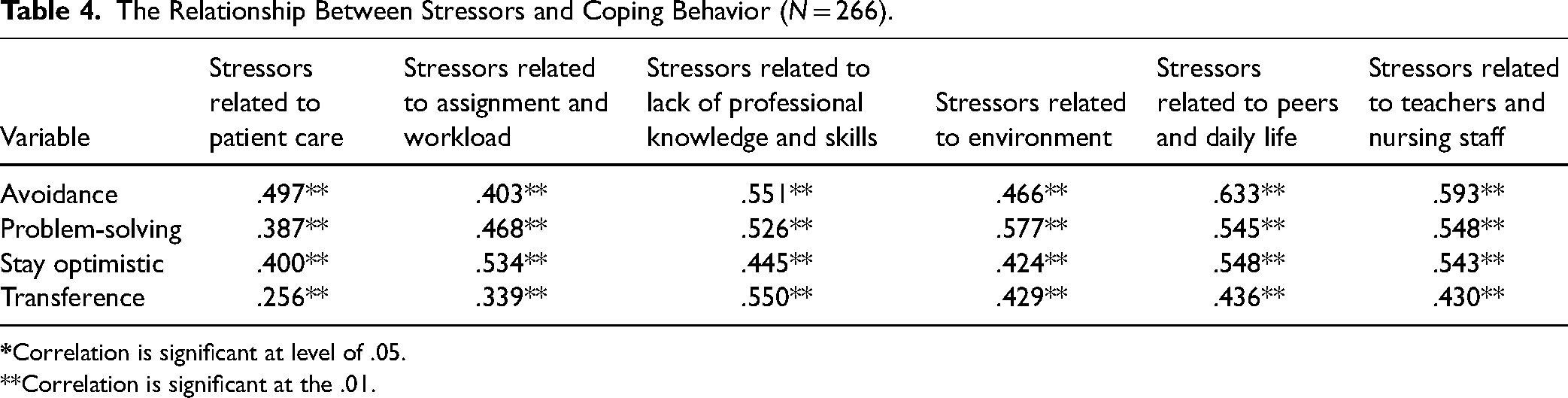
**Correlation is significant at the .01.
Discussion
The clinical training setting is an essential learning environment for nursing students. More than half of the participants were female, as it is well known by culture that nursing is female in Arab countries and that differs globally. Overall, the clinical training stress for this study's participants was moderate, which was slightly lower than the mean 41.2 ± SD = 19.5. The overall score of the PSS ranged from 0 to 116, with a lower number indicating a lower amount of stress. In the six ranking factors related to stress (PSS), students scored all of them as having stress levels below 2.0. As a result, despite the fact that students’ clinical practice experience included a variety of causes of stress, they would consider them challenges since they were confident in their capacity to cope. This is consistent with Hwang et al. (2021) study findings. Also, a systematic review of stress among nursing students conducted by Labrague et al. (2017) indicated similar findings. On the other hand, the results of the current study appear to be lower than those recorded in prior studies (Aedh et al., 2015; Ab Latif & Nor, 2019; Kaur & Guleria, 2021; Shaban et al., 2012). This may be due to the simulation strategy, which was integrated into nursing courses before clinical practice. Simulation is an innovative teaching strategy that supports student-centered learning and enhances critical thinking, problem-solving, and confidence among students in a nonstressful and safe environment without posing a risk to actual patients (Ayed et al., 2022).
The present study found that taking care of patients, as well as teachers and nursing staff, was the biggest source of stress for these students. Students who experience stress in practice settings report feelings of embarrassment, stupidity, or belittlement (Al-Qerem et al., 2021). Similar findings have been documented in the Khater et al. (2014) study.
A previous study, on the other hand, found that the greatest causes of stress were assignment work and the clinical environment (Shaban et al., 2012). The following key stresses were identified by nursing students: “feel stressed from the rapid change in the patient's condition; lack of experience and ability in providing care and in making judgments; and experience difficulties in changing from the role of a student to that of the profession.” As a result, clinical practicum placement should be viewed as an opportunity to learn more rather than a stage for assessing or testing theoretical knowledge. Clinical experience is vital in nursing education for the transition from nursing students to registered nurses.
Also, the current study findings revealed that coping was moderate, and problem-solving was a coping behavior utilized more by students who had an interest in nursing than those who did not. A possible reason might be that the high-fidelity simulation strategy, which was integrated into the fundamentals of nursing course before sending students to clinical practice, improved their critical thinking and clinical judgments. This finding goes with what was reported in previous studies (Al-Zayyat & Al-Gamal, 2014; Alsaqri, 2017; Pulido-Martos et al., 2012; Shaban et al., 2012). However, it contradicts the findings of Yasmin et al. (2018), who identified the optimistic approach as the most utilized coping strategy. Another study showed that the most effective coping behavior was transferring the stress into other leisure activities such as performing sports, sleeping, or listening to music (Aedh et al., 2015).
A surprising finding was that students occasionally employed a combination of coping strategies such as problem-solving, avoidance, and optimism. Transference behavior had little effect on stressors related to patient care, peers, and daily life, as well as stressors related to the clinical environment, teachers, and nursing staff. The findings indicated that students are aware of potentially useful coping mechanisms, but there is no guarantee that they will use them appropriately. More research is needed to better understand how to support students in using a combined coping strategy to relieve stress.
Limitations of the Study
Some limitations of this study may have influenced its findings. This study relied on self-reported questionnaires, which might lead to reporting bias because of personal interpretations of questionnaire items. Furthermore, one methodological limitation of this study is that it is cross-sectional and provides information about stress at a single point in time, whereas stress levels may vary over time, so longitudinal data collection would be an appropriate methodology to overcome these limitations. Finally, the convenience of sampling and the collection of data from a single university, Arab American University, limit the generalizability of the findings to this study's sample.
Recommendation and Implications
It is critical to understand how stressors can affect students’ performance as well as their ability to continue studying nursing. As a result, future research can expand on these findings through more detailed interviews or qualitative studies, as well as teach students stress-management techniques for dealing with unexpected events in their clinical practice. To assist students in achieving optimal learning outcomes, nursing instructors should maintain a stable learning environment. In order to reduce sources of stress during their first year, college staff should focus on the students’ personal needs and offer an orientation program before they begin clinical nursing training.
Conclusion
The study confirmed that students perceived moderate levels of stress in their first clinical training, and the most common sources of stress were taking care of patients, teachers, and nursing staff. However, the main coping behavior was problem-solving. Also, the students sometimes used a combined coping strategy that included problem-solving, avoidance, and optimism to overcome stressors in clinical training.
Footnotes
Acknowledgments
Researcher extends their thanks and appreciations to all participants who voluntarily to take time and participate in this study.
Declaration of Conflicting Interests
The authors declared no potential conflicts of interest with respect to the research, authorship, and/or publication of this article.
Funding
The authors received no financial support for the research, authorship, and/or publication of this article.
