




Abstract
Introduction
Limited research exists on the knowledge and attitudes of Jordanian community residents toward people with dementia (PwD). As the prevalence of dementia is anticipated to increase, there is a critical need for informed knowledge and positive attitudes toward dementia in the Jordanian community.
Objectives
This study aimed to evaluate people's knowledge of and attitudes toward PwD and identify the predictors of dementia knowledge and attitudes.
Methods
The study employed a cross-sectional research design and utilized a self-administered questionnaire as the primary data collection method. The study employed the Alzheimer's Disease Knowledge Scale (ADKS) to evaluate the knowledge of the participants, and the Dementia Attitudes Scale (DAS) was utilized to assess their attitudes in the Jordanian community. Multiple regression analysis was performed to find relevant factors influencing knowledge of and attitude toward dementia.
Results
The study's 346 participants revealed limited knowledge about dementia, with an average ADKS score of 17.21 out of 30. However, participants showed a positive attitude toward dementia, as evidenced by a mean DAS score of 88 out of 140. Statistical analysis demonstrated significantly higher knowledge scores among employed individuals (P < .05), while females exhibited significantly higher attitude scores (P < .05). Participants with experience in geriatric clinical practice, dementia education or training, informal caregiving experience, and a desire to learn more about dementia also exhibited significantly higher knowledge and attitude scores (P < .05).
Conclusion
The study offers preliminary insights into the knowledge and attitudes toward dementia in the Jordanian population. The findings underscore the importance of continuing education and training to increase knowledge and understanding of dementia. Improving dementia care and support in Jordan requires enhancing knowledge and attitudes toward dementia. The study findings were presented to policymakers, with recommendations for strategic planning and the development of awareness programs. Future research can build upon these findings and promote evidence-based practices in dementia care and community awareness programs.
Introduction/Background
In accordance with the World Health Organization (WHO) (2021), dementia is a public health priority. It is a chronic syndrome brought on by a brain disorder that impairs a number of higher cortical functions, including memory, thinking, orientation, comprehension, calculation, learning capacity, language, and judgment (WHO, 2021). Additionally, it may be detrimental to the family, friends, and caregivers of people with dementia (PwD) (Abdalrahim, ALBashtawy, et al., 2022; Abdalrahim, Carter, et al., 2022; Yang et al., 2021).
Cognitive and behavioral impairments are hallmarks of the degenerative illness dementia, which progresses over time (Abdalrahim, ALBashtawy, et al., 2022; Abdalrahim, Carter, et al., 2022; Moustafa, 2022). According to the WHO (2021) report, 53 million people worldwide are estimated to have dementia in 2021, and by 2050, that number is expected to rise to about 141 million (Abdalrahim, Carter, et al., 2022; National Academies of Sciences & Medicine, 2017). More than $600 billion is spent annually on the treatment and care of PwD worldwide (Kennison & Long, 2018). According to estimates, there were 850,000 PwD in the UK in 2014, and dementia had an annual cost of £26 billion (The British Psychological Society, 2016).
Dementia currently has no known cause or treatment. Dementia can be caused by the interaction of comorbidities, genes, and the environment. Tobacco use, inactivity, illiteracy, and comorbidities such as diabetes, hypertension, atherosclerosis, obesity, and hyperlipidemia are modifiable risk factors for dementia (Livingston & Lee, 2020). According to research, dementia symptoms can be avoided by altering these risk factors and managing comorbidities by leading a healthy lifestyle (Aljezawi et al., 2022; Livingston & Lee, 2020). On the other hand, there are risk factors including age and ethnicity that cannot be modified (Aljezawi et al., 2022).
Review of Literature
Assessing the general public's and caregivers’ knowledge of and attitudes toward dementia is critical for optimizing healthcare, ultimately improving patient and caregiver quality of life, and reducing their burden (Arsenault-Lapierre et al., 2021). Numerous studies showed that those who have a better grasp of the disease are more likely to recognize it early and seek the best therapy (Livingston & Lee, 2020).
Numerous research studies have assessed people's knowledge and attitudes toward dementia. The general public was unfamiliar with dementia and showed lack of dementia-related knowledge deficit, particularly its causes, risk factors, and symptoms (Amado & Brucki, 2018; Poreddi et al., 2015; Yang et al., 2015). In addition, the general population had positive attitudes toward dementia (Poreddi et al., 2015; Yang et al., 2015).
There is a need to disseminate a wide range of knowledge about dementia, with a particular focus on people with a poor educational level and an emphasis on the disease's causes, symptoms, and risk factors (Poreddi et al., 2015; Yang et al., 2015). Furthermore, evidence-based food and lifestyle advice for dementia risk reduction are urgently needed (Yang et al., 2015).
Jordan is situated in the Eastern Mediterranean region. According to Jordanian Department of Statistics (2022), there are roughly 11.05 million people living in Jordan in 2021, with a population growth rate of 2.2%. The birth rate is 25.5 births per 1,000 populations, and the death rate is 3.8 deaths per 1,000 populations. The proportion of the population aged 15 and below is 34%. Currently, the proportion of the population aged 60 and over is 5.4%, but it is projected to increase to 8.6% by 2030 and 15.8% by 2050. There were 100,000 people in Jordan over the age of 60 in 1994 and 582,141 in 2017 (Jordanian Higher Population Council, 2015; World Health Rankings, 2020). According to predictions made by the Jordanian Higher Population Council (2015), the population of individuals over the age of 60 in Jordan is expected to rise to 1.107 million by 2030 and 1.853 million by 2050. This percentage of people aged 60 and older is expected to increase in the coming years (Jordanian Higher Population Council, 2015; Kofahi et al., 2021). The life expectancy rate has increased to 76 years for men and 80 years for women (Department of Statistics, 2022; Jordanian Higher Population Council, 2015). In summary, Jordan is experiencing significant demographic changes, with a growing aging population and a projected decline in the number of young caregivers. These trends highlight the need for proactive measures to address the healthcare and support needs of the elderly population. Additionally, the increasing life expectancy rates for both men and women indicate improvements in overall health and well-being in the country.
The Jordanian society is distinguished by a notable emphasis on familial ties and reverence toward the elderly. In the Jordanian society, elderly parents, even those who suffer from dementia, are accorded a significant degree of respect and importance within the familial hierarchy. The provision of care for individuals with dementia is a common practice among family members, as cultural and religious values place a high priority on the care of elderly relatives. The advent of economic transformations and migratory patterns has presented a set of difficulties, whereby the youth are progressively seeking employment opportunities overseas, thereby leaving elderly family members to fend for themselves. This underscores the significance of extrinsic support structures for the elderly population in Jordan.
The healthcare system in Jordan is primarily organized around the Ministry of Health (MOH) and the Royal Medical Services (RMS). Additionally, there are smaller public programs, private sectors, and nonprofit organizations, including the United Nations Relief and Works Agency (UNRWA), the King Hussein Cancer Center (KHCC), Jordan University Hospital, and King Abdullah Hospital. The MOH manages various healthcare facilities, such as comprehensive centers, primary centers, village clinics, maternal and child health centers, and oral health clinics, as well as several hospitals. The RMS operates its own military hospitals. The UNRWA provides primary healthcare services, while the KHCC specializes in cancer treatment. Private healthcare facilities also play a significant role in the overall healthcare system. In terms of assistance for the elderly, both the public and private sectors contribute. The Ministry of Social Development oversees registered care homes, which are supported by public charitable organizations or private entities. The Ministry also covers the expenses of some residents who cannot afford care. However, further investigation and improvement are needed to address the challenges associated with the aging population. Understanding the Jordanian healthcare system is crucial for interpreting research findings and promoting effective resource utilization and support for the elderly. By advocating for system improvements, ordinary Jordanians can contribute to the development of healthcare services for older individuals, enhancing their well-being and overall health service in the Jordanian society. There haven’t been many studies done in Jordan to determine the most prevalent health issues affecting older people over 60. For instance, according to Hamdan-Mansour (2016), physical and motor issues accounted for 33% of problems, followed by visual, speech, and hearing issues (10–16%), paralysis brought on by stroke (10.5%), developmental disabilities (3.7%), and other chronic illnesses (7–15%).
Due to the absence of epidemiological studies on dementia in Jordan, the exact number of PwD is unknown (Bhalla et al., 2018; Kofahi et al., 2021). Nevertheless, a study conducted in Jordan aimed to determine the prevalence of dementia in adults aged 50 years or older found that the general prevalence of dementia for patients 50 years or older was 1.29%, increasing to 1.94% for patients 65 years or older (Kofahi et al., 2021).
As the numbers of PwD are expected to rise, there is an increasing need for informed knowledge and attitudes about dementia. In the past decade, there has been a significant global growth in the body of literature on community understandings and perceptions of dementia, including studies conducted in Jordan (Kofahi et al., 2021).
While extensive research has been conducted to assess knowledge and attitudes toward dementia, there is a lack of studies focusing specifically on the Jordanian population. Therefore, this study aims to fill this gap by exploring the knowledge and attitudes of Jordanian community residents toward dementia, providing novel insights that are tailored to the specific context of Jordan.
This study is the first examination of knowledge and attitudes toward dementia among community residents in Jordan, highlighting its significance in contributing to the development of targeted interventions and strategies for the Jordanian population. By exploring the knowledge and attitudes of community residents, valuable insights into the specific needs and challenges faced by individuals with dementia and their caregivers in Jordan can be gained by policymakers. Positive attitudes toward dementia play a crucial role in the care and well-being of PwD in Jordan, as they encourage community residents to provide necessary support and seek appropriate healthcare services. Promoting positive attitudes and dispelling misconceptions about dementia foster a supportive environment and enhance the quality of life for individuals with dementia.
The study also underscores the importance of collaborative efforts among government organizations, nonprofit entities, and healthcare institutions in developing and implementing education programs. These programs raise awareness about dementia, equip individuals with necessary caregiving knowledge and skills, and target different population segments based on age, educational background, and cultural context. By engaging schools, community centers, religious institutions, and media outlets, accurate information about dementia can be effectively disseminated, empowering individuals to provide appropriate care and support.
The study findings were presented to policymakers with recommendations to incorporate considerations for PwD in strategic planning and the development of awareness programs that focus on prevention, detection, diagnosis, and treatment, given the absence of a known cure for the disease. Future researchers, psychologists, and educators can utilize these findings as foundational data for further research and evidence-based practices in strategic planning and community awareness programs. Moreover, the significance of regional media in educating Jordanian citizens about dementia is highlighted, emphasizing the need to tailor dementia explanations in the media to various age groups and educational backgrounds. Additionally, the study findings suggest the necessity of expanding current dementia education programs to identify at-risk individuals and their families, ultimately improving the standard of dementia care.
Aims
The following were the purposes of the study:
To assess the level of dementia's knowledge among community residents in Jordan. To assess the level of attitudes toward dementia among community residents in Jordan. To assess the predictors of dementia's knowledge and attitudes among community residents in Jordan.
Materials and Methods
Study Design
We employed a descriptive cross-sectional design to explore the Jordanian community residents’ knowledge of and attitude toward dementia.
Setting
This research was conducted from May 2022 to June 2022 in three regions, Irbid from the north, Amman in the central, and Ma’an from the south. These regions are considered as the largest governorates in terms of population size in Jordan.
Sample
Inclusion and Exclusion Criteria
Participants were required to meet the following criteria: (1) living in these three regions, (2) be willing to participate in the study, (3) be able to read and write Arabic, and (4) be able to complete a survey questionnaire using the software and have access to social media. The study employed a convenience sampling method, whereby participants were selected based on their availability and willingness to participate. Recruitment efforts involved reaching out to individuals through various channels, such as social media platforms, community centers, and local organizations.
To determine the minimum sample size of the study participants, the researcher calculated it based on a conventional power of 0.80, a conventional criterion of statistical significance (α) of 0.05, and a medium effect size using the G*Power 3.1.2 (Faul et al., 2007). The calculation took into account the anticipated strength of the relationship between variables and the desired level of statistical power. The resulting minimum sample size required for this study was determined to be 384 participants.
In order to account for potential incomplete surveys, an additional 10% of participants (42 individuals) were added to the target sample size. This adjustment aimed to mitigate potential data loss and ensure a sufficient number of complete responses for analysis.
Ethical Considerations
Participants provided informed consent prior to their participation in the study, in accordance with ethical guidelines. The research procedures adhered to the standard code of ethics and institutional review board standards set by Al al-Bayt University's Research Ethics Committee. The study ensured the anonymity and confidentiality of participants by employing appropriate measures to protect their privacy and data security.
The Institutional Review Board (IRB) rigorously reviewed the research design and protocols. This review process ensured that the study followed ethical guidelines and protected the participants’ well-being. The IRB reviewed the study's purpose, procedures, and potential participant risks. The IRB's approval confirms that the research design and protocols adhered to ethical standards.
All participants offered informed consent, ensuring that they were fully aware of the study's purpose, procedures, potential risks, and benefits. Participants were clearly informed of their rights and the voluntary nature of their participation. Before agreeing to participate, they were given the opportunity to ask questions and clarify any concerns.
The manuscript ensures the ethical integrity of the study and demonstrates a commitment to safeguarding the participants’ rights and well-being by incorporating these ethical considerations, such as participant consent, anonymity and confidentiality protection, and adherence to institutional review board standards.
Theoretical Framework
The study's theoretical foundation was established on the “Promoting Excellence” framework. This framework offers healthcare providers with the essential knowledge and competencies required to deliver specialized care and interventions to PwD and their family members (Knifton et al., 2019).
The framework is based on the minimal amount of knowledge required to competently care for those with dementia and their relatives (NHS Education for Scotland SSSC, 2011). The improvement areas for both individuals and organizations are the main focus of the framework. The framework's use extends beyond personal development. It also aims to influence the development and delivery of future-focused education and training programs. By identifying the knowledge gaps revealed through the survey, the framework helps shape the content and methods of dementia-related education and training initiatives. This ensures that healthcare professionals and caregivers receive the necessary support and resources to provide effective care for PwD. As a result, they will have more confidence in their abilities and in themselves, which will eventually translate into a more positive attitude toward their future PwD. The knowledge gaps can be addressed through influencing the development and delivery of future-focused education and training (MacRae et al., 2022).
In the context of the study on Jordanian community people's knowledge of and attitudes toward dementia, the “Promoting Excellence” framework is used to assess the participants’ understanding of dementia, identify any gaps in knowledge or attitudes, and guide the development of targeted interventions and educational programs. By utilizing this framework, researchers can better understand the specific needs and challenges related to dementia in the Jordanian context and work toward enhancing knowledge, attitudes, and care practices within the community.
Instrument
Three questionnaires were used to collect the data. The first questionnaire was about sociodemographic such as the participant's age, gender, education level, occupation, region and address, marital status, family members with dementia, having experience in geriatric clinical practice, dementia education or training, informal dementia caring experience, and a desire in learning more about dementia that were used to describe the participants. The second questionnaire was the Alzheimer's Disease Knowledge Scale (ADKS), developed by Carpenter et al. (2009), which is used to evaluate people's knowledge of dementia using the following question domains: life impact (three items), risk factors (six items), AD symptoms (four items), treatment and management (four items), assessment and diagnosis (four items), caregiving (five items), and disease course (four items) (Carpenter et al., 2009). This validated tool consisted of 30 true/false questions (Carpenter et al., 2009). For each accurate response, one mark is scored; otherwise, zero is given. As a result, the overall score in the knowledge part ranged from 0 to 30. Despite the fact that the ADKS does not have a one-dimensional structure, its individual elements collectively constitute a broad spectrum of dementia knowledge. The ADKS has good internal consistency reliability (0.71 on average) and good test–retest correlation (0.81), and it offers sufficient validity and reliability (Spector et al., 2012).
The Dementia Attitudes Scale (DAS) is the third questionnaire. It has 20 items with responses ranging from strongly agree to strongly disagree on a 7-point Likert scale. It's meant to show how people feel about dementia. The total score from the Likert scale responses ranges from 20 to 140. Items on the DAS are divided into two primary categories, “social comfort” and “dementia knowledge,” each with a score range of 10 to 70 (Gkioka et al., 2020). The scale has a high degree of dependability, with a Cronbach's alpha coefficient ranging from 0.83 to 0.85. It is a valuable study tool because it also has high validity when compared to other attitude measurement scales (O'Connor & McFadden, 2010). The negatively worded items (items 2, 6, 8, 9, 16, and 17) were reverse coded to determine the overall DAS score.
The pilot sample consisted of individuals who participated in the study. To ensure the validity and reliability of the instruments, the ADKS and the DAS were adapted and translated into Arabic by qualified academic doctoral-prepared experts in mental health nursing. The translated versions were then back-translated into English to assess the consistency of the items. The pilot sample was selected to test the Arabic versions of the ADKS and the DAS.
The results of the pilot study confirmed the validity and reliability of the Arabic versions of both scales. The ADKS scale demonstrated a good level of internal consistency, with a coefficient of .76, which is comparable to the original version. Similarly, the Arabic version of the DAS scale exhibited acceptable internal consistency, with a coefficient of .82. These findings were further supported by a split-half coefficient of 0.80 and an ICC of 0.85 for the ADKS scale and a split-half coefficient of 0.75 and an ICC of 0.88 for the DAS scale in the Arabic context.
These results suggest that the translated scales maintain their psychometric properties in Arabic, indicating that they effectively measure the intended constructs. The rigorous translation process and the favorable internal consistency coefficients provide confidence in the validity and reliability of the Arabic versions of the ADKS and the DAS.
Data Collection and Procedures
After the Al al-Bayt University granted the ethical approval, QR codes were established and then distributed to the participants in the three selected regions manually, and for privacy, the link was encrypted to allow only one individual to access the data. The fill-out surveys were designed by utilizing Microsoft Forms from the internet. All the items in the fill-out surveys were marked as mandatory and required that participants fill out all the parts.
Before completing the survey, participants were asked to read and approved a consent form that was on the first page of the questionnaire. The consent form informed the participants that their participation was voluntary. After the survey forms were completed for data protection and confidentiality purposes, data were directly downloaded onto the researcher's email and were only accessed by the researcher. Participants were free to ask for any clarifications on queries surrounding the use of the survey forms by contacting the researcher via email or WhatsApp or phone. Participants were also allowed to withdraw from the study whenever they felt uncomfortable without being penalized.
Statistical Analysis
After data screening and cleaning, statistical analysis was conducted using the Statistical Package for Social Sciences (SPSS) version 25. Mean, standard deviation (SD), frequency, and percentages were used to describe the sample characteristics. It was determined that the data distribution was normal, which is necessary in order to conduct parametric statistical analysis. All data were examined for extreme values, and outliers were scanned in boxplots. Nonparametric techniques were utilized for data that were thought to vary from normality based on a visual examination of histograms. To find relevant factors influencing knowledge of and attitude toward AD, a multiple regression analysis was conducted. Independent variables were included age, gender, marital status, occupation, region, informal caregiving experience with PwD, geriatric clinical practice experience, dementia education or training, and an interest in learning more about dementia: Dependent variables were ADKS and DAS. An alpha of p ≤ 0.05 was considered statistically significant.
Results
Sample Characteristics
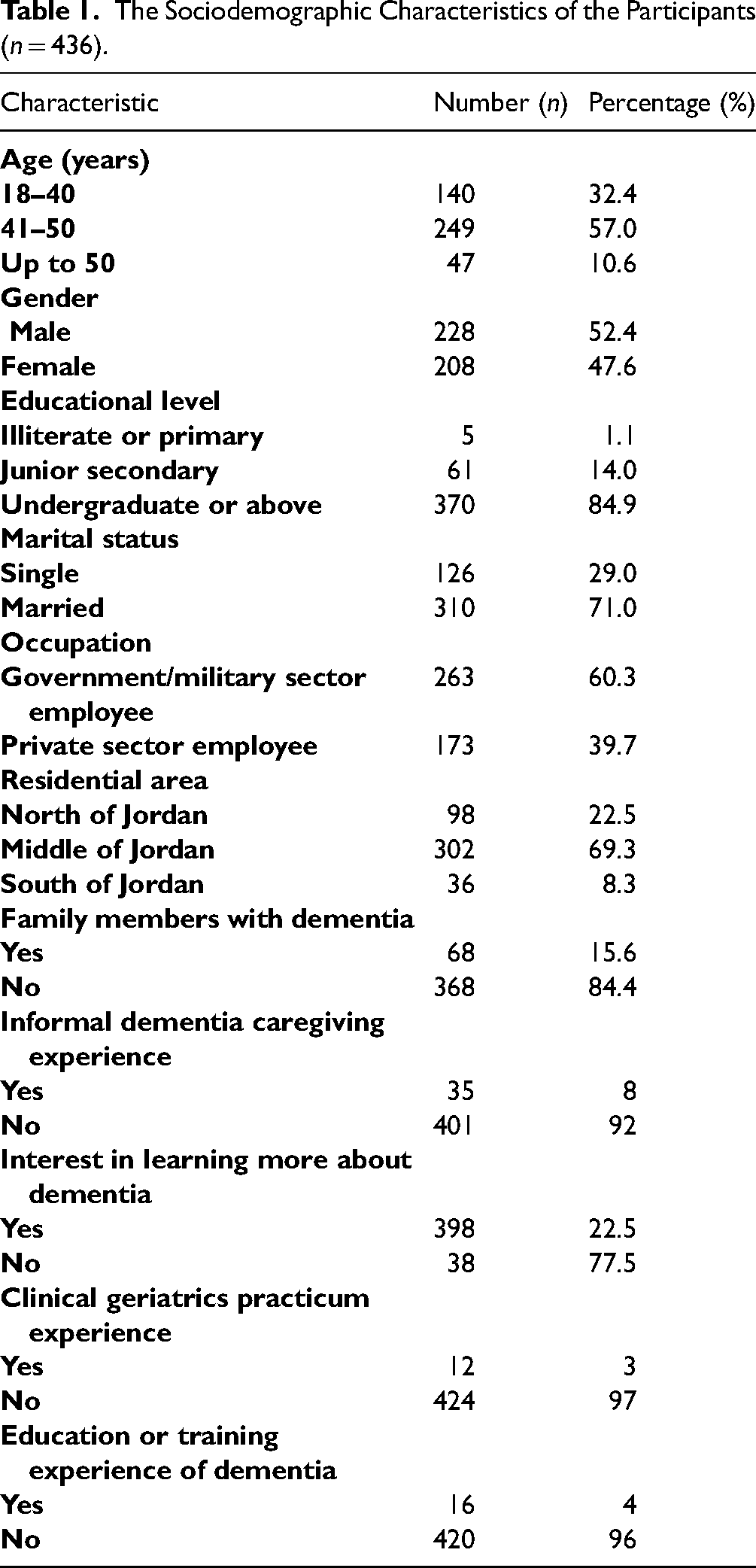
In the study, a total of 436 participants responded to the survey, and there was no missing data. The participants had a mean age of 45.5 ± 1.9 years old, ranging from 18 to 75 years. Approximately 52.4% of the respondents were male, and the majority (84.9%) were university graduates. Among participants in the 18–30 age group, 32% had a college degree or higher, while in the 31–50 age group, 57% had a degree or higher. In the group of participants above 50 years old, 10.6% had a degree or higher. Furthermore, 71% of the participants were married. Table 1 summarizes the demographics of participants.
The Sociodemographic Characteristics of the Participants (n = 436).
Knowledge
Regarding knowledge about dementia, the participants had a mean total score of 17.21 out of 30 on the ADKS, representing 57% of correctly answered questions. This indicated a limited knowledge level of dementia among the participants. The content domain “life impact” received the lowest overall score (50%), with two-thirds of the participants incorrectly believing that most people with Alzheimer's disease (AD) live in nursing homes. Additionally, only 37.8% of participants correctly responded to the item stating that it is safe for people with AD to drive as long as they have a companion in the car at all times.
In the domain of caregiving, the majority of participants (89.7%) correctly identified the statement that when people with AD begin to have difficulty taking care of themselves, caregivers should take over right away. In the “assessment and diagnosis” domain, the majority of participants (88.3%) accurately identified the statement that when a person with AD becomes agitated, a medical examination might reveal other health problems that caused the agitation. Table 2 describes ADKS domains and items’ frequencies and percentages. Table 3 describes ADKS questions’ frequencies and percentages.
ADKS Domains and Items’ Frequencies and Percentages.

The Alzheimer's Disease Knowledge Scale (ADKS).

Attitudes
Regarding attitudes toward dementia, the participants exhibited positive attitudes, with a mean score of 88 out of 140 (SD = 16.19) on the DAS. The dementia knowledge subdomain had a mean score of 48 out of 70 (equivalent to 69%), while the social comfort subdomain received a mean score of 40 out of 70 (equivalent to 57%). The mean total DAS score for the three regions studied was similar, ranging from 86.2 to 90.1. Table 4 shows participants’ DAS scores.
Participants’ DAS Scores.
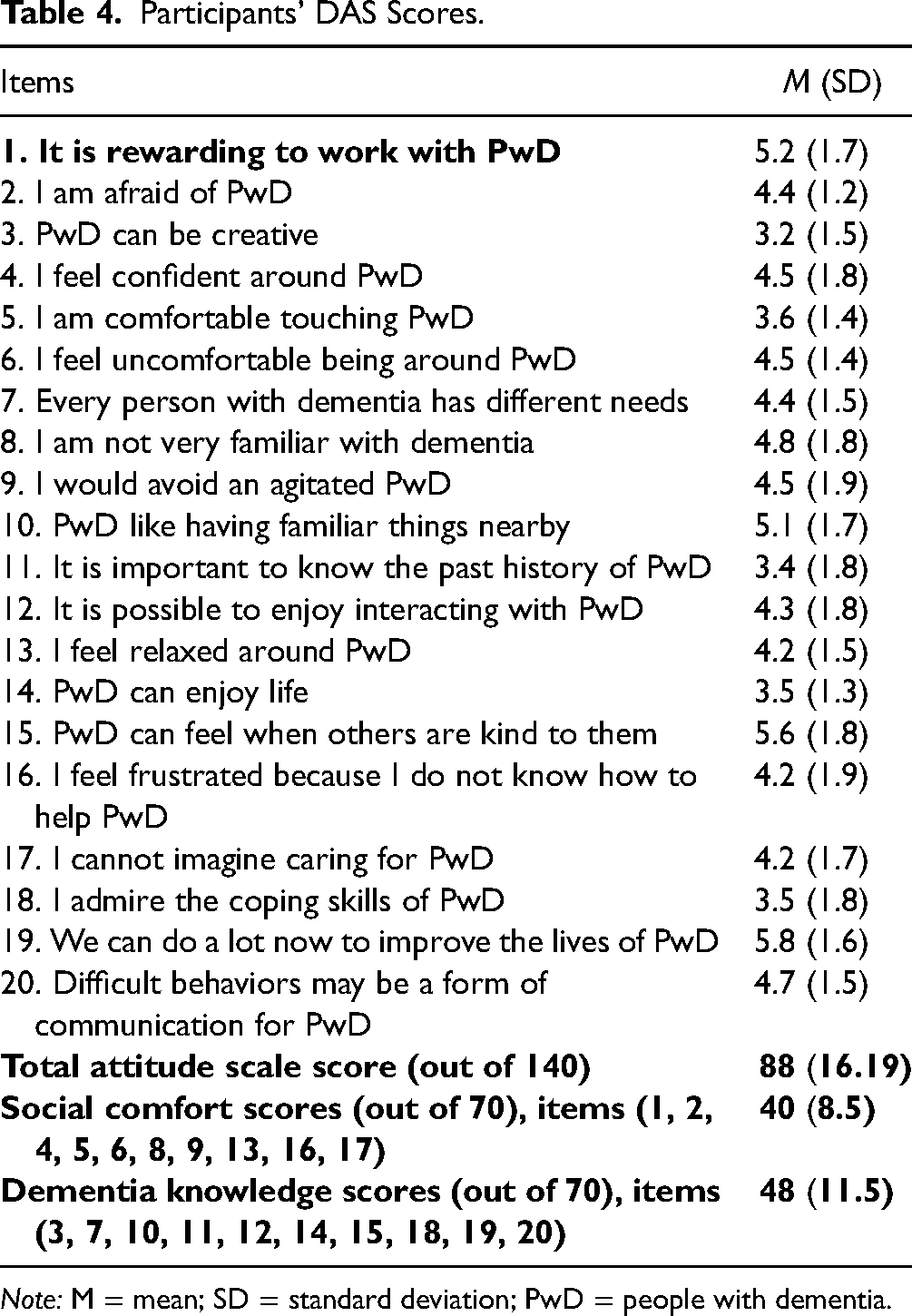
Note: M = mean; SD = standard deviation; PwD = people with dementia.
Predictors That Impact Knowledge of and Attitudes Toward AD
The study examined predictors that impact knowledge of and attitudes toward AD. The assumptions of a standard multiple regression were assessed, including multicollinearity, singularity, outliers, normality, linearity, and homoscedasticity. Multicollinearity was examined by the correlation between variables (range = 0.01–0.85), and the tolerance and variance inflation factor (VIF) fell within the acceptable value. Each independent variable is not a combination of others; therefore, there was no violation of singularity. According to the standardized residual plot, all values are between −3.3 and 3.3, with no violation for outliers. Residual scatterplots were used to assess the normality, linearity, and homoscedasticity; no violation of these assumptions was found.
The results indicated that individuals with informal dementia caregiving experience, employment experience, geriatric clinical practice experience, education or training in dementia, and a desire to learn more about dementia had statistically significantly higher dementia knowledge scores (P < .05). Female participants with informal dementia caregiving experience, geriatric clinical practice experience, dementia education or training, and a desire to learn more about dementia also demonstrated statistically significantly higher attitude scores (P < .05).
The findings discussed in this section highlight the knowledge levels, attitudes, and predictors related to dementia among the study participants (Table 5).
Predictors of Knowledge of and Attitudes Toward Dementia.

*Significant at the 0.05 level.
**Significant at the 0.001 level.
Discussion
This study aimed to explore the Jordanian community residents’ knowledge of and attitude toward dementia. The current study is significant because it contributes to a broader understanding of the subject by pointing to the necessity of expanding the current programs for dementia education in order to identify at-risk individuals and their families and enhance the standard of dementia care. Results from the current study indicated that Jordanian community residents had a limited level of dementia knowledge. Conversely, they showed positive attitudes toward PwD.
In the current study, Jordanian residents’ mean ADKS score, which measures their knowledge of dementia, was 17.21 out of 30. This result indicates that there is a knowledge gap among residents on dementia. The scores for the subdomains of the ADKS were similarly low, ranging from 1.50 out of 3 for “life impact” to 4.27 out of 6 for “risk factors.” While all of the studies in the literature used the same tool, some reported a higher mean knowledge score, while others reported a lower mean score. In a Brazilian study, the mean ADKS score for the population was 21.6 out of 30 (Amado & Brucki, 2018). Moreover, Wang et al. (2020) conducted a study in Beijing, China, evaluating 341 general practitioners’ dementia knowledge found that they had a mean score of 21.42 out of 30. In contrast, a study conducted in India found that the mean knowledge score was 16.8 out of 30 (Poreddi et al., 2015). The reported results were either higher or lower than the score from the present study; however, the difference is only minor and does not go beyond three points. Similar findings imply that dementia is a global problem with little knowledge among the general public.
According to a systematic review of population-based surveys assessing knowledge and attitudes about prevention and treatment of dementia, nearly half of the general public believed that dementia was a natural part of aging (Cations et al., 2018); however, almost two-thirds of the participants (66.5%) in our study believed that Genes can only partially account for the development of dementia. There is a critical need to educate the public about the fact that dementia is not an unavoidable part of aging since this misconception about dementia may prevent people from obtaining professional care as soon as possible (Cations et al., 2018; Poreddi et al., 2015; Smith et al., 2014).
In the current study, the mean DAS score was 88 out of 140. This score skews positively, showing that participants have positive attitudes toward PwD. This result is consistent with the literature. In the literature, there was evidence of generally positive attitudes toward PwD (Aljezawi et al., 2022; Farina et al., 2020; Poreddi et al., 2015; Yang et al., 2015). Although community residents in Jordan have a positive attitude, it is possible that they do not have adequate knowledge to care for PwD, as evidenced by the previous findings. Nevertheless, this could be interpreted as a positive attitude.
The current study's findings point to a dementia knowledge gap among community residents in Jordan, but they showed positive attitudes. Therefore, greater consideration must be given to promoting public education on dementia and its risk factors. The Jordanian population's respect for older people as a component of Jordanian culture may be contributing to the positive attitudes in the current study (Abdalrahim, ALBashtawy, et al., 2022; Aljezawi, 2021).
To fill this information gap, one approach is to employ the Promoting Excellence framework, which served as the theoretical basis for the current study (NHS Education for Scotland SSSC, 2011). By finding the questions with the fewest accurate answers, the framework identifies areas where dementia knowledge is insufficient. This will direct individuals to areas where their knowledge needs to be improved on a personal basis. Additionally, according to the research, special programs for dementia education that involve public training may be made available to residents in order to advance their knowledge (Williams & Daley, 2021). This improvement should be made not only to raise community residents’ knowledge levels but also to increase their attitudes toward PwD and to develop their confidence and competency in dementia care.
Due to Jordan's relatively young population in comparison to other nations with older populations, community residents there are not frequently exposed to PwD (Department of Statistics, 2022). However, it is anticipated that the number of older people in Jordan will rise in the coming years (Department of Statistics, 2022), which will be followed by a rise in dementia cases. As a result, the findings of this study can be used to develop educational interventions that will raise community members’ knowledge levels and improve their abilities and compassion in handling similar situations in the community. According to published research, offering learning opportunities in the field of dementia can give community members knowledge, positive attitudes, confidence in their dementia care, and competence (Evripidou et al., 2019).
Five statistically significant predictors of dementia knowledge were found in our regression analysis for the total ADKS score and its subscales (informal caregiving experience for PwD, having an interest in learning more about dementia, having geriatric clinical practice experience, having education or training in dementia, and having work). This result is consistent with research conducted previously in wealthy nations (Cheung et al., 2022; Smith et al., 2018; Tan Tee Hng et al., 2020). Gender, interest in learning more about dementia, having geriatric clinical practice experience, education or training in dementia, and informal caregiving experience for PwD were all found to be significant predictors of dementia attitudes in the current study. This result is consistent with a prior investigation (Schaffler-Schaden et al., 2021; Teichmann et al., 2022).
Strengths and Limitations of the Study
This is the first study in Jordan to evaluate Jordanian community residents’ knowledge of and attitudes toward dementia. The primary benefit of the current study is that the high response rate accurately reflects participants’ enthusiasm for dementia. There are many limitations on this study that should be taken into account. The small sample size was one of the study's weaknesses. Convenience samples were utilized in the aftermath of the COVID-19 issue despite the fact that they increase the risk of bias and restrict the generalizability of the results. When utilizing cross-sectional studies, researchers might not be able to analyze individual behaviors and patterns across time or arrive at causal findings. Longitudinal and experimental techniques should be utilized to overcome these constraints. Even if the results are restricted to the demographic in Jordan that is of interest, they might act as a springboard for further research into increasing public awareness and educating the general public about dementia. Pre-test and post-test studies will be carried out using the baseline data from this investigation.
Implications for Practice
This study provides important early insights into the knowledge and attitudes of the general people in Jordanian society regarding dementia. The majority of participants in our study had limited knowledge about dementia, including its causes, symptoms, and risk factors, which may have hampered its early detection or prevention. The findings of this study have significant ramifications for the growth of community mental health services, particularly for the development of dementia awareness and risk reduction. This needs to implement a number of strategies including, and it's important to spread awareness about a wide range of topics related to dementia in partnership with the government, media, healthcare organizations, and local communities, with a focus on those with low levels of education and an emphasis on the disease's causes, symptoms, and risk factors. In order to offer a set of realistic and first steps to the general population so that they can make food and lifestyle decisions based on the best research, there is an urgent need to produce evidence-based dietary and lifestyle guidelines. Additionally, health advocates should motivate the general population to embrace healthy lifestyle choices that can help lower the risk of dementia in daily life. Additionally, policymakers and organizations that promote health should designate priority populations for activities aimed at reducing the risk of dementia.
Conclusions
Jordanian community residents in the current study had inadequate knowledge regarding dementia including its causes, symptoms, and risk factors, which may have hampered its early detection or prevention. The findings of this study have significant ramifications for the growth of community mental health services, particularly for the development of dementia awareness and risk reduction. Conversely, participants expressed positive attitudes toward PwD. This could provide as a platform for these participants to understand information about dementia and thus enhance the awareness and care of PwD in the community.
Footnotes
Abbreviations
Declaration of Conflicting Interests
The authors declared no potential conflicts of interest with respect to the research, authorship, and/or publication of this article.
Ethical Approval
The present research was conducted in accordance with the general ethical guidelines, and the ethical approval was obtained from the Institutional Review Board (IRB) of Al al-Bayt University. Written informed consent was obtained from all participants prior to the study.
Funding
The authors received no financial support for the research, authorship, and/or publication of this article.
