




Abstract
Introduction
Newly graduating nurses should be able to enter clinical practice as safe, accurate, competent, and compassionate professionals in health care settings that necessitate them to be learners who can easily get familiar with a broad diversity of clinical practice settings.
Purposes
The purpose of this study was to evaluate the effect of high-fidelity simulation experiences on self-satisfaction and self-confidence among the pediatric nursing students.
Methods
A quasi-experimental design, post-test, was carried out through the recruitment of a convenience sample of 150 nursing students from Arab American University. The students were randomly assigned to the study (n = 75) or control (n = 75) groups. Data were collected using learner satisfaction and self-confidence scales.
Results
The results of the post-test revealed that there was a significant difference between both groups in self-satisfaction (t (148) = 11.14, P < .001) and self-confidence (t (148) = 13.04, P < .001). The mean score of self-satisfaction for the study group (22.45 ± 2.27) was higher than control group (16.80 ± 3.76). Also, the study group’ mean self-confidence score (35.72 ± 3.49) was higher than the control group (27.28 ± 4.39).
Conclusion
High-fidelity simulation was confirmed to be an helpful tool to keep an effective and safe learning method for pediatric nursing students, thus increasing their satisfaction and confidence.
Introduction
Higher degrees of nursing expertise are required to respond properly to complicated clinical contexts in the rapidly globalizing healthcare revolution (Kavanagh & Sharpnack, 2021). The difficulties need a reevaluation of nursing programs, particularly those involving instructional methodologies (Al Khasawneh et al., 2021). Recognizing the challenge for nursing instructors and suggesting a focus on creative teaching techniques and student learning rather than students’ reporting. Depending on the way things have traditionally been done, it may not be sufficient to qualify future nurses for practice. (Ralph et al., 2014). Nursing students should be prepared to enter clinical practice as accurate, safe, compassionate, and competent professionals in health care settings that necessitate them to be learners who can quickly become familiar with a broad range of clinical practice situations (Hussein et al., 2017). Nursing educators face a number of obstacles, including insufficient clinical environments (Dağ et al., 2019); a lack of clinical nursing staff (Harder, 2010; Jeffries, 2005; Sportsman et al., 2011); insufficient chances to care for patients with acute life-threatening conditions in hospital settings (Brannan et al., 2008); and patient safety, which may limit students’ involvement in delivering care (Sportsman et al., 2011). Such issues pose challenges for nursing students to gain clinical experience that improves their knowledge and self-esteem (Sportsman et al., 2011). Therefore, promoting other non-conventional methods such as simulation-based education for undergraduate nurses allows nursing students to practice clinical skills within a safe learning environment (Doolen et al., 2016; Oanh et al., 2021).
Litreture Review
The benefits of simulation are characterized by allowing students to learn and make mistakes that may be remedied without compromising patient safety (Dearmon et al., 2013; Rushton, 2015). Also, high-fidelity simulation (HFS) increased satisfaction with theoretical-practical learning (Al Khasawneh et al., 2021; Lubbers & Rossman, 2017; Oanh et al., 2021; Weaver, 2015); increased the level of self-confidence (Boling & Hardin-Pierce, 2016; Hwang & Kim, 2020; Oanh et al., 2021; Stayt et al., 2015); improved psychomotor skills (Ahn & Kim, 2015; Vincent et al., 2015; Zhen et al., 2021); improved decision-making (Ayed et al., 2021) and clinical judgment (Ayed et al., 2022; Cant & Cooper, 2017; Salameh et al., 2021). In addition, improvements have been obtained in learning (Shin et al., 2015), the acquisition of competences, and self-efficacy (Cant & Cooper, 2017). Thus, nursing students learn patient care, psychomotor skills, problem solving, professional communication, and critical thinking. They also promote their socializing and confidence in their professional roles (Pai, 2016).
Several studies revealed that self-satisfaction and confidence improved after simulation. Tawalbeh and Tubaishat (2014) found more confidence in adopting Advanced Cardiovascular Life Support (ACLS) through simulation. Lubbers and Rossman (2016) found that students who received pediatric simulation training reported greater self-confidence. Additionally, Sapyta and Eiger (2017) reported a significant statistical increase in confidence after taking part in the simulation experience. Another study, done by Saied (2017), found that students were satisfied with the simulation experience and that their self-confidence levels improved following the simulation. However, randomized controlled trials revealed no relationship between simulation experience and self-confidence in nursing students (Alinier et al., 2004, 2006; Blum et al., 2010; Brown & Chronister, 2009).
Pediatric nursing students in Palestine have minimal possibilities for training because of restrictions such as not being allowed to perform particular procedures (i.e., insert cannulas). As a result, students are frequently observers rather than participants in such nursing processes. Furthermore, there are several rare conditions that many nursing students would be unfamiliar with before graduating. Simply put, simulation in nursing education among Arab students, mainly pediatric nursing students, implies a paradigm shift and generates a new teaching culture (Ayed et al., 2021). This cultural transformation in education should be monitored and evaluated in the short and long term. Besides, there have been few studies conducted on HFS and its effect on Arab pediatric nursing students (Ayed et al., 2022; Salameh et al., 2021). Therefore, the purpose of this study was to evaluate the effect of high-fidelity simulation experiences on self-satisfaction and self-confidence among pediatric nursing students.
Method
Study Design
A quasi-experimental post-test, two groups study was conducted from March to June 2020.
Research Hypothesis
The pediatric nursing students who engaged in HFS intervention had more satisfaction and self-confidence than those who received traditional training.
Sample and Setting
Three hundred undergraduate nursing students registered in the pediatric nursing course at the third-year level from the faculty of nursing at Arab American University. The study was conducted between March and May 2019. Most nursing school lecturers rely on traditional education, which is insufficient for teaching nursing students clinical skills. As a result, a simulation laboratory was constructed in 2015 to increase clinical training and compensate for a lack of training situations. The laboratory incorporates high-fidelity simulation; it has the look of a human-like simulator and can mimic a broad variety of anatomical features and physiological processes in humans. It can also replicate the physiological changes caused by some disorders as well as a patient's verbal responses. Students performed prepared scenarios to fulfill course goals (e.g., a head-to-toe examination and practice on skills such as vital signs, blood tests, intravenous insertion, Foley's insertion, heart sound auscultation, intubation, and so on).
Using G*Power version 3.0.10, a t test with a power of .80, an effect size of .5, and an alpha of .05, a sample size of 128 participants was needed. A sample (N = 150) was recruited in order to overcome the attrition rate. The current study enrolled the participants using convenience sampling. Selection was randomly allocated to either the study (n = 75) or control group (n = 75) to maintain the homogeneity of the subjects. The researchers randomly assigned the first student on the list to the study group and the second to the control group. The same procedure was followed until the needed sample size was reached. The inclusion criteria were: (a) being a nursing student; (b) attending a pediatric clinical course; and (c) being willing to participate.
The Intervention
The simulated scenario followed the Best-Practices INACSL Standards: Simulations SM (INACSL, 2016a):
Pre-briefing: The students were provided with information to establish a psychologically-safe context and to consolidate the learning process (Rudolph et al., 2014) two weeks before the simulation scenario. The students were given a brief instructional paper regarding the simulation scenario, which enabled them to prepare and develop an evidence-based strategy. This report comprised the clinical history and health status of the child with bacterial meningitis who needed hospital admission. Briefing (5 minutes): The simulated scenario was summarized by presenting a brief description of the clinical case's background. Simulated scenario (30 minutes): The simulation scenario included a 4-year-old child complaining of bacterial meningitis; the scenario was developed by Campbell and Daley (2013). Taking vital signs, attaching a heart monitor, supplying oxygen as recommended by patient symptoms, measuring oxygen saturation, analyzing breath sounds, monitoring the results of laboratory and diagnostic tests, measuring arterial blood gases (ABGs), and offering medications were all aspects of the interventions. In the simulation room, active cameras and microphones were employed during the clinical simulation session. The students went over the scenario for the expert role again and again until they were comfortable with the demonstration. Debriefing (30 minutes): Once the simulated scenario was completed, it was analyzed and discussed (INACSL, 2016b). Following the recommendations proposed by Phrampus and O’Donnell (2013), we used the gather, analyze, and summarize (GAS) debriefing tool to structure this phase. As a result, the nursing students went over and analyzed the best evidence-based practices related to the clinical case, as well as commented on and studied in depth the best actions, errors, and needed improvements highlighted throughout the clinical simulation session. During the debriefing phase, nursing instructors who had been trained on the clinical simulation approach offered feedback to nursing students on their performance.
Data Collection Procedure
The researchers invited the students to participate in the study. Additionally, an announcement about the study was posted on the students’ board in coordination with the nursing faculty administrator.
The researchers provided students who showed a desire to participate in the study with information related to the study. The researchers supplied students who showed a desire to participate in the study with information related to the study. The participants obtained printed information concerning the time of the study. The researchers assigned the students randomly to the study or control group.
The study was carried out in two phases to overcome the contamination between the groups.
Phase I: The researcher provided the control group with a 3-hour lecture about bacterial meningitis and traditional clinical practice in a hospital setting for 2 weeks. After the completion of the clinical practice, the control group filled out the questionnaire. Phase II: The study group went through a 3-hour session of traditional teaching that included a PowerPoint presentation regarding bacterial meningitis, clinical training, and a simulation scenario session. The research group is divided into nineteen teams of four students each (primary nurse, secondary nurse, physician, and family). After the completion of the simulation session, the study group filled out the questionnaire (Figure 1).

Sampling and flow of subjects through the study.
The Instruments/Tools
The tools were:
The socio-demographic characteristics questionnaire was developed by the researcher. It was composed of “age, gender, general point average (GPA), previous experience in the healthcare setting, and if there was an experience outside of nursing courses in children's care with bacterial meningitis.” Learner Satisfaction and Self-Confidence in Learning (LSSCL) scale: The LSSCL is a 13-item, 5-point Likert scale developed by the National League for Nursing (Jeffries, 2005). The instrument is divided up into two subscales, each of which is intended to assess student learning satisfaction (five items) and learning self-confidence (eight items). Scores on the satisfaction subscale can range from 5 to 25, and on the self-confidence subscale from 8 to 40, with higher scores representing more satisfaction. It was translated into Arabic in accordance with World Health Organization (WHO) guidelines. Cronbach's alpha coefficients for the LSSCL scale (self-satisfaction = .92 and self-confidence = .89) were determined to be satisfactory in this study. This scale is widely used in simulation-based learning (Adamson et al., 2013; Franklin et al., 2014; Kardong-Edgren et al., 2010; Reierson et al., 2020).
Ethical Considerations
Ethical approval was obtained from Arab American University. The researchers approached potential study participants among the students and described the study's purpose. Participants who agreed to participate in the study and fulfilled the inclusion criteria were given a thorough description of the research. They were also notified that their participation was completely voluntary and that they could opt out of the research at any time without penalty. They were also told that the risks of participating were no more than those of any other simulation and that student confidentiality was preserved. Following that, we requested that they sign an informed consent form. The researchers, on the other hand, were familiar with both groups. The names of the participants were saved on the computer but were not backed up. For ethical reasons, we used a waitlist control group approach, in which, when we finished the study, we exposed the control group to the same experiences as the study group.
Data Analysis
Descriptive and inferential statistics were used. Data were analyzed using SPSS 23.0 software The homogeneity of the two groups in terms of demographic variables was determined using the Chi-squared test. An independent test was used to compare the differences between the two groups.
Results
Socio-Demographic Characteristics of the Participants
Sample Characteristics
One hundred and fifty participants met the eligibility criteria. The sample consisted of 87 (58.0%) females and 63 (42.0%) males. The students’ ages ranged from 20 to 26 years old. The mean age was 21.6 ± 1.16 years. The students’ GPA ranged from 1 to 3.97. The majority of the students, 110 (73.3%), had no previous experience in healthcare settings or outside of nursing courses related to children's care with bacterial meningitis (137 [91.3%]).
The analysis also revealed that more than half of the 42 (56.0%) participants in the study group were female. The sample's mean age was 21.7 ± 1.27. The students’ ages ranged from 20 to 26 years old. The mean GPA was 2.8 ± 0.43. The students’ GPA ranged from 2.03 to 3.94. Most students 57 (76.0%) had no previous experience in healthcare settings or outside of nursing courses in caring for children with bacterial meningitis 68 (90.7%). Concerning the control group, there were 45 (60.0%) female students and 30 (40.0%) male students. The mean age was 21.5 ± 1.03 years. The average GPA was 2.63 ± 0.51. The students’ GPA ranged from 1.00 to 3.97. About two-thirds of the students 53 (70.7%) hadn’t worked in a healthcare setting. The majority of the students, 69 (92.0%), had no previous experience outside of nursing courses in caring for children with bacterial meningitis, as seen in Table 1.
Comparison of the Sample Characteristics Between the Two Groups According to Background Characteristics (N = 150).
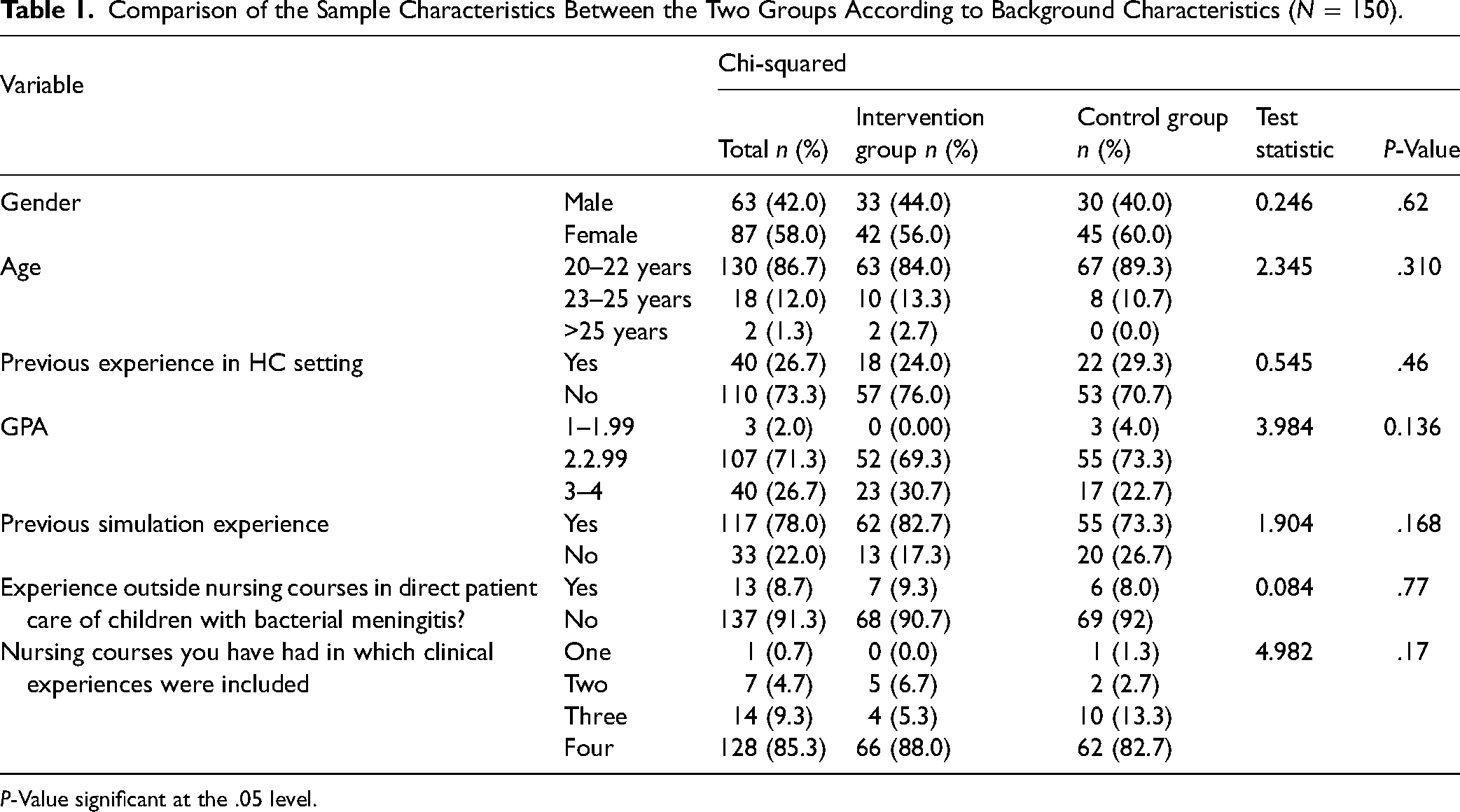
P-Value significant at the .05 level.
Research Questions Results
An independent t test was performed to assess the differences between the means of self-satisfaction of the experimental and control groups (t = 11.14, df = 148, P < .001). The mean score of self-satisfaction for the study group (22.45 ± 2.27) was higher than the control group (16.80 ± 3.76). This result indicates that high-fidelity simulation improves self-satisfaction among nursing students. Also, an independent t-test was used to assess the differences between the means of self-confidence of the experimental and control groups (t = 13.04, df = 148, P < .001). The experimental group mean self-confidence score (35.72 ± 3.49) was higher than the control group's (27.28 ± 4.39). This result indicates that high-fidelity simulation enhances self-confidence among nursing students, as seen in Table 2.
Differences Between Self-Satisfaction and Self-Confidence at Post-Test for Both Groups (N = 150).

P-Value significant at the .05 level.
Discussion
The purpose of the current study was to evaluate the influence of high-fidelity simulation experiences on self-satisfaction and self-confidence among pediatric nursing students. Based on the findings of the current study, there was a statistically significant difference between the intervention and control groups in terms of satisfaction and confidence after engaging in HFS. The satisfaction and confidence scores of the study group were higher than the control group. These findings support the effectiveness of the current study intervention (HFS) as a teaching method in improving the levels of satisfaction and confidence among students attending the pediatric course. These results are in line with the results of other studies, where the authors found that levels of satisfaction with the learning process improved with the use of high-fidelity simulation (Curl et al., 2016; Labrague et al., 2019; Negrão-Baptista et al., 2014). Also, these results of this study were supported by Bambini et al. (2009) who indicated that simulation experience is beneficial in constructing a learning environment that contributes to confidence. Prescott and Garside (2009) also assessed simulation experiences among nursing students (N = 45). The findings revealed that there is universal agreement that simulation is a beneficial learning approach that fosters confidence. Approximately 49% of respondents agree, with 49% strongly agreeing, that their confidence has improved following the simulation. Although many students stated that simulation was stressful during the initial interview, they stated that as they obtained more experience in the simulated environment, they became substantially more confident and competent in their skill level. Tawalbeh and Tubaishat (2014) compared the confidence of nursing students in the simulation experience of advanced cardiac life support (ACLS). Simulation improved nursing students’ confidence about ACLS. Another quasi-experimental study conducted by Lubbers and Rossman (2016) assessed the effects of the pediatric community simulation experience on the self-confidence of nursing students (n = 54). The study showed significant increase in self-satisfaction and confidence post the experience.
According to the findings, students who participated in the pediatric simulation course expressed more self-confidence after the course than before. Also, the same results of high confidence after simulation were reported in the Sapyta and Eiger (2017) study, which indicated that there was a statistically significant raise in confidence scores following participation in the simulation session. Furthermore, a quasi-experimental study carried out by Saied (2017) examined the effect of using simulation scenarios on the pediatric nursing students’ knowledge, self-efficacy, satisfaction, and confidence (N = 158). The results indicated that the students were satisfied with the simulation experience, and their self-confidence scores were higher after the simulation session. Another study that supports these results was conducted by Omer (2016) to explore the perceptions of 117 nursing students’ satisfaction and self-confidence after clinical simulation experiences using a survey method. Following the clinical simulation experience, participants reported a high degree of satisfaction and self-confidence in their skills to perform an effective intervention, conduct health assessments, detect patient deterioration events, and engage as an effective team member.
Lack of self-confidence in nursing students may limit their ability to master new skills (Lundberg, 2008). As a result, self-confidence is an essential topic for research. Nursing faculty members and students must understand the notion of self-confidence in order for antecedents such as knowledge, support, and preparation to be encouraged in simulation sessions and clinical placements (Perry, 2011). The building of self-confidence must be acknowledged as a core component for undergraduate program development and implementation (Chesser- Smyth & Long, 2013).
Strength and Limitations of the Study
Although the study generated significant results and added Arab nursing students to the body of literature, it contains a number of limitations that must be addressed. The first limitation was the convenience sample; this study only included bachelor's degree nursing students from one private university. The second limitation was the short study duration, and the study may have been limited by the use of only one simulated scenario.
Implications for Practice
Nursing schools can promote high-fidelity simulation through nursing courses. Qualitative research is recommended for future studies to explore the students’ experiences towards HFS.
Conclusion
High-fidelity simulation helps provide pediatric nursing students with a safe and relevant learning environment, enhancing their satisfaction and confidence. Furthermore, the study confirmed the use of high-fidelity simulation in combination with clinical training in educating pediatric nursing students, with the integration intended to bridge the knowledge-nursing practice gap.
Footnotes
Declaration of Conflicting Interests
The authors declared no potential conflicts of interest with respect to the research, authorship, and/or publication of this article.
Funding
The authors received no financial support for the research, authorship, and/or publication of this article.
