




Abstract
Introduction
Rapid use of technologically driven simulation environment in teaching–learning has caused mixed feelings among students. High-fidelity simulation-based education is superior in cultivating the knowledge, skills, caring, learning interest, and collaboration among nursing students. However, the nursing students’ attitudes and perceptions toward high-fidelity simulation-based education are unexplored.
Objectives
The present study aims to explore the attitude and perception of undergraduate nursing students toward high-fidelity simulation-based education.
Methods
Cross-sectional survey research design was adopted. We used self-administered Education Practices Questionnaire (student version) and Attitude Scale toward Simulation-Based Education to collect the data. A total of 109 nursing students were recruited.
Results
Nursing student's attitude shows (mean = 68.26); perception on educational practices of high-fidelity simulation-based education demonstrates (M = 39.33 ± 7.87) and the importance of high-fidelity simulation-based education shows (M = 37.73 ± 7.45). However, no significant difference observed between the male and female student's attitude (t = −0.286 [0.78]) and perception (t [107] = 0.960 [0.34]). Similarly, no significant difference was observed among the different levels of students p > .005 on perception and attitude toward high-fidelity simulation-based education.
Conclusion
The study proposed to have high-fidelity simulation-based education as an integral part of teaching in clinical training of students at all levels of nursing program.
Keywords
Introduction
Simulation-based education in practice-based disciplines has tremendously advanced over time. The innovative technological advancement in high-fidelity simulation (HFS) has influenced undergraduate nursing education. HFS refers to the usage of a technologically advanced computerized mannequin or standardized patient with the capability of providing interactive physiologic responses based on innovative scenarios that mimic clinical reality under a safe and controlled environment (Basak et al., 2016). Substantive research supports that HFS promotes intentional educational experiences employing the principles of active learning and provides valuable opportunities for students to improve their competencies confidently (Chin et al., 2014; Hogan et al., 2020; La Cerra et al., 2019; Zalewska & Zarzycka, 2022; Zapko et al., 2018; Zhen et al., 2021). Additionally, the American National Council of State Boards of Nursing (Bradley et al., 2019) recommends replacement of 50% of clinical education with simulation, as this strategy contributes to an essential interactive mode of teaching–learning (Basak et al., 2016). This active learning strategy encourages two-way communication between students and teachers allowing quick changes in the learning outcome (Kenzhaevna & Abdukhalikovna, 2023). The inclusion of HFS in nursing education has exponentially grown in recent years and has become an extensive component of the nursing curriculum (Bowen-Withington et al., 2020; Zhu et al., 2020).
There is emerging evidence that HFS is effective in nursing education. Nursing students believe that HFS is useful before clinical placement (Guerrero et al., 2021) and that it improves patient safety (El Hussein & Hirst, 2023) and provides authentic learning experiences (Abildgren et al., 2022). Furthermore, HFS enhances the preparedness, self-confidence, and satisfaction with clinical performance as well as the competence of nursing students (Craft-Blacksheare & Frencher, 2018). It also augments the acquisition of skills and is perceived by most faculty members that it increases the critical thinking skills of nursing students and enhances the learning outcome by providing safer patient care (Ogilvie et al., 2011; Silvia, 2013). Guerrero et al. (2022) found that HFS improves the mean scores in knowledge and skill examinations. Recent evidence suggests that HFS improves the thinking process and emotional and clinical decision-making capabilities (Ayed et al., 2023). In addition, Toqan et al. (2023) state that HFS is an effective and safe learning method that increases the satisfaction and confidence of nursing students. This strategy also yields better effects than do other simulation interventions (Zhen et al., 2021). Thus, HFS is an effective learning strategy if it is well planned and implemented.
Review of Literature
Although many studies have reported that HFS has a positive impact on various aspects of teaching and learning, some nursing students perceive that simulation does not match actual clinical practice (Cant & Cooper, 2011). Students also perceive that HFS does not create an accurate clinical learning environment and express feelings of fear and anxiety regarding the high level of realism in HFS (Munangatire et al., 2019). Moreover, the strategy creates a stressful environment and is considered an uncomfortable way of learning (DeCarlo et al., 2008). Moreover, the continuous presence of supervisors limits their experiential and self-directed learning. Faculty members and students also lack competency in using HFS (Munangatire et al., 2019). In addition, improper planning, organization, and implementation of simulation might cause frustration among learners, making them fail in meeting the learning objectives (Peisachovich et al., 2019). Such negative perceptions toward HFS may impede the learning process and engagement of students with this strategy.
The National League for Nursing (NLN)/Jeffries Simulation Framework is used in nursing education as a theoretical framework for the implementation of simulation (Wilson & Hagler, 2012; Young & Shellenbarger, 2012). Assessment of educational practice is one of the components of this framework (Cowperthwait, 2020). Each simulation session should include an evaluation session, which facilitates credibility in evaluating diverse learning activities during simulation. This approach of evaluating simulation experiences enhances the educational goals and evidence-based teaching methodology for educators (Crowe et al., 2018). With the Jeffries Simulation Framework, simulation-based education endeavors the use of diverse learning modalities ranging from simple physical assessments to management of complex life-threatening scenarios. The practice elements covered during this process include professionalism, patient safety, communication, evidence-based practice, critical thinking, clinical judgment, leadership, teamwork, and independent learning behaviors (Carvalho et al., 2017; Dura, 2021; Zapko et al., 2018).
In Gulf countries, simulation-based education is widely incorporated into the nursing curriculum. Many Arab nursing students perceive that simulation helps them overcome their culture-related stereotypes specifically while rendering women-centered care (Hamilton, 2016). Countries such as Egypt, Turkey, the UAE, Saudi Arabia, Jordan, and Oman have integrated simulation-based education into their nursing curriculum (Mohammad et al., 2017). HFS is widely used in the undergraduate nursing program across all courses at the College of Nursing (CON) at Sultan Qaboos University (SQU), Oman, mainly to cover complex and emergency conditions that are not available in the clinical area during regular rotations of students (Al Khasawneh et al., 2021). The pedagogy of HFS-based education (HFSBE) is incorporated intensively into all clinical nursing courses owing to the increased degree of realism and range of features in the latest mannequins or standardized patients (Alconero-Camarero et al., 2021). The NLN/Jeffries Simulation Framework is used as a theoretical framework for the implementation of simulation at the CON, SQU, Oman. The degree of engagement in simulation and emotional association may impact the learning process (Breckler, 1984). Studies have shown that attitudes stimulate behaviors and may substantially control the learning-by-doing process. In particular, attitudes impact learners’ perceptions that could influence HFSBE learning (Torres et al., 2020).
There is a lack of evidence on data related to students’ perceptions of educational practices of HFSBE in some parts of the world, including Oman. We expect that the current study would help in planning, developing, and implementing simulation by overcoming all challenges in achieving student learning outcomes. It is essential to assess the attitudes and perceptions of students toward the use of HFS to assist educators in planning effective delivery of simulation-based educational experiences to execute simulation as an effective teaching–learning strategy to enhance the quality of clinical training and establish the best simulation standards and practices in nursing education according to the International Nursing Association of Clinical Simulation and Learning (INACSL) (Bryant et al., 2020). Therefore, this study aims to explore the attitude and perception of undergraduate nursing students toward HFSBE.
Methods
Research Design
The study adopted a cross-sectional survey research design to assess the attitudes and perceptions of undergraduate nursing students toward HFSBE.
Setting
The study was conducted in the simulation laboratory of the CON, at SQU, in Spring and Fall semesters 2019. The CON at SQU offers a number of academic programs, including undergraduate and graduate nursing degree programs. An undergraduate nursing degree requires both theory and clinical education, culminating in a Bachelor of Science in Nursing (BSN). The BSN curriculum consists of 130 credits, of which 33 credits are offered for practical and clinical courses. Clinical education starts from the second year and is conducted in multiple settings, including a simulation laboratory, clinical setting, and community. All clinical courses in the BSN program at CON include simulation.
The simulation laboratory at the college contains state-of-the-art equipment that provides a realistic simulation environment of clinical settings and an effective learning environment. It is equipped with four dedicated simulation rooms featuring one-way mirrors that allow faculty members to observe students during a simulation scenario. The rooms are equipped with physiologic monitors for the simulators, resuscitation carts, and other supplies needed for realistic patient care. Separate nursing stations and areas for medication retrieval and set-up are also available. Each site has the ability to video record students during simulation experiences for later review and debriefing by students and teachers. Students and faculty members are provided with orientation and support in the simulation laboratory. The scenarios selected in each course include critical conditions that are unavailable during regular clinical rotations. The simulation sessions take from 20 to 30 min excluding prebriefing and debriefing.
Population, Sample, and Sampling Technique
The study population included undergraduate nursing students enrolled in Level III and Level IV clinical courses (i.e., maternity health nursing, child health nursing, and critical care nursing) at the CON. A convenience sample of 109 students who had registered in these courses during the academic year 2018–2019 was invited to participate in the study.
Instrument Description
The instruments used in the study included the Demographic Profile Form, Educational Practices Questionnaire (EPQ) (student version), and Attitude Scale Toward Simulation-Based Education. All of them were administered in the English language. Permission to use these tools was obtained from the developers prior to the study.
The Demographic Profile Form was developed by the study authors. It captures the participant characteristics, including age, gender, cohort, and current course registered.
The EPQ (student version) is a 16-item tool, which was used to measure the perceptions of the undergraduate nursing students (Farrés-Tarafa et al., 2020). It consists of four educational practice domains: active learning, collaboration, high expectations, and diverse ways of learning. Each item is measured on a 5-point Likert scale. The score of all items is summed up, and the total possible score is 80 points. The lowest possible score is 16 points, while the highest possible score is 80 points. The Cronbach's alpha for the design is 0.94, while that for the importance subscale is 0.95.
The Attitude Scale Toward Simulation-Based Education was used to measure the attitudes of the nursing students toward simulation-based education (Pinar et al., 2016). It consists of four subscales: Satisfaction–Self-Confidence (Items 1–6), Clinical Competence–Self-Efficacy (Items 7–11), Seriousness–Fidelity (Items 12–15), and Barriers–Difficulties (Items 16–18). Each item is measured on a 5-point Likert scale. The lowest possible score is 18 points, while the highest possible score is 90 points. The items have a high internal consistency and good validity. The Cronbach's alpha for this tool is 0.83.
Ethical Considerations
The ethical approval was obtained from the Research and Ethics committee of CON, SQU, Oman (REC/2018–2019). Written informed consent was obtained from the study participants. None of their personal identifying information was collected. The participants were not forced to participate in the study. They were given the freedom to withdraw their participation from the study at any time. The collected data were stored in a password-protected file and kept under the custody of the principal investigator of the study.
Data Collection
HFS experience was provided to the students in their respective clinical courses such as maternity health nursing, child health nursing, and critical care nursing. The scenarios provided in maternity nursing were postpartum hemorrhage, antepartum hemorrhage, preeclampsia, and newborn hypoglycemia. In child health nursing, acute respiratory distress syndrome, management of sickle cell crisis, management of epilepsy in children, and neonatal sepsis management scenarios were included. The scenarios included in critical care nursing included myocardial infarction, diabetic ketoacidosis, cerebrovascular accident, and care of dying patients. The students who agreed to participate in the study were taken to a reserved room and were explained about the purpose and nature of the study. After signing the consent form, they answered the survey in 20 min. A total of 109 nursing students participated in the study.
Data Analysis
All data were entered carefully, and all statistical data analyses were conducted using the Statistical Package for the Social Sciences (version 22). Descriptive statistics, including frequencies, percentages, means, and standard deviations (SDs), were used to describe the data about the students’ attitudes and perceptions toward HFSBE. Additionally, analysis of variance (ANOVA) was used to differentiate the attitudes and perceptions among different cohorts. An independent t-test was applied to determine the difference between the male and female students’ attitudes and perceptions toward HFSBE.
Results
The study included 109 nursing students. Approximately 60.6% and 39.4% of the students were women and men, respectively; 62.4% belonged to the 2015 cohort; and 28.4%, 38.5%, and 33% were enrolled in the critical care nursing, maternity nursing, and child health nursing course, respectively (Table 1).
Distribution of Demographic Variables of Undergraduate Nursing Students.

With regard to the nursing students’ attitudes toward HFSBE, the overall responses demonstrated a positive attitude with a mean ± SD score of 68.26 ± SD across all 18 subitems. Most participants either agreed or strongly agreed that HFSBE helped them develop self-confidence (M = 24.40, SD = 3.82), improve their self-efficacy (M = 20.34, SD = 3.25), and enhance their fidelity (M = 16.27, SD = 2.59). Few students (M = 7.23, SD = 3.52) perceived HFS as a barrier to learning owing to the increased workload and boredom (Table 2).
Nursing Students’ Attitude Toward High-Fidelity Simulation-Based Education.

Note. SBE = simulation-based education.
Table 3 shows that the scores were generally high across the domains, showing a growing positive perception toward HFSBE. The overall mean ± SD score for the educational practices was 63.22 ± SD, while the mean ± SD score for the importance of the educational practices was 60.83 ± SD. The mean score of all 16 items was 4–5, which was rated as very important. The students strongly perceived HFS as the best active learning method with a mean ± SD score of 39.33 ± 7.87; the students also rated HFS as very important for active learning with a mean ± SD score of 37.73 ± 7.45.
Nursing Students’ Perception on High-Fidelity Simulation-Based Education.

*Total mean for all sub-factors = 63.22.
**Total mean for all sub- factors = 60.83.
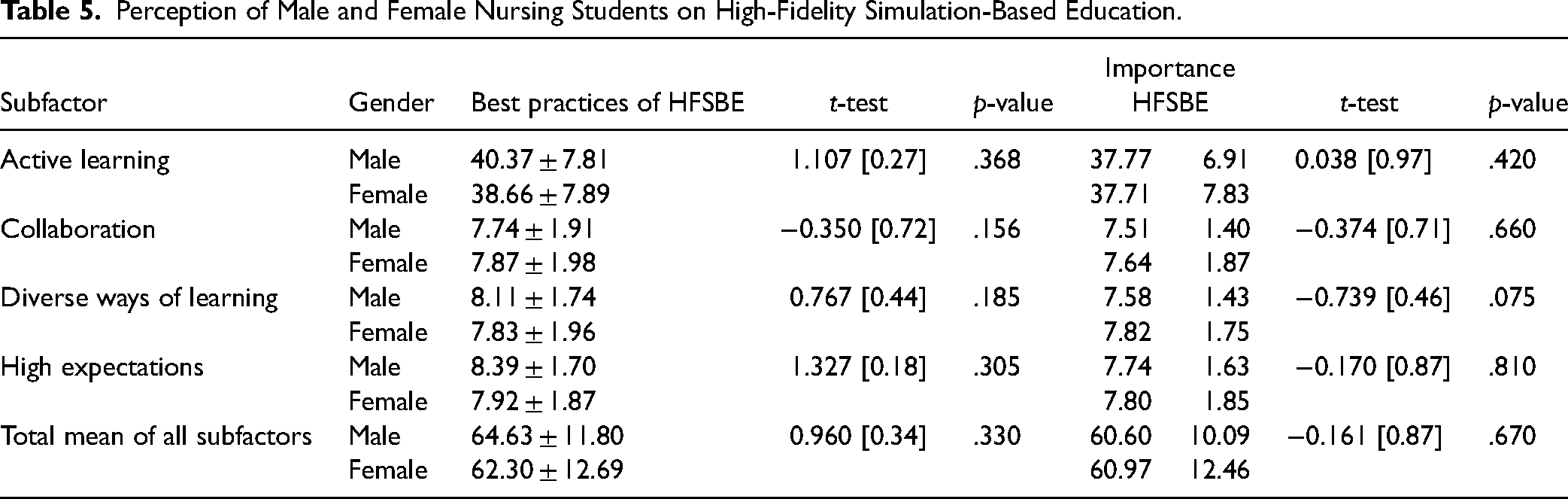
The learners strongly agreed with the importance of HFS in terms of collaboration and diverse ways of learning. Owing to the clear objectives, goals, and expectations set, the students had high expectations on HFS with mean ± SD scores of 4.03 ± 0.99 and 4.08 ± 1.00, respectively, for the two items. However, there was no significant difference in the perception between the male and female students, as the t value was 0.960 (0.34) for the agreement and 0.161 (0.87) for the rating. The students’ perceptions on active learning, collaboration, diverse ways of learning, and high expectations on HFSBE showed positive correlations.
Student's t-test was used to compare the male and female students’ attitudes toward HFSBE, which showed no significant difference between them (t = 0.286 [0.78], p = .70 [>0.005]). Hence, there was no significant difference in the attitudes between the 2012 and 2015 cohort students (Table 4).
Attitude of Male and Female Nursing Students Toward High-Fidelity Simulation-Based Education.

Similarly, there was no significant difference in the perception of HFSBE as the best practice and its importance between the male and female nursing students (t = 0.161 [0.87], p = .679 [>0.005]) (Table 5).
Perception of Male and Female Nursing Students on High-Fidelity Simulation-Based Education.
ANOVA showed no significant differences between the subscales of the students’ attitudes and cohort and between the perception and importance of HFSBE and cohort.
Discussion
In simulation, fidelity refers to the degree of realism created through the appropriate selection of equipment, scenario, and setting (Choi & Wong, 2019), the degree of exactness achieved (Rashid & Gianduzzo, 2016), and the believability of the experience related to the simulation activity (Cook et al., 2013). The INACSL states the achievement of learning outcomes should depend on the level of realism (Adamson, 2015). In nursing education, HFS has become an essential educational approach globally (Akhter et al., 2021), as students report higher levels of satisfaction with HFS and believe that it is more advantageous in providing simulation-based learning experiences than low-fidelity simulation (Christian et al., 2017; Kim et al., 2016; Saad Shaaban et al., 2021).
Perception Toward HFS
Nursing student's perception of HFS activity in nursing education is explored in few studies. Nursing students appreciated the use of HFS activities instead of real clinical placement. Students expressed HFS as a resourceful activity (Au et al., 2016). Likewise, nursing students recognized and perceived that the HFS allows them to cultivate problem-solving skills as the responses of the manikin are similar to those of human patients. Moreover, it allows the students to exercise prompt decision-making (Maneejak & Yasri, 2018). Student nurses perceive that HFS provides authentic learning environment and allows learning of critical thinking and problem-solving skills (Munangatire et al., 2019). Nursing students perceived that HFS provides a safe learning environment to experiment critical care (Brien et al., 2017). In consistent to these study findings, our study participants had a positive perception toward HFS. Considering these findings, the nurse educators should recommend to the administrators of the nursing educational institutions to invest in HFS-based manikins to enhance the learning of the nursing students.
In HFS, student engagement and knowledge acquisition, retention, and retrieval are enhanced (Fragapane et al., 2018; Helyer & Dickens, 2016; Huang et al., 2019). HFS yields knowledge and supports the learning of complex principles (Helyer & Dickens, 2016). The perceived self-confidence (El-hamid et al., 2021; Fragapane et al., 2018) and self-efficacy of students (Fawaz & Alsalamah, 2022; Garside, 2013; Hansen et al., 2023; Kameg et al., 2010; Roh, 2014; Zhu & Wu, 2016) increase during HFS. Additionally, students report increased feelings of control and positive mood and attitude after HFS (Arrogante et al., 2022; El-hamid et al., 2021; Hansen et al., 2023). Advancements in science and technology for HFS allow mimicry of activities that more accurately resemble real patient situations (Huang et al., 2019; Norman et al., 2012).
Attitude Toward HFS
Nursing students experienced increased levels of empathy and positive attitude toward older people after undergoing HFS training (Arrogante et al., 2022). Similarly, HFS improved the attitudes of nursing students toward providing care (Rattani et al. (2020). Furthermore, nursing students showed significant improvement in their attitude toward interprofessional learning through HFS (Beichler et al., 2024). In congruent to these findings, our study participants demonstrated a positive attitude toward HFSBE, improved self-confidence and self-efficacy, and increased level of fidelity with HFS. We then recommend adopting HFSBE to increase the self-efficacy, self-confidence, and satisfaction of learners. Furthermore, multiple instructional strategies are recommended to maintain positive attitudes and achieve optimal learning outcomes (Hung et al., 2021).
In addition to other benefits, HFS promotes active learning (D'souza et al., 2017; Hallin et al., 2016; Karacay & Kaya, 2020; Korhan et al., 2018; Reilly & Spratt, 2007) as well as clinical competence and confidence (Fawaz & Alsalamah, 2022; Hansen et al., 2023; Karacay & Kaya, 2020). Higher levels of learning effectiveness (Zhen et al., 2021) and satisfaction are also reported after HFS (El-hamid et al., 2021; Garside, 2013; Kameg et al., 2010; Karacay & Kaya, 2020; Korhan et al., 2018; Zhu & Wu, 2016). Consistent with these findings, the nursing students in our study expressed that HFS was important for active learning and showed a positive perception toward HFSBE. As the information learned through HFSBE increases the retention of knowledge, students positively perceive this method of learning (Costa et al., 2020). Therefore, nurse educators are encouraged to adopt HFSBE in a more realistic way to boost active learning, satisfaction, and positive perception.
In nursing education, repeated simulation experiences with HFS can allow students to master their clinical skills and enhance their self-efficacy (Al Gharibi et al., 2021), and multiple exposure collectively improves student learning outcomes (Hung et al., 2021). HFS is highly recommended as it enhances teamwork and provides diverse learning opportunities (Au et al., 2016). HFS increases teamwork and collaboration skills (Brown, 2014; Bursiek et al., 2020; Ferri et al., 2021) and yields positive experience and satisfaction. In line with these findings, our study participants realized the importance of collaboration through HFSBE, and it increased the diverse ways of learning. As nursing education incorporates technology that supports professional clinical practice, interprofessional collaboration, and ethical practice (Mackie, 2015), nurse educators and educational institutions are encouraged to invest in HFS, which could promote excellence in the academia, clinical practice, and collaborative practice (Bursiek et al., 2020).
HFS provides a positive learning experience, which increases the comfort and satisfaction of students, and useful in teaching communication and interpersonal skills. HFS provides knowledge on the provision of culturally competent care (Del Pino et al., 2022), promotes critical thinking (Henrico & Oostdam, 2022), and improves teamwork and clinical performance (Merchant, 2012). It is superior to traditional clinical teaching in delivering healthcare concepts to students and healthcare professionals (Abdulhussain et al., 2022). Further, HFS encourages learners to develop nontechnical skills, practice in a safe and controlled environment without compromising patient safety, and correct their mistakes in real time and provides the opportunity to rehearse rare, complex, or critical situations before practicing on patients (Lewis et al., 2012).
Implications for Nursing Practice and Health and Social Care Policy
HFSBE is considered one of the most useful educational interventions in improving many behavioral, clinical, and learning outcomes among students in various disciplines worldwide. This finding calls for an urgent need for training students and faculty members in increasing their knowledge and technological skills to optimize teaching and learning experiences. Policy-level changes are recommended to integrate HFSBE in all the nursing education programs as it promotes learning and enhances patient safety.
HFS is one of the viable options that can be incorporated into the nursing curriculum, as it helps in the acquisition of nursing skills, retention of knowledge, transference of theory to clinical practice, development of self-confidence, enhancement of the understanding of rationales of clinical care, and development of clinical reasoning and teamwork skills. HFSBE enhances the caring behavior of nursing students as it provides the opportunity to practice caring that is ethical, legal, and evidence based. As it improves the caring behavior, it supports the best clinical practice in the future as they become professional nurses. Nursing students are able to engage in lifelike rare clinical scenarios during HFSBE. This practice prepares them to translate theory into practice and improves patient safety, dexterity, and clinical performance in future similar clinical situations. HFSBE encourages nursing students to practice in a nonthreatening environment and practice without having fear of being punished and protects patient safety by practicing the skills on manikins. This calls for policy-level recommendations to incorporate HFSBE in all the nursing education programs considering patient safety and enhancement of clinical competence of nursing students.
Limitations
The study findings were obtained from only one public university in the Sultanate of Oman, which might limit their generalizability.
Recommendations
Future studies should consider a larger sample employing knowledge and skill acquisition domains and identify the relationship of perceptions and attitudes with the retention of clinical learning skills from the use of simulation to explore the benefits of HFSBE.
Conclusion
Nursing students consider HFSBE as a useful clinical teaching method, perceive HFS as a feasible option for enhancing their clinical judgment, reasoning, and skills, and accept HFSBE in fulfilling their learning outcomes.
Footnotes
Acknowledgments
We thank all the officials who assisted us in this study. We also thank all nursing students for their valuable time.
Declaration of Conflicting Interests
The authors declared no potential conflicts of interest with respect to the research, authorship, and/or publication of this article.
Ethical Approval
Ethical approval for this study was obtained from the Research & Ethics Committee at the College of Nursing, Sultan Qaboos University, Muscat, Sultanate of Oman (REC/2018-2019/ 02). Data were collected anonymously and stored in a password-protected computer. All completed forms were kept in a locked cabinet. Only the investigators of the study had access to the data. Furthermore, the students were informed that their participation was voluntary; their decision for nonparticipation in this study would not influence their course grade; and they were free to withdraw from the study at any time.
Funding
The authors received no financial support for the research, authorship, and/or publication of this article.
