




Abstract
Background
Nursing students should be well prepared before going to clinical setting as they provide direct care to patient. Simulation gives the learners the opportunity to be active learners who practice, train, and give a reflection on a specific experience.
Objective
To obtain an understanding of the human patient simulation experience and nursing students’ perceptions of satisfaction and self-confidence.
Method
Cross-sectional, descriptive design was undertaken. Using purposive sampling, 273 nursing students were enrolled in basic adult nursing courses at levels four and five at female nursing college at King Saud University, Riyadh, Saudi Arabia. A questionnaire was used to measure the demographic characteristics, simulation design characteristics, and simulation educational practice context. Student Satisfaction and Self-confidence in Learning Scale was used to measure students’ satisfaction and self-confidence. Bivariate analyses were utilized where needed and multiple linear regression analysis was performed to find the relationship between variables.
Results
The current study revealed overall, nursing students were satisfied and self-confident after their human patient simulation experience. A relationship was observed between demographic characteristics, simulation design characteristics, and simulation educational practice context with students’ satisfaction and self-confidence.
Conclusion
Simulation is an effective teaching strategy that prepares nursing students for real clinical practice. Findings provided policymakers with information on nursing students’ current levels of satisfaction and self-confidence that can lead to developing future policies.
Introduction/Background
Nursing is an essential profession as it provides holistic care to patients. Nurses should be well prepared for real clinical practice. New graduate nurses are struggling in delivering safe care to their patients because they have underdeveloped critical thinking, low self-confidence, and lack of competency to perform high quality care to the patients (Unver et al., 2012). Nursing students need to be confident when they are taking care of patients. Simulation has been widely used in nursing schools all over the world as an important component of nursing education. Simulation activity is an effective teaching method that enhances the enrollment of nursing students and reduces faculty shortages (Schoening et al., 2006). Rosen (2008) defined simulation as “an imitation of some real thing, state of affairs, or process” (p. 1). Simulation gives the learners the opportunity to be active learners who practice, train, and give a reflection on a specific experience. Students have the opportunity to receive immediate feedback from their instructor for any future improvement in their communication or skills. Also, they are learning from their mistakes via this experience (Kluwer, 2018). In education, simulation is used for teaching theoretical knowledge along with practical skills (Cantrell et al., 2017a).
Review of Literature
Self-confidence is the belief in self and own abilities to accomplish something (Greenacre et al., 2014). Self-confidence is needed by nursing students to be able to deliver safe care to their patients that is free from errors and mistakes. Many studies stated the importance of simulation experiences in nursing education. Satisfaction is the individual's judgment of his/her pleasurable level associated with fulfillment (Folorunso & Paul, 2015). Simulation has a positive impact on the self-confidence of students (Martins et al., 2018). Shin et al. (2015) conducted a study to measure critical thinking skills among nursing students. The tool used was Yoon's Critical Thinking Disposition tool. The study revealed that the critical thinking scores in School A increased by 2.45 points than other schools because it had received three simulation sessions unlike other schools which received one and two simulation sessions. Cantrell et al. (2017b) stated that simulation is a good educational strategy as it guarantees patient safety. Alammary (2017) revealed high self-confidence scores (3.70/5) among students after their simulation experiences. Fawaz and Hamdan-Mansour (2016) reported that the clinical judgment skills of nursing students have been enhanced after simulation experience.
A study by Burns et al. (2010) on 114 nursing students revealed that the self-confidence of the students has increased after their simulation experience. In addition, Au et al. (2016) reported that nursing students felt more confident after simulation. In Ahmed et al. (2018) study, the self-confidence scores in the simulation group (30.8) were higher than the scores of the control group (24.7). Gamble (2017) mentioned that 28 students felt confident because simulation enhanced their problem-solving skills. Jarvill et al. (2018) revealed in their study that nursing students have an improvement in medication administration skills in the simulation group (59.5%) than in the control group (9.3%).
Lubbers and Rossman (2016) found that students’ self-confidence increased because they have an improvement in the following skills: communication and documentation. Tawalbeh (2020) mentioned that the scores of self-confidence of 76 nursing students have increased from 5.36 to 23.00 after simulation experiences. A qualitative study performed by Kaddoura et al. (2016) stated that nursing students feel self-confident after simulation because they practiced skills in an environment that is similar to clinical practice. Nye et al. (2019) stated that 77% of students were satisfied with simulation and they asked to replace the clinical placement with simulation. Silvia (2013) added that 64% of nursing students were satisfied with the simulation experience because they found that their skills were improved.
In another study by McCaughey and Traynor (2010), 95% of students were satisfied with the simulation because they had the chance to practice in a safe environment. In Kaliyaperumal et al. (2021) study, it was revealed high satisfaction scores of nursing students with simulation (mean = 4.60). Demirtas et al. (2021) reported high satisfaction scores of nursing students with simulation: 23.98 out of 25. In Zapko et al. (2018) study, nursing students reported that they were satisfied with the simulation experience because it helped them achieve their learning outcomes. Ha (2018) found that 74.4% of students were satisfied with simulation because it prepared them for future clinical practice. Martins and Pinho (2020) stated that students were satisfied with the simulation because they found an improvement in their collaboration and communication skills. Nye et al. (2019) found that 98% of students reported that simulation should be integrated into the nursing educational program. A systematic review was conducted by Alalhareth and Howarth (2020) which supports that simulation is an effective technique in nursing education because it improves the satisfaction of students. Measuring the students’ outcomes is still challenging. More research studies are needed to understand the students’ satisfaction and self-confidence following their human patient simulation experience.
The main purpose of the current study was to obtain an understanding of the human patient simulation experience and nursing students’ perceptions of satisfaction and self-confidence. The study's objectives were as follows: First, to measure the nursing students’ satisfaction and self-confidence levels following the human patient simulation experience. Second, to examine the relationship between nursing students’ self-confidence and satisfaction levels. Third, to examine the relationship between nursing students’ demographic characteristics and their satisfaction and self-confidence levels. Fourth, to examine the relationship between simulation design characteristics and nursing students’ satisfaction and self-confidence levels. Fifth, to examine the relationship between simulation educational practice context and nursing students’ satisfaction and self-confidence levels.
Conceptual Framework
This study was guided by the National League for Nursing (NLN)/Jeffries Simulation Framework. In 2005, it was published by Jeffries to assess the simulation experience among students. In 2010, the NLN established a project to support Jeffries Simulation Framework that was reviewed by many experts (Groom et al., 2014). This framework is effective in guiding nurse educators in the application of simulation. It was selected because it provides a framework to understand the design, characteristics, application, and evaluation of simulation activities used in nursing education (Foronda et al., 2018). This framework is composed of five constructs: teacher, student, simulation design characteristics, educational practices context, and outcomes (Ravert & McAfooes, 2014). NLN/Jeffries Simulation Framework was adapted in the current study (see Figure 1). The interaction between simulation educational practices context, simulation design characteristics, and the students’ demographic characteristics lead to the simulation outcome (satisfaction and self-confidence).

Adaptation of National League for Nursing (NLN)/Jeffries simulation framework.
Method
Study Design
A cross-sectional, descriptive study was undertaken on a sample of nursing students from female nursing college, King Saud University in Riyadh, Saudi Arabia. This design was selected because it offers the advantage of leading to interventions that can be examined in further research studies using quasi-experimental and experimental designs. In descriptive research, the relationship between variables is identified (Polit & Beck, 2016). Moreover, one college was included as the researcher studying at the same university. However, there was no relationship between researcher and sample included in the current study.
Research Question
The following research questions were addressed in this study. First, what is the nursing students’ satisfaction level following their human patient simulation experience? Second, what is the students’ self-confidence level following their human patient simulation experience? Third, what is the relationship between students’ self-confidence and satisfaction levels? Fourth, what is the relationship between students’ demographic characteristics and satisfaction level? Fifth, what is the relationship between nursing students’ demographic characteristics and self-confidence level? Sixth, what is the relationship between simulation design characteristics and nursing students’ satisfaction level? Seventh, what is the relationship between simulation design characteristics and nursing students’ self-confidence level? Eighth, what is the relationship between simulation educational practice context and nursing students’ satisfaction level? Ninth, what is the relationship between simulation educational practice context and nursing students’ self-confidence level?
Sample
This study used purposive sampling from the study population. The sample size was calculated using Raosoft Inc (margin of error = 5%, confidence level = 95%, and the response distribution = 50%) (Raosoft, n.d.). The required sample size was 260. 20% were added because missing data is common in research; hence, the sample size after adding the 20% was 276. In the current study, 273 nursing students were enrolled in the basic adult nursing courses at levels four and five at the female nursing college at King Saud University in Riyadh, Saudi Arabia was included (see Figure 2). The current study had a response rate of 98.94%.
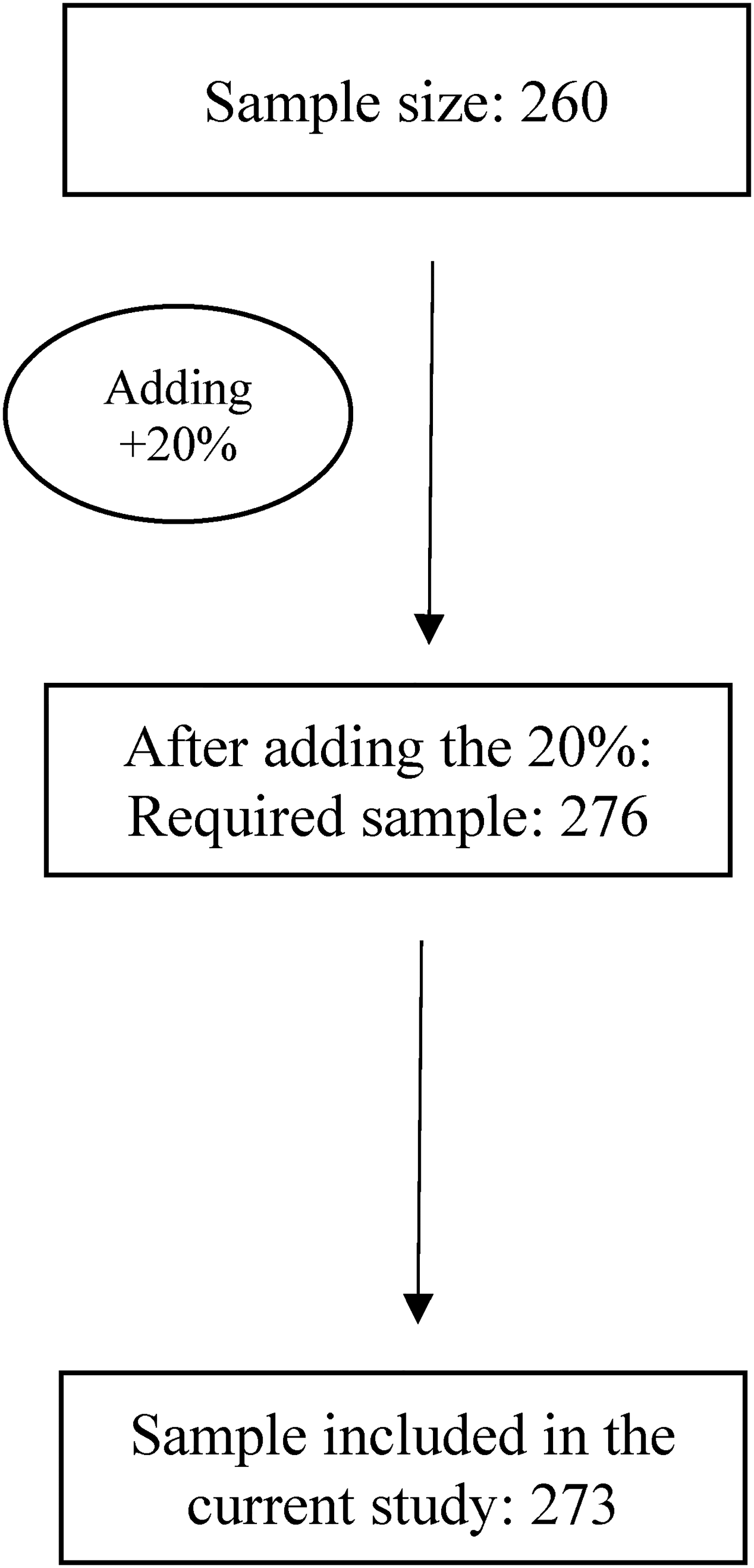
Sample flow.
Inclusion/Exclusion Criteria
To be eligible for the study, nursing students needed to be enrolled in the basic adult nursing courses, which were taught in English. They needed to be studying at either level four or five. Both levels are at an intermediate level. The students were needed to be over 19 years of age. Also, they had the choice to participate or not. The exclusion criteria were the age of students 19 years and below. Also, for those who were not studying at either level four or five. Another exclusion criterion was students who did not volunteer to participate in the study.
Measures
A questionnaire was developed by the researcher to measure the first three parts of the study. Students’ demographic characteristics (age, grade point average [GPA], and level), simulation design characteristics (environment, objectives, fidelity, and debriefing), simulation educational practice context (previous educational simulation experience, course type, collaboration, student/teacher interaction, and feedback).
The Student Satisfaction and Self-confidence in Learning Scale (SCLS), was established by the NLN in 2006. In this study, it was utilized to measure the students’ satisfaction and self-confidence levels after their simulation experience. This scale consists of 13 questions, five items on satisfaction and eight items on self-confidence. It is a 5-point Likert scale, ranging from 1 = strongly disagree to 5 = strongly agree. The Cronbach's alpha is 0.94 for satisfaction and 0.87 for self-confidence (Unver et al., 2017). In the current study, the reliability coefficient for the SCLS as the following: the Cronbach's alpha was 0.90 for satisfaction and 0.91 for self-confidence. Moreover, the content validity was established by nine experts in simulation who reviewed the tool (NLN, 2015). In the current study, the Cronbach's alpha for satisfaction is 0.90 and for self-confidence is 0.91. There was no cut-off score for the SCLS, hence, the mean was utilized to represent the students’ satisfaction and self-confidence levels.
Data Collection Procedure
A pilot study on 30 nursing students was conducted in November 2021 to evaluate the study's feasibility, tools’ applicability, and duration of the study. Participants who were involved in the pilot study were excluded from the sample of the main study to ensure the validity of the findings. The main data collection of the current study was conducted from December 2021 to February 2022. Students had five simulation sessions during their study in the basic adult nursing courses at levels four and five. The duration of each simulation session was between 20 and 30 min, and the duration of debriefing was from 30 to 50 min. The type of simulation was a human patient simulation. This type consists of human mannequins called SimMan 3G that have realistic physiologic responses, such as breathing, lung and heart sounds, and pulse. The simulation was a requirement in the adult courses. Students were asked to complete the questionnaire and the SCLS after completing all their simulation sessions.
Ethical Consideration
The study was approved by the Institutional Review Board at King Saud University (No: KSU-HE-21-300). Students were informed about the significance and aim of the study before participation. Informed consent was obtained from all the participants. They completely knew that their participation was voluntary and they had the right to withdraw from the study at any time. Confidentiality and privacy were maintained. All the information and personal data were saved on a computer that was locked with a password. Participants were provided with the phone number of the researcher if they had any questions or concerns.
Statistical Analysis
In total, 273 surveys were included in the analysis. The data were analyzed using the SPSS software version 26.0 (IBM Corp.). Before performing the analysis, data were checked for completeness and assumptions of the statistical tests. Descriptive statistics were used to describe the study variables. Bivariate analyses including independent t-test were used to compare the mean values of satisfaction and self-confidence scores in relation to all the categorical variables in the study. The relationship between the GPA and satisfaction scores; and the GPA and self-confidence scores were measured by Pearson's correlation and simple linear regression. Also, the relationship between satisfaction and self-confidence scores was identified by Pearson's correlation and simple linear regression. The dependent variables were examined using multiple linear regression analysis to see how well they were explained by the independent variables.
Results
Sample Characteristics
Out of the total 273 study participants, 95.6% were in the age group of 20–22 years, 52.4% of them from level 4, and their mean GPA is 3.79 (Table 1).
Participants’ Demographic Characteristics.

Four questions have been asked about the simulation design characteristics. The participants’ responses were observed on a binary scale (Yes/No). For the first question, “Was the environment organized and supportive?”, 92.7% of them responded positively (Yes), 94.1% of them responded as Yes, for the question, “Have you been provided with clear objectives at the beginning of the simulation session?”, whereas 79.9% and 86.1% of them had responded positively (yes) for the remaining two questions, “Were case studies and scenarios provided in the simulation laboratory reflective of a real-life situation?” and for the question, “ Does debriefing help you to understand the mistakes that you made during your practice?”
For the simulation educational practices context, five questions have been asked and their responses are given in Table 3. For the question, “ do you have previous educational experience with human patient simulation?, 67% of them had responded as Yes, 82.4%, 85,3%, and 78.8% of them had responded positively (Yes) to the three questions, “did you have the opportunity to work with your colleagues in the simulation lab?”, did the instructor interact with you before during, and after the simulation activity”, and for the question, “ did you receive constructive feedback from the instructor?”. Out of the 273 subjects, 143 (52.4%) of them have taken the Adult one course of the human patient simulation.
The overall mean of satisfaction scores was 18.70 (SD = 4.83); whereas the minimum score is 5 and the maximum is 25. The findings indicate an overall satisfaction among students toward their simulation experience. Moreover, the overall mean of self-confidence scores was 30.28 (SD = 6.97); whereas the minimum is 25 and the maximum is 40. The findings indicate overall self-confidence among students was built after their simulation experience.
Bivariate Analysis
There was a low positive correlation between GPA and satisfaction scores (r = .150, p = .013) and between GPA and self-confidence scores (r = .230, p = <.0001). It also showed a strong positive correlation between satisfaction and self-confidence scores (r = .842, p = <.0001). In addition, the simple regression analysis showed a linear relationship between satisfaction scores and GPA (R square = .022; F (1, 271) = 6.225, P = .013); self-confidence scores and GPA (R square = 0.053; F (1,271) = 15.191, P <.001); and satisfaction and self-confidence scores (R square = 0.709; F (1,271.) = 658.991, P <.001).
The independent two-tailed t-test showed high satisfaction scores in participants of 20–22 age group (M = 18.82, SD = 4.79) when compared with participants of 23–25 age group (M = 16.00, SD = 5.12), t(271) = 1.99, p = .048. Also, the mean satisfaction scores in level four participants (M = 19.40, SD = 4.35) were significantly higher than the scores of level five participants (M = 17.93, SD = 5.22), t(271) = 2.53 p = .012. In addition, there was no statistically significant difference t(271) = 1.85 p = .066 in mean of self-confidence scores between the participants of two age groups: 20–22 age group (M = 30.45, SD = 6.84); 23–25 age group (M = 26.67, SD = 8.94). In addition, there was no statistically significant difference t(271) = 1.93 p = .054 in the mean of self-confidence scores between the participants in level four (M = 31.06, SD = 6.09) and level five (M = 29.43, SD = 7.76).
Regarding the relationship between satisfaction scores and simulation design characteristics, the independent t-test showed a highly significant difference in the mean satisfaction scores of positive responses than negative responses for all four items. Moreover, the independent t-test showed a significant difference in the mean of self-confidence scores of the positive responses for three items: objectives, fidelity, and debriefing. The mean difference was as the following: 5.41, 4.72, and 5.00. However, there was no statistically significant difference in the mean self-confidence scores between groups based on the environment variable.
Regarding the relationship between satisfaction scores and simulation educational practice context, the independent t-test showed a highly significant difference in the mean satisfaction scores on positive responses than negative responses for two items: student/teacher interaction and feedback. Satisfaction scores were higher with those participants who didn’t have previous simulation experience and who study an adult one course. However, there was no statistically significant difference in the mean satisfaction scores between groups based on the collaboration variable. Moreover, the independent t-test showed a significant difference in the mean self-confidence scores of the positive responses for two items: student/teacher interaction and feedback. The mean difference was as the following: 3.79 and 3.44. However, there was no statistically significant difference in the mean self-confidence scores between groups based on the previous simulation experience, course, and collaboration variables.
Multivariate Analysis
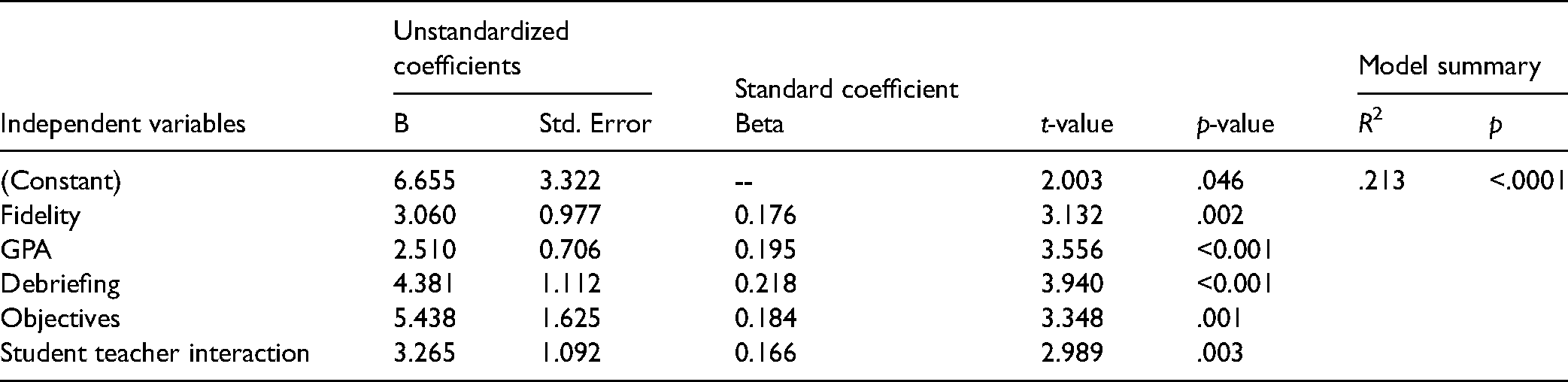
Table 2 showed the following predictors for satisfaction: objectives, student/teacher interaction, debriefing, course type, constructive feedback, age group, and environment. The multiple regression model was statistically significant (R square = 0.213; F (8,264) = 8.917, p <0.0001.). Table 3 showed the following predictors for self-confidence: fidelity, GPA, debriefing, objectives, and student/teacher interaction. The multiple regression model was statistically significant (R square = 0.213; F (5, 267) = 14.435, p <.0001).
Relationship Between Satisfaction Scores and All the Study Variables.

Relationship Between Self-Confidence Scores and All the Study Variables.
Discussion
The current study found that nursing students had overall satisfaction and self-confidence after their human patient simulation experience. In this study, there was a statistically significant difference in the students’ satisfaction scores according to the age variable. The results were similar to Cura et al. (2020) and Cabañero-Martínez et al. (2021). However, the current study showed there was no statistically significant difference in the students’ self-confidence scores based on their age. This was confirmed by a study performed by Omer (2016). In addition, the current study showed a correlation between students’ GPA and satisfaction scores; and students’ GPA and self-confidence scores. These findings were different from those of Ma (2013) study who reported no correlation between those variables. Moreover, the findings of the current study were similar to those of King (2012) who stated there was no relationship between students’ study level and self-confidence scores; but it had different findings of no relationship between students’ study level and satisfaction scores to those of current study who showed there was a relationship between of them.
The findings of the current study were consistent with other research studies: García-Mayora et al. (2021), Verkuyl and Hughes (2019), and Kirkpatrick et al. (2017) which showed the overall satisfaction among nursing students after their human patient simulation experience. In addition, the following studies: King (2012) and Burns et al. (2010) confirmed the findings of the current study about students’ gaining self-confidence after the simulation experience. Also, Kaliyaperumal et al. (2021) stated there was a strong positive relationship between self-confidence and satisfaction scores (r = 0.821, p <0.05). Reid-Searl et al. (2019) reported environment and debriefing are important elements in simulation to increase the students’ satisfaction and self-confidence. Motola et al. (2013) reported a relationship between students’ satisfaction and providing them with objectives before the simulation session. Aljohani et al. (2019) reported that fidelity and objectives increased the students’ self-confidence scores (mean = 3.83).
The current study revealed there was no association between collaboration and students’ satisfaction and self-confidence scores. These findings were different from the results of Li et al. (2018). Brohard and Moreland (2018) confirmed the finding of the current study on the association between receiving feedback from instructors and students’ satisfaction and self-confidence. Guinea et al. (2019) found that student/teacher interaction during simulation increases the self-confidence of students. Omer's (2016) study supported the current study's findings on the association between course type and students’ satisfaction. The current study showed there was an association between previous simulation experience and satisfaction. This was different from the findings of King's (2012) study. In addition, the findings of the current study were confirmed by Omer's (2016) study who stated that there was no association between course type and self-confidence; and King's (2012) study which revealed that there was no association between previous simulation experience and self-confidence scores.
Strengths and Limitations
One of the strengths of the current study is the finding can inform the use of human patient simulation experiences in nursing education for improving the students’ satisfaction and self-confidence in nursing schools in Saudi Arabia. In addition, examining the application and utilization of the adapted framework within the context of nursing education in Saudi Arabia helped to meet the needs of the students in nursing schools in Saudi Arabia. This study had a response rate of 98.94% to the study's questionnaire which is considered another strength of the study and its results. Another strength is that the current study used a reliable tool developed by NLN that measures the nursing students’ satisfaction and self-confidence levels.
The current study had several limitations. The purposive sampling method was utilized, which might lead to bias and decrease the generalization of the findings. Another limitation is that it is difficult to report the cause-and-effect relationship between variables in a cross-sectional research design. Another limitation is that the current study was conducted in one setting which may make the study's findings difficult to generalize. In addition, there might be other factors such as differences in instructors with their experiences in adult one and adult two courses that might affect the satisfaction and self-confidence of nursing students. Therefore, future research is recommended with other study designs on other settings with control of other factors.
Implications for Practice
The findings of the current study have important implications for nursing education since they provide useful insights into students’ perceptions of satisfaction and self-confidence following their human patient simulation experience. Faculty members at nursing colleges should be aware of instructional approaches that can be used to meet clinical course objectives, such as simulation. These findings can be used to improve the usage of simulation experience in nursing education to create a more successful education system. As a result, nursing students’ satisfaction and self-confidence would be improved, all of which have an impact on the quality of patient care. Moreover, the current study's findings provided the policymakers with information on nursing students’ current levels of satisfaction and self-confidence. The outcomes of the study could be used to design policies and actions in Saudi Arabia to improve the human patient simulation experience in laboratory settings.
Conclusion
Simulation is an effective teaching strategy that should be incorporated into nursing education programs to prepare students for future clinical practice. The current study revealed overall satisfaction and self-confidence among students after their human patient simulation experience. The study's findings will lead to the development of policies and interventions to improve the human patient simulation experience in laboratory settings in Saudi Arabia. A recommendation is that replication by further research studies with other research designs should be done including other settings and more than one geographical region.
Footnotes
Acknowledgment
The authors thank the Deanship of Scientific Research at King Saud University, Riyadh, Saudi Arabia for their support.
Author Contributions
The authors ensure that all authors listed have contributed to this study based on the criteria of the journal Editors. All have approved the manuscript and agreed to be submitted to the journal.
Declaration of Conflicting Interests
The author(s) declared no potential conflicts of interest with respect to the research, authorship, and/or publication of this article.
Ethical Statement
The study was approved by the Institutional Review Board at King Saud University (No: KSU-HE-21-300).
Funding
The author(s) received no financial support for the research, authorship, and/or publication of this article.
Informed Consent
Informed consent was obtained from all the participants.
