




Abstract
Introduction
A colostomy is a surgical procedure that brings one end of the large intestine out through the abdominal wall. Approximately 100,000 people in incidence in the United States undergo operations that result in a colostomy or ileostomy each year.
Objective
To assess knowledge and associated factors toward colostomy care among staff Nurses working at Dessie Town governmental hospitals, Ethiopia 2022.
Methods
Institutional-based cross-sectional study design was conducted at governmental hospitals in Dessie Town from August 1, 2022 to August 25, 2022. A simple random sampling technique was deployed using a self-administered questionnaire. Descriptive statistics analyses such as frequencies, percentage, and mean were used to summarize the results. Both bivariable and multivariable logistic regressions were employed to identify factors associated with participants’ knowledge of colostomy care. A p-value of <.05 and 95% confidence interval (CI) was used to declare statistical significance.
Results
A total of 265 nurses participated making a response rate of 98.1%. About 57.6% (157) of the participants had good knowledge of providing colostomy care. Having a clinical experience of 4–6 years (adjusted odds ratio [AOR] = 2.4 95% CI: 1.186, 5.513), 6–8 years (AOR = 2.5, 95% CI: 1.981, 6.177), and >8 years (AOR = 3.3, 95% CI: 1.481, 7.394), providing colostomy care for 6–10 patients (AOR = 2.6, 95% CI: 1.186, 5.512) and 10 or more patients (AOR = 3.3, 95% CI: 1.480, 7.394), and routine reading of professional (AOR = 1.83, 95% CI: 1.062, 3.153) were significantly associated with good knowledge of colostomy care.
Conclusion and recommendation
Knowledge of colostomy care was not satisfactory among nurse professionals working in governmental hospitals in Dessie town. Participation in the training of colostomy care, having more than eight years of experience, providing colostomy care for more than seven patients, attending scientific colostomy meetings, and reading professional literature were significant factors associated with good knowledge of providing colostomy care. Thus, capacity-building in-service training is required to enhance the knowledge of colostomy care.
Keywords
Introduction/Background
A colostomy is a surgical procedure that involves passing one end of the large intestine through the abdominal wall. One end of the colon is diverted through an incision in the abdominal wall to create a stoma during this procedure. Colostomies are not always permanent, particularly in children born with birth defects (Geleta, 2017).
There are three different types of ostomy. The first type is Colostomy; a colostomy is a surgically created opening into the colon (large intestine) through the abdomen. Its purpose is to allow stool to pass through a diseased or damaged part of the colon. The second type is an ileostomy; a surgically created opening into the small intestine through the abdomen. With an ileostomy, a section of the small intestine and large intestine (colon) has been removed or bypassed. The third type is a urostomy; a surgically created opening to drain urine. A urostomy allows urine to flow out of the body after the bladder has been removed or bypassed (Beitz et al., 2010; Doughty, 2005; Lim et al., 2017).
Based on a study in Coloproctology, it was found that the major reason for colostomy was colorectal cancer, which accounted for 88 cases (40.7%). Out of these, 13 were in the colon, six were in the rectosigmoid junction, four in the sigmoid, and one at an unspecified location. Trauma was the second most common cause of ostomy, with 39 (18.1%) cases (Lebona et al., 2016; Pandey et al., 2015).
Review of Literature
According to a study conducted in Nellore, India, it was found that among nursing health professionals, 8 (53.3%) have inadequate knowledge regarding colostomy care, while 8 (46.6%) have adequate knowledge regarding colostomy care (Duruk & Uçar, 2013; Geleta, 2017). A recent study conducted at the Addis Ababa public hospital revealed that a large percentage of nursing professionals 195 (57.5%) demonstrated low knowledge of colostomy care. On the other hand, only a small percentage 25 (7.4%) demonstrated high knowledge of colostomy care. Furthermore, the study conducted in Amhara regional hospitals found that only 40.4% of nursing participants had adequate knowledge of colostomy care (Lebona et al., 2016; Tiruneh et al., 2022).
Overall, 15 patients (N = 533) died after stoma closure, resulting in a 3% of mortality rate. Mortality rates were similar for both types of stomas (2% of ileostomy and 3% of colostomy). The leading causes of death were multiple organ failure due to several nonsurgical complications in nine patients and sepsis due to anastomotic leak or other intestinal injuries in six patients (Bagheri et al., 2017; Duruk & Uçar, 2013).
In this study, nurses are evaluated for their knowledge of colostomy care, their approach to colostomy care, the skills learned in the clinical area, and the quality of care rendered. Also, researchers will find research-based evidence and information for their studies that will help them improve their knowledge and clinical performance. Beyond that, this study will provide managers and policymakers with information that will help them take care of clients and manage them in hospitals.
The aim of this study was to assess the knowledge and associated factors of colostomy care among nurses working in Borumeda and Dessie General Specialty Hospitals, Ethiopia
Method and Materials
Study Area and Period
The researchers conducted the study at two Government hospitals, Dessie Comprehensive Specialist Hospital and Borumeda General Hospital (BGH) in Dessie Township. Dessie Comprehensive Specialist Hospital has 608 health professionals, of which 228 are nurses; BGH has 202 health professionals, of which 72 are nurses. Nurses were selected from the staff of two Government hospitals. The study was conducted from August 1, 2022, to August 30, 2022.
Source Population
All nurses work at Governmental hospitals in Dessie Town.
Study Population
All nurses who were working at Governmental hospitals in Dessie Town during the data collection period.
Inclusion and Exclusion Criteria
Inclusion Criteria
Staff nurses working at Governmental hospitals in Dessie Town were included in this study.
Exclusion Criteria
Staff nurses were those who were on annual and sick leave during the study period.
Sample Size Determination
Sample size has been calculated using single population proportions at a 95% confidence level with a 5% margin of error. This is with a prevalence of 48.7%. The formula has been used to calculate the sample size:

Then,

n = desired sample size for a population greater than 10,000. N = estimate of the population size = 771; hence, the desired sample size is


Sampling Technique
The study was conducted in two Governmental hospitals, and subjects were selected by simple random sampling using lottery methods from the list of staff nurses at the Governmental hospitals in Dessie Town.
Study Variables
Dependent Variable
Knowledge about colostomy care
Independent Variables
Age
Sex
Clinical experience, occupation, year of study
Marital status, monthly income, training
Operational Definition
Good knowledge is defined as the knowledge status of nursing professionals toward colostomy care when they score more than or equal to the mean value.
Poor knowledge is the knowledge status of nursing professionals toward colostomy care when they score less than or equal to the mean value (Geleta, 2017).
Data Collection Tool
The researcher used self-administered quantitative questionnaires to collect data. The questionnaire is divided into three sections. The first section includes 10 items on sociodemographic variables; the second section includes 16 items on nurses’ knowledge of colostomy care; and the last section includes seven items on associated factors. Overall, the questionnaire comprises 33 items in total.
Data Collection Procedure
The data collection process involved four BSc health professionals and two MSc health professional supervisors who were recruited from another hospital. During the data collection process, the principal investigator provided assistance and coordination to both the data collectors and participants. The nursing professionals from two hospitals were selected as the study participants. Initially, the principal supervisors were responsible for coordinating and explaining the study's purpose to the nursing health professionals. After expressing their willingness to participate, the nursing professionals received training on how to complete the questionnaires. Any difficulties that arose during data collection were clarified. Finally, the completed questionnaire was returned to the data collectors.
Data Quality Assurance
To ensure accuracy in data collection, a pretest was conducted with 5% of the sample size before validation. The questionnaire was initially prepared in English, translated into Amharic by a translator, and then interpreted back into English to ensure consistency. The data collectors were properly trained and informed about the study's purpose, the confidentiality of information, and the privileges of respondents. Study subjects were given questionnaires, and completed data were collected and checked daily for completeness.
Data Analysis and Interpretation
The collected data were carefully checked by the principal investigator to ensure accuracy, and then coded, entered, and cleaned using Epi Data 4.3 software. Next, the data were exported into SPSS 25 for further analysis. To describe the characteristics of the participants, descriptive statistics analysis such as simple frequencies, measures of central tendency, and measures of variability was used. The data were presented using frequencies, summary measures, tables, and figures. To control for confounding factors, we included independent variables with p-values of .25 in the multivariable analysis. In a multivariable logistic regression analysis, we estimated adjusted odds ratios with 95% CIs to identify the factors associated with knowledge of colostomy care awareness. This study determined the level of statistical significance as a p-value <.05.
Results
Sample Characteristics
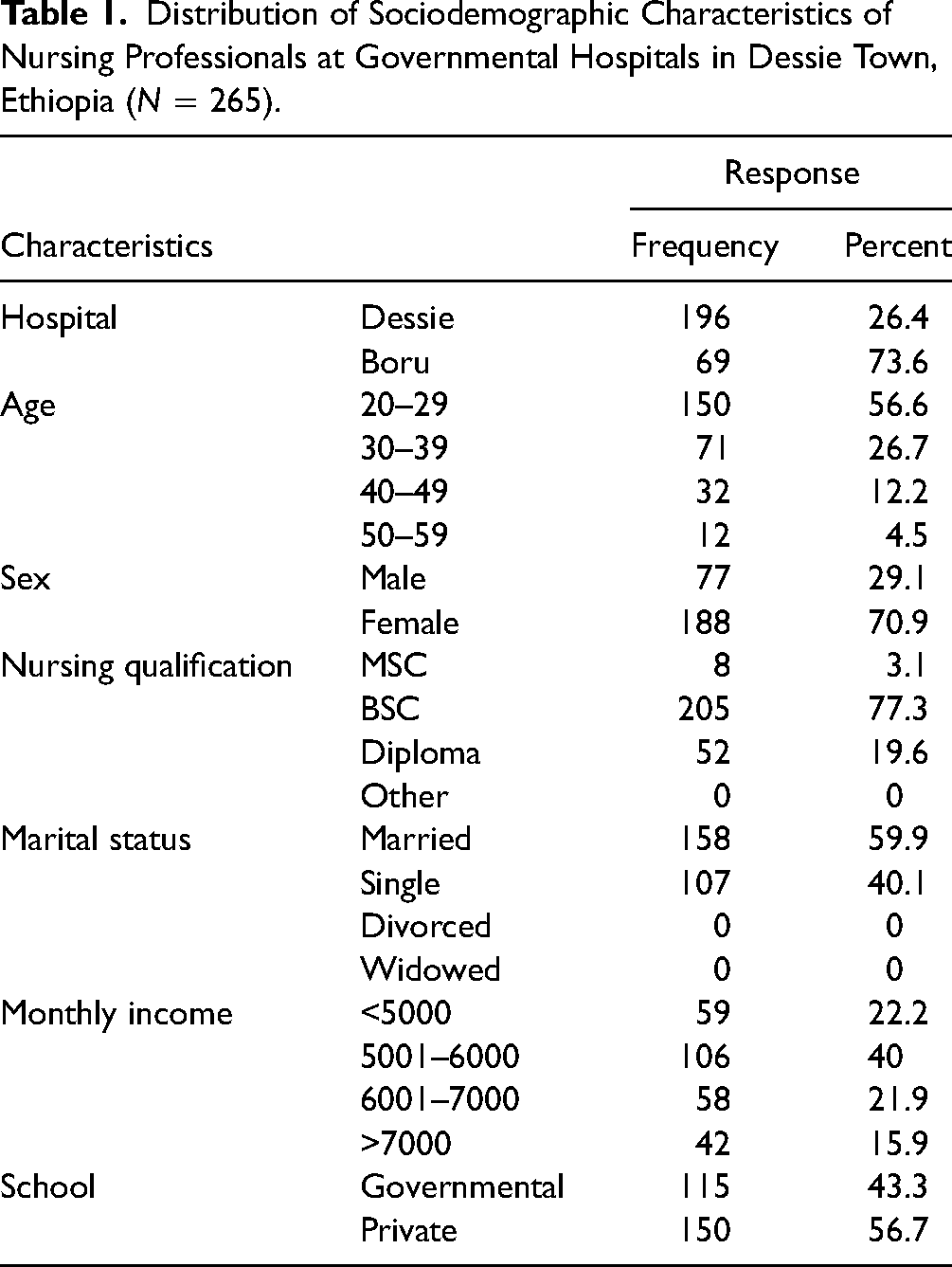
Out of all the participants who took part in the research, 265 provided 98.1% complete responses. Among these participants, 69 (26.4%) were from Boru general hospital, while 196 (73.6%) were from Dessie comprehensive specialized hospital. The age of the respondents ranged from 23 to 54, with a minimum and maximum age of 23 and 54, respectively.
As for the gender distribution of the participants, 188 (71%) were female, and 77 (29%) were male. In terms of education, 205 (77.3%) held a BSc degree, 52 (19.6%) held a diploma, and 8 (3.1%) were MSc nursing professionals. With respect to marital status, 158 (59.9%) of the participants reported being married, while 107 (40.1%) reported being unmarried.
Out of all the nurses who went to higher education schools, 150 (56.7%) attended private schools, and 115 (43.3%) attended government educational institutions. Additionally, 59 (22.2%) of the staff nurses in two governmental hospitals in Dessie town had salaries below 5000 per month (Table 1).
Distribution of Sociodemographic Characteristics of Nursing Professionals at Governmental Hospitals in Dessie Town, Ethiopia (N = 265).
Knowledge of the Study Participant Nurses
In the study, it was found that 129 (48.7%) of the participants had poor knowledge about the different types of colostomy care. On the other hand, 91 (34.2%) of the respondents had good knowledge about it. It was also noted that 66 (24.9%) of the staff nurses who participated in the study had poor knowledge about the indications for colostomies. Furthermore, 161 (60.7%) of the participants had poor knowledge about the duration of changing the colostomy pouch, while only 43 (16.4%) had good knowledge about it.
It was discovered that a significant amount of nurses, 151 (56.9%), lacked a proper understanding of how to provide effective bowel irrigation. However, the majority of the study participants, 143 (53.9%), had a good grasp of the nursing intervention required for colostomy patients. In addition, only 38 respondents (14.4%) knew how long it takes for colostomy patients to regain their previous level of activity.
When it came to health education and advice, 56 (21%) of the participants had good knowledge about bathing for colostomy patients. Unfortunately, the study revealed that 150 (56.5%) of the respondents had poor knowledge about diet and fluid intake and how to advise patients with colostomies. However, 40 (15.1%) of the nursing participants had good knowledge of such information. In terms of colostomy products and their usage, the majority of respondents, 157 (59.3%), had good knowledge. This study indicates that 153 nurses (57.6%) had good knowledge of colostomy care, while 112 (42.4%) had poor knowledge (Figure 1).

Knowledge of nursing professionals regarding colostomy care at Boru General Hospital and Dessie comprehensive specialized hospitals, Ethiopia, 2022 (n = 265).
Factors Associated with Knowledge of Colostomy Care
The study included bivariable and multivariable analyses, with the former used to determine the association of each independent variable with knowledge of colostomy care. Variables that had a p-value of .25 or less were entered into the multivariable regression model.
In the multivariable analysis, it was found that having clinical experience of 4–6 years (adjusted odds ratio [AOR] = 2.4 95% CI: 1.186, 5.513), 6–8 years (AOR = 2.5, 95% CI: 1.981, 6.177) and >8 years (AOR = 3.3, 95% CI: 1.481, 7.394), providing colostomy care for 6–10 patients (AOR = 2.6, 95% CI: 1.186, 5.512) and 10 or more patients (AOR = 3.3, 95% CI: 1.480, 7.394), attending training on colostomy care (AOR = 1.9, 95% CI: 1.054, 3.467), referring literature (AOR = 2.0 95% CI: 1.101, 3.502), participating in scientific meetings (AOR = 2.7, 95% CI: 1.208, 5.843) and routine reading of professional (AOR = 1.83, 95% CI: 1.062, 3.153) were significantly associated with good knowledge of colostomy care.
Based on the study's bivariable and multivariable analyses, it was discovered that certain factors were significantly associated with good knowledge of colostomy care. Those with 4–6 years of clinical experience were twice more likely to have good knowledge of colostomy care compared to those with less than two years of experience. Additionally, those who provided colostomy care to 6–10 patients were twice as likely to have good knowledge of colostomy care compared to those who cared for less than six patients. Furthermore, participants who had attended training on colostomy care were 1.9 (AOR = 1.9, 95% CI: 1.054, 3.467) times more likely to have good knowledge of colostomy care when compared to those who had not attended such training.
Participants who used literature as a reference were two times more likely to have good knowledge compared to those who had never used literature as to reference (AOR = 2.0, 95% CI: 1.10, 3.50). Similarly, those who participated in scientific meetings were 2.7 times more likely to have good knowledge of colostomy care as compared to those who never participated in such meetings (AOR = 2.7, 95% CI: 1.208, 5.843).
Additionally, the odds of having good knowledge of colostomy care were 1.83 times more likely among participants who routinely read professional literature as compared to their counterparts (AOR = 1.83, 95% CI: 1.062, 3.153) (Table 2).
Bivariable and Multivariable Analyses of Factors Associated with Knowledge of Colostomy Care Among Nursing Professionals Working at Boru General Hospital and Dessie Comprehensive Specialized Hospitals, Northeast, Ethiopia, 2022 (N = 265).

*p value <.25, **p value is significant at <.05.
Discussion
An institutional-based quantitative cross-sectional study was conducted to assess the knowledge of colostomy care and its associated factors among nurses working in governmental hospitals in Dessie, Ethiopia, in 2022.
Based on the cross-sectional study, it was discovered that 57.6% of the staff nurses had good knowledge of colostomy care, while 42.4% had poor knowledge. The study participants were knowledgeable about colostomy care, which was consistent with a previous study conducted in Addis Ababa at selected public hospitals by Tensaie Geleta that found 58% of study participants had good knowledge (Geleta, 2017). The consistent results might be due to the similarity of the educational curriculum, practical techniques, and training provided to professionals. Although the study was conducted in Nellore, India, 76% of participants had good knowledge (Lebona et al., 2016).
According to the findings of the study, almost half (48.7%) of nursing professionals had poor knowledge of colostomy care types. This result is consistent with a similar study conducted in public hospitals in Addis Ababa, where more than half of the nurses reported low and very low levels of knowledge regarding colostomy care types (Geleta, 2017). These findings suggest that less than half of the respondents had poor knowledge regarding colostomy care types, which could be due to difficulty in gaining new knowledge through job seminars, limited access, and insufficient information provided to professionals in hospitals.
More than half of nurses have poor knowledge of how to provide proper and standard bowel irrigation. Similar to this study, another study in the United States showed that half of the colostomy patients were not properly irrigated as per the standard guidelines (Sullivan et al., 2009). Thus, the staff nurses have not referred to updated guidelines regarding bowel irrigation in colostomy patients and are less knowledgeable about the latest developments in colostomy care.
In a study conducted in Addis Ababa selected public hospitals, less than half of staff nurses participating had little knowledge about colostomy products and their use (Geleta, 2017). The difference might be due to accessibility and updating existing information about colostomy care.
Study participants, staff nurses, responded with a low level of knowledge related to the prevention of skin sensitivity, signs and symptoms of constipation, and managing colostomy patients. There was an inconsistent finding in Iran, where the majority of nurses reported high knowledge regarding skin sensitivity prevention, identifying constipation symptoms, and managing colostomy patients. This difference in the gap is due to the location of health facilities. So, the staff nurse participant should attend training sessions and update information about colostomy care.
The discrepancy in findings could be attributed to various factors such as study design, sample size determination, study facility setting, and sociodemographic factors.
In this study, there was no significant association found between sociodemographic factors and knowledge of colostomy care. Tensaie Geleta conducted the study at a selected public hospital in Addis Ababa and found no such link (Geleta, 2017). However, a cross-sectional study on 50 colostomy care nurses from all Indian institutes of medical science revealed a strong correlation between the knowledge of nurses and their age, gender, income, clinical experience, and occupation (Roshini et al., 2017). The discrepancy in findings could be attributed to various factors such as study design, sample size determination, study facility setting, and sociodemographic factors.
Additionally, participants with over eight years of clinical experience and those who provided care for more patients were significantly associated with good knowledge of colostomy care. This finding is consistent with previous studies that have shown experienced staff nurses to be more adapted and familiar with procedures and perform colostomy care well.
In a cross-sectional study conducted at a selected hospital in Addis Ababa, it was found that staff nurses who routinely read professional literature and attended colostomy care training had better knowledge of colostomy care than those who did not (Geleta, 2017). Nurses who attended colostomy scientific meetings, who referred to literature on colostomy care in the last six months, and those who had been reading professional literature routinely, had significant relation with good knowledge of colostomy care. The results suggest that regularly updating information about colostomy care can contribute to better knowledge.
Additionally, participants with over eight years of clinical experience and those who provided care for more patients were significantly associated with good knowledge of colostomy care. This finding is consistent with previous studies that have shown experienced staff nurses to be more adapted and familiar with procedures and perform colostomy care well.
Additionally, participants with over eight years of clinical experience and those who provided care for more patients were significantly associated with good knowledge of colostomy care. This study finding is similar to a study conducted in Italy regarding knowledge of colostomy care associated with years of clinical experience (Duruk & Uçar, 2013). This finding is consistent with previous studies that have shown experienced staff nurses to be more adapted and familiar with procedures and perform colostomy care well.
Strength and Limitation of the Study
The study conducted at hospitals in Dessie and Borumeda allowed nursing health professionals to learn more about colostomy care and share their experiences managing it. The study also aimed to improve the management of colostomy care in care units and make it easier for nursing health professionals to understand and address issues related to it. However, it is important to note that the data collected through self-administered questionnaires may have been affected by individual biases. Additionally, since participants self-reported their responses, there may have been social desirability biases introduced into the study.
Implication for Practice
To ensure the best care for patients and improve communication between nurses and patients, nursing health professionals must have a strong understanding of colostomy care. Although studies on colostomy care management programs have been limited, they have provided helpful protocols and standard guidelines for nursing professionals to follow. However, it is important to keep in mind that self-reporting may be influenced by individual and social biases. As a result, nurses should be knowledgeable about colostomy care to provide excellent care and communication for their patients.
Conclusion and Recommendation
Conclusion
It has been found that nurse professionals working in governmental hospitals in Dessie town in the Amhara Region have satisfactory knowledge of colostomy care. According to relevant literature, participation in colostomy care training, having over eight years of experience, providing care for more than seven patients, attending scientific colostomy meetings, and reading professional literature are significant factors associated with good knowledge of colostomy care provision.
Recommendation
Regional Health Bureau
✓ Should prepare and provide opportunities for staff nurses to attend scientific colostomy meetings.
✓ Should have settled on internet access and a local library to update knowledge of colostomy care.
✓ Should have arranged training for staff nurses to enhance knowledge of colostomy care.
✓ Should have arranged training for mentor nurses to enhance the quality of colostomy care.
Hospitals
✓ Should have prepared on-the-job training and implemented a knowledge-sharing program.
✓ Should assign nurses with adequate knowledge and skills.
✓ Should have prepared access to updated information about colostomy care.
✓ It provides mentorship for nurses.
Nursing School
✓ Nursing schools should have focused on courses during the study to provide quality service for colostomy patients.
✓ The nursing curriculum content incorporates colostomy care as the main topic, and instructors should focus on it during the clinical session.
Other Researchers
✓ Mixed methods studies are required to identify additional explanatory factors in Ethiopia's colostomy care and provide qualitative data on the challenges nurses face when caring for patients with colostomies.
✓ In addition, intervention studies are required to determine the cost-effectiveness and practice outcomes of continuing professional development in colostomy care.
Footnotes
Ethical Consideration
The study was conducted with ethical clearance from the University's College of Medicine and Health Sciences, School of Nursing and Midwifery Department of Adult Health Nursing, as well as the hospital medical directors. Verbal informed consent was obtained from all participating nurses, and their confidentiality was assured. The study results did not include any names of respondents, and their right to refuse participation was respected.
Declaration of Conflicting Interests
The author(s) declared no potential conflicts of interest with respect to the research, authorship, and/or publication of this article.
Funding
The author(s) received no financial support for the research, authorship, and/or publication of this article.
