




Abstract
The purpose of this paper is to explore the potential of dialectical pluralism (DP) for nursing knowledge development. Nursing scholars have discussed ways of developing nursing knowledge, exploring the fit and relevance of various worldviews for knowledge development and examining the dynamic and perpetual processes of knowledge development. Scholars have argued that knowledge development occurs under a certain worldview to which the researcher adheres. Many nurses employ various worldviews, which can give rise to ontological and epistemological conflicts. DP can help nurses appreciate the diversity of worldviews and recognize the importance of implicit worldviews to generate more practical nursing knowledge. DP as a philosophical approach can enable nurses to communicate between diverse worldviews, become tolerant of conflicting differences, and develop an array of nursing knowledge.
Implications for Research and Practice
Nursing deals with complex human health processes, and scholars utilize worldviews from sociology, psychology, and other humanistic and behavioural sciences to inform nursing knowledge development. Dialectical pluralism emphasizes the importance of integrating multiple perspectives and worldviews in understanding complex nursing phenomena. Dialectical pluralism encourages researchers to embrace a dynamic and inclusive approach to nursing practice and knowledge development.
Debatable Issue
The debate about the nature of nursing knowledge and knowledge development is not a new endeavour. Nursing scholars have discussed the ways of developing nursing knowledge, exploring the fit and relevance of various worldviews for knowledge development, and examining the dynamic processes of nursing knowledge development (Risjord, 2011; Rodgers, 2005). Scholars have argued that knowledge development occurs under a certain worldview to which the researcher adheres (DeWitt, 2018; Rodgers, 2005). We will argue that dialectical pluralism (DP), derived from social sciences, provides an effective and useful conceptual framework for the development of nursing knowledge. For our discussion, we will not use the term paradigm because it has been used and interpreted in various ways. Rather, we will use the term worldview. The term paradigm was coined by American historian and philosopher Thomas Kuhn in his book The Structure of Scientific Revolution (Kuhn, 1962). Philosopher Margaret Masterman (1970) critiqued Kuhn's work and identified that Kuhn used the term paradigm in 21 different ways. She argued that the term was ambiguous, did not differentiate scientific from non-scientific knowledge, and was difficult to apply precisely in practice. For the scope of this paper, worldview is defined as a set of beliefs and values that are interconnected and intertwined and inform decision-making in research and practice (DeWitt, 2018).
Many nurse scholars developed their own worldviews (Fawcett, 1993; Newman, 1992; Parse, 1987), while others argued that pragmatism is a viable philosophical approach for nursing knowledge development (McCready, 2010; Younas, 2020). Parse (1987) developed the totality, simultaneity, and human becoming paradigms in nursing. Newman (1992) proposed the particulate deterministic, interactive integrative, and unitary transformative worldviews. Fawcett (1993) established the reaction, reciprocal interaction, and simultaneous action worldviews. The worldviews that have been adopted in nursing include positivism, empiricism, critical realism, historicism, post-modernism, feminism, poststructuralism, and pragmatism (Rodgers, 2005).
Using multiple worldviews is necessary for nursing knowledge development because of the dynamic and pluralistic nature of nursing knowledge (Younas & Parsons, 2019). Several nurse scholars established that nursing is pluralistic because of the complexity of nursing and health-care phenomena and the evolving need to tailor nursing knowledge to changing practice (McCaffrey, 2021; McCready, 2010; Weaver & Olson, 2006). While the utilization of multiple worldviews can be useful, it can also result in ontological and epistemological conflicts when scholars rigidly adhere to their favoured worldviews.
Purpose
The purpose of this paper is to explore the potential of DP in resolving conflicts arising out of worldview differences and discuss how DP can help in developing nursing knowledge by utilizing multiple worldviews.
Analysis of the Issue
There have been many attempts over decades to discuss the role of worldviews in nursing knowledge development. Some nursing scholars have developed their own worldviews, while others have borrowed from different disciplines such as psychology and social sciences to inform nursing knowledge development. In the following section, we will briefly discuss the various worldviews that nurse scholars developed and borrowed for nursing knowledge development.
Varied Worldviews for Nursing Knowledge Development
Carper (1978) proposed four fundamental patterns of knowing in nursing. These four patterns are empirics (the science of nursing), aesthetics (the art of nursing), personal knowledge in nursing, and ethics (moral knowledge in nursing). Parse (1987) contrasted totality and simultaneity worldviews and developed the human becoming worldview. Newman (1992) proposed the particulate deterministic, the interactive integrative, and the unitary transformative worldviews. In each of these, the first word refers to ‘the entity being studied, and the second word describes the notion of how change occurs’ (Newman, 1992, p.10). Fawcett (1993) proposed the reaction, reciprocal interaction, and simultaneous action worldviews. The reaction worldview proposes that humans are bio-psycho-social beings and share a linear relationship with their environments (Fawcett, 1993). Reed (2020) introduced the idea of ‘midparadigm’ for incessant knowledge development and moving beyond the nursing metaparadigm. Midparadigm entails concepts that share practical and scientific values for context-oriented knowledge development and is lower in abstraction than the metaparadigm (Reed, 2020).
Nurse scholars have also borrowed various philosophical worldviews to examine the nature of nursing knowledge and its development. McCready (2010) discussed the role of Jamesian pragmatism as a framework for developing nursing knowledge. He argued that the tenets of pragmatism fit well with nursing diversity and plurality. Younas (2020) examined the role of inferentialist and operationalist pragmatism in nursing knowledge development and practice. He suggested that nurse scholars need to move beyond the rudimentary understanding of pragmatism and adopt the dual aspects of pragmatism to bring considerable value to the field of nursing. Yous et al. (2020) argued for the usefulness of Feyerabend's theoretical concepts of epistemological anarchism, theoretical pluralism, and humanitarianism to develop new nursing knowledge using a pluralistic and creative approach. Nairn (2012) discussed a critical realist approach to nursing knowledge development. McCaffrey (2021) discussed Kasulis’ intimacy/integrity heuristic framework, contrasting Eastern and Western patterns of thought to comprehend what is involved in nursing knowledge. He argued that epistemological pluralism is evident in nursing and nurse scholars find it useful to accommodate various kinds of knowledge.
Some authors have discussed the philosophy of post-modernism, its notions of multiple truths and ephemeral knowledge, and its implications for nursing knowledge development (Holmes & Warelow, 2000; Yeh & Chen, 2008). Bender (2018) analyzed and compared models with theories as carriers of nursing knowledge, arguing that models are critical for the development of dynamic and actionable nursing knowledge. The detailed discussion of these worldviews is beyond the scope of this paper; readers should consult original sources to get a thorough understanding of these worldviews. However, the presence of multiple nursing worldviews substantiates that nursing knowledge development is a pluralistic endeavour.
The Multiplicity of Worldviews and Conflicts in Knowledge Development
Using multiple worldviews can enable nurses to build nuanced nursing knowledge (Engebretson, 1997; Monti & Tingen, 1999). It allows nurses to recognize similarities and differences in opposing worldviews, thereby building upon distinct valuable perspectives offered by each opposing worldview (Engebretson, 1997). Although multiple worldviews are beneficial for nursing knowledge development, some nurses zealously adopt and adhere to certain worldviews and relegate others. Therefore, there is tremendous breadth and diversity in nursing worldviews, with limited efforts to bring together these worldviews when needed to gain a richer understanding of nursing phenomena. Despite the usefulness of these worldviews, their diversity could also result in conflicts among nurse scholars regarding the relevance, importance, and prioritization of one worldview over another.
Types of Conflicts in Nursing Practice and Knowledge Development
Nurse scholars and practitioners can experience a wide variety of conflicts in practice and nursing knowledge development. These conflicts could be related to ethical dilemmas and/or sociocultural and religious conflicts, as well as conceptual, theoretical, methodological, and epistemological conflicts (Angelo, 2019). In clinical settings, nurses may experience ethical conflicts when their values and beliefs do not align with the beliefs of their patients, patients’ families, or colleagues. For instance, a nurse who believes in the principle of autonomy and the patient's right to make decisions may clash with a physician who believes in a paternalistic approach (Haahr et al., 2020). Sociocultural conflicts can also arise when a nurse has a cultural background that is not similar to other colleagues and patients. Additionally, professional conflicts can occur when a nurse's beliefs clash with professional standards. A nurse who believes in holistic care may have a conflict with an organizational policy that focuses only on managing the patient's symptoms (Haddad & Geiger, 2022). Nurse scholars can experience conflicts while developing nursing knowledge, for example in using diverse methodological approaches for nursing knowledge development such as qualitative and quantitative approaches. A nurse scholar who has been trained in quantitative research and believes in objective findings may not value the subjective insights of qualitative research. Therefore, a question could be raised, ‘How can nurses address the conflicts arising due to diversity and differences in worldviews?’ One potential solution to this problem could be to give equal respect to all worldviews and perceive conflicts as a strength rather than a weakness. DP acknowledges and respects these differences and provides an opportunity for dialogue among health-care professionals and other stakeholders to develop nuanced and comprehensive nursing knowledge.
Discussion
Philosophical and Scientific Basis of Dialectical Pluralism
DP is a combination of dialectics and pluralism that has emerged from contemporary social sciences faced with issues similar to those in nursing. The philosophical roots of dialectics date to the time of Aristotle and Socrates. In classical philosophy, dialectics meant reasoning that uses the pattern of questions and answers to resolve conflicting views and to reach a consensus on any matter under consideration (Corbett & Robert, 1999). In Aristotle's writings, dialectics was ‘logic of the opinion, of the probable: it permits reasoning in a field which, in a certain sense, is intermediate between that which is certainly true (apodictic reasoning) and that which is certainly false (sophistic reasoning). Dialectics appears as the method of analysis typical of philosophic problems’ (Giuliani, 1972, p. 129). Aristotle viewed dialectics as a method for criticizing arguments and discovering probable and absolute propositions, and as a form of reasoning called dialectical inference (Giuliani, 1972; Smith, 2000).
In Socrates’ ideas, dialectics meant questioning authorities and alleged knowledge to recognize false knowledge and unravel concealed truths. This type of questioning entails exploring ambiguous beliefs and their logical consequences to determine contradictions. The nature of questioning changed over time, but the purpose and the process of questioning remained the same, that is, dialectical (Meyer, 1980). Royce (1975) proposed constructive dialectics, which refers to the theories proposed in psychology (i.e., constructive) and dialogues to resolve differences and tensions among different theories to produce more integrative descriptions of psychological phenomena (i.e., dialectics). In his approach, Royce emphasized a tentative rejection or acceptance of psychological theories rather than outright rejection or immediate acceptance, because divergent theories provide a comprehensive understanding of psychological phenomena (Goertzen, 2010; Royce, 1975). Therefore, divergent theories should be critically and dialectically evaluated in relation to other theories (Goertzen, 2010).
Regarding pluralism, William James, in A Pluralist Universe (1909), described pluralism as a split reality in which each view is unique in itself and contributes towards an understanding of an overarching reality; ‘[T]he substance of reality may never get totally collected, that some of it may remain outside of the largest combination of it ever made, and that a distributive form of reality, the each-form, is logical as acceptable and empirically as probable as the all-form commonly acquiesced in as so obviously the self-evident thing’ (James, 1909, p. 20). All-form and each-form are James’ (1909) two distinct constructions of reality. All-form aligns with monism (i.e., empiricism, absolutism) which posits that reality can be captured via an inclusive scheme. On the other hand, each-form is James’ pluralism, which emphasized that a given reality is only a partial representation of its multifaceted nature.
James also wrote that there are multiple perspectives about the nature of reality, and that these perspectives are legitimate yet incommensurable (Goodman, 2012). This account is consistent with pluralism. Complementing this pluralistic view, Suppes (1978) advocated for a pluralistic view of scientific phenomena, arguing that a few scientific theories cannot explain a variety of scientific phenomena, therefore replacement and transformation of theories are necessary to continue scientific progress. Multiple theoretical perspectives are crucial for the pursuit of scientific knowledge and development. He argues for a pluralist science and states that ‘scientific knowledge, like the rest of our knowledge, will forever remain pluralistic and highly schematic in character’ (p. 15).
Origins of Dialectical Pluralism
In social sciences research, Mitchell (1982) used the term DP for the first time to articulate the aims and scope of the journal Critical Inquiry in dealing with practice problems using different methods (Johnson, 2017). Mitchell elaborated that the aim of DP ‘is not the mere preservation and proliferation of variety, but the weeding out of error, the elimination of trivial or marginal contentions, and the clarification of fundamental and irreducible differences’ (Mitchell, 1982, p. 613). DP allows communication between conflicting views, with the aim of clarifying the perspectives at stake and reaching a more nuanced understanding (Mitchell, 1982). Later, in the field of religious studies, Min (1997) proposed dialectical confessionalist pluralism of solidarity, as a multidimensional paradigm for religions ‘to confess their distinctive beliefs and claims’ (p. 588). In education, Johnson (2011a, 2011b) proposed DP for mixed methods research and indicated that ‘the potential use of DP is much broader than its use in methodological paradigms’ (2011b, p. 31). Johnson provided more comprehensive accounts of DP in subsequent writings (Johnson et al., 2014; Johnson 2017).
Ontological Premises
Ontology entails the study of being (Risjord, 2011). The underlying ontological view of DP is ‘ontological pluralism’ which implies that reality is multifaceted, with various ways to understand it (Johnson, 2017). Researchers must contemplate that because of the ever-changing nature of reality, there is no fixed single reality to any phenomenon; rather, the reality can be understood at subjective, inter-subjective, objective, and pragmatic levels (Johnson et al., 2014). In addition, there are divergent worldviews and sources of evidence which provide information about different aspects of an ever-changing and multifaceted reality (Johnson, 2012).
Epistemological Premises
Epistemology is the study of knowledge and how knowledge can be acquired (Risjord, 2011). Epistemological assumptions lie in dialectical, dialogical, and hermeneutical perspectives, and involve divergent epistemologies (Johnson, 2012). The ‘users of DP acknowledge the fallibility of knowledge, have a goal of producing somewhat heterogeneous and somewhat homogeneous wholes that respect multiple standpoints, and place weight on solutions that work in theory and contextualized practice’ (Johnson, 2017, p. 164).
The dialectical perspective emphasizes that to understand reality, it is important to consider and evaluate multiple and even opposing opinions. The dialogical perspective stresses the need for dialogues among divergent viewpoints in an attempt to make use of the most relevant and beneficial ideas. When working within research teams these dialogues could be interpersonal, such as listening to others’ viewpoints, and/or intrapersonal, such as being attentive to one's own thoughts. The hermeneutical perspective highlights the assumption that every opinion that can be used to shape reality is interpretive. Hence, every viewpoint is co-constructed and co-created over time and with dialogue, with the influence of new experiences and social and political phenomena (Johnson et al., 2014).
Johnson et al. (2014) claim that the purpose of intrapersonal dialogue in DP is to enhance one's integrative complexity. Integrative complexity comprises two components: differentiation and integration. Differentiation refers to the ability of an individual to examine the structure of personal thoughts and values, without focusing on the content of the thoughts, concerning any issue. Integration refers to the ability to develop connections among thoughts and values. Higher integrative complexity enables individuals to develop a multifaceted view and an openness to discrepant thoughts and values (Suedfeld et al., 1992). Intrapersonal dialogue is critical for using DP because it enables the articulation of personal values and thoughts and connects them to a complex interplay of ideas emerging from diverging and conflicting paradigms (Johnson et al., 2014; Johnson, 2017).
Axiological Premises
Axiology indicates the values and ethical positions held by researchers (Johnson et al., 2014). The users of DP thrive on multiple sociocultural, economic, and political values. Parallel to the pluralistic ontological and epistemological stance, DP acknowledges multiple axiological values. It proposes that an individual or teams purposively and unequivocally consider multiple important sociocultural, economic, and political values. In research teams, members should explicitly state their values, thoughtfully discuss the relevance of values, and bring together an agreed-upon set of values that serve best to adequately study and understand a phenomenon (Johnson, 2017).
Implications for Nursing Knowledge Development
As nursing knowledge is pluralistic in nature, DP as a philosophical worldview has the potential to produce dynamic and diverse knowledge. DP provides an opportunity to tackle multiple viewpoints and engage in dialogue about conflicting ideas, to develop workable solutions to nursing-specific problems, and to achieve a valuable product.
Appreciating Diversity of Worldviews
Given the diversity of worldviews, nursing knowledge development is a social process because any proposed nursing worldviews and theories are scrutinized through scholarly debates and research testing. Based on such evaluations, the theories and worldviews might be adopted or debunked (Younas & Parsons, 2019). Nursing knowledge development involves continuous dialogue among scholars holding divergent viewpoints. Earle-Foley (2011) argued that nursing knowledge development is very much dominated by positivist and post-positivist worldviews, which are too restrictive since they can eliminate, ignore, or downplay certain types of useful information, ideas, and experiences. Therefore, too much focus on these positivist worldviews precludes the development of diverse knowledge, applicable to various cultures and contexts. Similar concerns have been raised by several scholars (Fawcett et al., 2001; Holmes & Warelow, 2000). Despite these concerns, the tendency of some scholars to reject multiple worldviews and use a single worldview can result in dogmatic knowledge (Thorne et al., 1999).
To limit dogmatic knowledge development in nursing, Thorne et al. (1999) offered that ‘a more appropriate strategy for nursing scholarship involves full and lively debate toward shared understandings and points of agreement rather than microanalysis of the apparent disagreements amongst us’ (p. 129). Meleis (1987) also highlighted that nurses should embrace multiple worldviews for investigating nursing phenomena to develop integrated knowledge. These suggestions coincide with the philosophy of DP. The viewpoint of DP posits constantly listening to and interacting with scholars from diverse worldviews, embracing multiple epistemologies, utilizing and merging divergent views, and developing creative solutions. Therefore, nursing knowledge development, grounded in DP, can serve as an excellent way to resolve such issues, and enable the discovery of hidden nursing phenomena from multiple worldviews. Continuous and respectful dialogue among stakeholders is essential to resolving conflicts and conflicts should be viewed as a strength rather than a weakness.
Living in a complex world, most of our values and beliefs are shaped by background sociocultural beliefs and practices, including religious traditions, that influence how nurses will think about problems arising in clinical practice or research. DP recognizes and appreciates the humanly diverse world and the variety of worldviews that exist. It accepts contextual and cultural differences and their role in the development of diverse perspectives and beliefs. DP emphasizes that rather than dominating or eliminating others’ perspectives, we should engage in dialogue with these varied perspectives and strive to comprehend them. DP can also be useful to nurses in improving their collaboration with themselves and with other scholars, and their skills to embrace diverse worldviews to generate knowledge that ultimately benefits patients and the profession. DP can help nurses appreciate each other's unique contributions, accept individual differences, and emphasize mutual respect, trust, and shared decision-making, to achieve a common goal (Johnson et al., 2014)
Engaging with Differences Arising from Multiple Worldviews
Nurses work in a wide range of settings and perform various roles such as managers, leaders, researchers, and care providers. Therefore, they can differ in their perspectives, which are shaped by their personal, cultural, and social values, and by environmental factors. In their respective working environments, nurses bring their personal perspectives and philosophies and operate from different worldviews. Using varied worldviews may lead to continuous disagreement among themselves and with other health-care professionals, leading to conflicts (Almost, 2006).
Nursing deals with complex human health processes, and scholars utilize worldviews from sociology, psychology, physics, chemistry, biology, and other humanistic and behavioural sciences to inform nursing knowledge development (Campbell, 1992). Although the nursing discipline has its own unique worldviews, the worldviews from various disciplines are still needed to effectively deal with nursing research and practice problems. Nursing knowledge development entails problem-solving using the existing knowledge base as well as critical analyses of the existing knowledge. Knowledge development in nursing takes place in an intellectual climate within which critical intellectual inquiry is both nurtured and celebrated (Thorne et al., 1999). Toma (1999) argued that scholars choose to work in alternative paradigms because of personal choices, social factors, institutional climate and culture, the perceived influence of a dominant worldview, and the influence of other colleagues. Such a working environment can result in conflicts at individual and institutional levels. Alignment with different alternative worldviews is one reason for such differences.
Given the pluralistic nature of nursing, worldview differences are inherent to the nursing profession. DP has the potential to provide a supportive philosophical approach to create an intellectual environment where researchers look for, embrace, and bring together knowledge from various worldviews, resolve their differences, evaluate the knowledge, and develop approaches to apply knowledge to practice. Using DP can help bring together both nursing worldviews and worldviews from various disciplines, and tackle working differences arising out of the alternative usage of these worldviews. Geanellos (1997) argued that to generate nursing knowledge that is more useful for practice, scholars should show a willingness to be instructed and develop a desire to listen openly to conflicting viewpoints originating from worldview differences and to move between the worlds of knowing and not knowing.
Identification of Implicit Nursing Worldviews
Recently concerns have been raised that nursing worldviews have been abandoned because the focus has shifted to positivist and post-positivist paradigms for knowledge development and practice (Barrett, 2017; Parse, 2016). According to Turkel et al. (2018), nurses have drifted away from their own discipline-specific worldviews and nursing knowledge. In this situation, in which utilization of nursing knowledge and synthesis of multiparadigmatic views is at stake, DP-based philosophical analyses of knowledge can lead to the identification and recognition of concealed nursing worldviews, thereby helping nurses grapple with the complexity of nursing worldviews and develop innovative and integrated knowledge. The implicit nursing worldviews are those that nurses develop and practice from in their everyday practice.
The implicit nursing worldviews are those worldviews that originate from personal, social, cultural, contextual, and environmental factors, influencing nurses’ knowledge development activities and practices in specific contexts with specific populations; they are perhaps not recognized as nursing worldviews (Wilson et al., 2018; Younas & Parsons, 2019). For example, nurses who immigrate to other countries might apply their cultural and social nursing values and distinct workplace ethics to new practice settings, while learning about and adapting to the cultural and social values and workplace ethics inherent to the new settings (Primeau et al., 2014). Therefore, nurses’ personal worldviews can help them generate their own nursing philosophies. Such different philosophies may lead to workplace conflicts and practice differences. Dealing with such conflicts and recognizing unnoticed worldviews requires dialogues; DP can be useful to achieve this purpose. Geanellos (1997) advocated a dialectical approach to knowledge development, maintaining that bringing together diverse sources can help create knowledge that is better suited to guiding practice in various contexts. DP can help nurses develop knowledge that is dynamic, interactive, and holistic, and synthesize tangible and intangible nursing values to provide a more comprehensive scientific knowledge base. Following DP can enable nurses to increase their individual and group integrative complexity, which in turn would open new areas of inquiry, research, and knowledge generation for contextualized nursing practice.
Implications for Nursing Practice and Research
DP emphasizes the importance of integrating multiple perspectives and viewpoints in understanding complex nursing phenomena. The summary of key characteristics of DP and their application in nursing practice and knowledge development is presented in Table 1.
Key characteristics of dialectical pluralism and their application for nursing practice and knowledge development.
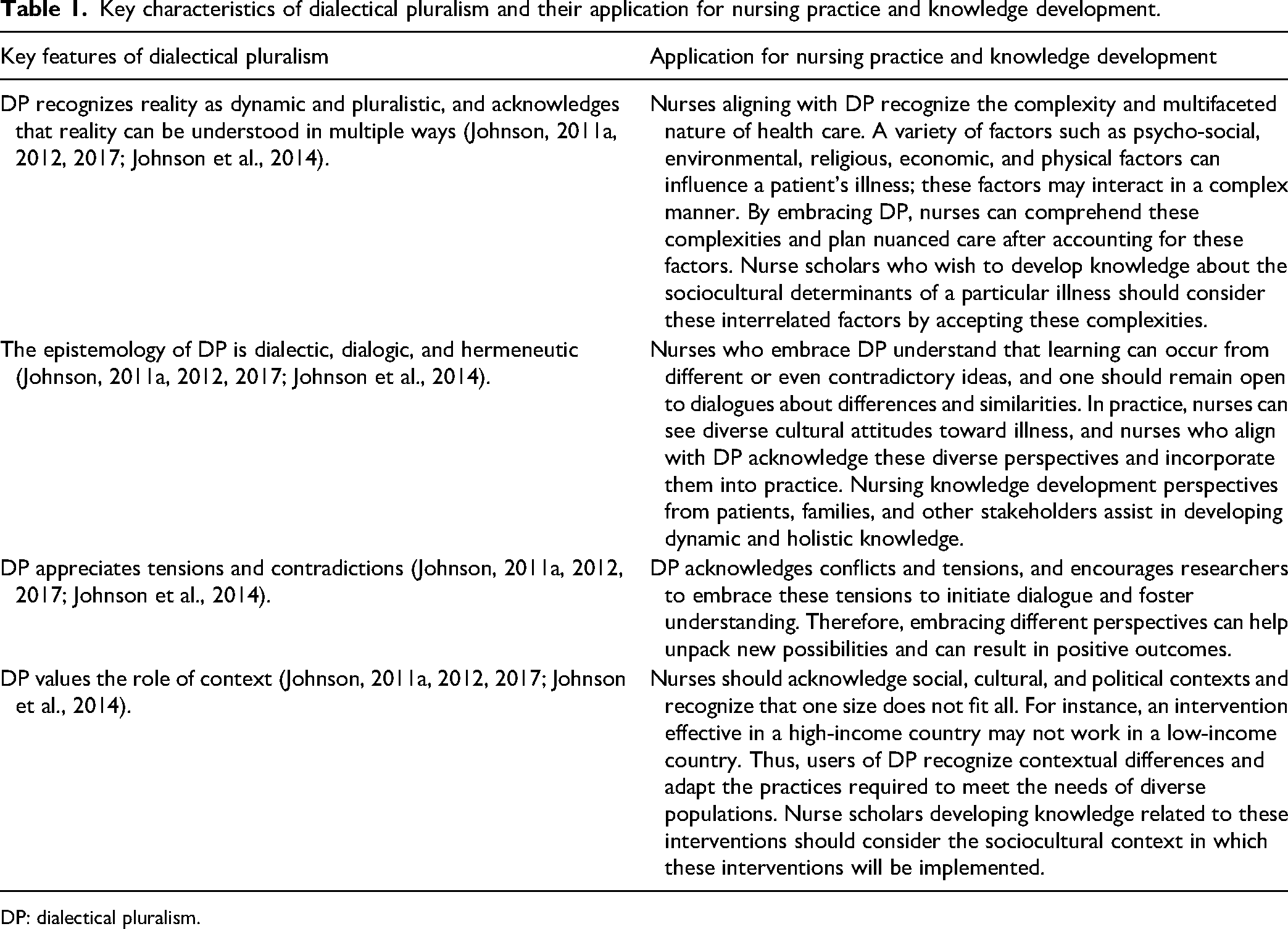
DP: dialectical pluralism.
DP can be relevant for nurses in the following ways.
DP can help nurses recognize and understand the complex and multifaceted nature of clinical problems, rather than relying on simplistic or reductionistic explanations. Nurses can appreciate the diverse factors that contribute to a patient's experiences and develop a more comprehensive understanding of their needs. DP can support nurses in developing more flexible and adaptive nursing care plans. By recognizing that there are often multiple valid approaches to addressing a patient's needs, nurses can draw on a range of therapeutic modalities and techniques to tailor their interventions to the individual patient. DP can help nurses engage in constructive dialogue with the health-care team and with patients and their families. Being open to multiple perspectives and showing a willingness to consider alternative viewpoints, nurses can build trust and rapport with patients and support them in making informed decisions about their care. Overall, DP offers a valuable perspective for clinical practice, emphasizing the importance of integration, flexibility, and collaboration in providing effective and compassionate care. DP inspires nurse scholars to choose a collaborative and interdisciplinary approach to nursing research. DP emphasizes the need to recognize the complexity of nursing phenomena and encourages nurse scholars to consider examining multiple perspectives.
Conclusion
Nursing is pluralistic, and all existing research and practice worldviews should be used for the development of nursing knowledge. Therefore, to promote a dialogue among diverging nursing worldviews, we advocate for the use of DP. DP can help nurses to appreciate diversity, identify concealed worldviews, resolve worldview differences, and generate knowledge that is grounded in diverse worldviews and is applicable to ever-changing nursing practice. DP can serve as an approach to go out and look beyond our differences that originate from diverging worldviews, and take a step forward towards the development of integrated and synthesized nursing knowledge.
Footnotes
Authors Contributions
SI: Design and conceptualization, principal manuscript writing, final drafting of the manuscript. GM: Advice on design and conceptualization, review, and revisions to the manuscript.
Declaration of Conflicting Interests
The authors declared no potential conflicts of interest with respect to the research, authorship, and/or publication of this article.
Funding
The authors received no financial support for the research, authorship, and/or publication of this article.
