




Abstract
The healthcare sector is essential for any country because it indirectly affects its economy. The productivity of land will increase if there is a healthy workforce, and it will enhance its economy, which will, in return, lead to the human welfare of the country. The present quantitative study has investigated the relationship between high-performance work systems (HPWS) on safety workarounds through the role of burnout as mediation, and explored coping strategies as a moderator between burnout and safety workarounds. These constructs play a vital role in efficiently managing different organizational activities to generate better productivity and employee performance, and educate employees about rules that can be used and adopted to ensure a healthy work-life. The data were collected from 550 nurses through a questionnaire in the healthcare sector of Lahore, Punjab (Pakistan). AMOS and SPSS were used to test the direct relationships between the constructs, and analyze the moderation of coping strategies and the mediation effect of burnout. The results have demonstrated the strong moderated mediation of coping strategies and burnout between existing HPWS and safety workarounds. The study of coping strategies would help managers and employees handle job stress and alleviate burnout in the healthcare sector through safety workarounds to increase effectiveness and efficiency.
Keywords
Introduction
Greater high-performance work systems (HPWS) and innovative work behavior can produce enhanced benefits for the employees compared to the less intensity of HPWS (Caniëls & Veld, 2019). As employees in the hospital industry are confronted with heavy workloads and low resources, they lose their valuable assets, including energy, time, and sentiments (Mansour & Commeiras, 2015), leading to enhanced burnout and then quitting (Mansour & Tremblay, 2016). Moreover, coping strategies generally encourage adjustment to life stressors after some time and conspicuous utilization of avoidant coping strategies will generally hinder adjustment and mental well-being. Cherry et al. (2017) stated that most people take part in both constructive and avoidant coping systems following significant life stressors (Jensen et al., 2015). Healthcare workers believe that patient safety and performance can be improved by developing inconsistent and idiosyncratic work patterns (Wheeler et al., 2012).
Work in the medical industry is considered well-structured routine and ultra-safe practices but through unbalanced, irregular, and damaging requests. Practitioners need to study at work simultaneously to show proficient self-rule (Debono et al., 2013). This medical industry attributes lead to employees’ work practices, behavior, and clinical practices demand (Debono et al., 2013). So, the complicated rules and unsafe behaviors of nurses affect the safety workaround practices (Mansour & Tremblay, 2019). Therefore, workaround practices may be seen as rewards or dangerous, influencing patients’ superiority and security (Lalley, 2013).
Human capital is becoming more important to organizations in order to achieve a competitive edge and enhance their overall performance. Human resources (HR) have developed into an essential component. Management researchers have been more interested in the ways in which HR may be used to enhance the performance of organizations as a result of their recognition of the practical significance of this topic. Implementing HPWS often consists of techniques such as comprehensive training, selective hiring, clear job descriptions, results-oriented assessments, and engagement is one specific method that may be used. These techniques are intended to increase organizational performance and maintain a competitive edge for as long as possible. Previous studies have shown apparently a favorable connection between HPWS and organizational performance (Korneeva et al., 2022).
Many studies, using a variety of methodologies and examining a broad range of sectors and organizations, have shown that HPWS are associated with progressive business and workforce results. When it comes to patient care, nothing is more important than having a competent team on the job. Evidence-based management practices (also called high-performance work practices), such as organized human resource induction and incentive compensation, may represent a necessary and underutilized policy for improving the quality of patient care and patient safety, and research from other industries suggests this. Employee outcomes (such as turnover and increased satisfaction/engagement) were shown to be related to HPWPs, and HPWPs were shown to contribute significantly to the system- and organization-level outcomes (e.g., enhanced recruitment, better ability to address safety concerns, and lower turnover). How the systematic use of high-performance work practices might affect healthcare quality and safety is an area of study that may lead to enhanced organizational performance (Audiana, 2022).
Choi et al. (2019) suggested that future practitioners should discover whether coping strategies play an alleviator role in other sectors working in a highly pressurized environment. Due to the lack of research in this area, a significant gap has been created that needs research and progress (Choi et al., 2019). The authors suggested that the researchers need to explore workaround with dimensions of burnout in the healthcare industry, leading to more efficiency and effectiveness (Mansour & Tremblay, 2019). On the other hand, another author said that in the future, it is suggested to investigate unexplored outcomes of HPWS in the public and private sectors, for example, the healthcare industry (Jyoti & Rani, 2019). Practically this study will help employees manage their workload, workaround policies, procedures, and organization practices to help employee safety. It will also help improve employees’ performance and productivity in organizational operations and allow managers to educate employees on healthy work life. As the HPWS has been widely talked over in the human resource management literature, see, for example, Shin and Konrad (2017), it is sufficient to restate here that its main objective is the achievement of higher employees results (Ananthram et al., 2018).
Thus, the first objective of the current study is to make a framework that develops the relationship between HPWSs and safety workarounds. The second purpose is to inspect the mediation role of burnout and the moderating role of coping strategies. In developing countries, the healthcare sector in the current era faces many challenges like weak health policies, irregular, complicated rules, and harmful demands that directly affect human welfare. Regrettably, with the possibility of uncertain and alarming results from workarounds in medical practice, academic researchers on the subject do far more than simply document its existence. Especially in Pakistan, the healthcare sector safety workarounds practices are not working much according to their perspective.
The healthcare sector in Pakistan faces safety workarounds problems due to complicated rules, inconsistent work patterns, and unsafe behavior of employees. This study of coping strategies would help managers and employees in similar contexts handle job stress and alleviate burnout in the healthcare sector through safety workarounds to increase effectiveness and efficiency.
Literature Review and Hypotheses Development
HPWS and Burnout
Gulza et al. (2014) showed that HPWS connect with burnout in a way that leads to burnout by encouraging the workers to do their best for the organization. But Fan et al. (2014) uncovered that workers’ burnout is oppositely related to the HPWSs and harms it. Kilroy et al. (2016) revealed that when we involve diverse work practices highly, it also negatively impacts emotional exhaustion and burnout components, significantly known as depersonalization.
According to Al-Qudah et al. (2022), the capacity of an organization to react and adapt to changes imposed by both the environment and the competitive marketplace has increased as a direct result of the increased importance of organizational change as an activity essential to the maintenance of that organization's efficiency. High-performance work practices are followed consistently to improve workers’ capabilities, level of involvement in decision-making, and level of incentive to put out their best effort. They consist of, among other things, stringently selected personnel practices, rigorous training and development, performance-based evaluations, communication, and incentive compensations contribution (Al-Qudah et al., 2022).
In the same way, Harley et al. (2010) demonstrated that work practices and execution supervision adversely affect emotional exhaustion. Jyoti et al. (2015) experimentally demonstrated that massive high-performance human asset practices negatively influence emotional exhaustion. When management makes sure to provide a highly cooperative environment and carries more social assets, HPWS minimizes work stress (Van De Voorde & Beijer, 2015). In HPWS, management usually pays attention to motivating workers by providing special prizes. It also lessens the stress factor in workers (Torre, 2012). Preceding scholars on HPWS have been divided into two paths: secure presentation and worker consequences. A recognized arrangement of studies encouraging the application of HPWS practices leads to a high-performing culture and outcomes in a win-win condition for both the worker and the organization (Van De Voorde & Beijer, 2015). One more perception backings the opinion that HPWS is an instrument in the hands of an organization that results in work escalation, causing career pressure between workers. In fact, in the situation of basically driven unrestricted hard work from workers, the procedure might be unsuccessful in resulting in the welfare of workers (Kaufman, 2010).
HPWS is known as a necessary aspect affecting performance-related results. Organizations spend considerably raising such organizations to increase presentation (Combs et al., 2006). Current literature shows the association between HPWS and performance, though these variables’ technique is still uncertain (Demirbag et al., 2014). There is a necessity to recognize issues that reinforce this relationship. The bundle of human resource practices cannot do miracles unaided. With respect to achieving performance outcomes results, the assistances prepared by certain, skilled and established over such practices are significant. Enhanced performance is of great significance for organizations; therefore, they are reforming their policies to improve HR (Harpan & Draghici, 2014). Human capital methodology accepts that organizations implement HPWS, which benefits the human capital establishment, therefore causing improved performance (Wright et al., 2001).
The plan of taking HPWSs invented from and originated in the past century during the US industrial revolution (Imran & Atiya, 2020). Throughout this era, it was recognized that the level of universal rivalry was strong, and it was necessary to reconsider trustworthy procedures. On the other hand, it is claimed that HPWS has its origins in HR practices with the Japanese systems (Chaudhuri, 2009). Regardless of these diverse viewpoints, the key impression of HPWS is to have an active organization that has involved, dedicated, and empowered employees (Tomer, 2001).
According to previous studies, we can summarize it as a HPWS that lessens the degree of burnout in an organization by providing a work-friendly environment (in terms of rewards, acknowledgment, working practices, autonomy, and empowerment).
H1: HPWS has a significant impact on physical fatigue burnout.
H2: HPWS has a significant impact on cognitive weariness burnout.
H3: HPWS has a significant impact on emotional exhaustion burnout.
Burnout and Safety Workarounds
Job burnout represents mental and emotional exhaustion physically caused by work pressure or relapse (Lizano & Barak, 2015). According to the experience of the hotel managers, less intensity of burnout in case of more straightforward coping strategies application. Factors like career development, higher studies continuation, enhancement in salary, and designation promotion cause disappointment in the managers; therefore, they are virtually vulnerable to emotional exhaustion (‘Sunny’ et al., 2010). Safety workarounds are considered a common discussion which shows a significant improper arrangement between “work as ideate” as specified in pharmacy methods and actual “work as done” in daily performance (Hollnagel et al., 2015). Conservation of resources theory recommends that compassion fatigue, or “feelings of being overreached and exhausted of one's emotive and corporeal means” (Maslach & Leiter, 2008) is expected to happen below source damage circumstances known a person's improved compassion to source damage (Hobfoll, 2001). Conservation of resources theory describes why we suppose an unintended consequence over emotional exhaustion. Workers who practice FRD take fewer regulators of exertion-life demands and observe they have fewer capitals to accomplish exertion-lifetime fight. The need for assets produced by production with an uncooperative manager generates emotional exhaustion. In turn, an advanced level of emotional exhaustion is expected to obstruct the non-work field, delay non-work accountabilities (Greenhaus & Beutell, 1985), and eventually end in an augmented work-life fight (Dickson, 2008).
Once forefront service workers have additional means to react to workloads, they practice less emotional exhaustion. Proceeding the conflict to defend their assets, forefront service workers facing little work pleasure will take accomplishment to stop additional source reduction (Halbesleben, 2010). Therefore, they have less accessible means to contract emotional exhaustion. Concurrently, the outcome of organizational embeddedness on emotional exhaustion will decline (Zhou et al., 2020). They are noble at consuming organizational means to reply to exertion requirements, resulting in less emotional exhaustion. The advanced level of job contentment is vital to organizational embeddedness in the association amid moral management and workers’ emotional exhaustion (Zhou et al., 2020). However, according to a scoping review of workarounds by Debono et al. (2013), the workaround behavior of nurses is still the primary focus, according to a few peer-reviewed studies (Debono et al., 2013). Workarounds are considered resourceful and capable of providing results and making work more manageable. The negative impact of workarounds is the potential and probability of adverse consequences. Security concerns drive an enormous portion of today's research on workarounds (Jordan, 2015).
By keeping in view the above discussion, the following hypotheses are developed:
H4: Physical fatigue burnout has a significant impact on safety workarounds.
H5: Cognitive weariness burnout has a significant impact on safety workarounds.
H6: Emotional exhaustion has a significant impact on safety workarounds.
Mediation Effect of Burnout Between HPWS and Safety Workarounds
Tran Huy (2022) stated it had been shown that HPWS benefits the results of both organizations and individuals. In contrast, this study adopts an opposing viewpoint of HPWS to investigate the influence that perception of HPWS has on the act of information hoarding. In addition, it is expected that the competitive atmosphere will be a mediator between the two factors. A violation of the psychological contract between HPWS and knowledge hoarding will act as a moderator of the connection between the two. The competitive atmosphere acts as a partial mediator between the notion that HPWS encourages information hoarding and the reality of the situation. The breaking of the HPWS psychological contract makes the connection more intense. Employees need to be motivated to improve their knowledge, skills, and abilities. Management needs to empower workers by delegating authority and giving them more say over their work in order to decrease the negative effects of high-pressure work situations (HPWS)
Job burnout has been studied extensively over prior decades, resulting in numerous achievements (Dreison et al., 2018). This research aimed to examine potential mediators of burnout for extreme stress in the form of cognitive weariness, physical fatigue, emotional exhaustion, and burnout, using an active psychological cure as a comparator and establishing essential process objectives to acquire symptom decline. Burnout has been utilized to state the end stage of a stress course, an adaptive collapse, with increasing handling problems (Schaufeli et al., 2009). It is observed that exhaustion is a core component in most concept definitions (Maslach & Leiter, 2016). The theoretical research from the past 20 years has revealed that the habit of absence from work was minimized by using HPWS (Zatzick & Iverson, 2011). It is consequently significant to pay additional consideration to professional bodily and psychological dangers and cognitive weariness and examine the possible risks in command to make maintainable exertion conditions for the call center managers (CABRERA, 2019). Cognitive weariness is theorized as an exclusive letdown to preserve and enhance recital above critical nevertheless constant cognitive energy subsequent in an act that is lesser and extra flexible than the person's finest skill (CABRERA, 2019). One of the signs involved in describing burnout is CW, which denotes the sensation of being sluggish or taking compact psychological nimbleness (Melamed et al., 2006).
Burnout develops over a period and can remain operationalized like a procedure using several constituents persuading individually (Taris et al., 2005). Provision of assets by HPWS practices (e.g., job independence, participation, better career-building opportunities, and work feedback) minimizes workers’ absence by avoiding stressful situations (Boon et al., 2014). Emotional exhaustion is considered the most experimented and researched indicator of burnout, mainly dependent on the lack of activity (Skaalvik & Skaalvik, 2011). Likewise, Jyoti et al. (2015) also conducted several experiments to demonstrate that great high-performance human resource practices undesirably affected sentimental exhaustion. The work stress could be minimized or its potential could be reduced if management provides a highly cooperative environment with further social assets (Van De Voorde & Beijer, 2015). Pugh et al. (2011) demonstrated that the center of attention of training is to increase and modify the talents of the workers, which helps to minimize emotional weariness. The stress level of the workers can be minimized by managing HPWS with a focus on motivating workers by giving them intrinsic rewards (Torre, 2012).
Given the above discussion, the following hypotheses have been developed:
H7: Physical fatigue burnout mediates the relation between the HPWS and safety workarounds.
H8: Cognitive weariness burnout mediates the relation between the HPWS and safety workarounds.
H9: Emotional exhaustion burnout mediates the relation between the HPWS and safety workarounds.
Moderator Effect of Coping Strategies Between Burnout and Safety Workarounds
Zhang et al. (2022) analyzed the impact of undergoing several HPWS on the organizational citizenship behaviors of workers. The self-regulation and self-identity orientation theories were both used as theoretical foundations for this investigation. In the first place, emotional weariness served as a mediator in the connection between helping/voice and performance-oriented and maintenance-oriented human resource systems. Second, the association between performance-oriented HR systems and emotional weariness was mediated by both relational identity and communal identity. Thirdly, relational and collective identities both had a role in moderating the indirect influence that performance-oriented HR systems had on assisting with getting past emotional weariness. In the fourth place, relational identification and collective identity helped to limit the influence that performance-oriented HR systems had on voice indirectly via emotional weariness. Fifth, an individual's identity is a controlling factor in terms of the connection between emotional exhaustion and a helping voice. Afterward, a sense of identity may be a controlling factor to determine the indirect effect of performance-oriented HR systems on helping voice through emotional tiredness. The HR systems and results evaluated effect explain that fundamental processes that correlate these factors give a balanced picture that HPWS influences worker performance.
Bodys-Cupak et al. (2016) stated a connection between coping strategies and stress intensity among nursing students. That is why coping strategies moderate the link between nursing work practices and stress from discourteous behavior among nursing students (Kim, 2018). A model has been introduced that proposed mitigating stress among students’ powerful emotional rules and self-motivation/leadership did not practically check this model (Maykrantz & Houghton, 2020). Thus, burnout leads them to leave their jobs. Therefore, mediation methods should highlight increasing the use of direct working coping skills. These coping strategies work as mitigation techniques or training of intellectual and behavioral practices that help expand direct action on resolving the circumstances. Often utilization of this factor may result in a reduced number of managers affected by burnout (‘Sunny’Hu & Cheng, 2010). Research conducted for the nurses explains that the PWB was formulated to be inclined by stress, and the option of stress coping strategies was the finest analysis of mental health (Chang et al., 2006). Healy and McKay (2000) Recommendations show that many stress-managing strategies for nurses have different effects on nurse job completion and managing their temper. However, approach-oriented strategies are very helpful and encouraged as well. These strategies can manage life stressors, and difficult and negative behavior efforts (Labrague et al., 2018). On the side of the scenario, avoidance to take these coping strategies was also evaluated. A study of 129 nurses in Australia reveals that avoidance is mainly due to attitude disorder (Healy & McKay, 2000). Comparing this with another study of 72 nurses in United Kingdom showed that implementation of these avoidance coping strategies is related to mental health (Tyler & Cushway, 1992).
Positive stress-handling approaches decrease the probability of more work stress and negative consequences (Li et al., 2017). Several studies depict that an optimistic approach toward stress handling strategies positively affects nurses’ quality of life (Cruz et al., 2018), and a decline in symptoms of burnout is observed. Chang and Chan (2015) proposed that proper planning is needed for active coping. Furthermore, social support greatly influences the quality of life (Sun et al., 2017). Better understanding and social support from family, including friends, coworkers, and higher authorities, enhances the quality of nurse life (Kowitlawkul et al., 2019). Proper reorganization and support from the organization enhance the mental health of the nurses as well (Smith et al., 2017). Stressful environments increase nurses’ risk of burnout and stress-related illness (Brennan, 2017). According to research, stress increases the chance of burnout and other health issues in nurses (Khamisa et al., 2017). So, effective coping with stress is needed. Research shows that nurses’ work-related stress is moderate to high and their approach toward stress management is different (Hasan et al., 2018). Laranjeira (2012) commented that the most used coping strategies in nurses are self-control, problem-solving approach, and seeking social support. The authors built the following hypothesis to verify moderation influence of coping strategy between JST and burnout (Choi et al., 2019). This research gives additional help to this proof, tying the advancement of dynamic adapting procedures in this examination to protecting from misery like conduct after constant pressure found in different studies (Kim et al., 2018).
Considering the discussion above, we propose the following hypotheses:
H10: Coping strategies moderate the relation between physical fatigue burnout and safety workarounds.
H11: Coping strategies moderate the relation between cognitive weariness burnout and safety workarounds.
H12: Coping strategies moderate the relation between emotional exhaustion burnout and safety workarounds (Figure 1).

Theoretical framework.
Methodology
Sample and Procedure
This research has used the deductive approach to test the relationships between HPWS and safety workarounds with the mediation role of burnout and the moderating role of coping strategies.
A structured questionnaire was adopted and utilized as a measuring method for the data collection on model validation and hypothesis testing to obtain answers on a 5-point Likert scale, that is, strongly disagree = 1 to strongly agree = 5. The sources of the questionnaire and the reported reliability values are mentioned in Table 1.
Sources of Measures.

It was divided into the responders’ demographic profiles and the measures’ scale. The primary data were gathered from the healthcare sector employees (nurses). Moreover, the data were collected from public and private hospitals in Lahore. Private hospitals’ understudy had at least 10 doctors on the panel or more than 50 employees working in the hospital. This study used a quota sampling technique and divided the questionnaires equally into public and private healthcare sectors. Before starting the data analysis process, the focal persons of the hospitals were contacted to request their support and consent for collecting the data from their employees. Additionally, the authors agreed with the ethical guidelines of these healthcare organizations to uphold moral norms during the data collection process. Additionally, each respondent gave the authors their free and informed consent before participating in the study.
Unfortunately, the extensive COVID-19 pandemic prevented the authors from directly obtaining the data from hospital employees. Because the majority of hospitals’ administrations did not permit the authors to remain at a hospital for several hours to collect the data, the questionnaire was distributed through the focal persons. A total of 1000 surveys were distributed, and 550 were received as complete, with a reasonable response rate of about 55%. The procedure of gathering the data was finished in January and February 2022.
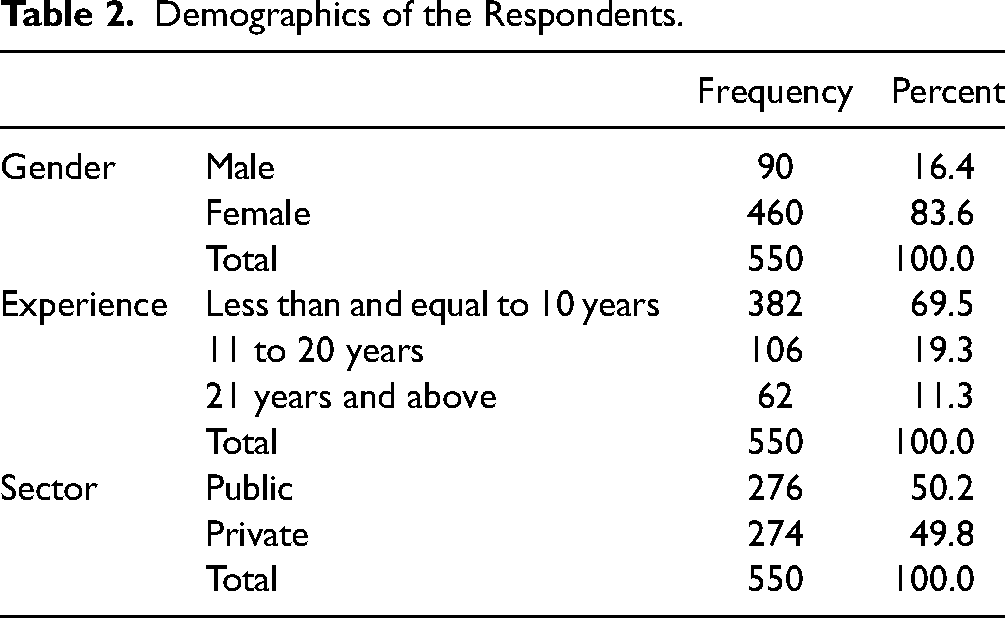
As shown in Table 2, 90 (16.4%) were male and 460 (83.6%) were female. On the other hand, 276 (50.2%) respondents belonged to public healthcare sectors/hospitals, while 274 (49.8%) were working in private hospitals. Furthermore, 382 (69.5%) of respondents possessed less than or equal to 10 years of experience, 106 (19.3%) had 11–20 years of experience, whereas 62 (11.3%) of the respondents had 21 years or above experience.
Demographics of the Respondents.
Analysis and Results
Data Analysis
For data analysis, we used two software: SPSS and AMOS. In AMOS, we performed confirmatory factor analysis (CFA) and path analysis while we measured descriptive statistics as well as moderation through process macro.
The descriptive statistics include minimum and maximum values, mean values, sample size, skewness, and standard deviations of HPWS, physical fatigue, cognitive weariness, emotional exhaustion, coping strategies, and safety workarounds, as shown in Table 3.
Descriptive Statistics.
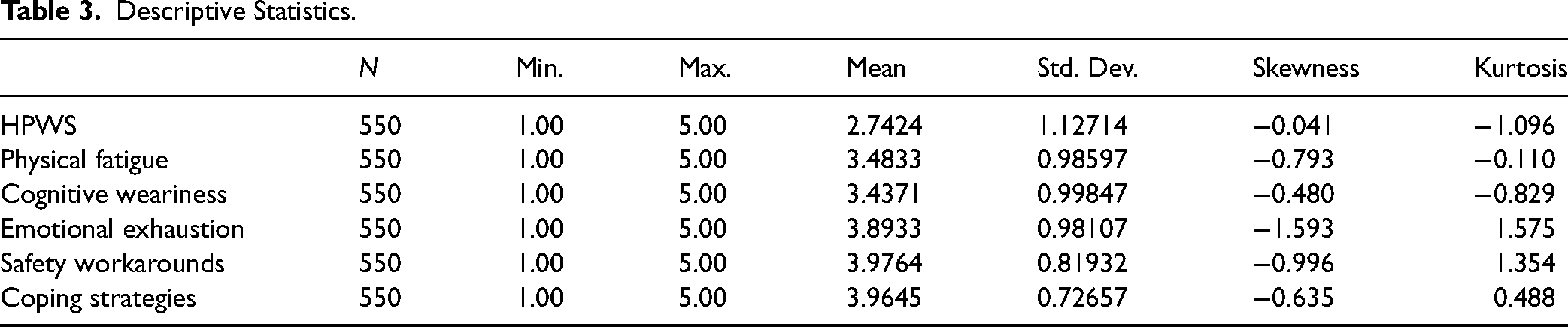
Mean values show the concentration of responses; overall, the variables have magnitudes above the midpoint (2.5). Moreover, the skewness and kurtosis values were found within the normality range, that is, −1.0 to + 1.0 for skewness, and for kurtosis, −3 to +3 (Kline, 2010). Table 3 shows the skewness values range from −1.593 to −.041 and the kurtosis values range from −1.096 to 1.575; therefore, the data were distributed normally.
Results
Measurement Model
Researchers need CFA to describe all aspects of the model (Zhao et al., 2016). It is the most widely used measurement model for loading the development-factor scale (object pattern) and significant amounts of underlying measurements of one size factor (Brown, 2015). In essence, it is used in research to show whether factors imply good data fitness (model fitness) (Scott et al., 2018), and whether reliability & validity are satisfactory (Troester & Van Quaquebeke, 2020). The graphic representation of the CFA has been depicted in Figure 2.

Conformity factor analysis.
For the best of model fit indices, values recommended by researchers such as Kline (1998) are: chi-square/degree of freedom (χ2/df) < 5 3. CFI should be greater than or equal to 0.95. Similarly, in standardized root mean square residual (SRMR), the values are less than 0.10 or 0.08 and the root mean square error of approximation (RMESA) should be less than 0.05 (Bentler, 1990). The CFA model achieved χ 2/df = 2.893, the value of CFI = 0.934, whereas SRMR = 0.034 and RMSEA =0.059. These values demonstrated that the results were satisfactory and an indicator of the fit model.
Validity is the criterion for assessing the goodness of a measure. It is established through face validity, convergent validity, and discriminant validity. Since all the measures were adopted from previous studies, it establishes face validity. The convergent validity was confirmed through factor loadings and average variations of extracted (AVE) values with minimum cutoff criteria of 0.7 and 0.5, respectively (Al-Refaie, 2015). The CFA results in Figure 2 indicate that all the loading values were above 0.70. Likewise, the AVE values of all constructs were beyond 0.5 (see Table 4), thereby supporting convergent validity. Discriminant validity specifies the degree to which the measurements of different latent variables vary. The shared AVE of the square root of the respective inter-construct correlation estimates of the latent structure was calculated. Table 4 shows that AVE's square roots are more than their corresponding inter-constructive relations in all constructs in the diagonal. Therefore, there is better discrimination in the proposed measurement model (Henseler et al., 2015).
Average Variance Extracted (AVE) and Discriminant Validity.

*** p ≤ .001
On the other hand, Cronbach's alpha is used to assess the reliability or internal consistency of a set of scale or test items. The reliability values in Table 4 show that Cronbach's alpha values are between 0.903 and 0.966, which are considered excellent values (Al-Refaie, 2015). The highest value of Cronbach's alpha is for coping strategies, while the lowest values are for physical fatigue and emotional exhaustion.
Structural Model
The next step is to analyze whether the direction, the degree of correlations, and the meaning among the variables are negative or positive. The graphical representation of the structural model drawn in AMOS software has been provided in Figure 3.

Structural model.
Table 5 summarizes the structural model by showing that some estimates (path coefficients) are positive and negative, while p-values below 0.05 imply significant relationships.
Path Analysis.

p ≤ .001
The results from Table 5 corroborated that a HPWS negatively impacts physical fatigue, cognitive weariness, and emotional exhaustion burnouts (β = .−274, p < .001; β = −.299, p < .001; β = −.344, p < .001, respectively). In turn, these burnouts significantly impact safety workarounds (β = .224, p < .001; β = .159, p < .001; β = .328, p < .001). Similarly, physical fatigue, cognitive weariness, and emotional exhaustion burnouts mediate the relation between the HPWS and safety workarounds (β = −0.061, p < .001; β = −0.098, p < .001; β = −0.055, p < .001, respectively).
Table 6 presents the results of moderating effects of coping strategies. Coping strategies moderate the relation between physical fatigue, cognitive weariness, and emotional exhaustion, burnouts, and safety workarounds (β = .1017, p < .001, R2 = .2551; β = .4292, p < .001, R2 = .4292; β = .2357, p < .001, R2 = .3206, respectively).
Moderating Effects.

Discussion
The results indicate that a HPWS has a negative impact on physical fatigue burnout, emotional exhaustion burnout, and cognitive weariness burnouts (β = −.274, p < .05; β = −.344 and p < .001; β = −.299, p < .001). It means that HPWS supports employees in achieving the necessary resources to meet job demands that reduce burnout (Kilroy et al., 2016). Similar to the previous studies (Mansour & Tremblay, 2019; Ishaq & Mahmood, 2017), the results of the current research have also shown that the dimensions of burnout (physical fatigue, cognitive weariness, and emotional exhaustion) have positive and significant effects on safety workarounds (β = .224, p < .001; β = .159, p < .001; β = .328, p < .001).
The mediating effect analysis was also performed, and the results revealed the significant effects of mediation between HPWS and safety workarounds. The first dimension of burnout (physical fatigue) has shown mediation impact as (β = −.061, p < .001), while the second dimension of (cognitive weariness) has shown results (β = −.098, p < .001) and the third dimension (emotional exhaustion) has a value of mediation effect is (β = −.055, p < .001). Moreover, it needs to be clear which burnout effectively reduces the personnel's safety workarounds with the help of coping strategies (Choi et al., 2019). Therefore, the authors built the following hypothesis to verify the moderation influence of coping strategy between burnout and safety workarounds. According to moderation results, coping strategies have a significant moderation between the dimensions of burnout (physical fatigue, cognitive weariness, and emotional exhaustion) and safety workarounds (β = .1017, p < .05, R2 = .255; β = .3674, p < .05; R2 = .4292; β = .2357, p < .05, R2 = .3206). That is, a HPWS helps maintain an organizational context that develops equality in the skills among employees. It contains various human resource practices that build an organizational context to benefit the capabilities and incentives of employees (Garaus et al., 2016), and further advancement opportunities are created (Fu et al., 2015). Furthermore, it has been observed that safety workarounds that cause mishaps, perils, or injuries are avoided or perceived as unnecessary when workers see that rules and procedures are built to help their safe working environment practices (Nixon et al., 2015).
Implications
The current research would be valued by medical practitioners as well as researchers. The practical suggestions established in this study lead us to the results discussed henceforth. HPWS emphasizes high performance by effectively organizing diverse organizational activities and improving worker performance and output. The grounding for the similar must commence from the appointment phase of workers. With respect to graciously performing HPWS, a proper person-role combination in command is required. This procedure must begin from the selection phase itself. The selection procedure must be performance-oriented over the appropriate assessment of requisite skills to do work. In this perspective, numerous assessments (cognitive, interest, and creativity thinking tests) must be handled to assess workers’ skills properly. Thus, they are capable of displaying requisite work performance after settlement. It is concluded that healthcare practitioners can carry safety workaround rules, practices, and techniques applied by the institute to shield patients’ and employees’ security. As our study was completed in healthcare sectors in Lahore city of Pakistan, these outcomes are significant in terms of practical implications.
This study will help the employees understand safety workarounds, policies, procedures, and practices. It will also enable employees to handle their workload by decreasing burnout efficiently and focusing on a HPWS to increase workers’ performance and patient safety. Coping strategies are also a helpful and valuable tool for managers and employees to handle job stress and alleviate burnout in the healthcare sector through safety workarounds practice to increase effectiveness and efficiency.
Conclusion
This study has shown strong moderated mediation of coping strategies and burnout between actual HPWS and safety workarounds. The results show that coping strategies and burnout play an essential role in the perceived relationship between HPWS and safety workarounds by allowing employees to communicate with their coworkers in an open and friendly manner to express frustration, express tension, or negative job emotions, and sharing work tips and advice to relieve stress and burnout at work. This expressly specified the varying organizational and environmental improvements of the current healthcare structure in various nations. The results obtained in this study are in line with the previous studies (e.g., Kilroy et al., 2016; Choi et al., 2019).
This study would provide a better comprehension of this concept of safety workarounds to the managers of the hospitals. Considerate associations among healthcare centers that try to order excellence of care and protect patients’ reactions to these challenges are essential for the HRM functions inside the hospital. Interest in the current perspective of decreased public health expenditure and organizational improvements in today's healthcare systems in numerous countries, seeing the significant influences and threats our study has emphasized. The study has certain limitations because it was conducted in a specific region, culture, and cross-sectional data were collected on a closed scale.
Limitations and Future Direction
Initially, the results were built on the healthcare sector in Lahore, Pakistan. Thus, assured industry features or cultural issues can impact the conclusions and implications of this study. Therefore, future researchers can extend the study to other cultural or country situations. The alternative restraint of this study is that it simply observes three kinds of burnout as mediators in the association between HPWS and safety workarounds while testing additional burnout types. Finally, accepting a cross-sectional design is limited to the study where the main information was assembled at a definite point in the phase because of availability concerns. Therefore, an additional route for upcoming research is accepting a longitudinal approach. Future research can consider the use of further methods and data sources to improve our understanding of workarounds. Researchers should interview nurses on a confidential and engaging basis to thoroughly investigate and detect the essence, background, and implications of workarounds. It will also be essential to explore why senior managers in the healthcare sector continue to facilitate workarounds because it can lead to future quality and efficiency changes.
Footnotes
Data Availability Statement
The dataset used in this research is available upon request from the corresponding author.
Declaration of Conflicting Interests
The authors declared no potential conflicts of interest with respect to the research, authorship, and/or publication of this article.
Ethical Statement
The Institution's Ethical Evaluation Committee (IB&M-ERC/2021-02) provided ethical review and approval for this study on human subjects. Furthermore, informed consent was obtained from all participants involved in the study.
Funding
The authors received no financial support for the research, authorship, and/or publication of this article.
