




Abstract
Background
Nurse burnout remains a significant global challenge, exacerbated by rotating shift work, which disrupts circadian rhythms and contributes to psychological strain. Burnout is characterized by emotional exhaustion, depersonalization, and reduced personal accomplishment—outcomes that can compromise patient care and workforce stability.
Objective
This systematic review examines the association between rotating shift work and nurse burnout, focusing on how specific shift characteristics influence each burnout dimension and exploring contextual moderators such as organizational support and work environment.
Methods
A systematic search of PubMed, Scopus, CINAHL, and PsycINFO was conducted to identify peer-reviewed studies published between 2015 and 2023. Eligible studies investigated hospital-based nurses and evaluated the effects of rotating shift work on burnout outcomes. The Joanna Briggs Institute (JBI) appraisal tool was used for quality assessment. Data were synthesized thematically due to study heterogeneity.
Results
Fifteen studies were included, primarily cross-sectional in design, with significant variability in burnout measurement tools and shift definitions. Emotional exhaustion was consistently associated with night shifts and irregular rotations. Depersonalization was linked to excessive workload and low social support, while reduced personal accomplishment appeared in contexts of prolonged shift exposure. Organizational support, sleep hygiene, and job autonomy emerged as potential protective factors. However, the lack of quantitative synthesis, high reliance on self-reported data, and publication bias limit the strength of conclusions.
Conclusion
Rotating shift work contributes significantly to nurse burnout, especially emotional exhaustion. The findings underscore the need for more longitudinal studies, standardized burnout assessments, and tailored interventions. Future research should incorporate effect sizes, subgroup analyses, and moderator evaluations to enhance evidence-based recommendations for shift scheduling and occupational health.
Keywords
Introduction
Burnout is a chronic occupational phenomenon characterized by emotional exhaustion, depersonalization, and a diminished sense of personal accomplishment (Maslach & Leiter, 2016; Schaufeli et al., 2009). Among healthcare professionals, nurses are particularly vulnerable to burnout due to sustained exposure to emotionally demanding work, high patient loads, and insufficient institutional support (Baldwin et al., 2025; Dall’Ora et al., 2020). The consequences of burnout extend beyond individual well-being, contributing to staff turnover, reduced quality of care, and increased healthcare costs.
One major contributor to nurse burnout is shift work especially rotating shift work, which involves alternating between day, evening, and night shifts over a defined schedule cycle. This type of scheduling, often necessary for continuous healthcare coverage, disrupts circadian rhythms, impairs sleep quality, and compromises physical and psychological recovery (Lin et al., 2024; Rodrigues et al., 2023). Unlike fixed shifts, rotating schedules introduce variability that exacerbates fatigue, disorientation, and work-life imbalance.
Although previous research has broadly examined the association between shift work and burnout, most studies fail to differentiate between rotating and fixed shift structures. Additionally, limited attention has been paid to how specific features of rotating schedules such as frequency of night shifts, short recovery periods, and irregular rotation patterns impact the distinct dimensions of burnout. Furthermore, contextual factors such as staffing adequacy, managerial support, and institutional culture may moderate these effects but remain underexplored in the literature.
To date, no systematic review has comprehensively examined how rotating shift work uniquely affects each dimension of nurse burnout, nor how individual and organizational variables influence these relationships. Clarifying these associations is crucial for designing targeted interventions and evidence-based policy reforms to support nursing workforce resilience.
This systematic review aims to synthesize current evidence on the relationship between rotating shift work and nurse burnout. Specifically, it (a) analyzes how shift-related variables influence emotional exhaustion, depersonalization, and personal accomplishment; (b) evaluates the role of moderating factors such as organizational support and personal resilience; and (c) identifies intervention strategies to mitigate the effects of rotating shift work in healthcare settings.
Review of Literature
Burnout among nurses is a well-documented occupational health issue, exacerbated by the increasing reliance on rotating shift schedules to ensure 24/7 patient care. Burnout manifests through three core dimensions: emotional exhaustion (feeling overextended and depleted), depersonalization (cynicism and detachment from patients), and reduced personal accomplishment (a sense of ineffectiveness or failure) (Cheng et al., 2023; Maslach & Leiter, 2016). These symptoms compromise not only individual nurse well-being but also organizational performance, patient safety, and care quality (Dall'Ora et al., 2023; Lin et al., 2023).
Rotating shift work, defined as alternating between day, evening, and night shifts within a set timeframe, has been consistently associated with higher levels of burnout compared to fixed shift schedules. For example, Dall’Ora et al. (2023) found that nurses on rotating shifts reported significantly greater emotional exhaustion and depersonalization. Similarly, Zhang et al. (2018) linked shift irregularity to poor sleep quality, which in turn heightened overall burnout risk. Poor sleep, circadian misalignment, and limited recovery time are recurrent mediators in the shift work–burnout relationship (Alston-Jackson, 2022; Rodrigues et al., 2023).
Despite this growing evidence base, many studies treat burnout as a singular construct, failing to disaggregate how rotating shifts uniquely affect each of the three dimensions. Emotional exhaustion is the most frequently assessed outcome, with limited attention to depersonalization or personal accomplishment (Khan et al., 2020; Travaglianti et al., 2016). This gap restricts our understanding of how shift design impacts specific psychological outcomes.
Moreover, measurement inconsistency remains a significant limitation. While the Maslach Burnout Inventory (MBI) is the most commonly used and validated tool, several studies employ alternatives such as the General Health Questionnaire 12 (GHQ-12) or locally developed scales. These instruments vary in sensitivity and conceptual emphasis, complicating cross-study comparison (Cheng & Drake, 2019; Stimpfel et al., 2020). A critical assessment of tool selection and validation processes is lacking in much of the current literature.
The methodological heterogeneity of studies further complicates synthesis. Most are cross-sectional, limiting causal inference and obscuring the temporal order between rotating shift exposure and burnout development. Only a few longitudinal or cohort studies (Vargas-Benítez et al., 2023; Xu et al., 2025) attempt to capture progression over time. This highlights an urgent need for prospective research designs to better understand directionality and delayed effects.
Additionally, contextual moderators and mediators such as leadership style, staffing adequacy, resilience, and institutional support are often mentioned but not systematically analyzed. Some evidence suggests that job engagement and flexible scheduling may buffer against burnout (Rodrigues et al., 2023; Xu et al., 2025), but few studies control for these factors in multivariate models or explore their interaction effects.
Lastly, publication bias and reliance on self-reported data limit the validity of conclusions. Studies with significant findings are more likely to be published, while subjective responses introduce recall and social desirability biases. Without broader inclusion of grey literature or use of objective measures (biometrics and sleep tracking), the current knowledge base may be skewed.
In summary, the existing literature provides preliminary support for the association between rotating shift work and nurse burnout but is hampered by methodological inconsistency, inadequate dimensional analysis, and limited attention to moderators. This review aims to address these gaps by focusing on burnout's distinct dimensions, examining contextual variables, and identifying potential intervention strategies tailored to rotating shift contexts.
Methods
Study Design
This study employed a systematic review methodology, guided by the Preferred Reporting Items for Systematic Reviews and Meta-Analyses (PRISMA 2020) statement. The aim was to synthesize available empirical evidence on the relationship between rotating shift work and burnout among hospital-based nurses. A narrative thematic synthesis approach was used due to substantial heterogeneity in study designs, measurement tools, and outcome definitions.
Eligibility Criteria
Studies were included if they met the following criteria:
Published in peer-reviewed journals between January 2015 and December 2023; Focused on registered nurses working in hospital or clinical settings; Explicitly examined the relationship between rotating shift work (alternating day/evening/night) and burnout outcomes; Employed validated burnout measurement tools such as the MBI, GHQ-12, or equivalent psychological scales; Used quantitative, qualitative, or mixed-methods designs.
Exclusion Criteria
Studies not focused on nurses or not involving rotating shifts;
Reviews, editorials, conference abstracts, or grey literature;
Studies with poor methodological rigor, such as lacking ethical approval, extremely small sample sizes, or using unvalidated instruments.
Search Strategy
A systematic literature search was conducted across four electronic databases—PubMed, CINAHL, Scopus, and PsycINFO. The search strategy combined Medical Subject Headings (MeSH) and relevant keywords, including terms such as “rotating shift work” or “shift work schedule” in conjunction with “nurses,” as well as “burnout,” “emotional exhaustion,” “depersonalization,” or “personal accomplishment.” Additional terms included “nurse fatigue” paired with “occupational stress.” Boolean operators (AND, OR) were applied to refine the search, and filters were used to limit results to human studies published in peer-reviewed journals and in the English language.
Study Selection
The study selection process followed a three-stage screening: Title and Abstract Screening: Two independent reviewers assessed relevance. Full-Text Review: Articles that passed initial screening were reviewed in full to ensure eligibility. Consensus and Arbitration: Discrepancies between reviewers were resolved through discussion, with a third reviewer consulted if necessary.
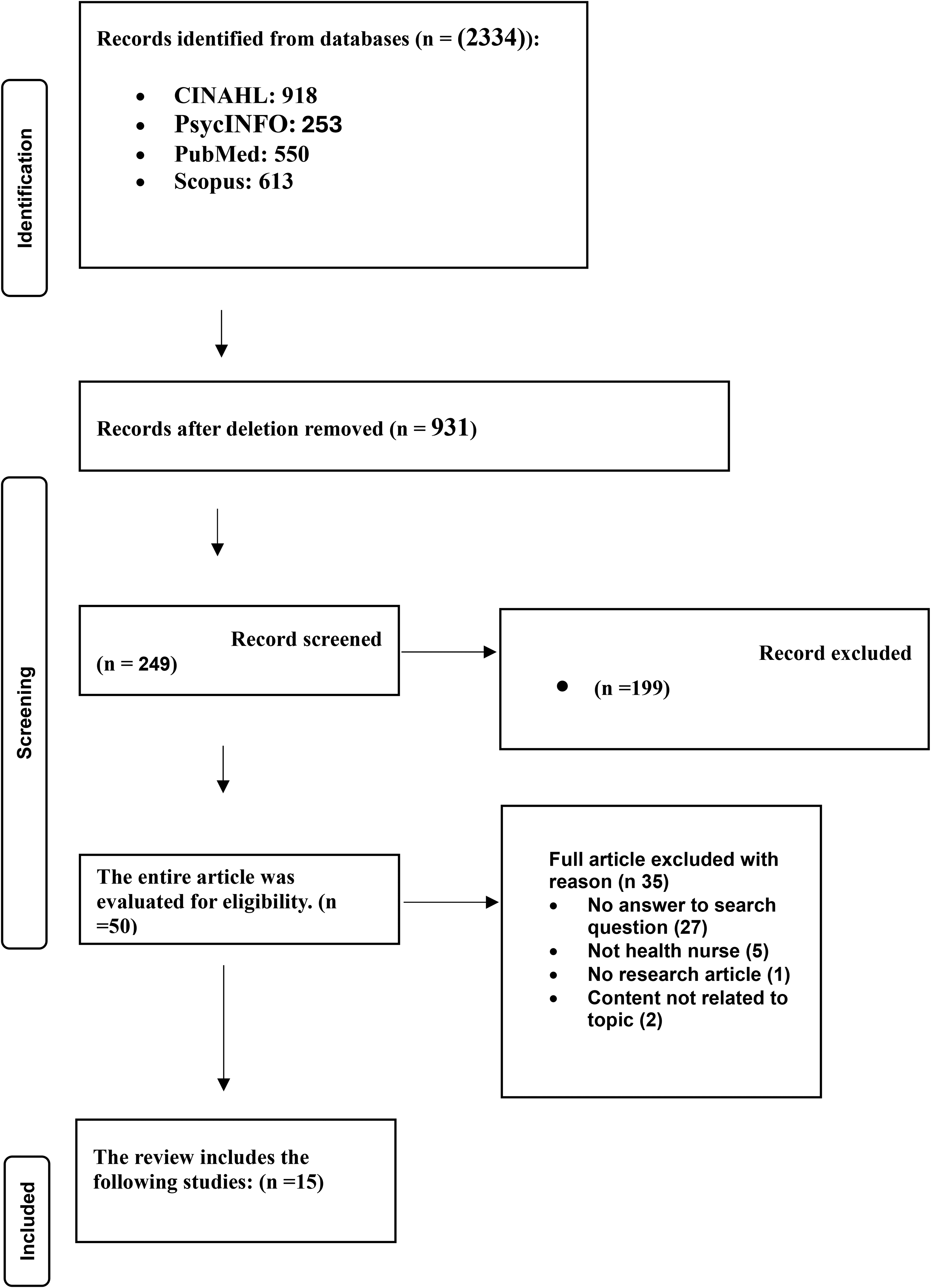
PRISMA 2020 flow diagram describing study selection for systematic review.
Data Extraction
A standardized data extraction form was used to record key information from each included study. This included the author(s), year of publication, and country of origin, as well as details on the study design and setting. Data on sample characteristics—such as age, gender, and nursing role were collected alongside information on the type and pattern of rotating shift schedules. The burnout measurement tools employed and the reported outcomes were documented, together with the key findings and any relevant moderators or interventions identified. Finally, the ethical approval status of each study was noted.
Quality Appraisal
Two reviewers independently assessed the quality of each study using the Joanna Briggs Institute (JBI) critical appraisal tools appropriate for the study design, such as those for cross-sectional or cohort studies. In addition, the Risk of Bias in Systematic Reviews (ROBIS) tool was applied to evaluate the relevance of the study aims, the risk of bias in study identification and selection, and the reliability and transparency of the reported data. Based on methodological rigor, studies were classified as having high, moderate, or low quality. Any disagreements between reviewers were resolved through discussion.
Data Synthesis
Due to the heterogeneity of study designs and outcome measures, a narrative thematic synthesis approach was adopted. This process included a descriptive analysis of study characteristics and outcomes, followed by thematic analysis to identify recurrent patterns across studies, such as emotional exhaustion and sleep disruption. When available, subgroup analyses were conducted based on demographic or institutional variables. The findings were then integrated into a coherent narrative with critical interpretation. A quantitative meta-analysis was not performed because of the variability in measurement tools and the insufficient reporting of effect sizes across the included studies.
Ethical Considerations
This review analyzed data exclusively from previously published studies. Ethical approval was not required for this secondary analysis. However, all included studies were required to have received ethical approval from their respective institutional review boards as part of the inclusion criteria.
Quality Appraisal
To assess the quality of the included studies, the ROBIS tool was used. The appraisal focused on study relevance, risk of bias in study identification, and data collection/analysis. The studies were rated for quality based on the following: Study Relevance: All studies were relevant, but there was variation in methodology. Risk of Bias in Study Identification: The review included studies from three main databases, but did not include a grey literature search, introducing moderate bias risk. Bias in Data Collection & Analysis: Several studies relied on self-reported data, contributing to potential reporting bias.
An overall moderate risk of bias was determined for the systematic review due to the methodological limitations of the included studies as in Table 1. Of the 15 studies reviewed, only a minority—specifically the longitudinal cohort studies (e.g., Fernandez-Mendoza & Vgontzas, 2013; Xu et al., 2025)—were rated as high quality with low risk of bias. The majority of studies was cross-sectional in design and showed moderate to high risk of bias due to reliance on self-reported data and lack of temporal assessment. ”
Quality Rating: A Measurement Tool to Assess Systematic Reviews 2 (AMSTAR 2) and ROBIS Adaptation.

Result
A total of fifteen studies met the eligibility criteria and were included in this systematic review. These studies spanned diverse geographical regions and healthcare systems, including both high-resource (e.g., the USA, Australia, and Switzerland) and resource-limited contexts (e.g., Brazil, Pakistan). The majority employed cross-sectional designs (n = 13), with only two studies utilizing longitudinal cohort designs (Fernandez-Mendoza & Vgontzas, 2013; Xu et al., 2025), thereby limiting the capacity to draw causal inferences.
The reviewed studies collectively indicated a strong association between rotating shift work and elevated burnout levels among nurses. Burnout was most frequently assessed using the MBI, although other tools, such as the GHQ-12 and institution-specific scales, were also used. Variability in instruments and conceptual frameworks contributed to inconsistencies in reported outcomes.
Emotional exhaustion emerged as the most consistently reported dimension across studies. Nurses working rotating or night shifts demonstrated significantly higher levels of emotional fatigue compared to those on fixed shifts. Contributing factors included frequent night duties, minimal recovery time between shifts, and excessive workloads (Dall’Ora et al., 2023; Travaglianti et al., 2016; Zhang et al., 2018). These findings were further supported by cohort data indicating a temporal relationship between shift exposure and emotional depletion (Xu et al., 2025).
Depersonalization, while less frequently examined, was associated with high-stress environments, lack of peer support, and organizational ambiguity. Nurses in rotational schedules often reported increased cynicism and psychological detachment from their professional roles, particularly in understaffed settings (Khan et al., 2020; Maslach & Leiter, 2016).
Reduced personal accomplishment was the least reported dimension. However, when evaluated, it was frequently linked to chronic shift instability, low decision-making autonomy, and a perceived mismatch between effort and reward (Huang et al., 2020; Rodrigues et al., 2023). The limited emphasis on this dimension across studies reflects a potential under recognition of its relevance in occupational burnout trajectories.
Five thematic categories emerged from the synthesis of findings as summary in Table 2: Emotional Exhaustion Nurses on rotating shifts consistently exhibited heightened emotional fatigue, particularly when engaged in night shifts or experiencing inadequate rest periods. (Dall’Ora et al., 2023; Zhang et al., 2018) Work-Life Imbalance Irregular scheduling disrupted personal routines and caregiving responsibilities, contributing to psychological strain and diminished job satisfaction. (Nilsson et al., 2025; Travaglianti et al., 2016)
Summary of Thematic Findings.
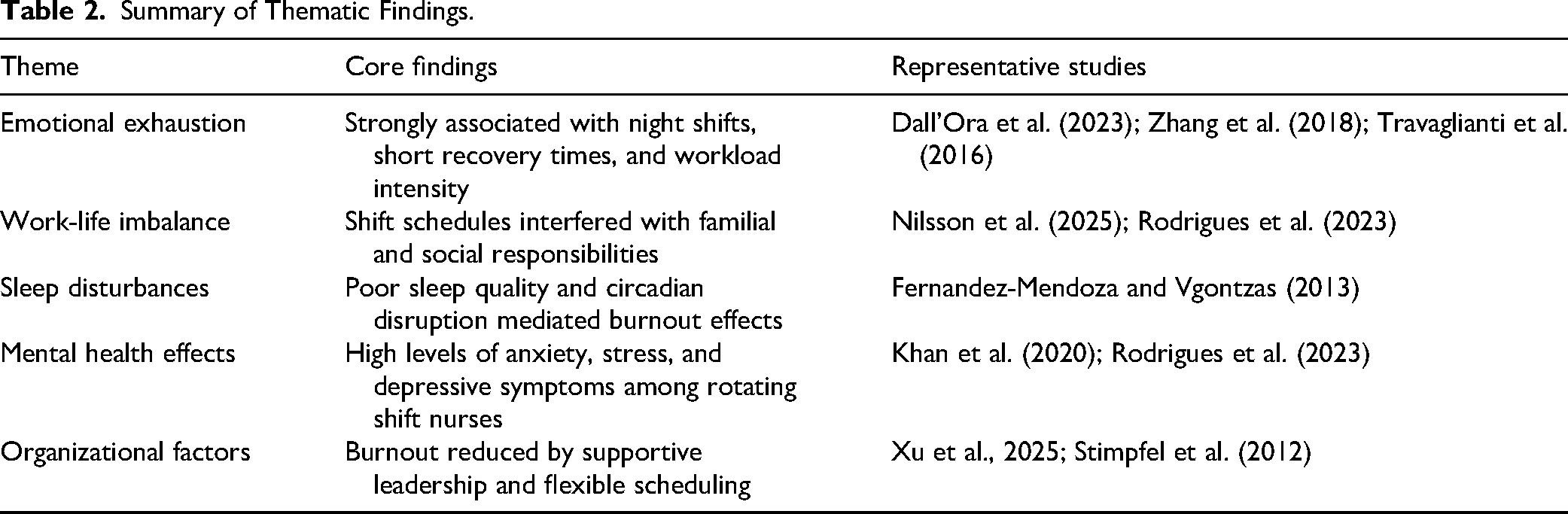
Sleep Disturbances Circadian rhythm disruption, poor sleep quality, and insufficient recovery were commonly reported among rotating shift nurses. These sleep-related impairments were strongly associated with increased burnout severity (Cheng & Drake, 2019; Fernandez-Mendoza & Vgontzas, 2013; Zhang et al., 2018).
Mental Health Implications Multiple studies documented elevated levels of anxiety, depressive symptoms, and perceived stress among nurses with rotating schedules. These mental health outcomes were often comorbid with emotional exhaustion and sleep disorders (Khan et al., 2020; Rodrigues et al., 2023).
Organizational Determinants Inadequate staffing, lack of managerial support, and constrained job autonomy exacerbated burnout. Conversely, protective organizational practices such as flexible scheduling and supportive leadership were associated with lower burnout scores (Stimpfel et al., 2012; Xu et al., 2025).
While not uniformly addressed, several studies identified potential moderators and mediators in the shift work–burnout relationship:
Sleep quality emerged as a frequent mediator, linking shift schedules to emotional exhaustion and mental health outcomes (Fernandez-Mendoza & Vgontzas, 2013; Zhang et al., 2018). Organizational support and job engagement functioned as protective moderators, attenuating the effects of shift-related stressors (Rodrigues et al., 2023; Xu et al., 2025). Individual resilience and coping strategies were inconsistently reported but may influence burnout trajectories.
Quality appraisal using the JBI checklist and ROBIS framework revealed considerable methodological variation. Only two studies (13%) were rated as high quality with low risk of bias due to their longitudinal design and robust analytic techniques (Fernandez-Mendoza & Vgontzas, 2013; Xu et al., 2025). The remaining studies demonstrated moderate to high risk of bias, largely due to:
Heavy reliance on self-reported data; Use of non-standardized burnout tools; Absence of temporal data, restricting causality assessment.
Discussion
This systematic review demonstrates a consistent association between rotating shift work and nurse burnout, particularly with regard to emotional exhaustion. Across the 15 included studies, nurses working rotating schedules—characterized by alternating day, evening, and night shifts reported higher levels of fatigue, psychological distress, and reduced professional efficacy compared to those on fixed or day-only shifts. These findings underscore the systemic impact of shift design on nurse well-being and, by extension, patient care outcomes.
Emotional exhaustion emerged as the most commonly affected burnout dimension. Nurses with frequent night duties, minimal rest periods, and irregular rotations reported greater physical and emotional fatigue (Dall’Ora et al., 2023; Zhang et al., 2018). This exhaustion reflects both circadian disruption and insufficient psychological recovery between shifts. The longitudinal study by Xu et al. (2025) provides stronger evidence for a causal relationship, indicating that burnout symptoms may intensify over time in response to shift exposure.
Depersonalization, though less consistently measured, was associated with environments marked by high stress, poor communication, and inadequate support. Nurses reported emotional detachment from patients and decreased empathy, particularly in understaffed or poorly managed units (Maslach & Leiter, 2016; Travaglianti et al., 2016). This aspect of burnout may reflect adaptive coping in emotionally demanding roles but ultimately undermines care quality.
Reduced personal accomplishment was the least studied dimension, but where measured, was linked to perceptions of ineffectiveness and diminished autonomy. Nurses who lacked opportunities for role clarity or professional development reported a lower sense of achievement, which contributes to dissatisfaction and turnover risk (Huang et al., 2020; Rodrigues et al., 2023).
The review identifies several moderating and mediating factors that influence the relationship between rotating shift work and burnout outcomes. Sleep quality was the most prominent mediator, with multiple studies reporting that circadian rhythm misalignment and poor sleep contributed to emotional exhaustion and mental health decline (Fernandez-Mendoza & Vgontzas, 2013; Stimpfel et al., 2020). Organizational support, including leadership responsiveness, schedule flexibility, and workload distribution, served as protective moderators (Stimpfel et al., 2012; Xu et al., 2025). However, these factors were inconsistently analyzed across studies, limiting generalizability.
Individual characteristics, such as resilience, coping mechanisms, and job engagement, were briefly mentioned in some studies but rarely operationalized. Understanding these personal variables is essential for tailoring interventions to diverse nursing populations.
The heterogeneity of the included studies presents significant challenges to synthesis. There was considerable variation in: Study design: Predominantly cross-sectional, limiting causal inference. Measurement tools: Inconsistent use of validated burnout instruments (MBI vs. GHQ-12). Shift definitions: Varying operationalization of “rotating shift” across studies Cultural and organizational contexts: Differences in health system infrastructure, staffing ratios, and work norms
While the thematic synthesis identified consistent patterns, the absence of a quantitative meta-analysis limits the ability to estimate effect sizes or determine the strength of associations. Future reviews should prioritize more homogeneous inclusion criteria and consider meta-analytic techniques if sufficient comparable data become available.
Additionally, the predominance of self-reported data introduces recall and social desirability bias. Very few studies used objective measures of sleep, workload, or burnout symptoms. The lack of grey literature inclusion also raises concerns about publication bias, as null findings may have been underrepresented.
Strengths and Limitations of the Systematic Review
This systematic review offers a timely and focused examination of the relationship between rotating shift work and nurse burnout, a topic of increasing relevance in healthcare workforce management. Among its key strengths is the clear delineation of rotating shift work from general shift patterns, thereby addressing a notable gap in the literature. While previous studies often conflated shift types, this review distinguishes the unique risks associated with alternating day, evening, and night rotations. This specificity enhances the precision of its findings and implications.
Another significant strength lies in the adherence to rigorous methodological guidelines. The use of the PRISMA 2020 framework for systematic reviews and the JBI and ROBIS tools for quality appraisal ensures transparency, reproducibility, and credibility. Furthermore, the inclusion of four major databases—PubMed, Scopus, CINAHL, and PsycINFO—strengthens the comprehensiveness of the search strategy and minimizes the likelihood of study omission due to database bias.
The review also contributes to the existing body of knowledge by examining burnout as a multidimensional construct, focusing on emotional exhaustion, depersonalization, and reduced personal accomplishment. This contrasts with many previous studies that treat burnout as a unidimensional outcome. Additionally, the thematic synthesis offers valuable insights into mediating and moderating variables such as sleep quality, organizational support, and resilience, highlighting potential intervention targets.
However, several limitations temper the strength of the conclusions drawn. The predominance of cross-sectional designs among the included studies (13 out of 15) significantly limits the ability to infer causality. Without longitudinal data, it remains unclear whether rotating shift work causes burnout or whether pre-existing burnout may influence shift assignment preferences. This issue is compounded by the heavy reliance on self-reported measures, which introduces the risk of recall and social desirability bias.
Another limitation is the heterogeneity of measurement tools used to assess burnout. While the MBI was frequently employed, other studies utilized alternative or institution-specific instruments, impeding cross-study comparisons. Similarly, the operational definitions of rotating shift work varied considerably, further complicating synthesis.
The exclusion of grey literature and the absence of a meta-analytic component due to inconsistent reporting of effect sizes introduce the potential for publication bias and limit the statistical robustness of the findings. Furthermore, while contextual and personal moderators are discussed, they are often inconsistently analyzed or merely hypothesized without empirical validation.
In conclusion, while the review presents a well-structured and comprehensive exploration of rotating shift work and burnout in nursing, its limitations—particularly methodological heterogeneity and lack of longitudinal evidence—underscore the need for more standardized, prospective research. Future studies should integrate objective data, employ consistent measurement tools, and include diverse settings to enhance generalizability and inform evidence-based workforce policies.
Implications for Research, Policy, and Practice
This review underscores the urgent need for longitudinal, mixed-methods research to better establish the temporal relationship between shift work and burnout, and to explore the interplay of institutional and personal factors over time. Future studies should employ standardized and validated burnout measures across diverse settings, integrate objective data such as autography or electronic scheduling logs, and disaggregate burnout dimensions to clarify the specific effects of shift-related variables. Research should also examine subgroup differences, including comparisons between intensive care and general ward nurses, as well as early career versus experienced staff.
From a policy perspective, healthcare organizations should adopt evidence-informed shift scheduling practices that limit the number of consecutive night shifts, avoid abrupt rotations, and ensure adequate recovery time between shifts. Complementary intervention programs—such as resilience training, peer support groups, mental health counseling, and managerial training—have shown promise in mitigating burnout and improving staff retention (Huang et al., 2020; Rodrigues et al., 2023; Roman et al., 2023). Tailoring these interventions to specific clinical contexts, such as emergency departments or oncology wards, and rigorously evaluating their outcomes through intervention trials, represents an essential next step in translating research findings into effective workforce strategies.
Conclusion
This systematic review demonstrates that rotating shift work is significantly associated with increased burnout among nurses, with the strongest effects observed in the domain of emotional exhaustion and, to a lesser extent, in depersonalization and reduced personal accomplishment. Contributing factors include frequent night shifts, insufficient recovery periods, disruption of circadian rhythms, and organizational shortcomings such as inadequate staffing and limited managerial support. Although these patterns are consistent across diverse healthcare contexts, the strength of the evidence is constrained by the predominance of cross-sectional designs, variation in measurement tools, and reliance on self-reported data.
The review also highlights several moderating and mediating factors—most notably sleep quality, organizational culture, and individual resilience—though these variables were inconsistently examined across studies. Moreover, the current literature lacks quantitative synthesis, standardized outcome reporting, and a thorough exploration of causal pathways. Addressing these gaps will require longitudinal and prospective research designs, the consistent use of validated burnout measures, systematic analysis of organizational and demographic moderators, inclusion of effect size estimates, and integration of objective workload and sleep data. Intervention trials aimed at testing burnout prevention strategies in rotating shift contexts are also warranted.
From a practice and policy perspective, the evidence supports structural reforms in nurse scheduling, including minimizing consecutive night shifts, optimizing shift rotations, and ensuring adequate recovery time between shifts. These efforts should be complemented by institutional support mechanisms such as mental health services, resilience training, and participatory scheduling, which can strengthen workforce resilience. By implementing targeted, evidence-based interventions, healthcare systems can reduce burnout risk, promote nurse well-being, and improve both patient care outcomes and organizational sustainability.
Supplemental Material
sj-docx-1-son-10.1177_23779608251374232 - Supplemental material for The Impact of Rotating Shift Work on Nurse Burnout: A Systematic Review of Contributing Factors and Organizational Strategies
Supplemental material, sj-docx-1-son-10.1177_23779608251374232 for The Impact of Rotating Shift Work on Nurse Burnout: A Systematic Review of Contributing Factors and Organizational Strategies by Mohammed Qtait, PhD, Mohammad Faisal Al Ali, PhD and Yousef Jaradat, PhD in SAGE Open Nursing
Footnotes
Acknowledgments
We acknowledge the midwives who participated in the study.

Ethical Approval and Consent to Participate
Ethics approval was obtained from the University Ethics review committee (ppu.nur-22/02/25). Informed consent was obtained from each participant with an assurance of anonymity and confidentiality.
Funding
The authors received no financial support for the research, authorship, and/or publication of this article.
Declaration of Conflicting Interests
The authors declared no potential conflicts of interest with respect to the research, authorship, and/or publication of this article.
Data Availability Statement
Data for this study would be available upon reasonable request from the principal investigator.
Supplemental Material
Supplemental material for this article is available online.
References
Supplementary Material
Please find the following supplemental material available below.
For Open Access articles published under a Creative Commons License, all supplemental material carries the same license as the article it is associated with.
For non-Open Access articles published, all supplemental material carries a non-exclusive license, and permission requests for re-use of supplemental material or any part of supplemental material shall be sent directly to the copyright owner as specified in the copyright notice associated with the article.
