




Abstract
Introduction
The COVID-19 pandemic significantly impacted the world in 2020. Every country adopted quarantine measures to prevent the transmission of the coronavirus infection. These measures resulted in dramatic changes in the daily lives of most people. In the academic world, students faced a shift from the traditional classroom-based teaching to virtual distance learning platforms. This shift in nursing education posed challenges both to the instructors and students as they were not fully prepared for this transition.
Objective
The study assessed the nursing students’ satisfaction with the virtual learning experience during the COVID-19 pandemic in selected nursing colleges in India.
Methods
The study was conducted in four nursing colleges in India. A total of 1,166 Diploma, Post Basic BSc (N), BSN, and MSN nursing students participated in the study. Ethical approval was obtained from all the nursing colleges included in the study. The Google Forms satisfaction survey included student, teacher, course, technology, environmental, and practical dimensions.
Results
The response rate was 86.31% (n = 1,166). The overall satisfaction with virtual theory and practical classes has a mean and SD score of 67.14 + 11 and 16.21 + 3.46, respectively. The results showed that overall 51% of the students had good satisfaction with virtual theory classes while 48% had moderate satisfaction. In terms of overall satisfaction with virtual practical classes, approximately 39% had good satisfaction, 58% had moderate satisfaction and nearly 3% had poor satisfaction. In addition, the students expressed that they had good satisfaction with Teacher dimension (64.3%), Student dimension (63%), and Course dimension (57.2%). On the contrary, they expressed poor satisfaction in the Technical dimension (11.3%) and Environmental dimension (5.6%). The results showed that the courses, the place of attending class, and health issues were significantly associated with the student's level of satisfaction with virtual learning.
Conclusion
Although the majority of the students rated their satisfaction level as being “good” in virtual theory classes and “moderate” in virtual practical learning, most of them were dissatisfied with the Technical and Environmental dimensions of virtual learning. This results calls for blended learning strategies to be designed to enhance better learning outcomes and, to ensure deepened level of satisfaction with virtual learning activities.
Introduction/Background
COVID-19 is a highly contagious disease and pandemic that disrupted most of the sectors globally. It had a major impact on health, education, and economy worldwide (Haleem et al., 2020). By the end of April 2020, 186 countries implemented nationwide lockdowns which affected 73.8% of enrolled learners (UNESCO, 2020). Complete lockdown led educational institutions to adopt virtual learning as traditional face-to-face learning became impossible due to this unprecedented situation (Chadda & Kaur, 2021; Selvaraj et al., 2021). As a result of the prolonged lockdown, both private and government institutions adopted remote learning to mitigate the negative impact of the pandemic on learning (Ebrahimi et al., 2020) and to keep academic activities open (Muthuprasad et al., 2021). Consequently, both, teachers and students were required to embrace various online platforms in order to actively participate in the teaching learning process as the pandemic spread (Chadda & Kaur, 2021).
In India, online education was initiated by the government supported by various online platforms including Study Webs of Active learning for Young Aspiring Minds (SWAYAM), National Repository of Open Educational Resources (NROER), E-Yantra (Robotics education), and Free and Open Source for Education (FOSSEE) (Amita, 2020). In addition to the national platforms, various international internet-based tools and platforms like Google Meet, Google Classroom, Webex, and Zoom meeting were used by the faculty and students. Furthermore, text messaging applications such as WhatsApp groups were adopted by teachers, students, and parents for effective communication through e-medium (Jena, 2020). As a remedy to the prolonged lockdown the regulators of education motivated the educational institutions to adopt innovative online educational approaches. While these measures were taken to enhance the educational process during COVID-19 pandemic, they nevertheless affected the students’ learning, clinical placements and created increased stress among the affected students who were forced to adapt to the change (Amita, 2020).
Review of Literature
Nursing education usually includes onsite lectures, clinical and laboratory training, community work, and group projects (Ilankoon et al., 2020). However, the COVID-19 pandemic negatively affected how nursing education was conducted. This negative impact arose because many colleges and universities stopped face-to-face classes as the crisis escalated to ensure the safety of nursing students and the faculty. The clinical placement in the skills laboratory and the hospitals were suspended or restricted to safeguard the health of the faculty and students (Tomietto et al., 2020). Since nursing curriculum is not designed to have a complete distance education (Ahmed et al., 2020a, 2020b), the pedagogical transition from traditional to distance learning posed major challenges in nursing education (Langegård et al., 2021).
The problem was compounded by the fact that the unknown time span of COVID-19 pandemic and suspension of laboratory and clinical teaching in the hospitals severely affected the students learning experience (Agu et al., 2021; Jang & Han, 2021). This meant that nursing students were limited in skill development as the nursing faculty was forced to deliver both theoretical and practical sessions online. Furthermore, the lack of clinical practice limited the ability of the nursing students to perform various nursing roles. The virtual classes reduced the interaction between the students and instructors (Diab & Elgahsh, 2020; Santos, 2020). In addition, there were reports of students experiencing difficulties in concentrating on learning and facing challenges in interacting with the instructors (Diab & Elgahsh, 2020; Ramos-Morcillo et al., 2020). Moreover, some students became anxious, tense, stressed, and apprehensive as a result of these rapid unexpected changes (Chan et al., 2020). Besides the students and faculty, even the parents faced unprecedented challenges. A key development was that parents of these students were compelled to provide internet services and technology to help their children access online classes (Agu et al., 2021).
In terms of acceptance of the online mode of learning, initial reaction was that of difficulties depending on the availability of internet infrastructure. However, with time students started accepting both online and onsite modes of teaching (Chadda & Kaur, 2021). As the acceptance grew, majority of the students preferred smart phone for online learning in the absence of onsite teaching (Muthuprasad et al., 2021). By comparing different professional programs, researchers found that while majority of students preferred distance learning using digital tools; most of the nursing students on the other side preferred onsite education (Langegård et al., 2021). This difference in preference may be attributed to the fact that in nursing education, while online learning is acceptable for theoretical teaching, the situation is somewhat complex for clinical courses because of the difficulties encountered by the faculty and students in achieving clinical objectives. This is because accessing practical learning using virtual and high fidelity simulation is costly and least accessible to most nursing students because of infrastructure availability and limitations especially in remote areas (Agu et al., 2021).
Since online nursing education during this pandemic posed several challenges which negatively affected the delivery of quality clinical nursing education services, understanding the level of satisfaction of the nursing students with virtual classes would help in preparing the most suitable teaching and learning strategy for nursing students during future pandemics. Moreover, the current study had the capacity to suggest to curriculum developers and policy makers insights that might be useful in updating nursing curricula with essential elements required to integrate online teaching and preferred clinical learning strategies.
Methods
Design
This study adopted a quantitative cross-sectional descriptive survey design.
Research Question
How satisfied were nursing students’ with virtual learning during the COVID-19 pandemic?
Setting
The study was conducted among nursing students of Hindu Mission College of Nursing, Tamil Nadu, Sri Gokulam Nursing College, Kerala, St. Lukes College of Nursing, Andhra Pradesh, and Narayana Hrudayalaya College of Nursing, Karnataka. These colleges initiated virtual classes from April 2020 and were therefore selected as settings for the study.
Population
The target population of the study included Diploma, Post Basic BSc (N), BSN, and MSN nursing students. The accessible population of the study comprised of Diploma, Post Basic BSc (N), BSN, and MSN nursing students studying in Hindu Mission College of Nursing, Sri Gokulam Nursing College, St. Lukes College of Nursing, and Narayana Hrudayalaya College of Nursing.
Sample, Sample Size, and Sampling Technique
Using convenient sampling method, 1,166 students were recruited in the study. In total, 470 students were sampled from Hindu Mission College of Nursing, 327 students from Sri Gokulam Nursing College, 210 students from St. Luke’s College of Nursing, and 344 students from Narayana Hrudayalaya College of Nursing as study participants.
Inclusion and Exclusion Criteria
Diploma, Post Basic BSc (N), BSN, and MSN nursing students in the second, third, and fourth years of study who were willing to participate in the study were included. However, first-year students were excluded from the study since they had limited exposure to virtual classes and were not involved in virtual clinical learning experiences, and therefore deemed unable to provide accurate data.
Description of Study Instruments
The instruments used in the study were prepared by the investigators of the study. It included three sections namely demographic variables, background variables, and satisfaction survey scale.
Section I
The demographic variables included gender, age, name of the course, year of study, marital status, residence, place of attending the class, education, and occupation of the head of the family.
Section II
Background variables included average hours of virtual session per day, average duration of a session per day, type of gadgets used, source of internet, quality of the network, virtual platform used, and any health issues related to virtual classes, part-time job, and need of a new device.
Section III
This section comprised of satisfaction survey scale which consisted of six domains, that is, Student dimension (five items), Teacher dimension (five items), Course dimension (three items), Technology dimension (four items), Environmental dimension (three items), and Clinical/practical dimension (five items). Dimensions were evaluated using 5-point Likert scale varying from Strongly Disagree (1), Disagree (2), Neutral (3), Agree (4) to Strongly agree (5). The total score ranges from 20 to 100. The domain wise total satisfaction were categorized into less than 33% = Poor satisfaction, 33%−67% = Moderate satisfaction, and above 67% = Good satisfaction. The instrument was prepared in English and no translations were done. Content validity was obtained from six experts in nursing education. The content validity index was 0.88. The Cronbach's alpha coefficient reliability score of the scale was 0.94.
Ethical Considerations
Ethical approval was obtained from the Research and Ethics Committee of Narayana Hrudayalaya College of Nursing (NHH/AEC-CL-2020-601 dated 26/12/20), St. Lukes College of Nursing (LUKES CON- EC -25 dated 23/12/20), Sri Gokulum Nursing College (SGMC IEC/606/03/2022/F dated 15/10/2020) and Hindu Mission College of Nursing (HMH/IEC/2020/EA55 dated 23/10/2020). After getting the ethical approvals, formal permission was obtained from the Head of the Nursing colleges to collect the data. The data collection instruments were transferred to Google Forms and were sent to the nursing students of the respective colleges. The study purpose was explained in detail in the Google Forms. Participation in the study was voluntary since participants were not forced to participate and they were free to withdraw from the study at any time without any penalty. A participant was implied to have given consent when they answered all the questions and returned the completed questionnaire. Since this was an online survey, the participants were therefore not exposed to any kind of risk. To keep the data anonymous, no identifying information was collected from the participants. The researchers maintained confidentiality of information throughout the study period. The data were secured using password protection to restrict any unauthorized access.
Data Collection and Data Analysis
The data were collected from December 27, 2020 to January 8, 2021. The data were collected through the Google Forms developed by the researchers. The created link was shared with the participants through their official school emails. Each participant was restricted to one time response. The response of the survey was assessed and checked individually for completeness, and the data were coded, entered into the database and processed using Statistical Package for Social Sciences (SPSS) version 22.0 for windows.
Results
Description of Study Participants
The details of the study participants presented inform of the demographic characteristics and inform of the baseline variables:
Demographic Characteristics
Table 1 shows the frequency and percentage distribution of participant's demographic variables. Majority of the participants were females (88.6%). In terms of their study programs, 78.4% of the students were undergraduate (BSN) nursing students, 17.6% were Diploma, while the rest were either Post Basic BSN or MSN students. In terms of year of study, 31.6 of the participants were in their third year of study. In relation to the marital status, 95.4% of participants were unmarried. Regarding the places where the students lived, 23.9% lived in urban areas and 32.8 in semi-urban while the majority (43.3%) lived in rural areas. In terms of where the students attended the online classes, majority of them (82%) attended from their homes. Regarding their states, 32.7% of the participants belonged to Tamil Nadu, followed by Kerala with 26.7% of the students with least of 17% from Andhra Pradesh. In terms of the socioeconomic status, 31.7% of the students belonged to upper middle class followed by 26.8% from upper lower middle class
Frequency and Percentage Distribution of Demographic Variables of Nursing Students (n = 1,166).

Frequency and Percentage Distribution of Baseline Variables
Table 2 shows the frequency and percentage distribution of participants’ baseline variables. The results show that most (44%) students had virtual classes for less than 4 h per day, followed by 42.8% who had 4–6 h of class per day and the rest had classes from 6 h and above. In terms of the duration of the sessions, more than half of students (54%) had 1 h sessions while the rest ranged from 45 min to 2 h for each session. In terms of the gadgets used for the online education, vast majority (94%) used mobile phones as their source of internet being mobile data. In terms of the experience with service interruption, 41.8% mentioned that they experienced interruption during the online classes, while 58.2% reported no interruptions. Regarding whether they engaged in part time work, the vast majority (87.7%) reported were not doing part-time job. In terms of the use of new devices, 29.8% bought new devices for attending the online classes, while the rest 70.2% reported using the usual devices for the online classes. In regard to the online platform, nearly half (48.2%) used Zoom followed by Google Meet at 5.6% while attending online classes. The remaining used multiple platforms such as Google Classroom, Moodle, Microsoft Team, and Webex. In terms of health status, more than half (77.7%) of the students expressed they had health issues while attending online classes and the most common being headache (22.6%) followed by back ache (14.2%) with the majority (44.3%) experiencing multiple health issues.
Frequency and Percentage Distribution of Baseline Variables of Nursing Students (n = 1,166).

Student's Satisfaction With Online Classes
As shown in Figure 1, slightly more than half of the students (51%) had good satisfaction with the virtual theory classes while 48% of them had moderate satisfaction. In addition, as shown in Figure 2, around 39% had good satisfaction and 58% had moderate satisfaction with virtual practical classes. As shown in Figure 3, the domain/dimension wise satisfaction of students with the online theory classes revealed that students had good satisfaction with Teacher dimension (64.3%), Student dimension (63%), and Course dimension of 57.2%. Furthermore, students had poor satisfaction with the Technical dimension (11.3%) and Environmental dimension (5.6%) of the online learning experience.

Overall satisfaction of nursing students with virtual theory classes.

Overall satisfaction of nursing students with virtual practical classes.

Domain/dimension wise satisfaction of nursing students with virtual classes.
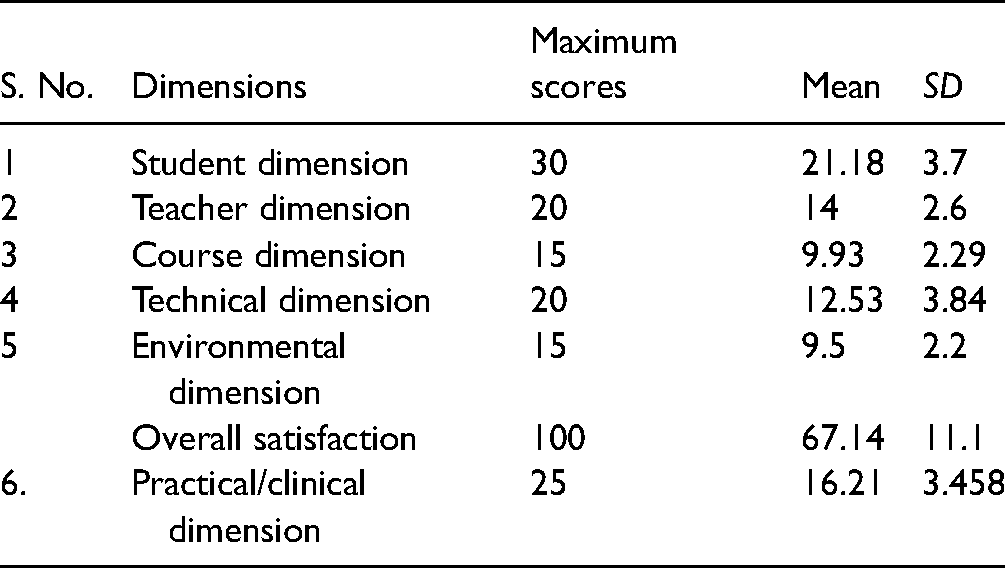
As shown in Table 3, the student's satisfaction with theory classes were focused on five domains, namely Student dimension, Teacher dimension, Course dimension, Technical dimension, and Environmental dimension. The overall satisfaction mean and SD for theory classes were 67.14 ± 11, respectively, while that of the Practical dimension was 16.21 ± 3.46, respectively, with a maximum score of 25.
Mean and SD of Satisfaction of Nursing Students With various Dimensions of Virtual Learning.
As highlighted in Table 4 regarding the item wise satisfaction, the results of the Student dimension, indicated that most (63%) of the students agreed that they understood the learning need during the pandemic. Furthermore, majority of them (61.7%) never used the opportunities to ask for clarifications. Around three fourth (75.7%) of the participants reported that faculty motivated the students to continue the session, while 80.4% of students mentioned that their communication with faculty has improved through various platforms. Similarly, 69.9% of the participants agreed that the internal exams were conducted online effectively while slightly over half of them (58%) completed the exam during the pandemic.
Nursing Students’ Satisfaction on Virtual Learning (n = 1,166).

Considering the Teacher dimension, majority of them (79.7%) expressed that the faculty clarified their doubts whenever asked online. Around (64.4%) instructors understood the learning needs of the students and used different teaching methods. Nearly half of (54.4%) of the faculty used the digital platform effectively, while, (25.3%) did not handle it effectively. Finally, majority (85.1%) of participants agreed that faculty efficiently shared feedback and followed-up effectively.
In terms of Course dimension, more than half (57.9%) agreed that the course objectives were achieved while (43.8%) mentioned that they experienced lack of materials like e-textbook, PowerPoints, and video. Regarding the internal and external evaluation, nearly half of the students (47.8%) considered the evaluation as being fair and only (15.6%) believed it was unfair.
Concerning the Technology dimension, around half of the participants, (49%) expressed that the quality of virtual classes was clear, whereas (28.1%) conveyed neutral response. In addition, 48.5% of the participants felt that the technology enhanced their learning, whereas up to 30.8% of the students were not comfortable with online classes. In terms of satisfaction with the internet connectivity, less than half 44% of the participants were comfortable with the internet connectivity.
Pertaining to Environmental dimension, (39.9%) participants mentioned that their teaching-learning was affected by environmental disturbance. In addition, slightly more than half, (51.2%) of students reported reduced interaction with peer groups during the virtual learning. Also, in terms of their satisfaction with attending virtual classes during the pandemic, the results show that only (43.5%) were comfortable attending virtual classes.
Lastly, concerning satisfaction with the Clinical/practical dimension, slightly over half (56%) of the students agreed that their instructors used a suitable video/ lab demonstration to teach the practical classes. However, only one-third of the students (32.3%) were comfortable with virtual learning of clinical practice. Almost half of the participants (48.9%) did not get proper exposure to practical aspects of nursing procedures with 69.03% of participants being worried about their practical exam/clinical exam as a result. Consistent with the above satisfaction level, only a third, (36.3%) of the nursing students indicated that online practical classes helped them to achieve the course objectives.
In terms of the Association of the participants’ demographic variables with student satisfaction with online education during the pandemics, the chi-square test revealed no association with the student's gender, place of residence, state, presence of interruption, and the online platforms used. However, significant association was found between the course, (p < .01), the student's place of attending the class (p < .05), and presence of health issues (p < .001).
Discussion
Global impact survey by the International Association of Universities reported that 90% of the institutions were completely shut down during the COVID-19 pandemic and around two-thirds of the institutions shifted to digital classes through Zoom, Google Meet, etc. (Marinoni et al., 2020). In response to the pandemic situation, virtual learning became the new norm in the field of education including medical and nursing education as a safety measure in the prevention of COVID-19 (Ahmed et al., 2020a, 2020b; Taha et al., 2020). Although virtual learning was the choice of education to students across the word, the transition from traditional to online learning posed many challenges. Therefore, the authors studied the satisfaction of nursing students with virtual learning during the pandemic in order to design strategies to enhance the learning of students during future instances.
While virtual learning is reported by some authors as causing social isolation, lack of motivation and difficulties in communicating with the instructors and peers (Niebuhr et al., 2014; O’Doherty et al., 2018), a large number of students in the current study reported the opposite. In fact, many reported that their communication with faculty improved through various platforms. However, while the communication improved, majority of the participants seize the opportunity to ask clarifications from the faculty members. The reason for this was not clear, and the only explanation might be that the stress and anxiety built up in the students during virtual classes which might have interfered with the communication between the instructor and students. Moreover, the quality of teaching and communication gets affected due to the lack of skill of the instructor in using the online teaching platform, lack of interest and lack of institutional support (O’Doherty et al., 2018). This finding implies that instructors must understand students’ inability to clarify doubts, as a remedy they should clarify any queries during virtual classes. Additionally, the instructors should develop skills in using computer technology and other multimedia to enhance communication with the students. Additionally, the smaller class size improves better interaction between the teacher and learner. Also, interactive groups are recommended to have collaborative interaction and discussion (Zubiri-Esnaola et al., 2020).
When comparing face-to-face learning with online learning, research shows that students’ score tend to be significantly higher during face-to-face learning compared to virtual learning. This improved performance could be due to direct supervision and monitoring by the instructors and interest of the students toward face-to-face learning. Moreover, the students can clarify their doubts immediately during face-to-face learning (Arias et al., 2018). Likewise, nearly half of the students in the present study expressed neutral and disagree responses related to passing online internal and external exam. Online exams have been tried in Australia (Hillier et al., 2018), Finland (Laine & Tirri, 2016), Saudi Arabia (Alsadoon, 2017), and many other countries including India (Shakeel et al., 2021). Although these online examinations represented advantages including test security, time reduction, quick assessment, cost effectiveness, automatic record keeping for learning analytics and item analysis, and secure data collection (Ilgaz et al., 2020), they have disadvantages such as hurdles in technology, support from external sources, tiredness of examinees and lack of training of students in using technology (Clark et al., 2021; Nguyen, 2017). These challenges might have been the reason for neutral and disagree levels of satisfaction among study participants. This finding implies the need by educators to plan and implement policies to train nursing faculty and students to use virtual platforms effectively.
In terms of the opportunities virtual learning opens, there is evidence in literature that virtual education creates several benefits in education including fast completion of theoretical content of the curriculum as it saves time (Agustina & Cheng, 2020; Rajab et al., 2020; Syauqi et al., 2020). The participants too agreed that the course objectives were achieved during virtual learning, even though they experienced lack of materials like e-textbook, PowerPoints, and videos. In fact researchers have argued that virtual teaching and learning will become more effective if more audio, video and interactive learning materials are provided to the students to improve collaborative learning among them (Gómez-Rey et al., 2018). This warrants the educational institutions to keep the electronic study materials available to the students to enhance their learning process.
Since, information technology is a tool necessary for teaching and learning in the current era, educational institutions should therefore develop the required infrastructure to enhance virtual and interactive learning (Johnson et al., 2016). Moreover, the students are required to have computer and internet connectivity to have an effective virtual learning (Dhawan, 2020). Nonavailability of computer, internet connection, and accessories can be a barrier for virtual learning. In addition, the software problems related to audio and video conferencing, unfamiliar technology and lack of skill and training of the faculty may pose additional challenges to virtual teaching and learning (Achmad et al., 2021; Khobragade et al., 2021; Rotas, & Cahapay, 2020; Shahmoradi et al., 2018). As highlighted in literature, most participants in the study faced several challenges and were thus dissatisfied with the quality of virtual classes, technology and internet connectivity. Additionally, the students had poor satisfaction in technology domain. Therefore, technological barriers should be addressed to enhance virtual learning. Besides, the students should have accessibility to reliable Wi-Fi, updated multimedia devices, and a suitable quiet room to have effective virtual learning (Alruwais et al., 2018; Fuller et al., 2020). If the technical barriers are minimized by improving the internet connectivity, the quality of virtual learning can be improved. Moreover, professional training is required for the faculty to understand new technologies in an online environment (Salas-Pilco et al., 2022). The authors recommend that the faculty of nursing educational institutions learn and adopt recent technologies to improve the quality of virtual classes.
During virtual learning sessions, most students lived in their residences. This poses several challenges to the students due to environmental disturbances (O’Doherty et al., 2018). Comparable results are found in the current study as most of participants mentioned that their teaching-learning was affected by environmental disturbance. Moreover, their interaction with peer groups reduced during the virtual learning. As found in the present study, students were less motivated in attending online classes in many other studies reported across the world (Abbasi et al., 2020; Al-Azzam et al., 2020; Altaweel, 2021; Amir et al., 2020; Chang et al., 2014; Changiz et al., 2013; Chen et al., 2020; Gómez-Rey et al., 2018; Kaczmarek et al., 2021; Khobragade et al., 2021; Sarwar et al., 2020). On the contrary, only few studies reported that the students were satisfied with online learning (Donn et al., 2021; Hung et al., 2021; Sadid-Zadeh et al., 2021; Schlenz et al., 2020; Wang et al., 2021). Therefore, these differences in perception should be explored further to understand the reasons for satisfaction and dissatisfaction toward virtual learning.
Despite the challenges faced during the pandemic, nursing educators employed various clinical teaching strategies including online small group discussions, virtual clinical simulations, video chats, digitally recorded demonstrations, online discussion boards, and other possible methods to supplement clinical learning (Singh, & Haynes, 2020). However, despite the efforts of educators, the nursing students tend to be dissatisfied with the virtual practical learning sessions noting that it does not meet their learning needs (Dutta et al., 2021; Oducado & Estoque, 2021). Likewise, in the current study, majority of the participants had moderate and poor satisfaction with the virtual practical sessions. The results show that whereas virtual learning is an effective teaching tool during this pandemic; it is not an efficient tool for replacing clinical nursing education. However, other scholars have observed that virtual learning can be made user-friendly by minimizing technical barriers; in addition, to introduction of other strategies such as virtual reality to enhance practical learning in nursing education (Thapa et al., 2021).
Strengths and Limitations of the Study
The study findings are limited to only four nursing colleges in India. Therefore, the study findings may not be generalizable to other states. As the study population was not selected through probability sampling strategy, the representativeness of samples might be lacking in the current study. Moreover, the study instruments were prepared by the investigators of the study that did not undergo rigorous standardization process, which might limit the strength of the study.
Implications for Practice
Nursing education through virtual learning can be enhanced by minimizing the technical barriers, reducing environmental disturbances, providing electronic study materials to the learners, and by training the nursing faculty on effective use of online teaching strategies. The quality and satisfaction of virtual learning can be enriched by providing a user-friendly virtual learning environment. Hybrid and blended teaching-learning strategies may further improve the learning among nursing students.
Conclusion
The authors conclude that most students had good satisfaction with virtual theory classes and moderate satisfaction with virtual practical learning. In specific terms, they had poor satisfaction with the Technical and Environmental dimensions of the virtual learning experience. The authors recommend that blended learning integrating both virtual and face-to-face learning opportunities will be beneficial to both the nursing educators and students.
Footnotes
Acknowledgment
The authors would like to acknowledge the nursing students who have participated in the study across India. Special thanks to the administrators and faculty members of the institutions for their motivation and support during data collection.
Declaration of Conflicting Interests
The author(s) declared no potential conflicts of interest with respect to the research, authorship, and/or publication of this article.
Ethical Approval
Ethical approval was obtained from the Research and Ethics committee of Narayana Hrudayalaya College of Nursing (NHH/AEC-CL-2020-601 dated December 26, 2020), St. Luke’s College of Nursing (LUKES CON-EC-25 dated December 23, 2020), Sri Gokulam Nursing College (SGMC IEC/606/03/2022/F dated September 15, 2020), and Hindu Mission College of Nursing (HMH/IEC/2020/EA55 dated September 23, 2020).
Funding
The author(s) received no financial support for the research, authorship, and/or publication of this article.
