




Abstract
Introduction
Academic incivility in students has the potential to undermine the learning process because it affects both the perpetrator and the educator. This results from the reduced trust between students and faculty resulting in a reduction in productivity, thereby impeding the learning process.
Objectives
The study was conducted to understand the perception and factors contributing to academic incivility among undergraduate nursing students.
Methods
A descriptive cross-sectional survey was conducted. A total of 250 undergraduate nursing students studying in three nursing colleges in India participated in the study. A convenience sampling approach was used to recruit the participants. A 13-item Uncivil Behavior in Clinical Nursing Education (UBCNE) tool was used to collect the data.
Results
The study found that 7.56% of the sampled nursing students always indulged in uncivil behavior, 9.51% of them often indulged in uncivilized activities, while 20.06% of them reported sometimes indulging in uncivil behavior. This means that 37.45% of the nursing students sampled engaged in some forms of uncivil behavior. In contrast, the study found that 62.55% of the nursing students never indulge in uncivilized activities. The contributing factors of academic incivility were the academic setting, the student's academic preparation, the teacher's attitude, emotional disturbance, substance abuse, cultural issues, and social issues. There was no significant association between the demographic variables and the level of perception on academic incivility among nursing students at p < .05.
Conclusion
It is important to understand the perceptions and factors that predispose students to engage in uncivil behavior given the prevalence of this educational challenge. Corrective strategies are needed to educate the perpetrators about the ill effects of their actions.
Introduction/Background
Civility refers to being kind and polite in disposition and speech. Civil behavior refers to showing polite behavior toward others and ensuring that their dignity is maintained. Conversely, incivility is defined as the negative behavior of insulting others or being rude and disrespectful (Shoorideh et al., 2021). Incivility creates an atmosphere of disrespect, conflict, and stress (Farzi et al., 2021). Uncivil behaviors are disruptive or impolite behaviors that can result in psychological distress, health problems, threatening conditions, and temporary or permanent injuries for the individual involved if left unmanaged (Safarpour et al., 2022). In the literature, several terms describe incivility or uncivil conduct. These terms include lateral violence, bullying, cyberbullying, violence, disruptive behavior, horizontal violence, mobbing, and misconduct (Bambi et al., 2018).
In recent years, there appears to be an increase in uncivil behavior among students taking the form of sleepers (sleeping in the class), latecomers (coming late to attend the lectures), mobile phone addicts (obsessive use of a smartphone), and ill-mannered students especially in undergraduate programs (Hasanvand et al., 2019). In higher education, incivility manifests as any disruptive behavior that occurs in learning environments there by negatively affecting the learners and the teachers (Small et al., 2024). In fact, scholars seem to agree that both students and faculty may contribute to a climate of disrespect for one another or to the learning process, implying that student incivility will be a reciprocal process triggered by both the teacher and the learner (Small et al., 2024).
Review of Literature
Academic incivility often manifests as a behavior that distracts the instructor or other students, classroom or clinical learning, or discourages the instructor from teaching and discourages other students from participating, thereby derailing the instruction process (Hasanvand et al., 2019). Several factors contribute significantly to academic incivility. These include outsized classes, improper evaluation of students, multiple task assignments, financial burden, lack of time management, lack of support, and faculty member or student incivility. In addition, psychosocial or personal health-related problems contribute to academic incivility (Al-Jubouri et al., 2021).
Regardless of the cause, uncivil behavior has devastating effects on all affected parties and it often results in several psychosomatic manifestations such as increased stress levels, headaches, insomnia, immune system suppression as well as mood disorders, and low self-esteem (Farzi et al., 2021). In extreme cases, incivility can lead to suicide, anxiety and depression, cognitive impairments, revenge, and violence (Farzi et al., 2021). When students are the reason for incivility, it creates disruption in professors’ interpersonal relationships with students, causing a decreased job satisfaction rate in educators and increased student absenteeism, all leading to psychological exhaustion (Al-Jubouri et al., 2021). Since more negative implications are seen, faculty considers incivility among undergraduate nursing students as one of the major challenges which affects the classroom and clinical education (Ehsani et al., 2023).
As a profession, nursing historically cherishes diligence and civil behavior; however, nursing faculty are easily susceptible to uncivil behavior of the students which often ranges from rudeness on the one end and extend to physical assault and loss of life on the extreme other end (Ehsani et al., 2023). In a way, uncivil behavior violates the implied understanding of respect for the learning process and the academic institution. Faculty decry incivility in the nursing programs. Academic incivility often triggers faculty shortages as faculty members usually leave their institutions because of disruptive student behaviors (Butler & Strouse, 2022). In a recent article, Olsen et al. (2020) added that incivility negatively affects the academic performance of the students as well as staff retention and jeopardizes the development of a culture of safety.
The problem of uncivil behavior in academic institutions is not only perpetrated by students. Additionally, the faculty too have been implicated in this disruptive behavior often accused of escalating uncivil behavior among students (Hudgins et al., 2023). In the healthcare environment, incivility targeting nursing students may be attributed to the fact that nursing like other healthcare students hold little power in the clinical environment. As a result, they are more likely to experience incivility compared to other healthcare professionals in the healthcare system because of the power imbalance (Shoorideh et al., 2021). The drivers of incivility from the learner's perspective include highly demanding course requirements coupled with faculty's unreasonable expectations. Such a mismatch of expectations often acts as a forerunner for conflict with the faculty which culminates in the student engaging in uncivil behavior (Claflin, 2020).
Understanding the perception and contributing factors of academic incivility among undergraduate nursing students is critical because of its impact on the learning outcomes and the overall well-being of nursing faculty (Rasheed et al., 2019). Moreover, several negative outcomes manifests in hostility and disrespect towards faculty, all of which reduces morale, diminishes patient safety, and increases staff turnover, distraction, and a number of errors. If this behavior is not handled effectively, it can have a negative effect on the teaching and learning process (Aunger et al., 2023). As a result of the plethora of negative consequences of academic incivility, scholars have called for a policy of zero tolerance to all forms of academic incivility to be enforced in educational institutions. In addition, regular monitoring and evaluation should be done to prevent academic incivility in nursing institutions (Aunger et al., 2023).
Al-Jubouri et al. (2021) proposed that regular assessments should be adopted to publicly highlight uncivil behaviors. Some scholars have suggested that faculty should engage students in their learning by adopting a reasonable pace during classroom and clinical sessions to minimize multiple-task assignments. In addition, involving students in the development of a classroom code of conduct, besides respectfully interacting with students by improving faculty member-student rapport is recommended. There have also been calls to communicate to students, clearly the ill effects of academic incivility besides streamlining policies and strategies to minimize the incidence of academic incivility in many higher education institutions. It is envisaged that doing so will help to preserve safe and effective learning environments for students and faculty (Hudgins et al., 2023). In addition, faculty members are urged to establish respectful and friendly relationships with students, adopt teaching strategies that are effective and rewarding, and ensuring that the course evaluations are fair and properly graded (Mohammadipour et al., 2018).
Considering the importance of civility in nursing education, the main purpose of the study was to explore how undergraduate nursing students in India perceive academic incivility including its contributory factors. This study is motivated by the fact that little is known about the perception and factors influencing academic incivility among nursing students in India. The findings are therefore envisioned to provide insight that are crucial to develop responsive strategies to prevent uncivil behavior among other students in the future. The researchers believe that such information will lead to the development of a healthier teaching-learning environment that serve to further improve the relationship between nursing faculty and students. Moreover, the findings would develop a new body of knowledge in nursing education. Furthermore, policy-level changes could be done to minimize the uncivil behavior among the faculty and students. Therefore, our study explored the perception and factors influencing academic incivility among undergraduate nursing students in three nursing colleges in Uttar Pradesh, in northern India.
Methods
Research Design
The researchers conducted a descriptive cross-sectional survey research to understand perception and factors contributing to academic incivility among undergraduate nursing students.
Setting
The study was conducted in three private nursing colleges: institution A, B, & C in India. These nursing colleges were selected as they represent one state of India to pilot test the study with an aim to expand the same research in all the other states in the future.
Sample
Undergraduate nursing students enrolled in the first, second, third, and fourth year of study in the three nursing colleges were considered as the study samples. A convenience sampling approach was used to recruit the participants. An equal proportion of samples were selected from all the three study settings. The study sample size was calculated using the one-sample study method (dichotomous) with a known population of 500 and margin error of 5% and a confidence interval of 95%. The calculated sample size was 218 samples. To ensure enough participants were enrolled in the study, the standard 10% attrition rate was considered and in total 250 students were selected to participate in the study.
Study Instrument
The questionnaire used had two sections: demographic characteristics and the uncivil behavior survey. Participant's demographic information collected were age, gender, year of study, and number of family members. Contributing factors of uncivil behavior among undergraduate nursing students were assessed using a tool prepared by the investigators of the study. This is a yes/no type of questionnaire having seven factors. The data related to academic incivility was collected using a reliable 13-item Uncivil Behavior in Clinical Nursing Education (UBCNE) tool (Tehrani et al., 2019). The UBCNE includes 13 items and is divided into three subscales: hostile/mean (five items), exclusionary behaviors (five items), and dismissive (three items). Based on the 5-point Likert style response categories (0 = never to 4 = very often) for each item, the 13-item total possible score is “0–52” divided as follows (0–17) low uncivil behavior, (18–35) moderate uncivil behavior, and (16–53) high uncivil behavior. The Cronbach's alpha for the UBCNE was .91 and from .78 to .88 for the three subscales (Mohamed & Kotb, 2021). English UBCNE instrument was used in collecting the data. Permission was obtained to use the tool.
Ethical Considerations
The study received ethical approval from the Institutional Review Board of institution A through the letter referenced: (API/ACN/Misc/2019-2020/268 dated 20.10.2019). In line with the ethical requirements, the researchers explained the purpose of the study and the process of participating in the study. All questions were exhaustively answered and any doubts were clarified. Prior to commencing data collection, written informed consent was obtained from each participant. None of the participants identifying information were collected. As an ethical requirement, all participants were assured that there were no or minimal risks or harm in participating in the study since the study was noninterventional in nature. The participants were informed of their right to withdraw without penalty if they wished to stop participating in the study. The collected data were saved in a password-protected file.
Data Collection Procedure
The study was conducted from January to May 2020. After obtaining approval from the ethics committee, the study was advertised on the notice boards of institution A, B, & C in India. The participants who expressed interest to participate in the study were guided through the consent process. All students who signed the written informed consent forms were provided a private room to fill out to complete the questionnaire. The study data was collected over 2 months, from November to December 2019.
Data Analysis
The research data were analyzed using Statistical Package for Social Science (SPSS Version 22.0). Data were checked for normality with the Shapiro-Wilk statistic and were found to be normally distributed. Descriptive statistics were used to analyze the perception of undergraduate nursing students toward academic incivility and the contributing factors of academic incivility. Inferential statistics, namely the chi-square test for independence was employed to understand the association between the demographic variables and the perception of academic incivility among the undergraduate nursing students. The level of significance for all analyses was set at ≤ .05 (two-tailed).
Results
Demographic Data of the Participants
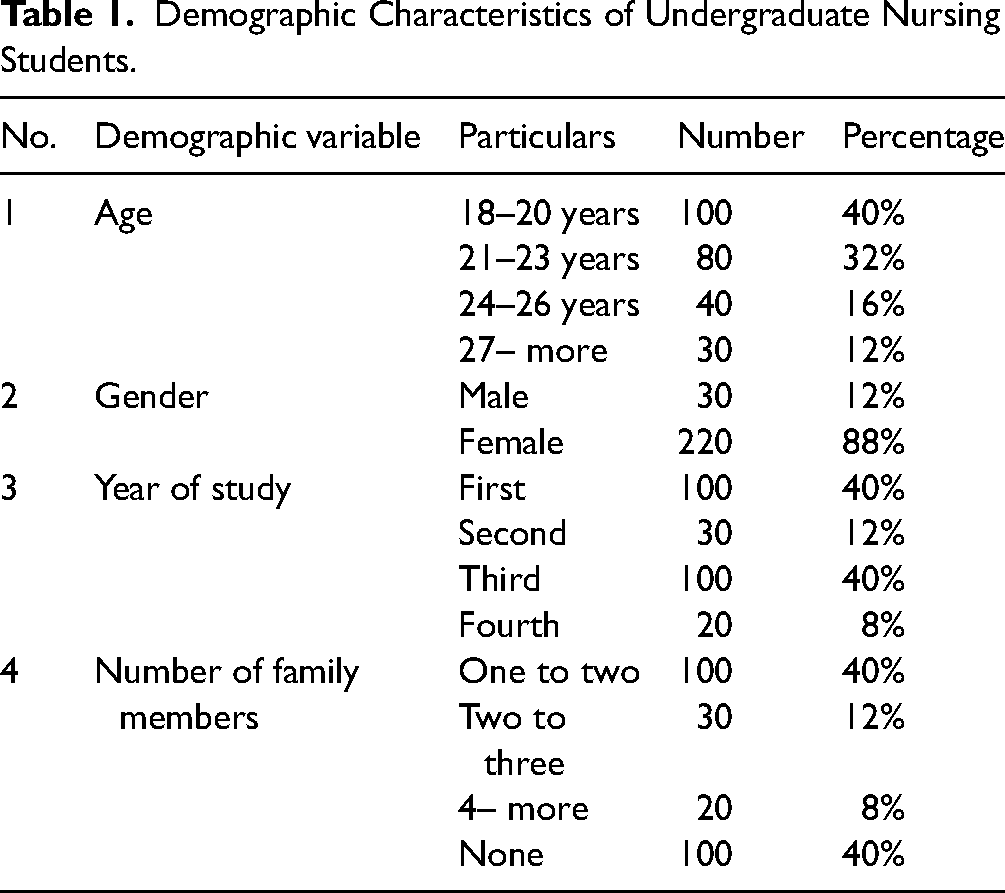
The response rate was 100% and all the 250 participants participated in the study. In terms of demographic characteristics of age, the result showed that out of the 250 participants, 40% of them were between 18 and 20 years, 32% were between 21 and 23 years, while 16% of them were between 24 and 26 years of age. The results further indicate that a small percentage of 12% were more than 27 years old. In terms of gender characteristics of the participants, a minority of 12% were males, while the majority of 88% were females. Regarding the year of study, 40% of the students were studying in the first year, 12% of them were in the second year, 40% of them were studying in the third year and the remaining 8% of them were fourth-year students. Regarding the number of family members, 40% of the students had one to two family members, 12% had two to three members in their family, while 8% had four or more members in their family and (40%) were the only child in their families (Table 1).
Demographic Characteristics of Undergraduate Nursing Students.
Perception of Academic Incivility
In terms of the participants’ perception of academic incivility, 7.56% of them reported always indulging in uncivil behavior; 9.51% reported often indulging in incivility, while 20.06% reported sometimes indulging in uncivil behavior. A large majority (62.55%) reported never indulging in any uncivil behavior during their undergraduate studies. The details are shown in Figure 1.

Perception of uncivil behavior among undergraduate nursing students.
Contributory Factors of Academic Incivility
In relation to the contributory factors of academic incivility, nearly half of the participants (47.41%) attributed the occurrence of academic incivility to the nature of their academic setting. A similar proportion of the participants, (40.96%) perceived that student's academic preparation contributed to their engagement in uncivil behavior. A further 11.93% of the students mentioned that they were influenced by the teacher's attitude to engage in uncivil behavior. In addition, 57.09% of the students believed that emotional disturbance contributed to uncivil behavior, while 42.9% blamed substance abuse for incivility. A further 40.96% of the students cited cultural issues as a contributory factor while 59.03% blamed social issues for driving uncivil behavior (Figure 2).

Contributing factors of uncivil behavior among undergraduate nursing students.
Association Between Participants’ Demographic Characteristics and Their Perception of Academic Incivility
In terms of association, there was no significant association between participants’ demographic characteristics such as age, gender, year of study, number of family members, and their perception of academic incivility at p < .05. The results are shown in Table 2.
Association Between Demographic Characteristics and Perception on Academic Incivility.

Discussion
Since nursing is a caring profession, there needs to be a conducive relationship between nurses without acts of unprofessionalism. While it is desirable to have the culture of nursing as caring, kind, compassionate, and supportive, in reality, nurses tend to be uncaring, competitive, and sometimes even aggressive toward nursing students and their fellow nurses. In support of this notion, Safarpour et al. (2022) mentioned that the nursing instructors and students had observed incivility in the learning, communication, and ethical climate. Furthermore, incivility seriously affects the well-being of the nursing students, and negatively affects their professional relationship with the faculty, and disrupts the learning environment (Ehsani et al., 2023).
Thus, it is critical to curtail this uncivil behavior in nursing students, starting by understanding the perception of nursing students and contributors to academic incivility. The finding that 7.56% of the students reported “always” indulging in uncivil behavior; 9.51% “often” indulged in incivility behavior, and a further 20.06% “sometimes” indulging in incivility behavior, means that nearly 40% of the student population engages in some forms of uncivil behavior during their undergraduate studies. In comparing our findings to similar studies, Al-Jubouri et al. (2021) also found a moderate prevalence of academic incivility among nursing students in Oman. Furthermore, the nursing faculty perceived that the nursing students exhibit the highest academic incivility behaviors, and disruptive behaviors (Rasheed et al., 2019). Additionally, Ehsani et al. (2023) noted academic dishonesty, ineffective teaching-learning, unreasonable requests, and the behaviors disrupting mutually respectful environments as the reasons for academic incivility from the perspective of nursing students and faculty. Likewise, nursing faculty in South Korea experienced uncivil student behavior as the students ignored behavioral standards in the nursing school life (Hyun et al., 2022). This is a significant observation that necessitates immediate correction. This is consistent with the recommendation by Al-Jubouri et al. (2021) who reiterated that regular assessments are needed to highlight uncivil behavior in nursing students as strategic steps toward reducing their occurrences by establishing appropriate rules, procedures, and policies that serve as deterrents.
In addition to deterrents, the nursing faculty should act as role models and should show a caring attitude toward the students in both theoretical and clinical learning spaces. If the nursing faculty acts as role models in the formal and informal curriculum, it will contribute to the formation of kind and responsible nurses in the future (Ayu Eka et al., 2023). In support of this view point, Lindquist (2019) commented that nurse leaders in the form of faculty, and nurse administrators play a critical role in preventing and addressing academic incivility. In further support for role modeling, the American Nurses Association urges nurses to create an ethical environment and culture of kindness and civility characterized by colleagues, coworkers, employees, and students being treated with dignity and respect across nursing settings (Ota et al., 2022). It is therefore, follows that undergraduate nursing students and should faculty interact professionally and establish effective communication to enhance the learning process (Al-Jubouri et al., 2021).
With regard to the factors contributing to academic incivility, an earlier study among nursing students conducted by Ibrahim and Qalawa (2016), at Port Said University, Egypt reported that 60.2% of students engaged in irresponsible behaviors, 55.9% of them behaved inappropriately, and 47.8% of them behaved aggressively. The students expressed that the faculty policies, political atmosphere, study climate, and faculty and staff attitude influenced the uncivil behavior of the nursing students. These findings are similar to that of the present study that reported 47.41% of students blaming academic incivility on their academic setting. Furthermore, 11.93% of the students mentioned that they were influenced by the teacher's attitude while 59.03% were influenced by social forces such as politics as cited in the Port Said study in Egypt. As earlier described by Woodworth (2016), the nursing faculty seems to play an important role in academic incivility.
Moreover, poor leadership, the existence of power cliques, and a culture of silence are the organizational factors that contribute to academic incivility (Pattani et al., 2018). An integrative review identified institutional attributes, communication, educational and resource management, communication and interpersonal dynamics, individual and societal influences, and technology and infrastructure as the antecedents of academic incivility in nursing education (Fontenot et al., 2024). Therefore, nurse educators should implement policies and strategies to minimize incivility in nursing students. In addition, an immediate response system or a responsible person should create an open communication environment to help the nursing students to confront incivility (Zhu et al., 2019).
Strengths and Limitations
This is a pilot study conducted in India to understand the perception and contributing factors of academic incivility among undergraduate nursing students. Furthermore, this is the first study conducted in the Indian context. Additionally, it calls for more studies in different states of India to develop policies and strategies to reduce the academic incivility among nursing students. The study is limited only to the study settings. Besides, the study did not represent all the nursing students as the samples were selected using a convenient sampling technique.
Implications for Practice
Academic incivility is a persistent and ongoing issue in nursing education. Therefore, interventions should be designed to increase the awareness on the ill effects of incivility among nursing students and faculty members. Moreover, this complex problem should be addressed including both the faculty and students using a multimodel approach. It could include online modules, in-person faculty-student and faculty-faculty approaches, and simulated exercises. Furthermore, the findings of the study help the nurse educators and policy makers to design evidence-based interventions to reduce the uncivil behavior among the nursing students. Moreover, additional corrective strategies are needed to educate the perpetrators about the ill effects of their actions.
Conclusion
The study found that few of the nursing students always indulged in uncivil behavior, some of them often indulged in uncivilized activities, and less than half of them reported sometimes indulging in uncivil behavior. However, majority of the nursing students never indulge in uncivilized activities. The contributing factors of academic incivility were the academic setting, the student's academic preparation, the teacher's attitude, emotional disturbance, substance abuse, cultural issues, and social issues. There was no significant association between the demographic variables and the level of perception of academic incivility among nursing students.
Academic incivility is undesirable in the nursing profession as it affects the learning environment, academic achievement, and institutional reputation and ultimately threatens the patient safety. Therefore, it is the need of the hour to train the nursing faculty to identify uncivil behavior in nursing students and to plan strategies to minimize such behaviors in order to have a healthy and productive teaching and learning environment. Nurse educators should set professionally and socially acceptable behavioral expectations and examples in the teaching-learning environment and should establish positive and harmonious interpersonal relationships with the students. The nursing faculty also should act as role models and should maintain academic and moral integrity. Furthermore, incentives could be provided to the faculty and students who maintain civil behavior and this concept should be introduced in the nursing curriculum to guarantee that the nursing students and faculty are aware of the consequences of academic incivility. Additionally, closer attention to be paid to ensure effective communication and interactive teaching strategies are employed. Lastly, precise rules and guidelines regarding the prevention of incivility should be developed and implemented in the universities.
Footnotes
Acknowledgments
The authors acknowledge all the Heads of the institution for granting permission to conduct the study and the nursing students who participated in the study. Sujay Singh Daliya, Sarita Kumari, Sheena Singh, and Sudha Singh of Apex College of Nursing are acknowledged for assisting in the data collection process. The authors acknowledge the participants of the study.
Author Contributions
JR—study design and data collection; JA—manuscript writing; GA—review and manuscript editing; PK—review and manuscript editing; SP—review and manuscript editing; and MR—data analysis.
Declaration of Conflicting Interests
The author(s) declared no potential conflicts of interest with respect to the research, authorship, and/or publication of this article.
Ethical Approval
The study received ethical approval from the Institutional Review Board of Apex College of Nursing through the letter referenced: (API/ACN/Misc/2019-2020/268 dated 20.10.2019).
Funding
The author(s) received no financial support for the research, authorship, and/or publication of this article.
