




Abstract
Purpose
This study aims to assess the knowledge, attitudes, and practices of healthcare workers toward COVID-19 preventive measures and related factors.
Methods
Descriptive, correlational, and cross-sectional design was used. A convenience sample of 140 Jordanian healthcare providers working in COVID-19 units from governmental hospitals completed the study during February–March 2021. A self-reported measure with three domains: knowledge (e.g., COVID-19 transmissions), attitudes (e.g., COVID-19 vaccination), and practices (e.g., handwashing) were used. An independent t-test was performed to assess the difference in knowledge, attitude, and practice depending on demographic and work-related variables, while Pearson r and multiple linear regression were performed to identify the relationships between the study variables and the predictors of COVID-19 preventive practices.
Results
The majority of the participants had good knowledge (81.4%), good attitude (87.1%), and satisfactory practice (77.9%). Knowledge was significantly associated with attitude and practice (p < .01), and attitude was significantly associated with practice (p < .01). There was a statistically significant difference in knowledge, attitude, and practice depending on the existence of infection control policy, availability of PPE, and receiving infection control training (p < .05). Predictors of COVID-19 practice included knowledge and attitude, PPE availability, and receiving training on infection control (p < .05).
Conclusion
This result might suggest that there are some gaps between knowledge, attitudes, and practices of COVID-19 preventive measures. Lack of PPE and inadequate infection control training could contribute to this gap.
Introduction
COVID-19 is a disease caused by one of the novel coronavirus families called SARS-COV-2 that causes diseases in humans and animals (Yin & Wunderink, 2018). The first human outbreak of the syndrome was detected in early December 2019 in China (Lu et al., 2020). Symptoms of COVID-19 vary from mild to severe (fever, dry cough, muscle aches and pains, sore throat, loss of taste and smell, shortness of breath, inability to move). Older adults or people with underlying medical conditions have a higher risk of experiencing severe complications from the disease (McIntosh et al., 2020). COVID-19 can spread either through the air or through direct contact (Esakandari et al., 2020).
According to the World Health Organization (2022), there have been 1,695,432 confirmed cases of COVID-19 with 14,059 deaths in Jordan from 3 January 2020 to 21 April 2022. The fight against COVID-19 in Jordan is challenged by misconceptions about the disease among the public and the spread of COVID-19 between healthcare providers. Another barrier was providing adequate personal preventive equipment and having a protective policy at the workplace (Abu Mansour & Abu Shosha, 2022; Mantelakis et al., 2021). Healthcare workers are among the highest risk group for infection with COVID-19 and have at least a threefold higher rate of infection with COVID-19 as compared to the general public (Ersoy, 2020).
Knowledge and practices of healthcare providers about hospital-acquired infection can be improved by conducting relevant interventional programs (Asfaw, 2021). For example, Abbas et al. (2020) found that a web-based health education intervention program was useful to promote preventative measures in hospital settings to reduce the spread of COVID-19 among healthcare workers. Providing baseline data about the current knowledge and practices about hospital-acquired infection is a prerequisite for conducting such interventional programs. Due to the urgency of the knowledge, attitudes, and practices (KAP) information during this current pandemic, several researchers have conducted KAP surveys with a variety of respondents. Some surveys involve the public (Azlan et al., 2020; Chang et al., 2021) and other surveys involve healthcare students (Sondakh et al., 2022; Zhang et al., 2021) and students from various majors (Saefi et al., 2020). However, the research analyzing KAP about COVID-19 in Jordan is still limited. As part of creating a preparedness plan, it was necessary to have baseline data on the level of healthcare worker knowledge, attitudes, and practice to identify gaps in practice. Therefore, this study aimed to evaluate the levels of healthcare workers’ knowledge, attitudes, and practices concerning COVID-19 preventive measures and associated factors. The result of this study could help care managers to design training and education programs to address the knowledge gap and improve awareness among healthcare workers to protect them from exposure and infection with COVID-19.
Methodology
The current study employed a cross-sectional descriptive correlational survey to fulfill its aim. The target population for this study was healthcare workers (i.e., physicians, nurses, and paramedical staff) who provide care for patients with COVID-19 admitted from February to March 2021 to various wards or units (i.e., isolation rooms and wards and ICU units). Healthcare workers were recruited conveniently from three main governmental hospitals in the central region of Amman, Jordan, that have a high occupancy rate during the pandemic. These three hospitals were Prince Hamzah Hospital, Al-Basheer Hospital, and Amman Field Hospital. During the data collection period (February–March 2021), Prince Hamzah Hospital had a bed capacity of 425 beds (occupancy rate is around 50–80%), with about 550 nurses and 99 health workers. Al-Basheer Hospital had about 60 ICU beds and 25 isolation beds in the medical department (occupancy rate was 40–55%) with about 300 medical staff. Amman Field Hospital had 84 ICU beds and 319 isolation rooms (occupancy rate around 25–46%), with 500 health workers (about 100 doctors and more than 400 nurses).
Inclusion criteria were nurses, physicians, and allied health professionals (lab technologists, radiologists) who provide care for patients with COVID-19 in hospital settings, more than three-month experience and have direct contact with COVID patients. Exclusion criteria were medical students, nonmedical staff, staff with no direct contact with patients, and pharmacists.
The sample was estimated using the G*power to conduct linear regression for possible predictors of COVID-19 practices. The sample size was estimated using the G*Power program, α = .05, medium effect size = 0.30, and power = 0.80, the minimum required sample size was 118 participants. However, the survey was circulated to 450 participants considering the potential of high nonresponse rates in web surveys. A two weeks period was allotted to complete the survey or reach the target number of participants. The response rate was 70% which was calculated by dividing the number of participants who completed the survey (n = 140) by the number of participants who opened the link online and accessed the cover letter.
Measurement
The study measures included the demographics data questionnaire and the knowledge, attitudes, and practices toward the COVID-19 survey (KAP survey) developed by Papagiannis et al. (2020). The survey consists of three domains, the first dimension is the knowledge which was assessed with eight questions (e.g., transmissions of COVID-19 and ways of prevention), the second domain is the attitude questions which assessed the participant perception regarding COVID-19 which was assessed with two items (getting vaccinated and handwashing for prevention of COVID-19). The third domain is practice questions which were assessed with two items (e.g., following the recommendations and handwashing) (Papagiannis et al., 2020).
For each item related to knowledge, attitude, and practice 1 point was given for correct answer or positive attitude and 0 points given for incorrect answer/negative attitude. For the knowledge score, respondents with a total score less than 4 were further categorized as “poor level” and those with a score of 4 to 8 were categorized as “good level of knowledge.” For practice and attitude subscales, a score equal to or more than 1 was considered a satisfactory score.
Pilot Study
To assess the content validity, the survey was sent to a panel of five professionals to assess its content and suitability to be used in the Jordanian context. Minor changes were made to the demographic part of the tool but no item related to knowledge, attitude, or practice has been modified. Before data collection, a pilot study was conducted among 20 healthcare workers who were currently working with COVID-19 patients. The scale reliability was assessed for internal consistency. The Cronbach's alpha values were as follows: knowledge scale (0.732), attitude scale (0.706), practice scale (0.661), and total scale (0.67).
Data Collection and Ethical Considerations
The study was approved by the Ethics Committee. The link to the web-based survey was distributed through emails by the data collectors during February–March 2021. The author explained the objectives of the study through an electronic cover letter. Participants were also assured that their data would only be used for research purposes and that their identities would remain anonymous. Participation in the study was voluntary and participants were allowed to contact the researcher by phone to ask questions about the study. The collected data were downloaded to a password-protected computer and entered into the IBM SPSS program directly for data analysis.
Data Analysis
The data of this research were analyzed using IBM SPSS software version 25. Descriptive statistics were used for this study including mean and standard deviation to assess participants’ knowledge, attitudes, and practices. Pearson r was used to identify the relationship between Covid-19 knowledge, attitude, and practice. Independent t-test and one-way ANOVA were used to evaluate the differences in the main study variables according to categorical demographics. Linear regression was used to explore the predictors of Covid-19 practices. The Cronbach's alpha values were reported for the KAP survey and its subscales to estimate the internal consistency reliability.
Results
Characteristics of Participants
A total of 140 participants completed the study, 104 of them were female (74.3%). The mean age of the study participants was 26.0 (SD = 4.456) years. Most participants were nurses (n = 113, 80.7%). The mean work experience of the study participants was 4.88 (SD = 4.317) years. About 46.4% of the respondents had traveled abroad in the previous six months and 68 participants (48.6%) had been diagnosed with COVID-19. Eighty-seven participants (62.1%) reported that one of their family members had COVID-19 and 100 participants (71.4%) reported that they know close persons other than their family members who had COVID-19.
Ninety participants (64.3%) reported that personal protective equipment (PPE) has been available and adequate at their workplace and 97 participants (69.3%) reported they received training in infection control. Moreover, 107 participants (76.4%) reported that their organization has a policy regarding COVID-19. Forty-seven participants (33.6%) think the quality of care they provide decreased a lot during the pandemic. Sources of information about COVID-19 included web page (n = 45, 32.1%), Ministry of Health and health authorities (n = 42, 30%), TV/Radio (n = 27, 19.3%), and physicians (n = 26, 18.6%) (Table 1).
Demographic Characteristics.

Scores of Knowledge, Attitudes, and Practices Regarding COVID-19
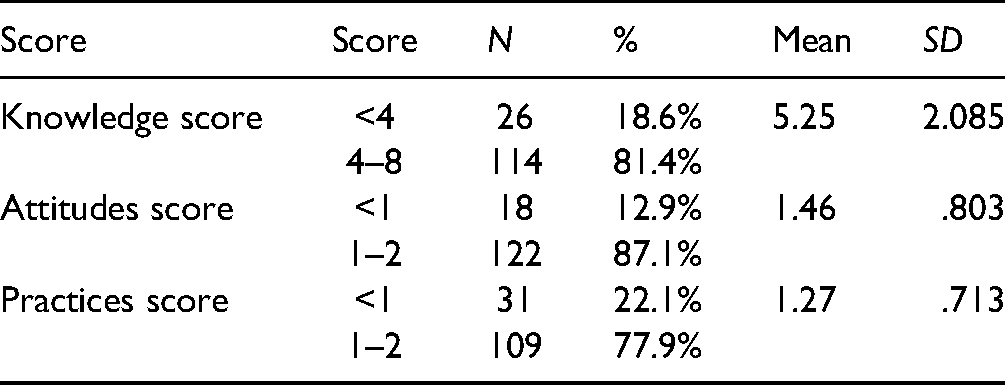
The mean (SD) scores of knowledge, attitudes, and practices regarding COVID-19 were 5.25 (SD = 2.085), 1.46 (SD = .803), and 1.27 (SD = .713), respectively. One hundred and fourteen participants (81.4%) had good knowledge, 122 participants (87.1%) had a good attitude, and 109 participants (77.9%) had a good practice (Table 2).
Knowledge, Attitudes, and Practices Score.
The Relationship Between Knowledge, Attitude, and Practice Regarding COVID-19
Knowledge score was significantly correlated with attitude score (r = 0.496, p < .001) and practice score (r = 0.513, p < .001), while attitude score was significantly correlated with practice score (r = .374, p < .001) (Table 3).
The Relationship Between KAP Regarding COVID-19.

Differences in the Scores of Knowledge, Attitudes, and Practices Based on the Demographic Variables of Healthcare Workers
Males had significantly higher attitude scores than females (p = .05) (Table 4). The presence of Covid-19 preventive policy at the workplace, having adequate PPE, and receiving infection control training were associated with higher scores of knowledge, attitude, and practice (p < .5). However, there were no significant differences in the scores of knowledge, attitudes, and practices according to receiving training on PPE (p > .05).
Differences in the Scores of Knowledge, Attitudes, and Practices Based on the Demographic Variables of Healthcare Workers.

Predictors of COVID-19 Practices Among Healthcare Workers
Linear regression analysis was used to examine the predictors of COVID-19 practice among the study participants. Overall, the results of the regression analysis were statistically significant (adjusted R2 = 0.331, F = 12.48, p < .01). COVID-19 preventive practice was significantly associated with knowledge, PPE availability, attitude, and receiving training on infection control, (p < .05) (Table 5).
Predictor of COVID-19 Preventive Practice.

Discussion
The current study assessed healthcare workers’ knowledge, attitudes, and practices related to COVID-19 preventive measures and their associated factors during the second wave of COVID-19 in Jordan in early 2021. The study showed that 81.4% of the participants have a good knowledge score, 87.1% have a good attitudes score, and 77.9% have a good practices score. This result might suggest that there is still a gap between knowledge, attitudes, and practices. Having adequate knowledge is a prerequisite to building positive preventive practice and formulating a positive attitude, while lack of knowledge is a risk factor that makes the healthcare worker more vulnerable to be infected with COVID-19 (Mbachu et al., 2020; Zhang et al., 2020). The outcomes of this study are in line with Mbachu et al. (2020) who conducted a web-based cross-sectional study in southeastern Nigeria during the lockdown period and showed that the majority of health workers (88.59%) had good knowledge and good preventive practices (81.39%) of COVID-19. In addition, one of the most recent online cross-sectional studies conducted in Sudan by Mohamed et al. (2021) showed that the majority of the participants had good COVID-19 knowledge and attitude but they were not reflected in practice. Also, in Lebanon, Abou-Abbas et al. (2020) reported that Lebanese doctors have a reasonable level of COVID-19 knowledge but limited understanding of how to use personal protective equipment. Furthermore, Hossain et al. (2021) reported that 99.5% of health workers in Bangladesh had good knowledge, 88.8% had a positive attitude, and 51.7% had good practice regarding using PPE during the COVID-19 pandemic.
It is noteworthy to mention that practices related to COVID-19 preventive measures could be influenced by the resources in the hospital. In this study, 35.6% of participants reported that personal protective equipment was not available in their facility. The current study was conducted during the second wave of COVID-19 in Jordan in early 2021 when the demands on PPE were high.
Healthcare workers’ sources of knowledge regarding COVID-19 were radio, TV, and internet website, formal authorities, and physicians. These results are similar to Huynh (2020) who noted that social media was the main source of information regarding COVID-19 among healthcare workers. This could misguide healthcare workers, due to public misconceptions regarding COVID-19 (Trevors & Duffy, 2020).
About 46.4% of healthcare workers were infected with COVID-19 and (64.1%) know a close one diagnosed with COVID-19. A previous study reported that around (85%) of healthcare workers were afraid of being infected with COVID-19. Infection rates are usually high among front line healthcare workers with close contact with patients (Zhang et al., 2020).
Good knowledge was significantly associated with a positive attitude and good practices. This outcome is similar to the study of (Jemal et al., 2021) who found a correlation between knowledge, attitude, and practice toward COVID-19 disease. Wahed et al. (2020) reported that knowledge plays a key role in prevention, while a positive attitude could promote safe practice. Adequate knowledge is a prerequisite for the use of preventable measures such as handwashing, wearing gloves, and reducing social distance.
There was a difference in knowledge scores between staff who had a policy regarding COVID-19 prevention at the workplace and those who didn’t have such a policy. The preventive policies could be based either on local healthcare authorities, CDC, or other resources. This result was supported by Aljondi et al. (2021) who found that following the CDC policy can prevent the spread of COVID-19 from infected patients to staff.
In our study, males had significantly higher attitude scores than females. This result contradicts the outcomes of Olum et al. (2020) who reported no statistically significant correlation between attitude toward COVID-19 preventive measures and the sociodemographic variables such as sex, age, hospital, qualification, and level of education. More research, however, is needed to verify this outcome.
Our study reported that knowledge was not influenced by occupation. In contrast to our findings, Mbachu et al. (2020) reported that medical doctors and nurses have higher knowledge compared to other occupations due to their direct contact with COVID-19 patients. In addition, Wahed et al. (2020) reported that physicians and pharmacists had higher knowledge scores than other professions. Further, Aljondi et al. (2021) reported significant associations between profession and good clinical practices of infection control regarding COVID-19 in the radiology department.
Infection control training was associated with higher knowledge scores. In addition, receiving training in infection control was a significant predictor of COVID-19 preventive practices. This could be related to the role of training in enhancing staff's ability to utilize evidence-based practice. This outcome is similar to Guo et al. (2020) who found that healthcare workers who had real-time training on prevention measures had a protective effect against COVID-19. This outcome is also in line with Abbas et al. (2020) who demonstrated the crucial role of education and training of healthcare workers to mitigate the spread of COVID-19 infection.
In our study, 33.6% of the participants declared that there was a decrease in the quality of healthcare services as a consequence of the COVID-19 pandemic. This outcome is expected during pandemics due to absenteeism and increased work hours, which occurred previously during pandemics (Challener et al., 2021).
Recommendations and Implications
Healthcare workers are the front line fighters, they play an important role in the prevention of COVID-19, and they have a very high risk for occupational exposure. This study shows that good knowledge about COVID-19 is associated with a positive attitude and good practice and highlights the importance of carrying out regular or continuing training and education regarding COVID-19 prevention.
Moreover, our study showed that healthcare providers depend on the website to gain their knowledge about COVID-19. Health authorities should support the COVID-19 awareness-raising campaign for medical staff and conduct training programs to address any gap between knowledge, attitude, and practice regarding COVID-19 preventive measures.
Policymakers may want to pay more attention to staff health issues and allocate more resources and budgets to protect them from infection. The availability of PPE is a prerequisite for a safe environment, and it is needed to protect staff from being infected by COVID-19.
Moreover, healthcare institutions have the responsibility to train staff on how to use PPE rather than only providing adequate PPE at the workplace. Healthcare institutions that have no clear infection control policy should develop such policies to unify infection control practices among healthcare workers and protect them from infection.
Study Limitations
We used a website survey questionnaire, which is a self-report measurement tool that depends on the accuracy of the participants’ answers and poses a risk of social desirability. Also, the descriptive design in the current study cannot infer causality. Finally, the study was conducted in governmental hospitals that could not represent all health sectors in Jordan (Al-Ajarmeh et al., 2021).
Conclusion
The current study showed that better knowledge about COVID-19 is highly associated with a positive attitude and good practice. In addition, the study highlighted the importance of training and education concerning COVID-19 prevention. The study also concluded that there is still a gap in the practice of COVID-19 protective measures due to a lack of PPE and improper infection control training. Healthcare leaders need to prepare educational programs and training courses to help other healthcare workers improve the preventive strategies to protect themselves and combat the spread of contagion.
Footnotes
Authors’ Note
The IRB was obtained from the Jordanian Ministry of health and the ethical committee at Zarqa University. All participants gave informed consent for the research, and that their anonymity was preserved. All authors have substantial conceptual and methodological contributions and approved the final version. I would like to disclose that all authors meet the criteria for authorship, all authors have read and agreed to its content and that the manuscript conforms to the journal's policies. Fayez Amro contributed to conception of the study, data collection, and data analysis and interpretation of findings. Ahmad Rayan contributed to literature review, study design and data analysis, and drafted the manuscript. Nidal Fareed Eshah contributed to study design, critically revised the manuscript, and contributed the interpretation of the findings. Mohammed Sa'd ALBashtawy contributed to the interpretation of the findings critically revised the manuscript.
Declaration of Conflicting Interests
The author(s) declared no potential conflicts of interest with respect to the research, authorship, and/or publication of this article.
Funding
The author(s) received no financial support for the research, authorship, and/or publication of this article.
