




Abstract
Background
It is essential to increase the knowledge base of teachers involved in facilitating return to learning in middle school students following a concussion. However, the best method to enhance the transfer of learning for teachers remains to be elucidated. Application of Adult Learning Theory (ALT) is a plausible solution to this problem.
Purpose
The purpose of this randomized post-test study was to examine the effects of ALT on the transfer of learning in teachers who work with individuals with concussion.
Methods
A convenience sample of 169 teachers at four middle schools were randomized to receive an in-service regarding concussion management either in ALT or traditional lecture format. Vignettes approximating classroom practice evaluated learning transfer.
Results
one-way between subjects ANOVA revealed no significant difference between the methods of educational delivery on group assessment scores (p = .22). Additionally, a regression analysis did not identify any demographic variables that predicted learning transfer (p = .65). A statistically significant difference existed for four questions (1, 4, 7, 25) between the groups (p = .03, .02, .01, .00, respectively). These vignettes were those that assessed information that was likely novel to the learner.
Discussion
The current study demonstrated that ALT applied to teacher in-service did not impact transfer of learning immediately post training compared to a traditional lecture format. Future research should continue to examine the effects of various educational strategies to enhance learning transfer for teachers managing students in the classroom after concussion.
Keywords
Introduction
The classroom is a dynamic environment that requires teachers to seek post-professional trainings typically in the form of in-service to acquire the information necessary to make informed decisions (Postareff et al., 2007; Supovitz & Turner, 2000). Schools devote considerable time and money to in-service programming to effect behavioral changes for teachers. An average of $18,000 per teacher per year and 19 school days are devoted to improving teacher practice in direct and indirect ways (Jacob & McGovern, 2015). However, studies have demonstrated that transfer of learning, the ability to use previously learned information in a novel setting or time, from the traditional, lecture-based, in-service environment to the classroom has not been successful (Awoniyi et al., 2002; Jacob & McGovern, 2015). Davis et al (1999) found professional behaviors were not changed after participation in a traditional, lecture-based in-service (Davis et al., 1999). Awoniyi et al. (2002) found that only approximately 10% of expenditure in continuing education results in changes in transfer of knowledge, skills, and behaviors.
Recently, safe and efficient return to the learning environment following a mild traumatic brain injury (mTBI) has received considerable attention (Arbogast et al., 2016; Halstead et al., 2013). Proper management of mTBI can aid in recovery from symptoms in the physical, cognitive, emotional, and sleep domains (DeMatteo et al., 2015). It stands to reason that these symptoms could interfere with success in school (McCrory et al, 2017; O’Neill et al., 2017; Swanson et al., 2017). In a recent survey, it was found that teachers strongly agreed that a concussion could affect school performance, teachers play a major role in students’ return to the classroom, and that formal concussion education is necessary to support this role. Teachers specifically mention in-service trainings as part of this education (Kasamatsu et al., 2017).
While rest is important in the early phases of mTBI recovery (Giza & Hovda, 2014), it is also important that youth return as soon as possible to the school setting for both academic and social reasons. The reintroduction of a student to the educational environment, where activities can be aimed at controlled, gradual reintroduction of both cognitive and physical exertion may have a positive impact on recovery post-mTBI. Appropriately timed school reentry combined with the implementation of proper, timely, and differentiated modification to the students’ academic day may encourage safe and efficient return to learning (McCrory et al. 2017; Sady et al., 2011).
To meet the complex needs of students recovering from mTBI, teachers require information. However, research shows teachers lack knowledge about the consequences of mTBI including the potential for symptoms to interfere with classroom performance (Davies et al., 2013; Dreer et al., 2017; McCrory et al, 2017). Training related to the identification of appropriate school supports for students recovering from concussion has also been identified as an area of need for teachers (Davies & Ray, 2014). Education regarding the effects of mTBI on students in the educational setting should be a priority (Halstead et al., 2013).
A list of competencies for educators working with students returning to the classroom after mTBI has been proposed (Maerlender et al., 2019, 2020). Efforts to standardize the content delivery for transfer of knowledge may assist in systematic assessment of outcomes. When working from a single set of standards, comparison of outcomes is facilitated. Assessment of these outcomes provides an understanding of best practice of mTBI in-service delivery to encourage transfer of learning.
Teachers may derive benefit from trainings about mTBI. Teachers engage in post-professional trainings to gain information with the goal of becoming better educators and seek concrete, feasible ideas to apply immediately in the classroom (Fullan, 1993) Further, an interactive model of delivery, such as that proposed by Knowles, that allows participants to apply learning, practice skills, and learn from others has been shown to promote intended changes in behavior (Blume et al., 2010). Knowles’ developed his Adult Learning Theory after observing adults pursuing individual interests in an open environment. Knowles states that there are five characteristics of adult learners (andragogy) along with the four principles of adult learning, which provide direction for designing instruction for the self-directed, adult learner. The successful adult educator must appreciate these differences when developing a program (Knowles, 1989a, 1989b).
Application of ALT to teacher in-service training design may assist with the transfer of knowledge of and enhance participant enjoyment. The design of an educational opportunity, along with personal characteristics of the learners and the environmental climate of the workplace, has the potential to enhance or reduce learning transfer (Botma et al., 2015; Donovan & Darcy, 2011). In a one-time in-service educational session, training design may be the element most easily modified to improve learning transfer.
Training design requires planning and needs to be specific and relevant to the learner in order to achieve transfer of learning. That is, participants are involved in planning and the training has vocational impact. ALT has been described in use in a variety of adult learning settings related to vocation: physicians’ assistant education (Lewis & Thompson, 2017), principal professional development (Zepeda et al., 2014), gallery educators (McCray, 2016), online learning (Cercone, 2008), and safety trainings (Galbraith & Fouch, 2007). No studies to date have examined the impact of the application of ALT on transfer of learning for teachers following an in-service. However, previous studies do support that effectiveness of continuing education is enhanced when the interventions are interactive and use multiple modalities, attributes inherent to ALT, to deliver content (Mansouri & Lockyer, 2007). Therefore, the purpose of the current study was to investigate the influence of a one-time in-service training based in ALT on the transfer of learning for teachers managing students returning to the classroom following an mTBI.
Methods
Subjects
Teachers, support staff, and administration from a convenience sample of four New Hampshire middle schools directly involved with students in grades 5–8 agreed to participate in teacher trainings regarding classroom management for students after mTBI. All four schools included in this study had active, school-related sports programs and a history of students returning to the classroom after mTBI.
One hundred sixty-nine participants from the four schools were included in the study. In this experimental, post-test only design, 78 participants engaged in an in-service based in ALT and 91 participants engaged in a traditional, lecture-based in-service. While there was a request to the schools for a more robust approach that included a pre-test to assess baseline knowledge, the logistics of scheduling teachers in school precluded such assessment. This study received approval from the X University and X University Institutional Review Boards. Informed consent was obtained from all participants prior to participating in the study.
Procedure
Upon providing informed consent, participants completed a demographic questionnaire and were assigned to the ALT-based in-service or the traditional in-service at each school by an administrator not involved in the study. Randomization to either group occurred in a systematic fashion by first letter of the participant’s last name. This process of randomization was chosen based on feasibility. The two training sessions occurred simultaneously at each school but in separate locations within the school. Participants were blinded to the type of in-service delivery.
The in-service at all schools aimed to facilitate an understanding of healthy brain activity, the impact of mTBI on the brain, the role of schools in monitoring recovery, and academic adjustments that could be implemented within the typical school day.
Traditional Method (TM)
The TM group received instruction covering the identified competencies in mTBI management in a lecture format, followed by a question and answer period. Time allotments were determined by each school based on their in-service schedules so equal time for in-service was not possible at all four schools. In-service occurred for a total of 90-minutes at three schools, 75-minutes at one school. To accommodate the shorter timeframe of 75-minutes, the question and answer portion of the in-service was reduced and the speed of the introduction of the material was slightly increased. The presenter of the TM format had more than 30 years of experience in working with individuals with brain injury and more than 7 years of teaching experience. Practice of in-service delivery occurred with the principal investigator.
Adult Learning Theory format (ALT)
At three of the four schools, the ALT group received a 90-minute in-service covering the identified competencies in mTBI management in a format representative of ALT. To accommodate the change to 75-minutes at one school, one activity in the ALT group was altered to be a brief, interactive discussion rather than a small group activity and the reflection portion at the conclusion of the intervention was reduced in time. Necessary learning materials were available at tables where small group work occurred. Attention to the principles of ALT and the characteristics of the adult learner for every aspect of the in-service was necessary to ensure fidelity to the theory proposed by Knowles (1989a, 1989b). Table 1 describes this process. The presenter of the ALT in-service had successfully completed master’s level educational courses in ALT.
ALT Principles and Characteristics.

Outcome Measures
Like previous quantitative studies, vignettes were used to understand the application of learned information to novel situations (Rahman, 1996; Stecher et al., 2006). Rahman (1996) found that vignette responses could closely relate to real life experiences if the design includes attention to the reality of participants and the relevance of the information. In order to adhere to the time limits imposed by the schools, 25 vignette-based test questions were written by an expert item writer with over 30 years of educational training and experience, over 20 years of brain injury treatment experience, and who serves as a Board Member for Specialist Examination. The vignettes were written as hypothetical case studies representing actual classroom practice and aimed to assess transfer of learning for both groups. Test questions related to each vignette assessed learning at the levels of Knowledge, Comprehension, Application, and Analysis as defined by Bloom’s Taxonomy (Anderson et al., 2001). Each vignette was followed by one test question.
Competencies in mTBI management relevant to the managing of students’ return to the educational environment have been suggested (Maerlender et al.., 2020). These competencies describe the knowledge and skills necessary for the full range of school personnel potentially working with students after mTBI, including related service providers, athletic trainers, and coaches. Online Appendix B contains a list of these competencies and the key points associated with each. Preliminary evidence supports the use of these competencies in school personnel training from both a knowledge acquisition and professional relevance perspective (Maerlender et al., 2019).
The vignettes and associated test questions addressed all competencies related to educators. While, some knowledge of mTBI is necessary for all personnel, it is recognized that not all personnel require the same education. Teacher specific competencies including basic neuro anatomy, biomechanics of injury, concussion basics, risk factors, prevention, assessment practices, individual recovery, and concussion management programming have been described and were represented in the vignettes used in this study (Maerlender et al., 2020). A heavier emphasis was placed on the competencies of individual recovery and concussion management programming as these areas relate most closely to teacher practice. Answering the test questions associated with the case-based vignettes in this study required that the participants manipulate and apply information gained from the in-services to relevant practice situations in the classroom. While 25 test questions were intended for assessment, a printing error at two schools reduced the usable questions to 21. The remaining 21 test questions covered all competencies related to teachers and were the items used in all analyses.
Validation of the vignettes used in this study occurred prior to the investigation with five current New Hampshire middle school classroom teachers who did not participate in this study. The teachers were selected from a sample of convenience and included educators with combined experience of greater than 100 years. Each vignette was rated for accuracy on a scale from 1, not at all representative of classroom practice, to 5, accurate representation of classroom practice. Respondents were asked for suggestions to improve the relationship of the question to actual classroom practice. The scores for each vignette were averaged. Items scoring an average of lower than 3 or items scoring lower than 3 by two or more validators were removed. However, no item met either exclusion criteria. Refer to Online Appendix A for examples of the vignettes.
Assessment of Learning Post In-Service
Assessments were given to the participants at the end of the training. One exception to this procedure occurred. At School 2, time was not provided for immediate post-test completion. Instead, teachers were given time the following morning to complete the assessments if they chose to do so. Teachers could have also chosen to use that time to prepare their classrooms for their incoming students. These assessments were collected by the researcher later in the day following the presentation.
Participants
The four middle schools in this study represented both urban and rural New Hampshire schools. Student population ranged from approximately 200 students to 650 students. Minority representation at these schools ranged from 2% to 16% where New Hampshire minority representation is 10%. Two schools were ranked in the top 50% of performing schools in New Hampshire and 2 in the bottom 50%. Average incomes in the schools’ districts ranged between $58,500 to 97,000 (United States Census Bureau. https://www.census.gov/quickfacts/NH
Data Analysis
To answer the primary question of whether transfer of learning is different between ALT and TM groups a one-way between subjects ANOVA was conducted. A 2x4 between subjects ANOVA was performed to determine if there was a difference between the means of assessment scores between ALT and TM at any individual school. For all analyses, a p value of 0.05 was considered statistically significant. All data analysis was performed using SPSS Statistics 25.
Demographic analysis first assessed the relationship of the demographic variables to group membership using Pearson chi-squared. Then, multiple regression was performed to explore the impact of individual, demographic characteristics of sex, level of education, teaching experience, role at school, personal and professional concussion knowledge on transfer of learning. A Pearson’s chi-squared was conducted to explore demographic differences by group. For the regression, Likert scale items were dichotomized to define two categories. Level of education was converted to two groups: High school diploma/bachelor’s degree and Master/Doctoral degree. Role at school was converted to two groups: support/teaching staff and administration. Personal and professional concussion knowledge was converted into two groups: none/a little and moderate/a lot. Pearson Chi Squared analysis was run on the assessment items to determine if there were differences in questions answered correctly between the ALT and TM groups.
Results
The post training assessments of two participants contained less than a 50% response. One of these participants was from school 1 and in the ALT group. The second participant was from school 2 and in the TM group. The data from these two participants was not included in the analysis. Data analysis included the remaining 167 participants.
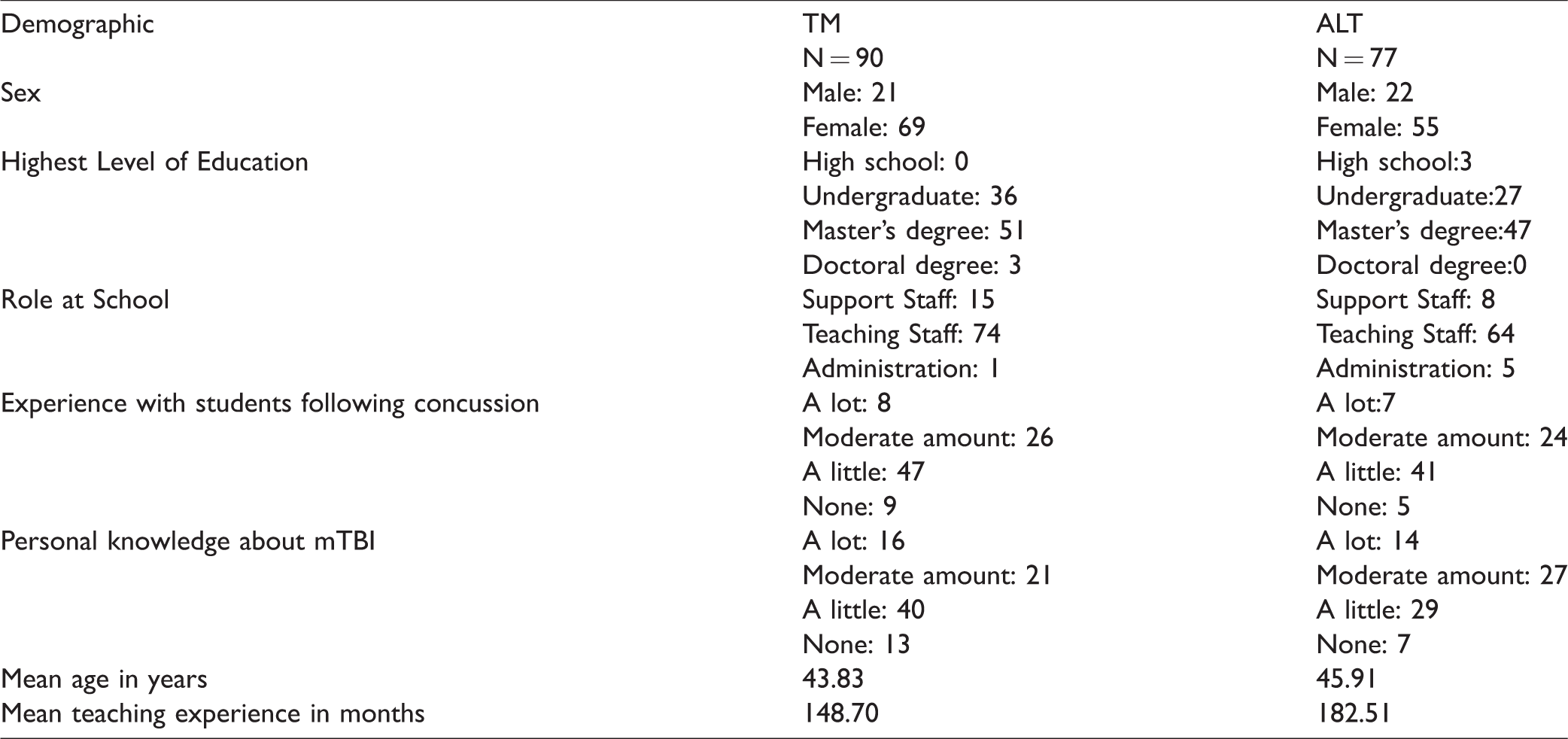
Demographics of both groups for sex, age, position at the school, teaching experience and participants’ self-reported experience with students returning to the classroom after concussion can be found in Table 2. The results of a Pearson’s chi-squared indicated that demographics were equally distributed among the groups, including experience with students recovering from concussion in the classroom and personal experience with concussion (p>.05 for all calculations).
Demographic Information.
Correct scores on the post-test assessment for the ALT groups across all schools ranged from 8 (38.10%) to 21 (100%) of 21 correct with an overall mean of 16.98 (80.86%) (SD 2.64). Scores on the post-test assessment for the TM groups ranged from 11 (52.38%) to 21 (100%) of 21 correct with an overall mean of 16.53 (78.71%) (SD 2.11). Mean scores for individual schools ranged from 16.08 (76.57%) to 17.82 (84.86%) in the ALT group and from 16.05 (76.43%) to 16.84 (80.19%) in the TM group. There were no overall score differences between groups or between groups by school (p=.44).
Primary Analyses
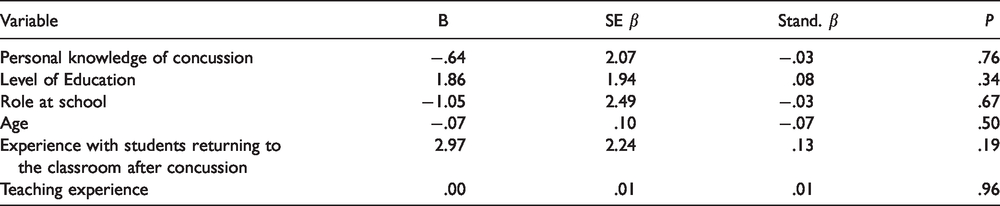
Analyses also found demographic variables did not predict learning transfer (p=.65).No effect of demographics by group membership. Refer to Table 3. Finally, there existed no statistically significant differences in correct answers between the ALT vs TM groups apart from four items. Participants in the ALT group more successfully answered items 1 (p = .03), 3 (p = .02), 6 (p =.01), and 21 (p =.00) than did participants in the TM group. These specific vignettes constituted all the Individual Recovery competency items at Bloom’s level of application contained in the assessment. Although differences were found for these four items between groups, there were no overall score differences between groups or between groups by school.
Regression Coefficients for Predictor Variables.
No statistically significant difference existed between ALT and TM groups for transfer of learning (p=.22). The result of partial eta squared showed that type of in-service training accounted for 1% of the variance in assessment scores. Additionally, no statistically significant difference was found for the main effect of individual school on score (p=.12) nor for the interaction between the variables of group and school (p=.44). Method of in-service accounted for 2% of the variability in assessment scores at single schools.
Discussion
This study examined the effect that two methods of in-service delivery, ALT and TM, had on transfer of learning for teachers on the topic of concussion management for students. There was no statistically significant difference between the means of the total assessment scores for the two methods. The mean total assessment score was 80.86% correct across all participants. While a significant difference in overall learning was hypothesized between groups, there was a significant difference between groups in the questions associated with Individual Recovery, in favor of the ALT group.
Several reasons may account for this result. First, ALT may not be applicable to the context of a traditional in-service format. Second, the type of learning expected from an in-service may not be facilitated by use of ALT. Third, ALT may not be descriptive of adult learning.
In addition, the relatively high scores across groups was notable. However, value cannot be placed on this score as the focus of the study was to compare learning between two methodologies to determine differences, not the general effectiveness. It should also be noted that the lack of a pre-test obscured the potential effects of prior knowledge of this topic on the outcome.
It is possible that the format of a traditional teacher in-service may not lend itself to some of the elements of ALT. Knowles’ original theory (Knowles, 1989a, 1989b) emerged from observing adults learn in a self-directed, voluntary setting without time constraint. Through his observations, Knowles noted the adult learner is ready to learn information that they perceive to have an immediate impact on their vocation (Knowles, 1989a, 1989b). Promoting self-directed learning and establishing topical relevance to a wide range of teachers may not be feasible in the format of a mandatory traditional teacher in-service. Further, the relatively low incidence of students sustaining concussion may have reduced the importance of the information for teachers when compared with the number of students they teach and the issues they face daily.
Allocating enough time for ALT to be effective during a traditional teacher in-service has limited feasibility. Time required to address some of the elements of ALT may exceed that of the typical, single event teacher in-service examined in this study. The duration of the in-service was 90 minutes for schools 1, 3, and 4 and 75 minutes for school 2. Ninety minutes may have not offered enough time for trial and error or reflection on learning that may be necessary to enhance learning transfer (Caffarella, 2002). Extended time with the material using the principles of ALT may have resulted in more favorable learning outcomes.
Evidence regarding adult learning may not support the description of adult learners proposed by Knowles. Knowles (1989a, 1989b) stated that adult learners are motivated to learn material that promotes their vocation or self-esteem and that adults are intrinsically motivated to learn. During teacher in-service, it is assumed that teachers will value information regarding best practices in teaching. Teachers will then transfer their learning to classroom teaching practice. These assumptions may not be accurate. Intrinsic and extrinsic motivators are complex and specific to the individual. Motivation can be changed over time and impacted by both personal and environmental influences (Ryan & Deci, 2000).
Further, these trainings were provided during preparation week prior to students starting school. During this time, teacher focus may have been on readiness for student arrival. Similar learning outcomes for both groups may be explained by the similar motivation to attend to material presented in this in-service.
Empirical evidence supports that experience may impede new learning if the dimensions of the new task are different from prior learning (Ranganathan et al., 2014). Unlearning of incorrect information may be necessary (Cirnu, 2015). This study found that no participant demographic data, including self-reported personal and professional knowledge about the in-service topic, was predictive of an assessment score.
Prior learning may also influence how something is learned. ALT does not differentiate between the learning of material that is novel to the learner and material with which the learner is more experienced. Even if teachers have no experience with concussion, they do have experience with children and adapting classroom activities to meet needs. Teachers are not novices in classroom management, the topic covered during this in-service. Research has shown differences in the way new material and familiar material is taken in and used (Daley, 1999).
The learning of novel material necessitates scaffolding. Such learning requires formalized opportunities for trial and error (Daley, 1999), structured learning opportunities (Daley, 1999), and validation for learning efforts (Halpern & Hakel, 2003).
Conversely, learning of familiar material can be less formal with these learners preferring collaboration with peers and direct application to the work setting. Excessive formal instruction on familiar material can result in cognitive overload, distracting the learner from new learning (Kalyuga & Renkl, 2010).
The teachers, staff, and administration in this study were experienced with students and classroom management. Teachers in both groups, TM and ALT, received the same information in different formats. The results of the item analysis in this study showed no statistically significant difference between the groups in items related to classroom management of students. The significant difference between groups on the four items that represented vignettes assessing application of the competency of Individual Recovery was notable. These items may have required the learner to apply novel information in novel ways to make decisions for students in these vignettes. Research has shown that teachers lack training regarding traumatic brain injury, specifically knowledge of student services and other supports required by students recovering from mTBI (Davies & Ray, 2014; Ettel et al., 2016). The competency of Individual Recovery covers return-to learn strategies with focus on adamic adjustments and related student specific supports.
When learning novel material, teachers may prefer formal learning opportunities that offer problem-solving and validation for their learning attempts (Daley, 1999). These formal problem-solving opportunities and validation were present in the ALT presentation, but not in the traditional presentation.
Study Strengths and Limitations
This study had several strengths including, consistent programming and procedures across schools. While School 2 devoted only 75 minutes to the study, statistical analysis showed no difference in learning transfer when compared to the other three schools. The presentations and method of outcome assessment were reviewed and approved by experts in the fields of education and brain injury. Presenters were required to demonstrate knowledge of material and experience in presenting in-services. The timing of presentations was similar at each school. Time of day and time of school year was comparable for all presentations. Settings in which each type of training occurred were homogeneous across schools.
There are study limitations that should be considered. Unfortunately, it was not possible to assess participant learning based on changes from pre- to post-training. Further, the omission of four vignettes may have impacted the findings. It is possible that the omitted vignettes may have provided additional insight into the learning of the participants or that those participants who answered additional questions may have experienced test fatigue. However, analysis of group by school effects were not found to be significant.
This study was designed to align with Knowles’ (1989a, 1989b) principles and characteristics of the adult learner. However, accurate and complete application of ALT cannot be ensured as empirical evidence regarding this theory is lacking.
Vignette-based test questions may measure what participants know they should do in a particular situation but may not represent actual practice. However, measurement of application of learning to novel situations in vignettes is an important first step in understanding affecting change in teacher practice.
Finally, as this study occurred in northern New England, generalizability to other regions may be limited.
Future studies should examine the longer term impact such trainings have on learning and, most importantly, on practice. The authors would have preferred a more robust assessment process but the logistics of scheduling teachers in school precluded such assessment.
Implications for Practice and/or Policy and Research
The findings of this study may help to inform practice in both methodology of content delivery and in determining what types of information regarding mild traumatic brain injury would be most important to constituencies. It is possible that learning may be enhanced when differentiation of instruction occurs. Novice learners prefer to learn differently than expert learners. Teaching in a modality that accommodates for such differences may improve outcomes.
In this study, it was of interest that the ALT method produced improved outcomes for teachers on the competency of individual recovery. That this competency is of interest to teachers has been supported as such in the literature. When school-based participants were asked to rank the competencies for usefulness, individual recovery emerged as the competency most identified at 94% (Maerlender et al., 2019).
Further, this study demonstrates the utility of competency-based instruction. By defining knowledge in terms of specific competencies it becomes possible to generate hypotheses about learning and about content.
Future research should include use of a pre-test of participant knowledge to determine specific learning over the course of a teacher in-service. Before and after teacher in-service, observation of classroom practice and participant interviews may provide additional quantitative and qualitative information regarding transfer of learning and the perceived experience of the learner. Studies should also include a long-term follow up to provide additional data on transfer of learning including evolution of application and maintenance of learning.
Supplemental Material
sj-pdf-1-son-10.1177_2377960820948659 - Supplemental material for The Effect of in-Service Methodology on Learning Transfer for School Personnel Managing Students following Concussion
Supplemental material, sj-pdf-1-son-10.1177_2377960820948659 for The Effect of in-Service Methodology on Learning Transfer for School Personnel Managing Students following Concussion by Jennifer Parent-Nichols, Angela DeSilva Mousseau, Joshua Cleland, Jonathan D. Lichtenstein and Arthur Maerlender in SAGE Open Nursing
Supplemental Material
sj-pdf-2-son-10.1177_2377960820948659 - Supplemental material for The Effect of in-Service Methodology on Learning Transfer for School Personnel Managing Students following Concussion
Supplemental material, sj-pdf-2-son-10.1177_2377960820948659 for The Effect of in-Service Methodology on Learning Transfer for School Personnel Managing Students following Concussion by Jennifer Parent-Nichols, Angela DeSilva Mousseau, Joshua Cleland, Jonathan D. Lichtenstein and Arthur Maerlender in SAGE Open Nursing
Footnotes
Acknowledgements
This study was developed from a collaborative project between the Brain Injury Association of New Hampshire, Geisel School of Medicine at Dartmouth College, and the New Hampshire Bureau of Developmental Services supported by grants through the US Health Resources and Service Administration, and then the Administration for Community Living. The aim of the original project was to change the culture surrounding concussion in New Hampshire high schools, part of which included the development of evidence-based protocols for returning students to school after sustaining a concussion. A need to better understand the most effective method of content delivery for teacher in-service training became evident during the development process. The original grant did not fund the present project.
Declaration of Conflicting Interests
The author(s) declared no potential conflicts of interest with respect to the research, authorship, and/or publication of this article.
Funding
The author(s) disclosed receipt of the following financial support for the research, authorship, and/or publication of this article:: This research was funded, in part, by an award from the College of Graduate and Professional Studies at Franklin Pierce University.

References
Supplementary Material
Please find the following supplemental material available below.
For Open Access articles published under a Creative Commons License, all supplemental material carries the same license as the article it is associated with.
For non-Open Access articles published, all supplemental material carries a non-exclusive license, and permission requests for re-use of supplemental material or any part of supplemental material shall be sent directly to the copyright owner as specified in the copyright notice associated with the article.
