




Abstract
In response to the coronavirus disease 2019 (COVID-19) pandemic, most of the higher education institutions (HEIs) across the globe have replaced conventional teaching with online teaching. However, the technological preparedness of countries of varied nature differs significantly. In this context, the purpose of the study is to answer the following research question: how are the HEIs mitigating the difficulties that have resulted from the COVID-19 pandemic to facilitate online teaching–learning process? The study is carried out based on a cross-sectional study from 281 academic professionals who are employed in HEIs in India and Ethiopia. The findings from this comparative study highlight that digital divide and lack of institutional preparedness are found to be major problems that constrained the effective implementation of online teaching/learning. Besides, this study also found that training programmes for the faculty members to utilize web resources and facilitate online teaching were found to be limited in both the countries. The article concludes by offering suggestions and policy advice to minimize the digital divide and for successful implementation of online teaching in HEIs.
Introduction
The coronavirus disease 2019 (COVID-19) pandemic has challenged the current global sociopolitical dynamics and economic landscape (Cuaton, 2020). It is already evident that the direct and indirect effects of the COVID-19 pandemic are pervasive (Holmes et al., 2020), and it primarily affects public health with spillover effects in many other key areas of human life, ranging from socio-economic, political and cultural life (Kummitha, 2020; Ng & Peggy, 2020). Specifically, the education sector has been significantly affected (Ng & Peggy, 2020). Higher education institutions (HEIs), in particular, in over 188 countries, have been closed (WHO, 2020). As a result, an estimated 1.58 billion learners are forced out of schools, colleges and universities, which represent 91.3% of total enrolled learners in the world (UNESCO, 2020). As a result, the pandemic has left several challenges to HEIs in both developed and developing countries. In response to mitigating the crisis, universities across the globe have decided to move from the traditional classroom-based teaching to online teaching (Eve-Marie, 2020). In view of that, HEIs made a significant effort to maximize the digital technology use to conduct the classes and delivering lectures online (Awogbenle, 2020; Labar, 2020; Kasturi Behari & Ganas, 2020). However, the usage of the digital technologies by HEIs is not even across the globe (Tamrat & Dmatew, 2020).
In light of the rising concern to access the digital technologies in order to conduct online teaching at an equitable way in the HEIs, the study aims to address the following research question: how do HEIs mitigate the difficulties resulting from the COVID-19 pandemic to carry out online teaching and learning? We test this research question by comparing both India and Ethiopia. The major reason for choosing these two countries is that both these countries have been working together to expand higher education. Ethiopia largely depends on India to expand its education sector (Sime & Latchanna, 2018). There are about 2,000 Indian faculty members who contribute to teaching and academic research in Ethiopian universities. Further, India welcomes hundreds of Ethiopian students as part of Indio-African scholarship program (Srinivasan, 2018). In addition, the Pan-African e-Network capacity-building project makes a significant effort in India and Ethiopia for education sector expansion. In this context, the study explores the technological capacity and preparedness between these two emerging countries to continue the teaching and learning process. Our findings indicate that the major issues linked with the impact of COVID-19 on teaching and learning activities in HEIs include digital divide among the institutions and academic professionals, and lack of preparedness among institutions and teachers.
This article is structured as follows. The second section highlights the impact of COVID-19 on teaching activities in HEIs and provides a research context for the study. The third section discusses the methodology and the findings of the study. The fourth section throws light on the discussion and concludes the article by providing a way forward in order to overcome the challenges faced by the HIEs, pertaining to online teaching and learning during and beyond emergency situations even in the future.
Review of Literature
Due to the COVID-19 pandemic, teaching and learning activities in HEIs have been significantly affected (Mukherjee, 2020). Given this challenging environment, the education sector across the globe has chosen to move from the traditional face-to-face classroom to online teaching and learning (Cuaton, 2020). In this context, facilitating better access to information and communications technology (ICT) or digital technologies in HEIs has become increasingly important. There are direct benefits of having easier and faster access to information through ICT adoption (Adam, 2003). Online teaching and learning is a teaching method that adopts digital technologies. Such a learning is often referred to as ‘e-learning’. Conventionally, online teaching and learning is seen as a type of ‘distance learning’—the umbrella term which is used to describe any learning that takes place across distance and not in a traditional classroom (Ya, 2020). In the recent years, online courses have becoming more popular as people have started to appreciate the advantages of online learning (Tung & Chang, 2007). In fact, online teaching and learning can be held through a virtual classroom. It is a design for an online environment that provides real-time interaction between educators and students. The online platform expands traditional classrooms into virtual classrooms through technology. In fact, applying virtual classroom approach is seen as an alternative method to enhance teaching and learning process in abnormal situations, including recent HEIs’ closure during the pandemic. It can also be an alternative method for educators to enhance continuous teaching (Mukherjee, 2020; Ng & Peggy, 2020; Tamrat & Dmatew, 2020). The impetus that is shifting from classroom learning to online during COVID-19 has been to ensure that students complete their academic year uninterrupted (Kasturi Behari & Ganas, 2020).
As part of the virtual classroom, educators not only offer online teaching for students but also share reading material, conduct webinars and prepare and upload videos to support the continuity of the education (Cuaton, 2020). Despite the merits, online learning tests the potential of the education system of many countries in capitalizing and facilitating the online education with technology support. In the process of adapting and facilitating online teaching, even the role of educators starting from school education to higher education is changing (Cuaton, 2020; Ní Shé et al., 2019) in terms of teaching mode, and multiple online teaching guides, resources, webinars and videos are being prepared in a rapid phase to support the continuity of the education system. In fact, amidst the pandemic outbreak, prolific online resources have mushroomed and the Internet and social media have been used to facilitate going online (Kasturi Behari & Ganas, 2020).
Despite the initiatives to facilitate online teaching and learning, it is argued that not all countries are equipped to handle online teaching/learning equally during the COVID-19 outbreak (Tamrat & Dmatew, 2020). Due to this unprecedented situation, the transition from classroom teaching to online teaching has raised questions even for the faculty members about their capability to deal with the existing technology (Sahu et al., 2020). Moreover, single dimension of digital learning also leads to inequality in learning opportunities (Kasturi Behari & Ganas, 2020).
At this juncture, while talking about digital learning in these two countries, two major challenges have to be taken into consideration. They are digital divide and institutional preparedness, which include efficiency of faculty with proper training and student’s accessibility. From the delivery side, majority of the faculty members are most likely inefficient or not well trained to deliver lectures through online. Due to this unprecedented situation, online teaching as a practice has raised questions for the faculty members about their potential to deal with the existing technology (Sahu et al., 2020). Even in the most technologically developed education systems, teachers are struggling to transit to online courses (Mukherjee, 2020). Several teachers are not tech savvy and are forced to adopt new approaches to conduct online classes without proper training that, in turn, diminishes the quality of teaching (Ya, 2020). As Coppola et al. (2002) argued that there are three roles that the teachers must perform while providing online teaching, which include (a) the cognitive role, because a deeper level of understanding may be required when teaching online, (b) the affective role, which is required to maintain relationships with students in the online environment and (c) the managerial role, as class management will change (cited in Ní Shé et al., 2019, p. 21). However, earlier, these online platforms have always been a supplementary teaching material to use in classrooms. Now, it has become the only means to reach out and teach the students (Ya, 2020). In turn, it is essential to review the possibilities of digital platform for continuing teaching and learning in developing countries like India and Ethiopia.
The above-mentioned literature makes it evident that during the COVID-19 outbreak, due to the closure of many universities, attempts have been made in facilitating online teaching for university students in order to continue their learning process. However, the literature also highlights the necessity to understand how effectively the HEIs are prepared to implement online teaching to the students amidst the COVID-19 pandemic (Cuaton, 2020; Kasturi Behari & Ganas, 2020).
Research Instrument
An online questionnaire survey was designed by using latent variable model to understand the impact of COVID-19 on teaching and learning activities. Three scholars from social science and management teaching backgrounds were invited to design the questionnaire. A pilot test of the questionnaire was conducted using convenience sampling approach. A total of 20 valid questionnaires were collected from the respondents. All the questionnaire items were analysed and subjected to item analysis. Few items have two or more unaccepted criteria (low Cronbach’s alpha > 0.5), which were then deleted. Among the 20 respondents from the pilot study, 5 respondents have given their feedback and, accordingly, 5 items were removed and 4 items were modified for readability and clarity.
The final questionnaire was prepared, which included the following four sections:
University preparedness in using online teaching: This scale consisted of four items, and it was developed based on the finding from Taylor et al. (2020) and Ahorsu et al. (2020). Teachers’ preparedness in using online teaching: This scale consisted of eight items, and it was developed based on the findings from Deng et al. (2020) and Mertens et al. (2020). Teachers’ perception about the students’ problems and their preparedness in utilizing online teaching and learning during the COVID-19 pandemic: This scale consisted of seven items, and it was developed based on findings from Taylor et al. (2020). Respondents’ personal and academic information: The demographic characteristics of the respondents consisted of 11 items, developed by the researchers.
The responses connected to the research and teaching and learning activities that were measured on a 5-point Likert scale ranged from 1 for ‘strongly disagree’ to 5 for ‘strongly agree’.
Data Collection
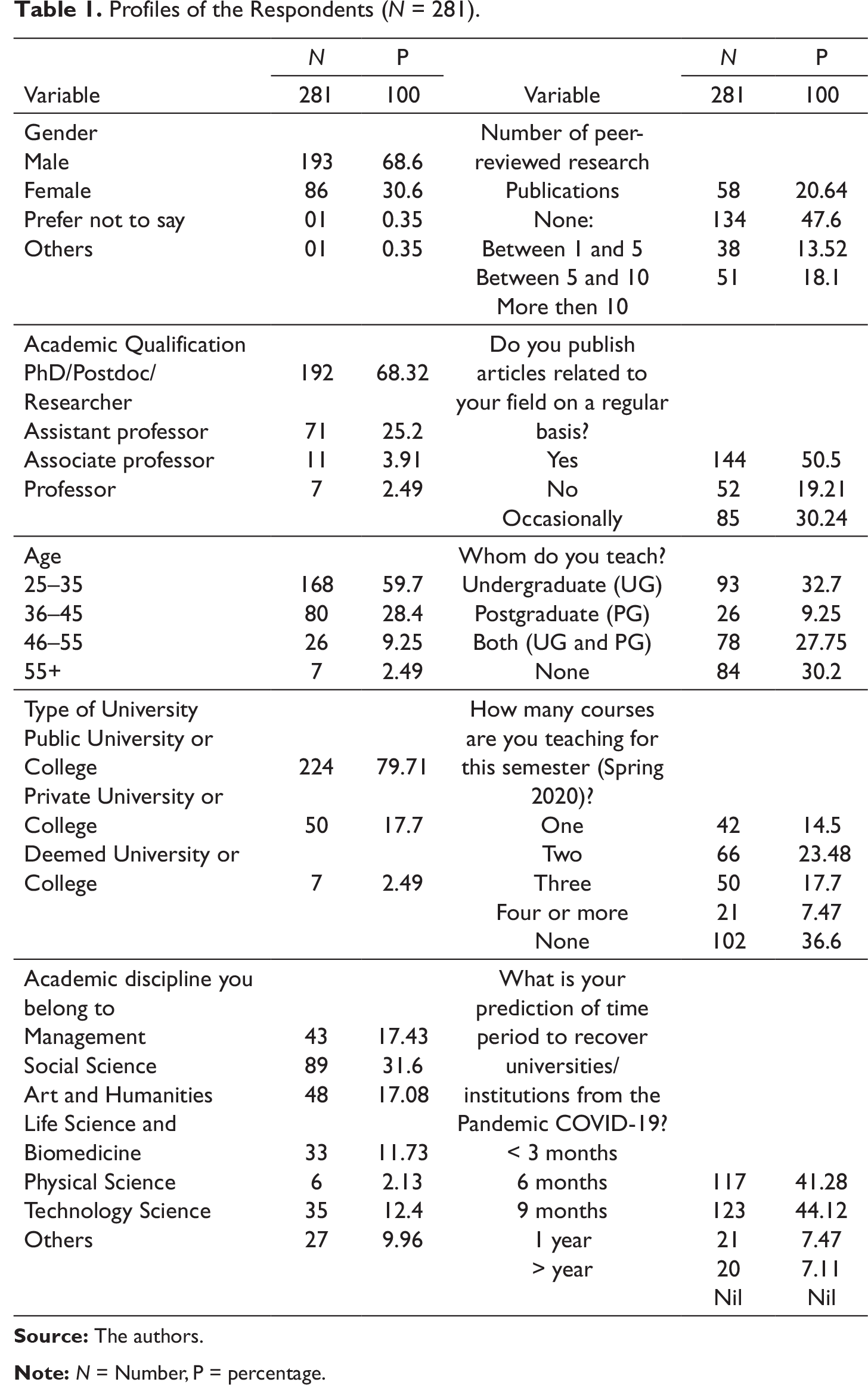
Profiles of the Respondents (N = 281).
Respondents’ Demographics
Table 1 represents the details about the profiles of the respondents of the study. A total of 281 respondents were selected for the final sample of the study, in which 193 (68.6%) belonged to the male category and the remaining 86 respondents (30.6%) belonged to the female category. The majority of the respondents (68.32%, which is equal to 192) were researchers (either doctoral or postdoctoral research), and 25.2% of respondents were assistant professors, whereas, 3.9% (11) of the respondents were associate professors, and only 2.4% of the respondents were professors in different universities of the two countries. The data also show that of the total 281 respondents, 79.1% were either doing research or teaching in public universities or colleges, and 17.7% were from private universities or colleges, while only 2.4% of the respondents belonged to deemed universities or colleges. Majority of the respondents came from the public sector educational institutions. The academic discipline of the respondents is also presented in Table 1. The majority of the respondents were from the Social Sciences, which comprised 31.6% and 17.73 respondents were from Life Science and Biomedicine. The respondents from the Management discipline consisted of 17.43%, and 17% of the respondents were from Humanities. The remaining respondents (12.4%) were from Technology Sciences, 2.13% of the respondents belonged to Physical Sciences and 9.9% of the respondents belonged to others categories. This showed that majority of the respondents were from three major disciplines, which included Social Sciences, Management and Humanities, while the other disciplines comprised very less.
Most of the respondents (32.7%) taught the undergraduate students, and 9.2% of the respondents taught postgraduate students, whereas 27.7% taught both undergraduate and postgraduate students, and 30.2% taught neither, which means they fell under the research category. Further, it is also indicated in Table 1 that 14.5% handled only one module, 23.4% taught two modules and 17.7% taught three modules per semester, whereas only 7.47% taught more than four modules. With reference to predicting the time period to resume face-to-face classes for universities/institutions which were closed due to the COVID-19 pandemic, it was observed that of the total respondents, an overwhelming majority (88.4%) felt that the HEIs will resume their face-to-face teaching between 3 months and 6 months, while about 14.5% assumed that it will take at least 9 months to 1 year.
Findings
A confirmatory factor analysis (CFA) and one-way analysis of variance (ANOVA) paired samples t-test was performed to find the significance between the two countries with respect to different variables. Test was conducted by using SPSS AMOS for Windows. The first model was used to assist the fit, reliability and validity (i.e., convergent and discriminant validity) of the three variables such as the university preparedness in using online teaching, the teachers’ preparedness in using online teaching and teachers’ perception about the students’ problems, and their preparedness in utilizing online teaching and learning during the COVID-19 pandemic. The CFA model also helped in the assessment and score verification of the two variables. The one-way ANOVA paired samples t-test was also employed to find out the difference among the respondents of the two countries. This test also helped in assessing the statistical differences for each subscale, which is determined to understand and analyse the impact of COVID-19 on the teaching and learning activities among the two countries.
Measurement Model
The χ2 value of the measurement model was 1,860.08 with 480 degrees of freedom (p < 0.001), which suggested that measurement value did not fit the data well. However, it is said that if the sample size affects the χ2 value, a larger sample size can make this fit test an insufficient measure of model fitness (Hair et al., 2010; McDonald & Ho, 2002). Besides, the assessment of the model fit test was achieved by considering other alternative fit indices like the model fit indices (CMIN/df = 1.431, GFI = 0.873, TLI = 0.898, NFI = 0.88, CFI = 0.91, RMSEA = 0.057, SRMR = 0.057). The score indices suggest that the measurement model achieved replication values that can fit the sample data (Hair et al., 2010).
Factors Loading, Average Variance Extracted (AVE), Composite Reliability (CR) of COVID-19 Impact.
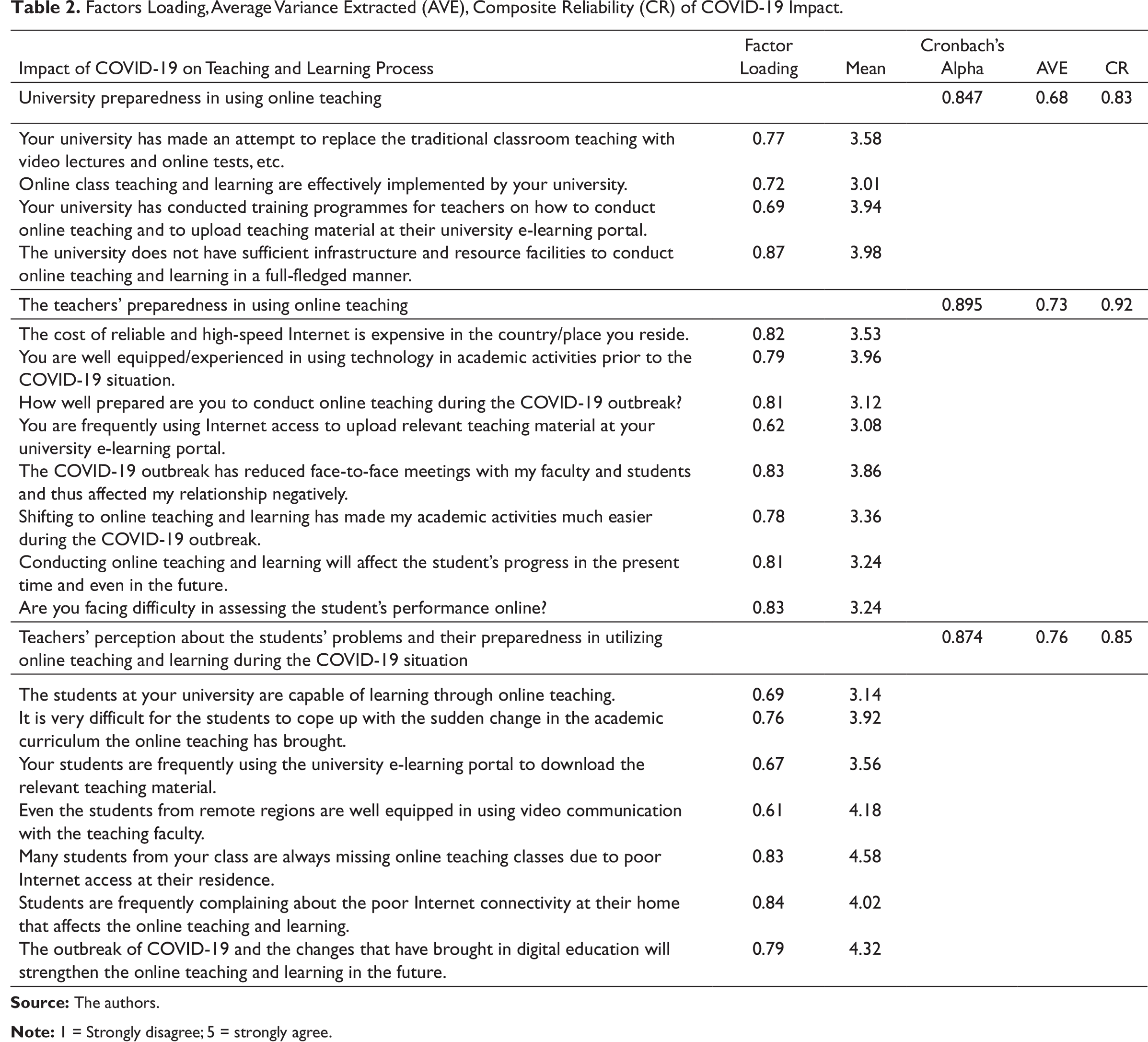
Table 2 represents the factor loading, average variance extracted (AVE) and composite reliability (CR) of COVID-19 and its impact on HEIs. Table 2 highlights all the three factors (a total of 19 items): (a) university preparedness in using online teaching with an α value of 0.847; (b) the teachers’ preparedness in using online teaching with an α value of 0.895; and (c) teachers’ perception about the students’ problems and their preparedness in utilizing online teaching and learning during COVID-19 with an α value of 0.874. All these scores are above the benchmark of > 0.70, suggesting good internal consistency (Nunnally & Bernstein, 1994). The CR score is also greater than 0.70, indicating that these items are reliable measures of the corresponding constructs. The first factor represents the university’s preparedness in using online teaching (CR = 0.83 and AVE = 0.68). It is characterized by four items, with the fourth item—the university does not have sufficient infrastructure and resource facilities to conduct online teaching and learning in a full-fledged manner—having the highest influencing item (the factor loading is 0.87), and the third item—your university has conducted training programmes for teachers on how to conduct online teaching and to upload teaching material at their university e-learning portal (the factor loading is 0.69)—is considered as the least influencing item. From the first factor, it is understood that both the countries—India and Ethiopia—are facing problems with insufficient infrastructure and resource facilities to conduct online teaching and learning in a full-fledged manner.
The second factor represents the teachers’ preparedness in using online teaching (CR = 0.92 and AVE = 0.73). This factor is characterized by eight items. Among those, item number nine—that is, the COVID-19 outbreak has reduced face-to-face meetings with other faculty members and students and thus affected my relationship negatively—(the factor loading is 0.83) and item number 12—are you facing difficulties in assessing the student’s performance online?—(the factor loading is 0.83) are considered as the highest influencing items. The least influencing item is item number eight—you are frequently using Internet access to upload relevant teaching material at your university e-learning portal—(the factor loading is 0.62). From these items, it is evident that the teachers/faculty have faced difficulty in assessing the student’s performance online. It is also observed that the reduced face-to-face meetings have affected the teacher–student relationship negatively. This phenomenon was observed mostly with the teachers from Ethiopia, followed by India.
The third factor represents the teacher’s perception about the students’ problems and their preparedness in utilizing online teaching and learning during the COVID-19 situation between the two countries (CR = 0.85; AVE = 0.76). This factor is characterized by seven items. Item number 18—students are frequently complaining about the poor Internet connectivity at their home that affects the online teaching and learning—(the factor loading is 0.84) is the highest influencing item, and item number 16—even the students from remote regions are well-equipped in using video communication with the teaching faculty—(the factor loading is 0.61) is the least influencing item. These results made it clear that students have complained about the poor Internet connectivity at their home. Consequently, this has affected the online teaching–learning process negatively. As far as the teachers’ response is concerned, this phenomenon is frequently observed in Ethiopia. All items reached significant level (t > 1, p < 0.5), indicating acceptable convergent validity. All the AVE scores exceeded the threshold of 0.5, indicating acceptable convergent and discriminant validity (Bagozzi & Yi, 1988; Hair et al., 2010).
Paired Sample t-Test: Dependent Variable: Teaching and Learning Activities Effected by COVID-19.
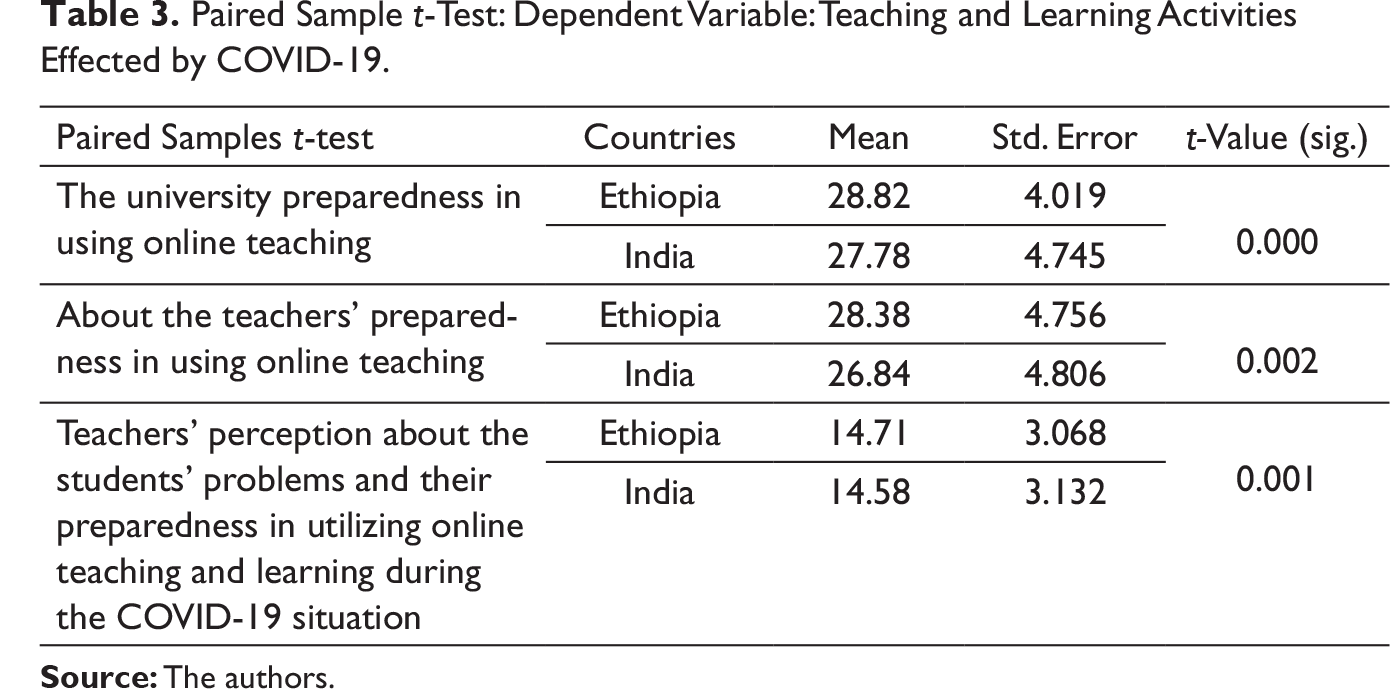
Universities in many developing countries do not have enough infrastructure or sufficient resources to facilitate online teaching to the students with immediate effect (Sahu et al., 2020). Particularly, the full-fledged implementation of online teaching is not feasible in many African countries as only 24% of the population has access to the Internet, and poor connectivity, exorbitant costs and frequent power interruptions are other serious challenges that constrain the potential to make online learning a practical reality (Mukherjee, 2020; Tamrat & Dmatew, 2020). The third variable refers to the teachers’ perception about the students’ problems and their preparedness in utilizing online teaching and learning services during the COVID-19 situation. With the Mean = 14.71 and SD = 3.068 relating to Ethiopia, it can be concluded that students from Ethiopian HEIs are not yet prepared to access online teaching and learning compared to the students from HEIs in India with the Mean = 14.58 and SD = 3.132. As a whole, it can be concluded that the HEIs in Ethiopia face more difficulties in implementing online teaching and learning activities as compared to the HEIs in India.
As far as the respondent’s perception is concerned, it is understood that there are two major difficulties in enabling online teaching to the students in Ethiopia: (a) digital divide and (b) lack of institutional preparedness. Few studies on facilitating the online teaching and learning process in African countries reveal that the online mode of teaching has laid bare the digital divide between those countries that have better ICT infrastructure and between HEIs within the same country, with some being far better equipped and experienced than others (Mukherjee, 2020). It is also evident from the respondents’ perception from different Ethiopian universities that many of the HEIs in the country face problems with poor infrastructure and Internet access.
In terms of teachers’ preparedness, it is found that training faculty members to facilitate online teaching is limited. With reference to Ethiopia, unprepared teachers will not be able to facilitate online teaching, adversely impacting the quality of education programmes (Boateng, 2020). Many teachers are not technologically savvy and are forced to adapt to conduct their classes online without proper training that, in turn, diminishes the quality of teaching (Ya, 2020). In fact, recent studies highlighted that the COVID-19 pandemic could have a devastating effect on African countries due to high levels of poverty, weak health systems and crowded urban areas (Venkatachary et al., 2020). With reference to India, the respondents opine that despite the problem of digital divide, the country has made some progressive steps in order to replace the conventional classroom learning with online teaching and learning activities. However, from the respondents’ perception, it is evident that the HEIs which are located at the remote regions of India are still not well equipped in facilitating online teaching. Thus, there is a digital divide found in HEIs, which are located at the urban areas and remote regions. As far as the institutional preparedness to conduct online teaching is concerned, the respondents reported that Indian HEIs are well placed compared to Ethiopian HEIs. Especially, some of the e-learning platforms, such as SHAGUN, Diksha, e-Pathashala, massive open on-line courses (MOOCS), etc., are very much useful for the student to learn online. However, these initiatives are not sufficient to replace the conventional classroom teaching with online teaching. In order to facilitate online teaching, the educators must have certain training in delivering the subject. The online learning classes are useful only to teach theoretical subjects without actual use of the laboratory; however, the problem occurs when it comes to laboratory-oriented and practical-based technical education. These online platforms have always been a supplementary teaching material to use in classrooms. Now, it has become the only means to reach out and teach students (Ya, 2020). Another key challenge to online teaching is continuous assessment and evaluation. Even though ICTs have been used earlier to support online teaching and learning, students and the faculty are uncertain about the procedure for administering outstanding assignments, projects and other continuous assessments. It is the need of the hour for the faculty members to change and implement new types of assessments to fit in the online mode (Sahu et al., 2020; Timmis et al., 2016). COVID-19-like situations also demand for well-equipped infrastructure and resources with proper training to the faculty members on how to conduct online teaching and address the queries of the students. Most importantly, it is also equally important to ensure that every student, including students from the remote places, is able to access Internet resources and gain knowledge on how to learn through online teaching. Until and unless, the efforts to make a full-fledged implementation of online teaching will become a distant reality in Ethiopia and India.
It is true that the present global crisis has provided an opportunity to all higher education institutions to quickly improve and maximize their ICT operations in order to capitalize and facilitate online (Ya, 2020). It is the pressing priority to come up with different types of mechanisms, depending on the country and institutions to make online teaching an effective mode of learning (Kozimor, 2020). Nevertheless, it is also equally important and the need of the hour that educators, from schools to universities, are proactive during online tutorials and willing to consult colleagues, who have had past experiences with online teaching and learning. In addition, the official national lockdown period could be utilized by teachers to upscale their skills to teach online (Mukherjee, 2020). On the other hand, institutions need to develop a comprehensive plan and a rigorous follow-up mechanism to ensure that academics and students make proper use of digital platforms. This task cannot be left solely to the discretion of individual actors (Tamrat & Dmatew, 2020). The concerted efforts from all the stakeholders are, therefore, necessary to make this online teaching and learning feasible and a practical reality.
Conclusion
By and large, the HEIs around the world have adopted ‘universalization of online education’ to overcome the restrictions imposed on classroom-based teaching and learning due to the COVID-19 pandemic. The move to remote learning has been facilitated by several online platforms such as Google Classroom, Blackboard, Zoom and Microsoft Teams. As far as the field observations are concerned, many HEIs in Ethiopia and India are still not yet well equipped to facilitate online teaching and learning activities to the students. The major issues linked to the impact of COVID-19 on teaching and learning activities among HEIs are the digital divide among the institutions, academic professionals and lack of preparedness among institutions and teachers. In particular, respondents from Ethiopia reported that the teachers’ preparedness in facilitating online teaching and students’ preparedness in receiving online learning are minimal in many HEIs in Ethiopia. In other words, besides the digital divide, institutional preparedness is also seen as one of the major barriers in facilitating online teaching. The findings of the study necessitated the urgency in making the HEIs capable of handling online teaching in a full-fledged manner. In order to overcome these challenges, the study suggests that the governments have to come up with reformed ‘Internet governance’ in order to expand ‘network of data’ with high-speed and feasible rates by breaking urban–rural divide. This can benefit the newly established educational intuitions, which are located at remote locations, and many students belong to the rural regions at large. The findings of the study also helped in suggesting that the time of crisis is also an opportunity for all education systems to look into the future, adjust to possible threats and build their capacity through constructive measures. It is also time for self-retrospection of HEIs in Ethiopia and India on how digital technologies can help in mitigating the impact of COVID-19 or future pandemics on the education system? And how far institutions are prepared to utilize technology and other alternatives to continue teaching and learning processes. Further, institutions have to be prepared to tackle resource gaps. However, it largely depends on Internet accessibility, connectivity and functional literacy among potential users. Availability of all these resources at an affordable price can only mitigate the larger section of student’s exclusion from the learning process.
As the study also recognized that though the shift to compulsory online teaching is born out of the COVID-19-induced emergency, this shift has brought several key issues to the forefront in terms of equitable education with technologically driven teaching. We are also concerned that the promotion of digital leaning may disconnect society from social justice, which will further lead to the discrimination of underprivileged groups. Based on the observations from the study, further research should focus on addressing the following research questions: how do we overcome the gap between social justice and digitalization? How do pressure groups like teachers’ associations or unions of HEIs play a constructive role in the promotion of equitable online teaching? What roles do the local governments and civil society organizations need to perform as active facilitators for equitable online teaching and to break the rural–urban divide? Further, there is also a research possibility to compare India and Ethiopia with a benchmark data of any country, which is significantly better in performance.
Supplemental Material
Supplemental material for this article is available online.
Supplemental Material for Coronavirus Disease 2019 and Its Effect on Teaching and Learning Process in the Higher Educational Institutions by Harshavardhan Reddy Kummitha, Naveen Kolloju, Prakash Chittoor and Venkatesh Madepalli, in Higher Education for the Future
Footnotes
Declaration of Conflicting Interests
Funding
The author received no financial support for the research, authorship and/or publication of this article.

Authors’ bio sketch
References
Supplementary Material
Please find the following supplemental material available below.
For Open Access articles published under a Creative Commons License, all supplemental material carries the same license as the article it is associated with.
For non-Open Access articles published, all supplemental material carries a non-exclusive license, and permission requests for re-use of supplemental material or any part of supplemental material shall be sent directly to the copyright owner as specified in the copyright notice associated with the article.
