




Abstract
In today’s fast-paced ICT-driven world, understanding the factors influencing the effectiveness of online teaching and learning is paramount, especially during the Movement Control Order (MCO) when physical educational activities are restricted. Assessing the efficacy of undergraduate students under these circumstances can be particularly challenging, and the resulting conclusions may vary depending on the context. Consequently, this study is driven by three primary objectives. Firstly, this study seeks to employ factor analysis as a robust method for validating the selected online teaching and learning instruments. Secondly, it endeavors to categorize the survey instruments into distinct core variables using Principal Axis Factor analysis. Additionally, the study aims to harness multiple regression analysis to uncover the factors influencing the efficiency of online teaching and learning. To achieve these objectives, an online questionnaire was administered to 107 students enrolled in a university in Malaysia. The collected data were analyzed using Statistical Package for the Social Sciences (SPSS). The results of the multiple regression analysis revealed that lecturer roles and student attitudes have significant positive relationships with the success of online teaching and learning. In contrast, flexibility exhibited a significant but inverse association. Despite the global transition into the endemic phase of COVID-19, this study aspires to furnish valuable insights for lecturers, students, and university administrators regarding the ongoing practices of online teaching and learning. Ultimately, these insights can empower policymakers to formulate optimal strategies thereby benefiting all stakeholders involved. In conclusion, this study acknowledges its limitations and offers recommendations for further research.
Introduction
The COVID-19 pandemic originated from a novel coronavirus (2019-nCoV) in Wuhan, the capital of Hubei province, China. Its impact has been far-reaching, disrupting lives, businesses, and tourism in over 200 countries worldwide (Jackson et al., 2020). Governments around the world implemented lockdowns to curb its spread, affecting industries globally, including the education industry. Academic leaders, in response, have endorsed online education as a remedy to this pandemic, as highlighted by the United Nations Educational, Scientific and Cultural Organization (UNESCO, 2020). This shift has been embraced by both public and private universities in Malaysia.
Education, particularly at the secondary and tertiary levels, remains pivotal for elevating the socioeconomic status of Malaysia’s youth. The pandemic prompted a significant increase in the adoption of e-learning to avert setbacks in educational attainment. The transition to digital learning is observable across higher education institutions (HEIs) in Malaysia (Menon, 2020). Professor Dr. Abdul Karim Alias, the Director of the Centre for Development of Academic Excellence (CDAE) at Universiti Sains Malaysia (USM), has emerged as a prominent advocate, stressing the shift from viewing online learning as optional to essential (Sia & Abbas Adamu, 2020). The ongoing improvement of online instructional and learning approaches carries substantial importance for higher education institutions (HEIs) and their students, particularly in the context of Movement Control Order (MCO) periods and beyond. It ensures the uninterrupted continuation of lessons, enabling the generation of highly capable graduates who are adept at navigating the labor market, exhibiting adaptability in the gig economy, and aligning with the principles of the Malaysian Higher Education Framework 4.0.
To mitigate the transmission during the COVID-19 pandemic, stringent measures were implemented. Consequently, students were mandated to engage in remote learning from their residences. This marked a notable departure from the traditional face-to-face classroom, where students and lecturers can observe and interpret nonverbal cues and establish visual contact throughout the educational experience. However, in the context of online environments, this interaction is substituted by the utilization of audio and visual components. Prior to the onset of the pandemic, some faculty members were already skilled in online teaching and learning, supplementing classroom learning with live streaming sessions, pre-recorded lectures, online discussions, and digital feedback (Lim, 2020). This adaptable approach ensures the seamless continuation of classes amid the COVID-19 pandemic, eliminating the need for university closures. The contemporary application of online teaching and learning methods, including both established and emerging approaches, represents a current phenomenon necessitating the academic sector’s continuous enhancement of existing skill sets and, in certain instances, the acquisition of novel ones.
Students pursuing a Business and Management degree with a specialization in economics commonly encounter statistical methods as essential components of their curriculum. This course serves as a foundational prerequisite for subsequent courses within the program. In other words, proficiency in statistical concepts and techniques is paramount for students, as they form the bedrock for the successful completion of future coursework. Traditionally, the pedagogical approach to teaching statistics involves imparting students with the skills to manually perform basic analyses using a calculator. However, many students express significant apprehension regarding their ability to comprehend and apply statistical concepts and formulas. Consequently, this subject matter tends to evoke fear and aversion among many undergraduate students (Seabrook, 2006; Townsend & Wilton, 2003). In the realm of business analytics, it is imperative to comprehend and apply statistical concepts to problem-solving. Moreover, achieving mastery in computation skills, including learning and implementing formulas, necessitates significant time investments from both students and lecturers. Toward the end of the syllabus, both disciplines require a robust component of statistical concepts and calculations, often involving students conducting and analyzing research projects using SPSS or Microsoft Excel. Hence, it is crucial to acknowledge the importance of these subjects and the need for a comprehensive grasp, especially when transitioning to online teaching and learning approaches.
Online learning empowers individuals to engage in activities from any location and at any time, irrespective of physical presence (Miles & Leinster, 2007; Parry et al., 2002). Online teaching and learning may differ from the traditional approach in several ways, including the roles of lecturer and student, communication methods, engagement levels, and flexibility (Young, 2006). Recent technological advancements have facilitated online teaching and learning. While the adoption of the MCO resulted in a shift of all classes in HEIs to e-learning platforms (Menon, 2020), some institutions faced challenges due to inadequate preparedness, whereas others had contingency plans and readily available online learning tools. Despite the potential benefits of e-learning, particularly as an alternative to conventional classroom teaching, it has witnessed a rough path (Johnson et al., 2008). It is imperative to acknowledge that the shift from traditional to online learning can pose challenges and disruptions, particularly in contexts characterized by inadequate internet connectivity, delivery methods, flexibility, and learner attitudes. These factors significantly influence the effectiveness of teaching and learning, especially in disciplines that require in-depth explanations and discussions of complex questions. It is also fundamental for lecturers to possess an understanding of the cognitive capabilities of their students (Sweller, 1988). As highlighted by Bao (2020) and Filius et al. (2019), a successful shift to online learning requires major planning and investment across all sectors. Despite the growing recognition of the educational environment’s importance for student learning (Miles & Leinster, 2007; Parry et al., 2002), research indicates that distance in the online learning environment can lead to feelings of isolation, discontent, boredom, academic overload, and low course completion rates (Berge, 1999; Hara & Kling, 1999; Northrup, 2002).
The education sector has undergone significant transformations, primarily driven by the rising popularity of online learning, where educational content is disseminated via remote digital platforms. The implementation of the MCO in March 2020 in Malaysia necessitated a complete transition of HEIs to online teaching and learning, introducing novel challenges to their operations. The efficacy of online teaching and learning, particularly in subjects like statistical concepts and calculations, remains uncertain and context-dependent. Hence, the primary research question addressed in this study is: What are the factors influencing the effectiveness of online teaching and learning in statistical and calculation subjects? The objectives of this study are as follows: firstly, to validate selected online teaching and learning instruments through factor analysis; secondly, to categorize the survey instruments into core factors using the Principal Axis Factor method; and thirdly, to analyze the factors impacting the effectiveness of online teaching and learning through multiple regression analysis.
Effective collaboration within the education sector is crucial to acknowledge and address pressing concerns, ensuring a promising and successful future for students (Bashir et al., 2021). As universities increasingly embraced blended learning as a pedagogical approach, the information obtained from this study offer valuable insights for both lecturers and institutions. In the current era of information and communication technology (ICT), characterized by the rapid expansion of online teaching and learning, gleaning insights from the experiences of both lecturers and students is paramount to aid universities in designing effective hybrid delivery models that cater to the specific needs of students, particularly in subjects involving statistics concepts and calculations.
Literature Review
Various terms have been used to describe online learning, including learning through the web, online learning, and computer-assisted learning, among others. According to Bertea (2009), some experts viewed the concept of online learning as a form of teaching that integrates multiple technologies. Others see it as a substitute for distance education, facilitated by internet technologies for effective and rapid communication.
In a study conducted by Stec et al. (2020), three primary online teaching techniques were identified: enhanced learning, blended learning, and fully online approaches. Enhanced learning employs technology extensively to foster creative and engaging instructional methods. Blended learning combines traditional face-to-face teaching with online components. The fully online modality entails the delivery of course content using digital platforms, offering students continuous access to learning materials throughout the day (Stern, 2020). Al-Salman and Haider (2021) noted that online education has shifted the focus of education toward a student-centered approach, where students actively engage in the learning process while teachers assume the roles of supervisors and guides.
Online learning offers numerous advantages (Picciano, 2017; Wang et al., 2019), including students’ greater control over study time and pace. Effective online students tend to be organized and self-initiated, capable of completing work with minimal supervision. However, there are various viewpoints on its drawbacks. Shank and Sitze (2004), for example, highlighted issues such as the absence of physical cues, technological barriers, and favoring individuals with strong writing skills. Integrity concerns for online teaching and learning were also pointed out by other researchers (Gallant, 2008; Michael & Williams, 2013; Roberts & Hai-Jew, 2009).
Sweller et al. (2019) explored the evolution of Cognitive Load Theory over the last two decades, emphasizing its relevance in facilitating successful online education. The theory posits that individuals’ cognitive processing abilities are constrained by their working memory capacity. Imposing unnecessary cognitive demands, such as ineffective instructional methods or distractions, increases cognitive load, impairing learning and transfer processes (Sweller, 1988). To enhance online education, it is essential to effectively control cognitive load by minimizing extraneous cognitive processing and optimizing relevant processing for the learning process. This theory holds practical implications and finds extensive application in educational research and practice (Schnotz & Kürschner, 2007; Sweller et al., 2019).
According to Sweller (1988), ineffective teaching practices can arise from a failure to consider students’ learning processes. Hence, it is imperative for lecturers to acknowledge the cognitive abilities of their students. Alternatively, when students are inundated with excessive information, they might become overwhelmed, resulting in a misalignment between desired learning results and the intended teaching objectives. This, as Asma and Dallel (2020) suggest, could result in a breakdown of the learning process. While online teaching presents well-documented challenges, it is essential to weigh these negative concerns against the potential benefits it offers for teaching and learning opportunities (Singh & Hurley, 2017). As mentioned in the introduction, the effectiveness of online teaching and learning for students remains largely unknown, and findings may vary across different situational contexts, particularly in subjects involving statistics and calculations. The literature review reveals a dearth of studies investigating the effectiveness of online teaching and learning methods in these specific subjects. Thus, the current study aims to bridge this gap and provide valuable insights into enhancing online teaching and learning effectiveness. In general, four determinants of online teaching and learning effectiveness have been identified, namely the lecturer, attitude, flexibility, and facilities. These variables are discussed briefly in subsequent paragraphs.
Lecturer
Present-day lecturers face significant challenges when transitioning from traditional classroom to online instruction (Phillips, 2005). Furthermore, Martin et al. (2019) emphasized that the emergence of online learning, lecture-based online classes, and the subsequent transformation of lecturers’ roles requires an extensive paradigm shift.
Within academia, lecturers are tasked with a multifaceted set of responsibilities, spanning instructional, social, management, and technical components, among others. These obligations involve providing comprehensive course materials, ensuring students grasp the subject matter, and effectively communicating important deadlines for exams, projects, and assignments. In addition to fostering an environment conducive to effective learning, which encompasses facilitating discussions, responding to inquiries, providing resolutions, and promoting teamwork, it is crucial for lecturers to cultivate a pleasant and friendly educational atmosphere.
Lecturers encounter various challenges in their profession, including the need to consider both the organization of knowledge and the cognitive framework supporting students’ information processing (Chandler & Sweller, 1991). According to Bernama (2020), lecturers must rapidly acquire the skills and expertise needed for effective online class delivery. Having to incorporate online learning into lectures isn’t always easy for lecturers. In light of the COVID-19 pandemic, it is imperative that they promptly incorporate technological elements into their educational programmes (Dhawan, 2020). Furthermore, the shift from traditional face-to-face teaching to virtual instruction requires lecturers to adapt their assessment strategies to fit the demands of online learning. This includes various assessment methods like continuous online assessments, final examinations, presentations, and other pertinent evaluation procedures. The use of online assessment marking exposes lecturers to the risk of computer vision syndrome (Forster, 2020), as extensive interaction with computers for evaluation and electronic feedback becomes necessary. These factors can pose significant barriers to the effectiveness and efficiency of online education systems. Besides, it is vital for lecturers to have an in-depth understanding of the cognitive ability of their students as the absence of such skill can lead to the implementation of poor teaching strategies, resulting from a failure to account for students’ individual learning processes (Sweller, 1988). Hence, the effectiveness of online learning heavily relies on the role of lecturers. This raises the question: to what extent is this situation applicable when focusing on students studying subjects that emphasize calculations? Therefore, the first hypothesis (HA1) suggests a significant relationship between lecturers and online teaching and learning effectiveness.
Attitude
From an alternative perspective, the positive attitudes and behaviors shown by students toward online learning are crucial for its acceptance and adoption (Selim, 2007). Specifically, students’ positive attitudes are driven by the quality and user-friendliness of online learning platforms, the usability of online learning courses, and students’ computer skills and proficiency (Aixia, 2011). Also, students’ prior computer experiences, including their self-use, satisfaction, and the effective application of online learning, play an especially dominant role in their attitudes (Liaw & Huang, 2011). In contrast, negative student attitudes toward online learning include attributes such as low computer skills and proficiency, technological anxiety, computer hardware problems, inadequate study skills, low motivation, and an inability to work independently (Govindasamy, 2001; Rosenberg, 2000; Smith et al., 2000). According to the study conducted by Jiang et al. (2023), it was observed that students developed favorable attitudes toward the use of online learning platforms during the COVID-19 pandemic. The utility of Cognitive Load Theory in facilitating effective online learning is in its proposition that individuals’ cognitive processing capabilities are constrained by the capacity of their working memory (Sweller et al., 2019). When students are provided with an adequate quantity of knowledge, they may experience an enhance feeling of motivation and a willingness to engage in the learning process. This ultimately results in achieving balance between the desired learning outcomes and the intended teaching objectives. Besides, factors contributing to this positive attitude included the availability of online course materials (Hashemifardnia et al., 2021), user-friendly program features, and the portability of digital devices (Yu et al., 2022). In contrast, Conrad et al. (2022) found that university students held a negative attitude toward online learning, particularly in asynchronous course formats and technical skills, during the COVID-19 pandemic. The previous investigation leads to the second hypothesis (HA2) which states that students’ attitudes significantly predict the online teaching and learning effectiveness.
Flexibility
Online learning offers a notable advantage in the form of enhanced flexibility, a concept defined by Naidu (2017) as the liberation of learning and teaching from the constraints of time, place, and study pace. Similarly, Saunders (2019) emphasized the need for e-learning to be flexible and accessible 24 hr a day. The success of students is strongly linked to their learning patterns, time management, and access to learning resources. As a result, comprehending the diverse patterns of flexibility usage can inform tailored learning approaches and foster collaboration among students sharing common features (Soffer et al., 2019). Furthermore, students often value the opportunity to work at their own pace and in a location of their choice, leading to increased self-direction as they adapt to the system (Kenny, 2002).
This study is grounded in the classification of Bergamin et al. (2012), which encompasses various sub-types of flexibility as identified in diverse sources. “Flexibility of time management” pertains to students’ autonomy in setting their learning schedules and advancing at their own pace. On the other hand, “flexibility of content” refers to students’ opportunity to acquire knowledge in their desired subjects, at their convenience, and in their preferred location.
However, it is important to acknowledge that different approaches to learning and teaching offer varying levels of flexibility, structure, and guidance for diverse study groups and learning contexts (Naidu, 2017). A contrasting view argues that a uniform approach to flexible learning may not suit all students, lecturers, or disciplines. Simply providing a range of options to students does not necessarily ensure deep learning (Goodyear, 2008; Willems, 2005). Notably, the advent of online learning has presented notable difficulties for students. Ya (2020) highlighted the considerable struggle some students face in adapting to e-learning, often due to increased workloads imposed by lecturers. Rafidi (2020) noted that students may experience reduced flexibility in engaging with both lecturers and peers in online learning compared to traditional classroom settings. In other words, student interactions are limited to specific times when both lecturers and students are logged into the online education platform.
Considering the pros and cons of flexibility, questions arise about its potential effectiveness in facilitating a cohesive teaching and learning experience. Therefore, it is hypothesized (HA3) that a significant relationship exists between flexibility and the effectiveness of online teaching and learning.
Facilities
The utilization of online platforms has become an integral component of modern education in the 21st century, giving rise to the phenomenon of online teaching and learning. Information technology infrastructure has made information more accessible to students, enhanced the utility of learning activities, increased interaction between students and teachers, and improved the overall effectiveness of teaching and learning processes (Almaiah et al., 2022). Ehlers and Pawlowski (2006) defined e-learning as the use of online platform technologies and the Internet to augment the learning experience and facilitate users’ access to online resources and services. The integration of the internet and education has also facilitated the acquisition of essential skills for future users (Haider & Al-Salman, 2020).
Technology has become widely available and accessible for lecturers in various learning settings, enabling them to provide attainable and practical instructions while monitoring student involvement via the computer (Phillips, 2005). It also offers lecturers a broad range of options, such as allowing them to create and share videos of their lectures and distribute other legally available online resources (Bartley & Golek, 2004; Palloff & Pratt, 2007; Shank & Sitze, 2004). Scholars like Degago and Kaino (2015), Powers et al. (2001), and Stevens (2015) have demonstrated how online education can potentially enhance student engagement or participation in the learning process. This is achieved by encouraging active interactions through discussion boards, an approach that goes beyond passive classroom attendance and relies on the aid of technology. Reliable internet connectivity technologies play a crucial role in attaining effectiveness in online education.
However, disparities in internet connectivity across different regions have resulted in unequal access to online education and subsequent variations in academic performance among students (Sia & Abbas Adamu, 2020). A study by Hampton et al. (2020) found that students in the United States lacking access to the internet and mobile devices exhibited lower academic performance compared to their counterparts with broadband access. Similarly, Shahibi and Rusli (2017) conducted research among students at the Faculty of Information Management, MARA University of Technology in Malaysia. Their findings found that incorporating online media in educational settings contributes to improved academic performance. The shift to online education due to pandemic-led university closures highlights the importance of robust infrastructure and readiness to conduct online classes. Therefore, it is hypothesized (HA4) that there is a significant relationship between facilities and the effectiveness of online teaching and learning.
Methodology
The current study adopted a quantitative approach to investigate the factors influencing the efficiency of online teaching and learning. A web-based platform was used to distribute questionnaires to eligible undergraduates in order to test the study hypotheses. The survey encompassed students enrolled in a fully online Bachelor’s Degree in Business Economics offered by the Faculty of Business and Management at a university in Malaysia. Specifically, the surveyed were those who had enrolled in courses related to Business Analytics and Statistical Subjects between March and July 2020. Consequently, the total population under study amounted to 124 students. However, after a rigorous screening process involving the removal of blank and straight-line responses, as well as the identification and exclusion of outliers, a final dataset of 107 valid responses was used for analysis. Using GPower statistical power analysis software 3.1.9.4, the appropriate sample size was determined. The analysis indicated that a minimum sample size of 85 was required for four predictors with an effect size of 0.3 and a power of 0.80, as suggested by Cohen (1988) for behavioral science research. Given that the study collected data from 107 respondents, the sample size was deemed sufficient for the analysis. The questionnaire consisted of two major sections: demographics and online teaching and learning variables. Table 1 outlines the 16 items retained from the original 20-question measurement scale, which were rated using a 7-point Likert scale, ranging from 1 (strongly disagree) to 7 (strongly agree). Notably, the questionnaire’s development drew inspiration from works by Bolliger and Wasilik (2009), Shea et al. (2006), and Kelly et al. (2009).
Survey Instrument.

This study used the statistical method of parallel analysis via the SPSS (version 26) scree plot to determine the appropriate number of components that should be kept as the factor analysis. Subsequently, the Kaiser-Meyer-Olkin (KMO) test was conducted to assess the data’s suitability for factor analysis, with significant KMO findings warranting the execution of factor analysis. In general, factor analysis is one of the most robust methods for examining and validating an instrument’s internal structure (Henson & Roberts, 2006; Kieffer, 1999; Nunnally, 1978; Pedhazur & Schmelkin, 1991). In this study, the instruments were investigated using the Principal Axis Factor and Promax Rotation, followed by a reliability test. Prior to regression analysis, seven multiple regression assumptions were tested: normality, normality of error term, linearity, multicollinearity, constant variance, outliers, and autocorrelation. Finally, bootstrapped multiple regression was employed to investigate the impact of lecturers, attitudes, flexibility, and facilities on online teaching effectiveness.
Findings
This section goes into great detail on the analyses conducted and the ensuing results. The study employed a range of statistical methods, including scree plots, factor analysis, reliability analysis, Pearson’s correlation coefficient, multiple regression assumptions, and regression analysis, to assess the study data in relation to the proposed hypotheses.
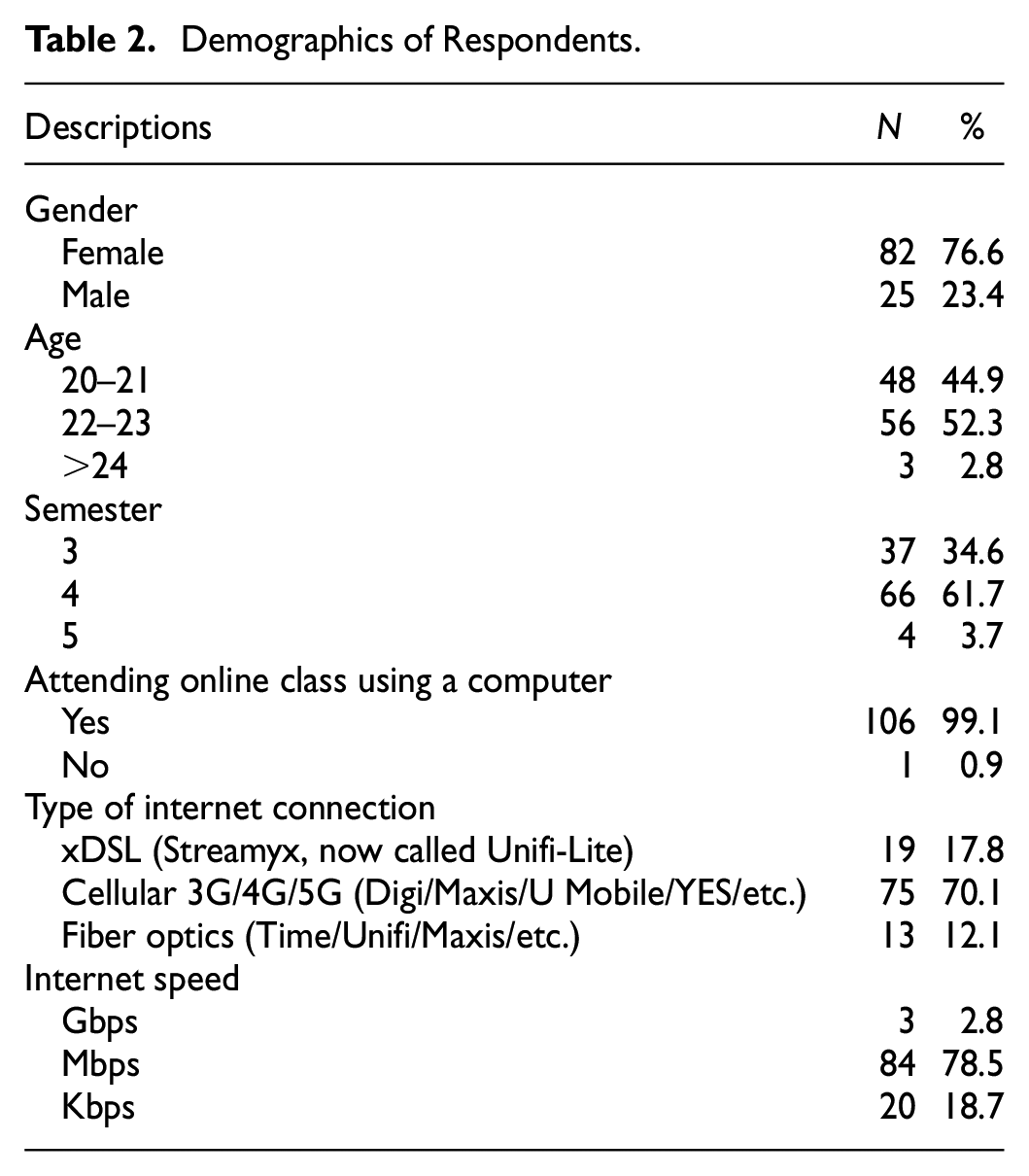
Table 2 illustrates the basic demographics of the 107 participants, with females accounting for 76.6% (n = 82) and males constituting 23.4% (n = 25). The majority of the participants (97.2%; n = 104) were between the ages of 20 and 23. Semester-wise distribution showed that more than half (61.7%; n = 66) of them were in semester 4, with the remaining 34.6% (n = 37) and 3.7% (n = 4) in semesters 3 and 5, respectively. Furthermore, an astounding 99.1% (n = 106) of participants reported having a computer at home for online studies, with a significant majority (70.1%; n = 75) utilizing cellular internet connections, while a smaller proportion, 17.8% (n = 19) and 12.1% (n = 13), employed xDSL and fiber optics, respectively, for internet connectivity. In terms of internet speed, most of the undergraduate students (78.5%; n = 84) had a moderate data transmission speed (Mbps), while the remaining 18.7% (n = 20) and 2.8% (n = 3) had low (Kbps) and high speed (Gbps), respectively.
Demographics of Respondents.
The Kaiser-Meyer-Olkin Measure of Sampling Adequacy (KMO) test was employed to assess the suitability of the data for factor analysis, providing a meritorious index value of 0.909. Similarly, Barlett’s test yields a significant value (p < .001). These findings confirmed that the data was suitable for factor analysis. Additionally, Anti-Image Correlation was determined by examining the diagonal values, denoted by the “a” alphabet next to each value in the table within SPSS (not shown), and was found to be larger than .5 in all cases.
The current literature has identified numerous variables that can influence online teaching and learning effectiveness. Therefore, in this study, Exploratory Factor Analysis was conducted to ascertain the number of specific variables presence in the dataset. During the factor analysis extraction process, Principal Axis Factoring and Promax rotation were applied to extract the fixed number of five factors, with loadings (i.e., the correlation between the items and the construct) and cross-loadings all exceeding .5 (Table 3). The Scree Plot, as shown in Figure 1, provided support for the number of factor analysis extractions by indicating the presence of five factors.
Results of Factor Analysis.

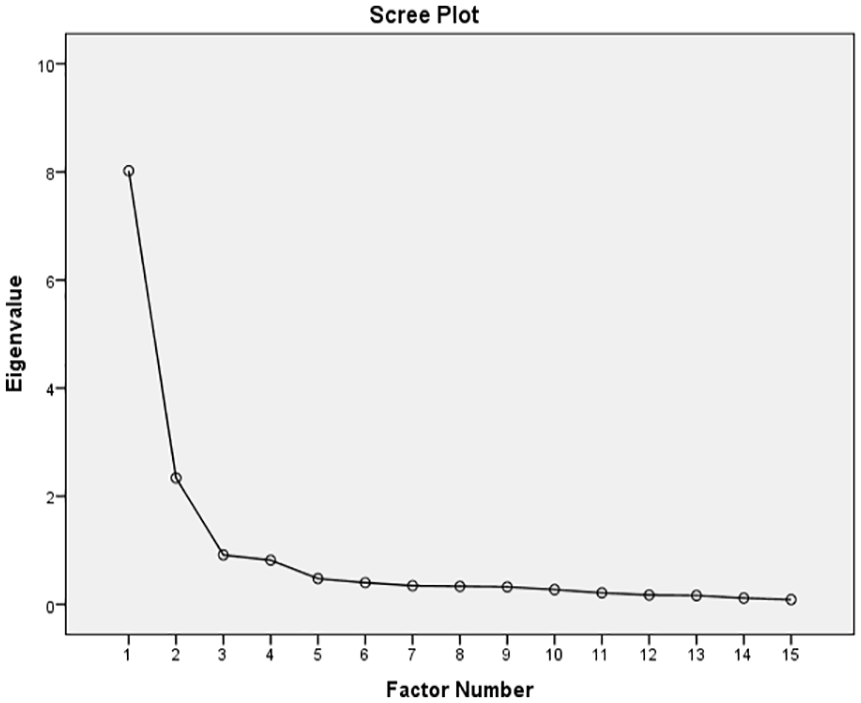
Screen plot.
During the analysis, four problematic items (i.e., B7, B8, B12, and B14) were identified and subsequently eliminated from the list due to their communality being less than 0.5. As a result, the final item lists consisted of 16 out of the original 20 items, with all communalities exceeding the cut-off value of 0.5. Furthermore, Table 3 demonstrates that by reducing the 16 items to five factors, the study retained 73.806% of the original variance, reflecting a loss of approximately 26.194%. These five factors were aligned with the theoretical framework outlined in the literature review, highlighting their potential influence on the online teaching and learning landscape.
To determine items belonging to specific factors, both independent and dependent variables in the dataset were considered. Consequently, items B15 to B20 were loaded onto Factor 1, while items B1, B2, B3, and B6 were loaded on Factor 2. Similarly, items B4 and B5 were loaded onto Factor 3, items B9 and B14 onto Factor 4, and items B10 and B11 onto Factor 5. These factors were subsequently labeled as Lecturer, Attitude, Flexibility, Facilities, and Effectiveness, respectively.
Next, reliability tests were conducted for all five factors (i.e., Lecturer, Attitude, Flexibility, Facilities, and Effectiveness). The results of these tests revealed that all Cronbach’s alpha values obtained in this study exceeded the threshold of .70, as indicated in Table 3. According to Hair et al. (2003), Cronbach’s alpha values exceeding .6 indicate acceptable questionnaire results.
Subsequently, Pearson’s correlation analysis was employed to generate insight and assess the relationships between online learning effectiveness and its independent variables. The results are shown in Table 4, where it can be observed that all independent variables are positive and moderately correlated with both online teaching and learning effectiveness (dependent variable) and each other (independent variables).
Correlations.

Note. All the variables were significant at α = .01, two-tailed, N = 107.
Assessing Multiple Regression Analysis and Its Assumptions
Prior to interpreting the results of this study, the assumptions for linear regression must be checked. First, multivariate normality was tested by using Mardia’s coefficient, specifically by employing the Webpower multivariate normality testing software (Cain et al., 2017). The Mardia’s multivariate skewness value was 11.085 (t = 208.78, p < .01), while kurtosis was 49.71 (t = 9.0343, p < .01). Since the skewness and kurtosis values exceeded the cut-off threshold of 3 and 20, respectively, it could be concluded that the data collected were not multivariate normal. Consequently, bootstrapping procedures with a resampling of 5,000 were employed to generate the standard errors, t-values, and p-values.
Then, using a histogram and a normal Probability-P plot, the normality of error terms was determined. The residuals of the dependent variable were fairly normally distributed, with mean (−1.59E−15) and standard deviation (0.981) values close to 0 and 1, respectively, according to the histogram analysis (see Appendix A). The normal Probability P-Plot demonstrated that some points were extremely close to the line, while others lay exactly on the line, indicating the normal distribution of errors (see Appendix A). Furthermore, linearity was evaluated using partial regression plots between the dependent and independent variables. These plots displayed random patterns without discernible trends (refer to Appendix C). The presence of multicollinearity was determined using the Variance Inflation Factor (VIF), which produced values below 3.3. Collinearity diagnostics revealed condition indices of less than 30 and variance proportions below 0.9 for all independent variables, confirming the absence of multicollinearity in the data (see Table 5). Furthermore, the assumption of constant variance (homoscedasticity) was evaluated by analyzing the scatter plots of regression studentized residual and regression standardized residuals. The plots demonstrated consistent variance, indicating no violation of the assumption (refer to Appendix B). Case-wise diagnostics, utilizing Mahalanobis, Cook’s, and Leverage Values Distances, identified six outliers with values greater than 3. These outliers were subsequently excluded from the regression analysis, resulting in a final sample of 107 respondents. Lastly, the Durbin-Watson value indicated an autocorrelation of 1.973. This value fell within the acceptable range of 1.5 and 2.5, indicating that autocorrelation was not a concern.
Regression Results.

With the fulfillment of the multiple regression assumptions, the next step involved analyzing the prediction of online teaching and learning effectiveness based on the four factors: lecturer, attitude, flexibility, and facilities. The ANOVA results showed F(4,102) = 34.21, p < .01, indicating the statistical significance of the model and its potential for development. The R2 value of .573 indicated that 57.3% of the variance in online teaching and learning effectiveness could be explained collectively by the four independent variables, leaving the remaining 41.7% as unexplained variance.
Except for facilities, all variables presented in Table 5 demonstrate significant predictive power for online teaching and learning effectiveness. Specifically, both Lecturer (B = 0.429, t[102] = 4.747, p < .01, BCa 95% CI [0.200, 0652]) and Attitude (B = 0.536, t[102] = 6.018, p < .01, BCa 95% CI [0.340, 0.707]) were positively associated with online teaching and learning effectiveness. Flexibility, on the other hand, was inversely correlated with online teaching and learning effectiveness (B = −0.291, t[102] = −2.772, p < .05, BCa 95% CI [−0.464, −0.043]). Furthermore, aside from facilities, all examined variables yielded statistically significant results. Notably, variables lecturer, attitude, flexibility, and facilities, demonstrated medium, big, small, and zero effect sizes (F2), respectively. This indicates that attitude holds the highest degree of importance for online teaching and learning effectiveness, followed by lecturer and flexibility, while facilities have minimal effect on this factor.
Discussion and Conclusion
This study aimed to evaluate the effectiveness of online teaching and learning among a sample of 107 undergraduate students enrolled at a university in Malaysia. The study focused on students who had taken subjects related to statistical concepts and calculations, with data collected from March to July 2020. Factor analysis was employed to evaluate the instruments used for online teaching and learning, resulting in the identification of five underlying factors. Subsequently, a multiple regression analysis was performed, revealing that all factors, except for facilities, exhibited statistical significance. Among these factors, lecturers and attitudes exhibited a favorable relationship with the effectiveness of online teaching and learning, while flexibility demonstrated a negative relationship.
Lecturers play a significant role in enhancing the effectiveness of online teaching and learning by assuming various responsibilities in higher education. These responsibilities encompass educational, social, management, and technical aspects, including providing accurate course materials, supporting student comprehension, and communicating important assessment dates. Moreover, lecturers are responsible for fostering an inclusive and engaging learning environment. This study’s findings reinforce the importance of lecturers in favorably influencing the success of online teaching and learning. This aligns with previous research by Hongsuchon et al. (2022) and Cheam (2021) who highlighted that the effectiveness of online education depends on many factors, including lecturer self-efficacy, attitudes, and technological confidence. Similarly, Darius et al. (2021) found that lecturer engagement and the provision of online resources contribute to successful online educational experiences.
In addition to the lecturers’ effective fulfillment of their obligations, students are also expected to assume greater responsibility for their own learning, thereby emphasizing the significance of students’ attitudes in influencing the outcomes of online education. The study findings demonstrated that the attitude of students has a significant and positive influence on the success of online learning, consistent with the findings reported by Picciano (2017), Wang et al. (2019), Selim (2007), Jiang et al. (2023), Hashemifardnia et al. (2021), Cheam (2021) and Yu et al. (2022). Students demonstrating positive attributes like discipline, organization, persistence, and self-initiative tend to succeed in completing their tasks with minimal supervision. These attributes enable students to proficiently navigate online learning and enhance its effectiveness.
Surprisingly, this study revealed a statistically significant, albeit negative, association between flexibility and online teaching and learning effectiveness. This finding echoes prior scholarly works by Goodyear (2008) and Willems (2005), suggesting that flexibility alone does not guarantee successful learning outcomes. Similarly, Hill (2006) asserts that freedom is accompanied by responsibility, emphasizing that genuine dedication and self-control among students are necessary to achieve the desired effectiveness of online learning. Several factors, such as inadequate internet infrastructure, lecturers’ challenges in effectively implementing online learning methods, and limited support and cooperation from parents or family members, among others, may contribute to a lack of flexibility in online teaching and learning, ultimately impeding the effectiveness of online learning for students. Therefore, the implementation of flexible learning necessitates that students assume a larger degree of autonomy in their educational pursuits, exercise independent judgment, and demonstrate improved commitment (Grant & Hill, 2006; You, 2016). Future research should explore students’ utilization of flexibility and its impact on academic performance to determine effective strategies for supporting flexible teaching and learning.
Despite the significant adjustment many individuals have had to make when transitioning to e-learning, numerous students have shown an impressive ability to manage challenges related to facilities, such as internet connectivity and creating a conducive study environment at home. Nonetheless, findings in this study have demonstrated otherwise. The research results indicate that there is no significant relationship between facilities and the effectiveness of online learning for students. This finding contrasts with the common belief that having access to appropriate facilities is vital for students to engage effectively in online learning. Conversely, a study by Mohd Basar et al. (2021) supports the idea that the effectiveness of online learning depends on many factors, including well-equipped facilities and stable internet connections. Several factors may account for the unanticipated lack of a significant relationship between facilities and student online learning effectiveness found in this study. These include the presence of inadequate internet facilities, lecturers’ inability to implement online learning, and a lack of support from parents, among others. Undoubtedly, all these factors can have detrimental effects on the effectiveness of online teaching and learning.
Implication
In light of the ongoing endemic phase, this study aims to shed light on the effectiveness of online teaching and learning, specifically within the context of selected courses that involve calculation. The insights derived from this study are expected to enrich the understanding of lecturers, students, and university administrators in this domain.
Drawing from the Cognitive Load Theory, it is crucial for lecturers to possess a foundational comprehension of the cognitive mechanisms that underlie information processing in the human brain. Equally important is their ability to design teaching materials that match the cognitive abilities of their students, ensuring the content is appropriately challenging without overwhelming them. This expertise equips lecturers to effectively engage with students within the framework of online teaching and learning. From the standpoint of the students, it is desirable that they receive a sufficient amount of knowledge in order to cultivate an elevated sense of motivation and favorable attitude toward participating in the learning process. This would result in the optimization of time and resources, ultimately enabling them to successfully complete their studies within the designated timeframe.
In order to attain success in the realm of online teaching and enhance the efficacy of learning, it is crucial that the lecturer plays a pivotal role by demonstrating constant commitment and possessing an in-depth understanding of the subject matter. However, it is important to note that the online teaching and learning format poses obstacles and demands substantial time investment from lecturers, potentially leading to resistance in the future (Bruggeman et al., 2021; Huang et al., 2022). In order to promote effective teaching and learning, and the acquisition of information, it is essential to establish unambiguous and achievable objectives, as well as offer appropriate incentives to acknowledge the efforts and dedication of lecturers (Andrade & Alden-Rivers, 2019).
The utilization of artificial intelligence in educational settings has become increasingly prevalent due to technological advancements. In this context, students have the opportunity to leverage available resources and tools to enhance their learning experiences. Consequently, lecturers and universities must play a central role in guiding students on the ethical use of artificial intelligence, ensuring its contribution to the learning process while preventing any potential misuse.
In the present circumstances, characterized by the transition of the COVID-19 pandemic to an endemic phase, it is likely that numerous Higher Education Institutions (HEIs) have opted to sustain the delivery of specific academic disciplines via online platforms. The observed phenomenon can be attributed to the emergence of a novel epoch, wherein there is a visible tendency toward the enhancement of digital resources and the incorporation of technology-mediated teaching within the realm of tertiary education. As a result, blended learning is being increasingly favored by students as a preferable alternative for their academic pursuits. This aligns with the findings of Mukherjee and Hasan (2023), who have advocated for blended learning as an appealing approach for the future of higher education.
Drawing from the aforementioned discussion, the current study attempts to offer insights to stakeholders regarding the factors that influence the efficiency of online teaching and learning, specifically in the context of statistical concepts and calculations disciplines. By understanding these drivers, stakeholders may enhance the implementation of blended learning and ensure its success in the future. Policymakers have the potential to develop a series of proposals aimed at designing an ideal online teaching and learning policy that effectively serves the interests of all parties involved, including students and lecturers alike.
Limitations and Recommendations for Future Research
The current study is subject to several limitations that warrant consideration. First of all, the sample size employed in this study is relatively small, consisting of only 107 students who enrolled in the computation course during the specified timeframe. Consequently, caution should be exercised when attempting to generalize the results to the broader population. Future research would benefit from larger and more diverse samples to enhance the external validity of the findings. Furthermore, the research inquiry focused on a limited set of four specific factors, which were determined by the existing academic literature that pertained to the research framework. Therefore, future research should consider incorporating a comprehensive array of variables, drawing from the latest literature in this field. On top of that, the study’s scope was confined to two specific statistics concepts and calculation courses offered at a local university. This narrow focus was driven by time constraints. Hence, future studies should include a wider range of courses.
Footnotes
Appendices
Acknowledgements
We would like to thank the anonymous reviewers and colleagues for their insightful comments, which have contributed substantially to the improvement of this article. We are also deeply grateful to the university for providing us with the necessary facilities that greatly facilitated our research efforts. Our sincere appreciation goes to the dedicated assistants who rendered valuable support during the data collection phase.
Declaration of Conflicting Interests
The author(s) declared no potential conflicts of interest with respect to the research, authorship, and/or publication of this article.
Funding
The author(s) received no financial support for the research, authorship, and/or publication of this article.
Ethics Statement
The survey was administered to undergraduate students between March and July 2020, which was coinciding with the global outbreak of the novel coronavirus disease (COVID-19) necessitating widespread movement control measure. Throughout the duration of the survey, which spanned until July 2020, the requirement for an ethical consent form had not yet been established as an obligatory prerequisite by the institution.

Data Availability Statement
Data sharing not applicable to this article as no datasets were generated or analyzed during the current study.