



Abstract
Exploration and exploitation have opposite natures; therefore, balancing the two presents a key challenge for firms. Recent studies have argued that firms can combine exploration (exploitation) capabilities with exploitation (exploration) partnerships to surmount this obstacle. However, little is known about how accumulated capabilities for exploring and exploiting activities shape the ways in which firms select partnerships. We examine this question by leveraging a unique data set on new product development in the Brazilian manufacturing sector that has 19,081 observations over a 14-year span. Contrary to the expectation of complementarity, in which the greater capability of one type (e.g., exploitation) is associated with selecting a partnership of another type (e.g., exploration), our findings suggest that increases in capabilities of any type are associated with exploration partnerships. We provide alternative explanations for our findings, highlight implications for theory and practice, and discuss potential avenues for future research.
Keywords
Introduction
As COVID-19 continues its grip on the world, the need for a vaccine to defeat the virus is urgent. This collaboration brings together the University of Oxford’s world-class expertise in vaccinology and AstraZeneca’s global development, manufacturing, and distribution capabilities. Our hope is that, by joining forces, we can accelerate the globalization of a vaccine to combat the virus and protect people from the deadliest pandemic in a generation.
The COVID-19 infection that was caused by the SARS-CoV-2 virus challenged businesses in the pharmaceutical industry to engage in a technological race to develop a vaccine that would help contain the spread of the virus that is responsible for more than 5 million deaths globally since December 2019 (Corey et al., 2020). As shown in the excerpt above, the development of a new vaccine required the combination of the biopharmaceutical company AstraZeneca’s exploitation capabilities and an exploration partnership with the University of Oxford. According to March (1991, p. 7), “Exploration includes things captured by terms such as search, variation, risk-taking, experimentation, play, flexibility, discovery, innovation. Exploitation includes such things as refinement, choice, production, efficiency, selection, implementation, execution.” Thus, this anecdotal example adds to mounting evidence that “maintaining an appropriate balance between exploration and exploitation is a primary factor in system survival and prosperity” (March 1991, p. 71).
This example also highlights the notion that firms can balance exploration and exploitation across their boundaries, which is rarely studied in current literature. Studies on the exploration–exploitation dilemma have mostly focused on the ways to solve this dilemma within a firm’s boundaries (e.g., He & Wong, 2004; Jansen et al., 2006; Sidhu et al., 2007; Tushman & O’Reilly, 1996). As exploration and exploitation entail inherently opposite forces, research has established that firms should use temporal separation and organizational separation within their boundaries to achieve a balance. The first approach, anchored on bounded rationality (Cyert & March, 1963), argues that firms should oscillate between exploration and exploitation activities over time (Gibson & Birkinshaw, 2004). The second approach, based on ambidexterity (Raisch et al., 2009), advocates for firms pursuing both simultaneously by using different business units (O’Reilly & Tushman, 2004). More recent studies have proposed an alternative approach in which firms can benefit from balancing exploration and exploitation through inter-organizational relationships, such as AstraZeneca and the University of Oxford working on the development of the COVID-19 vaccine (Lavie et al., 2011; Stettner & Lavie, 2014).
Despite this alternative approach’s contributions to understanding the performance implications of exploration–exploitation across boundaries, there is still a limited understanding of how accumulated capabilities shape the ways in which firms select partners. To date, organizational learning studies have primarily examined the financial returns from combining one type of capability—exploration or exploitation—with another type of partnership—exploitation or exploration (e.g., Stettner & Lavie, 2014). In doing so, they disregard that firms must decide whether they will engage with a partner and that they must consider the nature of the partnership before accruing any benefits from a complementarity. This leads to the following open-ended questions: To what extent do current exploration or exploitation capabilities drive the selection of exploitation or exploration partnerships? Will a firm be equally likely to engage in exploration–exploitation across boundaries or vice versa? The answers to these questions are nontrivial. Firm behavior is a function of accumulated learning in the form of capabilities (Dierickx & Cool, 1989; Nelson & Winter, 1982). However, many dysfunctions are associated with learning that might prevent firms from opting for complementary partnerships (Levinthal & March, 1993; Zollo, 2009). A priori, this makes the association between capabilities and the type of partnerships with which a firm tends to engage unclear.
To address this gap in the literature, we analyze the association between firms’ capabilities and their partnerships in terms of new product development (NPD). Because the ability to learn is key for innovation, we focus our attention on absorptive capacity (ACAP), which is the ability to learn from partners in terms of integrating external and internal information, assimilating it, and applying it to commercial endeavors (Cohen & Levinthal, 1990). Advantageous to our study, ACAP is composed of two dimensions (Zahra & George, 2002) that are closely aligned with the exploration–exploration framework. The first dimension, potential absorptive capacity (PACAP), underscores a firm’s ability to search for external knowledge. The second dimension, realized absorptive capacity (RACAP), underscores a firm’s ability to exploit and apply knowledge. Furthermore, we focus on the locus of NPD to understand the dynamics of partnership selection. Specifically, we examine whether firms developed their new main products by (1) relying on internal development; (2) moving toward exploration partnerships by collaborating in joint research and development; or (3) advancing toward exploitation partnerships by outsourcing and licensing (Hoang & Rothaermel, 2010; Koza & Lewin, 1998). By examining the main innovative project launched by firms, this research brings the challenges that firms face in leveraging their capabilities to the forefront. Accordingly, we investigate the role of firms’ capabilities (i.e., PACAP and RACAP) in governing the locus of NPD (i.e., internal development, exploration partnerships, or exploitation partnerships).
The research questions are answered using a unique data set on NDP in the Brazilian manufacturing sector that includes 19,081 observations over 14 years. We found that partnerships are not driven by complementarity with existing capabilities, as stated by Xia and Roper (2016), thereby suggesting the unexpected effects of accumulated learning. Our findings contribute to the literature in many ways. First, we enhance the innovation literature by showing that firms with greater exploration capabilities are less likely to seek complementary partnerships, which represents a threat to the long-term survival of highly innovative firms. Second, we contribute to expand resource-based explanations in strategic alliance research by suggesting that firms with strong capabilities are more likely to seek inter-organizational relationships in NPD. Third, we advance the microfoundations of organizational learning by exploring alternative explanations for the factors that limit rational firm behaviors in the context of NPD. In summary, our results clarify the patterns in firms’ decision-making when pursuing exploration and exploitation partnerships, thereby evidencing the need for different managerial styles and policies that can help firms overcome limitations and secure their competitive position.
Theory and hypotheses
Literature review: antecedents of exploration–exploitation
There is an extensive body of literature from various fields of research, such as organizational learning, knowledge management, innovation, and strategic alliances, on the nexus of exploration and exploitation in diverse sectors and at different levels (e.g., Døjbak Håkonsson et al., 2016; Patel et al., 2015; Stettner & Lavie, 2014). With the widespread use of this concept, more questions are being raised regarding the drivers of exploration and exploitation within organizations and which contextual aspects might lead firms to pursue exploration, exploitation, or a balance between them (Pertusa-Ortega et al., 2021; Pertusa-Ortega & Molina-Azorín, 2018). However, the discussion on the antecedents of exploration–exploitation across firms’ borders is nascent and is insufficiently addressed in the literature despite its relevance. In an attempt to summarize the overall antecedents of exploration–exploitation, Lavie et al. (2011) presented a model that encompasses three main levels of analysis: institutional, organizational, and individual antecedents.
At an institutional level, a combination of environmental antecedents that can influence a firm’s decision to pursue either exploration or exploitation is considered. As many researchers highlight, external factors are important to consider since differences across sectors have been identified in previous studies and can be used to explain firms’ choices regarding inter-organizational partnerships for exploration or exploitation (Lavie et al., 2011). Specifically, environmental dynamism, increased competition, abrupt changes in the environment, and strong intellectual property rights directly influence the intensity and the ways in which firms engage with exploratory and exploitative learning processes (Levinthal & March, 1993; Pertusa-Ortega & Molina-Azorín, 2018). More stable environments that enforce protection rights for innovation make it more attractive for firms to establish partnerships for exploration since they can effectively protect proprietary assets. On the contrary, changing environments characterized by fierce competition and weak law enforcement might make exploratory partnerships less interesting, leading to firms turning their focus to exploitation.
Antecedents at the organizational level are frequently studied and, according to Lavie et al. (2010), allow for more clarity in explaining firm heterogeneity when operating in the same sector. Among others, the most common organizational antecedents include accumulated resources, capabilities, structure, culture, age, size, history, and identity. Specifically, when considering firms’ capabilities, ACAP is commonly identified as an antecedent of exploration–exploitation as it relates to a firm’s capacity to identify, absorb, and apply external knowledge (Drnevich & Kriauciunas, 2011; Zahra & George, 2002). Recent research has analyzed the role of capabilities in the context of temporal and organizational separation, which allows firms to balance exploration and exploitation within their domains (Pertusa-Ortega et al., 2021; Pertusa-Ortega & Molina-Azorín, 2018). Pertusa-Ortega and Molina-Azorín (2018) chose organizational separation as an antecedent to focus on large Spanish organizations’ decisions to exploit and explore. García-Muina and González-Sánchez’s (2017) empirical study emphasized the role of ACAP in Spanish firms that benefit from external sources of knowledge to gain global innovations through international patents.
ACAP is needed to facilitate the process of external learning in exploitative and exploratory ways (Xia & Roper, 2016). As a process of continuous learning, ACAP is also developed through heterogeneous partners across various boundaries (Omidvar et al., 2017). This mutual causality is expected in such a phenomenon as alliances can shape capabilities and vice versa (Schilke et al., 2018). However, there is little research on the role of ACAP as an antecedent to firms’ decisions on exploration–exploitation across borders particularly. The few existing studies on the issue hypothesize the association of each dimension of ACAP to only one kind of partnership (e.g., Xia & Roper, 2016). Therefore, we answer the call from these authors that “future research could . . . conduct longitudinal studies of the evolution and development of exploratory and exploitative relationships and dimensions of PACAP and RACAP over time” (Xia & Roper, 2016, p. 947).
Finally, individual-level issues have been increasingly discussed in the growing field of microfoundations of exploration and exploitation. Behavioral and cognitive perspectives have highlighted the role of the manager as a decision-maker. Depending on the manager’s risk aversion and learning abilities, a firm will tend to either explore or exploit (March, 1991). Moreover, self-reinforcing mechanisms can trap managers in relying on the same solutions and knowledge they already possess, leading to the firm making incremental improvements instead of radical innovations. In addition, a manager’s experience also influences decisions and can lead to path-dependent trajectories as a consequence of previous outcomes (Schnellbächer et al., 2019). Table 1 summarizes the aforementioned environmental, organizational, and individual antecedents.
Multi-level antecedents of exploration-exploitation.
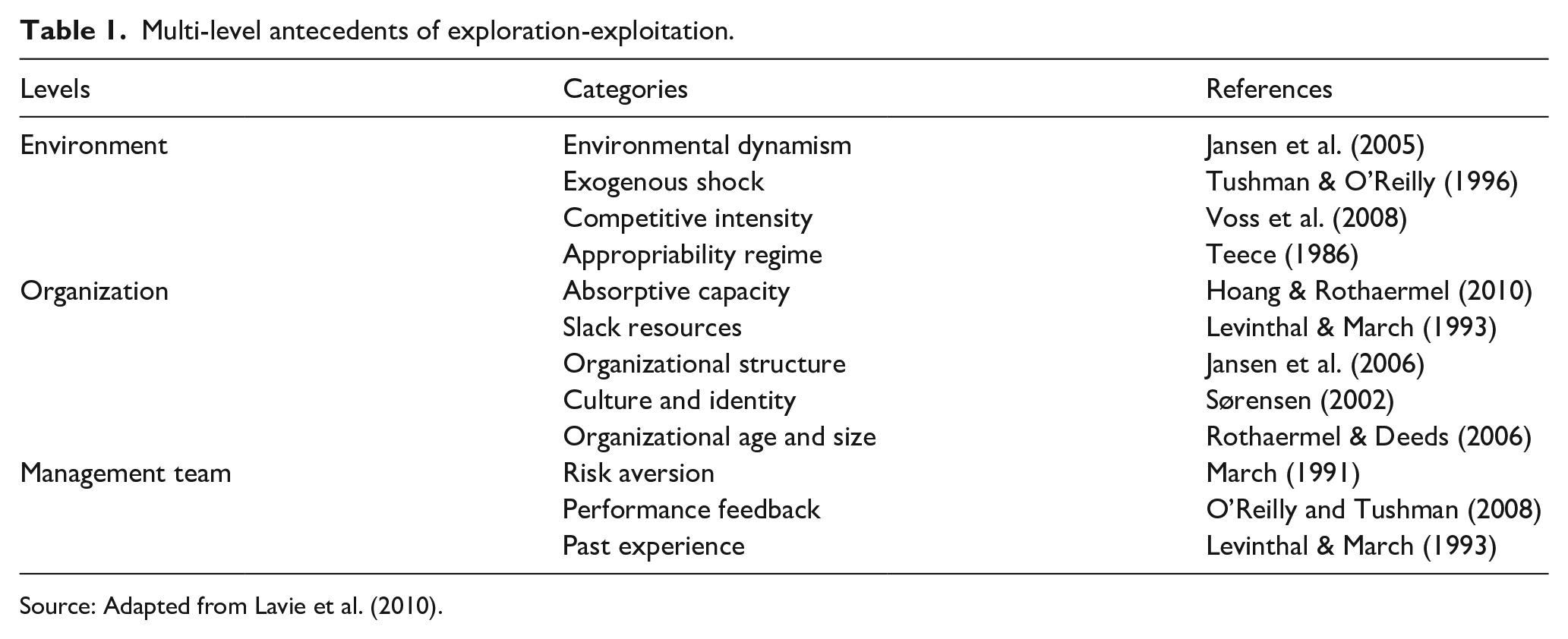
Source: Adapted from Lavie et al. (2010).
In sum, several antecedents can potentially lead to firms to form partnerships for either exploration or exploitation: institutional (i.e., competition), organizational (i.e., capabilities), and individual (i.e., biases and cognition). Our study further investigates the role of organizational capabilities in exploration–exploitation across boundaries. Research has addressed several of these antecedents, primarily within firm boundaries, thereby creating the opportunity for significant advancements in the exploitation–exploration nexus (Pertusa-Ortega & Molina-Azorín, 2018). Moreover, in the case of the locus of NPD, scant research has been conducted on the mechanisms behind firms’ behavior when forming partnerships beyond the differences in their strategic choice (Hoang & Rothaermel, 2010; Koza & Lewin, 1998). We provide a novel and in-depth perspective on how capabilities are associated with firms’ decisions to develop their new main products by relying on their current knowledge base or partnering with other organizations for both exploration and exploitation.
Research framework and hypotheses development: organizational capabilities and the locus of NDP
We leverage the exploration–exploitation theory (March, 1991) to explain the locus of NPD based on firms’ existing capabilities. We argue that firms’ PACAP and RACAP are associated with the probability of choosing exploration or exploitation partnerships for NPD. To explain firms’ decisions to expand their boundaries, prior studies have frequently relied on theories solely born in economics, such as the resource-based view and transaction-cost theory (McIvor, 2009; Odagiri, 2003), which “are viewed as complementary because the former is a theory of firm rents whereas the latter is a theory of the existence of the firm” (Barney et al., 2001, p. 626). Nevertheless, these theories might be limited in their ability to provide insights into the dynamics of learning, which are essential for innovation and technological development. The economic models in the resource-based view and transaction-cost theory relax the assumption of agents with perfect information, but they do not incorporate human cognition processes (see Bromiley & Papenhausen, 2003; Foss, 2003 for a detailed discussion). As a result, these theories have limited space for bounded rationality (Nelson & Winter, 1982), information aggregation (Cyert & March, 1963), myopias of learning (Levinthal & March, 1993), and other internal processes that shape firms’ behavior. Therefore, the exploration–exploitation theory (March, 1991) affords a parsimonious evaluation of the locus of NPD.
Our research framework departs from the notion that firm behavior is a function of accumulated learning in the form of capabilities (Dierickx & Cool, 1989; Nelson & Winter, 1982). Accordingly, firms’ capabilities can explain their differences in their strategic choices, that is, their firm heterogeneity (Eisenhardt & Martin, 2000; Teece et al., 1997; Zollo & Winter, 2002). In particular, we depart from prior studies’ observations that ACAP represents the firm stock of expertise that constrains and enables various strategic paths (Drnevich & Kriauciunas, 2011; Zahra & George, 2002).
We focus on firms’ ACAP, which is defined as “a dynamic capability pertaining to knowledge creation and utilization that enhances a firm’s ability to gain and sustain a competitive advantage” (Zahra & George, 2002, p. 185). Compared with the original conceptualization (Cohen & Levinthal, 1990), this more recent definition emphasizes the role of ACAP in ensuring competitive advantage following the dynamic capabilities literature (Teece et al., 1997). Zahra and George (2002) also replace the “recognition” routines with “acquisition” and introduce the “transformation” routines, with the main contribution of the study being the operationalization of ACAP in two main dimensions: knowledge internalization (PACAP) and knowledge application (RACAP). The theoretical distinction between these two large segments of capacities, which we follow in our theoretical framework, enables the analysis of their specific outcomes (Alves & Galina, 2021). As argued by Volberda et al. (2010), PACAP and RACAP differ in their nature as well as in their outcomes and antecedents. Firms focusing primarily on PACAP can continuously renew their knowledge stock, but they may suffer from a lack of capabilities in terms of reaching the benefits of market exploitation. Conversely, companies highly intensive in RACAP may gain short-term profits through continuous exploitation but may fail to access innovative skills to ensure a lasting competitive advantage. As argued below in our hypothesis development, these components might have contrasting associations with the locus of NPD. Figure 1 illustrates the proposed relationships.
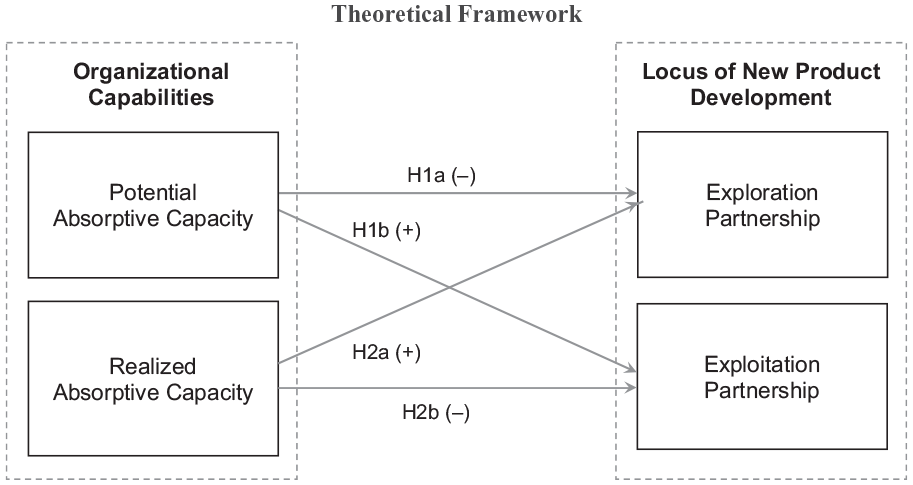
Theoretical framework.
The core of our argument relies on the fact that dynamic capabilities, such as ACAP, have a dimension of sensing. According to Teece (2007, p. 1326), this dimension “involves gathering and filtering technological, market, and competitive information from both inside and outside the enterprise.” This process enhances awareness of a firm’s capabilities as well as those that are to be sourced from beyond the enterprise’s boundaries. Therefore, the learning accumulated in the form of organizational capabilities changes a firm’s perception of its own expertise in a given area and that of other organizations, thereby expanding the probability of interrelationships for NPD.
Once the company internalizes certain capabilities, regardless of how they were developed, it evaluates the next steps for NPD, such as the partnerships that may complement these factors. Thus, we propose that firms tend to seek external relationships to complement their already developed internal capacities (Lavie et al., 2010), which may benefit firms’ innovation (Pittaway et al., 2004). 1 Firms with greater PACAP are more likely to complement their internal capabilities with exploitation partnerships, while firms with greater RACAP are more likely to seek exploration partnerships.
The role of PACAP
PACAP is an exploration capability due to its emphasis on new knowledge searching, acquisition, and assimilation (Zahra & George, 2002). PACAP sustains a firm’s ability to search for new information in the environment. This capability is particularly related to the activities of monitoring and sensing the environment, as empirically tested by Tsang (2002) and García-Muina and González-Sánchez (2017). As firms with PACAP can easily identify and evaluate new knowledge beyond the organizational boundaries, they benefit from an increasing inflow of external knowledge (Patel et al., 2015). As a result, these firms can quickly analyze and interpret changing market demands as well as discover new opportunities, such as serving customers (Jansen et al., 2005). Therefore, PACAP is an exploration capability as it enables “a pursuit of new knowledge” (Levinthal & March, 1993, p. 105).
We build on the theory of organizational learning (March, 1991; Nelson & Winter, 1982; Simon, 1947/1957) to argue that the accumulation of experience in the execution of PACAP activities is associated with an increased sense of expertise in a given area, that is, exploration. As capabilities are formed from repeated activities over time (cf. Nelson & Winter, 1982), firms with greater capabilities are better able to discern their strengths and weaknesses. Although PACAP enables the continuous renewal of knowledge stock, it is not enough to gain commercial benefits or market exploitation (Jansen et al., 2005). Therefore, while firms with low PACAP might not have strong preferences for any locus of NPD, high PACAP endows firms with a clearer understanding of the limits of their competence and results in their being more likely to seek a balance between exploration and exploration in their partnerships. That is, firms might complement their already developed internal capacity of PACAP with an exploitation partnership. Conversely, firms with high PACAP understand their expertise in exploration, so they might choose to produce internally rather than opt for an exploration partnership. Instead of duplicating exploration resources (i.e., PACAP and exploration partnership) that ultimately will not deliver the product to the market, the firm can autonomously search for the precise knowledge required to exploit and develop a new product internally (Patel et al., 2015).
Although balancing exploration–exploitation across boundaries is a recent topic, some empirical literature supports this reasoning. For instance, Schilling and Hill (1998) showed that companies enter into partnerships to access complementary assets to transform technological knowledge into commercial products. In the same vein, Lavie et al. (2011) stated that the association of ACAP with internal exploration can be leveraged by external partnerships to ensure exploitation. Moreover, PACAP might be particularly influential in driving complementary partnerships and avoiding overlapping ones because the monitoring activities also help to identify (1) which partners have the necessary skills and (2) which specifications of the product are relevant for innovative performance in the market (Drnevich & Kriauciunas, 2011). Xia and Roper’s (2016) findings also support the proposed complementarity by showing that PACAP is negatively associated with firms’ engagement in exploratory relationships. Taken together, these considerations support the following hypotheses:
Hypothesis 1a: All else being equal, greater PACAP is negatively associated with firms’ propensity to develop the new main product through an exploration partnership rather than internal development.
Hypothesis 1b: All else being equal, greater PACAP is positively associated with firms’ propensity to develop the new main product through an exploitation partnership rather than internal development.
The role of RACAP
Once PACAP internalizes valuable external knowledge, exploitation capability is necessary to guarantee the integration of this knowledge and its subsequent deployment (Zahra & George, 2002). RACAP plays this role by increasing the rate of internal changes in the firm and applying novel resource configurations to new products (Ben-Menahem et al., 2013; Patel et al., 2015). Thus, RACAP shapes the internal structure by converting new ideas into innovative products. For example, the introduction of new products requires changes in production processes (Lim et al., 2006; Tatikonda & Montoya-Weiss, 2001) or distribution channels (Schilling & Hill, 1998). Thus, RACAP is an exploitation capability as it supports the refinement and use of existing knowledge (March, 1991).
Despite the opposite nature of exploration and exploitation capabilities, we expect that the accumulation of experience is associated with a similar sense of expertise and, consequently, a preference for complementary partnerships. As firms accumulate specialized knowledge over time (Nelson & Winter, 1982), such as transforming and applying knowledge to commercial ends, they increase their capacity to recognize the limits of their competence. Indeed, firms with more expertise in knowledge deployment can “recognize and exploit the external opportunities afforded by new technological developments” (Hoang & Rothaermel, 2010, p. 752). Therefore, greater RACAP is associated with increased deployment of technology for innovation through exploration partnerships (Chesbrough, 2003).
In addition, firms with greater RACAP might not respond properly to environmental changes and are thus pushed to create relationships to rapidly explore knowledge to start cycles for NPD (Jansen et al., 2005). By contrast, the expertise in transforming and exploiting knowledge from RACAP could lead to firms preferring to develop their product internally rather than with an exploitation partnership, given the similar expertise. Therefore, RACAP is associated with complementary partnerships (exploration) instead of overlapping partnerships (exploitation). These expectations are also in line with the knowledge-based perspective that delineates the relevance of inter-organizational relationships in filling intra-firm knowledge gaps (Spender, 2007) as well as the cognitive perspective that highlights the role of accessing complementary competencies through external sources (Nooteboom, 1999). In summary, we hypothesize the following:
Hypothesis 2a: All else being equal, greater RACAP is positively associated with firms’ propensity to develop the new main product through an exploration partnership rather than internal development.
Hypothesis 2b: All else being equal, greater RACAP is negatively associated with firms’ propensity to develop the new main product through an exploitation partnership rather than internal development.
Method
Data set
We used data from the Brazilian Innovation Survey (Pesquisa de Inovação [PINTEC]) that are provided by the Brazilian Institute of Geography and Statistics (Instituto Brasileiro de Geografia e Estatística [IBGE]). PINTEC follows the Oslo Manual, similar to the Community Innovation Survey, and it has been widely used in innovation literature (e.g., Kannebley et al., 2005). Accordingly, PINTEC is a national cross-sectional survey that gathers information on innovation activities undertaken by firms with more than 10 employees. Importantly, the PINTEC questionnaire is designed to avoid concerns related to common method variance by using strategies such as a guarantee of anonymity and confidentiality, a fact-based questionnaire design, and the use of more than one scale. Furthermore, selected firms are also surveyed by phone to control for potential non-respondent bias in the questionnaires sent.
This data set had many features that allowed us to investigate our hypotheses. First, we had a complete questionnaire for firms that introduced an innovation in the 2 years prior to the survey. Second, we had information from firms about the locus of the “most important innovation project” in each period. Third, we secured a representative sample from all firms established in Brazil, including foreign-controlled firms. Furthermore, we were able to narrow our analysis to only manufacturing firms (e.g., chemicals, automobiles, and electrical equipment) to provide a clear focus on product innovation and limited confounding factors. This resulted in a sample of 19,081 observations retrieved from the five editions of PINTEC (2000, 2003, 2005, 2008, and 2011), 2 which allowed us to examine our research framework on a large scale.
Measures
Dependent variable: NDP locus
Firms indicated the NPD locus by answering how they developed their main new products launched in 20XX+2: (1) mostly by internal development; or (2) mostly in cooperation with other firms or institutes, which we proxied for exploration partnership; or (3) mostly outsourcing to other firms or institutes, which we proxied for exploitation partnership. This operationalization is consistent with studies on research and development (R&D) alliances (e.g., Hoang & Rothaermel, 2010; Lucena, 2016; Russo & Vurro, 2010). The method also supports our framework that is based on organizational learning (March, 1991). This framework states that cooperative agreements provide new opportunities for exploration in comparison to outsourcing, while outsourcing agreements leverage the exploitation of existing assets (Koza & Lewin, 1998).
Data were available for a maximum of one new project per firm that represented the innovation with the most strategic relevance (i.e., the main new product launched). As the options were mutually exclusive, we had access to the predominant strategy adopted by the firms when considering the locus of NPD. Furthermore, the three-category variable from PINTEC provides two additional advantages: (1) it reduces concerns about selection bias that could arise from examining only firms with R&D alliances; and (2) it more explicitly captures the options faced by firms when choosing their NPD locus.
Independent variables: PACAP and RACAP
Following Alves and Galina (2021), we operationalized PACAP and RACAP based on two distinct sets of indicators from PINTEC: (1) the firm’s past R&D inflow of knowledge; and (2) the R&D application of knowledge. First, firms rated the effective use and importance of the following external knowledge sources for innovation activities: (1) suppliers; (2) clients; (3) competitors; (4) consultants; (5) universities; (6) research institutes; (7) test laboratories; (8) qualification centers; (9) conferences; (10) fairs; and (11) digital networks. We used this set of indicators to capture PACAP. In order for a piece of information to be classified as important, a given firm must have the ability to explore the environment, identify the external information, assimilate it into the firm, and judge its value in comparison with some reference, which is PACAP (Fosfuri & Tribó, 2008). Consistent with the dynamic capabilities framework (Alves & Galina, 2021), we captured the specific process of knowledge internalization associated with a specific context, such as R&D. We evaluated the strength of this process both from the number of instances of a firm performing that process (e.g., 11 partners) and the effectiveness of that process (i.e., the relevance attributed to them).
Second, firms rated the impact of innovation on the following dimensions: (1) product quality; (2) product variety; (3) production capacity; (4) production flexibility; (5) costs of materials; (6) costs of labor; and (7) energy consumption. We used this set of indicators to capture RACAP. Previous studies (cf. Camisón & Forés, 2010) have frequently measured RACAP as patents (Xia & Roper, 2016), knowledge exploitation (Jansen et al., 2005), application of experience (Lenox & King, 2004), technological proactiveness (Jansen et al., 2005), and integrative capacity (Ferraris et al., 2019). Hence, this set of indicators captures RACAP in several methods of applying knowledge, ranging from market strategies (i.e., product variety) to adapting processes (i.e., production cost). This operationalization is in line with the notion that “RACAP is based on knowledge exploitation” (Zahra & George, 2002, p. 195), which enables firms to develop new processes, change existing processes, or convert knowledge into new products (Camisón & Forés, 2010; Flatten et al., 2011). Therefore, our measures offer reasonable proxies for both dimensions of ACAP: (1) the firm’s ability to explore external knowledge (i.e., PACAP) and (2) exploiting its knowledge in useful ways (i.e., RACAP; Alves & Galina, 2021). PINTEC measures both sets of indicators using a four-point agreement scale.
Control variables
We also included a set of control variables in our analysis that previous studies have linked to dimensions of innovation activity. We control for exports as firms with higher levels of exports have a higher probability of participating in cooperation agreements. Geographic scope (state, regional, national, or international) was also controlled for because the set of regulatory practices and policies that aim to regulate product, labor, and capital markets impact innovation activities. Furthermore, we controlled for firms’ access to international networking with the subsidiary variable. Moreover, considering the strong influence of R&D in the context of NPD and ACAP, we controlled for three R&D dimensions: (1) the maintenance of continuous R&D activities; (2) the team qualification of the R&D department, indicated by the number of members with master’s or doctoral degrees; and (3) the development of team training activities for the R&D department.
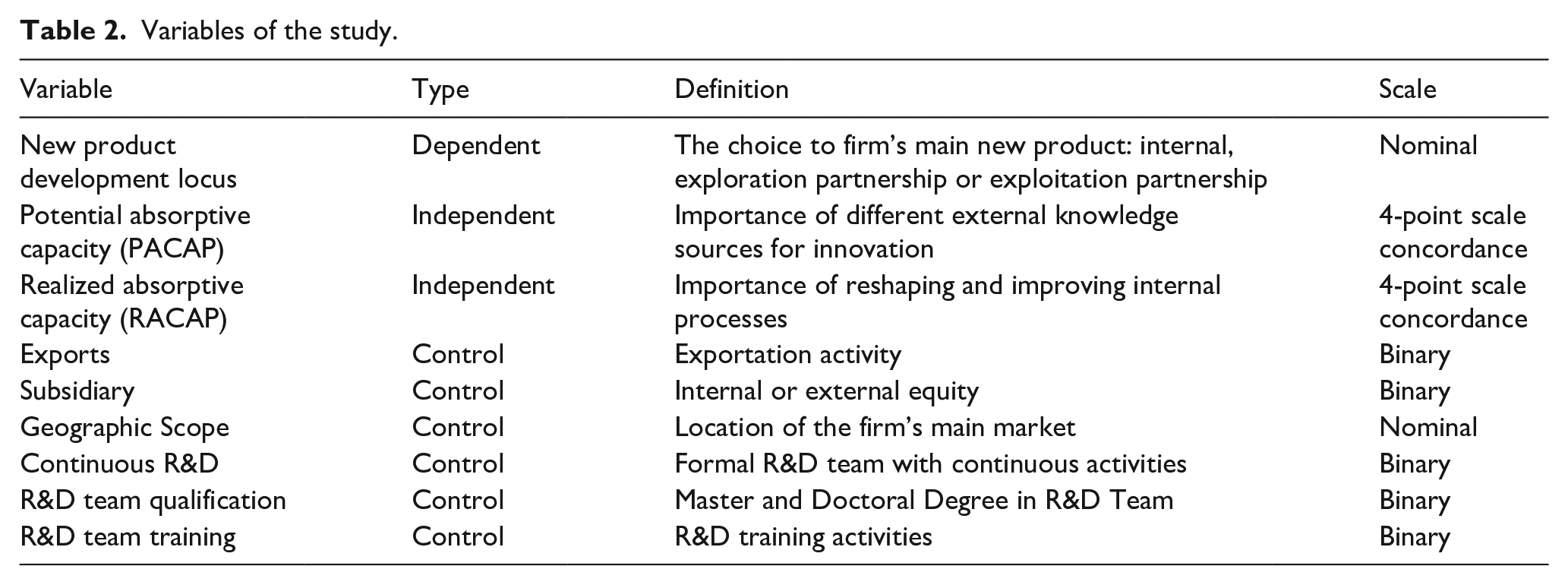
Table 2 describes the dependent, independent, and control variables. The full scales are described in Appendix 1, and the correlations are depicted in Table 3.
Variables of the study.
Correlation statistics.
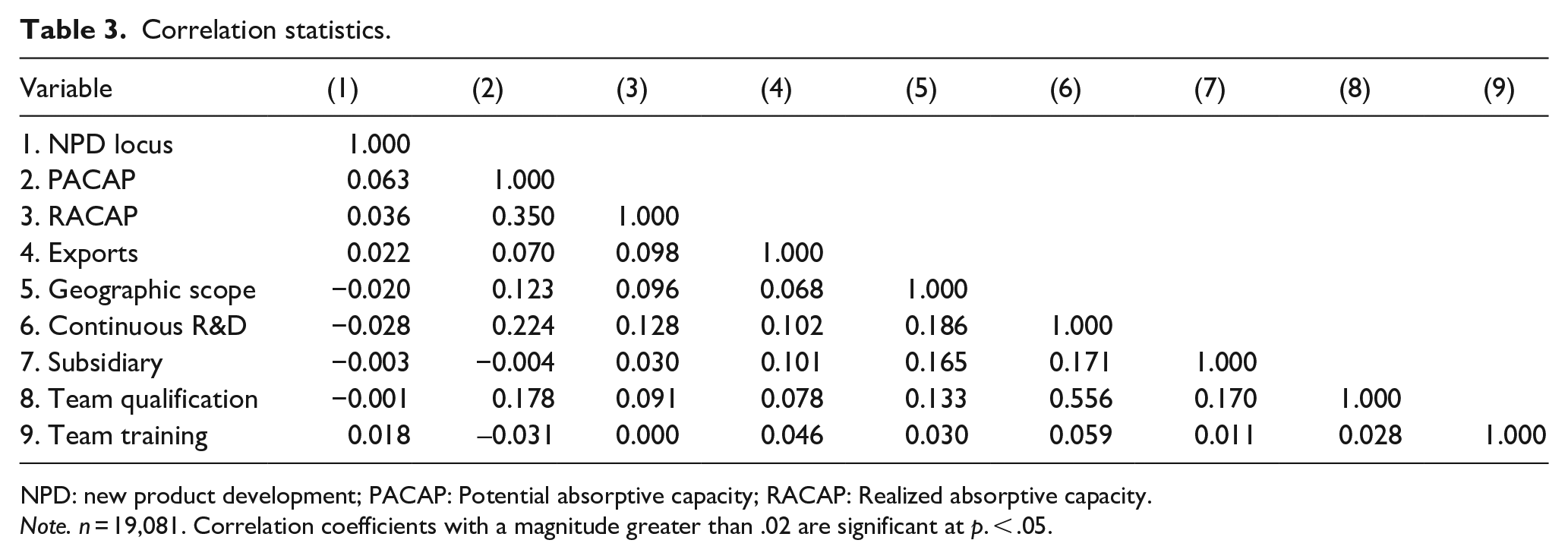
NPD: new product development; PACAP: Potential absorptive capacity; RACAP: Realized absorptive capacity.
Note. n = 19,081. Correlation coefficients with a magnitude greater than .02 are significant at p. < .05.
Data analysis
Our analytical strategy followed a two-stage process. In the first stage, we used confirmatory factor analysis (CFA) to evaluate the psychometric properties of the multi-item independent variables of PACAP and RACAP (Alves & Galina, 2021). In particular, we reviewed the scale’s reliability, convergent, and discriminant validity. Considering the categorical scale adopted by PINTEC (four-point agreement scale), CFA estimation was performed using the asymptotic distribution-free method. The reliability of our scale was supported by Cronbach’s alpha and composite reliability values, both of which exceeded the cut-off value of .70 (Hoyle, 2012), with PACAP reaching Cronbach’s alpha and composite reliability values of .823 and .850, respectively, and RACAP reaching .809 and .906, respectively.
In addition, all indicators exhibited significant (p < .01) factor loadings of between .657 and .821, which are above the recommended threshold of .60 for indicator reliability (Hoyle, 2012). The convergent validity was verified by the average variance: .723 for PACAP and .678 for RACAP. Both of these met the .50 criteria (Hoyle, 2012). Discriminant validity was determined using the heterotrait–monotrait ratio of correlations, with the resulting value of .425 being significantly below the conservative threshold of .95 (Henseler et al., 2015). Therefore, these indicators confirmed that the two dimensions of ACAP were properly measured for testing our hypotheses.
In the second stage, after we evaluated our measurement properties, we considered several factors that are of importance for predicting the likelihood that a firm will choose an exploration or exploitation partnership versus internal development. First, because of the three-category nature of the dependent variable (NPD locus), we used a multinomial model, which can be used to estimate a logit model that can be extended when the qualitative response variable has more than two categories. Therefore, this model generates k − 1 equations, where k is the number of categories, which, in turn, are used to generate probabilities to predict whether a category is above or below the category base (Weber et al., 2011). The equation we estimate is thus
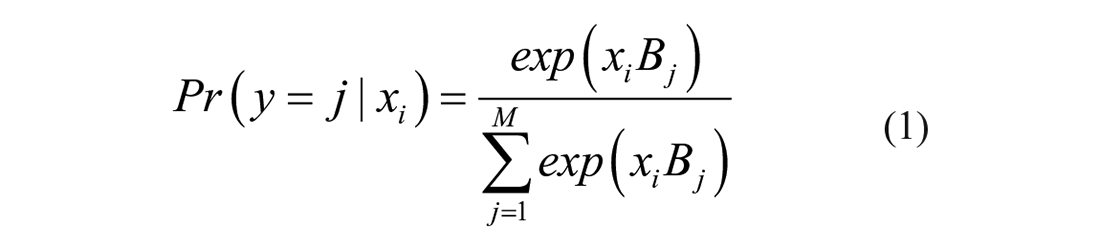
where j = 1,…, M, Pr(y = j|xi) are the probability that the firm (i) selects NPD locus category (j) given that xi, xi is a vector of characteristics and the fixed effects of firm (i), and βj is the vector of coefficients pertaining to a firm’s NPD locus category (j). The reference category is represented by internal development. In line with Wei et al. (2005), this modeling strategy accounts for three possible outcomes by estimating two equations: (1) exploration partnership versus internal development and (2) exploitation partnership versus internal development.
Second, PACAP and RACAP are distinct yet closely related dimensions of ACAP (Alves & Galina, 2021; Zahra & George, 2002). As such, we included both dimensions simultaneously in our analytical models to account for the effect size of PACAP controlling for RACAP and vice versa. Due to their close relationship, both variables exhibited a comparatively large correlation (r(19,081) = .350, p. < .001). While a large correlation between PACAP and RACAP has been frequently observed in previous studies (cf. Ali & Park, 2016), we carefully inspected the potential for multicollinearity. The variance inflation factor (VIF) for each individual variable was less than five, and the mean VIF for the regression model was below three. Hence, we concluded that multicollinearity did not threaten the coefficient estimates. Third, we attenuated the concern with unobserved heterogeneity by including robust standard errors at the firm level and time-fixed effects, with year-dummies capturing the influence of aggregate (time-series) trends.
Results
Hypotheses test
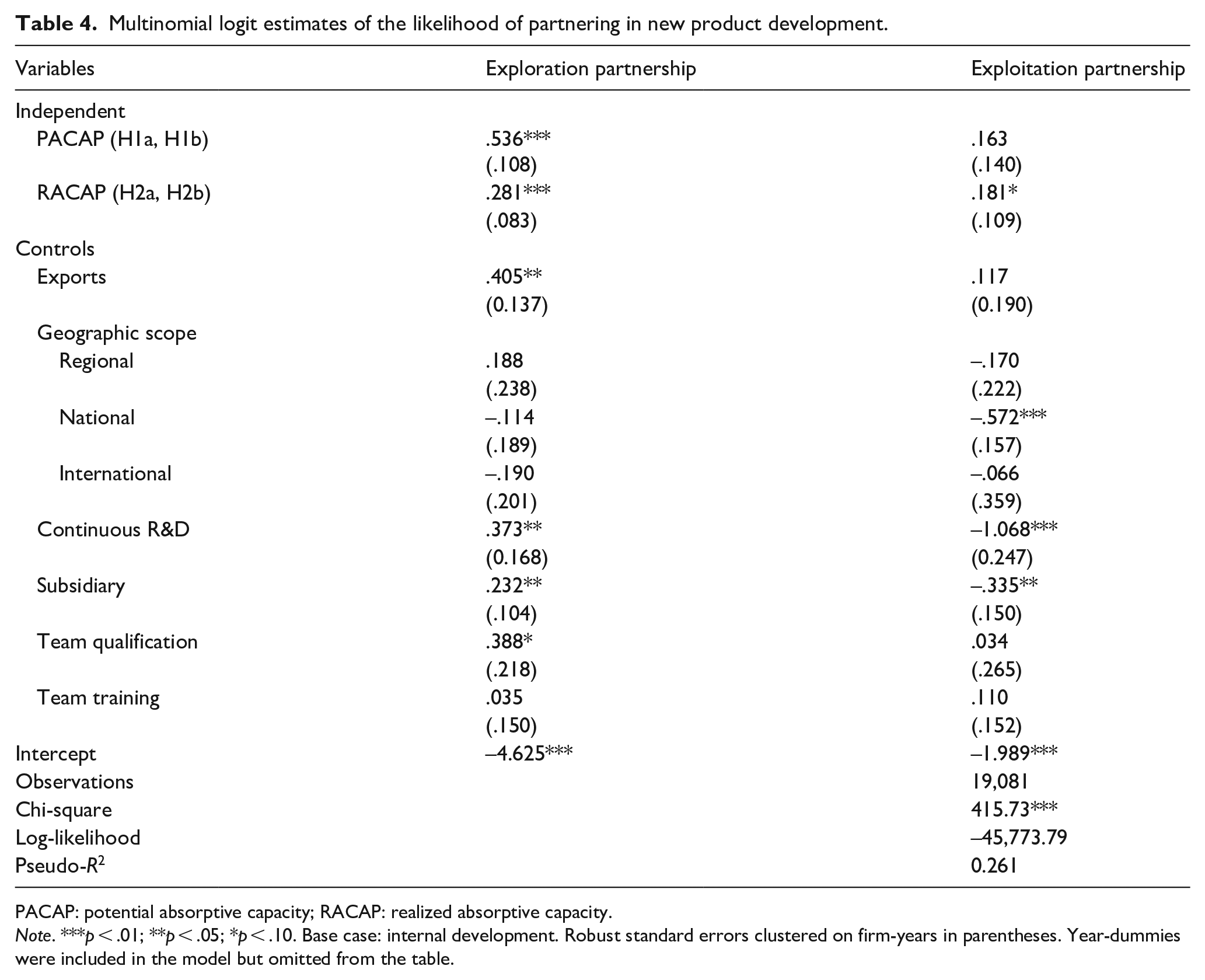
Table 4 presents the results of our multinomial logit estimations. Our model compares firms that chose internal development against firms that selected an exploration partnership and those that chose an exploitation partnership. The dependent variable for the multinomial logit estimation had three distinct values: 0 for internal development; 1 for exploration partnership; and 2 for exploitation partnership.
Multinomial logit estimates of the likelihood of partnering in new product development.
PACAP: potential absorptive capacity; RACAP: realized absorptive capacity.
Note. ***p < .01; **p < .05; *p < .10. Base case: internal development. Robust standard errors clustered on firm-years in parentheses. Year-dummies were included in the model but omitted from the table.
We proposed opposing direct associations of PACAP with the NPD locus: (1) an increased propensity to develop the new main product with an exploitation partnership over internal development (Hypothesis 1a); and (2) a decreased propensity to develop the new main product with an exploration partnership over internal development (Hypothesis 1b). As PACAP underscores exploration capabilities, we expected firms to look for complementarity in an exploitation partnership. Contrary to this prediction, we found that greater PACAP was more likely to lead to an exploration partnership in NPD (β = .536, p = .000), which provides strong support against Hypothesis 1a. We also found no support for Hypothesis 1b as our measure of PACAP had a positively hypothesized association but was not statistically significant (β = .163, p = .244). Therefore, the mechanism proposed in the theoretical development does not apply to the case of RACAP.
Next, we examined PACAP. Again, we proposed opposing direct associations of RACAP on the NPD locus: (1) an increased propensity to develop the new main product with an exploration partnership over internal development (Hypothesis 2a); and (2) a decreased propensity to develop the new main product with an exploitation partnership over internal development (Hypothesis 2b). We expected higher levels of exploitation capabilities (i.e., RACAP) to increase the firm’s propensity for a complementary exploration partnership, and the results partially supported this prediction. In line with Hypothesis 2a, we found a significant and positive coefficient in support of this hypothesis (β = .283, p. = .001), which indicated that higher RACAP was associated with a greater probability of pursuing an exploration partnership over internal development. We also found a positive but only marginally significant association between RACAP and an exploitation partnership (β = .181, p. = .097), which provides limited support for Hypothesis 2b. Overall, we observed that the dimensions of ACAP shape partnerships in different ways than were hypothesized. To allow for a better interpretation of the magnitude and amplitude of associations in our results, the odds ratios and their confidence intervals are reported in Figure 2.
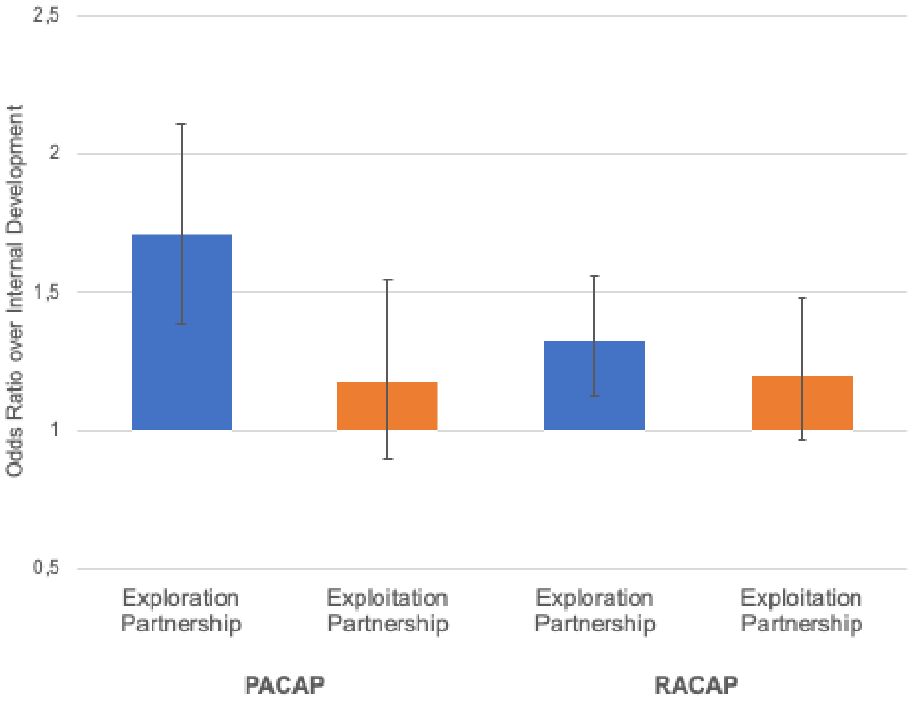
Effects size of absorptive capacity on new product development locus.
While larger sample sizes reduce the likelihood of random errors and increase the generalizability of the results, they can also increase the probability of statistically significant results. The estimation of the effect size addresses this concern and qualifies the findings appropriately. An odds ratio greater than 1 indicated that a 1-unit increase in the independent variable (i.e., PACAP and RACAP) increased the likelihood of an event occurring (i.e., exploration partnership and exploitation partnership instead of internal development). Conversely, an odds ratio smaller than 1 indicated that a 1-unit increase in the independent variable decreased the likelihood of an event occurring.
The odds ratio of PACAP associated with an exploration partnership and an exploitation partnership are 1.71 (p = .000) and 1.18 (p = .244), respectively, while the odds ratio of RACAP associated with an exploration partnership and an exploitation partnership are 1.32 (p = .001) and 1.20 (p = .097), respectively. These results imply, for instance, that a 1-unit increase in RACAP increased the odds of an exploration partnership choice over internal development by about 32% on average. Thus, the effect sizes suggest that our findings are materially relevant (odds ratio ranging from 18% to 71%) and show a general tendency toward exploration partnerships from both PACAP and RACAP.
Supplementary analyses
As the results do not support our theoretical framework, we explore alternative mechanisms to explain our findings. The patterns of firms’ behavior in our data suggest that overconfidence can be a mechanism that governs innovation in our setting (Galasso & Simcoe, 2011; Zollo, 2009). Hirshleifer et al. (2012, p. 1458) defined overconfidence as “the tendency of individuals to think that they are better than they really are in terms of characteristics such as ability, judgment, or prospects for successful life outcomes,” which increases individuals’ propensities to take more risks. Research has documented that firms that had previously achieved higher levels of competence become more overconfident in their abilities (Moore & Cain, 2007; Zollo, 2009). Accordingly, NPD is a setting in which we find that firms with more PACAP and RACAP capabilities are more likely to engage in exploration partnerships such as “risk-taking,” “experimentation,” and “innovation” (March, 1991, p. 71).
This phenomenon of overconfidence is associated with difficulty in establishing clear causal links between actions and results in complex tasks, leading firms to attribute competence where other factors played a role (Oskamp, 1965). Indeed, task complexity is a crucial factor in the association of capabilities with overconfidence (Oskamp, 1965; Zollo, 2009). Thus, there should be a reduction in the propensity to engage in exploration in a task with less complexity at the least. To investigate this possibility, we replicated our analysis in the context of process innovation. Process innovation is usually less complex (Reichstein & Salter, 2006; Utterback & Abernathy, 1975) because (1) there are fewer stakeholders directly involved; (2) the visibility to the public is generally small; and (3) the innovations frequently represent the introduction of a single element into the firm’s operations. The analysis of the model showed that greater capabilities are not significantly associated with exploration partnerships (βPACAP = .093, p = .207; βRACAP = .028, p = .591), but they are with exploitation partnership (βPACAP = .845, p = .000; βRACAP = .222, p = .023). These findings provide additional support to the overconfidence argument: in a less complex task, we did not observe a general tendency to rely on exploration partnerships as firms relied more on exploitation partnerships instead.
To rule out alternative explanations, we further investigated the possibility of quadratic effects. Our intuition here refers to the Dunning–Kruger effect (Kruger & Dunning, 1999) instead of overconfidence. This learning phenomenon suggests that, at the beginning of the learning curve, people tend to overestimate their ability and assume riskier activities, such as exploration partnerships. Later, as experience accumulates, people realize their limitations and look for complementary knowledge, which aligns with the predictions of our research framework. We did not find support for this alternative line of inquiry as the quadratic model’s overall fit was worse than that presented in Table 4, which suggests that the linear model is more parsimonious with the data (Burnham & Anderson, 2004) and that overconfidence is more likely to drive our results.
Discussion
To answer the two nontrivial questions of this study, we developed arguments grounded on the proposition that firms with greater capabilities of one type (e.g., exploitation) have a better perception of the missing capabilities of another type (e.g., exploration), and accordingly tend to establish complementary partnerships for NPD. However, our findings show that when ACAP is higher, regardless of which dimension, firms were more likely to engage in an exploration partnership. These results, discussed below, have important theoretical and practical implications that advance the research on the topic.
Theoretical contributions
Building on the body of innovation research that addresses the nexus of exploration and exploitation in the context of firm boundaries, we challenge scholars to reconsider an implicit assumption concerning the barriers encountered by firms striving for ambidexterity (Stettner & Lavie, 2014). When exploration is high, firms must find ways to apply and deploy the knowledge stock. Conversely, firms with high exploitation need to search for and experiment with new ideas. The question remains whether firms will be equally likely to engage in exploration–exploitation across boundaries or vice versa. Our findings highlight that these two processes are not equally challenging. Based on a representative sample of the manufacturing sector in Brazil, we demonstrate the following. Firms with high exploration capabilities (i.e., PACAP) opt for an exploration partnership, which means that they do not consider complementing their explorative learning with external exploitative knowledge. Meanwhile, firms with high exploitation capabilities (i.e., RACAP) naturally opt for a complementary exploration partnership. Thus, firms that emphasize searches are less likely to balance exploration and exploitation across boundaries. Scholars have long argued that the balance between exploration and exploitation learning is a key factor that shapes firms’ long-term performance (March, 1991). This asymmetry in the models analyzed suggests that the exploration–exploitation process might represent a larger threat to the long-term survival of the firms than the exploitation–exploration process.
The second contribution is a conceptualization of the antecedents of the NPD locus that enriches our understanding of strategic alliances. By linking theories of organizational learning (March, 1991) to inter-organizational relationships research, we contribute to the emerging stream of studies that incorporate a relational perspective into the traditional resource-based view on firm boundaries (Arya & Lin, 2007; Lavie, 2006). From this traditional perspective, only firms with limited resources seek out external partners in core activities, that is, NPD (Dierickx & Cool, 1989; Espino-Rodríguez & Padrón-Robaina, 2006). Due to an exploration–exploitation framework being adopted in this study (March, 1991), we examined this prediction with more granularity and distinguished between various resources. Specifically, we answered the question of to what extent current exploration (or exploitation) capabilities drive the selection of exploitation (or exploration) partnerships. Contrary to the resource-based perspective, our results suggest that firms with greater capabilities of any kind are more likely to seek inter-organizational relationships in NPD (see Figure 2). This finding is an important contribution to the widespread application of the resource-based view, which has been criticized for its lack of boundary conditions (Priem & Butler, 2001). Together with Makadok (2003), we contribute to showing the conditions in which resource-based interpretations alone are insufficient to explain firms’ behavior. While Makadok (2003) highlights the significance of agency theory to explain resource profitability, our study suggests that it is essential to use the Behavioral Theory of the Firm (Cyert & March, 1963; Zollo, 2009) to explain inter-organizational relationships and the NPD locus.
Third, this article also contributes to a more realistic view of the diverse innovation strategies associated with accumulated learning. In line with the literature on learning and innovation (Oskamp, 1965; Zollo, 2009), we cautiously suggest that overconfidence is the mechanism behind our findings—not limits of competence. Thus, our results show a dysfunctional outcome of a learning contingent on complex activities such as NPD. The intersection between overconfidence and innovation is not new. For instance, Steve Jobs, the former Chief Executive Officer (CEO) of Apple, was well known for his innovative spirit but also because “Jobs. . . oozes smug superiority . . . No CEO is more willful, or more brazen, at making his own rules, in ways both good and bad” (Fortune, 2008). Furthermore, strong empirical evidence from extant research shows that overconfidence is associated with more investment in innovation, more patents and patent citations, and greater innovative success (Galasso & Simcoe, 2011; Hirshleifer et al., 2012). Yet, there is virtually no research linking overconfidence to the locus of NPD. Our contribution provides an initial step for further research that can explore factors that limit rational firm behaviors in open innovation, as predicted by the resource-based view.
Managerial contributions
Our study also offers valuable insights into managerial implications. While most of the research on exploration–exploitation focuses on ways to solve this trade-off internally (e.g., He & Wong, 2004; Jansen et al., 2006; Sidhu et al., 2007; Tushman & O’Reilly, 1996), we highlight the practices that inform the dynamics involved in external partners either exploiting or exploring. Importantly, our findings suggest that firms with strong PACAP or RACAP might require diverse managerial styles to reach ambidexterity and, consequently, competitive advantage. Firms with high PACAP will probably need strong incentives and structures to focus managerial attention on complementary exploitation partnerships as they might not otherwise be able to reap economic benefits from their large pool of resources. Thus, the benefits of open innovation are likely tied to organizational goals that encourage the deployment of knowledge resources. In contrast, firms with RACAP are more prone to seek an exploration partnership, which complements their existing exploration capabilities. Therefore, managers need to be attentive and remove barriers that could impede this natural tendency toward complementary knowledge. In sum, by showing the prevalence of the patterns of sourcing exploration partnerships and exploitation partnerships, we clarify where policies are required to reduce the underutilization of technology assets, which is a problem that affects most firms (Rivette & Kline, 2000).
Limitations
This study has three limitations. First, we employed multiple indicators, a validated measure (Alves & Galina, 2021), and a wide database at the country level to increase the potential generalizability of our findings. However, this came at the cost of precision. The measures of PACAP and RACAP are proxies and do not fully capture the routines that are dedicated to the internalization and exploitation of external knowledge, as is the case with case studies (e.g., Peeters et al., 2014). Second, the conclusions from this study should be interpreted cautiously from the point of view of causality. Outside of a lab, it is difficult to determine the ways in which to randomly assign firms to develop RACAP and PACAP and later observe their choices in terms of NPD locus. Therefore, our study provides only correlational evidence on the role of capabilities, which should be further investigated by longitudinal in-depth qualitative research. Finally, the definition of an exploitative partnership is relative and dependent on a given set of dimensions that qualify other partnerships as exploratory and vice versa. In comparison to cooperative agreements, outsourcing can lead to outcomes that are exploitative in nature. The reverse is true as cooperation can lead to outcomes that are exploratory in nature compared with outsourcing agreements. This methodological choice might not reflect all dimensions in which these types of strategic alliances might not generate the expected outcome in terms of exploration or exploitation.
Future research
Our contributions open interesting avenues for future research. For example, they suggest that firms are not equally prone to balancing both exploration–exploitation and exploitation–exploration with partnerships. To shed light on the drivers of these differences, additional studies could consider the role of institutional, organizational, and cognitive factors in moderating the relationship between internal capabilities and partnerships. This would be a crucial contribution to understanding the ways in which to increase the propensity of firms with strong exploration capabilities to engage in complementary partnerships. Camuffo et al. (2020) provide an interesting framework in which future studies can develop interventions to provide a better sense of firms’ limits of competence.
Moreover, the literature would benefit from further studies that explicitly investigate the role of overconfidence in external partnerships for NPD. We relied on a large-scale data set on innovation activities, which reduced our ability to capture lower-level processes. Laboratory experiments or in-depth qualitative studies, such as ethnographic studies, are promising ways to depict the underlying microelements of capability-building and its effects on the NPD locus. This effort would integrate the fast-growing research stream on the microfoundations of organizational capabilities (Felin et al., 2012). In sum, there is a fruitful path to expanding our understanding of how inter-organizational relationships can drive the balance between exploration and exploitation to generate innovative products over time.
Conclusion
In a world with pressing demands for creative and disruptive solutions to complex problems, inter-organizational relationships are a key vehicle for expanding firms’ boundaries and incorporating the necessary knowledge to develop new products. Our study examined how the stock of knowledge in the form of capabilities is systematically associated with firms’ propensity to engage in partnerships for exploration or exploitation. From the results, we conclude that accumulated experience in any of these domains was associated with an increased propensity to experiment with new and riskier alternatives, that is, exploration. Therefore, instead of a better sense of the limits of their competence, we observe a pattern in our data that is consistent with increasing overconfidence. The findings in this article contribute to multiple streams of research at the intersection of organizational learning and inter-organizational relationships, which has resulted in implications for theory and practice.
Footnotes
Appendix 1
Acknowledgements
We gratefully acknowledge the insightful comments and suggestions on earlier drafts of the manuscript provided by Murilo Oliveira and Roberto Bernardes. We also would like to thank the technical assistance of Glaucia Ferreira and Leandro Veloso, and the data access granted by the Brazilian Institute of Geography and Statistics (IBGE).
Declaration of conflicting interests
The author(s) declared no potential conflicts of interest with respect to the research, authorship, and/or publication of this article.
Funding
The author(s) disclosed receipt of the following financial support for the research, authorship, and/or publication of this article: Financial support was provided by the Brazilian National Council for Scientific and Technological Development (CNPq). All remaining errors are the responsibility of the authors.
