




Abstract
In this article, we analyze the impact of learning from internationalization on small and medium enterprises’ (SMEs) performance along different development paths. Drawing on the exploitation versus exploration logic, we use an alternative view of foreign operation modes (the learning perspective) to provide insights into the impact of such learning on technological and organizational innovation as well as overall performance. Our results, which are derived from a sample of 132 SMEs active in traditional manufacturing industries, point to a path to superior performance that entails resource-augmenting operation modes and organizational innovation.
Introduction
Understanding the interplay between entry mode choices and organizational learning has been the focus of international business (IB) research for many years. Learning from previous international experience has been widely addressed as an important way to overcome barriers in both the organizational learning and the internationalization process literature (Johanson & Vahlne, 1977). Knowledge about foreign markets is thus considered a source of competitiveness, as internationalization is a learning process that permits the identification and exploitation of opportunities abroad (De Clercq et al., 2012; Zahra et al., 2000). Yet, we have only a limited understanding of what happens after internationalization decisions are made. In other words, we know little about the outcomes of these operation-mode choices.
The knowledge accumulated from experience with various foreign operation modes 1 facilitates the management of relevant information about foreign markets and extends the firm’s knowledge base for subsequent entries. In this sense, the classical entry-mode paradigm focuses on minimizing transaction costs when transferring assets abroad (Anderson & Gatignon, 1986). However, recent years have brought the emergence of an alternative, resource-based perspective focused on maximizing value at the firm level as well as the creation and transfer of the pool of resources acquired through accumulated experience (Meyer et al., 2009; Riviere & Suder, 2016). This approach offers key insights, as it analyses foreign-market decisions not only as simple trade-off between more or less control and more or less resource commitment but also as formula for augmenting firms’ resources. However, we lack empirical evidence on the drivers of firm competitiveness in relation to operating modes, which are highly dependent on the organizational context. For instance, a recent study demonstrates that although entry modes involving higher commitment offer better learning prospects for small and medium enterprises (SMEs) (Schwens et al., 2018), these firms face multiple challenges when managing their international approach and they struggle to maximize their learning from international operations.
In this article, we draw on dynamic perspectives on organizational learning (Helfat et al., 2007; Teece et al., 1997) to illustrate how learning from foreign operations can help firms achieve long-term advantages in terms of capability building and competitiveness. More specifically, we analyze the interplay among the knowledge-sourcing logic behind operation modes, the type of innovation, and firm performance.
We focus on SMEs in traditional manufacturing sectors, as the ambidexterity logic suggests that these firms often face a key trade-off. One of the basic premises of this stream of literature is that exploitation and exploration compete for scarce resources, and that firms need to balance the optimal points in the continuum (March, 1991). As management of the ambidexterity paradox often requires proper resource allocation (Klingebiel & Rammer, 2014; Wei et al., 2014), this allocation decision is particularly complex for SMEs. These ventures face a “liability of smallness” (Lu & Beamish, 2006)—they have fewer financial, human, and technological resources available, which causes a clear disadvantage for both internationalization and innovation strategies (Majocchi et al., 2005). Their approach toward internationalization is often risk-averse and focused on short-term performance. As a result, many of these firms adopt flexible and simple modes of operation, such as exporting, while they accumulate international experience (Anderson & Gatignon, 1986; Cavusgil & Zou, 1994). The more “complex” approach of foreign direct investments has been underutilized by these companies due to the costs of such transactions as well as the recent economic crisis, which prompted many firms to engage in exporting.
We make three important contributions to the literature. First, we add to the international ambidexterity literature by extending the debate on exploitation versus exploration. This theoretical framework has proven useful for explaining innovation from a dynamic perspective (Benner & Tushman, 2003; O’Reilly & Tushman, 2008). However, interactions between dynamic capabilities and internationalization remain an underdeveloped area of research even though they are at the core of IB learning processes. We use a knowledge-based conceptualization of operation modes to expand our understanding of how operation modes permit the generation of firm capabilities, thereby extending our understanding about the role of dynamic capabilities in internationalization (Hsu et al., 2013; Luo, 2002; Prange & Verdier, 2011; Villar et al., 2014).
Second, we provide a comprehensive conceptualization of innovation types by splitting technological innovation from non-technological innovation. Many successful business models emerge from marketing and organizational innovations, and not just from technological capabilities. Therefore, focusing on less technological sectors in which innovation is typically incremental and the result of the application of novel combinations of existing (and tacit) knowledge could add insights at the industry level.
Third, we illustrate how learning from decisions on foreign operation modes can trigger a virtuous circle for performance by aligning international resource allocation with the type of innovation. In this sense, we offer recommendations and benchmarks for a more robust model of internationalization in traditional manufacturing industries by specifying the types of internationalization and innovation that are more likely to enhance competitiveness. In so doing, our study offers managers a useful framework for understanding the specific capabilities needed to achieve competitive advantages and, thereby, superior performance.
The remainder of the article is organized as follows. The next section presents the theoretical background for this study as well as our hypotheses. In the subsequent sections, we outline our methodological approach and major results, and provide a discussion. We conclude by highlighting our study’s main contributions.
Theoretical background and development of hypotheses
Experiential learning and dynamic capabilities
The role of dynamic learning in international expansion has been at the core of IB research since the development of the main internationalization frameworks (Johanson & Vahlne, 1977; Oviatt & McDougall, 1994). As knowledge is the outcome of the learning process, foreign market experience leads to the development of two types of experiential knowledge (Johanson & Vahlne, 1977; Johanson & Wiedersheim-Paul, 1975). The first is general, non-location-bound knowledge that can be exploited globally without significant adaptations (e.g., information about marketing processes and routines, information on the organization of foreign operations). The second is location-bound knowledge, which is not easily transferred to other countries because it relates to specific institutional or cultural traits, aspects of competition, or local market conditions (Safari & Chetty, 2019). Both types are fundamental in the Uppsala model, which posits that experiential knowledge affects future mode and market decisions (Johanson & Vahlne, 1977). However, general market knowledge is believed to accelerate subsequent expansion in more complex foreign markets through the exploration or upgrading of capabilities (Luo, 2002). Moreover, learning can vary depending on the entry mode (Salomon & Jin, 2008; Vermeulen & Barkema, 2001).
According to this view, entry modes can be classified into two broad categories (Meyer et al., 2009): resource-exploiting and resource-augmenting. Foreign direct investments (FDIs) (e.g., acquisitions, greenfield investments, and joint ventures) are examples of entry modes that allow for high and medium levels of resource augmentation because they require the exchange of resources, technologies, or information with the local context. Entry modes with low levels of resource augmentation include licenses, cross-border provision of services, and other forms of contractual collaboration aimed at exploiting existing resources by applying accumulated knowledge in foreign markets.
This conceptualization is consistent with the rationale of ambidexterity, as a firm can focus its capabilities with the aim of either fostering long-term growth through experimentation and search or refining its knowledge base (Helfat et al., 2007). Ambidexterity refers to the ability to combine both, being efficient in managing the demands of modern business and adaptive to changes in the environment (O’Reilly & Tushman, 2008; Raisch & Birkinshaw, 2008). The two components of ambidexterity—exploration and exploitation—arise from different knowledge-processing capabilities, and they require different structures, processes, strategies, and capabilities (Benner & Tushman, 2003). As these two strategies imply a trade-off (March, 1991), an interesting debate over the best way to use these strategies has emerged. Some authors maintain that exploration and exploitation are equally important, and that firms need to balance them to achieve sustainable performance (Hsu et al., 2013; Lavie & Rosenkopf, 2006) and generate synergistic effects (Cao et al., 2009). Others suggest that these are conflicting capabilities and that firms should prioritize one or the other in the pursuit of better performance (Koryak et al., 2018; Menguc & Auh, 2008). Some research proposes that exploration and exploitation are interrelated, and that there might be an optimal combination or sequence for firm performance (Benner & Tushman, 2003; Yalcinkaya et al., 2007). By and large, this line of research indicates that ambidexterity is highly dependent on contextual and organizational aspects, and that it should be approached as a process. We follow this reasoning in the context of our study.
Learning, innovation, and firm performance: exploration versus exploitation
Experiential learning from foreign markets is believed to foster the development of organizational capabilities (Vermeulen & Barkema, 2001). One organizational capability that has attracted widespread interest among IB researchers is innovation capability (Chiva et al., 2014; Damijan et al., 2010). Innovation is expected to have a positive impact on internationalization because internationalization helps to spread the costs of innovation and improves competitive positioning overseas. This link has mainly been analyzed using export formulae (Basile, 2001; Ribau et al., 2019). With regard to the reverse path (i.e., from internationalization to innovation), comprehensive empirical evidence is lacking. What little evidence exists is generally limited to “learning by exporting” (Araújo & Salerno, 2015; Golovko & Valentini, 2014; Salomon & Jin, 2008) with few studies covering other types of entries (Kafouros et al., 2008).
Notably, the capability to engage in product innovation may be a necessary but not a sufficient condition to compete globally. A firm’s degree of innovativeness broadly reflects its tendency to engage in and support new ideas, innovation, experimentation, and creative processes that may lead to new products, services, or technological processes (Lumpkin & Dess, 1996). Recent developments, such as the Oslo Manual, have extended this classical conceptualization of innovation defining it as “the implementation of a new or significantly improved product (good or service), or process, a new marketing method, or a new organisational method in business practices, workplace organisation or external relations” (Organisation for Economic Co-Operation and Development [OECD]-Eurostat, 2005, p. 46). Product and process innovations fall into the category of technological innovations, as both refer to the introduction of significant changes in the characteristics, uses, materials, techniques, equipment, or software used to produce a product.
In contrast to the well-known category of technological innovation, which reflects the classical concept of innovation, we highlight non-technological or organizational innovation, which includes marketing and organizational innovation. This type of innovation—broadly referred as business process innovation in the last version of the manual—can involve, for instance, the implementation of new marketing methods, changes in marketing techniques, the introduction of new organizational methods in a firm’s business practices, or changes in workplace organization or external relations (Hagen et al., 2018).
Innovation in management practices complements and supports technical innovation (Azar & Ciabuschi, 2017; Leonard-Barton & Deschamps, 1988). Technological innovation can be embedded, at least to some extent, in organizational innovation. For instance, the development of new production technologies implies a reorganization of company processes, which in turn engenders the introduction of new organizational models (Battisti & Stoneman, 2010). Recently, management scholars have developed a new interest in the study of technological and organizational innovation, and they have found some complementarities between these forms of innovation, largely using secondary databases such as community innovation surveys (Ballot et al., 2015; Battisti & Stoneman, 2010; Doran, 2012; Hervás-Oliver et al., 2015). By and large, although the literature has shown that ambidexterity affects product and process innovation (Onufrey & Bergek, 2020; Yalcinkaya et al., 2007), empirical evidence on the mechanisms behind other forms of firm innovativeness is lacking. Therefore, to explain the impact of internationalization on innovation, we return to the exploration–exploitation paradigm.
We propose that as a result of new knowledge combinations, both technological and organizational innovation can arise from international experiential knowledge. However, these types of innovation emerge along two different paths. Resource-exploiting entry modes, especially non-FDI entry modes, have limited returns in the form of learning—they are mostly focused on applying and replicating existing knowledge about foreign markets. As such exploitative operation modes lead to the development of a competitive position in a specific host market, it becomes difficult to transfer knowledge to other markets or to integrate it into the company. This is the result of the lack of interaction with local firms, which inhibits learning. Firms with resource constraints may have incentives to devote managerial, human, and financial resources to innovation targets more related to their existing knowledge base, as incremental innovation portfolios typically offer more certainty on potential returns than new, ambitious projects. In this regard, a study by Yalcinkaya et al. (2007) suggests that technological resources are more related to exploitation. In short, the exploitative path involves local search, as this knowledge is familiar or related to what the company already knows. On this path, the company builds on its core base through incremental improvements in processes and products (Onufrey & Bergek, 2020).
In contrast, resource-augmenting entry modes (i.e., those involving foreign direct investments) are expected to improve a firm’s current knowledge base. This formula implies closer interactions with the host country, as it requires the exchange of resources and information with suppliers, customers, and other stakeholders, which can help expand the knowledge base (Meyer et al., 2009; Pla-Barber et al., 2014). This explorative learning approach implies the extension of capabilities through experimentation, reconfiguring the knowledge from both internal and external sources. In fact, the management of complex internationalization formulae, such as alliances or the establishment of a physical presence abroad, often entails the renewal of the business model and changes in the value proposition. Because sophisticated demand abroad fosters constant adaptations with regard to distribution channels and partnerships, this learning approach is consistent with the notion of organizational innovation.
As explorative and exploratory innovation play different roles in sustaining SMEs’ competitive advantages (Ribau et al., 2019), the two routes constitute alternative strategies for SMEs. However, as the effects of exploitation and exploration on performance differ based on the firm’s strategic orientation (Lin et al., 2013; Wei et al., 2014), we provide a broader view of their impact on the ultimate variable that explains firm sustainability—firm performance. For the sake of brevity, we propose two hypotheses that summarize the paths in terms of operation modes, capability exploitation/exploration, and type of innovation:
Hypothesis 1 (H1). The use of resource-exploiting operation modes is positively related to performance through capability exploitation and technological innovation.
Hypothesis 2 (H2). The use of resource-augmenting operation modes is positively related to performance through capability exploration and organizational innovation.
In addition, we extend our analysis to the mechanisms that might facilitate the implementation of these strategies. In the literature on innovation and internationalization, a common approach has been to analyze the firm’s international orientation. International orientation helps firms adapt to new environments by gathering data and using knowledge about foreign markets and local competencies (Kafouros et al., 2008; Ripollés et al., 2012). It enhances organizational learning capabilities by supporting the discovery of new market opportunities in terms of products and services, distribution channels, or communications. A clear international orientation is expected to favor firm performance, as it should sustain the deployment of resources and organizational structures to ensure proper implementation of the strategy (Cadogan et al., 2002; Liu et al., 2002).
However, in the presence of resource constraints, a relevant question is which capabilities should be fostered by this international orientation, since the performance effects of exploitation and exploration differ with a firm’s strategic orientation (Lin et al., 2013; Wei et al., 2014). Firms can pursue different objectives when going international, such as efficiency, economies of scale, risk diversification, or market expansion, which also affect their innovation approach. A firm can pursue foreign markets as sources of new knowledge, which can serve as an innovation input; yet, in a very basic approach to international markets this would simply involve an international orientation focused on efficiency and the continuous exploitation of current capabilities.
Given the restrictions arising from limited resources in SMEs, we believe that an international orientation is not necessarily a guarantee of success. Instead, it needs to be aligned with the company’s strategic priorities, especially in terms of its approach to foreign expansion and innovation. In the presence of resource constraints, firms need to fit their resource-allocation decisions with their social and market orientations. We connect this idea to the exploitation–exploration paradigm to propose two possible mediation effects:
Hypothesis 3a (H3a). The effect of capability exploitation on technological innovation is mediated by international orientation.
Hypothesis 3b (H3b). The effect of capability exploration on organizational innovation is mediated by international orientation.
The proposed relationships are depicted in the conceptual model presented in Figure 1.
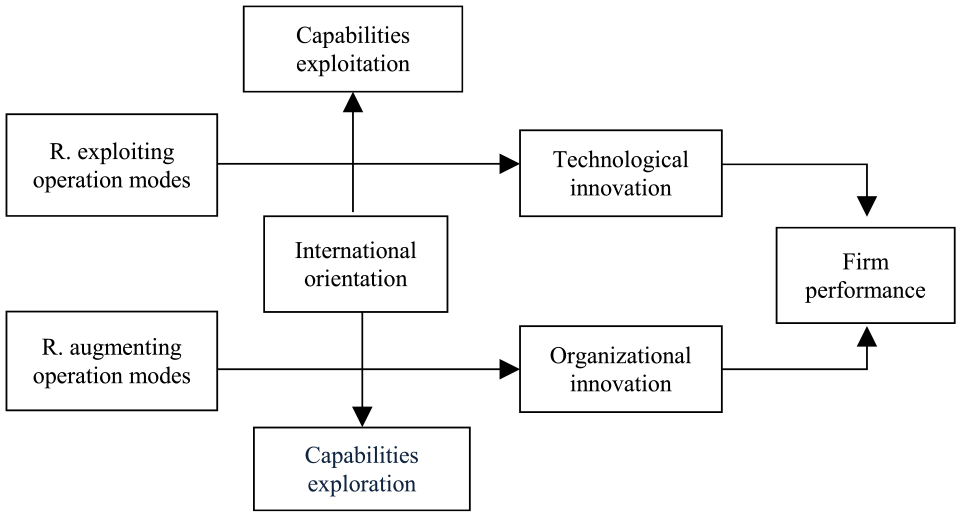
Conceptual model.
Research design
Data collection
Our empirical study covered SMEs in several traditional manufacturing sectors: textiles, furniture, and shoes. These mature sectors were selected for several reasons. According to the OECD, traditional manufacturing sectors are characterized by a small size, low technological intensity, and higher demand for less qualified labor. As such, they find themselves in a particularly complex situation in terms of maintaining competitiveness in the age of globalization. These sectors have been immersed in an enforced restructuring process driven by globalization and the entry of more competitive firms from overseas. Many firms have disappeared as a result, while the survivors have had to rapidly learn to adapt to foreign markets. In the face of recent economic crises, some of these firms have survived by exporting to foreign markets, redefining their corporate strategies, and reshaping the boundaries of their activities.
The sample population, which was obtained from the ORBIS database, 2 consisted of firms located in Spain (with Spanish ownership) with 10–400 employees and assigned the NACE 2009 manufacturer codes of 13, 15, or 31. Of the firms in the ORBIS database, 2,181 met these criteria: 1,008 companies active in furniture manufacturing, 614 in shoe production, and 559 in the textile sector.
The data were collected using a questionnaire sent by email with a cover letter directly to internationalization managers. The email was followed by a telephone call. When designing the questionnaire, we included Likert-type scales ranging from five to seven points to avoid automatic responses, following recommendations to avoid common method bias ex ante (Podsakoff et al., 2003). We also included variables from secondary sources in our model to reduce this potential effect. The questionnaire was then pre-tested on academic and professional experts. Data collection was carried out in 2014. We received 134 responses, two of which were removed from the sample because the focal firms were engaged in activities other than manufacturing.
Consequently, our final sample was composed of 132 firms: 49 in the shoe sector, 45 in textiles, and 38 in furniture. As such, the sample size achieves the recommended level of 100 observations to ensure statistical power in the social sciences (Cohen, 1992) for a confidence level of 95% and 8.2% error. The sample is composed of SMEs (50–250 employees according to the European classification). Of these, 83% were small companies up to 50 employees. Due to the natural agglomeration effect in these sectors, most of the respondent firms were located in industrial districts in Valencia and Catalonia. All of the firms in the sample had international experience, mostly between 10 and 20 years. In addition, 53% of them exported less than 40% of their production, and a high percentage were family companies. More than half of the firms were focused on Europe, while some were focused on the Middle East, Asia, or the Americas. The sample’s balanced distribution helps to control for the risk of biased results due to dissimilar firm profiles.
Measurement of variables
All variables in this study were measured according to the extant literature. However, in some cases, we used previous theoretical proposals to develop new scales adapted to our research questions. We also included a partial lag between resource-allocation decisions (i.e., operation modes, capabilities exploration/exploitation) and innovation output (Mairesse & Mohnen, 2010). In other words, we asked respondents to assess their operation modes over the previous 5 years. Although some evidence suggests that operation modes tend to be quite stable in lower tech sectors, we aimed to ensure that the input existed prior to the output (i.e., innovation strategy in the previous 3 years).
Endogenous or dependent variable
Performance was measured using a five-point Likert-type scale. It included such items as sales growth, productivity, and market share. This variable has been extensively used in related literature (Kafouros et al., 2008).
Exogenous or independent variables
Resource-exploiting and resource-augmenting operation modes
These variables were designed following Meyer et al. (2009) and measured as in previous studies of entry modes (Ripollés et al., 2012). Specifically, we measured the use of resource-exploiting operation modes using three items: the use of indirect exports through distributors or external agents, the use of the firm’s own network for distribution in foreign markets, and the use of licenses. However, use of licenses as an operation mode did not provide enough explanation and it was dropped from the model. The measure of resource-augmenting operation modes included three items: a greenfield investment with exclusive capital, the creation of a joint venture, and the acquisition of or majority participation in a firm in a host market. Respondents were asked to assess the use of these operation modes on a seven-point Likert-type scale. We believe this represents an improvement relative to studies measuring entry modes as a dichotomic variable because most firms maintain and combine different operation modes in host countries, and they do so with different intensities.
Technological and organizational innovation
When reviewing the literature on innovation, we observed that few scales measure both types of innovation as discrete variables rather than as a dichotomous variable. We thus developed this variable drawing on the OECD-Eurostat (2005) recommendations and related studies (O’Cass & Weerawardena, 2009). We asked respondents to assess their achievements in the four categories of innovation during the previous 3 years. In particular, they were asked to assess the intensity of their firms’ innovation activities as well as their degree of innovation (incremental or radical). We included examples to facilitate participants’ understanding of the meaning of innovation in relation to products, processes, marketing, and the organization. Five-point Likert-type scales were used for all of these items.
International orientation
This seven-point Likert-type scale with three items was based on Ripollés et al.’s (2012) notion of international compromise. It accounts for the search for information on market conditions and for competencies in foreign countries, as well as the adaptation of financial and human resources for international operations.
Control variables
Following previous studies on internationalization and innovation, we included three control variables that might affect the proposed relationships in our context. Size, measured as the log of employees obtained from ORBIS database, is regularly used as a proxy for the resources the firm has available for internationalization and innovation (Chen & Hsu, 2010). International experience accounts for the number of years a firm has been operating abroad. It is relevant because learning resulting from past investments can increase the likelihood of future success (Johanson & Wiedersheim-Paul, 1975). Respondents were asked to indicate the year of their firm’s first international experience (through either exports or FDI). Finally, as a cluster might be a local source of capabilities for innovation and internationalization, especially in traditional manufacturing sectors, we included cluster as a dichotomous variable that accounts for whether the firm was located within a cluster.
Statistical analysis
We employed structural equation modeling (SEM-PLS) to analyze the relationships between endogenous and exogenous latent variables at the same time (Chin, 1998). We analyzed the data using SmartPLS for several reasons. Partial least square (PLS) is a variance-based modelization technique that fits the particularities of social sciences, where we typically find theories that are not yet solid, relatively small samples, and data that do not follow a normal distribution. We performed a Kolmogorov–Smirnov test and a Shapiro–Wilk test, which showed that the data were not normally distributed. Furthermore, even if the number of observations meets the minimum requirements for statistical power (Cohen, 1992), our sample size is limited. Likewise, considering the model’s characteristics and the absence of solid prior evidence of how the variables are related PLS offers an appropriate fit, as its objective is not to confirm known relations but to provide predictions based on the data.
Prior to this analysis, we checked the descriptive statistics, which are presented in Table 1. The variance inflation factor (VIF) test revealed no multicollinearity problems, as the highest level is far from the cut-off point (5) that is considered acceptable.
Descriptive statistics.
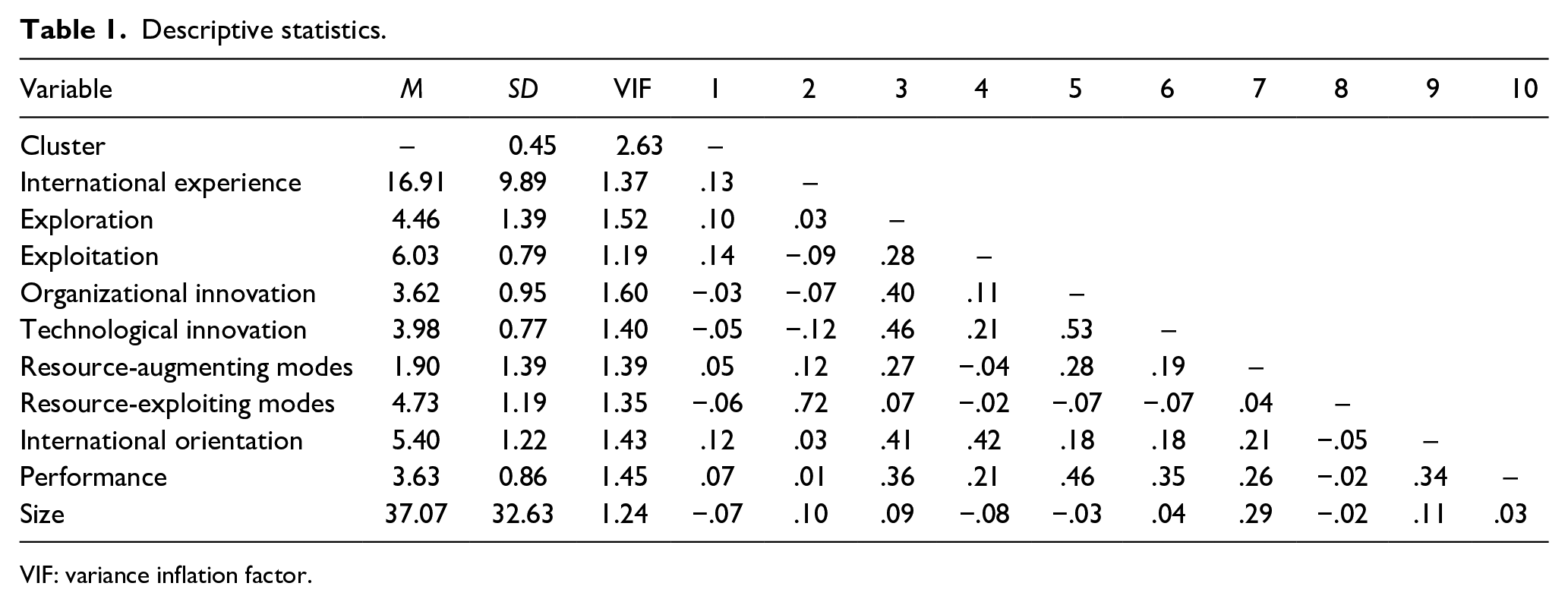
VIF: variance inflation factor.
Confirmatory factor analyses
When assessing the psychometric properties of variables in order to perform SEM, we first checked the reliability of the individual items, which is viewed as acceptable with loadings higher than .707. Almost all of our items reached that minimum level, and the only exceptions were two items within the innovation scales. However, their loadings were at least .65, which is close to the threshold and had no effect on the construct’s convergent validity. Also, there is some flexibility to maintain items with loadings slightly lower than .7 when testing a new scale (Chin, 1998), as in our case for the technological and organizational innovation scales. After this process, we also withdrew the item on licenses due to its very low loading, given that SMEs rarely use licenses as an entry mode. The remaining scale had three items for exploitation and exploration. The rest of items were maintained, providing a good composite reliability index (preferably higher than .8, or .7 in the initial stages; Nunnally, 1978).
We assessed convergent validity using the average variance extracted (AVE) index, which accounts for the variance explained by the construct through the indicators. AVE values higher than .5 in the interval (0–1) indicate convergent validity (Chin, 1998). Moreover, discriminant validity is assumed when the AVE of a latent variable is higher than the variance shared with the rest of the latent variables. We proceeded with the preferred method of determining a construct’s square root AVE and the correlations with the other constructs (Table 3). As shown in Tables 2 and 3, all of these conditions for confirmatory factor analyses were assured.
Item loadings, reliability, and AVE of the latent variables.
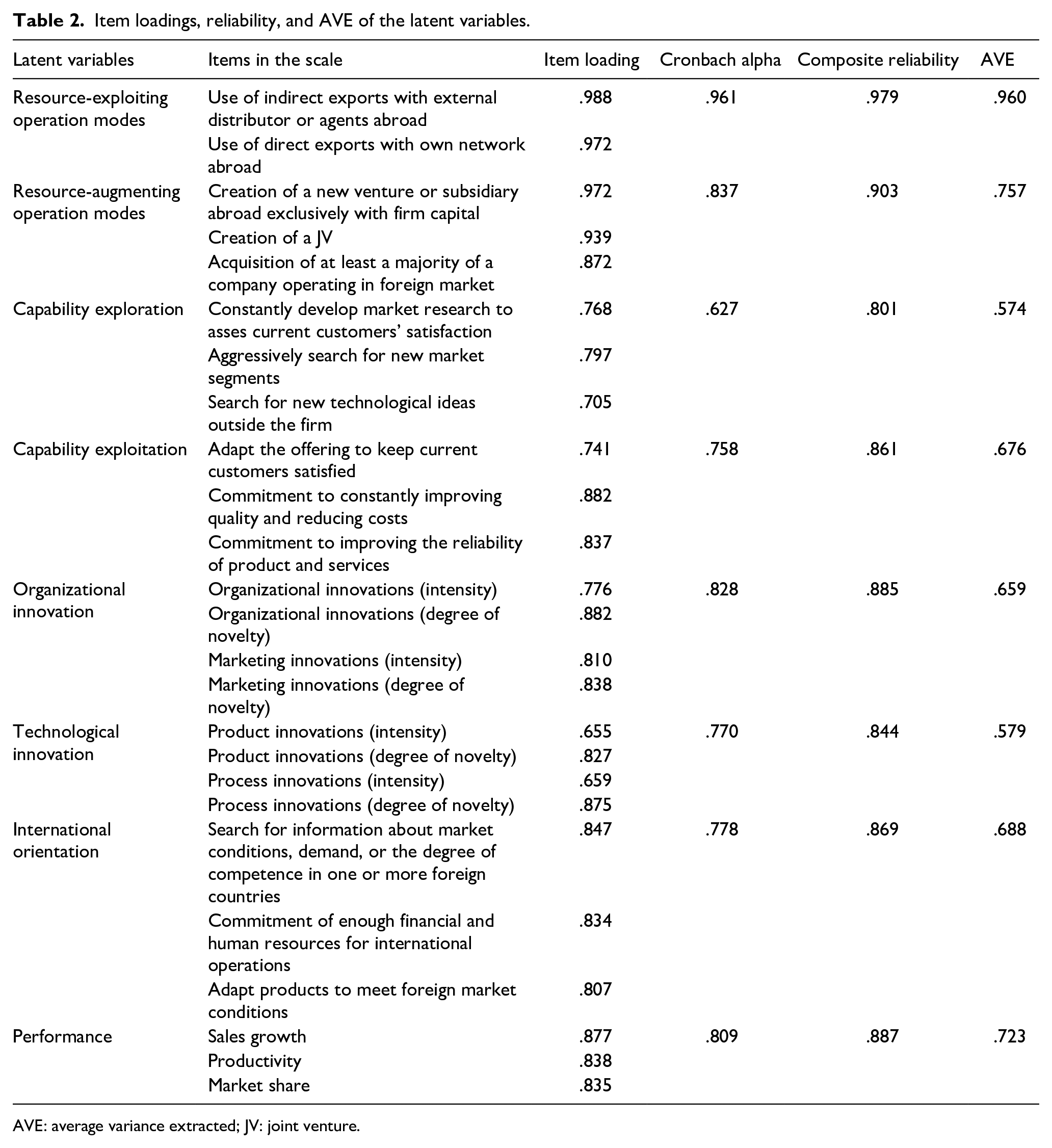
AVE: average variance extracted; JV: joint venture.
Discriminant validity.
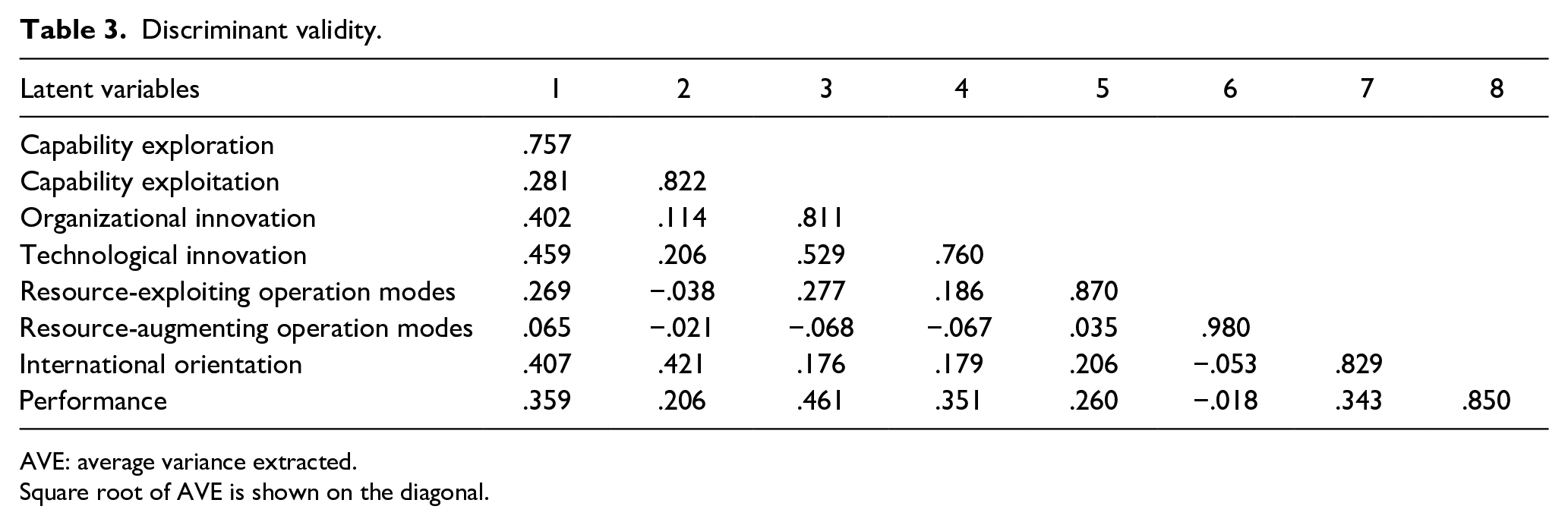
AVE: average variance extracted.
Square root of AVE is shown on the diagonal.
Structural model
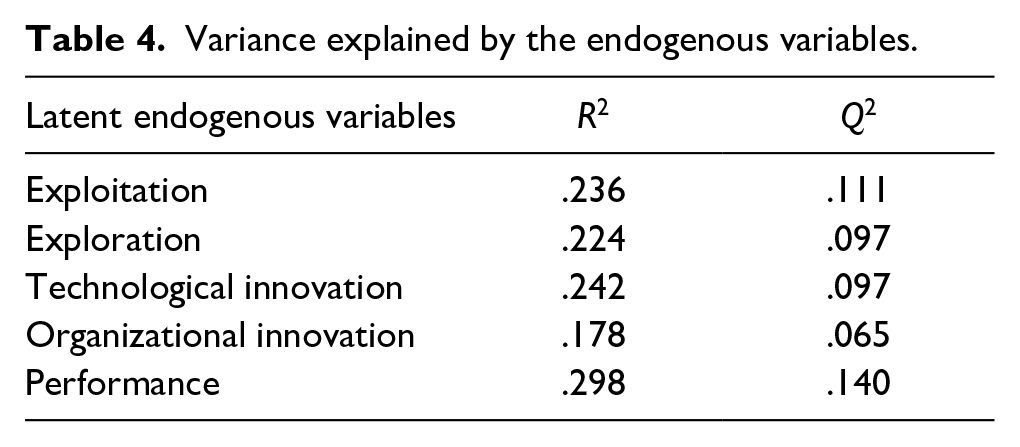
To estimate the empirical model in PLS and to obtain the t-values and their paths, we used a bootstrapped sample of 5,000 following the recommendations of Hair et al. (2012) to ensure more consistent results. To assess fit, we consider the variance explained by endogenous constructs (R2) the path coefficients (β), as well as Stone-Geisser’s indicators for assessing the predictive relevance of endogenous constructs (cross-validated redundancy). In general, all variables are indicative of moderate goodness of fit according to threshold levels indicated by Chin (1998) (see Table 4). The lowest R2 is seen for the non-tech innovation construct, but it still over the minimum standard value and in line with the average obtained in management studies. Likewise, the Q2 > 0 condition is met. In other words, the model has predictive relevance.
Variance explained by the endogenous variables.
Test of the direct hypotheses (Hypotheses 1 and 2)
To test the direct paths proposed in Hypotheses 1 and 2, we checked the results of the bootstrapping procedure. We first checked the weight of the standardized path coefficients (β), which should be higher than .2 to at least explain 1.5% of the variance. After examining the proposed relationships, we cannot accept H1, as we do not find a significant relationship between resource-exploiting entry modes and capability exploitation, or between capability exploitation and technological innovation or firm performance. However, H2, which connects resource-augmenting operation modes, organizational innovation, and performance, is supported by the empirical results. This suggests that organizational innovation actually enhances organizational performance. We did not explicitly develop a hypothesis on the effect of international orientation on performance, as its positive role has been widely analyzed in the literature. Nevertheless, we find a significant relationship (.2495; t-value 2.5636).
With regard to the control variables, firm size did not account for the variance in any of the previous variables. International experience was significant for capability exploitation but not for capability exploration. We also accounted for location within a cluster, but this variable was not significant in any case. A summary of the results is provided in Table 5.
Results of the test of direct hypotheses.
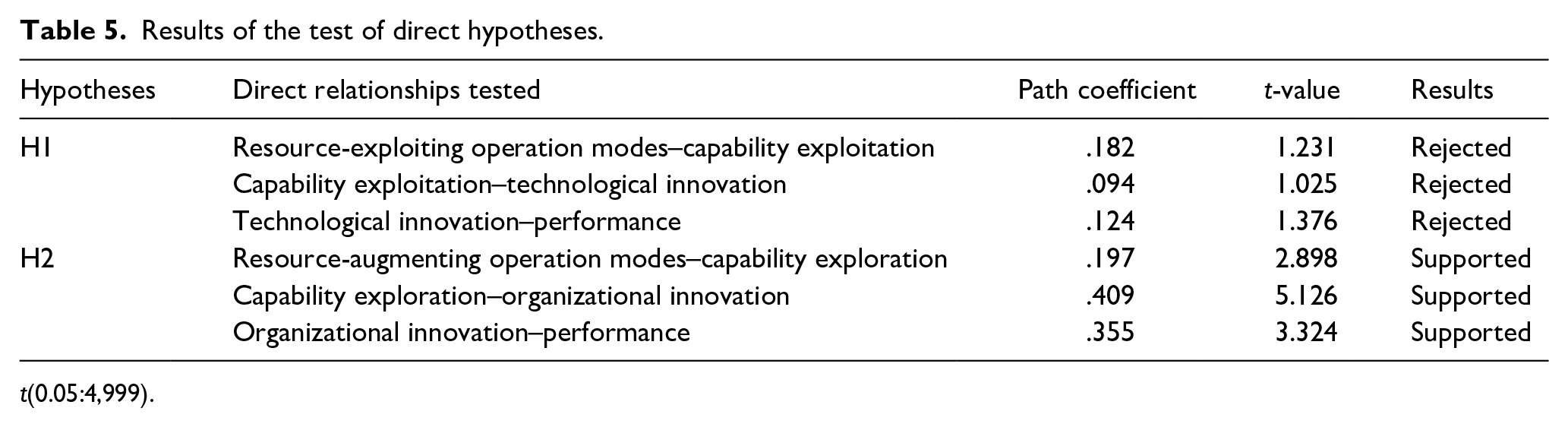
t(0.05:4,999).
Test of the mediation hypotheses (Hypotheses 3a and 3b)
Given the lack of strong empirical evidence, we were guided by the theoretical basis in proposing two mediation hypotheses with the aim of deepening our understanding of the different alternatives available to firms. To test the mediation hypotheses, we followed the approach developed by Preacher and Hayes (2004, 2008). We first calculated the path of the indirect effects, which is required to test for the existence of mediation and assess the size of the mediation effect. We bootstrapped 5,000 subsamples and calculated the product of the paths a*b for H3a (international orientation–exploitation and exploitation–technological innovation) and H3b (international orientation–exploration and exploration–organizational innovation). We then estimated the significance using the percentile approach (i.e., lower and upper confidence intervals from the bootstrapping), in which an indirect effect is significant when the interval [.025, .975] does not contain the value 0. Table 6 displays the results for the tests of these two hypotheses. The results for H3a indicate a non-significant indirect effect, as the confidence intervals contain 0 [−.0603531, .1482151]. We therefore reject H3a.
Test of mediation hypotheses.
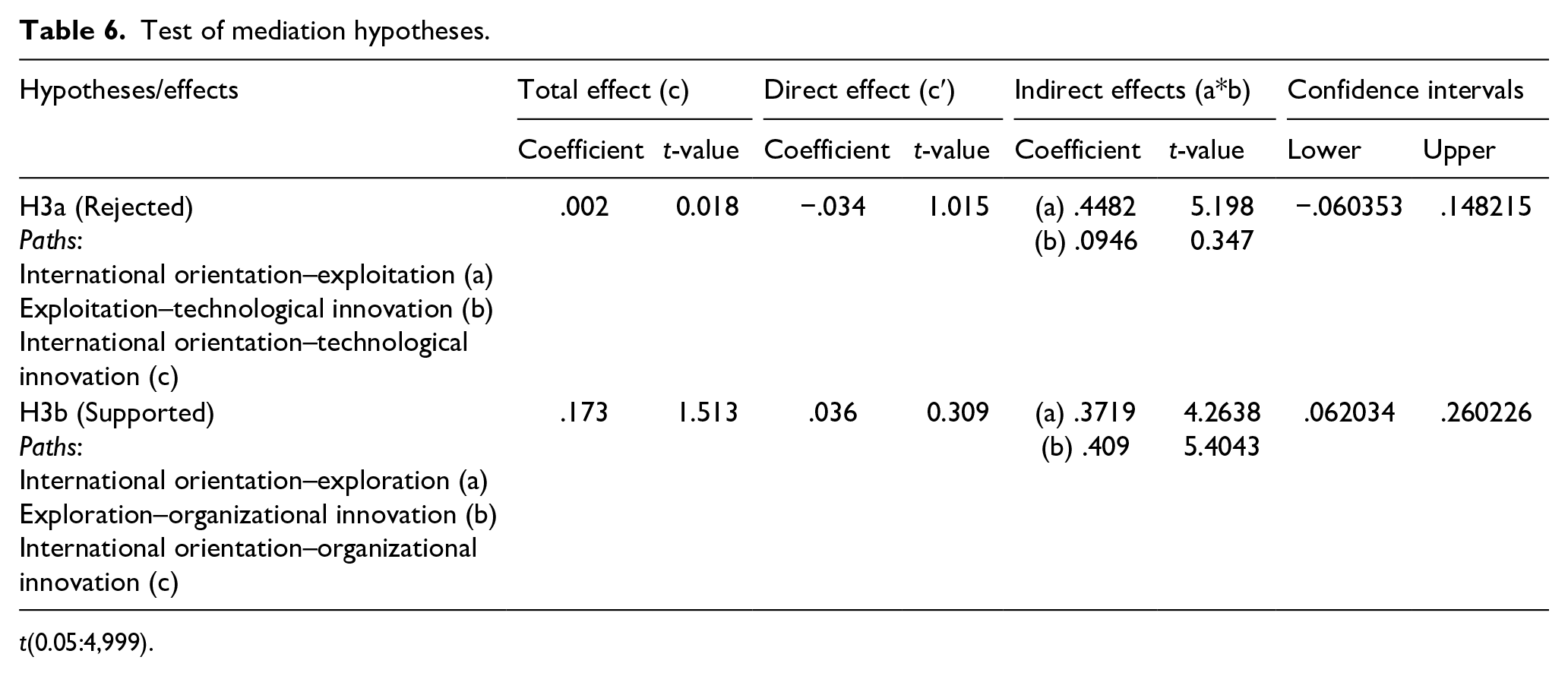
t(0.05:4,999).
We then tested H3b, which proposes the alternative mediation effect, following the same approach with 5,000 resamplings. The results show a significant indirect effect, being the path a*b (international orientation–exploration–organizational innovation) different from 0. For the bootstrapped product of these paths, the lower and upper confidence intervals do not contain 0 [.06203415, .26022640]. For a confidence level of 95%, we could not reject the alternative hypothesis that the mediating effect is null. Therefore, this indicates that capability exploration has a mediating effect on the relationship between international orientation and organizational innovation, which supports H3b. Given that the indirect effect a*b is significant and that the direct effect when including the mediator variable is not significant, we can consider this as a full mediation (i.e., only an indirect effect; Zhao et al., 2010). Notably, according to Preacher and Hayes (2008), the fact that the total effect is significant is not a necessary condition. The test must be addressed along the individual paths by testing the indirect effects in a single model that includes all of the variables (Nitzl et al., 2016; Zhao et al., 2010).
Finally, in order to further test the robustness of our model, we ran it with technological and organizational innovation as the dependent variables. In other words, we tested a reversed model. The results displayed organizational innovation–exploration as a significant link, where any of the operation modes affected performance in turn. This suggests that although innovation activity may be important for foreign operations, it actually affects performance through the other path (i.e., through the learning accumulated while operating with resource-augmenting modes).
Discussion
In this article, we have addressed the question of how learning about foreign markets can affect a company’s performance. From a conceptual angle, the extant literature suggests that dynamic capabilities support different internationalization processes (Luo, 2002; Prange & Verdier, 2011; Riviere & Suder, 2016). Our results provide new insights into the opposite relationship—the ways in which foreign operation modes can expand capabilities and resources. When applied deliberately to the proper innovation missions, these capabilities and resources can foster organizational performance in SMEs.
According to our findings, firms using the resource-exploiting operation path cannot benefit from capability development to the same extent as firms following the resource-augmenting path, as the two paths do not lead to equal performance. This can be explained by the fact that although exporting enables organizations to place products outside their domestic markets, some modes (e.g., indirect exporting) do not enhance current capabilities. In the worst cases, distributors impose their conditions on the transaction, as they possess the contacts, networks, and knowledge about consumer tastes and market structure. In fact, they can hinder market-specific learning prospects. Unfortunately, this is a recurrent problem for SMEs given their risk preferences. Moreover, a focus on cost minimization might inhibit learning about foreign conditions.
Our results also indicate that firms using the resource-augmenting path make more intense use of capability exploration but not capability exploitation, such that these firms mainly focus on the search for and development of, for instance, new customer or product segments. This, in turn, leads to better performance. Organizational innovation advances the needs of markets and makes it more difficult to imitate the value offered to customers (Doran, 2012). Therefore, allocating resources to organizational innovations would be one direct way to improve performance. In our view, this is the result of the effort needed to adapt commercialization and management practices at a time when the ability to reconfigure business models is crucial for differentiation. When firms invest in foreign countries and are, therefore, exposed to different institutional and cultural factors, they can develop and exploit specific market knowledge to adapt their products. However, the main change will come from the adaptation of management and commercialization systems. Hence, organizational innovation becomes more important for sustaining long-term competitiveness.
Conversely, the relation between technological innovation and performance on the exploitation path does not seem to lead to improved performance. Nonetheless, we believe that this strategy offers a “basic position” for surviving with minimal risk in the global arena. A similar argument can be made for exporting. While our results provide evidence on the benefits of resource-augmenting entry modes, firms deciding to export and commit fewer resources to foreign markets (and, thereby, face fewer risks) can still compete.
Concluding remarks
We believe our research contributes to the academic literature in several ways. The relationship between innovation and internationalization is an area of increasing academic interest, but the empirical evidence on the underlying learning mechanisms connecting these two areas remains limited. Furthermore, much of the extant literature focuses on innovation and its influence on internationalization, while the impact of learning from internationalization on innovation is still mainly limited to learning from exporting effects or from secondary databases (Araújo & Salerno, 2015; Golovko & Valentini, 2014; Thakur-Wernz et al., 2019; Wu et al., 2016). This might restrict the adoption of a dynamic capability approach and, thereby, simplify the richness and complexity of these decisions. In this article, we have offered a more comprehensive view on the impact of international operation modes as an input for innovation using firm-level data. That innovation, in turn, influences organizational performance.
In addition, the related literature points to numerous ways of measuring primary and secondary innovation. In this article, we aimed to provide a global measure of innovation that was empirically valid. This measure includes not only all recent types of innovation but also their degrees of novelty. As our results show, we find significant differences when we extend the analysis beyond classical product and process innovation.
All in all, several conclusions can be made on the basis of our findings. If a firm’s main objective is to improve performance, it would be well served to adopt resource-augmenting operation modes aimed at affecting organizational innovation. Exposure to different local conditions triggers a need to reconfigure, experiment with, and uncover resources for new customer segments and products. These resources differ from the extant knowledge base. A second mechanism is also needed, as posited in the mediation hypotheses: the international orientation (i.e., the specific resources devoted to foreign markets) must be addressed to ensure exploration.
Learning from various operation modes helps in the allocation and concentration of resources in exploitation or exploration activities, with different effects on performance. Our consideration of operation modes as a decision that can affect the development of organizational capabilities through learning allows us to connect recent lines of research. By including only exporting modes and FDI, we have provided an updated view on the international strategies adopted by contemporary firms, which are increasingly based on the use of diverse entry modes.
In addition, we provide empirical evidence on the impacts of exploitation and exploration on internationalization and innovation. The dynamic capabilities literature is essentially in a theoretical stage, especially with regard to internationalization processes (Prange & Verdier, 2011; Riviere & Suder, 2016). Therefore, this study contributes to the international ambidexterity literature. A related theoretical contribution rests in our examination of the heterogeneity of firms’ resource-allocation choices—innovation and performance are the result of the amount of resources a firm has available as well as the allocation of those resources.
In our view, the testing of this novel framework in traditional manufacturing sectors leads to some interesting conclusions with relevance for managers. The study stresses the importance of utilizing more sophisticated operation modes and organizational innovations to enhance a firm’s knowledge base and to foster new models relevant for competing at the international level. In this regard, we illustrate how resource-augmenting operation modes and non-technological innovation arise as the hallmarks of superior performance. Our results contrast with the traditional perspective in these sectors, which can be extended to SMEs facing similar conditions and limitations. The reactive tendencies of these firms to export in similar markets and to make minimal investments in new product and process innovations may ensure a basic competitive position but will not enhance performance over time.
This study also offers some interesting results regarding structural variables, which are frequently tested in this type of research. Our findings suggest that the classical path followed by traditional manufacturing firms does not significantly affect performance regardless of firm size, location in a cluster, or international experience. Even if these organizations have obvious resource limitations, our analysis indicates that success is possible. As such, a proactive attitude can be more important than restrictions arising from organizational structures.
Naturally, this study is not free from limitations. Some of them arise from the assumptions needed to depict the contrary process with little evidence when the archetypal sequence is capabilities–innovation–internationalization. In order to avoid overlapping and tautological relations, we had to simplify the starting point as a plain setting of different operation modes already in use. Consequently, we disregarded the capabilities that may have led firms to that point. However, we do not deny the existence of former conditions—even if international experience was not significant or other capabilities were not included, the firms in our study probably invested in improving their products and processes before going international.
Moreover, the choice of sectors might affect our ability to generalize our results. Although we control for location within a cluster, the results could differ in other regions or sectors. Finally, in order to simplify our model, we did not explicitly analyze paths with combinations of operation modes or combinations of types of innovation. In other words, there is some potential for synergistic effects between resource-exploiting and resource-exploring operation modes, and between technological and organizational innovation. Analyses of these possible relationships could be interesting in the context of location- and non-location-bound knowledge arising from operation modes that lead to superior stages or learning.
Footnotes
Declaration of conflicting interests
The author(s) declared no potential conflicts of interest with respect to the research, authorship, and/or publication of this article.
Funding
The author(s) disclosed receipt of the following financial support for the research, authorship, and/or publication of this article: The authors are grateful for the financial support received from the Ministry of Economy, Industry and Competitiveness (ECO201785456R) and Valencian Government (GV/2017/155).