




Abstract
From a contingency view, we aim to contribute to a better understanding of how exploitation and exploration influence performance. By conducting a meta-analysis, we aim to answer the following research question: How do substantive moderators (slack resources, organizational structure, inter-organizational relationships, competitive intensity, and environmental dynamism), extrinsic moderators (region, size, and sector) and methodological moderators (data sources and performance measurement) affect the impact of exploitation and exploration on performance? The results of the meta-analysis, including 328 correlations, 102 studies, and a sample of 41,298 cases, suggest that the influence of exploitation and exploration on performance depends on the presence of the moderating factors included in our analysis. Furthermore, some of these factors are relevant for explaining a better performance of exploitation versus exploration, while other moderators do not determine a different effect of exploitation and exploration on performance.
JEL CLASSIFICATION
M10; M19; O3
Introduction
The concepts of exploitation and exploration proposed by March (1991) have become a referential framework to explain organizational performance (e.g., Belderbos et al., 2010; Bierly & Daly, 2007; Hsu et al., 2013; Marín-Idárraga et al., 2016; Ojha et al., 2018; Yuen et al., 2019). Whereas exploitation is the refinement of current competencies by means of “choice, production, efficiency, selection, implementation and execution,” exploration implies experimenting with new alternatives, which involves “search, variation, risks taking, experimentation, flexibility and discovery” (March, 1991, p. 71).
As exploitation and exploration compete for scarce resources, firms have to make explicit or implicit choices between one or the other (Li & Wang, 2019; March, 1991). As a result, some scholars state that exploitation and exploration, as well as the practices, processes, and forms that support them, tend to be incompatible and mutually exclusive, in line with the paradox of stability and change traditionally addressed in administration research (Farjoun, 2010). From this view, firms may fall for some sort of myopia when they must sacrifice the short term for the long term or vice versa regarding the expected benefits. These decisions imply that exploitation and exploration represent substitute strategies and entail inversely correlated associations, which indicates that the more exploitation there is, the less exploration, and vice versa (Bierly & Daly, 2007; Li et al., 2010), where the privilege toward one produces a neglect of the other (Adler et al., 2009; Levinthal & March, 1993; Turner et al., 2013).
The perspectives that analyze and establish exploration and exploitation competencies as contrary or substitutes, ignore the value of organizational learning and the synergies that knowledge produces on performance (Bierly & Daly, 2007). Therefore, as an alternative to the optics of the exchanges between exploitation and exploration, an extensive line of research emerges that has shown the complementary nature between them (Knott, 2002). The studies in this line of research propose the thesis of the complementary balance between exploitation and exploration as a condition either of simultaneity (ambidexterity) or of separation in the form of a successive cycle, where according to environmental and organizational circumstances, both logics can coexist or be alternating and recursive in the search to improve organizational performance (Gilsing & Nooteboom, 2006; Lewin et al., 1999; Piao, 2014). These opposite views about how exploitation and exploration must be managed (separately or simultaneously) have undermined the clarity concerning the influence of each of them on organizational performance. Conversely, some researchers have questioned these assumptions and argue that exploitation and exploration may be complementary competences and that their balance may drive a greater organizational performance (e.g., Centobelli et al., 2019; Gibson & Birkinshaw, 2004; Jansen et al., 2012; Junni et al., 2013; Kauppila, 2010; Luger et al., 2018; Simsek et al., 2009; Solís-Molina et al., 2018).
Another reason may have contributed to this lack of an accurate picture of how exploitation and exploration could improve performance. As Benner and Tushman (2003) and Auh and Menguc (2005) have claimed, a contingency approach is being extensively applied in the research on organizational learning in an attempt to understand under which conditions exploitation and exploration have a greater effect on performance. As manifested by He and Wong (2004), “studies have shown that exploration and exploitation require substantially different structures, processes, strategies, capabilities, and cultures to pursue and may have different impacts on firm adaptation and performance” (p. 481). Consequently, a considerable number of moderating variables have been brought to study this phenomenon, both referring to industry-level factors and firm-specific moderators (Heirati et al., 2017; Li & Wang, 2019; Mueller et al., 2013; Pertusa-Ortega & Molina-Azorín, 2018). This, together with the variety of methods used, the geographical contexts, and the industries analyzed, has meant that after almost three decades since the proposal of James March, research on exploitation and exploration has not yet determined which of them, under a number of internal and contextual factors, may have a bigger impact on performance. Although some meta-analytical studies in the field have shown the moderating effect of different variables (Fourné et al., 2019; Mueller et al., 2013), there are still other unanalyzed conditions and variables that can help to better understand the effect of exploration and exploitation on performance.
In line with those discussed by Guisado-González et al. (2019), who identified research that has not yet shown conclusive results (exploitation and exploration as complementary, substitute, and independent), we conclude that it is not yet clear how performance behaves in the presence of exploitation and exploration, since we consider that there are various conditions that affect the decisions of its substitutability or complementarity. Even among scholars who recognize them as complementary, it is not yet clear whether they balance cyclically–alternately or simultaneously. Therefore, regarding performance, we observe that the impact it receives from exploitation and exploration changes in the presence of different contingency factors that moderate the relationship. Performance here is understood as organizational effectiveness in terms of financial results (ROE, ROA, and ROS) and market results (sales growth ratio, market share, and Tobin’s Q), evaluated both objectively and subjectively (Venkatraman & Ramanujam, 1986, 1987).
The previous review constitutes the gap that inspired our study, carried out through a meta-analysis that is an ideal technique to clarify divergences or controversies in a particular theoretical field (Borenstein et al., 2009; Card, 2011). Therefore, we pose the following research question: How do different moderators affect the impact that exploitation and exploration have on performance? In a meta-analysis, different types of moderators can be identified: substantive, extrinsic, and methodological (Borenstein et al., 2009; Lipsey & Wilson, 2001). Given that the answer to the question requires a contingency, more than a universalistic approach, we propose the analysis of substantive moderators (slack resources, organizational structure, inter-organizational relationships, competitive intensity, and environmental dynamism), extrinsic moderators (region, size, and sector) and methodological moderators (data sources and performance measurement). Furthermore, we separately analyze the effect of each moderating factor on the relationship between exploitation and performance and between exploration and performance, since the complementary integration (alternating or ambidextrous) does not allow to identify these effects independently, which is the main objective of this study.
In this way, our research aims to provide a comprehensive view of the findings from the organizational adaptation theory and improves the understanding of how exploitation and exploration influence performance. 1 Our meta-analysis has an important contribution: it shows that to improve performance, decisions regarding investment in exploitative and exploratory activities are influenced by different contingency factors, so that slack and environmental dynamism can favor application balanced on exploitation and exploration, instead of the type of organizational structure and inter-organizational relationships leading to privilege the substitutability between exploitation and exploration. Furthermore, when competitive intensity increases, companies decrease their exploitative and exploratory activities. Likewise, an additional contribution of our meta-analysis is that it demonstrates that the region where a study is carried out, the size of the companies, the technology sector, and the ways in which the data are obtained and performance is measured, affect the influence that exploitation and exploration have on performance, such that the effect is stronger in studies carried out in the West, in large companies in the high-tech sector, and in the measurement of variables by surveys.
The article is divided into seven sections. In the second section, we address the theoretical approach to the concepts of exploitation and exploration. In the third section, we propose our hypotheses related to the moderator variables that could explain the different effects on performance. In the fourth section, the meta-analysis and the method developed are explained. The results are described in the fifth section. In the sixth section, we address the discussion of the results as well as the main conclusions of our research. Finally, the limitations and possible future research lines are presented.
Theoretical framework
Figure 1 illustrates the conceptual model.
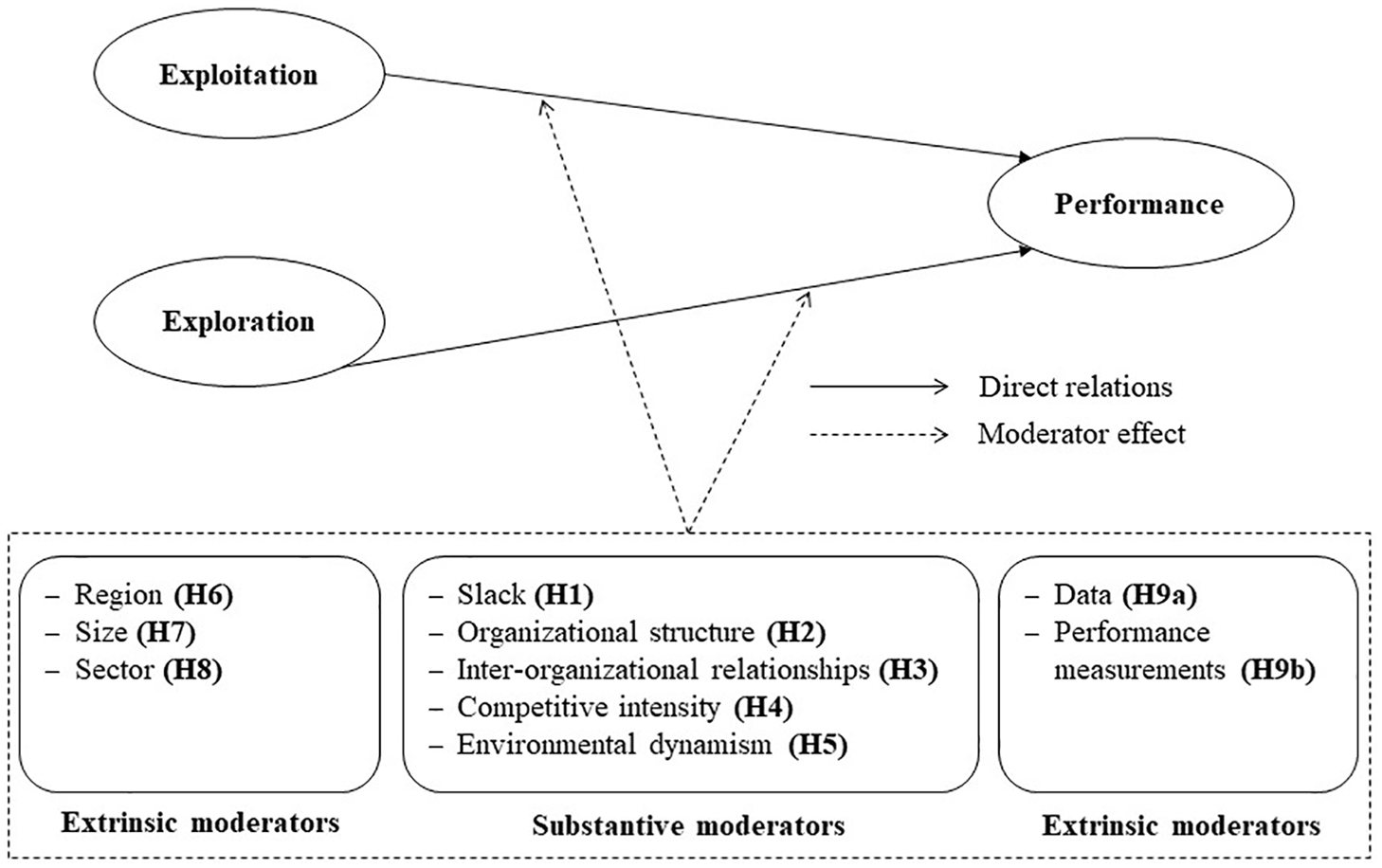
The conceptual model.
Exploitation and exploration
The initial conception of March (1991) and Levinthal and March (1993) represented an important challenge for subsequent research in the field of organizational adaptation, consisting of solving the paradox that implies focusing either on exploitation or exploration (Atuahene-Gima, 2005; Lin et al., 2013). Given that organizational resources are scarce, the underlying question is how to combine exploitation and exploration without affecting performance (Lee & Huang, 2012). For this reason, companies have to choose to invest either in the refinement and extension of existing knowledge, skills, and processes, or in the acquisition of new knowledge, skills, and processes (Chu et al., 2011; Katila & Chen, 2008). The need to choose forces companies to apply exploitation and exploration in a substitute or complementary way according to their needs (Gupta et al., 2006).
Determining whether exploitation and exploration are substitute or complementary capabilities has been one of the main research questions in this field (Andriopoulos & Lewis, 2009; Bierly & Daly, 2007; Knott, 2002; Lavie et al., 2010; Simsek, 2009; Stettner et al., 2014; Turner et al., 2013). The empirical studies that have analyzed the relationship between both have shown contradictory results. As stated by Su et al. (2011), “although the significant performance implications of exploratory learning and exploitative learning have been well documented, the issue of whether they are complementarities or substitutes still remains a puzzle” (p. 697).
Some works have demonstrated a negative and significant relationship (Beckman, 2006; Chu et al., 2011; Kim et al., 2012; Nerkar, 2003; Voss et al., 2008), supporting the argument that, due to their limited resources, firms have to decide between exploiting and exploring. This is why these competences end up as being exclusive or substitutable (Atuahene-Gima & Murray, 2007; Kim et al., 2014; Li et al., 2010; March, 1991). Such results reinforce the idea of a certain tension between exploitation and exploration and show that some companies make discrete choices depending on the availability of resources or organizational and environmental conditions (Atuahene-Gima, 2005; Gupta et al., 2006; Lavie et al., 2010).
A second and broader group of works has shown a positive relationship between exploitation and exploration (e.g., Auh & Menguc, 2005; Bierly et al., 2009; Clausen et al., 2013; Fang et al., 2012; Im & Rai, 2008; Li & Huang, 2013; Rothaermel & Deeds, 2004), suggesting that firms can balance both of them. That is, they take advantage of stored knowledge and foster continuous improvements to achieve short-term performance and, at the same time, can develop new knowledge and technologies to improve their long-term performance (Benner & Tushman, 2003; Bierly et al., 2009; Lavie et al., 2011; Li et al., 2008). This balance represents the complementarity between exploitation and exploration (Bierly & Daly, 2007; Knott, 2002). Achieving this balance is not an easy task (Adler et al., 2009; Farjoun, 2010), so the literature has proposed various solutions, which are summarized in two perspectives. The first involves its separate application, either structurally, temporally, or contextually, as a continuous cycle, known as balance by separation. The second implies its simultaneous application, known as ambidexterity (O’Reilly & Tushman, 2013; Simsek, 2009). Organizational ambidexterity has been analyzed in theoretical and empirical research to refer to an organization’s ability to simultaneously exploit and explore (Andriopoulos & Lewis, 2009; Birkinshaw & Gupta, 2013; Simsek, 2009). Ambidextrous companies are therefore those capable of efficiently exploiting current capabilities and exploring new skills with the same degree of skill (Benner & Tushman, 2003; He & Wong, 2004).
Although exploitation, based on the use of local knowledge, and exploration, through the external search for new knowledge, may separately favor organizational results (Holmqvist, 2004; Nerkar, 2003), the research suggests that the ambidextrous balance between the two produces a more significant impact on performance. In this way, adaptability in the short term can be balanced with the flexibility necessary to guarantee durability in the long term, which leads to greater performance of the organization (Cao et al., 2009; He & Wong, 2004; Lubatkin et al., 2006).
Exploitation, exploration, and performance
One of the main focuses of attention in exploitation and exploration research has been the attempt to understand and explain their effect on organizational performance (Bierly & Daly, 2007; Junni et al., 2013; Lee & Huang, 2012). The research on exploitation and exploration has demonstrated their positive effect on performance either in a substitute or complementary way. Morgan and Berthon (2008) and McDermott and Prajogo (2012) found that there is a positive influence of exploitative and exploratory innovation on performance, and Li et al. (2011) establish that both the long-term development, enabled by exploration, and the short-term productivity, provided by exploitation, are essential determinants of performance and the firm’s sustainability. Other works have tackled the analysis of these relationships from a more contingency-based perspective. For example, Menguc and Auh (2010) demonstrated that exploratory actions improve performance when firms follow an “exploratory” strategy, while exploitative actions improve performance in firms with a “defensive” strategy. Moreover, exploitation and exploration may influence different types of performance. In this sense, the research of Sanders (2008), about different patterns of the use of information technologies, illustrates that the exploitative pattern enhances operational benefits, while the explorative pattern improves strategic benefits. 2 Belderbos et al. (2010) established that the exchange of exploratory technological activities between the partners of a collaboration network bring about positive effects on financial performance, and Yuen et al. (2019) demonstrated that “organisational slack and environmental uncertainty negatively moderate the relationship between sustainable exploitation capability and business performance but positively moderate the relationship between sustainable exploration capability and business performance” (p. 90).
The variability of the results in the vast amount of research on exploitation and exploration and their effect (either separately or jointly) on performance is mainly explained by a number of contextual factors determining the intensity and sign of this relationship (He & Wong, 2004; Lavie et al., 2010). In the following sections, we discuss the main internal and contextual factors that can help to better understand and synthesize the findings of the research on exploitation, exploration, and performance.
Hypotheses development
There are different moderators that may explain the differences in the impact on performance of exploitation and exploration. A moderator is a qualitative or quantitative variable that affects the relationship between an independent and a dependent variable and, consequently, becomes a source of heterogeneity in the results of studies that analyze a hypothesized relationship (Borenstein et al., 2009). Given that meta-analysis verifies the existence of heterogeneity in studies, it becomes a useful method to identify which moderating variables are causing such variability. In this sense, in the management field, several studies using meta-analysis have analyzed the effects of previously established moderator factors (Bowen et al., 2010; Guerrero-Villegas et al., 2018; Pérez-Calero et al., 2019; Rosenbusch et al., 2011).
In a meta-analysis, different types of moderators can be identified, as they affect the results of the studies: substantive, extrinsic, and methodological (Borenstein et al., 2009; Lipsey & Wilson, 2001). The substantive moderators can be considered as the most relevant and refer to other variables included in the studies, forming part of the hypotheses or developed theories. Although we acknowledge that the spectrum of moderators to consider is broad, following the same procedure as Lee and Madhavan (2010), we identified from the theoretical literature the substantive moderators that could affect the relationship of exploitation and exploration with performance producing heterogeneity, and then we selected those factors that had greater presence in the studies included in our meta-analysis. Thus, the variables slack resources, organizational structure, inter-organizational relations, competitive intensity, and environmental dynamism are considered as substantive moderators. For extrinsic and methodological moderators, we included those that are generally suggested by the meta-analytical literature and that are the most frequently evaluated in the field of management and business to explain heterogeneity (Camisón-Zornoza et al., 2004; Kirca et al., 2005; Lee & Xia, 2006). The extrinsic moderators are exogenous conditions to the analyzed relationship that could affect the strength and direction of this relationship. In the present investigation, the region, as well as the size and sector of the companies, are proposed as extrinsic moderators. Finally, the methodological moderators refer to the methods of obtaining and operationalizing the variables in the studies considered, which can also be a source of heterogeneity in their results. As methodological moderators, we propose the way to obtain the data and the type of measurement of the dependent variable.
Substantive moderators
Organizational slack
Although the organizational slack evidences multiple conceptions (Bourgeois, 1981), in the present study we take the definition of Nohria and Gulati (1996) for its simplicity and clarity: “We define slack as the pool of resources in an organisation that is in excess of the minimum necessary to produce a given level of organisational output” (p. 1,246).
Some works show that when slack exists (operational, financial, or related to human resources), firms that develop activities of exploitation achieve a higher performance (Greve, 2007; Levinthal & March, 1993; Voss et al., 2008). Other studies indicate that slack also facilitates searching and experimenting and, in this context, the activities of exploration may achieve their goals more effectively and improve performance (Katila & Shane, 2005; Lavie et al., 2010; Sidhu et al., 2004). Finally, some research concludes that slack promotes balance in the allocation of resources to promote both exploitation and exploration activities and, therefore, guarantees a better performance (Geiger & Makri, 2006; Huang & Li, 2012).
Consequently, we propose the following hypothesis:
H1. Organizational slack positively moderates the influence of (a) exploitation on performance and (b) exploration on performance.
Organizational structure
Organizational structure is defined as the way in which work is divided and its later coordination is carried out (Mintzberg, 1979). Overall, organizational theory classifies organizational structures into mechanistic and organic. Mechanistic structures have a high formalization, a high centralization, and narrow spans of authority. Organic structures are characterized by a low formalization, a greater decentralization, and broader spans of authority (Burns & Stalker, 1961; McCaskey, 1974).
On the whole, mechanistic structures favor exploitation and complicate exploration (He & Wong, 2004; Lavie et al., 2010). The very centralization and formalization of mechanistic structures hinder the activities of exploration by inhibiting the search for new knowledge and alternative solutions to non-routine problems, which would require an organic structure. On the contrary, this formalization and standardization facilitate exploitation and the incremental improvement in processes and products (Jansen et al., 2006; Lavie et al., 2010). The benefits of the fit between the type of structure and exploitation and exploration activities have been demonstrated by Raisch (2008) and Zhang et al. (2012), among others.
We therefore present the following hypothesis:
H2. The mechanistic organizational structure moderates (a) the influence of exploitation on performance positively and (b) the influence of exploration on performance negatively.
Inter-organizational relationships
Through inter-organizational relationships, firms build collaborative network in terms of the complementarity of resources, reciprocal agreements, and strategic negotiations in which organizations autonomously create collective interdependences (Oliver, 1990). These are articulated via alliances and cooperation agreements which facilitate the exploitation and generation of knowledge (Holmqvist, 2004; Lavie & Rosenkopf, 2005; Phelps, 2010).
The research has shown conflicting results under different contingency conditions. For example, Guisado-González et al. (2019) showed that innovative performance, due to exploitation or exploration alliances, depends on the age of the company. They found a substitute relationship in which young companies achieve higher innovative performance when they implement only exploration-oriented alliances, and they affect their innovative performance by implementing exploitation-oriented alliances. Regarding collaborative agreements with large companies, Yang et al. (2014) found that, in general, small companies obtain greater benefits with exploitation alliances than with exploration alliances.
On the whole, inter-organizational relationships are a source of opportunities for both exploitation and exploration (Koza & Lewin, 1998) and create a context where the two of them may better contribute to performance. On one hand, by means of inter-organizational relationships, firms can rapidly access resources and capabilities that increase their local learning and help to improve their current technologies and processes (Hoang & Rothaermel, 2010; Nooteboom et al., 2007; Rothaermel, 2001; H. Yang et al., 2014). On the other hand, inter-organizational relationships represent a suitable context for exploration as reaching out to new partners becomes a promising way of exploring new opportunities (Lavie et al., 2011; Phelps, 2010; Rosenkopf & Nerkar, 2001; Rothaermel & Deeds, 2004).
In this sense, the following hypothesis is proposed:
H3. Inter-organizational relationships positively moderate the influence of (a) exploitation on performance and (b) exploration on performance.
Competitive intensity
Competitive intensity represents the degree of competition that a firm faces in the market where it operates. It is considered to be one of the main threats to the organization (De Clercq et al., 2014) and an important external factor that affects performance (Jaworski & Kohli, 1993; Kim & Atuahene-Gima, 2010).
When competitive intensity is high, firms experience strong pressures toward cost efficiencies and price reductions, which narrow utility margins and reduce the organizational slack (Li et al., 2010; Miller & Friesen, 1983; Zahra, 1996). In this context, exploitation may help to compete through the continuous improvement of products, services, and processes, taking advantage of the current resources and the accumulated knowledge and avoiding the costs and risks of new searches and developments. In this line, research demonstrates that when competitive intensity is high, exploitation shows a positive linear relationship with performance (Nerkar, 2003; Yang & Li, 2011).
Exploration may also help to develop new sources of competitive advantage in highly competitive contexts (Jansen et al., 2006; Lavie et al., 2010; Levinthal & March, 1993). Indeed, in such scenarios the firms should balance exploitation and exploration to avoid technological obsolescence and to proactively anticipate market changes. This would allow firms to enrich their current processes, to broaden their range of products, to improve their market position, and to obtain greater yields from their investments (Abebe & Angriawan, 2014; Auh & Menguc, 2005; Chang et al., 2011; Lumpkin & Dess, 2001).
Consequently, the following hypothesis is formulated:
H4. Competitive intensity positively moderates the influence of (a) exploitation on performance and (b) exploration on performance.
Environmental dynamism
Environmental dynamism is the degree of change and unpredictability of the environment where the firm operates (Dess & Beard, 1984; Jansen et al., 2009; Jaworski & Kohli, 1993). In a very dynamic context, different external factors (economic, social, political, etc.) concur and influence the firm performance in conditions of high uncertainty (Burton & Obel, 2004). Accelerated changes in technology, unexpected variations in customers’ preferences, unforeseeable fluctuations in the demand of products, and the supply of materials are some of the factors causing environmental dynamism (Jansen et al., 2006; Jaworski & Kohli, 1993). It represents a particular condition that pressures companies to a certain exploitative and exploratory behavior (Chang et al., 2011), giving rise to different strategic alternatives to achieve efficiency and effectiveness (Auh & Menguc, 2005; Li & Huang, 2013).
Empirical research has shown that the dynamic environment produces a moderating effect on the influence that exploitation and exploration have on performance, with results that are not yet conclusive and in some cases contradictory. For example, in their study, Bernal et al. (2019) demonstrated that technological and market evolution produces different influences on the relationship between exploitation and exploration with innovative performance; Yuen et al. (2019) found that in the face of greater environmental uncertainty, companies obtain better performance of exploratory capacity than of exploitative capacity, and Li and Wang (2019) showed that companies with a higher financial slack tend to form more exploration and less exploitation alliances, but when the environment is highly uncertain they tend to establish exploitative relationships, avoiding explorative collaborations. Other studies have found that environmental dynamism leads companies to decrease their exploitative activities, since they may face excessive routinization and inertia affecting flexibility and propensity to change (Atuahene-Gima, 2005; Chang et al., 2011; Kim & Atuahene-Gima, 2010; Wang & Li, 2008). Likewise, some studies have found that in a dynamic environment, the operational units resist the threat of obsolescence, increasing the unlearning of the routines established to obtain new knowledge (Bierly & Daly, 2007; Li et al., 2010). As Moss et al. (2014) indicated, in stable environments companies should promote greater exploitation to achieve greater efficiency, while in dynamic environments, a greater focus on exploration will be needed to promote new technologies and products. Similarly, various studies argue that the negative effect produced by exploitation on performance in dynamic environments is offset when companies develop a balanced strategy between exploitation and exploration (Jansen et al., 2012; Pertusa-Ortega & Molina-Azorín, 2018; Sarkees et al., 2010).
Finally, Jansen et al. (2006) showed that environmental dynamism positively moderates the relationship between exploratory innovation and financial performance, and negatively moderates the relationship between exploitative innovation and financial performance.
In this perspective, the following hypothesis is proposed:
H5. Environmental dynamism moderates (a) the influence of exploitation on performance negatively and (b) the influence of exploration on performance positively.
Extrinsic moderators
Region
Several works using the meta-analysis technique have shown that the region moderates the relationship between the independent variable and the firm performance (Carney et al., 2011; Hancock et al., 2013). In the field of exploitation and exploration, the region under study has proved to be a relevant factor that influences the results. For example, the study of Katila and Ahuja (2002) on the global robotic industry found that American and European firms perform more exploitation and exploration than their counterparts in Japan. Similarly, Kim et al. (2012) found that the influence of ambidexterity on the process of organizational learning is more evident in American and European firms than in Japanese firms. Thus, it may be speculated that capacities for exploitation and exploration are more effectively developed in the American and European areas than in the Asian region. In turn, this could be explained by the dynamism and rapidity of their penetration strategies in foreign markets, which allows them better absorption and development of knowledge (Hsu et al., 2013), supported by their ability to develop alliances (Rothaermel, 2001). In addition, companies with a greater capacity for global expansion are more prone to exploitation and exploration (Prange & Verdier, 2011). Therefore, the following hypothesis is postulated:
H6: The region in which the study was conducted moderates the influence of (a) exploitation on performance and (b) exploration on performance, with the effect being stronger in western regions than in eastern regions.
Size
The size of the organization has been an important moderating variable in meta-analytic studies (Camisón-Zornoza et al., 2004; Lee & Xia, 2006). In the field of exploitation and exploration, the incidence of size has yielded ambiguous results, since it has sometimes been found that large companies are more liable to exploit–explore, while in others this situation has been more prominent in small and medium-sized enterprises (SMEs; Lavie et al., 2010; Lee & Huang, 2012; Raisch, 2008).
Although smaller companies can develop better their exploitative and exploratory skills, due to their flexibility and the absence of inertia in their processes, their scarce resources limit them in the search for opportunities (Lee & Huang, 2012). As argued by Moss et al. (2014), while it makes sense that larger companies have institutionalized norms and structural inertia that limit change, it is also true that they have a greater resource slack than small companies to correct the poor results of strategic decisions. In fact, some studies found that large companies, due to their greater resources, have a greater propensity to adopt radical or exploratory innovations (Dewar & Dutton, 1986; Ettlie & Rubenstein, 1987).
Furthermore, because of the correlation between age and size—considering that young companies tend to be smaller and mature companies tend to be larger—some authors showed that “young companies achieve better performances with the implementation of exploration-oriented alliances and mature companies with the implementation of exploitation-oriented alliances” (Guisado-González et al., 2019, p. 402).
Indeed, most studies on exploitation and exploration that include size as a control variable show that they are more common in large companies (Anand et al., 2009; Fang et al., 2012; Lubatkin et al., 2006; Sarkees et al., 2010; Zhou & Wu, 2010). For large companies it is easier to exploit and explore, since they have a greater availability of resources and better economies of scale (Cao et al., 2009; Sarkees et al., 2010). Likewise, large companies have consolidated structures, characterized by a clearly defined hierarchical and functional division that facilitates the organizational balance between exploitation and exploration, so that they can exploit in one area and explore in another (Lavie et al., 2010; Raisch et al., 2009). As indicated by Mom et al. (2007), “both exploitation and exploration concur in the organisation, but in different places in the structure” (p. 925). Moreover, research has shown that the creation of agreements for the exploration of new products and the exploitation of current markets is positively related with size, since large companies can realize vertical integration to carry out projects, involving further product and market development (Rothaermel & Deeds, 2004).
In sum, given the greater availability of resources (slack) and a more consolidated organizational structure, larger companies will be better able to exploit and explore than SMEs. It is expected, therefore, that the relationship between exploitation, exploration, and performance is significant and stronger in large companies than in SMEs, so the following hypothesis is posited:
H7: The size of the companies studied moderates the influence of (a) exploitation on performance and (b) exploration on performance, such that the effect is stronger in large companies than in SMEs.
Sector
The industry in which companies operate is an important moderator of organizational results (Camisón-Zornoza et al., 2004; Junni et al., 2013). In the field of exploitation and exploration, studies have been carried out on sectors of different technological levels, with conflicting results. For example, Beckman (2006) found that in the biomedical industry more exploration capacities are developed and that in manufacturing companies there is a greater development of exploitative actions. However, Bierly and Daly (2007) indicated that both exploitation and exploration are more evident actions in high-tech companies, since in low-tech companies customers could underestimate technological advances due to their preference toward the brand and the price.
To be successful in the market, high-tech companies must make strategic decisions that allow them to develop competitive advantages, a purpose for which the exploration of new processes/products and the exploitation of current processes/products are crucial (Chandrasekaran et al., 2012; Gedajlovic et al., 2012). Huang (2009) states that in high-tech companies the strategic renewal of their competitive capabilities stems from confronting inertia and disruption by exploiting existing knowledge and exploring new ways of learning. For example, in the bio-pharmaceutical industry, firms have shown profound changes as a result of the continuous discovery cycle between exploitation and exploration (Gilsing & Nooteboom, 2006). High-tech companies are more likely to make strategic alliances, both through exploration agreements that allow them to develop new products and exploitation agreements that favor the development of their markets (Rothaermel & Deeds, 2004).
In sum, both exploitation and exploration are more evident in high-tech companies, since in low-tech companies the customers could underestimate technological advances in exchange for their preference toward the brand and the price (Bierly & Daly, 2007). Thus, in low-tech firms, incentives to invest in exploitative and exploratory activities will be lower.
In view of this, it is expected that the relationship between exploitation and exploration with performance will be significant and stronger in the high technology sector (e.g., biomedical, microcomputer) than in other, low-technology sectors (e.g., manufacturing and services), so the following hypothesis is put forward:
H8: The sector in which the study was conducted moderates the influence of (a) exploitation on performance and (b) exploration on performance, such that the effect is stronger in the high-tech sector than in the low-technology sector.
Methodological moderators
Ways of obtaining data
Several meta-analytical studies in the organizational field have considered that the relationships analyzed are moderated by the way the data were obtained (Camisón-Zornoza et al., 2004; Junni et al., 2013). For example, the meta-analysis carried out by Van Wijk et al. (2008) included, as a moderating factor, the way of capturing data (primary vs. secondary data). They found that the effect size was greater in the studies based on surveys.
Studies analyzing the relationship between exploitation, exploration, and performance have used different ways of obtaining data, specifically (a) questionnaires (e.g., Atuahene-Gima, 2005; Bierly & Daly, 2007; Chang et al., 2011; Sirén et al., 2012; Zhan & Chen, 2013), (b) databases (e.g., Anand et al., 2009; Belderbos et al., 2010; Kim et al., 2014; W. Li & Wang, 2019; Schultz et al., 2013; Solís-Molina et al., 2018), and (c) a combination of primary and secondary data (e.g., Calantone & Rubera, 2012; Fernhaber & Patel, 2012; Jansen et al., 2012; Patel et al., 2012; Shirokova et al., 2013; Vorhies et al., 2011). Different ways of gathering data can lead to random errors that cause heterogeneity in the results. As indicated by Van Wijk et al. (2008), the operationalization of the variables can affect the real correlations.
In this research, we assume that questionnaires may provide more precise information about exploitation and exploration, since they are specially designed to measure the variables under analysis (this allows a closer assessment of the facts and behaviors). Furthermore, such precision occurs since in general the scales used in the studies tend to be similar, which was verified by Nicolau-Juliá et al. (2015), who found that the exploitation and exploration measures are equally valid in low-technology sectors as in the medium and high technology.
On the contrary, secondary data implies the use of databases that were designed for other purposes, which reduces the accuracy of information about the variables under study. For this reason, it is expected that the relationship between exploitation and exploration on performance will be significant and stronger when the information is obtained with primary data compared with that obtained with secondary or mixed data.
Performance measurements
Performance has represented one of the most representative variables in the research agendas of strategic management. Although performance can have different semantic connotations, it is generally defined as the scope of organizational effectiveness. This has been specified as the concomitance between effectiveness and efficiency. The former is understood as the achievement of objectives and the latter as the optimal use of resources (Auh & Menguc, 2005; Burton & Obel, 2004).
The measurement of organizational performance is still a subject of debate among academics due to its multidimensional condition that makes this variable a complex and sometimes unobservable construct (Nudurupati et al., 2011). From the economic point of view, performance has been evaluated in accounting and financial terms and, in the field of organizational theory and strategic management, its valuation has transcended both financial and non-financial areas. In fact, at present, performance has come to be considered as an integral construct in management measurement systems through the balanced scorecard (Kaplan & Norton, 2005).
In the literature on exploitation and exploration, there is also great heterogeneity in the performance measures employed. In this regard, three groups of studies are identified. The first employs financial measures such as ROE, ROA, and ROS (e.g., Anand et al., 2009; Bierly et al., 2009; Hsu et al., 2013; Vagnani, 2015; Yamakawa et al., 2011); the second uses market-based measures, such as sales growth ratio, market share, and Tobin’s Q (e.g., Abebe & Angriawan, 2014; Kim et al., 2014; Li et al., 2013; Vagnani, 2015); and the third includes a combination of the previous two (e.g., Ngo et al., 2019; Pertusa-Ortega & Molina-Azorín, 2018; Sharma et al., 2018). This heterogeneity in the performance measures is a source of variability in the findings of the research, limiting the comparability and replication of studies. Therefore, the way of measuring performance can be considered as a moderating effect that explains the heterogeneity among the studies (Hancock et al., 2013; Junni et al., 2013). For example, in their meta-analysis, Hancock et al. (2013) showed that subjectively measured performance (quality, safety, and customer service) has a stronger impact on the relationship between employee turnover and results than objectively measured performance (financially). Likewise, in the meta-analysis conducted by Kirca et al. (2005), the subjective measurement of performance, as opposed to one that is objective, moderated the relationship between market orientation and performance. This is explained by the fact that the correlation coefficients could be artificially inflated when using a perceptual evaluation, an aspect that was also explained by other authors (Severgnini et al., 2018; Van Wijk et al., 2008).
Therefore, this article assumes that the type of measurement of the dependent variable moderates the effect of exploitation and exploration on organizational performance. Following the proposal of Venkatraman and Ramanujam (1986, 1987), for this meta-analysis the studies were classified into (a) objective measures based on the financial domain obtained from secondary sources (databases and financial reports) and (b) subjective measures based on the financial and operational domain obtained from primary sources (survey). In this sense, it is expected that the analyzed relationship will be stronger for subjective than for objective measures of performance.
Consequently, the following hypotheses are presented:
H9a: The way of obtaining the data moderates the influence of (a) exploitation on performance and (b) exploration on performance, such that the effect is stronger when the data are obtained through a survey than when obtained from databases.
H9b: The way of measuring performance moderates the influence of (a) exploitation on performance and (b) exploration on performance, such that the effect is stronger when measured subjectively than objectively.
Methodology
This research was carried out via a meta-analysis which comprises a set of statistical techniques that enable the quantitative synthesizing of the empirical results obtained in different studies. This is to determine the significance of the relationships and the degree to which different variables are influenced and represents a relevant possibility for the development of theories (Hunter & Schmidt, 2004). Interest is focused on identifying the size of an average effect over multiple studies, on determining whether this is representative of all the studies, as well as on establishing if the results can be generalized (Borenstein et al., 2009; Card, 2011; Lipsey & Wilson, 2001).
Meta-analysis has also been applied in research into exploitation–exploration by some authors with very interesting and contributive works (Fourné et al., 2019; Junni et al., 2013; Mueller et al., 2013). However, of the different precursors of exploitation and exploration (Marín-Idárraga et al., 2016), and of the various internal and contextual antecedents (Lavie et al., 2010), there are some that have not yet been analyzed in their influence on performance, indicating that this relationship is still not completely justified. Thus, by using meta-analysis, our work aims to test and summarize the results of prior studies that explore the link between these two competences by introducing the contingency factor as a variable that can help to explain better the impact on performance.
Methodological sophistications include moderator analyses. In this line, the presence of heterogeneity will mean that the studies do not share a common effect size and therefore it will be necessary to identify moderator factors that explain better the relations between the variables (Hedges & Olkin, 1985; Lipsey & Wilson, 2001; Rosenthal, 1995). According to Borenstein et al. (2009), this is carried out by applying subgroup (for extrinsic and methodological moderators) or meta-regression (for substantive moderators) analysis.
In the field of management and organizations, meta-analytical research has used two procedural approaches: (a) psychometric meta-analysis, developed by Hunter and Schmidt (2004) and (b) HOMA meta-analysis, thus called due to the proposal of the authors Hedges and Olkin (Carney et al., 2011). In this research, we chose to carry out the meta-analysis based on the HOMA method, following the protocol proposed by Borenstein et al. (2009).
We followed a two-stage procedure. First, we performed a meta-analysis to summarize the relationships between exploitation and exploration that emerge from many previous studies. In a similar vein, we then ran a subgroup analysis and a meta-analytical regression to compute the moderating effect of the contingency factors, which we identify as extrinsic, methodological, and substantive moderators (Salazar et al., 2016).
Table 1 presents a summary of the moderators included in the hypotheses.
Moderators and measurements considered in this study.
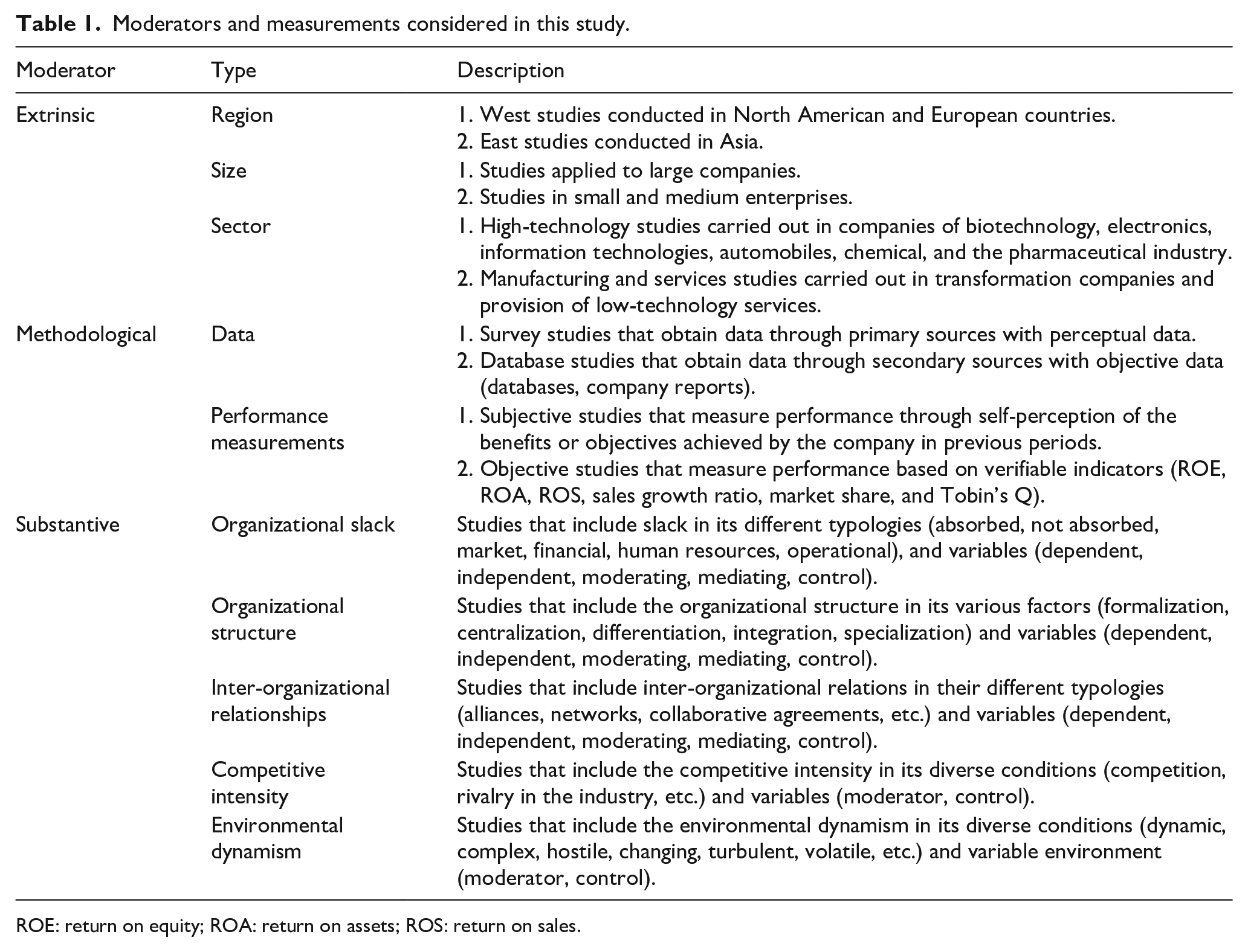
ROE: return on equity; ROA: return on assets; ROS: return on sales.
Literature search
Identification of empirical studies and criteria for inclusion
For the identification of the relevant empirical studies, the bibliographical search was conducted by consulting databases—Business Source Complete (EbscoHost), ABI/Inform Complete (ProQuest), Scopus (Elsevier)—and editorial platforms of electronic journals—Emerald Management Xtra, JSTOR, SAGE Journals Online, ScienceDirect, SpringerLink, Taylor and Francis Online, Wiley Online Library. The keywords used were Exploitation, Exploration, Exploitative, Exploratory, Exploiter, and Explorer.
Although exploitation and exploration have been analyzed as simultaneous, substitute, or independent variables (Guisado-González et al., 2019), in our meta-analysis we only include studies that separately present the correlations between exploitation and performance and between exploration and performance. Furthermore, in the literature there are several works that analyze ambidexterity as a proxy between exploitation and exploration, adding, multiplying, and subtracting those dimensions (Pertusa-Ortega & Molina-Azorín, 2018). Because of that we also included, when available, the individual correlations among exploitation and performance as well as exploration and performance (e.g., Cao et al., 2009; Chandrasekaran et al., 2012; Koryak et al., 2018; Severgnini et al., 2018; Solís-Molina et al., 2018; Zhang et al., 2016). Therefore, we try to clarify that in the present investigation we do not include those studies that analyze ambidexterity as an integrated construct between exploitation and exploration (e.g., Chang et al., 2011; De Clercq et al., 2014; Jansen et al., 2012; Lubatkin et al., 2006; Sarkees et al., 2010).
In this meta-analysis, we considered all the empirical studies that reported the average, the standard deviation, and the correlations of the variables to be analyzed, regardless of whether the variables to be studied were dependent, independent, moderator, or control variables (Field, 2001). An initial sorting of the papers’ titles and summaries, together with further screening of the main body of each paper, left us with studies that matched all the inclusion criteria. We then manually scrutinized these papers to ensure that they included an empirical quantitative analysis and/or reported the correlation matrices. We also eliminated studies that did not report a relationship on at least one of our focal constructs, those with overlapping samples and those not in English, as well as unpublished and forthcoming papers. In addition, we discard the studies that analyze ambidexterity as a single construct without disaggregating the correlations between exploitation and performance and between exploration and performance. This reduced the initial sample from 122 to 102 usable studies that examined the effect (with 328 correlations and a total sample size of 41,298 firms).
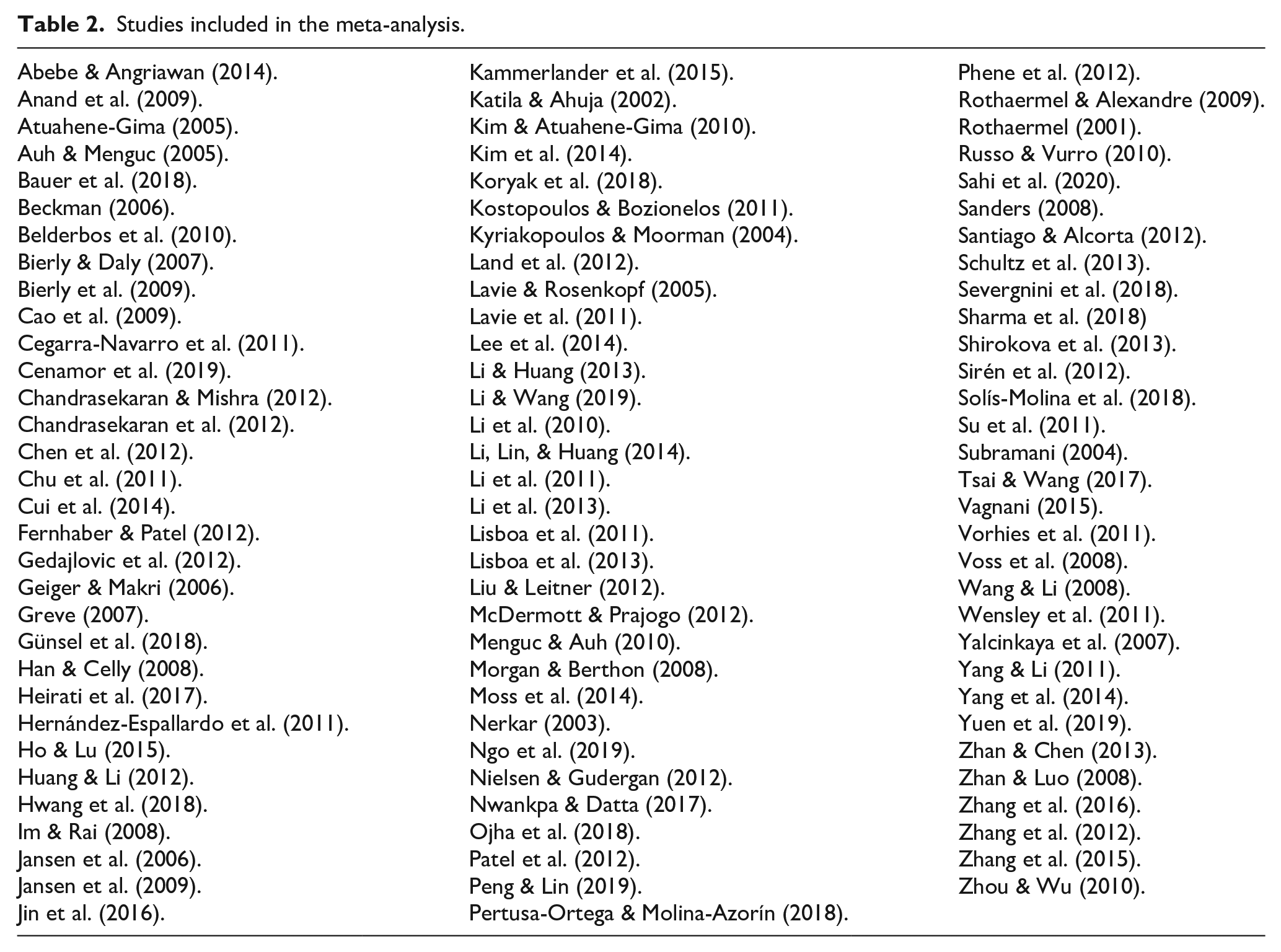
When building the database, the studies that had two samples were included separately. In those in which the variables to be analyzed (exploitation, exploration, and performance) were calculated more than once, their average value was measured. Table 2 presents the studies that make up the total population for the meta-analysis.
Studies included in the meta-analysis.
To guarantee their reliability, after classifying the studies, the variables were codified with the help of an expert. Then, we calculated the inter-rate agreement proposed by Orwin and Vevea (2009). Its value was 0.74 (a value over 0.6 is considered acceptable).
Data description
Calculation of the effect size and heterogeneity
In accordance with Borenstein et al. (2009), the calculation of the effect size can be obtained through (a) standardized averages (category d), (b) binary data (odds ratios, risk ratios), and (c) correlations (category r). The latter is the most common method in organizational studies (Hunter & Schmidt, 2004), which is why it has been used in this work.
Since the studies included in a meta-analysis may have operationalized and measured the variables in different ways (e.g., continuous, scalar, ordinal and proxy values), the effect size r (correlations) transformed to the Fischer Z was used, as the methodological alternative to standardize and correct different measurements in the variables. This transformation also allows to compare studies carried out with different hypotheses.
Next, the standard error was obtained from this measurement and the magnitude of the effect was calculated for all the studies by the random effects model. 3 In the first instance, the standardized correlations of each study were weighted by the inverse of the variance and then the total weighted average was obtained. The conclusion about the strength and direction of the relationships between the analyzed variables is offered by the total average of the effect size and its statistical significance (Borenstein et al., 2009; Card, 2011).
Calculation of moderators
To identify the moderating effect of third variables on the relationship between exploitation and exploration with performance, two procedures were performed:
For the substantive moderators, a meta-regression was conducted to identify the moderator effect of third variables in the relationships between exploitation, exploration, and performance. This consists of taking the effect sizes as a dependent variable and a continuous moderator as an independent variable. These are weighted by the effect size according to the random effects model that include the intra- and inter-studies variance. The significance of the results indicates the existence of a moderating effect between the variables (Borenstein et al., 2009; Card, 2011).
For the extrinsic and methodological moderators, a subgroup analysis (whose procedure is the same as described above) was performed to find the effect size and heterogeneity, with the particularity that the calculations were made by grouping the studies according to the aspects to be evaluated (e.g., region and size). To specify the effects of moderation, disturbing studies were withdrawn because they had an effect size with outliers. The identification of such studies was done visually based on the forest graphics, discarding those whose individual effect sizes are ostensibly far from the total effect size (Hunter & Schmidt, 2004).
Results
Meta-analysis
Analysis of the effect sizes
The results presented in Table 3 indicate that there is a significant and positive relationship between exploitation and performance (Mr = 0.28, p < .01) and between exploration and performance (Mr = 0.25, p < .01). These results are similar to the results of previous studies (Junni et al., 2013) and reaffirm that gradual changes through the improvement of the current options and the search for new options through disruptive changes are performance determinants (O’Reilly & Tushman, 2013).
Meta-analysis of mean correlations by random effects.
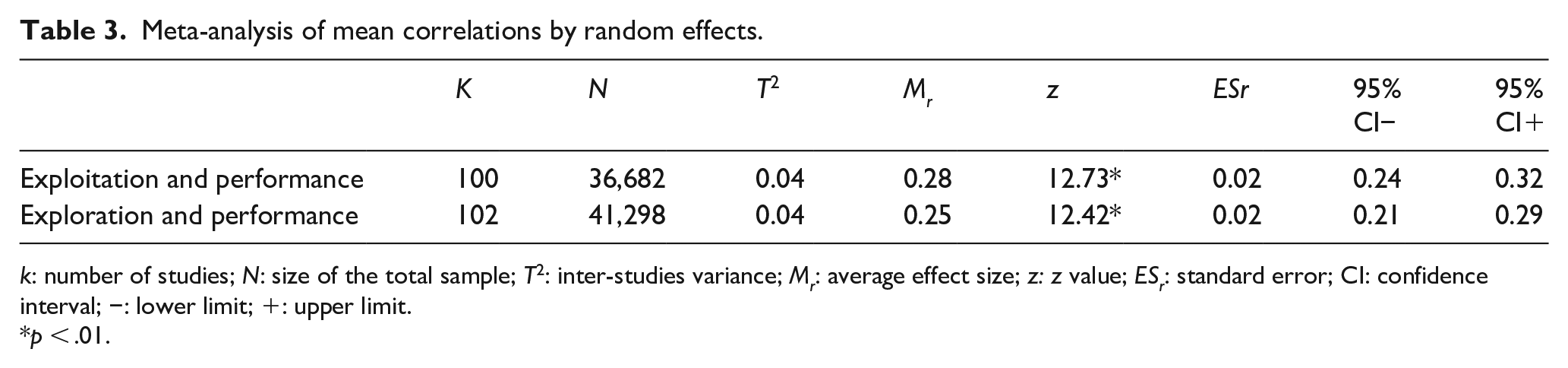
k: number of studies; N: size of the total sample; T2: inter-studies variance; Mr: average effect size; z: z value; ESr: standard error; CI: confidence interval; −: lower limit; +: upper limit.
p < .01.
Analysis of heterogeneity
According to the forest graphics obtained, an important dispersion is noted in the set of studies around the average effect size. This provides a first idea concerning the heterogeneity and makes it necessary to seek moderator factors that explain this variability. Likewise, it was convenient to exclude outliers to carry out the moderation analysis in the meta-regression of substantive factors (Borenstein et al., 2009; Hunter & Schmidt, 2004). The Q statistic enables the confirmation of the level of heterogeneity in the studies. Table 4 presents the results.
Test of heterogeneity.

k: number of studies; N: size of the total sample; Q: heterogeneity statistic (with k-1 gl); I2: heterogeneity index.
*p < .01.
In all the cases, the Q result is significant (p < .01) (Higgins et al., 2003; Huedo-Medina et al., 2006). Therefore, the null hypothesis of homogeneity is rejected, and it is concluded that the studies are heterogeneous. Namely, they do not share a common effect size. Therefore, it is necessary to verify the effect of the moderator factors that were proposed in the hypotheses (Borenstein et al., 2009).
Analysis of moderator effects
Tables 5 to 7 present the results of the analysis of substantive, extrinsic, and methodological moderating factors.
Meta-regression of substantive moderator factors.
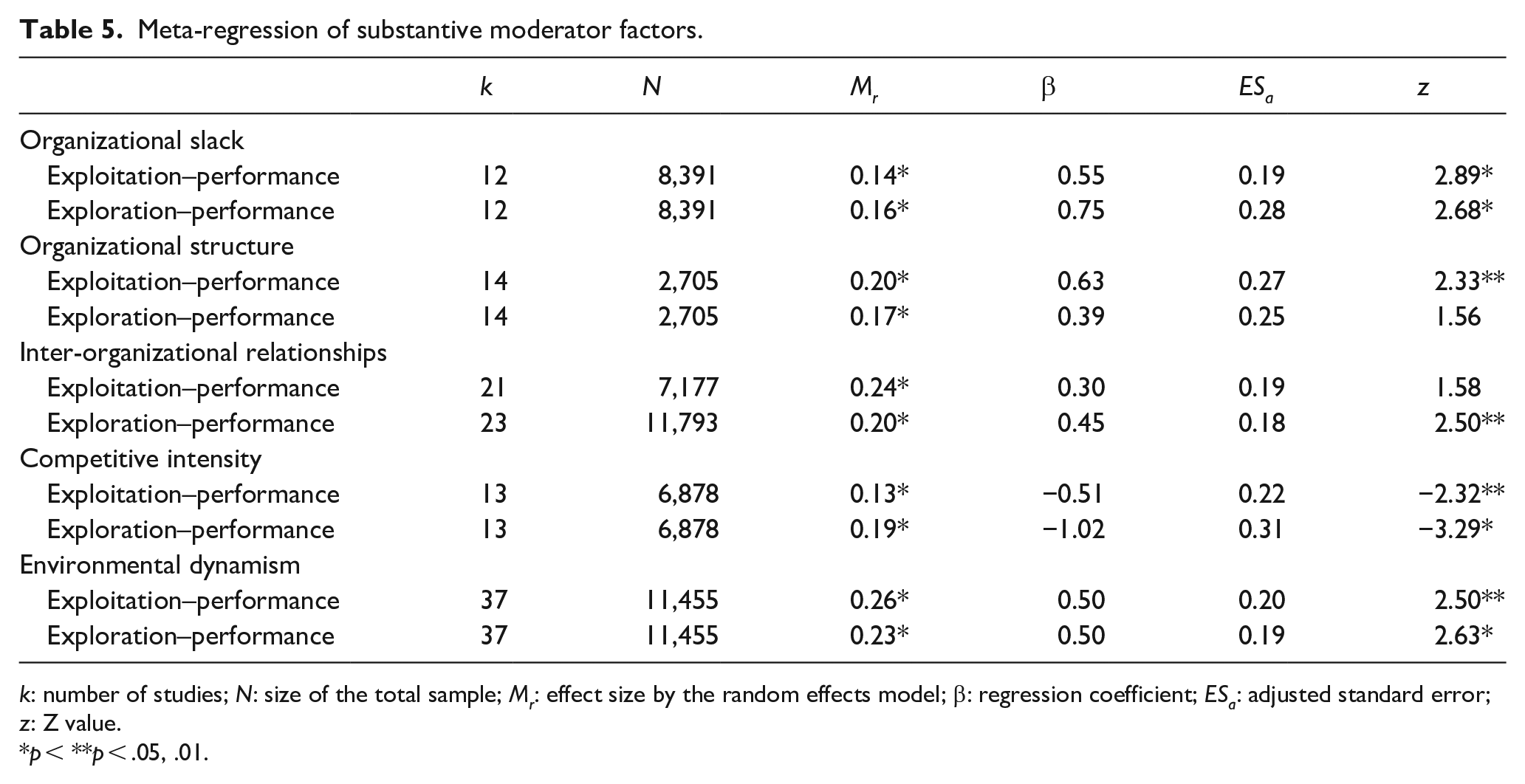
k: number of studies; N: size of the total sample; Mr: effect size by the random effects model; β: regression coefficient; ESa: adjusted standard error; z: Z value.
p < **p < .05, .01.
Extrinsic moderators’ results.
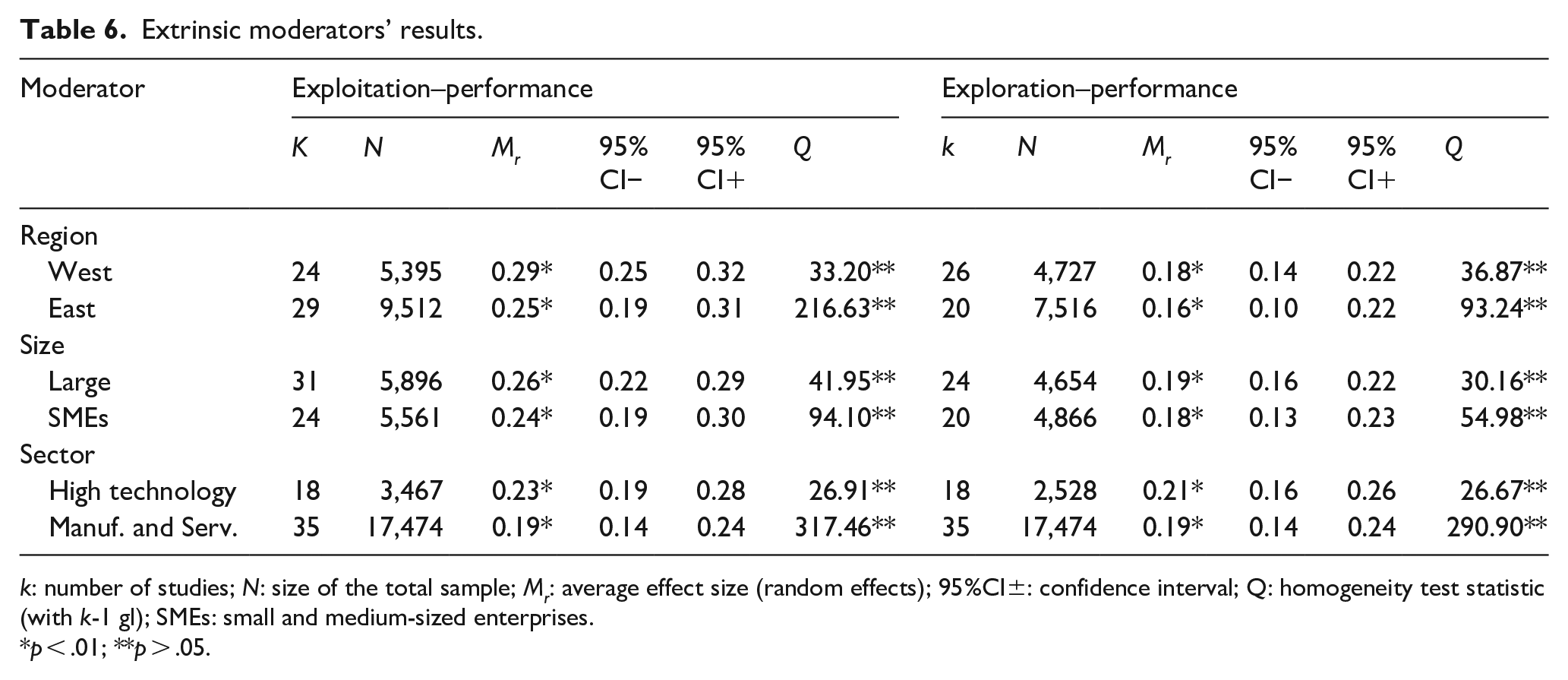
k: number of studies; N: size of the total sample; Mr: average effect size (random effects); 95%CI±: confidence interval; Q: homogeneity test statistic (with k-1 gl); SMEs: small and medium-sized enterprises.
p < .01; **p > .05.
Methodological moderators’ results.
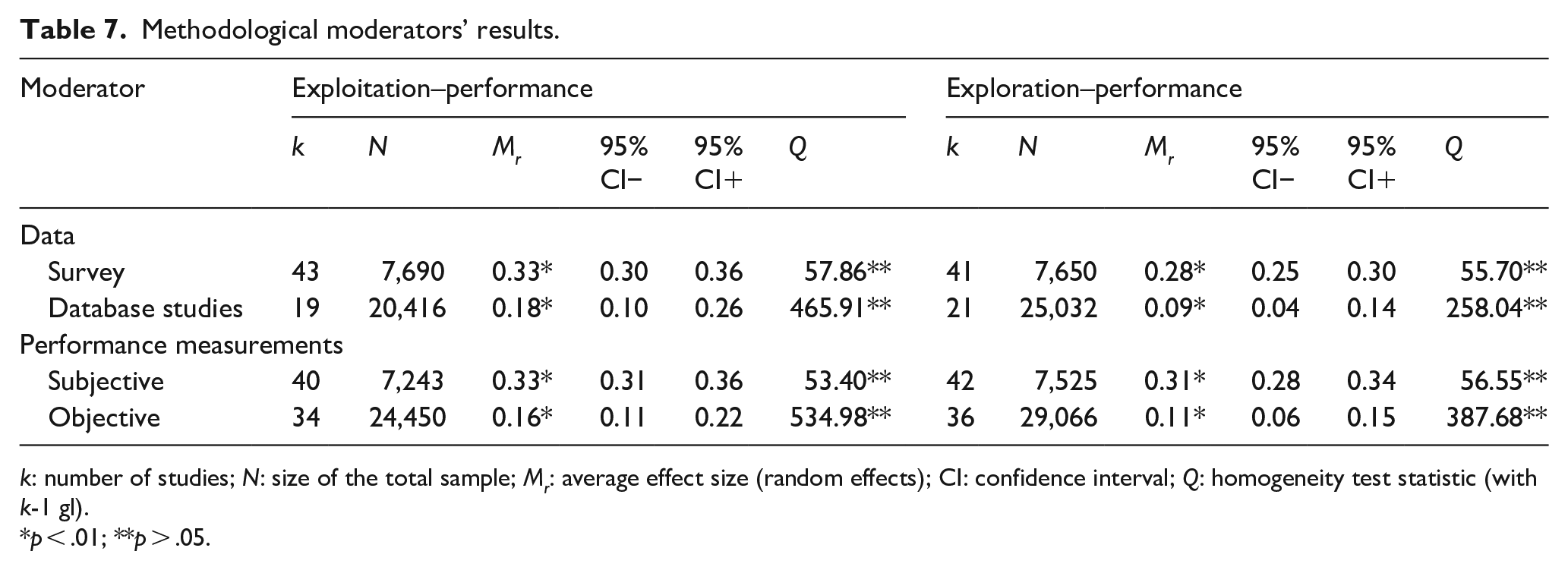
k: number of studies; N: size of the total sample; Mr: average effect size (random effects); CI: confidence interval; Q: homogeneity test statistic (with k-1 gl).
p < .01; **p > .05.
Substantive moderators
The results presented in Table 5 indicate that organizational slack has (a) a positive and significant moderator effect on the relation between exploitation and performance (β = 0.55, p < .01) and (b) a positive and significant moderator effect between exploration and performance (β = 0.75, p < .01). In this sense, H1 is verified; there is a moderator effect of slack in the relationship between exploitation and exploration with performance. Organizational structure (in this case mechanistic) has (a) a positive and significant moderator effect on the relationship between exploitation and performance (β = 0.63, p < .05) and (b) a positive but weaker and nonsignificant effect on the relationship between exploration and performance (β = 0.39, p > .05). In this sense, H2 is partially verified.
The results also indicate that inter-organizational relationships have (a) a positive and nonsignificant effect on the relationship between exploitation and performance (β = 0.30, p > .05) and (b) a positive and significant moderator effect on the relationship between exploration and performance (β = 0.45, p < .05), thus H3 is partially verified, as the moderator effect of inter-organizational relationships only appears in the relationship between exploration and performance. As for competitive intensity, contrary to what was expected, the outcomes indicate that competitive intensity has (a) a negative and significant moderator effect on the relationship between exploitation and performance (β = −0.51, p < .05) and (b) a negative and significant moderator effect on the relationship between exploration and performance (β = −1.02, p < .01). Therefore, H4 was not verified. Finally, environmental dynamism has (a) a positive and significant moderator effect on the relationship between exploitation and performance (β = 0.50, p < .05) and (b) a positive and significant effect on the relationship between exploration and performance (β = 0.50, p < .01). Hence, H5 is partially supported, since the positive moderating effect of environmental dynamism on the relationship between exploration and performance was verified. However, while environmental dynamism affects the relationship between exploitation and performance, the moderating effect was positive, contrary to what was expected.
Extrinsic and methodological moderators
The results in Table 6 show that H6 is supported, in the sense that the region moderates the influence of exploitation and exploration on performance; the impact was stronger in studies conducted in Western countries than in those of Eastern countries (exploitation: 0,29 vs. 0.25, Q = 33.20, p > .05; exploration: 0.18 vs. 0.16, Q = 36.87, p > .05). Related to H7, the results support the hypothesis by showing that size moderates the influence of exploitation and exploration on performance, in the sense that the impact is slightly stronger in studies conducted in large companies (exploitation: 0.26 vs. 0.24, Q = 41.95, p > .05; exploration: 0.19 vs. 0.18; Q = 30.16, p > .05). The sector corresponding to H8 moderates the influence of exploitation and exploration on performance, in the sense that the impact is stronger in studies conducted in high technology sectors (exploitation: 0.23 vs. 0.19, Q = 26.91, p > .05; exploration: 0.21 vs. 0.19; Q = 26.67, p > .05). Thus, this hypothesis is supported.
Likewise, the results in Table 7 show that data sources (H9a) moderate the influence of exploitation and exploration on performance, in that the impact is stronger in studies conducted by surveys than in those based on databases (exploitation: 0.33 vs. 0.18 Q = 57.86, p > .05; exploration: 0.28 vs. 0.09; Q = 55.70, p > .05). Regarding performance (H9b), the results show a significant moderating effect of the studies that measure performance in a subjective way compared to the studies that measure it objectively (exploitation: 0.33 vs. 0.16 Q = 53.40, p > .05; exploration: 0.31 vs. 0.11; Q = 56.55, p > .05). Thus, H9a and H9b are supported.
Table 8 summarizes the results obtained from all the hypotheses included in the study.
Summary of hypothesis verification.
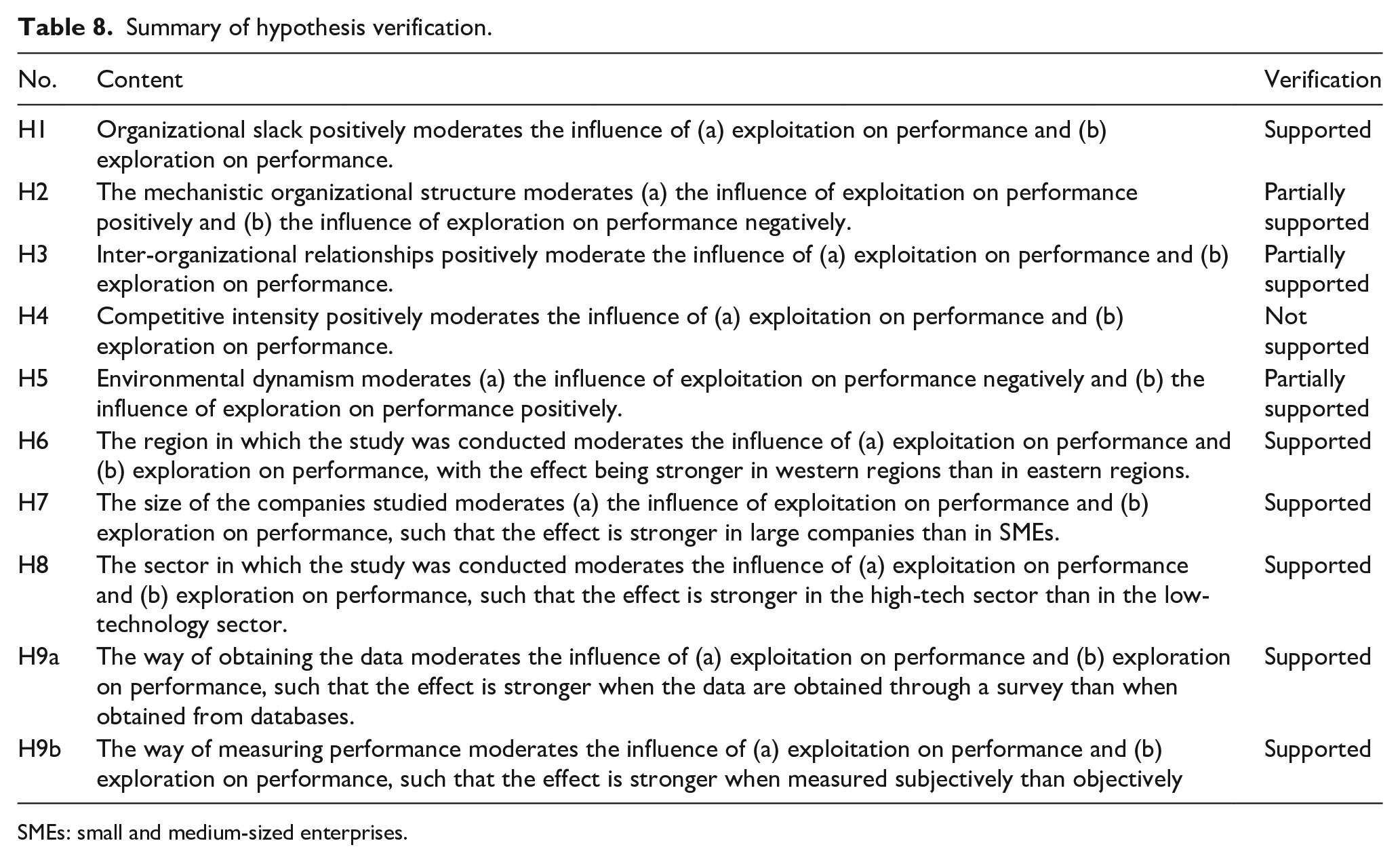
SMEs: small and medium-sized enterprises.
Discussion and conclusion
This study contributes to the theory of organizational adaptation, postulated by March (1991), by aiming to clarify assumptions of this field of research, related to internal and contextual variables that remain ambiguous or controversial, and other conditions that affect the relations of exploitation and exploration with performance. These are issues for which there is still much to contribute. Using a meta-analytical review, we have aimed to answer our research question from a contingency point of view: How do substantive, extrinsic, and methodological moderators affect the impact of exploitation and exploration on performance?
Our results show that several contextual factors determine differences in the influence of exploitation and exploration on performance. Following Borenstein et al. (2009) and Lipsey and Wilson (2001), three types of moderating factors have been addressed: substantive (slack, organizational structure, inter-organizational relationships, competitive intensity, and environmental dynamism), extrinsic (region, size, and sector) and methodological (data sources and performance measurements).
Regarding the substantive factors, organizational slack positively moderates the effect of exploitation and exploration on performance in the sense that when firms have many available resources, both exploration and exploration can improve their performance. Thus, organizational slack may allow firms to successfully carry out both technological processes of improvement and scientific actions of development (Fleming & Sorenson, 2004; Geiger & Makri, 2006; Huang & Li, 2012).
The type of organizational structure, the second substantive factor, may determine differences in the impact of exploitation and exploration on performance. In this sense, mechanistic structures, characterized by strong formalization, centralization, and vertical differentiation (Burton & Obel, 2004; Sun & Pan, 2011), lead to a higher effect of exploitation on performance. That is, learning through organizational routines and standardized processes seems to contribute to gradual improvements which favor efficiency and profits in the short term (Adler et al., 2009; He & Wong, 2004; Hsiao & Wu, 2020; Jansen et al., 2006). Nevertheless, we could not demonstrate a negative moderating effect of these mechanistic structures on the relationship between exploration and performance. Thus, although strong formalization and centralization may limit the initiative and creativity necessary to strengthen experimentation and innovation, certain procedures and protocols may contribute to articulating and making the process of exploration successful. As Cabello-Medina et al. (2011) demonstrated, some degree of formalization could help people to manage complex, uncertain, and multidisciplinary information in radical innovation processes. However, since in our meta-analysis the studies that analyze the organizational structure correspond to mechanical type structures, the results could be obviating other contingent circumstances, such as organizational innovation. As Guisado-González et al. (2017) demonstrated, the relationships between exploitation and exploration with organizational innovation are complementary, so that performance can be improved if companies simultaneously implement exploitation, exploration, and organizational innovation activities. In this case, when organizations make the organizational structure more flexible, making them more organic to introduce better management practices (e.g., with the design of parallel substructures), they will have the possibility of balancing the resources allocated to exploitative and exploratory activities (Raisch, 2008).
Inter-organizational relationships, the third substantive factor, reinforce the influence of exploration on performance. Participating in alliances may be a useful strategy to absorb external knowledge, sharing resources, and capabilities with partners and interchanging R&D activities (Holmqvist, 2003; Lavie et al., 2011; Li et al., 2014; Phelps, 2010), all of which may contribute to improving the results of exploration (Lavie & Rosenkopf, 2005; Li & Wang, 2019). Nevertheless, inter-organizational relationships do not seem to be as valuable when firms are involved in exploitation activities. As has been stated in prior research, exploitation may be a fundamentally intra-organizational condition (Auh & Menguc, 2005; Benner & Tushman, 2003; Dutta, 2012; He & Wong, 2004). Although firms can exploit in an inter-organizational manner (Hoang & Rothaermel, 2010; Holmqvist, 2004; Russo & Vurro, 2010), the benefits are not as significant at the firm level (Lavie et al., 2011). In addition, this relationship may be affected by different contingency factors, such as age, since, as Guisado-González et al. (2019) showed, exploitation alliances decrease the company’s innovative performance, whereas innovation alliances increase it.
The fourth substantive factor, competitive intensity, does not seem to be the suitable context for both exploitation and exploration, although most studies in this field point in the opposite direction. Regarding exploitation, firms facing an environment of technological and market rivalry, which can threaten their competitive position, are expected to exploit to maintain their performance at appropriate levels (Jansen et al., 2006; Kim & Atuahene-Gima, 2010; Yang & Li, 2011). Nonetheless, what our results suggest is that, in a highly competitive environment, efforts toward efficiency may not produce greater performance. This could be due to the problems stemming from the inertia and routinization that exploitation entails (Adler et al., 2009; Wang & Li, 2008), as well as the fact that, in situations of high competitive intensity, the efforts to optimize processes and rationalize costs are insufficient to counteract the competition in prices and the decrease of operational margins (Miller & Friesen, 1983; Zahra, 1996). Regarding exploration, our results suggest that in highly competitive contexts, exploration activities may not be successful. As has been discussed in previous research, competitive intensity tends to increase uncertainty and, in turn, risk aversion, hampering, and discouraging search processes, experimentation and the development of new knowledge or products (Jansen et al., 2006; Li et al., 2010).
Our results also suggest that a dynamic environment, the fifth substantive factor, seems to be a favorable context for developing both exploitation and exploration activities. Although organizations that exploit are expected to survive and be successful in stable environments, a certain degree of change and dynamism may encourage firms to refine their current competencies and improve their efficiency. Dynamism may especially benefit explorative “organisations that can promptly take advantage of emerging opportunities and abandon expiring certainties” (Lavie et al., 2010, p. 119). Firms could face this unforeseeable environment via producing new knowledge, with a greater technological search, a diversification in their offer portfolio, a broadening of their customer base, and a stronger market development (Jansen et al., 2006; Kim & Atuahene-Gima, 2010; Wang & Li, 2008). Regarding the evolution of the market, these results agree with those found by Bernal et al. (2019), who argue that “the innovations resulting from the development of exploration and exploitation strategies can both be accommodated in an environment characterised by rapid market evolution” (p. 315). Although, as these authors have shown, exploratory and exploratory competences can be diverse in different environmental conditions (e.g., in technological evolution), our meta-analysis refutes the idea that the dynamic environment discourages exploitation and shows that companies invest in exploitative and exploratory activities to face the uncertainty that environmental changes bring and to improve performance, which is consistent with the findings of Zhan and Luo (2008).
Regarding the extrinsic moderators, for the case of the region, our results suggest that exploitation and exploration activities are more successful in Western organizations than in their Asian counterparts, which is consistent with what has been stated in some studies (Katila & Chen, 2008; Kim et al., 2012; Rothaermel & Deeds, 2004). American and European companies seem to face strong competitive demands that induce them to accelerate their internationalization process, so they must make quick decisions that imply better use of their current capabilities and a strong drive toward global expansion (Hsu et al., 2013).
In terms of size, the second extrinsic factor, it was found that in large companies there is a greater effect of exploitation and exploration on performance. Although, for SMEs, exploitation and exploration can be easily managed due to their low routinization and few bureaucratic restrictions (Lee & Huang, 2012), they do not seem to achieve as good results as large companies. Large companies, with a greater availability of resources and with the capacity to achieve economies of scale, can develop better skills, whether exploitative and exploratory (Cao et al., 2009; Lavie et al., 2010; Sarkees et al., 2010).
Our results also suggest that the sector, the third extrinsic factor, moderates the relationships analyzed, in the sense that in the high-technology sectors the positive effect of exploitation and exploration on performance is intensified. In terms of exploitation, high-tech companies are constantly refining their internal resources to optimize their R&D activities, allowing them to improve their processes and make them more efficient (Chandrasekaran et al., 2012; Chandrasekaran & Mishra, 2012). In terms of exploration, companies belonging to these sectors, operating in highly volatile technological environments, invest more in research, experimentation, and development to enhance their capabilities (Gedajlovic et al., 2012).
Regarding the methodological conditions, they are considered as representative moderating factors in a meta-analysis (Borenstein et al., 2009; Hunter & Schmidt, 2004; Lipsey & Wilson, 2001). We found that the way of obtaining the data as well as the performance measurements affect the results of the studies: studies based on surveys on exploitation and exploration, using a subjective measurement of performance, produce a larger effect size. This finding was similar to that obtained in other meta-analytical studies in the field of management and organizations (Camisón-Zornoza et al., 2004; Lee & Xia, 2006; Van Wijk et al., 2008). Although surveys can provide a faithful representation of the reality of the company because they measure the facts as they are experienced by their actors, some authors have warned that the significant results could come from artificial correlations due to the operationalization of the variables (Kirca et al., 2005; Van Wijk et al., 2008).
To sum up and answer our research questions, exploitation and exploration have different impacts on performance, depending on the presence of several moderating factors. Not all the factors considered are relevant to explain a better performance of exploitation versus exploration, and vice versa. In this sense, slack resources and a dynamic environment contribute to the success of both exploitation and exploration activities, while competitive intensity seems to hamper the two strategies. The rest of the factors analyzed in our study determine a different effect of exploitation and exploration on performance, either regarding the intensity of the effect (region, size, sector, data sources, performance measurement) or the significance of the relationship (organizational structure, inter-organizational relationships). In this sense, our research may contribute to a better understanding of how exploitation and exploration influence performance.
Our results provide relevant findings for management practice regarding substantive factors. A more precise knowledge of the nature and behavior of exploitation and exploration enables managers to design the appropriate strategies to improve organizational performance. Both exploration and exploitation can contribute to improving the firm performance, but certain moderator factors must be considered, given that they can either intensify or weaken this influence. To be aware of the context in which the firm operates (slack resources, organizational structure, inter-organizational relationships as well as the degree of competition and dynamism) will help managers to substantially improve the efficiency of the strategies designed.
Limitations and future research lines
First, given that in our meta-analysis we only include studies that present independently correlations between exploitation and performance and between exploration and performance, and that we only considered some studies that propose ambidexterity hypotheses if they presented these correlations separately (exploitation on performance and exploration on performance), future meta-analysis could assess the effect of ambidexterity on performance as an integrated construct.
Besides, although the moderator variables included in our analysis can be considered as some of the most relevant in the studies on the effect of exploitation and exploration on performance, it could be considered that they are only a subset of all the potential moderators. Future research should explore the role of other variables that also could determine differences in the effect of exploitation and exploration on performance.
Regarding the analysis of some of the moderators, the low number of previous studies, due to the novelty of studies in the field of exploitation and exploitation, may limit the generalization of the results. Nevertheless, and in line with other meta-analyses in the management field (Camisón-Zornoza et al., 2004; Hancock et al., 2013; Rosenbusch et al., 2013), this should not affect the validity of the findings.
According to some authors, empirical works included in a meta-analysis may present inconsistencies, due to issues of how the method is applied and the analysis level, which may affect the results (Green, 1984; Rosenthal, 1991). This study included all research works found in the field of exploitation and exploration, without discriminating on the level of analysis. Therefore, a subsequent meta-analytical study could analyze the individual, organizational, and sector level to comparatively assess the consistency of these results. In fact, an individual-centered investigation would be very interesting and correspond with the new research trend on the construction of exploitation and exploration, consisting of studies at the individual level (especially in 2019). These investigations have shown the different ways people in the organization carry out particular exploitation and exploration activities that affect the overall performance of the company (e.g., Greco et al., 2019; Kassotaki, 2019; Laureiro-Martinez et al., 2019; Schnellbächer et al., 2019; Wilms et al., 2019).
Footnotes
Acknowledgements
The authors thank the two anonymous referees for their insightful and detailed comments and suggestions.
Declaration of conflicting interests
The author(s) declared no potential conflicts of interest with respect to the research, authorship, and/or publication of this article.
Funding
The author(s) disclosed receipt of the following financial support for the research, authorship and/or publication of this article: We acknowledge the Spanish Ministry of Economy and Competitiveness for financial support (Project ECO2016-75047-P and ECO2016-78882-P).
