




Abstract
This study contributes to the emerging literature on the employee work passion appraisal (EWPA) model, by replicating structural equation modeling across three samples (total n = 4,613). We examine passion for work as a mediator of employees’ work environment characteristics and work intentions. Our data fit the structure of the EWPA model in three samples. As expected, work environment characteristics were strongly and positively correlated with harmonious passion, but contrary to our expectations, work environment characteristics were moderately and positively correlated with obsessive passion. Harmonious passion was positively correlated with work intentions, but the connection between obsessive passion and work intentions yielded mixed results. The overall results support harmonious passion, and less so obsessive passion, as partial mediators of employees’ perceptions of their work environment characteristics and favorable work intentions. This study has limitations in that it uses a cross-sectional, single-source, self-report design. Practical implications of the study are also presented.
Keywords
Introduction
In 2003, Vallerand, Blanchard, Mageau, Koestner, Ratelle, Leonard, Gagne, and Marsolais published a seminal paper on human passion. Since Vallerand et al. (2003), numerous studies have been published focusing on human passion in the arts, sports, and interpersonal relations (e.g., Akehurst & Oliver, 2014; Curran et al., 2013; Jowett et al., 2013; Li, 2010; Padham & Aujla, 2014). The authors defined passion “as a strong inclination toward an activity that people like, that they find important, and in which they invest time and energy” (Vallerand et al., 2003, p. 757). Vallerand and his colleagues proposed a dualistic model of passion (DMP), specifically harmonious and obsessive passion, citing that “passion is not always adaptive and can, at times spillover into compulsion, negative emotion, and rigid persistence” (Curran et al., 2015). Interest in human passion increased so much that after approximately a decade of empirical research a meta-analysis was produced with 94 studies that contained 1,308 independent effect sizes (Curran et al., 2015).
Using cognitive appraisal theory as a framework, in 2009, Zigarmi, Nimon, Houson, Witt, and Diehl published an operational definition and a model to explain the formation of work passion. Six years after the groundbreaking research articles on human passion by Vallerand et al. (2003) and Vallerand (2008), an author of this study first theoretically (Zigarmi et al., 2009) and then empirically (Zigarmi et al., 2011) introduced an employee work passion appraisal (EWPA) model to explain the formation of employee work passion. Because they were interested in examining how and why people become passionate about their work, the authors presented an operational definition (as advocated by Kerlinger & Lee, 1999) rather than a constitutive definition of work passion; also, they embedded their definition in appraisal theory (e.g., Bagozzi, 1992; Bandura, 1986; Lazarus & Folkman, 1984; Ryan & Deci, 2017) to specify the subconstructs in the formation of work passion.
Zigarmi et al. (2009) offered the following operational definition of work passion: “an individual’s persistent, emotionally positive, meaning-based, state of well-being stemming from reoccurring cognitive and affective appraisals of various job and organizational situations that result in consistent, constructive work intentions and behaviors” (p. 310). As implied by the definition, the authors postulated that the formation of employee work passion involves an appraisal of selected job, organizational, and relationship characteristics leading to the creation of various intentions.
Perhaps due to their differing origins and definitional approaches to passion, Vallerand and colleague’s DMP concept and Zigarmi and colleague’s EWPA model have thus far rarely appeared in the same empirical study. However, integrating the DMP and the EWPA model into a single study is valuable for advancing what is currently known about work passion, which was part of the inspiration for this work. Perrewé et al. (2014) noted that there is a need for a holistic model for passion, so we believe that combining the DMP and EWPA model could advance our understanding about work passion.
The primary contribution of this article is threefold. First, we answer the call by Egan et al. (2017) to expand the literature on the EWPA model by testing its applicability to different organizational contexts. Second, as noted above, we connect research done on the DMP (Vallerand, 2008, 2015; Vallerand et al., 2003; Vallerand & Houlfort, 2003) with research done on the EWPA model (e.g., Zigarmi et al., 2009, 2011, 2019), by including a measure for the DMP (Vallerand et al., 2003) in our testing of the EWPA model. Third, we fill a gap in the literature (Cameron, 2019) by analyzing how a comprehensive measure for work environment differentiates between the DMP’s two components: harmonious and obsessive passion (Vallerand et al., 2003).
In the pages that follow, the academic foundation for our threefold contribution will be explained as various bodies of literature are reviewed, with a focus on appraisal theory and the EWPA model; we will point to notable concepts and evolving scholarly publications on the topic of work passion. Then, this article’s core contributions will be revisited in-depth in the “Purpose of the study” section. We next review the literature in support of our proposed hypotheses. Then, we describe our study’s methods, results, and close by discussing key findings.
What is known about the EWPA model: a brief literature review
Several researchers have used the appraisal process for many years as a framework for examining the volitional or motivational behavior in human beings (e.g., Caudwell et al., 2016; Hagger et al., 2006; Johnson et al., 2006). Studies that use psychological appraisal as a framework in organizational settings include topics such as the analysis of customer service/satisfaction (e.g., Oliver, 1993; Wofford, 1994), organizational change (e.g., Fugate et al., 2011), and transformational leadership (e.g., Wofford et al., 1998). In keeping with this tradition, the authors of the EWPA model also chose appraisal theory as a framework to explain the formation of employee work passion.
The literature on human psychological appraisal maintains that behavior is agentic, implying that all individuals can, and do, appraise and influence the events that happen to them, thereby shaping their future (e.g., Bagozzi, 1992; Bandura, 1986; Lazarus & Folkman, 1984; Ryan & Deci, 2017). There are two phases to an individual’s appraisal process, as reflected in the reoccurring questions asked. The individual’s immediate experience may generate a sense of psychological well-being (or ill-being) found in primary questions such as “How does this present experience or situation affect me?” or “Will I win or lose in the present or in the future?” (Lazarus & Folkman, 1984, p. 32). The first phase of the appraisal process helps the individual grasp the significance of what is happening in the environment (Lazarus & Folkman, 1984). The second phase of the process is rooted in examining options and possibilities resulting from questions such as “What if anything can be done about it?” or “Why is one option more advantageous than another?” (Lazarus & Folkman, 1984, p. 32). It is in the second phase where intentions are formed to cope with a sense of well-being or lack thereof (Lazarus & Folkman, 1984). Researchers who seek to explain human agentic behavior maintain that psychological appraisal theory “considers behavioral intention the focal point of behavioral engagement, where intention is formed by belief-based constructs of attitude, subjective norms, and perceived behavioral control” (Caudwell et al., 2016, p. 2).
As can be seen in the aforementioned definition of work passion, and in accordance with appraisal theory, there are four basic elements to the appraisal process underlying an employee’s experience of work passion: the antecedents that shape the inner life of the perceiver, the personal characteristics of the appraiser, the appraisal (cognitive and affective sense job well-being), and the ensuing coping mechanisms in the form of intentions and behaviors.
Since the initial non-empirical study (Zigarmi et al., 2009), almost two dozen empirical studies have been published on the EWPA model over the past 10 years. In a recent publication (Zigarmi et al., 2019), a graphic figure of the EWPA model (see Figure 1) was presented along with a summary of various studies done in the past decade.
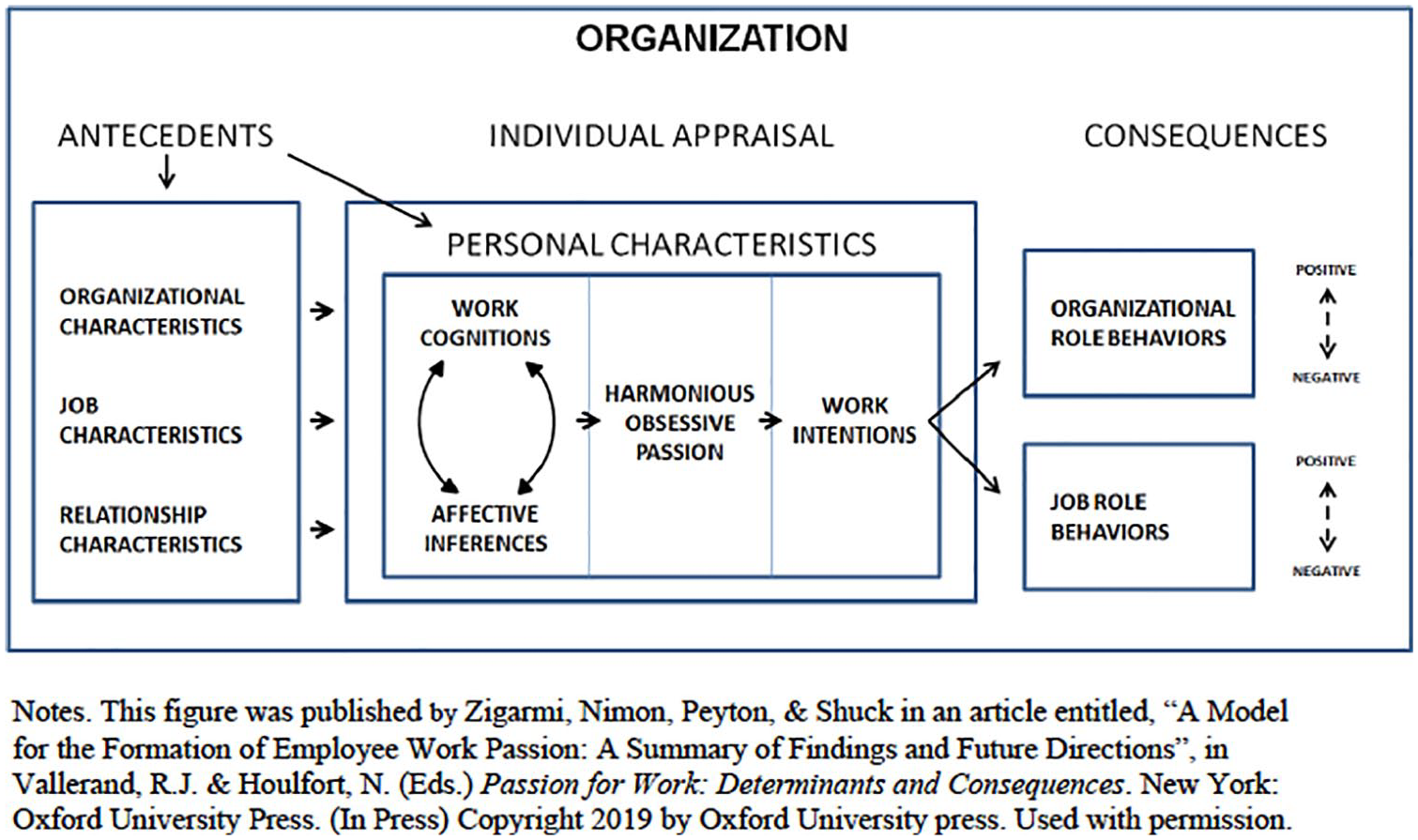
Employee work passion appraisal model.
Most empirical studies on the EWPA model have used structural equation model techniques involving the employee work environment as an antecedent, with some form of employee psychological state mediating the relationship between work environment antecedents and outcome variables (such as trust in leader and intentions to stay with the organization). Almost all the EWPA model studies cited below used the same work intention scales as outcome variables. However, the studies below varied in the subconstructs and measures used as antecedents and mediators in the EWPA model.
Antecedents
To better understand the predictors of well-being, researchers over time began exploring various environmental antecedents to measure what may stimulate an individual’s sense of well-being. Antecedents investigated in some of these studies were constructs such as leader values (Zigarmi & Roberts, 2012), forms of leader power (Peyton et al., 2019; Zigarmi et al., 2015), and leader behaviors such as direction and support (Egan et al., 2019). Other antecedents examined have included workers’ perceptions of their work environment, such as autonomy, task variety, opportunities for growth, procedural justice, distributive justice (Shuck et al., 2018), and affective- and cognitive-based trust in their leader (Zigarmi et al., 2018).
Mediators
As proposed in the operational definition of work passion, subjective well-being was posed as a mediator between antecedents and outcomes, but in an initial study (Zigarmi et al., 2011), the employee’s cognitive schema of their work environment seemed to have an underwhelming relationship to a sense of job well-being, relative to the relationship between the employee’s cognitive schema of their work environment and their work affect. From that early study, as well as subsequent works, it became evident to the authors that job well-being (i.e., the employee’s sense of their own cognitive and affective processing) needed to be better understood for the EWPA model; therefore, job well-being and various other possible mediators have since been explored (e.g., affectivity and motivational outlooks).
Positive and negative affect
Negative and positive affect were used as mediators in five studies of the EWPA model: Egan et al. (2019); Roberts and Zigarmi (2014); Zigarmi et al. (2011); Zigarmi and Roberts (2012); and Zigarmi et al. (2015). Taken together, the findings of these studies revealed that both positive and negative affect partially mediated the relationship between antecedents (e.g., leader behaviors, leader values, and forms of leader power) and five work intentions as outcomes of the EWPA model.
Motivational outlooks
Motivational outlooks have been identified as partial mediators of employees’ cognitive appraisal of their work environment and work intentions (Shuck et al., 2018; note that introjected regulation was an exception to this claim). Also, motivational outlooks were shown to partially mediate employees’ locus of control and harmonious/obsessive passion felt on the job (Zigarmi et al., 2018). Thibault-Landry et al. (2018) tested a structural model suggesting basic psychological need satisfaction as a mediator of cognitive appraisal of their work environment and work intentions, but they did not fully investigate mediation effects. General findings across these studies highlight forms of motivational outlooks as mediators in the EWPA model, as well as a need for additional testing of motivational outlooks and basic psychological needs in the EWPA model.
Job well-being
Two early field-test studies of the EWPA model, seeking to capture a sense of job well-being, used general state of well-being measures derived from various life domains such as work, social relationships, and family. Zigarmi et al. (2011) used the Utrecht work engagement scale (Schaufeli et al., 2006) to measure a sense of job well-being as a positive, fulfilling, work-related state of mind characterized by vigor, dedication, and absorption. Joo et al. (2017) examined forms of engagement and general well-being, and used the Ryff and Keyes (1995) 16-item measurement of psychological well-being that included subscales such as self-acceptance, positive relations, autonomy, environmental mastery, purpose in life, and personal growth. These studies showed significant relationships between different measures of a sense job well-being and antecedents and outcomes proposed by the EWPA model.
The term well-being has mainly been used outside of the appraisal literature. There have been several different subtypes established within the general concept of well-being, such as general life well-being, psychological well-being, and subjective well-being at work (e.g., Grebner et al., 2005). However, in appraisal theory, subjective job well-being refers to the affective aspects of the appraisal process and is defined as the balance of pleasure or displeasure in the immediate, subjective experience (Schimmack et al., 2008). Importantly, the term job well-being used in the context of appraisal theory (Bagozzi, 1992; Lazarus & Folkman, 1984) must be seen from a process-oriented perspective, in which affective and cognitive judgments concerning an individual’s sense of subjective job well-being focus on the immediate job experience and is in frequent change.
In the work context, the EWPA model proposes that subjective job well-being has both affective and cognitive qualities (Schimmack et al., 2008). The first step of the appraisal process relates to categorizing and understanding the work experience with its different dimensions of threat and challenge that significantly shape an individual’s state of affective well- or ill-being. By experimenting with various measures of well-being, researchers have found that when motivational measures replace affectivity measures or general well-being measures as mediators in the EWPA model, it becomes possible to explain how cognition may add nuance to the concept of job well-being in the context of the EWPA model. For example, Zigarmi et al. (2018) found that forms of employee motivational regulation (i.e., controlled, autonomous, and amotivation) correlated differently with harmonious and obsessive passion, which, in turn, related to work intentions differently.
Purpose of the study
Scholars have called for further research on the EWPA model. Perrewé et al. (2014) called for “expanding the breadth of the work passion construct to include unexamined relationships . . .” (p. 148). They noted, “there is no holistic model for passion in the literature . . . to adequately capture the construct domain” (Perrewé et al., 2014, p. 148). Egan et al. (2017) also pointed to “a need to refine the EWPA model” (p. 402). After acknowledging some of the empirical evidence underlying the factor structure of the EWPA model, Egan et al. (2017) stated that there is a need to develop and refine the model by moving to research that replicates and extends the model “in different organizational contexts and in different countries, [such that] results may allow the factor structure of the EWPA model to be generalized more broadly” (p. 402). Egan et al. (2017) also suggested that longitudinal designs were needed that could strengthen the case for causality in the model.
In addition to these scholarly calls for more research on the EWPA model, Cameron (2019) opined in a chapter of a recently published book dedicated entirely to work passion (Vallerand & Houlfort, 2019), “. . . findings suggest that more research is needed to clarify more precisely the outcomes associated with both forms of passion and the conditions in which they occur, as well as to identify the antecedents of both obsessive and harmonious passion” (p. 523). Cameron continued by asking such provocative questions as, “What individual differences exist in how passion is experienced and developed? What are the major mediators and moderators associated with passion?” (p. 526). In sum, given Perrewé et al. (2014), Egan et al. (2017), and Cameron (2019), three calls have been recently made to conduct specific aspects of work passion research.
The first purpose of this study is to expand the literature on the EWPA model, as recommended by the above authors. This study will most clearly address the call made by Egan et al. (2017) for more replication studies on the EWPA model and for it to be studied across contexts; here, we will use three samples to attempt the replication of our results, and we choose samples that test the EWPA model in different organizational contexts and countries. In so doing, we aim to test the integrity of the EWPA model by confirming both its accuracy and broad applicability in different organizations, industries, and countries.
The second purpose of this study is to bridge the research between the DMP and the EWPA model, mainly by including both harmonious and obsessive passion in our investigation on the EWPA model. Over the past two decades of research on the DMP, its corresponding harmonious and obsessive passion scales (Vallerand et al., 2003) have been widely used for studies of human passion. For EWPA model research, however, the work cognition inventory (WCI, Nimon & Zigarmi, 2015a) and the work intentions inventory (WII, Nimon & Zigarmi, 2015b) have been regularly used. Notably, to the best of our knowledge, Vallerand and colleagues’ harmonious and obsessive passion scales have only been used twice as a measure in EWPA model research, that is, as a mediating variable between basic psychological needs (Shuck et al., 2015) or motivational outlooks (Zigarmi et al., 2018) and five employee work intentions as outcomes. Overlooking the DMP as a potential aspect in understanding the EWPA model has been a missed opportunity thus far in EWPA research, because the Vallerand et al. (2003) instrument can capture both the state of threat and the state of challenge. Including harmonious and obsessive passion in the study of the EWPA model aligns with appraisal theory, which holds that part of an individual’s appraisal is to assess how the present experience or situation is affecting the individual’s sense of well-being, which could be positive or negative.
Finally, our third purpose is to fill a notable gap in the literature regarding the use of both harmonious and obsessive passion in studying the EWPA model. According to Cameron (2019), “Little is known about the differences between the development of obsessive passion and the development of harmonious passion. In many studies of determinants, obsessive and harmonious passions have not been differentiated” (p. 508). By incorporating both harmonious and obsessive passion as well as the precise antecedents and outcomes proposed by the EWPA model, this study contributes to a differentiation between harmonious and obsessive passion called for by Cameron (2019). To date, we have not found a published study on the EWPA model that has analyzed a full range of employee work environment antecedents, harmonious and obsessive passion, and work intentions.
Literature review and hypotheses
In the following section, we briefly examine the existing literature on antecedents within the EWPA model, give a brief review of previous research on harmonious and obsessive passion (which we more broadly refer to as “passion for work”), and provide a short review of the literature on work intentions to build a foundation for our six hypotheses. We also present a brief review of the literature on intention to support the link between work passion and work intentions.
Antecedents proposed by the EWPA model
According to Figure 1, the EWPA model proposes two kinds of antecedents of an employee’s appraisal process: personal and environmental. The model considers how the appraiser’s personal characteristics (e.g., an individual’s values, disposition, and significant emotional events in the employee’s life history) and cognitive perceptions of their work environment contribute to their appraisal process for work passion and related intentions. Three higher order factors are classified under the work environment aspect of this model: (1) job characteristics (e.g., meaningful work and task variety), (2) organizational characteristics (e.g., performance expectations, procedural fairness, and distributive fairness), and (3) relationship characteristics (e.g., feedback, connectedness with colleagues).
Some empirical work has evaluated the model by partially testing only personal characteristics as antecedents for how they contribute to the EWPA model (e.g., Roberts & Zigarmi, 2014; Shuck et al., 2015, 2018; Zigarmi et al., 2018). These studies provided evidence that personal characteristics such as cynicism and motivational outlooks impact the appraisal process and work intentions.
The work environment concept originates from a vast body of research concerning psychological climate perceptions (e.g., Parker et al., 2003; Schneider & Barbera, 2014). This body of research has established that the construct of psychological climate (i.e., the employee’s perceptions of their work environment) shapes work attitudes, motivation, and performance behavior (Parker et al., 2003). In keeping with the EWPA model and the findings of various researchers (e.g., Albrecht, 2014; Boyce et al., 2015), we believe that organizational culture, in the form of perceptions of the work environment, precedes performance and that organizational context can inhibit or induce various attitudes, outcomes, or behaviors.
In addition, the above literature has established that an employee’s perceptions of their work environment can focus on subdivisions, or factors, such as organizational structure and practices, leader behaviors, job characteristics, workgroups, and resource support (e.g., Albrecht, 2014; Parker et al., 2003; Schneider & Barbera, 2014). Albrecht (2014) noted that psychological climate has often been studied in relation to outcomes, such as, for example, a climate for engagement, a climate for safety, a climate for customer service, or a climate for innovation.
Harmonious and obsessive passion
As mentioned above, Vallerand and colleagues (2003; Vallerand & Houlfort, 2003) contributed to research on the psychology of human passion by introducing harmonious and obsessive passion as the DMP. Vallerand (2008) described passion as an aspect of what makes people’s lives worth living.
Harmonious passion
Vallerand’s DMP holds that there can be a positive state of passion, called harmonious passion, and a less positive state called obsessive passion. Harmonious passion is manifested when an individual puts time and energy into an activity that creates a sense of autonomous choice, personal self-esteem, and positive affect while engaged in the activity (Vallerand, 2015). When a person is harmoniously passionate about an activity, the activity will be in balance with other life activities (Vallerand, 2008). They postulated that a passionate activity becomes internalized, connected to a person’s self-identity, and becomes part of who they are (Vallerand, 2015; Vallerand et al., 2003). In other words, when engaged in a self-defining activity, the individual has autonomously chosen the activity through a sense of volition and interest, and the activity has become an important aspect of the individual’s life (Vallerand, 2008).
Obsessive passion
However, obsessive passion is typified by an internal, unexamined, compulsive tendency to engage in an activity (Vallerand, 2008). In this case, the activity takes an unbalanced amount of energy to the exclusion of other important life activities (Vallerand, 2008). This exclusion often generates conflict with other important elements of life (Vallerand, 2008). It is almost as if the individual is dependent on, or addicted to, an activity to express themselves. This pattern of behavior often results in excessive, uncontrollable conflict/risk and negative affect and is manifested in a stiff, habitual persistence toward an activity at the expense of other, unmet psychological needs (Vallerand, 2010, 2015) (e.g., see excessive gambling ending in financial ruin, Rousseau et al., 2002).
The difference between harmonious and obsessive passion
While harmonious and obsessive passion share commonalities, the two concepts have two significant differences. One key difference is that a different affective valence characterizes each form of passion. Harmonious passion is usually typified by long-term positive affect, while obsessive passion is often associated with long-term negative affect, both during and after engaging in the associated activity (Vallerand, 2015; Vallerand & Houlfort, 2019). Since harmonious and obsessive passion differ in their underlying emotional valences (Vallerand et al., 2003, 2008, 2015), they may also vary in how they relate to work environment antecedents and outcomes in the EWPA model.
A second difference between harmonious and obsessive passion is in their underlying motivational outlook (Curran et al., 2015; Vallerand et al., 2003; Zigarmi et al., 2018). Vallerand et al. (2014) wrote: “in the quality of motivation, specifically harmonious passion leading an individual to experience a more autonomous form of motivation and obsessive passion leading to a more controlled form of passion” (p .88). Obsessive passion originates from unacknowledged intrapersonal pressures typically stemming from the need for social acceptance or greater self-esteem rather than from the more harmonious, autonomous form of motivation that exists for the love of the activity itself. It should be noted that, contrary to what the names harmonious and obsessive passion might suggest, they are not opposites; they are not strongly negatively correlated.
Inconclusive findings for obsessive passion
There are two reasons why obsessive passion is important to study within the context of the EWPA model. First, as the concept of affectivity has emerged in the psychological literature, positive and negative affect dimensions began to show some controversial patterns with both desired outcomes as well as with antecedents that may produce them. There has even been some debate in the literature about whether negative affectivity should remain an unmeasured variable, for example, in studies of job stress (Brief et al., 1988). It has been found through meta-analyses (Kaplan et al., 2009; Ng & Sorensen, 2009; Thoresen et al., 2003) that correlations will be significantly larger for positive affect measures than for negative affect measures when studying positive valence outcomes such as job satisfaction, organizational commitment, and personal accomplishments. Kaplan et al. (2009) also showed that correlations were significantly large between negative affect and negative valence outcomes such as emotional exhaustion, depersonalization, stress measures, and turnover intentions. The conclusion of these above meta-analyses “supported the unique contribution of each form of affect with each attitude variables of interest” (p. 914).
Second, in an EWPA model study (Zigarmi et al., 2018) that used the DMP instrument by Vallerand et al. (2003), moderate-to-large and positive (rs ranged from .40 to .56) relationships were found between harmonious passion for work and five positive valence work intentions, whereas relationships between obsessive passion for work and work intentions showed mixed results (i.e., weak negative or positive relationships as well nonsignificant results). This study further explores the empirical relationship between obsessive passion and work intentions in the EWPA model.
Work environment, and harmonious and obsessive passion
A review of the literature on the relationship between a full range of work environment characteristics and harmonious/obsessive passion yielded only a few studies. Existing research tends to focus on the presence of the following: autonomy support strategies within the work environment, signature strengths, activity selection, activity valuation, and internalization (Mageau et al., 2009). Mageau et al. (2009) found that young people are more likely to develop harmonious passion for an activity when their environment supported their autonomy. We found only a few studies that examined the connection between work environment antecedents and harmonious/obsessive passion, including work on leadership and harmonious and obsessive passion, or organizational culture and harmonious and obsessive passion (e.g., Hargrove, 2019; Zigarmi & Roberts, 2012). McAllister et al. (2016) presented empirical evidence of the interaction between their four-item measure for work passion—which resembled the harmonious passion construct by Vallerand et al., 2003—and perceived resource availability (enough equipment and personnel) such that higher levels of work passion were related to positive outcomes, including performance and well-being, when resources were available.
Appraisal theory (Bandura, 1986; Lazarus & Folkman, 1984) would suggest that employees who perceive their work environment as functional and favorable will be more likely to feel a state of well-being, and, according to self-determination theory (Ryan & Deci, 2017), will be more likely to have their basic psychological needs met (i.e., they would experience higher levels of autonomous motivation). For obsessive passion, we expect the inverse to be true; less functional work environments will inspire ill-being, or the need to cope. Thus, we assume a substandard work environment would probably adversely affect the fulfillment of employees’ basic psychological needs, resulting in employees’ motivational outlooks that are less autonomous or controlled. If harmonious passion is more closely related to states of positive well-being, and that obsessive passion is more representative of ill-being, we propose:
Hypothesis 1a. Work environment characteristics will be strongly and positively correlated with harmonious passion.
Hypothesis 1b. Work environment characteristics will be weakly and negatively correlated with obsessive passion.
A brief review of intentions
In keeping with the EWPA model, intentions form in the second phase of the appraisal process, after some sense of subjective well-being or ill-being arises. Intentions are an individual’s latent thought patterns of possible strategies for coping with the presence or absence of their sense of job well-being (Lazarus, 1991; Lazarus & Folkman, 1984). Individuals generate coping strategies originating from the cognitive aspect of the appraisal process. An intention is defined as a mental image of the behavior that an individual plans to manifest. There are two types of intentions: ends intentions and means intentions (Heckhausen & Beckmann, 1990). The literature has shown that intentions are a meaningful concept in the attitude–intention–behavior chain (e.g., Armitage & Connor, 2001; Bagozzi, 1992). In addition, meta-analyses showing strong relationships between intentions and behaviors have been reported by both the social and health psychology fields (e.g., Cooke & Sheeran, 2004; Gollwitzer & Sheeran, 2006; Webb & Sheeran, 2006). Ultimately, various meta-analyses have shown that intentions (e.g., turnover intentions) tend to be better predictors of actual behavior (e.g., turnover) than other related outcomes/attitudinal variables traditionally of interest such as organizational commitment and job satisfaction (e.g., Steel & Ovalle, 1984; Tett & Meyer, 1993).
Harmonious passion, obsessive passion, and work intentions
As mentioned earlier, harmonious passion and obsessive passion differ in: how they are integrated with a person’s self-identity and other life commitments (Vallerand, 2008, 2015; Vallerand et al., 2003), their affective valence (Vallerand, 2015; Vallerand et al., 2003, 2008, 2015; Vallerand & Houlfort, 2019), and in their underlying motivational outlooks (e.g., Curran et al., 2015; Vallerand, et al., 2003, 2014; Zigarmi et al., 2018).
The dualistic passion literature (e.g., meta-analyses by Curran et al., 2015; Pollack et al., 2020) presents strong and consistent findings for the direct relationship between harmonious passion and various positive valence outcome measures. Harmonious passion tends to positively correlate with outcomes such as positive affect, job satisfaction, vitality, and a sense of well-being (Vallerand et al., 2003).
Furthermore, several EWPA model studies mentioned above (Egan et al., 2019; Roberts & Zigarmi, 2014; Zigarmi et al., 2011, 2015; Zigarmi & Roberts, 2012) have examined positive and negative affect to uncover notable differences in relationships between type of affectivity and the five intentions in the EWPA model. For example, Egan et al. (2019) found strong positive correlations with positive affect and work intentions (rs ranged from .66 to .55). These findings were duplicated by Zigarmi et al. (2015), which uncovered positive relationships between harmonious passion and work intentions (rs ranged from .38 to .49). The one EWPA model study we could find that used the DMP as a mediator (Zigarmi et al., 2018) showed significant positive correlations between harmonious passion and work intentions (rs ranged from .40 to .56). These findings are in keeping with harmonious passion directly correlating with other positive valence concepts, such as organizational commitment, life satisfaction, vitality, intrinsic motivation, performance, psychological need satisfaction, and engagement (Curran et al., 2015; Pollack et al., 2020) in the DMP literature. If harmonious passion features positive valence and correlates very highly with positive affect (the latter was found in the meta-analysis by Pollack et al., 2020), based on the above evidence, we hypothesize:
Hypothesis 2a. Harmonious passion will be strongly and positively correlated with work intentions (intent to use discretionary effort, intent to perform, intent to endorse, intent to stay, and intent to use OCB).
Obsessive passion tends to correlate positively with negative valence outcomes, such as a sense of ill-being, negative affect, and burnout (e.g., Curran et al., 2015). While the studies below provide some preliminary empirical support for the relationship between obsessive passion and employee work intentions, existing literature on work passion lacks information about those relationships. Unlike harmonious passion, obsessive passion has been found to be positively related to both positive affect and negative affect (Pollack et al., 2020), although the effect size for the latter relationship is weaker. Pollack et al. (2020) also found that obsessive passion was positively related to hours worked and to organizational citizenship behavior (OCB), but that it was not significantly related to performance, suggesting that obsessive passion in employees may not create undesirable workplace behaviors.
Zigarmi et al. (2018) showed statistically significant relationships between forms of employee motivational regulation, harmonious and obsessive passion, and various work intentions. Specifically, Zigarmi et al. (2018) found direct, but weak, positive correlations with obsessive passion and two of five work intentions (i.e., intent to use discretionary effort and intent to stay). That study showed weak inverse relationships between obsessive passion and intent to perform and intent to use OCBs, while the relationship between obsessive passion and intent to endorse the organization was not significant.
The DMP (Vallerand et al., 2003) has origins in self-determination theory (Ryan & Deci, 2017), which suggests the quality of a person’s motivation (e.g., autonomous vs. controlled) may influence how a person’s passion for an activity may integrate into their identity. Through structural equation modeling, Zigarmi et al. (2018) found that variance in harmonious passion was only explained by autonomous regulation (r = .73), however, variance in obsessive passion was explained by autonomous (r = .49), controlled (r = .16), and amotivated (r = .18) motivational outlooks. Thus, a person’s underlying motivations for obsessive passion, and perhaps the type of affect accompanying it, seems less clear and more nuanced than for harmonious passion. The psychological complexity of obsessive passion may lend insight into why Pollack et al. (2020) uncovered direct relationships between obsession passion and both positive affect and negative affect, and for obsessive passion and other positive valence work-specific outcomes. So, here we broadly extend the meta-analytic findings by Pollack et al. (2020) regarding the small-to-moderate direct relationship between obsessive passion and positive valence work-specific outcomes to hypothesize that, in this study, we may find similar relationships between obsessive passion and favorable work intentions. Because so little work exists on this specific topic, our hypotheses are largely exploratory:
Hypothesis 2b. Obsessive passion will be weakly-to-moderately and positively correlated with work intentions (intent to use discretionary effort, intent to perform, intent to endorse, intent to stay, and intent to use OCB).
Harmonious and obsessive passion as mediators
Theoretical work on psychological processes underlying appraisal has suggested the importance of self-regulation in explaining human behavior, such that cognitive and affective appraisals relate to emotional responses, which in turn lead to coping behaviors (Bagozzi, 1992). In addition, a two-phase appraisal process has been described (Lazarus & Folkman, 1984) in which an individual: during the first phase evaluates their subjective state of well-being in response to what they are experiencing in their environment; and, in the second phase, forms coping intentions. In response, researchers have run statistical models to test the above theories in the workplace setting. Specifically, several empirical articles on the EWPA model have varied their antecedents and have applied different approaches to measure and study subjective job well-being (e.g., Joo et al., 2017; Zigarmi et al., 2011, 2018).
Some tests of the EWPA model have focused on the mediating role of subjective job well-being in the link between personal characteristics and work intentions. Zigarmi and Roberts (2012) measured employees’ subjective job well-being by using a semantic differential for positive/negative affect as mediators between their cognitions of personal cynicism and their work intentions. Shuck et al. (2015) used three separate instruments to capture individuals’ subjective job well-being as harmonious/obsessive passion, job engagement, and work engagement, and they tested them as mediators between individuals’ basic psychological need cognitions and their work intentions. Examining both personal and relationship antecedents, Zigarmi et al. (2018) used harmonious and obsessive passion as mediators representing subjective job well-being between employees’ cognitions of locus of control and quality of motivation, and their work intentions.
Other tests of the EWPA model have examined subjective job well-being as a mediator between environment characteristics and work intentions. Roberts and Zigarmi (2014) used affect intensity to evaluate subjective job well-being as a mediator between employee cognitions of their leader’s values and employee work intentions. To capture subjective job well-being, Shuck et al. (2018) incorporated motivational outlooks as a mediator of employees’ work environment cognitions and their work intentions. Peyton et al. (2019) studied employees’ motivational outlooks as a measure of subjective job well-being, testing motivational outlooks as mediators between cognitions of leaders’ power use and employee work intentions. This article aims to continue similar empirical testing of the EWPA model, and in keeping with previous findings, we propose:
Hypothesis 3a. Harmonious passion will partially mediate the relationship between work environment characteristics and work intentions (intent to use discretionary effort, intent to perform, intent to endorse, intent to stay, and intent to use OCB).
Hypothesis 3b. Obsessive passion will partially mediate the relationship between work environment characteristics and work intentions (intent to use discretionary effort, intent to perform, intent to endorse, intent to stay, and intent to use OCB).
Method
Participants and procedures
Three samples were used for this study for replication of results. Sample 1 used an international sample involving employees from various organizations mainly in North America (specifically the United States and Canada), to test the EWPA model broadly. The international sample was selected to see if the EWPA model might hold across employees from many different organizations. We then wanted to test the EWPA model in specific organizations, which was the inspiration for collecting Samples 2 and 3. If the EWPA model could hold up within two different companies, one from an individualist culture and one from a collectivist culture, it would provide some evidence of its generalizability. Sample 2 was from a large organization in the United States (electrical contracting company). Sample 3 was from a large global organization in India (banking and investment firm). Three samples were used primarily to test for replication of results, but secondarily because the size of an organization may influence an employee’s perceptions of their organization’s work environment (e.g., Connell, 2001; Gray et al., 2003), which could possibly affect our hypothesized relationships in accordance with the EWPA model. All samples were cross-sectional. Organizations were selected for participation based on our authors’ established business relationships, which enabled us to gain access.
For all samples we launched online surveys through Qualtrics. The surveys included informed consent clauses that told participants their responses were anonymous and that they could quit at any time. Company representatives agreed to be part of the study and sent the survey link to their employee populations with assurances that results would be anonymous and would be aggregated by third-party researchers. Each organization was given a generic link, which then could be distributed to their employees. The online survey included a human subject’s statement, a phone number to contact researchers for follow-up questions, and 65 items. No participants in this study were compensated for their time.
Sample 1: international sample
The international sample of managers and non-managers from several hundred companies was generated using a training management company’s listserv of 40,000 email recipients who were asked to fill out the survey. Those who chose to complete the survey represented approximately 3% of the email listserv list. After treating missing data, the final sample included 1,202 participants. The initial sample had 1,238 participants from the following demographic backgrounds: 62% were female (n = 764) and 38% were male (n = 474); 59% were born in 1961 or later (n = 731) and 41% were born in 1960 or earlier (n = 507); 71% were Caucasian (n = 883) while 28% reported ethnicities other than Caucasian (n = 340), and 1% of respondents did not report their ethnicity (n = 15); 66% were managers (n = 818) while 44% were not managers (n = 420); 44% had been working with their current organizations for over 10 years (n = 540) while 56% were with their organizations for 10 years or less (n = 698); 19% had been in their current jobs for over 10 years (n = 233) while 81% were in their jobs for 10 years or less (n = 1,005); 23% worked for organizations with 0–250 employees (n = 290), 58% worked for organizations with 251–20,000 employees (n = 713), and 19% worked for organizations with over 20,000 employees (n = 235); and 69% were from organizations within the United States (n = 855), with 31% of respondents from outside of the United States (n = 383).
Sample 2: electrical contracting company
Sample 2 was drawn from a midsized U.S. electrical contracting company in Texas of approximately 1,160 employees, all of whom were invited to participate in the study. There were 759 respondents and the same number in our final sample, for a 65% response rate. The pool of respondents came from the following demographics: 87% male (n = 657) male and 13% female (n = 102); 82% were born in 1961 or later (n = 621) and 18% were born in 1960 or earlier (n = 138); 73% were not managers (n = 557) while 27% were managers (n = 202); we did not have race/ethnicity, organization/job tenure, organization size, or other descriptive information about this sample to report.
Sample 3: banking and investment firm
Sample 3 was taken from an international banking and investment firm, which had branches in 35 countries. Data were collected from the firm’s subunits in India, for which the total population was approximately 4,000 employees. There were 2,668 respondents, a 67% response rate. After removing some participants due to missing data, the final sample was 2,652 employees, of which are the following demographic composition: 60% of respondents were male (n = 1,583) and 40% were female (n = 1,069); 67% were born in 1982 or later (n = 1,777) while 33% were born in 1981 or earlier (n = 875); and 60% were non-managers (n = 1,591) and 40% were managers (n = 1,061). Demographic data were limited across the three samples.
Measures
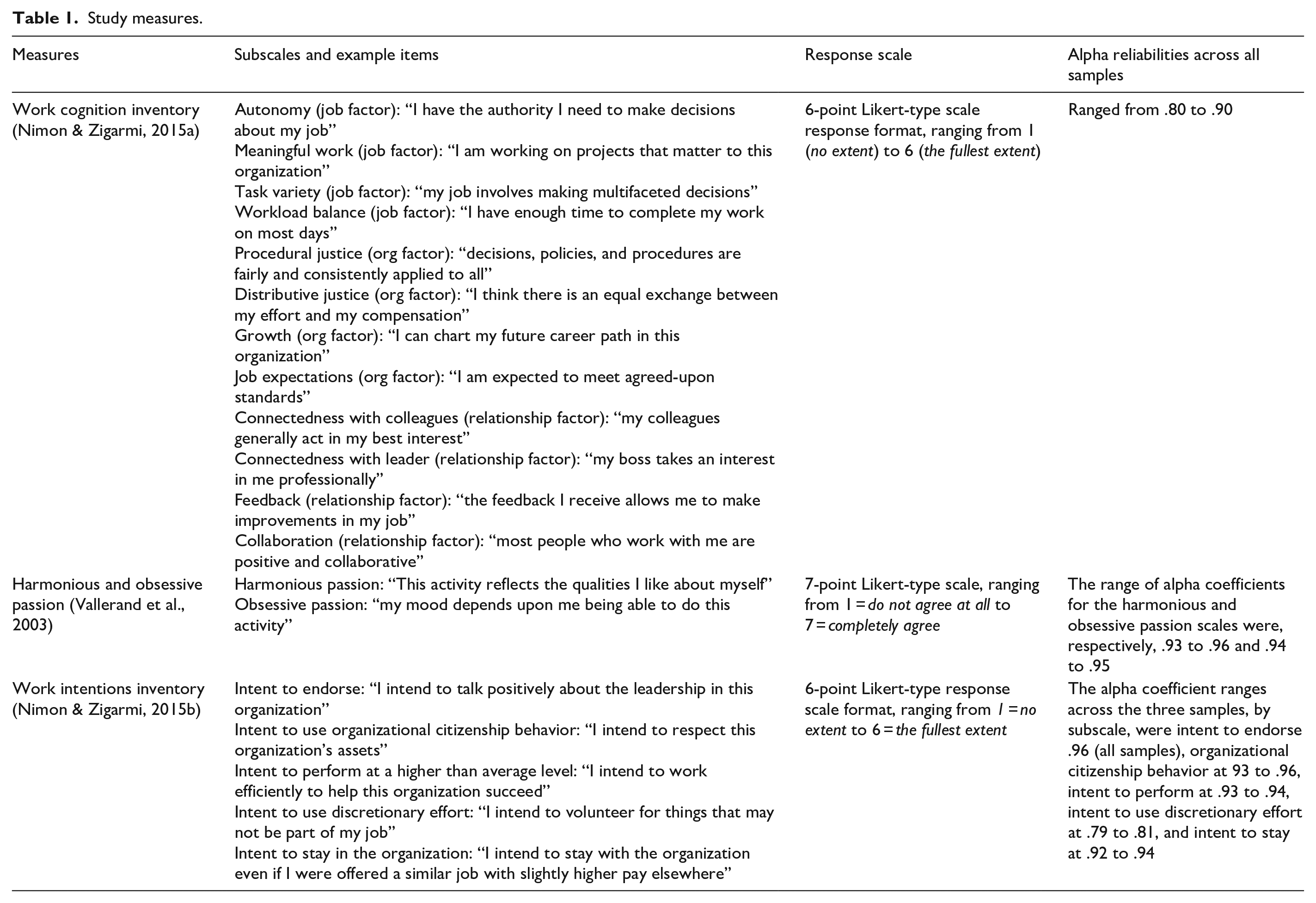
All participants were given the same battery of three instruments, which are described below. Survey instructions asked participants to rate constructs of interest while thinking about their current job and workplace. Details for all measures, including example items, response scales, and reliabilities are presented in Table 1.
Study measures.
Work environment
The work environment measure we used was the work cognition inventory (WCI) short form, which had 12 scales and 36 items (Nimon & Zigarmi, 2015a). The short form was used in this study, which empirically has been shown to have three higher order factors: job factors, organizational factors, and relationship factors (Nimon & Zigarmi, 2015a). In this article, we use the WCI to measure respondents’ cognitive evaluations of their work environments, so we refer to employees’ cognitive evaluations as “work environment.”
Harmonious and obsessive passion
The passion instrument used in this study had 14 items and was from Vallerand et al. (2003). The passion instrument includes two, seven-item scales: harmonious passion and the obsessive passion.
Work intentions
The work intentions inventory (WII) short form included 15 items, representing five work intentions scales (Nimon & Zigarmi, 2015b). The five intentions scales which included three items each, were intent to endorse, intent to use OCB, intent to perform at a higher than average level, intent to use discretionary effort, and intent to stay in the organization.
Results
Sample 1: SEM results
Table 2 provides results from preliminary analyses summarizing correlations, means, standard deviations, and reliabilities for all variables in Sample 1 (Tables 3 and 4 provide the same for Samples 2 and 3). The primary analysis used for this study was structural equation modeling (SEM). Model fit in SEM was evaluated using the following indices: chi-square, the comparative fit index (CFI), and standardized root mean residual (SRMR). After running preliminary analyses in SPSS, we used EQS to run competing measurement models and structural models for hypotheses testing.
Study 1—scale score means, standard deviations, reliabilities, and correlations.
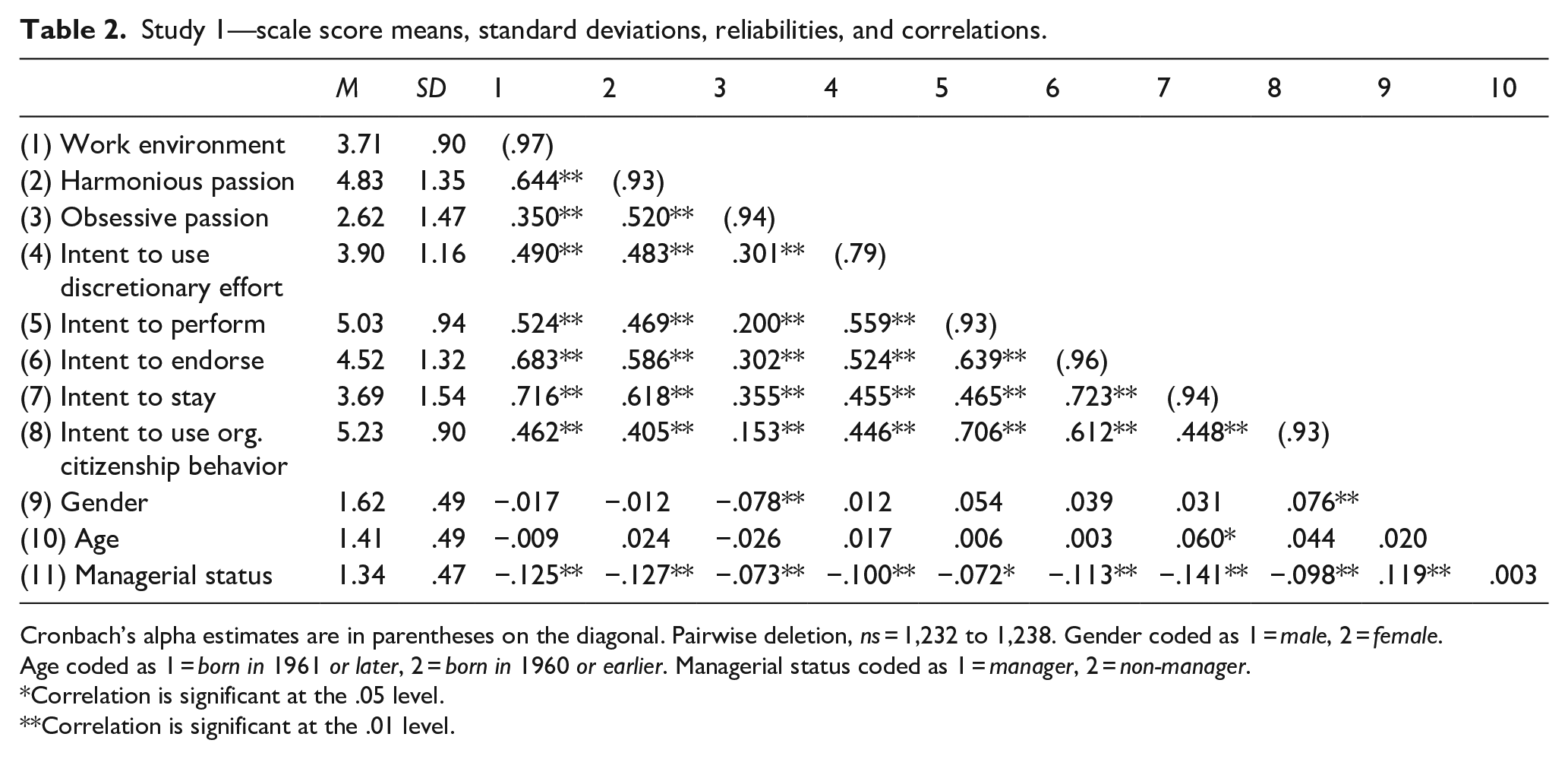
Cronbach’s alpha estimates are in parentheses on the diagonal. Pairwise deletion, ns = 1,232 to 1,238. Gender coded as 1 = male, 2 = female.
Age coded as 1 = born in 1961 or later, 2 = born in 1960 or earlier. Managerial status coded as 1 = manager, 2 = non-manager.
Correlation is significant at the .05 level.
Correlation is significant at the .01 level.
Sample 2—scale score means, standard deviations, reliabilities, and correlations.
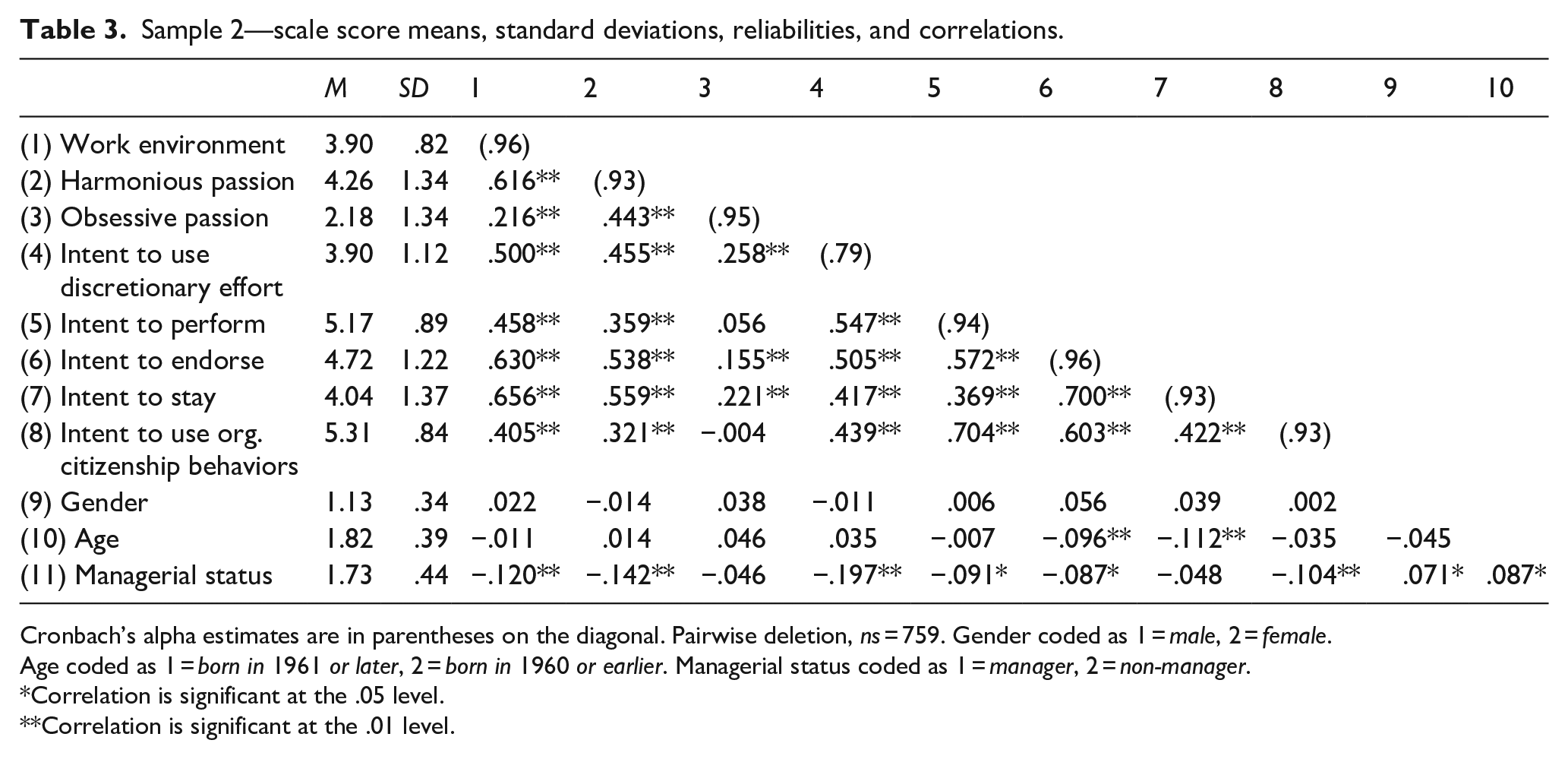
Cronbach’s alpha estimates are in parentheses on the diagonal. Pairwise deletion, ns = 759. Gender coded as 1 = male, 2 = female.
Age coded as 1 = born in 1961 or later, 2 = born in 1960 or earlier. Managerial status coded as 1 = manager, 2 = non-manager.
Correlation is significant at the .05 level.
Correlation is significant at the .01 level.
Sample 3—scale score means, standard deviations, reliabilities, and correlations.
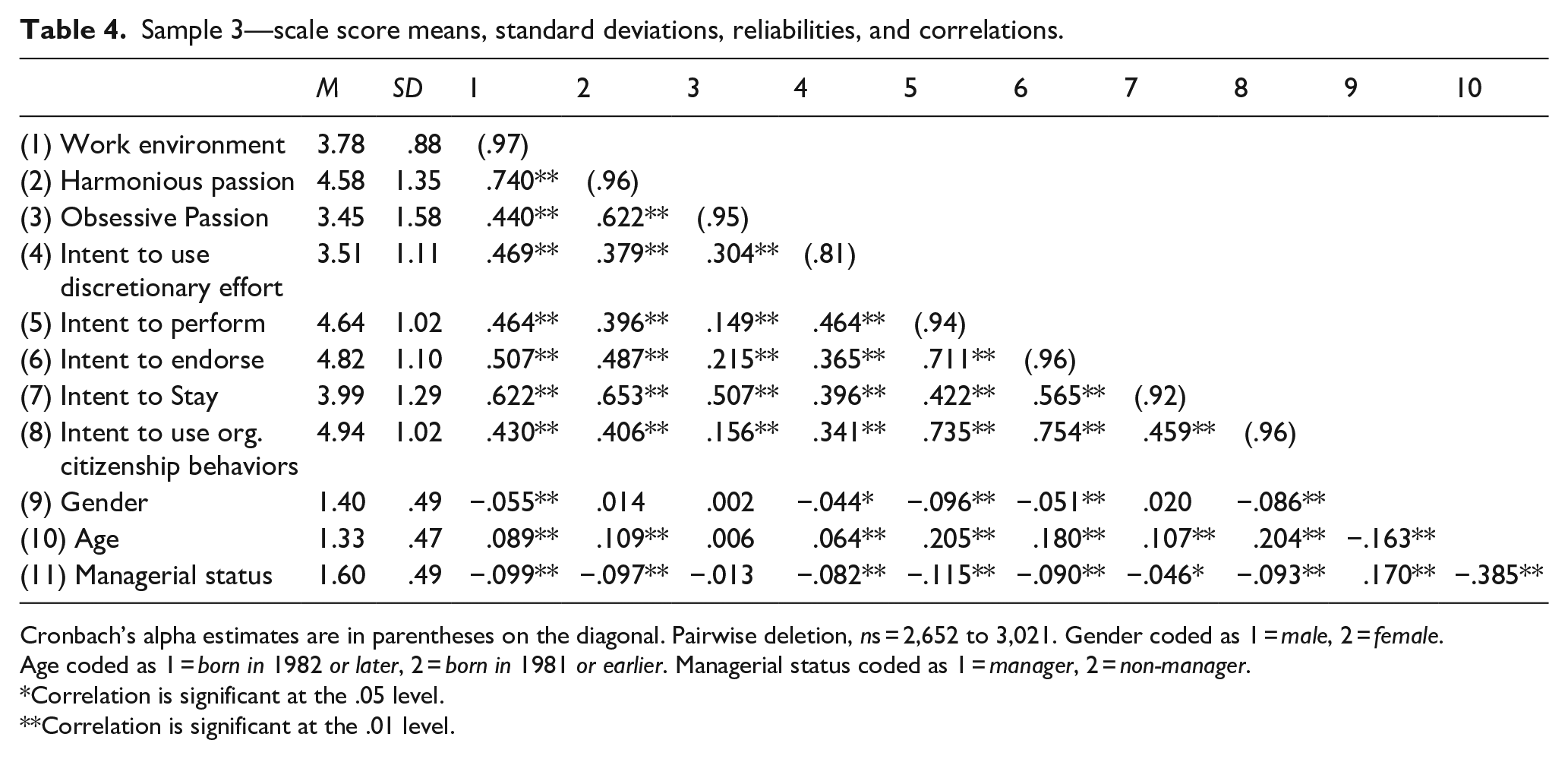
Cronbach’s alpha estimates are in parentheses on the diagonal. Pairwise deletion, ns = 2,652 to 3,021. Gender coded as 1 = male, 2 = female.
Age coded as 1 = born in 1982 or later, 2 = born in 1981 or earlier. Managerial status coded as 1 = manager, 2 = non-manager.
Correlation is significant at the .05 level.
Correlation is significant at the .01 level.
Measurement models (international sample)
Measurement and construct validity work on the WCI was conducted by Nimon and Zigarmi (2015a), and confirmed a third-order factor model for the WCI. Not all our samples could successfully estimate the WCI in accordance with the third-order factor model, so in keeping with the underlying factor structure identified by Nimon and Zigarmi (2015a), we minimized the number of parameters to be estimated for structural equation modeling by estimating a first-order latent variable representing the WCI from three observed scores: the mean of all job factors, the mean of all organizational factors, and the mean of all relationship factors.
For harmonious and obsessive passion, we followed parceling procedures similar to those used by Carbonneau et al. (2008), whereby for Parcel 1 of harmonious passion we calculated the mean of items 1 and 2, for Parcel 2 we calculated the mean of items 3 and 4, and for Parcel 3 we calculated the mean of items 5, 6, and 7. The same was done for obsessive passion. In Sample 1 (and for Samples 2 and 3), our parceling procedure demonstrated good measurement model fit for harmonious and obsessive passion items modeled as theoretically anticipated into two latent factors, as compared to a measurement model where harmonious and obsessive passion items all loaded onto a single latent factor (Δχ2[1] = 1,932.06, p < .001). Parceling in this way provided good measurement model fit for all samples.
We also compared five-factor and one-factor measurement models for our work intentions variables. The five-factor model, where all work intentions items were specified to load onto their respective latent factor, fit the data significantly better than a model that specified all work intentions items to load onto a single latent factor (Δχ2[10]= 6,273.81, p < .001). Finally, for the full measurement model, in Sample 1 we found that an eight-factor model that designated all observed items to load onto each of their expected latent factors fit the data well (χ2[224]= 1,346.620, CFI = .96, SRMR = .05) and much better than a model allowing all observed items to load onto a single latent factor (Δχ2[28]= 11,620.40, p < .001). For our final eight-factor measurement model in Sample 1, ranges of factor loadings were as follows: .837–.922 for WCI, .860–.941 for harmonious passion, .804–.955 for obsessive passion, .674–.821 for intent for discretionary effort, .882–.924 for intent to perform, .932–.955 for intent to endorse, .852–.959 for intent to remain, and .874–.945 for intent to use OCB. See Table 5 for a summary of measurement models across samples.
Measurement model and item factor loadings summary—all samples.
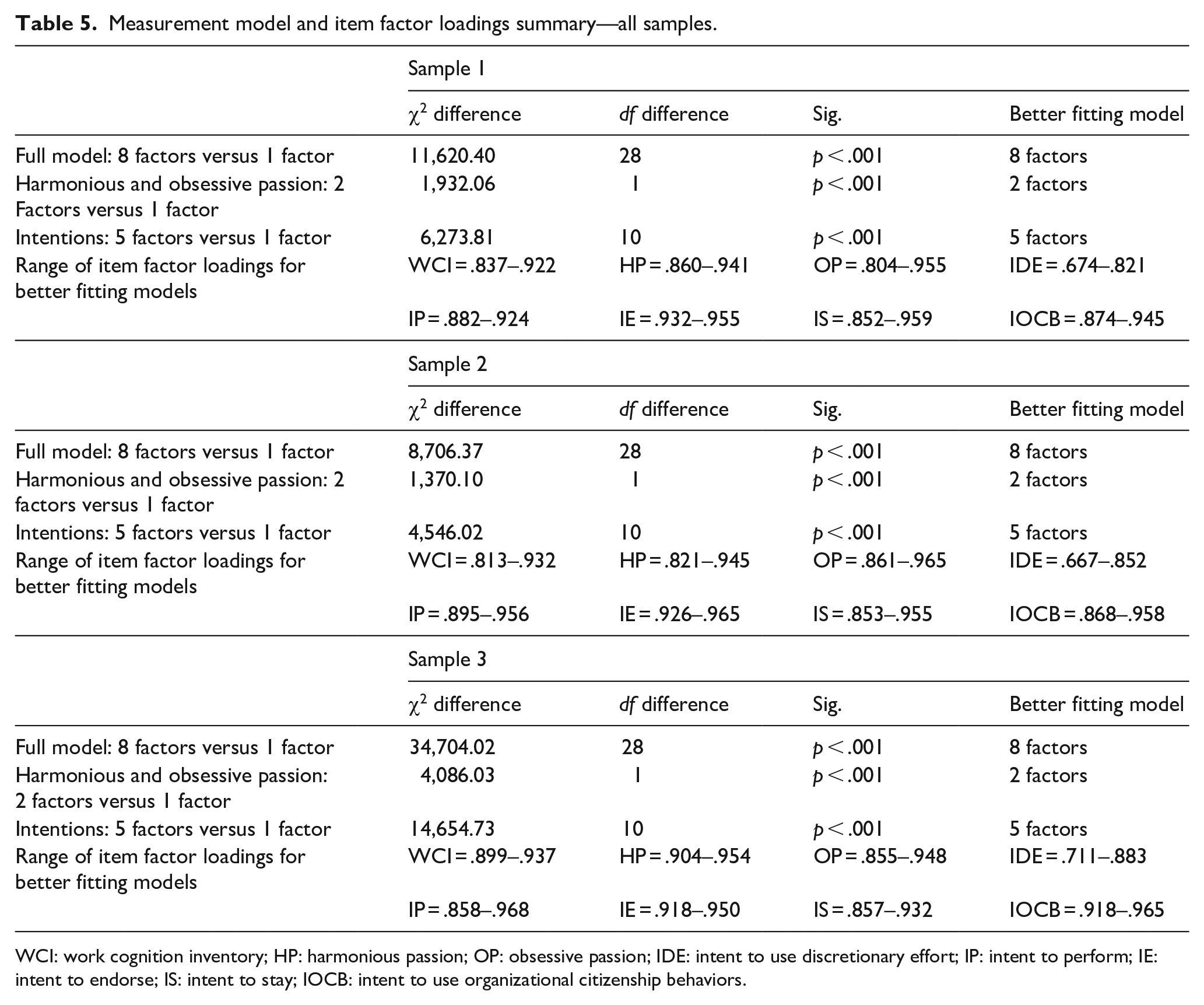
WCI: work cognition inventory; HP: harmonious passion; OP: obsessive passion; IDE: intent to use discretionary effort; IP: intent to perform; IE: intent to endorse; IS: intent to stay; IOCB: intent to use organizational citizenship behaviors.
Structural models and mediation testing (international sample)
All structural equation models were run while controlling for respondent gender, age, and manager versus non-manager role. In Sample 1 (and for Samples 2 and 3), we specified the disturbance terms for our harmonious and obsessive passion latent variables to covary, because we would anticipate these constructs to correlate and due to our preliminary analysis indicating that these variables were indeed correlated. We also allowed disturbance terms for our five work intentions variables to covary, as they are also theoretically expected to correlate. No error terms for observed variables were allowed to covary.
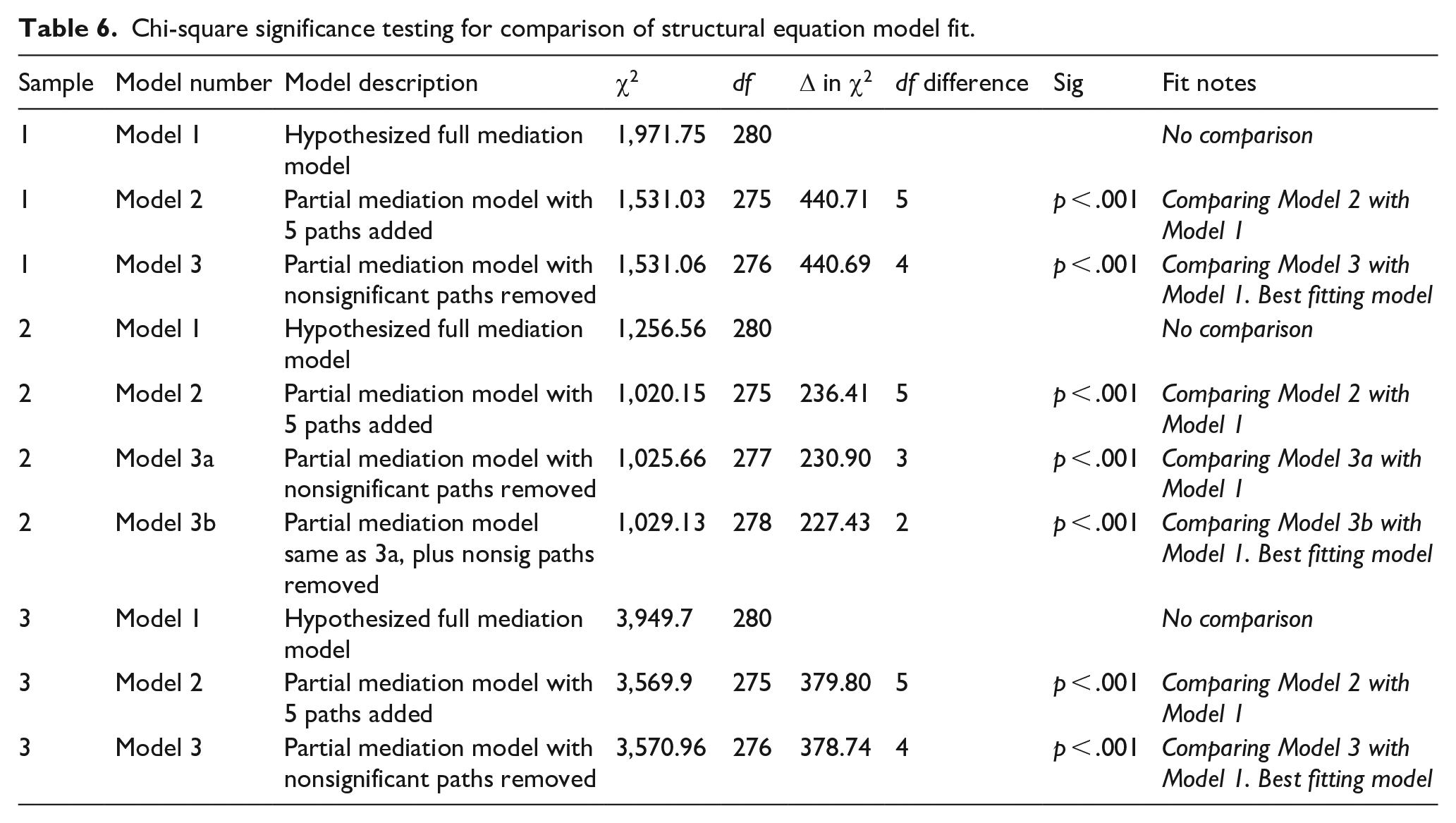
In Sample 1, our hypothesized Model 1 tested harmonious and obsessive passion as mediators of the relationship between work environment and work intentions, and we found that the model fit the data well (χ2[280] = 1,971.745, CFI = .941, SRMR = .076). Then in Model 2 we investigated the possibility of partial mediation, whereby direct paths were added from work environment to each of the five work intentions variables. Model 2 demonstrated significantly better fit to the data than Model 1 (Δχ2[5] = 440.71, p < .001). We next ran Model 3, which dropped all nonsignificant paths from Model 2 (i.e., the one path from obsessive passion to intent to endorse). Model 3 fit the data significantly better than Model 1 (Δχ2[4] = 440.69, p < .001). We retained Model 3 as our most parsimonious and final structural model for Sample 1 (χ2[276] = 1,531.057, CFI = .956, SRMR = .045). Chi-square significance testing is provided in Table 6, and path coefficients for Models 1 and 3 are shown in Figures 2 and 3, respectively. R-squared values for our latent variables in Model 3 for harmonious passion, obsessive passion, intent to use discretionary effort, intent to perform, intent to endorse, intent to stay, and intent to use OCB were .46, .16, .37, .33, .54, .61, .27, respectively.
Chi-square significance testing for comparison of structural equation model fit.
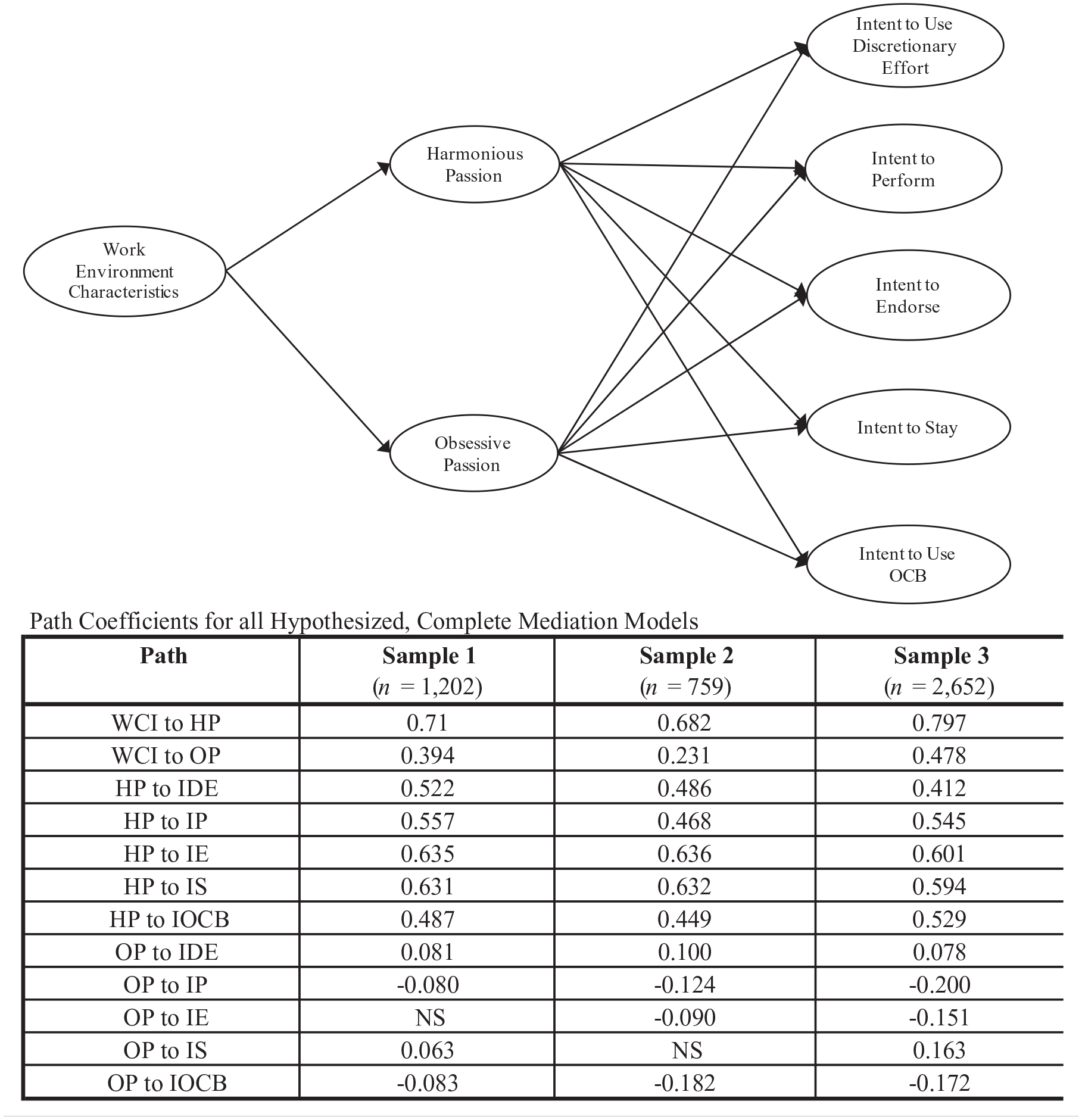
Path coefficients for all hypothesized, complete, mediation models.
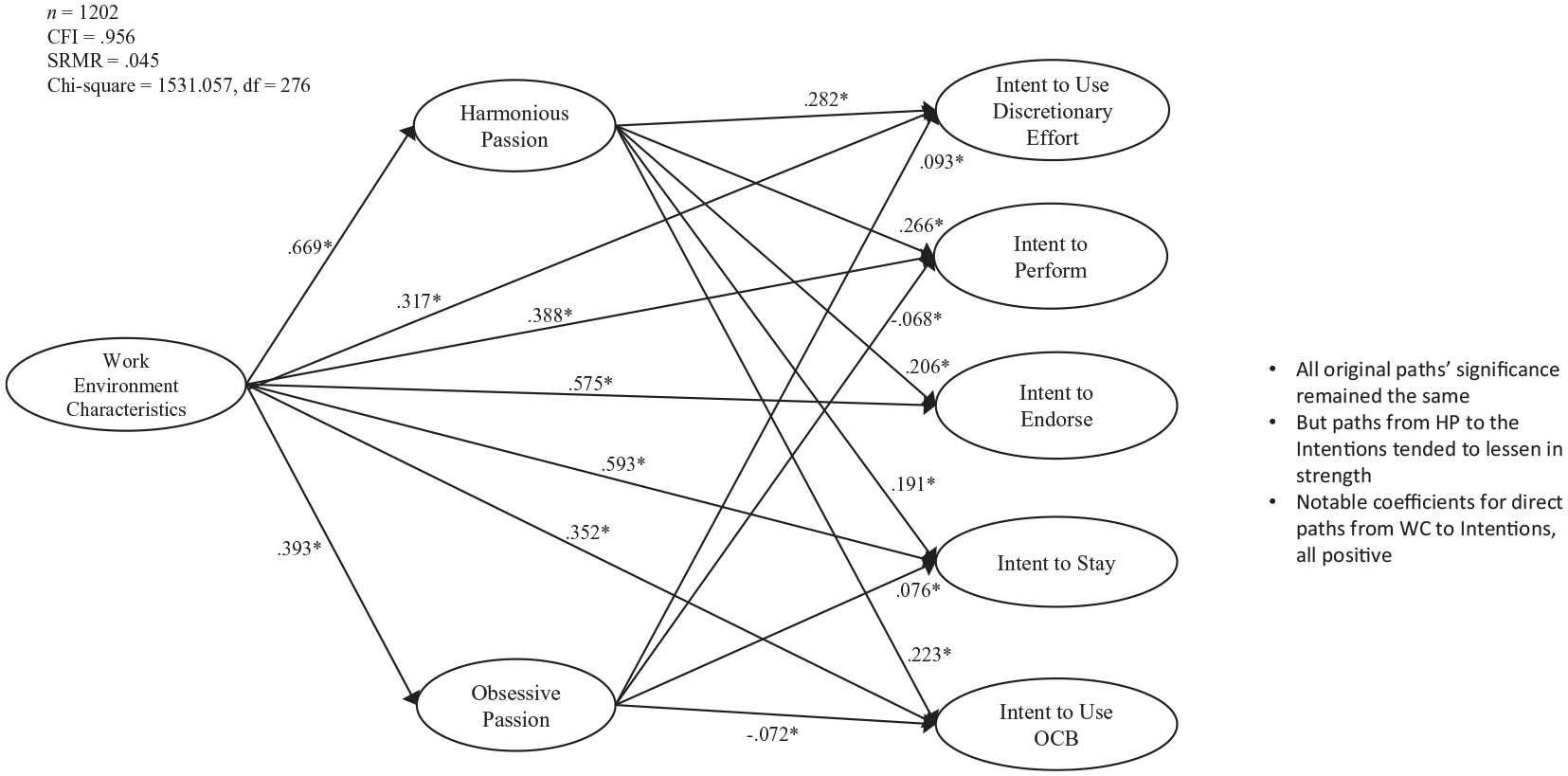
International sample, final model (Sample 1, Model 3).
Sample 2: SEM results
Preliminary analyses and measurement models (electrical contracting company)
Table 3 provides initial correlations and reliabilities for variables in Sample 2. In Sample 2, we used the same procedures as those used in Sample 1 to build and test our measurement models (see Table 5).
Structural models (electrical contracting company)
As in Sample 1, all structural equation models in Sample 2 were run with respondent age, gender, and manager versus non-manager role as control variables. The same hypothesized model was tested in Sample 2 as in Sample 1, and across both samples the same specifications were made for disturbance terms for our harmonious and obsessive passion latent variables and for our five work intentions variables. Also, in Sample 2 we did not allow error terms for observed variables to covary.
The process used in Sample 1 for testing across competing structural models was followed for Sample 2 as well. In Sample 2, for Model 1 we again tested harmonious and obsessive passion as mediators of the association between work environment and work intentions, and the model demonstrated adequate fit to the data (χ2[280] = 1,256.557, CFI = .947, SRMR = .075). For Model 2, we added direct paths from work environment to our five work intentions. Compared to Model 1, Model 2 showed significantly better fit (Δχ2[5] = 236.41, p < .001). Then we dropped the two nonsignificant paths indicated in Model 2 (i.e., the path from obsessive passion to intent to endorse, and the path from obsessive passion to intent to stay) to run Model 3a. However, in Model 3a, one formerly significant path had become nonsignificant (i.e., the path from obsessive passion to intent to perform). Therefore, we ran Model 3b, which was the same as Model 3a but with the path from obsessive passion to intent to perform removed. Model 3b fit the data significantly better than Model 1 (Δχ2[2] = 227.43, p < .001) and Model 3b fit the data well (χ2[278] = 1,029.125, CFI = .959, SRMR = .044). Table 6 includes results from chi-square significance testing, and Figures 2 and 4 provide path coefficients for Models 1 and 3b. For the final Model 3b, R-squared values for our latent variables were as follows: .44, .06, .40, .24, .48, .54, .20, respectively, for harmonious passion, obsessive passion, intent to use discretionary effort, intent to perform, intent to endorse, intent to stay, and intent to use OCB.
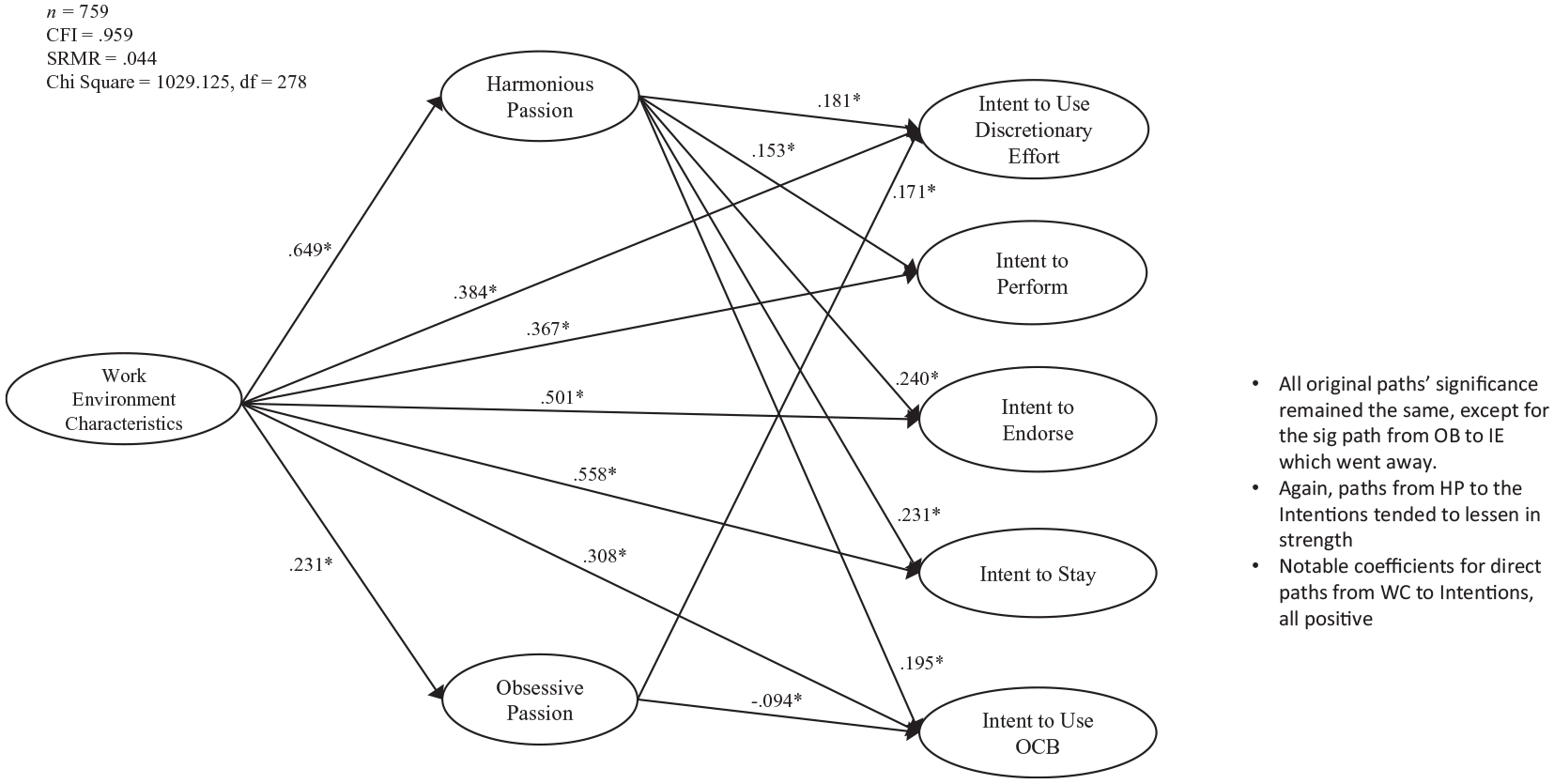
Electrical contracting company, final model (Sample 2, Model 3b).
Path coefficients for our hypothesized, complete mediation Model 1 in Sample 2 were similar to those observed in our hypothesized, complete mediation Model 1 of Sample 1, so for purposes of word length we will not repeat interpretations that were consistent across samples. Instead, we summarize all path coefficients for our hypothesized models across samples in Figure 2.
Sample 3: SEM results
Measurement and structural models (banking and investment firm)
Sample 3 used the same preliminary analyses and measurement model testing approaches as Samples 1 and 2; see Tables 4 and 5. For Sample 3, we controlled for the same demographics as in Samples 1 and 2 (i.e., respondent age, gender, and manager versus non-manager role), and we tested the hypothesized model using the same procedure as in the other two samples.
In Sample 3 for our hypothesized Model 1, we evaluated harmonious and obsessive passion as mediators of the relationship between work environment and work intentions, and we found that the data fit the model well (χ2[280] = 3,949.702, CFI = .948, SRMR = .062). Then for Model 2 we tested for partial mediation by adding direct paths from work environment to all work intentions latent variables. Model 2 showed significantly better fit (Δχ2[5] = 379.80, p < .001), relative to Model 1. We next tested Model 3 by replicating Model 2 while removing the one nonsignificant path in Model 2 (i.e., the path from harmonious passion to intent to use discretionary effort). The data fit Model 3 significantly better than Model 1 (Δχ2[4] = 378.74, p < .001), so for parsimony Model 3 was identified as our final model (χ2[276] = 3,570.959, CFI = .953, SRMR = .049). Chi-square significance testing across our structural models is provided in Table 6, and path coefficients for Models 1 and 3 are shown in Figures 2 and 5. For Model 3, latent variables’ R-squared values for harmonious passion, obsessive passion, intent to use discretionary effort, intent to perform, intent to endorse, intent to stay, and intent to use OCB were, respectively, .62, .23, .30, .27, .32, .55, and .25.
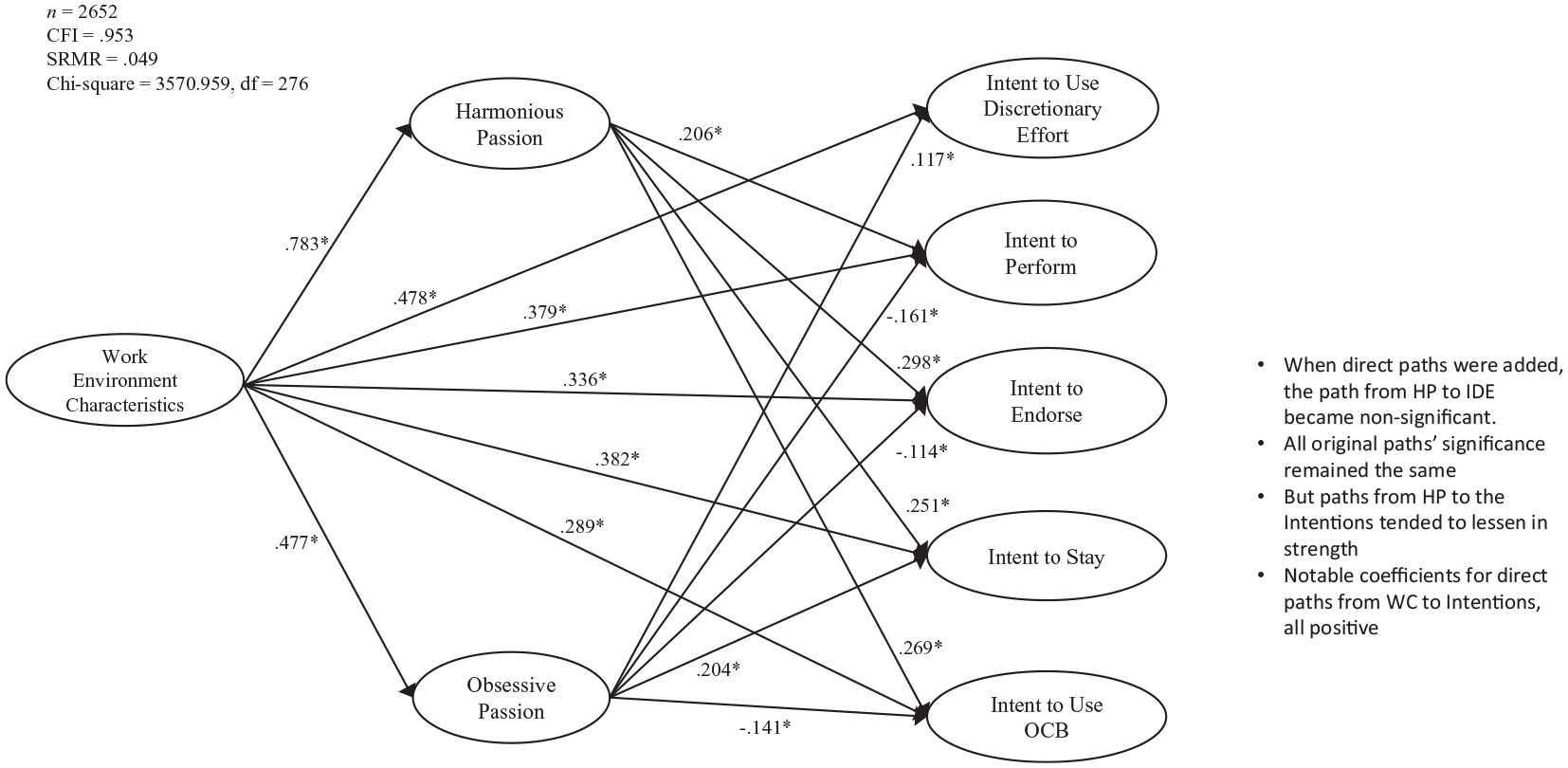
Banking and investment firm, final model (Sample 3, Model 3).
Partial mediation and decomposition of effects results (Samples 1–3)
While models were being compared within each sample, similar effects were observed upon the addition of direct paths from work environment to the five work intentions. Namely, for all three samples, when these direct paths were added, the relationships between harmonious passion and work intentions decreased somewhat. Across Samples 1–3, for our full mediation models, path coefficients from harmonious passion to work intentions ranged from .412 to .636; whereas, upon adding the direct paths from work environment to work intentions in subsequent models, path coefficients from harmonious passion to work intentions ranged from .153 to .298, thereby supporting the importance of work characteristics perceptions in employees’ appraisal process.
Effects decomposition analyses were generated from our EQS output from our final structural models using the RMediation package (MacKinnon et al., 2007); from this we generated indirect effects from work environment characteristics through each mediator (harmonious and obsessive, separately) onto our five work intentions. Effects decomposition analyses results are provided in Table 7. Small-to-medium significant indirect effects were apparent for harmonious passion, whereas the indirect effects for obsessive passion were much weaker with a few exceptions.
All samples—indirect effects of work environment on intentions through harmonious and obsessive passion.
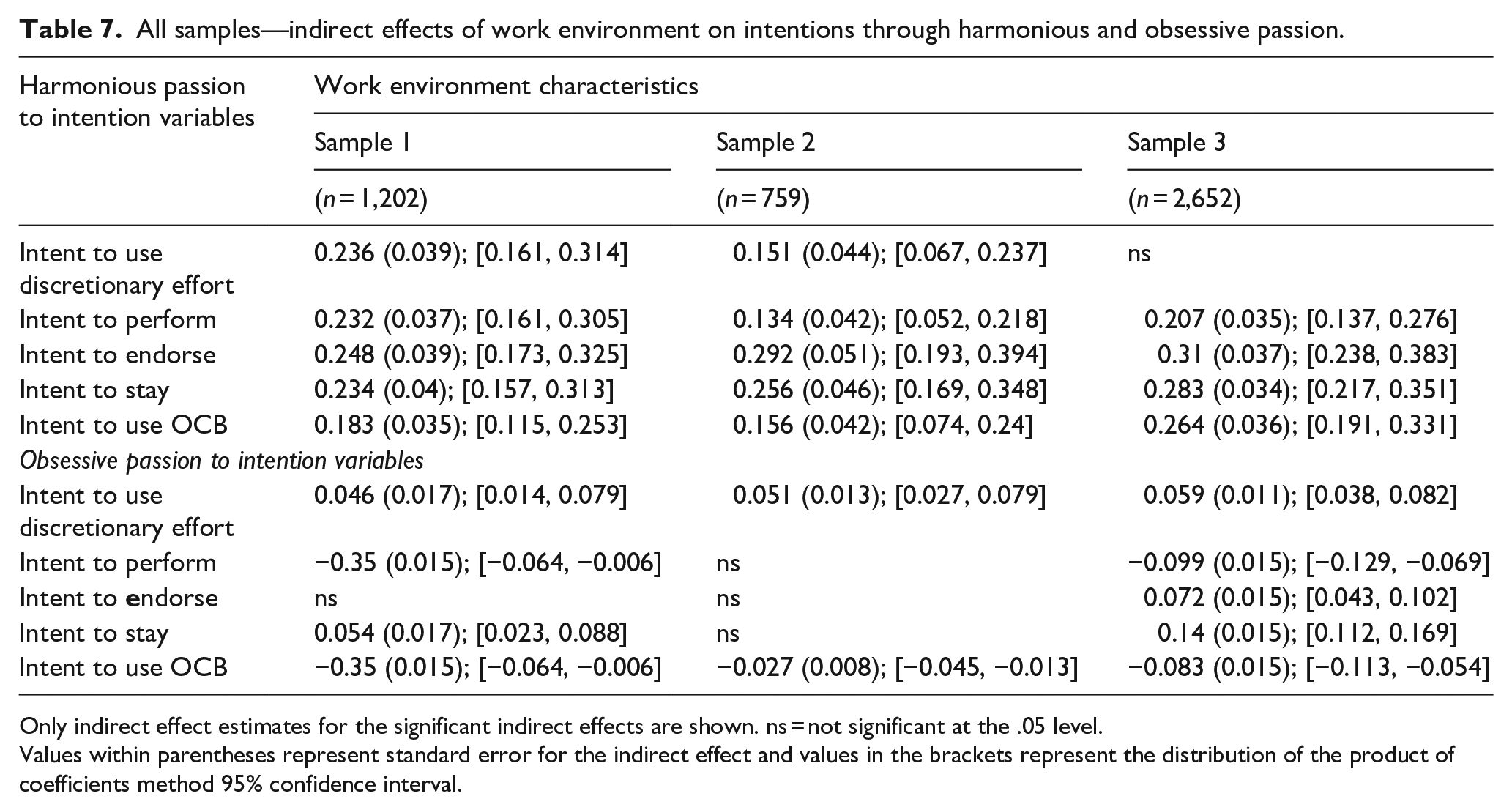
Only indirect effect estimates for the significant indirect effects are shown. ns = not significant at the .05 level.
Values within parentheses represent standard error for the indirect effect and values in the brackets represent the distribution of the product of coefficients method 95% confidence interval.
For researchers interested in studying the relationship between work environment characteristics and work intentions, see Table 8: we conducted exploratory hierarchical multiple regressions to probe for how job, relationship, and organizational characteristics of employees’ work environment may relate to each of the five work intentions.
Exploratory Hierarchical Multiple Regressions—job, relationship, and organizational characteristics (work environment characteristics) and work intentions.
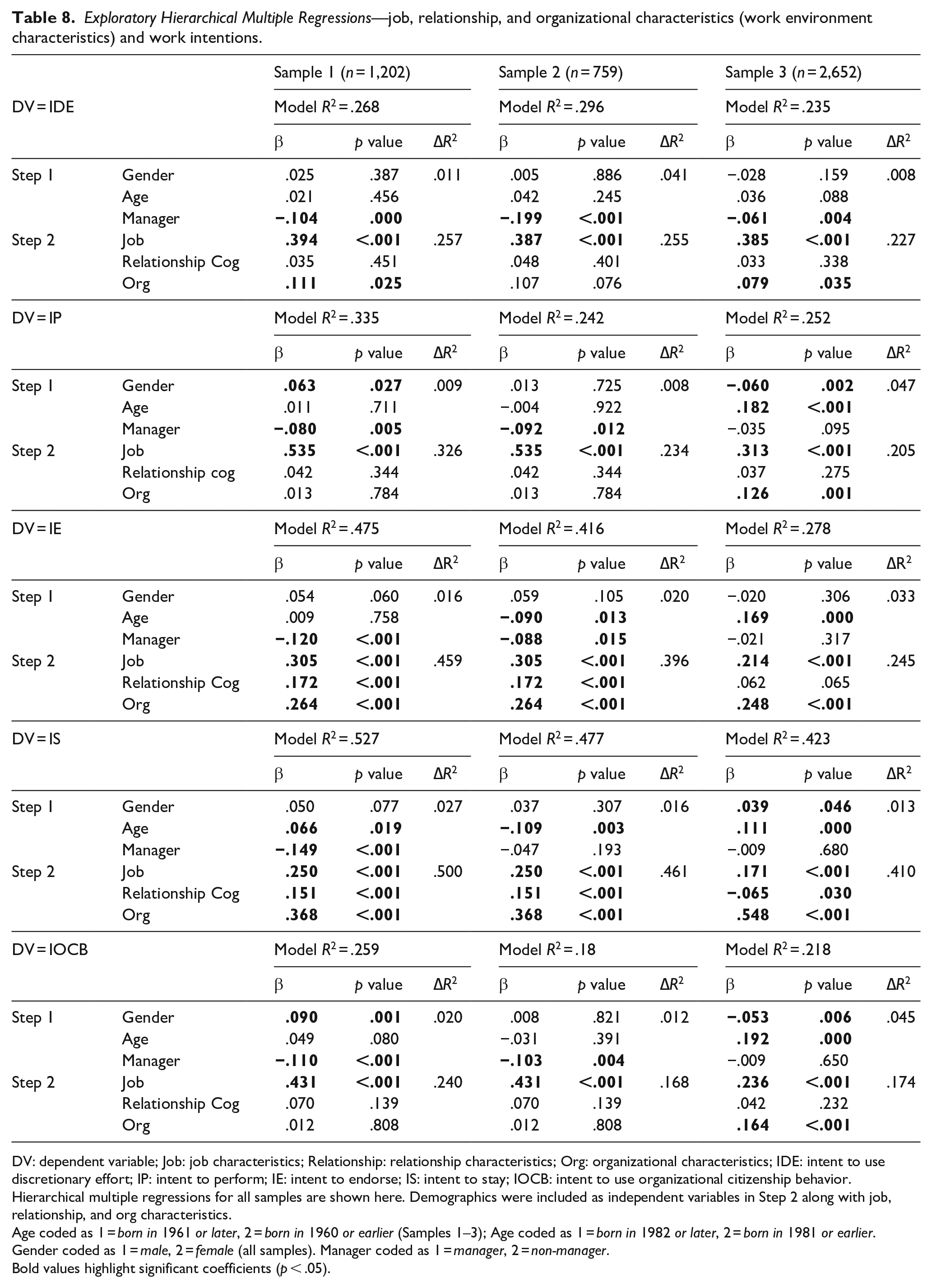
DV: dependent variable; Job: job characteristics; Relationship: relationship characteristics; Org: organizational characteristics; IDE: intent to use discretionary effort; IP: intent to perform; IE: intent to endorse; IS: intent to stay; IOCB: intent to use organizational citizenship behavior.
Hierarchical multiple regressions for all samples are shown here. Demographics were included as independent variables in Step 2 along with job, relationship, and org characteristics.
Age coded as 1 = born in 1961 or later, 2 = born in 1960 or earlier (Samples 1–3); Age coded as 1 = born in 1982 or later, 2 = born in 1981 or earlier.
Gender coded as 1 = male, 2 = female (all samples). Manager coded as 1 = manager, 2 = non-manager.
Bold values highlight significant coefficients (p < .05).
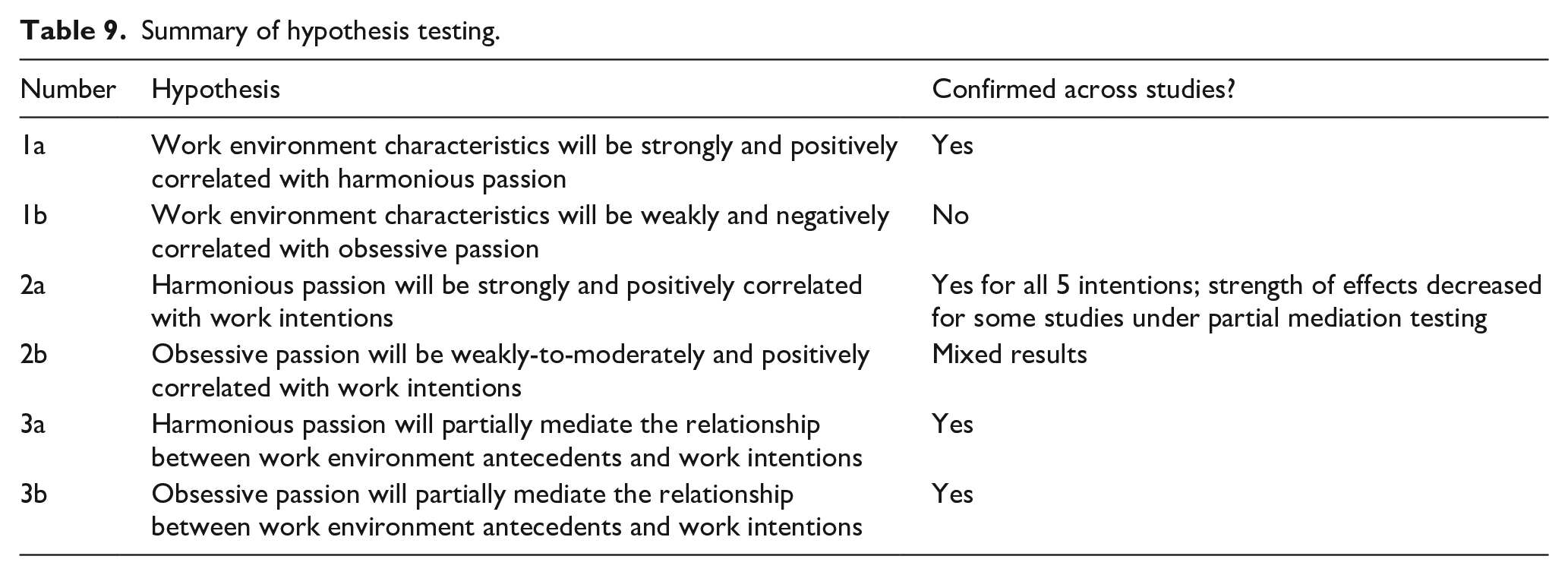
In this investigation, many of our anticipated relationships across various components of the EWPA model were confirmed across samples. A summary of the results of all hypotheses tested is provided in Table 9.
Summary of hypothesis testing.
General discussion
By testing several EWPA models across three samples, our work responded to calls from Perrewé et al. (2014) and to Egan et al. (2017) to expand a body of research in pursuit of a better understanding of work passion, its relationship with related constructs, and its exploration within different organizational contexts. Thus, our investigation built upon a growing body of research that empirically tests the EWPA model (Zigarmi et al., 2019). This research is significant in four specific ways.
First, much of the research done thus far on passion has been focused upon intrapersonal outcomes such as well-being, positive affect, performance, and states of flow—outside the context of work (see Curran et al., 2015). This study examined passion for work in various organizational settings, thereby adding to what is known about how passion operates in professional contexts. Second, this study is significant because, up to this point in time, we have not yet found empirical research on the EWPA model that comprehensively tests relationships between employee perceptions of job, and relationship, and organizational work environment characteristics. Future work is needed to investigate specific antecedents of the EWPA model, but this study offers an initial glimpse of how an array of work characteristic antecedents could explain an employee’s work passion appraisal process. This study is the first we know of that tests harmonious and obsessive passion for work within the context of the EWPA model. Third, this study confirmed and replicated empirical relationships in support of the EWPA model for three samples. Replication studies are rare, but needed.
Fourth, our empirical analysis across three samples revealed differentially significant relationships for harmonious and obsessive passion as partial mediators between employees’ perceptions of their work environment characteristics and their work intentions. These results are in keeping with the initial findings of Vallerand et al. (2014) regarding how harmonious and obsessive passion correlated differently with related constructs. We similarly found that employees’ perceptions of their work environment characteristics were related to their individual experiences of harmonious and obsessive passion, and each form of passion (i.e., harmonious and obsessive) differently correlated with various work intentions.
Notably, for the three samples, work environment was moderately and positively related to obsessive passion (path coefficients ranged from .231 to .477 across samples), and work environment was strongly and positively correlated with harmonious passion (path coefficients ranged from .649 to .783 across samples). Employees who perceived their work environments more favorably were more likely to report higher levels of obsessive passion, and this effect was even stronger for harmonious passion. The direction of the relationship between work environment and obsessive passion was surprising. As Mageau et al. (2009) found that autonomy support strategies were related to the formation of harmonious passion, it would be interesting to know which of the twelve work environment factors measured on the WCI might relate to autonomy support strategies, and ultimately to autonomous versus controlled motivational outlooks in employees. Thibault-Landry et al. (2018) found evidence for the connection between work environment and psychological need satisfaction, and Lalande et al. (2017) concluded that obsessive passion could be a compensatory mechanism to satisfy unmet psychological needs, but additional research is needed on how qualities of the work environment lead to psychological need satisfaction, motivational outlooks, and work passion in employees. Perhaps employees can rate their work environment favorably despite operating under various kinds of motivation at once. Applying self-determination theory, if an employee’s basic psychological needs are met by their work environment, then that employee is likely to develop autonomous motivational outlooks; furthermore, if an employee is acting purely from autonomous motivation, we would expect them to also be exercising harmonious passion. However, obsessive passion’s motivational foundations seem more complex than those of harmonious passion, according to empirical evidence found by Zigarmi et al. (2018); to the best of our knowledge that complexity—if accurate—is not yet fully addressed by existing definitions of obsessive passion. Specifically, in Zigarmi et al. (2018), while accounting for locus of control, obsessive passion somewhat directly correlated with controlled motivation (as we would expect from Vallerand and colleague’s definition of obsessive passion), it more largely directly correlated with autonomous regulation. Therefore, if obsessive passion notably relies on autonomous motivation to propel employees’ productivity forward, perhaps it makes sense that well-designed workplaces would inspire autonomous motivation, harmonious passion, and obsessive passion in employees. Overall, the positive relationship we found between work environment and obsessive passion raises important questions for investigating the formation of obsessive passion in the workplace.
Another possibility for explaining the positive relationship between work environment and obsessive passion is that an employee’s personal characteristics (e.g., neuroticism, locus of control, cynicism) may lead them to hold non-autonomous motivational outlooks (see Zigarmi et al., 2018), and that individual characteristics may contribute to the formation of obsessive passion, more than work environment characteristics. This idea is an area for future research, and additionally, more work is needed on the connection between employees’ basic need satisfaction and obsessive passion.
This study revealed that harmonious passion, which is typified by autonomous regulation, has strong positive correlations with five desirable work intentions. Alternatively, obsessive passion in this study showed mixed direction, or nonsignificant, correlations with desirable work intentions. Where paths were significant, the direction of relationships between obsessive passion and two of the five work intentions variables was interesting. Obsessive passion related positively, although weakly, to intent for discretionary effort in all three samples and to intent to stay in two of three samples. These findings regarding the weak direct relationship between obsessive passion and intent for discretionary effort and intent to stay replicate what was found in Zigarmi et al. (2018). Furthermore, the positive direction of these relationships is in line with how Pollack et al. (2020) found some direct relationships between obsessive passion and positive valence work-specific outcomes; however, our study’s work intentions were different from the outcomes used in the meta-analysis by Pollack and colleagues. The exception for this lack of overlap was for OCB; Pollack et al. (2020) found a positive relationship between obsessive passion and OCB, but our study found negative, albeit weak relationships between obsessive passion and intent for OCB across three samples. More research is needed to understand the connection between obsessive passion and workplace outcomes. It seems that obsessive passion, for some types of work performance, inspires people to be productive, even if the nature of that productivity may be healthy or unsustainable in the long run. The above findings support previous research that identifies harmonious and obsessive passion as separate constructs (Curran et al., 2015; Vallerand, 2008; Vallerand et al., 2014).
Employees reporting high harmonious passion were more likely than those with low harmonious passion to demonstrate favorable work intentions in general, although the same tends to be true (but the effect is weaker) for employees who report high levels of obsessive passion when it comes to intending to put forth extra effort for their organization. Moderate-to-large positive and significant direct paths between work environment and the five work intentions (across Samples 1–3, path coefficients ranged from .289 to .593) indicated that employees who rated their work environment highly were more likely than those with low-rated work environments to score highly on favorable work intentions.
Limitations and future directions
The organizational samples presented in this article come with some limitations. We used cross-sectional data, so we are unable to make statements about causality and the order of observed effects among variables. We recommend that future researchers consider conducting studies using longitudinal design, as such approaches would enable greater conclusions regarding causality to be drawn about constructs of interest within the EWPA model. Longitudinal design would be particularly valuable to evaluate mediation effects in future studies. Or, qualitative approaches could potentially lend rich insight into the experiences of employees while they feel different kinds of passion at work, perhaps beyond the existing framework of the EWPA model. Research studies that compare employees from individualist and collectivist cultures could lend further insight into how the EWPA model operates across contexts.
Our study’s self-report, single-source design could make it susceptible to common method bias. However, we believe self-ratings are appropriate for capturing the substantive psychological variables in this study, as they ultimately are best known by the employees experiencing them (Chan, 2009). Nevertheless, we took some action to protect against the possibility of common method bias by selecting measures with variant response scales (e.g., harmonious/obsessive passion featured a 7-point agreement scale, while our work intentions measures had a 6-point extent scale). We also changed the referent of the questions for respondents, such that sometimes they rated perceptions of their work environment, and at other times they were rating their intrapersonal levels of intentions to perform on the job. Both design decisions can help guard against common method bias, but to probe further, we used Harman’s single factor exploratory factor analysis procedure (Podsakoff et al., 2003; Podsakoff & Organ, 1986). The number of factors and percent of variance accounted by the first factor were 11% and 40% (Sample 1), 12% and 37% (Sample 2), and 10% and 42% (Sample 3). All samples demonstrated many factors and less than 50% variance accounted for by the first factor extracted, indicating that common method bias was not a substantial problem in this study. That said, additional studies could include other-ratings or multi-source data to diversify the data sources used for analysis, which could help safeguard against potential limitations noted above.
Finally, our exploratory hierarchical multiple regressions in Table 8 revealed that job factors of the WCI were predictive of all work intentions across all three samples. In addition, we found that relationship factors and organizational factors of the WCI were largely only significant for intent to endorse and intent to stay, not for the other three work intentions. Future researchers interested in studying antecedents within the EWPA model could analyze how specific job factors in the WCI (i.e., autonomy, meaningful work, task variety, and workload balance) relate to work intentions. A comprehensive study is needed to test all 12 environmental antecedent work cognition factors in relationship to harmonious/obsessive passion and work intentions. Also, given the effect sizes of the relationship between organizational factors of the WCI and intent to endorse and intent to stay, future research could dive deeper into how subscales of the organizational factors (i.e., distributive justice, procedural justice, growth, and performance expectations) may predict employees’ willingness to speak well of their organizations and remain with their organizations.
Practical implications
This investigation supports the validity and practical utility of the EWPA model, particularly in developing a better understanding of how an employee’s work environment and passion for their work relates to their intentions to perform well for their organization. Furthermore, the degree of harmonious or obsessive passion will relate to positive work intentions. Notably, a favorable work environment will positively and strongly correlate with employees’ levels of harmonious passion.
Practitioners who are interested in training interventions to increase work passion in their employees could look beyond characteristics of the individual employee by also considering the work environment for potentially detrimental effects. In addition, managers should note that employees who work hard and expend great discretionary effort are not necessarily doing so out of harmonious passion; they could be experiencing obsessive passion, which is not sustainable for the long term. Organizations that have employees demonstrating high levels of obsessive passion should take caution, create initiatives, and consider how their cultures may encourage better well-being among their employees.
Footnotes
Declaration of conflicting interests
The author(s) declared no potential conflicts of interest with respect to the research, authorship, and/or publication of this article.
Funding
The author(s) received no financial support for the research, authorship, and/or publication of this article.
