



Abstract
A recent cross-cultural study suggests employees may be classified, based on their scores on a measure of work ethic, into three profiles labeled as “live to work,” “work to live,” and “work as a necessary evil.” The present study assesses whether these profiles were stable before and after an extended lockdown that forced employees to work from home for 2 years because of the COVID-19 pandemic. To assess our core research question, we conducted a longitudinal study with employees of a company in the financial sector, collecting data in two waves: February 2020 (n = 692) and June 2022 (n = 598). Tests of profile similarity indicated a robust structural and configural equivalence of the profiles before and after the lockdown. As expected, the prolonged pandemic-based lockdown had a significant effect on the proportion of individuals in each profile. Implications for leading and managing in a post-pandemic workforce are presented and discussed.
JEL CLASSIFICATION: M12
Keywords
Few would disagree that the COVID-19 pandemic has had a dramatic and lasting impact on work organizations and the people in those organizations. Research to date has begun to explore the nature of this impact and the implications for leading in a post-pandemic business environment. The primary purpose of this study is to contribute to this literature by examining the impact of organizational responses to the pandemic on employees. Specifically, we focus on employee work ethic. Work ethic is defined as a values-related construct that reflects a set of attitudes and beliefs emphasizing the centrality of work in life, the value of hard work, the postponement of immediate rewards, and the constructive use of time as a resource (Miller et al., 2002). Over the past six decades, a great deal of research has developed a robust nomological network surrounding the work ethic construct, examining a broad range of attitudinal, behavioral, and dispositional correlates. This research indicates that work ethic is a distinct, relatively stable individual difference with some (albeit minimal) overlap with various aspects of personality (e.g., Christopher et al., 2010; Meriac et al., 2013; Miller et al., 2002). In addition, and perhaps more importantly, research indicates that work ethic is related to a wide range of individual behavioral outcomes. Thus, it is important for organizational leaders to understand the nature of employee work ethic as a precursor to work-related behavior and outcomes.
A recent large sample study conducted in two diverse cultures (Mexico and the United States) and using data from two different time frames (i.e., March 2020 &1998–2003, respectively) found that employees can be classified, based on their scores of a multidimensional measure of work ethic, into three general profiles or categories labeled as live to work, work to live, and work as a necessary evil (Woehr et al., 2023). In addition, the results suggest these profiles were relatively stable across the two cultures and time frames. The goal of the present study is to capitalize on the unique and serendipitous opportunity we had to examine the stability of these three profiles in the same population of employees pre- and post-lockdown because of the COVID-19 pandemic. Specifically, employee work ethic was assessed 2 weeks before they were forced to move to a work from home (WFH) modality, and 2 years later, when they started to return to work within a hybrid modality. We address two research questions. First, to what extent do the work ethic profiles that emerged prior to the lockdown also emerged following a return to in-person work? Second, to what extent does the relative representation in each profile remain the same following the lockdown? Finally, we discuss the implications of the answers to these questions with respect to leading in a post-pandemic world.
The COVID-19 pandemic and its impact on employees’ attitudes and behaviors
The disruptive, massive, and often mandatory switch to remote work affected the lives of employees in social, psychological, and health-related domains (Kniffin et al., 2021) as well as in the practices and policies of Human Resource Management in the lives of organizations (e.g., Aguinis & Burgi-Tian, 2021). Initial research in the fields of Management and Work and Organizational Psychology focused on identifying which individual differences and sociodemographic variables might predict better adaptation of individual employees to the pandemic. In essence, employees were faced with the uncertainty of a massive and abrupt global emergency that presented serious challenges, from a life-threatening disease to the more mundane reality of moving from a traditional face-to-face work modality to a novel, work-from-home modality in which interaction with family members and significant others was greatly enhanced. Several cross-sectional or longitudinal studies showed employees low in emotional stability and high in extraversion reported higher levels of anxiety and low levels of psychological well-being; on the contrary, those high on emotional stability showed a better adaption to the unknown and unpredictable length and consequences of the extended pandemic (e.g., Kocjan et al., 2021; Zacher & Rudolph, 2021).
Other research explored the psychological consequences of the prolonged lockdown with respect to specific attitudes and psychological states; for instance, it was demonstrated that the absence of informal conversations, handshakes, and other non-verbal communication gestures developed a feeling of workplace loneliness that has been shown to have a negative relationship with employees’ affective commitment and affiliative behaviors (Ozcelik & Barsade, 2018).
From the perspective of the sociodemographic variables, it was found, for instance, that individuals with higher education experienced a greater increase in depressive symptoms and a greater decrease in life satisfaction during the pandemic, in comparison with those with lower education (Wanberg et al., 2020). Regarding the health-related sphere, research indicates that, for instance, the consumption of illegal drugs and alcohol increased in working adults because of the lockdown (e.g., Mezaache et al., 2022).
In sum, research to date suggests that the disruptions that the COVID-19 pandemic brought to the lives of employees have changed to some extent their perceptions and attitudes toward jobs, work environments, and work in general. The post-pandemic demands a shift in understanding how the modality of work (i.e., fully in person, WFH, hybrid) influences employee behaviors and actions (Collings et al., 2021). Along these lines, we focus on employees’ work ethic beliefs and attitudes with respect to work in general following 2 years of enforced remote work.
Work ethic and work ethic profiles
Work ethic has been conceptualized as an individual difference construct pertaining to the importance of work in general (i.e., not a particular job or organization). Early research generally treated “work ethic” as a unidimensional construct (e.g., Mirels & Garrett, 1971). Current conceptualizations of work ethic, however, propose that work ethic is not a single unidimensional construct but a constellation of attitudes and beliefs pertaining to work (Miller et al., 2002). Miller and collaborators (2002, p. 455) provide a clear multifaceted definition of work ethic. Specifically, they propose that work ethic (a) is multi-dimensional; (b) pertains to work and work-related activities in general, is not specific to any particular job; (c) is learned; (d) reflects attitudes and beliefs (not necessarily behavior); (e) is a motivational construct reflected in behavior; and (f) is secular, not necessarily tied to a particular religion, despite early work focusing on the association of work ethic with specific religious orientations.
Based on both an exhaustive literature review and empirical research, Miller and collaborators (2002) identify seven dimensions of work ethic: (a) centrality of work, the belief that work itself is important as a main activity in the life of a person; (b) self-reliance, representing the individual’s vigor toward independence; (c) hard work, the belief that a sustained level of work is the best way to achieve a feeling of accomplishment; (d) leisure, beliefs and attitudes regarding the relevance of non-work activities; (e) morality-ethic, believing in a just and moral existence; (f) delay of gratification, the capacity to delay rewards until a later date; and (g) wasted time, the consciousness of the value of time. Based on this framework, they developed the Multidimensional Work Ethic Profile (MWEP) Scale to operationalize the seven dimensions and analyze its antecedents, consequences, and correlates (Miller et al., 2002). Subsequent research led to the development and psychometric evaluation of a short form of the MWEP (MWEP-SF) (Meriac et al., 2013). A more detailed description of each of the MWEP dimensions along with example items is presented in Table 1. Since their development, both the MWEP and MWEP-SF have been widely utilized in the work ethic literature (Google Scholar currently indicates over 800 citations of the scale development articles).
MWEP dimensions, dimension definitions, and sample items.
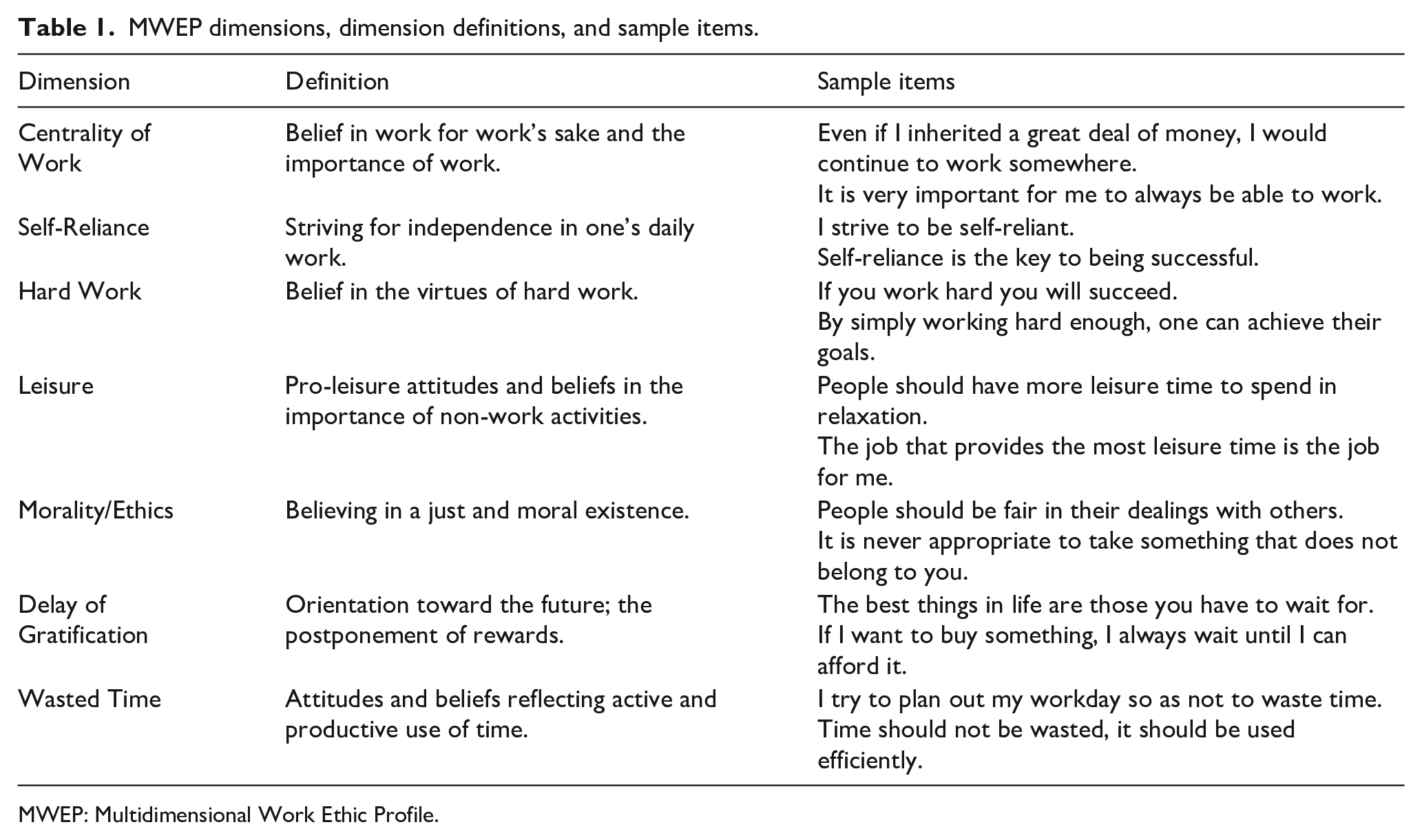
MWEP: Multidimensional Work Ethic Profile.
To date, research has examined the relationship among the different work ethic dimensions and between dimensions of work ethic and other work-related constructs (e.g., Grabowski et al., 2019; Meriac et al., 2015). Recently, however, rather than examining the seven dimensions of work ethic individually, Woehr et al. (2023) adopted a person-centered approach to studying work ethic dimensions. Here, it is important to note that a person-centered approach examines intra-individual variation in a set of variables (Marsh et al., 2009). Specifically, this approach posits that variables may align differently depending on category membership. Rather than focusing on relations among specific variables across all individuals, person-centered research identifies groups or categories of individuals sharing similar variable patterns. Subgroups of individuals are identified based on a particular configuration of variables and are therefore viewed more holistically than is the case in variable-centered research (Vandenberg & Stanley, 2009).
Using a person-centered approach, Woehr et al. (2023) found that employees could be reliably categorized into three broad profiles. The three profiles were identified as live to work, work to live, and work as a necessary evil. The first profile, live to work, was characterized by individuals with a high orientation toward work indicated by significantly higher scores on all work ethic dimensions except for leisure (which was low) relative to the other two profiles. The second profile, work to live, was characterized by individuals with a moderately low orientation to work indicated by relatively low scores on all the work ethic dimensions except leisure, which was high relative to the other profiles. Finally, the third profile, work as a necessary evil, was characterized by significantly lower scores on all the work ethic dimensions except for leisure, which was somewhere between the leisure scores for the other two profiles.
Importantly, Woehr et al. (2023) found that the three work ethic profiles were structurally consistent across a large U.S.-based sample (N = 2,593) and a Mexico-based organizational sample (N = 692). That is, the same number and pattern of profiles were supported in both samples. This suggests that these profiles are consistent across different time frames, and the two cultures. The samples did differ, however, in terms of the relative proportion of individuals in each profile. Specifically, the percentage of each sample included in the “live to work” profile was approximately equal (44.7% vs. 48.5%) and represented the largest group in both samples. The percentage included in the “work to live” profile was much higher in the Mexico-based sample than in the U.S.-based sample (44.5% vs. 27.7%). Finally, the percentage included in the “work as a necessary evil” profile was much higher in the U.S.-based sample than in the Mexico-based sample (27.6% vs. 6.9%). This suggests that while the number and pattern of profiles may be consistent, other factors may influence the relative proportion of individuals in each profile. Consequently, we postulate
H1: The number and pattern of work ethic profiles will be consistent pre and post the pandemic lockdown.
Leading a post-pandemic workforce
Few studies have had the opportunity to longitudinally assess changes in employee perceptions across the different waves and stages of the pandemic. One study, however, collected monthly responses from 30,000 employees in the United States beginning in May 2020. They reported that around 30% of managers participating in the longitudinal study believed that WFH reduced the productivity of their collaborators by at least 10%, while around 35% of employees felt it was increased by at least 10% (Bloom et al., 2023). When these employees were required to return to work from a purely WFH environment to a hybrid or fully in-person modality, it is reasonable to expect that some of them experienced a cognitive dissonance (Festinger, 1957), claiming, “why should I have to return to the office if it is clear that I am more productive working at home, it does not make sense.” This unpleasant tension could have changed their general attitude toward work, and they might switch from one work ethic profile to another (e.g., work to live to work as a necessary evil).
The same research team, using the same sample, found that 32% of the employees surveyed did not want to return to work from an office following the pandemic. Not surprising, the primary demographic in this group were professionals with young children who lived in suburban areas and for whom commuting was a serious concern. In contrast, 21% of the employees said they did not want to spend one more day working remotely. In addition, it was found that college graduate women with young children wanted to work from home full-time, almost 50% more than men (Bloom, 2021). These findings suggest that a considerable proportion of employees felt they lost something in their lives when they had to get back to their offices, even in a hybrid modality. From a theoretical perspective, one plausible explanation of why they faced these feelings of loss is that some of them experienced psychological reactance (Brehm, 1966), that is, they perceived that by returning to an in-person or hybrid work modality, they would be losing the freedom they had during the lockdown to organize their working hours according to their personal/family needs, to avoid commuting at rush hours, or to work from the location they wanted. The psychological reactance theory establishes that the more the person believes himself free to have a given alternative, the more likely it is that the alternative will increase in attractiveness upon being eliminated (Brehm, 1966, p. 313). Once the employees realized they would be losing the option to organize their working hours according to their needs, or to work remotely from the location they desired, some of them reacted by seeing work as a necessary evil, because they perceived they would be losing their highly attractive alternative of working from home every day and moved from one ethic profile to another. This is why we propose that
H2: The pandemic-based lockdown had a significant effect modifying the proportion of individuals in each profile.
In a complex context such as the COVID-19 crisis, leadership research must focus on how to enable leaders and organizations to adapt rapidly to the challenges and pressures that the complexity brings to the live of organizations, being a first step understanding complexity and why leaders need to change or adapt the way they lead their followers (Uhl-Bien, 2021). The need of leaders to understand and adapt to the changing attitudes, behaviors, cognitions, and so on of followers is not only required during the crisis itself, but they also need to effectively manage the transition from the crisis to the new normality (Hannah et al., 2009), that is why crisis leadership has been defined as “a leadership process around times of crisis, including times immediately prior crises, the duration of the crises as they unfold, and times immediately after the acute consequences of the crisis” (Bavik et al., 2021, p. 3).
A bibliometric analysis of studies conducted during the first year of the pandemic showed a clear increase in leadership research focused on approaches that deal with change, uncertainty, and complex challenges, and how leaders can react to these in an agile manner (Bauwens et al., 2022).
Errors committed by leaders during a crisis and its aftermath, such as denying the existence of it, minimizing its potential consequences, or delaying the response to react, among others, are a major source of negative outcomes (e.g., Hannah et al., 2009; Uhl-Bien, 2021). Villanueva and Sapienza (2021) have highlighted that some leaders tend to show a hubristic behavior when they experience dramatic events, or when the environment is very uncertain. Employees see their leaders as heroes and give them an unrealistic status that bolsters their power. Under this feeling of empowerment, some leaders tend to deny the real facts that are in a complex context during a highly uncertain environment, and for this blindness they do not react properly, being the consequences of this inaction potentially disastrous for the firm and its employees. A study conducted in the United Kingdom, the United States, and Canada during the pandemic, showed that managers working in organizations lead by CEOs who were perceived as narcissists experienced higher levels of uncertainty, more over if they worked for firms whose viability was more vulnerable to the COVID-19 crisis (Kim et al., 2021). In addition, it is important to highlight that followers tend to feel more vulnerable and are more willing to scrutinize their leaders in the aftermath of a crisis (Hurst, 1995).
Our study seeks to provide objective information to leaders, which would allow them to understand whether the transition from the WFH modality, because of the COVID-19 crisis, to a new normal where employees work in a hybrid, or fully face-to-face setting, brought some changes in their work ethic, and suggesting how to deal with those changes.
Method
Transparency and openness
The data for both waves were collected as part of an ongoing project conducted by the management of the financial organization (one of the authors served as a consultant on the project). The data were primarily intended to be used for management purposes by the organization. As such, there was no institutional review board (IRB) oversight. However, all data collection followed the principles outlined in the Belmont report regarding the treatment of study participants (National Commission for the Protection of Human Subjects of Biomedical and Behavioral Research, 1979). Data were collected with the approval of the sponsoring company; participation was voluntary and with informed consent. In addition, responses were collected anonymously via the survey procedure described below. Data are not publicly available due to company restrictions and confidentiality. The data of the pre-lockdown sample were used in a previous publication (the guest editors of this special issue were informed of the prior data use). The data collection process in both waves is described below for consistency purposes.
Samples
The data for this study were collected in a leading organization in the financial sector in Mexico, with operations in most of its states. As previously mentioned, data were collected in two waves, the first took place in the first week of March 2020. Two weeks later, the company moved to a WFH modality. This working condition was a novelty for all employees in the firm. The initiative was also adopted by other organizations in the private sector. On March 23, the Mexican government officially recommended the suspension of all non-essential face-to-face activities.
All the employees of one of the sales divisions of the company were invited to participate in the study through an email sent by its director. The total number of employees in that unit at that time was 946. The invitation explicitly expressed participation in the study would be anonymous and voluntary, and that just some basic sociodemographic information would be requested. At the bottom of the invitation, there was a link to access the questionnaire. By clicking on the link, employees expressed their consent to participate in the study. A total of 692 employees completed the questionnaire, for a response rate of 73%. The mean age of the participants was 36.9 (SD = 9.38) ranging from 20 to 65 years; 49.44% were female. With respect to formal education, 65.8% of the participants had college studies, 31.4% completed upper secondary school, and 2.8% did some graduate studies.
The data for the second wave were collected using the same procedure as in Wave 1. Data collection took place in June and July 2022, when employees started to return to their offices gradually, within a hybrid environment. It is important to highlight that the company did not reduce its headcount during the lockdown in the division where the study was conducted. A total of 568 employees completed the questionnaire online, for a response rate of 60%. As participation in the first wave was anonymous, cases were not matched, but were extracted from the same population. The mean age of the participants was 40.36 (SD = 9.69) years and ranged from 21 to 62 years; 48.4% were female. The slight increase in the mean age can be explained based on the fact that there was no reduction in the headcount and that data at Wave 2 were collected 27 to 28 months apart from Wave 1.
Measures
To measure work ethic at both waves, we used the Spanish language version of the short form of the multidimensional work ethic profile (MWEP-SF; Meriac et al., 2013). This version has been previously used in other studies (e.g., Arciniega et al., 2019). The MWEP-SF contains 28 items to operationalize the seven dimensions described above, with four items per dimension. Responses use a Likert-type scale, ranging from 1 = strongly disagree to 5 = strongly agree. The Cronbach’s alphas for the seven dimensions of the scale at Wave 1 ranged from .67 to .86. with a mean of .74, and from .73 to .87 with a mean of .78 at Wave 2 (specific values for each scale/wave are shown in the diagonal of Table 2).
Means, standard deviations, reliability estimates, and intercorrelations among the seven dimensions of work ethic in each wave.
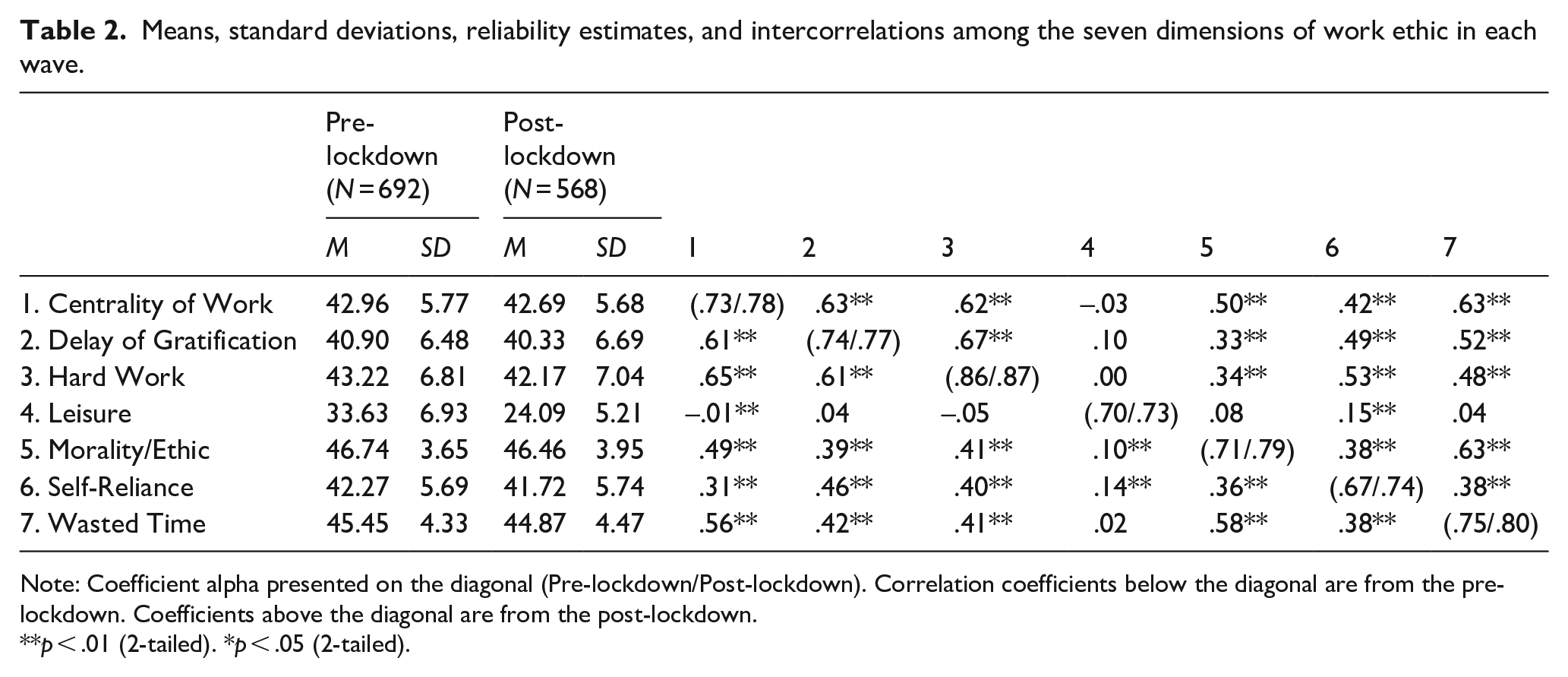
Note: Coefficient alpha presented on the diagonal (Pre-lockdown/Post-lockdown). Correlation coefficients below the diagonal are from the pre-lockdown. Coefficients above the diagonal are from the post-lockdown.
p < .01 (2-tailed). *p < .05 (2-tailed).
Analysis
Latent profile analyses
First, we computed a series of latent profile analyses (LPAs) to identify a set of profiles with respect to patterns of responses of the participants to the seven dimensions of work ethic in each sample independently. A basic principle of LPA is that membership to a particular profile is not known a priori; it is inferred from the data once the profiles are determined. Each profile represents a categorical variable determined by a particular combination of ranges of scores in the set of variables under study, in this case the seven dimensions of work ethic. Because profiles are latent, individuals are assigned a probability of membership in all extracted profiles (McLachlan & Peel, 2000). The ideal scenario is to see that everyone in the sample has a high probability to be assigned to just one of the extracted profiles and a very low probability to be assigned to the remaining ones. This peculiarity of the method is a core difference when compared with more traditional techniques such as cluster analysis (for a detailed explanation about the method, see Morin & Wang, 2016).
Mplus 8.8 (Muthén & Muthén, 1998–2017) and a robust maximum likelihood (MLR) estimator were used to compute the LPAs for the data of both waves. An iterative approach was followed to assess a sequence of models from 1 to 8 profiles using the data from each sample independently. Models were estimated using 5,000 sets of random start values, 100 iterations for these random starts, and 200 solutions retained for the final step of optimization (Hipp & Bauer, 2006). The means and variances of the seven dimensions of work ethic were freely estimated in all profiles in both samples. Since convergence was not achieved after multiple attempts in the data from the pre-lockdown sample, suggesting over-parameterization (Bauer & Curran, 2003), all models were estimated in both samples using free means and fixed variances as suggested in the literature of LPA (Morin & Wang, 2016). All models converged on a well-replicated solution.
The following criteria were considered to determine the model with the optimal number of profiles in each sample: (a) the theoretical consistency and congruence of the extracted profiles, and (b) the adequacy of the statistical solutions taking into account the following indicators (Morin & Wang, 2016): Akaike information criterion (AIC) and the consistent AIC (CAIC), the Bayesian information criterion (BIC), sample-size-adjusted BIC (SABIC), the p values of the bootstrap likelihood ratio test (BLRT), the adjusted Lo–Mendel–Rubin likelihood ratio test (LMR), the entropy indices, and with special attention the posterior probabilities of profile membership, and the number of individuals belonging to each profile (Vandenberg & Stanley, 2009). These criteria have been widely used in previous studies employing LPA and reflect recommended best practices for organizational science research (Spurk et al., 2020).
Decreasing scores on the AIC, CAIC, BIC, and SABIC suggest a better model fit, if the p values for the BLRT and LMR tests are statistically significant. Both tests compare a k-profile model versus a k − 1 -profile model, and nonsignificant p values suggest that the k − 1 profile model should be retained (Morin & Wang, 2016). Simulation studies suggest that CAIC, BIC, SABIC, and BLRT tend to be the more efficient indicators to determine the number of profiles (Diallo et al., 2016). Elbow plots with these indicators were used as an additional resource to identify the optimal number of profiles based on the flattening of the curves (Morin et al., 2011). The entropy index ranges from 0 to 1; the higher the value is, the better the quality of the classification of the subjects into the profiles. Values higher than 0.80 are considered acceptable (Muthén & Muthén, 1998–2017). It has been recommended to use entropy, just as an indicator to confirm the number of profiles, but not as a key figure to make the decision (Lubke & Muthén, 2007). Posterior probabilities should be ⩾0.90 (Muthén & Muthén, 1998–2017), and the number of individuals in each profile should be ⩾5% of the total sample (Stanley et al., 2017).
Once the number of emerging profiles in each sample was determined, we proceeded to test our central hypothesis that suggests the extracted profiles would be the same before and after the lockdown; to assess this, we conducted a multigroup analysis of similarity in latent profile solutions proposed by Morin and collaborators (2016). The approach provides a robust method to systematically and quantitatively evaluate the extent to which a latent profile solution generalizes across two or more samples. The method assesses four levels of similarity: configural which reflects the extent to which the number of profiles is equivalent across groups; structural, which reflects the extent to which the level of the indicators (seven work ethic dimensions) is the same across groups, that is, being this the level of similarity that is expected in our core hypothesis; dispersion, which reflects similarities in within-profile variability; and distributional, which reflects similarities in the relative size of the profiles (fixing membership probabilities as equivalent). With this approach, changes in the level of fit (as reflected in the AIC, CAIC, BIC, SABIC indices) are examined as the increasingly restrictive levels of similarity across samples are tested. If a more restrictive model is added, and there is a decrement in two or more of the CAIC, BIC or SABIC indices, it could be assumed the equivalence at that level is validated (Morin et al., 2016).
Results
Number of profiles
The process started by specifying a one-profile model and increased the number of latent profiles until no evidence of improvement was found in the indices previously mentioned: AIC, CAIC, BIC, SABIC, entropy, and posterior probabilities. To determine the final number of profiles, we followed the criteria described earlier.
Pre-lockdown sample
Examination of the AIC, CAIC, BIC, SABIC, and the p values for the BLRT and LMR in the pre-lockdown sample (see Table 3) shows they continue to decrease with the addition of a new profile in the models. Although the p values for the BLRT were significant for all models, this does not happen with the p values of the LMR that goes from .01 to .22 when a fourth profile is introduced. The entropy value for the three-profile configuration substantially drops from .856 to .806 when a fourth profile is considered. In addition, a visual examination of the elbow plots representing the AIC, CAIC, BIC, and SABIC indices (see Figure 1(a)) suggests that the curves tend to flatten at the four-profile configuration. The posterior probabilities for the three-profile model ranged from .922 to .955, being above the .90 value suggested as acceptable (Muthén & Muthén, 1998–2017); in contrast, the four-profile configuration shows posterior probabilities below .90. The number of individuals in each of the three profiles was larger than 5% of the sample (details are provided in profile characterization section). This set of results suggests the three-profile model provides the optimal solution for the data in the pre-lockdown sample.
Pre-lockdown sample: Latent profile analyses results summary.
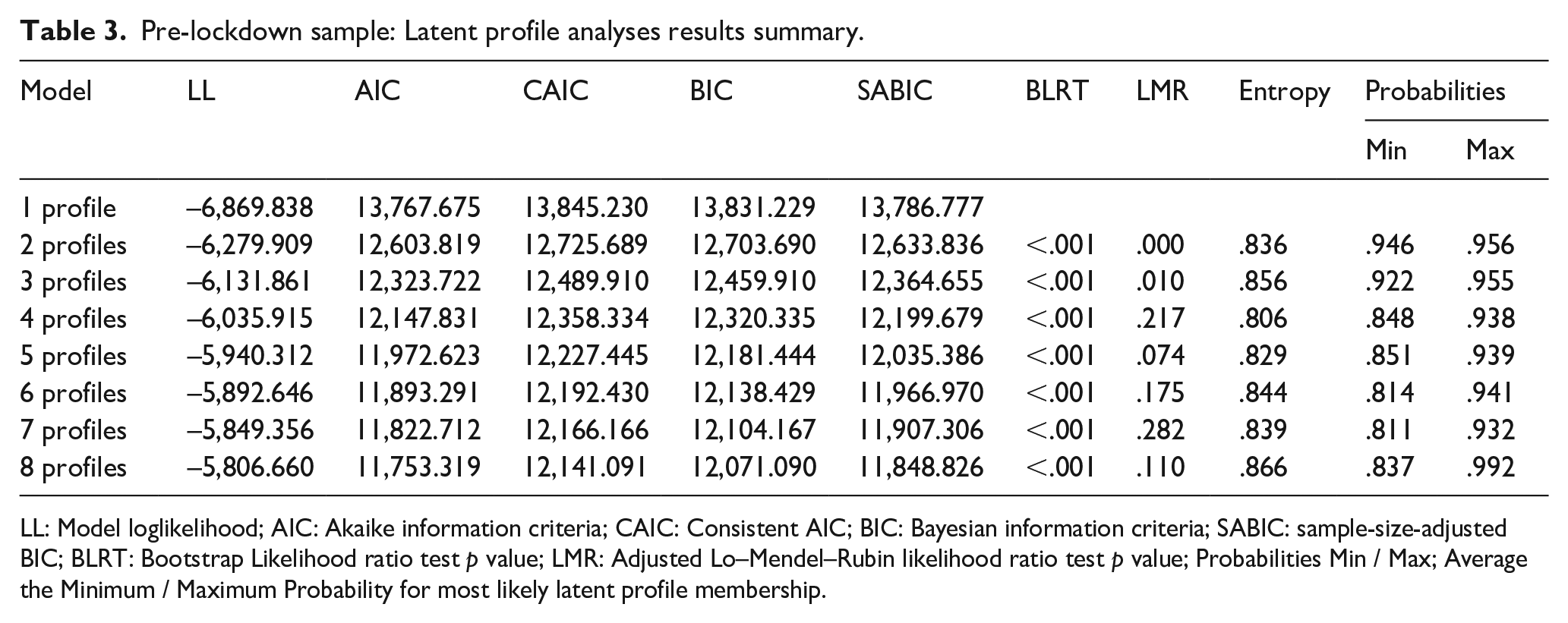
LL: Model loglikelihood; AIC: Akaike information criteria; CAIC: Consistent AIC; BIC: Bayesian information criteria; SABIC: sample-size-adjusted BIC; BLRT: Bootstrap Likelihood ratio test p value; LMR: Adjusted Lo–Mendel–Rubin likelihood ratio test p value; Probabilities Min / Max; Average the Minimum / Maximum Probability for most likely latent profile membership.
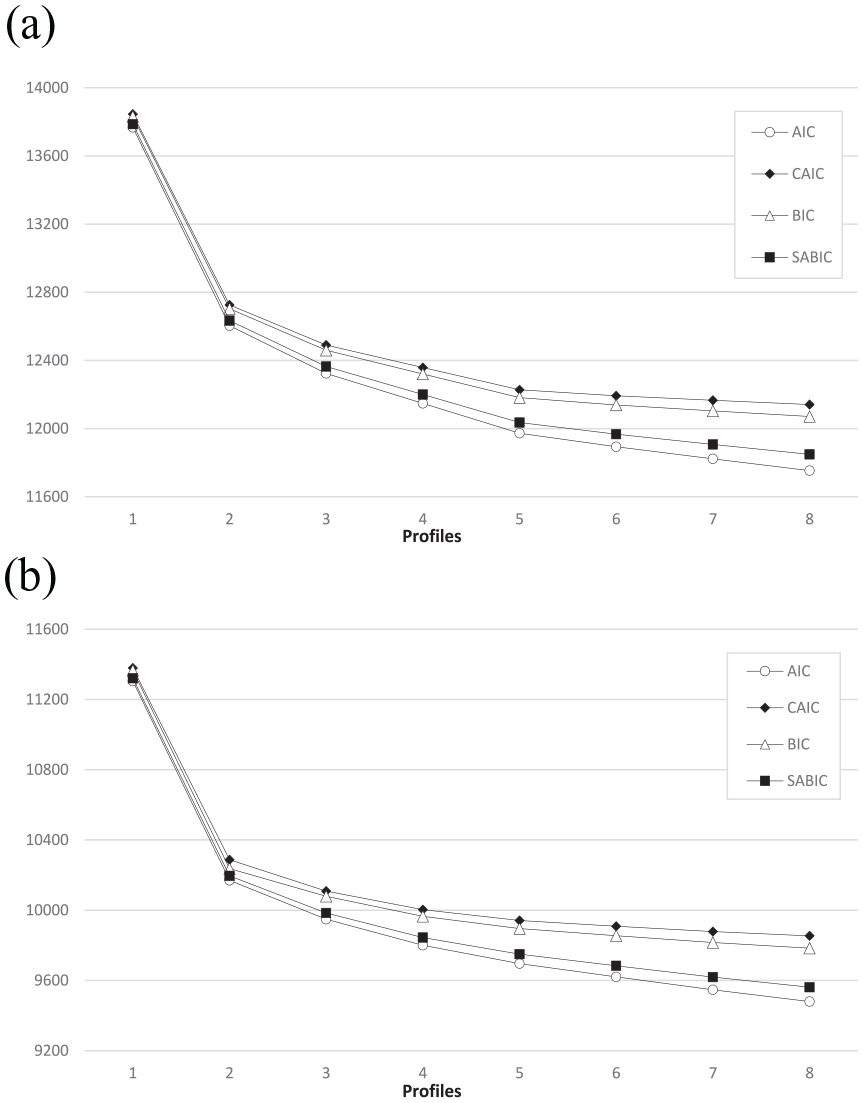
Elbow plots for the AIC, BIC, and SABIC indices. (a) Pre-lockdown sample. (b) Post-lockdown sample.
Post-lockdown sample
A general examination to the classic indicators AIC, CAIC, BIC, SABIC, the p values and LMR, and entropy (see Table 4) allows to say the three-profile model offers the best solution to the data from the post-lockdown sample. As can be seen, the p value test for the LMR changes from a significant value of .008 for the three-profile solution, to a non-significant of .074, and the entropy drops from .863 to .850 when a fourth profile is introduced. In addition to this, and as it can be observed, the posterior probabilities for the three-profile configuration range from .91 to .96, being above the desired value of .90; in contrast, the values for the four-profile configuration drop below this. Then, the three-profile model was selected as the best solution to the data from the post-lockdown sample.
Post-lockdown sample: Latent profile analyses results summary.
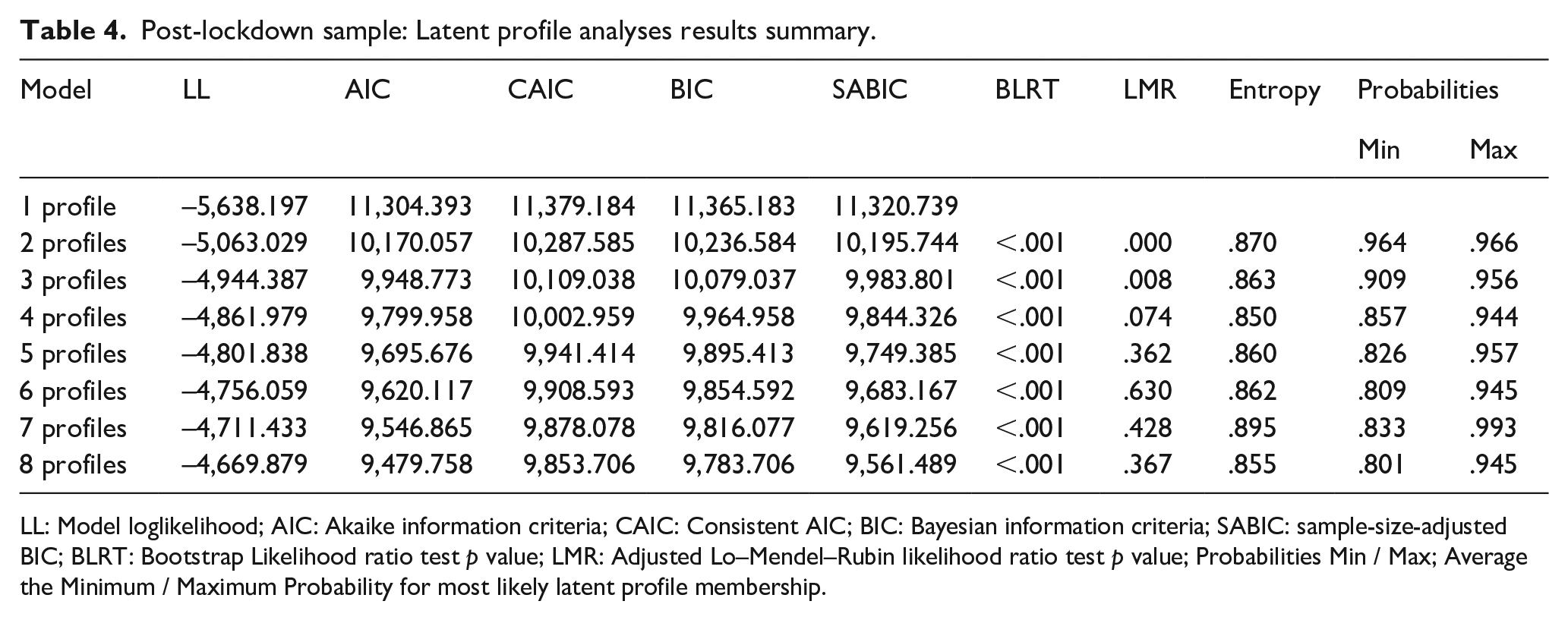
LL: Model loglikelihood; AIC: Akaike information criteria; CAIC: Consistent AIC; BIC: Bayesian information criteria; SABIC: sample-size-adjusted BIC; BLRT: Bootstrap Likelihood ratio test p value; LMR: Adjusted Lo–Mendel–Rubin likelihood ratio test p value; Probabilities Min / Max; Average the Minimum / Maximum Probability for most likely latent profile membership.
Profiles characterization
Pre-lockdown sample
Figure 2(a) shows the characterization of the three profiles extracted from the LPA from the pre-lockdown sample. Employees in Profile 1 scored above the mean in six of the seven dimensions of the measure of work ethic, except for leisure where they scored exactly on the mean, that is why the bar is imperceptible in the figure. In the case of work centrality, hard work, delay of gratification, and morality the scores of the employees were above 0.5 standard deviations, a value that can be considered high according with the rules of thumb established in the LPA literature. These high scores in the core dimensions of the work ethic construct represent a high orientation toward work; for this reason, this profile has been recently labeled as live to work (Woehr et al., 2023). Employees classified into this profile represented 48.6% of the pre-lockdown sample.
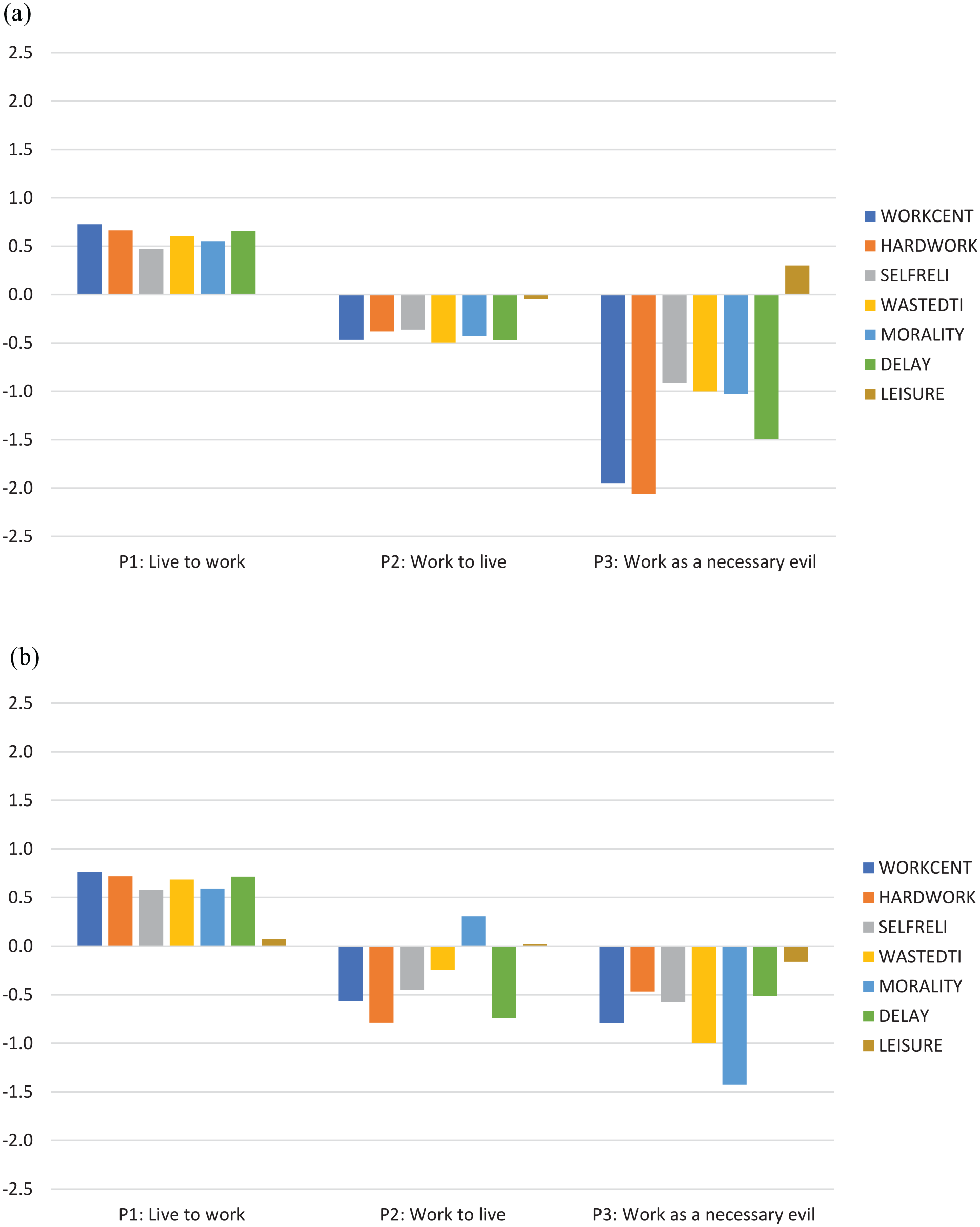
Characterization of the latent profiles. (a) Pre-lockdown sample. (b) Post-lockdown sample.
The central profile in Figure 2(a), that is Profile 2, concentrates the cases of employees in the sample who scored below the mean in the seven dimensions of the work ethic measure, but in a moderate level, that is, between the mean and minus 0.5 standard deviations. For these individuals, work is not something central in their lives but their negative attitudes toward work can be considered low to moderate, that is why this profile has been previously categorized as work to live (Woehr et al., 2023). Individuals assigned to this profile represented 44.5% of the sample at Wave 1.
Finally, as can be seen in Figure 2(a) right, individuals assigned to Profile 3 were the ones with the lowest scores in almost all the seven dimensions of the construct of work ethic, except for leisure. Based on the rule of thumb that values between the mean and ±0.5 standard deviations can be considered as moderated and values >±0.5 SD are considered high, employees in this profile show a high negative affect toward work in general and a moderate positive to leisure. For this reason, this profile has been labeled as work as a necessary evil (Woehr et al., 2023). The proportion of employees that were classified in this profile with respect to the pre-lockdown sample was 6.9%.
Post-lockdown sample
Figure 2(b) shows the characterization of the post-lockdown profiles. Profile 1 can be clearly associated with the live to work configuration. All individuals in this profile have higher scores (>0.5 SD above the mean) in six out of the seven dimensions of work ethic, except for leisure that is very close to the mean. Employees classified in this profile represented 47.9% of the sample at Wave 2, just 0.7% lower than in Wave 1, suggesting the proportion of employees extracted from the same population before and after the lockdown was almost identical.
Profile 2, at the center, reveals that employees in this group have a moderate/high negative attitude toward work as a central activity in their lives, except for morality that is positive and moderate, and leisure that is right above the mean, almost imperceptible. This configuration is consistent with the profile previously identified as work to live. The proportion of individuals assigned to this profile represented 27.1% of the post-lockdown sample; this proportion is substantially lower when compared to the 44.5% in the pre-lockdown sample.
Individuals in Profile 3, at the right, are characterized for having a high negative affect to work in general as can be noted by the high scores in five out of the seven dimensions of work ethic, surprisingly even for leisure that is slightly below the line of the mean. Except for this last minor variation, the configuration of this profile is compatible with the previously labeled as work as a necessary evil. Individuals classified into this profile represented the 25% of the participants of the post-lockdown. This is another relevant finding, since the proportion of employees in the work as a necessary evil profile before the lockdown just represented the 6.9% of the sample.
The substantial decrease in the proportion of employees in the profile work to live from 44.5% before the lockdown to 27.1% after this, along with the relevant increase in the percentage of employees in the work as a necessary evil profile from 6.9% in March 2020 to 25% in June 2022, allow us to validate our second hypothesis, and to confirm the prolonged lockdown changed the orientation toward work in approximately 20% of the employees in the population under study, and suggest these employees felt they lost something when moved from a fully WFH modality to a hybrid. As a post hoc analysis of these specific findings, one of the authors conducted five focus groups with supervisors of the organization that participated in this study, as part of a 14-hr online workshop on Leaderships and Negotiations. In each group, there were 25 to 42 participants. The direct reports of these supervisors had the same sociodemographic profile of the employees of our samples. The supervisors were informed about the main results of the study with emphasis on the transitions between the profiles and were sent to breakout rooms of four or five participants for 10 min, to discuss whether some of their collaborators had commented on a “feeling of loss” because of the return to a hybrid modality, and in case this happened, they had to list the freedoms, benefits, or positive aspects their followers had expressed they felt they lost because of the change from a 100% WFH to a hybrid model. All groups of supervisors reported that some of their followers had expressed a feeling of losing something because of the transition to the hybrid modality. The most common aspects they said they missed, in order or frequency, were (a) avoiding commuting at rush hours, (b) organizing their working hours according to their personal/family needs, (c) socializing with family members while having meals, (d) eating fresh/healthy food at a lower cost, (e) conducting studies, and (f) having time to do exercise in a continuous and regular base.
As an additional analysis, and to assess the potential impact of the sociodemographic data collected from the participants on their profile membership at both waves, we computed a set of multinomial logistic regressions having age, sex, number of economic dependents, and level of education as the independent variables and profile membership as the dependents. At Wave 1, just the level of education was significant. The higher the level of education of the employee, the higher the likelihood to be assigned to the live to work profile; in contrast, the lower the level of education, the higher the likelihood to be assigned to the work as a necessary evil profile. In the post-lockdown sample, only age was significant; the higher the age of the employee, the higher the likelihood to be assigned to the live to work profile, and the lower the age of the employee, the higher the likelihood to be assigned to the work as a necessary evil profile (because of space limitations tables with the results from the multinomial logistic regressions are not shown, but can be requested from the first author).
Once the profiles live to work, work to live, and work as a necessary evil were identified in each sample independently, we proceeded to conduct the core assessment to test our first hypothesis. Table 5 presents the results of the profiles similarity assessment across the two samples. As can be seen in the table, these tests indicate an adequate level of structural and configural similarity; it means that not just the number of profiles between the pre- and post-lockdown samples are equivalent, but also that the within-profile means in the seven dimensions of work ethic are similar across samples. These results confirm our first hypothesis.
Results of profiles similarity tests.
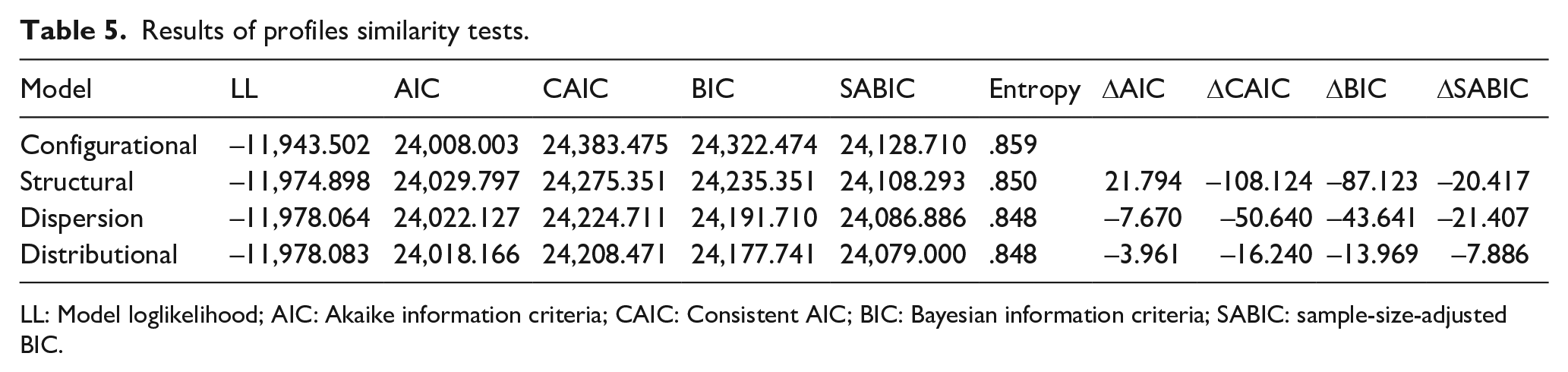
LL: Model loglikelihood; AIC: Akaike information criteria; CAIC: Consistent AIC; BIC: Bayesian information criteria; SABIC: sample-size-adjusted BIC.
Discussion
Our results show the proportion of employees in the live to work profile remained similar before and after the lockdown, suggesting that for these employees the relevance that work has in their lives is not affected if they work in an in-person, hybrid, or fully remote modality. In contrast, our study suggests that approximately 20% of the employees sampled were affected with respect to their attitudes and beliefs about the relevance of work in their lives following the extended lockdown. It seems some employees during the lockdown discovered a set of personal benefits of working from home, and once they were informed, they had to return to work under a hybrid modality; they realized they would be losing a set of positive benefits of WFH and changed their general attitudes toward the importance of work in their lives, in line with the postulates of the reactance theory (Brehm, 1966), that is, they increased their affect to the modality of work they were partially losing (i.e., WFH) and decreased their affect toward work in general. In addition, our findings reflect that younger employees had a higher likelihood to move from the work to live to the work as a necessary evil profile than older collaborators. These findings are in line with the definition of the term recently coined in popular media and social networks of “Quiet Quitting,” specifically with the comment made by an influencer on TikTok that became viral: “You’re still performing your duties but you’re no longer subscribing to the hustle culture mentality that work has to be your life” (Zaidleppelin, 2022). In other words, the return to a hybrid or in-person modality represented, to some employees, a more demanding work scenario, with a potential negative effect on their quality of life, and as a reaction to this risk, they reduced their work ethic. Also, it is reasonable to suggest that older employees were more accustomed to work in a fully in-person or hybrid setting than younger employees, for whom the 2 years of the lockdown represented a large proportion of their working lives, and they easily adapted and enjoyed the positive personal benefits of WFH.
The fact that approximately 20% of the employees of our study moved from the work to live to the work as a necessary evil profile, and that our post hoc study suggests it is because they feel they had lost something relevant when they returned to an in-person or hybrid work modality, reflects a new emerging reality for leaders, in particular for those with young followers. Leaders need to be aware of these changes, adapt, and react in an agile manner (Bauwens et al., 2022). As it was said before, leaders need to understand and adapt to the changes in the attitudes and behaviors of their followers in the aftermath of a crisis (Hannah et al., 2009), since they tend to feel more vulnerable, and are more willing to scrutinize the behaviors and actions of their leaders in this phase of a crisis (Hurst, 1995).
Leaders need to be aware, but more important, conscious of these new employees’ perceptions, and adopt a relationship-oriented leader behavior during the transition (Yukl & Gardner, 2018), such as showing support by being concerned for the needs and feelings of employees, giving credit and public recognition to achievements, and maintaining constant and open communication with followers, to take advantage of the in-person social interaction. Consequently, it is important that leaders are mindful of employee perceptions of loss and change on returning from a WFH to hybrid or in-person modalities. Explicitly addressing changing perceptions and attitudes may attenuate resulting performance issues.
Conclusion, limitations and future research
One of the strengths of the present study was the unique chance to capitalize on the opportunity to assess employee work ethic pre- and post-pandemic in a single financial service company. This allowed for the examination of potential changes in the composition of work ethic-based profile following an extended period of working from and a subsequent return to work. Our results clearly demonstrate the stability of the profiles that emerge at both pre- and post-assessment. As noted above, the proportion of individuals in each profile, however, changed such that following the pandemic, the proportion of individuals in the “work as a necessary evil” profile increased while the proportion of individuals in the “work to live” profile decreased and the proportion in the “live to work” profile stayed the same. This suggests that work ethic–related attitudes and beliefs may have changed for some individuals following the pandemic. This raises issues with respect to the stability of work ethic over time. To date, the majority of the work ethic literature suggests that work ethic is a “relatively” stable individual difference reflecting attitudes and beliefs about work in general (e.g., Arciniega et al., 2019). Factors that might impact or change work ethic attitudes have not received much attention in the literature. Nonetheless, we need to be very cautious with respect to this point. Specifically, one potential limitation of the present study is that we did not have the ability to link pre- and post-measures of work ethic to specific individuals. Rather, we frame our study in terms of the workforce as a group. And while our response rates for both waves of data collection were relatively high (73% and 60%, respectively), we cannot disentangle the extent to which differences in the individuals sampled might be responsible for the observed changes as opposed to changes in specific individual’s work ethic. Unfortunately, this greatly limits our ability to examine the stability of work ethic for individuals over time. This is clearly an important avenue for future research. Specifically, how stable is an individual’s work ethic over time? And what factors may lead to shifts in work ethic? It may be that work ethic is relatively stable but major changes or “shocks” may result in changes. Clearly, the shift in work-related behavior and opportunities to work from home represents a major paradigm shift with respect to work. Alternatively, it may be that work ethic is stable for some individuals but not for others. Here, it would be important to consider factors that might predict not work ethic levels or profile but also the stability of work ethic over time.
The main goal of this study was (a) to assess whether the work ethic profiles that emerged prior to the lockdown, from a large sample of employees in the financial sector in Mexico, maintained its number and characterization 26 months later, when the conditions of the COVID-19 pandemic were relatively under control, and allowed them to return to a hybrid work environment from a fully WFH, and (b) to assess whether the proportion of employees in each profile remained intact or suffered changes because some employees modified their general orientation toward work as a consequence of their personal experiences along the prolonged lockdown. Our findings clearly show the profiles live to work, work to live, and work as a necessary evil remained the same before and after the lockdown, as it was confirmed by the robust LPA similarity tests. This theoretical contribution allows us to say that the three recently labeled work ethic profiles are not only stable across cultures and time, as it has been previously demonstrated (Woehr et al., 2023), but that these are also stable across abrupt and significant changes in the working conditions of employees. It seems these three profiles based on the scores of employees to the MWEP measure represent a promising framework and system of classification of employees that can be helpful for scholars and practitioners to study the antecedents, consequences, and correlates of work ethic. Future research should assess the validity of the profiles across diverse cultures regarding religion, ethnicity, and economic growth.
Footnotes
Author contributions
L.M.A. contributed to the conceptualization of the study, the collection of data, analysis and interpretation of results, and drafting of the article. D.J.W. contributed in the analysis and interpretation of results, and drafting of the article. L.G. contributed in the analysis and interpretation of data and drafting of the manuscript.
Declaration of conflicting interests
The author(s) declared no potential conflicts of interest with respect to the research, authorship, and/or publication of this article.
Funding
The author(s) disclosed receipt of the following financial support for the research, authorship, and/or publication of this article: The participation of the first author in this project was supported by the Asociación Mexicana de Cultura, A.C., a not-for-profit organization.
