



Abstract
For understandable reasons, hitherto most published research on entrepreneurship and well-being has prioritized interesting research questions and the development of theory aimed at understanding the unique well-being challenges in entrepreneurship. With this special issue and editorial, we seek to initiate a conversation on how to enhance the methodological rigor in this area of research to build a more robust and reliable evidence base. We consider why methodologically robust research is needed and the methodological challenges of conducting such research in entrepreneurship in general and on entrepreneurs’ well-being in particular. We also introduce the papers included in this special issue and outline avenues for future research on entrepreneurship and well-being that is methodologically robust while advancing our understanding of entrepreneurs’ well-being in new ways.
Introduction
Over the past decade or so, well-being has emerged as an important consideration within the entrepreneurship literature. This coincides with greater general concern for human well-being in the world. For example, there are worldwide ambitions to “promote well-being for all at all ages” (United Nations, Sustainable Development Goal #3) and to track well-being in assessing a nation’s level of development alongside economic performance (European Commission, 2016). To a large extent, the entrepreneurship research on well-being is grounded in insights of positive psychology, which emphasizes human flourishing and strengths rather than psychological deficits (Seligman & Csikszentmihalyi, 2000). Research on entrepreneurial well-being has made significant strides, posing bold and thought-provoking questions about the intersection of entrepreneurship, health, and well-being (Stephan, Rauch, & Hatak, 2023; Wiklund et al., 2019).
The impetus for this special issue was our observation of an imbalance of interesting research questions and the development of theory on the one hand and convincing empirical evidence on the other. It seems that empirical research has not kept up with advancements of ideas and theory. This is a substantial problem, as theory development is an iterative process involving the interplay between valid empirical evidence and novel conceptual insights (Collier, 2011). In other words, to qualify as a scientific enterprise, a body of empirical evidence is needed that substantiates novel ideas and theoretical proposals.
Importantly, this imbalance is not unique to well-being in entrepreneurship, but something that applies to entrepreneurship research more generally. Entrepreneurship scholars are willing to ask novel and relevant research questions, to use whatever data they could find, and to analyze them using a variety of methods. There are certainly advantages to this approach, as it ensures that entrepreneurship scholars focus on issues that are societally relevant. But it also provides challenges. These challenges are particularly salient for scholars studying entrepreneurship and well-being, as they build on psychology research that has a long tradition of utilizing rigorous research methods. It would be very unfortunate if entrepreneurial well-being research would be dismissed by other scholars based on methodological shortcomings. Relatedly, for theory to be any good (for scholars or practitioners), it must be veridical. Thus, a body of empirically solid knowledge is necessary, for developing and assessing theory.
In the next sections, we document what we believe are methodological challenges in the entrepreneurship and well-being field, introduce the papers published in this Special Issue, and propose solutions to these challenges along with avenues for future research.
Methodological challenges in entrepreneurship and well-being research
Most of the research on entrepreneurs’ health and well-being has been conducted cross-sectionally, often on small and select samples (e.g., Stephan, 2018). This is a common and understandable starting point as a research area establishes itself and explores whether relationships exist. However, it is also problematic because findings might be systematically biased and have limited generalizability based on the (self)selected samples. The good news is that it does not have to be this way.
Studying entrepreneurship and well-being allows, for example, entrepreneurship scholars to tap into large health databases. Many institutions, including national health agencies and medical universities, have collected large samples of high-quality data related to health for many decades; health scholars have a long tradition of utilizing such data for research. This is a potential treasure trove for entrepreneurship scholars. Imagine being able to access decades long panels with millions of observations! This is very different from what most entrepreneurship scholars are used to. It is truly difficult to collect information directly from entrepreneurs, and having entrepreneurs fill out multiple surveys over several years is virtually impossible. Therefore, there are very few panel studies with primary data collected directly from entrepreneurs.
However, there is also a fundamental limitation with using public health databases for entrepreneurship research purposes, which is related to the fact that these databases are typically constructed to study the general public. If they contain any occupational information, this information tends to be very rudimentary (e.g., separating students, employees, and unemployed); if these databases contain any information related to entrepreneurship, it is typically limited to whether people are self-employed or not. This shortcoming has not hindered entrepreneurship scholars from fruitfully utilizing such databases. In fact, it seems that entrepreneurship and well-being research is increasingly relying on this kind of data (see Lerman et al., 2021; Stephan, Rauch, & Hatak, 2023).
The main problem with using such data is its very coarse consideration of all self-employed individuals. The Uber driver, the restauranteur or law-firm operator with various employees, the inheritor of a family business, and the co-founders trying to start a high-tech company (who’ve finally given up their employment) may be classified as self-employed. And once the start-up is funded and founders receive some salary from the venture, or if the other entrepreneurs receive wages (be it for tax, organizational form, liability, or other reasons) are they wage-employed (no longer entrepreneurs)?
Research about entrepreneurship and well-being makes certain assumptions about causal mechanisms linking the two. For example, it is common to assume that compared to employees, entrepreneurs have greater autonomy in designing and carrying out their work, which has positive implications for their well-being (Gish et al., 2022; Stephan, Rauch, & Hatak, 2023; Wiklund et al., 2019). While that is likely the case for those starting a tech company, does it really apply to the same extent for the Uber driver or self-employed accountant?
Even if the classification of self-employment accurately captured all entrepreneurs, considering entrepreneurial endeavors as equivalent leads to several problems. First, there is extensive unobserved heterogeneity. The methodological implications of this are well-known. It leads to noisy data with extensive measurement error where it is hard to discover any relationships among variables, even if they exist. Second, it is difficult to argue for specific causal mechanisms, as most relationships are likely to apply to some of the self-employed in the sample, but not all. Third, representative samples of entrepreneurs are overwhelmingly dominated by marginal subsistence businesses. While these businesses may not align with the high-growth, world-changing Schumpeterian entrepreneurship that captures the interest of many scholars, they still provide valuable insights into more everyday entrepreneurial activity and their relationship to well-being. It is important to recognize the heterogeneity among entrepreneurs and to analyze their well-being with this diversity in mind. Fourth, self-employment appears as a poor empirical proxy for most established definitions of entrepreneurship. Thus, many papers in entrepreneurship and well-being tell a conceptual story about how entrepreneurship is important for the economic development of nations and similar, but empirically study all types of self-employments, the majority of which is quite marginal. As illustrated by the contributions included in this special issue, not all research on entrepreneurship and well-being relies on public health data. In fact, only two out of the seven papers included in this special issue relied on such data.
As it has become increasingly difficult to collect survey data directly from entrepreneurs, many scholars turn to third-party data crowd-sourcing services such as M-Turk, Prolific, and Qualtrics. While these commercial companies are able to collect data from quite impressive number of respondents, their validity could be called into question. Is it reasonable that otherwise busy entrepreneurs are willing to set aside time to fill out surveys in return for a few dollars? Unfortunately, most studies using crowd-sourced data for entrepreneurship and well-being research do NOT validate that the individuals responding in fact represent entrepreneurs in line with conceptual definitions of the term. Again, considering the great heterogeneity in entrepreneurship, researchers should be encouraged to reflect on the type of entrepreneurship that samples from crowd-sourced service providers represent. This will typically require adding screening questions about firm size, age, industry, etc. It can also be helpful to compare the crowd-sourced sample against population-representative data in terms of key socio-demographic and business characteristics to gauge the extent of potential sample biases.
Case studies represent yet another feasible alternative for collecting well-being data from entrepreneurs. Unfortunately, case studies face the same problems as surveys concerning time-crunched entrepreneurs being unwilling to set aside time. As a consequence, scholars examining entrepreneurship and well-being using case study designs tend to rely on interviews only, rather than direct observations and other more intrusive means of data collection. As a result, this research can be rather superficial. However, one of the papers in this special issue offers a valuable contribution to improving research in this area (Pauley, in this special issue). Using Eisenhardt’s Multi-Case Study Method and a combination of semi-structured interviews and observations, this qualitative comparative analysis captures a richer understanding of entrepreneurs’ personal experiences and well-being.
We now turn to discuss the papers included in the special issue and how they have tackled these methodological challenges before discussing methodological recommendations more generally.
Papers in this special issue
The high level of interest in entrepreneurship and well-being is evident from the 35 manuscript submissions received in response to our call for papers. Of these, only 12 (34%) met the initial criteria for inclusion and were sent for peer review. The main reason for not being selected was either lack of fit with the theme entrepreneurship and well-being or lack of empirical rigor. Following a thorough evaluation process which included multiple rounds of double-blind peer-review on all papers, we are pleased to present the final set of seven papers. They offer valuable insights not only for entrepreneurship research but also for the fields of psychology, sociology, and economics. Together, these studies showcase a diverse range of methodological approaches, contributing to a more comprehensive understanding of well-being in entrepreneurship.
To illustrate the diversity of methodological approaches, the seven papers rely on different data sources (e.g., cross-sectional and longitudinal data sets from EU, USA, Canada, deep interviews), analysis methods (multivariate analysis of variance [MANOVA] and univariate analysis to test mean differences, ordinary least squares [OLS], structural equation modeling, latent profile analysis [LPA], the Eisenhardt method, the problematizing review methodology), types of entrepreneurs (entrepreneurs who have experienced venture distress, entrepreneurs transitioning out of their businesses, entrepreneurs in insolvency vs not, mompreneurs, self-employed), measures of well-being and ill-being (subjective well-being, biological stress hair glucocorticoid concentrations, psychological recovery, sleep quantity and quality, eudaimonic well-being, thriving at work, vitality, life satisfaction, work satisfaction) and diverse explanatory variables (e.g., financial success or failure, self-compassion, exit timing, gender, age, entrepreneurial engagement, family support, institutional conditions, lockdown stringency during COVID, mental health stigma, business insolvency, venture distress). These different approaches offer unique ways to build and advance our knowledge on entrepreneurial well-being. Below, we provide an overview of the papers included in the special issue. Table 1 provides a structured overview of the key aspects of the papers included in this special issue, highlighting their research focus, methodology, and contributions to the study of heterogenous entrepreneurial well-being and ill-being.
Overview of the papers in this Special Issue.
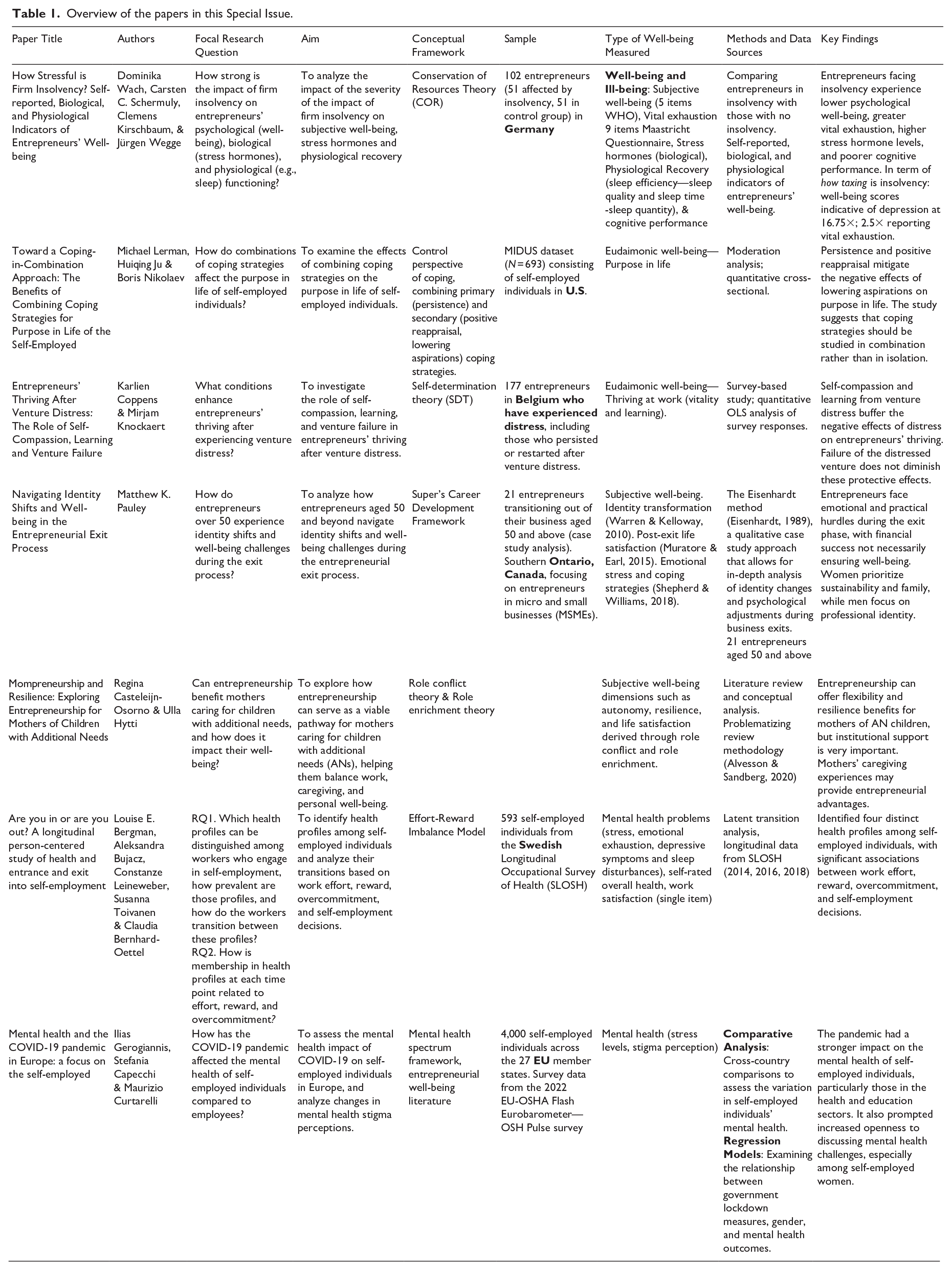
Dominika Wach, Carsten Schermuly, Clemens Kirschbaum, and Jürgen Wegge advance research on the nexus of business insolvency and entrepreneurs’ well-being by examining the severity of firm insolvency on subjective well-being, stress hormones, and physiological recovery. To test their pre-registered hypotheses, they compared entrepreneurs operating in 51 businesses affected by insolvency with 51 entrepreneurs in a control group. Conducted in Germany—where legal regulations surrounding insolvency are relatively unfavorable (German Federal Ministry of Justice, 2024)—their findings indicate that entrepreneurs facing insolvency experience lower psychological well-being (measured by the WHO-5; Brähler et al., 2007), greater vital exhaustion (Kopp et al., 1998; Schnorpfeil et al., 2002), and higher stress hormone levels, particularly cortisol and cortisone (Stalder et al., 2017), alongside poorer risk adjustment. While certainly not surprising that insolvent entrepreneurs are worse-off than their peers, the study offers empirical insight into just how stressful insolvency is. For example, the authors found: “over 67% of participants in the firm insolvency group reported [well-being] scores indicative of depression [compared to] only 4% of control group participants . . . [suggesting] a prevalence rate that was 16.75 times higher.” In terms of vital exhaustion,
60% of firm insolvency group participants reported severe vital exhaustion (Schnorpfeil et al., 2002), compared with 24% of control group participants . . . [corresponding to a] prevalence rate 2.5 times higher than in the control group, which itself had a notable prevalence of vital exhaustion (about 1 in 4).
By complementing self-reports with objective measures such as hair glucocorticoid concentrations and actigraphy-assessed sleep parameters (Wach et al., 2021; Weinberger et al., 2018), the study provides a multidimensional examination of entrepreneurial well-being in face of serious financial hardship (and in comparison to peers also subject to the stresses of entrepreneurship but not insolvency). These findings offer insights into the potential repercussions of business failure for entrepreneurs’ psychological, biological, and physiological functioning. The reliance on preregistration is laudable. We hope to see more papers preregistering their hypotheses to ensure that what is published in our journals is not biased in favor of research finding support for hypotheses at the expense of those not finding any support. Moreover, the reliance on biomarkers of stress as complement to self-perceived survey responses also represents an important methodological step forward. We hope other studies follow suit. Investments into quality data, including valid measures of key variables should be awarded by journals. Theory development is an iterative process involving the interplay between valid empirical evidence and novel conceptual insights (Collier, 2011).
Michael Lerman, Huiqing Ju, and Boris Nikolaev examine how self-employed individuals use coping strategies to enhance their Purpose in Life (PIL), a fundamental component of eudaimonic well-being (McKnight & Kashdan, 2009; Ryff & Singer, 1998). Unlike previous research that explores coping mechanisms in isolation, this study applies a control perspective, integrating both primary control strategies (persistence in goal striving) and secondary control strategies (positive reappraisal and lowering aspirations). Using data from the MIDUS data set (N = 693), moderation analyzes reveal that lowering aspirations generally reduces PIL (Wrosch et al., 2000). However, this negative effect is buffered when individuals also demonstrate high persistence or engage in positive reappraisal. These findings suggest that while persistence and positive reappraisal do not necessarily reinforce one another, they can act as substitutes, allowing self-employed individuals to maintain a strong sense of purpose despite adversity (Brown et al., 2005). The study contributes to entrepreneurship and well-being literature by demonstrating that a coping-in-combination approach—where self-employed individuals adjust their strategies based on circumstances—enhances resilience and long-term well-being (Corner et al., 2017; Eager et al., 2019). This aligns with meta-analytic findings that the self-employed tend to achieve better performance and well-being outcomes despite stressors compared to traditionally employed workers (Lerman et al., 2021; Stephan, Rauch, & Hatak, 2023). Ultimately, these results suggest that self-employed individuals actively manage stress by using either persistence or cognitive reframing, helping them sustain their sense of purpose in life. MIDUS represents a high-quality database with detailed information about the well-being of middle-aged people. Some of them are self-employed. Unfortunately, as so many databases constructed primarily to study well-being rather than entrepreneurship, MIDUS does not contain the level of granularity that would be ideal for entrepreneurship research, as it places all self-employed on equal footing.
Karlien Coppens and Mirjam Knockaert investigate the important role of entrepreneurial well-being, emphasizing that the stressful nature of entrepreneurship—especially during venture distress—can hinder entrepreneurs’ ability to thrive. Drawing upon Self-Determination Theory (Deci & Ryan, 2000), this study explores how self-compassion and learning from distress influence entrepreneurs’ ability to recover and thrive following challenging business experiences. Using survey data from 177 entrepreneurs in Belgium, the study compares individuals who persisted with a distressed venture and those who started a new business after failure. The findings reveal that self-compassion and learning from distress act as psychological buffers, reducing the negative impact of venture distress and fostering entrepreneurial thriving (Spreitzer et al., 2005). Importantly, the results indicate that venture failure does not diminish the protective role of these personal attributes, suggesting that entrepreneurs who develop self-compassion and a learning mind-set can maintain well-being even after experiencing business failure. These insights contribute to the entrepreneurial well-being literature by integrating psychological resilience mechanisms into the study of post-distress recovery. The findings also hold practical implications for entrepreneurship support programs, highlighting the importance of fostering emotional resilience and adaptive learning strategies for entrepreneurs navigating adversity. By cultivating self-compassion and a growth-oriented mind-set, entrepreneurs may better withstand business challenges and sustain long-term well-being. This research also shows the potential for entrepreneurship scholars of collaborating with organizations collecting data about entrepreneurs for purposes other than research. It would be costly and difficult for entrepreneurship scholars to get access to real-time venture distress information directly from entrepreneurs.
Matthew Pauley studies how entrepreneurs in their 50s and beyond navigate identity shifts and well-being challenges as they transition out of the businesses they have built. Applying Super’s career development framework (Super, 1957) and employing the Eisenhardt method (Eisenhardt, 1989) for multi-case analysis, this study examines how entrepreneurs experience business exits during the maturity stage (50s) and decline stage (60s and beyond) of their career. The findings reveal that entrepreneurs encounter both emotional and practical hurdles, including health concerns, financial pressures, and shifting personal priorities (Morris et al., 2020; Wennberg & DeTienne, 2014). The study highlights that identity diversification and social support are crucial in easing this transition, as financial success alone does not guarantee positive post-exit well-being (Hessels et al., 2018; Shepherd & Williams, 2018). Notably, the research uncovers gender differences in entrepreneurial exits: women tend to prioritize sustainability and family, while men are more likely to focus on business growth and professional identity (Jennings & Brush, 2013; Marlow & McAdam, 2013). In addition, entrepreneurs over 60 generally navigate identity transitions with greater ease than those in their 50s, often due to health-related motivations and evolving perceptions of retirement (Erikson, 1963; Muratore & Earl, 2015). This study extends the entrepreneurial well-being literature by offering a nuanced perspective on identity transformations during business exits. The findings underscore the need for early exit planning and holistic support systems that address both financial and psychological well-being, contributing to policy discussions on entrepreneurial succession and retirement strategies.
Regina Casteleijn-Osorno and Ulla Hytti explore how entrepreneurship can serve as a viable pathway for mothers caring for children with additional needs (ANs), helping them balance work, caregiving, and personal well-being. Applying role conflict theory (Croom & Miller, 2018), the study highlights how entrepreneurship offers flexibility and autonomy, allowing mothers to integrate their professional and caregiving responsibilities in ways that traditional employment often fails to accommodate. However, the research also underscores systemic barriers—including inadequate institutional support, limited child care options, and restrictive social security policies—that continue to hinder their entrepreneurial engagement (Duberley & Carrigan, 2013). Drawing on role enrichment theory (Greenhaus & Powell, 2006), the study suggests that the skills these mothers cultivate through caregiving—resilience, networking, and advocacy—become entrepreneurial assets, contributing to business success. Moreover, a well-balanced division of caregiving and financial responsibilities within the household can transform family structures into valuable support systems that promote long-term entrepreneurial sustainability (Ekinsmyth, 2013). The well-being implications of these findings are profound. Entrepreneurial autonomy enhances psychological well-being, empowering mothers to structure work in alignment with their caregiving needs (Ekinsmyth, 2013). In addition, the emotional resilience and problem-solving skills developed through caregiving translate into adaptability, a key driver of entrepreneurial success (Greenhaus & Powell, 2006). Crucially, strong social networks—such as peer mentorship and online support communities—serve as essential buffers against stress, fostering mental well-being (Vershinina et al., 2022). This research contributes to the inclusive entrepreneurship discourse, calling for policy interventions that recognize and support caregiving entrepreneurs. By addressing structural barriers, governments and institutions can empower mothers of additional needs children to leverage entrepreneurship not only for financial independence but also for enhanced well-being.
Louise Bergman, Aleksandra Bujacz, Constanze Leineweber, Susanna Toivanen, and Claudia Bernhard-Oettel investigate the long-term health trajectories of self-employed individuals, addressing the ongoing debate over whether self-employment enhances well-being or exacerbates stress and insecurity (Stephan, 2018). Using data from the Swedish Longitudinal Occupational Survey of Health (SLOSH), the study follows 593 self-employed individuals across three waves (2014, 2016, 2018) to assess changes in mental health, self-rated health, and work satisfaction. Employing LPA and Latent Transition Analysis (LTA), the study identifies four distinct health profiles: (a) Moderate Profile, (b) Mentally Healthy Profile, (c) Relaxed and Satisfied Profile, and (d) Exhausted and Dissatisfied Profile. The findings reveal that most individuals remain in the same health profile over time, suggesting that self-employment does not inherently improve or deteriorate well-being but rather reinforces pre-existing health conditions (Wiklund et al., 2019). However, those who entered self-employment were more likely to experience higher work satisfaction and lower exhaustion, while those who exited self-employment displayed more varied well-being trajectories. The study draws on the Effort-Reward Imbalance (ERI) model (Siegrist, 1996), confirming that high effort coupled with low rewards negatively impacts mental health and job satisfaction, particularly among individuals with high overcommitment. These findings challenge the assumption that self-employment is universally beneficial, emphasizing instead the importance of work conditions, effort-reward balance, and individual psychological predispositions (Hessels et al., 2018). The SLOSH data are interesting in that they represent a panel with multiple waves of data collected from the same individuals. Potentially more important, SLOSH contains detailed information about the entrepreneurs’ businesses, such as industry, size and performance data.
Ilias Gerogiannis, Stefania Capecchi, and Maurizio Curtarelli study the mental health impact of the COVID-19 pandemic on self-employed individuals across Europe, highlighting their unique vulnerabilities in times of crisis. Using data from over 4,000 individuals across the 27 European countries, the study examines how economic uncertainty, lack of social protections, and increased work-related stress affected this workforce segment. The findings reveal that self-employed individuals—particularly those in the health and education sectors, as well as those in countries with the strictest lockdown measures—experienced greater mental health deterioration than employees. In addition, the study identifies a shift in mental health stigma, with more self-employed individuals—especially women—becoming open to discussing their mental health struggles at work. Leveraging data from the 2022 EU-OSHA Flash Eurobarometer—OSH Pulse survey, the study highlights how the pandemic reshaped mental health awareness and openness among the self-employed. Drawing on previous research, it underscores the disproportionate burden on self-employed women, who faced additional stressors such as work-family conflicts and financial insecurity. This research contributes to ongoing discussions on entrepreneurial well-being and provides critical insights for policymakers, advocating for targeted mental health interventions and economic support policies to help self-employed individuals “build back better” in the post-pandemic era. Interestingly, although the EU collects lots of harmonized data across its member states, such data are rarely used in entrepreneurship research. This paper represents a promising exception to this.
Suggested solutions to methodological challenges and avenues for future research in entrepreneurship and well-being
In this section, we turn our attention to identifying practical solutions for the key methodological challenges discussed earlier, and we outline promising directions for future research in entrepreneurship and well-being. As noted above, most of the methodological challenges within the entrepreneurship and well-being research stem from issues related to data quality. This is something that applies to entrepreneurship data more generally. It is difficult to come by quality data about entrepreneurs and their ventures. Entrepreneurs are busy and often unwilling to devote time to respond to surveys or take part in in-depth case studies.
In terms of secondary data, new ventures typically only appear in data registers years after they have been initiated. Also, only those new ventures that are successfully launched ever appear, leading to success bias in secondary data. This may be particularly problematic from a well-being perspective. Entrepreneurs attempting but failing to successfully launch their businesses likely experience much lower well-being than those who succeed. Keeping these fundamental challenges of conducting research on entrepreneurship and well-being in mind, here are some suggestions related to increasing the quality of data, and thereby the quality of research more generally.
Measuring well-being
The well-being sciences have developed robust and validated measures of well-being and have highlighted how different types of well-being (e.g., hedonic and eudaimonic) lead to diverse outcomes. We would like to see entrepreneurship research pay more attention to what type of well-being is assessed and why (Stephan, Rauch, & Hatak, 2023). This is because different measures will lead to different conclusions: Consider that the antecedents of ill-being and well-being can be distinct (stressors vs. resources). Researchers might also find more substantial effects of work- and venture-related characteristics on measures of work-related well-being (e.g., work satisfaction)—while such characteristics may have less impact on overall well-being (e.g., life satisfaction); and conversely, the reverse might be true when studying the effects of more general characteristics such as entrepreneurs’ social support networks. In addition, while it might not be possible for all studies to take a multi-plex approach to assessing well-being which includes both self-report and physiological measures, Wach et al. (in this special issue) offer an example of doing so—and there is much value in complementing with subjective and objective assessment of stress. Indeed, the latter might be invaluable in helping entrepreneurs recognize that they are stressed in the first place.
Crowdsourcing of data
Private companies crowdsourcing data, such as Prolific, Amazon M-Turk and Qualtrics claim to have the capacity to collect data from entrepreneurs. It is, however, unclear what kinds of entrepreneurs sign up to take surveys in return for a few dollars rather than spending time on building their businesses. What population do entrepreneurs willing to fill out surveys for these crowdfunding platforms actually represent? Moreover, private companies have incentives to define inclusion criteria generously, which likely applies to entrepreneurs as well. We recommend that entrepreneurship scholars utilizing crowdsourced data: (a) collect data from the same respondents at least twice, each time including questions to check that respondents answer truthfully (e.g., asking about birthyear every round); (b) include questions about their businesses (e.g., annual sales and hours worked) to determine if respondents qualify as entrepreneurs in accordance with conceptual definitions; and (c) validate findings in other samples of entrepreneurs.
Studying heterogeneity among the self-employed and entrepreneurs
We suggested that it is important to unpack the significant heterogeneity mentioned in the beginning of this editorial. Most existing high quality well-being databases contain very rudimentary information about entrepreneurs, typically only whether a person is self-employed or not, or possibly if they operate as sole proprietor or own an incorporated firm (the opposite can be said for high quality entrepreneurship databases—most contain little to no information about well-being). This severely hampers advancement of the field, not least theoretical development. Consider the example of a database classifying an Uber driver, the founder of a biotech firm, and the heir of a third-generation family business as self-employed, placing them all on equal footing. The mechanisms linking entrepreneurship and well-being are likely not the same across these three examples. Thus, it is difficult, not to say meaningless, to use such diverse samples to test and develop new general theory about entrepreneurship and well-being. Also, unobserved heterogeneity is likely to be substantial, leading to the attenuation of results. In other words, it will be difficult to detect any relationships even if they are present, because the noise in the data cover up the signal.
Instead, the heterogeneity of such data needs to be acknowledged and taken into account. There are several ways of doing so. The study by Bergman et al. (in this special issue) showcases a useful analysis method to unpack heterogeneity in well-being trajectories—Latent Profile Analyses. Other papers in the special issue draw attention to how well-being relates to the heterogeneity of entrepreneurs in terms of age (Pauley, in this special issue), gender and caring needs (Casteleijn-Osorno & Hytti, in this special issue), and venture distress and failure (Coppens & Mirjam Knockaert, in this special issue; Wach et al., in this special issue).
The lack of comparative research
Entrepreneurs’ well-being is unlikely to look the same everywhere. It may be shaped by country-level institutions, culture, or for example more regional ecosystems. Yet systematic comparative research on entrepreneurs’ well-being is scarce. We were pleased that one of the papers in the special issue (Gerogiannis et al., in this special issue) utilized existing social survey data across the EU 27 utilizing the Flash Eurobarometer. The authors make explicit that they study self-employment (rather than entrepreneurship broadly). We think there is a gap and need for more systematic cross-country comparative research which uses validated indicators and multi-level analyses to understand and unpack the role of context, institutions, and culture for entrepreneurs’ well-being. Equally, research should examine how context may shape the well-being of different types of entrepreneurs. Such evidence would be critical to inform choices about how ecosystems should ideally be configured to support entrepreneurs’ well-being. Of course, ideally comparative research would be conducted longitudinally, but the resources required for this are immense. The few harmonized longitudinal panel studies that also track self-employed (such as the British and German household panels and the Australian Hilda study) only focus on few highly developed countries and typically contain very rudimentary information about entrepreneurship. This means we are missing information on some of the world’s most entrepreneurial countries, and the vast preponderance of entrepreneurs. We hope to see more large-scale data collection efforts and consortia whereby researchers collaborate across countries to collect harmonized robust data longitudinally. Doing so would be following the example of large-scale medical and cross-cultural studies. It requires careful consideration of equity and ethics, especially when coinvestigators operate in resource-poor contexts, and will result in publications with large authorship teams to recognize everyone’s contribution (e.g., Stephan, Zbierowski, et al., 2023). It seems that many universities are not yet ready to fully recognize the value of coauthoring a paper with 10 or 20 coauthors within entrepreneurship. This is unfortunate, as large investments into quality data and analyses often require pooling of resources to be feasible.
Conclusion
We hope this editorial can inspire more methodologically robust research in entrepreneurship and on entrepreneurship and well-being. Doing so will benefit our research community through developing the knowledge-base and advancing our understanding of entrepreneurs’ well-being in new ways. Importantly, methodologically robust research will also allow us as a research community to “make a difference” and offer evidence-based advice on how to support entrepreneurs’ well-being to entrepreneurs, their support organizations and policy makers.
Footnotes
Authors’ note
Daniel Lerner is also affiliated with Universidad del Desarrollo, Concepción, Chile.
Declaration of conflicting interests
The author(s) declared no potential conflicts of interest with respect to the research, authorship, and/or publication of this article.
Funding
The author(s) disclosed receipt of the following financial support for the research, authorship, and/or publication of this article: This publication was part of the R+D+i project PID2020-114751RB-I00, aid financed by MCIN/AEI/10.13039/501100011033.
