




Abstract
Using the resource-based view of the firm, this article examines how different resources are used by small- and medium-sized enterprises (SMEs) in response to environmental uncertainty in an emerging market context. A survey was conducted involving 212 owners, CEOs, or managing directors of SMEs in the United Arab Emirates (UAE) to explore the drivers of firm growth strategies. Our empirical results show that higher environmental uncertainty, in terms of market and regulatory uncertainty, drives SMEs to pursue a more exploratory instead of an exploitative growth strategy. Our results also show that SMEs pursuing more of an exploratory growth strategy focus predominantly on intangible resources such as human capital and social capital while firms pursuing more of an exploitative growth strategy focus more on financial resources. The results from our study provide valuable insights for how managers can structure, bundle, and leverage different resources for developing their strategies based on their level of perceived environmental uncertainty. The policy implications from our study are that support for SMEs should be multi-faceted depending on the combination of uncertainty faced and type of strategy chosen by SMEs.
Keywords
Introduction
Developing firm growth strategies is the very essence of entrepreneurship and small businesses (Sexton & Smilor, 1997). High growing firms, mostly small- and medium-sized enterprises (SMEs), have drawn wide public attentions because they make significant contributions to our economic well-being through job creation (Birch, 1979), innovation and “creative destruction” (Schumpeter, 1934), and development (Pereira & Temouri, 2018). However, achieving a successful firm growth strategy is challenging and thus only a few SMEs manage to grow large (Aldrich & Auster, 1986; Case, 1995). The difficulty of growing a SME into a mature organization suggests that the transition is not a simple scaling up but requires a fundamental transformation in the organization and requires extensive capital development (Cassia & Minola, 2012).
The resource-based view (RBV) has been widely adopted to address the importance of valuable resources in the growth process (Anderson & Eshima, 2013; Ireland & Webb, 2006; Mishina et al., 2004; Naldi & Davidsson, 2014). Most research following this stream of literature focuses on the impact of resources on firm growth rates (Andersen & Samuelsson, 2016; Gilbert et al., 2006; McKelvie & Wiklund, 2010). While these studies provide useful understanding of what resources lead to higher growth rates (Chandler & Hanks, 1994; Cooper et al., 1994) or different growth strategies (Deligianni & Voudouris, 2011; Ireland & Webb, 2006; Zou et al., 2010), the literature offers surprisingly little insight into the detailed decision-making processes, such as how specific growth strategies may affect and interact with firm resources to overcome challenges, such as environmental uncertainty (Mallon et al., 2018; McKelvie & Wiklund, 2010).
To this end, researchers have recently shifted their attention from the possession and level of resources to the particular use of resources (Ireland et al., 2003). The reason is that merely possessing certain resources may not guarantee the development of competitive advantages (Barney & Arikan, 2001; Priem & Butler, 2001). Instead, firms must mobilize, coordinate, and exploit resources to realize value (Grant, 1991; Wright et al., 2012). Within the RBV literature, such actions taken by managers is called resource orchestration (Sirmon et al., 2007, 2011) or resource configuration (Mallon et al., 2018), which is argued to be as important as resource possession itself (Sirmon et al., 2011).
A related strand of literature explores the role of and impact that specific knowledge, intangible assets, and intellectual capital may have on firm strategy and performance. A recent study by Massaro et al. (2015) investigates the relationship and impact that strategic intent can have on intellectual capital development and in turn on firm performance. Their study focuses on a large sample of Italian SMEs over time and sheds light on interesting dynamics between strategic intent, intellectual capital, whereby relational, human and structural capital are highlighted as important influences on product and service diversification.
Building on the emerging literature of resource orchestration, this article examines how and which resources are leveraged in different growth strategies of SMEs (Sirmon et al., 2007, 2011). Moreover, this research extends previous work of resource orchestration which is exclusively on large mature firms to the context of SMEs. Utilizing a unique database of 212 SMEs in the United Arab Emirates (UAE), this article reveals how SMEs under environmental uncertainty choose between financial, human, and social resources for their explorative versus exploitative strategy. In other words, we are exploring the determinants of SMEs choosing between the three types of resources (human, social, and financial) for their explorative versus exploitative strategy in the face of environmental uncertainty. By doing so, this research contributes to the literature in following ways.
Following calls for greater research into the processes and strategies of firm growth (Achtenhagen et al., 2010; Davidsson et al., 2010; McKelvie & Wiklund, 2010), our first contribution is to examine the drivers that explain the firm growth strategies that are chosen by SMEs. More specifically, this research distinguishes between two types of growth strategies: the exploratory growth strategy versus the exploitative growth strategy (see March, 1991; Voss & Voss, 2013). An exploitative growth strategy is generally defined as leveraging a firm’s current firm-specific advantages to exploit existing product and service markets. However, an exploratory growth strategy refers to the development and innovation of new products and services. These two growth strategies not only reflect fundamental organizational learning paths, but also represent a critical choice for SMEs as how much to devote to each strategy due to their limited resources and capabilities (Voss & Voss, 2013). We, therefore, contribute to the RBV of the firm by examining how managers use resources. Prior research often assumes that more resources tend to be better (e.g., Chandler & Hanks, 1994; Cooper et al., 1994). However, resources are heterogeneous and how SMEs strategically use resources may be more important than the possession and amount of resources. Thus, this research develops a model of how SMEs utilize and choose between financial capital, human capital, and social capital for different growth strategies under environmental uncertainty. Our finding suggests SMEs following exploitative growth strategies tend to focus on financial capital, while exploratory growth strategies require greater use of human and social capital.
Our second contribution is to extend the analysis to a non-developed country setting, and particularly the UAE. Although recent research on SME growth is based on the RBV, very few studies focus on emerging markets, especially the UAE which has experienced significant economic development and reforms (Bruton & Rubanik, 2002). As these economies tend to move toward market-based economies, the SME landscape in these countries face unique challenges. Due to significant differences in social, political, and economic systems between emerging and developed economies, existing SME theories developed for advanced economies may not be generalizable and thus applicable to emerging markets, which presents ample opportunities to test existing theories and to develop new ones (Zahra, 2011). Based on our results, we draw a number of managerial and policy relevant implications in the context of the UAE and relate these more widely to the existing literature.
The rest of the article is structured as follows. The next section presents the theoretical background from which we derive our hypotheses on how SMEs utilize resources under environmental uncertainty. This is followed by the research methodology where we describe the data collection and estimation strategy. The next section presents our results discussion. We conclude with implications of our results, limitations, and future avenues of research.
Theoretical background and hypotheses
The investigation of various antecedents and conditions of SME growth has been a central theme in the entrepreneurship and small business literature since the seminal work of Penrose’s (1959) The Theory of the Growth of the Firm. The RBV suggests that the resource endowments can determine a firm’s ability to create, implement, and appropriate the value through entrepreneurial behaviors (Covin & Slevin, 1991). However, the size or amount of a firm’s resource endowment is argued to be less meaningful than firm’s ability to turn a given level of resources into a competitive advantage versus its rivals (Nohria & Gulati, 1996; Wiklund & Shepherd, 2005). Thus, how managers structure, bundle, and leverage resources is as important as owning resources (Sirmon et al., 2007). The resource orchestration arguments emphasize the critical role of resource deployment/leveraging in obtaining competitive advantages (Hitt et al., 2011). For SMEs who are likely to particularly constrained in their resources (Thornhill & Amit, 2003), the management of resources could be even more critical for their success. Following this line of research, this article focuses on the use, rather than the possession of resources.
In the resource leveraging process, two critical elements are resource mobilization and resource coordination (Chirico et al., 2011). Mobilization refers to managers’ plan or vision to form requisite capability configurations (Sirmon et al., 2011). In our context of SMEs, the exploitation versus exploration strategies resemble such kinds of visions. Resource coordination is to integrate capability configurations (Sirmon et al., 2011), which in our context means the integration of three types of resources: financial capital, human capital, and social capital. These three types of resources are argued to be the most important resources for SMEs to use effectively and efficiently in their quest to create competitive advantage (Ireland & Webb, 2006). It is argued that environmental uncertainty may influence an SME’s choice of growth strategies, which in turn determines their use of resources. Figure 1 presents the causal flow of our conceptual model. It shows that the decision which of the three types of resources (human, social and financial) to use is determined by the strategy that managers choose to adopt (exploitative vs. explorative) in the face of environmental uncertainty in the emerging market. Based on this overall framework of relationships, we develop our hypotheses in the next section from the existing literature and our framework.
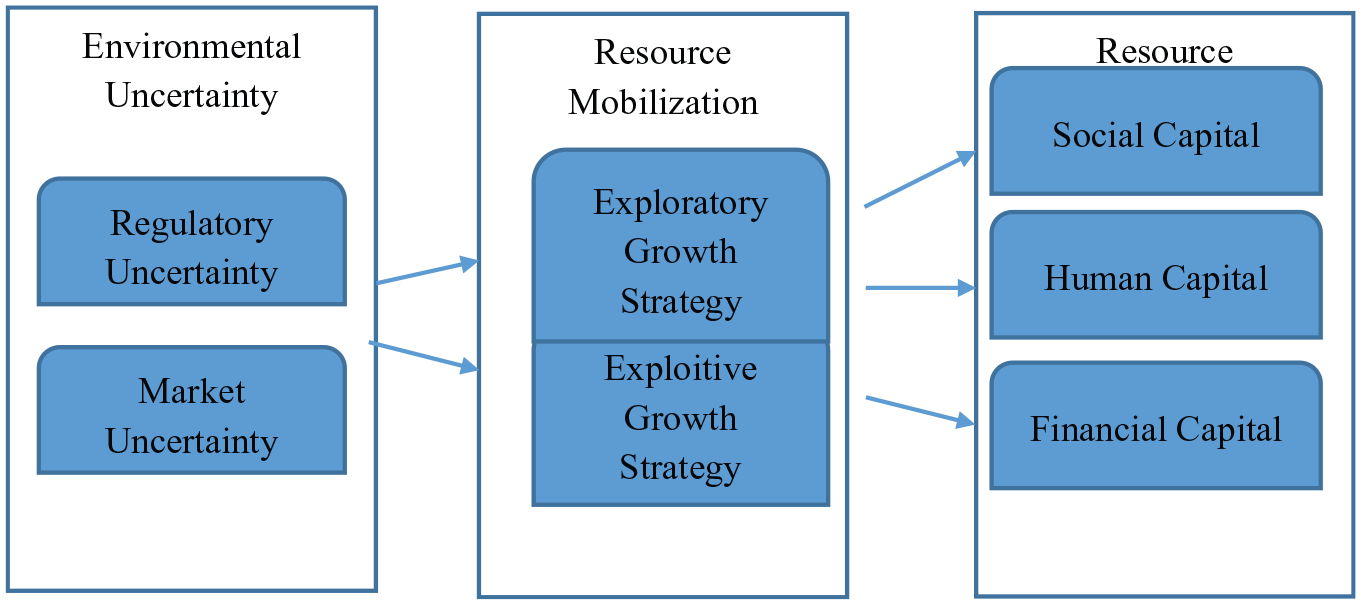
Overall research model.
SME resource mobilization
Resource mobilization is about designing the capability configurations and the resource leveraging strategy (Sirmon et al., 2007). Within an experiential learning framework, organizational search could be conceptualized as the allocation of attention and resources between exploring new capabilities and exploiting existing capabilities (March, 1991). If a firm introduces a related product/market, it can leverage its existing knowledge base and exploit its existing capabilities. On the other hand, a firm can also experiment with a new product/market, which requires new knowledge and capabilities (March, 1991).
With respect to SMEs, an exploitation strategy would lead to an incremental extension of product/markets, while an exploration strategy would lead to a novel product-market entry. SMEs pursuing different growth strategies may grow at different rates, yet as learning theory suggests, at any given time one will dominate the other (March, 1991), which is particularly true for SMEs, due to their limited resources (Rothaermel & Alexandre, 2009; Voss & Voss, 2013). In the context of emerging market SME, the high level of environmental uncertainty for these SMEs may suggest one strategy to be more beneficial than the other, depending on the environmental uncertainty faced by each SME in different industries.
Uncertainty arises when firm cannot anticipate and predict accurately the future states of the environment (Pfeffer & Salancik, 1978). This article focuses on two sources of environmental uncertainty, namely market uncertainty and regulatory uncertainty. Market uncertainty is rooted in the changes in market demands and degree of competition. In emerging markets, such as the UAE, due to the immature market development, and the change brought by market transition, demand and competition usually are less predictable than fully developed markets.
Regulatory uncertainty is associated with the unstable governmental rules and regulations (Engau & Hoffmann, 2011). Many emerging markets have not yet developed strong market-supporting institutions such as well-established legal infrastructures and effective market intermediaries that help enforce laws and regulations (Bai et al., 2004; Tenev & Zhang, 2002).
A very recent meta-analysis by Giachetti et al. (2019) reviews a wide-ranging literature on host country institutional development, including studies that analyze perceived uncertainty resulting from institutional voids. Institutional voids, such as in the rule of law (Khanna & Palepu, 2000; Luo & Chung, 2013), create great uncertainty for business firms because they do not know whether and how regulatory agencies will respond to their actions and strategies. Thus, firms operating under uncertain environment face more difficulty to predict market demands and competitors’ actions because both market/product opportunities and rules and regulations are likely to be transitory (Denrell et al., 2003). Under such kind of an environment, firms with exposure to greater variety of future opportunities would have higher flexibility when market conditions change (McGrath & Nerkar, 2004).
An exploratory growth strategy will increase the diversity of an SME’s internal capabilities through developing new goods and services, which can enhance the chances that it will possess the capabilities required to cope with an uncertain future state. This leads to our first hypothesis:
SME resource configuration
When resources are mobilized, SME managers need to integrate the resources to generate capability configurations. Three broad types of resources are discussed in the previous literature, which are financial capital, human capital, and social capital (Ireland & Webb, 2006). Different resource combinations may be associated with different growth strategies (Gilbert et al., 2006).
The human capital of a firm refers to all the knowledge and skills embedded in firm managers and employees (Hitt & Ireland, 2002). Social capital of a firm refers to the knowledge assets embedded in firm relationships (Liao & Welsch, 2003). Human capital reflects the internal knowledge stock of the firm while social capital entails the external knowledge stock of the firm (Ireland & Webb, 2006).
Particularly in the case of SMEs, human capital heavily lies in the entrepreneurs and their teams’ career experience (Zikic & Ezzedeen, 2015) which influence new idea generation and performance outcomes (Gabrielsson & Politis, 2012). These knowledge stocks are tacit in nature and are important sources of competitive advantage. For example, human resource enables a firm to innovate (Cohen & Levinthal, 1990; Loch et al., 1996) and recognize and capture the growth opportunity (Shane & Venkataraman, 2000).
Social capital generates value through better supplier or customer relationships, quicker accessibility to new markets, and a reputation of legitimacy (Adler & Kwon, 2002). For example, in the services sector, where financial capital is a less critical barrier for entry and human capital is similar in its important, social capital is considered to be crucial for firms to obtain competitive advantages (Stringfellow & Shaw, 2009).
Both human and social capital exhibit tacit knowledge, which takes time to develop and is more difficult to imitate, thus could provide greater competitive advantage (Barney, 1991), especially for firm exploratory growth strategies. As the theory of resource orchestration suggests, if a firm is pursuing an exploratory growth strategy, it might need to integrate R&D, engineering, and marketing capabilities to create innovative ideas and projects. Moreover, the sharing of tacit knowledge is key in effective coordination of these capabilities (Sirmon et al., 2007). Knowledge networks internal and external to the firm can facilitate the communication and knowledge sharing process (Hitt & Ireland, 2002). For example, social capital enables SMEs to reduce the risks in reaching new markets with their product offerings and human capital can facilitate internal learning and innovation for new product breakthrough.
On the contrary, financial capital is more “generic” yet are more tangible than human and social capital (Zahra & Bogner, 1999). Exploitative growth is achieved through expanding the current customer base or incremental change to current products, which is more about replication and scaling current practice. Increased financial capital would be most effective in this process because such growth needs new investments which can buy other resources useful for fast expansion. Thus, for SMEs which pursue growth strategies through exploitation, raising additional financial capital is often their first concern.
Research design
Sampling and data collection
Given that our research involved SMEs operating in the Emirate of Dubai to test our hypotheses, we relied on the SME definition of the government of Dubai which is as follows: an entity engaged in an economic activity, with a legal form (registered as a business either with a Commercial Registry by the Department of Economic Development (DED) or with a free zone) and meets the thresholds of employee headcount and turnover as applicable to the industry group it belongs to (Trading / Manufacturing / Services). (Dubai SME, 2009)
Figure 2 shows a summary of the employment and turnover thresholds used to defined SMEs.
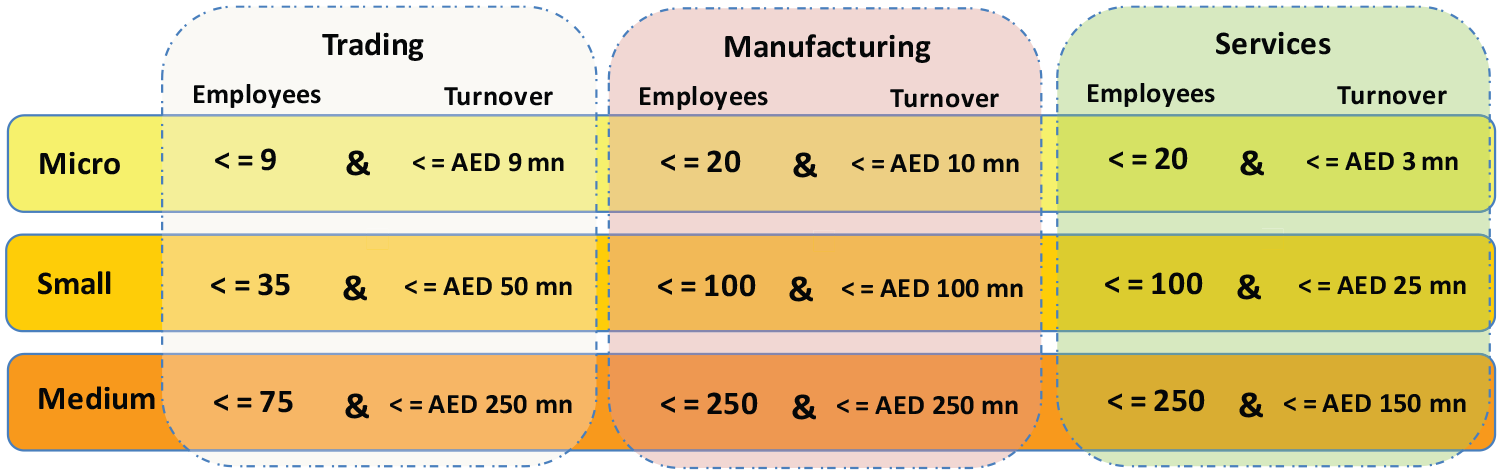
The Dubai SME definition.
According to the recent report by Dubai SME, 1 SMEs account for 95% of the establishments and 42% of the total workforce in Dubai, contributing around 40% to the total value-added generated by the Dubai’s economy. Following the above definition, this research drew a random sample of 500 SMEs from the database of the Dubai Economic Development Department and sent the invitation to participate in this study. In total 212 SMEs’ owners, CEOs, or Managing Directors agreed to participate, resulting in response rate of 42.4%. Table 1 reports the profiles of the sampled SMEs. All respondents were either CEOs, owners, or managing directors, who have completed the entire survey, based on their detailed knowledge of their companies. As indicated in Table 1, the sampled SMEs cover a wide range of industries and all three major sectors. It also has reasonable variance in terms of firm size and, years of operation, implying representativeness. Following Armstrong and Overton (1977), we performed t-tests to compare the early and late respondents to estimate any selection bias, which yielded insignificant results in all variables and thus suggests that non-response bias is not present.
Sampled SME profile for the survey study.
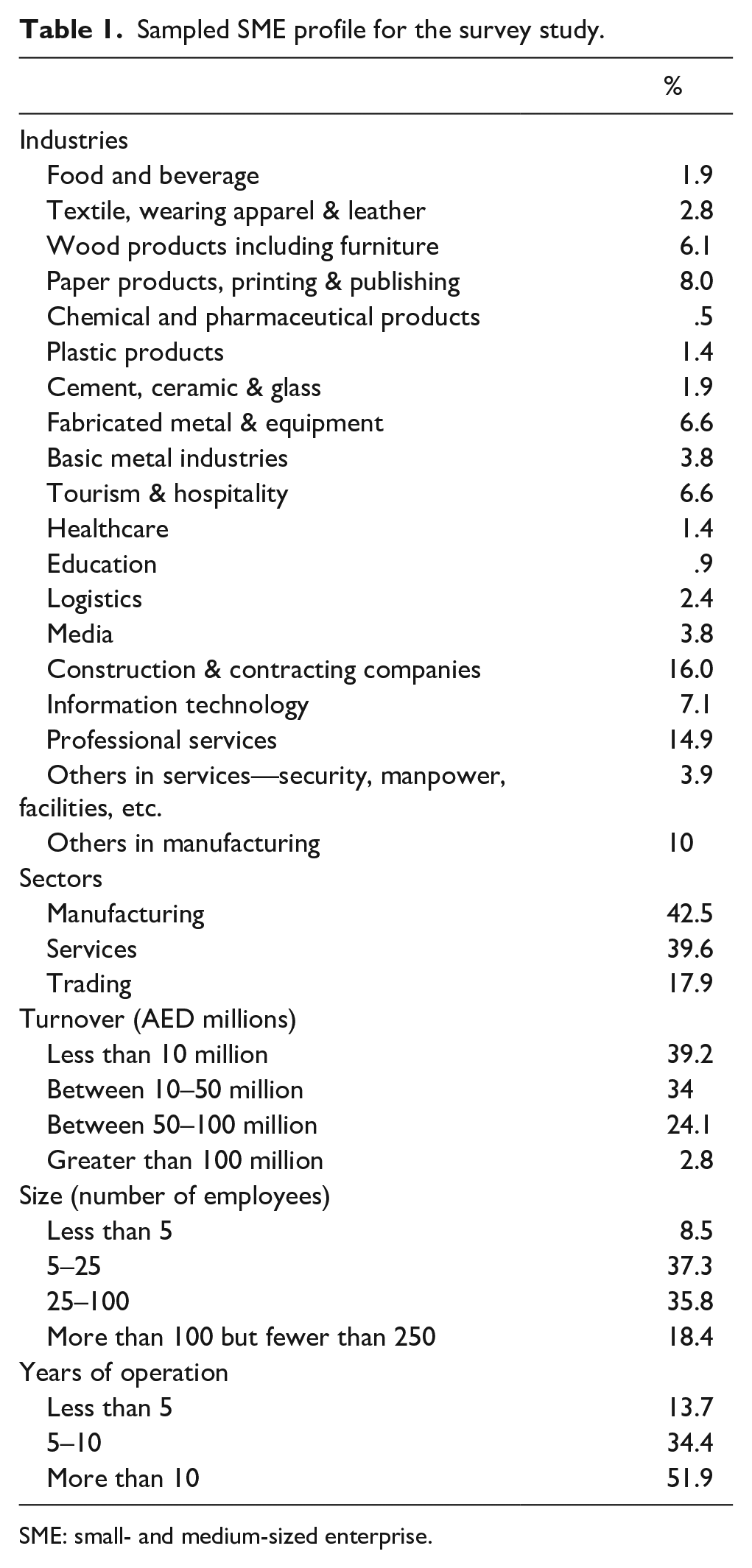
SME: small- and medium-sized enterprise.
Measurement
Prior to the survey, we conducted 59 interviews over a 6-week period with CEO, owners, or managing directors of the SMEs, who were responsible for strategic decisions, to elicit their views about the environmental uncertainty, growth strategies, and resource requirements. Table 2 reports the profiles of the SMEs participating in the interviews.
SMEs’ profile in interviews.
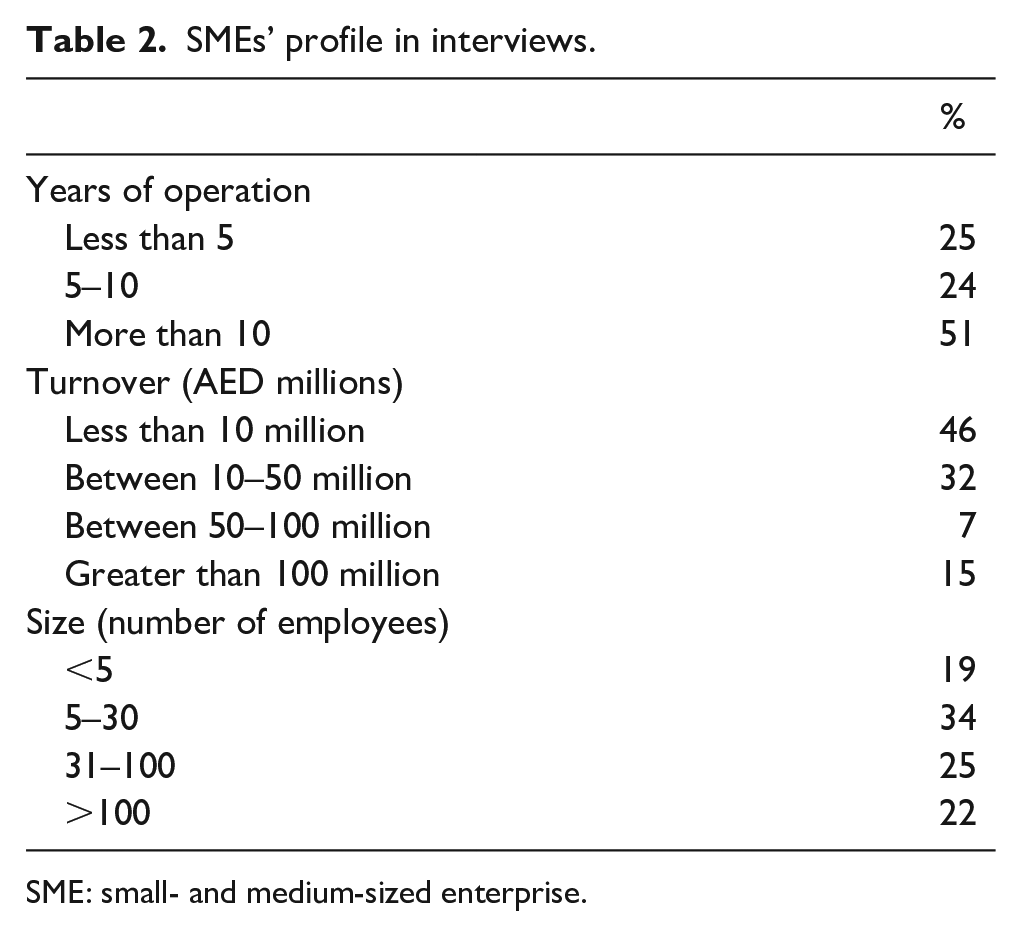
SME: small- and medium-sized enterprise.
Our main objective in conducting interviews prior to sending out the questionnaire was to ensure the relevance and measurement of the variables about environmental uncertainty, growth strategies, and resource requirements by integrating what we know from the existing literature and the findings from the interviews. Therefore, these interviews facilitated understanding of the phenomena of interest and enhance the relevance of the measures adapted from prior research. In particular, our findings from the interviews reveal the constructs’ content domains for measurement development. Furthermore, the interview results helped in refining the questionnaire with another round of personal interviews and pre-tests with senior marketing managers before the main survey was sent out.
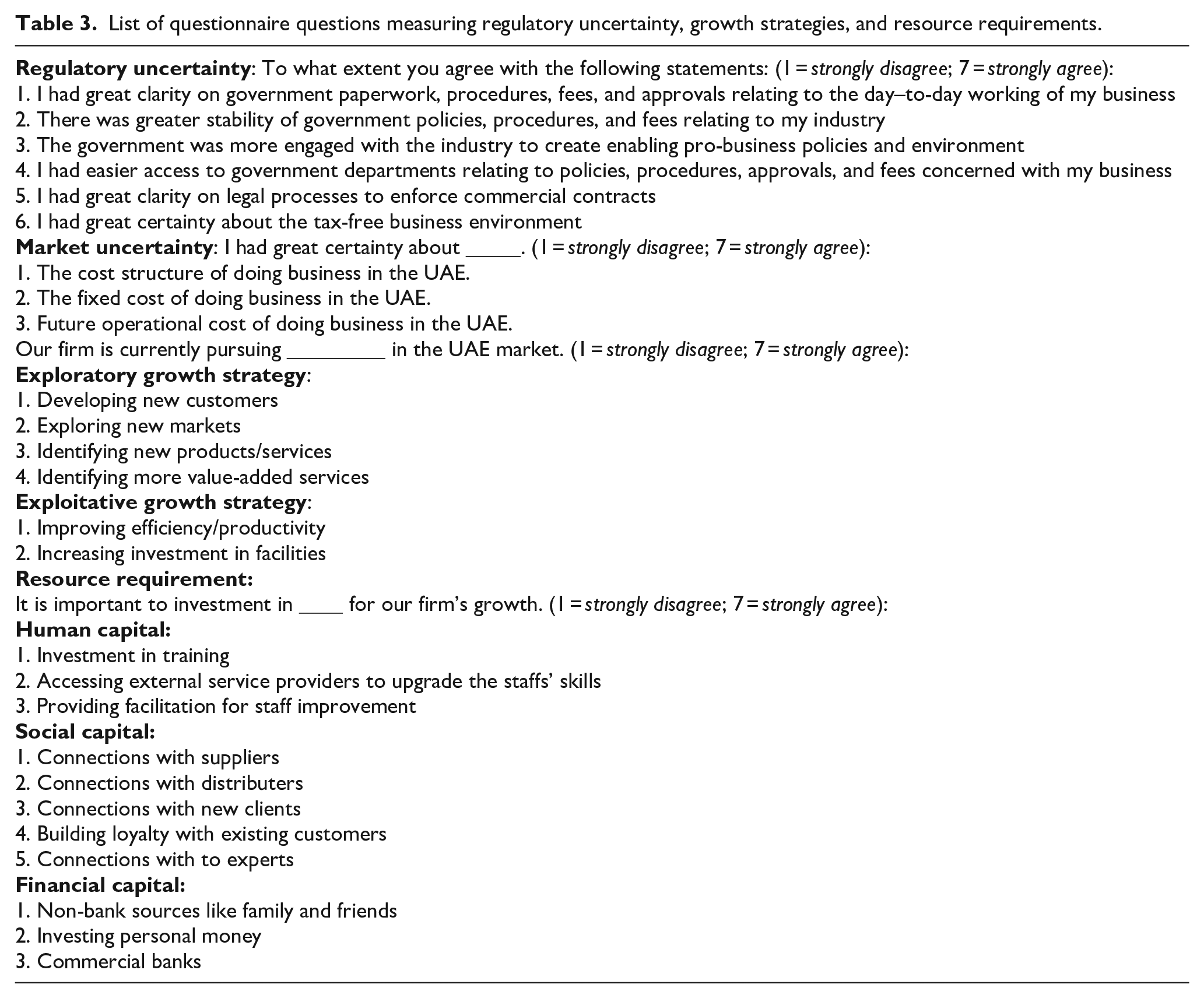
Table 3 shows all the questions included in the questionnaire. Each measure used the 7-point Likert-type scale, ranging from 1 representing strongly disagree to 7 representing strongly agree. The measures can be categorized into three areas, namely (1) regulatory uncertainty, (2) growth strategies, and (3) resource requirements. We discuss each area in turn now.
List of questionnaire questions measuring regulatory uncertainty, growth strategies, and resource requirements.
Regulatory environment
The first area concerns the environmental uncertainty that SMEs face and we draw on Milliken’s definition of perceived uncertainty as ‘‘an individual’s perceived inability to predict something accurately’’ (Milliken, 1987, p. 136). Based on this definition, we developed two questionnaire questions to measure. Based on the interview results, we identified and developed two measures of environmental uncertainty, namely (1) regulatory uncertainty and (2) market uncertainty. In terms of regulatory uncertainty faced by SMEs operating in Dubai, this includes the clarity, stability, and enforcement of the government policies and procedures. Following Engau and Hoffmann (2011), we included six items in the questionnaire for respondents to indicate the extent to which they perceived themselves able to predict the future clarity, stability, and enforcement of government policies regarding SMEs. A similar approach was used for the second environmental uncertainty, namely market uncertainty, where we included three items to capture the extent to which respondents could predict future operational cost resulting from the market dynamics and complexity.
Growth strategies
As for growth strategies, interview results demonstrate that SMEs consider two broad categories of strategies (exploratory and exploitative growth strategy) depending upon their target market scope and location. In measuring the exploratory growth strategy, we used four items, that is, developing new customers, exploring new markets, identifying new products/services, and finally identifying more value-added services.
With regard to an exploitative growth strategy, we included two items indicating the extent to which SMEs intent to improve efficiency/productivity and increase investment in facilities.
Resource requirements
As for the resource requirement, the importance and relevance of human, social, and financial capital was confirmed in the interviews. With regard to human capital, this includes education, experience, knowledge, and skills (Hitt & Ireland, 2002). As revealed by the interviews, of particular relevance for SMEs was to develop human capital within the organization to improve the task-related knowledge and skills. Accordingly, three items were developed to measure the importance of developing human capital, that is, investment in training, accessing external service providers to upgrade the staffs’ skills, and providing facilitation for staff improvement.
With regard to social capital, we followed the Burt’s perspective (Burt, 1982) to measure social capital and asked respondents to indicate the importance of social network development for SME growth. Similar to (Westlund & Nilsson, 2005) where the authors identified internal and external (including production-related, environment, and market-related) social capital components, this research also found that external social capital components were particularly highlighted in the interviews. Accordingly, five items were developed for social capital, that is, connections in the industry such as suppliers/distributers, links to new clients, building loyalty with existing customers, and links to experts.
Finally, three items were developed for financial capital sources, and respondents were asked to indicate the importance of such resources for SME growth. These items included non-bank sources like family and friends; investing personal money; commercial banks.
Methodology
Following the literature on similar SME studies using survey responses (Massaro et al., 2015), we use partial least squares (PLS), one of structural equation modeling (SEM) techniques, for measurement validation and hypothesis testing (see also McIntosh et al., 2014; Mouritsen, 2006). PLS is widely accepted as a suitable technique for exploratory model testing, while covariance-based SEM developed using software such as LISREL is usually used for theory confirmation (Fornell & Bookstein, 1982; Hair et al., 2011, 2017). Another reason for using PLS is that it leads to stable, correct, and highly predictive models even for correlated independent variables (Eriksson et al., 2001; Pirouz, 2006).
Using covariance-based SEM for hypothesis testing requires sufficient sample size for model structure (McQuitty, 2004). Generally, the minimum ratio between the samples and number of parameters is 10 (Schreiber et al., 2006). Hoe (2008) suggests that it would entail sufficient statistical power with a sample size of 200. According to the Daniel Soper’s a priori sample size calculator for SEM, 2 the minimum sample size for our model testing is 100. Therefore, a sample of 212 is considered suitable for using SEM.
This research employed the bootstrap re-sampling procedure to test the path significance and followed the standard approach to evaluate the fitness of the both measurement and structural models. Particularly, the measurement validity requires path loadings from construct to measures exceeding 0.70. In addition, composite reliability measures (ρ) and average variance extracted (AVE), as suggested by Fornell and Larcker (1981), were used to demonstrate internal consistency of reflective measures. The discriminant validity was examined by comparing the square root of the AVE for a particular construct to its correlations with the other constructs (Fornell & Larcker, 1981) and by examining cross-loadings of the constructs.
Since this study adopted a cross-sectional design, common method variance might be a threat to the internal validity. This issue was addressed first through the instrument design by using different scales and randomizing the sequence of the questions. Such methods have been proved to effectively reduce the common method variance. Furthermore, this research used Harman’s single-factor test (Podsakoff & Organ, 1986) to check whether common method variance could be a concern for the validity. According to Harman’s single-factor test (Podsakoff & Organ, 1986), common method variance is present if a single factor accounts for the majority of the covariance in the dependent and independent variables. The principle component analysis with all measures resulted in nice distinct factors and the first factor only accounted for 16% of the variance, implying common method bias may not be a serious concern in this study.
Results
Measurement validation
Table 4 shows the loadings of the measures to their respective constructs along with composite reliability scores. All reflective items, except for one item for exploitation, are significant at the 99% level with loadings above 0.8, demonstrating the convergent validity. Even the loading of that item for exploitation is less than 0.8 but remained acceptable. The composite reliability scores (ρ) of all latent constructs are higher than the recommended value of 0.80 (Nunnally, 1978), demonstrating internal consistency.
Measurement model —loadings and reliability.
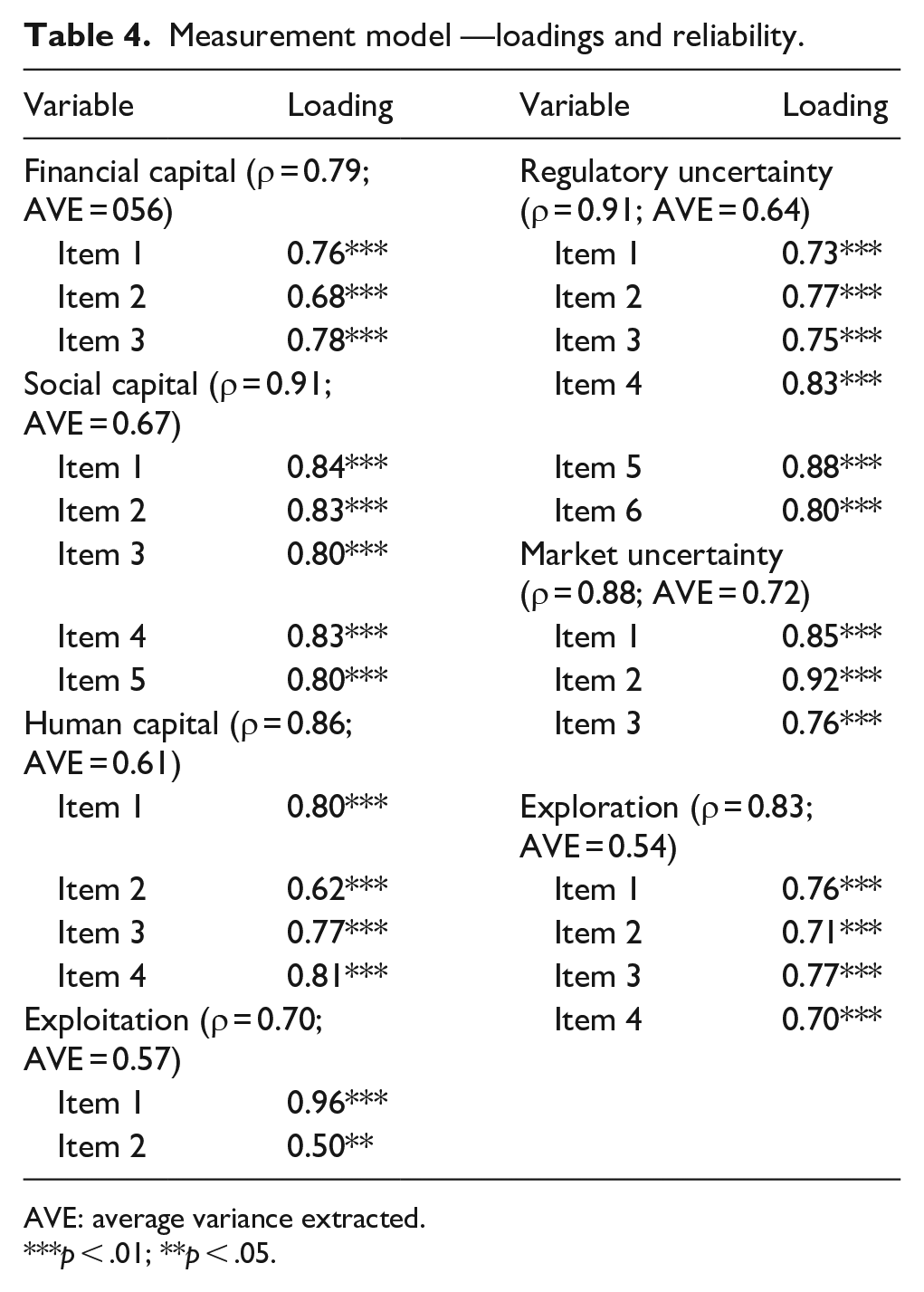
AVE: average variance extracted.
p < .01; **p < .05.
Table 5 reports correlations among the latent constructs and the square roots of the AVE scores (diagonal elements in Table 5). As indicated in Table 5, all correlations are much lower than the square roots of the AVE scores. Furthermore, all items load higher on their respective constructs than on others. Both evidences support discriminant validity.
Measurement model—correlations and discriminant validity.
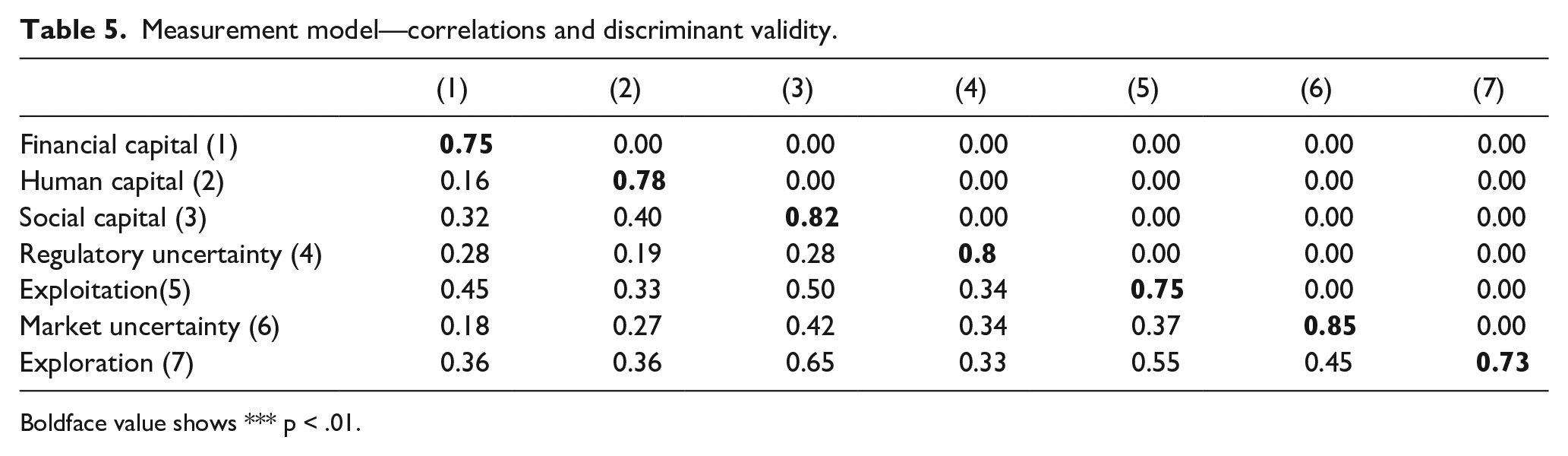
Boldface value shows *** p < .01.
Hypothesis testing
Figure 3 presents the results of the structural model analysis, including the overall explanatory power (R2) and path coefficients (for relationships between latent variables). Assessment of the structural model also involved control variables including the number of employees, annual revenue, and types of industry. Environmental uncertainty, including both regulatory (β = 0.22; p < .01) and market uncertainty (β = .25; p < .01), explains 28% of the variance in SMEs adopting exploration growth strategy, but relationships between either regulatory or market uncertainty and exploitation growth strategy is not significant. Hence, H1 is supported.
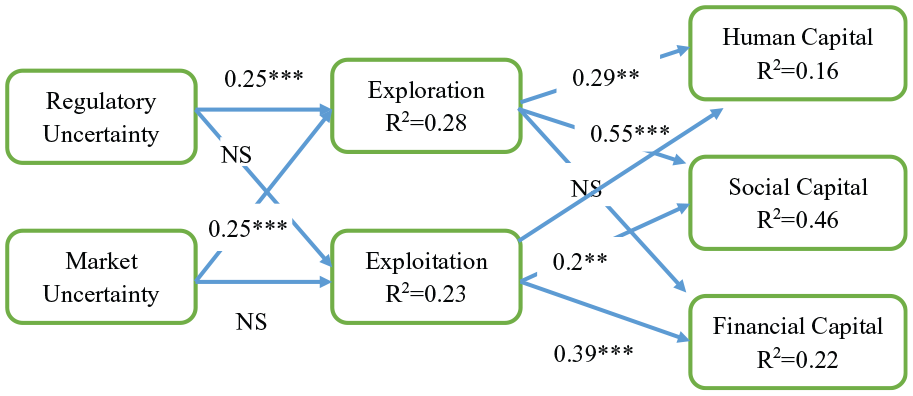
Structural model for hypothesis testing.
As for the impact of growth strategies on various resources, this study provides empirical support for the positive impact of exploration growth strategy on social capital (β = 0.55; p < .01; R2 = 46%), and human capital (β = 0.29; p < .01; R2 = 16%), but not for financial capital. Moreover, the empirical result suggests a significant positive relationship between exploitation and financial capital (β = 0.39; p < .01; R2 = 22%). Thus, H2 and H3 are also supported. Moreover, this research also finds a significant positive relationship between exploitation growth strategy and social capital (β = 0.2; p < .05; R2 = 46%).
Discussion of results
How SMEs choose strategies is an important research question that is yet to be fully understood. This article uses the RBV to explore how SMEs mobilize and coordinate resources to decide on their particular strategy in the face of environmental uncertainty. In terms of resource mobilization, we find that environmental uncertainty may be an important antecedent of such strategic choice. Higher perceived environment uncertainty will drive SME managers to pursue exploratory growth, by entering new product-market domains. And this effect holds for both market uncertainty and institutional uncertainty. On the contrary, neither types of uncertainty affect the pursuit of exploitative growth. While previous research finds uncertainty may negatively related to growth performance (Baum et al., 2001), this finding indicates uncertainty may be an important source of entrepreneurial growth, particularly for new product or market expansions. Since exploration may be riskier than exploitation, such growth strategy may incur greater level of firm death and failure, which in turn may help explain why market uncertainty can lead to worse growth performance.
Regarding how managers use resources to achieve their growth strategy, this research reveals firms pursuing exploratory growth strategies emphasize more on intangible resources such as human capital and social capital. The importance of such resources for firm growth has been supported by previous research and can be explained by the RBV, which argues only rare and non-inimitable resources can create competitive advantage. Compared with financial resource, human and social capital are rarer and more difficult to gain and develop. It seems SME managers rely more on such resources in exploratory growth. This research also finds firms that pursue exploitative growth are more likely to emphasize financial resource. Such resource is more liquid and can be easily redeployed thus would better support exploitation.
Conclusion
SME growth is one of critical challenges for policy makers and entrepreneurs, particularly for emerging economies. This research addresses this challenge by taking the perspective of resource orchestration and investigates SMEs’ strategic choices and subsequent resource preferences. With a sample from the UAE, this study adds interesting insight to the SMEs’ behavior. We show that SMEs are likely to pursue exploratory growth instead of exploitative growth when perceiving higher environment uncertainty (in forms of market and institutional uncertainty) and emphasize more on intangible resources such as human capital and social capital. SMEs with exploitative growth strategy are more likely to emphasize financial resource. Such results provide valuable guidance for policy makers to design the supporting mechanisms and SMEs for resource orchestration.
Overall, this research contributes to the research on the process of SME growth, by further exploring how managers orchestrate resources through mobilization and coordination. Particularly, this research makes several theoretical contributions. First, this research contributes to the entrepreneurship and small business literature by better explaining the growth process of SMEs. Previous research has demonstrated SMEs’ growth is critical for any economy (Ayyagari et al., 2007; Wennekers & Thurik, 1999), yet most prior research only focuses on overall growth without carefully delineating different growth processes (Gilbert et al., 2006). This research examines specific growth strategies rather than overall growth results and provides further insight about how different paths of growth may need different types of resources.
Second, this research contributes to the nascent research stream of managerial resource orchestration, which argues mangers’ actions play an important role in structuring, bundling, and leveraging firm resources (Helfat et al., 2007; Helfat & Martin, 2015; Sirmon et al., 2011). This more in-depth examination of the resource-related processes could provide extended insights for RBV (Crook et al., 2008), yet need additional theoretical development and empirical tests (Sirmon et al., 2011). Along with this line of research, this research reports the specific strategic preferences made by managers in response to external environments and their priority in resource configuration, thus contributing to the development of the “resource orchestration” research.
Finally, this research contributes directly to the RBV by investigating how resources are used in either an exploratory or exploitative strategy. Using a finer grained manner to separate resources into three types, and looking into the process of resource orchestration, this research shows heterogeneity in firm resource mobilization and resource coordination. The importance of a certain type of resource may thus be contingent on the context.
In addition to above theoretical contributions, our empirical results must be considered in light of the limitations of this research, which in turn opens up potential avenues for future research. First, the focus of this article is not explaining firm growth per se but to analyze growth strategies, which reflects how SME owners and decision makers make sense and respond to external environment uncertainty. It would be fascinating to explore how different strategic choices affect the actual growth of firms. Resource orchestration, while aligned with the external environment, is expected to generate firm performance improvements. Thus, future research can add performance as a dependent variable to further examine this issue.
Second, the empirical test of the concept of resource orchestration is not yet comprehensive. A more in-depth test of the theory of resource orchestration could further measure the breadth, depth, and life cycle of research orchestration. For example, the sample used for this research were firms at their growth stage, yet their resource orchestration may be different between early stage and mature stage. Similarly, one could explore the situations where SMEs have a dual or mix strategy of exploration and exploitation and how such decisions are developed. Another fruitful area to explore is to consider a firm’s intellectual capital in more detail when it comes to resource orchestration of organizational and structural capital, such as patents and various forms of know-how encompassing human and social capital. Recent work by Massaro et al. (2015, 2019) shows that in different contexts, such as large versus small firms, permanent teams versus temporary teams, firms require diverse resources. Based on their findings, the implication is that it is crucial to consider intellectual capital (human and social) alongside other standard resources in a firm strategy formulation to increase firm performance, which in turn will vary across firm contexts. Future research is need on the role of organizational and structural capital for SMEs.
Finally, the sampled firms were from the UAE. While this approach helps provide much needed empirical evidence from emerging markets, the results may not be generalizable to other emerging countries. Future research can test this theory in other countries and explore whether the institutional differences may confirm or offer alternative findings.
Nevertheless, this article has a number of important managerial and policy implications based on the results of our study. The policy implications from our study are that support for SMEs should be multi-faceted depending on the combination of uncertainty faced and type of strategy chosen by SMEs. Thus, it is important to realize that a general support mechanism at the regional or governmental level is not going to provide the best business environment for SMEs. Instead, more tailor-made support is needed, such that policies in strengthening the business environment need to vary industry by industry. For example, the market and regulatory environment in the energy and construction sector in the UAE is more advanced than in some industries in the service sector and medium technology manufacturing sector. Therefore, knowing which SMEs in which industries are more in need of specialized support and how to tailor such support is crucial for local and regional policy makers to know and implement.
The results from our study also provide valuable insights for how managers can structure, bundle, and leverage different resources for developing their strategies based on their level of perceived environmental uncertainty. Managers of SMEs need to realize and make sense of the choices that are available in the decision-making process toward deriving an exploitative versus explorative strategy in the face of environmental uncertainty that is dynamic and every changing.
Footnotes
Declaration of conflicting interests
The author(s) declared no potential conflicts of interest with respect to the research, authorship, and/or publication of this article.
Funding
The author(s) received no financial support for the research, authorship, and/or publication of this article.