




Abstract
It is important for organizations to identify the drivers for effective collaboration in contemporary teams, such as self-managed ad hoc teams. Therefore, we aimed to investigate (1) the influence of team task engagement and mastery experiences on collective efficacy beliefs and (2) the temporal relationship between team task engagement and task performance over time. We postulate that to build collective efficacy in contemporary teams over time, it is necessary to enhance positive emotional states (i.e., team task engagement) and mastery experiences (teams’ past task performance). The study adopted a three-wave longitudinal design in which 575 individuals nested within 112 self-managed ad hoc teams participated in a decision-making task. Results showed that team task engagement and past task performance positively predicted future collective efficacy. Moreover, team task engagement positively predicted teams’ task performance over time. This study contributes to the understanding of the antecedents of team effectiveness, specifically in contemporary teams.
Keywords
Introduction
The development department’s goal is to find individuals who will work effectively together. Ensure social dynamics in the team.
Employees tend to exchange and share emotions and beliefs, and these interactions often take place within the context of employees working in teams. Moreover, technology, globalization, and the often complex nature of distributed work have led organizations to recognize the relevance of understanding team effectiveness in these environments (Salas et al., 2009). Teams have become the basic unit for work organization and work accomplishment (Hirschfeld & Bernerth, 2008). For instance, project-based organizations based on teams’ specific functions have become prominent in today’s economy because their configuration makes them flexible and well equipped to overcome traditional barriers to innovation and organizational change (Sydow et al., 2004). In fact, according to new management models and ideas (e.g., Laloux, 2014), self-managed teams are the pillars for a renovated organizational structure. In other words, project self-managing structures and peer-based processes are found to be much more powerful, inspiring, and agile than the staid old pyramid (Laloux, 2014). However, when studying teams’ dynamics, contemporary team typologies show that fuzziness is not an exception, but rather a common rule. Hence, “any researcher doing a study of teams may struggle to describe exactly what kind of team is the focus of his or her study” (Hollenbeck et al., 2012, p. 82).
According to the taxonomy by Hollenbeck et al. (2012), team types can be defined based on three dimensions: skill differentiation, or the degree to which members have specialized knowledge or functional capacities that make it more or less difficult to substitute members; authority differentiation, or the degree to which decision-making responsibility is established in individual members, subgroups of the team, or the collective as a whole; and temporal stability, or the degree to which team members have a history of working together in the past and an expectation of working together in the future. Hence, based on this taxonomy, we can define the teams that are becoming increasingly more frequent in organizations as being related to: high skill differentiation (team members have different backgrounds and knowledge related to multidisciplinary or cross-functional teams—Denison et al., 1996); low authority differentiation (team members have the same influence, and there are no formal leaders, which is related to autonomous and self-managed teams—Taggar et al., 1999); and low temporal stability (teams that have a short history as a team and work for specific project, related to ad hoc or project teams—Salas et al., 2008).
Framing contemporary teams using the dimensions of high skill differentiation, low authority differentiation, and low temporal stability (Hollenbeck et al., 2012) resulted in defining our teams as self-managed/ad hoc teams. We focus on contemporary teams because organizations are increasingly encouraging self-governing teams to solve specific projects and design their work (Laloux, 2014; Nonaka & Toyama, 2005). This framework will facilitate discussion about how to best conceptualize differences between teams in a consistent and flexible way (Hollenbeck et al., 2012), allowing researchers in the team field to more accurately build and test the theory on team processes.
Thus, it is necessary to understand the emergent ways and forms of collaboration and the dynamics and processes of today’s teams (Wageman et al., 2012). In fact, research on contemporary teams should also address the different contributions that team management can make to team processes, such as collective efficacy, and to team outcomes, particularly using longitudinal research designs (Quinteiro et al., 2016). Moreover, research on team effectiveness should consider, for instance, the specific characteristics of teams that are responsible for a temporary project or specific goal (i.e., ad hoc teams). Because ad hoc project teams are becoming common in organizations, it is important to explore which factors may foster team efficacy in these types of teams. Therefore, studying the drivers of effective collaboration in teams, especially in contemporary typologies of teams, has become a fruitful and exciting topic for research and practice (Maynard et al., 2012; Wageman et al., 2012), and it is necessary to further advance team effectiveness. Team effectiveness (i.e., performance evaluated by others, member satisfaction, viability) is an emergent result that unfolds across levels (individual to dyadic to team) and over time (Kozlowski & Ilgen, 2006). Past research on team effectiveness has shown that various team processes have positive relationships with team performance (Kozlowski & Ilgen, 2006; LePine et al., 2008). Team effectiveness literature is extensive, and, therefore, there is considerable research on diverse team processes, such as team cohesion, trust, and climate, that affect team performance (Devine et al., 1999). One of the emergent motivational processes (state) of teams that has been linked to team performance is collective efficacy (Gully et al., 2002; Kozlowski & Ilgen, 2006). Collective efficacy refers to a team’s shared perception of its ability to successfully perform a specific task (Bandura, 1997). Given the well-supported relationship between team efficacy and team performance, there is a clear interest in understanding the antecedent factors that help to promote team performance development (Kozlowski & Ilgen, 2006). However, thus far, most research has examined the team efficacy–performance relationship, with far less attention devoted to the antecedents of team efficacy. Due to this gap in the literature, it has been difficult to provide direct recommendations about the ways managers and organizations can build efficacy at the team level (Tasa et al., 2007). Moreover, existing research on collective efficacy has mainly focused on traditional teams, but much less on contemporary teams, which often have different characteristics (such as no formal leaders and short-term history). Therefore, with this study, we aim to fill some of these gaps in the literature on team effectiveness.
First, our study tries to respond to the call by Mesmer-Magnus et al. (2017) to study teams operating in the more specialized and distributed environments faced by contemporary teams. For example, relevant companies usually work on temporary project teams that often have clear and specific goal planning. Therefore, the mission of the managers is not only “to find individuals who will work effectively together” (Catmull, 2008, p. 6), but also to ensure the best possible social dynamics by building a strong sense of collective efficacy and high-performance levels from the very early stages of team functioning and development. Therefore, it seems highly relevant for organizations to appraise and manage the main drivers of effective collaboration and high performance in self-managed ad hoc teams. Therefore, as a contribution, in the present study, we will analyze collective efficacy in contemporary teams based on a clear team conceptualization, such as the taxonomy by Hollenbeck et al. (2012), and taking into account the specificity of contemporary teams.
Second, as Kozlowski (2018) pointed out, capturing team dynamics requires intensive longitudinal data. However, because it is difficult to collect such data, most research uses cross-sectional designs. Therefore, investigating temporal relationships and, for instance, reversed or reciprocal relationships, has not been possible with these designs, and so it has been difficult to properly capture team dynamics.
In the present study, we will investigate the drivers of team effectiveness (i.e., collective efficacy) in contemporary teams using a longitudinal design with three time points to reach the study goals. We investigate, first, the impact of team task engagement and mastery experiences on collective efficacy beliefs and, second, the temporal relationship between team task engagement and task performance.
Theoretical background and hypotheses development
Building efficacy beliefs in teams
Bandura (1997, 2000) theorized that collective efficacy influences what team members choose to do as a team, the amount of effort they make, and their perseverance in the face of challenges or failure to produce results. Previous research has primarily focused on the consequences of collective efficacy, such as group effectiveness (Baker, 2001; Mulvey & Klein, 1998—also see Stajkovic et al., 2009 for a meta-analysis), creativity (Ma et al., 2017), innovation (Liu et al., 2015), satisfaction (Judge & Bono, 2001; Salanova et al., 2011), performance (Gully et al., 2002), and collective positive experiences (Salanova et al., 2014). However, there is a need for more empirical research on the antecedents of collective efficacy beliefs (Salanova et al., 2011; Tasa et al., 2007), especially in contemporary teams.
According to the perspective of social cognitive theory (SCT) developed by Bandura (1986, 1997), people’s beliefs about their efficacy can be developed by four main sources of influence: enactive mastery experiences, vicarious experience (modeling), verbal persuasion, and physiological and emotional states. These determinants of efficacy beliefs operate in the same way at the collective level as they do at the individual level (Bandura, 1997, p. 478). Thus, perceived collective efficacy is not simply the sum of the efficacy beliefs of individual members; instead, it is an emergent group level property (Bandura, 2000). However, a stream of research suggests that the development of collective efficacy may be different from the antecedents of self-efficacy (Chen & Bliese, 2002; Gully et al., 2002; Tasa et al., 2007).
Drawing on the SCT (Bandura, 1986, 1997), the four main sources of efficacy beliefs (enactive mastery experiences, vicarious experience, verbal persuasion, and physiological and emotional states) might have an influence on collective efficacy. However, considering the self-managed and ad hoc nature of contemporary teams, we expect that sources that might be within the team’s control would have a greater influence on collective efficacy. Therefore, we included in our study two specific sources of efficacy beliefs that might be more under the control of contemporary teams, that is, enactive mastery experiences and emotional states. Although we can be both verbally persuaded and learn vicariously through others team members not necessarily formal leaders, previous research has shown that the most powerful source of collective efficacy is past mastery experiences (Goddard et al., 2004). Moreover, according to emotional contagion theory (Hatfield et al., 1994), we posit that the past successful experiences that the team lives generate positive emotional states that reinforce the collective efficacy of the team. Therefore, these two sources of collective efficacy seem the most salient sources for self-managed teams.
In contrast, we considered that vicarious experience and verbal persuasion (related to experts and formal leadership aspects) would not have a direct influence on collective efficacy in contemporary teams. One reason for not including these two sources in this setting is that, although the role of the leader has been widely demonstrated in team efficacy (Chen & Bliese, 2002; Taggar & Seijts, 2003), formal leaders are not typically associated with self-managed teams. Self-managed teams allow their team members a high degree of autonomy, thus encouraging individuals to lead themselves independently from external supervision, take responsible action, and control personal behaviors. Members of self-managed teams are often highly skilled individuals, and these teams are associated with more positive intra-team processes (Stewart & Barrick, 2000) and increased productivity (Millikin et al., 2010). Hence, contemporary teams, such as self-managed or ad hoc teams, might not be functioning in the same way as traditional ones. Therefore, we will explore the antecedents of efficacy beliefs considering the self-managed nature of the teams. Thus, based on SCT, we propose that collective efficacy beliefs build over time in contemporary teams, by means of two main sources of influence: positive psychological affect (i.e., collective task engagement) and past mastery experiences (i.e., task performance).
Regarding the first source of collective efficacy, positive psychological affect, and according to Bandura (1986, 1997), efficacy beliefs can be created and strengthened through emotional and affective states. People partly rely on their somatic and emotional states when judging their capabilities. Thus, mood also affects people’s judgments of their personal efficacy. Positive mood enhances perceived self-efficacy, whereas despondent mood diminishes it. People who have a high sense of efficacy are likely to view their state of affective arousal as an energizing facilitator of action (Bandura, 1986, 1997). Therefore, positive affective-motivational states, such as work engagement, have been found to boost efficacy beliefs, both at the individual (Ouweneel et al., 2012) and collective levels of analysis (Salanova et al., 2011).
Work engagement has been defined as a pervasive affective-motivational state that can spread and be shared among the different members of work teams (Torrente et al., 2012). Team work engagement is “a positive, fulfilling, work-related and shared psychological state characterized by team work vigor, dedication and absorption which emerges from the interaction and shared experiences of the members of a work team” (Torrente et al., 2012, p. 110). Team work engagement involves a number of behaviors, such as emotional expressions and emotionally charged verbalizations, that can be appraised by team members and, hence, promote a shared perception of work engagement (Bakker et al., 2007). For example, a vigorous employee persists when there are difficulties because he or she feels strong and devoted to his or her job and is able to motivate the rest of the team members to carry out team duties. A dedicated employee feels emotionally attached to the task at hand, which provides him or her with a sense of meaning and purpose that is expressed in the form of joy and pride toward his or her work. Finally, absorbed employees feel happily engrossed with the task they are carrying out, which can provide them with a strong focus and concentration when interacting with the rest of the team members. In the context of the current study, we will use the term team task engagement because it refers to the specific task at hand, and not to the work itself or the job in general (Schaufeli & Salanova, 2010). Furthermore, participants performed the tasks in a laboratory setting and not in the actual work environment, which made it possible to account for specific temporal processes related to the task at hand.
Bakker et al. (2006) identified emotional contagion as the main crossover mechanism behind the emergence of a shared psychological state such as team work engagement. As team members interact on a daily basis, they influence each other and are susceptible to positive emotional contagion, in terms of work engagement spreading among workers (Bakker et al., 2005, 2006). Emotional contagion theory (Hatfield et al., 1994) posits that people have the innate, inner tendency to mimic facial expressions, postures, and emotions, thus synchronizing physically and emotionally with each other. Furthermore, during the socialization process, employees develop norms of emotional expression that are appropriate in a given context, which in turn may have an effect on expressing similar affective states.
Therefore, based on the existing theoretical literature, we expect that collective task engagement will lead to collective efficacy beliefs over time. In other words,
Hypothesis 1. Team task engagement is positively related to collective efficacy over time (from T1 to T2 and from T2 to T3).
The second source of efficacy is past mastery experiences and past success. According to Bandura, the most influential antecedent of self-efficacy for a given task is one’s previous experience in the same or similar situations (i.e., enactive mastery). Thus, the most effective way to create a strong sense of efficacy is through mastery experiences (Bandura, 1997). A study by Hirschfeld and Bernerth (2008) with 110 newly formed action teams in a military setting also indicated that past successes may build a strong belief in one’s personal efficacy. Successful experiences can be even more relevant for teams that have less experience working together.
At the individual level, Gist and Mitchell (1992) argued that, in novel task situations, efficacy beliefs are partially based on a detailed assessment of personal (e.g., skill level and available effort) and situational resources and constraints (e.g., task demands and distractions). In contrast, when the task has been performed well in the past, a quicker and more superficial judgment about self-efficacy tends to be made. For example, on routine tasks, individuals are apt to refer to their previous accomplishments and utilize previous performance levels as the main determinant of self-efficacy. Hence, the same thing might occur at the team level; that is, the way the team performed previously will act as a builder of collective efficacy beliefs. To our knowledge, there is scarce empirical evidence in work settings that shows how past performance influences future collective efficacy beliefs, especially in self-managed teams. However, this assumption has gained support in sports contexts (e.g., volleyball teams), where subjective and objective performance positively predicted collective efficacy at the team level (Dithurbide et al., 2009). Therefore, we hypothesize that past success perceived by the team will enhance its future collective efficacy. In other words,
Hypothesis 2. Mastery experience (i.e., good performance) enhances collective efficacy over time (from T1 to T2 and from T2 to T3).
Engagement and performance in contemporary teams
In seeking to build efficacious and productive contemporary teams, there is also interest in knowing under which conditions teams may perform well. We posit that team engagement is not only one of the sources of strong efficacy beliefs, but it is also related to good performance. A large body of evidence has been found on the benefits of engagement for organizations (see Harter et al., 2002, for a meta-analysis). Specifically, the link between work engagement and task performance has been empirically validated (Christian et al., 2011). However, studies that examine the association between collective engagement and performance are scarce (Torrente et al., 2012).
Individual work and task engagement provide employees with persistence in facing obstacles, purpose and meaning toward their task, and a strong focus and concentration. Therefore, the quality of the job increases, as well as the number of proactive and prosocial behaviors enacted. For instance, helping other team members (even if they are not requested to do so) or engaging in back-up behaviors (e.g., ensuring that the team has the necessary tools, materials, and technology to perform its duties successfully). Past research has shown the association between engagement and performance (e.g., Demerouti & Cropanzano, 2010), especially revealing that engaged employees are ready to “go the extra mile” by helping other team members. In this vein, Mäkikangas et al. (2016) showed that individual engagement impacted team performance via a shared crafting climate (for instance, helping other team members to craft their tasks). Thus, we can argue that engaged members act as resources for the rest of their colleagues and thereby enable the team to achieve its goals. These proactive and prosocial behaviors may spread and be shared within the team by means of giving back through gratitude for the help given. This is related to the research showing individual positive gain spirals, where employees’ job resources, engagement, and proactive behaviors reciprocally influence each other and encourage innovativeness at the work-unit level (Hakanen et al., 2008). Furthermore, the enthusiasm and positive and encouraging words expressed by engaged employees toward their job may positively “infect” their colleagues. In this way, engaged employees act as resources for the rest of the team members, who can be expected to improve performance at the team level of analysis. In fact, in organizations (or in teams) where performance is a joint effort, the transfer of positive experiences from one person to another is likely to occur, partly because when people have more opportunities to interact with each other, they have more chances of being involved in psychological contagion processes (Tickle-Degnen & Rosenthal, 1987).
Previous research shows that team-level work engagement is positively related to the task performance of students working in groups (Salanova et al., 2003); extra-role performance, customer loyalty, and service quality (Gracia et al., 2013; Salanova et al., 2005); affect and positive collective efficacy beliefs (Salanova et al., 2011); and individual work engagement (Bakker et al., 2006; Tims et al., 2013). However, research is needed to uncover the associations between collective engagement and team performance over time, especially in longitudinal studies. Based on the theory and existing studies, we hypothesize that team task engagement will enhance future task performance. In other words,
Hypothesis 3. Team task engagement enhances task performance over time (from T1 to T2 and from T2 to T3).
Method
Sample and procedure
The present study adopted a three-wave longitudinal design, in which 575 individuals participated in three sessions involving a decision-making task related to a business simulator (SITMECOM; González Zamora et al., 2000). Individuals were randomly assigned to the 112 teams. Participants were recruited through a webpage developed for this purpose and through advertising on university information panels. Each participant received a financial reward (20€) for taking part in all three tasks. The sample was heterogeneous, consisting of university students (71%) from different degrees (Psychology, Languages, Economics, Law, Design, Engineering, etc.), workers (16%) from a wide range of occupations, and unemployed people (13%). Participants made up 112 teams that were similar in magnitude (i.e., four to six members in each) and structure (i.e., similar number of men and women whenever possible, combination of students, employed, and unemployed people). Thirty-six percent of the participants were men, and the average age was 25.3 years (SD = 9.5 years). Each team was brought together for three laboratory sessions, one 2- to 3-hr session per week on three consecutive weeks, to work on a decision-making simulation task. The task consisted of running a fictitious organization, based on information and data provided by the researchers. The teams had to make decisions about where to invest money (e.g., buying goods, machinery, hiring people) or how to gain money (e.g., bank loan, selling goods, firing people). Teams had to solve similar simulations during the three sessions. Participants were told that the purpose of this study was to investigate how teams function in the context of a decision-making simulation project. Initially, 119 teams and 610 participants made up the initial sample, but based on the agreement analysis criteria (James et al., 1984), only those teams that met the criterion of common shared perceptions of the study variables were included in the study. This means that to justify aggregation of the team members in the study variables, adequate levels of agreement are needed (Bliese, 2000; LeBreton & Senter, 2007). In other words, we excluded seven teams that statistically showed lower RWG values, which means that they might not work as a real team, or that they had different opinions about what they experienced on the team. In fact, when examining the characteristics of these seven teams, we realized that four groups finished the three sessions with fewer team members (e.g., in session 1, the team had five members, and in session 3, it had three members). Moreover, members of the three teams appeared to answer the questionnaires in a random way (e.g., presenting missing data or showing incongruent and extreme scores on similar constructs). Therefore, based on aggregation analysis criteria and the characteristics of the teams, the final sample consisted of 112 teams.
Measures
Collective efficacy (our dependent variable) was assessed with a self-constructed scale (according to Bandura’s guidelines, 2006) containing six items (“My team is able to solve this task even if we have to deal with ambiguity”). Items were answered on a 7-point Likert-type scale ranging from 0 (never) to 6 (always). Participants answered this scale just before the team started the task (during the three sessions).
Collective task engagement (our independent variable) was assessed (Salanova et al., 2003) by measuring three dimensions: Vigor (three items, for example, “While performing the task, my team felt full of energy”), dedication (three items, for example, “My team was enthusiastic about the task”), and absorption (three items, for example, “Time flew when I was working on the task”). Participants answered this scale right after the team finished the task (during the three sessions).
Perceived team performance (our independent variable) was assessed with an in-role performance measure (three items, for example, “Our team achieved its work goals,” Goodman & Svyantek, 1999). Participants answered this scale right after the team finished the task (during the three sessions).
Items were answered on a 7-point Likert-type scale ranging from 0 (never) to 6 (always), and in the case of perceived team performance, the scale ranged from 0 (strongly disagree) to 6 (strongly agree).
Data analyses
First, we performed descriptive analyses and computed internal consistencies (Cronbach’s α). Furthermore, to assess the convergent validity of the scales, we calculated the composite reliability (CR) level (Chin, 1998). According to Nunnally (1967), CR should be greater than 0.7. Moreover, discriminant validity was checked using the average variance extracted (AVE; Fornell & Larcker, 1981), which should be greater than 0.5 (Chin, 1998), and the average shared squared variance (ASV), which should be lower than the AVE.
Regarding the aggregation analyses, individual team members responded to team-referent items for each construct being measured, in accordance with the referent-shift model (Chan, 1998). This model is generally preferred over the individual-referenced, direct-consensus method, which may not be able to capture the team-level construct (Klein et al., 2001). To statistically justify the aggregation of the team members’ questionnaire responses to the team level (i.e., collective efficacy, team engagement-collective vigor, collective dedication and collective absorption and team task performance), various indices were computed; we used intraclass correlation coefficients (i.e., ICC1 and ICC2) and within-group interrater agreement (i.e., RWG; James et al., 1984). Values that exceed .12 for ICC1 indicate an adequate level of within-unit agreement (James, 1982). For ICC2, values higher than .60 are recommended by Glick (1985). Although there is some debate about the cut-off point for RWG, according to LeBreton and Senter (2007), values that range between .51 and .70 offer moderate agreement, and values between .71 and .90 offer strong agreement.
To test the hypothesized cross-lagged effects, we employed structural equation modeling and the Amos 18.0 software package (Arbuckle, 2009). We used several indicators for each latent variable in the models. Collective task engagement was indicated by its three scales, that is, vigor, dedication, and absorption; collective team performance was indicated by three items; and the five collective efficacy items were randomly assigned to two parcels consisting of two and three items each (Bandalos, 2002).
In addition to the chi-square statistics, several complementary fit indices were used to examine the overall quality and fit of the models: goodness-of-fit index (GFI), comparative fit index (CFI), normed fit index (NFI), Tucker–Lewis index (TLI), and root mean square error of approximation (RMSEA). For GFI, CFI, NFI, and TLI, values between .90 (and preferably greater than .95) indicate a good fit of the model (Hoyle & Panter, 1995; Hu & Bentler, 1999). An RMSEA value of .05 or less indicates a close fit, and values up to .08 would still indicate a reasonable error of approximation (Browne & Cudeck, 1993). The fit of nested models was compared by examining the significant changes in the chi-square values and degrees of freedom. To compare non-nested models, we computed the Akaike information criterion (AIC; Akaike, 1987); the lower the AIC index, the better the fit.
We first tested the measurement model that defines the relations between all the observed and unobserved study variables. The confirmatory factor analysis (CFA) model specifies the pattern of each measure’s loading on a particular factor (Byrne, 2001, p. 12). The measurement model (MMunconst) showed a good fit to the data, indicating that the study variables could be distinguished from each other. Moreover, comparing this model with the time constrained model (MMconst), in which the time invariance of the same factor loadings at T1, T2, and T3 were constrained to be equal, showed that constraining the factor loadings (MMconst) did not worsen the model fit, thus supporting the stability of the factor structures across time.
Using SEM, we first tested the hypothesized model (Mhypot), in which collective task engagement and collective team performance predict collective efficacy from T1 to T2 and from T2 to T3, and in which collective task engagement also predicts collective team performance, respectively. After that, we compared this model with three competing alternative models. The first alternative model was the so-called stability model (Mstabil), which only included the autoregressive effects over time of each latent variable, but with all cross-lagged associations constrained to zero. The second alternative model was called the traditional model (Mtrad) because it followed the mediation assumption included in the well-studied job demands–resources (JD–R) model (e.g., Schaufeli & Bakker, 2004), according to which collective task engagement would mediate the cross-lagged effects of collective efficacy on collective team performance. Finally, the third alternative model (Mrecipr) was the reciprocal model, in which all the latent variables were allowed to predict each other over time, thus following the principles of the so-called gain cycles (Hobfoll, 1998). Comparing these models allowed us to conclude the causal relationships between collective efficacy, collective task engagement, and collective team performance.
In all the models, synchronous correlations between the latent variables were allowed. In addition, the error terms of each indicator at T1, T2, and T3 were allowed to covary with each other, which is the recommended procedure in longitudinal structural equation models (Anderson & Williams, 1992).
Results
Descriptive statistics and aggregation analysis
Table 1 shows the means, standard deviations, and aggregation indices for the study variables. Moreover, the results showed average RWG values for the referent-shift consensus of the judgments of the variables, which ranged from .71 to .93 across the three waves for all the study variables. Therefore, according to Lebreton and Senter’s (2007) criterion, our variables offer strong agreement, thus indicating substantial agreement among team members.
Means, standard deviations, and aggregation indices for the study variables (N = 575 individuals nested in N = 112 teams).
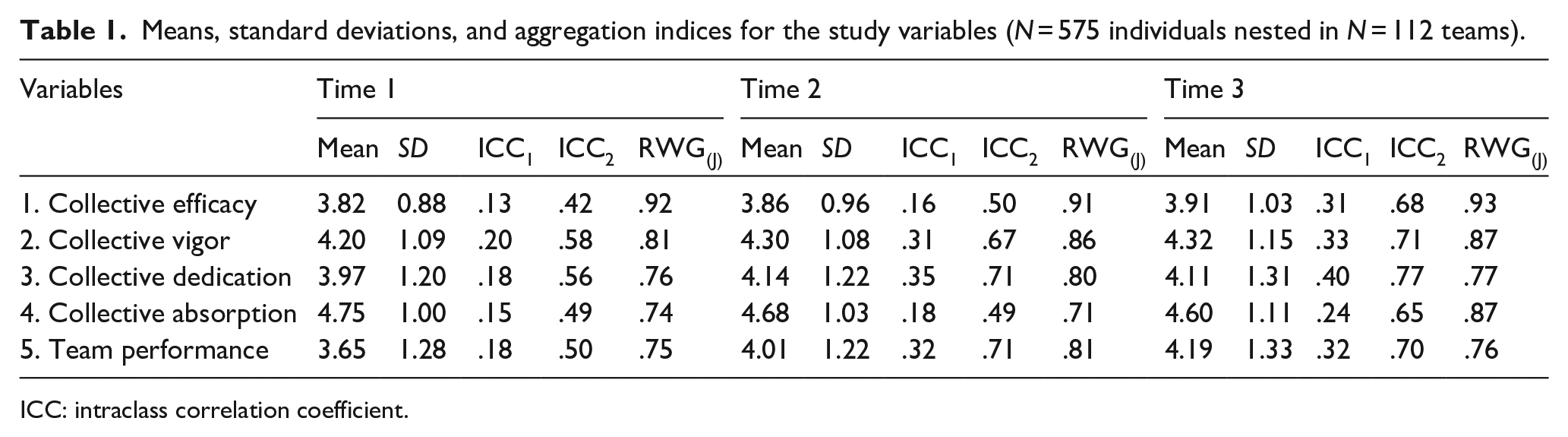
ICC: intraclass correlation coefficient.
Table 2 shows the intercorrelations and internal consistencies of the variables. All correlations were in the expected direction. In addition, the Cronbach’s alphas varied between .74 and .95, indicating acceptable internal consistencies for all the study variables.
Internal consistencies and intercorrelations among the study variables.
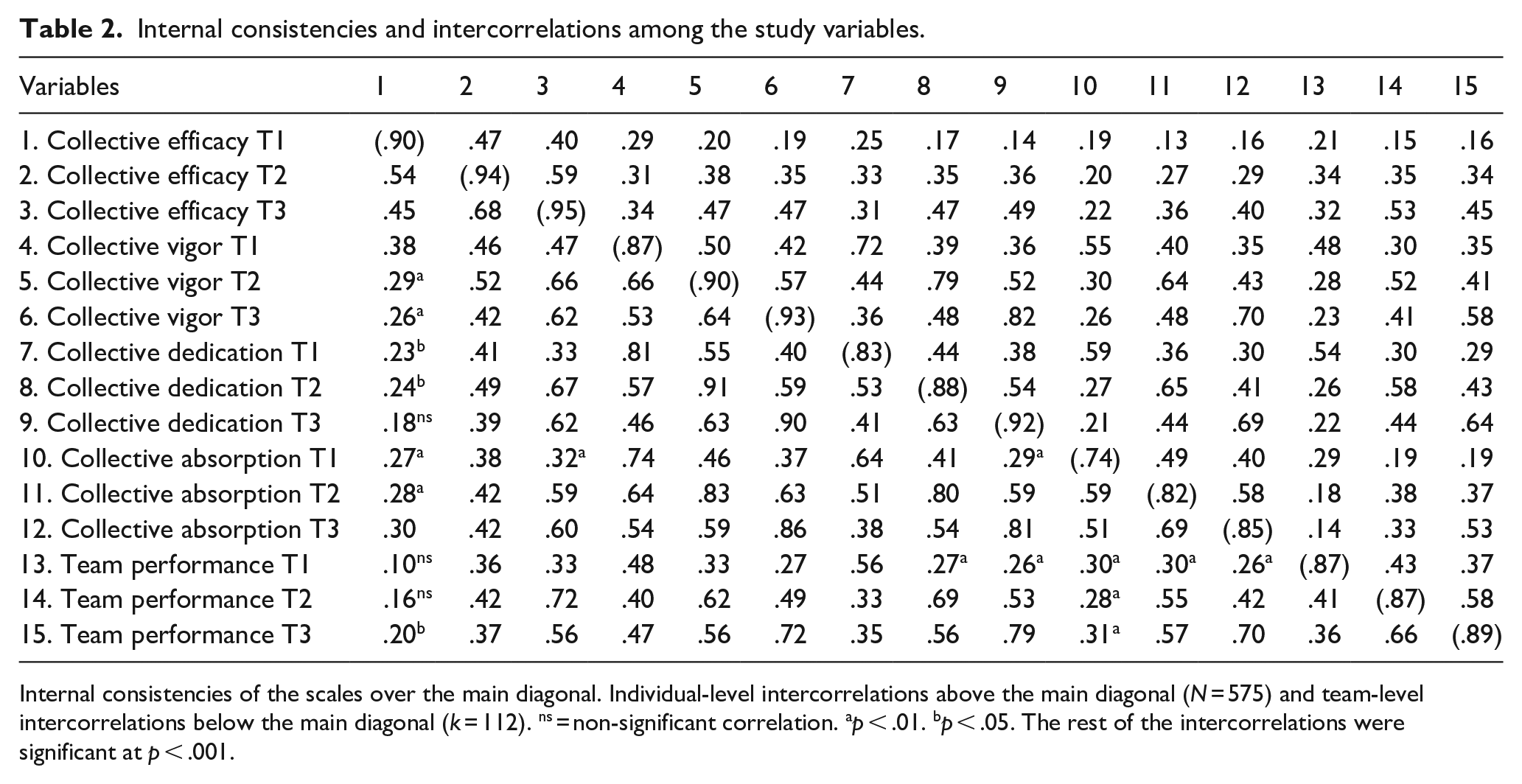
Internal consistencies of the scales over the main diagonal. Individual-level intercorrelations above the main diagonal (N = 575) and team-level intercorrelations below the main diagonal (k = 112). ns = non-significant correlation. ap < .01. bp < .05. The rest of the intercorrelations were significant at p < .001.
Table 3 shows that most of the study variables from our model met the requirements for the CR, AVE, and ASV at the three time points, hence confirming convergent and discriminant validity. In addition, the intercorrelations and the results of the CFA (see Table 3) indicate that there was no multicollinearity between the variables. Moreover, to test whether collective efficacy and team performance can be distinguished from each other, we compared the one-dimensional “team efficacy-performance” factor, including all the T1 collective efficacy and team performance items as indicators with the expected two separate and related factors. The results clearly supported two distinct constructs (CFI = .397, NFI = .399, RMSEA = .682 for the one-dimensional factor and CFI = .995, NFI = .986, RMSEA = .071 for the two-factor model, respectively).
CR, AVE, and ASV for the study variables (N = 112 teams).
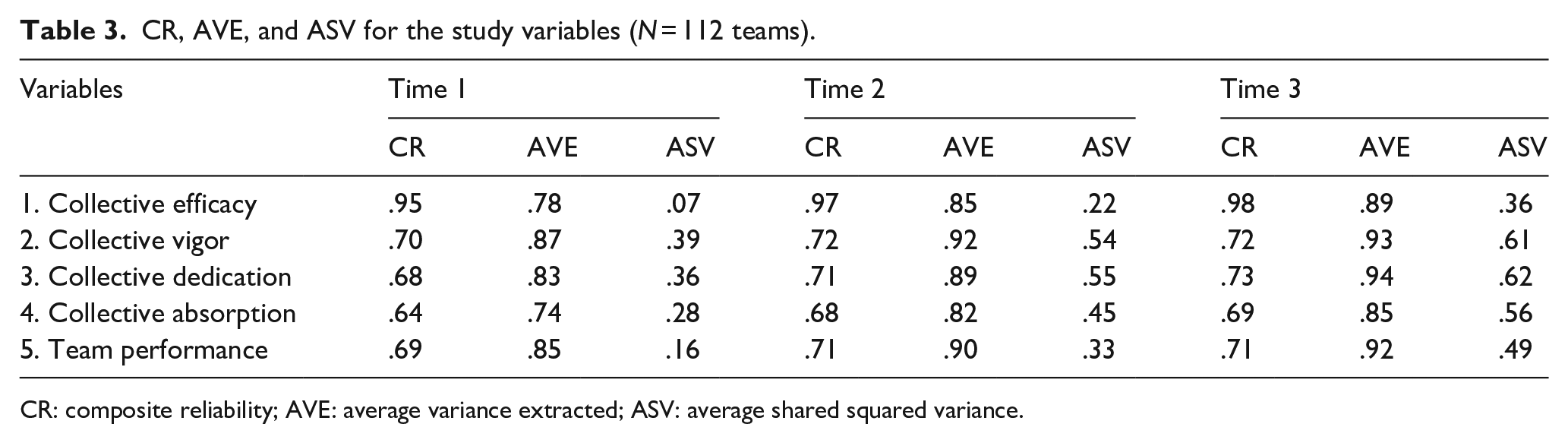
CR: composite reliability; AVE: average variance extracted; ASV: average shared squared variance.
Structural equation analyses
Table 4 shows the fit statistics for all the tested models. The hypothesized model Mhypot fitted the data well. In addition, the comparison of the models showed that Mhypot fitted better than Mstabil (Δχ2 = 104.18, Δdf = 6, p < .001). In addition, comparing the AIC values shows that Mhypot (AIC = 489.89) was also better fitting than Mtrad (AIC = 578.18). Finally, the model comparisons showed that, although Mrecipr had a better fit than Mstabil or Mtrad, allowing reciprocal relationships did not improve the model fit compared with Mhypot (Δχ2 = 3.56, Δdf = 6, ns.). Thus, the hypothesized model Mhypot indicated the best fit to the data.
Fit statistics for the alternative study models (N = 112 teams).
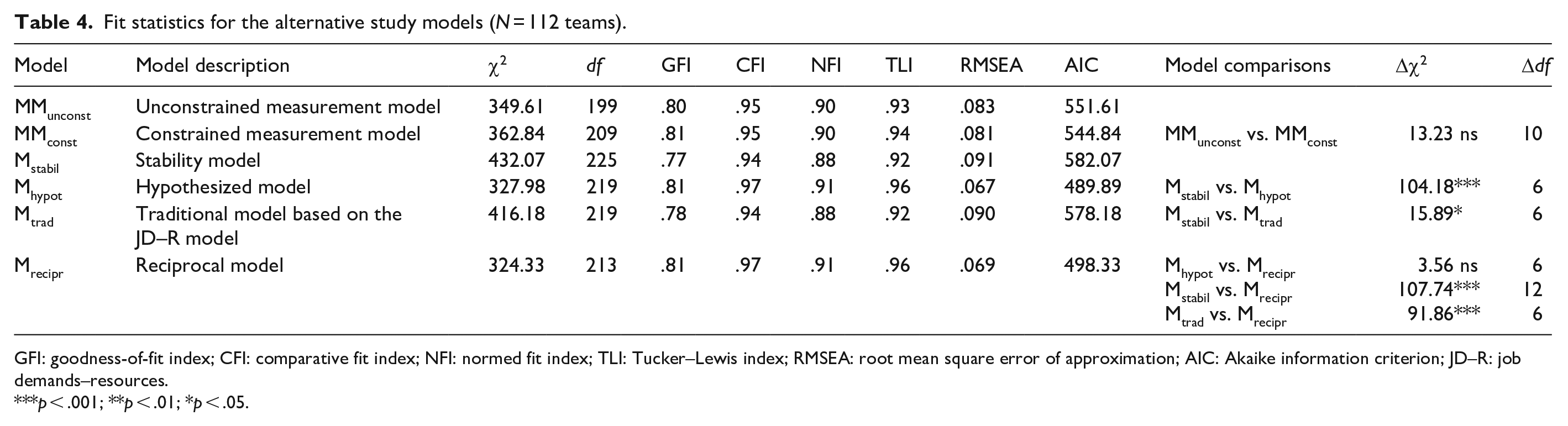
GFI: goodness-of-fit index; CFI: comparative fit index; NFI: normed fit index; TLI: Tucker–Lewis index; RMSEA: root mean square error of approximation; AIC: Akaike information criterion; JD–R: job demands–resources.
p < .001; **p < .01; *p < .05.
According to the best fitting model (see Figure 1), collective task engagement predicted collective efficacy (st.β was .23, p < .05) and marginally predicted collective task performance (st.β was .19, p = .06) from T1 to T2. In addition, collective task engagement at T2 also predicted collective efficacy at T3 (st.β was .23, p < .01) and collective task performance at T3 (st.β was .30, p < .01). Moreover, collective task performance positively influenced collective efficacy from T1 to T2 (st.β was .20, p < .05) and from T2 to T3 (st.β was .43, p < .001). All in all, these results support our hypotheses that collectively experienced task engagement and good team performance are positively related to collective efficacy over time. In addition, collective task engagement is positively related to task performance. Two out of three effects were also stronger from T2 to T3 than from T1 to T2, which can be expected in newly formed, positively developing teams.
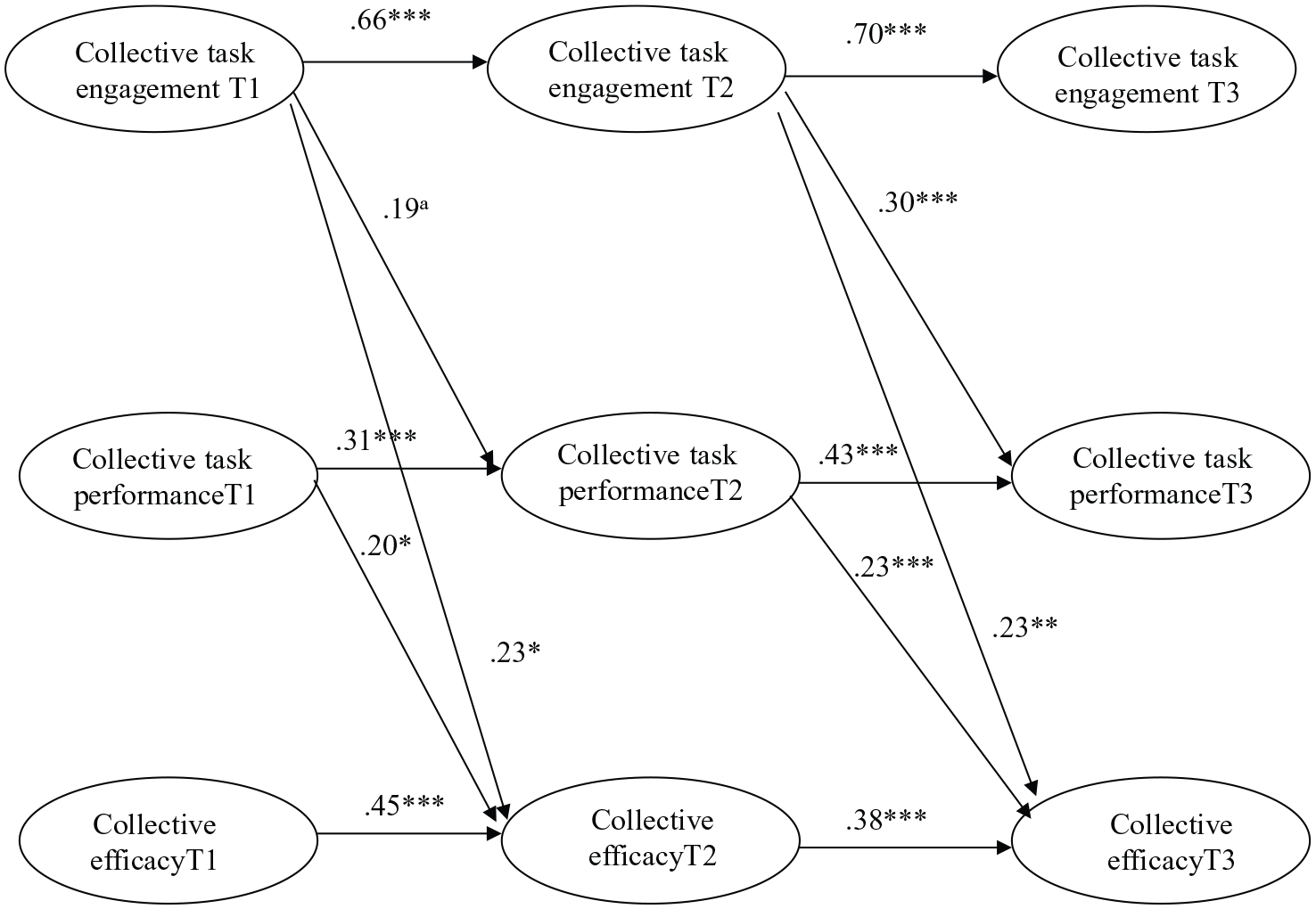
Structural path coefficients of the hypothesized model (N = 112 groups). Note: Only significant paths are shown in this figure.
Discussion
In the present three-wave cross-lagged panel study, we aimed to contribute to the team effectiveness research by focusing on contemporary, self-managed ad hoc teams and investigating the role of two key determinants: team task engagement and mastery experiences in predicting collective efficacy beliefs. In addition, we tested the temporal relationship between team task engagement and task performance over time. We postulated that to boost collective efficacy in contemporary teams over time, it is necessary to enhance two main sources of efficacy beliefs, namely, positive emotional states, which in this study were conceptualized as collective engagement (i.e., collective vigor, collective dedication, and collective absorption), and mastery experiences, which in this study referred to the teams’ past task performance. Results supported our predictions. Specifically, we indicated that both sources of efficacy beliefs (collective engagement and past task performance) positively impacted future collective efficacy over time (Hypotheses 1 and 2). In addition, we also found that collective task engagement predicted future team task performance (Hypothesis 3).
Theoretical and practical implications
First, this study provides further insight into the functioning of contemporary teams, such as self-managed teams or ad hoc teams, according to the taxonomy of Hollenbeck et al. (2012). Using this taxonomy, our study contributes to the need to analyze, in this case, self-managed ad hoc teams, which have received less attention even though they are the emerging type of team. Hence, the study responds to the need for clear and consistent research on team effectiveness. The use of this taxonomy has an important advantage because the conclusions drawn in the present study will help to more accurately and precisely compare further research results in these types of teams. In other words, we cannot compare the dynamics of hierarchical decision-making teams with those of democratic teams, or compare the results of cross-functional teams with those of behavioral teams. Incongruent results in team research might be caused by comparing results from different type of teams with different backgrounds and characteristics. Future research could replicate this study, but focusing on other types of teams, to shed light on possible similarities and differences in the dynamics of collective efficacy, collective engagement, and team task performance.
Theoretically, these results lend support to and extend Bandura’s (2000) SCT in terms of providing empirical evidence for the sources of efficacy beliefs at the collective level over time, especially among contemporary teams. Our study contributes to understanding the two main sources of efficacy beliefs, testing them in contemporary teams. The two main sources of efficacy beliefs were positive emotions (in the form of collective task engagement) and past mastery experiences (in the form of previous task performance). In our study, we considered the specific characteristics of contemporary teams (e.g., self-managed nature, multidisciplinary composition, project-based teams) that made it necessary to update the sources of efficacy beliefs, but without including vicarious experience and verbal persuasion because formal leaders are not part of contemporary teams.
Not only our study contributes to extending SCT, but our results also align with and make a contribution to the literature on team cognition and its relationship with team effectiveness (Cannon-Bowers & Salas, 1990). Our results are in line with previous research focused on shared mental models, showing that both greater collective efficacy and more shared mental models predict better performance in groups (Peterson et al., 2000). These findings can be explained by the fact that shared cognitions among team members create a positive climate for teamwork that is known to predict collective efficacy in teams (Cannon-Bowers & Salas, 2001). Thus, in our study, shared cognition would be the mechanism explaining how positive climate, that is, collective positive emotions and engagement, while doing the task can lead to collective efficacy. We can conclude that building a strong sense of efficacy at the very beginning of a group may guarantee the shared belief (a shared cognition) that the team will be efficacious and have enough capabilities when performing a task in the future. Our results further support the idea of Tasa et al. (2007) that “initial levels of collective efficacy are likely to have a long-lasting effect on how well teams function and perform over time” (p. 26). In our case, we tested this assumption in contemporary teams (self-managed ad hoc teams) and hope that our findings have implications for both research and practice in building team effectiveness in contemporary teams.
Moreover, our study provides interesting findings about the efficacy–performance relationship. Although most of the evidence shows that efficacy beliefs lead to performance (Gully et al., 2002; Kozlowski & Ilgen, 2006), our study also supports the idea that previous performance predicts efficacy. Therefore, our results in this direction may be explained by different mechanisms studied in the team literature, such as the spiral relationship between efficacy–performance (Lindsley et al., 1995) or the input–mediation–output–input (IMOI) model (Ilgen et al., 2005). In this regard, the outputs of team effectiveness cycles (in our case, previous team performance and team engagement) serve as inputs for the next performance episode, creating a recurring loop. In fact, according to the integrative framework of team effectiveness by Salas et al. (2009), the processes involved in teamwork occur dynamically, simultaneously, and episodically over time, which leads to shared cognition. Hence, testing the spiral relationship in contemporary teams means that, even in the early stages of self-managed ad hoc teams, the team performance–efficacy relationship may develop over time.
According to our findings, in addition to collective engagement, previous perceptions of good team task performance may enhance the collective belief that the team will be able to work effectively together and solve its challenges.
These findings are important because, to date, researchers have largely assumed that models of self-efficacy and collective efficacy are homologous, but it has been suggested that self-efficacy and collective efficacy do not necessarily have similar antecedents and consequences (Chen & Bliese, 2002). For instance, Chen and Bliese (2002) showed that leadership was found to be a stronger predictor of collective efficacy than it was of self-efficacy. Therefore, the present study provides further empirical evidence of sources of collective efficacy beliefs at the collective level to alleviate this controversy. Specifically, our study shows two main sources of efficacy beliefs at the collective level (i.e., past team task engagement and task performance) to be key predictors of collective efficacy over time.
All in all, previous experiences of good performance and shared positive emotional states, such as collective engagement, seem to be important drivers of a collective sense of efficacy. Moreover, our study suggests that self-managed ad hoc teams are indeed able to build collective engagement and successful performance.
Another interesting finding of the present study is that collective task engagement also predicts better future team performance in contemporary teams. To our knowledge, only one previous study has indicated this association in consolidated teams (teams with a long history working as a team; Torrente et al., 2012). However, to our knowledge, the present study is the first one to show the impact of collective task engagement on task performance in contemporary self-managed ad hoc teams over time. Our results suggest that collective engagement may play a key role in self-managed ad hoc teams in pursuing good performance. Being engaged in the task along with one’s new teammates matters from the very early stages of a team. However, in this study, we could not study the antecedents of collective engagement, but it can be assumed that clear and challenging goals are valuable drivers of initial engagement (Hyvönen et al., 2009).
Finally, it is noteworthy that all the results discussed above were based on using a three-wave panel design and controlling for the stabilities and previous levels of the study variables. Moreover, we found the same longitudinal effects from T1 to T2 and from T2 to T3, thus indicating the robustness of our findings and the role of these two important sources of collective efficacy beliefs.
Regarding practical implications, the results obtained provide key information about how contemporary teams with new team members that have never worked together before may achieve a collective sense of efficacy and perform well thanks to collective engagement and past mastery experiences. Therefore, for practitioners, these results provide suggestions and reflections that may be valuable when working with self-managed teams in their early stages. According to our results, previous performance or past mastery experience is a relevant source of collective efficacy. Hence, it seems that, at the very beginning, teams build a sense of collective efficacy based on small gains. Therefore, it is important to give the team small-scale, short-term tasks in the beginning on which they can succeed, to gain mastery experiences as a team that will contribute to building a shared sense of efficacy. Moreover, it may be beneficial for team members to be allowed to interact with each other and share positive experiences in their first meetings, to build collective positive emotions and engagement. Strategies such as team building activities may also foster a sense of collective engagement in the group and with the task.
Limitations and future research
This study has some limitations. First, Bandura (1986) mentions four potential sources: mastery experiences, physiological and emotional states, vicarious experience, and verbal persuasion for efficacy, of which we only investigated the first two because of the specific nature of the contemporary teams that participated in this study. Therefore, a main limitation of the present study is not examining the effect or controlling for the two sources of collective efficacy such as vicarious experience and verbal persuasion. We were guided by the idea that in self-managed teams formal leaders do not have a relevant role in persuading, giving feedback or being a model such in other traditional teams. However, a concern on the informal influence through verbal persuasion or vicarious learning that other team members may have in their colleagues should have into account in further studies. In this line, some self-managed teams may include aspects of shared leadership, expert leadership, or rotated leadership, and future studies in such teams could also focus on vicarious experience and verbal persuasion, or at least control for their potential impacts. Moreover, our study lacks for controlling on previous levels on individual efficacy (i.e., self-efficacy). Although the goal of our study was to explore the factors that predict collective efficacy beliefs in contemporary teams, so we focused only on team-level variables, it might be of interest for further research to explore whether previous individual self-efficacy levels may influence team effectiveness.
Second, our study lacked objective performance measures. In future research, it would be interesting to investigate how collective engagement impacts collective task performance over time using more objective measures of performance. We only used self-report questionnaires to collect the data, and so our results may be affected by common method variance (Podsakoff et al., 2003). However, we used self-report measures with a degree of inter-subjectivity and agreement among the team members about in and extra-role performance. From our point of view, all the group members are well-suited to self-reporting shared visions of the team (collective engagement and collective performance), mainly because team members are working and experiencing, and so they acquire firsthand information about what is happening on the team. Furthermore, we used a three-wave panel design and could control for the impacts of the previous wave, which diminishes the likelihood of common method variance, and we also used latent factors to correct for measurement errors (Podsakoff et al., 2012). Moreover, studies comparing subjective and objective performance measures agree that these measures may be equally reliable (Wall et al., 2004).
Third, the ecological validity might be influenced by the laboratory setting because we used self-managed ad hoc teams in a laboratory team setting, and, therefore, the design was more controlled by the researchers. The simulation and the tasks were designed to reflect the work of self-managed ad hoc teams in a real environment as much as possible. Future research should gather data from real self-managed teams in different organizations to make the generalization of our results more accurate.
Finally, as an avenue for future research and practice, it would be interesting to test whether the role of positive emotions and working in an engaged team would lead to increases in collective efficacy and better performance in the future. It seems that it is important to provide teams with enough social (e.g., supportive climate) and task resources (e.g., clear goals) to facilitate engagement. There is strong evidence that job resources foster engagement (Bakker et al., 2007; Hakanen et al., 2008; Schaufeli & Bakker, 2004). Hence, in the case of teams, it is relevant to consider these previous recommendations about how to intervene to increase work engagement by focusing on social interactions (Schaufeli & Salanova, 2010).
To sum up, two main findings were obtained from the present three-wave study in 112 teams. We found that collective engagement and team task performance were important drivers of collective efficacy experiences in self-managed ad hoc teams. In addition, we found support for the effect of team work engagement on future performance at the collective level. These findings are all important because they involve cotemporary ad hoc teams, and success factors for these types of teams are rarely studied longitudinally. Overall, this study represents a step forward in understanding how contemporary teams may gain the power of belief as a group and perform well, even in the early stages of their life as a team.
Footnotes
Declaration of conflicting interests
The author(s) declared no potential conflicts of interest with respect to the research, authorship, and/or publication of this article.
Funding
The author(s) received no financial support for the research, authorship, and/or publication of this article.