




Abstract
Environmental sustainability may be seen as a collective challenge that can only be met if a sufficient number of individuals cooperate. Whether or not individual tourists are willing to contribute their share may thus depend not only on the degree to which they think that environmental sustainability is important (attitudes), but also on the degree to which they think that other tourists hold similar attitudes (social comparison). Other possible influences are beliefs that one's own behaviour can make a difference (self-efficacy beliefs) and that tourists as a group together can make a difference (collective efficacy beliefs). This paper reports on findings from a study (N = 358) that investigated the role of these factors in explaining people's willingness to pay for environmental protection when travelling. Attitudes, self-efficacy and collective efficacy accounted for 30% of the variance in willingness to pay for environmental protection; social comparison did not explain additional variance. Theoretical and practical implications are discussed.
Keywords
Introduction
The question of how to encourage people to behave in environmentally sustainable ways has caught the attention of researchers within various disciplines. A broad distinction can be made between research focusing either on structural or on informational strategies (cf. Steg and Vlek, 2009). Structural strategies aim at implementing behavioural change through changing the situational circumstances in which decisions are made. One common approach within this stream of research is to identify and eliminate external factors that may hinder people from engaging in pro-environmental behaviour (e.g. costs and benefits of different behavioural alternatives; Van Raaij, 2002). Informational strategies seek to achieve behavioural change through targeting internal factors such as attitudes and beliefs without intervening with the situational circumstances. Research in this vein often draws upon psychological theories that view human behaviour as planned and deliberate (e.g. theory of planned behaviour; Fishbein and Ajzen, 2010). The present paper follows up on the latter line of research and examines individual characteristics of people who are willing to pay for environmental protection when travelling.
In order better to understand what influences decisions to pay for environmental protection, it may be helpful to conceive of environmental sustainability as a large-scale social dilemma – a situation in which the attainment of a desired collective outcome depends on the cooperation of many individuals (cf. Van Lange et al., 1998). The crux of social dilemmas is that each individual (or group member) is to decide between behavioural alternatives that maximize personal interests and behavioural alternatives that maximize collective interests. While the rational choice for each individual is to pursue personal interests, the group as a whole will only achieve the best possible outcome if everybody subordinates own interests to those concerned with collective benefits (Dawes and Messick, 2000). With regard to travelling, the choice of environmentally sustainable travel options (e.g. transportation with low carbon dioxide emissions) can be regarded as an alternative that maximizes collective interests (e.g. mitigating global climate change, pursuing environmental sustainability), and the choice of conventional travel options can be regarded as an alternative that maximizes personal interests, because it is usually associated with lower individual costs (e.g. cheaper, less time consuming).
In large-scale social dilemmas, such as in the case of environmental sustainability, individuals may feel that their own efforts to foster collective interests make little difference. People's beliefs in their ability to make a difference are often referred to as self-efficacy beliefs, and research has shown that individuals with stronger self-efficacy beliefs are more likely to contribute to collective benefits in social dilemmas (Kerr, 1992) and to help foster sustainable development (Gupta and Ogden, 2009; Hanss and Böhm, 2010). In addition, strong collective efficacy beliefs, that is, the belief that the members of a group (e.g. tourists) can together achieve desired outcomes might be decisive for individual contributions in social dilemmas (De Cremer, 1999; Seijts and Latham, 2000). Both self-efficacy and collective efficacy beliefs are concerned with questions about uncertainties that people may think about when they are involved in a social dilemma: Can I personally make a difference? Will we together be able to make a difference? Another uncertainty that characterizes social dilemmas has to do with perceptions about the individual characteristics of other group members (Van Lange et al., 1992). For example, people may ask themselves whether others are similarly concerned about environmental problems associated with tourism. We assume that if people believe that they hold stronger views regarding the importance of mitigating these problems than the typical tourist, they are less likely to choose environmentally sustainable travel options because they may doubt that others will contribute their share. In the present study, we refer to comparisons between own and others' attitudes towards environmentally sustainable tourism as social comparison.
The aim of this study was to investigate whether social comparison contributes to explaining choices of environmentally sustainable travel options, conceptualized as willingness to pay for environmental protection when travelling, along with absolute judgments of own attitudes, self-efficacy beliefs and collective efficacy beliefs.
Literature review
Attitudes
Attitudes are evaluative judgments towards an object with respect to some degree of favour or disfavour (Eagly and Chaiken, 1993). Supporting the view that these judgments play a major role in determining human social behaviour (e.g. Ajzen and Gilbert Cote, 2008; Fishbein and Ajzen, 2010), there is a plethora of empirical evidence linking attitudes to pro-environmental behaviour (for two recent meta-analyses, see Bamberg and Möser, 2007; Klöckner, 2013). The typical finding in this research is that favourable attitudes towards environmental preservation are associated with pro-environmental behaviour. For example, Han et al. (2010) demonstrated that environmental attitudes are positively associated with intentions to stay at a green hotel. Other contexts in which attitudes have been associated with pro-environmental behaviour include, for instance, travel mode choice (e.g. Thøgersen, 2006), sustainable consumption (e.g. Tanner and Wölfing Kast, 2003) or energy conservation (e.g. Hansla et al., 2008). In line with this research, we assume that people with strong positive attitudes towards environmentally sustainable tourism are more willing to pay for environmental protection than people with less positive attitudes towards environmentally sustainable tourism. By referring to positive attitudes towards environmentally sustainable tourism, we mean evaluative judgments in favour of actions that aim at limiting the negative impacts of tourism on the natural environment (cf. Doran and Larsen, 2014).
Hypothesis 1 (attitudes): Positive attitudes towards environmentally sustainable tourism will be positively related to willingness to pay for environmental protection.
As mentioned earlier, own attitudes towards environmentally sustainable tourism may not be the only factor that influences people's willingness to pay for environmental protection; social comparison may also play a role. The rationale behind this assumption is that people have an inherent need for self-evaluation that motivates them (if there are no objective criteria available) to compare own opinions and abilities to those of others (Festinger, 1954). Previous research on social comparison has demonstrated that the outcomes of these evaluations are often biased in the sense that there are systematic differences in the perception of oneself and others (for a review, see, e.g., Chambers and Windschitl, 2004). One such bias is the tendency to view own characteristics more favourable than those of similar others (Alicke and Govorun, 2005). An illustration of this is provided by White and Plous (1995) who found that people perceive themselves as being more concerned about the environment and as showing more environmental activism than most others. Additionally, more than half of the participants in that study expressed that they would be willing to do more about protecting the environment if others would be more concerned about the issue. These findings are similar to those of Pieters et al. (1998) who demonstrated that people tend to attribute more pro-environmental behaviour and motivation to their own households than to other relevant societal actors such as other households, the government, agriculture and industry.
Although an increasing body of literature indicates that people wish to dissociate themselves from other tourists (e.g. Doran et al., 2014; Prebensen et al., 2003), there are yet few studies investigating social comparison within the domain of environmentally sustainable tourism. One notable exception is a recent study that investigated whether tourists perceived their own attitudes to be different from those of other tourists (Doran and Larsen, 2014, Study 1). While one group of participants was asked to judge their own attitudes towards environmentally sustainable tourism, two other groups of participants were asked to indicate what they thought to be the attitudes of either a typical or an average tourist. It turned out that judgments of own attitudes were more favourable (i.e. more positive views about preserving the environment) than those concerning the other two groups, and that there was no difference between judgments of a typical or an average tourist (for similar findings, see Doran and Larsen, 2014, Study 2). Another study explored how people who frequently engage in eco-friendly activities at home view themselves and their behaviours in a vacation context (Juvan and Dolnicar, 2014). While participants interviewed in this study were generally aware about negative environmental consequences linked to tourism activities, they also acknowledged that their vacation behaviours were mostly inconsistent with their attitudes towards environmental preservation. One of the strategies to justify such inconsistencies in retrospect was downward social comparison (i.e. comparison with others who are perceived as doing worse than oneself).
It has been suggested that viewing oneself more favourable than others may hinder people from engaging in pro-environmental behaviour (Leary et al., 2011; Van Raaij, 2002). Applied to the context of tourism, we propose that people who believe that they hold more positive attitudes towards environmentally sustainable tourism than the typical tourist should be less optimistic that others will contribute their share and, hence, be less likely to contribute themselves. More specifically, we assume that social comparison (in this study conceptualized as comparing own attitudes to those of typical tourists) contributes to explaining variance in people's willingness to pay for environmental protection when travelling, in addition to absolute judgments of own attitudes.
Hypothesis 2 (social comparison): Favourable social comparison will be negatively related to willingness to pay for environmental protection.
Efficacy beliefs
If people think that environmental preservation is important but believe that their personal behaviour has little impact on the environment, it is unlikely that they will act in accordance with such attitudes. Bandura (2006) stated that “[u]nless people believe that they can produce desired effects by their actions, they have little incentive to act, or to persevere in the face of difficulties” (p. 170). A person's beliefs about how efficacious his or her behaviour is for achieving desired outcomes are commonly referred to as self-efficacy beliefs (Kerr, 1992; Van Lange et al., 1992). Self-efficacy is assumed to be another important determinant of behavioural intentions, and indirectly, of actual behaviour (Fishbein and Cappella, 2006).
Self-efficacy beliefs may be particularly important when people decide whether or not they should pursue collective interests in large-scale social dilemmas. In line with this assumption, Kerr (1989, Experiments 1–3) found that self-efficacy declined with increasing numbers of people being involved in social dilemmas and that self-efficacy was positively related to pursuing collective interests. In an early review of psychological determinants of global environmental change, Stern (1992) concluded that variables dealing with perceived personal control were the only personality variables that showed systematic relationships with environmentally relevant behaviours. Empirical support for the relationship between self-efficacy and pro-environmental behaviour also comes from recent cross-sectional studies (Gupta and Ogden, 2009; Hanss and Böhm, 2010). A common finding in these studies is that a stronger sense of self-efficacy is associated with a greater tendency to engage in behaviours that foster sustainable development (e.g. purchasing eco-friendly consumption products). A novelty in Hanss and Böhm's study (2010) was that the authors investigated self-efficacy concerning people's perceived direct impact on sustainable development (i.e. through their own actions) and people's perceived indirect impact on sustainable development (i.e. through encouraging others to contribute to sustainable development). They found that both aspects of sustainable development self-efficacy predicted sustainable consumption behaviours.
Considering that self-efficacy beliefs were found to be associated with various types of pro-environmental behaviour, it is somewhat surprising that self-efficacy (as conceptualized in the present study) has so far received little attention in research on environmentally sustainable tourism. A notable exception is a study by Gustin and Weaver (1996) that showed that self-efficacy, together with knowledge about environmental issues and attitudes towards environmental strategies, was positively related to people's intentions to stay in a hotel that applies environmental strategies. Findings from other studies further indicate that perceived lack of ability can be used to justify personal inaction (e.g. Hares et al., 2010; Miller et al., 2010). In the study by Juvan and Dolnicar (2014), for example, downward social comparison was not the only strategy used to justify discrepancies between home and vacation behaviours. Another strategy was denial of responsibility, which is, denying personal responsibility to take action and/or denying personal ability to make a difference. Based upon these findings, we assume that self-efficacy concerning environmental preservation is positively associated with people's willingness to pay for environmental protection when travelling.
Hypothesis 3 (self-efficacy): Self-efficacy beliefs will be positively related to willingness to pay for environmental protection.
Building upon the view that mitigating environmental problems is a collective effort, individual tourists may derive efficacy expectations not only from judgments of their own ability to make a difference but also from the degree to which they think that tourists together can affect the state of the environment. The beliefs of an individual member of a group about the group's ability to achieve desired outcomes are referred to as collective efficacy beliefs (Bandura, 1997). Just like self-efficacy may affect behaviour on the individual level, this type of efficacy beliefs may determine how much effort group members put into the pursuit of collective interests (cf. Bandura, 2000). Homburg and Stolberg (2006) found some support for this assumption by showing that people's engagement in activities to cope with environmental stressors can be predicted by collective efficacy (Studies 3 and 4) but not by self-efficacy (Studies 1 and 2). Likewise, Thaker (2012) found that collective efficacy predicted the degree to which local residents engaged in behaviours to secure the supply of safe drinking water in their community (e.g. participate in demonstrations, encourage other community members to save water). People with higher levels of collective efficacy did more to help secure drinking water than people with low and moderate levels of collective efficacy. Another study that is important in this context comes from Bonniface and Henley (2008) who used focus groups to explore efficacy beliefs among environmental activists and non-activists. One of their findings was that people participating in household waste management were more likely to believe that the waste problem could be reduced if everybody contributed their share than people who did not participate in household waste management.
According to Bandura (2000), one way of measuring collective efficacy beliefs is by asking members of a group to judge the group's ability to jointly achieve desired outcomes. This method of assessment takes account of group dynamics that may influence the functioning and efficacy of the group. With regard to group membership, different levels of aggregation may be distinguished (cf. Homburg and Stolberg, 2006). For example, tourists can be grouped at very general levels, such as tourists from a specific continent or country, or more specific levels, such as tourists from a specific city. In this study, we measured collective efficacy at the highest possible level of aggregation, that is, people's beliefs about the ability of tourists in general to jointly help preserve the environment. We chose this level of aggregation because many of the environmental problems linked with tourism activities are global (UNEP-UNWTO, 2012) and thus their mitigation requires the cooperation by individuals from all over the world. Based on the findings from other domains (see above), we assume that collective efficacy is positively associated with people's willingness to pay for environmental protection when travelling.
Hypothesis 4 (collective efficacy): Collective efficacy beliefs will be positively related to willingness to pay for environmental protection.
Method
Participants
A cross-sectional survey using a convenience sample (N = 358) was used to investigate the hypotheses. Data were collected by the authors and research assistants among domestic and international tourists visiting Bergen, Norway. Potential participants were contacted at waiting areas (e.g. tourist information, hotel lobby) and recreational areas (e.g. scenic nature spots, famous sights). After information about the study was provided (i.e. topic, purpose and duration, confidentiality, language of the questionnaire, contact information of the project leaders), people were asked whether they were willing to take part in the study. Those who agreed to participate were provided with a self-administered paper-and-pencil questionnaire (English language). Completed questionnaires were collected and the participants were asked whether they had any questions regarding the study. Questions were answered immediately on-site.
The sample consisted of n = 183 women (51%) and n = 175 men (49%) between 18 and 83 years of age (M = 31.49, SD = 13.67). Participants were from different continents: The majority was from Europe (68%); thereof most participants were from Germany, Norway, the United Kingdom, Sweden and France. The second largest group was from Asia (16%), thereof most participants were from China. The remaining participants were from North America (9%), Oceania (4%), South America (2%) and Africa (1%). Although the questionnaire did not ask specifically whether participants were domestic or international tourists, some 11% (n = 38) indicated that they were Norwegian by nationality. This might serve as an estimate concerning the number of domestic tourists participating in this study.
Materials and procedure
In addition to questions about participants' age, gender and nationality (see above), the questionnaire consisted of items to measure various aspects of travelling. At this point, we will only report self-report measures for willingness to pay for environmental protection, attitudes, social comparison, self-efficacy beliefs and collective efficacy beliefs.
Willingness to pay for environmental protection
Means and standard deviations for items measuring the index variables.
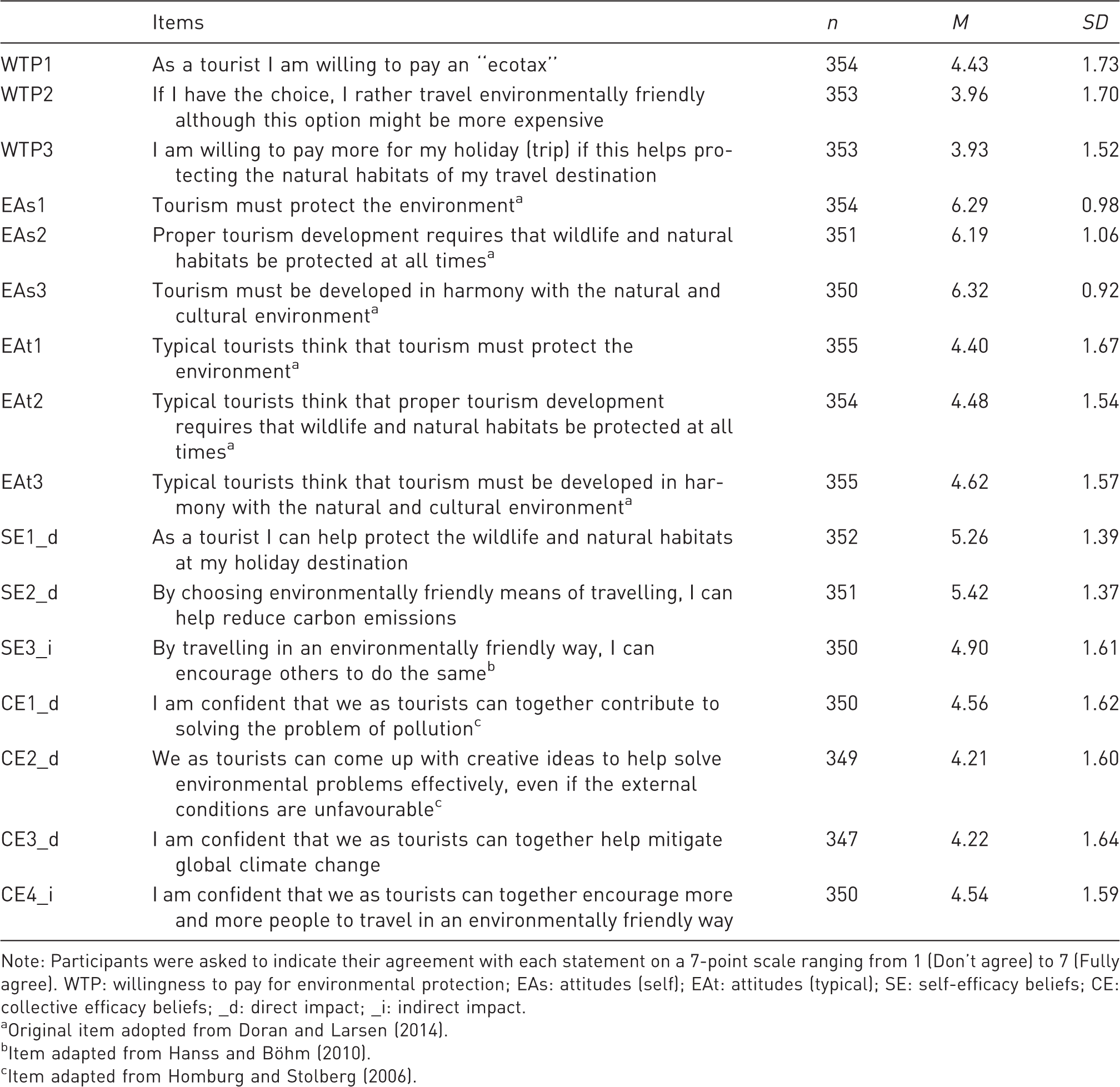
Note: Participants were asked to indicate their agreement with each statement on a 7-point scale ranging from 1 (Don't agree) to 7 (Fully agree). WTP: willingness to pay for environmental protection; EAs: attitudes (self); EAt: attitudes (typical); SE: self-efficacy beliefs; CE: collective efficacy beliefs; _d: direct impact; _i: indirect impact.
Original item adopted from Doran and Larsen (2014).
Item adapted from Hanss and Böhm (2010).
Item adapted from Homburg and Stolberg (2006).
Means, standard deviations, and coefficient alphas for index variables.
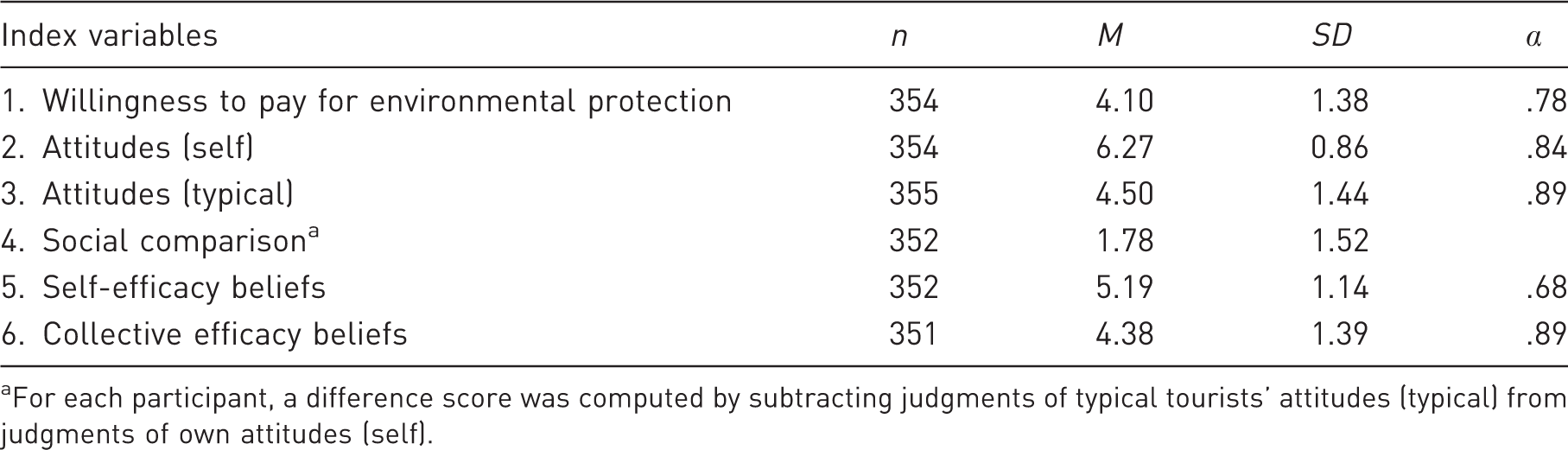
For each participant, a difference score was computed by subtracting judgments of typical tourists' attitudes (typical) from judgments of own attitudes (self).
Attitudes
Attitudes were measured by three questionnaire items (see Table 1), adopted from Doran and Larsen (2014). Because one aspect addressed in this study was social comparison, these attitude items were provided in two different variants: one to measure participants' own attitudes and one to measure what participants thought to be the attitudes of typical tourists. All six items (self and typical) entered a PCA (direct oblimin, listwise deletion), KMO = .75; approximate χ2(15) = 1039.38, p < .001. Two components with an eigenvalue greater than one were retained, which explained 79.12% of the variance in attitudes: one comprising judgments of own attitudes (i.e. EAs1-EAs3) and one comprising judgments of typical tourists' attitudes (i.e. EAt1-EAt3). Index variables were computed by averaging participants' answers to each set of items (see Table 2).
Favourable social comparison can be measured using direct or indirect methods of assessment (see Alicke and Govorun, 2005; Chambers and Windschitl, 2004). The present study used an indirect method of assessment where participants are asked to make separate judgments about themselves and others (here: typical tourists). Favourable social comparison can then be measured by subtracting judgments of typical tourists' attitudes from judgments of own attitudes (cf. Alicke and Govorun, 2005). Higher positive scores were interpreted as stronger contrasts, that is, people view their own attitudes more favourably than those of typical tourists. We further used two questionnaire versions that differed with respect to the order in which the item measures were presented. One part of the participants was first asked to judge their own attitudes and then the attitudes of typical tourists (i.e. self → typical, n = 163). Another part of the participants first judged the attitudes of typical tourists and then their own attitudes (i.e. typical → self, n = 195).
Efficacy beliefs
Self-efficacy beliefs were measured by means of three questionnaire items (see Table 1). Each item consisted of a statement about the personal ability to make a difference. 1 One item (i.e. SE3_i) was inspired by a questionnaire item of sustainable development self-efficacy used by Hanss and Böhm (2010) and measured the perceived indirect impact on environmental preservation through encouraging other tourists to travel environmentally friendly. Two items (i.e. SE1_d, SE2_d) were newly formulated for the purpose of this study and dealt with the perceived direct impact on environmental outcomes, such as protecting wildlife or reducing carbon emissions. The three items entered a PCA (direct oblimin, listwise deletion), KMO = .67; approximate χ2(3) = 160.39, p < .001. One component with an eigenvalue greater than one was retained, explaining 60.86% of the variance in self-efficacy beliefs. An index variable was computed by averaging participants' answers to these items (see Table 2).
Collective efficacy beliefs were measured by four questionnaire items (see Table 1). While some items (i.e. CE3_d, CE4_i) were newly formulated for the purpose of this study, other items (i.e. CE1_d, CE2_d) were adapted from Homburg and Stolberg (2006) but adjusted to measure collective efficacy in the context of tourism. Three of these items consisted of a statement that tourists can together help solving environmental problems, such as pollution or global climate change (i.e. CE1_d-CE3_d). The fourth item dealt with the ability of tourists to indirectly mitigate environmental problems through encouraging an increasing number of people to travel in an environmentally friendly manner (i.e. CE4_i). One component with an eigenvalue greater than one was retained when the four items entered a PCA (direct oblimin, listwise deletion), KMO = .83; approximate χ2(6) = 756.54, p < .001. This component explained 74.73% of the variance in collective efficacy beliefs. An index variable was computed by averaging participants' answers to the four items (see Table 2).
Data handling and analysis
Some participants did not respond to all items (n = 24, 7%) and therefore had missing values on some of the variables. Missing values were deleted listwise in the analyses. Data were analysed with the statistical package IBM SPSS Statistics, Version 21.
The correlational structure of each construct was explored by means of principal component analyses and index variables were computed for each of the constructs (see Materials and procedure). Index scores were also computed for those participants who had missing values on some of the variables and thus were excluded from the principal component analyses. Two-way mixed analysis of variance (ANOVA) examined social comparison outcomes. Correlation and regression analyses tested the hypothesized associations. Preconditions for performing multiple regression analysis (cf. Field, 2013) were satisfied (i.e. no significant outliers, imperfect multicollinearity of predictors, unbounded criterion variable, independent and normally distributed residuals, homoscedasticity and linearity, non-zero variances). 2
Results
Analyses of social comparison outcomes
We conducted a 2 (social comparison) × 2 (item order) mixed ANOVA with social comparison (self vs. typical) as a within-subjects and item order (self → typical vs. tourists → self) as a between-subjects factor. There was a significant main effect for social comparison, F(1, 350) = 577.14, p < .001, partial η2 = .62, indicating favourable social comparison in the sense that participants perceived themselves as holding more positive attitudes towards environmentally sustainable tourism than typical tourists. There was also a significant interaction effect between social comparison and item order, F(1, 350) = 50.03, p < .001, partial η2 = .13, indicating that the magnitude of favourable social comparison varied depending on the order by which the item measures were presented. Participants who first answered items about themselves (Mself = 6.45, SDself = 0.64; Mtypical = 4.09, SDtypical = 1.46) showed stronger favourable social comparison (i.e. greater difference scores) than participants who first answered items about typical tourists (Mtypical = 4.82, SDtypical = 1.33; Mself = 6.10, SDself = 0.98). For the correlation and regression analyses (see below), we pooled the data and analysed responses of all participants together, independent of which questionnaire version the participants had filled out. 3
Associations between willingness to pay for environmental protection, attitudes, social comparison, self-efficacy beliefs and collective efficacy beliefs
Intercorrelations for index variables.
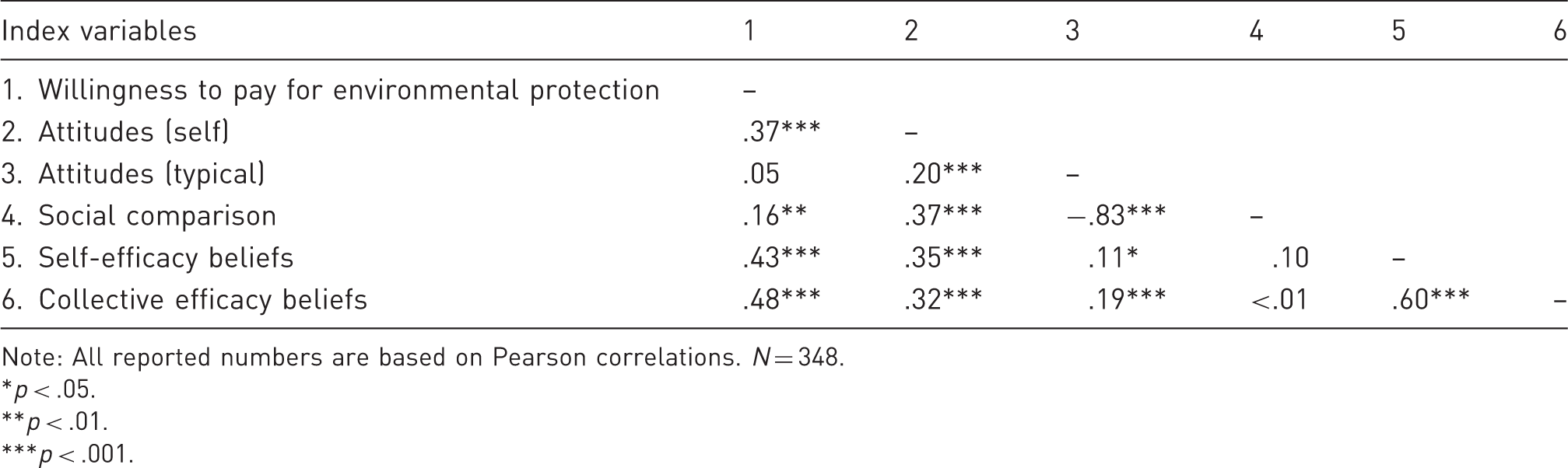
Note: All reported numbers are based on Pearson correlations. N = 348.
p < .05.
p < .01.
p < .001.
Explaining willingness to pay for environmental protection with attitudes, social comparison, self-efficacy beliefs and collective efficacy beliefs
Summary of hierarchical regression analysis.
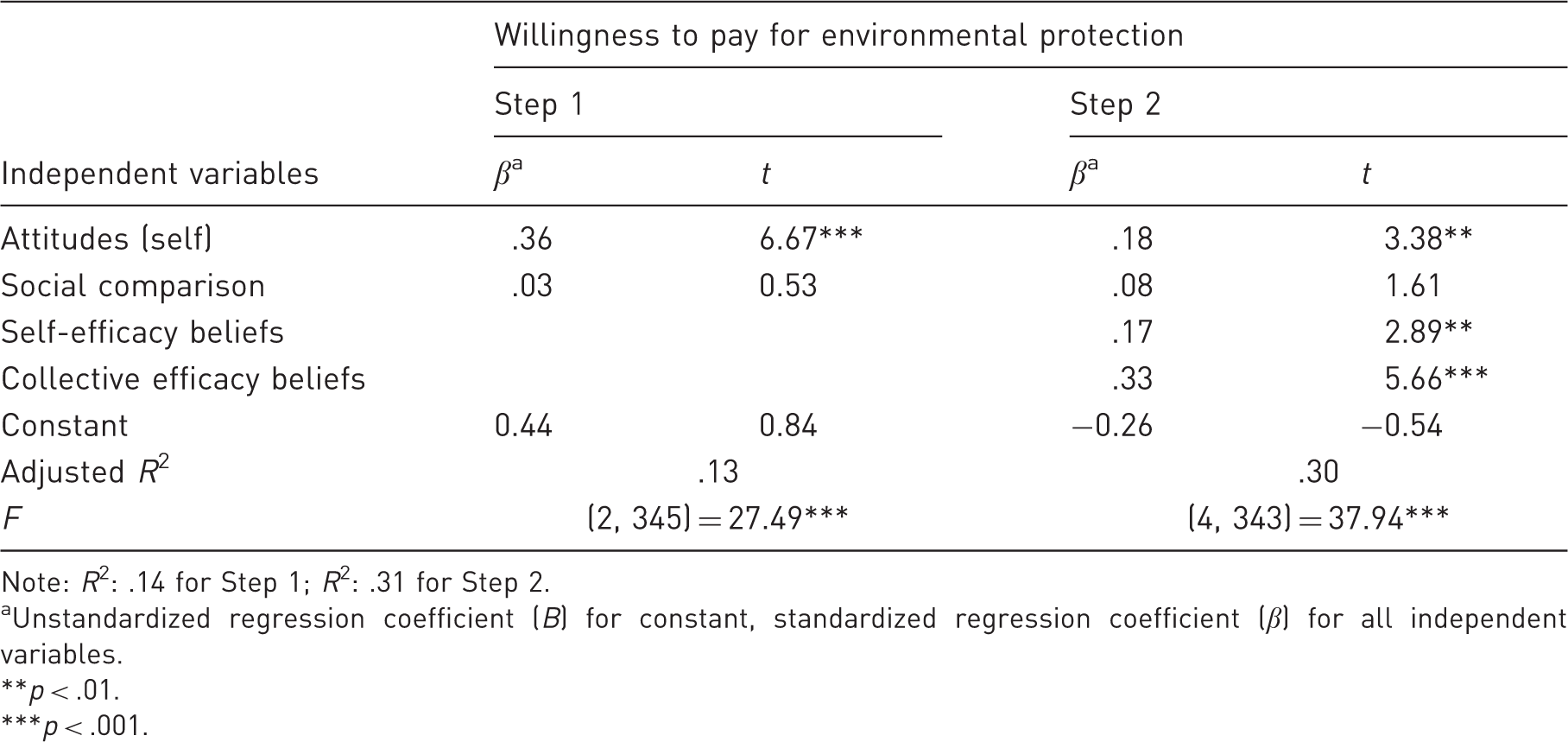
Note: R2: .14 for Step 1; R2: .31 for Step 2.
Unstandardized regression coefficient (B) for constant, standardized regression coefficient (β) for all independent variables.
p < .01.
p < .001.
In sum, these findings provide support for Hypothesis 1 (attitudes), Hypothesis 3 (self-efficacy) and Hypothesis 4 (collective efficacy). The data did not support Hypothesis 2 (social comparison).
Discussion
The aim of this study was to investigate whether the degree to which tourists are willing to pay for environmental protection can be explained by a combination of attitudes, social comparison, self-efficacy beliefs and collective efficacy beliefs. The decision to include social comparison as an independent variable was based on the assumption that people who believe that they hold more positive attitudes towards environmentally sustainable tourism than the typical tourist may doubt that others will contribute their share, and therefore be hesitant about contributing themselves. While social comparison did not explain extra variance in stated willingness to pay for environmental protection, absolute judgments of own attitudes as well as self-efficacy and collective efficacy beliefs were all positively and significantly associated with stated willingness to pay for environmental protection.
Our findings corroborate recent studies indicating favourable self-views when people compare themselves with others on dimensions related to issues of environmentally sustainable tourism (Doran and Larsen, 2014; Juvan and Dolnicar, 2014). However, and contrary to our hypothesis, this type of social comparison did not explain variance in willingness to pay for environmental protection additionally to own attitudes. One possible explanation is that social comparison of attitudes is a matter of retrospectively justifying counter-attitudinal behaviour rather than being decisive in situations where people choose between different travel alternatives. The underlying assumption here is that perceived discrepancies between own attitudes towards environmental preservation and actual travel behaviours may lead to cognitive dissonance (i.e. feelings of discomfort caused by inconsistencies between a person's behaviours, attitudes or beliefs; Festinger, 1957). Based on semi-structured interviews with environmental activists, Juvan and Dolnicar (2014) concluded that tourists may rely on different types of beliefs (or strategies) to re-establish cognitive consonance, one of which they identified as comparisons with people who are thought of as behaving less environmentally friendly. It can be speculated that similar processes take place in situations where people decide not to pay an additional cost for environmental protection even though environmental preservation is important to them (see also Doran and Larsen, 2014).
As mentioned earlier, decisions to pay for environmental protection can be regarded as a large-scale social dilemma. In these situations, people may have stronger doubts regarding their personal ability to make a difference (cf. Kerr, 1989) and perhaps also regarding the ability of the collective to achieve desired outcomes. One reason could be that in larger groups people are less familiar with the other group members involved, and predictions of group dynamics that may affect the performance of the group are thus difficult. Following this line of reasoning, we assumed that uncertainties concerning the ability and effectiveness of oneself and others in producing a desired outcome (e.g. environmental preservation) may be particularly decisive. Consistent with this view, our findings showed that self-efficacy and collective efficacy beliefs were both positively associated with willingness to pay for environmental protection. Targeting efficacy beliefs could therefore be one promising approach of encouraging people to travel in an environmentally sustainable manner. One way of strengthening perceptions of efficacy could be to reduce the perceived size of the social dilemma through informational campaigns that implement strategies of scope reduction (cf. Hanss, 2012). Scope reduction (Wiener and Doescher, 1991) refers to breaking down large-scale, global challenges (e.g. environmental sustainability, mitigating global climate change) into small-scale, local problems (e.g. extinction of local species, air pollution at a specific tourist destination). Applied to the context of tourism, scope reduction allows communicating environmental problems as small-scale social dilemmas and may thereby help increase perceptions of self-efficacy and collective efficacy in the tourism domain.
To our knowledge, this is the first study that examined different types of efficacy beliefs in the context of environmentally sustainable tourism. While both efficacy constructs explained separate amounts of variance in willingness to pay for environmental protection, stated willingness was particularly sensitive to changes in collective efficacy. This finding supports the view that the degree to which people perceive tourists as a group to be capable of helping to protect the environment may motivate reparative actions, and potentially more so, than self-efficacy (see also Homburg and Stolberg, 2006). One way of strengthening perceptions of collective efficacy could be to provide people with information about the accomplishments of similar others (i.e. vicarious experiences; Bandura, 1997). For instance, providing examples of tourist destinations in which the cooperative behaviour of many individuals (e.g. using public transportation instead of renting a car) contributed to mitigating environmental problems (e.g. air pollution) may enhance perceptions of collective efficacy in the tourism domain. Another option for strengthening perceptions of collective efficacy is to provide evaluative feedback that endorses the group's ability for achieving the desired outcome (i.e. verbal persuasion; Bandura, 1997). For instance, people who decide on whether to pay extra in order to protect the environment (e.g. via participation in carbon offsetting schemes) could be confronted with information illustrating how the joint contributions of many individuals would potentially benefit the state of the environment (e.g. global reduction in carbon dioxide emissions). The potential impact of using verbal persuasion as a means of strengthening perceptions of efficacy depends on whether the persuading actor is perceived as knowledgeable and credible (Bandura, 1997).
Willingness to pay for environmental protection may not only depend on beliefs that people (or tourists as a group) can make a difference through their own actions but also that these actions can serve as an inspiration to others (cf. Hanss and Böhm, 2010). The present study therefore included measures for direct and indirect components of efficacy beliefs. In both cases (self- and collective efficacy), items measuring each of the two components loaded on the same factor. This indicates that the belief that people can encourage others to contribute their share (e.g. by setting a good example) also seems to be an important aspect of efficacy beliefs in connection with environmentally sustainable tourism. One way to increase people's perceived impact on the behaviour of other tourists may be to increase the social visibility of cooperative behaviours, thereby creating social norms to join in (cf. Hanss and Böhm, 2013). For example, tourists who make economic sacrifices in order to help preserve the environment could be provided with an eye-catching sticker or a tag to be attached to their luggage whilst travelling. Empirical support for this view comes from Goldstein et al. (2008) who demonstrated in two field experiments that making pro-environmental behaviours public can have powerful effects on people's behaviours. For example, when hotel guests received an appeal to reuse their towels in order to help protecting the environment, and, in addition, were told that other hotel guests also had reused their towels (i.e. social norm), towel reuse was greater than when hotel guests only received the appeal to reuse. Illustrations of this type of empirical research may also be used in informational campaigns to further convince tourists that their own actions may have an actual impact on the behaviour of others.
Limitations and future directions
There are some limitations to this study that could be addressed in future research. First, cross-sectional data were used to investigate associations between attitudes, efficacy beliefs, and willingness to pay for environmental protection. Although there is empirical evidence to suggest that these variables influence behaviour in the proposed direction, cross-sectional data are nonetheless insufficient to test for causal relationships. It follows that, based on the findings of this study, interpretations regarding how to encourage people to travel in an environmentally sustainable manner must be taken with caution.
Second, behavioural intentions are often regarded as the main determinant of actual behaviour (e.g. Fishbein and Ajzen, 2010). Previous studies (e.g. Hanss and Böhm, 2013) have shown, however, that intentions are not perfectly related to sustainable consumption behaviour. Future studies should thus ideally include measures of actual behaviour as well. One option could be to include self-reports of behaviour, for example, by asking people to fill out travel diaries. This type of approach would also produce longitudinal data that allow for detecting changes in the focal variables over time.
Third, collective efficacy beliefs were measured at the highest possible level of aggregation, that is, beliefs about the ability of tourists in general to jointly help preserve the environment. It could be that people may not consider themselves as being part of such a heterogeneous and large group and, as a consequence, report lower levels of collective efficacy. Future studies may benefit from choosing more specific levels of aggregation in order to clarify the relationship between group size and collective efficacy (cf. Homburg and Stolberg, 2006). This could be done, for instance, by referring to tourists at a certain destination or tourists with similar socio-demographic profiles.
Fourth, the indirect component of efficacy beliefs was measured with only one item for each construct, which is, encouraging others to travel environmentally friendly themselves. Future studies that employ a more comprehensive measurement (e.g. multiple items) would further facilitate the understanding of how perceptions of efficacy may influence decisions to travel in an environmentally sustainable manner.
Despite these limitations, this study provides important insights into individual characteristics of people who are willing to contribute their share in helping to protect the environment. From a research perspective, we hope that our findings will stimulate further research (in particular experimental studies) into the roles of self-efficacy and collective efficacy as antecedents of pro-environmental behaviour and, in particular, with regard to choices of environmentally sustainable travel options. An important area for future investigations is to examine whether targeting perceptions of efficacy offers a fruitful approach for encouraging people to consider environmental issues when making travel choices, and whether efficacy beliefs on a collective level are more decisive than those on an individual level. From a managerial perspective, the findings of such studies may inform those involved in the planning and implementation of informational strategies that seek to promote behavioural change among tourists. For example, previous research suggests that people often fail to ascribe personal responsibility for solving environmental problems associated with tourism activities (Hares et al., 2010; Juvan and Dolnicar, 2014). Consequently, and in line with our present findings, communications about the necessity to take reparative actions may benefit from shifting the focus away from emphasizing personal responsibility towards positioning each individual tourist as being part of a larger group that shares a collective responsibility (see also Moisander, 2007).
Footnotes
Acknowledgements
We would like to thank Ane Gjerland, Linn Winther Berge, Tora Palmer Skagestad, and Iveta Keisa for helping us collecting the data. We also thank Torvald Øgaard and two anonymous reviewers for providing some helpful comments on an earlier draft of this manuscript.