




Abstract
This article deals with two important concepts in the prior literature on the internationalization process: age at entry and export experience. Against previous research, we analyze how both of them influence simultaneously international behavior in the early stages of the internationalization process as a trade-off. For that aim, we analyze the influence of both variables on international behavior in the early stages of the internationalization process, from a dynamic perspective, looking at initial export behavior and speed during this period. We analyze export development process of 106 Spanish small and medium-sized enterprises (SMEs), most of them international new ventures, in their first 8 years of export activity, combining the effect of age at entry and experiential learning during this period, finding that age at entry and export experience exert not only a direct effect but also a moderation influence on initial export development, observing a trade-off between such influence as experience grows.
Introduction
The concepts of age at entry and experiential learning have been widely used in the literature on the internationalization process (Autio et al., 2000). However, there have been very few studies that take the relation between these two basic concepts as the main focus of the process (Hashai, 2011; Hashai & Almor, 2004). While past research has widely investigated how born-global firms emerge and establish themselves, “we know less about how these companies develop” (Øyna et al., 2018, p. 714).
For the past half century, research into the internationalization process has been dominated by two main trends: the sequential approach and international entrepreneurship. The sequential approach, which encompasses the Uppsala (Johanson & Vahlne, 1977, 1990; Johanson & Wiedershein-Paul, 1975; Vahlne & Johanson, 2017) and innovation perspectives (Bilkey & Tesar, 1977; Cavusgil, 1980; Czinkota, 1982; Reid, 1981), argues that internationalization is a gradual process, oriented to reduce the inherent risk of entry into external unfamiliar markets, involving a learning process that requires time (Eriksson et al., 1997, 2000); International entrepreneurship, however, emerged in response to this view and shows that there are alternative internationalization paths (Knight & Cavusgil, 2004; Oviatt & McDougall, 1994, 2005). Within this phenomenon of early internationalization, different types of firms, which have been identified and given a variety of labels (international new ventures [INVs], born-global firms, accelerated multinationals, etc.), are able to internationalize very early on, overcoming the various liabilities traditionally associated with newly formed firms, such as the liability of newness (Stinchcombe, 1965), foreignness (Zaheer, 1995), and outsidership (Johanson & Vahlne, 2009).
Previous studies have observed these as opposing approaches (Hashai & Almor, 2004), while others have argued that these two perspectives are not opposing, but complementary. Indeed, two decades ago, Madsen and Servais (1997) carried out a very interesting study of the convergent and divergent aspects of the two approaches, and several authors have recently pointed out that the majority of differences between the approaches are based on a number of misunderstandings of the Uppsala Model (U-M; Santangelo & Meyer, 2018; Welch et al., 2016). Following this line of studies, the focus of our work is the analysis of internationalization on the border between these two theoretical perspectives. That is to say, our intention is to examine the relationship between two concepts that form the bases of the two perspectives: age at entry and learning based on international experience, which until now has been analyzed independently, and specifically, at the very beginning of the process.
We heed the call of a growing number of researchers for a dynamic approach to the internationalization process, demanding real-time-based (Eden, 2009; Humerinta-Peltomäki, 2003) and longitudinal research (Welch & Paavilainen-Mäntymäki, 2014).
Unlike earlier studies, the main aim of this investigation is to analyze how age at entry influences international behavior in the early stages of the internationalization process. We look at initial export behavior, considering both state and change variables (Johanson & Vahlne, 1990; Santangelo & Meyer, 2018), and identifying the role of the knowledge that is accumulated during this initial period (Jones & Coviello, 2005). We analyze the export behavior of firms in their early years, when export experience in foreign markets is still low and when it can be expected that internationalization depends on certain initial conditions, which helped propel them toward their early international activity. We follow new lines of research that attempt to investigate how born-global firms evolve (Hilmersson et al., 2017; Romanello & Chiarvesio, 2017). Similarly, we aim to investigate the influence of the gradual development of the firm’s export behavior, from the commencement of this activity, and how it interacts with the motives that drove this initiative (Hashai, 2011; Hashai & Almor, 2004). This leads us to propose the following research questions: How does age of entry affect export behavior in the initial stages of the international expansion process? and How does the international experience acquired in the first years alter this effect? To answer these questions, we analyze the evolution of export behavior during the first 8 years of export activity in a group of 106 firms with a known age at entry and a suitable period of export development.
We investigate a sample of 106 Spanish SMEs during their first 8 years of exporting activity, analyzing the direct and joint effects of age at entry and export experience on the export development process (Leonidou et al., 2010). Our findings show that younger firms initiate internationalization activities more intensely than older ones, and export experience assists the expansion of future exports. However, we also find a convergence process, in which there is a decrease in the effects of export experience on further export activity growth, while reducing the effect of age at entry on future exports.
The first contribution of our work therefore is to establish a bridge between the two main approaches to the study of internationalization, identifying the importance of age at entry and international experience in the understanding of a firm’s export development (Hashai, 2011; Madsen & Servais, 1997). Second, our work expands the existing knowledge surrounding the commencement of exports (generally the start of international activity), by studying both age of entry, and the factors associated to it, and the role of export experience over a number of years following the initial export activity (Hashai, 2011).
The structure of the article is as follows. In the following section, we summarize theoretical backgrounds in relation to the dynamic process of the initial stage of the export development process, proposing six hypotheses. In the third section, we describe the methodology followed, including a sample selection, measurement, and data analysis strategy. The fourth section sets out the results and the implications are discussed, and our conclusions are found in the last section of the article, including potential contributions of our study and suggestions for subsequent research.
Theory and hypotheses
The commencement of international expansion through exports is an “event” of particular importance (Jones & Coviello, 2005). Allport (1940) defined an event as the point in space and time, where entities or entity actions contact, encounter, or meet each other. More recently, Morgeson et al. (2015) made three refinements to this concept: (1) events are being part of the environment or context that is external to the perceiver, (2) events are bounded in space and time (i.e., discrete), and (3) events can result from the actions of a single entity on another entity or can occur when the actions of multiple different entities converge. These three characteristics are in evidence at the commencement of export activity, demarcating two fundamentally different stages. This explains why the great majority of works with a sequential focus have concentrated on international behavior once it is underway (Johanson & Vahlne, 1977, 1990), while studies of born-global firms, INVs, and so on, are generally based on events during the firms’ pre-exporting phase (Jones et al., 2011). The essential difference lies in the role played by experiential learning (Eriksson et al., 1997, 2000). Thus, while firms lack international experience during their pre-exporting phase, once they begin their export activities, they start to accumulate experience, which in turn initiates a learning process (Eriksson et al., 1997; Johanson & Vahlne, 1977).
As previous research has evolved, it has mainly formed two different streams, each of them separated by the first internationalization event, usually export activities (Leonidou & Katsikeas, 1996), such as the pre-international stage and post-first entry internationalization process (Autio et al., 2000). Internationalization process literature historically focused on post-entry decisions, with some exceptions (Caughey & Chetty, 1994; Wiedershein-Paul et al., 1978). Both the seminal stage and process internationalization approaches proposed by the Innovation Model (I-M; Bilkey & Tesar, 1977; Cavusgil, 1980; Czinkota, 1982; Reid, 1981) and U-M (Johanson & Vahlne, 1977, 1990; Johanson & Wiedershein-Paul, 1975) and their subsequent developments (Andersen, 1993; Johanson & Vahlne, 2009; Kutschker et al., 1997; Vahlne & Johanson, 2017) had underlined the internationalization process, once it has begun, from different perspectives. This stream has focused on the role of experiential learning (Eriksson et al., 1997, 2000), the risk-avoidance attitude (Johanson & Vahlne, 1977), and the dynamic of the state versus change process (see Johanson & Vahlne, 1990; Santangelo & Meyer, 2018; Welch et al., 2016, among others).
With regard to the pre-exporting phase, many works have analyzed the factors that explain accelerated internationalization (see Cavusgil & Knight, 2015; Jones et al., 2011, for a review). Most of this research identifies the internal and external determinants of early internationalization. Internal factors include international entrepreneurial orientation (Knight & Cavusgil, 2004; Kuivalainen et al., 2007), social capital (Evald et al., 2011; Yli-Renko et al., 2002), congenital knowledge (Bruneel et al., 2010; Casillas et al., 2015; Pellegrino & McNaughton, 2017), learning capabilities (Autio et al., 2000; Prashantham & Floyd, 2012), and the cognitive characteristics and experiences of the founder’s teams (Autio et al., 2011; Ganotakis & Love, 2012; Reuber & Fischer, 1997). Most of the external factors are related to industries and institutional issues (Patel et al., 2018). Fernhaber et al. (2007) found that born-global firms are more likely to occur in industries characterized by rapid growth, high knowledge intensity, and global interconnectedness.
In spite of the divergent evolution of the literature, recent proposals argue that both stages belong to the same process (internationalization), though separated by such a crucial event as the first export/international behavior, and find similarities between both theoretical perspectives (Madsen & Servais, 1997), and point out that some of the criticisms of the theories are in fact based on misunderstandings (Santangelo & Meyer, 2018; Welch et al., 2016). Following Hashai and Almor (2014) our work analyzes the connection between pre- and post-first entry behavior, attempting to better understand “sequences” in the internationalization process, where past behaviors influence future ones in a path-dependence view of the process (Welch & Paavilainen-Mäntymäki, 2014). Some recent research has analyzed the effect of age at entry on post-entry survival of INVs and the role of geographical diversification (Meschi et al., 2017; Patel et al., 2018).
Age at entry and post-entry export behavior
Previous research is unanimous in pointing out that firms that undergo early internationalization possess particular internal capabilities linked to certain environmental—largely sectoral—conditions, which drive the expansion of their international activities from the time of the firm’s foundation (Cavusgil & Knight, 2015; Rialp et al., 2005). Conversely, firms that are born into sectors with different conditions or that lack these particular characteristics (Fernhaber et al., 2007), and whose founders do not have access to the resources and capabilities required for internationalization, take longer to begin their export activities (Gabrielsson et al., 2008; Jones et al., 2011). It can therefore be expected that firms that start to export sooner will do so with greater intensity (Hilmersson et al., 2017; Hilmersson & Johansson, 2016), in comparison to those that take longer to begin exporting their products beyond their domestic market. Once a firm begins to export, it enters a new phase of the internationalization process. During the first years of exporting, the firm begins to acquire its own experience of export activity, but at the same time, the factors that drove it to begin exporting continue to influence the firm’s export behavior.
Firms that commence their export expansion early have a distinctive product, capabilities oriented toward internationalization, international entrepreneurial orientation, and so on, that are greater than in firms that wait longer before starting to export their products (Cavusgil & Knight, 2015; Coviello, 2015). Younger firms have an advantage when it comes to learning from new international experiences (Autio et al., 2000). This “learning advantage of newness” (LAN) derives in part from their capacity to develop a more flexible combination of resources, more inclined “to use” than “to possess,” where networks play a central role (Bell, 1995; Coviello & Munro, 1995; Johanson & Vahlne, 2009). LAN helps firms that commence their exporting earlier to develop a more intense export activity during the first few years (Hilmersson & Johansson, 2016; Kuivalainen et al., 2007; Sapienza et al., 2006). However, once the firm has begun to export, and it enters a new stage, its main orientation is to exploit prior knowledge rather than exploring new knowledge. In this line, Hashai and Almor (2014) proposed that “when the internationalization process of ‘born global’ firms is studied not only before but also after entry into the first foreign market, it may be characterized by gradual increased commitment to foreign markets” (p. 468). Several reasons, based on the learning literature, can be put forward to argue a gradual evolution of post-entry export growth. First of all, a learning sequence is per se defined as “an ordered use of learning processes” (Bingham & Davis, 2012), finding a direct relationship between firm age and organizational inertia. Second, learning refers not only to knowledge acquisition (Huber, 1991) but also to absorptive capacity (Jansen et al., 2005; Zahra & George, 2002), affecting born-global firms (Cavusgil & Knight, 2015). According to time compression diseconomies (Dierickx & Cool, 1989), younger firms need time to assimilate and absorb all the information and knowledge learning at the starting point of their internationalization (Hashai et al., 2015). And, finally, younger international firms not only show some LAN but also suffer some of the liabilities arising from newness (Stinchcome, 1965) and foreignness (Zaheer & Mosakowski, 1997). Both liabilities affect the survival of INVs (Mudambi & Zahra, 2007). It also requires time to overcome these liabilities, promoting the slower international behavior of born-global firms. Combining the previous arguments, we propose that younger firms will begin a more intense internationalization process than older firms, but they will evolve more slowly in subsequent years. We therefore hypothesize the following:
Export experience and post-entry export behavior
The traditional approaches emphasize the role of international experience as the primary source of learning in the development of international activities (Johanson & Vahlne, 1990; Penrose, 1959). Casillas et al. (2015) recently demonstrated how experiential learning gains importance as firms accumulate international experience once the internationalization process is underway. Experience helps firms to test their initial expectations against reality and contributes information on the operational details of the process (the characteristics of the product that are valued by foreign clients, modes of access to external markets, etc.), developing new routines and processes for foreign operations (Bruneel et al., 2010; Steen & Liesch, 2007). In other words, real export activity helps to reduce the level of uncertainty surrounding foreign export activities (Eriksson et al., 2000), allowing the firm to maintain and increase the flow of exports during the first few years.
We would also expect to see a decrease in the learning ratio as the firm acquires greater export experience, according to the decreasing rate of the learning sequence (Bingham & Davis, 2012). In other words, during the initial years of exporting, the firm will gain more valuable information, which will diminish over time. This decrease in learning is first due to the existence of different types of international knowledge. Thus, Eriksson et al. (1997, 2000) differentiate between a specific (institutional and market) understanding of each country and an understanding of internationalization in general. While the former can vary from country to country (although there may also be regional similarities), the latter is acquired as the firm gains experience in different markets. Therefore, the latter type of knowledge is acquired little by little, becoming of secondary importance once the firm gains extensive international experience. Second, Hashai and Almor (2014) argue that knowledge-intensive born-global firms will be oriented to exploit their knowledge into less risky markets. As they graphically explained, “foreign market commitment KI-BGs commences at their inception [. . .] and is much more rapid [compared to mature MNCs]. Therefore, it can be described as a concave curve” (Hashai & Almor, 2004, p. 469). From a dynamic perspective, we argue that younger firms begin exploring the acceptance of their goods in foreign markets, and they continue to exploit their advantages according to the knowledge acquired in their first international activities. This process of evaluating their first international activities leads to a deceleration of their exports in subsequent years. Taking these arguments into account, we propose the following hypotheses:
Export experience as moderator
As firms progress through the internationalization process, they start to develop a learning process based on their own export experience. However, the literature puts forward opposing arguments regarding this learning, depending on the age of the firm. On one hand, firms that commence their export expansion when they are younger can be expected to have a greater capacity for incorporating new knowledge, due to their learning advantages (proposed by Autio et al., 2000). Firms with a lower age at entry will therefore be able to learn more quickly as they acquire greater international experience, which in turn drives their internationalization (Sleuwaegen & Onkelinx, 2014; Sui & Baum, 2014). On the other hand, firms that delay the launch of their international behavior are less flexible and have more organizational routines that make them slower to learn (Mudambi & Zahra, 2007). According to the organizational learning literature, young firms have a greater facility for assimilating new routines and processes because, unlike large, established firms, they do not have to unlearn habits or routines that have been ingrained in the organization for years (Cavusgil & Knight, 2009). Allied to these learning advantages of newness, firms that embark later on internationalization do so after developing a pattern of organizational behavior that predates the export activity, and they therefore have to unlearn certain activities and behaviors (unlearning) to incorporate this new behavior into the original pattern (Casillas et al., 2010). This does not occur in firms that have exported since the start of their activities. For these firms, exports are a part of their initial behavior pattern and there is no need to incorporate new patterns, structures, or strategies. In other words, the sooner firms commence their export activity, the easier they find it to assimilate internationalization into their culture and values, organizational structure, and long-term strategy, which assists their post-entry export behavior.
On the other hand, another stream of research shows that the firm will face difficulties in learning and international development when it begins its expansion early on. For example, the rapid commencement of export activities requires a large amount of new knowledge to be assimilated over a short time, which poses the challenge of absorbing new knowledge. Prior works have stressed that firms need time to absorb market and institutional knowledge (Eriksson et al., 1997, 2000; Vermeulen & Barkema, 2002). Similarly, Casillas and Moreno-Menéndez (2014) demonstrate that as the diversity of external operations increases, the speed of internationalization decreases. This idea has recently been incorporated into the concept of time compression diseconomies (Jiang et al., 2014)—the inefficiencies that occur when things are done faster—which states that as the time allowed to develop a competence shortens, the cost of developing the competence will increase exponentially (Dierickx & Cool, 1989).
These ideas might imply that firms that initiate their expansion very rapidly require a greater assimilation time, that is to say, time to absorb the new knowledge and incorporate it into their business model, reconfiguring it before progressing their international growth. As Mohr and Batsakis (2018) recently argued, “rapid internationalization also increases the strain on managerial resources by increasing coordination requirements” (p. 4). Conversely, firms that begin to export later are able to absorb this knowledge more rapidly, as a result of a more considered and planned launch of their external activities. Gabrielsson et al. (2008) have already identified three stages in the development of born-globals: Following initiation of the first, introductory phase, born-globals launch a second phase of (tangible and intangible) resource accumulation, before embarking on the third phase of break-out strategy leverage (Romanello & Chiarvesio, 2017). This resource accumulation requires time and resources, which tend to be scarcer among younger firms.
Mohr and Batsakis (2018) offer three processes that promote a moderating role of export experience on the effect of age at entry on subsequent export behavior: (1) higher experience provides better knowledge for identifying and evaluating foreign opportunities; (2) export experience allows firms to develop routines and foreign operational capacities; and (3) it works as a “knowledge absorption” facilitator (Gunawan & Rose, 2014). Considering these two perspectives (LAN and time compression diseconomies), we argue that the effect of early entry mode on subsequent export activities will be progressively less intense, as firms begin to acquire direct export experience (Bingham & Davis, 2012; Dierickx & Cool, 1989; Jiang et al., 2014). According to previous arguments, as firms gain export experience, the effect of age at entry on subsequent export behavior dwindles. We expect a convergence process as firms undertake their own-experience exporting. We propose that, although younger firms have learning advantages (LAN), the effects on behavior and the results need some amount of time, which is greater for younger firms, due to the time compression diseconomies. Younger firms learn from both their first export successes and their failures in a trial-and-error process (Cheng & Van de Ven, 1996; Patel et al., 2015). Furthermore, although younger firms have some LAN, new knowledge requires time to be absorbed and exploited (Casillas & Moreno-Menéndez, 2014). For this reason, at the beginning of the process, the export behavior of earlier exporters will increase less than later exporters, as both groups gain export experience, with the passage of time. We therefore propose a final pair of hypotheses:
We have summarized the six hypotheses in Figure 1.
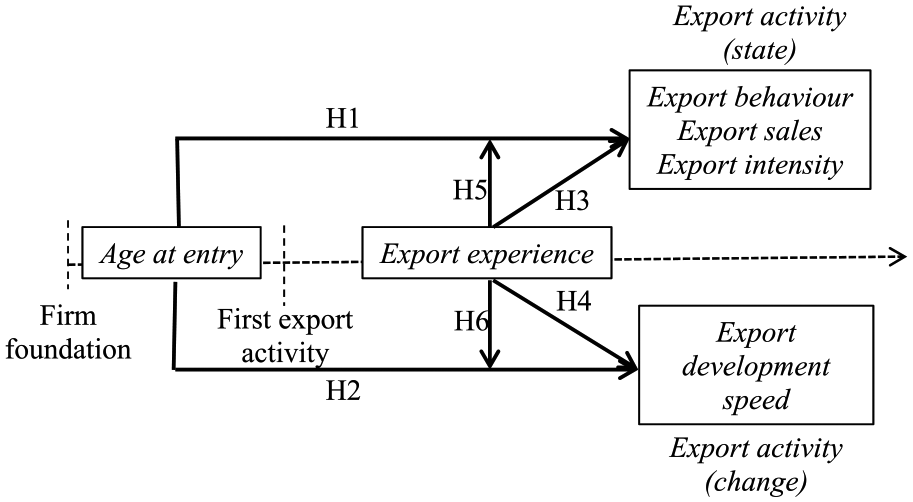
Model and hypotheses.
Method
Data
The source of our empirical work is the Survey of Business Strategies (SBS). This firm-level panel of data is a representative sample of Spanish manufacturing firms with more than 10 employees; it is probabilistic and stratified by industry and firm size (in terms of the number of employees), and compiled by the Spanish Government. Many previous investigations have used this source of data in the international business field (Fernández & Nieto, 2006; García et al., 2012; Golovko & Valentini, 2011). This annual survey covers the period 1990 to 2013. This time-span is similar to other recent studies, as Sleuwaegen and Onkelinx (2014), that analyze 5 years, or Deng et al. (2017), and Mohr and Batsakis (2018), that consider a 10-year period. The limit of 8 years (and not more) is derived by the need of information also of several years before the first export activities, specifically from their foundation. If we included more than 8 years exporting, jointly with the information of the pre-export period would reduce the sample too much and statistical analyses would have not been possible. The panel is not balanced, however, in that there is not information for each firm in every year, because some have joined, while others have left the panel, either because they have folded or they may simply have not responded to the questionnaire.
We have selected the data from this broad base of panel data, choosing only those firms that met the criteria for the objectives of our investigation. The firms had to provide reliable information on two important events: the year the firm was founded and the start of their export activities. Likewise, information had to be available for the selected firms regarding the evolution of their export activity from the beginning of that activity, over a suitable length of time.
First, with regard to the year that the firm was founded, we only considered firms that had been created since the first year of the questionnaire, that is to say, that were founded after 1990. This allowed us to monitor the activity of the firm since its foundation, thus avoiding the inclusion of firms that might have been exporting before the start of this time period and may subsequently have ceased exporting, or other similar cases. Second, we adopted a conservative attitude for identifying the start of export activity and therefore imposed two conditions for establishing this event and its inclusion in the final sample: (1) We chose the year in which the first exports took place, so that we could be certain that the selected firms had never exported before that date; and (2) since its first exports, the firms must have continued to export regularly and without interruption over a significant period of time; in this case, for 8 consecutive years. In this way, we were able to exclude from the final sample any firms with an irregular start to their exporting activity, that is to say, firms with a sporadic start to their internationalization, because in these cases, we could not be certain that they eventually became regular exporters.
The final sample consists of 106 firms, founded since 1990, which began their internationalization process before 2005 and maintained their exports for a period of 8 years. This sample provides an unbalanced panel dataset ranging from 640 to 848 firm/year observations. More than 25% of exports go to European countries, only 2% go to Latin American countries, and approximately 10% go to other OECD (Organisation for Economic Co-operation and Development) countries and another 10% to other markets. The industry distribution is very diverse, although all firms are manufacturing. SBS database differentiates 20 different industries. The more relevant industries are machinery (10%), and chemical and pharmaceutical (9%). Finally, 42% of the firms were family businesses. There is no any listed company in the sample.
Variables
Dependent variables
Export behavior (for Hypotheses 1, 3, and 5) was measured by two related but different variables: (1) export volume (absolute measurement), through the logarithm of the total value of export volume, and (2) export intensity (relative measurement), as the percentage ratio between the firm’s exports and its total sales. Export intensity is a commonly used measurement of export performance (Keupp & Gassmann, 2009) and reflects the firm’s commitment to its export activities. This variable was measured in each of the initial 8 years of the firm’s export activity. Growth of exports is the third dependent variable (for Hypotheses 2, 4, and 6), measured as a percentage. It is a measure of the distance between 2 consecutive years: (Export volume j – Export volume i) / Export volume i. We have used export sales instead of export intensity because the latter, as a percentage, tends to saturation values.
Independent variables
We have used two independent variables, in accordance with the proposed hypotheses—(1) Age at entry: measured as the difference between the year that exports began and the year that the firm was founded; and (2) Export experience: measured as the number of years that the firm has been exporting, that is to say, the difference between the year in question and the year in which the firm began exporting. This variable ranges from 1 to 7, owing to the structure of the sample.
Control variables
We have adopted seven control variables. The first two control variables are related to the size of the companies, previously considered in most research into the internationalization process (Bonaccorsi, 1992; Calof, 1994): (1) the logarithm of the number of workers in each year (Size); (2) the logarithm of the total volume of firm sales, also measured in each of the years analyzed (Sales). The next two variables are related to innovation and technology intensity derived from the demonstrated influence of innovation on the export development process (Cassiman & Golovko, 2011; Golovko & Valentini, 2011); (3) R&D intensity, measured as the quotient of total R&D expenditure and the firm’s sales in each year; (4) Technological intensity of the sector, which takes the value of 1 if the firm belongs to a sector of medium or high technology, and 0 if the reverse is true. We have also considered (5) the Degree of standardization, using two categories: A value of 1 indicates that products are highly standardized and on the whole are the same for all companies, and the value 0 indicates that the majority of products are designed specifically for each client. A sixth variable is the family nature of the business, which describes the nature of the firm and how the firm takes decisions (Fernández & Nieto, 2006), measured by the following: variable (6) Family, determined by a dichotomous variable that indicates whether the firm is run by a single family or not; and finally (7) Idle capacity, measured as the percentage of the firm’s capacity that is not being used in each of the years analyzed, that could influence the motives for international expansion through exports.
Statistical methodology
To analyze different hypotheses, where we considered the entire timescale, we conducted a number of tests to identify the best estimation model. The first test that we carried out was the Breusch-Pagan Lagrange Multiplier, to decide between a random effects model and a pooled least squares regression. We also carried out an F test, which compares the fixed effects model with the pooled least squares regression. For Hypotheses 2, 4, and 6, the results of these two tests showed that the pooled least squares regression was the most efficient. However, the results suggest that for testing Hypotheses 1, 3, and 5, it was most appropriate to use a panel model, given the possible unobserved heterogeneity associated with each firm. On the basis of the previous tests, the next step was to carry out the Hausman test to choose between a fixed effects model and a random effects model. In both cases, we accepted the null hypothesis that proposed the non-existence of a correlation between the regressors and the error terms, and consequently a random effects model for the estimation was more suitable. However, after carrying out various diagnostic tests (the White test, Wooldridge test, and Pesaran test), we encountered problems relating to heteroscedasticity, autocorrelation, and contemporaneous correlation. These problems can be resolved jointly by using Feasible Generalized Least Squares (FGLS) or Panel-Corrected Standard Errors (PCSE). Beck and Katz (1995) demonstrate that PCSE estimators are more accurate than FGLS. These authors also recommend their use when the timescale is relatively short compared to the number of observations, which is applicable to our study. Therefore, following Beck and Katz’s recommendation, we chose the PCSE estimation method to mitigate the problems of heteroscedasticity, autocorrelation, and contemporaneous correlation.
Results
Table 1 sets out the descriptive statistics and correlation matrix for all of the variables used in our study, with the exception of “Technological intensity of the sector,” “Degree of standardization,” and “Family firm,” because these are qualitative categorical variables. The descriptive statistics show that the firms in our sample achieve an average of €300,000 in exports, representing almost 30% of total sales. As described above, on average, these firms begin exporting at the age of 2 years and do not exceed 90 employees. Finally, to identify possible problems of multicollinearity, we calculated the variance inflation factor (VIF). According to Hair et al. (1998), in multiple regression models, values above 10 would indicate the presence of multicollinearity. Our results, which fall within a range of 1.01 to 3.85, allow us to conclude that our variables do not present any problems of multicollinearity.
Correlation matrix and descriptive statistics.
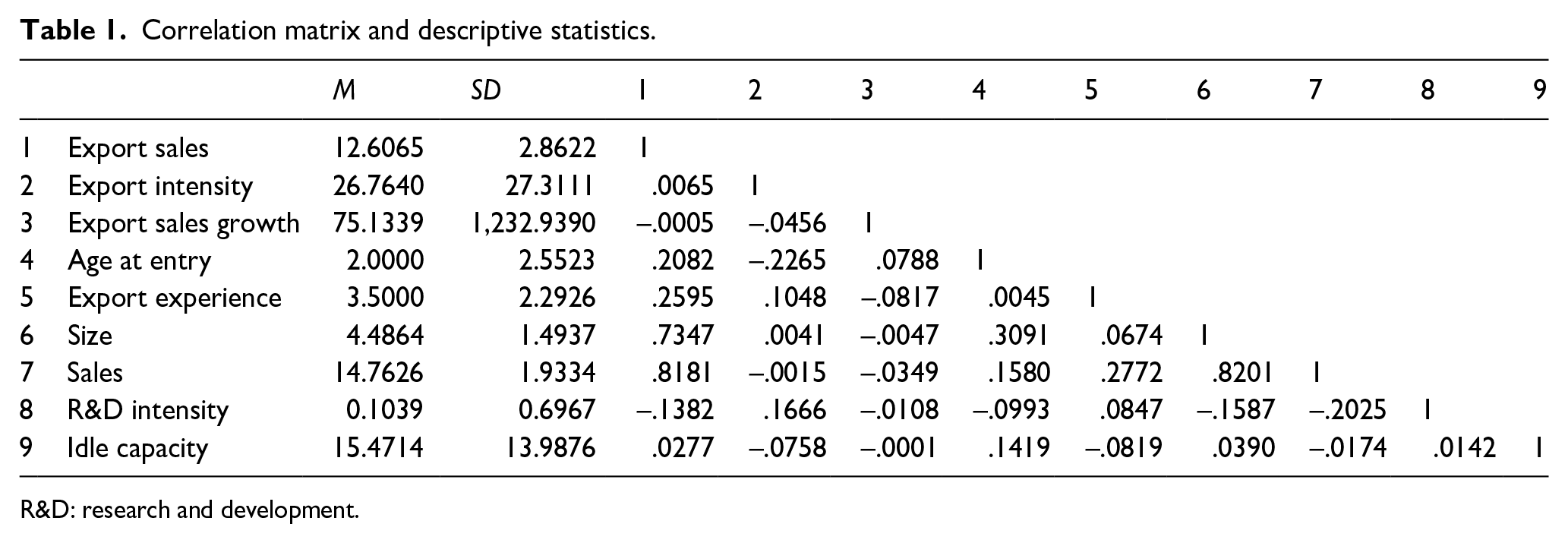
R&D: research and development.
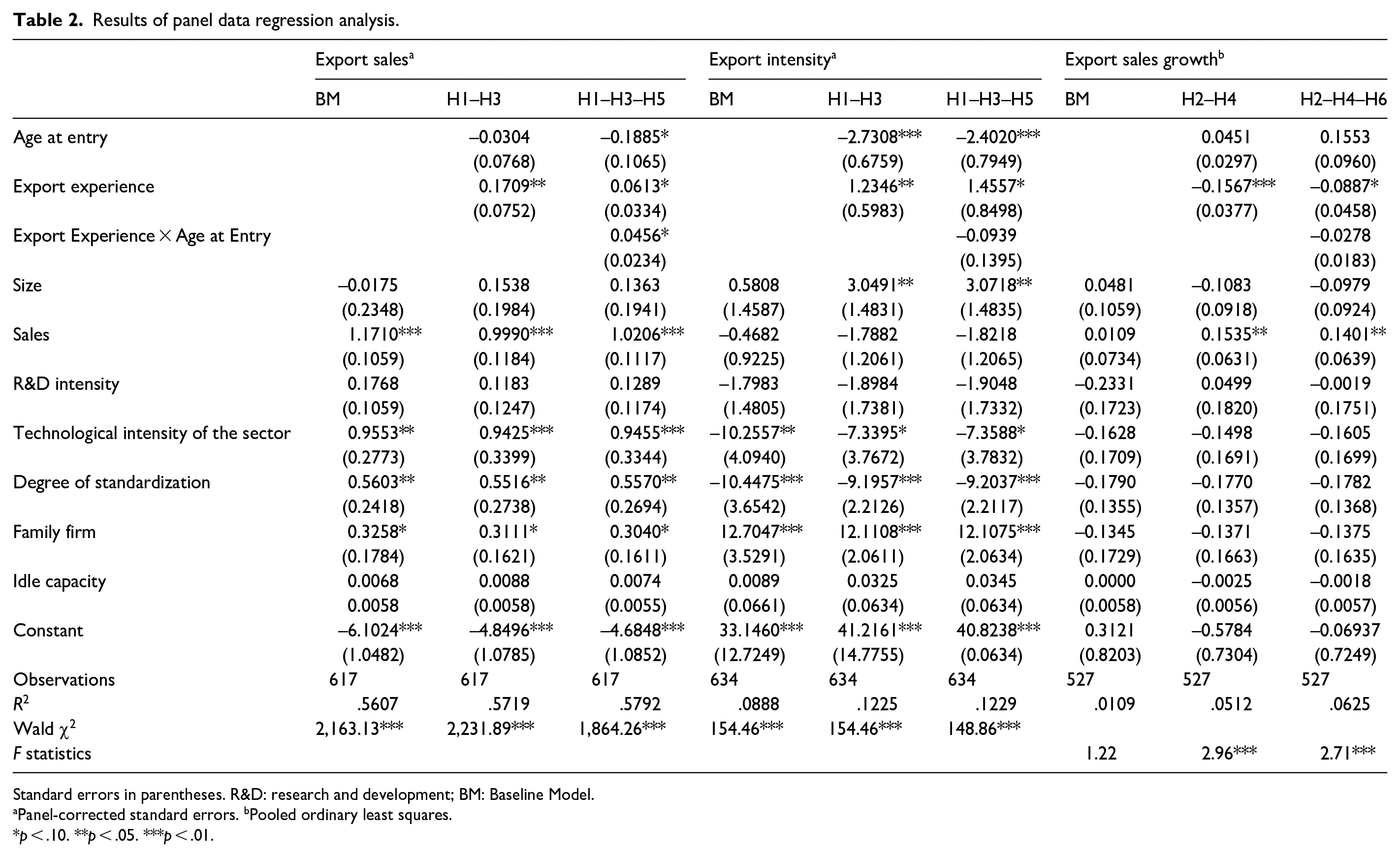
Table 2 shows the results of panel data regression analysis. For each dependent variable, the first column corresponds to the baseline model and the second column shows the direct effects of age at entry and export experience, while the third column includes the interaction effect of both variables. The results show a significant and negative beta coefficient of the independent variable age at entry, both when the Dependent Variable is export sales (β = –0.1885, p < .05) and when it is export intensity (β = –2.4020, p < .001). These results show that the lower the age at entry, the higher the export sales and export intensity during the first years of exporting. However, when the dependent variable is growth of exports, age at entry does not show a significant effect. These results lead us to the conclusion that as the time between the firm’s founding and its first exports increases, there is a decrease in export volume and export intensity in the initial years.
Results of panel data regression analysis.
Standard errors in parentheses. R&D: research and development; BM: Baseline Model.
Panel-corrected standard errors. bPooled ordinary least squares.
p < .10. **p < .05. ***p < .01.
On the other hand, the variable export experience also shows a significant and positive coefficient in both models, when DV is export sales (β = 0.0613, p < .05), and when it is export intensity (β = 1.4557, p < .05), showing that firms increase export behavior as they accumulate export experience. However, the results reveal the negative significant influence of export experience (β = –0.0887, p < .05) on growth of exports, showing that experience in export activities reduces the growth of exports.
Finally, the interaction effect between age at entry and export experience shows a positive significant coefficient when the dependent variable is export sales (β = 0.0456, p < .05). However, when the endogenous variables are export intensity and growth of exports, the interaction effect does not show a significant influence.
Discussion and conclusion
In view of the results attained in the testing of the hypotheses, we can conclude the following. The negative relationship between age at entry and export behavior during the first years following initial exports (both export sales and export intensity) confirms Hypothesis 1, showing that firms that begin to export sooner will do so with greater intensity during the first years of exports (initial stages) than those that begin exporting later. Hypothesis 2 proposed a positive effect of age at entry on growth of exports, but our results are not significant (Table 2). We do not find evidence of a faster or slower growth of export development among younger/older firms, so we are not able to support Hypothesis 2. Combining the findings of the first pair of hypotheses, we conclude that firms that begin their export activities early initiate more intense export activities than those that begin later, although we do not find any differences in relation to post-entry growth of exports during the first years.
The results of the tests of Hypothesis 3 also confirm the positive impact of export experience on post-entry export behavior, with positive and significant effects on both export sales and export intensity. Thus, Hypothesis 3 is supported. However, our findings reveal a significant and negative influence of export experience and growth of exports, thus also supporting Hypothesis 4. These results show the important role played by export experience, as a source of learning, in the development of international activities, and its diminishing effect over time. These findings support the idea of a positive but decreasing learning effect of export experience, in accordance with previous insights (Bingham & Davis, 2012; Casillas & Moreno-Menéndez, 2014). Although previous literature has underlined the importance of the “learning by export effect” (Salomon & Jin, 2008; Salomon & Shaver, 2005; Tse et al., 2017), our findings confirm that some time is needed to absorb and to exploit new knowledge (time compression diseconomies), according to the idea of a curvilinear influence of learning on international behavior (Casillas & Moreno-Menéndez, 2014).
Furthermore, the results confirm that experience has a moderating effect on the influence of age at entry on international behavior during the initial years, but only when export behavior is measured by export volume and not by export intensity. The significant coefficient of the interaction term confirms that export experience will moderate the influence of the speed of entry on export volume in the early years. However, we have also produced a graph (Figure 2) that will allow us to correctly interpret the direction of this moderation. This figure demonstrates that export experience reduces the intensity of the negative relation between age at entry and export volume. In other words, as the firm acquires greater export experience, the influence of age at entry on export sales will become less intense, allowing Hypothesis 5 to be confirmed. Finally, Hypothesis 6, which proposed a moderation effect of export experience on the relationship between age at entry and growth of export, cannot be supported, with a non-significant coefficient. This result is consistent with our previous findings described for Hypothesis 2.
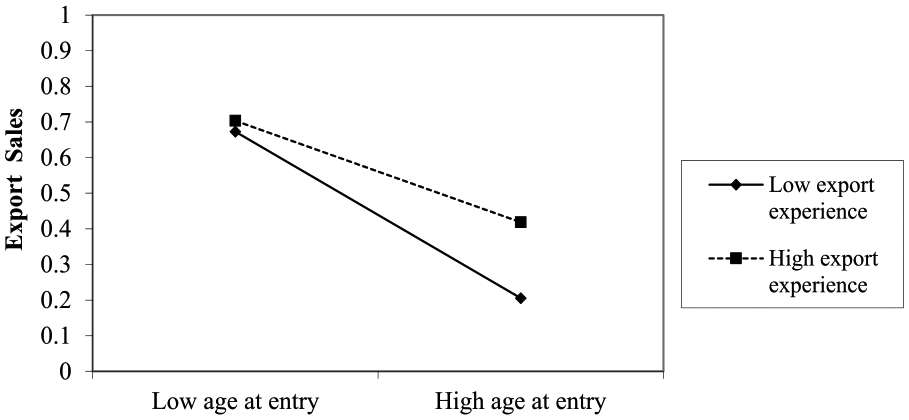
Interaction effect Age at Entry × Experience on export sales.
Academic implications
Our results contribute to the literature of the internationalization process from a dynamic perspective, linking pre-export and post-entry stages (Hashai, 2011; Hashai & Almor, 2004), and including simultaneously state and change variables (Johanson & Vahlne, 1990; Santangelo & Meyer, 2018). Our longitudinal analysis of a hundred firms from their first export activity and over the following 8-year period improves our understanding of how pre-internationalization speed (age at entry) and post-entry international behavior (export experience) both separately and jointly influence (1) absolute and relative export behavior and (2) export development speed, such as the yearly growth in export sales. We found some significant relationships: (1) the lower the age at entry, the higher the export sales and export intensity; (2) the greater the export experience, the greater the export sales and export intensity, but the rate of increase of export sales decreases over time; and (3) when the export experience is higher, the negative influence of age at entry on export sales is less intensive.
We found that younger firms initiate internationalization activities more intensely than older ones, but, as they accumulate export experience, the export evolution of firms tends to converge. In other words, the earlier a firm becomes international, the longer it will take to integrate this internationalization into its culture and values and its organizational routines. Our results appear to identify a process of convergence in the export behavior of firms that begin their export activity early on, which continues into the initial years of exporting. That is to say, firms that begin exporting earlier tend to grow more slowly as they acquire experience, while those that delay taking this step tend to grow more rapidly.
The international entrepreneurship literature has emphasized on innumerable occasions the importance and differentiating effect of age at entry on internationalization (Autio et al., 2000; Gabrielsson et al., 2008). Nevertheless, we understand very little of how it actually affects this behavior (Hilmersson & Johansson, 2016; Meschi et al., 2017; Romanello & Chiarvesio, 2017), and it is generally associated with the pre-exporting to exporting phase, and the firm’s future development. In our analysis, we have proposed the duration of this initial effect on the firm’s future development, assuming that it gradually becomes diluted in a trade-off with the experience acquired in the process. It is frequently suggested in the literature that internationalization requires the management of the learning and unlearning processes (Autio et al., 2000; Casillas et al., 2015). However, the question has almost never been asked whether LAN has a long-term effect on INVs. Existing studies that have attempted to assess the evolution of this type of firm have almost exclusively focused on performance (Fernhaber, 2013; Lu & Beamish, 2004) and only infrequently on international behavior (Sleuwaegen & Onkelinx, 2014).
Managerial implications
These results underline once again the importance of the market entry momentum of these firms and its short-term effect. Age at entry is therefore considered to be significant for explaining both export volume and intensity. However, it would appear that, after an initial phase, these firms begin to adopt what could be described as a gradual development process in which learning (experience) becomes more important than the characteristics of the initial internationalization strategy, as our post hoc analyses have shown (Romanello & Chiarvesio, 2017). Thus, the effects of the variables change as the international life of the firm progresses. Our observation of the variety of effects on the different measures linked to the internationalization process once again highlights the intrinsic complexity of the internationalization process.
This article shows a change in the capabilities required at the beginning of export activities. While early exporters seem to have some advantages over late exporters, as firms acquire direct export experience the evolution of both groups of firms follows a convergent trend. These results are in line with Romanello and Chiarvesio (2017), who underline the changing role of two different types of international knowledge: congenital versus experiential knowledge. Thus, managers need to develop new organizational capabilities when they begin to export actively, which are different from congenital knowledge and other aspects associated to the age at entry, because this loses its effects as the company develops experiential knowledge (Casillas et al., 2015).
Limitations and future research
Nevertheless, these results are not entirely conclusive since, on one hand, the timescale is limited (8 years) and, on the other hand, we have only taken the volume of international sales and their weighting against total sales to evaluate firms’ international development. Unfortunately, we did not have information relating to the different dimensions of post-entry export development process, such as the geographic destination of the exports (country diversification) and specific country experience. These limitations indicate opportunities for further research that do not measure speed in years but introduce other events that characterize the internationalization process (Jones & Coviello, 2005). Our study of the learning process and the sources of learning needs to continue, with particular emphasis on the assimilation and interiorization of this knowledge.
Our research shows that, at the start of export development process, younger firms export more than older firms, whereas later on the ratio of export growth decreases. This is probably due to the effect of time compression diseconomies and the difficulty of rapidly converting the knowledge learned about these new foreign markets into a growth in export volume. In future studies, it will be very interesting to analyze a potential curvilinear effect (S-curve) between export experience and export growth over time (Hilmersson et al., 2017; Pellegrino & McNaughton, 2017) in an attempt to ascertain which specific year of export activities (and thus of accumulating export experience) could change this effect (from positive–negative–positive).
Footnotes
Declaration of conflicting interests
The author(s) declared no potential conflicts of interest with respect to the research, authorship, and/or publication of this article.
Funding
The author(s) disclosed receipt of the following financial support for the research, authorship, and/or publication of this article: This research is part of the project ECO2017-84364-R, financed by the Government of Spain (Ministry of Economy and Competitiveness).