



Abstract
Despite existing evidence indicating that organizational learning positively influences dynamic capabilities, the complex and dynamic interplay of leadership in this process still remains incomplete. Organizational learning models note that leadership is embedded in the development of dynamic capabilities, and this research empirically investigates the interplay of organizational learning (exploitative and exploratory learning) and strategic leadership (transformational and transactional leadership) in developing dynamic capabilities (sensing, seizing, and reconfiguring). A survey questionnaire on a sample of 106 firms is carried out, and results of hierarchical linear regressions indeed reveal that organizational learning shows a direct or indirect influence on dynamic capabilities through transactional or transformational leadership, depending on the type of department. This study is an innovative attempt to distinguish different antecedents for each type of dynamic capability on the basis of the type of learning and strategic leadership involved.
Introduction
The dynamic of changes in the world in which current firms operate, has turned into a riskier scenario characterized by volatility, uncertainty, complexity, and ambiguity (VUCA). Under this environmental turbulence, firms need to be prepared to “pick a path through the fog” (Schoemaker et al., 2018, p. 15) by achieving sustainable competitive advantages. Under the resource-based view of the firm, dynamic capabilities (DCs) might be a fundamental source of competitive advantage, as they develop resources and capabilities having an effect on organizations’ competitiveness and performance (Barney, 1991; Fainshmidt et al., 2016). In this vein, DCs should develop valuable, rare, imperfectly imitable, and non-substitutable (VRIN resources and capabilities) conditions. Recent research reveals how key sensing, seizing, and reconfiguring capabilities (DCs) enhance digital transformation (Warner & Wäger, 2019), facilitate effective B2B marketing operations (Mikalef et al., 2021), transform lean management practices into sustainable business performance (Mohaghegh et al., 2021), and impact on performance (Schriber & Löwstedt, 2020). Thus, DCs allow organizations to adapt to rapidly changing contexts and integrate, mobilize, and reconfigure their key resources (Teece, 2007) to achieve sustainable competitive advantages and superior performance.
At the same time, learning-oriented organizations can better adapt to our changing context than competitors do (Jiménez-Jiménez & Sanz-Valle, 2011). In this vein, global competition and new forms of innovation and manufacturing explain how the mere stockpiling of unique knowledge is not enough to ensure that a business is competitive and that DCs emerge as sources of sustainable competitive advantage (Asija & Ringov, 2021). Organizational learning (OL) plays a crucial role in leveraging organizational knowledge and improving performance on the road to developing sustainable competitive advantage (Jerez-Gómez et al., 2005). Alegre et al. (2012) argued that OL enhances sustainable competitive advantage and illustrated how OL was linked to market orientation, product innovation, project performance, and firm performance in diverse studies.
DCs and OL are two interrelated fields of study, as, DCs require the ability to learn (Kang & Snell, 2009; Zollo & Winter, 2002), namely, to explore new capabilities while exploiting existing ones (March, 1991). The OL–DCs connection can be supported following Winter’s (2003) differentiation between zero-level (operational), first-order (dynamic), and second-order (learning) capabilities. Zero-level capabilities facilitate resources being operative and functional, thus facilitating to get the work done and collect the revenue from customers. First-order capabilities redefine operational routines. For example, they support the creation of new products or services, but they are still highly patterned. However, second-order capabilities are defined as learning capabilities that are geared toward the creation and modification of DCs. Accordingly, Winter’s (2003) notion of second-order DCs provides a solid basis to understand why OL is a powerful antecedent of DCs. Eisenhardt and Martin (2000) argue that under dynamic environments, as the present one, DCs require specific mechanisms within a context to be developed, such as OL. This is because the process whereby DCs are developed involves change and evolution, namely, learning (Winter, 2003), and learning underpins resource and operational renewal processes (Easterby-Smith & Prieto, 2008). OL has the potential to develop and reshape DCs as long as it increases knowledge and integrates it into the organization knowledge system (García-Morales et al., 2012). The term dynamic of DCs requires OL seeing that it denotes change, transformation, and progress (Winter, 2003). OL involves repetition and experimentation, which enables tasks to be better performed (Teece et al., 1997). Furthermore, OL has the potential to change resources, routines, and competencies, thus reconfiguring DCs (Easterby-Smith & Prieto, 2008). Learning orientation may, for example, foster the DC of ambidextrous learning (Huang & Li, 2017). Farzaneh et al. (2021) revealed that OL offers crucial mechanisms in highly innovative industries, such as the pharmaceutical sector, for developing DCs, which in turn foster innovation performance. In this sense, they found a direct effect of OL on sensing, seizing, and reconfiguring capabilities. Cadden et al. (2022) recently found that OL develops higher-order intangible supply chain capabilities. For all the above, OL shapes and develops DCs (Zollo & Winter, 2002). Thus, a firm distinctiveness might come from how DCs are developed, and OL is essential in this role. In sum, learning is considered a fundamental process for the development and renewal of DCs (Easterby-Smith & Prieto, 2008). There is, however, a notable lack of empirical work seeking to link specific types of learning with sensing, seizing, and reconfiguring capabilities. Accordingly, exploring how OL contributes to each of these DCs as microfoundations becomes essential. By focusing on how OL exerts an impact on firm’s DCs, this study will draw interesting conclusions as to which types of OL (explorative and exploitative) influence the development of DCs.
However, there are inconsistencies of prior studies addressing the OL–DCs that reveal a still ambiguous relationship between both concepts. Several studies are carried out in emerging economies. For example, Farzaneh et al.’s (2021) research was performed in Iran, and found that OL, taken as a single construct, positively impacted on the DCs of learning, integrating, and reconfiguring, and underlined the need to introduce key organizational factors. However, they did not distinguish between exploratory and exploitative learning and its effects on DCs. Kim and Atuahene-Gima (2010) found that the relationship between exploitative learning and new product differentiation was not affected by environmental turbulence, and the relationship between explorative learning and new product differentiation was not affected by competitive intensity. These results show that a VUCA environment does not have homogeneous effects on DCs in the emerging economy of China. Recent studies focus in advanced countries and reveal intriguing results. As an illustration, Cadden et al. (2022) found that OL not always impacted DCs. Wilhelm et al. (2022) explored how DCs worked in low and high dynamic environments, and found that DCs do not always need to be associated with learning orientation. They revealed that current firm knowledge can also shape DCs, which evidences that the study of the impact of OL on DCs is more complex than earlier research has anticipated. In contrast, Ferreira et al. (2021) carried out a research in the underexplored context of catching-up countries in Europe, namely, developed countries that are on an improving trajectory to increase their competitiveness and innovation (Hervas-Oliver et al., 2021). They found that exploration capability required high OL to develop innovativeness, while exploration had a higher effect on innovation capability for lower OL capability.
The debate concerning the OL–DCs suggests the lack of the human factor affecting this relationship. Wilhelm et al. (2022) called for further research exploring organizational enablers and constraints in the relationship between OL and DCs. Microfoundations literature of DCs suggests that organizational activities involve the characteristics, actions, and interactions of people implicit in managerial processes and specific organizational procedures in which they operate (Teece, 2007). Tran et al. (2019) supported the idea that the process of learning takes place through a sequence of conflicts, social, and cognitive interactions in which leaders are indispensable. As Farzaneh et al. (2021) recognized, the effectiveness of OL depends on employees’ contribution with new ideas, schemes, and approaches. This is an idea that is shared with Tamayo-Torres et al. (2016), which signals the key role of leaders to activate the potential of OL. Oh (2019) underlined that the organization is a particular social space in which learning can hamper or facilitate access to resources. According to Oh (2019), OL is stronger when an “actional–personal” component creates confidential relations in which leaders can reinforce the actions and thoughts of employees that foster voluntary participation in learning activities.
According to Soekijad et al. (2011), learning takes place most effectively in informal and voluntary settings, such as networks of practice, which tend to be led by someone with formal responsibility. Pitelis and Wagner (2019) argue that leaders counteract the status quo bias by promoting reflection and debate. Leaders play a central role in connecting learning at the individual level with learning at the organizational level, through the processes of intuiting, interpreting, and institutionalizing (Crossan et al., 1999). Intuiting identifies the possibilities of learning in a personal experience. Interpreting refers to the development of cognitive maps and language that could be connected by leaders. Integrating involves developing a shared understanding, and leaders support this process by creating strong ties that individuals can use to share their knowledge. Thus, leaders are challenged to set up ties among team members that let them to connect new and existing knowledge (Berson et al., 2006), thus giving rise to DCs. Altogether, the above arguments show that leadership matters, and strong DCs are inconceivable without the role of leaders (Schoemaker et al., 2018), who need to find the potential value of individuals to boost the capacity of OL in developing DCs. Accordingly, leadership should act as an external variable moderating the effect of OL on DCs.
In particular, we suggest that strategic leadership, understood as transformational and transactional leadership styles, could positively moderate the effect of OL on DCs making stronger such a relationship. Vera and Crossan (2004) integrated strategic leadership and OL in a theory of strategic learning, whereby strategic leaders can foster the development of stocks and flows of learning. Under this theory, strategic leaders encourage employees to go beyond their formally defined job tasks (Mokhber et al., 2018), fostering employees’ development (Bass et al., 2003). On the one hand, transformational leaders inspire followers to innovate and learn (Ojha et al., 2018). On the other hand, transactional leaders clarify roles and tasks, and improve employees’ performance (Pantouvakis & Patsiouras, 2016). In the line of the above arguments, strategic leaders can reinforce the orientation of OL toward experimentation and exploitation of opportunities, helping to generate higher DCs into the organizations.
For all the above, the first objective of this research is to check the direct effect of OL on DCs. As a second objective, we will explore the moderating role of strategic leadership in the relationship between OL and DC. Although OL has been studied as an antecedent of DCs, the interaction effect of leaders’ strategic orientation and OLC is a still underdeveloped field of research. Our contribution to this nascent dialogue is twofold. First, we follow Winter’s (2003) notion of second-order DCs to suggest that DCs need learning processes to be developed, thus suggesting that OL is a relevant antecedent of organizational DCs. Because there is significant lack of empirical research linking specific types of learning with sensing, seizing, and reconfiguring capabilities, this study aims to shed light on which types of learning (exploitative or exploratory) influence DCs. Second, prior empirical studies have reached inconsistent conclusions in the OL–DCs relationship. While some research identifies a significant effect of OL on DCs (Farzaneh et al., 2021), others reveal that this relationship is more complex than anticipated (Cadden et al., 2022). In particular, “catching-up countries” that are in a trajectory to improve their competitiveness, such as Spain, require further attention. Third, literature shows that OL demands an “actional–personal” element to ensure actions and thoughts of employees that result in deliberate participation in learning activities. Furthermore, leaders are crucial in connecting individual and OL levels through the processes of intuiting, interpreting, and integrating (Crossan et al., 1999; Soekijad et al., 2011), yet scarce studies introduce the moderating role of strategic leadership in the OL–DCs linkage. To fill this gap, we build on the emergent research of microfoundations of DCs to check the moderating role strategic leadership in the relationship between OL and DCs.
OL and DCs
The DCs approach explains how firms are able to sustain superior performance in a rapidly changing environment through continuous proactive and reactive adaptation, and entrepreneurial activities (Gölgeci et al., 2017). Although Easterby-Smith et al. (2009) argued that is not easy to have an universally accepted definition of DCs, some common traits can be found. In general terms, as Helfat, et al. (2007) recognize, DCs are firm capacities “to purposefully create, extend or modify its resource base” (Helfat, et al., 2007, p. 4). In essence, DCs involve three types of activity and adjustment: “(1) identification and assessment of an opportunity (sensing); (2) mobilization of resources to address an opportunity and to capture value from doing so (seizing) and (3) continued renewal (reconfiguration)” (Teece, 2016, p. 1396). Barreto (2010) proposed an integrated definition in his research work that covered these three main clusters of activities, defining DC as a firm’s potential to systematically solve problems thanks to its propensity for sensing, seizing, and reconfiguration, in Teece’s (2007) words.
The work from Teece (2007) is seminal for understanding such capabilities. By sensing, Teece (2007) recognizes that it is “very much a scanning, creation, learning and interpretive activity” (p. 1322). Second, once opportunities are identified and shaped, they “must be addressed through new products, processes and services. This almost always requires investments in development and commercialization activity” (Teece, 2007, p. 1326). This is the way seizing is conceptualized. Finally, the same author explicitly states that reconfiguration implies “to maintain evolutionary fitness and, if necessary, to try and escape from unfavorable path dependencies. In short, success will breed some level of routine, as this is necessary for operational efficiency (. . .) Changing routines is costly, so change will not be (and should not be) embraced instantaneously” (Teece, 2007, p. 1335).
The microfoundations of organizational capabilities can be understood as causal explanations of the origin of such capabilities, including individuals, processes, structures, and their interactions that contribute to the emergence of capabilities (Felin et al., 2012). In studying microfoundations of capabilities, Barney and Felin (2012) reviewed several half-truths about the concept and consider that aspects as OL, cognition, and organizational identity must be explained in terms of aggregation and interaction to constitute capabilities. That is the reason why we focus on microfoundations of DCs as Teece (2007) suggests, in order, better explaining the antecedents of sensing, seizing, and reconfiguration.
The literature shows that DCs rely on an extensive learning process (Verreynne et al., 2016). Learning is seen as a necessary antecedent for building DCs, as they require a continuous process of absorption, integration, and reconfiguration of organizational competences (Teece et al., 1997). When firms face unpredictable and shifting markets, the existence of an appropriate stock of resources and processes is insufficient to sustain competitive advantage (Eisenhardt & Martin, 2000; Teece et al., 1997). In this regard, OL has been defined as “the process by which the organization increases the knowledge created by individuals in an organized way and transforms this knowledge into part of the organization’s knowledge system” (García-Morales et al., 2012, p. 1041). It can then be presented as a key mechanism for creating and developing DCs (Barreto, 2010).
To approach the study about how OL can enhance DCs, the exploration/exploitation framework (March, 1991) can be useful. Specifically, OL has been classified by distinguishing between exploration and exploitation (March, 1991). Exploitation makes a firm continue working in familiar areas proximate to existing solutions rather than obtaining novel, emerging, original knowledge (Kang & Snell, 2009; March, 1991). The resulting learning is therefore an incremental improvement on existing products, services, or processes. In contrast, exploration involves expanding the firm’s well-known, set knowledge into unusual or novel areas, generating innovative new products, services, or processes. These notions are part of the microfoundations that explain DCs.
In the relationship between OL and the generation of DCs, Eisenhardt and Martin (2000) suggested that overall DCs require a blend of the two different strategic logics, namely, the logic of exploration and the logic of exploitation, arguing that DCs “are rooted in streams of innovations—in simultaneously exploiting and exploring” (p. 658). The ability to achieve such a level of ambidexterity is said to lie at the heart of a firm’s DCs (Eisenhardt and Martin, 2000; Teece et al., 1997). It is probable that a firm that is capable of simultaneously exploring and exploiting is likely to achieve performance superior to that of firms which emphasize one at the expense of the other (Tushman & O’Reilly, 1996). Therefore, OL is a core microfoundation of DCs (Teece, 2007). However, although the relationship between OL and DCs is supported in the literature, we still do not know the specific contribution of types of learning to promoting sensing, seizing, and reconfiguring capacities. Therefore, the study on OL contributing to each of the DCs is a key element for understanding the generation of the DCs as microfoundations.
Starting by analyzing the microfoundations of sensing, it involves learning, interpretation, and creative activity (Teece, 2007). Individuals can take advantage from their own capabilities and knowledge or the learning capability of the organization employees work for (Nonaka & Toyama, 2007). This task involves a monitoring function that continuously scans environmental changes (Schreyögg & Kliesch-Eberl, 2007).
Working groups linked to exploration, given their job of prospecting new markets, developing new technologies, and keeping track of emerging industry trends (Duncan, 1976), would require experimentation, variation, and searching for innovation, which entail exploratory learning. As Teece (2007) pointed out, sensing capacity implies the identification and shaping of opportunities, scanning, searching, and exploring across technologies and markets. Exploratory learning tends to be less entrenched in a particular perspective and has the potential adaptability to discover, comprehend, combine, and apply new knowledge in the future. It also facilitates the flexibility needed to expand, acquire, and absorb new knowledge. Therefore, exploration is a relevant antecedent to sensing capability.
Nevertheless, as Teece (2007) also pointed out, sensing capability requires a careful search activity “about what’s going on in the business ecosystem” (p. 1324). That implies analytical frameworks to tap developments in suppliers and identify changing needs in customers as examples. This involves studying technological, market, and competitive information from both inside and outside the enterprise, making sense of it, and figuring out implications for action (Teece, 2007), and this knowledge is related to firm with familiar areas to improve existing solutions (Kang & Snell, 2009; March, 1991); therefore, exploitative learning is also relevant in this scenario.
Taking into account the above arguments, we suggest the following hypotheses:
H1a: Exploratory learning is positively associated with sensing capability.
H1b: Exploitative learning is positively associated with sensing capability.
Once a new (technological or market) opportunity is sensed, it must be addressed through new products, processes, or services (seizing). Addressing opportunities involves making timely, market-oriented decisions (Barreto, 2010), taken “quickly” (Teece et al., 1997), and seeking the best way to provide superior value to customers (Priem, 2007). In terms of the seizing capacity conceptualized by Teece (2007), its activation would require an internal assessment of the extent to which the organization has structures to exploit the opportunity identified.
Developing complementary investments, capturing co-specialization benefits, and overcoming biases, deceptions, and investment failures are some of the microfoundations of seizing capability (Teece, 2007). Firms need a systematic process for this end that not only helps firms replicate and transfer best practices but also brings better understanding of the causes of success and failure. Codified tools should provide deeper insight into the cause-and-effect relationships underlying acquisition integration (Heimeriks et al., 2012). So, it is probable that codified processes and tools allow the firm a more rapid reaction. As Swart and Kinnie (2010) suggest, a short-term response may be based on exploratory learning through the creative combination of existing knowledge or just using existing knowledge. Nevertheless, as Barreto (2010) insists on the need to make quick and timely decisions as part of the seizing capacity, it could be associated with the learning processes of exploitation.
However, other microfoundations related to seizing capability are associated to select product architectures and business models that reflect managers’ hypotheses about new customer needs and how to best meet these expectations (Teece, 2007). These activities clearly call for creativity and insight, and as Chesbrough and Rosenbloom (2002) pointed out, firms need to deal with different technologies, targeted market segments, value chain, and profit potentials. Seizing capability may also benefit of exploratory learning that allows such creative and innovative behaviors. The above arguments lead us to propose that:
H2a: Exploratory learning is positively associated with seizing capability
H2b: Exploitative learning is positively associated with seizing capability
Finally, the last dimension of DCs is the ability to recombine and to reconfigure assets and organizational structures as the enterprise grows, and as markets and technologies change. The process of reconfiguration involves generating new combinations of existing knowledge, or leveraging existing knowledge for new purposes or in new ways (Eriksson, 2014). Reconfiguration capability is needed to maintain evolutionary fitness and, if necessary, to try and escape from unfavorable path dependencies (Teece, 2007).
Lavie (2006) analyzes different mechanisms for capability reconfiguration, moving from substitution and evolution to transformation, each case needing different type of innovation and learning processes. This reconfiguration includes a firm’s propensity to create, extend, and reconfigure the resource base (Helfat et al., 2007). However, as Rosenbloom (2000) pointed out, organizations with a high propensity to reconfigure might show a lower propensity to make timely decisions to take advantage of changes previously made in the resource base, so a good incentive design and the creation of learning, knowledge-sharing, and knowledge-integrating procedures are likely to be critical to successful reconfiguration (Chesbrough, 2003; Nonaka & Takeuchi, 1995).
Taking into account Teece’s (2007) microfoundations for reconfiguration, under certain circumstances, managing co-specialization and complementarities is very important and these activities may imply the adaptation of the existing routines, systems, structures, and processes of the organization (Sun & Anderson, 2010). Certain technologies are worth more to some market participants than to others, based on the technology they already have, and their technology and product strategy. In these cases, exploitative learning is needed here for creating alignment with existing products and markets related to refinement, implementation, and efficiency in production (Teece, 2007). Exploitative learning tends to be more effective for acquiring and assimilating new, in-depth knowledge (Kang & Snell, 2009). Therefore, exploitative learning would be suited to a mechanistic pattern, including standardized process and structures, detailed routines, and rules to establish a common frame of reference among employees (Crossan et al., 1999).
Other microfoundations associated with reconfiguration involve knowledge management, open innovations, and incentives to share knowledge (Teece, 2007). Existing capabilities and resources can be modified by experimentation (Lavie, 2006). This means that trial and error mechanisms can be implemented and for reconfiguration is recommended to scan the environment and therefore exploratory learning can be helpful (Zollo & Winter, 2002). We therefore argue that both exploratory and exploitative learning should be associated with reconfiguration capacity, as set out in the following hypothesis:
H3a: Exploratory learning is positively associated with reconfiguration capability.
H3b: Exploitative learning is positively associated with reconfiguration capability.
Strategic leadership as a moderator between OL and DCs
As we have previously mentioned, the debate about the relationship between OL and DCs calls for the attention of the human factor affecting it (Farzaneh et al., 2021; Oh, 2019; Tran et al., 2019). Learning occurs in social places where a person has the formal responsibility (Soekijad et al., 2011). To this respect, strategic leadership literature focuses on the executives who have overall responsibility for an organization (Carter & Greer, 2013; Elenkov et al. 2005:; Finkelstein et al., 2009; Vera & Crossan, 2004, p. 666) defined “strategic leadership” as “the process of forming a vision for the future, communicating it to subordinates, stimulating and motivating followers and engaging in strategy-supportive exchanges with peers and subordinates.” Strategic positions in a firm are key factors to recognize opportunities and make decisions that affect organizational processes (Ling et al., 2008). According to this view, strategic leadership has been specifically referred to as the leadership style conducted by top strategic positions in a firm, such as that of the Chief Executive Officer (CEO) (Finkelstein et al., 2009), who has demonstrated the capability to influence the initiatives proposed at operating levels (Smith, 2014). Such an influence can be discussed and studied using the transformational/transactional leadership style framework (Bass, 1985). In general terms, the literature has shown a transformational leadership style to enhance innovation, especially in dynamic environments (Ling et al., 2008; Smith et al., 2004), through the exploration of what is unknown, motivating employees to go beyond their established work prescriptions (Mokhber et al., 2018), while a transactional leadership style mainly enhances the current development of the employees (Bass et al., 2003), ensuring a correct correlation between the work well-done and rewards. The transactional leader prefers working in a well-known and controlled environment, is risk-adverse, and prioritizes the achievement of goals and efficiency (Bass, 1985). In contrast, transformational leaders adopt a proactive approach, seeking opportunities that challenge the status quo, and trying to develop new ways of working. Transformational leaders promote openness to new ideas (intellectual stimulation), act as a good working model for their followers (charismatic influence), take their interests into account (individual consideration), and offer an attractive vision (inspirational motivation) that steers followers away from their self-interest to the objectives of the team or the organization (Bass, 1985).
Helfat et al. (2007) pointed out that the way in which top managers send messages will influence the policies and practices they are implementing, and to the development of the capabilities they are interested in. This assumption is high of interest to study the relationship between OL and DCs since OL requires a context where trust and confidence are essential for employees sharing knowledge and participation in learning activities (Oh, 2019; Park & Kim, 2015). Miles (2007) summarizes an emerging perspective in management education, noting that more attention should be put on trust, culture, and leadership, highlighting the behavioral foundation for the DCs framework.
Because OL relates to generating, disseminating, interpreting, and storing knowledge (Rehman et al., 2019), the leadership style can be determinant, building the proper social context to the OL development, letting organizational members to connect new and existing knowledge (Berson et al., 2006). Soekijad et al. (2011), drawing on Crossan et al. (1999), highlighted the role of leaders on OL through the intuiting, interpreting, and integrating processes. More recently, Vashdi et al. (2019) examined OL by four components: information acquisition, information distribution, information interpretation, and organizational memory. Acquisition refers to how knowledge is created, organizational memory refers to the retention and storage of knowledge for future use, distribution refers to the process of sharing knowledge among members and departments, and interpretation refers to the process by which knowledge is gathered and shared. Keeping in mind the process of learning and its elements (Crossan et al., 1999; Vashdi et al., 2019), the CEO’s leadership style could reinforce the orientation of OL toward experimentation, variation, innovation, or toward the exploitation of current opportunities, or the quest for higher efficiency in production (Lopez-Cabrales et al., 2017), reinforcing the influence of OL on specific DCs.
As we argue into the previous section, exploratory learning involves expanding the firm’s well-known, set knowledge into novel ideas, and that could be related to the development of the sensing capability (identification and assessment of an opportunity). In this sense, transformational leaders seek new ways of working, challenge conventional norms (Conger & Kanungo, 1987), and are open to original ideas. Transformational leaders focus on the identification and development of new ideas, and they are able to build, support, and stimulate teams involved in the learning processes (García-Morales et al., 2012). This kind of leader helps followers to develop their skills and motivation to search for opportunities and new methods of approaching a problem (Schneier et al., 1988). Transformational leadership invites individuals to go one step further, analyzing problems from different perspectives and adopting exploratory thinking processes (Sosik et al., 1997). Augier and Teece (2009) noted that manager’s function in the DCs framework by one hand is Schumpeterian (where he or she introduces novelty and seeks new combinations) and by other hand is evolutionary (the manager endeavors to promote and shape learning). Managers should lead, making these roles (Schumpeterian and evolutionary) the essence of DCs. Leaders with transformational behaviors push exploratory processes throughout the organization (Garcia-Morales et al., 2008), contributing to reinforce the relationship between OL and DCs (Gölgeci et al., 2017).
In accordance with the idea that exploration and sensing capability are related to search, risk-taking, experimentation, and innovation (March, 1991; Teece, 2016), we expect that CEO’s transformational leadership behaviors moderate the relationship between exploratory learning and sensing capability, strengthening the relationship between exploratory learning and sensing capability.
H4: Transformational strategic leadership positively moderates the relationship between exploratory learning and sensing capability, such that the relationship is stronger when transformational leadership style is high.
As the same way, the CEO’s leadership style could also reinforce the orientation of OL toward the exploitation of current opportunities, or the quest for higher efficiency in production (Lopez-Cabrales et al., 2017). Compared to transformational leadership, transactional leaders are more focused on the efficiency of existing operations than the acquisition of new competences (Shamir et al., 1993). Transactional leaders are expected to focus on maintaining the status quo, as Vera and Crossan (2004, p. 224) noted: “. . . transactional leaders seek to strengthen an organisation’s culture, strategy, and structure.” Leaders with transactional behaviors control individual and team performance, put corrective actions into place when needed (Howell & Avolio, 1993), and reward employees for achieving objectives.
Transactional leadership would be also necessary as it can contribute to the efficiency coordination of existing capabilities, which support new ones. Since seizing capability is about mobilization of resources to address an opportunity and reconfiguration capability is about continued renewal (Teece, 2016), transactional leaders may be better than transformational ones, in terms of reinforcing the relationship between exploitative learning (working on existing solutions rather than obtaining novel ones) and seizing and reconfiguration capabilities.
Bearing in mind that exploitative learning implies the reinforcement of current institutionalized learning (Jansen et al., 2009) and the improvement of existing competences, thereby increasing efficiency in established practices and products (March, 1991), it is expected that transactional leaders could favor the influence of exploitative learning on seizing and reconfiguration capabilities. Transactional strategic leadership behaviors can strengthen the relationship between exploitative learning, and seizing and reconfiguration capabilities.
H5: Transactional strategic leadership positively moderates the relationship between exploitative learning and seizing capability, such that the relationship is stronger when transactional leadership style is high.
H6: Transactional strategic leadership positively moderates the relationship between exploitative learning and reconfiguration capability, such that the relationship is stronger when transactional leadership style is high.
Method
Setting and data collection
To examine the DCs of the firm, strategic leadership styles, and OL, we focus on production and marketing departments as our unit of analysis since the DCs are seen as sensing market opportunities, and seizing and reconfiguration activities. Managers of production and marketing departments have information about the firm as a whole (Pasamar et al., 2019) and are particularly involved in the identification of market opportunities, the mobilization of resources, and in reconfiguring capabilities. These two departments should provide good examples of the DCs of the firm.
We therefore began with a sampling framework that encompassed the most innovative companies. By focusing on innovative companies, this study guarantees that the target population is framed in a VUCA environment, in which the development of DCs is decisive to survive. Prior research has focused on innovative firms to explore exploitative and exploratory learning (Prieto-Pastor & Martín-Pérez, 2015). There were two criteria for population selection: presence in innovative industries and a minimum number of 100 employees, to ensure that learning mechanisms are presented and promoted by managers. The industries with the most patents, according to data from the country’s Patent Office, were manufacturing of machinery, manufacturing of motor vehicles, TVs, and telecommunications equipment. Our initial population included 420 firms in the above-mentioned sectors.
The methodology used was to contact the firms, mailing the questionnaire and following up, as proposed in the literature (Dillman, 1991). We identified the manager responsible for both units (Production and Marketing) to explain the study, request collaboration, and discuss the mailing of the questionnaire. After a first contact with a manager in the firms, we sent different questionnaires to Production and Marketing managers, and also to Human Resource managers. By means of our telephone interviews, we obtained information about the right respondent to each question. Specifically, we asked questions related to OL and DCs to production and marketing managers since it is supposed they are close to the daily functioning of the department and are close to sensing, seizing, and reconfiguration activities in the firm. We also asked questions related to OL and strategic leadership to the human resource managers since they are supposed to be close to the CEO, and to be aware of the main policies and vision coming from the top level of the company. We finally obtained responses from 106 firms (which included 3 responses per firm), representing 25.23% of the total population.
Checking for non-response bias, we used a mean difference test to compare the respondents and non-respondents. We based the comparison on their general features, such as the number of employees and revenue. The results of the t-test for equality of means for independent samples provided evidence of non-existence of a non-response bias related to these factors, obtaining values that were not statistically significant (t[420] = .39, p > .05).
Measurement and validation of constructs
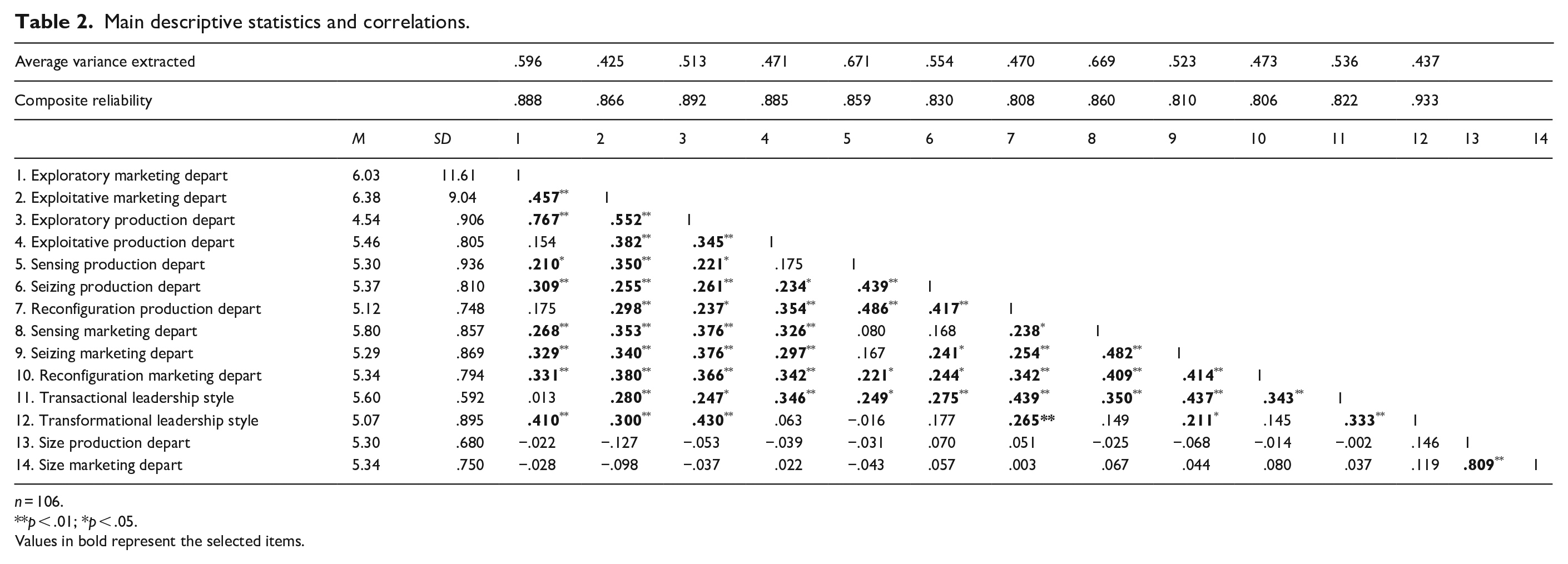
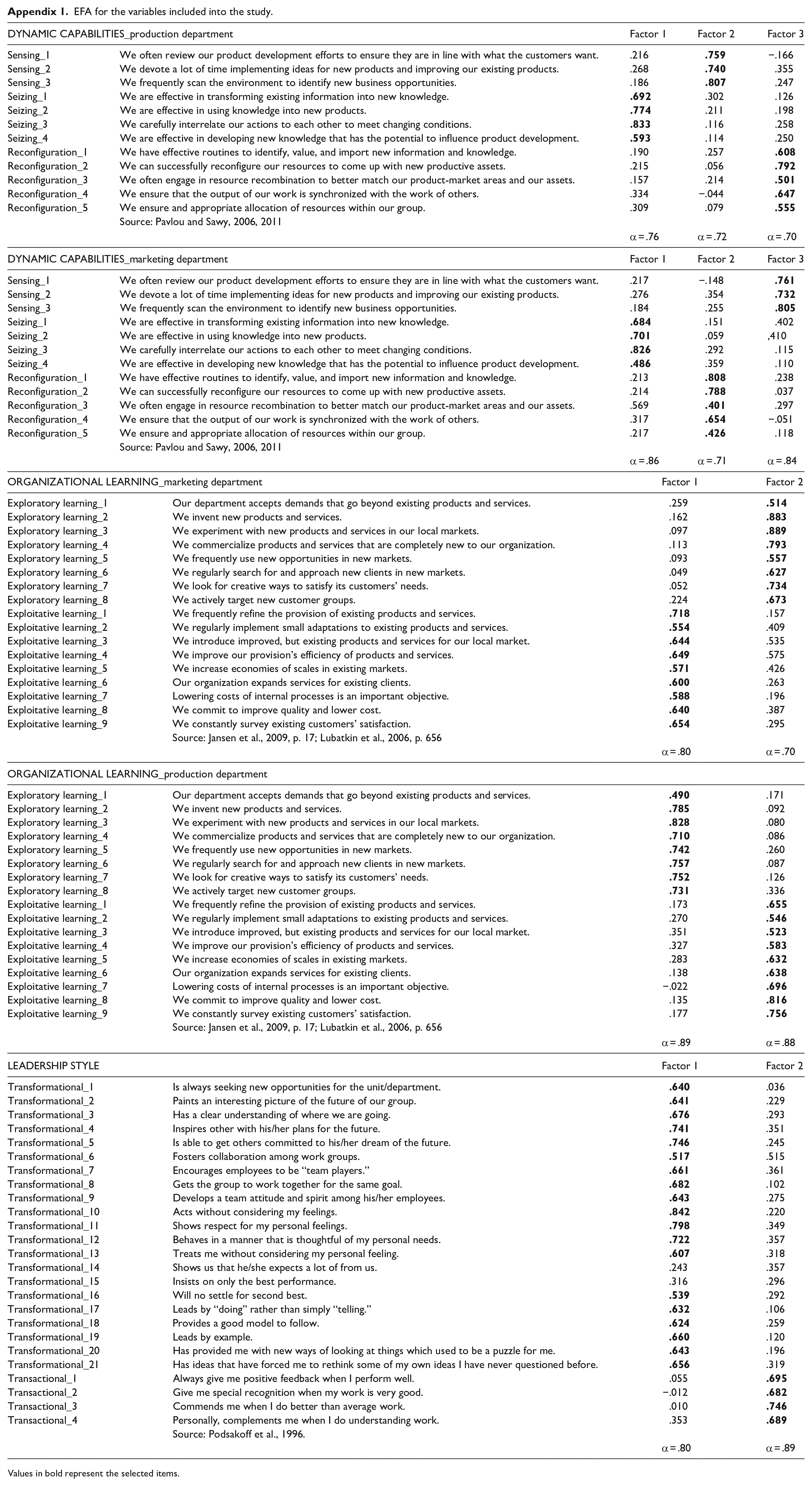
We used existing multi-item scales and verified them through various analyses as described in the following section. All the variables were measured using a seven-point Likert-type scale. With regard to convergent validity, as a common strategy for all the variables, an exploratory factor analysis (EFA) was conducted individually on each construct (for dimensionality purposes) following the principal axis factoring method, which is appropriate for identifying latent variables, and those factors with eigenvalues greater than 1 were selected. A table with the item scales used in the analysis and the results for the dimensionality-EFA are shown in Appendix 1. Some items were eliminated given their low-factor loadings on the factor. We followed the recommendation from Kim and Mueller (1978) deleting items below .4. Discriminant validity is also supported by the EFA (Table 1). We found a total of five factors: DCs in marketing departments, explaining 38.4% of the variance, 13.8% of the variance was explained by OL in marketing departments, 12.8% by DCs in production departments, 8.5% by strategic leadership style, and 7.2% by OL in production departments. To ensure the adequate reliability and validity of the constructs and measures, we calculated the average variance extracted (AVE), and we checked that it is close or exceeds the recommended level of .50. We then, to test the constructs’ convergent and discriminant validity, we compared the AVE and correlation between constructs. A comparison of the correlation with the square root of AVE indicated that all correlations between the two constructs are less than the square root of AVE (Fornell & Larcker, 1981). Results supported adequate convergent and discriminant validity of the constructs and variables in the model (see Table 2). Additionally, we also calculated the composite reliability (sometimes called construct reliability). It is a measure of internal consistency in scale items (Netemeyer et al., 2003). Results were satisfactory achieving the threshold of .80 for all the scales (Table 2).
EFA indicators of constructs.
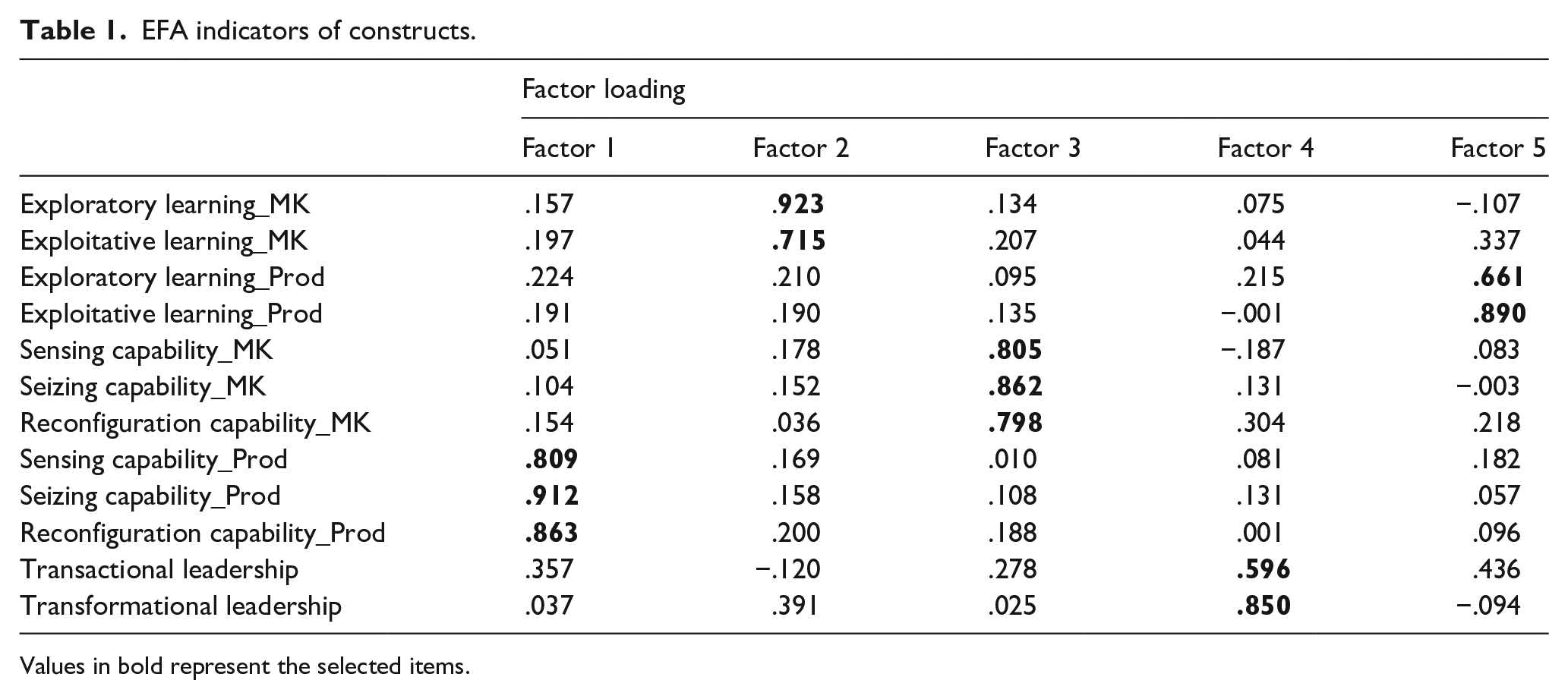
Values in bold represent the selected items.
Main descriptive statistics and correlations.
n = 106.
p < .01; *p < .05.
Values in bold represent the selected items.
Dynamic capabilities
To measure DCs, we chose to focus on the three capabilities proposed by Teece (2007): sensing, seizing, and reconfiguration (defined previously), after conducting a full literature review of the dimensions of DCs. To take our measurement, we took into account the scales proposed by Pavlou and El Sawy (2011), due to the theoretical nature of Teece’s paper. We selected three items for sensing capability, four items for seizing, and five items for reconfiguration. The factor loading for both departments is shown in Appendix 1. In the case of marketing departments, we found Cronbach’s alpha coefficients of .86, .71, and .84 for sensing, seizing, and reconfiguration capabilities, respectively. In the case of production departments, we found Cronbach’s alpha coefficients of .76, .72, and .70, respectively. EFA showed the intended three-factor structure with each item loading on its intended factor and all factors presenting eigenvalues greater than one, for both departments. Discriminant validity is also supported by the EFA (Table 1).
Exploratory and exploitative learning
Measurement scales for exploration and exploitation consisted of items from Jansen, Vera and Crossan (2004), and Lubatkin et al. (2006). Specifically, for the exploratory learning scale, we used five items from Jansen et al. (2009) and we added three more items from Lubatkin et al. (2006); for exploitative learning, we used the seven items from Jansen et al. (2009) and we added two more items from Lubatkin et al. (2006). Items used and the results of the EFA are shown in Appendix 1. In the eight-item exploration scale (α = .80 and α = .89, marketing and production, respectively), we sought to capture whether the department looks for novel ideas, bases its success on its ability to explore new technologies, or creates products or services that are innovative to the firms. In the case of the nine-item exploitative scale (α = .70 and α = .88, marketing and production, respectively), we sought to capture whether the departments look to improve quality and bring down costs, continuously improve the reliability of its products and services, or increase levels of automation in its operations. EFA (see Appendix 1) showed the intended two-factor structure with each item loading on its intended factor and all factors presenting eigenvalues greater than one. Discriminant validity is also supported by the EFA (Table 1)
Strategic leadership
The measure of leadership style with respect to the CEO was that developed by Podsakoff et al. (1996). The items specifically used pertained to the transactional leadership style and transformational system concepts. We used these items because the literature has shown them to be generators of strategic leadership behavior and closely linked to the other variables studied here.
The leadership style scale originally consisted of 21 items from the Transformational Leadership Inventory (Podsakoff et al., 1996), which measures six dimensions including articulating a vision, providing an appropriate model, fostering the acceptance of group goals, having high-performance expectations, providing individualized support, and providing intellectual stimulation. Transactional leadership was measured on a four-item scale based on Podsakoff et al. (1996). Contingent reward behavior captures the exchange notions fundamental to transactional leader behavior and is the principal behavior identified by Bass (Avolio & Bass, 1991; Bass, 1985) to represent this category. All of these items tap the extent to which a leader provides rewards in exchange for a follower’s effort.
Following the literature in this respect, the leadership scale is treated in this study as unidimensional. Researchers have treated transformational scales as unidimensional by combining all their dimensions (MacKenzie et al., 1993; Podsakoff et al., 1993, 1996; Podsakoff & Organ, 1986); the same unidimensionality pattern is followed for the transactional leadership style. The reason leadership is treated as unidimensional is to achieve construct parsimony that best differentiates leadership styles. Items used and the results from the EFA are shown in Appendix 1. For the transformational leadership style, we dropped two items (Items #14 and #15—Table Appendix 1) for dimensionality purposes since they were loading very low (Kim & Mueller, 1978). We found the intended two-factor structure. The scales achieved α = .93 for transformational leadership and α = .88 for transactional leadership. Discriminant validity was also supported by the EFA (Table 1).
Control variables
Department Size. Company size has been shown in the literature to be closely related to innovation in such a way that an increase in company size could imply more resources and greater potential for innovation (Bantel & Jackson, 1989). However, at the same time, there is also some research arguing that small organizations can also be highly innovative due to their flexibility and higher capability to adapt to the environment (Damanpour, 1991). Based on these arguments, we assume that the department’s size also has an influence on an organization’s DCs because the size can affect its resources and, therefore, its potential to innovate or incorporate changes, being more dynamic in nature. We measured the department size variable by the number of employees in the department. The average value for department size was 259.72 employees for production departments and 287.14 employees for marketing departments. We used a Napierian logarithm of the number of workers in the department to estimate it, to avoid the scale effect because of the wide dispersion expected.
Intergroup agreement (data aggregation)
Obtaining responses from more than one respondent reduced the potential common method variance bias and the measurement error noted by some researchers in the human resource management (HRM) literature (see Gerhart et al., 2000). The study called for different managers in each firm to respond to the questions. Specifically, we asked production and marketing managers to respond to the questions related to DCs and OL, corresponding to each department (i.e., we asked questions related to the DCs of the production department to production managers). We also asked human resource managers about OL and strategic leadership. Questions related to OL were asked to human resource managers about each of the departments (marketing and production). In this way, human resource managers answered twice about OL (referring to a different department each time). As we explained in the setting and data collection section, we first contacted firms and managers and, in this way, obtained accurate information about the right respondent for each set of questions. Therefore, for each firm, we obtained one response related to strategic leadership style from human resource managers, one answer for DCs from marketing and production managers (one for each department), and two responses about OL from each department, coming from HRM and from the manager of the corresponding department. Under the assumption that the scores obtained reflect a shared reality within each firm, we predicted that the scores obtained from each firm manager would be similar. These arguments can be measured by means of the intergroup agreement coefficient (rwg) (Bliese & Halverson, 1998). These expectations were confirmed by measuring the interrater agreement coefficient (rwg), which has been used for the purpose of aggregating data (James et al., 1984). The average rwg values were .69 and .82 for exploration and exploitation in production departments, respectively, and .73 and .82 for exploration and exploitation in marketing departments, respectively. These results confirm response consistency within each firm with respect to the OL variable, and we then used an average measure of the rating provided by the two sources for each of the variables.
Results
Correlation and descriptive analyses showed that there are positive relationships between OL, leadership style, and the DCs of the firm (Table 2).
To test our hypotheses, we used multiple and hierarchical regression analysis, always introducing the control variables at the first stage. Since our unit of analysis is the department, we conducted an independent analysis of each of the departments; one analysis of the marketing department and another of the production department. In this way, we analyzed the behavior of our variables in different contexts within the firm. We constructed the variables differentiating between the production and the marketing departments. To run our regressions, we built Models 1, 2, and 3 related to Marketing departments, and Models 4, 5, and 6 related to Production departments.
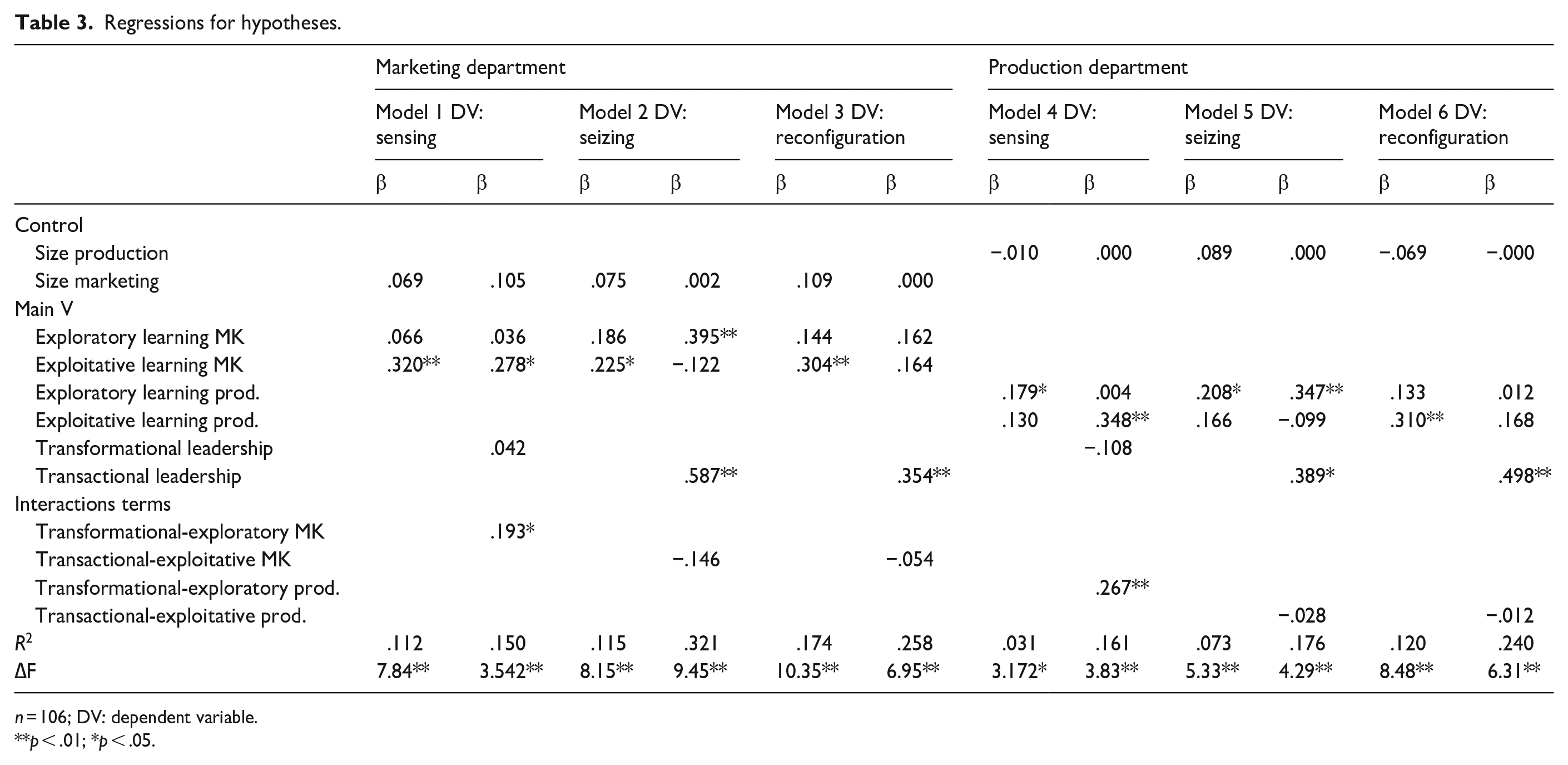
Hypotheses 1, 2, and 3 (a and b) refer to the relationship between OL and DCs. Related to sensing capability, we can observe in Table 3 (Models 1 and 4) that our results show a statistically significant relationship between exploratory learning and sensing capability for production departments (H1a) (Table 3, Model 4, β = .179*), and a positive and statistically significant relationship between exploitative learning and sensing capability (H1b) for marketing departments (Table 3, Model 1, β = .320**). Related to seizing capability, we found the same pattern as for sensing. Specifically, we also found a positive and significant relationship between explorative learning and seizing capability for production departments (H2a) (Table 3, Model 2, β = .208*) and a statistically significant relationship between exploitative learning and seizing capability for marketing departments (H2b) (Table 3, Model 5, β = .225*). Finally, with respect to the reconfiguration capability, the pattern found is different, and we found a positive relationship between exploitative learning and reconfiguration capability for both departments (Table 3, Models 3 and 6, β = .304*, β = .310**), and non-statistically significant relationship between exploratory learning and reconfiguration capability.
Regressions for hypotheses.
n = 106; DV: dependent variable.
p < .01; *p < .05.
Summarizing, exploratory learning is statistically related to sensing and seizing capabilities for production departments, and exploitative learning is related to sensing and seizing capabilities for marketing departments, and related to reconfiguration capability for both departments. In other words, exploratory and exploitative OL are directly related to sensing and seizing capabilities in both departments in our sample. However, regarding reconfiguration capability, it seems that the exploitative learning plays a more decisive role than exploratory learning does. Therefore, we found partial support for our initial set of hypotheses for direct relationships between OL and DCs.
Our second set of hypotheses refers to the moderating role played by the strategic leadership style in the relationship between OL and DCs. In this case, we first introduced control and main variables and, in a second step, we introduced the interaction terms, after centering all the variables.
Table 3 also shows the results for the hierarchical regressions. It can be observed that in this case, the behavior of the variables is the same for the marketing and production departments. The moderator effect of the transformational leadership reinforces the relationship between exploratory learning and sensing capability. Specifically, we found support for Hypothesis 4 in both cases—marketing and production departments (interaction term Model 1, β = .193*; Model 4, β = .267**). With respect to the role played by the transactional leadership style, it can be observed (in Table 3, interaction term for Models 2, 3, 5, and 6) that we did not find support for Hypotheses 5 and 6 in either department.
The interaction plots for the significant moderating effects of the transformational leadership style are shown in Figures 1 and 2.
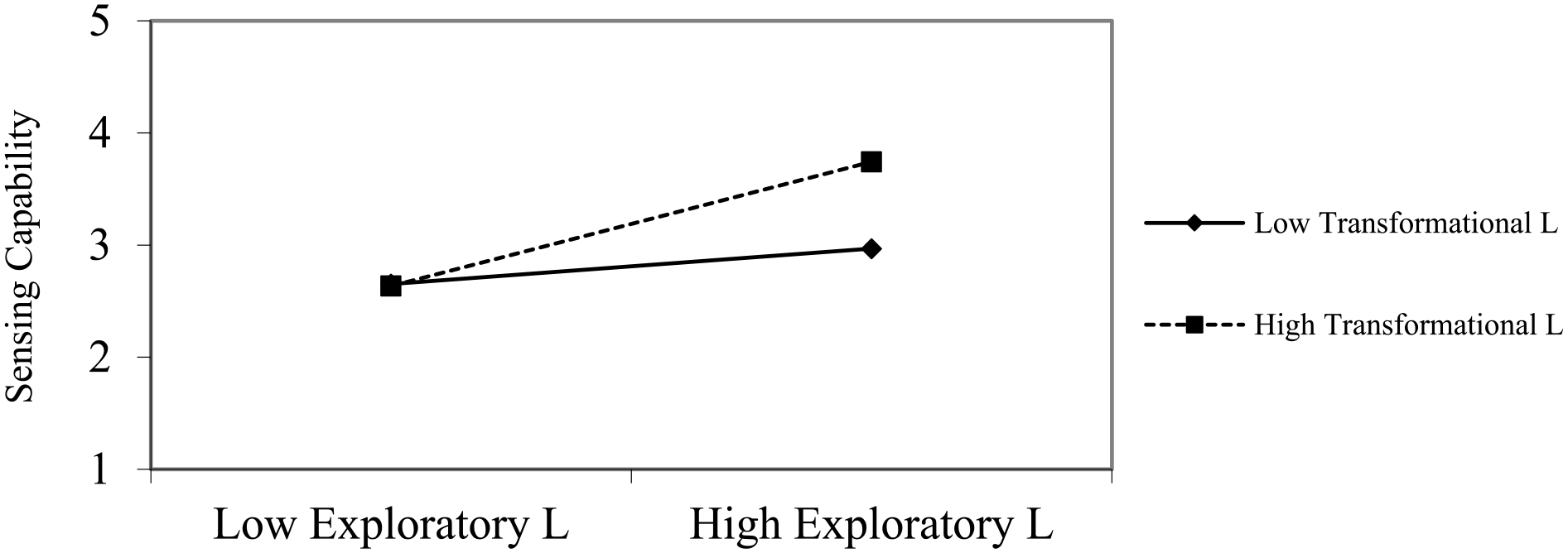
Interaction plot for transformational leadership and sensing in marketing department.
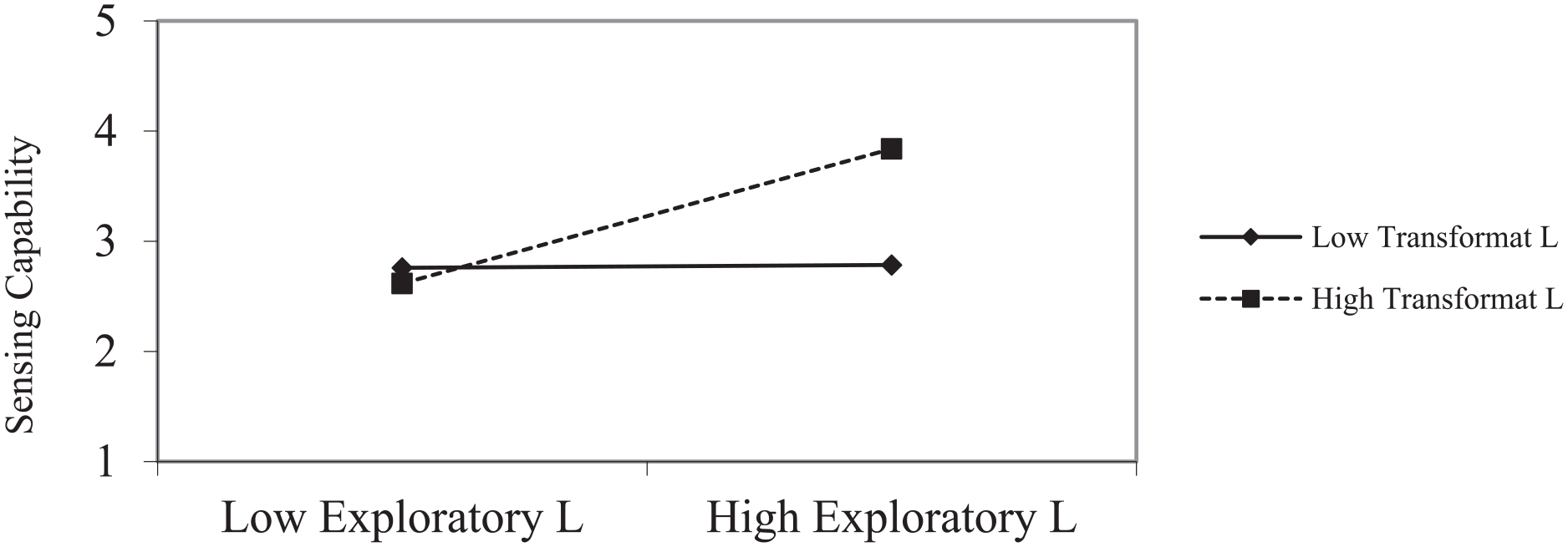
Interaction plot for transformational leadership and sensing in production department.
We plotted exploratory learning in relation to sensing capability at high and low levels of transformational leadership (Aiken et al., 1991). High and low levels were defined as one standard deviation above and below the mean, respectively. For departments with low transformational leadership, exploratory learning was not significantly related to sensing capability. However, for departments with high transformational leadership style, the relationship between exploratory learning and sensing capability was positive and significant (Figures 1 and 2).
Additional analyses
To better characterize the efficacy of strategic leadership, and based on a reviewer recommendation, we also carried out additional analyses to evaluate the impact of transformational and transactional leadership on sensing, seizing, and reconfiguring capabilities, controlling for explorative and exploitative learning. The results showed a consistent pattern, where the transformational leadership style had no significant effect on sensing, seizing, and reconfiguring capabilities (except for reconfiguring capability for the production department), while the transactional leadership style had a positive and significant effect on all the DCs, in both production and marketing departments (even controlling for both the exploratory and exploitative learning, and for the transformational leadership style). Overall, those results show a positive impact of the transactional leadership on sensing, seizing, and reconfiguring capabilities, and this impact seems to be independent of the OL–DCs relationship that remains almost unaltered when entering the different leadership styles. Non-control variables were statistically significant to any model developed. Tables 4 to 9 show the results of the regression analyses.
The effect of leadership in sensing capability (marketing department), controlling for explorative learning.
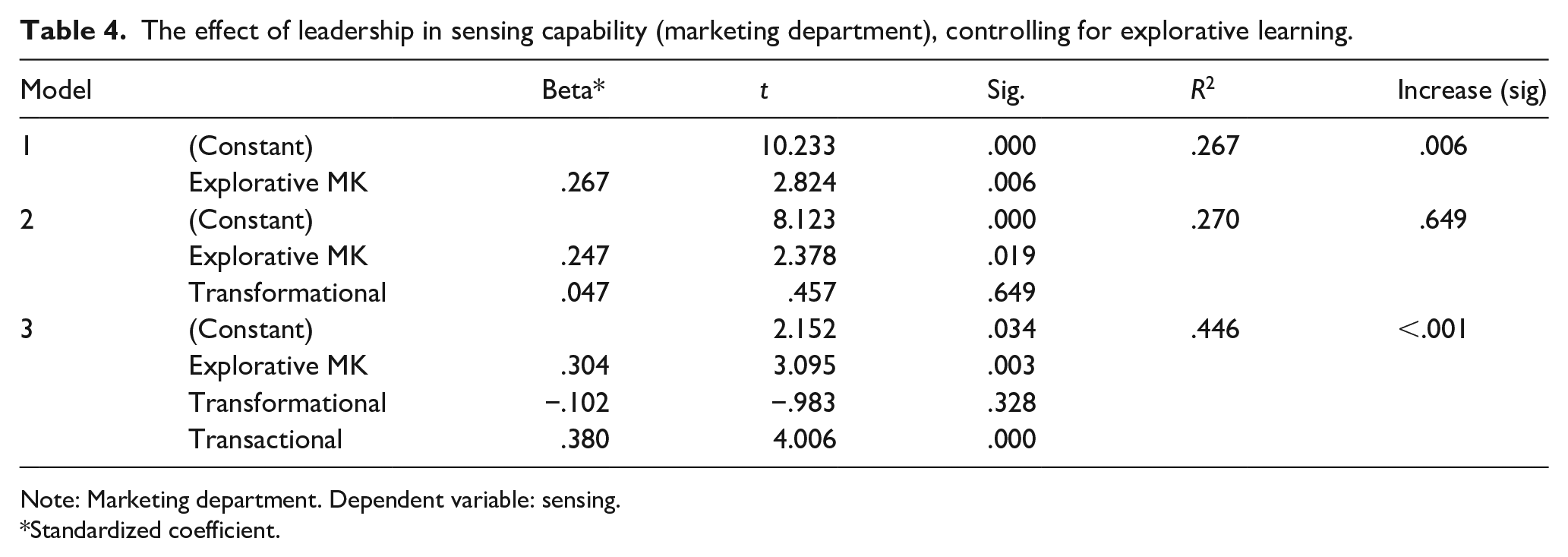
Note: Marketing department. Dependent variable: sensing.
Standardized coefficient.
The effect of leadership in sensing capability (production department), controlling for explorative learning.
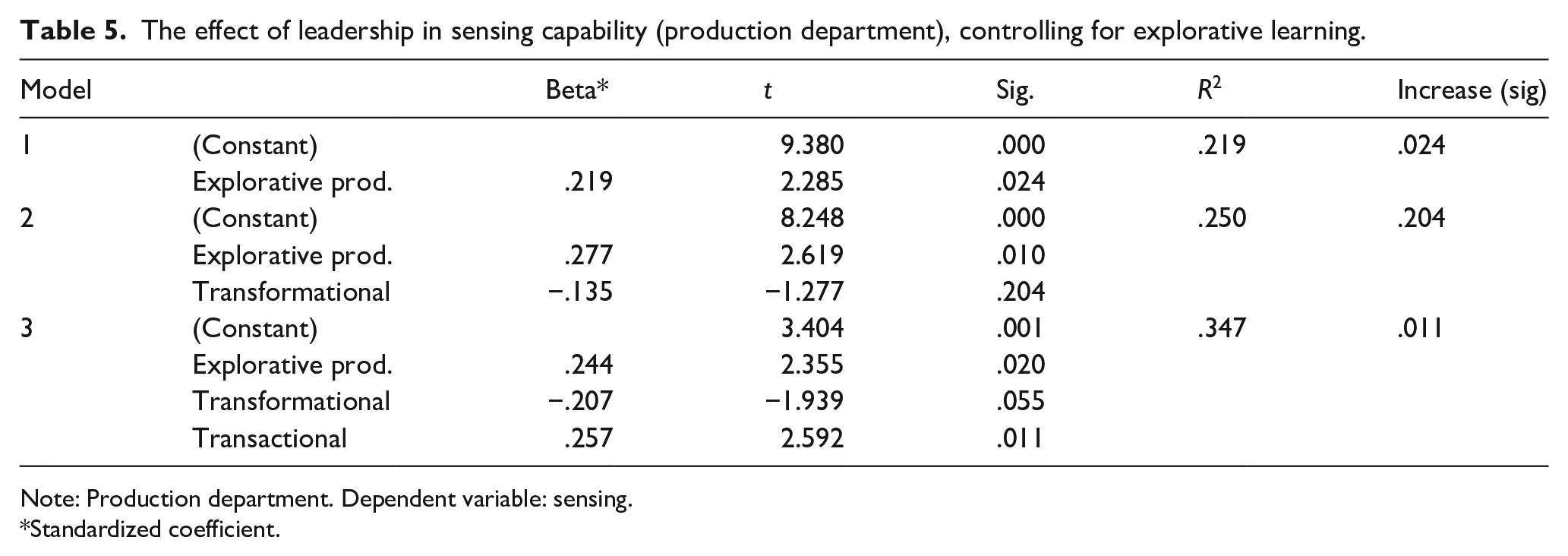
Note: Production department. Dependent variable: sensing.
Standardized coefficient.
The effect of leadership in seizing capability (marketing department), controlling for exploitative learning.
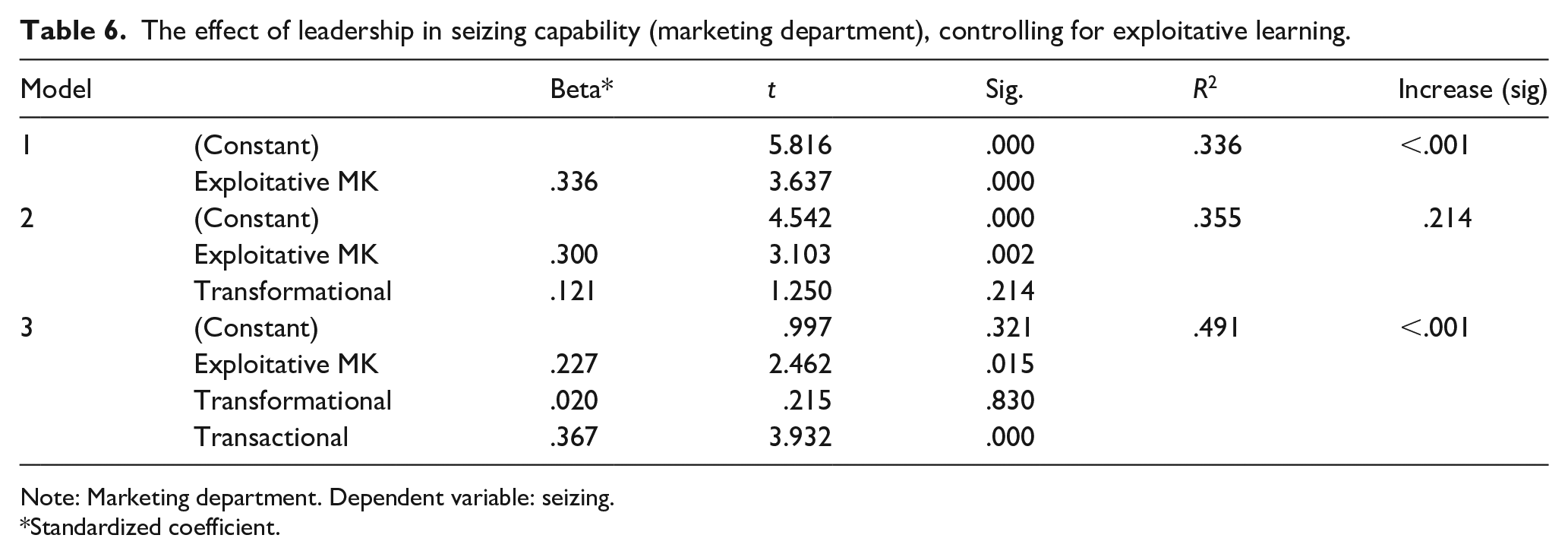
Note: Marketing department. Dependent variable: seizing.
Standardized coefficient.
The effect of leadership in seizing capability (production department), controlling for exploitative learning.
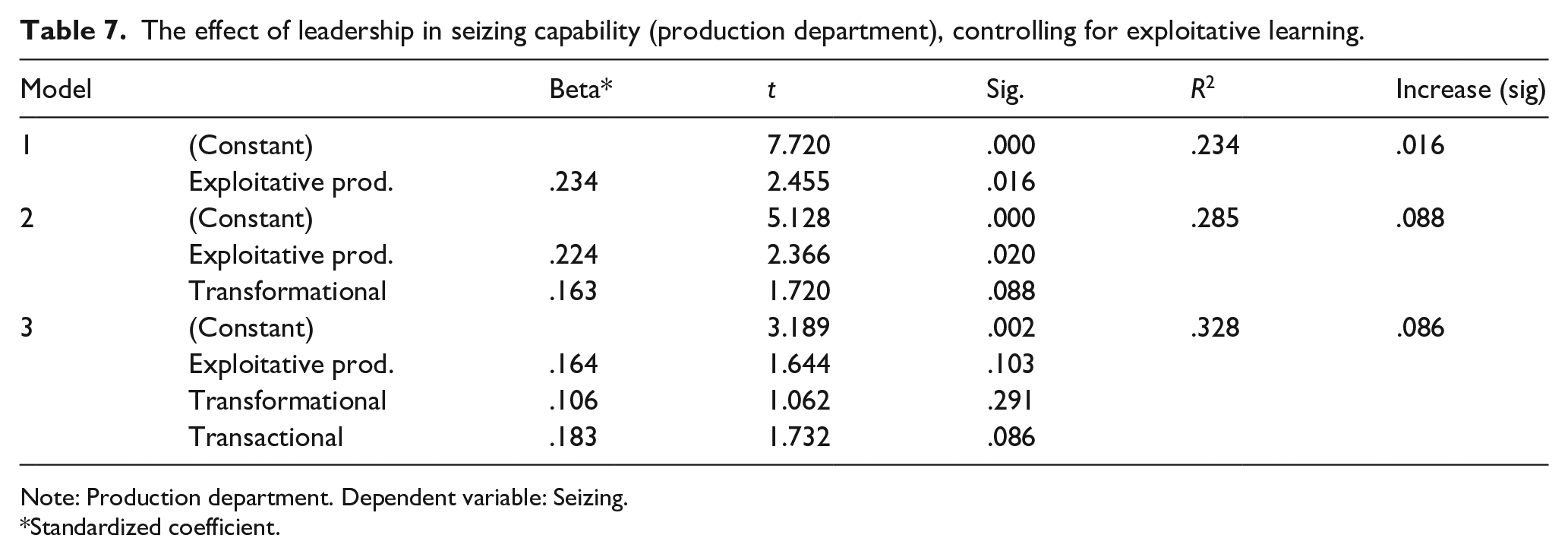
Note: Production department. Dependent variable: Seizing.
Standardized coefficient.
The effect of leadership in reconfiguring capability (marketing department), controlling for exploitative learning.
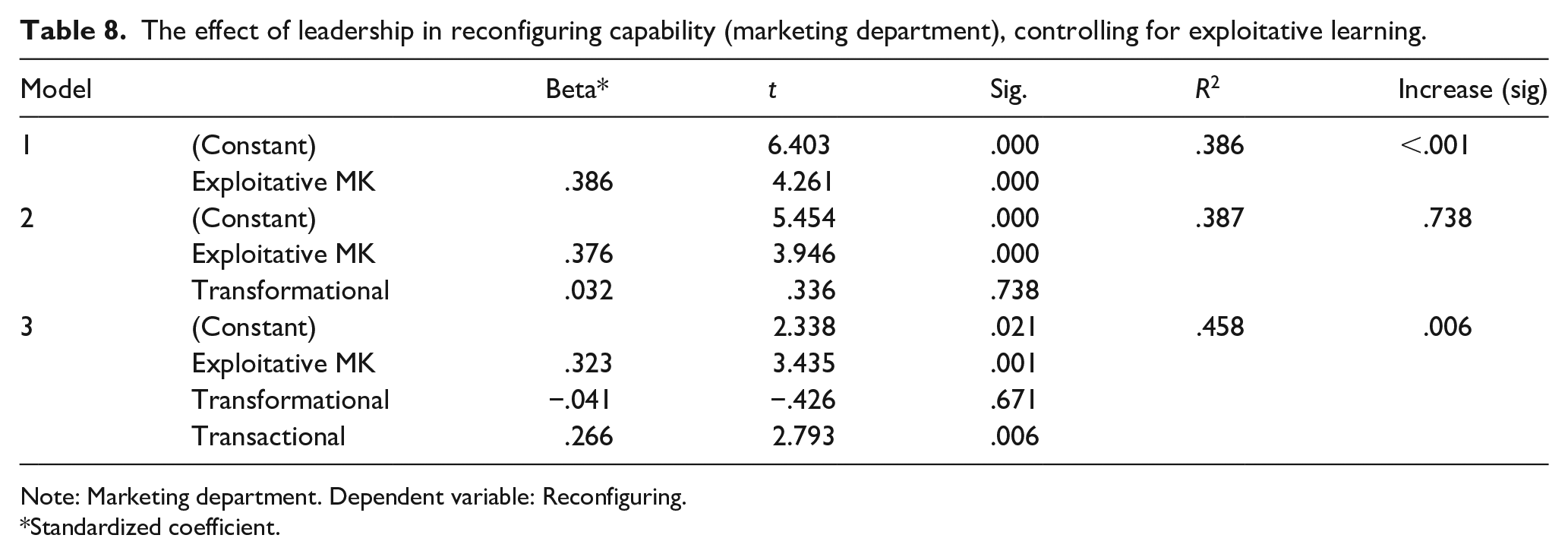
Note: Marketing department. Dependent variable: Reconfiguring.
Standardized coefficient.
The effect of leadership in reconfiguring capability (production department), controlling for exploitative learning.
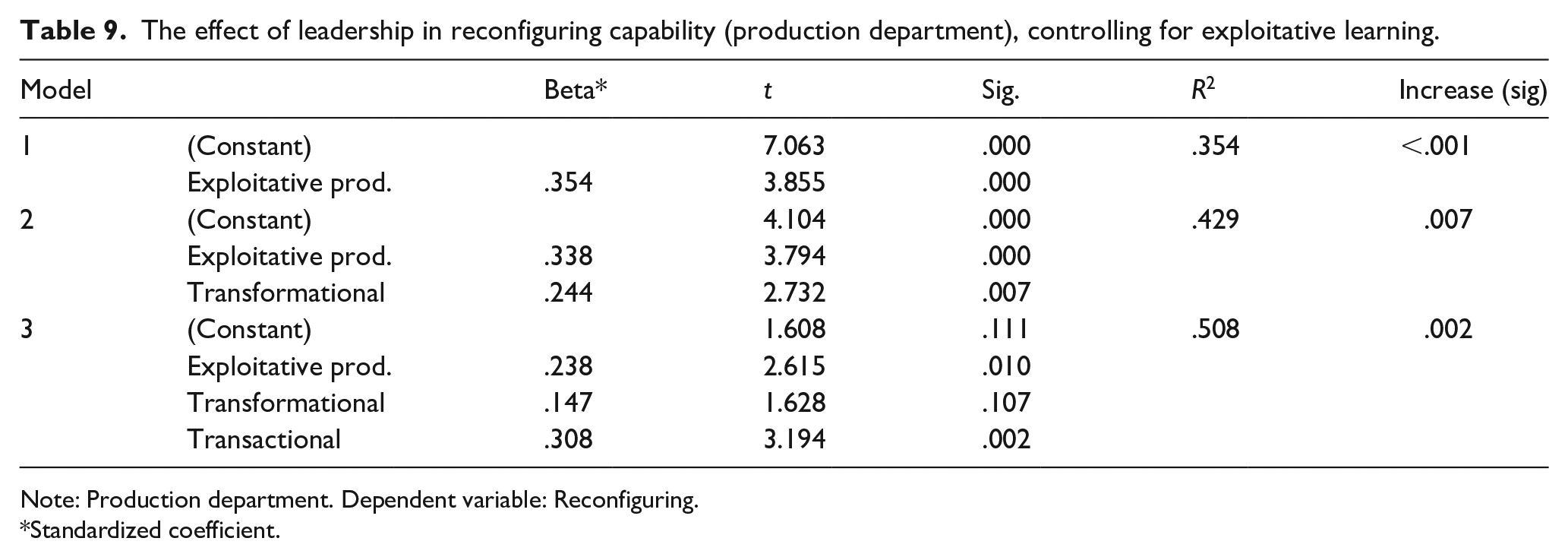
Note: Production department. Dependent variable: Reconfiguring.
Standardized coefficient.
Discussion, limitations, and future research lines
This article has studied the role of strategic leadership and learning mechanisms in leveraging DCs, defined by Teece et al. (1997) as the ability to capture new opportunities, integrate new and former knowledge, and reconfigure internal and external competences. Teece’s (2007) revised proposal for structuring DCs in terms of sensing, seizing, and reconfiguration served as an inspiration to understand better how these capabilities emerge, being considered drivers of resilient and sustainable organizations (Stephens et al., 2013).
The role of learning processes to increase a firm’s capabilities is a well-known area of research (Zollo & Winter, 2002). Exploratory and exploitative learning are required since DCs use existing operational capacities to extract new ones. In addition, the combination of both kinds of learning process balances the high costs of exploration and the improved efficiency of established processes (Yukl, 2009). What our data analyses suggest, as a first interesting result to discuss, is that DCs need both types of learning to emerge and, more interestingly, they can be combined following a structural approach through separate organizational units. Our results show that marketing and production departments can improve sensing, seizing, and reconfiguration capabilities if they are able to develop the appropriate exploratory and exploitative learning processes, depending on the specific capabilities to be leveraged.
From a critical point of view, we consider this to be a valuable result, as it demonstrates that not any form of learning is exclusive to any specific department. Both units, in our case marketing and production, can use exploratory learning mechanisms to enhance sensing and seizing capabilities while they can use exploitative learning for all the types of DCs. Therefore, both units can use the knowledge management of their employees and supervisors to contribute to sustainable competitive advantage.
Nevertheless, learning requires other leverages to contribute to the development of DCs. The literature shows that, for a sustainable competitive advantage, all organizations require strategic leaders to adopt a strategic view of the firm, thereby promoting DCs. The results of this article contribute to the discussion of the use of a framework of transformational/transactional leadership styles (Avolio & Bass, 1991).
With respect to the direct effects of a strategic leadership style on DCs, our results showed that the transformational leadership style has not a direct effect on DCs but transactional leadership style has a direct and positive effect on seizing and reconfiguration capabilities (in the marketing and production departments). This finding makes special sense for production departments since seizing and reconfiguration usually consist of addressing opportunities identified in the shape of new products or processes and the ability to recombine assets and organizational structures. It seems that a transactional style focused on the efficiency of existing operations directly enhances such DCs. In addition, reconfiguration capability requires the administration of tasks, activities, and resources to deploy the reconfigured operational capabilities (Pavlou & El Sawy, 2011), so it may be a routine-based capability that does not require any interaction between strategic leadership style and OL to emerge. Among the activities to be developed by reconfiguration are the simple reassignment of resources to tasks (Helfat et al., 2007) or matching the right employee to the right task (Eisenhardt & Brown, 1999), different activities that can be effectively performed directly through the transactional leadership style.
When controlling for both exploratory and exploitative learning, and for the transformational leadership style, the results showed that the transactional leadership style had a direct, positive, and significant effect on sensing, seizing, and reconfiguring capabilities for both departments. Interestingly, the transformational leadership style follows a pattern with no direct effect in any DC, except for on reconfiguring capability for the production department. Although transformational leaders adopt a proactive attitude to enhance innovation (Ling et al., 2008), encouraging employees to go beyond that required by the organization (Mokhber et al., 2018), it fails to develop DCs, and when it does, its effect is lost and absorbed by transactional leadership.
Specifically related to the moderator effects of strategic leadership style on DCs, our research helps to explain how an appropriate leadership style reinforces the role of OL. In other words, our data show that transformational strategic leadership style moderates the relationship between learning and DCs. In our case, we found that the transformational leadership style has a moderator role on sensing capabilities (for both departments). It seems that when a strategic transformational leader promotes the use of exploratory learning to develop sensing capabilities in an inspirational and motivational atmosphere, it helps to identify new thinking and new ways to find new opportunities. Also, and contrary to our expectations, marketing and production departments obtained no moderator effect of the transactional leadership style in promoting seizing and reconfiguration capabilities (but there was direct effect).
In summary, our results indicate that strategic leadership styles play direct and indirect roles, influencing in a direct manner on DCs (seizing and reconfiguration) and strengthening the relationship between exploratory learning and sensing capabilities, in our units. A last point of note here is that reconfiguration capability does not benefit from an exploratory learning, only exploitative learning seems to be useful for their development. Therefore, an interesting contribution is the evidence that the effects of leadership styles in promoting DCs and the way in which they do, it will depend on the specific capability to be developed.
Following a structural approach to learning, our results seem to confirm that organizations should combine some departments (in our case, Marketing units) that can better contribute to all of DCs using exploitative learning, motivated by different strategic leadership styles, whereas other units (in our article, Production departments) can contribute better to sensing and seizing capability by focusing on exploratory learning mechanisms directly and through the moderator effect of the transformational leadership style, and to reconfiguration capability by focusing on exploitative learning mechanism, regardless of the strategic leadership styles.
In spite of above contributions, this article has some limitations that could be considered as potential avenues for future research. In our work, we have analyzed strategic leadership from a leader-centered perspective, using the framework of the transformational/transactional leadership style. However, a more recent leadership paradigm has emerged (Gardner et al., 2010), moving leadership studies in a new direction focused on shared work inside organizations: “Organic Leadership Paradigm.” This paradigm covers several theories, such as distributed leadership (Chambers et al., 2010), shared leadership (Hmieleski et al., 2012; Pearce et al., 2008), team leadership (Morgeson et al., 2010), and collective leadership (Uhl-Bien, 2006), among others. These leadership concepts underlie Avery’s (2004) term “Organic leadership,” and they move away from leader-centricity, and are focused on shared work by multiple members of the organization to achieve common goals. While transformational leadership is related to a leader, the “organic” concept of leadership is associated with an organization’s culture. The conversation between a leader-centered leadership style and the “organic” concept is of special of interest nowadays due to the relevance of concepts, such as Sustainability Development for organizations. Sustainability relates to the capacity of firms to manage dynamic environments, in which the development of DCs can make the difference between success and failure and, therefore, much work remains to be done in terms of leadership concepts which enhance OL for sustainability.
In addition, we only explore the independent effects of exploratory and exploitative learning on the development of DCs. The use of both types of learning, exploratory and exploitative, calls for an analysis of a combination, named “ambidextrous learning” in the literature. There is literature suggesting that not only a simple combination of types of learning but the concept of “ambidexterity” could be relevant to our conclusions. In this case, a different and specific measurement scale should be used. Second, this article is unable to answer certain questions, such as which coordination mechanisms should be developed between units and departments to guarantee the development of DCs. For example, Human Resource Practices appear as mechanisms that are able to develop OL. Therefore, should there be different human resource practices depending on the kind of learning required and the leadership style? In this regard, Kang and Snell (2009) propose that ambidextrous learning derives from a combination of human capital, social capital, and organizational capital. HRM practices, intellectual capital, and OL should be studied together to gain a better understanding of DCs.
Also, a potential new research stream is the connection between DCs, leadership, learning, and the resilience of the firm. As organizational resilience is based on the ability of employees to absorb stress but also to learn and grow from adversity to emerge even stronger than before (Stephens et al., 2013), it is reasonable to think that the need to develop more sustainable, competitive organizations, through DCs, knowledge sharing, and learning from other people are mechanisms that enable employee actions and engage them in problem-solving or involvement mechanisms, thereby further increasing the resilience of the firm (Bos-Nehles et al., 2013; Boxall & Purcell, 2008).
In conclusion, the search for OL as such is not a simple task, but learning remains a condition that must be met to develop DCs. This is not new in the literature, but we think that this article’s proposals that different units should focus on different types of learning and also that top managers must combine both types of leadership styles (transactional and transformational) as a way of improving the level of DCs in firms are still areas of improvement to be explored. Therefore, the path to competitiveness is through firms that are able to combine leadership styles and learning approaches within different departments that can contribute in different ways to sensing new opportunities, seizing investments, and reconfiguring a firm’s resource base. It is maybe long, slow path, but it leads to the road to sustainable competitive advantage.
Footnotes
Appendix
EFA for the variables included into the study.
| DYNAMIC CAPABILITIES_production department | Factor 1 | Factor 2 | Factor 3 | |
|---|---|---|---|---|
| Sensing_1 | We often review our product development efforts to ensure they are in line with what the customers want. | .216 |
|
−.166 |
| Sensing_2 | We devote a lot of time implementing ideas for new products and improving our existing products. | .268 |
|
.355 |
| Sensing_3 | We frequently scan the environment to identify new business opportunities. | .186 |
|
.247 |
| Seizing_1 | We are effective in transforming existing information into new knowledge. |
|
.302 | .126 |
| Seizing_2 | We are effective in using knowledge into new products. |
|
.211 | .198 |
| Seizing_3 | We carefully interrelate our actions to each other to meet changing conditions. |
|
.116 | .258 |
| Seizing_4 | We are effective in developing new knowledge that has the potential to influence product development. |
|
.114 | .250 |
| Reconfiguration_1 | We have effective routines to identify, value, and import new information and knowledge. | .190 | .257 |
|
| Reconfiguration_2 | We can successfully reconfigure our resources to come up with new productive assets. | .215 | .056 |
|
| Reconfiguration_3 | We often engage in resource recombination to better match our product-market areas and our assets. | .157 | .214 |
|
| Reconfiguration_4 | We ensure that the output of our work is synchronized with the work of others. | .334 | −.044 |
|
| Reconfiguration_5 | We ensure and appropriate allocation of resources within our group. | .309 | .079 |
|
| Source: Pavlou and Sawy, 2006, 2011 | ||||
| α = .76 | α = .72 | α = .70 | ||
| DYNAMIC CAPABILITIES_marketing department | Factor 1 | Factor 2 | Factor 3 | |
| Sensing_1 | We often review our product development efforts to ensure they are in line with what the customers want. | .217 | −.148 |
|
| Sensing_2 | We devote a lot of time implementing ideas for new products and improving our existing products. | .276 | .354 |
|
| Sensing_3 | We frequently scan the environment to identify new business opportunities. | .184 | .255 |
|
| Seizing_1 | We are effective in transforming existing information into new knowledge. |
|
.151 | .402 |
| Seizing_2 | We are effective in using knowledge into new products. |
|
.059 | ,410 |
| Seizing_3 | We carefully interrelate our actions to each other to meet changing conditions. |
|
.292 | .115 |
| Seizing_4 | We are effective in developing new knowledge that has the potential to influence product development. |
|
.359 | .110 |
| Reconfiguration_1 | We have effective routines to identify, value, and import new information and knowledge. | .213 |
|
.238 |
| Reconfiguration_2 | We can successfully reconfigure our resources to come up with new productive assets. | .214 |
|
.037 |
| Reconfiguration_3 | We often engage in resource recombination to better match our product-market areas and our assets. | .569 |
|
.297 |
| Reconfiguration_4 | We ensure that the output of our work is synchronized with the work of others. | .317 |
|
−.051 |
| Reconfiguration_5 | We ensure and appropriate allocation of resources within our group. | .217 |
|
.118 |
| Source: Pavlou and Sawy, 2006, 2011 | ||||
| α = .86 | α = .71 | α = .84 | ||
| ORGANIZATIONAL LEARNING_marketing department | Factor 1 | Factor 2 | |
|---|---|---|---|
| Exploratory learning_1 | Our department accepts demands that go beyond existing products and services. | .259 |
|
| Exploratory learning_2 | We invent new products and services. | .162 |
|
| Exploratory learning_3 | We experiment with new products and services in our local markets. | .097 |
|
| Exploratory learning_4 | We commercialize products and services that are completely new to our organization. | .113 |
|
| Exploratory learning_5 | We frequently use new opportunities in new markets. | .093 |
|
| Exploratory learning_6 | We regularly search for and approach new clients in new markets. | .049 |
|
| Exploratory learning_7 | We look for creative ways to satisfy its customers’ needs. | .052 |
|
| Exploratory learning_8 | We actively target new customer groups. | .224 |
|
| Exploitative learning_1 | We frequently refine the provision of existing products and services. |
|
.157 |
| Exploitative learning_2 | We regularly implement small adaptations to existing products and services. |
|
.409 |
| Exploitative learning_3 | We introduce improved, but existing products and services for our local market. |
|
.535 |
| Exploitative learning_4 | We improve our provision’s efficiency of products and services. |
|
.575 |
| Exploitative learning_5 | We increase economies of scales in existing markets. |
|
.426 |
| Exploitative learning_6 | Our organization expands services for existing clients. |
|
.263 |
| Exploitative learning_7 | Lowering costs of internal processes is an important objective. |
|
.196 |
| Exploitative learning_8 | We commit to improve quality and lower cost. |
|
.387 |
| Exploitative learning_9 | We constantly survey existing customers’ satisfaction. |
|
.295 |
| Source: Jansen et al., 2009, p. 17; Lubatkin et al., 2006, p. 656 | |||
| α = .80 | α = .70 | ||
| ORGANIZATIONAL LEARNING_production department | |||
| Exploratory learning_1 | Our department accepts demands that go beyond existing products and services. |
|
.171 |
| Exploratory learning_2 | We invent new products and services. |
|
.092 |
| Exploratory learning_3 | We experiment with new products and services in our local markets. |
|
.080 |
| Exploratory learning_4 | We commercialize products and services that are completely new to our organization. |
|
.086 |
| Exploratory learning_5 | We frequently use new opportunities in new markets. |
|
.260 |
| Exploratory learning_6 | We regularly search for and approach new clients in new markets. |
|
.087 |
| Exploratory learning_7 | We look for creative ways to satisfy its customers’ needs. |
|
.126 |
| Exploratory learning_8 | We actively target new customer groups. |
|
.336 |
| Exploitative learning_1 | We frequently refine the provision of existing products and services. | .173 |
|
| Exploitative learning_2 | We regularly implement small adaptations to existing products and services. | .270 |
|
| Exploitative learning_3 | We introduce improved, but existing products and services for our local market. | .351 |
|
| Exploitative learning_4 | We improve our provision’s efficiency of products and services. | .327 |
|
| Exploitative learning_5 | We increase economies of scales in existing markets. | .283 |
|
| Exploitative learning_6 | Our organization expands services for existing clients. | .138 |
|
| Exploitative learning_7 | Lowering costs of internal processes is an important objective. | −.022 |
|
| Exploitative learning_8 | We commit to improve quality and lower cost. | .135 |
|
| Exploitative learning_9 | We constantly survey existing customers’ satisfaction. | .177 |
|
| Source: Jansen et al., 2009, p. 17; Lubatkin et al., 2006, p. 656 | |||
| α = .89 | α = .88 | ||
| LEADERSHIP STYLE | Factor 1 | Factor 2 | |
| Transformational_1 | Is always seeking new opportunities for the unit/department. |
|
.036 |
| Transformational_2 | Paints an interesting picture of the future of our group. |
|
.229 |
| Transformational_3 | Has a clear understanding of where we are going. |
|
.293 |
| Transformational_4 | Inspires other with his/her plans for the future. |
|
.351 |
| Transformational_5 | Is able to get others committed to his/her dream of the future. |
|
.245 |
| Transformational_6 | Fosters collaboration among work groups. |
|
.515 |
| Transformational_7 | Encourages employees to be “team players.” |
|
.361 |
| Transformational_8 | Gets the group to work together for the same goal. |
|
.102 |
| Transformational_9 | Develops a team attitude and spirit among his/her employees. |
|
.275 |
| Transformational_10 | Acts without considering my feelings. |
|
.220 |
| Transformational_11 | Shows respect for my personal feelings. |
|
.349 |
| Transformational_12 | Behaves in a manner that is thoughtful of my personal needs. |
|
.357 |
| Transformational_13 | Treats me without considering my personal feeling. |
|
.318 |
| Transformational_14 | Shows us that he/she expects a lot of from us. | .243 | .357 |
| Transformational_15 | Insists on only the best performance. | .316 | .296 |
| Transformational_16 | Will no settle for second best. |
|
.292 |
| Transformational_17 | Leads by “doing” rather than simply “telling.” |
|
.106 |
| Transformational_18 | Provides a good model to follow. |
|
.259 |
| Transformational_19 | Leads by example. |
|
.120 |
| Transformational_20 | Has provided me with new ways of looking at things which used to be a puzzle for me. |
|
.196 |
| Transformational_21 | Has ideas that have forced me to rethink some of my own ideas I have never questioned before. |
|
.319 |
| Transactional_1 | Always give me positive feedback when I perform well. | .055 |
|
| Transactional_2 | Give me special recognition when my work is very good. | −.012 |
|
| Transactional_3 | Commends me when I do better than average work. | .010 |
|
| Transactional_4 | Personally, complements me when I do understanding work. | .353 |
|
| Source: Podsakoff et al., 1996. | |||
| α = .80 | α = .89 | ||
Values in bold represent the selected items.
Declaration of conflicting interests
The author(s) declared no potential conflicts of interest with respect to the research, authorship, and/or publication of this article.
Funding
The author(s) disclosed receipt of the following financial support for the research, authorship, and/or publication of this article: This work was supported by Junta de Andalucía. Consejería de Economía y Conocimiento, Programa operativo FEDER-Andalucía (Reference UPO-1262853); and by Spanish Ministry of Science, Innovation and Universities-Mobility Program “José Castillejo” (Reference CAS18/00132).
